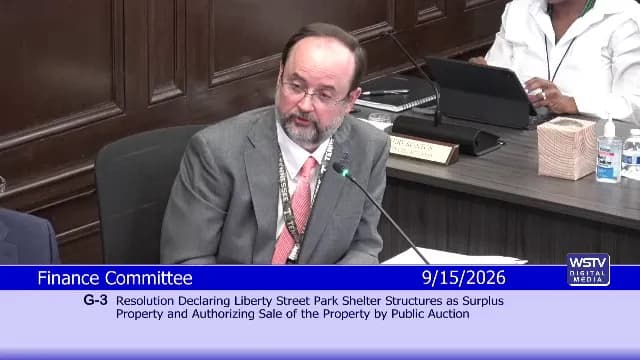
The Winston-Salem Finance Committee met on Tuesday, September 15, 2026, at 4:00 PM, chaired by Council Member Robert C. Clark. Members present: Mayor Pro Tempore Denise D. Adams, Council Members Annette Scippio and James Taylor Jr. Also in attendance were Mayor Joines and Council Member Burke. The committee reviewed four consent items, with one removed for discussion. The agenda also included an update on the DRIVE program, a lease agreement for a DIY skate park, and the sale of shelter structures at Liberty Street Park. The meeting adjourned at 4:55 PM. Consent Calendar - C-1 (Jet Vac Sewer Cleaning Truck, $565,000) and C-2 (Aerial Ladder Truck, $2,413,452) were approved by consent and referred to the City Council meeting on October 5, 2026. - C-4 (Summary of Minutes from August 11, 2026) was approved by consent. - C-3 (Contract Extension for Temporary Staffing Services with The Resource Company, estimated $3,500,000) was pulled for discussion and ultimately held in committee until October 13, 2026. Discussion Items C-3: Temporary Staffing Contract Extension Dr. Kena Cofield Jones, Director of Human Resources, presented the contract extension. Mayor Pro Tempore Adams expressed concern about the lack of detailed information regarding temporary employee numbers, departmental breakdowns, and average length of employment. She noted that in FY25-26, the city hired 1,012 temporary workers, with 617 assigned to the fairgrounds. She requested additional data be provided by email before the next meeting and indicated she would not vote without it. Council Member Scippio asked whether any temporary employees receive benefits and about the cost savings of using temps versus hiring staff. Council Member Burke reported that temps at Evergreen Cemetery lacked necessary skills to complete required work and stressed the need to ensure the contractor provides qualified personnel. The item was held without a vote, pending more information. G-1: DRIVE Program Update District Attorney Jim O'Neill, Assistant District Attorney Jane Garrity, Program Director Veronica Nesbit, and Legal Assistant Tre'Quan David presented an update on the Driver's Restoration Initiative and Vocational Expansion (DRIVE) program. The program assists Forsyth County residents who have had their driver's licenses suspended for reasons other than DWI or pending felonies. Since its launch, the program has helped restore licenses by dismissing court fees and failures to appear. In the 25-26 fiscal year, 559 cases were dismissed and 520 failures to appear were struck. The September 2026 session includes 25 participants, with 107 failure-to-appear cases to be dismissed and an estimated $30,000 in fines to be vacated. The program is funded through one-time city appropriations totaling roughly $175,000 annually, with a requested increase to a little over $200,000. Existing funding will expire in November 2026. The presenters emphasized the program's success and its replication across the state, urging continued city support. No action was taken, as this was an information item. G-2: Lease for DIY Skate Park Assistant City Manager Ben Rowe presented a resolution to lease city-owned property (nine parcels totaling 0.6 acres, bounded by 7th, 8th, Spruce, and Marshall Streets) to Colab, Inc., a nonprofit, for the development of a do-it-yourself (DIY) skate park. The proposed lease has a base term of 10 years with an option for a 10-year extension at an annual rate of $12. Colab would be responsible for fundraising, construction, operation, and maintenance, and would indemnify the city against liability. Brian Ledbetter and Jerry Cooper, community organizers, spoke about the park's benefits: providing a safe space for youth, promoting physical activity, and offering an alternative to organized sports. They noted over 1,700 residents signed a petition supporting the project. Council members voiced support, with Mayor Pro Tempore Adams highlighting the need for innovative youth activities. The committee voted unanimously to recommend approval, referring the matter to the full City Council on October 5, 2026. G-3: Sale of Liberty Street Park Shelter Structures Ben Rowe presented a resolution to declare the two shelter structures at Liberty Street Park as surplus and authorize their sale by public auction. The structures (one open-air, one conditioned) were built in 2013 as part of a vendor market, later rebranded as Liberty Street Urban Farmers Market. The original cost was $395,000; the current depreciated value is $284,000. The city intends to clear the site for future redevelopment, including a community center requested by residents of the adjacent Choice Neighborhood. A company will oversee the auction, with a minimum bid likely set. If the structures do not sell, the city may need to consider demolition or relocation, which would require additional council approval. Council Member Clark abstained, expressing concern about the loss of the investment. Council Members Adams and Burke emphasized that the community had asked for a community center and that the structures were underutilized. The committee recommended approval (3 in favor, 1 abstention) and referred the item to the City Council on October 5, 2026. Key Outcomes - Consent items C-1, C-2, and C-4 were approved and referred to full council. - C-3 (Temporary staffing extension) was held in committee for further information. - G-1 (DRIVE program) received as information; no vote. - G-2 (DIY Skate Park lease) recommended for approval (4-0 vote). - G-3 (Liberty Street shelter structures surplus) recommended for approval (3-1 vote, with Clark abstaining). - All items requiring full council action were referred to the October 5, 2026 City Council meeting.
The Public Meeting Index
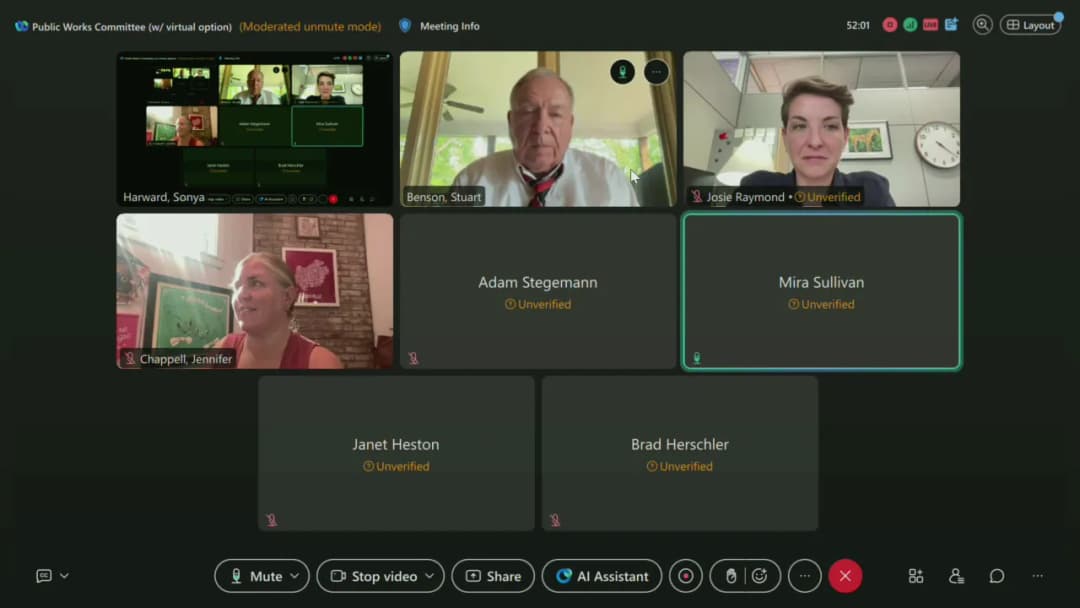
The Public Meeting IndexThe Public Works Committee of the Louisville Metro Council met on September 15, 2026, at 4:05 PM in Council Chambers and virtually. The committee considered a resolution to accept state funds for a bridge replacement and a slate of appointments and reappointments to the Complete Streets Coalition. The meeting adjourned at 4:30 PM. Seven members were present; one was excused. Consent Calendar - R-122-26: Resolution authorizing the Mayor to accept up to $971,943 from the Kentucky Transportation Cabinet for the Goldsmith Lane Bridge replacement project (sponsored by Brent Ackerson, D-26). The bridge over the South Fork of Beargrass Creek has a structural rating of 1/10 and is in very poor condition. The total project cost is estimated at $1.2 million; the grant saves over $700,000 from the city’s bridge structures fund. Director Bill Bell (Louisville Department of Transportation) explained that the department applied for state funding through the City-County Bridge Improvement Program and was notified of the award in July 2026. The motion to recommend approval carried by voice vote; the resolution was sent to the Consent Calendar. Discussion Items - Complete Streets Coalition Appointments and Reappointments: The committee considered a series of appointments and reappointments. Wesley Sydnor (Executive Director of Public Works) and Jeremy Chesler (Transportation Planner, LouDot) provided background. The slate was revised to meet diversity requirements after previous discussions. The committee discussed the verification of demographic information submitted by applicants; staff noted that the coalition is not an official boards and commissions body and therefore does not conduct background checks, but relies on self-reported data. The following items were heard: - AP050526KA – Kristi Ashby (appointment): Ms. Ashby, an Irish Hill resident, stated she walks everywhere and wants to promote safe streets and slower traffic. Vice Chair Herndon noted her community service record. Motion carried; sent to Consent Calendar. - AP050526AS – Adam Stegemann (appointment): Mr. Stegemann, a St. Joseph neighborhood resident, described working with Councilwoman Chappell’s office to get speed humps installed and wants to expand pedestrian safety work. Motion carried; sent to Consent Calendar. - AP050526BH – Brad Herschler (appointment): Mr. Herschler, an avid runner, walker, and cyclist and vice president of a local bike club, appeared online after an initial motion was withdrawn because he was not present. A new motion was made and carried; sent to Consent Calendar. - AP050526MS – Mira Sullivan (appointment): Ms. Sullivan, a District 4 resident, stated she walks a lot and wants to use design to create safe, active streets. Motion carried; sent to Consent Calendar. - RP050526JH – Janet Heston (reappointment): Ms. Heston, an OIVO resident and founder of a nonprofit in memory of her son who was killed crossing the street, has been on the coalition since its inception and advocates for safer roads. Motion carried; sent to Consent Calendar. - RP050526PS, RP050526KT, RP050526EV – Patrick Smith, Kenneth Thompson, Estela Valdez (reappointments): These three items were considered together. Mr. Smith was not present, but the clerk noted that attendance is not required for reappointment. Motion carried; sent to Consent Calendar. - RP050526BW – Bill Wright (reappointment): The expiration date was amended from October 31, 2027, to October 31, 2028, on a motion by Vice Chair Herndon. The amended motion carried by voice vote; sent to Old Business because it was amended. - RP050526LF, RP050526AH, RP050526JS – Lucas Frazier, Anita Hall, Joseph B. Spencer (reappointments): These items were withdrawn and not considered. Key Outcomes - R-122-26 (Goldsmith Lane Bridge funding) recommended for approval and placed on the Consent Calendar for the full Metro Council meeting on September 24, 2026. - Appointments and reappointments to the Complete Streets Coalition were recommended for approval and sent to the Consent Calendar, except for Bill Wright’s reappointment (sent to Old Business due to the amendment) and three withdrawn items. - The committee noted that the revised slate of appointees satisfies the diversity requirements of the ordinance, following feedback from previous meetings.
This meeting was a public hearing regarding the proposed removal of five mature trees at 249, 255, 261, and 265 Main Street to facilitate sidewalk reconstruction and ADA compliance. The hearing included presentations from city staff, engineering consultants, and a landscape architect, as well as public testimony from a concerned citizen. Public Comments & Testimony - Mr. Chang, a resident, expressed full support for preserving the existing mature trees. He argued that the trees provide shade, aesthetic value, and environmental benefits, and that new trees would take decades to reach similar size. He suggested enlarging tree pits and modifying sidewalk design to keep the existing trees rather than removing them. Discussion Items - A civil engineer from Martinez Couch and Associates presented the project need: the existing sidewalks were last rehabilitated in 1991 and now exhibit vertical displacement, uneven panels, and ADA accessibility deficiencies. The engineer explained that the tree roots are directly conflicting with required sidewalk reconstruction, as excavation would remove substantial roots and compromise tree health and stability. The proposed solution involves removing the trees, installing root barriers, and replanting with new cultivars better suited to urban conditions. - Terry Hahn, landscape architect, reviewed the condition of the five specific trees, noting that they were planted in 1991 with a 30-year lifecycle and are now declining in health. He stated that the mulch areas are no longer functioning as designed and that the trees exhibit root girdling and displacement. The new design uses a diverse palette of 14 tree species to avoid monoculture issues. - City officials (Chair and another representative) emphasized that the tree removal was part of a long-community-engaged process, that the number of trees will be maintained, and that the new trees will be healthier and better suited to the constrained sidewalk environment. They noted that the project must comply with state PROWAG and ADA standards for accessible pedestrian routes. Key Outcomes - No formal vote was taken. The Chair stated he would review the information and notify Mr. Chang of his decision. - The city and engineering team confirmed their intent to proceed with the removal of the five trees and replacement with new trees in the ongoing Main Street reconstruction project, which has already been approved by DOT and started construction in phases.
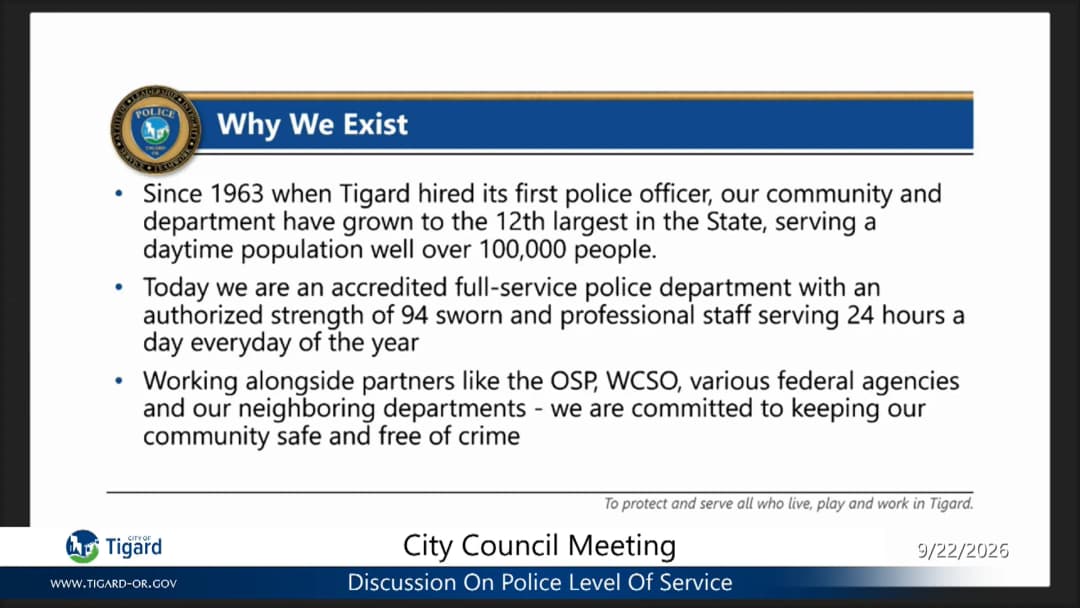
The Tigard City Council convened on September 15, 2026, for a joint meeting with the Local Contract Review Board and the Town Center Development Agency. Agenda items included public testimony on traffic safety and property disputes, an update from Tigard High School ASB, a police department recruitment briefing, approval of the consent agenda, a presentation from the Town Center Advisory Commission on its revised strategic plan, a public hearing and adoption of an ordinance regulating vehicle camping near homeless service providers, a capital improvement plan update, and an in-depth discussion on police levels of service. The meeting concluded with an executive session on labor negotiations. Consent Calendar - Approved the contract for the 2026 pavement management program pavement rehabilitation by unanimous vote (7-0). Councillor Cudahy thanked staff for maintaining roads. Public Comments & Testimony - Dan Hayes (resident of 13957 SW Mistletoe Drive) pleaded for action on extreme traffic speeds (50-60 mph in a 20 mph zone) in his neighborhood, citing broken promises for traffic surveys, police patrols, and signage. He requested a neighborhood liaison and asked if residents could fund police overtime for traffic enforcement. He noted that non-residents use the area as a thoroughfare to Beaverton. - Todd Powell (new resident on Bankview near Mistletoe) echoed Hayes, stating cars blow through stop signs, endangering his granddaughters. He offered to personally pay for a police officer to sit and issue tickets. He noted that neighbors said police presence has worked in the past. - Elizabeth Sprack defended her property against complaints from Roger and Mary Pottoff, alleging harassment, including being filmed while milking goats. She stated the Pottoffs use fear tactics (citing a rare rabies case in North Dakota) and that she filed a complaint against a tent in the Pottoffs\' backyard out of concern for children. She asked the council to stop the dispute. - Jeff Darland (Tigard resident) criticized the city\'s blanket discount on transportation system development charges (SDCs), adopted in 2015, which he said created a $20 million funding gap. He noted staff stated there\'s no direct link between reduced SDC rates and housing affordability. He requested the city track foregone revenue and use targeted, measurable affordable housing programs instead. - Zach Kingler (representing BKM Management, owner/operator of Tigard Business Park) reported escalating safety and transient issues over the past 12 months, including trespassing, altercations, attempted theft, abandoned vehicles, and encampments. He requested city enforcement, outreach, and parking management on public rights-of-way, stating private security has limited authority. Tigard High School ASB Update - ASB President Sydney Jewell and Vice President Gabriel Musangu welcomed the council and announced homecoming week (September 28–October 3), including a parade on October 2 (Durham Road closing at 4:15 p.m., parade at 5 p.m.), a football game, and a dance with theme \"Princess and the Frog: A Night in the Bayou\" at Tigard High School Commons (7–10 p.m.). Councilors asked about the dance theme and welcomed the students. Tigard Police Department Report - Interim Chief Rogers and Assistant Chief Sitton reported on recruiting and hiring. Currently 9 open officer positions and 1 command officer vacancy. A new recruit, J.R. Scott (son of officer Mark Scott), was hired. A recruiting campaign launched August 1 via vendor All Star Talent produced 55 leads last week. The hiring process takes 9–10 months before an officer is solo-certified. The assistant chief clarified a data error in the strategic dashboard: AI-generated call-taking data was miscategorized as self-initiated activity, inflating numbers; corrected for September onward. Town Center Development Agency & Town Center Advisory Commission Strategic Plan - Redevelopment Manager Sean Farrell introduced TCAC members who presented their revised strategic plan aligned with the city\'s Comprehensive Economic Development Strategy (CEDS). The plan outlines five goals: (1) thrive new and existing businesses; (2) collaborate with TCAD boards and committees; (3) develop livable communities focused on safety and quality of life; (4) improve housing, shelter, and services (especially workforce housing); (5) evaluate TIFF district expansions and investments. Key performance indicators include number of TIFF marketing tools created and updated. Commissioners shared their motivations for serving (affordable housing, business perspective). Councillor Shaw noted ongoing work to update grant program materials and a planned video advertisement. Councillors praised the alignment and requested continued collaboration. Legislative Public Hearing: Ordinance Amending TMC Chapter 7.80 (Camping in Vehicles) - Homeless Liaison Megan Cohen presented the staff report, stating the ordinance adds definitions for vehicle camping and expands the buffer around homeless service sites from 500 to 1,000 feet. Vehicle camping will be allowed on public rights-of-way outside the buffer, subject to parking rules. Enforcement will focus on education for 30 days after approval, then enforcement. The only permitted camping location is the public works lawn. Cleanups: 15 this month; police and street teams proactive. Council President Wolf and Councillor Cudahy expressed concerns about displacement but acknowledged need to address concentrated impacts. The ordinance was adopted unanimously (7-0) as Ordinance 26-15. Capital Improvement Plan (CIP) Update - Acting Public Works Director Joe Isneski provided an update on FY27 CIP projects. Highlights include: - Water: East Pressure Zone Consolidation (consultant selection fall); Red Rock Creek Waterline Relocation (final phase under construction); pipeline renewal evaluating CIPP lining technology; generator replacement at pump station 1 at 90% design; Reservoir 8-1 improvements moving to construction bidding; meter replacement program extended to five years. - Sanitary Sewer: All projects green; sanitary sewer system plan update drafted, will go to planning commission then council; new CIPP program for ongoing pipe repairs. - Stormwater: Red Rock Creek stabilization wrapping up November; stormwater system plan update consultant selection in December; detention pipe retrofit project started; 121st Avenue Bridge stabilization under construction; several new projects scoping. - Transportation: Pavement management program contract approved; Hall/Faffle Street signal design moving (state approval received); North Dakota Street Bridge replacement paused due to grant funding FY28 availability; Tigard Street Bridge replacement moving to bid; Bonita/Sequoia signal under construction (county delivered); McDonald Street 30% design complete, alternative delivery method planned; Greenburg Road/Hall 2217 design phase with budget concerns resolved; street light replacement (600 poles) under construction; Fanno Creek Trail crossing improvements (ODOT delivering); 95th Avenue Ped/Bicycle Bridge consultant procurement in process; wayfinding signage installation this fall. - Parks: Steve Street Park under construction through October/November; trail system plan phase 2 on hold pending budget; Beglin Wetland Park moved to FY29 due to Clean Water Services sewer work; Cook Family Park accessible boat ramp under construction; Lacich Park kayak launch coordinating with Willamette Water Supply; Copper Creek/Cook Park stream stabilization under construction; Fanno Creek Trail Bonita-Durham coordinating with ODOT; Ash Creek Trail scope reduced due to grant reduction but path forward with minimal trail. - Facilities: Facility system plan under development (condition assessment, space planning, capital strategy); citywide HVAC control system upgrade; major maintenance program. - Councillor Schlack noted large budget variances in some projects and asked for clearer scope-change documentation. Isneski agreed to follow up. Councillor Cudahy raised ADA ramp issue from TTEC walkabout; Isneski acknowledged need for community input from people with disabilities. Discussion: Police Levels of Service - Interim Chief Rogers, Assistant Chief Sitton, and Business Manager Katie Cook-Papanuk presented a comprehensive overview of police services, statutory requirements, levy obligations, and staffing. Key points: - The department is authorized 94 sworn positions, currently with 10 vacancies. - 71% of budget is salaries/benefits; 17.6% interdepartmental services; 11.4% materials/services. - Programs categorized as core functions (response 53%, process 13%, assessment 4%, inquiry 8%, enforcement 12%), capacity building (development, partnerships), and outreach. - Staffing declined from 97 FTE (2021) to 95 (2026) while population grew 2% (55,584 to 57,000), not including daytime population (100,000). - Minimum staffing per collective bargaining: 3 officers and 1 supervisor at any time; scales up on weekends. - Community-oriented policing positions, school resource officer (general fund), FBI task force detective, dedicated traffic safety unit (funded by photo enforcement), mental health response team (with partners), community service officers, and outreach programs are current services beyond minimum. - Options: reallocating resources could reduce some specialized programs but would affect patrol availability and community engagement. - Councilors expressed appreciation for the presentation and emphasized need to balance community expectations (traffic enforcement, homeless response) with staffing realities. Mayor noted importance of communication to build support for future levies. Key Outcomes - Consent calendar approved unanimously for pavement management program. - Ordinance 26-15 (camping in vehicles) adopted unanimously (7-0), effective 30 days after approval, with education period. - TCAC strategic plan received; council acknowledged progress and encouraged continued collaboration. - Police levels of service discussion set foundation for future budget decisions; council directed staff to develop cost/risk analysis for potential service changes. - Council went into executive session under ORS 192.660(2)(d) for labor negotiations; no final action taken.
This is the meeting summary for the Lake Oswego City Council meeting held on Tuesday, September 15, 2026. The meeting covered a wide range of topics, including a presentation from Republic Services on their return to excellence plan, updates on city council goals, a municipal grant awards resolution, a legislative feedback session for the League of Oregon Cities, approval of the Arts Council's annual public art plan, enactment of an e-micromobility device ordinance, and a work session on the code audit project. The meeting also included public comments and recognitions. Call to Order and Proclamation - The meeting was called to order at approximately 7:00 AM? (time not specified). The pledge of allegiance was recited. - A proclamation was issued recognizing the rich histories, cultures, and contributions of Hispanic and Latin communities (Hispanic Heritage Month), with the theme "Unidos Somos Mass" (Together We Are More). Republic Services Return to Excellence Plan - Presentation by Cindy Rogers (Municipal Relationship Manager), John Oliveras (General Manager, Republic Services, and Lake Oswego resident), and Steve Baker (Operations Manager). - Republic Services serves 11,846 residential customers, 412 commercial customers, and 1,769 industrial halls in Lake Oswego. Residential service involves three separate trucks (trash, yard debris/food waste, commingled recycling including glass) for each of the 11,846 homes, totaling 35,000 stops every week. - The presentation provided an overview of services, including two annual bulky waste events (186 vehicles in spring, over 500 in fall), partnership with the Mattress Recycling Council, and community involvement events like TetraTrucks, birthday drive-bys, Earth Day e-waste events, and in-kind donations for various local organizations. - The "Return to Excellence Plan" was presented to address staffing challenges experienced from March through July 2026. The challenges included unexpected retirements, relocations, terminations, and a transition in General Manager, leading to staffing shortages (goal of 26 drivers to cover 19-21 daily routes). Customer complaints and missed pickups approximately doubled during this period, but by August 2026, complaints dropped to three total (two missed pickups), indicating a return to standard service levels. The plan includes enhanced communication (ensuring accurate phone numbers) and increased supervisor presence. - Council members expressed appreciation for Republic Services' service, professionalism, and partnership. Specific comments highlighted the high standard of service, the company's sustainability efforts (electric and natural gas trucks), and the need to learn from the experience. Questions were raised about the duration of the staffing issues (March-July) and remedies for affected customers. 2026 Council Goals Update - Assistant City Manager Megan Phelan provided the third-quarter update on 2026 city council goals, noting progress on some goals and continuation of others into the fall. - Councilor Corrigan reported on a tabletop exercise using AI modeling for wildfire spread, noting its impact and encouraging broader participation. Public Comments - Steve Dole: Submitted a packet of correspondence regarding an anti-Semitic trope displayed on a Lake Oswego marquee. He criticized the council's response (boilerplate emails about First Amendment) as silence and a double standard, highlighting a documented pattern of incidents (concentration camp poster, anti-Semitic flyers, vandalized swastika). He proposed three concrete actions: (1) Adopt a baseline condemnation policy for targeted rhetoric against any minority group, (2) utilize city media channels to explicitly condemn anti-Semitism, and (3) partner with regional organizations like the Jewish Federation to provide resources. He requested a public hearing on the matter. - Andrew Edwards: President of the Friends of the Lake Oswego Public Library. He spoke in support of the library, highlighting the Friends' support for over 100 annual programs (including Lake Oswego Reads), the success of the Summer Library Challenge (1,073 youth, 565 adults, over 1 million minutes of reading), and the need for a larger facility given the current space limitations (staff forced to hold programs in parks; poor air quality/heat forced a performer to move indoors, accommodating 171 people). He invited councilors to become members. Consent Agenda - Items included: Approval of meeting minutes (May 15 and May 28, 2026), Resolution 26-34 (adopting a tree retention deficit fee), and Resolution 26-48 (approving Megan Phelan as City Manager Pro Tem). - Motion made by Councilor Corgan, seconded by Councilor Mance. Passed 7-0. Discussion Items: Municipal Grant Awards (Resolution 26-38) - Presented by Management and Program Analyst Teo Ramirez. A subcommittee (Councilors Afkin and Corrigan) reviewed 19 applications. Total funding requests: $62,000 (Council Goals), $46,000 (Social Services). - Recommendations for funding (8 initiatives in Council Goals, $43,450 total): Lake Forest Neighborhood Association (Emergency Preparedness), Evergreen Neighborhood Association (Emergency Preparedness/Emergency Cash), Oswego Lake Watershed Council (Emerald Ash Borer outreach), Gifting Gears (safety equipment), Lake Oswego Sustainability Network (feasibility study for clean energy district/thermal energy network in Foothills District - $15,500, the largest individual award). - Recommendations for funding (4 initiatives in Social Services, $27,000 total): Tualatin Food Pantry, The Children's Center, Clackamas Women's Services, Lake Oswego Monsters Robotics. - Not funded: Applications determined to be below scoring thresholds (75% for Council Goals, 70% for Social Services). - Additional recommendations: Reserve $10,000 for LO for Love (maturing out of three-year funding limit) while developing a sponsorship pathway. Explore sponsorship pathways for recurring high-performing organizations (Children's Center, Clackamas Women's Services). - Discussion: Councilor Wenlin raised a concern that the LOSN project ($15,500) might be more appropriately a city-funded government project rather than a community grant. Councilor Afkin defended it as supporting the city's climate change council goal. Councilor Verdick praised the subcommittee's work and fiscal responsibility. Councilor Mance thanked the 2025 council for improving the grant program. - Motion made by Councilor Verdick, seconded by Councilor Wenlin. Discussion concluded. Passed 7-0. Discussion Items: League of Oregon Cities (LOC) 2027-28 Legislative Priorities - Deputy City Manager Madison Thiesing presented the request to narrow down the LOC's top eight priorities to the top five for the city's survey submission. - Top eight identified: (1) Right-of-way authority/revenue, (2) Public meeting law clarity, (3) Full funding and streamlining for housing production, (4) Energy grid hardening/modernization, (5) Economic/workforce development, (6) 2027 transportation package, (7) Infrastructure funding, (8) Ratepayer assistance. - Council discussion to narrow to five: There was strong consensus (Councilors Corrigan, Wenlin, Verdick, Corgan, Mayor Buck) to include public meeting law clarity (due to confusion for volunteer board/commission members and previous vetos). The final five selected were: (1) Public meeting law clarity, (2) Full funding/streamlining for housing production, (3) Energy grid hardening and modernization, (4) 2027 transportation package, (5) Infrastructure funding. - Mayor Buck emphasized the need for carrots over sticks from the state and urged less preemption. Councilor Mance raised cybersecurity and AI guardrails as additional concerns. Councilor Wenlin and Mayor Buck called for a pause on new housing mandates to let existing ones work. Discussion Items: Arts Council of Lake Oswego Annual Public Art Plan - Presented by Arts Council Executive Director Nicole Nathan. The plan is a new requirement stemming from the 2024 Public Art Master Plan. - Contractual commitments: Maintenance/conservation (e.g., rust mitigation on elephant sculpture on Boons Ferry Road, plaque replacement at Glenmorrie Park), acquisition (installation of "Echoes of Belonging" by Sahara Defrize at the library, dedication on Saturday), deaccession of "Fairy Tree" (3D scanned for historical record, Christmas tree ornament fundraiser planned), annual exhibition "What We Behold" (on view through October 30, curated by Kendra Roberts), percent-for-art projects (South Shore Fire Station, Rassekh Park phase two mural on restroom/maintenance building), Gallery Without Walls (8 new pieces in 2026 cohort, new call opens October 1), Cultural Exchange (September 27, including People's Choice Award to PUP by Ben Dye). - Non-contractual programs: Exhibitions (holiday marketplace, Artmart, student art show, winter/spring, spring/summer), docent tours, programs aligning with exhibitions (e.g., Ikebana demo), public art in private developments (Hacienda, Habitat for Humanity on Boons Ferry), Highway 43 art corridor collaboration with West Linn and Oregon City (currently on hold). - Council members praised the Arts Council for maintaining the collection, managing volunteerism, integrating art into new developments, and fostering inclusivity (especially at Hacienda and Habitat for Humanity). Councilor Mance highlighted the City's volunteer ethic. - Motion made by Councilor Wenlin, seconded by Councilor Verdick. Passed 7-0. Discussion Items: Ordinance 2980 (E-Micromobility Device Usage) - A legislative public hearing was held. No public testimony was offered. - Presented by Police Chief George Burke and Captain Clayton Simon. The ordinance amends Chapter 32 of the Lake Oswego City Code. - Key provisions: Simplifies device terminology, updates bicycle provisions to align with state statute, adds clarifying information on lawful operation and locations, defines "unsafe operation" and "unreasonable speeds," establishes an escalation of penalties for subsequent violations within 12 months, and includes an educational component (public information materials developed, distributed via social media, city website, Parks, Library, ACC; future partnerships with school district). - Discussion: Councilor Mooer expressed concern about children using e-bikes instead of pedaling for health. Councilor Mance inquired about enforcement and education plans. Councilor Afkin volunteered to be an ambassador at the Farmers Market to reduce confusion. Chief Burke confirmed the goal is safe behavior, not prohibitive on use, barring non-compliant devices (e-motos without pedals, license, etc.). Captain Simon noted many non-compliant devices are sold online. Captain Simon also confirmed that cameras on trucks are primarily outward-facing for safety, not license plate recording. - Motion made by Councilor Mooer, seconded by Councilor Verdick. Passed 7-0. Work Session: Code Audit Project & Technical Advisory Committee (TAC) Formation - Presentation by Associate Planner Evan Franstead, consultants Lee Alligator and Karen Tolstadt (3J Consulting). The project is a comprehensive 18-month review of Lake Oswego's Community Development Code (Chapter 50). - Background & Purpose: The code has become increasingly complex due to multiple amendments, overlays, design standards, and new state requirements. The project aims to remove regulatory barriers to housing and economic development while retaining high-quality development standards and ensuring compliance with state housing mandates (e.g., middle housing, cottage clusters, SROs). It works in tandem with a separate rezoning for housing project. - Findings from Background Report (Phase 1): Code is difficult to use; 52+ unique combination zones due to overlays and design districts that sometimes conflict; building code thresholds can hinder middle housing; tenant improvements face unanticipated requirements; food carts are only temporary; state legislative compliance is needed (review procedures, SRO types). Items outside scope (sign code, SDCs) were noted for awareness. - Draft Public Involvement Strategy: Proposed a two-phased approach: (1) Early education and outreach to stakeholders (interviews done) and neighborhood associations. (2) Later (when specific proposals exist) use broad tools (website, public meetings, media) PLUS targeted "intercept conversations" (face-to-face at casual settings like church coffee hours, PTA meetings) to reach underrepresented audiences (busy families, renters, lower-income, diverse ethnic groups). Strategy emphasizes being clear on what the city can vs. cannot control due to state mandates. - Council Feedback: Councilor Mooer expressed confusion with technical language and requested concrete, discrete questions for the public (e.g., "Should overlay X be removed?"). Councilor Mance emphasized retaining Lake Oswego's character while simplifying complexity. Councilor Mance also noted that the city should not remove all overlays but instead streamline them; Councilor Verdick cautioned overlays were created for neighborhood character. Councilor Mooer also questioned the timeline relative to potential LUBA appeals (staff clarified this is a code change, not a land use decision). Mayor Buck requested that the city's goals be measured with metrics to ensure accountability (e.g., housing production, permit times). Councilor Wenlin called for a pause on new state mandates. Councilor Afkin stressed kindness to overlays due to their historical purpose. - Technical Advisory Committee (TAC): Resolution 26-52 to form an ad hoc TAC was presented. Motion made by Councilor Mooer, seconded by Councilor Afkin. Councilor Mance suggested the TAC include a builder who does not currently work in Lake Oswego to get an outside perspective on barriers. Motion passed 7-0. Recognitions - Farewell to Pro Tem City Manager Lynn: Mayor Buck delivered heartfelt remarks thanking Lynn for stepping into a temporary leadership role during a transitional period. He praised her community engagement, solutions-oriented approach, and the support she provided to the council and staff on regional issues. Lynn (Lynn) expressed gratitude for the opportunity and apologized for "overlays" she passed 20 years ago, joking that the city is unique. She thanked the council and staff for their dedication. Executive Session - The council moved into executive session under ORS 192.660(2)(d) (labor negotiations) and (f) (exempt information). No final decisions were to be made. The meeting adjourned following the session. Key Outcomes - Public Comments: Received; no specific council action taken, but the Mayor acknowledged the requests regarding the anti-Semitic marquee. - Republic Services: Presentation given; discussion held. Service reliability appears to be recovering. - Consent Agenda: Approved (7-0). - Municipal Grants (Resolution 26-38): Adopted (7-0), awarding funds as recommended. Staff directed to develop sponsorship pathways for certain recurring organizations. - LOC Legislative Priorities: The city will submit its top five priorities (public meetings clarity, housing funding/streamlining, grid hardening, transportation package, infrastructure funding). Council also noted additional concerns (cybersecurity, state preemption, pausing new housing mandates). - Arts Council Public Art Plan: Approved (7-0). - E-Micromobility Ordinance: Adopted (7-0). Effective upon enactment. - Code Audit Project: Work session held; staff directed to incorporate council feedback, particularly on community engagement (discrete questions, intercept strategy) and metrics for effectiveness. Formation of TAC approved (7-0); membership currently being considered. - Pro Tem City Manager Farewell: Recognized and thanked.
The Beaverton City Council met on September 15, 2026, at 7:00 PM. The meeting included two proclamations, visitor comments, a city manager report, approval of a consent agenda, a public hearing on a zoning map amendment, a work session on the city manager hiring process, first readings of two ordinances, and multiple council discussion items. Proclamations - Hispanic Heritage Month: Councilor Hussan read a proclamation recognizing September 15–October 15, 2026 as Hispanic Heritage Month in Beaverton. - B City USA: Councilor Tivnon read a proclamation recognizing Beaverton's commitment to pollinator conservation and B City USA designation. Consent Calendar - The council approved the consent agenda (including the contract review board consent agenda) with a 6-0-1 vote (Councilor Kimmy absent). Public Comments & Testimony - Jacqueline Leedy: Criticized the Downtown Association (BDA) for blocking community members who spoke out against its use of AI, estimating over 30 accounts blocked. Called for city to denounce BDA's practices and for a social media policy. - Evelyn Cocher: Echoed concerns about BDA blocking, noted that new AI policy would not apply until 2027 contract renewal, and raised concerns about annexation across from Raleigh Hills Elementary lacking sidewalks. - Tyler (last name not given): Criticized BDA for not listening to artists and small businesses, blocking community members, and using AI; called for change in leadership. - Alicia Bermies: Praised Beaverton Police Department for compassionate handling of her daughter's accident, highlighting Officer Ruby Estrada-Vega. - Written comments from Mr. Reese and Mr. Perog were acknowledged. City Manager Report - Building Improvement Program: 20th anniversary, applications open through September 29 for downtown and Island Boulevard businesses. - Night Out Celebration: Rescheduled to September 22 at Evelyn Schiffler Park. - Library Book & Media Sale: September 24–October 4 at Main Library. - Library Card Sign-Up Month: September. - Boards & Commissions Recruitment: Applications due October 5, terms begin January 2027. Public Hearing – Zoning Map Amendment (Ordinance 4885) - Proposal to rezone five parcels in Shoals Heights/Valley Heights PUDs to reflect lot reconfiguration. Staff (Elena Sassin) presented, noting planning commission recommended approval. No public testimony. Council approved the motion (6-0-1) to adopt Ordinance 4885 and approve application ZMA32026-00081. City Manager Hiring Process - Assistant City Attorney Kirsten Rush presented a resolution to amend the hiring process (Resolution 4971) based on lessons learned from previous hires. Key change: the subcommittee (Councilors Duggar, Hartmeyer-Prigg, Teeter) will conduct initial interviews and report back to council. Council adopted the resolution (6-0-1). First Readings - Ordinance 4886: Annexation of 5200 SW Scholls Ferry Road and portion of SW Montclair Drive. Public hearing set for October 6, 2026. - Ordinance 4887: Comprehensive plan and zoning map amendment for the same parcel. Public hearing set for October 6, 2026. Council Discussion Items - Mayor Beatty – AI Policy for Contractors: Proposed directing the city manager to add AI policy requirements to future contracts. Council discussed workload; city attorney noted this would require substantial work. Mayor requested a workload estimate from the city attorney for the next meeting. Consensus: city attorney to report back. - Mayor Beatty – Religious/Cultural Observance Policy: Proposed developing a policy to avoid scheduling meetings during significant observances. Council expressed support, citing successful models from schools. Consensus to direct staff to develop a policy. - Mayor Beatty – Ride-Share Fee Evaluation: Requested further evaluation of a fee on ride-share trips. City manager agreed to report back on staff hours needed for a deeper dive. Consensus to proceed. - Councilor Hartmeyer-Prigg – Labor Compliance Ordinance: Proposed an ordinance requiring contractors/subcontractors to disclose wage theft and safety violations. Council requested a workload estimate from staff on enforcement implications. Consensus: staff to report back. - Councilor Duggar – Anti-Discrimination Ordinance (Relationship Status): Proposed adding relationship status and multi-generational households to the housing non-discrimination ordinance. Council discussed enforcement and court capacity. Councilor Duggar will consult with the municipal judge before proceeding. Consensus to move forward with due diligence. - Councilor Duggar – Gross Receipts Tax Evaluation: Proposed evaluating a gross receipts tax for the fiscal sustainability plan. Mayor and city manager noted legal and data challenges, suggested a more limited lift evaluation. Council agreed to have staff report back on the effort required. Key Outcomes - Proclamations for Hispanic Heritage Month and B City USA were read and approved. - Consent agenda approved (6-0-1). - Ordinance 4885 and associated zoning map amendment approved (6-0-1). - Resolution 4971 (city manager hiring process) adopted (6-0-1). - First readings of Ordinances 4886 and 4887 were presented; public hearings scheduled for October 6, 2026. - Council directed staff to: provide workload estimates for AI policy, ride-share fee evaluation, labor compliance ordinance, and gross receipts tax; develop a religious/cultural observance policy; and consult with the municipal court on the anti-discrimination ordinance. - Council agreed to a prioritization exercise to sequence multiple new work requests.
The September 15, 2026 Hillsboro City Council session opened with a DEIB work session and then moved into the regular council meeting. DEI Manager Eunice, joined by Simone, presented a high-level update on equity work, including an equity toolkit, language access, staff training, community engagement grants, and survey results. Staff also presented the upcoming November 2026 Capital Construction Bond. Public comment and council discussion covered the Sky Harbor development and data centers, surveillance cameras, police practices, sanctuary city provisions, library internet filtering, and eviction prevention funding. No agenda was available in the source transcript. Consent Calendar - The meeting noted there was one item on the consent calendar; the transcript does not identify the item. Public Comments & Testimony - A speaker urged the council to keep the public aware of the Sky Harbor application and permits before decisions are made, not after, saying the public would not otherwise know about the conversations affecting the project. - Another commenter said that if the current public-safety baseline is accepted, it is imprudent to rezone 470 acres for 221 data centers that PGE has said will be among the largest power and water users in the country without a full accounting of public-safety impacts. - A speaker noted that the last new transmission line permitted and under construction in Oregon took 20 years. - A speaker described the city's sanctuary-city codification, saying police officers must document if they see a detainment but not interfere. - Concerns were raised about Flock license plate readers; a city official said they did not know the exact image-retention time frame but would find out. - A speaker asked why, at a filmed incident with two officers present, the other officer did not ask the officer to slow down and read the Miranda rights correctly. The responding official said they knew of the incident but not the details and would look up the information. - A speaker referenced Council Member Harris and said comments about respecting politicians and 'attitude coming toward the dais' did not match what Harris experienced when she raised questions about council members meeting off site. Discussion Items - DEIB Work Session: Eunice explained the city's DEIB approach: building internal capacity through tools, training, shared language, and structures. The Equity Leadership Council meets monthly with two to three representatives from each department and is advisory rather than decision-making. Staff developed ISP Hillsboro language-access cards and presented the equity toolkit and community engagement framework to boards and commissions. - DEI grants and survey: The largest engagement investment was just under $958,000 in community-engagement capacity building grants across 10 organizations over two years; the figures did not include small-business grants. The employee survey had an 84% response rate from full-time employees. Staff said they use a consultant for the survey and moved to roughly a three-to-four-year cycle to allow meaningful progress. - Council training request: One council member welcomed a DEI trainer for council decision-making and votes if time could be arranged. - Eviction prevention data: A council member asked for a future staff report in the advice-and-information section on how eviction-prevention funding has been used, with statistics. - Equity toolkit story: DEI staff described the community engagement framework as a multi-page tool for large projects and said equity toolkit examples were being posted on the city's internal DEI web page for staff reference. - Digital navigators: Staff noted that two digital navigator positions will become full-time City of Hillsboro employees in the next fiscal year. - Capital Construction Bond: Staff presented the November 2026 Capital Construction Bond proposal, including a five-year implementation plan if passed. The tax rate estimate dropped from about $1.97 per $1,000 in 2020 to about $1.52 last year, leaving a $187 million gap and requiring choices about what to include in the final proposal. August polling showed similar results to February with slightly softer support. Staff proposed monthly reports from an owner's representative/construction management overseer on each project's status and spending. A staff member also said there is zero nexus between the bond and surveillance, and no license plate readers. - Library internet filtering: Staff presented a library internet filtering policy that would filter content at the least restrictive adult-filtered level. Enforcement would start with a conversation with the patron and then follow the rules-of-use rubric after repeated issues. A council member summarized that patrons could arrange ahead of time or use a space that would not be threatening to other patrons. - City Manager Report: Robbie Hammond reported two items: council members could have up to three minutes for comments without deliberation, and he wanted to address an incident from that morning at the Washington County Commission work session. The transcript does not include the substance of the incident. Key Outcomes - No formal votes were captured in the source transcript. - Staff committed to follow up on the Miranda-rights incident, Flock image-retention time frame, and eviction-prevention funding statistics. - A council member requested DEI training for council decision-making and votes. - Staff plan to share additional equity toolkit/community engagement framework impact stories later; no date was given. - The November 2026 Capital Construction Bond remains scheduled for the ballot; oversight reports from an owner's representative would be provided, most likely monthly.
This study session covered the consent calendar, a resolution opposing Colorado Proposition 132, an ordinance on turf and water conservation, and extensive discussion on data center regulations including classification, setbacks, and screening requirements. Consent Calendar - Item 2C was pulled by Mayor Partino for clarification on the appointment process. It was moved to the next study session without objection. All other consent items (2A–2B, 2D–2H) were approved as part of the consent calendar. Discussion Items - 3A – Resolution opposing Colorado Proposition 132 (mandatory minimum sentences for fentanyl possession). Councilmember Horton introduced the resolution, arguing it lacks evidence-based effectiveness, increases overdose risk by discouraging Good Samaritan calls, strips judicial discretion with minimum sentences of 8–32 years, and would cost taxpayers $433 million over five years. Councilmember Lawson and Hancock opposed the resolution, citing $13.1 billion in total costs from the fentanyl crisis and the need to hold dealers accountable. The resolution advanced to the regular meeting with additional research after a vote: 5 in favor (Horton, Jackson, Andrews, Mayor Partino, and one other) and 3 opposed (Bergen, Gardner, Hancock, Lawson? – tally from transcript: 4 objections but later 5 supporters counted). - 3B – Ordinance on installation of new turf and ornamental water features. Marshall Brown, General Manager of Rural Water, explained the ordinance expands the prohibition of cool-season turf (Kentucky bluegrass) to backyards and clarifies that ornamental water features are prohibited for new development (forward-looking). Spray irrigation restrictions were also detailed. The item moved forward without objection. - 5A – Data center standards discussion. Staff presented options for classifying data centers by scale (25 megawatt threshold), measuring setbacks (from generators/chillers to residential zone district, including public right-of-way and dedicated open space), and setting a minimum distance. Council debated using square footage vs. megawatts; the 25 MW threshold was adopted. Setback measurement: from generators/chillers to residential zone district, with exceptions for right-of-way and open space. Setback distance: 350 feet was proposed and approved (5 in favor: Bergen, Gardner, Lawson, Hancock, Andrews; 3 opposed: Horton, Jackson, Mayor Pro Tem? unclear but outcome is 350 feet). Equipment screening: a requirement for a screen wall around ground-mounted equipment was directed, with alternative compliance options. All moved forward to staff for drafting. - 5B – Rules discussion and planning/zoning commission vacancies were postponed to the next study session (September 28) to allow time for the data center discussion. Key Outcomes - Consent item 2C postponed to the next study session. - Resolution opposing Proposition 132 advanced to the regular meeting with additional research to be provided by Councilmember Horton. - Ordinance on turf and water features moved forward to formal adoption. - Data center regulations: direction to staff to draft an ordinance with a 25 MW classification threshold, setback measurement from generators/chillers to residential zone district (including right-of-way and open space), a 350-foot minimum setback, and screening requirements for ground-mounted equipment. Staff will return with a draft.
This evening meeting of the Aurora City Council on September 15, 2026 (noted in the transcript as September 14, 2026) addressed a packed agenda including a major overhaul of council rules, public hearings on the 2027 budget and several ordinances, and extensive public testimony on police accountability, traffic safety, data center development, and budget priorities. The meeting saw multiple votes on amendments to the rules, with final passage of the amended resolution by a 9–1 vote. Other ordinances introduced included a supplemental license for socioeconomic impact retail, removal of mandatory minimum sentences, and water conservation measures. Council reports and a second public comment period followed. Consent Calendar - Approved the minutes from August 24, 2026, unanimously. - Adopted the consent calendar for resolutions and ordinances, with item 11A1 (rules) removed for separate discussion, unanimously. Public Comments & Testimony - Joseph Ortiz (Aurora Hills neighborhood): Described the death of his neighbor Gordon, killed in a crosswalk on September 2, 2026, citing long-standing traffic safety concerns. Requested expedited neighborhood traffic calming measures for Troy Street and parallel streets. Councilmember Medina confirmed follow-up. - Ayante Anderson: Called out certain council members as lacking courage, demanding accountability from the Aurora Police Department (APD) regarding the deaths of Joseph Jones and others. Criticized Mayor Kaufman’s past comments about President Obama. Urged police reform and firing of Police Chief Todd Chamberlain. - Katie Edwards: Opposed proposed food truck regulations, arguing that food trucks generate sales tax and that the city should treat them as an opportunity. Cited statistics: 80 complaints in a year, 27 empty parking spaces at the corner in question, and Aurora’s library funding of $18 per resident versus $53 in comparable cities. Urged a change in premise. - Medine Schaffner: Raised discrepancies in APD’s investigation of Joseph Jones’s death, citing the 108-page report: on page 58, the collision investigator wrote “unknown” if Jones was hit by another vehicle; a witness reported hearing an impact and seeing a white truck before the bus. Accused APD of defensiveness and deflection. Demanded a thorough investigation. - Chad Johnson (Ward 5): Opposed automatic license plate readers (ALPRs), citing Electronic Frontier Foundation findings of officer misuse (e.g., searches with “LMAO,” “idiot”). Noted Englewood allowed its Flock contract to expire. Asked Aurora to let its contract expire in March 2027 without replacement. - Lee Erickson (Green Valley Ranch resident): Opposed the Trident Data Center (1.5 million sq ft, largest in Colorado) adjacent to his 55+ community. Raised concerns about noise, water, light, and air pollution. Requested full vetting by Planning and Zoning Commission and City Council before any permits. - Jacqueline Peterson (22-year military veteran, educator): Strongly opposed the data center near a school, asking for independent health/safety studies. Cited noise, vibration, air pollution, and lack of timely notification. - Jeffrey McFarland: Urged safeguards: buffer wall with noise mitigation, recirculatory water systems, electric generators instead of diesel, acoustic enclosures for substation, and protections against rolling blackouts. - Christina Macalone (55+ community resident): Opposed data center, noting it would be across from a detention pond with carcinogenic sludge. Cited city ordinances protecting residential neighborhoods and asked for a pause. - Anna Harris: Presented evidence on Corey Dillard’s death, showing a photo she claimed contradicts Police Chief Chamberlain’s account. Asserted the rock was in Eric’s hand, not Corey’s. Said Corey was killed within 7.5 seconds of police arrival with body cams off. Offered to share footage. - Cassandra Hyle (DACAC): Called Chief Chamberlain corrupt and criticized councilmembers, especially Janina Horton, for not firing him. Demanded community control over police. - Paul Nelson (DACAC): Defined community control as an elected civilian council with authority over police policy, budget, discipline, and hiring/firing. Noted $20M budget shortfall, $181M to police vs. $8M to libraries (104th out of 107 in state). Called for budget reallocation and firing of Chamberlain. - Jeff Brown: Apologized to councilmembers for incendiary language but criticized city’s retail tax base performance (14% below other Colorado cities, 59% behind Denver). Urged strategic goals and benchmark updates. - La Ronda Jones: Expressed disappointment that no remembrance was held for Elijah McClain on his death anniversary, while the council voted to give police raises. Accused council of enabling police violence. Vowed continued action. - Ray Chaplewski: Opposed data center, noting it was six times larger than any in Colorado and approved administratively without community input. Asked for a slowdown. - Jan Wilson: Raised three points—against mandatory sentencing (three-strikes), urged caution on data centers (citing insider warnings about AI dangers), and requested police department work with youth on the SAVE program. - Additional speakers in the second public comment period reiterated demands for police accountability, especially regarding Joseph Jones (calling him “offender” in the report), and criticized Councilmember Bergen’s remarks about “the same people.” Discussion Items - 11A1 – Rules of Order and Procedure Amendments: Extensive debate on amendments proposed by Mayor Pro Tem Coombs. Key amendments included: - Amendment 1: Change agenda publication from 5 calendar to 5 business days. Passed unanimously. - Amendment 2: Remove the one-hour limit from the first public invited to be heard session. Failed 5–6 (Mayor Kaufman voted no). - Amendment 3: Move council reports to before the first public invited to be heard. Passed 6–4 (Bergen, Gardner, Hancock, Lawson opposed). - Mayor Kaufman’s amendment: Limit council reports to three minutes. Passed 9–1 (Hancock opposed). - Amendment 4: Remove the one-hour limit from the second public invited to be heard. Failed 5–6 (Mayor Kaufman voted no). - Amendment 5: Strike the entire public participation section (including enforcement rules) and send back to committee for further work, including accessibility. Passed 6–4 (Bergen, Gardner, Hancock, Lawson opposed). - Amendment 6: Strike forfeiture of travel/training budget as a censure sanction. Passed unanimously. - Final vote on 11A1 as amended: passed 9–1 (Gardner opposed). - 13A – Supplemental License for Socioeconomic Impact Retail: Introduced ordinance requiring a permit for certain high-concentration retail uses (e.g., convenience stores). An amendment reduced distance restrictions from 2,000 to 500 feet for SNAP/EBT-compliant stores meeting new stocking requirements (effective November 2026). Mayor Kaufman added a friendly amendment to sunset the change if the SNAP rule changes are not implemented by January 1, 2027. Introduced on first reading with a 9–1 vote (one no, likely Gardner). - 13B – Repeal of Mandatory Minimum Sentences: Removed all mandatory minimum sentences from city code in response to Camp Simons Supreme Court ruling, and repealed unenforced sections. City Attorney noted majority council direction to not enforce. Passed unanimously. - 13C – Prohibition on Evaporative Cooling for New Buildings: Required closed-loop cooling for industrial, commercial, and multifamily new construction, saving millions of gallons per day per large data center. General Manager of Aurora Water stated closed loops use minimal water and discharge is manageable. Passed unanimously. - 13D – Turf and Ornamental Water Feature Restrictions: Extended prohibition on cool-season turf to all new spaces (must use warm-season turf); prohibited spray irrigation between October 15 and April 30 for functional spaces and October 1 to April 30 for non-functional; exceptions available. Passed unanimously. - 12A – Public Hearing on 2027 Budget: Several speakers criticized the $20M projected shortfall, police budget ($181M) versus libraries ($8M), and lack of investment in youth. Jeff Brown noted the retail tax base underperformance. No council action; public hearing closed. Key Outcomes - Rules overhaul (11A1) adopted 9–1 after multiple amendments. Council reports moved earlier; public participation enforcement sent back to committee. - 13A (retail license) introduced 9–1 with a conditional reduction for SNAP-compliant convenience stores. - 13B (mandatory minimum repeal) introduced unanimously. - 13C (evaporative cooling ban) introduced unanimously. - 13D (turf/water feature restrictions) introduced unanimously. - The council rejected removing the one-hour limit for public comment in both sessions (5–6 votes). - Next steps: All introduced ordinances will receive second reading at a future meeting; the rules committee will continue work on public participation and accessibility.
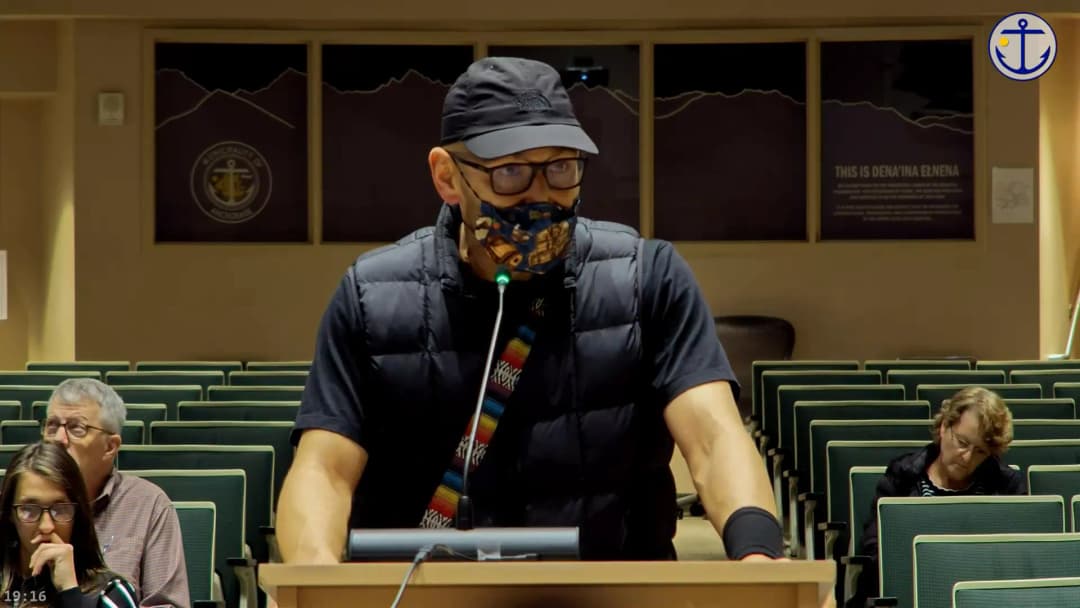
Note: The transcript refers to the meeting as occurring on September 14, 2026, but the provided timestamp indicates September 15, 2026, UTC. This summary uses the provided date. The Anchorage Planning and Zoning Commission convened to discuss an informational item on the role of neighborhood and district plans relative to the Comprehensive Plan, and to hold a public hearing on the Basher Trailhead parking lot expansion. The commission approved the minutes from August 3 and 10, 2026, and the consent agenda was adopted without discussion. Consent Calendar - Minutes: Approved from August 3 and August 10, 2026 (motion by Commissioner Gardner, second by Commissioner Mills). - Consent Agenda: Approved by motion (Commissioner Key, second Commissioner Abaza); no items were pulled for discussion. Public Comments & Testimony - River Ramuglia (South Anchorage): Expressed concern that the commission should prioritize housing and emergency housing over data centers and trailhead amenities, citing 45 outdoor deaths in 2025. Urged zoning changes to allow smaller homes and to restrict data center development. - Mrs. Maurer (via phone, Stuckagain Heights resident adjacent to Basher Trailhead): Stated general support for the Basher Trailhead project but raised concerns about traffic safety (narrow road, lack of bike path), security (past homicides, break-ins, dumping), and the burden on neighborhood volunteers. Requested that any construction staking be done prior to excavation to avoid impacting adjacent properties and trails. Discussion Items Informational Item: Advisory Status of District and Neighborhood Plans - Daniel McKenna Foster (Long-Range Planning Staff): Presented Assembly Resolution 2025-67, which asks the commission to recommend whether district and neighborhood plans should be considered advisory to the Comprehensive Plan rather than having the same force of law. Staff noted that Anchorage has many plans, most unupdated, and that advisory status would reduce their regulatory weight. The resolution also asks for policy and budget recommendations to remedy plan implementation. - Commissioner Ron: Requested clarification on what “advisory to the comp plan” means in practice and whether the commission must choose between advisory status or making budget recommendations. - Director Babb (Planning): Explained that adopted elements of the Comprehensive Plan have regulatory weight (e.g., the wetlands plan has regulatory language). Advisory plans would not carry that weight. He suggested inviting an assembly sponsor to future discussions. - Commissioner Krishna: Emphasized the volunteer time residents invest in neighborhood plans and noted that many plans are already advisory in practice because they do not directly lead to budget allocations. She advocated for a broader review of Title 21, Chapter 21.03, and requested more information about the Girdwood Board of Supervisors and Chugiak-Eagle River Advisory Board processes for plan amendments. - Commissioner Ron: Asked about a conflict between the Hillside District Plan (allowing gravel roads) and Title 21 (requiring paved roads). Staff indicated that adopted comp plan elements could be used to challenge regulations, while advisory plans would only be recommendations. - Outcome: The commission agreed to schedule a future work session to discuss the issue further; no motion or vote was needed. Public Hearing: Case 2026-0109 – Basher Trailhead Parking Lot Project - Staff Presentation (Francis): The project proposes a new paved 52-space parking lot (including 3 ADA spaces) at the Basher Trailhead, replacing a 16-space gravel lot. The project also includes a pathway connection, re-vegetation, vaulted restroom, bike racks, and trash receptacles. Staff found the four approval criteria met with five conditions of approval (see packet page 4). - Petitioner Presentation (Lucy Barrenko, Huddle, with Tom Garrett, PTS): Described public engagement (400+ survey responses, multiple community council meetings). The lot design was based on the Chugach State Park Access Plan, site constraints, and public input. Addressed safety improvements (improved sight distances: west from 280 to 445 ft, east from 106 to 393 ft), a gate for management, and no lighting or webcam due to fiscal infeasibility of bringing power to the site. - Commission Questions: - Commissioner McKee: Asked about traffic study (none performed, but municipal traffic had no objection), security (gate, visibility), and ADA pathway (slope at 4.9%, close to 5% max). Petitioner noted no issues with the five conditions of approval. - Commissioner Gardner: Clarified that the three bike racks can accommodate six bikes; compared to other trailheads. - Commissioner Ron: Raised concerns about long-term maintenance and potential parking in the access driveway. Public Works Director Kent Cole Hayes confirmed a $70,000 annual perpetual maintenance appropriation from the construction bond for snow removal and trash pickup, managed by PME via contract. - Public Testimony: See above. - Petitioner Rebuttal: None. Key Outcomes - Basher Trailhead Project: Motion by Commissioner Ron, second by Commissioner Krishna, to approve the major site plan review subject to the five conditions of approval. The motion passed (voice vote, no dissent). - Neighborhood Plan Review: The commission will schedule a work session to further discuss Assembly Resolution 2025-67 and potential recommendations on the advisory status of plans and related budget implications. - Future Agenda Items: Staff announced upcoming informational items on Title 21 impacts and the right-of-way management strategy.