The Bourne Select Board held a joint meeting with the Planning Board on September 8, 2026. The meeting covered appointments, updates on the Growth Incentive Zone, a proposal for affordable housing at the former police station, a fire response report, and preliminary budget discussions for fiscal year 2028. The meeting was conducted virtually due to technical issues. Consent Calendar - Approved the consent agenda as presented by a roll call vote of 4-0-0 (Jean Ozeverovicz, Peter Meyer, Mary Jane Mistrangelo, and the chair voting yes). Discussion Items Appointment of Associate Member to Planning Board - The Planning Board had vacancies for an alternate member. Two applicants (Liz Brown and Corinne Moore Covey) were considered, but only Corinne Moore Covey was present. Planning Board member Steve Stroni nominated Corinne Moore Covey, seconded by Robert. The Select Board also voted. The joint vote was unanimous: all Planning Board members (Steve, Chris, David, Mandy, Robert) and Select Board members (Jean, Peter, Mary Jane, and the chair) voted in favor. Absent: Anne Marie Sarunian. The appointment is for a term ending June 30, 2029. Peter Meyer suggested considering a bylaw change to expand alternate members from two to three to accommodate future candidates. Growth Incentive Zone Update - Town Planner Jennifer Copeland summarized the Growth Incentive Zone (GIZ) history, adopted in 2012 and amended in 2019. Current allowances are 360 housing units and 650,000 square feet commercial space. The town is requesting additional units to include MBTA multifamily housing overlay district units (up to 750 units). Projects over 30 units require a Development of Regional Impact (DRI) review by the Cape Cod Commission. The Commission has requested additional information, including policies for historic resources, updated hazard mitigation plan, water and sewer calculations, floodplain bylaw, open space and recreation plan, design standards, and a capital improvement plan. Jennifer noted the process will take longer than anticipated. Discussion included: - Mary Jane Mistrangelo suggested providing the sewer allocation spreadsheet to demonstrate capacity. - Peter Meyer asked about mitigation funds held by the Cape Cod Commission; Rob Ashley (town's Commission representative) will investigate. - John York raised concerns about pedestrian walkability in the GIZ and urged the town to push back on MassDOT bridge designs that add extra distance for pedestrians. - Mary Jane Mistrangelo proposed separating the MBTA units (which lack sewer allocation) from the existing projects with allocated sewer to avoid delays. Jennifer Copeland indicated the sewer system cannot support 750 additional MBTA units currently. The town may seek grant funding (Catalyst Fund) for sewer expansion. Future Use of Former Police Station on Main Street (Affordable Housing) - Sue Ross (Affordable Housing Trust) presented a proposal for workforce housing, focusing on town employees. The Trust hired architect Leonardi to assess the existing building. Leonardi reported that the building (built 1955, second floor added 1970s) is structurally unsound for residential conversion due to obsolete mechanical/electrical systems, hazardous materials, and floodplain location. The Trust recommends demolition. Leonardi presented a conceptual design for two three-story buildings on the site (173 Main Street and the other side) with ground-level parking and residential units above, yielding an estimated 24–26 units. First floor would be parking and non-residential use. Parking ratio of 1:1 (about 35 spaces). The Trust seeks control of the property to apply for funding from Mass Housing Partnership (application deadline September 15, 2026). The Select Board agreed to place on a future agenda to discuss transferring control, with town counsel advice. Mary Jane Mistrangelo noted town meeting previously authorized the Select Board to dispose of the building, and a similar agreement with a reverter clause (like Hoxie) could be used. Boat Fire Response (August 8, 2026) - Fire Chief David Pallonzi briefed the board on the department's response to a boat fire in Monument Beach. Key facts: original 911 call at 4:26:59 PM reported only a boat fire (no injury). The initial response included Engine 5 and Marine Unit with typical staffing of nine personnel on duty. A full department recall was initiated. At 4:33:05 PM, the 14th call identified an injured person. Medical dispatch occurred 52 seconds later; an ambulance from Buzzards Bay (not Monument Beach) responded and arrived 13 minutes after the medical call (19 minutes from the original fire call). Chief Pallonzi stated that the response was appropriate given the information available, and a 30-minute ambulance response did not occur. He clarified that an ambulance at Monument Beach station was not staffed because all three on-duty personnel responded to the fire. Public comments: - Carla Emmons (Monument Beach resident) expressed concern that the local ambulance could not respond immediately, asking what would need to change for a faster response. - Joe (likely union representative) emphasized the need to add staff and raise minimum manning (currently 9), noting that only three personnel cover the entire south side of the canal. He urged board to plan for future staffing. - Jeff (former firefighter) had connectivity issues but raised manning concerns. - John York noted the population is roughly 50-50 north and south of the canal, calling for equal services. - Chief Pallonzi noted current staffing challenges: two vacancies (conditional offers accepted), three long-term injuries, and firefighters attending academy. He addressed mandatory holdover policies, which rotate by seniority. - Discussion included minimum manning: Select Board members asked about the costs of increasing staffing. MJ noted the Safer grant previously added eight firefighters, but after grant termination only four were retained. The department currently has four shifts of ten personnel when fully staffed; minimum is nine. FY28 Budget Deficit and Debt Service Policy - Town Administrator Marlene McKernan and Finance Director Erica outlined a potential operating budget deficit for FY28. Four major revenue sources: property taxes (75%, limited by Prop 2.5 with low new growth $300k-$450k), state aid (unpredictable), local receipts (10-12%, should not exceed 90% of prior actuals), and other funds (ambulance, conservation, waterways). The town has been using capital stabilization funds to cover debt service (approx. $492,000 in FY27) rather than including it in the operating budget. The Select Board had a goal to transition debt service funding into the operating budget. Mary Jane Mistrangelo stressed the need for a detailed capital plan showing all projects, costs, and funding sources (as recommended by DLS). She noted that the previous administration stopped borrowing and used free cash for capital, but now capital stabilization is being depleted. Marlene asked the board to consider holding space in the FY28 operating budget for pay-as-you-go capital and debt service. The board agreed to continue the discussion at a future meeting, with a need for more detailed projections and a policy subcommittee. Peter Meyer suggested starting budget discussions after the fall town meeting (late October). Key Outcomes - Appointment: Corinne Moore Covey was appointed as Associate Member of the Planning Board for a term ending June 30, 2029 (unanimous joint vote). - License Agreement: Approved the execution of a license agreement with NSTAR Electric for electrical service to the new fire station at 171 Clay Pond Road (motion by Peter Meyer, second by Jean Ozeverovicz; roll call vote: 4-0-0). - Article 97 Transfer: Authorized the execution of assignment and assumption of conservation restriction for property on Dr. Julius Kelly Lane, authorizing town counsel and Marlene to finalize documents (motion by Peter Meyer, second by Jean; roll call vote: 4-0-0). - Minutes Approved: Meeting minutes from August 18, 2026, were approved (motion by Peter Meyer, second by Jean; roll call vote: 4-0-0). - Future Agenda Items: The board agreed to: - Schedule a discussion on transferring control of the former police station to the Affordable Housing Trust, with town counsel advice. - Continue FY28 budget and debt service policy discussions, possibly after fall town meeting. - Review correspondence response policy at a future meeting. - Consider implementing a waiting room for Zoom meetings to prevent disruptions. - Town Administrator Report: Noted planning board zoning article for special town meeting (five-foot height allowance for non-conforming lots), splash pad closure (Sept 14), Cape Cod Commission open space survey, ISWIM food waste diversion (25.28 tons), and ADA compliance improvements. - Adjourned: Motion by Peter Meyer, second by Jean Ozeverovicz; roll call vote: 3-0-0 (Mary Jane Mistrangelo had dropped off).
The Public Meeting Index
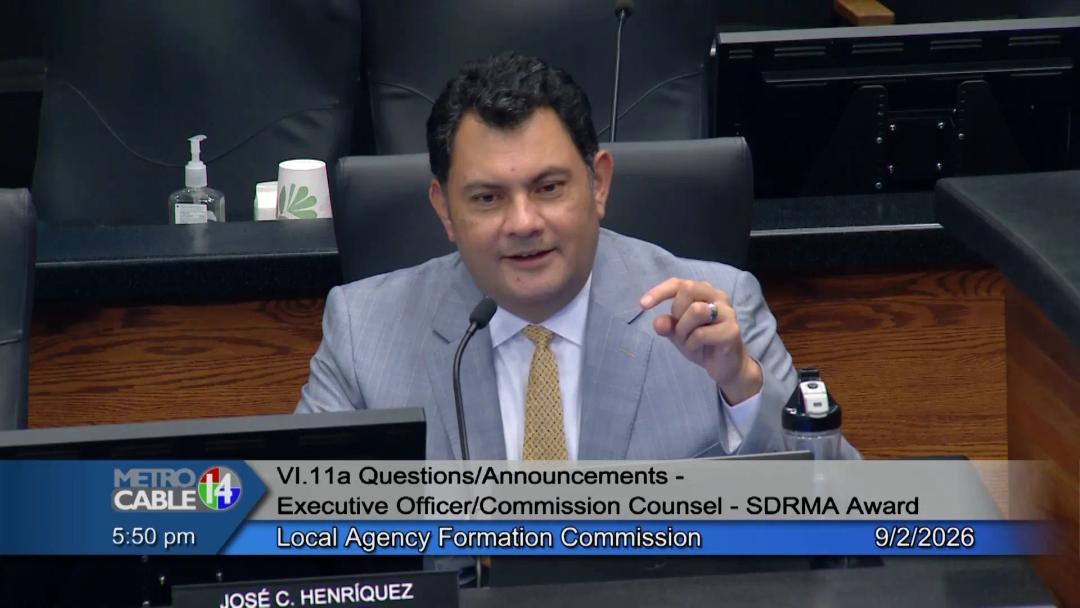
The Public Meeting IndexThe Sacramento Local Agency Formation Commission (LAFCO) met on September 4, 2026, to consider a transition plan for becoming an independent agency, approve a bank account to begin financial separation, receive staff reports on awards and office relocation, and hear commissioner comments. All votes were unanimous, and no public comments were made. Consent Calendar - Items 2-7 (with modification): The consent calendar was approved 6-0, with item 2 (approval of August 5, 2026 meeting action summary) pulled for discussion. Commissioner Hume Pratton noted that the action summary for item 7 (fees) should reflect a change from a 10% annual increase to annual reviews, as per the prior motion. The chair confirmed the change would be made, and the consent calendar passed unanimously. Discussion Items - Item 8: Transition Plan for Separation: Staff presented a two-phase plan for LAFCO to become an independent employer. Phase 1 involves establishing accounts payable structures; Phase 2 shifts LAFCO to its own payroll, compensation, and benefit plans. Recommendations included hiring own employees, remaining with the Sacramento County Employee Retirement System (SCERS), and using CalPERS for health benefits due to cost and variety. The plan notes possible need for legislation regarding pre-PEPRA retirement benefits. Commissioner Wickard and others expressed support for the thoughtful timeline and approach. The plan was approved unanimously (6-0). - Item 9: Authorize Executive Officer to Open Independent Bank Account: As the first step of Phase 1, the item authorized opening a bank account to manage accounts payable. Staff emphasized it does not immediately transfer funds but builds financial infrastructure; a future contract with an accounting firm will set up policies. The motion was approved unanimously (6-0). - Item 10: CalAFCO Board of Directors Nominations: Staff reported the item was no longer necessary and dismissed it. Chair noted nominations could still be made from the floor if needed. - Item 11: Executive Officer Report – SDRMA Award, Office Move, Astro Sheet: Staff announced LAFCO received an award from SDRMA for having no claims. The office successfully relocated to 1000 G Street with no budget impact, thanks to policy analyst Grabo, who sold surplus items via Facebook to cover disposal costs. The astro sheet will be pared down to focus on active projects; a consultant will be hired to assist with ongoing work. - Item 12: Commissioner Comments: Commissioner Jones clarified nuances in the Metro Fire MSR report: revenue deficits in the report are offset by Measure O capital funds, and response time calculations include dispatch and code 2/3 responses, which can make times appear slower than firefighters typically measure. Commissioner Wickard requested a future meeting with staff regarding the Omo Chimney water agency, noting unique characteristics and absence of groundwater level data in the MSR. Key Outcomes - Consent calendar approved 6-0 with modification to item 2 reflecting annual reviews instead of 10% annual increase for fees. - Transition plan for separation (Item 8) approved unanimously (6-0). - Authorization to open independent bank account (Item 9) approved unanimously (6-0). - Item 10 (CalAFCO nominations) dismissed as unnecessary. - Staff directed to schedule a follow-up with Commissioner Wickard regarding Omo Chimney water agency. - Meeting adjourned at 5:56 p.m. to closed session (existing litigation).
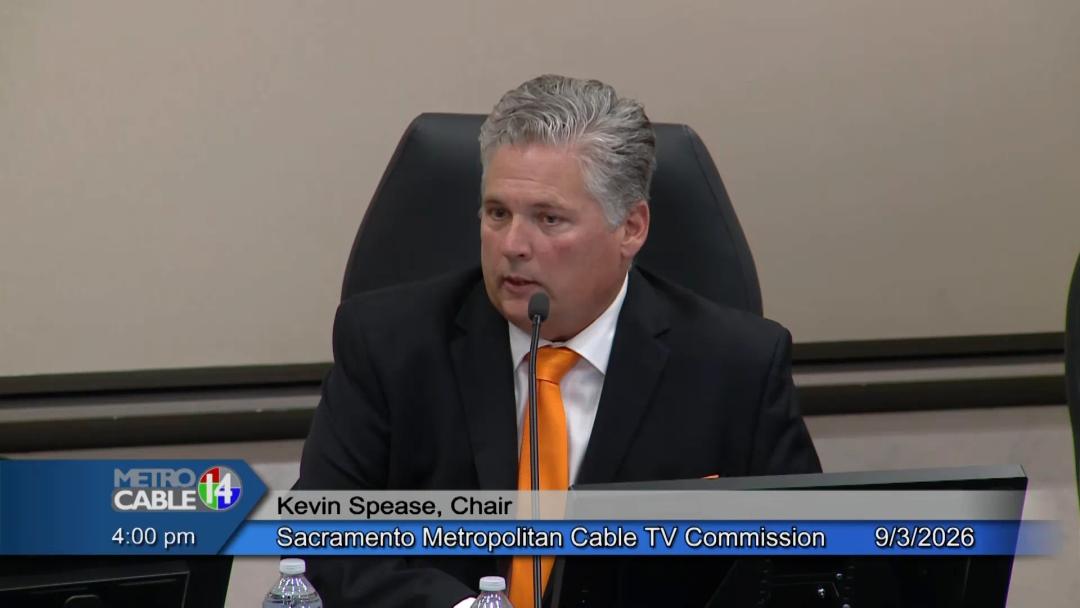
The Sacramento Metropolitan Cable Television Commission met on September 4, 2026, to address a declining revenue environment and approve the fiscal year 2026-27 final budget. Key actions included appointing an interim executive director, adopting a conflict of interest code update, approving the budget with reduced member agency distributions and channel licensee cuts, setting interim director compensation, and authorizing strategic planning support. The meeting featured public testimony from four member agency finance directors in support of the budget and updates from channel licensees. Consent Calendar - Received and filed the other post-employment benefits (OPEB) valuation and GASB 75 report for fiscal year ending June 30, 2024. - Received and filed the engagement letter for the financial audit of the Commission for fiscal years 2022, 2023, and 2024. - Both items were approved unanimously without public comment. Public Comments & Testimony - Susan Towler (Administrative Services Director, City of Citrus Heights): Spoke in support of the budget recommendation, noting participation in the finance working group and praising fiscal prudence. - Pete Coletto (Finance Director, City of Sacramento): Supported the budget, stating it strikes a balance in a declining revenue environment and reminding that member distributions support essential services like fire, police, and parks. - Thomas Grunison (representing City of Folsom): Expressed support, acknowledging shared burden and noting that the revised budget balances the Commission's financial health and member agencies’ needs. - Layla Manner (Finance Director, City of Galt): Supported the budget, emphasizing the need for balance to minimize impacts on residents and essential services, especially for smaller cities. Discussion Items - Closed Session (Items 1-2): The commission entered closed session for public employee appointment and conference with labor negotiators. After reconvening, it was announced that the commission unanimously appointed Chris Sinriggs as interim executive director. - Conflict of Interest Code Amendment (Item 6): Staff presented updates to the conflict of interest code, including adding a board alternate for Sacramento County District 5, an additional alternate for the City of Sacramento, and removing duplicate legal counsel titles. The resolution was approved unanimously. - Fiscal Year 2026-27 Budget (Item 7): The main agenda item. Chair Speace opened with acknowledgments, thanking staff, the finance working group, the budget ad hoc committee, and channel licensees. He noted a common problem of declining revenues and a common objective of transparent management. He also apologized for delayed communication with licensees. Interim Executive Director Kristen Riggs presented the budget: anticipated franchise fee revenue of $6.4 million (downward trend), total general fund revenue including carry-forward of $13.3 million, and recommended two per capita distributions to member agencies—a retroactive $4.7 million (75% of FY 24-25) and a FY 26-27 distribution of $3.5 million (75% of that retro amount). Channel licensee funding was recommended at 25% less than FY 25-26 levels, totaling $1.2 million, with specific amounts for Access Sacramento ($576,000), KVIE ($228,000), SECC ($357,000), and SAC Life TV ($47,869). The PEG fee fund was unchanged. OPEB pre-funding was reduced to zero. The budget also increased contingency appropriation. After public comment, commissioners discussed OPEB liability, PEG funding future, and thanked staff. The budget was approved unanimously. - Strategic Planning Ad Hoc Committee: Chair Speace outlined a seven-part charge for the strategic ad hoc committee, including revenue sharing methodology, governance, financial sustainability, and service delivery. He requested a consultant to assist and that channel licensees be substantively involved. The committee will report back by March 4, 2027. - Interim Executive Director Compensation (Item 8): The commission approved a temporary salary adjustment for Ms. Riggs at 70% of the salary range maximum for the position, expressed on a monthly basis. Passed unanimously. - Authorization for Strategic Support Services (Item 9): The commission authorized the interim executive director to execute an agreement for strategic support services, with a not-to-exceed amount of $100,000. The motion was amended from no cap to $100,000. Passed with Member Thandu abstaining. - Channel Licensee Reports (Item 10): - David Lowe (KVIE): Reported on local film "Unhoused Neighbors," 16 awards for digital newsroom Abridged, surpassing 70,000 donors, and top 10 PBS viewership. - Joe Barr (Access Sacramento): Noted partnership with Sacramento Region Community Foundation, a new show for the Afghan community (in partnership with New York Times philanthropies), and an AI in filmmaking convening. He thanked the commission for collaborative spirit. - Aaron Heinrich (SECC): Presented a video showcasing student programs, teacher support, and the annual Student Educational Video Awards. - Ron Herman (SAC Life TV): Highlighted their Powerhouse podcast (60 episodes), community spotlight documentaries, and new streaming network (SacramentoLife.tv). He also raised a concern that SAC Life TV’s funding ($47,869) is far below other licensees, requesting equal consideration in future budgets. Key Outcomes - Appointment: Chris Sinriggs appointed interim executive director by unanimous vote in closed session. - Conflict of Interest Code: Resolution adopted unanimously. - Fiscal Year 2026-27 Final Budget: Approved unanimously, including $8.2 million in total per capita distributions to member agencies ($4.7 million retroactive + $3.5 million), $1.2 million to channel licensees (25% reduction from FY 25-26), and no change to PEG fund projects. - Interim Director Compensation: Temporary salary adjustment approved unanimously. - Strategic Support Services Agreement: Authorized with a $100,000 cap, passed with one abstention. - Next Meeting: Scheduled for December 3, 2026.
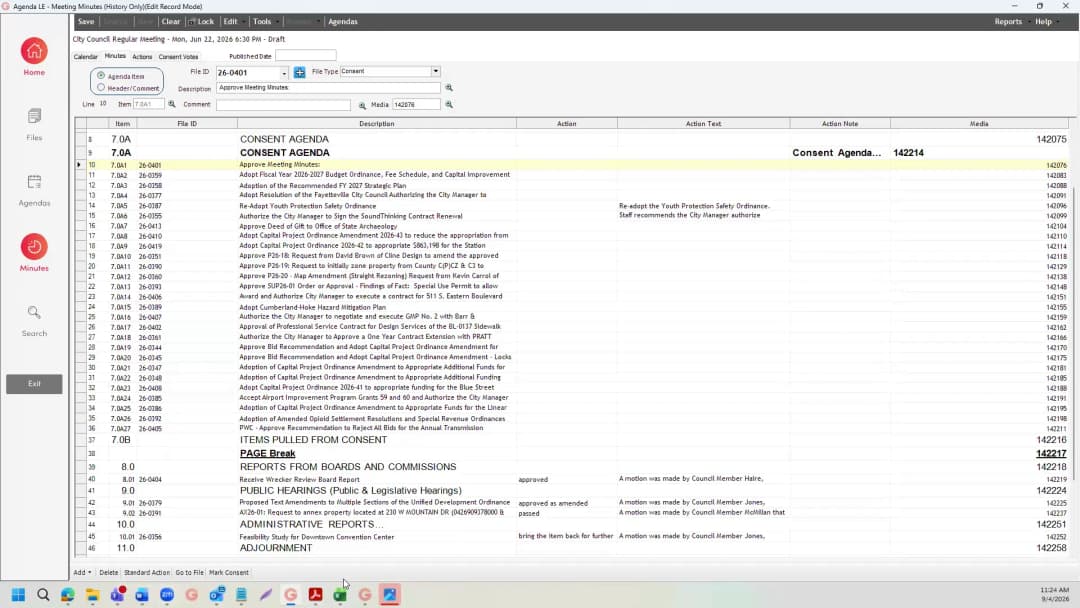
On September 4, 2026, a Granicus consultant and Fayetteville city staff met virtually for about two hours to review how the city produces meeting minutes, test importing minutes from the June 22, 2026 meeting into Legistar, and identify configuration changes to reduce manual work. No agenda or minutes for this working session were provided; no formal city council votes or decisions occurred. Current Minutes Process - City staff currently uses Media Manager / Live Manager to timestamp meeting activity, then exports minutes and has someone manually upload a custom document rather than importing the meeting data back into Legistar. - The city does not record motions or votes inside Live Manager; votes and motions are not currently pulled automatically into Legistar. - Staff expressed strong interest in not recreating minutes manually every month. Legistar / Live Manager Demonstration - The consultant demonstrated how minutes in Legistar begin as a one-for-one copy of the agenda and can import data from Media Manager, including timestamps and actions taken during the meeting. - Live Manager is browser-based, can be used on any device, and includes annotation tools such as highlighting, drawing lines, and adding notes and images. - The consultant walked through sample consent items, a roll call vote, a unanimous vote, a motion without a second, and calling a speaker; test data was paired with the original June 22 video using a temporary video swap. - A limitation was noted: no mass voting for consent agendas; a common workaround is to add a note with the intended motion text. Configuration Review and Staff Requests - Workflow actions / motion text: Staff asked to remove unused actions such as received and filed and bring back for further consideration and formal vote, and to clean up punctuation and grammar in automatically generated motion text. - File types: The consultant identified that legislative hearing is not used by city council but is used by the zoning commission; zoning and planning meeting bodies were given permission to vote on that file type in workflow control, since they previously could not take any action on it. - Attendance and voting types: Staff decided to add a virtual attendance type, use an others present attendance group, and add Douglas Hewitt as a non-voting member so he appears in attendance but not in votes. - Roll call and office titles: The city has nine districts; staff requested office titles such as Council Member District One through District Nine so each council member's district number can appear after their name. - Meeting statuses: Staff noted the preliminary status was never used and should be removed. - Standard paragraphs: The existing standard paragraph referencing former City Manager Ted Voorhees was outdated and was not actively used. - Names: Council Member DJ Hare appeared in Live Manager attendance but was missing from Legistar's roll call; the consultant agreed to investigate, possibly with engineering. - Mac users: Legistar is Windows-only; Mac users at the city currently connect through a separate server or VPN, and running Windows via a partition was mentioned as a possible alternative. Minutes Formatting and Design Requests - Staff and consultant compared the current Legistar output with the city's existing minutes template and agreed to send a marked-up sample to the design team. - Formatting changes requested: - Action notes: change from italics to left-aligned text with a single indent. - Comments: display as bold, half-inch indented text to hold ordinance and resolution language. - Roll call: place attendance before Call to Order using a blank header. - Signature block: add a non-forced header line at the bottom after adjournment. - Fix spacing and formatting of names and titles, including the mayor's name and title. - Staff remained open to trying Legistar's header layout but wanted spacing and formatting adjustments. Insight Page, Accessibility, and Next Steps - The consultant noted that finalizing minutes in Legistar will make legislation, votes, and actions searchable on the public Insight page. - Staff supported adding accessible HTML publishing for ADA compliance; it would require no extra staff work once enabled. Staff responded 100 percent in favor of enabling accessible HTML. - Staff requested an audio column for committees that are not broadcast, including planning, zoning, and audit; the consultant will enable settings similar to Charlotte, NC and add accessible agenda and minutes columns before the next meeting. - The consultant showed Insight skins, including enhanced ADA styling, and examples from other jurisdictions such as King County, Oakland, and Charlotte for future design choices. Key Outcomes - Consultant will send the current workflow actions list and the sample minutes export to staff for markup. - A design team ticket will be created for minutes formatting updates: action notes, comments, motion and vote text, headers, attendance placement, and signature block. - Staff will send additional markup notes before the next meeting; updates will be reviewed at the start of the next call. - Before the next session, the consultant will add accessible agenda and minutes columns and enable audio download so these features can be demonstrated. - The next meeting will be a hands-on working session on the Insight public page, including skins, accessible HTML, audio, and additional jurisdiction examples.
The Rochester Airport Commission met on September 4, 2026, per the provided timestamp, with a quorum present. The commission approved the agenda and consent calendar, received July 2026 financial and operational/marketing reports, and approved two new business items: a basement lease extension and a Transportation Security Administration (TSA) reimbursement agreement. Note: The agenda and transcript identify the meeting date as September 8, 2026; the supplied timestamp says 2026-09-04, and this summary follows the supplied date. Consent Calendar - The minutes of the Airport Commission meeting of August 4, 2026, were approved as the official record. Public Comments & Testimony - No members of the public were present for comments; the public comment period was closed after no one came forward. Reports Airport Financials – July 2026 - The financial report was received and filed. Staff noted the combined operating fund position was on track, with the levy already received; last year's higher balance reflected final COVID-era funding that has now ended. - Fund balances were lower than normal due to a large reimbursement expected to be recorded in August, which should restore the balance. - Staff confirmed the TSA reimbursement agreement on the agenda was not included in these numbers and would be new dollars for future budgets. - Commissioners discussed Passenger Facility Charges (PFCs). Staff said the airport collects the full $4.50 PFC per eligible passenger, minus 11 cents retained by airlines for administration. PFCs are dedicated to capital projects and are currently leveraged for at least another 10 years, including the CAP two project. Additional airline seats would generate more PFC dollars. Staff noted that raising the PFC remains a national priority for airport executives but faces strong airline opposition. Airport Operational and Marketing Data – July 2026 - The operational and marketing report was received and filed. Employment and seat numbers were on track, but the airport needs more flights to improve departing flight options. - July passenger traffic was up 1% overall and up 7% year-to-date, which staff described as bucking the national trend. - Delta had another strong month, up 13% year over year, with an 81% load factor for the second consecutive month. American was down 12%, driven largely by operational issues such as weather and mechanical problems; American's seats were relatively flat, with 11,765 seats in July 2026 compared to 11,245 in July 2025, and its load factor slipped from the 70s to 66 month over month. - Parking and car rental revenues increased marginally. International activity was down slightly from the prior month but followed historical seasonal patterns. Cargo was recovering but remained down 3% year over year, and total operations were still recovering from a light January and construction-related impacts on general aviation. - Marketing staff reported modest audience growth and strong search growth despite a planned summer budget pullback, aided by reposting evergreen content such as the airport ASMR video. - Staff introduced the CPATC metric, described as the cost to get a consumer to add a ticket to the cart in the airport's search widget. The Isabella ad performed well at $7 per add-to-cart, while a retargeting ad cost $23 per add-to-cart. New Business 7.A – Amendment to Agreement for Leasing Space in the Basement of the Terminal - The commission authorized an amendment to the agreement between the City of Rochester and the Rochester Airport Company for basement storage space in the terminal. - The amendment replaces the expiration date and extends the term through the end of 2027; the rate and square footage remain the same. The lease has been in place since 2015 and provides a transparent exchange of value with the FAA. - The motion passed by voice vote with no opposition. 7.B – Transportation Security Administration (TSA) Reimbursement Agreement - The commission adopted a resolution accepting the reimbursement agreement and authorizing execution of the necessary documents with the TSA and the Department of Homeland Security. - Staff explained the agreement covers 5,000 checkpoint support hours at $110.25 per hour, with an annual allocation of just over $127,000. This reinstates federal reimbursement that was previously removed from budgets, and the airport is bringing it forward before final legal language is issued to ensure the funds are captured before the federal fiscal year ends. Legal review will occur before final execution. - In discussion, staff noted the airport is legally required to staff the checkpoint and that the reimbursement supports checkpoint operating hours rather than FTEs. Even with automatic exit doors, someone must respond when doors go into lockdown; staff will continue cross-utilizing personnel to optimize operations. - The motion passed unanimously. Key Outcomes - Approved the consent calendar and the July 2026 financial and operational/marketing reports. - Approved both new business items by voice vote with no opposition. - Staff indicated that the next meeting will include a deeper commission discussion of parking operations and potential improvements, with a base project to be presented for additional commission input. - The meeting adjourned at 2:26 p.m., after a 26-minute session.
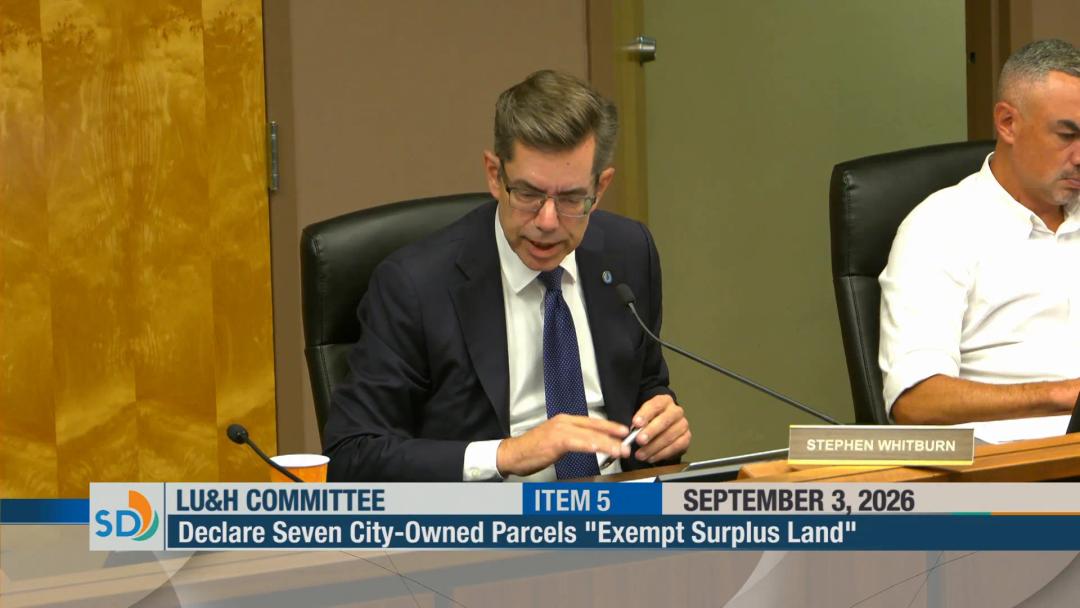
The Land Use and Housing Committee met on Thursday, September 4, 2026 (the transcript repeatedly states September 3, 2026; the system timestamp identifies the meeting as September 4) to take up a consent calendar and one discussion item. The meeting was conducted in person and via Zoom, with a temporary City TV outage noted early in the proceedings. A quorum was present, with Chair Council President Pro Tem Lee presiding; attendees included Vice Chair Elo Rivera, Councilmembers Whitburn and Moreno, and staff from the Mayor's office, City Attorney, Independent Budget Analyst, and committee consultant. No agenda or minutes were provided in the source materials. Consent Calendar - Approved the committee minutes from July 9, 2026. - Approved the first amendment to the subrecipient grant agreement with the County of San Diego for the riverbed encampment resolution funding project. - Approved the third amendment to the grant agreement with the County of San Diego for the domestic violence shelter. - Approved the first amendment to the real estate purchase and sale agreement between the city and Bridge Deck owner for city-owned property at 40th Street and El Cajon Boulevard, revising the sequence of work and extending the close of escrow date. - Councilmember Whitburn made the motion; it was seconded and passed unanimously 4–0. Public Comments & Testimony - Non-agenda, in person: Joyce Hanyada urged a changed perspective on homelessness. Janet Bourgeois praised Harrington Heights as helping very low-income families and urged preserving the Neil Day Goods Center. Maximilian Schmidt spoke about conspiracy/occult topics unrelated to land use. Lori Saldania presented new sea-level-rise projections and warned that El Niño could bring up to a foot of sea-level rise within weeks. Allegedly Audra criticized fire preparedness and evacuation planning in high-fire zones. Blair Beekman marked the 25th anniversary of 9/11 and asked for respectful debate about that event. - Non-agenda, virtual: Becky Rapp requested a comprehensive smoke-free outdoor/odor ordinance for mixed-use and multifamily housing. Hector opposed development at the Petco parking lot, suggested opening Fiesta Island for camping, and commented on parking meter placement. Madison reported that Assembly Bill 2697 (cannabis drive-through sales) had been placed on hold and expressed relief, citing land-use and public-safety concerns. Judy Strang asked for more smoke-free public places to reduce tobacco waste in waterways. Kathleen Lippett said the city has paid over $38 million in large claims from bicycle and vehicle crashes tied to infrastructure hazards, including $24 million for a severe accident on Fiesta Island, about $3 million for a bicyclist injured by sunken asphalt on Santa Fe Street, $6.5 million over a fatal scooter accident, and $420,000 in e-bike crash lawsuits; she urged that maintenance funds be spent on maintenance. - Consent agenda: Joyce Hanyada supported items 2–4, citing homelessness strategies and EEO/subcontractor requirements. Lori Saldania spoke to items 1–2, calling riverbed encampment resolution urgent before expected El Niño storms. Allegedly Audra criticized the domestic violence shelter amendment and meal services for homeless people. Blair Beekman supported the riverbed project and domestic violence work. Virtual commenter Hector spoke to item 4 and requested a recurring public Q&A with the city. - Item 5: Sue Taylor, a 41-year former employee of the city's Real Estate Assets Department, supported the declarations but said the written record was insufficient, citing acreage discrepancies and an unmentioned right-of-way, and questioned whether the 30th Street parcel should be treated as unavailable for housing. Lori Saldania urged considering surplus parcels for pocket parks, community gardens, and native habitat rather than sale. Allegedly Audra expressed distrust and said small parcels were unsuitable for housing. Blair Beekman said the parcels looked like good parkland and cautioned against selling public land. Jeff Hewter asked about the bidding process and noted the Alder Drive parcel may lack street access. Hector urged the city to lease rather than sell land. Discussion Items - Item 5: Staff asked the committee to declare seven city-owned parcels exempt surplus land under California Government Code. The parcels, all under one-half acre, were described as: approximately 6,098 sq ft on Trinidad Way in Encanto, acquired in 1944 for the Bonita water pipeline; approximately 8,276 sq ft at Rio Drive and Banbury Street in Paradise Hills, acquired in 1915 for the Bonita pipeline; two non-contiguous parcels on Marina Boulevard in Bay Park, approximately 5,227 and 6,098 sq ft, acquired in 1964 for the Marina Boulevard expansion; approximately 1,306 sq ft on Alder Drive in Kensington, acquired in 1940 for a sewer pump station that was never completed; approximately 12,632 sq ft on Sweetwater Drive in National City, acquired in 1915 for the Bonita pipeline; and approximately 6,970 sq ft at 4069 30th Street in North Park, acquired in 1987 for a mid-city multi-service center, now a vacant office building. - Staff said the parcels had been circulated to all city departments under Council Policy 700-10, with no department indicating a current or future municipal need. Disposing of the parcels would generate one-time revenue and ongoing property tax, reduce maintenance and liability costs, and return dormant assets to productive use. Staff also said the Real Estate Division is separately working on high-priority lease renegotiations and a broader property management plan, but funding for a comprehensive plan is not currently available. - Councilmember Moreno said she consistently opposes sale of city-owned land because it is a limited public asset, cannot be recovered once sold, and should first be considered for affordable housing, parks, open space, community facilities, and future needs; she also cited potential impacts on the city's bonding capacity. Councilmember Whitburn questioned why 4069 30th Street was not pursued for affordable housing. Staff responded that a small affordable development there would likely require a large per-unit subsidy and compete for limited housing funds, and that selling the parcel would allow the market to propose uses. Vice Chair Rivera asked about lease prioritization, departmental review, and ensuring buyer accountability so properties do not become blight. Staff stated lease work and dispositions are being handled concurrently and that the city retains options when deciding how to dispose of property. - Councilmember Whitburn moved to approve the staff recommendation with an amendment to remove 4069 30th Street from the exempt surplus declaration, so that parcel could be evaluated through the surplus housing availability process. Vice Chair Rivera seconded. Key Outcomes - Consent agenda approved unanimously, 4–0. - Item 5 approved 3–1 (Councilmember Moreno dissenting), with 4069 30th Street removed from the list of parcels declared exempt surplus. That parcel is to be routed through the 60-day notice/negotiation process for surplus housing opportunities instead. - No continuances were requested. - The next regularly scheduled committee meeting is Thursday, October 8, 2026, at 1:00 p.m.
On September 4, 2026, the New Rochelle Chamber of Commerce hosted a ribbon-cutting ceremony celebrating the relocation of Space Beauty Spa from Main Street to North Avenue. The event featured remarks from local officials, the developer, and the business owner, highlighting the city's support for local businesses and economic development. Ceremony Highlights - Catherine White, Executive Director of the New Rochelle Chamber of Commerce, welcomed attendees and introduced the speakers. She noted that Space Beauty Spa had been on Main Street for five years before relocating to a location with ample parking. - Mayor of New Rochelle (unnamed in transcript) thanked Elizabeth Rhodes for choosing to stay in New Rochelle for nearly 20 years and for relocating within the city. The mayor expressed gratitude to Bob Young for ensuring the business was retained. - Martha Lopez, MWBE Director for Westchester County and New Rochelle city council representative, congratulated Elizabeth, emphasizing the importance of economic development to the county and the city. - Bob Young of the Young Companies, the developer, expressed delight that Space Beauty Spa joined their section of North Avenue, stating it "completes the area." He wished the business success. - Elizabeth Rhodes, owner of Space Beauty Spa, thanked her family, loyal clients, and team. She acknowledged the support of Bob and Connor and the process, saying "thanks got we can make it." - Lenny Orojas from Hotel Noma, on behalf of the Chamber of Commerce, presented Elizabeth with a certificate of congratulations. Key Outcomes - The ribbon-cutting ceremony publicly welcomed Space Beauty Spa to its new location on North Avenue, reinforcing community support for local entrepreneurship and small business growth. - No formal votes or decisions were made; the event was ceremonial and celebratory.
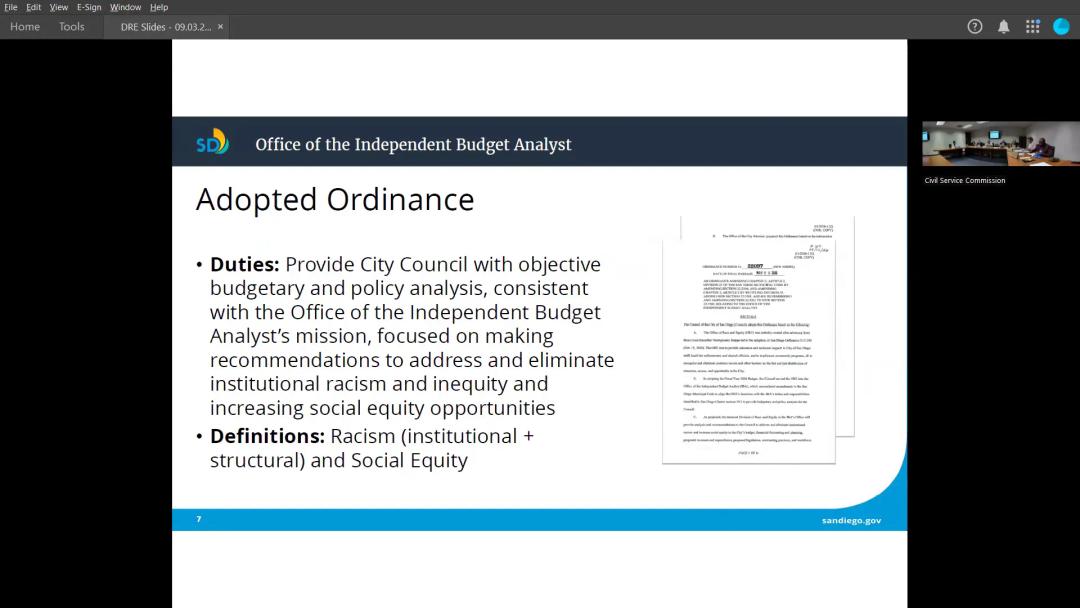
The Civil Service Commission convened on September 4, 2026, with Commissioners President Pico Portillo, Freeman, Merrill, and Moore present (Commissioner Fant absent). The meeting included a closed session with three appeals, approval of consent agenda, consideration of two special leave requests, review of FY2028 salary proposals, presentation of the FY2025 EEO Annual Report and presentation from the Division of Race and Equity, and updates on personnel policies and the reduction-in-force (RIF) process. Consent Calendar - Unanimously approved the regular minutes of the July 2, 2026 meeting (Item 3-12). Public Comments & Testimony - No public comments were made on non-agenda items or closed session items. Discussion Items - Closed Session Report: Three appeals were addressed. James P. Howe's appeal of conviction record disqualification for Building Supervisor was denied 4-0. An anonymous police officer's termination appeal was denied 4-0. James Bice's appeal of termination from Custodian 2 was continued to the next meeting. - Item 13 – Special Leave for Alexandria Gutierrez: Senior Paralegal requested 11-month unpaid leave with job saved for spouse relocation to Spain. The Office of the City Attorney recommended modifying to "name on eligible list" citing operational hardship due to recent resignations and workload. Employee spoke in support. Commission approved the request as filed (job saved) unanimously 4-0. - Item 14 – Special Leave for Jamila Hodges: Parking Enforcement Officer requested 7-month unpaid leave with job saved for son's medical/mental health needs. Stormwater Department recommended modification to name on eligible list due to staffing impacts. Employee spoke in support. Motion to approve job saved passed 3-1 (Commissioner Moore dissenting). - Item 15 – FY2028 Salary Proposals: Staff recommended six proposals for further study; commission approved by unanimous consent. Two additional proposals were debated: - Plant Process Control Electrician (Local 127 request for 30% adjustment): Staff noted a previous 20% recommendation with only 10% implemented through meet and confer. Commission voted not to forward for study (unanimous). - Retirement Assistant (SD SERS request for 10% adjustment): Employee representatives and SD SERS HR Director testified about turnover and pay disparity relative to other clerical classifications. Commission voted to forward for study (unanimous). - Item 16 – FY2025 EEO Annual Report: Staff presented demographic shifts: Hispanic/Latino representation grew from 33.71% to 34.75%; slight decreases in White and African American representation; stable Asian representation. The Division of Race and Equity (DRE) presented their role within the Independent Budget Analyst, tactical equity planning, budget equity implications, and connection to civil service. Discussion focused on underrepresentation in the Fire Department, memo response rates, need for multi-year disinvestment analysis, and retention data. Commission accepted the report. - Item 17 – Personnel Updates: Personnel Director David Gallagher announced a new citywide administrative regulation for fingerprinting allowing out-of-area candidates to be fingerprinted off-site. Update on the Reduction in Force (RIF) process: 48 employees were initially impacted; through promotions, reclassifications, and vacancies, 20 were removed, leaving 28 for placement. Of those, 13 transferred, 11 were demoted, and all were placed by August 14—three months faster than the prior year. Commissioner Moore also presented a memo for commissioner orientation materials. Key Outcomes - Closed Session Decisions: Denied two appeals (Howe and police officer termination) with 4-0 votes; continued Bice appeal. - Special Leave Approvals: Gutierrez leave approved (job saved) 4-0; Hodges leave approved (job saved) 3-1. - Salary Study Decisions: Approved six proposals for further study; denied study for Plant Process Control Electrician; approved study for Retirement Assistant. - EEO Report: Accepted by commission; directed staff to continue tracking department memo responses and include deeper analysis by classification and retention data. - Policy Updates: New fingerprinting AR effective; RIF process concluded for 2026 with all impacted employees placed. - Next Steps: Salary study results to be presented in October-November 2026 and February-March 2027; memo response tracking to be enhanced; EEO report analysis to be expanded.
This meeting of the Anchorage Community and Economic Development Committee (CEDC) was called to order at 9:02 AM on September 4, 2026 (though the transcript references September 3rd). The committee heard a director’s report, a report from the Anchorage Community Development Authority (ACDA), a presentation on the third-party plan review audit, and a presentation from Greater Anchorage Inc. (Fur Rondy). No public testimony was given. No formal votes were taken, but several recommendations were discussed. Director’s Report (Bob Dole, Director of Community Economic Development) - Construction and Development: Valuation of construction activity is up 23% year-over-year by total value. Housing units: 417 units permitted so far in 2026 (compared to 401 all of last year). Subdivision lots: 144 lots under construction, expected to be ready by spring 2027. An Eagle River project of 21 units built for $3.9 million ($186,000 per door, excluding land and off-site) was highlighted as a model for affordability through density. - Permit System: A new smart code permit system is being tested; it will allow simultaneous communication during plan review, reducing delays from 2–3 weeks per round. - Trades Licensure: The state now allows temporary licensure for trades, but the municipality will maintain its own licensing to address bad actors. The $200 fee for municipal contractor licenses remains. - Abbreviated Rezones: The program has processed 20 requests; committee members asked about cost savings from reduced mailing compared to full rezones. - Denali Street Pilot: A winter pilot project to reduce lanes for snow storage, expected to save overtime costs and improve pedestrian safety. Opposition from some Calais Corporation lessees noted; the chair clarified the city’s authority over right-of-way. - Traffic Calming: Collaboration with the state on speed reductions, including traffic feedback signs. The chair noted that NACTO data shows economic benefits of reducing speeds on commercial corridors from 40–45 mph to 30–35 mph. - Right-of-Way Maintenance: Chair flagged issues with snow berms and overgrown brush, and potential for workforce development partnerships. - ABATEMENT Fund: The fund is running low; the administration will incorporate funding requests into the next budget. ACDA Report (Chad Stobel, Development Director) - Housing Focus: ACDA is concentrating on workforce housing (80–120% AMI, termed “foothold housing”). Key initiatives: partnership with UAA for student/workforce housing (letter of intent forthcoming), discussions with Alaska Mental Health Trust Authority, and exploration of modular housing with a Cleveland-based company (Via Build) that offers a lay-flat, lightweight concrete product. - Capital Stack Strategies: Seeking favorable interim construction financing, long-term leases, cooperative housing models (including limited equity co-ops and corporate leases), and technology to reduce vertical construction costs below $100/sq ft. - Acquisition: A property on Burkaw Street acquired for a dense workforce housing complex; RFP expected by end of 2026 with groundbreak in 2027. - Member Questions: Member Baldwin Day requested clarification on “workforce housing” vs. “affordable housing.” Stobel explained the 80–120% AMI target and the need for subsidies. Discussion on modular vertical construction (existing pathways noted) and cooperative models with the National Co-op Foundation. Third-Party Plan Review Audit Report (Daniel King, Engineering Services Manager) - Program Overview: Third-party plan review was expanded in 2024 to include commercial projects (previously only residential). A mandatory 10% audit and a registry of approved reviewers were instituted. The audit report is required annually but sunsets in 2026. - Audit Results (June 2025–June 2026): - Commercial: 600 permits, 1% (8) used third-party review. 2 audits (25% of third-party permits): 1 structural passed with corrections, 1 architectural passed. - Residential: 800 permits, 20% (160) used third-party review. 16 audits: structural – 9 pass, 5 corrections, 2 fails; fire/life safety – 6 pass, 1 correction, 1 fail. - Staffing: Fully staffed since December 2025; plan review times now average 3 days or less (down from 9 days during short-staffing). - Challenges: One reviewer missed major life safety items (lack of fire separation, missing lateral load path) due to pressure from contractors to review faster. He was placed on probation and improved. - Recommendations: 1. Remove the sunset on the third-party review code (now in new code cycle). 2. Make the annual audit report permanent (currently sunsets this year). 3. Change revocation language from “material false statements” to “incompetence or lack of knowledge” (aligns with contractor licensing). - Discussion: Member Brawley (co-sponsor of original expansion) supported keeping the audit. Member Park raised concerns about the extrapolated failure rate (3 fails out of 16 audits) and questioned cost savings. Staff noted that third-party review adds cost (pay both reviewer and reduced city fee) and that faster reviews may lead to missed items. Fur Rondy Presentation (Beth Helgeson, President; Dakota Foujon, Executive Director, Greater Anchorage Inc.) - Winter Tourism: Fur Rondy (93 years old) is a key winter tourism driver, with an estimated $15–30 million economic impact over three weeks, 80,000–100,000 participants, and a 25% increase in hotel occupancy. - Evolution: The festival is modernizing to attract younger demographics and international visitors. Awards include gold from IFEA and recognition from National Geographic. - Community Impact: The booster pin program donates proceeds to school art programs; Running of the Reindeer supports Toys for Tots. Over 100 local businesses and charities participate. - Next Steps: The chair suggested the report be introduced at a future assembly meeting. The committee expressed support for winter tourism initiatives and potential partnerships with the Alaska Native Heritage Center and Nordic skiing events. Key Outcomes - No formal votes were taken. - The committee will consider the third-party plan review recommendations (removing sunset, permanent audit, language change) for future action. Staff urged the committee to find a new sponsor for the ordinance. - The Fur Rondy report will be forwarded to the full assembly for consideration. - The committee noted that committee names may change at the next rules meeting. Note: The transcript indicates the meeting was called to order on Thursday, September 3rd, 2026 at 9:02 AM, but the provided metadata specifies the meeting date as 2026-09-04 17:31:41+00:00. This summary uses the specified date per instructions.
Note: The transcript indicates the meeting was held on September 3, 2026, but the provided date is September 4, 2026. This summary uses the provided date. The Environmental Services Commission met to discuss the proposed 2027-2028 utilities budget and rates, hold a public hearing, and receive an informational presentation on the wastewater remote sensor monitoring program. The meeting included roll call (Commissioners Margolis, Heinosh, Tyson, DePurtis present; Juan and Laxon excused), approval of the agenda, and public comments. Consent Calendar - Approval of the agenda (motioned and seconded, no objections). - Approval of the June 18, 2026 meeting minutes. - Approval of the July 2, 2026 meeting minutes. Public Comments & Testimony - Alex Zimmerman (President of Stand Up America) spoke during both oral communications and the public hearing. He criticized city policies on development, traffic, and budget transparency, calling for more cash-based budgeting and opposing what he described as discriminatory practices. He expressed support for former President Trump and the