Browse by city
Date range
Search help

Search titles, summaries, topics and stored transcripts together. Keywords may match separately; put the whole query in double quotes for a phrase. Matching follows word analysis, so punctuation is not exact. Both dates are included. Documents are not searched.

SHOWING 11–20 ENTRIES
11
AUG 24, 2026 · AURORA, COLORADO · CITY COUNCIL
Aurora City Council Regular Meeting – August 24, 2026

The Aurora City Council met in regular session on Monday, August 24, 2026, with all 11 members present and a quorum established. The agenda and minutes were not provided; this summary is based on the raw transcript. The meeting included approval of prior minutes and an amended agenda, two public comment periods, removal of two collective bargaining agreements from the consent calendar for separate votes, and votes on land-use and financing items. Consent Calendar - Minutes of the August 10, 2026 City Council meeting were adopted unanimously. - The agenda was adopted as amended, removing items 11A4 and 13A and continuing them to the September 14, 2026 council meeting. (The transcript once lists the removed item as 11A1, but later references confirm 11A4.) - Consent calendar on motions: items 10A1 and 10A2 were removed for separate votes; the remaining item 10C1 was adopted unanimously. - Consent calendar on resolutions and ordinances: items 11A1 through 11A3 were adopted unanimously; item 11A4 had been removed from the agenda. Public Comments & Testimony First public comment period - The council unanimously suspended the three-minute timer beep for three members of Joseph Jones's family and later unanimously extended the one-hour public comment limit to hear four additional speakers. - Chloe Des Mullins urged the council to request an independent administrative review of the RTD death investigation and a study session on Aurora Police Department policies on victim treatment, investigative equity, and release of information about deceased victims. - Bridget Jones, Joseph Jones's mother, said her son was hit by a vehicle, then run over and dragged 1,000 feet by RTD bus No. 937 in November 2024. She said the bus driver did not stop, there was no media coverage, and the district attorney's case was closed in two months. Family members Lashonda Pope and Shekwana Jones asked for accountability, with Shekwana Jones saying they were forced to bury Joseph Jones in pieces. - Several speakers criticized police accountability. Anna Harris said Corey Dillard, a military medal recipient, was killed 7.5 seconds after Aurora police arrived at his home. Hashim Coates, Jeffrey McFarland, Paul Nelson, and Tristan Hoost called for the firing of Police Chief Todd Chamberlain and criticized City Manager Jason Bachelor. Paul Nelson, with the Denver Aurora Community Action Committee, demanded a democratically chosen police chief. Tristan Hoost referenced Elijah McClain (called Elijah McLean in the transcript) and Kylan Lewis, and said the consent decree has not been audited. Ayante Anderson, using an ADA accommodation for an extra minute, accused the council of hiding behind procedure. Megan Siffring said the community was watching council votes and expected transparency from the new Office of Public Safety Accountability. - Chad Johnson of Ward 5 opposed Flock/ALPR cameras, stating there are more than 116,000 across the United States, about 100 in Aurora, about 2 million photos per camera per month, and 200 million photos per month in Aurora. He cited abuse by officers in Georgia and security flaws, and asked that the contract be allowed to expire. - Andrew Pinkowitz opposed the council's failure to pass an AI data center moratorium, citing noise, health effects, hyperscale data centers using 10 times the reported water, 56% of AI data centers still powered by fossil fuels, and AI workloads using 3 to 8 times the energy of traditional workloads. - Aaron Fuchell, a member of the RTD Citizens Advisory Commission, criticized the concentration of gas stations along Havana Street and urged the city to pursue creative revenue sources; he also voiced support for the Jones family. - Jason Bailey opposed government debt and urged a no vote on city debt on the November ballot, mentioning the group Citizens for No New Debt. - Della Jordan described an incident at the ADRC/Navigation Center in which a young Black man named Ashley was body-slammed and kneeled on by Advanced Pathways and Dominion Security employees; she said Ashley was suspended and asked for help locating him. - Ken Hampshire said 56th Avenue has been closed for three years after flooding, and he estimated 17,520,000 forced detour miles, over $12.6 million in detour costs, and 36,800 unpaid hours; he asked the city to prioritize reopening the road. - Laura McLaughlin and Veronica Sebron said the Joseph Jones case was part of a pattern and must not be ignored. Comments on consent calendar items - Before the firefighters' and police contracts were voted on, Hashim Coates spoke on both items. He said he supports collective bargaining but opposed using union contracts to shield accountability; he opposed any raise for the Aurora Police Department and called the police union corrupt. - Ayante Anderson spoke against the police contract, listing APD incidents since 2019 and stating a top-step patrol officer salary would rise from $89,000 in 2019 to $126,000 under the new contract, a 41% increase. - During the resolutions consent calendar, Ayante Anderson used her time to sit in silence as a protest over the anniversary of Elijah McClain's death, and Hashim Coates spoke on item 11A3 about Proposition 308 and water policy. Second public comment period - Ayante Anderson responded to the mayor's closing report, saying the city should have honored Elijah McClain and Joseph Jones instead of focusing on her; she said she would make the mayor's remaining time on council difficult. - Bridget Jones continued her family's remarks, asking why the district attorney was not assigned to the RTD case, why there was no media coverage, and why the bus driver kept his license. - Alan Wu raised concerns about subsidies to Gaylord, data centers, Amazon, and a reservoir, as well as water conservation by Gaylord and Niaga bottling. Hashim Coates closed by criticizing the mayor's treatment of grieving families and renewing calls for removal of the police chief and city manager. Discussion Items - Item 10A1 – Firefighters' collective bargaining agreement (IAFF Local 1290): The item was removed from the consent calendar for a separate vote. City staff and the city attorney said a continuance could create severe legal issues because the unions had already approved the contracts and deadlines had passed. A motion to call the question passed 9-2, and the main motion passed 10-1, with Councilmember Jackson opposing. - Item 10A2 – Police collective bargaining agreement (FOP Lodge 49): The item was approved 9-2, with Mayor Pro Tem Coombs and Councilmember Jackson voting no. - Item 12A – Comprehensive plan amendment (Ordinance 202644): Staff said the 18.03-acre parcel east of South Lewiston Way, north of East Arapaho Road, and west of South Olaf Street was previously part of the Centennial de-annexation and is unincorporated. The amendment assigns a commercial hub place type in anticipation of a possible annexation application. No testimony was offered; the item was approved unanimously. - Item 13B – Equipment lease-purchase financing (Ordinance 202646): Treasury Supervisor Andrew Jameson presented the ordinance authorizing up to $10 million in lease-purchase financing at a maximum interest rate of 5.5% for a term not exceeding 60 months, covering fire equipment and public works dump trucks. It was approved unanimously. - Council reports: Mayor Pro Tem Coombs, Councilmember Horton, and Councilmember Wiles apologized for taking up police and fire raises on the anniversary of Elijah McClain's death. Councilmember Jackson said the Joseph Jones case was a disgrace and that research showed the only citation appeared to be against Joseph Jones himself; she said she would follow up. Councilmember Horton said he would work with the RTD board on the case and announced upcoming events, including the Central Library renaming for Edna Wilson Mosley and a Ward One town hall. The mayor's closing report criticized Tay Anderson for gavel-smashing during a prior meeting. Key Outcomes - Minutes and amended agenda adopted unanimously; items 11A4 and 13A continued to September 14, 2026. - Consent calendar items 10C1 and 11A1 through 11A3 adopted unanimously. - Firefighters' collective bargaining agreement approved 10-1. - Police collective bargaining agreement approved 9-2. - Ordinance 202644 and Ordinance 202646 approved unanimously. - The council unanimously suspended the timer beep for the Joseph Jones family and extended the public comment period. - Councilmembers said they would follow up on the Joseph Jones case and collected contact information related to the 56th Avenue closure.
PUBLIC SAFETY 38% · PROCEDURAL 13% · RACIAL EQUITY 12% · PUBLIC ENGAGEMENT 8%
12
AUG 24, 2026 · AURORA, COLORADO · CITY COUNCIL
Aurora City Council Meeting Summary - August 24, 2026

The Aurora City Council convened on August 24, 2026, at 3:01 PM, acting as a committee of the whole for a study session. The meeting covered multiple agenda items, including proposed amendments to food truck regulations, code cleanups related to the Camp Simons decision, and three related data center ordinance items. The council voted to advance several items while deferring the food truck ordinance for further revisions and providing staff direction on data center standards. Consent Calendar - The consent calendar was approved without objection. Discussion Items Item 3A: Food Truck Ordinance (Text Amendment) Councilmember Lawson introduced the ordinance to address issues with food truck operations, particularly overcrowding, waste, safety, and storage. Staff presented changes including: a refined definition, requirement for trucks to be attended, updated noise code reference, mandatory nightly storage on improved surfaces (not residential), and density limits (one truck per 15,000 sq ft lot area, max five per lot). Two options for earlier operation (6:00 AM) were discussed: Option A (construction sites only) and Option B (general 6:00 AM with 50-foot residential buffer). Council discussion revealed divergent views. Councilmember Wiles voiced strong concerns about overregulation in her ward, which is a food desert, and noted that many small, minority-owned businesses rely on food trucks; she also favored a broader 6:00 AM start. Councilmember Jackson questioned the storage requirement, the density limit as too large (15,000 sq ft), and supported an overall 6:00 AM start. Councilmember Bergen supported Option A (construction sites) and suggested a sunset clause. Councilmember Gardner opposed the density limits, citing property rights and overregulation. Councilmember Lawson emphasized the need for controls in dense, multi-owner retail centers like Chambers and Hampden. Councilmember Hancock raised health and sanitation concerns. Councilmember Horton supported construction site early start time. Mayor Pro Tem Coombs expressed concern about trucks parked in residential driveways. Councilmember Lawson ultimately withdrew the item to work with staff and incorporate feedback, with plans to bring it back to a future study session. Item 3B: Repealing Sections of Chapter 94 (Code Cleanup) Deputy City Attorney Megan Platt presented updates to remove mandatory minimums no longer valid after the Camp Simons decision, and to delete outdated violations such as skateboarding enforcement. Councilmember Bergen asked about e‑bike enforcement, which remains unchanged. The item was approved to move forward. Item 5B: Evaporative Cooling Prohibition Staff presented a brief ordinance to prohibit new evaporative cooling technologies for HVAC in commercial, multifamily, and industrial spaces, noting water efficiency gains and similar actions in Las Vegas. Councilmember Gardner asked for state-level assurance that ratepayers won't bear energy cost increases. The item was approved to move forward. Item 5C: Use Table Amendment for Data Centers Staff proposed removing MUOI (Mixed Use Office Institutional) zoning districts from the list of permitted uses for data centers, as these districts are often near neighborhoods. No objections were raised. The item will go to Planning Commission in September and then to council. Item 5D: Data Center Standards Discussion Staff presented an overview of current zoning (data centers allowed in several districts, including mixed-use), possible buffers (quarter-mile, half-mile, mile), and tools such as setbacks, screening, and noise regulations. Council debated whether to treat all data centers uniformly or differentiate by size (e.g., megawatt capacity). Councilmember Gardner objected to the presentation defaulting to quarter-mile buffers, noting many jurisdictions use smaller distances. Councilmember Wiles and Councilmember Bergen advocated for context-specific buffers. After objections from several members (Gardner, Hancock, Lawson, Wiles), council directed staff to return with at least two size categories for data centers. Staff also received direction to investigate smaller buffer distances and to bring back options for setbacks, noise mitigation, and screening (including water‑wise landscaping). Staff will present refined options at a subsequent study session, with evaporative cooling ordinance proceeding directly to council. Key Outcomes - Item 3A (Food Truck Ordinance): Withdrawn for further study and revision; sponsor will bring back to a future study session. - Item 3B (Chapter 94 Repeals): Approved to move forward to regular council meeting. - Item 5B (Evaporative Cooling): Approved to move forward to regular council meeting. - Item 5C (MUOI Zone Removal): Approved; will go to Planning Commission then to council. - Item 5D (Data Center Standards): Staff directed to return with: (1) at least two size categories for data centers, (2) smaller buffer distance options, (3) considerations for noise, screening, and landscaping. No final action taken; item continued.

ZONING AND LAND USE 36% · FOOD TRUCK REGULATION 33% · TECHNOLOGY AND INNOVATION 6% · PUBLIC SAFETY 5%
13
AUG 11, 2026 · AURORA, COLORADO · CITY COUNCIL
Aurora City Council Regular Meeting - August 11, 2026

Note: The transcript listed the date as August 10, 2026, but the provided metadata indicates the meeting occurred on August 11, 2026. This summary uses the metadata date. The Aurora City Council met on August 11, 2026, starting at approximately 6:00 PM. Key agenda items included approval of minutes, adoption of the consent calendar, a pair of competing resolutions on data center regulations (11A5 and 11A6), and a ballot measure to move municipal elections to even-numbered years (14A). The meeting featured extensive public comment on police accountability, environmental concerns, and community oversight. The council voted to reject a six-month data center moratorium resolution (11A5) on a tie vote, but passed a competing resolution (11A6) directing the city manager to propose data center regulations within 35 days. The ordinance to shift municipal elections to even years was approved and will be placed on the November 2026 ballot. Consent Calendar - Unanimously approved the minutes of July 27, 2026. - Adopted the agenda with item 13A (a data center moratorium ordinance) removed after the city attorney noted significant amendments were needed. - Adopted consent calendar on motions (10C1–10C3) unanimously. - Adopted consent calendar on resolutions and ordinances (11A1–11B2) with items 11A5 and 11A6 pulled for separate discussion. Public Comments & Testimony First Session (Items not on the agenda) - Medean Schaffner and others criticized the Aurora Police Department and Chief Todd Chamberlain, citing the death of Rajon Belt Stubblefield and the recent indictment of Officer Matthew Neely. Multiple speakers demanded Chamberlain’s firing, calling for accountability and community control over police. - Della Jordan accused the city council of complicity in police killings and presented a “verdict” of guilty on several charges, including prioritizing police unions over accountability and treating black grief as disruption. - Jeffrey McFarland raised concerns about the Geo Aurora ICE Processing Center, reporting a tuberculosis outbreak and the denial of entry to public health officials. He called for the facility to be shut down. - Cassandra Hill (Denver Aurora Community Action Committee) celebrated the indictment of Officer Neely but demanded further action, including the dismissal of Chief Chamberlain and community oversight of police. - Hashim Coates supported the indictment and urged a full conviction, while also criticizing surveillance and license plate readers. - Kristen Mallory addressed disability access and criticized the city’s removal of turf at the Great Lawn, calling it wasteful during a drought. - Aaron Futrell and Juan Marcano spoke about council rules changes, including removing the one-hour limit on public comment, eliminating remote participation restrictions, and ending security theater. - Zachary Cotton urged the council to pressure the GEO Group over the tuberculosis investigation and questioned a $4 million contract with Integra. - Jeff Brown (with an accommodation for extra time) criticized the city’s retail tax base and presented resolutions for reporting metrics. - Adalika Shepard, Robert Lewis, Shardina Lewis, Paul Nelson, Tristan Hoost, Kyoa Lewis, and Laura McLaughlin all spoke about police violence, naming victims and demanding accountability, including the firing of Chief Chamberlain. Several expressed anger and grief over the deaths of family members. Second Session (Item 11A1 and 11B2) - Ayante Anderson and Medean Schaffner supported the accountability metrics resolution (11A1), citing testimony from Della Jordan about the Aurora Navigation Center. - Hashim Coates spoke against the automated traffic enforcement system (11B2), warning about privacy concerns and the potential for misuse of license plate reader data. Third Session (Items 11A5 and 11A6) - Anita Cabrick, Ayante Anderson, Aditi Desai, Varang Desai, Arvin Martinez, Hashim Coates, Juan Marcano, Chad Johnson, Kristen Mallory, Kathleen Peterson, Christopher Fellows, and Nicholas Bedan spoke in favor of a moratorium or stricter regulations on data centers. They cited concerns about water usage, energy demands, noise, pollution, property devaluation, and environmental racism. Several expressed support for Councilmember Wiles’ resolution (11A5) and criticized Councilmember Gardner for not attending in person. - Chad Johnson noted that the average medium-sized data center uses 300,000–500,000 gallons of water per day. Fourth Session (Item 14A) - Ayante Anderson, Hashim Coates, Kristen Mallory, and Juan Marcano spoke in favor of moving municipal elections to even-numbered years, arguing it would increase voter turnout, reduce political polarization, and improve democracy. They cited studies showing turnout can double when local elections coincide with state and federal races. Discussion Items Data Center Resolutions (11A5 and 11A6) - Councilmember Wiles presented resolution 11A5, which would direct the city manager to not accept new data center applications during a six-month pause while the city develops updated regulations. She emphasized that the resolution was not anti-business but pro-responsible development, citing research showing potential property value decreases of 6–7% for homes within a quarter mile of hyperscale data centers. She noted that existing UDOs were not designed for modern hyperscale facilities and that a temporary pause would allow for proper standards. - City Manager Jason Batchelor provided an overview of current data center regulations: they are allowed by right in five zone districts (I-1, I-2, AD, APZ, and mixed-use office/institutional). The city’s large water user guide effectively bans evaporative cooling, and existing data centers use only 0.3% of the city’s water annually. However, noise standards and setbacks are not specifically tailored for data centers. - Councilmember Gardner presented resolution 11A6, which would direct the city manager to bring forward regulatory changes within 30 days (later amended to 35 days) without a moratorium. He argued that a moratorium creates uncertainty for businesses and that the city can address concerns through the normal legislative process. - Councilmember Hancock questioned the need for a six-month moratorium, noting that the water department already effectively prohibits evaporative cooling and that staff could work on updates alongside existing applications. - Councilmember Andrews expressed concerns about the process, saying the public had not been fully educated and that the city should tour data centers and visit reservoirs before making decisions. - Mayor Pro Tem Coombs proposed an amendment to 11A5 to allow applications only if they meet a half-mile buffer from residential areas and use closed-loop cooling. The amendment failed on a tie vote (5-5), with Mayor Kaufman voting no, arguing that the buffer distance was not yet supported by data. - A second amendment to 11A5 (adding pre-application meetings to the exemption) passed on a tie vote with Mayor Kaufman breaking the tie in favor. - The final vote on 11A5 as amended resulted in a tie, and Mayor Kaufman voted no, causing the resolution to fail. - For 11A6, the sponsor accepted friendly amendments to strike Section 2 (which had exempted certain applications) and extend the timeline to 35 days. A motion to continue the item to the August 24 study session failed (5-6). The resolution then passed on a 7-3 vote (Councilmembers Coombs, Jackson, and Medina dissenting). Municipal Elections (Item 14A) - Councilmember Jackson sponsored the ordinance to place on the November 2026 ballot a charter amendment to move municipal elections to even-numbered years. She argued that this would increase voter participation, reduce the influence of partisan rhetoric, and allow for better intergovernmental coordination. - Councilmember Hancock opposed, stating that off-year elections give local issues the attention they deserve and that moving to even years would nationalize local politics. - Mayor Pro Tem Coombs supported the change, noting that higher turnout is a hallmark of democracy. - The ordinance passed 6-4, with Councilmembers Bergen, Gardner, Hancock, and Lawson voting no. Key Outcomes - Item 11A5 (Data Center Moratorium Resolution): Failed on a tie vote (5-5) with Mayor Kaufman breaking the tie by voting no. - Item 11A6 (Data Center Regulations Resolution): Passed 7-3. The city manager is directed to bring forward proposed ordinances within 35 days, including a ban on evaporative cooling, and to study noise, setbacks, and other zoning issues. No moratorium is imposed. - Item 14A (Municipal Elections Charter Amendment): Passed 6-4. The ordinance will be submitted to voters at the November 3, 2026 coordinated election. - Consent Calendar: Approved unanimously. - Council Reports: Several councilmembers reported on upcoming community events, including a town hall on the renaming of the Central Library (August 15), a housing strategy feedback session (August 20), and a water tour to inspect reservoirs.

PUBLIC SAFETY 23% · PROCEDURAL 22% · ENVIRONMENTAL PROTECTION 10% · COMMUNITY ENGAGEMENT 9%
14
AUG 11, 2026 · AURORA, COLORADO · CITY COUNCIL
Aurora City Council Study Session – August 11, 2026

On August 11, 2026, the Aurora City Council held a study session to discuss updates to public notice and appeal processes for development applications, a proposed socioeconomic impact permit, financing for heavy fleet vehicles, amendments to council rules of order and procedure, and an appointment to the Fitzsimons Redevelopment Authority (FIC). Mayor Kaufman presided, and the following council members were present: Andrews, Bergen, Coombs, Gardner, Hancock, Horton, Jackson, Lawson, Medina, and Wiles. No mayor’s or issue updates were given. The consent calendar (items 2A–2D) was approved without objection. Consent Calendar - Items 2A through 2D were moved forward without objection. Public Comments & Testimony - No formal public comment period was held. During the rules discussion, Mayor Pro Tem Coombs mentioned receiving email feedback from the public regarding proposed changes to the public comment periods, but no testimony was taken. Discussion Items 3A – Notice and Appeals Unified Development Ordinance (UDO) Update Senior Planner Sarah Weil presented an overview of the project, which aims to balance transparency with efficiency in development review. Staff research from eight Front Range communities showed wide variation in mailed notice, sign posting, and appeal procedures. Council provided initial feedback on six policy questions: - Question 1 (Explore options): No objection to moving forward. - Question 2 (Enhanced notice for public hearings vs. administrative decisions): Councilmember Bergen objected, but the item moved forward. Several members discussed the rationale for differentiating notice, with concerns raised about community input on administrative approvals. - Question 3 (Expand mailed notice to a buffer area): No objection. Mayor Pro Tem Coombs supported using a defined buffer rather than adjacent owners only. - Question 4 (Sign postings at the start of projects requiring a public hearing): No objection. Staff noted that signs would be placed and removed during the first review period to avoid prolonged posting. - Question 5 (Appeals of administrative decisions – direct to council or via Planning and Zoning Commission): After initial confusion, Councilmember Bergen ultimately expressed support for the current system (direct to council) but then objected; the item nevertheless moved forward. - Final question (Other changes): Mayor Pro Tem Coombs suggested including tenants in notice requirements; no objection was raised. 3B – Socioeconomic Sales and Service Impact Permit (SSIP) Trevor presented the proposal to prevent clustering of high-risk businesses (liquor stores, payday lenders, vape shops, etc.) by attaching a permit to the general business license. Key elements include 300-foot spacing between such uses, 1,000-foot separation from extended-stay motels, and a prohibition on these uses in retail centers with more than 50% vacancy or exhibiting blight. The permit would fund place-based crime prevention (CPTED) and risk terrain modeling. Councilmember Bergen asked about enforcement, grandfathering, and the vacancy rule. Mayor Pro Tem Coombs noted that feedback from a business town hall helped shape exemptions for small grocery stores. The item moved forward without objection. 3C – 2026 Lease Purchase Financing for Heavy Fleet Vehicles Andrew Jameson presented an ordinance to authorize up to $10 million in lease purchase financing for 13 heavy fleet vehicles, including four fire apparatus (two ladder trucks and two engines) and four dump trucks. The financing term is 60 months with a maximum interest rate of 5.5%. Approved at the Management and Finance Committee. No questions were raised, and the item moved forward. 5A – Rules of Order and Procedure Amendments Mayor Pro Tem Coombs led discussion on proposed changes to council rules. Key amendments addressed the censure process: - Censure resolutions would first be reviewed by the city attorney, who would present legal analysis in executive session. A consensus of council is required to move forward. - The threshold to pass a censure resolution was raised from two-thirds (six votes) to three-fourths (seven votes) after Councilmember Bergen argued for a higher bar to prevent politicization. Councilmember Hancock and others supported the change. - Sanctions beyond public admonishment (e.g., removal from committee assignments, forfeiture of travel budget) require a three-fourths vote. The default sanction remains public admonishment. - City Attorney Pete agreed to add language that censure is intended for egregious conduct that council cannot overlook. - Also discussed: restoring public comment to two one-hour periods (first hour with priority for students 18 and under, second hour for those who did not speak earlier). Mayor Pro Tem Coombs stated she would send amendments based on public feedback for the regular meeting. - Section 12 (censure) was moved forward with the three-fourths threshold; no objection. 5B – Appointment to Fitzsimons Redevelopment Authority (FIC) Mayor Pro Tem Coombs noted a vacancy on the FIC board. Councilmember Hancock expressed interest, and Councilmember Andrews also volunteered. A vote was taken: Councilmember Andrews was appointed to the FIC with support from the mayor, Councilmember Hancock, and Councilmember Andrews (self-nomination). Key Outcomes - Status of 3A (UDO Update): Staff will continue exploring options and bring forward code amendments in early 2027, incorporating council’s feedback on notice, appeals, and tenant inclusion. - Status of 3B (SSIP): The proposal will proceed to a regular meeting for a vote; direction was given on spacing, vacancy restrictions, and exemptions. - Status of 3C (Lease Purchase): The ordinance will be presented for adoption at a regular meeting. - Status of 5A (Rules Amendments): The censure threshold was changed to three-fourths; the city attorney will add egregious conduct language; other amendments will be submitted for the regular meeting agenda. - Appointment: Councilmember Andrews was appointed to the FIC board, filling the vacancy.

PROCEDURAL 23% · PUBLIC ENGAGEMENT 21% · PUBLIC SAFETY 19% · PERSONNEL MATTERS 18%
15
JUL 27, 2026 · AURORA, COLORADO · CITY COUNCIL
Aurora City Council Regular Meeting – July 27, 2026

The Aurora City Council held its regular meeting on Monday, July 27, 2026. Present were Mayor Kaufman, Mayor Pro Tem Coombs, and Councilmembers Andrews, Hancock, Horton, Jackson, Lawson, Medina, and Wiles; Councilmembers Bergen and Gardner were excused. The meeting opened with the pledge, a prayer, and a land acknowledgement, and the council received an executive session update on labor and contract negotiations. The council approved consent items, referred a charter amendment to the November ballot, and heard a lengthy public hearing on a proposed gas station, convenience store, liquor store, and restaurant project known as All-in-One Harmony Commercial. The conditional use failed on a 3–4 vote, and the related site plan was remanded to the Planning Commission. Consent Calendar - Approved the minutes of July 13, 2026, and adopted the meeting agenda. - Approved the consent calendar for motions (items 10A1–10C2) unanimously. - Approved the consent calendar for resolutions and ordinances (items 11A1–11B1) unanimously. - Approved the annexation items 15A–15J as a group after unanimously suspending council rules; no public speakers were signed up for those items. Public Comments & Testimony - First public invited-to-be-heard period: Jerry Drinsky opposed the city's settlement with activists, calling them “race hustlers.” Medina Schaffner said “we will be coming back,” described an alleged detective lie that led to a young man's arrest, and demanded that Police Chief Todd Chamberlain be fired. Aonte Anderson criticized decorum rules and recalled people she said were killed by Aurora police (Kylene Lewis, Ray John Belt Stubblefield, Elijah McLean), arguing the council could fire the city manager who hired the police chief. Della Jordan detailed shelter complaints, including suspensions, lost medication, and requests for compensation, and called for removal of the company Advanced Pathways. Jeffrey McFarland (Ward 1) raised a tuberculosis outbreak in a detention center, the $5–6 million consent-decree monitor that he said had never been audited, and contracts with GEO, an AI data center, and a water bottling company. Nate Weaver urged raising water restrictions to Level 2 and pursuing long-term water solutions. Ali DeWills Marcano supported $2 million accessibility upgrades to the council chamber, noting Aurora's more than $2 billion in capital needs. Cassandra Hill (Denver Aurora Community Action Committee) advocated community control over police, including an elected civilian board with authority over police chief hiring/firing, budget, and discipline. Shadina Lewis spoke about her grandson killed by an Aurora police officer. Robert Lewis, father of Kylene Lewis, demanded an end to killings of unarmed Black men. Tristan Houston criticized police shootings, called for firing the police chief, and said the city manager should not lead the new oversight board. Francisco Soto complained about slow, costly records requests, body-camera footage fees, and a records clerk removing documents about Ridge Hill Apartments. - Item 13B speakers: Hashim Coates supported the even-year election referral, calling opposition voter suppression and saying it would end the era of certain council members. Juan Marcano (Ward 4) also supported it, citing higher turnout and examples from Parker, Castle Rock, and Boulder. - Item 16A/16B public hearing: Opponents included Mark Saxolby, Aditi Desai, Erika Sanders, Shelby Moore, Cameron Moore, Arvin Martinez, Rihanna Athey, and a former gas station owner and Harmony resident. They cited concerns about neighborhood character and quiet hours, crime, property values, light and air pollution, traffic, hours of operation, the applicant's financial history and pattern of building and selling stations, and a petition with nearly 800 signatures. Several said they were not anti-development and preferred coffee shops, restaurants, childcare, or other uses. Supporters included Jason Handal, Envir Purewall (the applicant's wife), Varon Sai, Aura Carr, Suki Dillon, Harkeron, Sam Chahal, and Navia Nagra. They cited convenience, local family ownership, tax revenue, jobs, the applicant's concessions (reduced hours, good-neighbor agreement), and safety features such as 24/7 cameras and license plate readers. - Second public invited-to-be-heard period: Aonte Anderson again criticized council members and called for accountability. Ellen Wu discussed the 2012 Niagara bottling contract, drought, and the need for city decisions driven by community voices rather than political or personal gain. Discussion Items - Ordinance 202632 (Item 13A): Staff member Jeffrey Moore presented a clarification to Oil and Gas Advisory Committee membership: five citizen members must be Aurora residents, while the three industry representatives and three surface/property owners may be from outside the city. Mayor Kaufman noted a 5–6 resident/non-resident balance concern; Councilmember Hancock supported the stakeholder structure. The council approved the ordinance unanimously. - Ordinance 202641 (Item 13B): Councilmember Jackson sponsored a referral to the November 3, 2026 coordinated election to move municipal elections from odd to even-numbered years. Under the proposal, terms of officials elected in 2027 and 2029 would be shortened by one year to transition to even-year elections beginning in 2030/2032. The city attorney clarified term-limit impacts. Councilmember Horton said she wanted voters to decide the issue; Mayor Kaufman cited coalition-building opportunities. Councilmembers Lawson and Hancock opposed, predicting lower ballot drop-off and higher campaign costs for local nonpartisan races. The ordinance passed 6–2, with Lawson and Hancock voting no. - Ordinance 202642 (Item 13C): Sergeant Stevenson Carey presented automated vehicle identification system (AVIS) amendments required by Senate Bill 26-152, effective August 12, 2026. The system switches to registered-owner civil liability, removes driver-photo requirements, and updates penalties; city programming triggers only at 11 mph or more over the limit, and 25+ mph carries a maximum $120 penalty. Dismissal requires proof of sale, theft, or death of the registered owner. The ordinance was approved unanimously. - Annexations (Items 15A–15J): Council unanimously suspended rules to hear the annexation items as a group; no public speakers were signed up, and the items were approved unanimously. - All-in-One Harmony Commercial (Items 16A/16B): The council held a public hearing on a call-up of the Planning Commission's 6–0 approvals. Staff planner Ani Karabashian summarized the 1.45-acre site on the southeast corner of Alameda Avenue and South Powhatan Road, proposing a 9,767-square-foot multi-tenant building with three tenant spaces, one fuel canopy, and a patio. Hours of operation were proposed as 4 a.m.–11 p.m. for fuel and convenience, 8 a.m.–11 p.m. for liquor, and 6 a.m.–10 p.m. for the restaurant. Applicant Manraj Singh described his Aurora background, the store design, projected tax revenue, and safety features. He said he had built five stations and currently owns three. Mayor Kaufman and Councilmember Wiles recused from the item; the city attorney also recused from advising, and Chief Deputy Holly Burkholz provided legal counsel. Council discussion was limited to the approval criteria. A motion to approve the conditional use (16A) failed 3–4, with yes votes from Hancock, Horton, and Lawson and no votes from Andrews, Coombs, Jackson, and Medina. The conditional use therefore was not granted. A motion to remand the site plan (16B) to the Planning and Zoning Commission passed unanimously. Council Reports - Councilmembers reported on the 720 Memorial events and 5K, the midnight vigil, Camp Spark, Aurora Youth and Families Night at Moorhead Recreation Center, Ward town halls, the Korean War Memorial ceremony, and the upcoming Boards and Commissions Convention on August 6. Reports also included information about tree-canopy reimbursement, watering trees during drought, and upcoming Ward 2 and Ward 5 meetings. Key Outcomes - Approved the minutes and the agenda. - Approved consent calendars for motions and for resolutions/ordinances. - Approved Ordinance 202632 (Oil and Gas Advisory Committee membership clarification) unanimously. - Approved Ordinance 202641 (referred even-year municipal election charter amendment to the November 3, 2026 ballot) 6–2. - Approved Ordinance 202642 (AVIS speed enforcement amendments) unanimously. - Approved annexation items 15A–15J unanimously. - Failed to approve the conditional use for All-in-One Harmony Commercial (Item 16A) by a 3–4 vote. - Remanded the related site plan (Item 16B) to the Planning and Zoning Commission unanimously.

COMMUNITY ENGAGEMENT 27% · PUBLIC SAFETY 13% · ENGINEERING AND INFRASTRUCTURE 11% · PROCEDURAL 10%
16
JUL 27, 2026 · AURORA, COLORADO · CITY COUNCIL
Aurora City Council Study Session: July 27, 2026 – GEO TB Outbreak, Navigation Campus, ADA Chambers, Election Timing

The Aurora City Council held a study session on July 27, 2026, addressing multiple agenda items including a public health statement regarding a tuberculosis outbreak at the GEO detention facility, a resolution on the Aurora Regional Navigation Campus, ADA compliance upgrades to council chambers, and a proposed charter amendment to move municipal elections to even-numbered years. Key decisions included authorizing a statement on the GEO outbreak, advancing the Navigation Campus resolution, approving design and contractor procurement for chamber renovations, and advancing the election timing measure to the ballot. Consent Calendar - Item 2.8–2e: An ordinance update to align local law with state legislative changes regarding automated vehicle identification systems (excluding license plate readers). Moved forward without objection. Discussion Items 1. GEO Facility Tuberculosis Outbreak Statement - Mayor Pratem and Mayor Kaufman presented a draft statement urging GEO to cooperate with Adams County Public Health after at least one confirmed TB case (later reported as 12 cases) and GEO’s refusal to allow health officials access. The statement emphasizes public health, not immigration enforcement. - Councilmember Bergen questioned the role of the health department. Mayor Pratem clarified that Adams County Public Health was denied entry. Councilmember Hancock noted GEO did not notify AFR (Aurora Fire Rescue) as required by a recently enacted city ordinance effective July 25, 2026. The city attorney indicated that new violations after that date could incur penalties, but existing cases predate the ordinance. - Councilmember Lawson mentioned an update from Congressman Crow’s office on July 15 confirming one case but added that detainees were reporting additional positives. No confirmed secondary cases because health officials cannot investigate. - Outcome: Council unanimously supported issuing the statement via communications; no objection noted. 2. Aurora Regional Navigation Campus Resolution (Item 3A) - Councilmember Horton introduced the resolution to formalize performance metrics, reporting, and accountability for the navigation campus operated by Advanced Pathways. Key metrics include medical respite services by July 1, 2027, subject to renovation completion. - Jim (Advanced Pathways) confirmed reporting requirements are consistent with the operator agreement and will not require new hires. The only unresolved point was board meeting minutes (7B). Respite rooms not yet available due to tower renovations; completion expected in 3–6 months. DCM Venegas added the July 2027 deadline is flexible and non-binding. - Councilmember Lawson asked about reporting cadence. Councilmember Horton noted six-month reporting is referenced in 9B. Councilmember Wiles praised the transparency for taxpayer investment, noting 75% of the operating budget is privately funded. - Councilmember Bergen asked if similar accountability would apply to all nonprofits. No direct answer. - Outcome: Moved forward without objection. 3. Council Chambers ADA Improvements - Staff presented findings from a January 2026 assessment: wheelchair spaces not vertically dispersed, non-conforming lift, inaccessible path to dais. Proposed base scope (≈$1.4M) includes two ramps (one to dais, one to floor), companion seating, and other fixes. Alternate (≈$575,000 additional, total ≈$2M) adds rebuilding the dais for better behind-desk circulation and lowers dais height slightly. - Councilmember Bergen and others supported the alternate for future-proofing and cost savings over later retrofits. Councilmember Hancock raised security and sightline concerns; staff confirmed dais would remain elevated. Mayor Pratem suggested exploring hybrid in-person/virtual meetings during construction (e.g., using APS facilities). Councilmember Bergen opposed delay; consensus was for staff to return with public meeting options later. - Outcome: (a) Proceed with final design and contractor selection (CMGC at risk). No objection. (b) Include the dais alternate in project scope. No objection. (c) Staff to bring back options for public participation during construction (virtual vs hybrid). No objection. 4. Charter Amendment – Timing of Municipal Elections (Item 5A) - Councilmember Jackson proposed moving city elections to even-numbered years to boost voter turnout, citing increased participation in other municipalities. Cost difference: e.g., 2022 midterm cost $300,000 vs. 2025 odd-year cost $70,000. - Councilmember Bergen opposed, arguing local races get buried, voter fatigue, competition for fundraising, and increased outside influence. Councilmember Hancock echoed concerns about dilution and national agenda intrusion. Councilmember Lawson worried the amendment would overshadow three Build Up Aurora ballot questions and suggested delay. Councilmember Wiles noted cost allocation from counties needs scrutiny. Mayor Pratem countered that the measure merely asks voters to decide, not council. - Vote on moving the item forward: 4 in favor (including Mayor Pratem, Councilmember Jackson, others?), 4 opposed (Bergen, Hancock, Lawson? Actually transcript:

HOMELESSNESS 16% · PUBLIC HEALTH 15% · PROCEDURAL 15% · DISABILITY RIGHTS 15%
17
JUL 13, 2026 · AURORA, COLORADO · CITY COUNCIL
Aurora City Council Regular Meeting – July 13, 2026

The Aurora City Council met on Monday, July 13, 2026, for a regular meeting that included public comment, consent calendar approvals, multiple annexation and zoning items, a deferred ordinance on the oil and gas advisory committee, and councilmember reports. The meeting was called to order at approximately 6:00 p.m. with a quorum present. Consent Calendar - Minutes Approval (June 22, 2026): Adopted unanimously. - Consent Calendar for Motions (Item 10C1): Adopted unanimously. - Consent Calendar for Resolutions and Ordinances (Items 11A1–11A3): Adopted unanimously. Public Invited to Be Heard Approximately 15 community members spoke during the public comment period. Key themes included: - Police accountability and oversight: Multiple speakers called for the removal of Police Chief Todd Chamberlain and criticized the new Office of Public Safety Accountability. One speaker referenced Denver’s oversight board as ineffective. - Water and environmental concerns: Speakers voiced opposition to fracking near the Aurora Reservoir and raised concerns about water usage by data centers and bottling plants. A speaker noted that the two largest water users are Niagara Bottling (300 gallons per day) and data centers (500,000 gallons per quarter each, with nine centers in Aurora). - Housing and homelessness: Several speakers reported unsafe conditions at the Aurora Navigation Center and called for better services. One speaker described a veteran panhandling at an intersection without improvement. - Community engagement: Speakers urged council to listen to residents and criticized councilmembers for inattentiveness (e.g., using phones during public comments). - Apprenticeship programs: A speaker from a union advocated for supporting apprenticeships and skilled trades. Agenda Items - Item 12A – Sand Creek Metro District Service Plan Amendment: Public hearing on Resolution 2026-81 to increase the district’s debt limit from $105 million to $200 million for infrastructure on remaining 100 acres. Approved unanimously. - Item 13A – Oil and Gas Advisory Committee Membership (Ordinance 2026-32): Staff proposed clarifying that industry and property-owner representatives need not be Aurora residents. Councilmember Horton moved to continue the item to July 27, 2026, citing need for further due diligence. The motion passed 7-3 (Councilmembers Bergen, Hancock, and Lawson opposed). - Item 13B – IT Property Acquisition Authority (Ordinance 2026-33): Fifth annual renewal allowing the CIO to enter lease-purchase agreements. Approved unanimously. - Items 15A–15E – Annexation and Zoning for Gun Club Road and East Biode Avenue: Series of annexation and initial zoning for two parcels totaling 20.49 acres (MUR zoning) and two parcels totaling 46.6 acres. All actions (resolutions, ordinances, zoning) passed unanimously. - Items 15F–15G – Annexation and Zoning for South Gun Club Road and East Alameda Avenue: Initial zoning for a 10-acre parcel (MUR) and a 35.7-acre parcel (R3 medium-density multifamily). Thunderbird Estates residents raised concerns about well water and drainage; staff stated those issues would be addressed at the development plan stage. Both passed unanimously. - Items 15H–15J – Annexation for 165-Acre Parcel at 56th Avenue and Valley Head Street: Initial zoning to Airport District (AD) for industrial/commercial use. No public comment. Passed unanimously. Councilmember Reports Councilmembers provided updates on city activities: - Horton: Reported on a sister cities meeting, 4th of July celebrations, a conference on local government, and an upcoming Youth and Families Night (July 22). - Wiles: Summarized a data center town hall, the Baltimore conference, softball tournament awards, and the Day of Resilience 5K (July 25). - Hancock: Noted a well-attended town hall, the 4th of July fireworks, and a Freedom Summer Camp visit. - Lawson: Announced re-election to the Colorado Municipal League executive board, legislative updates (the 21st Century Road to Housing Act signed into law July 11), and an upcoming committee meeting on county health department presentations. - Bergen: Discussed the CML conference (AI, data centers, housing), E470 board meetings, Skywatch Park art selection, and a waste management facility ribbon cutting. - Kaufman: Reminded of an upcoming town hall on July 23. Additional Public Comment After reports, several community members spoke again, reiterating concerns about water, fracking, data centers, and the treatment of residents. One speaker criticized councilmembers for phone use during public comments. The meeting was then adjourned.

ENGINEERING AND INFRASTRUCTURE 22% · PUBLIC SAFETY 13% · PROCEDURAL 12% · COMMUNITY ENGAGEMENT 12%
18
JUL 13, 2026 · AURORA, COLORADO · CITY COUNCIL
Aurora City Council Study Session on ADU Policy and Rules Amendments – July 13, 2026

The Aurora City Council held a study session on July 13, 2026, addressing two major items: a re-evaluation of Accessory Dwelling Unit (ADU) regulations and proposed amendments to the council's Rules of Order and Procedure. The council provided direction to staff on ADU expansion and debated significant changes to public comment procedures, council reports, budget carryovers, and censure processes, with several amendments adopted. Accessory Dwelling Unit (ADU) Re-evaluation Planner Jeremy Fedig presented findings from community inquiries and discussions with PED committees. Since 2023, staff documented 262 ADU inquiries citywide (44 in 2026 as of June 1), with Ward I showing the most interest. Currently, ADUs are only permitted in original Aurora on alley-served lots via conditional use permit (CUP); only 9 have been approved since 2018, with 5 constructed. Staff proposed allowing internal, attached, and detached ADUs citywide with administrative approval and architectural standards, while tying detached ADU size to primary dwelling size. Council directed staff to proceed with drafting a text amendment ordinance incorporating feedback from PED and study session, expected to take 6–8 months. Specific questions: - Question 1: Do council members support administrative approval for detached ADUs (instead of CUP)? Consensus: yes, with robust standards. - Question 2: Should detached ADU size maximums be tied to home size? Consensus: yes, staff to research and formalize. - Question 3: Should staff advance a text amendment ordinance? Consensus: yes. Councilmember Bergen lightheartedly asked if a shed would count; Mayor clarified no. Rules of Order and Procedure Amendments Mayor Pro Tem Coombs presented a comprehensive set of amendments developed by the rules committee, covering multiple sections. The council debated each section, sometimes splitting items or amending them. Key discussions and outcomes: - Section 1 (Study sessions, workshops): Eliminated requirement for prior study session to set workshop agenda; allows Mayor Pro Tem to set agenda. Adopted without objection after discussion about timely agenda distribution. - Section 2 (Virtual attendance): Allows remote appearance including off-camera. Adopted. - Section 3 (Dais seating): Removed voluntary seat-swapping provision. Adopted. - Section 4 (Agenda items): Removed court administrator from list of those who can place items; now only council appointees (mayor, city manager, presiding judge, chief public defender). Adopted. - Section 5 (Agenda packet): Requires publication at least 5 days before meeting. Adopted. - Section 6 (Parliamentarian): City Attorney serves as parliamentarian. Adopted. - Section 7 (Order of business): Major debate on two sub-items: - Council reports: Councilmember Bergen proposed keeping reports at the end (current practice). An amendment to move reports after public invited to be heard failed; Council voted 5–? to keep reports at end. - Youth public comment: Councilmember Bergen proposed integrating youth (18 and younger) into the regular one-hour first public comment period, prioritizing them, rather than a separate 30-minute segment. Adopted. Mayor Pro Tem Coombs then successfully amended to add the removed 30 minutes to the end of the meeting (second public comment), creating up to one hour at both ends. Final: first public comment up to one hour (youth prioritized), second up to one hour for those who haven't spoken. - Section 8 (Public participation): Clarified speaker sign-up, three-minute limit, sanctions for exceeding time (striken from next meeting's public comment). Councilmember Gardner added requirement that speakers state their name, residency, and association with Aurora; staff to include in decorum statement. Adopted. - Section 9 (Travel/training budget carryover): Proposed limiting carryover to $3,000 annually, with unused excess returned to general fund. Councilmember Bergen objected; Councilmember Gardner argued against forced return, suggesting it encourages wasteful spending. Mayor Pro Tem Coombs proposed an amendment allowing council members to voluntarily return unspent funds rather than mandatory reversion. Adopted. - Section 10 (Ballot initiatives): Clarified no city funds for support/opposition; council members may use personal funds. Adopted. - Section 11 (Professional conduct): Statement of expectation. Adopted. - Section 12 (Censure process): Introduced a three-step process – finding of violation (majority), sanction phase (two-thirds for any sanction beyond public admonishment), default to public admonishment if no sanction gets two-thirds after three motions. Discussion revealed concerns about political weaponization and subjectivity. Councilmember Bergen asked for guardrails; Councilmember Lawson asked about ability to hire personal attorney. City Attorney suggested possible changes to vote thresholds. Item deferred to next meeting for further refinement. Key Outcomes - ADU expansion: Council directed staff to draft a text amendment allowing internal, attached, and detached ADUs citywide with administrative approval and size tied to primary dwelling. Timeline: 6–8 months. - Rules changes: Most sections adopted with amendments as described, except Section 12 (censure) held for further work. Specific decisions: - Council reports remain at end of agenda. - Youth prioritized in first hour of public comment; second hour added. - Travel budget carryover capped at $3,000, with voluntary return option. - Speakers must state residency/association; sanctions for overtime. - Next steps: Staff to bring back revised rules ordinance reflecting study session direction, and to return with a refined censure process in two weeks.

PROCEDURAL 57% · AFFORDABLE HOUSING 15% · PUBLIC ENGAGEMENT 13% · BUDGET EQUITY ANALYSIS 7%
19
JUN 22, 2026 · AURORA, COLORADO · CITY COUNCIL
Aurora City Council Meeting – June 22, 2026: Budget, Ballot Measures, and Detention Oversight

The Aurora City Council met on June 22, 2026, at 6:00 p.m. to consider a wide range of items including the approval of minutes, consent calendar, several ballot measures for the November 2026 election, detention facility oversight ordinances, a budget supplemental, and appointments. The meeting featured extensive public comment, primarily from community members demanding accountability for police violence and the firing of Police Chief Todd Chamberlain. After deliberation, the council passed most items, often with divided votes on issues related to police funding, public defender staffing, and detention facility oversight. Consent Calendar - Minutes of June 8, 2026: Approved as amended (friendly amendment by Mayor Pro Tem Coombs to correct vote order on a previous ordinance). - Agenda: Adopted. - Consent Calendar on Motions (Items 10C1–10C3): Adopted unanimously. - Consent Calendar on Resolutions and Ordinances (Items 11A1–11A4, 11A6–11A10, 11B1–11B6, 11B10): Adopted unanimously, with Items 11A5, 11A11, 11B7, 11B8, and 11B9 pulled for separate consideration. Public Comments & Testimony - Police Accountability and Chief Todd Chamberlain: Dozens of speakers, including family members of those killed by Aurora Police (e.g., Kylan Lewis, Jordell Richardson), called for the firing of Chief Todd Chamberlain and criticized the city manager Jason Batcher. Speakers described systemic racism, excessive force, and lack of accountability. Many opposed additional funding for APD. - Rental Registry (Item 11A7): Multiple speakers (e.g., Dre Chiriboga, Doug Evans, Gia Nayas) supported a rental registry and licensing program to hold landlords accountable, citing unsafe conditions and need for enforcement. Some speakers urged including property owners and real estate stakeholders in the process. - Detention Facility Oversight (Items 14A & 14B): Advocates (including State Representative Nikita Rix) spoke in favor of ordinances requiring habitability inspections and communicable disease reporting at detention facilities, especially the GEO Group ICE facility. They cited deaths and poor conditions. - Ballot Measures (Items 11B7, 11B8, 11B9): Several speakers (e.g., Jeff Brown, Medine Schaffner, Cassandra Hill) opposed the three tax and bond measures, arguing they lacked binding project lists, would fund police without accountability, and were developed without adequate community trust. Some supported transportation improvements but wanted clearer guardrails. - Other Topics: A speaker raised security issues regarding plastic water bottle bans; another praised Aurora Fest and interactions with councilmembers; others discussed the Aurora Works Initiative, the SAVE program, and ambulance fee increases. Discussion Items - Item 11A5 – Edward Byrne Justice Assistance Grant: Staff presented a $325,411 grant (Aurora’s share $304,039) for police equipment. Approved unanimously. - Item 11A11 – Aurora Family Plan Initiative (Resolution): Sponsored by Councilmember Jackson, this resolution directs the city manager to create a working group to evaluate services for families. Councilmember Bergen requested a fiscal note; Jackson stated existing staff would absorb the work. After debate over process, the resolution passed 7–3 (Bergen, Hancock, Lawson opposed). - Items 11B7, 11B8, 11B9 – Ballot Measures (Community Facilities, Public Safety, Transportation): Deputy City Manager Laura Perry presented three proposed ordinances to be placed on the November 2026 ballot, each authorizing a sales tax increase and revenue bonds. The measures fund specific Tier 1 projects listed in prior council resolutions, with an oversight committee to be formed. Questions focused on whether future councils could redirect funds. The city attorney clarified that the listed projects are binding, but excess sales tax revenue could be repurposed by a future council. All three measures passed: 11B7 (unanimous), 11B8 (9–1, Jackson opposed), 11B9 (unanimous). - Item 14A – Detention Facility Inspections (Ordinance): Final reading. Requires periodic habitability inspections of all detention facilities in Aurora. Passed 6–4 (Bergen, Gardner, Hancock, Lawson opposed). - Item 14B – Detention Facility Disease Notification (Ordinance): Requires facilities to report communicable diseases to Aurora Fire within 48 hours. Passed 6–4 (same opposition). - Item 14C – 2026 Spring Budget Supplemental: The ordinance included adjustments for FY2025 and FY2026. Councilmember Bergen had previously moved to delay transferring three public defender FTEs from non-departmental to the public defender’s budget until fall budget talks. An amendment to undo that delay (i.e., include the transfer) passed 6–4 (Bergen, Gardner, Hancock, Lawson opposed). The main motion then passed 7–2 (Hancock and Lawson opposed). - Item 17A – Downtown Development Authority Board Appointments: Nine members appointed to the inaugural DDA board on staggered terms. Approved unanimously. Key Outcomes - Votes on Ballot Measures: The council approved three ordinances (11B7, 11B8, 11B9) to place sales tax and bond questions on the November 3, 2026 ballot. Each measure would increase the sales and use tax by 0.064% for 30 years: for community facilities ($47M+ bonds), public safety ($53M+ bonds), and transportation ($41M+ bonds). - Detention Facility Oversight Passed: Both ordinances (14A and 14B) passed, requiring inspections and disease reporting at all detention facilities, including the GEO Group ICE facility. - Public Defender Staffing: The council voted to immediately transfer three FTEs from non-departmental to the public defender's budget, reversing a prior delay. The funds were already being used for variable-hour employees. - Family Plan Initiative Approved: The resolution creating the Aurora Family Plan working group passed despite concerns over fiscal impact and committee process. - DDA Board Seated: Nine members appointed to the new Downtown Development Authority board for terms beginning June 22, 2026. - No Action on Police Chief: Multiple public comments demanded the firing of Police Chief Todd Chamberlain, but the council took no formal action on the matter.

PUBLIC SAFETY 21% · COMMUNITY ENGAGEMENT 15% · PROCEDURAL 12% · AFFORDABLE HOUSING 10%
20
JUN 22, 2026 · AURORA, COLORADO · CITY COUNCIL
Aurora City Council Study Session - June 22, 2026

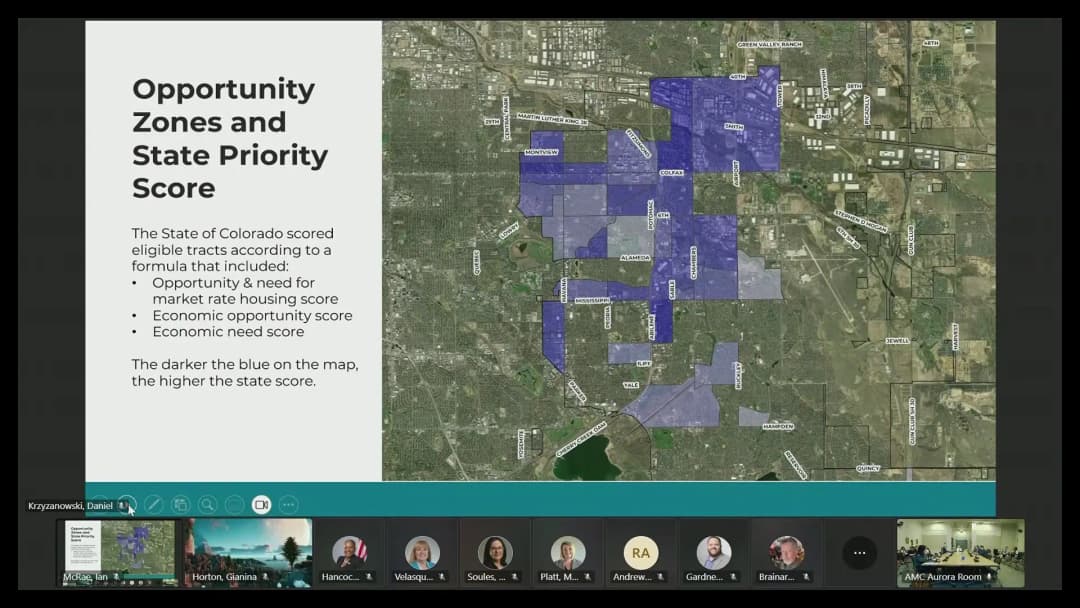
The Aurora City Council held a study session on June 22, 2026, addressing several items including a request for a special meeting on fireworks, approval of the consent calendar, IT lease purchase authority, opportunity zone designations, and a directive to amend landscaping requirements in industrial zones. Consent Calendar - Items 2A through 2B were moved forward without objection. Discussion Items - Special Meeting on Fireworks: Mayor Pro Tem Coons requested a special meeting to address community concerns about fireworks amid the statewide drought emergency. Councilmember Hancock expressed support, citing public awareness. Councilmember Pratem argued the issue could go through the Public Safety Committee, questioning the effectiveness of a meeting to stop illegal fireworks. After discussion, Mayor Pro Tem Coons indicated he would call the meeting unilaterally or seek six votes by email to schedule. - 3A: 2026 Information Technology Lease Purchase Authority: Chief Information Officer Scott Newman presented an annual ordinance to renew lease purchase authority, noting it saved the city approximately $500,000 last year. Council approved the staff recommendation without objection. - 3B: Opportunity Zones 2.0 Map Designations: Daniel Krasanowski from Planning and Business Development briefed council on the federal opportunity zone program, presenting staff recommendations for prioritization of eligible census tracts. Council gave direction to submit the recommended tracts to the Colorado Office of Economic Development and International Trade (OEDIT) before the June 30 deadline. - 5A: Amendment to the Unified Development Ordinance (UDO) for Landscaping in Industrial Zones: Councilmember Gardner sponsored a resolution directing staff to begin work on updating landscaping requirements in industrial zones to conserve water, starting with industrial areas and later expanding to commercial and residential. Council directed staff to proceed. Key Outcomes - Consent calendar approved. - IT lease purchase authority renewed for another year. - Council directed staff to submit recommended opportunity zone tracts to OEDIT. - Council directed staff to proceed with UDO amendments for industrial zone landscaping. - Mayor Pro Tem Coons to schedule a special meeting on fireworks, either by unilateral call or by obtaining six votes via email.

ECONOMIC DEVELOPMENT 21% · PUBLIC SAFETY 19% · WATER AND WASTEWATER MANAGEMENT 17% · ENGINEERING AND INFRASTRUCTURE 16%
OPENPUBLICA · PUBLIC MEETING INDEXUPDATED DAILY · openpublica.com