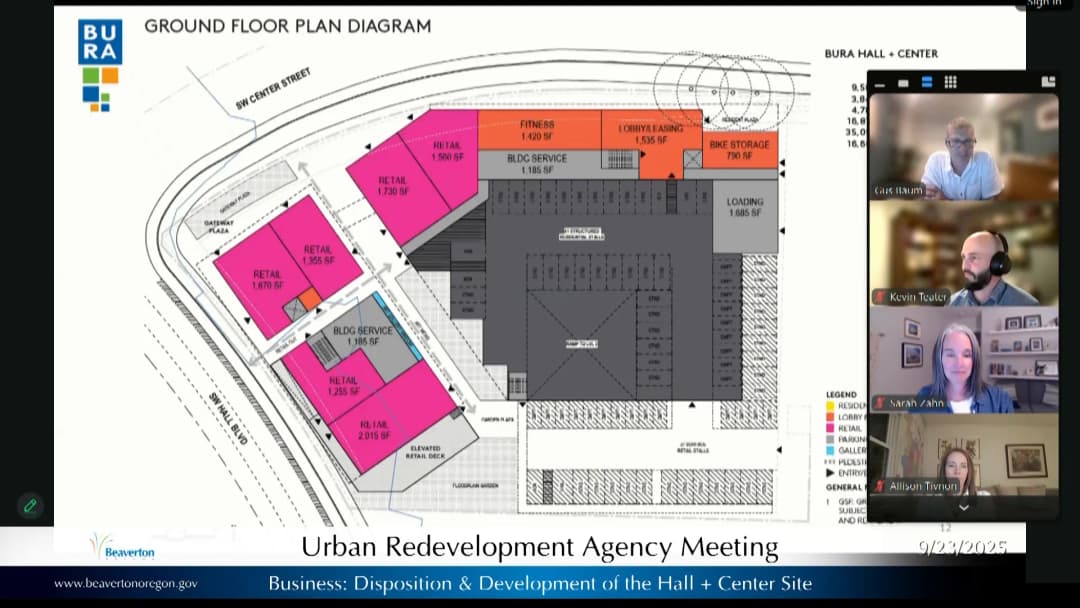
The Beaverton Urban Redevelopment Agency (Bureau) met on September 23, 2025, to consider developer selection for the Hall and Center site, approve a consent agenda, and receive a director's report. The meeting began with an executive session (ORS 192.660(2)(e)) for real property negotiations. No public comments were made. Consent Calendar - Approved minutes from the regular meeting of June 23, 2025. - Approved Bureau Bill 2025-19: Post-project evaluation of the Construction Manager/General Contractor contracting method for the Creekside Parking Garage. Motion passed unanimously (9-0). Discussion Items - Bureau Bill 2025-20 – Developer Selection for Hall and Center Site: Staff presented the RFQ process and recommended Security Properties for exclusive negotiation. The site is at SW Center Street and Hall Boulevard, zoned RCMU (mixed-use). Proposal: six to seven stories, 215 residential units (studio to 3-bedroom), 5,000 sq ft ground-floor retail, structured parking (225 spaces, 1.05:1 ratio), and public art. Features include an "Art Mews" pedestrian pathway and a floodplain garden. Board members expressed strong support, praising the design, retail integration, and transit orientation. Constructive feedback: desire for more units and height, but acknowledged feasibility constraints (parking ratios, construction costs, floodplain). Security Properties representatives (Sarah, Gus) answered questions about unit mix, market analysis, and the Mews concept. Board also asked about stormwater and floodplain mitigation. - Director's Report: Andy provided updates: Beaverton will host a tour for the national Impact Transit and Community Conference on October 27, 2025 (sold out); fall Building Improvement Program applications are open; board and commission recruitment (Bureau Board, URAC, Budget Committee) is ongoing; upcoming URAC meeting on October 6 with discussion of ENA agreements and the downtown Beaverton subbasin stormwater strategy. Key Outcomes - Motion on Bureau Bill 2025-20: Authorized the executive director to negotiate an Exclusive Negotiation Agreement (ENA) with Security Properties for the Hall and Center site. Motion carried unanimously (9-0; one member excused). The ENA will be brought back for approval at the October meeting. - Next regular Bureau meeting: October 28, 2025.
Public Meetings - Beaverton, Oregon
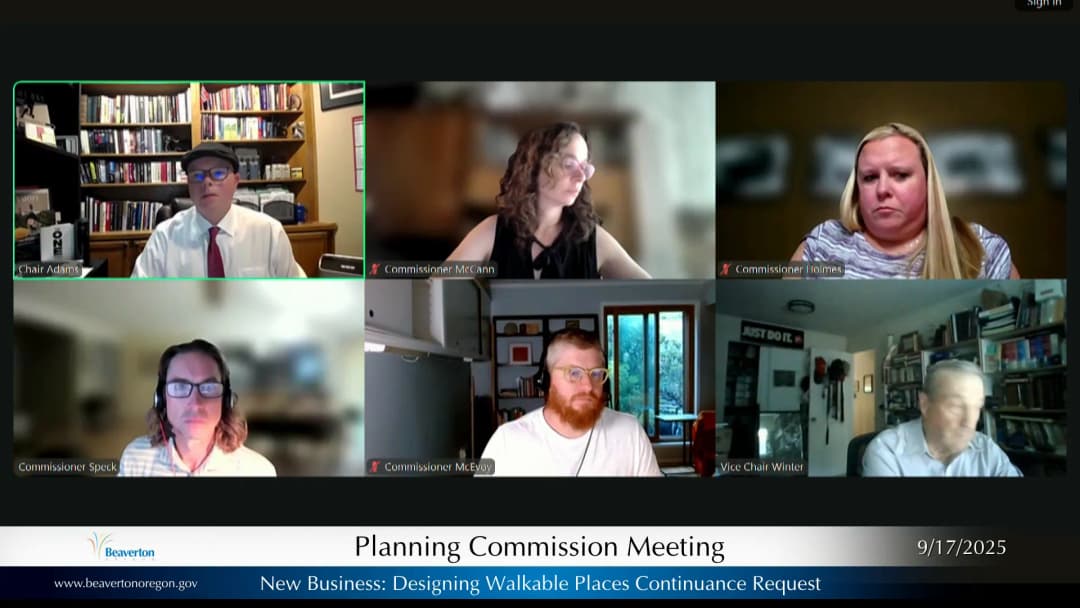
Public Meetings - Beaverton, OregonThe Beaverton Planning Commission met on September 17, 2025, at 6:36 PM to consider a public hearing on the Designing Walkable Places amendments. The applicant, the City of Beaverton, requested two continuances for separate components of the project, which were approved unanimously by the commission. No public testimony or other business was conducted. Public Hearing: Designing Walkable Places (LU 42025-00608) - The public hearing was opened for application LU 42025-00608, encompassing case file numbers CPTA 42025-00615, CPTA 42025-00718, and TA 42024-00607. - Staff requested a continuance for CPTA 42025-00718 (proposing town center boundaries for Raleigh Hills Town Center and Sunset Town Center) to the regularly scheduled Planning Commission meeting on October 15, 2025. - Staff requested a continuance for CPTA 42025-00615 and TA 42025-00607 (the remainder of the Designing Walkable Places amendments) to the regularly scheduled Planning Commission meeting on January 7, 2026. Key Outcomes - First motion: To continue CPTA 42025-00718 (town center boundaries) to October 15, 2025. Motion carried unanimously (5-0, with one commissioner excused). Vote: Commissioners Winter—Aye, Speck—Yay, McCann—Yay, McAvoy—Yay, Holmes—Yay, Chair Adams—Yay. - Second motion: To continue CPTA 42025-00615 and TA 42025-00607 (remainder of Designing Walkable Places) to January 7, 2026. Motion carried unanimously (5-0). Vote: Commissioners Winter—Aye, Speck—Yay, McCann—Yay, McAvoy—Yay, Holmes—Yay, Chair Adams—Yay. - The public hearing was continued accordingly. The meeting adjourned at 6:36 PM.
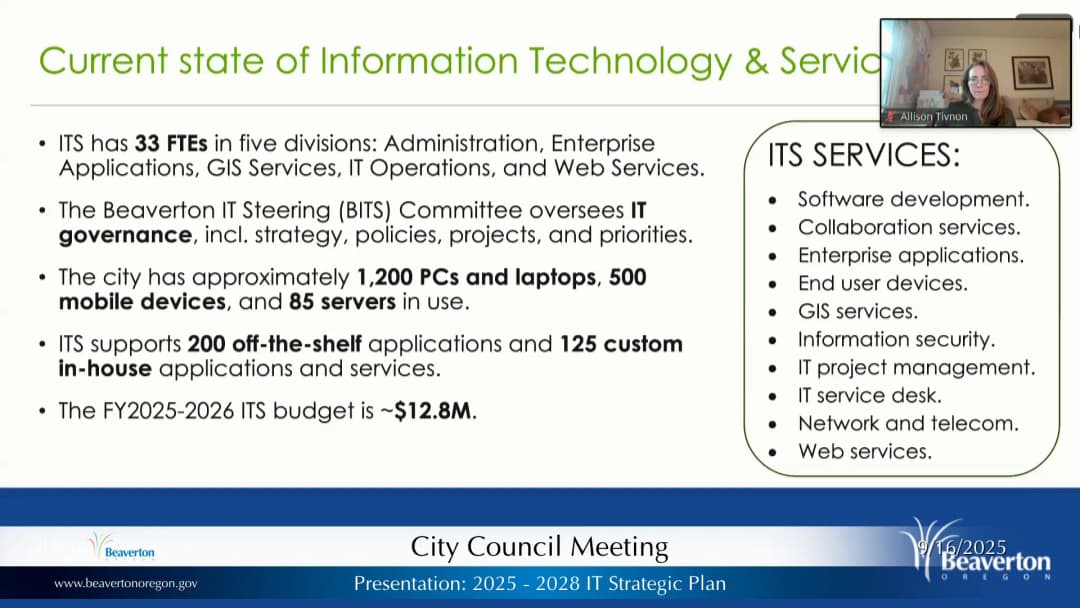
The Beaverton City Council met on September 16, 2025, starting at 7:00 PM, for a regular meeting that included a consent agenda, two presentations, a public hearing, two work sessions, an executive session, and a vote. The meeting addressed updates on the Patricia Reser Center for the Arts, the city's IT strategic plan, an ordinance to transition the voter pamphlet to digital, and in-depth work sessions on downtown parking permit fees and a proposed street maintenance fee. The council also voted on joining an amicus brief after executive session. Consent Calendar - Approved unanimously (7-0) with a comment from Councillor Teter asking the city manager for annual updates on two unresolved Clean Water Services issues: billing negotiations and asset transfers related to annexation. The city manager confirmed. Presentations - Patricia Reser Center for the Arts (RESER) Update – Presented by Chris Azukian, Executive Director. Key fiscal year 2025 highlights: 59,000 visits, 160,000 total since opening in March 2022, 194 public events, 347 activations, 23% increase in attendees year-over-year despite skylight repairs. 80% of users are nonprofits; the RESER drove $2 million in ticket revenue for those organizations. Economic impact estimated at $23.4 million annually. Operating budget of $4.3 million, with 37% from city lodging tax, 27% from fundraising (2,600+ donors), and 36% from earned revenue. The RESER avoided deficits in its first four years and reinvested over $600,000 into building upgrades. A new strategic plan was adopted aiming to become "indispensable" to the community. Council members expressed strong support, noting the center's inclusive programming and public value. - IT Strategic Plan (2025–2028) – Presented by Chief Information Officer Travis Lucky. The plan was developed collaboratively and approved by the city's IT steering committee. Key objectives: strengthen cybersecurity, advance digital equity, improve staff productivity through IT, and modernize systems. The city has 33 IT staff, supports 1,200 PCs/laptops, 500 mobile devices, 85 servers, and 200+ applications. A SWOT analysis identified strengths (customer service, engaged steering committee) and weaknesses (underinvestment, high number of custom apps). The AI strategy includes a pilot that saved staff an average of 97 minutes per week. Council praised the customer service culture and asked about data privacy vetting and transparency. The plan will be made available to council but not publicly posted due to security concerns. Public Comments & Testimony - No public comments were offered during visitor comment or the public hearing. Public Hearing & Ordinance – Voter Pamphlet Digital Transition - Ordinance 4872 – Amending Beaverton Code sections 2.06.415 and 2.06.435 to allow digital publication of the voter pamphlet instead of mailing printed copies to every household. Staff estimated annual savings of $20,000. Implementation options included mailing postcards with QR codes, limited printed copies at public facilities, and online access. Council discussed the need to balance cost savings with accessibility, especially for non-digital residents and during the upcoming levy election. Motion to adopt passed 7-0. Council direction: proceed with both print and digital for the 2025 election, then transition to primarily digital with printed copies available at libraries, city hall, and other locations. Work Session – Downtown Parking Permit Work Plan - Staff presented parking permit fee options based on a peer survey (median employee permit $30/month, residential $125/month). Four options: no change (free residential, $10 employee), at-cost ($16 for all), market rate ($86 for all), recommended ($86 residential, $16 employee). Council discussed cost recovery, code limitations, and the need to align fees with private parking rates to avoid incentivizing on-street parking. Key concerns: impact on low-income residents and small businesses, need for zone-based pricing, and the program's overall goals. Councillor Teter suggested expanding the permit zone. Mayor Beatty announced she will host a downtown parking roundtable with business owners. No formal vote; staff directed to revise code and bring back refined options. Work Session – Street Maintenance Fee - Presented by Public Works Director Tim Elco and Project Manager Brant Holiday. The street fund faces a $6.9–$12.4 million annual shortfall due to 70% construction cost increases since 2020. Current PCI (pavement condition index) is 71, projected to drop to 64 in five years without new revenue. Preventive maintenance is no longer viable for many roads; deferred maintenance costs escalate rapidly. Three funding scenarios were presented: PCI Control ($10.93/month per single-family home), Steady State ($14.21), and Target PCI ($15.70, raising PCI to 75). A proposed state transportation package could reduce these rates by about $3.80, but passage is uncertain. Council discussed phased implementation, low-income discount programs, and the potential inclusion of a small sidewalk component. Most council members leaned toward the Steady State or Target scenarios, with emphasis on affordability and public communication. Direction given to staff to draft code and explore phased rates. Key Outcomes - Consent agenda approved 7-0. - Ordinance 4872 (voter pamphlet digital) adopted 7-0. - First reading of ordinance on sewer and stormwater utility charges noted; public hearing set for October 7, 2025. - Parking permit work session – No formal vote; council directed staff to revise code and return with options reflecting cost recovery, equity, and program goals. Mayor to convene stakeholder roundtable. - Street maintenance fee work session – Council directed staff to proceed with code development, targeting a phased implementation around $14–$20/month with low-income assistance and possible small sidewalk allocation. - Executive session (ORS 192.660(2)(h)) – Council voted 6-0-1 (Councillor Tivnon abstained, citing inability to participate in closed session) to authorize the city attorney to join an amicus brief in Newsom v. Trump (9th Circuit). - Meeting adjourned.
On September 9, 2025, the Beaverton City Council held a work session to discuss the city's fiscal sustainability and a potential financial recovery plan. The meeting, which began at 7:00 PM, featured presentations from the city manager and assistant city manager on property tax limitations, the fiscal sustainability action plan, expense reductions, and revenue generation options. Council members asked questions and shared perspectives on the path forward, including the possibility of a local option levy in May 2026. No votes were taken. Discussion Items - Property Tax Context: Assistant City Manager Elizabeth explained that property taxes make up 54% of the general fund revenue and are constrained by Oregon’s Measures 5 and 50. The city receives 21 cents of every dollar of property tax. Assessed values are not reset to market value upon sale; residential properties have an average assessed value of 55% of real market value, multifamily 37%, and commercial/industrial 65%. Compression (the $10 per $1,000 real market value limit) currently costs the city approximately $87,000 annually. - Fiscal Sustainability Action Plan: The city manager presented the status of the plan adopted in FY22-23. Revenue enhancements include adjusting property tax to the cap (generated $4.2 million), a fee study (estimated $1 million, likely lower), and a future operating levy (originally estimated at $3.3 million but expected to be significantly higher due to rising costs). The transportation utility fee, estimated at $6.8 million, is now projected at $9–10 million and will be discussed on September 16. - Expenditure Reductions: The city has reduced general fund FTEs from 380 in FY22 to 340 currently. The city achieved 95% of its expense reduction target ($9 million out of $9.5 million). Examples include $2.5 million in materials/supplies savings (target $1 million) and organizational assessments. Further cuts would directly impact services; eliminating a $10 million deficit through personnel cuts alone would require 42 fully general-funded FTEs or 75 partially funded FTEs—equivalent to nearly all staff in City Hall. - Revenue Options: Staff outlined tools available to the council: fees (e.g., public safety fee, adopted via resolution), a local option levy (requires voter approval), business license fee study underway, and increasing the transient lodging tax (currently 4%, with 70% required for tourist promotion and 30% for general services, but much of that is dedicated to the Patricia Research Center for the Arts). For the levy, a May 2026 ballot would allow revenue by July 2027, whereas November 2026 would delay revenue until November 2027 and require interim budget adjustments. However, the Tualatin Hills Park and Recreation District plans a bond renewal in May 2026, creating potential voter competition. - Council Reactions: - Counselor Duggar requested analysis of essential services, peer city comparisons, and polling on public appetite. He emphasized the need to explore revenue options and understand what neighboring cities are doing. - Counselor Hartmeyer Prigg supported a May 2026 levy path, noting that expense reductions have been as aggressive as possible and further cuts would harm services. She stressed the importance of timing to avoid losing another year of revenue. - Counselor Tibnon praised the staff’s work on efficiencies, including AI tools that save staff time, and asked that all options—even unattractive ones—be placed on the table for transparent deliberation. - Counselor Teter asked about raising the transient lodging tax to offset general fund costs for arts and other services. He also favored a May levy to align with city council elections and drive voter turnout. - Counselor Kimmy argued that the structural deficit cannot be solved by revenue alone; he called for identifying non-essential services to cut, warning that a levy only covers a portion of the shortfall and that without service reductions, the city will deplete reserves by mid-2026. - Mayor’s Remarks: The mayor encouraged council to document all ideas and use one-on-one time with the city manager to vet them. He stressed the need for a unified front and urged council members to call county commissioners about the library levy, noting that the county does not see the value of services like the bookmobile. He also clarified that the city’s base property tax rate is already higher than some peer cities, making comparisons difficult. Key Outcomes - No formal votes or decisions were made; this was a discussion-only work session. - Staff will refine the general fund forecast and bring a follow-up presentation to council in October 2025 for direction on the fiscal sustainability action plan. - The council is likely to consider a local option levy on the May 2026 ballot, pending further analysis and public engagement (including a community survey and potential polling). - The city will continue to explore other revenue tools (e.g., business license fee restructuring, TLT increase) and expense efficiencies (e.g., fleet study, shared insurance pools). - Council will prepare for upcoming decisions on the transportation utility fee (September 16) and engage with county officials on the library levy.
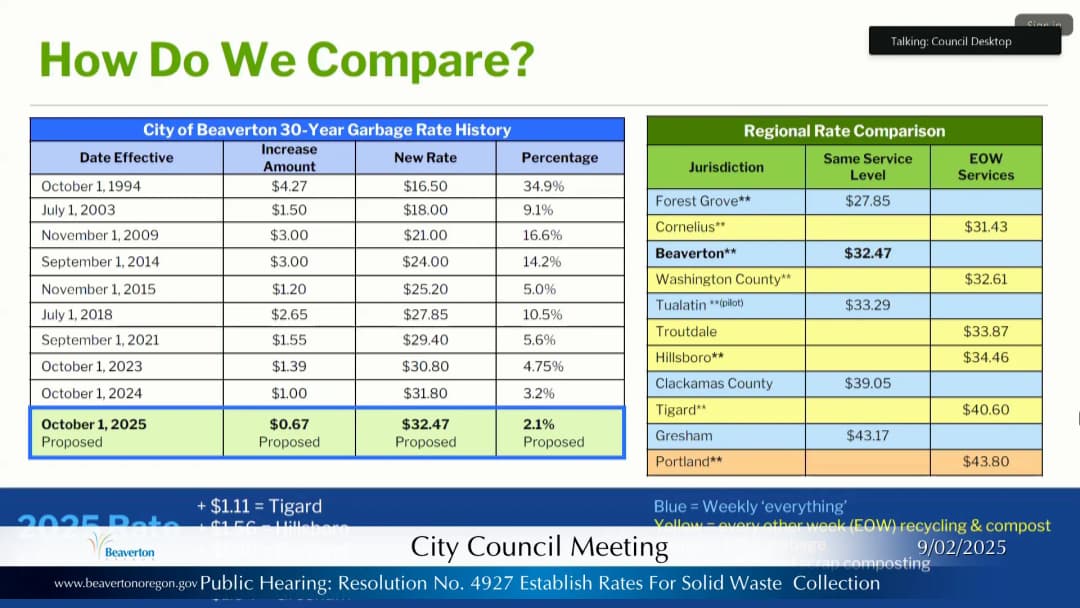
The Beaverton City Council met on September 2, 2025, to address a packed agenda including visitor comments, a proclamation, a presentation from the Washington County Sheriff’s Office, an update on Oregon’s Plastic Pollution and Recycling Modernization Act, a public hearing on solid waste rates, and a first ordinance reading. The council approved the consent calendar and the rate resolution unanimously, and heard public testimony and staff presentations. Consent Calendar - Approved unanimously (7-0) the consent agenda, which included routine approvals and a liquor license change for Bluto’s Greek restaurant opening a second location on First Street. Public Comments & Testimony - Mark Bradley (Beaverton resident) suggested safety improvements for downtown Beaverton roads, including converting Farmington and Canyon roads into one-way streets (westbound Canyon, eastbound Farmington), adding bike lanes, bus-only lanes, protected turn signals, and grade-separated crossings for Max trains. He also raised concerns about TV Highway, Rowdy House intersection, and the need for sidewalks and streetlights. The mayor noted that the "kamikaze corner" six-way intersection is under Washington County jurisdiction and promised follow-up. - Dave Huber (WM senior public sector manager) expressed support for the proposed solid waste rates, highlighting WM’s 19,000 residential and 180 commercial customers in Beaverton and a new state-of-the-art recycling facility opening in Portland. - Kristen Leichner (President, Pride Disposal Company) supported Resolution 4927, noting the transparency of the franchise system and the need for rates to maintain service levels. She offered metaphors (e.g., one cubic yard equals about seven large garbage bags) to help customers understand container sizes. Discussion Items - Proclamation: Council recognized September 15 – October 15, 2025, as National Hispanic Heritage Month in Beaverton. - Washington County Sheriff’s Office Presentation: - Undersheriff and Sheriff reported on jail staffing (fully staffed a year ahead of schedule, but three housing units closed for critical infrastructure repairs; roof, HVAC, piping, fire suppression). A jail expansion capacity study projects a need for 1,000+ beds by 2055 (current capacity 572, operating at 380). - A $775,000 grant will build a comprehensive pretrial release program with 24/7 in-house electronic monitoring. - The Community Violence Reduction Team (formed Oct 2024 with Beaverton PD, Hillsboro PD, DA) has seized 282 firearms and uses a Niven terminal for shell casing analysis. - Search & Rescue responded to 48 missions in unincorporated and city areas last year; programs Project Lifesaver and Help Me Home assist individuals with Alzheimer’s or autism. A July rescue in West Slope/Canyon area was highlighted. - The ROVT team (robotics/drones) flew over 500 missions last year, deployed only for specific incidents. A video showed drone use in tactical operations and fleeing suspects. - Council members asked about resources for minority communities facing violence, mental health and social service partnerships (MHRT, HOPE program, deflection program one-year benchmark), and policies around drone use (privacy, legislation, national best practices). - Plastic Pollution and Recycling Modernization Act (RMA) Presentation: - Scott Keller and Elizabeth Cole explained the RMA, which took effect July 1, 2025, after seven years of planning. The law shifts costs to producers (Circular Action Alliance) and aims to expand recycling access, add materials, and reduce contamination. - Key changes to Beaverton’s recycling list (effective July 1): pizza boxes (no food), paperback books, and plastic caps left on bottles are now accepted; shredded paper is no longer accepted. Plastic containers now require a 2-inch size, and glass types expanded. - The city expects $300,000 per year in contamination reduction funding for education. PRO-funded depots (3 planned in Beaverton) will collect hard-to-recycle items like plastic bags. - Council emphasized communication plans (stickers on roll carts, multilingual outreach) and noted the importance of education over punishment. - Public Hearing on Solid Waste Rates (Resolution 4927): - Staff proposed a 2% increase for residential roll carts (about $0.67/month for the most common size), 1% for commercial, and $8 increase in drop box haul fee, effective Oct 1, 2025. - New services include temporary cleanup containers (smaller than drop boxes, fixed upfront pricing, 7-day use) and updated bulky waste pricing (with a mattress category reflecting EPR program). - Future analysis of glass and motor oil collection (potential switch to every-other-week) and a multifamily composting pilot (6-12 properties) were announced. - The reduced rate program (75% discount for income-eligible) has 360 households enrolled, targeting 500 by end of 2025 and 250 more in 2026. - Council praised the small annual increase and responsiveness to resident needs, particularly temporary containers. Key Outcomes - Consent Calendar: Approved 7-0. - Resolution 4927 (Solid Waste Rates): Adopted 7-0, effective October 1, 2025. - First Reading of Ordinance: Related to voter pamphlet statement (BC 2.06.415 and 2.06.435) was continued to the public hearing on September 16, 2025. - Council New Business: Announced Beaverton Celebration Parade (animal print theme), support for immigrant communities (regional council solidarity, ICE activity briefings), calls for federal action on Gaza, shout-out to code enforcement for positive interaction, and encouragement to support downtown businesses on slower nights.
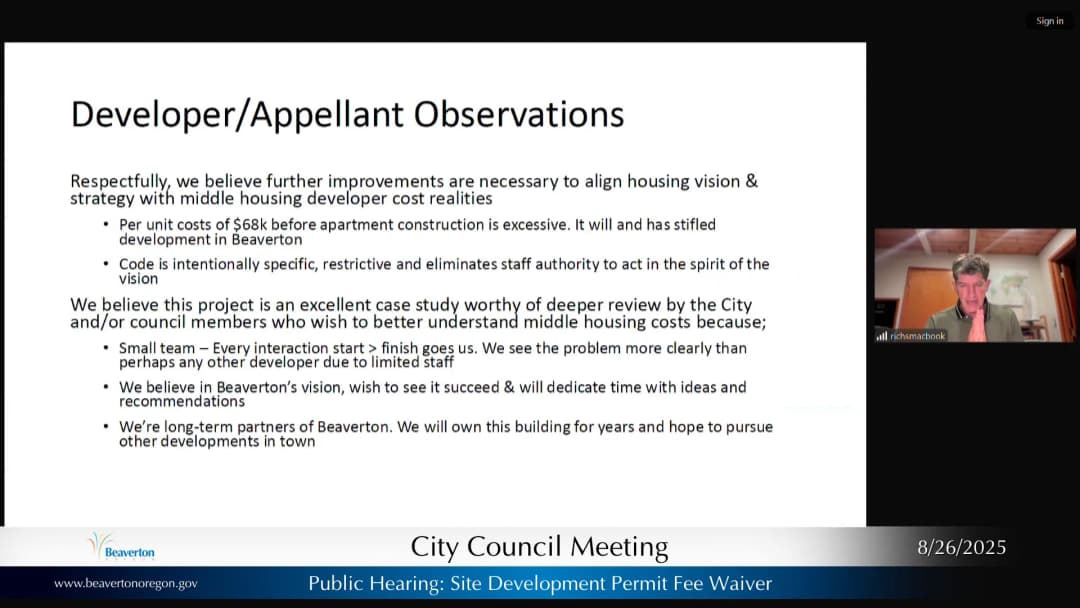
The Beaverton City Council met on Tuesday, August 26, 2025, starting at 6:00 PM. The agenda included public comments, a city manager update, presentations on the proposed Washington County library and public safety levies, a public hearing on a site development permit fee waiver, a code amendment for parking permit fees, and a work session on parks and open space. The meeting lasted several hours, with the library levy discussion extending considerably. The council approved the consent agenda, adopted a parking permit fee code change unanimously, and voted 4-3 to reduce a developer's site development permit fee by 50%. No votes were taken on the library or public safety levy presentations; the council voiced strong concerns about the library levy. Consent Calendar - Approved unanimously (7-0) including routine approvals. Public Comments & Testimony - Kayleen Miller (resident of Southwest Laurelwood Avenue) expressed frustration about the delayed sidewalk project on Laurelwood Avenue. She stated that the sidewalk was promised within six months of moving in January 2021, but was put on hold due to funding. She cited safety concerns, speeding cars (estimated up to 40 mph in a 30 mph zone), three nearby schools, a bus stop, and two prior pedestrian fatalities. She requested better communication from the city and completion of the sidewalk. - Doug Renault (resident, trumpet player with Oregon Symphony) asked what concrete steps the city is taking to protect immigrant neighbors from federal ICE actions, rescinding DEI resolutions, and other harms. He specifically queried about sanctuary law enforcement, courthouse presence, school protections, and support programs. City Manager Report - Community Survey: Now live through September 15, 2025, at BeavertonOregon.gov/survey to gather public input on safety, housing, transportation, and livability. - Transportation System Plan (TSP) Update: Survey open at BeavertonOregon.gov/goBeaverton; community workshops held in fall 2024 and February 2025. - Street Mural Program: New community-led program allowing residents to apply to create street murals; no city funding provided. - Parade: Saturday, September 6, 2025, at 10 AM with theme "Wild Wonders." - Council Learning Session: Tuesday, September 9, 2025, at 6 PM on fiscal sustainability and addressing budget shortfalls. Discussion Items Library Services Levy (Proposed Measure 34-346) - Presented by Marnie Kyle (Assistant County Administrator) and Lisa Tattersall (WCCLS). The levy would replace the expiring levy and represent 45% of WCCLS revenue (55% from county general fund). The rate increase for a typical homeowner: about $54 per year (from current level). - Key Statistics: WCCLS serves an estimated 600,000 residents with 16 library locations; 83,000 library cards issued to public school students since 2019; 2.4 million visits and 7.2 million checkouts in FY23-24; 10,000 students participated in programs; over 6,000 in-person events with 200,000 participants. - Funding Formula: Based on population within a 10-minute drive and average FTE costs (excluding nonprofits). Nonprofits contribute 7-15% of their operating costs, while cities contribute up to 50% (Beaverton contributes $5 million annually). - Council Positions: - Mayor Beatty stated the levy "does not work for us" in its current form; Beaverton residents would pay more and receive less; he does not support the levy as proposed. - Councilor Duggar expressed concern that Beaverton residents subsidize unincorporated areas and pay significantly more; noted a 68% rate increase for a 90% increase in Beaverton's allocation. - Councilor Teeter said it is "very hard to support it as it is right now" and urged changes before the funding formula is finalized. - Councilor Tivnon echoed concerns about equity and residents bearing too much of the cost. - Councilor Hartmeyer Prigg raised questions about funding formula inputs, foot traffic vs. population, and oversight. - Councilor Kimmy asked about personnel costs and long-term sustainability. - Outcome: No vote; council expressed that the levy needs more work and that Beaverton's support hinges on a revised funding model. Public Safety Levy (Replacement Levy) - Presented by District Attorney Stephanie Martin and Undersheriff Kevin Cook. Proposed increase from $0.47 to $0.66 per $1,000 assessed value, raising an estimated $337 million over five years. Average homeowner would pay $6 more per month ($230/year). - Key Statistics: County jail capacity reduced from 572 to 388 beds due to COVID and staffing shortages; 22-30 people released weekly due to lack of capacity; 1.3 million fentanyl pills seized in three years; one vehicle stolen per day (2021-2024 average, now declining); 17% increase in child abuse reports post-COVID. - Council Questions: - Councilor Hartmeyer Prigg asked about ICE cooperation; Undersheriff Cook stated the sheriff's office does not enforce civil detainers and limits cooperation to criminal matters with judicial orders. - Councilor Hussen asked about the mental health response team (MHRT) and whether the levy would increase services; response was that it maintains current levels. - Councilor Duggar requested cost-cutting and efficiency talking points for community outreach; staff agreed to provide. - Outcome: No vote; council indicated support for the levy but requested additional information. Site Development Permit Fee Waiver (Ordinance Discussion) - Applicant (Rich Hannah of 1224 Architecture & Assembly) requested a refund of $38,146 for Site Development Permit SD2022-0025. The original permit expired in August 2024; a second permit was issued in 2025 after re-application. Staff argued fees are non-refundable per code unless just cause is shown. - Arguments: - Applicant cited regional bank failures (Silicon Valley Bank, First Republic) that caused financing to collapse, leading to a hiatus. They noted the city notified them of building permit expiration but not site development permit; requests for extensions are typically granted. They offered to pay for the six days of staff review (second permit processed quickly) but sought a full refund of the second fee. - Staff (Andy Varner, Community Development Director) stated permitting extensions must be requested before expiration; the city relies on permittees to manage expiration dates. Staff spent time on inspection and review for both permits. - Council Deliberation: Motions were made for a $30,000 reduction, then amended to a 50% reduction ($19,073). Councilor Hartmeyer Prigg argued that reduced housing development costs and the unusual bank failure constituted just cause. Councilors Teeter, Tivnon, and Kimmy opposed, citing code clarity and precedent. - Vote: 4-3 in favor of 50% reduction (Councillors Hartmeyer Prigg, Hassan, Duggar, and Mayor Beatty yes; Councillors Teeter, Tivnon, Kimmy no). Parking Permit Fee Code Amendment (Ordinance 4871) - Presented by Casey Graziano (Parking Operations Manager). The amendment removes language capping parking permit fees at the cost to administer/enforce the program and removes specific department references. The code had not been updated since 2002. - Public Comment: None. - Vote: Unanimously adopted (7-0). Work Session: Parks and Open Space (Metro Bond Local Share) - Presented by Lee Crabtree (Assistant Community Development Director) and THPRD staff. The city has $5.7 million in local share funds from the 2019 Metro Parks and Nature Bond (THPRD has $8.6 million). Funds must be used by June 2026 (agreements) and completed within 10 years. - Options: Partner with THPRD to acquire property/deliver projects, or go it alone, or a mix. Staff recommended partnering with THPRD, which has SDC funds for capacity projects. - Council Positions: - Mayor Beatty supported partnering, noting THPRD's SDC credits and community impact mechanisms. - Councilor Duggar expressed hesitation, emphasizing need for downtown parks to match housing growth; he wants specific investments in downtown and active transportation. - Councilor Teeter favored downtown confluence and active transportation connections. - Councilor Hartmeyer Prigg supported partnership with checkpoints and milestones. - Councilor Hussen advocated for walkable parks and collaboration with THPRD. - Councilor Tivnon supported partnership and highlighted Cooper Mountain preservation. - Councilor Kimmy requested a water feature for heat relief. - Outcome: Council broadly supported moving forward with an agreement with THPRD; staff will prepare for a joint meeting on September 30, 2025. Key Outcomes - Consent Agenda: Approved 7-0. - Site Development Permit Fee Waiver: Motion to reduce the $38,146 fee by 50% ($19,073) passed 4-3. The mayor will sign the final decision and order. Staff directed to bring back a process to handle similar requests at the staff level. - Parking Permit Ordinance (4871): Adopted unanimously, 7-0, removing fee caps and department specificity. - Library Levy: No action taken; council expressed that the current funding model is unacceptable and needs significant changes before Beaverton can support the levy. A revised proposal is expected by the end of the month. - Public Safety Levy: No action taken; council requested efficiency talking points for community outreach. - Parks Work Session: Council directed staff to pursue an agreement with THPRD to deploy the city's $5.7 million Metro bond local share, with a focus on downtown parks, active transportation, and the downtown confluence concept. The joint THPRD board meeting is scheduled for September 30, 2025.
The Beaverton Planning Commission met on August 20, 2025, at 7:00 PM. The meeting included a roll call, staff communications, a motion to continue a public hearing, and an informal training presentation by Planning Division Manager Anna Satinsky on significant planning projects from 2018-2025. The meeting adjourned at 7:25 PM. Consent Calendar - No consent calendar items were presented. Public Comments & Testimony - No public comments or testimony were heard. Discussion Items - Staff Communications: Anna Satinsky noted that the September 3, 2025 planning commission meeting is cancelled; a training session will be held in person at Council Chambers. - Motion to Continue Hearing: Commissioner McCann moved to continue the public hearing for LU 32025-00329 (HMT Outdoor Court Expansion) to a date to be determined. The motion was seconded by Commissioner Mettler and passed unanimously (5-0). - Training Presentation – Planning Projects 2018-2025: Anna Satinsky presented an overview of major planning projects, including: - The Downtown Design Project (adopted 2020), which created new zoning districts and limited vehicle sales/service uses to encourage vibrant development. - The Housing Options Project (adopted 2022), implementing middle housing (duplexes, triplexes, quadplexes, cottage clusters, townhomes) in response to state HB 2001. - The Cooper Mountain Community Plan (adopted December 2024), which zoned a new urban growth boundary area for up to 5,000 housing units, included a natural resource overlay, and planned infrastructure. - Upcoming projects: Designing Walkable Places (hearing Sept 17), Code Maintenance 2025 (hearings Oct 1 & 15), and Go Beaverton Transportation System Plan update (ongoing). - Commission Questions: Commissioner McAvoy asked about future projects from the 2025 legislative session; Satinsky noted ongoing digestion of new state laws and potential code updates. Commissioner Mettler asked how the city encourages development after zoning changes; Satinsky discussed developer outreach and early pre-application meetings. Chair Adams inquired about annexation status for Cooper Mountain; Satinsky explained property-by-property annexation with infrastructure coordination, expecting first annexations within nine months to a year. Chair Adams also asked about redevelopment of former auto dealership sites downtown; Satinsky noted that while no formal plans are in place, the city and redevelopment agency own some parcels, and a prior RFP was paused due to COVID. Key Outcomes - Motion to Continue Hearing (LU 32025-00329): Passed unanimously (5-0). The public hearing for the HMT Outdoor Court Expansion is continued to a date uncertain. - Next Meeting: No regular meeting on September 3, 2025; a training session will be held in person at Beaverton City Hall Council Chambers.