The meeting was the second day of a city council retreat held on December 8, 2025, continuing from the previous day's discussions. Councilors reflected on priorities from Day 1, engaged in a strategic planning overview, participated in visioning and SWOT activities, and outlined expectations for the strategic plan process. The session was facilitated by a consultant and included all seven councilors (with Councilor Tivnon joining remotely). Discussion Items - Reflections on Day 1: Councilors shared their takeaways, emphasizing alignment on values and priorities. They noted the productive conversations and the shared direction that emerged from the previous day. - Strategic Planning Overview: The facilitator presented the three core questions of strategic planning: current context, desired future, and how to get there. The plan is intended to be a 3-5 year roadmap that nests within longer-term plans like the Comprehensive Plan and Capital Improvement Plan. - Visioning Activity (True Today / True in 10 Years): Councilors wrote on post-it notes what they value about Beaverton today (e.g., safe community, quality of life, effective government, vibrant downtown, diversity) and what they want to be true in ten years (e.g., financial sustainability, thriving organization, improved mobility and infrastructure, affordable housing, a clear identity). These were grouped into themes. - SWOT Analysis: The council split into groups to discuss strengths, challenges, and opportunities. Reported strengths included past investments, stable council leadership, good union relationships, community diversity, strong location, and a growing cultural scene. Challenges included financial constraints, external factors (state/federal laws, climate), workforce pressures, dependence on large employers, and slow decision-making under the city manager form of government. Opportunities included new funding streams, state support for housing, urban renewal, transportation updates, stronger regional partnerships, and modernization of technology. - Roles and Engagement: Councilors discussed the appropriate roles for council vs. staff in strategic planning. They agreed that council should set the vision and priorities, while staff should develop detailed strategies and implementation plans. They expressed that the plan should be internally focused on the organization, drawing from existing plans and community input already collected, to avoid asking the community for redundant feedback. They stressed the need for the plan to be implementable, flexible, and regularly reviewed. Key Outcomes - Reaffirmation of Priorities: The council confirmed the five priorities from Day 1: fiscal sustainability, affordable housing, enhanced mobility (safe streets), economic development (small business focus), and community safety, with community engagement as an overarching priority. - Direction for Strategic Plan: The council agreed that the strategic plan should be an organizational roadmap that guides budget, annual priorities, and departmental work. It should be informed by existing plans (e.g., Transportation System Plan, Facilities Master Plan, Climate Action Plan) and include annexation strategy considerations. - Next Steps: The facilitator will produce a summary report of the retreat discussions, which will serve as a resource for budget conversations and the upcoming strategic planning process. Councilors emphasized that the plan must be actively used and socialized with staff and future council members.
Public Meetings - Beaverton, Oregon
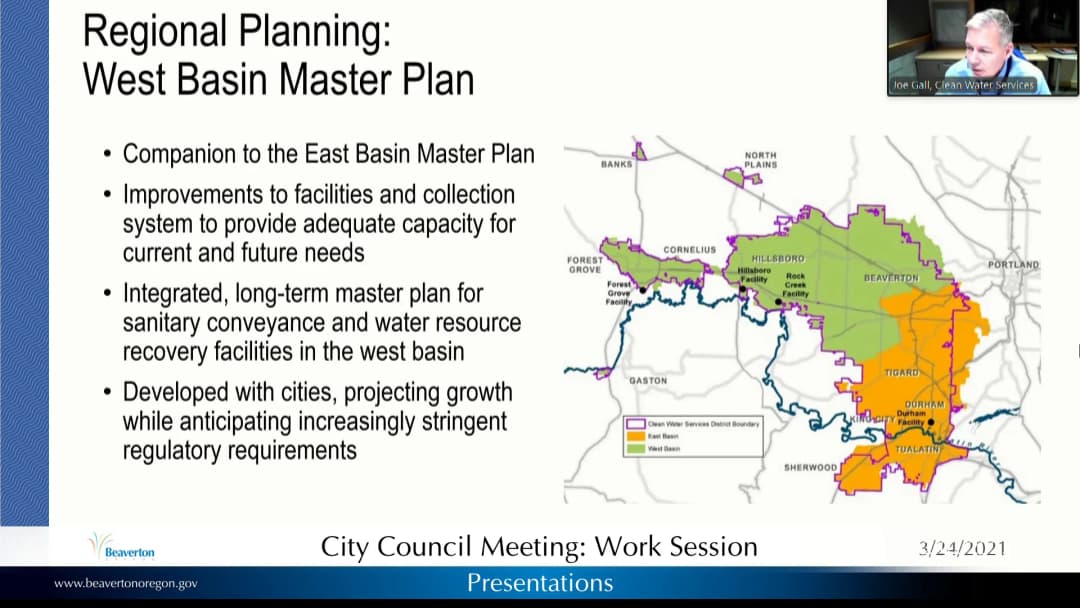
Public Meetings - Beaverton, OregonThe city council held a work session on fiscal sustainability and the Transportation System Plan update, followed by a regular meeting that included a public hearing on a code maintenance text amendment, a presentation from Clean Water Services, and public testimony on immigration enforcement impacts. Council discussed a potential local option levy to address a projected $15 million general fund deficit. Consent Calendar - Approved unanimously (6-0-1) the consent agenda, which included routine approvals and actions. Public Comments & Testimony - Emily Grant, a Beaverton teacher and 18-year resident, testified about ICE enforcement activity in her students' neighborhood, describing students unable to board school buses due to ICE agents. She urged the city to take action to protect immigrant communities and expressed appreciation for the earlier announcement of a state of emergency. The council acknowledged her testimony and noted ongoing efforts. Discussion Items Fiscal Sustainability and Local Option Levy (Work Session) - Assistant City Manager Elizabeth Coffey presented the fiscal sustainability action plan, reviewing a $15.7 million deficit from the prior year, temporarily closed with $8.2 million in one-time funds. For FY 2026-27, an early forecast shows a $15 million gap. Staff proposed a minimum levy of 40 cents per $1,000 assessed value ($9.23/month for the average homeowner, generating $5.3 million annually) and asked for feedback on three policy questions: levy amount, package options, and timing (May vs. November 2026). - Option 1 (Modern Tools Local Safety): Restores four officer positions (bike team, mental health response) and invests in technology (body cameras, tasers, drones) – preserves 13 officers through levy funding. - Option 2 (Core Public Safety): Focuses on maintaining current services, preserving 21 officers, but does not restore positions or add technology. - Council Feedback: - Councillor Hartmeyer Prigg supported 40 cents, preferred Option 1 (storytelling value), and favored May 2026. Noted that one-time reserve use is a temporary solution. - Councillor Duggar supported 40 cents and May 2026, but favored Option 2, expressing concern about promising new services while asking voters for money. He emphasized the need for clear messaging and the council's campaign responsibility. - Councillor Teter supported 40 cents, May 2026, and Option 1, comparing it to a recent county levy. Asked about technology lifespan (body cameras last 3 years). - Councillor Tibnon supported 40 cents, May 2026, and Option 1, citing the bike team's effectiveness and need for technology oversight discussions. - Councillor Hassan supported 40 cents, May 2026, and Option 1, but raised concerns about drones and messaging. Asked if the levy covers the full deficit (only $5.3M of $15M), noting a structural deficit requires ongoing work. - Councillor Kimmy supported 40 cents and May 2026, leaning toward Option 1, but questioned whether a higher amount might be needed. The mayor cautioned that polling does not support a higher levy. - Mayor Beatty supported 40 cents, May 2026, and emphasized the blended approach (levy + fee). Noted the council has a responsibility to campaign and communicate the three tools together (levy, fee, reductions). - The council broadly agreed to continue pursuing a May 2026 levy at 40 cents/$1,000, with further refinement of package details expected at the January 13 work session. Transportation System Plan (TSP) Update (Work Session) - Transportation Planner (lead) presented findings from extensive community engagement (2,800 responses, ambassadors). Key findings: short local trips are common; speed is a major safety factor; crashes causing injury occur every 10 hours, with a serious injury or fatality every 11 days; 42% of pedestrians and 28% of cyclists in crashes were killed or seriously injured. The Shiffler Park map illustrated how high-speed streets (30+ mph) cut off walkable access. - Council Comments: - Mayor Beatty highlighted lack of safe routes to elementary schools in the Shiffler Park area and urged lowering speeds where possible. Noted state/county roads pose challenges. - Councillor Hartmeyer Prigg praised the engagement and emphasized expanding off-street protected trails. - Councillor Kimmy asked about crash timing (peak afternoon and late weekend) and the need for lighting and design cues to slow traffic. - Councillor Duggar noted the high crash frequency, emphasized network completeness, and suggested exploring policy changes (e.g., construction detours for bike lanes). - Next steps: staff will return in spring 2026 with network proposals. Clean Water Services – State of the District - Joe Gall (Chief Utility Relations Officer) and Rick Shanley (Interim CEO) presented on regional wastewater/stormwater services. Highlighted $1.4 billion in planned capital improvements (West Basin), pending permit updates, and a 2026 study on billing (potentially taking over billing from cities). - Councillor Duggar thanked them for governance improvements after past media scrutiny. The board members noted ongoing work to restore public trust, including a forensic analysis and policy updates. Code Maintenance Text Amendment (Public Hearing and Adoption) - Senior Planner Steve Regner presented ordinance 4876 (2025 code maintenance), a package of minor updates to the Beaverton Development Code, including state law compliance for childcare facilities, clarification of outdoor eating rules, and streamlined sidewalk standards (transferring authority to the engineering design manual). - No public testimony was offered. Council heard staff presentation and questions. - Councillor Hassan asked about making code more understandable; staff acknowledged the tension between precision and readability. - The council adopted Ordinance 4876 unanimously (6-0). Key Outcomes - Levy Direction: Council directed staff to continue work toward a May 2026 ballot measure with a minimum levy of 40 cents per $1,000 assessed value. Further refinement of levy packages (Option 1 vs. Option 2) will be discussed at the January 13 work session. Council will also consider a monthly services fee and other revenue tools as part of the blended approach. - TSP: Staff will proceed with network analysis and return in spring 2026. Council emphasized safety, speed reduction, and network connectivity. - Clean Water Services: Council acknowledged the presentation; a billing study is expected in 2026. - Code Amendment: Ordinance 4876 adopted unanimously. - Emergency Declaration: Mayor announced that a state of emergency was declared earlier that day regarding federal immigration enforcement impacts; council will consider ratification on December 16. - Council New Business: Request for a work session on water conservation (landscaping) was declined by most councilors. An upcoming community training on immigrant rights and bystander intervention was highlighted.
The Beaverton Planning Commission held a work session on the Transportation System Plan (TSP) update, receiving a presentation from senior planner Jessica Engelman on community engagement findings and modal network analysis. The commission also approved meeting minutes from October 1 and October 15, 2025. No public testimony was offered. Staff Communications - The city council adopted the town center maps previously considered by the planning commission; those maps become effective next month. - City staff reported on fiscal sustainability challenges, noting a structural budget deficit due to expenses outpacing revenue growth. The city council will discuss potential revenue options (city service fee, local option levy, street maintenance fee) at a meeting on December 9, 2025, at 6 p.m. - The Winter Lights and Tree Lighting Ceremony will be held December 5, 2025, from 4 p.m. to 8 p.m. at City Park and Downtown Beaverton. Discussion Items - Transportation System Plan (TSP) Update Work Session - Senior planner Jessica Engelman, joined by engagement coordinator Rob Zeller, presented findings from six months of community engagement (April–September 2025) and data analysis. - Key community takeaways included: - Travel is essential for daily needs beyond commuting; 71% of trips beginning in Beaverton are for purposes other than work. - Safety is a major concern; top streets where people want safer conditions include Canyon, Farmington, Cedar Hills, and TV Highway. - Crash data (2018–2022) indicates injury crashes occur approximately every 10 hours; severe crashes every 11 days. Pedestrians and bicyclists face disproportionate risk (42% of pedestrians and 28% of bicyclists in crashes were killed or seriously injured vs. 6% of motorists). - Speeds above 30 mph significantly increase fatality risk; over 40 mph, a pedestrian has an 80% chance of death. - Community members expressed interest in walking, biking, and transit if facilities are safe and connected; 87% of sidewalks exist but accessibility and maintenance issues remain. - Different groups (youth, older adults, people with disabilities, caregivers) share a common desire for safer, more accessible streets. - Residents supported future street designs that prioritize safety, comfort, and community gathering. - The city is currently completing existing conditions analysis and will begin defining future modal networks (pedestrian, bicycle, transit, motor vehicle) in the coming months, with next commission update expected in spring 2026. - Commission members asked about the definition of safe crossings, jurisdictional challenges with state/county roads, feasibility of speed reductions and traffic calming on corridors like Cedar Hills and Hall Boulevard, and strategies for managing peak travel demand. - Staff clarified that while the city does not control all roadways, it advocates for safety improvements and coordinates with partner agencies. Key Outcomes - Approval of Meeting Minutes - The commission unanimously approved the minutes from the October 1, 2025, meeting (motion by Commissioner [unstated], seconded, vote: 5-0-1 with Chair Adams absent and Commissioner Holmes excused; all present voted aye). - The commission unanimously approved the minutes from the October 15, 2025, meeting (motion by Commissioner [unstated], seconded, vote: 5-0-1 with same composition). - The meeting adjourned at 7:18 p.m.
On November 18, 2025, the Beaverton City Council held a regular meeting beginning at approximately 8:00 PM. The meeting included visitor comments, a quarterly capital improvement plan presentation, city manager updates, approval of consent agenda, two public hearings, a work session on development fees, and council new business. Six council members were present; Mayor Baby was absent. Consent Calendar - Approved the council consent agenda and contract review board consent agenda unanimously (6-0). Items included acknowledgment of staff work on Open Air Beaverton rulemaking and the janitorial contract award to Relay Resources. Public Comments & Testimony - Lauren Garrett (Executive Director, Beaverton Education Foundation) expressed support for the "Feed My Body, Feed My Brain" campaign, raising $100,000 to provide grocery gift cards for students over winter break. She highlighted partnerships with THPRD, TVF&R, Beaverton Police, Skanska (goal $25,000), Saktius, and the Beaverton Chamber of Commerce. - Evelyn Cooker (lifelong Beaverton resident) urged the council to take decisive action on ICE raids, describing personal observations of arrests and calling for declarations of emergency, verification of federal agents, and codification of sanctuary policies. - Yasmin Ibarra (Political Director, SEIU Local 49) applauded the city's janitorial contract award to unionized employer Relay Resources, noting that living wages reduce dependence on social services and sharing the story of worker Laile Shassis who achieved independent living. - Mason Crosswaite (Lead Janitor, Relay Resources, Beaverton Public Safety Center) expressed support for the five-year extension of the janitorial contract, emphasizing benefits of union protections, seniority, and cost-of-living raises. - Marlene Smith (via proxy) expressed appreciation for the 14-year partnership with Relay and supported contract renewal, highlighting union protections against discrimination and dangerous working conditions. - Dr. Miranda Morgan (Portland State University, Beaverton resident) described increased ICE detentions and requested stronger action beyond the city's statement, asking what more the council could do. - Sarah Taylor made four requests: declare a state of emergency (citing Forest Grove), disable Flock safety cameras (if used), establish ICE-free zones on city property and require agents to show identification, and enact an eviction moratorium. Discussion Items - Capital Improvement Plan (CIP) Update: Public Works Director Tim Elsie and new City Engineer Brian Vinson presented the first quarterly CIP update for FY 2026. Key projects included the North Transmission Line (6.8 miles, 36,100 ft of ductile iron water line, 90% complete on Segment 1, completion fall 2028), the 209th Pump Station (spring 2026 start, summer 2027 completion), the Sterling Park Stormwater Treatment Facility (completed June 2025, now in winter testing – unique in Oregon), and the AMI Metering Project (6,000 meters installed, five leaks found, saving over $2 million in meter box replacements). The five-year CIP shows $23.1 million for water capacity in FY26, dropping sharply after Willamette Water Supply completion. Staff recommended quarterly updates to council. - City Manager's Report: Included Belonging Speaker Series (next session January 2026 on housing/houselessness), Welcoming Week 2025 (11th annual), Winter Lights & Tree Lighting (Dec 5), Neighborhood Match Grant program (up to $3,500), annual council retreat (Dec 7-8), and budget deficit update ($9 million in cuts, 32 positions eliminated). The city manager also presented an immigration enforcement response: reaffirmed sanctuary city status, outlined support for impacted residents (utility assistance, no shutoffs during holidays), partnership with Centro for know-your-rights training (Dec 9), business support (multilingual campaign, microgrants up to $3,000), and legal advocacy. - Work Session on Development Fees: Staff (Andy Varr, Anna Latinsky) presented a study of planning and Open Air Beaverton (OAB) fees. Current planning fees recoup 35% of costs; staff recommended targeting 75% cost recovery, with some fees subsidized for affordable housing and small businesses. For OAB, two options were presented: Option 1 – variable fees based on parking space usage and sidewalk cafe area; Option 2 – flat $300 for sidewalk cafes and $500 per parking space for parklets. Council discussed subsidizing OAB fees further, with councilors Duggar and Teter favoring deeper subsidies to support downtown restaurants, while others cautioned against additional subsidies given the city's structural deficit. Council consensus leaned toward Option 2 with potential reductions. Key Outcomes - Consent Agenda: Approved unanimously (6-0). - Ordinance 4874 (Town Center Boundaries for Raleigh Hills and Sunset): Adopted unanimously (6-0) after a public hearing with no opposition. - Ordinance 4875 (Firearm Disposition – allowing police to trade surrendered firearms for credit): Adopted unanimously (6-0) after a public hearing with no public testimony. Councilors noted oversight mechanisms and that individuals can request destruction. - State of Emergency Declaration: Council unanimously (6-0) passed a motion to direct staff to draft a resolution declaring a state of emergency due to federal immigration enforcement actions. - Sanctuary Ordinance: Council unanimously (6-0) directed staff to return with an ordinance codifying Oregon's sanctuary statute into city code. - Data Collection/Sharing Review: Council unanimously (6-0) directed staff to examine how the city collects, stores, and shares court-related data to prevent harm to immigrant communities. - Lawsuit Framework: Council unanimously (6-0) directed staff to develop a framework for council policy on joining lawsuits, including on immigration enforcement. - Informal Direction: Council asked staff to explore state programs related to housing and food assistance for impacted families.
The Beaverton Urban Redevelopment Agency (BURA) met on October 28, 2025, at 7:00 PM. The meeting covered approval of the consent agenda, board communications, an executive director's report, and discussion of upcoming items. No public comments were received. Consent Calendar - Bureau Bill 2025-21: Resolution 2025-069 adopting a supplemental budget for FY 2025-2026 and making appropriations. - Bureau Bill 2025-22: Authorizing the executive director to execute an exclusive negotiations agreement for the disposition and development of the Hall Center site. - Bureau Bill 2025-23: Authorizing the executive director to execute an exclusive negotiations agreement for the disposition and development of the Lombard West site. - Motion: Approved unanimously (11-0). Board Communications - Board Member Hartmeyer Prigg reported on a meeting with the owner of Central Station Tops, discussing open retail space in the Beaverton Garage and encouraging efforts to fill vacancies, particularly noting that small businesses near the round feel the impact. Executive Director's Report - Downtown Parking Round Table: The mayor and staff convened a round table on October 21, 2025, at First Street Commons. Over 25 property owners and businesses attended (double the number of staff). Participants discussed the first two years of the parking pilot project, compliance, data collection, and recommendations. A white paper summarizing the conversation will be prepared and shared with participants and BURA, informing the Downtown Parking Management Action Plan (DPMAP) draft expected in early 2026. - Impact Conference Tour: On October 27, 2025, staff led a tour for about 30 attendees from the Impact conference (transit and urban mobility professionals from the U.S. and Canada). The tour, called "Leave It to Beaverton," highlighted BURA accomplishments, including the round, Art Central Hyatt House, Lombard West and Hall Center sites, sub-basin strategy, transit center improvements, restaurant strategy, vertical housing development, BC2 Beaver Dam area acquisitions (17 properties), and the BG Food Cartel. Positive feedback was received. - Next Meeting: The next BURA meeting will be November 18, 2025, in conjunction with the city council. The agenda includes a work session on the downtown sub-basin strategy and potential real estate conversations. Key Outcomes - Consent Agenda Approved: All three bills passed 11-0. - Building Improvement Program Grants: In response to a board member's question, staff reported that more funds were available because some previous grantees did not proceed, allowing more projects to be funded in the current round. Specific application numbers were not provided but will be included in the executive director's report. - ICE Activity Inquiry: A board member asked about ICE activity impacts on businesses. The executive director noted that while some parts of Beaverton have seen reduced visitors and customers, no specific impacts within the BURA district have been reported. - Adjournment: The meeting was adjourned. The next regular meeting is scheduled for November 18, 2025.
The Beaverton City Council met on October 21, 2025, to conduct a consent agenda, hold a first reading of a land use ordinance, and participate in a work session on the city's fiscal recovery follow-up. The work session focused on revenue options, budget balancing strategies, and service prioritization to address a structural deficit. Consent Calendar - Item 3.5 was pulled from the consent agenda per the mayor's request. The remaining consent agenda items were approved unanimously (7-0). First Reading of Ordinance - A first reading was held for an ordinance amending the Beaverton Comprehensive Plan Land Use Map to adopt boundaries for the Raleigh Hill Town Center and Sunset Town Center (LU42025-00608/CPTA42025-00718). A public hearing is scheduled for November 18, 2025, during the regularly scheduled city council meeting. Work Session: Fiscal Recovery Follow-Up - City Manager and staff presented a detailed update on the fiscal sustainability plan, building on a September 9, 2025 work session. Key points included: - Revenue research: Six out of seven similarly sized Oregon cities (Beaverton, Bend, Eugene, Gresham, Salem, Medford) have considered or passed new revenue to address property tax limitations. Hillsboro is the exception due to a long-standing local levy and high industrial property values. - Revenue tools categorized by timeline: Short-term (within 1–2 years) includes local option levies and monthly service fees; medium-term (2–5 years) includes franchise fees and transient lodging tax (TLT) increases; long-term (beyond 5 years) includes property tax reform and insurance pooling. Payroll taxes and targeted sales taxes were not recommended at this time. - Deficit estimate: Approximately $10 million. A local option levy of $0.76 per $1,000 assessed value would generate $10 million, with a monthly impact of $17.51 for the average single-family homeowner. A monthly fee could range from $16 to $35.50 depending on structure. A blend of both ($5 million each) would reduce the levy impact to $0.38 per $1,000 and the fee to $8–$17.75. - Reserve targets: Current policy requires 11% of general fund operating expenses at budget time and 17% by fiscal year-end. Staff recommended a temporary 1% reduction to provide flexibility while new revenue is implemented. - Service prioritization: Staff proposed a framework to categorize general fund services by direct/indirect, mandated/discretionary, and cost coverage to aid council in making reduction decisions. Council members expressed diverse positions: - Councilor Hartmeyer-Prigg supported a blend of levy and fee, noting the fee provides flexibility and the levy offers voter buy-in. She also supported TLT increase and careful consideration of franchise fee impacts on local businesses. - Councilor Tivnon supported a blend, citing easier communication with a levy and the streamlined collection of fees. He also supported moving TLT to short-term and temporary reserve reduction. - Councilor Duggar supported a mix of levy and fee, emphasizing the need to provide future councils with tools. He was uncomfortable with reserve reduction without a reinstatement timeline and called for strategies on healthcare, PERS, and Cooper Mountain cost containment. - Councilor Hussen leaned toward a fee only, citing community appetite for a levy as low and expressing concerns about public safety and police reform. She supported TLT increase, shared services, and a study on police needs. She also supported temporary reserve reduction. - Councilor Kimmy supported a blend but stressed the need to know the exact deficit amount before deciding on fee structures. He asked about permanent fixes and was interested in indexing fees to inflation. - Councilor Teeter supported a levy as the primary tool, with a possible blend to make it more feasible. He wanted to move TLT to short-term and supported temporary reserve reduction. He also emphasized using the TLT increase to shift burden to visitors. - Mayor Beatty advocated for a blend of levy and fee, noting the need to go to voters in May 2026 to avoid deep cuts. She cautioned against sequential implementation (levy then fee) and highlighted the importance of a unified council message. She also noted that franchise fees are difficult to implement and that TLT increase is a good option. She called for a massive communication outreach and asked staff to refine financial analysis. Key Outcomes - Council direction: Strong interest in pursuing a blend of a local option levy and a monthly service fee (public safety or city operations fee). Councilors also expressed support for increasing the transient lodging tax (TLT) and moving it to the short-term timeline. A temporary 1% reduction in reserve targets was generally supported, with the condition of a reinstatement timeline. - Next steps: Staff will refine the five-year financial forecast using updated property tax data (expected November 2025), develop specific fee structure options and levy amounts, and create a communications and engagement plan. Council will hold additional work sessions in the coming months, with a goal of referring a levy to voters in May 2026 and implementing a fee by mid-2026. The mayor committed to working with Councilor Hussen on additional information regarding police services and public safety reform. - No formal votes were taken on the work session items; the meeting was a discussion and direction-setting session.
The Beaverton Planning Commission held a public hearing on October 15, 2025, beginning at approximately 7:00 PM and adjourning at 7:48 PM. The meeting addressed three land use applications: a major expansion of the HMT Recreation Complex to include a 12-court pickleball facility, a new conditional use for Willamette Valley Academy, and a comprehensive plan amendment to designate two town center boundaries. Commissioner Holmes was excused and absent. All votes were unanimous. Public Comments & Testimony - In favor of the town center boundaries: Scott Eaton (390 S. Rosemont Rd., West Linn) and Joseph Schaefer (1211 SW 5th Ave., Portland), representing the Peter Court family, expressed support for the proposed town center maps, particularly the exclusion of a single-family residential notch from the Sunset Town Center boundary. They also noted ongoing development plans for the Peter Court sites (West Village project) and thanked staff for assistance. - In favor via Zoom: Brandon High (3335 SW 175th Ave., Aloha/Beaverton) voiced general support for dense, walkable town centers and mentioned infrastructure needs at the Sunset Town Center, including connectivity across highways. - No public testimony was offered for the pickleball facility or the Willamette Valley Academy applications. Discussion Items - HMT Outdoor Court Expansion (Pickleball Facility) – Case files CU 32025-00327, DR 32025-00328, RP 22025-000382, TP 12025-00533. The applicant (THPRD) proposed a 12-court pickleball facility with a seasonal air-supported dome (45 ft tall, requiring a 10-ft height adjustment), a 3,700 sq ft permanent pavilion, and a 3,000 sq ft covered outdoor area. The site is centrally located on the 90-acre HMT campus, at least 600 ft from property lines. Staff presented findings that the proposal meets all criteria, including compatibility with surrounding neighborhoods, tree preservation (three trees impacted, with city arborist approval), and the replat of three parcels into one. The seasonal dome is intended to be up from September to May, similar to existing tennis domes on site. The applicant noted that the 12-court facility is the first of its kind locally and will meet growing demand for pickleball. - Willamette Valley Academy – Case files C UN 32025-00303, DR 12025-00304. The applicant proposed a new conditional use for a K-8 STEM-focused school in an existing office building on NW 167th Place. No exterior changes were proposed. The school currently serves over 100 students, having grown from 20 in 2021. Plans include converting part of the parking lot into an outdoor sports court and creating an indoor activity area for inclement weather. Staff recommended approval. - Designing Walkable Spaces – Town Center Boundaries – Case files LU 42025-00608, CPTA 42025-00718. Staff presented a comprehensive plan amendment to add two town center boundaries: Sunset Town Center (near Sunset Transit Center, Hwy 26 and 217) and Raleigh Hills Town Center (near Beaverton-Hillsdale Hwy and Scholls Ferry Rd). The boundaries were developed in coordination with Metro and Washington County. The Raleigh Hills boundary is largely outside city limits but includes some lots already in Beaverton. The amendment is part of a larger Designing Walkable Places project; other code and plan amendments will be heard on January 7, 2026. Commissioner Mettler raised safety concerns about the Raleigh Hills intersection, but staff noted that traffic improvements are not part of this boundary-only amendment. Key Outcomes - HMT Outdoor Court Expansion: Motion to approve (based on October 15, 2025 staff report) passed unanimously (6-0). - Willamette Valley Academy: Motion to approve (based on October 8, 2025 staff report) passed unanimously (6-0). - Designing Walkable Spaces – Town Center Boundaries: Motion to recommend approval to City Council (based on October 1, 2025 staff report) passed unanimously (6-0). - All decisions will be memorialized in land use orders; appeals must follow Beaverton Development Code and LUBA rules.
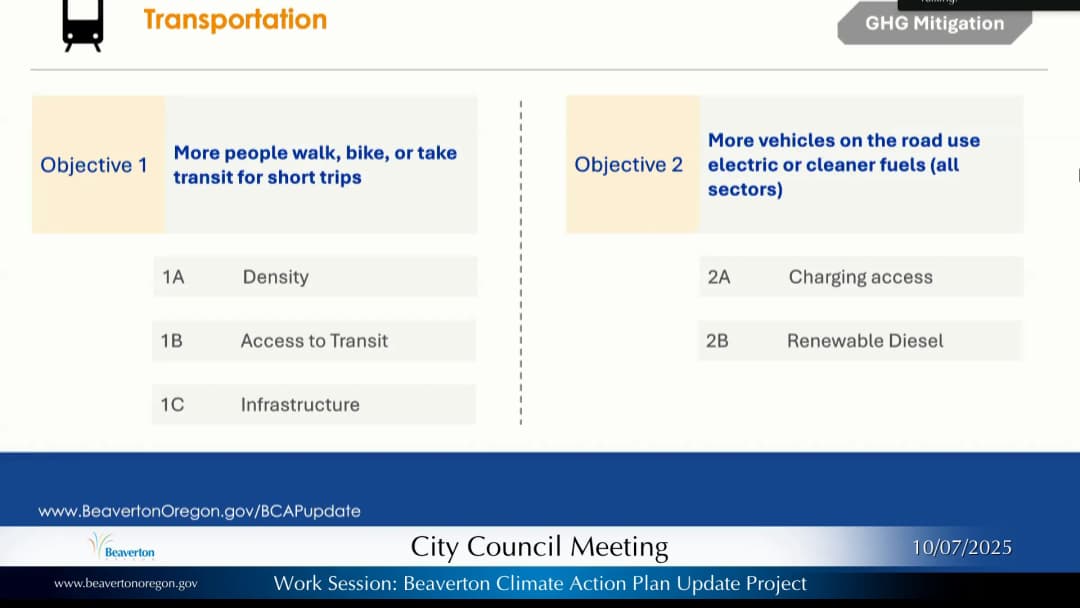
The Beaverton City Council met on October 7, 2025, to address routine approvals, public hearings, and a work session on the Climate Action Plan update. The meeting included two proclamations, public comments, consent agenda approval, adoption of a supplemental budget and code amendments, and a detailed discussion on the revised climate plan structure. Consent Calendar - The consent agenda was approved with a unanimous 7-0 vote, except for the minutes of the September 9, 2025, council meeting, which were pulled due to an error incorrectly listing Councillor Hassan as present. - The council later agreed to correct the minutes by amendment during discussion. Public Comments & Testimony - David Whitter, President of the Lewis and Clark Chapter of the Sons of the American Revolution, provided an update on the Revolutionary War memorial to be placed in Veterans Memorial Park. He noted a $61,000 grant from the Oregon Veterans and War Memorials Grant Program, full funding, and that the memorial will be dedicated on April 19, 2026 (Patriots Day). He thanked the city, THPRD, and American Legion Post 124. Proclamations - Native American Heritage Month: Councillor Hartmeyer Prigg read a proclamation declaring November 2025 as Native American Heritage Month in Beaverton, recognizing the city’s location on ancestral lands of the Atfalati tribe and the estimated 10,437 Native Americans in Washington County. The council encouraged residents to observe the month. - Murray Hill Little League All-Stars: Mayor Beatty read a proclamation celebrating the 2025 Murray Hill Little League All-Stars for winning district and state championships and advancing to the Little League World Series regionals. The team was recognized for their sportsmanship and community representation. Public Hearings Supplemental Budget Adoption (Resolution 4933) - Staff presented the first supplemental budget for FY 2025-26, described as mostly technical adjustments: adjustments to beginning working capital, carryover of unspent grant funds, additional funding for capital improvement programs, and personnel reorganization in public works. No public testimony was offered. The council approved Resolution 4933 unanimously (7-0). Sewer and Stormwater Drainage Utility Charges (Ordinance 4873) - Staff explained that the ordinance removes outdated surcharge provisions from the Beaverton Code (sections 4.04.060, 4.06.010, and 4.06.020, repealing 4.04.065 and 4.06.030) that had been unnecessary since 2008 when rates were split into regional and local components. The change simplifies accounting and audit processes. No public testimony was offered. The council approved the ordinance unanimously (7-0). First Reading - A first reading was held for an ordinance amending Beaverton Code Section 2.05.026 related to special disposition of other personal property. A public hearing is scheduled for November 18, 2025. Discussion Items Work Session: Beaverton Climate Action Plan Update - Kevin Boylan (Sustainability Analyst) and Scott (Sustainability Program Manager) presented the revised structure of the Climate Action Plan, incorporating feedback from almost 700 survey respondents, seven community conversations, and multiple workshops with partners and staff. - The new structure has a clear hierarchy: Focus Areas - Measurable Objectives - Strategies - Illustrative Activities. This allows flexibility and accountability, replacing the previous long list of actions. - Emissions drivers: Transportation (nearly half) and building energy (48%) are the primary sources. - Focus areas presented: - Buildings & Energy: Objectives to reduce energy consumption and increase use of clean energy. - Transportation: Objectives to increase walking, biking, transit, and reduce single-occupancy vehicle trips; includes density, safe infrastructure, and technology access. - Consumption & Materials: Objectives to reduce wasted and carbon-intense food and shift community practices (e.g., food is a large imported emissions category). - Community Resilience: Objective to keep community safe, healthy, and connected during climate impacts (heat, storms, flooding). - Infrastructure Resilience: Objectives for natural/green infrastructure (canopy, parks, water management) and built infrastructure (energy resilience). - Organizational Capacity: Objective to institutionalize climate considerations into city decisions and secure funding. - Council members provided feedback: - Councillor Hartmeyer Prigg: Asked about measurable targets and praised the new structure for enabling progress tracking. Inquired about Climate Action Task Force involvement (confirmed ongoing). - Councillor Teeter: Suggested adding "useful" to transportation strategies (safe, comfortable, useful). Raised concern about gas-powered lawn equipment (two-stroke engines) not explicitly covered; staff noted building energy is primary but co-benefits exist. - Councillor Hassan: Emphasized distinguishing city vs. community roles; asked about city fleet efficiency (anti-idling policy, fleet study). Questioned codification of plan elements; staff responded that metrics and an online dashboard are planned. Encouraged policy action where feasible. - Councillor Duggar: Requested metrics on implementation difficulty alongside emissions impact. Asked about regional coordination; staff noted workshops with partners but acknowledged previous lack of ongoing engagement. Stressed the need for communication and use of existing neighborhood programs (NACs) for practical implementation like neighborhood swaps. - Councillor Kimmy: Inquired about coordination with Community Development Department on new developments (e.g., Cooper Mountain). Mayor Beatty explained that recent state code changes (parking minimums, setbacks) diverted staff resources. Asked for resident education resources; staff noted plans to include community role in the plan and communications. - Councillor Tivnan: Supported engagement with business community and suggested case studies from other cities. Highlighted the challenge of large residential neighborhoods without commercial amenities, suggesting zoning changes and first/last-mile shuttles. - Mayor Beatty: Praised the new structure and the city's existing climate achievements (microgrid, hydropower pump station, ASR wells, purple pipe, indigenous tree planting). Emphasized the need for better storytelling and balancing city accomplishments with resident education. Council New Business - Mayor Beatty reported that the Washington County Commission voted to move the library levy forward without addressing Beaverton's concerns about a 68% increase that could lead to service cuts. She is drafting an op-ed for council members to sign (individually, not as a body) to inform voters that the ballot title promises increased services but may result in cuts. She stressed the council's responsibility to inform the community. - Councillor Hartmeyer Prigg shared highlights from the League of Cities conference, noting solidarity among mayors on sanctuary laws and the importance of protecting Oregon's sanctuary policies. Key Outcomes - Consent Agenda: Approved 7-0, except September 9, 2025, minutes pulled for correction. - Resolution 4933 (Supplemental Budget): Adopted 7-0. - Ordinance 4873 (Sewer/Stormwater Charges): Adopted 7-0. - First Reading of ordinance on personal property disposition: Scheduled for public hearing on November 18, 2025. - Climate Action Plan Work Session: No vote taken; council provided feedback for further refinement. Staff will return in December with a draft plan including metrics, leads, and co-benefits, targeting adoption in early 2026.
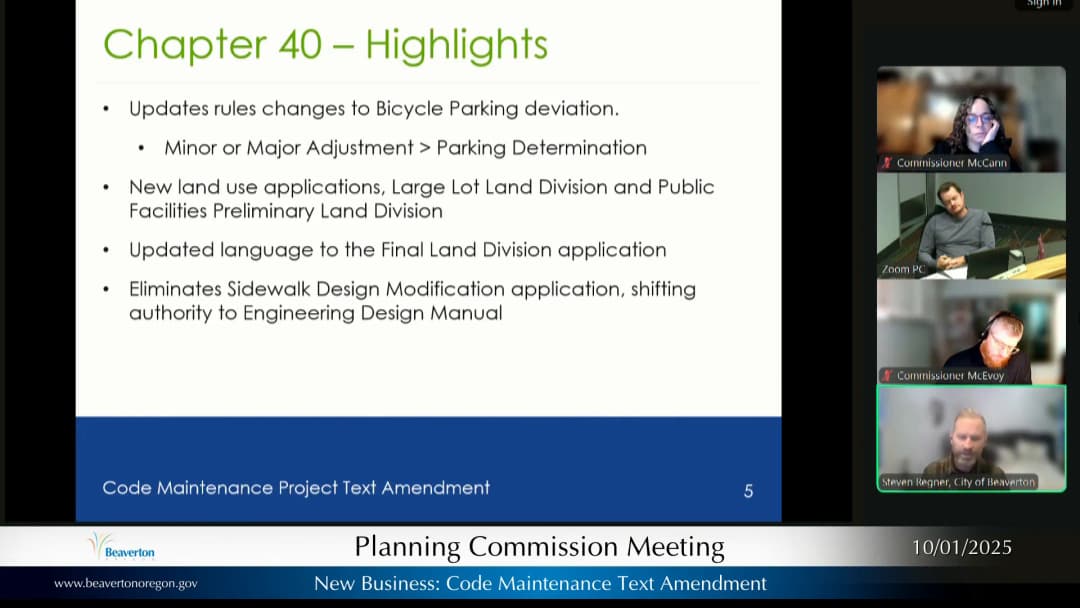
Meeting Duration: 7:00 PM – 7:36 PM (36 minutes) Attendance: Chair Adams, Commissioner McAvoy, Commissioner McCann, Commissioner Mettler, Commissioner Winter (present); Commissioners Holmes and Spec (excused/absent). Note: This was the first in-person planning commission meeting since 2020, though hybrid participation was allowed. Staff Present: Anna Slatinski (Planning Division Manager), Steve Regner (Senior Planner, presenting virtually), Robin McIntyre (Assistant City Attorney), Jana Fox (Current Planning Manager). Agenda Item: The sole agenda item was a code maintenance text amendment application (Case File TA 42024-00709 / LU4 2024 00710 – the agenda and minutes were not available, and the transcript uses both numbers; staff referred to the application as LU4 2024 00710). The proposal is a policy-neutral update to the Beaverton Development Code, covering chapters 20, 40, 50, 60, 70, and 90, with a focus on transportation-related changes. Public Comments & Testimony - No members of the public testified in favor, in opposition, or neither. The hearing was closed after staff confirmed no additional comments. Discussion Items - Staff Presentation (Steve Regner): Mr. Regner provided a high-level overview of the proposed amendments, including: - Chapter 20: Updates to comply with Oregon House Bill 3560 (effective 2026) regarding child care facility siting; clarification that outdoor commercial operation limits do not apply to outdoor seating for eating/drinking establishments; corrections for Cooper Mountain housing type integration and land division rules. - Chapter 40: Shifting bicycle parking deviations from the adjustment application to the parking determination process; adding two new land division applications for Cooper Mountain (large lot land division and public facilities preliminary land division); eliminating the sidewalk design modification application and transferring authority to the city engineer via the Engineering Design Manual (EDM). - Chapter 50: Removing internal policies from the code to allow more nimble updates; specifying that applications are not deemed received until fees are paid; updating language for digital submittals and virtual neighborhood meetings; adding a limited land use decision process; streamlining notice of decision distribution (full staff report to parties, two-page letter to public commenters). - Chapter 60: Differentiating between walkways (on-site) and sidewalks (right-of-way); clarifying bicycle parking requirements for all development types and adding an “other” category; transferring wider sidewalk requirements for high-pedestrian areas to the EDM; allowing weather protection (up to 15 feet tall) on decks/patios within rear setbacks (similar to ADU rules); clarifying the threshold for Tree Plan Type 3 (preserving less than 25% of a significant grove requires a public hearing); updating driveway design rules for infill development (three tiers based on number of lots served, with shared driveways allowed across property lines). - Chapter 70: Aligning with HB 3560 for child care facilities; transferring sidewalk width regulations to the EDM; adding a conflict resolution rule that defers to the EDM when development code and EDM conflict on driveway placement. - Chapter 90: Adding/modifying definitions for bus bay, care facilities (all ages, not just children/seniors), child care center (consistent with HB 3560), fence height measurement (measured from high side), and initial development (exempting new large lot land divisions). - Commissioner Questions: - Commissioner McCann asked about the process for changing sidewalk design standards if moved to engineering. Staff clarified that policy decisions (e.g., wider sidewalks) are made by City Council, and the Transportation System Plan update will address cross-section design, with planning commission involved as appropriate. - Commissioner McCann also asked about fire access for narrower driveways. Staff noted that fire access can be satisfied via sprinkler systems or Tualatin Valley Fire & Rescue approval; the new driveway tiers are designed to accommodate fire apparatus needs. - Commissioner McAvoy asked about the five-acre minimum for the new large lot land division application. Staff explained that five acres was chosen to allow coherent development (e.g., separating commercial and residential portions) while still enabling further subdivision, and is based on lessons from South Cooper Mountain. - Commissioner McAvoy asked why child care facilities remain conditionally permitted in lower-density residential zones (RMB, RMC) as standalone uses, while state law requires outright permitting when co-located with institutional uses. Staff responded that the text amendment is policy-neutral, and state law does not require the standalone use to be permitted outright; changing that would require a separate, more engaged process. Key Outcomes - Motion: Commissioner Mettler moved to recommend passage of the code maintenance project (LU4 2024 00710) to City Council, based on the findings in the September 17 staff report and supplemental memos. Commissioner McCann seconded. - Vote: The motion passed unanimously (5-0). - Next Steps: The planning commission’s recommendation will be forwarded to City Council, which will hold a public hearing and make the final decision. The companion Engineering Design Manual amendments are expected to be considered by Council in December 2025.
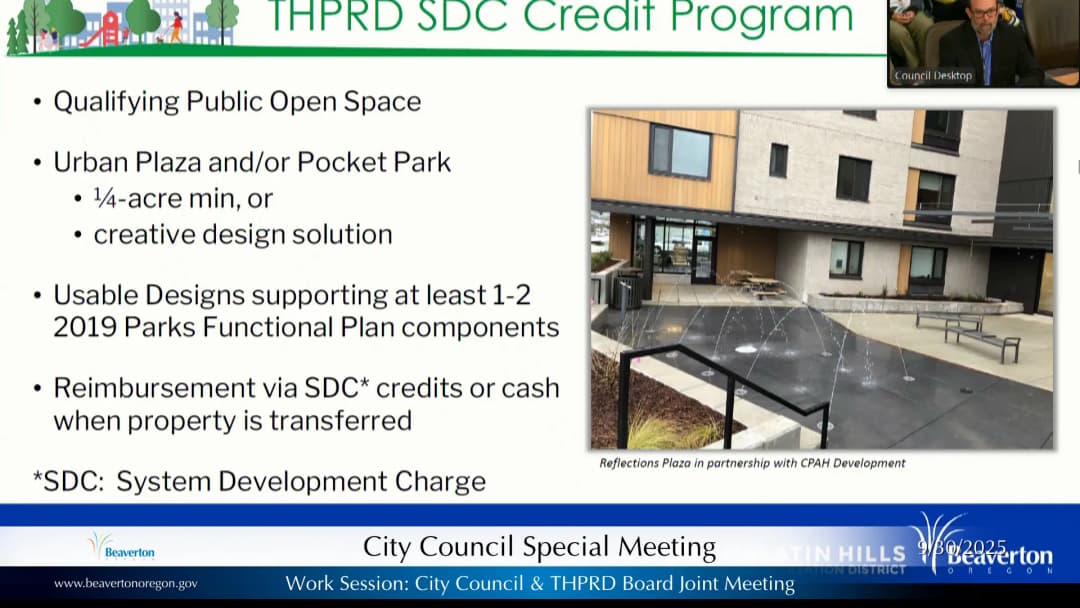
The Beaverton City Council and the Tualatin Hills Park & Recreation District (THPRD) Board met jointly on the evening of September 26, 2025, to discuss collaboration on parks, trails, housing, and a potential Bloomberg Mayors Challenge project. The meeting featured presentations from city and THPRD staff, followed by discussion among elected officials. No public testimony was taken, and the meeting ended with a vote on a settlement agreement. Discussion Items 1. Metro 2019 Parks & Nature Bond – Local Share Collaboration - Staff (Lee Crabtree, City; Aisha Panis, THPRD) presented background on the bond's six programs, highlighting the $92 million 'Support Local Projects' program. Beaverton received $5.7 million and THPRD $8.6 million in local share allocations. THPRD has already committed most of its allocation to projects like Willow Creek Greenway (under construction, completion end of 2025), Sakasaka Park (design phase, construction summer 2026), and accessible play structures. - The city has not yet dedicated its $5.7 million. Staff requested guidance on whether to enter an agreement for THPRD to deliver projects using the city's allocation. - Mayor Beatty expressed support for trails and a "cool park" within city limits. Councilors Duggar, Hasson, Hartmeyer-Präg, and Teter emphasized access to parks, especially via trails, and the need for safer connections to Cooper Mountain and downtown. Board members Moreno, Minor, and Palacios voiced strong commitment to collaboration, noting that Beaverton is 37% of THPRD's service population and contains most of its facilities. - Key constraints: Local share funds cannot be used for sports courts or tennis courts; THPRD SDCs can only cover 40% of trail costs; upfront costs required before reimbursement. 2. Downtown Confluence Concept – Large-Scale Community Vision Grant - Staff introduced the 'Downtown Confluence Concept' as a candidate for Metro's $50 million Large-Scale Community Vision program. The concept integrates nature, housing, transportation, and job opportunities around downtown creeks, building on the Downtown Parks and Open Space Framework Plan and the Downtown Subbasin Strategy. - Project requires at least $6 million total cost, $2 million in habitat restoration, and meaningful engagement with marginalized communities. The city has not yet applied; staff sought feedback on proceeding with a letter of interest. - Councilors and board members expressed strong enthusiasm. Councilor Hartmeyer-Präg praised the water-related potential. Mayor Beatty noted Metro has not substantially invested in District 4 before. Board Chair Moreno emphasized THPRD's ability to adapt its suburban park expertise to urban settings. - Specific ideas included: bathrooms (Councilor Hasson), dog-friendly spaces (Hartmeyer-Präg), flood mitigation (Duggar), and placemaking to boost economic vitality (Tivnon). 3. Housing Collaboration – SDC Waivers and Bloomberg Mayor's Challenge - SDC Incentives: THPRD staff (Gary Keck, Javier Mena) described the SDC credit program (developer provides open space in exchange for credits) and the affordable housing SDC waiver program. Since 2020, waivers have provided $2.5 million in relief, with $1.7 million from four projects within Beaverton. In April 2025, the board increased the unit cap by 268 units (now 900 total). Current example: Lombard West development (231 units, 131 affordable). - Bloomberg Mayors Challenge: Mayor Beatty framed the city's participation, noting a $1 million prize and two funded FTE positions for the winner. Javier Mena presented the city's idea: a program to support middle housing (duplexes, triplexes, cottage clusters) in walkable neighborhoods, using the LC STER Center site (THPRD-owned) as a case study. The site is currently green space in front of the senior center. The program aims to create moderate-cost housing without deep subsidy, addressing roadblocks like high land costs and ambiguous processes. - Councilors and board members raised questions about land leases (Duggar), parking for caregivers (Ping), modular housing (Duggar, Kimmy), deed restrictions for affordability (Ping, Kimmy), and the scope of the project (Hasson). Board Member Minor expressed concern about impact on existing senior programming and green space. Mayor Beatty clarified the existing agreement to explore housing at the site and noted zoning allows six stories; the proposed designs are low-rise (1-2 stories) to fit community desires. Staff emphasized the project is still in idea/application phase; no commitments have been made. - The winner is selected from 50 finalists; final application due October 17, 2025. Key Outcomes - No formal decisions were made on the local share allocation, downtown confluence, or Bloomberg challenge. Staff will continue refining ideas and report back. - Settlement Agreement Vote: The council voted 7-0 (Counselor Kimmy moved) to authorize the city manager to sign a settlement agreement in litigation Captain the Round Owners LLC v. City of Beaverton (Case No. 24CV51423), including dismissal of third-party claims against ABM Industry Groups LLC. This was the final action of the meeting. - Both bodies agreed to hold joint meetings more frequently and continue dialogue on housing and parks collaboration.