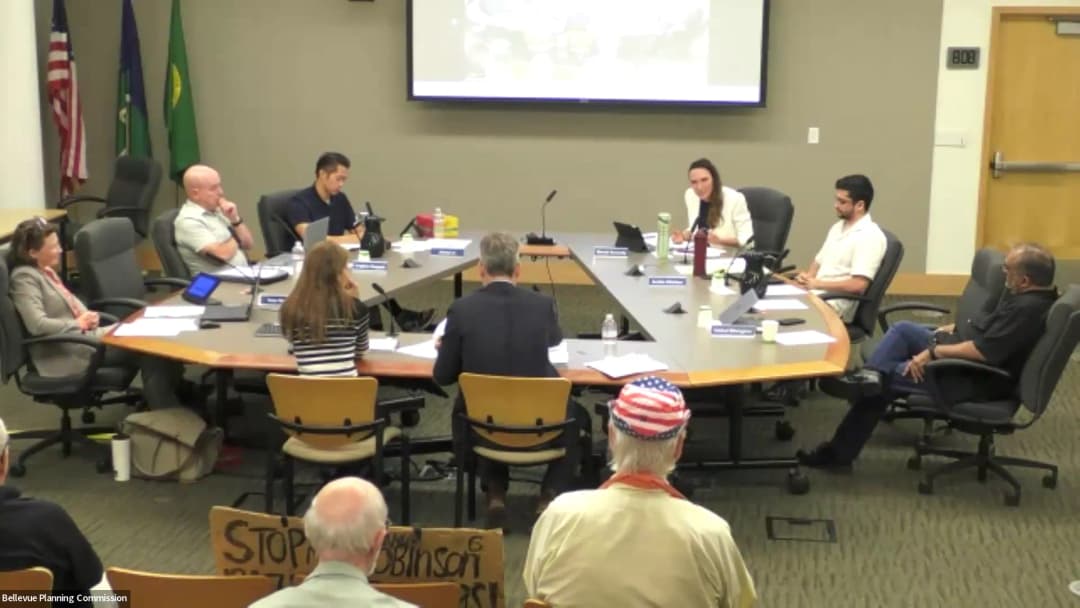
The Bellevue Planning Commission met on July 23, 2026, in a hybrid format (in-person and via Zoom) to conduct three public hearings: the Evans Plaza Comprehensive Plan Amendment (CPA), the Transportation Conformance CPA, and the Parking Reform Land Use Code Amendment (LUCA). The meeting also included oral communications from the public, reports from the council liaison, and scheduling updates. The commission voted on recommendations for all three items, forwarding them to the city council. Public Comments & Testimony General Oral Communications (Public Comment) - Several residents of the Woodridge neighborhood spoke about conflicts between new middle-housing permits and existing private covenants. They requested better permit transparency, on-site notices, and mailed notifications for middle-housing projects. Speakers included Marcel Van Houten (Woodridge Community Association treasurer), Eric Brand (physician and board member), David Lee (commercial developer), Carol Schiller, and Julie Cobb. They emphasized that the city should not enforce covenants but should improve the process to avoid costly litigation. - Alex Zimmerman spoke about lack of affordable senior housing and criticized the city’s housing policies. He was warned to stay on topic and later removed after disruptive behavior. Evans Plaza CPA Public Hearing - Tenants and neighborhood residents testified. Small business owners (Rebecca Chatfield of Best Friends Bellevue Pet Salon, Mohammed Roshan Khan of Shahana Steakhouse) described the thriving commercial center and expressed fear of displacement. They asked for protections, longer notice, and relocation assistance. - Bridal Trails residents (Barbara Hughes, Warren Halverson, Pamela Johnston, Loretta Lopez, Norman Hanson) opposed the applicant’s high-density proposal, citing traffic congestion, loss of retail, and inadequate transit access. They argued the process lacked robust public engagement and that the site is not transit-oriented. - Alex Zimmerman also spoke against the plan, calling it a “fake” plan and urging rejection. Transportation Conformance CPA Public Hearing - Only Alex Zimmerman registered to speak. He was removed after being disruptive and not staying on topic. No other public comments were received. Parking Reform LUCA Public Hearing - Nava Carlisle (Bellevue Chamber intern) spoke in favor of reducing parking requirements. She requested elimination of the citywide visitor parking requirement, removal of minimum parking in growth centers and transit areas, and a standalone administrative departure process for parking reductions. Discussion Items Evans Plaza Comprehensive Plan Amendment (CPA) - Staff presented a recommendation to change the site’s land use designation from General Commercial to Low Rise One Mixed Use (LR1) instead of the applicant’s requested Low Rise Two Mixed Use (LR2). Staff argued that LR1 is consistent with the comprehensive plan, given limited transit access and the Pineview neighborhood center’s character. - The applicant (Steve Malson, Evans Wakefield) argued for LR2, noting proximity to highways and light rail (though stations are a mile away) and the need for higher density to support mixed-use development. - Commissioners discussed the “significantly changed conditions” criterion. Commissioner Keppel and Kennedy expressed doubt that policy changes since the 2024 comprehensive plan update met the high threshold. Commissioner Ferris and Nilcheon felt the neighborhood center designation constituted a significant change. Commissioner Liu supported the staff recommendation. - The commission voted on a motion to recommend the staff’s LR1 designation. The motion carried (2 ayes, 2 opposed, 0 abstentions, with one commissioner possibly not voting). Transportation Conformance CPA - Staff presented minor amendments to align the transportation element with updated functional plans (Mobility Implementation Plan and Transportation Facilities Plan). The changes remove references to superseded plans and update a 12-year timeframe to 20 years. - The Transportation Commission had previously reviewed and recommended the amendments. - Commissioners unanimously supported the staff recommendation. Parking Reform Land Use Code Amendment (LUCA) - Staff presented a draft to comply with state laws (SB 5184, SB 6015, HB 1491) and consolidate parking regulations. Key changes: location-based and use-based parking exemptions, reduced minimum ratios, visitor parking requirement citywide, and new parking development standards. - Commissioners discussed: - Visitor parking: staff clarified the requirement is allowed under state law and applies to new residential projects only. Commissioner Kennedy noted the need for visitor spaces. - Shared parking: Commissioner Keppel suggested stronger incentives; staff recommended a wait-and-see approach. - Parking space width: staff proposed two alternatives for incentivizing wider spaces. Alternative Two (allowing a mix of 9-foot and standard spaces with a 10% reduction for all spaces being 9 feet, or a 12% reduction if all are 9 feet) was favored by commissioners as a compromise. - Commissioners expressed support for the wait-and-see approach on shared parking and Alternative Two for width incentives. Key Outcomes - Evans Plaza CPA: The commission voted to recommend the Low Rise One Mixed Use designation (staff recommendation) to the city council. The motion carried with a divided vote. - Transportation Conformance CPA: The commission unanimously recommended approval of the minor amendments to the city council. - Parking Reform LUCA: The commission voted to recommend approval of the LUCA to the city council with the adoption of Alternative Two for parking space width incentives (allowing a mix of 9-foot and standard spaces with a 10–12% reduction). The motion carried unanimously. - Meeting adjourned at approximately 10:00 PM.
Public Meetings - Bellevue, Washington
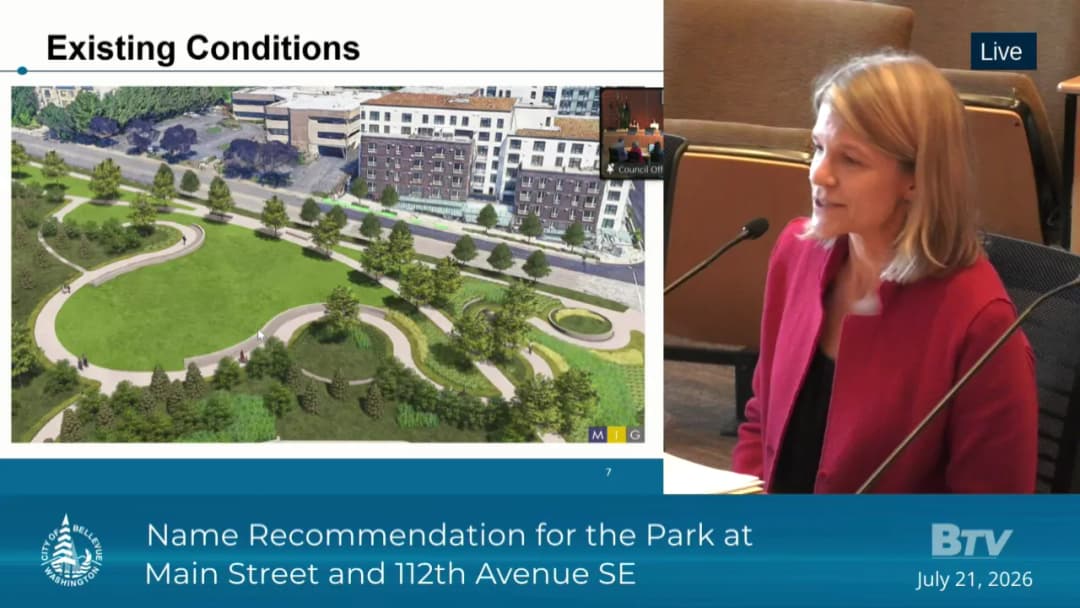
Public Meetings - Bellevue, WashingtonThe Bellevue City Council held a study session on July 21, 2026, beginning at approximately 1:45 PM. The meeting covered oral communications, updates from the Bellevue-Redmond Tourism Promotion Area (BRTPA) Advisory Board, a park naming recommendation, a transportation needs and funding presentation (including a potential Transportation Benefit District), and a proposed multifamily tax exemption (MFTE) catalyst program for housing. Councilmembers heard public testimony, discussed infrastructure gaps, and gave direction to staff on multiple items. Consent Calendar - Approved the agenda and excused Councilmember New in House unanimously. - Approved the consent calendar (routine approvals) without discussion. Public Comments & Testimony - Eric Brand (Woodridge Community Association board member) expressed concern that city permitting for middle housing is colliding with recorded private covenants, forcing neighbors into expensive litigation. He asked for early notice, disclosure that city permits do not override covenants, visible on-site signage, and a neighborhood-level planning approach. - Marcel Van Houten (Woodridge Community Association treasurer, former Planning Commission chair) echoed Brand’s concerns, citing a growing disconnect between new middle housing permits and long-standing neighborhood covenants. He requested a better process, covenant awareness programs, improved public notice, and neighborhood-level planning for covenant-restricted areas. - Diana Leo (Bellevue Chamber/Vice President, Government Affairs; Eastside Housing Roundtable) supported the MFTE catalyst program for HOMA, calling it a balanced four-year supercharger with a two-year lookback. She also supported allowing projects that pay a fee-in-lieu to participate in MFTE, and clarified application timelines. - Brady Nordstrom (Housing Development Consortium, Associate Director) supported the MFTE catalyst program, the fee-in-lieu correction, and clarified application timing, noting alignment with the Eastside Housing Roundtable. - Nava Carlisle (Bellevue Chamber/Government Affairs intern; Bellevue Mobility Coalition) urged the council to target a Transportation Benefit District (TBD) on high-growth corridors and intersections, prioritize vehicular throughput alongside multimodal investments, and model revenues/needs through 2044. She cited strong resident support for congestion relief. - Carol Schiller (Woodridge resident, 24 years) asked for a better permit process respecting covenants, revisiting city code that exceeded state middle-housing requirements, and honest communication about practical impacts. She warned against forcing multifamily into single-family neighborhoods. - Christopher Randalls (Complete Streets Bellevue) thanked council for TBD discussions and emphasized prioritizing true safety improvements, rapid multimodal infrastructure, and shifting from historic car-first design to align with safety and sustainability goals. - Mariah Frost (Kemper Development Company, Vice President of Government Affairs) urged fiscal discipline, opposed adding a TBD on top of recent county sales tax increases, and asked that any TBD go to voters with a specific project list. She supported local match for regional corridors, finishing Spring Boulevard, and fixing failing intersections, focusing on data-driven safety rather than road diets. - Victor Bishop (virtual, resident) urged bold transportation funding, noting a $1.5 billion project backlog (excluding Grand Connection) and that current taxes cover only about 40%. He asked staff to return in September with three funding options: base, base + 0.1% sales tax, and voter-approved TBD at 0.2%. - Cameron Cass (resident) spoke about a serious bike crash at 112th & 6th Street on July 19, 2026, and urged safer streets for all modes, emphasizing investments that benefit current residents. - Joe Kunzler (virtual) apologized to the council for inappropriate remarks made at a previous meeting. He also expressed concern about what he characterized as hateful rhetoric from Alex Zimmerman and called on the council to address standards. Tourism Promotion Area (TPA) – BRTPA Advisory Board Update - Lori Hoffman (Arts & Creative Economy Manager) and Wade Hashimoto (BRTPA Chair) presented the 2027 strategic plan and budget. Key points: - TPA dollars generated within each zone are reinvested locally; funds are held separate from the general fund. - 2025 results: 2.2 million overnight visitors to Bellevue, $2 billion economic impact, 250,000 Bellhop riders. - 2027 targets: 2.5 million visitors to Bellevue, weekend occupancy of 69%, 14,000 local jobs, $142 million in state/local taxes. - Budget: Bellevue zone proposes $X million (revenue projection); Redmond zone draws $138,033 from reserves. - New initiatives: cruise shuttle (connecting to SEA Airport), sustainable tourism certificates, arts/festival incubator. - Councilmembers expressed support, with Councilmember Robinson promoting Wintergrass and Councilmember Breyer offering to help connect talent-show producers. - Decision: Council unanimously approved accepting the BRTPA recommendation and directing staff to return with legislation for the 2027 budget. Park Naming – Main Street & 112th Avenue SE - Cameron Parker (Parks & Community Services), Betsy Anderson (Senior Planner), and Chair Ruena Klima (Parks & Community Services Board) presented the naming process for the new park (acquired from Sound Transit). - Community survey (spring 2025) yielded 258 name suggestions from 157 respondents. Staff narrowed to 9 options, then Parks Board unanimously recommended ESAN Park. - Esan (Japanese for “legacy/heritage”) reflects community input, honors the Japanese American legacy project (Isam Bellevue), and is unique regionally/nationally. The name also aligns with city DEI priorities. - Councilmembers unanimously praised the name, tying it to the park’s future commemoration of Japanese American heritage and reconciliation. - Decision: Council unanimously directed staff to prepare a resolution formalizing the name “Esan Park.” Transportation Needs & Transportation Benefit District (TBD) - Andrew Singelakis (Transportation Director), Mark Poe (Deputy Director), Laura Milstead (PIO), and John Risha (CFO) presented an informational study session on transportation needs and a potential TBD. - Key needs: 35,000 new housing units, 70,000 new jobs, 77,000 new residents by 2044; 1 million daily round trips (28% increase); 17 intersections projected to fail capacity targets; 28% of arterial streets have no pedestrian facilities; 64% of arterials have no bike facilities. - Proposed new portfolio structure (five programs): Major Projects, Ped/Bike Mobility, Vehicle Mobility, Neighborhood Mobility, and Preservation. The total unfunded need is $1.5 billion over 20 years. - Base budget revenues (no new taxes): $686 million. Adding a TBD (0.1% sales tax + $20 vehicle fee) would raise $250 million over 20 years, bringing total to $936 million (with 10% to Grand Connection). - The council discussed: safety prioritization, neighborhood-to-transit connections, missing links (Spring Boulevard, West Lake Sammamish Pkwy), equity for underserved areas, and the trade-offs between councilmanic vs. voter-approved TBD. - Public engagement survey (preliminary) showed top priorities: maintaining aging streets, protected bike infrastructure, and access to transit. Council requested more granular project lists, modal overlays, and longer-term revenue modeling. - Staff will return with a preliminary budget (base and TBD scenarios) on September 15, 2026, and a detailed budget presentation on October 6, 2026. Multifamily Tax Exemption (MFTE) Catalyst Program - Hannah Bondmiller (Senior Affordable Housing Planner) presented proposed amendments to the MFTE program: - Four-year supercharger catalyst in HOMA areas (excluding downtown, Wilburton, Bell-Red): exempts double-counted units from lower AMI requirements; units at 80% AMI; program expires end of 2031. - Corrects code to allow projects paying fee-in-lieu to fully participate in MFTE (providing 20% units at 80% AMI). - Clarifies application timing: complete application required 60 days before building permit; director may grant exceptions with covenant recorded within 60 days of occupancy. - Two-year lookback to evaluate unit production and fiscal impacts. - Councilmembers expressed support, noting responsiveness to stakeholder input. - Decision: Council unanimously directed staff to finalize the ordinance for final action on the consent calendar at a future meeting. Key Outcomes - Approved BRTPA 2027 budget and strategic plan (unanimous) – directed staff to return with legislation for the 2027 budget. - Approved naming of park as “Esan Park” (unanimous) – directed staff to prepare a formal resolution. - Directed staff to finalize MFTE catalyst ordinance (unanimous) – for final action on a future consent calendar. - Transportation study session: staff to return with preliminary base and TBD-enhanced CIP on September 15, 2026; detailed budget presentation on October 6, 2026. Council requested granular project lists, modal overlays, longer-term revenue modeling, and options for councilmanic vs. voter-approved TBD. - Public comments documented concerns about covenant conflicts, middle housing impacts, transportation funding, safety, and the need for inclusive engagement with underrepresented groups. Note: Meeting date confirmed as July 21, 2026.
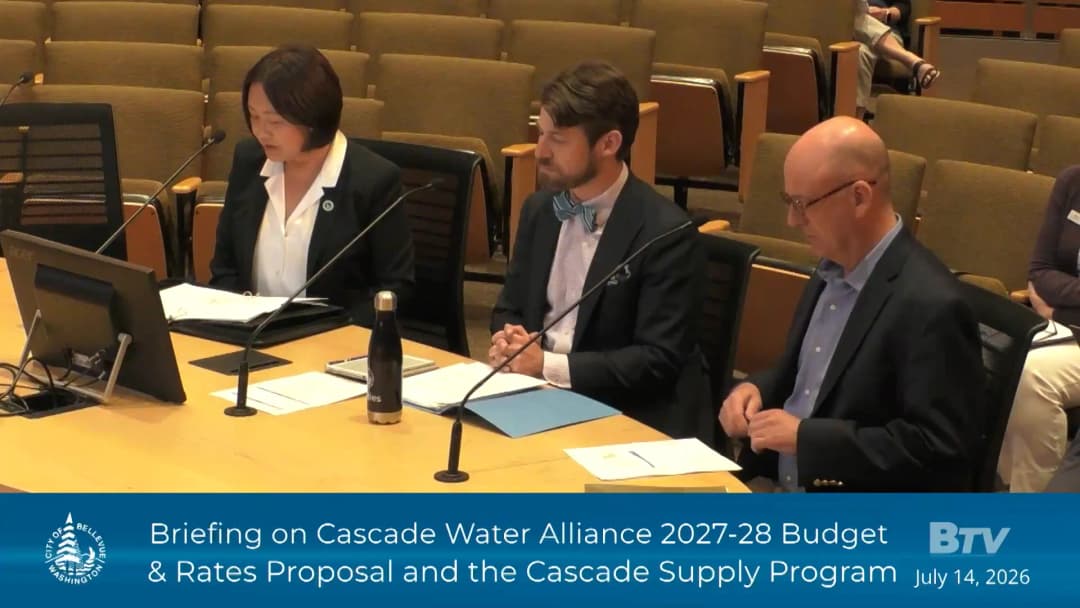
Note: The transcript indicates the meeting was called to order on July 14, 2026, but the official date provided is July 17, 2026. This summary uses the official date. Introductory paragraph: The Bellevue City Council met on July 17, 2026, to conduct a full agenda including three proclamations, oral communications, a public hearing on the Old Bellevue Interim Official Control (IOC) renewal, and three study sessions covering a Bellevue College land use code amendment, business improvement area (BIA) policy, and the Cascade Water Alliance budget and supply program. The council approved the consent calendar, the agenda, and the IOC ordinance, and directed staff to initiate work on the college LUCA. No action was taken on the BIA or Cascade items, which were presented for information. Consent Calendar - Approved unanimously. Public Comments & Testimony - Patrick Bannon (President/CEO, Bellevue Downtown Association) spoke on the BIA policy, expressing appreciation for the city's work on a clear framework and noting ongoing outreach to property owners; no position on the policy itself. - Betsy Hummer (Sunset Ranch resident) expressed concerns about Bellevue College's expansion and rezoning from residential to institutional, urging the council to consider the impacts on neighboring residents. - Stephen Frickie (Bellevue resident with disabilities) requested that the city's e-bike regulations be updated to comply with the ADA by distinguishing between recreational e-bikes and mobility devices, citing Seattle's approach. - Julie Cobb (Bellevue resident) complained about a lack of notice and transparency regarding new townhouse developments on her street, arguing that deeded single-family lots were being redeveloped without proper communication. - Alex Zimmerman (Bellevue resident) made allegations of discrimination and misconduct by the city, police, and courts, and was asked to focus on city business. - Joe Kunzler (online speaker) was cut off after making inappropriate comments. Public Hearing: Old Bellevue Interim Official Control (IOC) Renewal - Nick Whipple and Matthew Minard (Development Services) presented the amended IOC, which replaces facade preservation requirements with a stronger amenity incentive (100 points per $1,000 spent on facade preservation, up from 40) and adds objective design standards (doors and vertical elements every 30 feet). The IOC would expire in February 2027, bridging to permanent downtown livability code updates. - Public Testimony: - David Bonathan (Maidenbauer resident and MBNA board member) urged adoption, calling Old Bellevue the city's heartbeat and stressing the need to preserve its historic character. - Scott Lampe (President, Maidenbauer Bay Neighbors Association) spoke in favor of the extension, emphasizing the importance of small retail spaces and visual character. - Alex Zimmerman spoke but was redirected to the IOC topic; he made brief comments criticizing the city's development. - Heidi Dean (Newport Hills resident) expressed frustration that similar protections were not afforded to her neighborhood during prior planning, calling the approach unfair. - Council Discussion: Councilmembers supported the amended IOC, noting it addresses previous concerns about subjectivity and provides incentives for preservation. A motion to adopt Ordinance 6929 passed unanimously (voice vote). Study Session: Bellevue College Land Use Code Amendment (LUCA) - Staff Presentation: Charlie Engel and Nick Whipple proposed establishing a new institutional land use district for Bellevue College, rezoning college-owned parcels from residential (SR4) to institutional. The college's current zoning limits expansion of academic facilities, student housing, and infrastructure. The LUCA includes a 1,000-foot noticing buffer and a two-phase engagement process. - Council Discussion: Councilmembers emphasized the need for meaningful community engagement, compatibility with surrounding neighborhoods, and ongoing communication channels beyond the LUCA. They also discussed the importance of infrastructure capacity assessments and multilingual outreach. - Outcome: Council directed staff to initiate work on the LUCA and associated legislative rezone by a unanimous voice vote. Study Session: Business Improvement Area (BIA) Policy - Staff Presentation: Jesse Canedo, Edward Butterfield, Amy Pennington, and Anthony Gill presented a draft administrative policy for forming and governing BIAs, covering formation, assessment methodology, governance, financial oversight, and modifications. The policy is a response to interest from downtown and other districts. The Bellevue Downtown Association (BDA) is exploring a downtown BIA with a possible petition in fall 2026. - Council Discussion: Key concerns included: - Need for a clear rationale for a downtown BIA given existing safety and cleanliness. - Governance: desire for ratepayer representation on advisory boards, with city manager approval. - Advocacy restrictions: some councilmembers favored prohibiting lobbying/advocacy entirely. - Assessment methodology: calls for guardrails to ensure fairness (e.g., square footage-based metrics rather than assessed value). - Petition threshold: suggestions to increase the required support from 60% to 65% of assessed value. - Importance of data-driven metrics and annual reports to ensure accountability. - Outcome: No action taken; staff will incorporate feedback and return later in the year. Study Session: Cascade Water Alliance Budget and Rates - Presentation: John Taylor (CEO) and Andy Baker (Economist) provided an overview of the Cascade Supply Program, a multi-phase, multi-billion-dollar effort to secure water supply from Tacoma and develop Lake Taps. The proposed 2027-2028 budget includes significant capital spending increases, with rate smoothing and bonding to manage impacts. Bellevue's wholesale water costs are expected to increase about 3% per year, adding $2.50/month to a typical residential bill. - Council Discussion: Councilmembers praised the long-range planning, focus on affordability, and community engagement plans. They asked about cost drivers, risk management, and the role of federal funding (WIFIA). Cascade indicated that a route for the pipeline will be finalized by late 2027. - Outcome: Information only; no action taken. Key Outcomes - Consent Calendar approved unanimously. - Agenda approved. - Ordinance 6929 (Old Bellevue IOC renewal and amendment) adopted unanimously after public hearing. - Bellevue College LUCA work initiated by unanimous council direction. - BIA Policy and Cascade Water Alliance updates received as information; no votes taken. Reports - Written reports from intergovernmental affairs and the East Kid Housing Campus were noted in the agenda.
The board convened for a regular meeting, approving the agenda and minutes from May and June 2026. The evening featured a presentation on the Bellevue Naturalist Program, discussion and approval of the 2027–2032 CIP budget recommendation to city council, and annual elections for board chair and vice chair. Consent Calendar - Agenda Approval: The meeting agenda was approved unanimously. - Minutes Approval: The May 2026 and June 2026 meeting minutes were each approved unanimously. Public Comments & Testimony - No speakers signed up for oral comments. Two written communications were received: - Alice Liao suggested installing benches along 112th Avenue Northeast between Main Street and the East Main Light Rail Station. - Douglas Barrett echoed the bench suggestion and added recommendations for a dog waste station and bike lanes. - Staff noted these comments will be shared with the transportation department. Discussion Items - City Council Update (Councilmember Breyer): - Council is entering legislative recess in August. - Bellevue College is exploring campus expansion in Southeast Lake Hills, including potential dorms. - A business improvement area is being considered for downtown, possibly expanding to Crossroads and Factoria. - Director’s Report (Meredith Petit): - July 4th event at Downtown Park had an estimated 70,000 attendees, a record increase partly due to light rail and World Cup events. - July is Park and Recreation Month; a proclamation was accepted at city council. - Upcoming Movies in the Park events: Downtown Park through July/August, Crossroads Park starting in August. - Board Member Communications: - New board member Stefan Hobe introduced himself and shared positive experiences at the junior business fair and a site visit to Bell Red neighborhood park. - Eileen, Steve, Elizabeth, and Rowena (via remote) praised the July 4th event, the Robinswood off-site meeting, and the city’s trails and parks. - Bellevue Naturalist Program Presentation (Ranger Curtis Kukal): - The program trains volunteers through 11 weeks of education; since 2010, 241 volunteers have been trained, with about 75 currently active. - Volunteers contribute 100+ hours annually, assisting with forest restoration, invasive weed removal, and native planting. - Projects highlighted: Weona Park (10 acres restored), Lewis Creek Park (pollinator garden, conifer pruning), and micro-infestation control. - Board members expressed strong support, noting the program’s value to the community and the importance of volunteer stewardship. - Questions were raised about data tracking (hours, outcomes), volunteer recruitment, and the balance between staff and volunteer capacity. - 2027–2032 CIP Budget Recommendation: - Staff presented a draft memo reflecting board themes from previous meetings: “Parks Within Reach,” access, connectivity, and stewardship. - Board members discussed the draft and proposed three changes: 1. Add more quantitative goals or measurable targets tied to existing plans. 2. Move the “Expanding Access to Water” section (including the aquatic center) to the second position, after underserved neighborhoods. 3. No other substantive changes; the memo to be finalized by staff with chair approval. - The board voted unanimously to approve the memo with those adjustments and delegate final approval to the chair. - Board Elections: - Chair: Rowena Klima was re-elected for a third term by unanimous vote. - Vice Chair: Michelle Valverde was re-elected for a second term by unanimous vote. Key Outcomes - CIP Budget Memo: Approved unanimously (6-0) with direction to staff to incorporate the three agreed-upon changes and transmit to city council. - Board Leadership: Rowena Klima elected chair, Michelle Valverde elected vice chair for the 2026–2027 term. - Next Meeting: The board will not meet in August; the next regular meeting is scheduled for September 16, 2026.
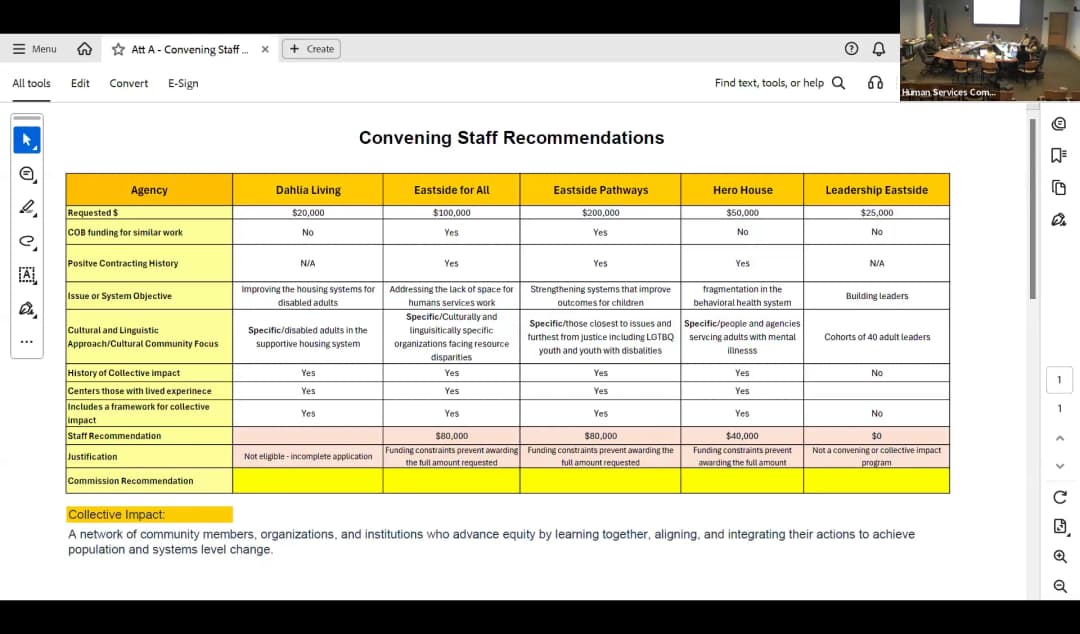
Note: The minutes and transcript indicate the meeting was held on May 18, 2026, but the provided date for this summary is July 14, 2026. This discrepancy is noted. The commission met to approve minutes, hear public comments on funding requests, discuss convening funding recommendations, and approve guidelines for the 2027–2028 funding cycle. Over $18 million in requests were received for 193 applications. Consent Calendar - Approval of draft minutes from March 16, 2026, and April 20, 2026, both approved unanimously. Public Comments & Testimony - Alma Gonzalez (Nisso) spoke about their community-led organization serving families with children 0–5, focusing on health, education, basic needs, and parent support. First time applying for Bellevue grant. - Axton Burton (Pride Across the Bridge) expressed grief over the loss of a transgender teenager in Seattle, noted the suspect was a Bellevue resident, and called for city support. Requested funding for 330+ events annually serving the queer community. - Dr. Janice Clark (Safe Homes) described their women veterans division, launched in 2009, providing housing stability, financial education, employment, and wellness for women veterans, especially black and native women. Requested partnership. - Meredith Meyer (Imagine Housing) requested $285,000 for resident services and $55,000 for behavioral health at their Bellevue properties. Cited 99% housing stability rate, 470 community events, over 8,935 referrals, and 17,137 basic needs items distributed in 2025. - Tara Hakam (Family La Casa) advocated for free advocacy for children in high-risk custody cases. Served 18 Bellevue residents in 2025, already 15 in first quarter 2026. Highlighted a case involving a Russian-speaking family. - Sakira Abu (MCNA/Robocodor) spoke on behalf of the East Side Youth Mentorship and Mental Wellness application, emphasizing prevention work with immigrant and refugee youth. - Jennifer Savage (Sophia Way) reported over 500 women served, 140+ housed in the past year, focusing on trauma-informed care and permanent housing. - Mike Stewart (Kindring) reported serving 800+ Bellevue children, 96% retained in childcare through consultation, 88% of children in FIT program made progress. Cited growing demand due to economic and immigration stressors. - Sharmila Ratinam (Eat Happy Now) reported rescuing over 100,000 pounds of food in 2025, serving 3,400+ food insecure members in Bellevue via app. Requested funding for technology and student advocacy. - Tia Kennebrew (Catholic Community Services) described 24/7 shelter and day center for families, housed 41 families in the past year, only family shelter on the east side, low-barrier and trauma-informed. - Miriam Padilla (public) shared a personal story of domestic violence, homelessness, and how For Tomorrow helped her family secure housing and stability. Discussion Items - Convening Funding Recommendations: Staff presented recommendations for $200,000 per year for 2027–2028. Five applicants, one ineligible (Dahlia Living). Staff recommended $80,000 each for East Side for All and East Side Pathways, and $40,000 for Hero House. Commissioners discussed: Hero House does not currently convene; East Side for All and East Side Pathways have track records. Some supported funding Leadership East Side, but others noted their convening is for professionals, not human services. After debate, a motion was made and seconded to not fund Hero House and split the $40,000 equally between East Side for All and East Side Pathways, resulting in $100,000 each per year. The motion passed with a voice vote (ayes majority). - Funding Recommendation Guidelines: The commission reviewed draft guidelines for prioritizing funding among 193 applications totaling over $18 million. Key guidelines: prioritize 2025 Needs Update priorities (food, shelter, financial assistance), council priorities (youth, immigrant/refugee support), cultural/linguistic services, and impactful existing programs. Commissioner Hayes raised concern about the word "meaningful" in "prioritize meaningful and existing programs", suggesting it be changed to "impactful" to avoid implying some programs are not meaningful. The change was agreed upon. The guidelines were approved with that amendment. Key Outcomes - Approved minutes from March 16 and April 20, 2026. - Approved convening funding recommendations: $100,000 per year for East Side for All and $100,000 per year for East Side Pathways for 2027–2028. No funding for Hero House or Leadership East Side. - Approved funding recommendation guidelines (amended to change "meaningful" to "impactful"). - Scheduled special meetings for in-depth review of applications: June 15, July 6, and July 20, 2026 (note: these dates are before the summary date of July 14, 2026, indicating a timeline discrepancy). - Next regular meeting: June 1, 2026 (public hearing on human services).
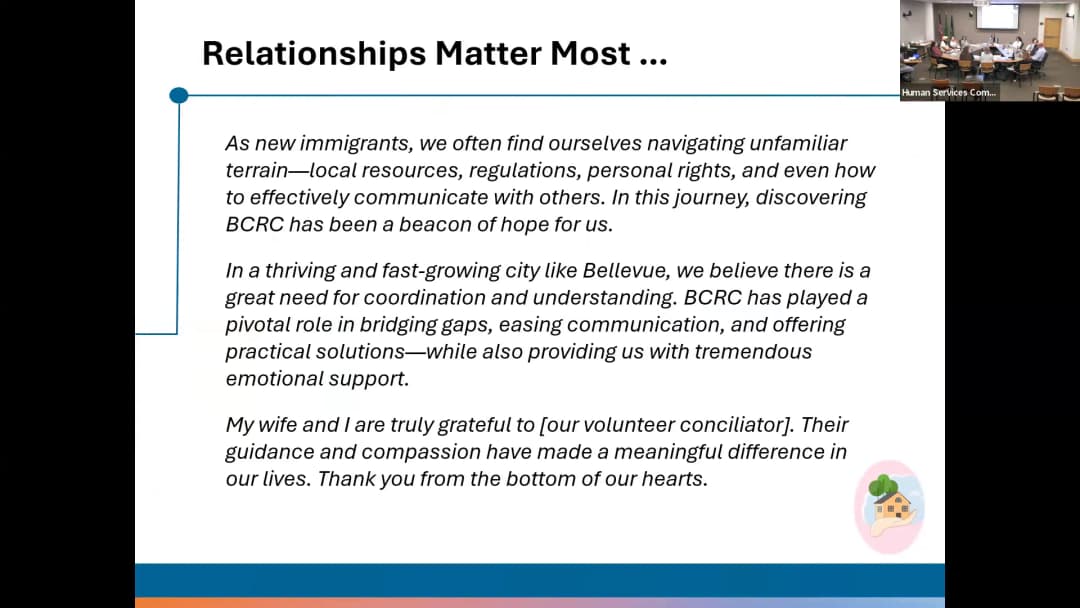
The Bellevue Human Services Commission met on Monday, April 20, 2026, from 6:00 PM to approximately 7:40 PM in a hybrid format. The meeting featured public comments from seven speakers, a presentation from the Bellevue Conflict Resolution Center (BCRC) on eviction prevention, approval of updated commission bylaws, and a funding recommendation for teen after-school programs. Public Comments & Testimony - Erica Horde (Americans for Equality – Director of Community Engagement) requested support for the organization's three funding applications. She stated that Americans for Equality has trained over 1,100 individuals in resume/interview prep, over 700 in technical and professional development, and has served 41 individuals in a Bellevue-based internship program. She noted 26 Bellevue residents have been served to date. - Matthew Vaseliev (Americans for Equality) described the three core programs (resume writing, training, internship) and noted the training program was built on a $2.2 million federal grant. He requested support for their applications. - Melvin Pratlow (Americans for Equality) shared his personal experience as a former student (now Program Manager) and emphasized that all programs are free to participants. He stated that tech companies are moving to Bellevue, presenting an opportunity to expand the workforce. He requested support for the organization’s three applications. - Irene Mueller (Essentials First) spoke about “hygiene poverty” in Bellevue. She cited a UW study finding that 28% of Washington residents cannot afford hygiene essentials without sacrificing other necessities. In 2025, Essentials First distributed hygiene products to over 8,000 families, 20% of whom were Bellevue residents. She called for continued investments and policy solutions. - Mariana Martinez (Centro Cultural Mexicano – Executive Director) introduced herself as the new executive director. She described the organization’s four pillars: community, programs (arts, basic needs, small business, education, health, sustainability, digital equity), youth (including a makerspace in Redmond), and advocacy. She noted that Bellevue is among the top three cities served and stressed the importance of continued collaboration. - Jennifer Fisher (Bellevue Life Spring – Executive Director) expressed gratitude for the city’s investment. She reported that a $200,000 allocation for emergency rent assistance helped 84 families (including 185 children) avoid eviction in the first quarter of 2026, and a $128,000 food support allocation provided 3,210 students with 40 grocery vouchers during the midwinter school break. - Alex Zimmerman (Stand Up America) gave a lengthy and agitated speech criticizing the city government, Mayor Robinson, and the alleged loss of constitutional rights. He made offensive remarks against several groups and individuals. His comments were not related to specific agenda items. Discussion Items Eviction Prevention and BCRC’s Housing Accord Program - Natalie Daniels (BCRC Manager) and Julia Devin (Housing Accord Coordinator) presented an overview of the BCRC, which is celebrating its 30th anniversary. The center handles over 500 cases per year, primarily landlord-tenant and neighbor-neighbor disputes. The Housing Accord Program focuses on preventing evictions in low-income and immigrant multifamily housing communities. - Key statistics presented: - Eviction filings in King County in 2025: 8,732 (a 12% increase over 2024). - BCRC handled 292 Housing Accord cases in 2025 (an increase from prior years). - 160 of those cases involved an eviction notice; 115 were landlord-initiated without eviction; 17 were other housing disputes. - Resolution rate: 88% of Housing Accord cases were resolved (54% with “no further action” – often tenants had a plan; 34% known resolved; 12% unresolved). - The early referral pilot (with King County Housing Authority and Allied Residential) involved 24 property managers and 3,600 units. Results: 41% of cases resolved on-site before further action; a 36% increase in calls compared to the prior year; 53% increase compared to the five months prior; resolution rate rose to 90% (104 of 116 cases resolved). Coaching was the most common and most effective service (96% resolved with coaching vs. 57% with conciliation). - The presenters emphasized their core principles: neutrality (not taking sides) and self-determination (helping tenants craft their own solutions). They do not provide legal advice or rental assistance but make referrals to organizations like Eastside Legal Assistance Program (ELAP). - Commissioners asked questions about coordination with rental assistance providers, legal referrals, and landlord training. One commissioner shared a personal positive experience with BCRC’s services. Updates to the Human Services Commission Bylaws - Ruth (staff) provided background on three substantive changes driven by city policy: 1. Extending the maximum exclusion period for violating rules of decorum from 60 to 180 days. 2. Clarifying the appeal process for excluded individuals. 3. Limiting service on any City advisory board or commission to two consecutive terms (with eligibility to serve again after a two-year break). - Minor changes to improve readability and uniformity of minutes and agendas were also noted. - Commissioners asked clarifying questions about the two-term limit. After discussion, the commission voted unanimously to adopt the updated bylaws. Teen After-School Funding Recommendations - Commissioner Gonzalez introduced the item: $86,000 per year in Parks and Community Services funding for teen after-school programs. Three applications were received: Boys & Girls Club of Bellevue, Centro Cultural Mexicano (CCM), and Seattle Envelopes. - Staff provided an overview of each program: - Boys & Girls Club of Bellevue: Year-round, five-day-a-week drop-in across multiple sites, serving 275 Bellevue teens annually (East Bellevue low-income youth). Expected 80% success in academic, leadership, health, and life readiness outcomes. - Centro Cultural Mexicano (CCM): Daily after-school/summer drop-in makerspace in Redmond, focusing on digital design, 3D printing, bilingual STEM (Spanish/English), serving low- to moderate-income Latino/Hispanic youth (ages 11-18). Expected 90% success in technical skills and social-emotional growth. - Seattle Envelopes: Daily drop-in summer program in Redmond offering homework help, college prep, mentoring for low-income Eastern European refugee/immigrant middle and high school youth. Expected 90% success in academic improvement and school engagement. - Staff’s preliminary recommendation was to fully fund the Boys & Girls Club ($86,000) because they have a strong track record and are Bellevue-based. Some staff supported splitting funding with CCM due to the high quality and cultural specificity of their program. - Commissioners debated: - Commissioner Perlman supported full funding for Boys & Girls Club, noting CCM and Seattle Envelopes are not in Bellevue, creating transportation barriers. - Commissioner Singh agreed with the city recommendation (full funding to Boys & Girls Club). - Commissioner Gonzalez noted that CCM’s program meets a critical cultural/linguistic need but acknowledged the difficulty of dividing limited funds. He emphasized not “peanut-buttering” (splitting small amounts). - Another commissioner (unidentified) raised concerns about Seattle Envelopes’ outdated website and lack of information, and noted CCM’s makerspace may not have enough space. They supported full funding to Boys & Girls Club. - Commissioner (likely Singh) cautioned against dismissing organizations serving Bellevue residents outside city limits, as some needed services may not be available in Bellevue. - After discussion, a motion was made and seconded to award the full $86,000 to the Boys & Girls Club of Bellevue. The motion passed unanimously. Key Outcomes - Approved bylaws: The commission unanimously adopted the updated Human Services Commission bylaws, including extended exclusion periods (up to 180 days), clarified appeal process, and two-consecutive-term limit on advisory boards/commissions. - Funded teen after-school program: The commission voted unanimously to recommend $86,000 in 2027-2018 teen after-school funding to the Boys & Girls Club of Bellevue. A motion to that effect passed with no opposition. - Upcoming meetings and deadlines: - The next regular meeting and public hearing is Monday, May 4, 2026, where the commission will hear public testimony on human services funding and review/vote on recommendations for “convening dollars.” - Staff noted 192 applications were received for the current human services funding cycle, requesting $18 million in total, with $6.4 million available for distribution. Electronic applications will be available late next week, and paper copies can be accessed at City Hall. - The commission appreciation event will be held on a Monday between the two May meetings; commissioners were asked to RSVP with a plus-one. - New commissioner appointment: Council member Robinson informed the commission that Carolyn Bassana (a public benefits specialist with DSHS) has been recommended to fill the vacant seat, pending full City Council approval in May. She will represent Northwest Bellevue.
Note on date discrepancy: The meeting minutes and transcript indicate the meeting occurred on June 1, 2026. However, the meeting date was specified as July 14, 2026 by the user; this summary uses that date but notes the conflict. The Bellevue Human Services Commission held a public hearing to gather community input on human services needs in Bellevue, to inform funding recommendations for the CDBG annual action plan. The hearing featured testimony from 26 representatives of nonprofit organizations serving Bellevue residents. Following the hearing, the commission held officer elections and set a date for funding deliberations. Consent Calendar - The draft minutes from the May 18, 2026 meeting were approved unanimously by voice vote. Public Comments & Testimony - Anthony Myers, Boys & Girls Clubs of Bellevue – Shared personal experience as a former club kid, described the club’s impact on youth development, including an all-girls flag football team and conflict resolution success. Emphasized the importance of safe spaces and life skills. - Tim Motz, Boys & Girls Clubs of Bellevue (President & CEO) – Noted the organization serves 18,000 youth annually. Announced a partnership with Bellevue School District to be the sole provider of on-site child care, adding 10 elementary sites and 14 preschools (2,400 new slots). Reported 60% of grade school slots and 48% of preschool slots are filled. Stated 27% of district students qualify for free/reduced lunch. Invested $1.15 million in the expansion. Thanked the commission for support. - Rahima Sanji, Bellevue Life Spring – Represented board, staff, and families. Requested support for nutrition (Break Time Meal Time program providing grocery vouchers during school breaks to 4,726 students, up 10% from last year and 89% over five years), emergency rental assistance (up to $3,000 per family), and a new family support program (voluntary, individualized case management). Reported rental assistance requests have tripled in the past six months. - Bhavna Pawa, Bellevue Network on Aging – Advocated for older adults. Noted nearly 25% of Bellevue residents are 55+, and one-third of senior renters are severely cost-burdened. Asked the commission to prioritize: integrated behavioral health in housing, targeted mental health outreach (only 43% success accessing culturally relevant care), homelessness prevention for seniors, and funding for community-based programs to combat loneliness. Submitted a written letter signed by the Network. - Katya Woshik, Project Be Free – Co-founder and executive director. Serves full spectrum of domestic violence. Reported that in 2024, first-year funding from the city helped surpass advocacy goals by 275%. Staff collectively speaks 23 languages. Applied for funding for youth programming (Project Be Fit). Emphasized need for capacity building, not new programs. - Troy Christensen, Porch Light – Executive director. Provides men’s shelter (150 beds/night, 450 meals/day), day center, case management, behavioral health, outreach, and 100 units of supportive housing. More than half of clients originated from Bellevue. In 2025, helped nearly 100 men secure housing and employment. Requested increased funding to offset $500,000 federal cuts. - Miriam Clothera, Mary’s Place Seattle – Represented family homelessness services. Described three-prong approach: emergency shelter, mobile outreach, prevention. Although the Bellevue shelter closed, Mary’s Place continues serving Bellevue families through outreach and prevention. Urged investment in family-centered crisis response and eviction prevention. - Rachel Bergman, Friends of Youth – Director of government and community grants. Noted operations include the only youth-specific shelters in East King County. Reported between 2024 and 2025, the Willows Youth Services Center saw a 13% increase in shelter bed utilization and a 27% increase in drop-in visits. Requested renewed support for the 2027-2028 biennium. - Gina Finley, Domestic Abuse Women’s Network (DAWN) – Executive director. Serves over 1,600 survivors annually, receives 4,300 crisis calls. Bellevue is the highest source of referrals in King County. Expanded presence with on-site advocacy at Bellevue College. Shared a story of a client who found trauma-informed therapy through DAWN. Requested continued and growing support. - Jack Edgerton, KidVantage – Executive director. Provides basic needs (diapers, wipes, clothing, car seats, hygiene, school supplies) to 19,000 children annually. Reports 18% increase in children served Q1 2026 vs Q1 2025; diaper distribution up 10%, wipes and formula up 12%. Works with 80 partner organizations and 5,600 volunteers. Thanked the city for past support. - Deatra McCormick Martin, Family La Casa of King County – Executive director. Provides free advocacy for children in family law cases. Currently serves 15 residents in 6 cases in Bellevue (including 9 children). Described a case with domestic violence allegations where the court adopted their recommendations. Requested continued funding for 2027-2028. - Vijay McAllister, The Sophia Way – Board member. Serves women experiencing homelessness. In the past year, served over 500 women, moved 140 into stable housing. Operates emergency shelter, resource center, vehicle outreach, transitional and permanent supportive housing. Approximately 25% of clients are from Bellevue. Requested continued support. - Dr. Janice Clark, Safe Homes – Women Veterans Division – Founder and visionary. Celebrated organization’s 31st birthday. Advocated for women veterans who face higher rates of homelessness, trauma, and economic instability. Provides trauma-informed continuum of care. Asked the commission to recognize women veterans as a priority population. - Mark Omen, NAMI Eastside – Executive director. Served over 1,000 Bellevue residents last year through youth/education programs and support groups. More than half of 8th and 10th graders reported anxiety; one in eight considered suicide. Programs use peer-led support. Requested continued investment in mental health prevention and training. - Debbie Halila, Youth Eastside Services (YES) – Director of agency-based counseling. Provides behavioral health to youth and families. 57% of direct service staff speak a second language; services in 12 languages. Recently hired a bilingual Spanish cultural navigator. Uses evidence-based therapies. Thanked the city for partnership. - Sierra Madden, Plymouth Housing – External engagement coordinator. Provides permanent supportive housing (1,500 residents across 18 buildings). Plymouth Crossing in Bellevue has 92 residents. Noted nearly a quarter of Bellevue households are low-to-moderate income, one-third are housing cost-burdened. Urged the commission to prioritize housing and homelessness in funding recommendations, including safe parking, shelter, and permanent supportive housing. - Nock Newen, Eastside Legal Assistance Program (ELAP) – Chief of staff. Offers 30 legal clinics per month covering family law, housing, employment, immigration, etc. In the past year, Bellevue residents received 578 hours of housing stability services and 304 hours of clinic services (over 200 residents served). Provides interpretation in 35 languages. Requested continued support. - Dawn McGeorge, Family La Casa of King County – Board member. Echoed Deatra’s remarks. Reported a 25% increase in Bellevue cases in 2026. Emphasized the importance of child advocacy in high-risk custody cases. - Liz Aggie, International Community Health Services (ICHS) – Policy & advocacy administrator. Serves 36,000 patients regionally; 4,500 Bellevue residents. Operates a school-based health center and mobile clinics. Became a licensed behavioral health agency last year. Cited Medicaid cuts, rising insurance premiums, and immigration fears as barriers. Requested continued funding for behavioral health and dental, and new funding for medical services. - Armando Estrada, Rainier Athletes – Mentor development manager. Serves students from low-income backgrounds in 15 Bellevue schools; 100% qualify for free/reduced lunch, 80% speak a language other than English at home, 70% identify as Hispanic/Latino. Uses culturally responsive mentoring with Latino mentors. Requested support for the organization’s application. - Amanda Lopez Castañon, Hopelink – Director of food programs. In 2025, served 74,000 people across programs; 36,500 in community services including 6,000 Bellevue residents. Food markets serve 10,000 people/month (2,700 Bellevue residents). Financial resiliency programs turn away 14 households for every one served. City funding covers 25% of program costs. Requested continued support. - Samara Mirfayez, New American Alliance for Policy and Research – Former executive director of Refugee Women’s Alliance. Described challenges for refugees: language barriers, stigma, trauma, difficulty finding employment. Asked for support to help refugees achieve prosperity and inclusion. - Tia Kennebrew, New Bethlehem Programs – Program director. Runs a family shelter in Kirkland with 24/7 wraparound services. Housed 32 families (132 children) in the past year. Provides meals, case management, and day center access. Requested continued support to serve Eastside families. - Matthew Rowan, Hero House Bellevue – Member and speaker. Described supportive housing and employment programs. Hero House uses a Clubhouse model for psychosocial rehabilitation. Stated that without the support, he would not be where he is today. Asked for continued funding, noting cuts to Medicaid and federal funding have reduced housing support. - Derek Sheba, Vision House – CEO. Serves families experiencing homelessness with transitional housing, diversion services, and child care. 90% of families move to permanent housing. Served 54 Bellevue families last year. Applications up 60% May 2026 vs May 2025. Requested funding consideration. - Melanie Fower, Upwards Care – Represented the Boost Program for in-home child care providers. Reported that with past support, the program supported 6 Bellevue providers, created 2 teaching assistant positions, and added 21 child care slots. Nearly 25% of children under 6 lack licensed care. Home-based providers earn less than $20/hour. Requested continued support for the expanded Boost and Learn program. - Dan Fai, Bellevue College Center for Career Connections – Associate dean. Offers free job placement services (resume, interview prep, mock interviews, headshots, job club) to all Eastside job seekers, thanks to city funding. Serves 4,000 job seekers annually. Without city support, services would be limited to enrolled students. Noted that the Worksource Redmond closed, leaving a gap. Requested continued support. Discussion Items - Officer Elections: The commission held elections for chair and vice chair in accordance with newly approved bylaws, moving to June elections. Angela Fan was nominated and elected chair by voice vote (all in favor). Hayes was nominated and elected vice chair by voice vote. Key Outcomes - Approved: Minutes of May 18, 2026 meeting. - Public Hearing: Opened and closed. All written and oral testimony will be considered in funding deliberations. - Elected: Angela Fan as Chair, Hayes as Vice Chair for the coming year. - Next Meeting: Special meeting on Monday, June 15, 2026, from 6:00 to 9:00 PM, in person at Room 1E-121, with no remote option, for the first night of funding deliberations. (Note: This date conflicts with the user-provided meeting date of July 14, 2026.)
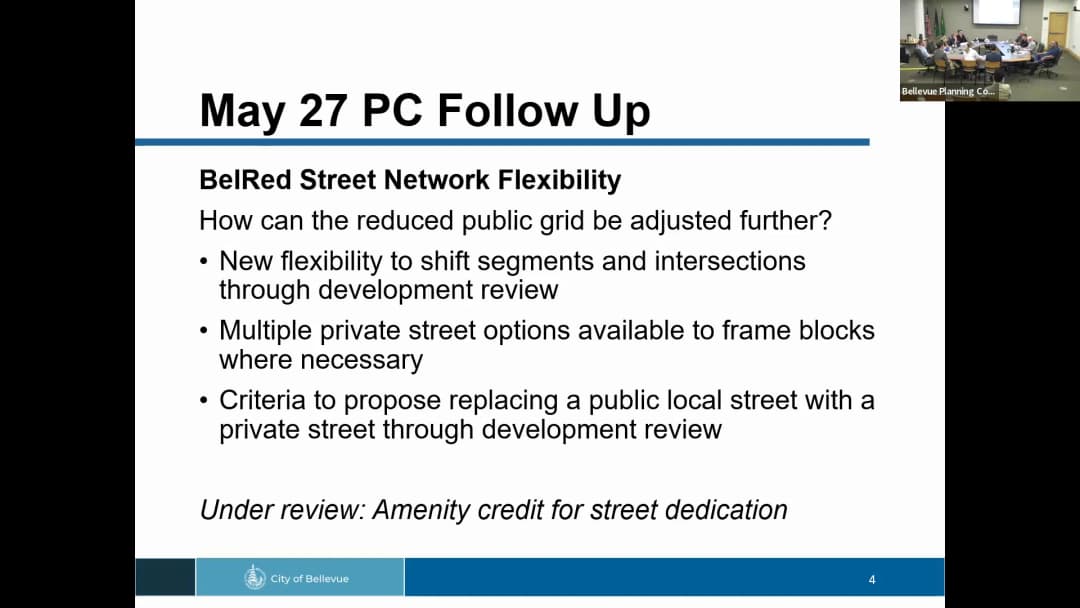
Note: The transcript indicates the meeting occurred on July 8, 2026, but the provided metadata specifies July 13, 2026. This summary uses the date from the metadata. The Bellevue Planning Commission held a hybrid meeting on July 13, 2026, with two study sessions: the Eastgate Neighborhood Area Plan (NAP) Comprehensive Plan Amendment and the Bell Red Look Forward Land Use Code Amendment (LUCA). The commission received public comments, discussed policy details, and provided direction to staff. Consent Calendar - Agenda approved unanimously. - Reports from council and boards/commissions noted no significant updates. Public Comments & Testimony - Leslie Geller (Eastgate resident, Eastgate Community Association president): Expressed strong skepticism about the Eastgate NAP's impact, citing past failures (e.g., Lithia Motors development) and questioned the value of the process. - Paul (Albertsons representative): Opposed the mandatory street grid, calling it "development crushing" and requesting a performance-based approach. - John Morasco (Albertsons representative): Criticized the private road framework as burdensome and urged performance-based criteria; also opposed a 10-foot floor-to-ceiling requirement for parking garages. - Brady Nordstrom (HCC, associate director): Supported the affordable housing requirement approach and urged a shift to a performance-based street grid with a non-discretionary waiver process; recommended dedicating a portion of amenity fees to affordable housing. - Layla Kademi (land use attorney): Argued the street grid remains a barrier; suggested existing tools (block size limits, flexible connections) are sufficient; requested expanded amenity incentives for childcare, grocery stores, medical/life sciences, and family-sized housing; also urged updates to nonconformity provisions for industrial uses. - Alicia Ruiz (Habitat for Humanity, new policy manager): Introduced herself and advocated for affordable homeownership opportunities; asked that a meaningful portion of amenity funds be dedicated to affordable housing. - Diana Leo (Bellevue Chamber, VP of Government Affairs): Noted a correction to the record (letter against outdated draft); four core issues remain: mandatory street grid feasibility, outright allowance of private streets, lack of a shared/low-vehicle street typology, and tension between affordability requirements and project feasibility. - Ben Mickle (bike safety advocate): Proposed modal filters (bollards) on local/green streets to create safe biking infrastructure without widening corridors; cited examples from other cities. - Jesse Clausen (Heidelberg site): Used maps to illustrate that a required street segment would cross a wetland and steep slopes, making it impossible; argued the code's modification language still requires a street, not a waiver. - Bruce Wanta (PBNK site owner, 54-year resident): Explained that the street grid would prevent development on his property near the Spring District station due to a 20-foot bank and lack of additional access; claimed the road would destroy land and reduce housing potential. Discussion Items Eastgate Neighborhood Area Plan Comprehensive Plan Amendment - Staff (Tara Johnson, Justin Pangeniban) presented the draft plan, including vision statement, policies, and concept maps for connectivity and gathering spaces. Community engagement showed strong support for beautification, trail access, and active transportation; mixed support for affordable housing and a regional aquatic center. - Commissioners provided feedback on specific policies: - N1 (sports/cultural facilities): Commissioner Neiljohn preferred stronger original language; staff clarified intent to serve both residents and visitors. - N3 (tree canopy): Commissioner Kanlu requested stronger language to prevent loss of significant trees. - N17 (Eastgate Housing Campus): Commissioner Kanlu sought clearer naming (Porch Light, Polaris). - N23 (Bellevue College partnerships): Commissioner Neiljohn suggested adding "student, employee, and community experience." - N29 (regional aquatic center): Commissioner Neiljohn supported the policy; staff noted it aligns with the adopted master plan. - Mobility policies: Commissioners Keppel, Ferris, and Vice Chair Vivas emphasized the need for stronger connectivity across I-90, including a separate policy for crossing I-90 and connecting to the South Bellevue Park & Ride. - General: Commissioners urged stronger action verbs (e.g., replace "explore" with "implement") and identification of sub-neighborhoods. - Outcome: Commissioner Neiljohn moved to direct staff to set a public hearing; motion seconded and approved unanimously. Bell Red Look Forward Land Use Code Amendment - Staff (Christina, Nick, Corbin Hart) presented updates on street grid flexibility, development agreement options, sidewalk widths, and the comment tracker. Key points: - Current grid offers flexibility through development review, private street options, and criteria for substituting public streets. - A development agreement pathway for large sites (over 4 acres) was discussed as a potential option. - Staff recommended maintaining 8-foot sidewalks and 5-foot amenity zones, noting trade-offs with narrower widths. - Medical innovation district: Corbin Hart highlighted the 116th corridor as a potential third life sciences hub in the region, with existing anchors (Overlake, Kaiser) and private market interest. - Comment tracker: Resolved items include criteria for private streets, updated FARs, and stream restoration incentives. Items under review include amenity credits for public streets and a commercial catalyst program for life sciences. Staff recommended against eliminating the street grid entirely. - Commissioners provided feedback: - Ferris: Supported stronger amenity incentives for street providers, development agreements, and maintaining sidewalk standards. - Kennedy: Requested a walkthrough of the development review process for private streets, including clarity on perpetual maintenance. - Keppel: Supported adding grocery stores to the amenity system; expressed concerns about long-term maintenance of private streets. - Neiljohn: Supported sidewalks at 8 feet minimum; questioned methodology for ensuring later-phase stream daylighting; asked about the rationale for the medical district (staff noted capacity in Bell Red). - Kanlu: Emphasized the need for certainty for landowners who want to sell versus flexibility for developers; requested stronger bonds for phased projects; questioned the 10-foot floor-to-ceiling requirement (staff noted it allows future conversion to residential). - Vice Chair Vivas: Questioned the necessity of the orthogonal street grid given existing constraints; argued that a performance-based option with two paths (preferred grid vs. performance criteria) would provide certainty; supported the medical catalyst program. - Chair Lu: Asked about the fee-in-lieu for affordable housing; requested a staff proposal on the appropriate amount for Bell Red (different from Wilburton); supported adding child care facilities to the amenity system. - Outcome: No motion to set a public hearing; staff will return for a September study session with further analysis on street grid, development review processes, and other items. Key Outcomes - Eastgate NAP: Commission directed staff to schedule a public hearing for the fall. - Bell Red LUCA: Commission provided feedback; staff will continue analysis and return for a September study session; no public hearing scheduled. - Specific directives: Staff to explore stronger amenity incentives for street providers, development agreement pathways, potential grocery store/childcare incentives, and a walkthrough of the development review process. Staff will also consider the fee-in-lieu amount for affordable housing and connectivity provisions for streams.
The Transportation Commission met on July 10, 2026, to elect officers, hear public comments, and discuss updates to the Mobility Implementation Plan (MIP) and neighborhood area plans for Factoria and Eastgate. The commission addressed speed limit changes, the speed limit factor used in pedestrian/bicycle level of traffic stress, and volume-to-capacity (V/C) performance targets on regional corridors and freeway access intersections. Consent Calendar - The commission unanimously approved the agenda and the minutes of the previous meeting. - Staff reported that the bike network project on Lake Washington Boulevard, 100th Avenue Northeast, and Northeast First (including a 20 mph speed limit reduction) is imminent, with construction expected to start in early July. Public Comments & Testimony - Diana Leo (Bellevue Chamber) supported updating bicycle and pedestrian level of traffic stress measures but expressed serious concerns about relaxing volume-to-capacity (V/C) performance targets, called it a "last resort." She urged the city to exhaust alternatives and bring back engineering evaluations before any target changes. - Maria Frost (Kemper Development) supported eliminating the 20% speed limit multiplier for pedestrian/bicycle calculations but strongly opposed weakening V/C targets on regional corridors, arguing it "papers over the problem." She asked for documented evaluations of operational alternatives and cost-benefit analysis. - David Bonathan (Maidenaue resident) described severe speeding and noise on Lake Washington Boulevard, calling it a "24/7 race track." He requested speed enforcement, fixed cameras, sound enforcement cameras, and a 20 mph speed limit extension. - Scott Lampy (Maidenaue Bay Neighbors Association) supported the proposed speed limit changes and requested extending the 20 mph zone one block to 99th Avenue and Lake Washington Boulevard for safety. - Vic Bishop (former commissioner) criticized the city for changing standards rather than adding capacity, citing data showing 37 failing intersections in 2030 reduced to 8 by changing standards. He urged the commission to prioritize capacity improvements. - Alex Simmerman (speaker) delivered a rant against the city and council, accusing them of being criminals and idiots, and claimed nothing will improve traffic. - Joe (online) condemned Simmerman's comments as racist and sexist, and encouraged multimodal transportation like e-scooters and bikes. - Heidi Dean (Newport Hills) criticized the Factoria and Eastgate neighborhood area plans for focusing on biking, walking, and transit while ignoring traffic congestion. She stated the surveys were biased toward non-vehicle modes and urged the commission to maintain V/C standards and seek real solutions. Discussion Items - Election of Officers: Vice Chair McGill was elected Chair without opposition after no other nominations. Commissioner Williams became Vice Chair after Commissioner Stash un-nominated himself. The commission thanked past Chair Stash for his service. - Factoria and Eastgate Neighborhood Area Plans (NAP): Senior Planner Zach Lucan presented the draft policies and concept maps. Commissioners questioned the representativeness of community engagement (Commissioner Kilman wanted quantifiable metrics) and noted that surveys appeared biased toward non-vehicle modes. Commissioner Ting suggested adding all modes in future surveys and using affinity diagrams. Commissioner Williams (Eastgate resident) found the open-ended responses accurate. Commissioner Rubin raised safety concerns near shelters. Commissioner Welcher noted the lack of vehicular focus in the vision statements. Staff acknowledged feedback and will incorporate it into final drafts for the Planning Commission. - 2026 Mobility Implementation Plan Update (MIP): Kevin McDonald and Chris Breland led four topics: 1. Speed Limit Changes: Council direction to lower speed limits on many arterials. The commission agreed to update MIP maps, tables, and figures accordingly (no objection). 2. Speed Limit Factor (1.2x): Staff proposed changing from the current 1.2 multiplier to the adopted speed limit for calculating pedestrian/bicycle level of traffic stress, citing data showing the factor overestimates actual speeds. Commissioners asked for further analysis, including possibly a 1.1 factor or a segmented approach (e.g., downtown vs. open roads). Direction given to return with analysis using adopted speed limit and alternatives. 3. Regional Corridors (e.g., 148th, Bellevue Way, Coal Creek Parkway): Staff sought direction to study V/C performance targets on corridors that carry heavy regional traffic but are in PMA3 (residential areas). Commissioners strongly opposed lowering standards, with Commissioner Ting calling it "disingenuous" and Commissioner Williams stating it feels like "lowering the bar." The commission directed staff to analyze capacity improvements and trade-offs, but not to change the standard at this time. Commissioner Kilman saw no need for further study because the standard should be upheld. 4. Freeway Access Intersections: Similar to regional corridors, staff asked for direction to study V/C gaps at intersections serving freeways. The commission gave the same direction: analyze options and trade-offs, but do not lower the standard. Key Outcomes - Officers Elected: Chair McGill and Vice Chair Williams for the coming year. - Speed Limit Maps: Staff to update MIP maps with council-adopted speed limits and return in July (likely September meeting). - Speed Limit Factor: Staff to analyze the effect of using adopted speed limit (and possibly 1.1 or segmented alternatives) and report back. - Regional Corridors & Freeway Intersections: Staff to perform analysis of capacity improvements and options, but the commission affirmed it will not lower V/C standards at this time. Results expected in Q3. - Neighborhood Area Plans: Staff will incorporate commission feedback on engagement and multimodal balance before final drafts go to Planning Commission later in July.
This meeting of the Bellevue Transportation Commission began at 6:45 PM and adjourned at 8:45 PM. The commission elected officers, heard public comments, received staff reports, and held study sessions on the Factoria and Eastgate Neighborhood Area Plans (NAPs) and the 2026 Mobility Implementation Plan (MIP) update. Commissioners directed staff to conduct further analysis on MIP performance metrics while maintaining current standards unless compelling justification emerges. Election of Officers - Vice Chair McGill was elected Chair by acclamation after no other nominations were received. - Commissioner Williams was elected Vice Chair after Commissioner Stash withdrew from the nomination. Public Comments & Testimony Six members of the public provided oral comments: - Diana Leo (Vice President of Government Affairs, Bellevue Chamber) expressed support for updating bicycle and pedestrian level of traffic stress measures but had "serious concerns" about relaxing volume-to-capacity (V/C) ratio performance targets. She argued that lowering targets should be a "last resort, not a first step" and asked for an evaluation of engineering alternatives before any changes. - Maria Frost (Vice President of Government Affairs, Kemper Development) thanked staff for eliminating the 20% speed limit multiplier but strongly opposed weakening V/C targets on regional corridors and freeway access points. She urged the commission to decline further analysis that would weaken targets and instead focus on operational and engineering alternatives. - David Bonathan (resident of Maidenbauer neighborhood) described dangerous speeding and illegal exhaust noise on Lake Washington Boulevard, stating it "literally feels like a 24-7 race track." He requested speed enforcement, fixed speed cameras, sound enforcement cameras, a reduced 20 mph speed limit, and a four-way stop at 100th and First. - Scott Lampy (Maidenbauer Bay Neighbors Association, former transportation commissioner) supported the proposed speed limit reductions but recommended extending the 20 mph zone one block to 99th Avenue Northeast and Lake Washington Boulevard for pedestrian safety. - Vic Bishop (50-year resident, former commissioner, retired transportation engineer) said the staff recommendation to review V/C standards as a way to change the standard for congestion rather than increase capacity is "nonsense." He argued the city has changed standards before to reduce the number of failing intersections and should instead produce a priority list of capacity improvements. - Alex Simmerman (resident) delivered a lengthy, critical statement accusing the city of being unprepared for traffic growth, calling commissioners "criminal" and "degenerative idioti," and claiming that red-light cameras have wasted millions of dollars. He stated the only solution is to block cars from the city entirely. - Joe (online commenter) objected to Alex Simmerman's remarks as racist, sexist, and anti-American. He encouraged Bellevue to adopt more multimodal transportation, citing Redmond's lime scooters and bikes. - Heidi Dean (Newport Hills resident) commented on the Factoria NAP, stating that its policies appear driven by "anti-car urbanists" rather than residents. She noted that traffic congestion is a huge concern but the mobility survey questions were worded to drive respondents toward biking, walking, and transit, ignoring vehicle solutions. She also opposed changing V/C numbers, saying it creates the "appearance that intersections aren't failing as badly as they actually are." Staff Reports - Kevin McDonald reported that gift boxes from the Bellevue City Council had been distributed to commissioners (except Vice Chair Williams, who received hers earlier). He also announced that a bike network project on Lake Washington Boulevard, 100th Avenue Northeast, and Northeast First—including a 20 mph speed limit reduction on Northeast First—is imminent, with construction expected to start in early July. Study Session: Factoria and Eastgate Neighborhood Area Plans Senior Planner Zach Lucan presented draft NAP transportation policies and concept maps for Eastgate and Factoria. Key points from the discussion: - Community engagement: Staff reported over 1,200 touches at 31 events. Commissioners questioned the representativeness of the outreach, especially for residents who drive. Commissioner Kilman asked if the input reflected a majority of residents; staff acknowledged it is a small percentage but said they exceeded typical survey response rates (2–3%). - Survey design: Several commissioners noted that the mobility survey did not include vehicle congestion relief as a multiple-choice option, potentially biasing results toward alternative modes. Staff explained they used open-ended questions and later coded responses. - Congestion concerns: In Factoria, congestion emerged as a defining theme from open-ended questions. Heidi Dean and others argued the draft policies did not adequately address vehicle traffic. Staff responded that the NAPs are meant to supplement the MIP, not duplicate it, and that the MIP already has performance metrics for congestion. - Vision statements: The draft vision for Eastgate emphasizes walking, biking, and transit, which some commissioners felt excluded driving. Staff said the vision is aspirational and reflects community desire to move away from auto dependence. - No formal recommendation was requested at this meeting; feedback will be shared with the Planning Commission. Study Session: 2026 Mobility Implementation Plan Update Kevin McDonald and consultant Chris Breland presented four topics for commission direction: 1. Speed limit changes: Council is set to adopt lower speed limits on many arterials (June 23, 2026). Commissioners unanimously agreed to update MIP maps, tables, and figures to reflect the new speed limits. A formal recommendation will be sought at the July 9 meeting. 2. Speed limit factor (1.2× speed limit): Staff proposed replacing the 1.2 multiplier with the adopted speed limit for calculating pedestrian and bicycle level of traffic stress, citing actual speed data that shows the multiplier overestimates speeds in many areas. Commissioners supported further study but asked staff to also consider a 1.1 multiplier or a segmented citywide approach rather than a simple switch to the speed limit. 3. Regional corridors V/C targets (PMA3): Staff requested direction to analyze capacity improvements and trade-offs on regional arterials (e.g., 148th Avenue, Bellevue Way, Coal Creek Parkway) where 2045 forecasts show failing V/C ratios. Commissioners strongly opposed lowering the 0.85 target. Several members (Commissioners Ting, Williams, Kilman, and others) expressed that changing the standard would be disingenuous and that allowing intersections to remain yellow or red is preferable. Direction was given to study capacity alternatives but not to lower the standard unless compelling evidence is presented. 4. Freeway access intersections: Similar direction: study alternatives and constraints but do not lower the V/C target. Key Outcomes - Officers elected: Chair McGill and Vice Chair Williams. - MIP direction: Staff will return with updated maps and figures reflecting new speed limits and a revised speed limit factor analysis. For regional corridors and freeway access points, staff will analyze capacity improvements and trade-offs but will not change V/C performance targets unless the commission later approves a change based on strong justification. - Neighborhood area plans: No action taken; feedback will be forwarded to the Planning Commission. - Minutes: Approved by motion. - Next meeting: July 9, 2026 (special meeting) to receive the MIP analysis results.