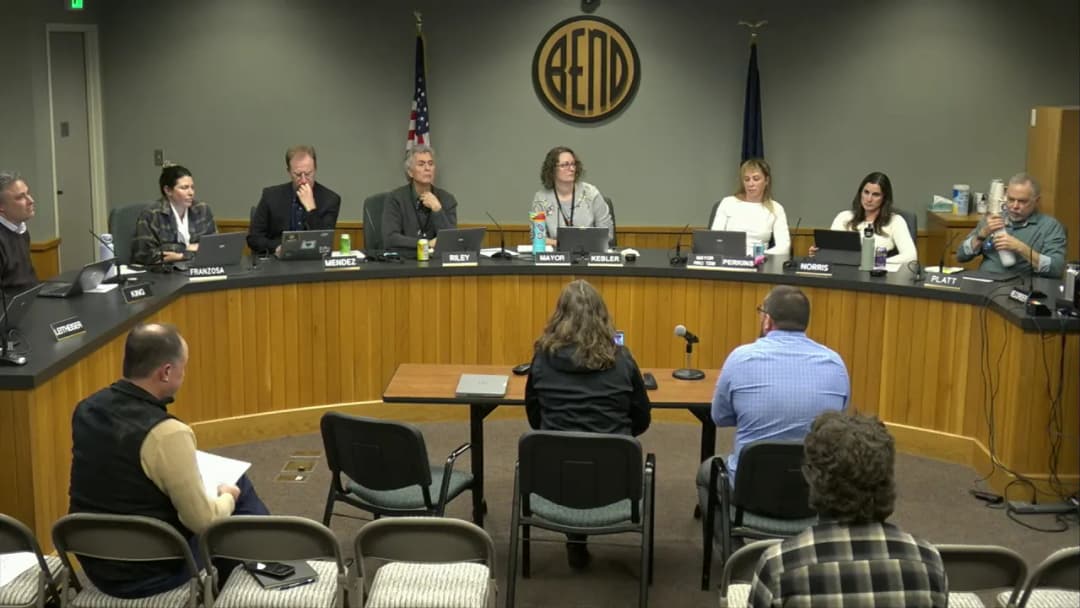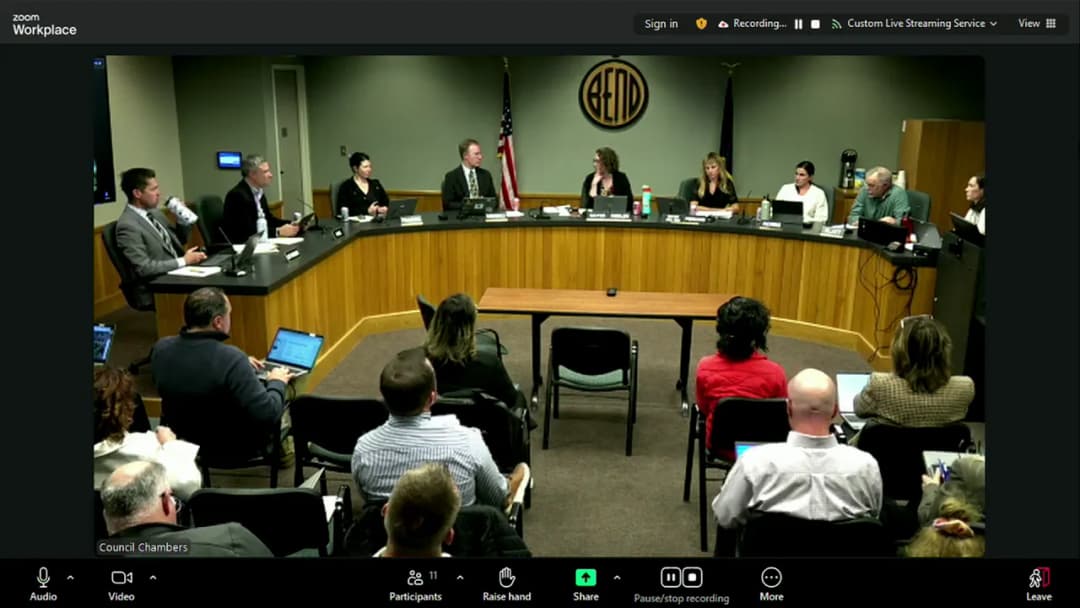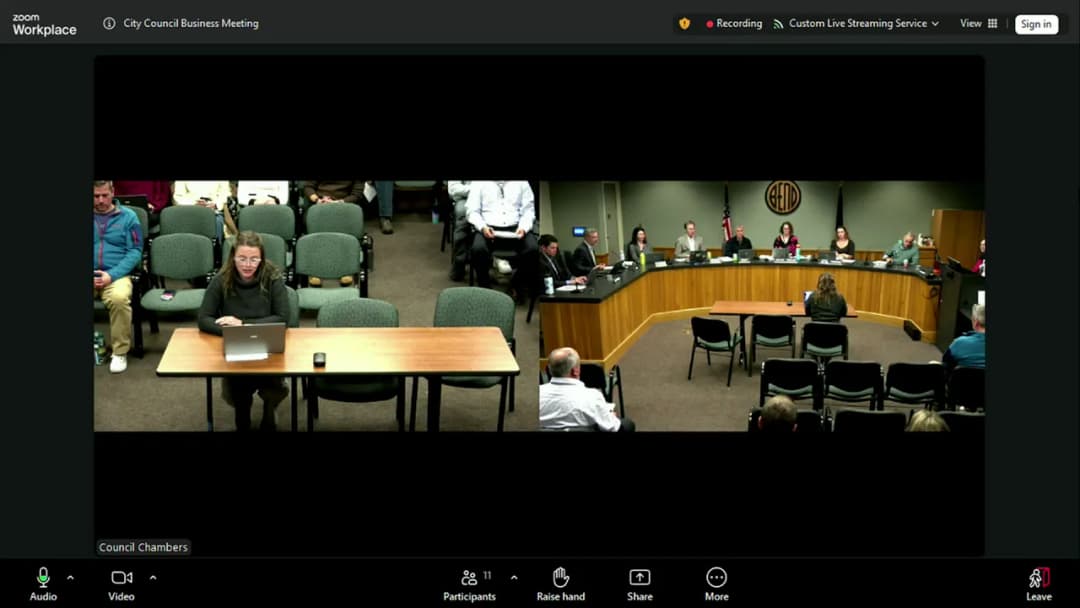
The Bend City Council met on January 21, 2026, for a regular session that included an executive session (closed to the public) followed by an open session starting at 6:00 PM. The meeting featured presentations from state legislators, a proclamation for Human Trafficking Prevention Month, discussions on immigration enforcement, legislative priorities for the 2026 short session, a work session on the downtown parklet program, and a quarterly council goals update. Notable actions included unanimous support for joining an amicus lawsuit against federal immigration enforcement actions, approval of the city's 2026 state legislative priorities (as amended), and direction on refinements to the urban renewal agency's financial guarantee (clawback) provisions for affordable housing projects. Consent Calendar - The council approved the consent agenda, which typically includes routine approvals and unanimous actions. No specifics were contested. Public Comments & Testimony - Several community members and organizational representatives spoke during the Visitor Section, primarily addressing the proposed climate fee (electrification fee) on new natural gas connections. Speakers included representatives from the Oregon State Building Trades Council, Northwest Gas Association, Local 290 Plumbers and Steamfitters, Bend Chamber of Commerce, and Cascades East Association of Realtors. They expressed concerns about grid reliability, cost impacts on households (citing potential 10-140% Pacific Power rate increases), and the need for more data before proceeding. A Bend resident of 78 years urged the city to maintain its commitment to equity work and called for a full investigation into allegations of a toxic workplace for employees and volunteers. Discussion Items 1. State Delegation Update - State Senator Anthony Broadman (D-Central Oregon) and Representative Jason Krupp (HD-54) presented priorities for the 2026 short session. Senator Broadman is chairing the Senate Finance and Revenue Committee and highlighted bills on public lands protection (Public Lands Promise), corner crossing access, and a study for a Port of Central Oregon for economic resilience. Representative Krupp emphasized the budget challenge due to federal tax changes (HR1) causing an $800 million shortfall, noting impacts on education, healthcare, and public safety. Representative Emerson Levy, unable to attend, sent remarks focusing on three bills: battery recycling (to address lithium battery fires), protecting homeless students (codifying McKinney-Vento), and regulating AI chatbots to protect children's mental health. 2. Human Trafficking Prevention Month Proclamation - Councilor Riley read a proclamation declaring January as Human Trafficking Prevention Month. The proclamation cited national statistics (27.6 million people trafficked globally) and local numbers (48 victims in Deschutes County from 2018-2019, 110 survivors served by the Anti-Trafficking Project in 2025). Representatives from the Anti-Trafficking Project, In Our Backyard, and Soroptimist International of Bend spoke, urging awareness and community action. Members shared signs of trafficking and emphasized that one-third of survivors are recovered because someone spoke up. 3. Response to Immigration Enforcement & Amicus Lawsuit - Mayor Keebler delivered a statement criticizing federal immigration enforcement tactics, describing them as a "campaign of terrorizing communities." She confirmed a new internal policy on facility use for immigration enforcement is nearly complete. The council discussed a resolution reaffirming values and providing support to the Latino Community Association (LCA). Unanimously, the council agreed to partner with the Human Rights and Equity Commission (HREC) to draft a resolution, with a target to bring it back by February 18, 2026. Funding for LCA will be part of that conversation. Additionally, the council authorized joining an amicus brief in support of Minnesota, Minneapolis, and St. Paul in a lawsuit against DHS and ICE for alleged unlawful actions, including excessive force and warrantless arrests. 4. Council Action: Appointment and Letters - Council appointed Navjad Hughes to the Human Rights and Equity Commission, moving up from alternate status, approved a letter of support for the Lift Home Ownership Fund (Habitat for Humanity), and noted no objections. 5. 2026 State Legislative Priorities - The council reviewed and adopted the city's 2026 state legislative priorities after several amendments. - Top Priorities: Local lodging tax flexibility and protecting state funding for shelter and housing services ($207 million previously allocated). - Amendments: Added language to protect neighborhood commercial uses in complete communities; specified support for maintaining the 50-30-20 split of state highway funds; added support for a bill (sponsored by Senator Golden) offering insurance discounts for wildfire home hardening and defensible space; changed "support" to "promote" in two sections on climate and energy priorities. - Other key areas: housing production, economic development (including recreation liability waiver reform), transportation (autonomous vehicle regulations, payroll tax for transit), water infrastructure, public safety (including automated license plate reader reform), and wildfire funding. 6. Parklet Program Direction - Staff presented an update on the downtown parklet program (10 operators, 25 parking spaces used, $11-12k annual revenue). Council provided direction to: - Continue the program. - Refine code definitions for alleys, sidewalks, and parklets (e.g., allowing alley cafes). - Require removal if the business is closed for more than 30 consecutive days. - Allow storage of propane tanks/heaters on parklets if used for operations (resolving a code conflict). - Keep the program year-round and maintain current fee structure (aligned with construction rental rates). - Explore expanding the program outside downtown. - Consider establishing minimal maintenance and design standards. - Staff will return with code changes by November 2026 for implementation in 2027. 7. Council Goals Update (City Manager's Report) - The city manager presented a quarterly progress report on six council goals. Key metrics included: - Housing: 1,228 housing units permitted since July 1, 2025, exceeding the pace needed for the 3,900-unit biennial goal. - Shelter: 525 shelter beds achieved, with 19 new safe parking spaces added. - Permitting: Engineering permit times reduced to 92.7 days (goal: 92 days), meeting the 20% reduction target. - Climate: 74.3% of new homes since July 1 are all-electric (data includes multifamily and single-family). - Fiscal: Highlighted challenges in funding for public safety and transportation, with plans to discuss long-term options. - Community Engagement: Upcoming neighborhood roundtables and an advisory body summit in late February. 8. Urban Renewal Agency (BURRA) - Financial Guarantee Provisions - The Bend Urban Renewal Agency (a separate legal entity with the same council members) discussed refinements to the clawback provision for site-specific tax increment financing (TIF) projects. The goal is to ensure affordable housing requirements are met. - Staff proposed three options: a flat fee, a phased fee, or a scaled fee. After discussion, the agency directed staff to develop a phased fee: 30% of the remaining TIF rebate for defaults in years 1-15, and 20% for years 16-30. This replaces the current vague recapture language. The new policy will be brought back in February 2026. Key Outcomes - Unanimous decision to join amicus lawsuit against federal immigration enforcement actions (exact vote tally not recorded, but stated as unanimous). - Unanimous approval (4-0, with Councilor Norris excused) of the 2026 state legislative priorities as amended. - Direction to staff to bring forward a resolution on immigration enforcement values and support, partnering with HREC and LCA, by February 18, 2026. - Direction to staff on parklet program changes, with code amendments to be presented by November 2026. - Direction to BURRA staff to draft phased clawback provisions (30% fee for years 1-15, 20% for years 16-30) for approval in February 2026. - Appointment of Navjad Hughes to the Human Rights and Equity Commission (unanimous). - The council will continue work on the budget, climate fee discussion (work session on February 11), and transportation funding options (work session on February 25). - The next BURRA meeting is anticipated in February 2026 to finalize the clawback policy.
Public Meetings - Bend, Oregon
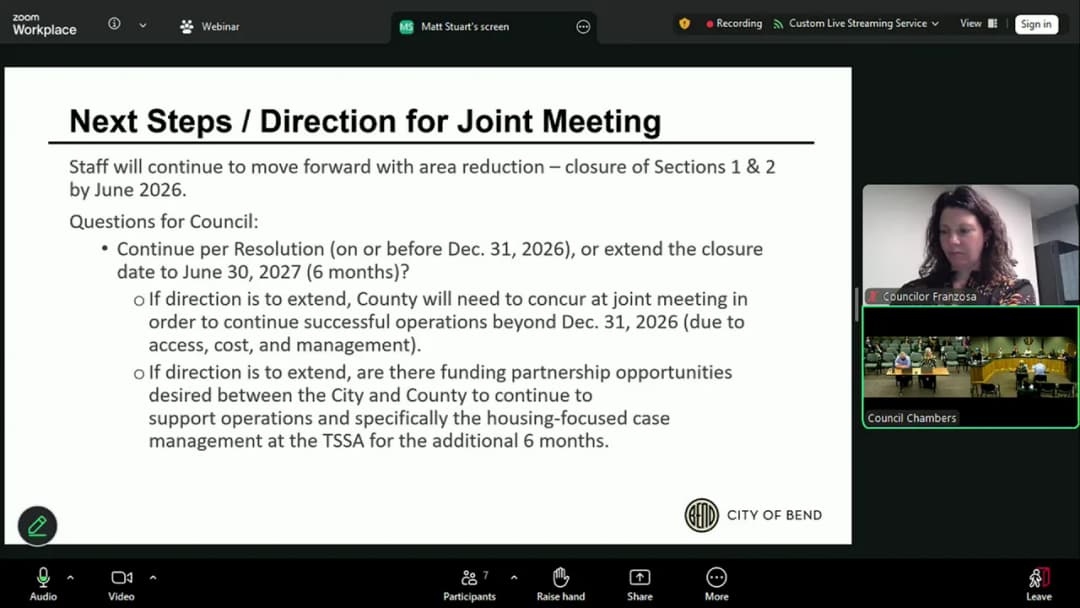
Public Meetings - Bend, OregonThe Bend City Council held a work session on January 14, 2026, to discuss commercial development strategies and the future of the Temporary Safe Stay Area (TSSA). Council heard presentations from staff on protecting and activating commercial lands, including legislative advocacy regarding Senate Bill 8, local code updates, and potential incentives. The second half focused on the TSSA, including progress on reducing the site, options for relocating residents, and funding challenges as ARPA funds expire. Council expressed general consensus on extending the TSSA through mid-2026 in partnership with Deschutes County and on pursuing state-level amendments to SB8. Discussion Items Commercial Strategies - Staff (Russ, Sarah) presented three buckets for action: state legislative advocacy, local code/policy updates, and financial incentives. - Discussion on Senate Bill 8, which allows affordable housing in commercial zones by right. Council and staff expressed concern that this could undermine planned commercial nodes. Eric (lobbyist) confirmed they are working on potential amendments for the short legislative session, possibly excluding smaller planned commercial sites (under 25 acres) or master-planned communities. - Council supported continuing advocacy for SB8 amendments to protect commercial land while acknowledging the importance of affordable housing. - Council discussed short-term code cleanup for neighborhood-scale commercial uses (e.g., easing citing standards, change of use processes) and longer-term integration into the growth plan. - Market analysis underway (due July 2026) to identify commercial gaps and support. - Council expressed interest in focusing on daily-need commercial (grocery, cafes, services) and small-scale entrepreneurial uses. - Council suggested engaging the Planning Commission for code cleanup work. Temporary Safe Stay Area (TSSA) - Matt Stewart and Amy Fraley provided an update on the TSSA at Juniper Ridge. - Since last meeting, enforcement has increased; 10 people removed for violations. 309 people have engaged with services; 35 transitions to permanent housing. Currently 192 campers (150 camps). The TSSA is to be reduced by half (closing sections 1 and 2 by June 1, 2026) and fully closed by end of 2026 per current resolution. - Staff recommended extending the TSSA deadline if the county agrees, due to limited shelter alternatives. Cost to extend 6 months: $550k total (city share $275k). Ongoing funding gaps: state shelter funding shortfall of $1.7M for the region in first half of 2026; ARPA ends Dec 31, 2026. - Council discussed need for new revenue sources and private sector partnerships. Some expressed concern about using one-time land sale funds for operations. - Council generally supported pursuing an extension with the county at the January 21 joint meeting. Key Outcomes - Council directed staff to continue advocating for SB8 amendments in the short legislative session. - Staff will bring forward a plan for code cleanup, possibly via Planning Commission, and will report on timing. - Council will take a position supporting a six-month extension of the TSSA (through mid-2026) to the joint meeting with Deschutes County on January 21, contingent on county cost-sharing. - Staff to present financial strategies for housing and houseless services at February 25 work session, including potential use of Juniper Ridge land sale proceeds. - Council will discuss legislative agenda with state delegation at regular meeting on January 21.
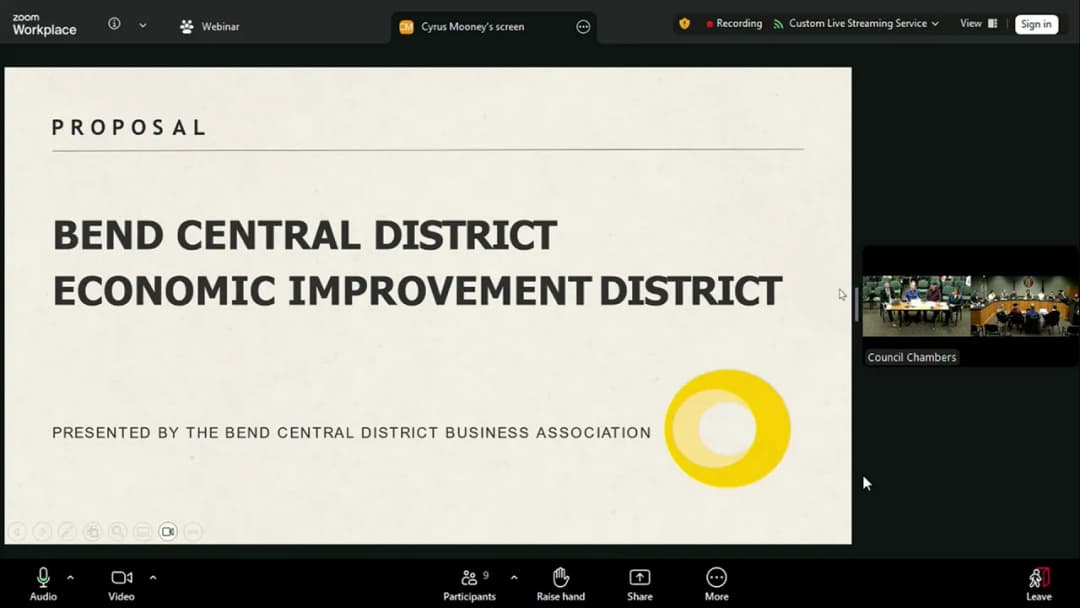
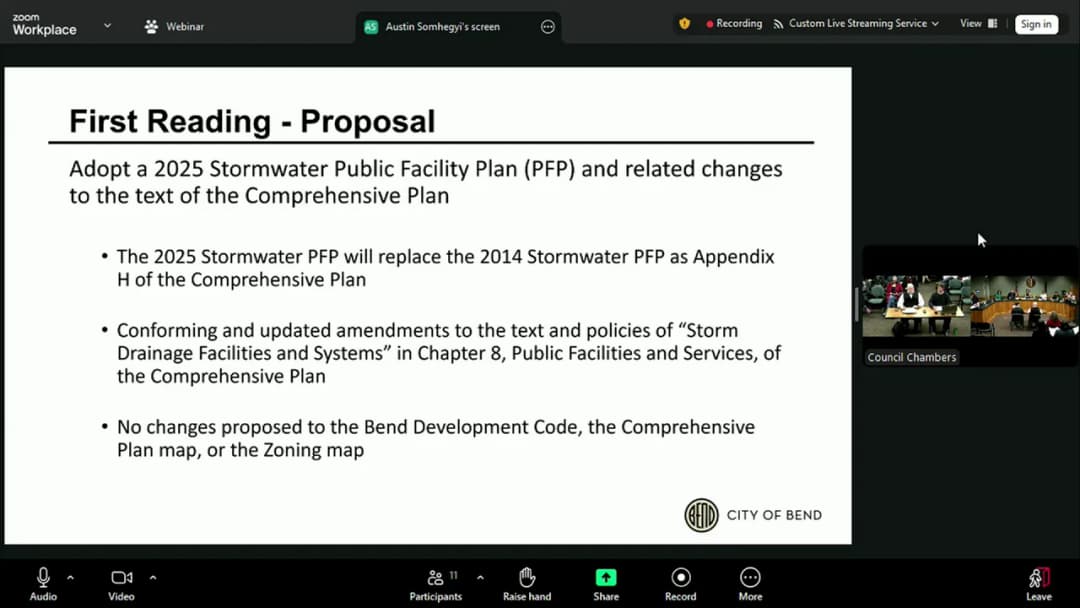
The City Council meeting convened at 14:00 to address critical community safety, housing, and infrastructure matters, including the non-renewal of Flock Safety contracts, fiscal auditing, and the establishment of a temporary committee on electrification policy. The session featured significant public testimony regarding immigration enforcement practices, the preservation of neighborhood master plans in Petrosa, and concerns surrounding data privacy and local economic development initiatives. Consent Calendar - Neighborhood Street Safety Program: Approved the design for the 2027 Neighborhood Street Safety Program, which includes five locations citywide. Councilor Franzosa raised concerns regarding the selection of Discovery Park (a newer neighborhood with low traffic), but the item was retained based on its high score in the evaluation matrix and the presence of schoolchildren using the area; Councilor Norris expressed trust in staff. The project includes a raised crossing at High Lakes and Discovery Park Drive. Public Comments & Testimony - Latino Community Association (LCA): Catalina Sanchez Frank expressed urgent support for sanctuary protections, citing over 1,000 statewide deportations since January 2025 and the need for a formal state of emergency declaration. She requested increased financial support for LCA and active municipal collaboration to protect families from racial profiling. Luis Jimenez (LCA Board President) expressed support for the City's Sanctuary Promise Act and urged the Council to consider the equity impacts of ICE data abuse. - Chris N. (Community Resident): Expressed strong opposition to Flock Safety, citing security risks and the inability of the current US legal environment to protect data from federal acquisition via National Security Letters; advocated for locally managed technology. - Kate Bernard: Expressed support for pausing the Flock contract and urged the city to establish a clear community framework regarding data control and transparency before selecting new vendors. - Madison Bordeaux: Expressed strong opposition to the Flock contract, arguing it industrializes bias, creates constitutional liability for the city, and contains loopholes allowing Flock to retain perpetually anonymized data without city approval. - Rowan Jones (LCA): Expressed full support for the decision to end the Flock contract. - Dave Berger: Expressed concern that the city lacks sufficient data, goals, and budget to proceed with electrification policies or form a tri-committee at this time. - Brian Kennedy (Old Farm District Neighborhood Board): Stated that 88% of survey respondents support amending Oregon statutes to allow local representatives to restrict affordable housing on property zoned as commercial if master plan requirements are met; urged lobbying for local planning control. - Sarah Odin Dahl & Garrett Mosher (Chamber & COBA): Expressed strong concern that electrification fees could increase housing costs by approximately $9,700 per unit; both advocated for a mandatory pilot program to collect localized data on costs, grid capacity, and affordability before implementing fees. - Gary Norris: Expressed opposition to fees for electrification without verified net CO2 reduction metrics, arguing that the policy imposes real economic harm for speculative climate benefits and that a pilot is required to confirm outcomes. - Duane: Expressed support for the committee to evaluate proven decarbonization strategies (like heat pumps) rather than just fees, noting the lack of data to support the current fee structure. - Christine Wilkins, Sean Rayleigh, Carolyn Schott, & Trevor Larson (Petrosa Residents): Expressed deep disappointment and opposition to the approval of the Bella Pines affordable housing project in the Petrosa commercial zone; argued this constitutes a "bait and switch" violating master plan promises, undermines local control, and ignores neighborhood concerns. - Karen Sims Bundy: Expressed concern that multiple affordable housing developments in a one-mile radius will increase traffic and endanger safety for elderly and young families in the Petrosa walkable community. - Lee Delagarza: Expressed support for the Flock Safety cameras and law enforcement, arguing that the technology aids community safety and opposing the pause on its use. - Michael Baker (Boys & Girls Clubs): Shared good news regarding the expansion of Saturday hours for the club starting in February. Discussion Items - Flock Safety Contract Status: City Manager King reported that the contract will not be renewed due to public concerns regarding data privacy and vendor practices. Captain Beekman presented six examples of successful public safety outcomes from the system, including the recovery of stolen vehicles and apprehension of a sex crime suspect. Councilor Platt expressed concern over data release provisions in the contract that lack notice requirements to the city regarding federal requests. The Council directed staff to pause the use of the technology for the remainder of the contract while acknowledging the financial inability to terminate early. - Fiscal 2024-2025 Audit Results: Auditor Amanda Moore (Baker Tilly) presented an unmodified (clean) opinion on the City's financial statements and the Urban Renewal Agency. The audit found no compliance findings with state laws. Testing for federal awards is pending the release of the compliance supplement. - Bend Central District Economic Improvement District (EID): The Bend Central District Business Association proposed establishing an EID with an initial assessment rate of 10 cents (proportional to commercial square footage). Councilors expressed strong support for the initiative's momentum but raised concerns that the 10-cent rate might be too low to cover staffing and operational costs. The Council voted to move forward with the establishment process, instructing staff to return with feedback on the scope and rate. - Temporary Committee on Electrification Policy (TCEP): Councilors debated the scope and membership of the new committee. Concerns were raised by BDAB and the Human Rights and Equity Commission (HREC) regarding the lack of specific data, the need for a pilot program to test costs and impacts, and the necessity of equity analysis. Councilor Platt suggested postponing the committee's formal creation until the February 11th work session to allow for clearer definition of the fee structure and data requirements. No vote was taken to establish the committee tonight; discussions were deferred to the next work session. - Stormwater Master Plan: Council adopted the 2025 Stormwater Master Plan, which identifies a nearly $80 million, 20-year investment strategy. The plan incorporates climate change projections, level-of-service targets, and drainage improvements. Staff noted that a financial plan for rate impacts will be presented in the spring. - Bend Bikeways Eminent Domain: Council authorized the potential use of eminent domain for the Butler Market and Boyd Acres intersection project to ensure schedule certainty if agreements with landowners cannot be reached. Key Outcomes - Contract Decision: The Flock Safety contract for fixed ALPR systems will not be renewed; staff is directed to pause all use of the technology immediately. - EID Authorization: Unanimous approval granted to begin the formal process for establishing an Economic Improvement District in the Bend Central District based on the presented boundary, scope, and initial 10-cent rate proposal. - Stormwater Plan Adoption: The 2025 Stormwater Master Plan and the associated Public Facility Plan were officially adopted via roll-call vote. - Eminent Domain Resolution: Resolution adopted to authorize eminent domain for the Bend Bikeways intersection if necessary. - Administrative Actions: Reappointments approved for Tom Schmidt (Landmarks Commission) and Katie Brooks (Redmond Municipal Airport Committee). Council liaison assignments were updated regarding neighborhood and advisory committee representation. - Legislative Strategy: The City Manager proposed using non-settlement local revenue for the Stabilization Center to ensure continuous funding, pending council direction at the TSSA joint meeting.
The Bend City Council convened on December 17, 2025, at 14:00 UTC to address several critical items, including a proclamation for Homeless Persons Memorial Day, the adoption of the 2025 Stormwater Public Facility Plan, and the approval of the Bend Urban Renewal Agency's 2026-2030 Strategic Investment Plan. The meeting featured significant public testimony regarding surveillance cameras and the equity director's resignation, alongside routine budget approvals and road project authorizations. Consent Calendar - Proclamation for Homeless Persons Memorial Day: Unanimously adopted, designating December 21, 2025, to honor those who died homeless in Central Oregon and recommitting the community to ending homelessness. - Bachelor View 2 Development Agreement: Council authorized the City Manager and City Attorney to enter a non-statutory development agreement regarding eminent domain authority for public access and utility easements on Bachelor View 2 to facilitate adjacent property development. - Committee Appointments: Unanimous approval of the final round of appointments for various committees and the Planning Commission for the year. - Letter on Language Access: Council approved the issuance of a full council letter to Pacific Source regarding language access in healthcare following contract cancellations. Public Comments & Testimony - Surveillance Cameras (Flock): Multiple speakers (Abigail Schneider, Matthew Brynholt, Nathan Jewell, Jonathan Westmoreland, Dan Rowe) expressed strong opposition to the use of Automated License Plate Reader (ALPR) technology by the Bend Police Department. They cited privacy concerns, potential misuse of data by law enforcement and federal agencies, and the risk of setting a dangerous precedent for citizen monitoring. They requested a ban or strict moratorium on the technology. - Equity and Inclusion Director Resignation: Speakers Jamie Hampton and Karim Boris criticized the City Council for accepting the findings of the investigation into the resignation of the Equity and Inclusion Director. They argued the report relied on hearsay, failed to address the context of racial hostility facing the city, and represented performative commitment rather than genuine equity work. - Neighborhood Commercial Development: Kristen Reidelberger, speaking for Central Oregon Landwatch and Bend B.I.P., expressed support for the Invest Bend plan but urged the city to broaden its approach to commercial uses in residential zones to support small-scale entrepreneurship and walkable neighborhoods. - Affordable Housing Support: Michelle Martin expressed full support for the city's affordable housing efforts and master plans. Michael Baker (Boys & Girls Club) thanked the council for their continued support of youth programs. Discussion Items - 2025 Stormwater Public Facility Plan: Staff presented the updates to Chapter 8 of the Comprehensive Plan and the adoption of the Stormwater Public Facility Plan (PFP). The plan addresses drainage and water quality issues, incorporating climate change projections for increased storm frequency and density challenges. Councilor Franzosa expressed satisfaction that climate change effects on stormwater systems are being addressed. - NEF Corridor Eminent Domain: Council approved a resolution authorizing the use of eminent domain for up to 11 parcels along the NEF corridor for pedestrian and bicycle improvements. Councilor Franzosa suggested future right-of-way acquisitions might be streamlined to the consent agenda. - Ani Street Safety Project: Council authorized a contract amendment with Dow LLC ($874,081) for final design services. Discussion focused on the construction budget range and coordination with the Timber Yards development to ensure the East-West Ani Street connection is made. - Urban Renewal Investment Plan: The Bend Urban Renewal Agency (BORA) reviewed its 2026-2030 Strategic Investment Plan. Key decisions included reallocating $350,000 in the Core Area plan from marketing/branding to development assistance programs. Staff committed to bringing boundary expansion options for Juniper Ridge back in March for council consideration. Councilor Mendez expressed concerns about expanding the urban renewal boundary versus using Local Improvement Districts (LIDs) for the Caraway area infrastructure. - Core Area Advisory Board (CAB) Recommendations: The CAB presented five recommendations to the City Council, including: - Exploring System Development Charge (SDC) modifications and deferrals to catalyze redevelopment in the Bend Central District (BCD). Council members expressed interest in a geographically and time-limited approach but requested further analysis. - Redesignating Light Industrial zones to Mixed Use in the BCD as part of the Growth Management Plan. - Streamlining adaptive reuse and minimum development standards to reduce permitting barriers. - Prioritizing public infrastructure projects like the Hawthorne Landing relocation and open space development. - Exploring alternative governance structures for the Urban Renewal Agency to improve focus and decision-making. Key Outcomes - Unanimous Vote: Adoption of the proclamation for Homeless Persons Memorial Day. - Unanimous Vote: Authorization of the non-statutory development agreement for Bachelor View 2. - Unanimous Vote: Approval of committee appointments. - Unanimous Vote: Adoption of the resolution approving supplemental budget adjustments for the 2025-2027 biennial budget. - Unanimous Vote: Adoption of the resolution establishing fees and charges for fiscal year 2025-2026 (Councilor Norris declared a conflict of interest and recused themselves during the vote). - Unanimous Vote: First reading of the ordinance adopting the 2025 Stormwater Public Facility Plan and amending the Comprehensive Plan (Councilor Norris declared a potential conflict of interest but voted). - Unanimous Vote: Adoption of the resolution exercising eminent domain for the NEF corridor. - Unanimous Vote: Authorization of the contract amendment with Dow LLC for the Ani Street Safety and Connectivity Project. - Roll Call Vote: Adoption of the emergency ordinance adopting a statutory development agreement regarding Bachelor View 2. - Motion Passed: Approval of the Bend Urban Renewal Agency's 2026-2030 Strategic Investment Plan with adjustments to the Core Area allocation; approval of the Core Area Advisory Board work plan with branding bullet removal. - Staff Directives: Council will review SDC modification options, zoning redesignations, and adaptive reuse code updates. Staff to return in March with Juniper Ridge boundary expansion options and LID feasibility comparisons. - Administrative: City Manager's office noted storm preparation and that the new parking code enforcement will begin warnings on January 4th and tickets on January 21st.
On December 10, 2025, the Bennett City Council convened to review the electrification policy process and the Home Committee's housing incentive recommendations. The session featured updates on fee designs based on the social cost of carbon, with Councilor Norris declaring a potential conflict regarding her employer. The council deliberated on the scope of a proposed Joint Committee, the fee level determination, and the sequencing of policy development. Subsequently, the Home Committee presented three primary recommendations for housing incentives, followed by staff analysis and discussion. Consent Calendar - [No items listed in the transcript as being processed under the consent calendar prior to work session agenda start.] Public Comments & Testimony - [No dedicated public testimony section recorded in the transcript; engagement occurred during the presentation and discussion phases.] - Note: Councilor Norris declared a potential conflict regarding her employer, Hayden Holmes, but expressed intent to seek legal advice while participating in the discussion. Discussion Items Electrification Policy & Fee Design - Presentation: Cassie Lacey (Senior Management Analyst) and Danielle Walker (Brightline Group) presented an updated equipment cost analysis and a proposed fee structure based on the social cost of carbon ($215/ton). The fee targets natural gas appliances, abandoning the initial proposal to differentiate based on electric efficiency levels due to complexity and policy scope differences. - Councilor Norris: Raised concerns about the grid's carbon intensity (Pacific Power at 27% clean energy) and argued the fee ignores upstream emissions, questioning the net carbon benefit if the grid is not yet clean. She noted Pacific Power is legally mandated to be 80% decarbonized by 2030. - Councilor Platt: Argued that local emissions from gas appliances are within city control and that the fee aligns with the Climate Action Plan, distinguishing it from a broader carbon tax on the grid. - Councilor Perkins: Expressed concern about grid reliability and household affordability, questioning if the proposed committee makeup adequately represents equity and industry expertise. She noted the city lacks a direct tenant union voice. - Councilor Mendez: Advocated for immediate council decision-making on the fee level rather than delegating it to a committee, referencing the precedent of the transportation fee and the difficulty of the decision required. - Councilor Riley: Disagreed with removing fee decisions from the committee, emphasizing the need for public engagement and expertise from builders and developers who are affected by the policy. - Councilor Franzosa: Highlighted the State's energy strategy supporting electrification as a cost-effective path and affirmed alignment with the Climate Action Plan goals. - Proposed Process: Councilor Platt proposed a "hybrid" approach where the Council sets the fee level directly by late February, while the Joint Committee begins work on non-financial incentives immediately and addresses fee exemptions/revenue use later. - Committee Composition: The proposed Joint Committee includes members from the Economic Development Advisory Board, Affordable Housing Advisory Committee, and Environment & Climate Committee, with utility representatives as non-voting ex-officio members. Councilor Franzosa requested adding grid reliability as a specific policy question for the committee. Housing Incentive Programs - Home Committee Presentation: Sarah Odendahl (Chair) and Carly Colgan (Vice Chair) recommended three near-term tools: Site-specific Tax Increment Assistance for Affordable Housing (TIHAF), an Infrastructure Revolving Loan Fund, and Credit Enhancement. - Staff Analysis: Jonathan (Urban Renewal) and Rachel Baker (Housing Division Manager) detailed the mechanics, risks, and staffing needs. They noted the TIHAF program is currently paused and requires policy revisions, including potential affordability threshold adjustments and clawback provisions. The Infrastructure Loan Fund aims to address barriers for small infill projects (4 units or fewer) to avoid prevailing wage triggers. - Councilor Mendez: Concerned about developer default risk with loan funds versus the certainty of tax increments, though acknowledged the potential for high returns. - Councilor Platt: Expressed nervousness about the staffing burden of reinstating TIHAF on Urban Renewal, which is also handling core area redevelopment plans. He suggested a delay to allow current projects to prove their success before expanding. - Councilor Norris: Expressed concern about the impact on neighboring taxing districts and the need to wait for current projects to come to fruition before expanding. - Councilor Franzosa: Noted the high staffing needs for the new programs and questioned the feasibility of the city's capacity to administer them all simultaneously without increased staffing. - Councilor Riley: Expressed support for the Home Committee's recommendations and the need to address the production gap, particularly for middle-income housing. Key Outcomes - Electrification Fee Decisions: The Council agreed to Councilor Platt's proposal to have Staff bring two to three fee level options directly to the Council for a decision by the end of February, bypassing the Joint Committee for this specific element. The Joint Committee is directed to start in January to focus on non-financial incentives first, followed by fee exemptions and financial incentive use. - Committee Charge: Staff is directed to prepare a resolution establishing the Joint Committee by January 7, incorporating the request to address grid reliability as a policy question. - Housing Incentives: The Council expressed general support for the Home Committee's three recommended tools (TIHAF, Infrastructure Loan Fund, Credit Enhancement) but requested further staff analysis on: - Specific policy adjustments for TIHAF (e.g., lowering AMI thresholds, clawback provisions, homeownership options). - Staffing capacity analysis for administering all new programs. - Funding sources for the Infrastructure Loan Fund and Credit Enhancement (specifically non-restricted revenue streams like the Juniper Ridge fund). - Timeline Adjustments: The Council decided to push back the Parks joint work session (originally scheduled for Feb 11) to facilitate the electrification and housing discussions, prioritizing those agenda items over economic development or transportation standards for the immediate future. - Next Steps: Staff to present TIHAF policy updates by late Q1, with broader housing implementation plans and staffing needs proposed by the end of 2025 for 2027 implementation.
The Bend City Council convened on December 3, 2025, to address a range of municipal issues, including a Rees (Rose) Across America proclamation, a contentious public comment period regarding electrification and climate fees, personnel compensation, and land use approvals. The meeting featured significant debate between public members and industry representatives concerning the economic and environmental impacts of natural gas ban in new construction. The council concluded public business by adjusting the City Manager's compensation and advancing a development agreement for the Bachelor View subdivision. Consent Calendar - Proclamation Adoption: The council unanimously approved a proclamation declaring Saturday, December 13, 2025, as "Reese Across America" in Bend, supporting the initiative to honor veterans. - Appointments: The council approved appointments to various advisory bodies upon motion by Councillor Perkins and second by Councillor Norris. - Consent Agenda: The regular consent agenda was approved, incorporating routine items. - Development Agreement: A motion was moved by Councillor Riley and seconded by Councillor Perkins to adopt an emergency ordinance for the first reading of a statutory development agreement for Bachelor View 2 and 3. This agreement resolves a legal dispute by removing a sentence requiring specific public dedication timing in Section 4.1.1b. The vote passed unanimously. - Land Annexation: The council adopted, by roll call vote, an ordinance annexing 10.66 acres in the northeast Butler Market Village Urban Growth Boundary (UGB) expansion area. Councilor Riley abstained; the motion passed with Councilors Freund, Mendez, Bruggins, Norris, and Mayor Keebler voting in favor. Public Comments & Testimony - Support for Climate & Electrification: - Peter Fargo (Ecumenical Ministries): Expressed full support for policies reflecting the right to a healthy environment, citing Stanford studies that identify natural gas appliances as sources of benzene, a carcinogen. - Julianne Marati Green (Retired Nurse Practitioner): Expressed strong opposition to natural gas, stating it is toxic and suppressed data regarding benzene risks; she highlighted the high annual economic cost of pollution. - Amelia DeBose: Expressed support for a strong climate impact fee, arguing that fossil fuels are a scarce resource and that siloing affordable housing from climate justice is counterproductive. - Christy Kimball: Expressed full support for a strong climate pollution fee, emphasizing that delaying the transition from fossil fuels will increase costs for residents and is an environmental justice issue. - Rowan Lucas (Energize Bend): Urged the council to pass a strong climate impact fee, framing it as an equitable first step toward a just transition and stating the council's job is to represent residents, not developer profits. - Mike Reed: Expressed support for making electric-only homes the standard for new construction and criticized the omission of in-home toxic gas costs in consultant reports; he called for Councilor Norris to recuse herself due to a potential conflict. - Austin Cutchman (Teacher): Expressed full support for electrifying new construction to protect local ecotourism and reduce carbon emissions, noting that electrified homes can reduce emissions by 84%. - Tristy Osbund (Environmental Biologist): Expressed that passing a climate impact fee is an obligation, not an opinion, to protect citizens and meet community climate action plan goals. - Sophia Borgeson: Urged the immediate passage of a strong climate impact fee as a tangible solution to the global climate crisis. - Quartz Calac: Expressed support for a strong climate impact fee to address health risks, specifically noting a 42% higher risk of asthma for children in homes with gas stoves. - Jade O'Hare Volachos (Student): Advocated for a "heavy cost" climate impact fee to persuade developers to use electric infrastructure, citing health risks from benzene in her foster home. - Kyla Guerrero: Urged the passage of a strong fee to meet emission reduction targets, linking climate inaction to disappearing snow seasons. - Michaela May (High School Student): Expressed support for a climate fee citing the danger of aging natural gas pipelines near her home and school. - Derek Reemers: Expressed support for a strong fee, arguing that the fossil fuel industry is malleable and that electrical options are becoming affordable. - Brennan Breen (Energize Bend Organizer): Expressed strong support for an impact fee, criticizing fossil fuel lobbyists and noting that Cascade Natural Gas proposed a 17% rate increase. - Opposition & Concerns Regarding Electrification: - Carl Shoemaker: Expressed concern for public safety regarding natural gas leaks and explosions, urging the city to consider electrification to protect children and pets in new construction. Note: While Carl Shoemaker's testimony mentioned "electrification as opposed to... natural gas," the context of his personal experience with a leak was to urge caution regarding gas inclusion, effectively supporting the switch to electric for safety, though the transcript is ambiguous on whether he opposes the fee specifically. - Morgan Greenwood (Cascades East Association of Realtors): Expressed opposition to the immediate evaluation of new development fees, requesting the council pause until a complete cost analysis, resiliency evaluation, and community education on electrification impacts are completed. - Sherry Helt: Expressed concern for working families regarding the affordability of electrification, noting that gas costs could rise significantly as a percentage of income for middle-income families; she urged the council to provide choices rather than mandates. - Garrett Mosher (COBA): Expressed opposition to an impact fee, cautioning that it would undermine housing goals; they requested a pilot program to gather localized data on costs and grid sustainability before proceeding. - David Berger (Local 290 Plumbers): Expressed opposition to the electrification policy, citing his industry experience that moving to electric is 4.5 times more expensive and may double carbon output due to current electrical service limitations; he requested a pilot program. Discussion Items - City Manager Compensation: The council discussed the performance review of City Manager Eric King, noted as receiving a 4.5/5 rating. Despite existing competitiveness concerns, the council discussed and agreed to a 5% salary increase and an option to cash in up to three weeks of vacation to retain him. The council unanimously approved the motion to approve this adjustment. - Executive Session Report: Following an executive session regarding the City Manager evaluation, the council publicly read the positive statement of gratitude for Eric King's leadership. - Hawthorne Bridge: Councillor Mendez reported on the open house, highlighting community excitement and the project's potential for economic development in the core area. Other councillors expressed support for the project's potential to revitalize the district. - Cabinet Comments: Councillors Mendez and Riley discussed the former President's derogatory comments regarding Somalis, with Riley expressing strong objection to the language and affirming that immigrants are essential to the community. - Urban Renewal Agency (URA) Meeting: The URA met following the city council session. Discussions included the approval of a promissory note ($161,000) for a multi-use path in Juniper Ridge, noting the path remains incomplete due to county right-of-way permitting issues. A resolution was adopted to amend the Capital Improvement Program (CIP) to fund the trail and road improvements. Key Outcomes - Compensation Adjustments: Approved a 5% salary increase and a 3-week vacation buyback option for City Manager Eric King. - Development Agreement Adoption: Approved the first reading of an emergency ordinance to finalize the Bachelor View Development Agreement by removing the contested dedication timing clause. - Land Annexation: Adopted the ordinance to annex 10.66 acres of land for the Butler Market Village expansion. - URA Financial Approvals: Authorized a $161,000 promissory note for the Juniper Ridge multi-use path and amended the CIP to fund associated infrastructure improvements. - Public Comment Scheduling: Council announced a work session on December 10, 2023, regarding the electrification policy, with no public comment period scheduled for that meeting.
The Bend City Council convened for a business meeting featuring the approval of a proclamation honoring the 250th anniversary of the United States Post Office, the recognition of public works staff, discussions on regional infrastructure projects, and several land use and procurement actions. Council members shared reports from recent community events, committee meetings, and intergovernmental meetings, while addressing public comments on youth programs and street safety initiatives. Consent Calendar - 250th Anniversary Proclamation: Moved by Councilor Perkins and seconded by Councilor Norris. The Council unanimously approved a proclamation supporting the public mission of the U.S. Postal Service, citing its role in binding the nation together, supporting 7 million jobs, and serving 169 million addresses without taxpayer funding. - Post Office Representatives: Linda O'Donnell and Jesse Soto of the American Postal Workers Union (Local 555) expressed gratitude to the Council for their support of union members and the postal system's public mission. - Employee Recognition: The Council honored Joe Wells (City Staff/Owner's Rep) for leading the design and construction of the new, net-zero Public Works Campus under budget and on time. Wells expressed that the success was a team effort. Public Comments & Testimony - Michael Baker (CEO, Boys & Girls Clubs of Bend): Expressed appreciation for the community's generosity at the Flannel and Frost event and highlighted the critical importance of after-school programming (3:00 PM - 7:00 PM) in reducing juvenile crime. - David Green (Bend Bikes): Expressed strong support for the city's adoption of new street safety techniques (e.g., semi-protected lanes, raised crosswalks, modal filters). He noted these innovations are vital for improving safety for all road users and aligning with the City's affordability and climate goals. Discussion Items - Housing and Homelessness Funding Concerns: Councilor Francosa reported on a letter sent to the US Council of Mayors regarding federal changes to HUD funding, noting a shift away from permanent supportive housing which creates challenges for local services. - Federal Policy Impacts on Climate and Energy: Councilor Norris highlighted concerns from the Environment and Climate Committee regarding federal rollbacks of environmental justice programs, clean car standards, and fossil fuel expansion. She noted that tariffs are increasing the cost of energy items (heat pumps) by up to 25% and that solar subsidies are expiring in 2025. - Regional Housing and Economic Development: The City Manager reported on the Bend Chamber Impact Conference, noting that population growth in Bend has slowed to 1.45% (adding 1,527 people), which is below the 2022 forecast of 109,000 by 2025. This prompted a discussion on refocusing economic development strategies. - Summer Break Schedule: After discussion, the Council agreed to a "bimodal" summer break for 2026: the first two weeks of July and the last two weeks of August, ensuring at least one business meeting per month. Key Outcomes - Annexation (First Reading): Unanimous approval to annex 10.66 acres of land in the Northeast Butler Market Village UGB expansion area (Item 5). The Council authorized a land division for 58 lots in RS (Standard Density Residential) zoning. - Transportation Design-Build Procurements: - Unanimous approval to use Progressive Design Build (PDB) for the "Four-Pack" (Revere and Only Intersections) project (Item 6). - Unanimous approval to use Progressive Design Build (PDB) for the Reed Market Bridge project (Item 7). - Unanimous approval to use Construction Manager General Contractor (CMGC) for the Outback Facility Improvements project (Item 8). - Sequential UGB Review: Unanimous approval to adopt a resolution authorizing staff to submit a proposal to the Oregon Department of Land Conservation and Development (DLCD) for a sequential review process for the 20-year Growth Plan components (Item 9). - Eminent Domain Authorization: Unanimous approval to adopt a resolution authorizing the City to exercise eminent domain for up to 14 parcels along Franklin Avenue if agreements cannot be reached for right-of-way acquisition (Item 10). - Development Code Amendments: Second reading and adoption of the ordinance amending the Bend Development Code (BDC) via a roll call vote (Item 10 follow-up). Councilor Norris declared a potential conflict due to her employer's potential financial impact but voted in the affirmative. - Urban Growth Boundary: The Council will continue to engage in future discussions regarding the Northeast Butler Market Village to ensure the "complete community" vision is met as the area develops beyond the Petrosa Master Plan.
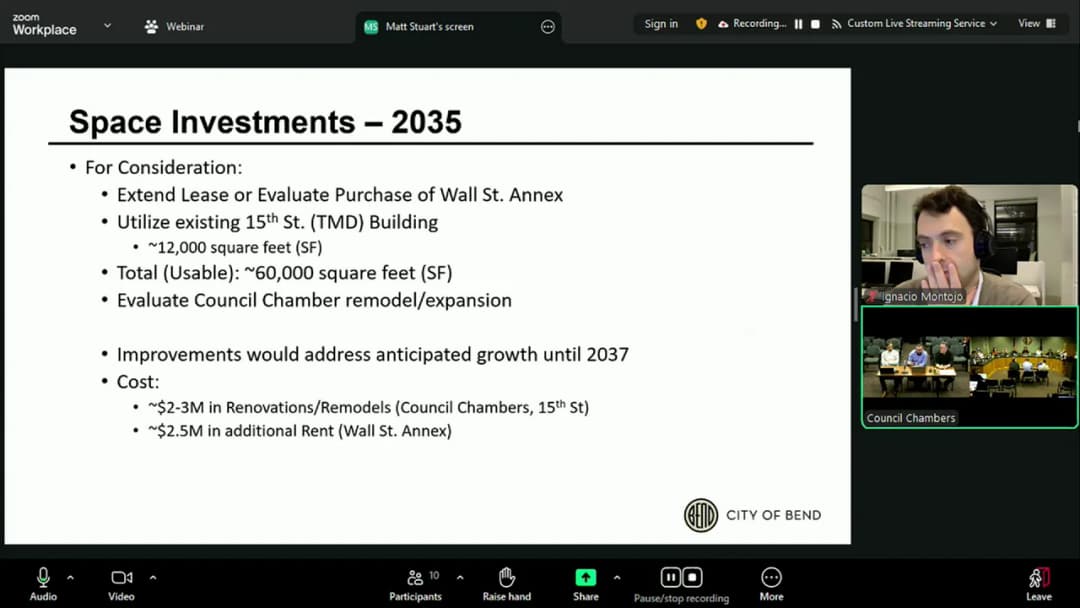
The Bend City Council convened for a work session to review informational updates on major infrastructure projects and to initiate a strategic discussion regarding a Public-Private Partnership (P3) for a future City Hall. Key topics included conceptual designs for the Hawthorne Overcrossing and Reed Market Bridge, a legal briefing on federal grant conditions, and a deep dive into financial feasibility and land use strategies for potential mixed-use city hall development. Consent Calendar - None listed in transcript. Public Comments & Testimony - No specific public testimony was recorded; the session included staff introductions and presentations to the Council. Discussion Items Hawthorne Overcrossing Bridge - Project Status: Ryan Oster (Director, Engineering), John Bresciers (Architects), and Craig Tack (Structural Engineers) presented a conceptual design for a truss bridge anchored in the local mountain identity. The design features triangular trusses, elevated landings with views, and ADA-compliant grades. - Key Specifications: The design spans BNSF tracks. The team is currently refining railing concepts and access points. - Safety & Management: Councillor Kibo expressed concern regarding pedestrian/cyclist safety and etiquette, asking for non-barrier solutions to manage speed. The team confirmed they are exploring surface texture changes and color differentiation to manage user behavior without restricting access. - Space Utilization: Regarding the space under the bridge on the east side, Councillor Franz noted the potential for a skate park or community use. Staff clarified that diagonal parking (approx. 12 spaces) is planned for the east side, while the west side's under-bridge space remains in discussion for potential community use concepts to be shared at a December open house. - Council Position: Councillors Mendez and Plack expressed strong support for the 3D concept and the mountain-inspired design, noting it looks better than previous iterations. Reed Market Bridge - Project Status: Alex Doza (Engineering) provided an update on the elimination of the at-grade rail crossing. The project aims to construct a 108-foot span to tie 9th Street back into Reed Market. Construction is estimated to require a full closure of the corridor for approximately two years. - Funding & Legal: Elizabeth O'Shelw (City Attorney) reported that the Oregon District Court ruled against federal transportation grants requiring cooperation with civil immigration enforcement. This confirms the City is not required to comply with this condition under the FRA grant program, removing a previous legal constraint on funding. - Community Feedback: Councillors Mendez and Kibo referenced community support for keeping 9th Street open and for the pedestrian underpass. Councillor Franz expressed concern about the 6-7% pitch of the 9th Street ramp, questioning safety during icy conditions. Staff acknowledged the grade is slightly above city standards but necessary for the connection, promising to minimize it as much as possible. - Timeline: Preliminary engineering is expected to complete by year-end. The team anticipates a progressive design-build solicitation next year, with construction potentially starting in mid-2027. City Hall P3 Analysis & Future Development - Financial Scenarios: A team from Cushman Wakefield, Accenture, and Conner reviewed development scenarios. The original 134,000 sq. ft. "full build-out" scenario was deemed financially unaffordable due to availability payments exceeding city revenue streams. - Revised Scenario: A scaled-down 58,000 sq. ft. facility was modeled, requiring a $78 million capital investment. While cash flow profiles still show deficits (negative cumulative cash flow) in the 2040s, the scenario is considered feasible if revenue gaps are managed or offset by private development. Councillor Plack and Kibo expressed concern about burdening future councils with cash flow gaps and demanded a long-range facilities plan grounded in realistic population and staffing growth projections. - Development Strategy: Ignacio Montoy (HRA) presented options for vertically or horizontally integrating the City Hall with private mixed-use development to generate revenue streams. Staff confirmed the city has acquired 3.2 acres in the BCD to facilitate this. - Guiding Principles & Values: - Councillor Franz emphasized the need to catalyze the BCD, create a community gathering space (referencing "Heritage Square"), and leverage assets for conventions or performing arts. - Councillor Plack and Kibo stressed the importance of housing/shelter integration and public safety considerations. - Councillor Kibo suggested expanding the highest-and-best-use analysis to include the 15th Street campus and the Drake Park parking lot, though the Mayor noted the 15th Street area is currently zoned PF/RS and would require further study. - Councillor Franz noted that while city hall needs to be welcoming, it should not be a "Cadillac" building at the expense of staffing levels, and encouraged value-engineering operations alongside facilities. - Next Steps: Staff is directed to conduct a "highest and best use" analysis for City Hall, 15th Street, and potentially other downtown parcels; develop a long-range facilities plan; and engage in short-term lease/renovation discussions to bridge until 2037. Key Outcomes - Hawthorne Bridge: Progression to next stage of structural design; public open house scheduled for December 2nd at Dogwood Park; further design refinement (railings, lighting) to return to Council in January. - Reed Market Bridge: Confirmation that the grant condition regarding immigration cooperation is legally waived; preliminary engineering on track for year-end completion; full closure of two years anticipated for construction. - City Hall P3: - The 134,000 sq. ft. full build-out scenario is effectively removed from immediate consideration due to financial infeasibility. - Staff directed to pivot to the 58,000 sq. ft. model while exploring private development revenue offsets. - Authorization granted to expand the scope of the "highest and best use" analysis to include the 15th Street campus and potentially other downtown parking/land parcels. - Council requested a formal long-range facilities plan and staff to form a more frequent advisory process or committee to maintain momentum. - Next Work Session: Scheduled for January 14th to discuss legislative advocacy, land use code changes, and financial incentives regarding neighborhood commercial areas.
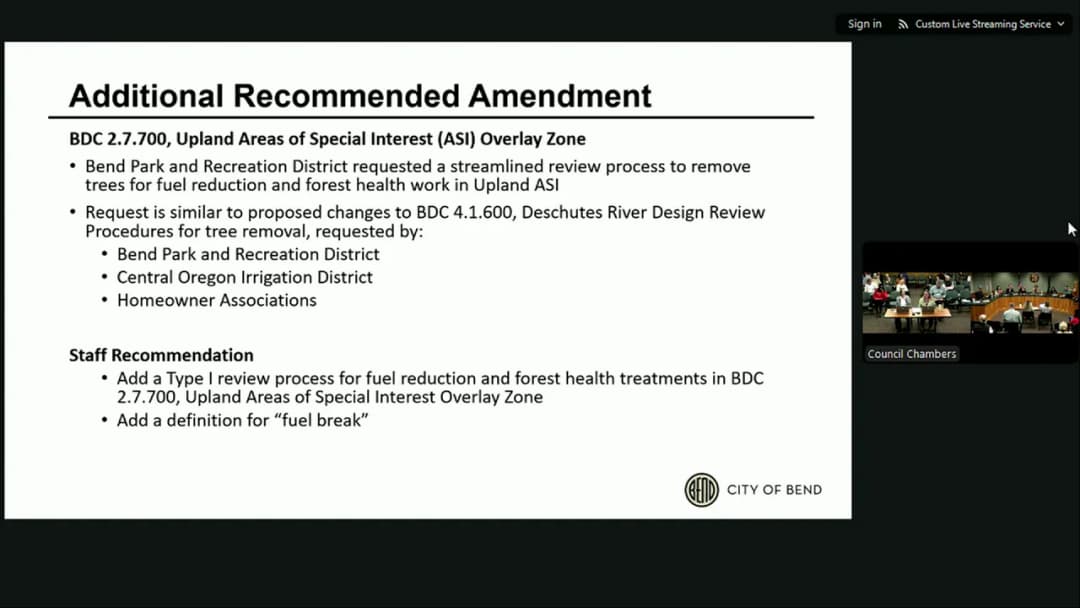
The Bend City Council convened to address community welfare, code amendments, and administrative reviews. A significant portion of the meeting focused on supporting residents impacted by a federal SNAP benefit delay through an emergency $20,000 contribution and internal food drives. The Council also engaged in extensive deliberations regarding the removal of public access requirements for private open space in master plans, receiving substantial public testimony and planning commission feedback before approving a cleanup of the Development Code. Additional actions included approving staff alternates for the Metropolitan Planning Organization, finalizing zoning for a school-adjacent parcel, and initiating the annual City Manager review process. Consent Calendar - The Council approved the Consent Agenda, excluding Item B (15th and Ferguson Roundabout Project). - Item B was deferred from the Consent Calendar to allow for a specific motion and discussion regarding design engagement. Public Comments & Testimony - Transportation Safety (Annie Goldner, Jim Elliott): Representatives of Families for Safe Streets expressed full support for the city's traffic safety improvements and urged the Council to modernize street standards to prioritize pedestrian and cyclist safety, citing the World Day of Remembrance for Road Traffic Victims. - Business Concerns (Adriana Cohn): A local business owner expressed concern regarding limited parking availability at the Jackstraw development and sought clarification on plans for a parking district. - Master Plan Compliance (Mike Fanning): A resident of Northeast Bend expressed strong opposition to the new owner's intent to subdivide the Markets of Petrosa site, arguing it contradicts the approved master plan and threatens neighborhood character. The community was urged to pause all activities on the property until master plan compliance is addressed. - Interoperability (David Green): A representative of Bend Bikes expressed support for increased coordination between the City and Park District but called for the Council to mandate unified rules for e-bike usage on city and park paths. - Nuclear Safety (Craig Sheets): A member of the public raised concerns regarding the transport of nuclear materials via trains and alleged connections to narcotics trafficking in the region. - Resignation Review (Foster): An individual expressed support for the City's commitment to an independent review of a former employee's resignation, urging the process remain fact-based and free from speculative reporting. - Open Space Access (Mark Gentle, Karen Johnson, Roberta Silverman): Community members expressed strong opposition to the removal of the "must be open to the public" clause from the Development Code. They argued this change creates a dangerous loophole allowing developers to designate private, fenced-off open space, undermining public access to trails and parks and reducing equity. - Planning Commission Response (Commissioners Winters & Johansson): Commissioners clarified that while the code change aims to remove ambiguity regarding fenced drainage basins, the existing Park Search Area map and connectivity requirements still ensure public access to necessary parks and trails. They expressed confidence in the Park District's ability to identify needs. Discussion Items - SNAP Benefit Disruption: - Neighbor Impact presented data indicating 23,405 households are food insecure in Central Oregon. Speaker Molly Heiss expressed full support for community action but noted the crisis is a "failure of government" caused by political inaction. - The organization reported a 28% loss in food volume compared to previous shutdowns, with no commodity surge to offset the shortage. - Councilor Franzone and the Council expressed full support for a $20,000 emergency contribution to Neighbor Impact, with Councilor Riley explicitly stating this is a temporary measure to address a federal failure, not a permanent solution. - MPO Staff Alternates: - Council approved the appointment of Brian Rankin, David Abbas, and Janet Ruby as staff alternates for the Bend Metropolitan Planning Organization to ensure business continuity if city representatives are absent. - Short-Term Rentals (CN Zone): - Councilor Riley requested to return to a previously tabled discussion regarding applying concentration limits to the Neighborhood Commercial (CN) zone for three specific properties. Councilor Franzosa raised concerns that this narrow approach might ignore a broader policy issue of commercial zones converting to short-term rentals. - The Council agreed to include the discussion of the three specific CN properties in the next comprehensive housing code package to be scheduled in the spring. - A separate work session was not requested for the broader short-term rental policy question at this time, though the Council acknowledged the need for future policy discussion. - State Housing Law vs. Neighborhood Commercial Space: - Councilor Franzosa requested a work session to discuss unintended consequences of state housing laws (SB 8, HB 3395) leading to the loss of land for neighborhood commercial space in areas like Wildflower and Easton. - Councilor Platt expressed support for exploring the tension between complete community goals and affordable housing mandates. - Staff indicated plans to include this topic in the next work session related to Council goals, potentially incorporating advocacy efforts regarding state law amendments. - Code Amendment (Public Hearing Item 5): - Open Space Definition: Staff proposed clarifying that open space in master plans must be usable and not a fenced drainage basin, removing the 2023 requirement that it be "open to the public" to resolve ambiguity. Council Mayor Keebler expressed comfort moving forward but acknowledged the need for a broader future conversation on public vs. private open space policy. - Bicycle Parking: Discussion clarified the distinction between short-term (50% U-racks minimum) and long-term (25% U-racks minimum) bicycle parking requirements to ensure accessible options while maintaining flexibility for developers. - Fuel Reduction: The Council discussed exempting public agencies from the fuel reduction land use process in Waterway Overlay Zones (WAS) and Areas of Special Interest (ASI). The Planning Commission recommended no exemption to ensure consistent oversight. The Council acknowledged the tension but did not support adding an exemption to the motion at this time. - Final Vote: The Council unanimously passed the ordinance to amend the Bend Development Code, addressing rear setbacks, bicycle parking, legal lots, and other procedural clarifications. - Zoning Amendment (Item 6): - The Council approved the rezoning of 1.93 acres adjacent to Pacific Crest Middle School from Urban Area Reserve (UAR) to Residential Urban Medium Density (RM) via a roll call vote, with all members voting in favor. - City Manager Review: - City Manager Rob initiated the 2025 review process for City Manager Eric King. Council members agreed to proceed with the standard timeline, though Councilor Mendez requested an extension to review a pending third-party investigation report before the December 3rd executive session. Key Outcomes - SNAP Support: Unanimous authorization of a $20,000 financial contribution to Neighbor Impact, alongside the institution of city-wide food drives and a partnership with the Fire Department. - MPO Governance: Approval of three staff alternates (Brian Rankin, David Abbas, Janet Ruby) to serve on the Bend Metropolitan Planning Organization policy board to maintain quorum. - Code Amendments: Unanimous passage of the ordinance amending the Bend Development Code to clarify open space definitions, update bicycle parking standards, and streamline review processes for fuel reduction and master plans. - Zoning Approval: Adoption of the ordinance redesignating 1.93 acres from UAR-10 to RM, effective immediately, with a vote tally of 7-0 (Aye). - Administrative Action: Initiation of the City Manager performance review process, with the executive session scheduled for December 3rd pending the release of an independent investigation report.
On October 22, 2025, the Van City County Council held a work session to discuss three major agenda items: the policy direction for a residential natural gas electrification fee, an annual review and proposed amendments to the tree preservation standards, and funding allocation for Transient Room Tax (TRT) projects including a flex plaza, riverfront path, and Drake Park bridge. Staff presented data analysis and preliminary fee structures for electrification, while seeking council direction on fee objectives, equipment efficiency requirements, and calculation tiers. The council also reviewed implementation data from the first year of tree code enforcement and evaluated three proposed tourism infrastructure projects. Consent Calendar - No items from a consent calendar were presented in the transcript. Public Comments & Testimony - Councilor Mendez: Expressed support for incentives and non-monetary options like density bonuses; acknowledged a conflict of interest as an employee of Hayden Homes but noted the struggle between climate goals and housing production costs. - Councilor Franzosa: Expressed support for basing the fee on rational principles like the social cost of carbon and actual community impacts; requested inclusion of line extension and infrastructure provisioning costs in the analysis. - Councilor Perkins: Expressed concern that highly restrictive (selective) fees could harm housing goals; requested a committee review of fee options. - General Public/Builders: Provided concerns that equipment cost estimates in the presentation (e.g., central air conditioners) were too low or high based on local experience; requested inclusion of gas line extension costs and externalities like health impacts from methane leakage in the fee model. Some community members advocated for exempting juniper trees entirely, while others proposed limiting protection to larger junipers. Discussion Items Electrification Policy Process - Staff Presentation (Cassie Lacey & Danielle Walker): Presented data showing that for most residents, converting to inefficient electric equipment increases annual bills significantly (e.g., +$2,500/year for Pacific Power customers), while efficient equipment reduces costs or has a minimal increase. Carbon impacts vary by utility mix; current conversion to inefficient electric equipment increases emissions, while efficient equipment reduces them. - Policy Direction: Staff outlined three spectrum options for the fee: 1. Purpose: Shift behavior to near-zero gas vs. signal/disincentivize gas to raise revenue for programs. 2. Efficiency: Mandate efficient electric equipment vs. allow any electric equipment. 3. Calculation: Individualized home attributes vs. averaged tiers. - Council Positions: - Councilor Riley: Expressed full support for shifting away from gas as soon as possible to lock in lower long-term costs and prevent expensive retrofits, but balanced this with extreme sensitivity to housing production and affordability goals, particularly for Central Electric Cooperative service areas. - Councilor Mendez: Expressed support for the "shift" outcome (strongly discouraging gas) but emphasized the need to see multiple options to understand trade-offs with housing goals; requested inclusion of density bonuses and non-monetary incentives. - Councilor Perkins: Expressed support for the "signal" end of the spectrum (revenue generation) to avoid unintended consequences on housing, citing the housing emergency and cost barriers for developers. - Councilor Franzosa: Expressed support for the "signal" path to align with industry trends toward zero carbon and rational cost accounting (social cost of carbon), noting the emergence of renewable natural gas. - Councilor Kieber: Expressed general support for a fee but requested staff to include the cost of line extensions and to clarify assumptions regarding the 2030 clean energy transition target. Tree Preservation Standards Review - Staff Presentation (Renee Brooke, Pauline Hardy, Ian Gray): Reviewed Year 1 implementation data (766 applications, 55 subject to code). Key stats: 17 projects met clear objectives (20% priority or 25% DBH preservation), 9 met the 5% baseline with mitigation, 4 used discretionary paths. No developers utilized the code's incentives (setback reductions, etc.). - Recommendations: Staff recommended minor amendments to allow flexibility in Root Protection Zones (based on tree species/architecture), exempt middle housing land divisions on sites <1 acre, and clarify exemptions for sites with no trees. - Council Positions: - Councilor Mendez: Expressed strong support for flexibility in Root Protection Zones to save more trees; requested future discussion on junipers and large expansion areas, citing fire safety and water usage concerns. - Councilor Franzosa: Expressed support for the root zone flexibility; advocated for differentiating juniper preservation standards based on growth rate compared to other species. - Councilor Kieber: Welcomed the in-house urban forester (Ian Gray) and expressed interest in integrating the tree inventory into carbon sequestration models. - General Council: Supported the proposed minor amendments and agreed to delay the broader discussion on junipers and large sites to a future work session. Transient Room Tax (TRT) Projects - Staff Presentation (Cyrus Mooney, John Condon, Brian Tower): Reviewed three projects: North Mirror Pond Flext Plaza ($4.25M estimate), Riverfront Street Path ($3.5M estimate), and Drake Park Pedestrian Bridge (Design phase, construction TBD). Staff recommended allocating $2M TRT to the Flext Plaza, $360k TRT to Riverfront (seed money), and retaining focus on the Bridge study. - Council Positions: - Councilor Riley: Expressed skepticism of the Flext Plaza design (heat island effect, bathroom sizing) and proposed reallocating TRT funds to prioritize the Drake Park Bridge, arguing it is a higher community need and should be funded sooner. - Councilor Mendez: Expressed skepticism about the plaza surface but supported the concept if design standards address heat; expressed strong support for the Riverfront and Drake Park Bridge partnerships. - Councilor Franzosa: Expressed full support for the Flext Plaza as a downtown win, noting local business support; agreed to focus on design standards to mitigate heat issues. - Councilor Perkins: Expressed full support for the Flext Plaza as an innovative solution for downtown flow and parking; supported the Riverfront partnership with Parks and Rec. - Councilor Kieber: Agreed with the design concerns regarding the plaza surface but leaned on local business expertise to support the recommendation as read. Key Outcomes - Electrification Fee: Council directed staff to develop 2-3 fee scenarios reflecting the spectrum of outcomes (shift vs. signal) and to include cost data for line extensions, infrastructure provisioning, and non-monetary incentives (e.g., density bonuses). - Next Steps: Staff will return on December 10, 2025, with the fee options. A Joint Committee (BDAP, AHACK, ECC) will be launched to further refine the fee structure and incentives in January 2026. - Tree Code: Council approved minor amendments to the tree preservation code to be brought forward for adoption, specifically regarding Root Protection Zone flexibility and middle housing exemptions on sites <1 acre. - New Discussions: Council mandated future work sessions to address juniper preservation standards, large expansion area requirements, and fire safety interactions with tree codes. - TRT Projects: Council moved forward with staff's recommendation to allocate TRT funds to the North Mirror Pond Flext Plaza and Riverfront Path, while acknowledging the ongoing prioritization of the Drake Park Bridge. Staff is directed to pursue the Bend Sustainability Fund grant for the Riverfront project. - Process Directive: Council requested staff to ensure the design of the Flext Plaza addresses heat island concerns and bathroom sizing for 2,000-person events. - Data Refinement: Council directed staff to validate equipment cost estimates (specifically air conditioning and gas furnaces) against local builder data and update the analysis accordingly before the December presentation. - Conflict Declaration: Councilor Norris declared a conflict of interest regarding the Electrification and Tree Code items due to employment with Hayden Homes and will vote or participate on these items as a remote participant; however, the transcript indicates she left the dais for the Tree Code item. - Note on Discrepancy: The transcript notes Councilor Norris declared a conflict for the electrification and tree code items but left the dais for the tree code. The transcript does not explicitly confirm her remote participation status for the electrification items in the final text, though it mentions she is late or joining by call for other items. The summary reflects the explicit conflict declaration noted for the Tree Code. - Note on Discrepancy: The transcript mentions a conflict for Councilor Norris regarding the electrification items (Hayden Homes), but she does not explicitly restate this conflict for the Tree Code in the specific segment, though she declares it before the Tree Code discussion begins. The summary reflects the explicit conflict declaration for the Tree Code item. - Note on Discrepancy: The transcript mentions a conflict for Councilor Norris regarding the electrification items (Hayden Homes), but she does not explicitly restate this conflict for the Tree Code in the specific segment, though she declares it before the Tree Code discussion begins. The summary reflects the explicit conflict declaration for the Tree Code item. - Note on Discrepancy: The transcript mentions a conflict for Councilor Norris regarding the electrification items (Hayden Homes), but she does not explicitly restate this conflict for the Tree Code in the specific segment, though she declares it before the Tree Code discussion begins. The summary reflects the explicit conflict declaration for the Tree Code item. - Note on Discrepancy: The transcript mentions a conflict for Councilor Norris regarding the electrification items (Hayden Homes), but she does not explicitly restate this conflict for the Tree Code in the specific segment, though she declares it before the Tree Code discussion begins. The summary reflects the explicit conflict declaration for the Tree Code item.