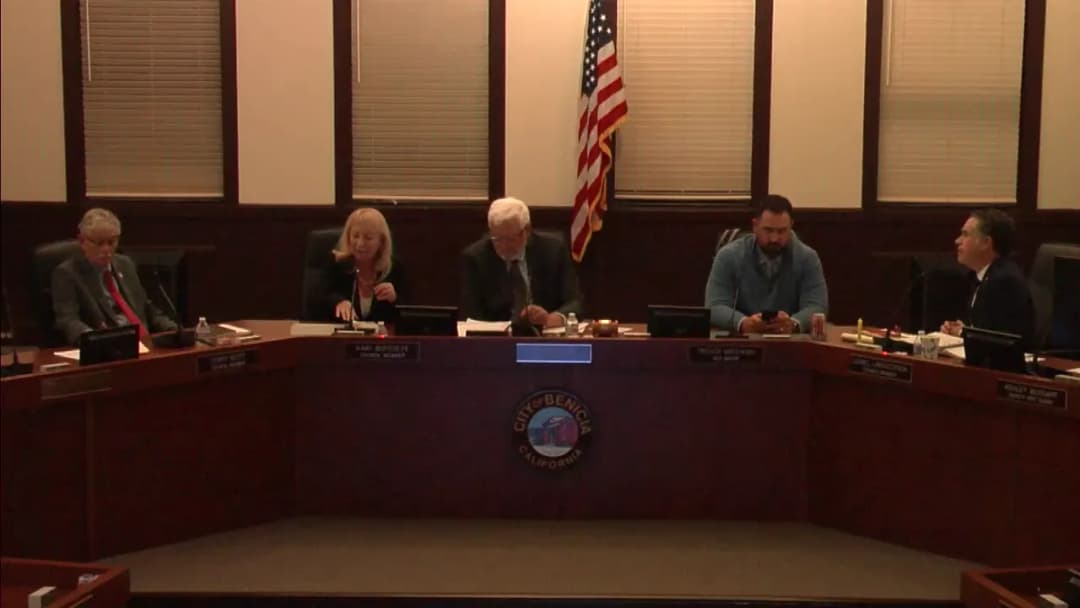
The Benicia City Council met on October 27, 2026, in Council Chambers at Benicia City Hall; the agenda called for a 6:00 PM start and a 7:30 PM adjournment. All five Council Members were present, and remote participation was available via Zoom. After a closed-session report that the Council took no reportable action, the Council adopted the agenda, heard public comment, approved the consent calendar, adopted the data center zoning ordinance on second reading, approved CalPERS retired annuitant appointments, and declared a local emergency for the El Niño season. Consent Calendar - Item 14A (Title 17 zoning amendment for data centers) was pulled from the consent calendar by request and considered separately. - The remaining consent item, 14B (waiver of reading of ordinances), was approved unanimously. Proclamation - Mayor Steve Young read a proclamation designating November 18, 2026 as Ruby Bridges Day / Ruby Bridges Walk to School Day in Benicia, honoring Ruby Bridges' 1960 integration of William Frantz Elementary School and encouraging student participation. - A community advocate who helped establish Benicia's observance said racial discrimination still affects children in Benicia and called on the community to act; a student named Avi spoke about the need for diverse schools, teachers, and equal resources. City staff announced that the VIBE team and city employees would participate in the walk at school sites. Public Comments & Testimony - During non-agenda public comment, a resident urged the Council to revisit the Industrial Safety Ordinance fee structure, saying the program spent roughly $500,000 in its first year while collecting only about $70,000, and called for a fee structure and a funded community air monitoring program, citing a two-year Valero agreement to bring in refined products. The Mayor said he would raise the issue with air district staff twice that week and ask staff to bring options back. - Marilyn Bardet, a B Camp Benicia Community Air Monitoring Program board member, said B Camp had helped design a community-wide networked monitoring program, did not receive a major grant, and cannot sustain operations after January 1 without new funding; she asked for help seeking emergency CARB funding and other air district grants. Pat So Smith, another B Camp board member, warned that B Camp's website, used by the public during odor or leak events, would be shut down without revenue. - During the data center discussion, most public speakers opposed allowing data centers in Benicia or urged a moratorium. Concerns included water and electricity consumption, AI risks, toxic coolants, 24/7 noise, and experiences elsewhere where promised benefits did not materialize. One speaker noted California already has 280 data centers; another raised the risk that a smaller developer could later sell to a large tech company. A written comment from an absent resident described the draft ordinance as restrictive and containing, in his words, 'poison pills' that would prevent any data center from being built. - On water, a speaker asked about Valero's usage and drought policy. Staff said Valero historically used about 4 million gallons per day and currently uses about 2 million gallons per day. The speaker argued the city should protect industrial and commercial water supply and consider rate-design alternatives in the December water rate study. - During the El Niño item, a resident asked whether the city would assist Rancho Benicia residents if flooding recurred; staff said emergency response is the same regardless of whether a park is private, and park management has improved pumping. Another resident asked about the predicted Kelvin wave; staff said it raises water levels but infrastructure cannot be moved, so flood response would follow the same road-closure and notification procedures. Discussion Items - Data Center Zoning Ordinance (14A): Staff reported that the Council had introduced the ordinance one week earlier and directed that the Planning Commission be the review authority for all data center use permits. The new ordinance closes a loophole that made data centers a by-right use in parts of the industrial park. It creates a conditional use permit process for data centers between 5 and 20 MW, imposes a 55 dB noise limit, prohibits fossil-fuel generators, and requires structural noise mitigation. Staff noted the ordinance is far below hyperscale size and is intended to serve industrial park users, but does not require co-location. City Attorney Stock explained that an immediate emergency moratorium was not legally advisable because the city has no pending application; Government Code Section 65858 requires a current and immediate threat tied to imminent entitlement approval, and he cited an Imperial County moratorium struck down in August. Councilmember Birdseye said she works for NRDC and brought model guardrails to the city; she supported the ordinance with a commitment to amend it as technology evolves. A council member who had voted no the previous week expressed continuing concerns about battery storage, noise, and the speed of decision-making, but supported closing the loophole to prevent a hyperscale application in the 30-day period before the ordinance takes effect. The Mayor noted the ordinance can be amended after adoption, and an emergency moratorium could be considered if an application arrives. - CalPERS Retired Annuitant Appointments (15A): The interim Human Resources manager presented two resolutions for retired annuitants. Mark Menesini, who retired effective October 21, 2026, would serve as interim police chief because the department is down four officers, has four officers on extended leave, and lacks sergeant bench depth. Stacy Hatfield would remain temporarily after her December 3, 2026 retirement to train fire department administrative replacements; the city lost all of its fire department administrative staff within a few days. The city is actively recruiting, and CalPERS limits hours to keep the appointments in compliance. A retired teacher spoke in support, citing CalPERS' COVID-era exception for retired teachers. - El Niño Local Emergency (15B): Deputy Public Works Director Neil Leary presented the resolution. Governor Newsom proclaimed a statewide emergency on September 21, 2026, and NOAA's October 8, 2026 forecast showed a greater than 83% chance of strong to very strong El Niño conditions continuing into 2027. The declaration authorizes emergency procurement and response for flooding, erosion, landslides, power outages, and infrastructure damage. A collapsed 12-inch sewer main under Industrial Way near Park Road was discovered October 8; a temporary bypass with 24-hour pumping is in place, one travel lane remains closed, and repair costs are estimated at $1.8 million to be funded through wastewater operating and capital accounts. Public Works has restocked sandbag stations, ordered pre-filled sandbags, coordinated mutual-aid pumps with Solano County, and prepared treatment plants for 24-hour staffing. Key Outcomes - Adopted the meeting agenda and the consent calendar (14B) unanimously. - Adopted the Title 17 data center zoning ordinance on second reading, 5-0. It becomes effective 30 days after adoption; future amendments were discussed for backup power and battery safety, drought-related water conservation, and staff noted a request to consider clustering and residential separation standards. - Approved both CalPERS retired annuitant appointments, 5-0. - Adopted the El Niño local emergency declaration and authorized emergency contracting procedures, 5-0. - The next regular meeting is November 17, 2026; the November 3 meeting was canceled because it is election night.
Public Meetings - Benicia, California
Public Meetings - Benicia, CaliforniaThe Benicia City Council met at 6:00 PM on October 20, 2026, in the Council Chambers at Benicia City Hall. All five council members were present; City Manager Mario Giuliani participated via Zoom. The council adopted the agenda, heard two proclamations, approved consent items, approved a Valero standstill agreement, established a sidewalk vending fee, introduced a data center zoning ordinance, and acted on quarterly policy requests. Proclamations and Opening Items - Mayor Steve Young proclaimed October 18-24, 2026 as United Against Hate Week. A representative from the group thanked the city, noted that Benicia was the first Solano County city to sign on for multiple years, and urged other cities to join. - Mayor Young proclaimed October 2026 as Domestic Violence Awareness Month, citing statistics that nearly one in three women and one in four men have experienced physical violence by an intimate partner. Bisa French, Executive Director of the Family Justice Center, accepted the proclamation and said an annual vigil would be held Thursday at City Park from 5:00 to 5:30 p.m. - The agenda was adopted 5-0. No non-agenda public comments were offered. Consent Calendar - The consent calendar included amendments to Valero Benicia Redevelopment (VBR) review support agreements with not-to-exceed amounts of $935,800 for CSG, $1,657,371 for FCS, and $1,674,788 for Good City, all extended through June 30, 2030; an OpenGov, Inc. grants management software agreement not to exceed $307,871.21 through June 30, 2032; acceptance of the 2026 Citywide Curb Ramp Improvements Project; and an ordinance prohibiting fishing from the Benicia Marina boat launch float. - Items 14A, 14B, 14C, and 14E were approved 5-0. Item 14D was pulled for separate discussion. - On 14D, Laura Grundman asked to postpone the vote, arguing the fishing community had not been adequately notified and that marina staff had previously posted signs even when fishing was allowed. Scott Trumer, a 26-year slipholder, supported the restriction, saying it stopped damage and disruption and that fishing remains available at other locations. City Manager Giuliani said updated signs would list alternative fishing locations. The council approved 14D 5-0. Public Comments & Testimony - No non-agenda public comments were made during the general public comment period. - On the marina fishing restriction, Laura Grundman opposed the item and urged postponement; Scott Trumer supported it as a damage-prevention measure. - On the Valero standstill agreement, public commenters raised tank and pipeline safety, map transparency, pipe corrosion inspection, and air pollution concerns; one commenter thanked the city for the agreement and asked about the term and checkpoints. - On data centers, commenters were divided. Kathy Carrige, Steve Gottlob, Shana Deutsch, Jack Colk, and others called for a moratorium or more time; one commenter said data center outcomes elsewhere had been poor. Former Vice Mayor Tom Campbell provided historical water supply context, including Benicia's over 30,000 acre-feet of paper allocation, about 27,000 acre-feet tied to state agreements, and drought-year shortfalls. Courtney Vasek asked whether the city could pass the ordinance and also adopt a moratorium. Kyle Crawl, speaking for the Western Steel Council, supported the ordinance and opposed a moratorium. Brett Nelson of the Citizens Oversight Industrial Safety Commission asked about tax revenue and industrial safety monitoring. - On quarterly policy requests, Steve Gottlob said the proposals sounded interesting, encouraged the dog park idea, and urged consideration of tourism resources. Valero Standstill Agreement (15A) - The council approved a standstill agreement with Valero. City Manager Giuliani explained that the city considers refined fuel importation an unpermitted use after the refinery stopped refining; Valero disagrees, and the agreement preserves both interpretations while the city withholds enforcement in exchange for state funding. Valero is not paying the city; the state funding serves as consideration. - The state appropriated $5,250,000: AB113 provides $3,750,000 for Fuel Import Operations and $1,500,000 for Community Benefit for Valero Fuel Importation. The agreement covers an initial period through the end of the fiscal year; a second year would require an additional $7 million state allocation. City Attorney staff cited Section 6B, noting the agreement automatically terminates if milestones, including the second payment, are not met by January 15, 2028. - Fire Chief Josh Chadwick said Valero disbanded its fire brigade but retains two fire stations, an engine, a ladder truck, a foam tender, and a substantial foam supply that the city would be trained to use. Monitoring requirements from the Bay Area Air District remain unchanged, and pre-fire plans are required for each tank. - Public comment is summarized above. The resolution passed unanimously. Sidewalk Vending Permit Fee (15B) - Staff recommended an $88 annual sidewalk vending permit fee to recover administrative costs, effective 30 days after adoption, and noted the fee is lower than neighboring cities including Vallejo and Vacaville. The council also found the fee exempt from CEQA under Guideline 15061(b)(3). - Mayor Young said he voted against the underlying sidewalk vending ordinance and voted no on the fee. The resolution passed 4-1. Data Center Zoning Ordinance (15C) - Assistant City Manager Suzanne Thorson presented an ordinance amending BMC Title 17 to make data centers a conditional use in Benicia's four industrial districts. It would require a use permit and public hearing, cap electrical capacity at 20 megawatts, limit power to renewable or grid energy, prohibit internal combustion equipment including diesel generators, require water conservation, and impose light and noise standards. The ordinance would also eliminate caretaker housing in industrial districts. There is no pending application. The Planning Commission recommended approval 6-0 on September 10, 2026. - As originally proposed, smaller facilities under 5 megawatts and 50,000 square feet could receive a director-level hearing; the adopted amendment requires all data center use permit applications to go to the Planning Commission. - Council discussion focused on backup battery fire risk, cumulative impacts, water supply and drought curtailment, the 20-megawatt cap, the generator prohibition, and the short time between first and second reading. The City Attorney said an emergency moratorium would require findings and would be difficult to justify without an application; passing the ordinance now was described as the fastest way to close the by-right loophole. Councilmember Birdseye said early estimates suggest data centers could generate $5 million to $10 million per year in utility user tax revenue and moved approval with the Planning Commission amendment. - Public comment is summarized above. The council voted 4-1 to waive the first reading, read the ordinance by title only, and introduce it, with Councilmember Scott voting no because he wanted more time for public review. A second reading is scheduled for October 27, 2026, with the ordinance taking effect 30 days after adoption if approved. Quarterly Policy Issue Requests (15D) - The council considered seven two-step requests. Councilmember Largaespada submitted four: public access/customer assistance, entertainment zone, residential sidewalk repair partnership, and special event tourism investment. Councilmember Scott submitted two: dog park and one percent for art. Mayor Young submitted one: reducing city manager contract signing authority from $200,000 to $100,000. - After presentations and public comment, the council advanced five items to future scheduling/goal setting: public access/customer assistance, entertainment zone, residential sidewalk repair partnership, dog park exploration, and one percent for art. The special event tourism investment and the mayor's contracting-authority proposal were not advanced. ACT Task Force Updates and Committee Reports - Mayor Young gave brief oral updates on Bay Area Air District matters: a $5 billion opportunity grant was awarded; several nonprofits received seed grants; the board directed staff to review the program within six months; a reimbursement cash-flow issue was being raised; and the gas appliance ban will receive a final vote on November 4, 2026. - Council members provided committee reports by exception; no other substantive reports were presented. Key Outcomes - Adopted agenda 5-0. - Approved consent items 14A, 14B, 14C, and 14E 5-0 and 14D 5-0. - Approved the Valero standstill agreement, authorized the City Manager to implement $5.25 million in state funding, and authorized budget adjustments, 5-0. - Established an $88 sidewalk vending permit fee, 4-1. - Introduced the data center zoning ordinance with an amendment requiring Planning Commission review for all applications; second reading scheduled for October 27, 2026; passed 4-1. - Advanced five of seven quarterly policy requests for future council scheduling/goal setting.
The Benicia Planning Commission met on October 12, 2026, from 6:00 p.m. to 6:33 p.m. in Council Chambers at Benicia City Hall, 250 East L Street, Benicia, California. The agenda packet is dated October 8, 2026, while the meeting timestamp provided with the transcript is October 12, 2026; this summary uses the required timestamp date. Commissioner Gilpin Hayes was absent. The Commission unanimously adopted the agenda, approved the September 10, 2026 consent calendar minutes, and voted unanimously to recommend that the City Council adopt both the Eastern Gateway Infrastructure Master Plan and the General Plan Circulation Element Update. Consent Calendar - The Commission approved the minutes of the September 10, 2026 regular meeting by unanimous roll-call vote (motion by Commissioner Marshall, second by Commissioner Donahue). No comments or requests for removal were made. Public Comments & Testimony - No public commenters came forward during the general public comment period or during the public hearing for item 11A. Staff reported that no written comments were received after 3 p.m. on the item. Discussion Items - Staff and consultant presentation: Planning Manager Jason Hayden, consultant Bonique Emerson of Precision Civil Engineering, and City Engineer Neil Leary presented the two related planning efforts and the recommended CEQA determinations. - Eastern Gateway Infrastructure Master Plan: The plan responds to barriers to development that remained after the city's 2022 rezoning of the area around Military East and East Fifth Street to support mixed-use and multifamily residential development. It includes 30% design plans for East Fourth Street, East Fifth Street, East End Street, and Military East, plus an implementation plan addressing project prioritization, cost estimates, timelines, and funding opportunities. The work was released in phases: an existing conditions report (June 2025), constraints analysis (July 2025), recommendations report (February 2026), and public review draft (July 2026). Outreach included community workshops in February 2025 (over 20 participants), September 2025, and July 2026; stakeholder interviews; a Planning Commission study session in October 2025; and a City Council study session in February 2026. At that council study session, council and staff discussed shovel-ready projects, grant applications, water supply, bike lane recommendations, traffic calming, truck traffic, and bicycle safety on Park Road. The final draft incorporates community input to the extent feasible. Staff stated the project is CEQA-exempt under Sections 15301 (Class 1), 15303 (Class 3), and 15304 (Class 4). - General Plan Circulation Element Update: The circulation element had last been updated in 1999. The update is driven by the 2020 Solano County Active Transportation Plan, AB 932, and AB 98. It incorporates a safe system approach, adds a mapped truck route network, incorporates safety and collision analysis, adds timeline-based programs for bicycle and pedestrian improvements, and introduces vehicle-miles-traveled (VMT) policies in place of outdated level-of-service (LOS) analysis for CEQA purposes. Staff stated the update is CEQA-exempt under Section 15061(b)(3) because it consists solely of policy amendments and does not authorize specific development or construction. Next steps are review by the Airport Land Use Commission in October or November 2026 and City Council consideration in November 2026. - Commissioner Bennett asked whether real estate investor input helped shape the plan and whether it was inspired by comparable Bay Area redevelopment projects. Staff responded that development professionals were interviewed, the plan reduces unknowns related to easements and utilities, draft conditions of approval are included, and 30% designs plus grant-ready infrastructure improvements are intended to attract developers. Staff also cited case studies from the Bay Area and California for alleys and stormwater programs. - Another commissioner asked how the plan addresses weekday versus weekend bicycle traffic, noting that the weekend bike ride draws close to a thousand riders. Staff responded that Military East is a key bicycle corridor and that the 30% designs propose a separated bike lane along Military East rather than a Class II lane. - Commissioner Jesson commented on encroachment rules and sidewalk maintenance. Staff said encroachments and right-of-way vacations are addressed as improvements or development occur rather than through proactive removal. Commissioner Jesson recommended that the city educate the public on sidewalk maintenance, noting the issue is not limited to the Eastern Gateway. - Commissioner Marshall asked about alleys. Staff responded that the plan includes alley activation programs and could help the city pursue grant funding, although developers improving alley rights-of-way may still be required. Key Outcomes - The Commission adopted the meeting agenda unanimously (motion by Commissioner Gorman, second by Commissioner Jesson). - The Commission approved the consent calendar, including the September 10, 2026 minutes, unanimously (motion by Commissioner Marshall, second by Commissioner Donahue). - The Commission adopted both resolutions by a single unanimous motion (motion by Commissioner Marshall, second by Commissioner Jesson): Resolution 1 recommending City Council adoption of the Eastern Gateway Infrastructure Master Plan, and Resolution 2 recommending City Council adoption of the General Plan Circulation Element Update, including CEQA exemption findings. All voting members voted yes: Commissioners Bennett, Donahue, Gorman, Jesson, Marshall, and Chair Slate. - The meeting adjourned at 6:33 p.m. Staff and Commission Communications - Staff announced that Benicia won the Helen Putnam Award at the California League of Cities conference in the internal administration category for converting its paper-based permitting system to a 100% digital platform. The award program received 161 submissions and recognized 12 winning cities in 12 categories.
The Board of Library Trustees met on October 5, 2026, at 6:00 PM in the Benicia City Council Chambers. The meeting included reports on the Summer Reading Program, appointment of Art Gallery Committee members, and a discussion and vote to endorse a statewide library vision statement. No public comments were received. Consent Calendar - The board unanimously approved the minutes from the September 14, 2026 meeting. Public Comments & Testimony - No public comments were made in person, in writing, or online. Discussion Items - Art Gallery Committee Interviews and Election: Two candidates introduced themselves: Brady Thomas (35-year visual communicator) and Barbara Fredericks. The Art Gallery Committee endorsed both. The board later voted unanimously to appoint them to the committee. - Summer Reading Program and Schools Report: Amber Kelly and Melena Tanner reported that the 2026 Summer Reading Program was a major success. Participation reached 835 individuals (575 youth, 260 adults/teens). Youth Services saw a 232% increase over the previous year. Highlights included a foam party, bouncy houses, and community prizes. Adult participation was boosted by San Francisco Giants tickets (250 tickets donated). The partnership with Benicia Unified School District continues, with over 50 books circulated to school sites. - Open Government Training: Trustees were reminded that all training must be completed and certificates turned in by October 15, 2026. - City Librarian Report: Jennifer Baker provided updates on budget adjustments, grants (received a "Teens Succeed" grant for robot kits; did not receive a "Play for All" grant but will participate in related training), her keynote at the Future of Libraries Conference, and upcoming California Library Association conference. She also shared statistics from a workplace violence presentation: 68.5% of library workers have experienced harassment or violence, and 70% of those have PTSD symptoms. - Board Liaison Reports: - Art Gallery Advisory Committee: Received 18 applications for 10 artist spots for 2027; voting on October 19. - Friends of the Library: No report. - Library Foundation: Participating in Solano County Day of Giving on October 7. - Historical Museum/Historical Society: New museum director Roseanne Esplanada hired. Successful "Back in the Day" panel on September 27 had standing-room-only attendance. Historical Society and Museum are collaborating on a History Corner at the farmers market. - Vision Statement Discussion and Vote: Jennifer Baker presented "Helping All Californians Learn, Thrive, and Belong: A Vision for California's Public Libraries," a document she helped craft as part of a statewide effort. The vision provides common language for library advocacy and outlines aspirations for networked, community-centered libraries. After discussion about the difference between endorsing and adopting, the board voted unanimously to endorse the document. Key Outcomes - Appointment of Art Gallery Committee Members: Brady Thomas and Barbara Fredericks were unanimously approved to serve on the Art Gallery Committee. - Endorsement of Vision Statement: The board unanimously endorsed "Helping All Californians Learn, Thrive, and Belong: A Vision for California's Public Libraries." - Consent Calendar Approval: Minutes from September 14, 2026 were approved.
The Benicia Community Sustainability Commission (CSC) held a special meeting on September 28, 2026, convening at 4:02 PM. The meeting featured an educational presentation from the Benicia Bicycle Club (BBC), a significant update on Bay Area Air District grants, an in-depth discussion on bike lane planning tied to Measure F, the election of a new secretary, and planning for upcoming community outreach events. Consent Calendar - Minutes Adoption: The minutes from the July 20, 2026 meeting were adopted unanimously by a vote of 6-0. Public Comments & Testimony - Opportunity for Public Comment: Chair Fleming opened the floor for public comment on non-agenda items. No members of the public in the audience or on Zoom offered comments. Discussion Items - Introduction of New Commission Members: Two new commissioners shared their backgrounds. Barbara McBride has lived in Benicia for over 30 years and worked as an environmental engineer. Caroline Pilot is a senior at Benicia High School involved in the forestry team and expressed interest in learning about government and sustainability. Chair Fleming noted one vacancy remains, which will be filled in the next application cycle. - Benicia Bicycle Club (BBC) Presentation: Bob Hyde (Vice President) and Brett Nelson (Past Ride Director) presented on behalf of the BBC, which has 66 members. The presentation covered the club's role in promoting safe cycling, concerns over connectivity (especially the Lopes Road landslide closure blocking routes to Fairfield/Napa), safety issues related to throttled e-bikes, and a desire for a bike boulevard system similar to Berkeley to create safe, connective routes for children and commuters. They highlighted successful improvements like the repaving of Park Road and expressed willingness to collaborate on safety awareness. - Update on Bay Area Air District Local Community Benefits Fund Grants: The Staff Liaison announced that on September 2, the Air District awarded a $30 million grant to the City of Benicia and a $10 million grant to the Benicia Unified School District. Contract negotiations are ongoing, with a final scope of work expected by early 2027, potentially covering EV charging, solar, and general maintenance. Additionally, recommendations were made for a $5 million Opportunity Grant for re-granting to residents and businesses (for heat pumps, solar, EV charging, etc.), a $2.4 million grant for Sustainable Solano, and a seed grant of under $200,000 for the Benicia Community Air Monitoring Program (B-CAMP). Final decisions on these grants will go to the Air District Board on October 7. One commissioner expressed concern that the city grants primarily address losses from the Valero refinery closure rather than advancing sustainability. - Bike Lanes and City Engineering: Commissioner Lindsay Ray presented a proposal for bike lane recommendations, focusing on quality, connectivity, and safety. She identified West 7th Street (connecting schools and shopping) and zones around schools as priority case studies, emphasizing the need to safely connect the upper and lower sections of town. Derek from City Engineering discussed the intersection of bike lane planning with Measure F road repaving projects. He noted that every repaving project is an opportunity to re-stripe roads, mentioning plans for a buffered bike lane on First Street (2028), a grant for reconfiguring the West K/Military/State Park intersection, and identified gaps under the freeway (Southampton, West 7th, West 2nd) that are in Solano Transportation Authority plans. He confirmed the Lopes Road construction contract has been signed, though winter weather may extend the timeline. - Election of Secretary: Chair Fleming called for nominations for the Secretary position. Caroline Pilot was nominated and unanimously elected by a vote of 6-0 to serve a one-year term from September 2026 through September 2027, with the possibility of an extension for student terms. - Upcoming Elections for Chair and Vice Chair: Chair Fleming informed the commission that elections for Chair and Vice Chair will be held at the next regular meeting. He expressed willingness to continue serving but encouraged other commissioners to consider the roles. - Current/Ongoing Projects: Commissioner Barbara McBride updated the commission on the upcoming Farmers Market event on October 8, dubbed the 'Sustainability Corridor.' Partner organizations attending include the Benicia Bicycle Club, Bay REN, Tree Foundation, Republic Services, Monarch Milkweed Project, and MCE. Three commissioners maximum are allowed to staff the event. Commissioner Richard discussed the 'Sustainability Corner' newsletter articles, aiming for a pattern of alternating educational pieces with partner spotlights every few weeks. - Open Government Training Discussion: The commission was reminded of the annual Brown Act training mandate. Commissioners who have not yet completed the online training were urged to do so promptly to avoid being required to watch an hour-long video at the November 16 meeting. Key Outcomes - Secretary Elected: Caroline Pilot was unanimously elected to serve as Secretary for a one-year term. - Consent Calendar Approved: Minutes from July 20, 2026 were adopted. - Grant Awards Received: City awarded $30 million Air District grant; BUSD awarded $10 million. $5 million Opportunity Grant recommended for resident/business sustainability upgrades. - Bike Lane Planning Integrated with Measure F: City Engineering confirmed that bike lane improvements will be incorporated into Measure F repaving schedules, with specific projects identified (First Street, West Military intersection). - Community Outreach Scheduled: Farmers Market Sustainability Corridor is set for October 8, 2026 at 4:00 PM. - Future Meeting Dates: The next regular meeting is scheduled for November 16, 2026, where Chair and Vice Chair elections will take place.
The Historic Preservation Review Commission (HPRC) of Benicia met on September 24, 2026 to consider a continued design review application for a residence at 469 West J Street. The meeting included approval of prior meeting minutes, public comment, and deliberation leading to a unanimous approval of the project with specific conditions. Consent Calendar - The Commission unanimously approved the minutes from its June 25, 2026 meeting via a roll call vote. Public Comments & Testimony - Tom Carroll (neighbor) expressed strong support for the revised design, stating it was a "major improvement" over the July submission due to reduced massing, an appropriate Craftsman style, and better materials. He requested that planning staff provide early guidance to future applicants to avoid conflict. - Mr. Nalbiara (neighbor, 453 West J Street) thanked the applicant for his efforts and the revisions made. - Wayne Eisenhart (neighbor, 480 West J Street) urged the Commission and applicant to preserve a historic concrete retaining wall on the street frontage, which he described as a unifying feature over 100 years old found on several properties in the neighborhood. - Sarah Eisenhardt expressed gratitude to the Commission and the applicant for the collaborative process and the resulting design changes. - Applicant Israel Dela Cruz thanked the subcommittee (Chair Reynolds and Commissioner Twala) and staff (Hugo McMillan) for their guidance. He confirmed that the mature street tree on the south frontage would remain and the exterior cladding would be Hardie board composite siding and shingles. Discussion Items - 469 West J Street Design Review Associate Planner Hugo McMillan presented the revised project. The original proposal, heard on June 25, 2026, included a third-floor addition and was continued to allow revisions. A subcommittee met with the applicant in late July. The revised plan removes the third floor, limits the rear and side additions, and changes materials. Key Discussion Points: - Height: The structure height increases from 24.5 ft to 25 ft. A commissioner noted this increase differs slightly from a general finding statement in the staff report. - Setbacks: The front entry stairs are an existing non-conforming condition that is not being expanded by the proposal. Commission members acknowledged that strictly enforcing modern setbacks in this historic district context was not appropriate. - Street Tree: Commissioner Nearlin raised the issue of the mature street tree. The applicant confirmed the tree is shown to remain on the plans and will be retained. - Retaining Wall: A significant discussion focused on the historic concrete retaining wall along the sidewalk, specifically on the east side of the entry stairs. Commissioners explored options to preserve it, while the applicant noted that building code requirements for drainage might necessitate cutting into or replacing it. Commissioners suggested a condition requiring a compatible replacement if preservation is infeasible. - Materials: The proposed exterior finishes (horizontal lap siding and shingles) were reviewed and deemed appropriate for the Conservation Plan guidelines. The applicant confirmed the use of a composite material (Hardie board). Key Outcomes - Motion and Vote: Chair Reynolds made a motion to approve the design review application as submitted, with two specific conditions. The motion was seconded by Commissioner St. Clair. - Conditions of Approval: 1. The existing mature street tree on the south frontage shall remain. 2. Staff shall work with the applicant to either preserve the historic retaining wall located on the east side of the front entry stairs. If replacement is necessary due to structural or code requirements, the replacement must be built to be compatible with the historic character of the original wall. - Result: The motion passed unanimously by a roll call vote of 6-0. Staff Communications & Commissioner Introductions - Staff welcomed Commissioners St. Clair and Nearlin, who were attending their first regular meeting. Both briefly introduced themselves and their interest in historic preservation. - Staff reminded all Commissioners to complete the online Open Government training if they had not done so already. Adjournment - The meeting was adjourned at 7:29 PM.
The Benicia Industrial Safety Citizen Oversight Commission met on September 16, 2026, at 4:00 PM in the City Hall Council Chambers with remote participation via Zoom. The meeting included the adoption of previous minutes, introduction of a new commissioner, election of officers, updates on air district grants, incident notifications, and the formation of an ad hoc committee for public outreach. The meeting adjourned at 5:00 PM. Consent Calendar - The Commission unanimously approved the minutes of the June 17, 2026 meeting. Public Comments & Testimony - No members of the public were present in person or online, and no public comments were received. Discussion Items - Open Government Training: Commissioners discussed the annual training requirement. Staff confirmed that most commissioners have submitted their training certifications except for Commissioner Fentress and Commissioner Manetti, who were reminded to complete it. - Commissioner Introduction: New Commissioner Cynthia Pappas introduced herself, noting her 20+ year career at PG&E as a hazardous materials subject matter expert, her certification in hazardous materials management from UC Berkeley, a Lean Six Sigma Greenbelt, and past service on the Solano County Civil Grand Jury. - Election of Chair, Vice Chair, and Secretary: The Commission elected David Lindsay as Chair, Commissioner Nelson as Vice Chair, and Commissioner Manetti as Secretary for one-year terms (Chair and Vice Chair from December 2026 through December 2027; Secretary from September 2026 through December 2027). All votes were unanimous. - Bay Area Air District Local Community Benefits Fund: Chief Chadwick reported that the Air District Board approved a $30 million catalyst grant for the city on September 2, supporting clean energy, clean mobility, just transition, and community health. For the opportunity and seed grants, the community equity health and justice committee did not recommend funding for the Benicia Community Air Monitoring Program (B Camp) five-million-dollar opportunity grant (final board vote on October 7), but did recommend $199,420 in seed grant funding to upgrade existing air monitor capabilities. Commissioners expressed concern about the opportunity grant denial and discussed seeking alternative funding and improving monitoring given the refinery closure and ongoing industrial risks. - Air Quality Monitoring Program: Commissioners discussed the need for continued monitoring post-refinery closure due to chemical transfers, eventual decommissioning, and regional refinery pollution. Staff noted the city has a grant-writing firm (Townsend) that sends monthly grant opportunities. The ad hoc committee on public outreach was later formed. - Industrial Safety Community Notifications: Chief Chadwick reported that only one incident required notification since the last meeting: a Mercaptan odor event on August 29-30 from contractors cleaning a tank at the refinery. The fire department responded, air monitors showed no hazardous readings, and community notifications were issued. Commissioners asked to receive text notifications directly; staff agreed to sign up commissioners for the non-emergency notification system. - Public Education and Outreach: The Commission discussed creating an ad hoc committee to develop outreach initiatives such as newsletter articles and a farmers market booth. Chief Chadwick noted no budget for hiring experts but suggested using existing city channels (newsletter, farmers market). The Commission approved a motion to form the ad hoc committee. - Ordinance Oversight: Chief Chadwick reported that the city is calculating costs to invoice Valero for the fire department response to the Mercaptan incident, per the industrial safety ordinance. The Air District will also issue a public nuisance violation to Valero. Key Outcomes - The Commission unanimously approved the June 17, 2026 meeting minutes. - David Lindsay was re-elected Chair, Commissioner Nelson elected Vice Chair, and Commissioner Manetti elected Secretary, all for one-year terms. - An ad hoc committee for public education and outreach was created with volunteers Chair Lindsay, Commissioner Anderson, and Commissioner Pappas. The committee is tasked with planning outreach initiatives (newsletter blurbs, farmers market booth) through September 2027. - Staff will enroll commissioners in the non-emergency community notification system for incident alerts. - The Commission noted the $30 million catalyst grant award and will monitor the October 7 Air District board vote on the B Camp opportunity and seed grants.
The Benicia City Council convened at 6:00 PM on September 15, 2026, in Council Chambers at City Hall (250 East L Street, Benicia, CA), following a closed session with no reportable actions. Mayor Steve Young participated remotely from Atlanta under the exception for official city business (Bay Area Council delegation on energy equity and economic development); Vice Mayor Trevor Macenski presided, with Council Members Kari Birdseye, Lionel Largaespada, and Terry Scott present. No minutes for this meeting were available in the source materials; the agenda listed a 7:30 PM adjournment target. The council approved the consent calendar with two pulled items, received the Independent Oversight Committee's first formal evaluation of voter-approved tax measures, and introduced an ordinance restricting fishing at the Benicia Marina boat launch float. Proclamation — Hispanic Heritage Month 2026 Vice Mayor Macenski proclaimed September 15 through October 15, 2026, as Hispanic Heritage Month on behalf of Mayor Young and the council. The proclamation noted that Hispanic Heritage Week began in 1968 under President Lyndon B. Johnson and was expanded to a 30-day observance in 1988 under President Ronald Reagan; Costa Rica, El Salvador, Guatemala, Honduras, and Nicaragua celebrate independence on September 15, Mexico on September 16, and Chile on September 18. Martha Ramirez and Francisco Roman of Chico's Taqueria accepted the proclamation and thanked the city for recognizing and supporting Hispanic small businesses. Presentation — Independent Oversight Committee (IOC) Tax Measure Evaluation Bob Sachs presented the IOC's evaluation of Measure C (1% general sales tax, adopted 2014), Measure B (three-quarters of one percent general sales tax, adopted 2024), and Measure F (a specific-use measure). The committee, together for two years (started with 19 members, five of whom are original), individually scored each measure using a 0–3 rubric (0 = poor, 3 = exceeds expectations). Measure F scored highest; Measures B and C, which draw from the general fund, scored "needs improvement." Key findings: the annual tax measure report is retrospective and not timely for oversight; reaching budget documents requires multiple steps and is too hard for the average citizen; Measure B revenue is untraceable; Measure C's capital expenditure tracking and associated oversight ended in 2022 with no communication to taxpayers; and rising CalPERS costs pressure the general fund, with the unfunded actuarial liability growing significantly from 2018 to 2025. While the committee could not prove tax revenues funded the pension liability, the mere question undermined confidence. Recommendations included tax-measure landing pages (budgeted revenues, past uses, staff reports), a CalPERS strategy page, publishing plans for each measure, and using priority-based budgeting scoring data. In discussion, Councilmember Scott questioned comparing a specific-use measure with general fund measures; each measure scored individually. Councilmember Birdseye asked about pension cost pressure; Sachs confirmed the committee discussed—but omitted from the report—a hypothesis that tax measure revenues (including an apparent correspondence with Measure F revenue) were covering pension costs. Councilmember Largaespada asked for rubric details. Mayor Young supported a transparency landing page and suggested tying Measure B revenue directly to pension payments ($8 million this year, rising to about $13 million in 2031). Deputy City Manager Shaki presented slides prepared by City Manager Mario Giuliani (absent) showing how locally approved tax measures—utility user tax (described as Measure A, adopted 1996), business license tax (Measure R, 2004), Measure C (2014), Measure B (2024), and a transient occupancy/hotel tax adopted in 2024 (also described as "Measure A" in the transcript, an apparent naming inconsistency)—support departments; together they fund approximately one-third of city services, based on the revised FY 2024–25 budget. Examples included 21.4% of utility user tax revenue directed to police services, 19.7% of business license tax revenue to fire services, and 12.1% of Measure C revenue to public works. Mayor Young questioned the 16% "general services" allocation, which is not an actual department; staff responded that priority-based budgeting would reallocate such citywide costs to individual programs. Public Comments & Testimony - Nicole Newell, program manager with Sustainable Solano and a Benicia resident, promoted a countywide air quality summit on Saturday, October 17, at the Joseph Nelson Center in Suisun City (9 AM–4 PM), with lunch, Spanish translation, and a $50 stipend for the first 50 non-government-affiliated registered participants who stay the full day. - Chris Shinfeld, who pulled consent item 14I, argued the employee MOU cost increases (health insurance, education reimbursement contributions, comp time) should be made public and should not be on the consent calendar. - Scott Trommer, a 25-year Benicia Marina slip holder, urged approval of the fishing restriction, stating no marina he has seen permits fishing; Harbor Master Ryan supported the restriction as a safety and liability issue, noting better locations exist for fishing. Consent Calendar The council approved by one motion, with no removals beyond 14H and 14I: 14A (minutes of the August 18 and September 1, 2026 regular meetings); 14B (second amendment to the DC Electric Group, Inc. agreement for streetlight and facility light maintenance, increasing the not-to-exceed amount from $400,000 to $410,000); 14C (FY27 police department General Fund and Asset Forfeiture budget amendments); 14D (FY 2025/26 fourth quarter investment report); 14E (first amendment to the Beauchaine Consulting Group, LLC agreement for Tyler Resident Access implementation, $36,090, new total not to exceed $121,090); 14F (professional services agreement with TRB + Associates, Inc. for Rose Estates development review support, not to exceed $345,000); 14G (declaration of Housing Element Site 34, 1471 Park Road, as surplus land); and 14J (waiver of reading of all ordinances). The vote was unanimous. Discussion Items - Item 14H — Southern Pacific Railroad Depot Construction Management Task Order. Staff recommended a task order with Unico Engineering under the City's existing Master On-Call Agreement, not to exceed $90,500, for construction management and inspection for the Depot Preservation and Maintenance Project. Councilmember Largaespada said he was not persuaded the project requires 570 hours and a $90,000 construction management budget and supported the lower-cost competitor, Consor. Mayor Young called spending nearly half of the $195,000 project value on contract management for essentially re-roofing, gutters, and a paint job "crazy." A motion to award the task order to Consor passed 3–2 (Largaespada, Macenski, and Young in favor; Birdseye and Scott opposed). Staff warned that departing from its recommendation means "it's on the shoulders of the members that voted this way" if the work is not done right. - Item 14I — Employee Association MOUs (FY 2026–27). The one-year agreements (June 21, 2026 through June 20, 2027) with the Benicia Public Service Employee Association, Benicia Supervisors and Professionals Association, Benicia Police Officer's Association, Benicia Dispatchers Association, Benicia Firefighter's Association, and unrepresented management groups were pulled for discussion. HR Director Kim Bowden reported an estimated citywide cost of about $955,000 if fully staffed, with most provisions one-time and non-pensionable (no impact on CalPERS rates or the unfunded liability). Employees had requested cost-of-living adjustments, but the city was not in a financial position to grant ongoing increases given uncertainty such as Valero; of 150 job classifications, 59 are market-surveyed, 48 are below market (averaging about 12% below by classification and about 15% on an employee-weighted basis), and vacancies run about 10% in police and 14% in management classifications versus roughly 8% typical government turnover. Mayor Young and Councilmember Birdseye said the item should have been on the business agenda; Mayor Young questioned whether health cost increases are truly one-time since premiums generally rise annually (staff explained health coverage and cost-sharing are renegotiated each year). The resolution passed unanimously (5–0). Business Item — Ordinance Amending Chapter 12.41 (Marina Boat Launch Fishing Restriction) City Attorney Stock introduced an ordinance extending the existing prohibition on fishing from the Ninth Street boat launch float to the Benicia Marina boat launch float, following requests from the marina and residents citing boat damage. Councilmember Birdseye moved to waive the first reading and introduce the ordinance; it passed unanimously (5–0). Key Outcomes - Adopted the agenda and the consent calendar unanimously; pulled and separately considered items 14H and 14I. - Awarded the Depot construction management task order to Consor instead of staff-recommended Unico Engineering (3–2). - Approved the FY 2026–27 employee MOUs unanimously (5–0). - Introduced, on first reading, the ordinance prohibiting fishing from the Benicia Marina boat launch float unanimously (5–0). - Proclaimed Hispanic Heritage Month, September 15 – October 15, 2026. - Mayor Young announced $30 million in Air District catalyst grant funding, with an additional $5 million recommended (total $35 million), plus $10 million for the school district; contracts are being negotiated, and funds are expected to become accessible in the fall. Councilmember Birdseye expressed hope the Air District board approves the additional $5 million for electrifying homes closest to the refinery. - No reportable closed session actions; no ACT task force group updates were presented; the meeting was adjourned.
The Benicia Planning Commission convened on September 14, 2026, at 6:01 PM and adjourned at 7:41 PM. The primary agenda item was a public hearing and vote on proposed amendments to BMC Title 17 (Zoning) to establish regulations for data centers. The commission unanimously recommended the adoption of the new regulations to the City Council. Consent Calendar - Approval of Minutes (August 13, 2026): Adopted unanimously (6-0-1) on a motion by Commissioner Gilpin Hayes, seconded by Commissioner Marshall. Public Comments & Testimony General Public Comment (Non-Agenda Items) - Speaker (Chris): Addressed the Valero property, advocating for a feasibility study on data centers before deciding the property's future. Highlighted existing infrastructure on the site (power, water, utilities). Public Comment on Agenda Item 11A (Data Center Zoning Amendments) - Speaker (Chris): Urged the commission not to impose arbitrary size limits on data centers, favoring flexibility. Requested transparent public evaluation of any proposal. - Speaker (AI Industry Worker): Expressed concerns that the 20 MW limit is arbitrary and could discourage tech investment. Emphasized the need for computing capacity. - Speaker (Ken Taylor, Resident): Questioned the necessity for immediate action and suggested studying best practices from other cities (e.g., Oakley's moratorium). Asked if staff considered controversial issues from other communities. - Speaker (Youth 1): Raised environmental concerns including urban heat island effect and carbon emissions. Stressed the importance of renewable energy mandates at the forefront of discussions. - Speaker (Youth 2): Voiced concerns about water usage (citing over 40,000 gallons/day per center) and the strain on local water resources like Lake Herman. Noted the absence of a limit on the total number of data centers. - Speaker (Youth 3): Inquired about water supply during drought emergencies, enforcement of operational rules, and the potential for fines to be treated as an acceptable cost of doing business. - Speaker (4-Year Resident): Stated community awareness of the meeting was low. Requested better outreach for future hearings. Advocated for requiring data centers to operate entirely off-grid with green energy to avoid strain. - Speaker (Online): Called for greater transparency and community input. Expressed concern about long-term and unforeseen environmental consequences. Discussion Items Amendments to BMC Title 17 (Zoning) for Data Centers Staff Presentation: Assistant City Manager Suzanne Thorson and consultant Vikrant presented the proposed ordinance. They noted that data centers are currently allowed by right as "technology industry" in industrial zones with no public review or specific standards. The proposed changes would: - Define data centers as a separate use class requiring a Conditional Use Permit. - Limit them to the city's four industrial zones only. - Establish a hard cap on electrical design capacity at 20 megawatts. - Require backup power from non-diesel sources (specifically solar, wind, or geothermal as drafted). - Mandate water conservation to the "maximum extent feasible." - Create a tiered review system (Development Services Director level for facilities under 5 MW, 50,000 sq ft, and 30 gal/min water consumption; Planning Commission for larger). - Staff confirmed there are no current applications for data centers in the city. Commission Deliberations: - Commissioner Gilpin Hayes: Emphasized the ordinance is a significant restriction over the current by-right allowance. Supported the 20 MW limit to ensure diversification of industrial uses and prevent a single user from monopolizing utility resources. Firmly opposed diesel backup power. - Commissioner Gorman: Applauded the proactive nature of the text amendment. Supported the size limit. Suggested reinforcing on-site renewable generation requirements through the Use Permit process. - Commissioner Bennett: Argued the 20 MW limit appropriately balances economic opportunity and resource management, attracting colocation facilities without inviting hyperscale developers. Acknowledged environmental trade-offs but prioritized near-term fiscal stability and business diversity. - Commissioner Marshall: Questioned the reasoning behind the 20 MW cap given the existing discretionary Use Permit process and "will serve" letters from utilities. Advocated for broader language on renewable energy sources and proposed adding an energy efficiency standard mirroring the water conservation language ("maximum extent feasible"). - Commissioner Donahue: Expressed concern that a complete ban on combustion engines for emergency backup power is impractical. Suggested allowing limited emergency use (e.g., 72 hours to 1 week per year). Key Outcomes - Motion to Amend: Commissioner Marshall made a motion to amend the ordinance, seconded by Commissioner Bennett, to: 1. Broaden the allowed on-site renewable electric power sources beyond the original list (solar, wind, geothermal). 2. Add a requirement that data centers reduce electric power consumption to the "maximum extent feasible." The commission voted unanimously (6-0-1) to approve this amendment. - Main Motion Passed: The Planning Commission then voted unanimously (6-0-1) to adopt the resolution recommending the City Council adopt the zoning text amendments for data centers, as amended. Commissioner Jesson was absent. - Next Steps: The proposed ordinance will proceed to the Benicia City Council for two separate public hearings. It must also be reviewed by the Airport Land Use Commission. - Staff Announcement: Staff announced the city was awarded the "Pro Housing Designation" by the State of California, which has already yielded a $750,000 grant for a senior housing project.
The Benicia Community Services Commission held a meeting on September 14, 2026, at 6:00 PM in the City Council Chambers at City Hall, 250 East L Street, Benicia, California. The meeting was presided over by Chairperson Bhagwat. Key agenda items included welcoming new commissioners, a presentation on the Majestic Theater restoration, the Community Services Department's summer report, and the formation of ad hoc committees. Consent Calendar - The Commission approved the Consent Calendar, which included the Draft Minutes from March 11, 2026, on a motion by Commissioner Sachs, seconded by Commissioner Stewart, with a 7-0 roll call vote. Public Comments & Testimony - No members of the public provided comments during the public comment period, and no written comments were submitted. Discussion Items Commissioner Introductions - The Commission and staff introduced themselves. Chairperson Bhagwat and Director Dunleavy officially welcomed the two newest commissioners, Commissioner De Trane and Commissioner Fowler, who shared their backgrounds and excitement for serving the community. Majestic Theater Presentation - Alicia and Brandon Brewster, owners of the Majestic Theater on First Street, along with David Batchelor of the Benicia Community Foundation (BCF), presented plans for the historic theater's preservation and reopening as a community event space. - The Brewsters outlined major milestones: HVAC/air filtration upgrades (currently underway), electrical panel updates (dependent on PG&E timeline), bathroom upgrades, and the addition of a concessions area. - The seating capacity is approximately 290 (180 floor, 90 balcony). The goal is to open within a year, potentially by fall 2027. - Costs for HVAC and electrical are estimated at $30,000 to $50,000 each, with plans for incremental renovations. - BCF is acting as a fiscal sponsor until the Majestic Theater establishes its own 501(c)(3) non-profit status. Over 130 people have already signed up as volunteers. - Commissioners offered suggestions for partnerships (Arts Benicia, local schools, corporate meetings, weddings), potential grant sources, and connections to film festivals, event planners, and similar venues (e.g., the Cameo Theater in St. Helena). Community Services Department Summer Report - Recreation Division (Lindsay Zarcone & Eliot Palmer): - The summer program was extensive, serving thousands of residents daily across the aquatics center, Adventure Day Camp, community centers, parks, and senior center. - Aquatics: 243 kids per session in group swim lessons (1,300+ total), 170 swim team participants, with an average of 180 daily participants (rec swim and campers). - Youth & Camps: Adventure Day Camp saw 1,526 participants over 10 weeks. Preschool camp had 263 campers. Sports camps had 407 participants. - Adult & Senior: The Senior Center averaged 270 visits per week. Fitness punch passes reached 3,750 participants over the summer. - Revenue for the recreation division was approximately $1.6 million. - New initiatives included online park reservations, digital signage, Apple Pay acceptance, and a reopened snack bar at the pool. - Benicia Public Library (Jennifer Baker & Amber Kelly): - The Library significantly restructured its summer reading program to boost engagement, introducing daily activity logs, a ticket/prize system, and kickoff/closing events. - The restructuring led to a 232% increase in participation compared to the previous year. - The kickoff and closing events each attracted over 300 people, including a highly successful foam party funded by purchasing a foam machine. - Staff surveys indicated high satisfaction with the new program model and anecdotal reports of increased library usage. - The Friends of the Library remain the largest sponsor, contributing $70,000 annually. - Commissioner Feedback: - Commissioners praised the department for its hard work, affordability, and positive community impact. - Commissioner Sachs requested more qualitative data and personal stories to complement participation numbers, framing the impact for future budget priorities. - Commissioner Kolk and Vice Chair Stewart highlighted the value and affordability of programs. - Chairperson Bhagwat suggested rethinking how participation numbers are framed (e.g., unique participants vs. incidences of participation). Ad Hoc Committee Assignments - Community Grant Ad Hoc: The Commission discussed forming an ad hoc committee to refine the grant application questions and scoring process based on last cycle's experience. - Commissioner Fowler and Commissioner Sachs volunteered for this committee (a third member will be sought). - Director Dunleavy clarified that the changes would be recommended to the Finance Department, which controls the application form. - Senior Roundtable Ad Hoc: Commissioners Stewart, Kolk, and O'Brien expressed interest in serving on this ad hoc to attend quarterly Senior Roundtable meetings, though none were available for the upcoming September 17 meeting. - Events & Collaboration Ad Hoc: This proposed ad hoc was discussed but ultimately tabled. Staff will instead facilitate communication about grantee events and revisit the topic after the next grant cycle. Key Outcomes - Votes: - The Agenda was adopted unanimously (7-0). - The Consent Calendar (including March 11, 2026 minutes) was approved unanimously (7-0). - Ad Hoc Appointments: - The Commission effectively formed the Community Grant Ad Hoc (Commissioners Sachs and Fowler). - The Commission identified interested members for the Senior Roundtable Ad Hoc (Commissioners Stewart, Kolk, and O'Brien). - Referrals: - The Community Services Department was directed to explore gathering qualitative stories and metrics to support future budget advocacy. - Staff will actively collect and share grantee event information for commissioners to support. - Next Steps: - Commissioner Kolk will provide an update on the Commission's activities at the upcoming City Council meeting on October 13, 2026. - A special meeting date will be determined once information on the upcoming grant cycle is available. - The meeting was adjourned at 7:55 PM.