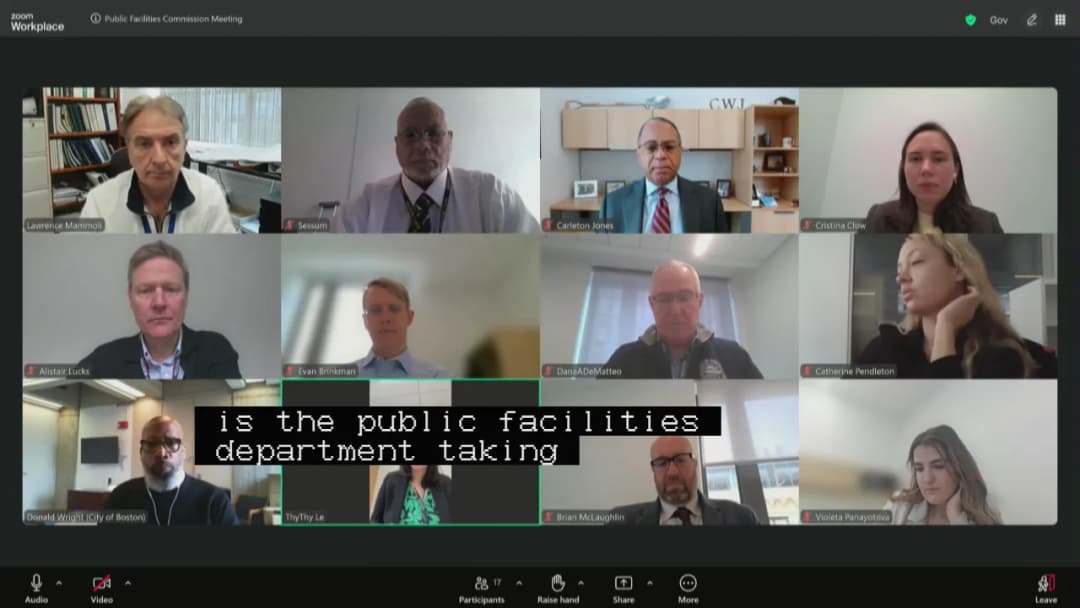
The Boston City Council Ways and Means Committee, chaired by Councillor Ben Weber, held a hearing on May 4, 2026 (Star Wars Day) at 2:05 PM to review the proposed FY27 operating budgets for the Inspectional Services Department (ISD), Property Management Department (PMD), and Public Facilities Department (PFD). The hearing was live-streamed and open for public testimony, though no members of the public signed up. The panel presented accomplishments, ongoing initiatives, and fielded questions from councillors. Discussion Items - Public Facilities Department (PFD): Executive Director Carlton Jones reported that PFD will manage 27% of the FY27-31 capital plan, covering 88 projects. Notable FY26 accomplishments included ribbon cuttings at four schools (Carter, Henderson Upper, PJ Kennedy, Sarah Roberts) and groundbreakings at two community centers (Grove Hall and North End), two libraries (Chinatown and Fields Corner), and an EMS Seaport Station. PFD received several awards, including LEED Platinum for Josiah Quincy Upper School. Ongoing initiatives include increasing supplier diversity, implementing a project dashboard with QR codes for real-time updates, and process improvement using Trimble software. - Inspectional Services Department (ISD): Commissioner Tanya Del Rio presented a proposed budget of $25 million. ISD issued 37,000 permits, performed 58,000 building inspections, 15,000 rodent control inspections, and 17,000 health inspections in FY26. Key achievements include reorganization of the Plans & Zoning division, which reduced average time to first review from 35 to 33 days; rolling out online permits for sheet metal, trench, sprinkler, and certificate of occupancy; and removing the yearly certificate of inspection requirement for establishments with fewer than 50 occupants not serving alcohol. The Boston Rodent Action Plan continues with rat-resistant barrels, sewer traps, sensors, and containerization pilots. Goals for FY27 include increasing registered rental units by 1,000 (to 76% coverage), increasing site cleanliness compliance by 10%, and implementing mobile inspection results. - Property Management Department (PMD): Commissioner Eamon Shelton highlighted the department's role in maintaining city buildings, graffiti removal, snow removal, and special events. Accomplishments included refinishing gym floors at multiple BCYF centers (Nazarro, Vine Street, Galvin, Shelburne, and others), historic lows in open graffiti removal cases, and successful move-in at 26 Court Street. Ongoing projects include a four-stop elevator replacement at City Hall, City Hall Plaza Phase II accessibility improvements, and continued work through Boston’s Resilient Building Program to reduce pool downtime. - Budget Cuts: All departments are managing a 2-3.6% reduction through salary savings and vacancy delays. ISD cut three positions (wire inspector, two IT) and reduced contracted services. PMD and PFD are absorbing cuts while seeking external funding for summer events like FIFA Fanfest. - Rodent Control: Councillors raised concerns about specific infestations (e.g., at 8 Ruthvin Street). Assistant Commissioner John Ulrich explained use of tanked carbon dioxide instead of dry ice, and described six intervention types being tested: sewer traps, tree pit treatments, trash compactors, burrow treatments, surface traps, and trash barrel toppers. Sensors and cameras are deployed in parks and public housing to measure effectiveness. Expansion of rodent-resistant barrels is planned for Mattapan Square. - Permitting Modernization: ISD reported improvements in permit issuance times: 6 days for short-form, 1 day for trade permits, and 44 days for non-ZBA long-form applications. Efforts include upgrading fire review capacity from one to five staff, and implementing a new permitting system later in 2026. - Accessibility at City Hall: PMD detailed the four-stop elevator project (construction to start late summer 2026) and City Hall Plaza Phase II to make the south entrance accessible. A wheelchair lift was installed after earlier funding. - Summer Events and FIFA Fanfest: PMD is coordinating with the state for funding to cover overtime and security costs. Municipal protective services officers are fully staffed (64 of 67 positions filled) and completed additional training. - Rental Registration and Inspections: ISD has 25 housing inspectors, conducting about 10 inspections per day. The goal is to inspect all registered units every five years, but current staff covers about every six years. The department is restarting compliance enforcement and issued fines for non-renewal of registrations. Key Outcomes - No votes were taken; the hearing was informational for budget review. - Councillors requested follow-up on specific projects: Blackstone School timeline, South End Library community meeting (scheduled for May 2026), rodent traps at 8 Ruthvin Street, steam room at Grove Hall Community Center, and data on fleet electrification. - PFD will provide the facility condition assessment report to Councillor Murphy. - ISD committed to sharing data on short-term rental trends related to the World Cup. - The Operations cabinet will follow up on fine collection data and updating the Boston Municipal Code fines per the home rule petition. - The hearing adjourned at approximately 4:00 PM.
Public Meetings - Boston, Massachusetts
Public Meetings - Boston, MassachusettsThis budget hearing, chaired by District 6 City Councilor Ben Weber, reviewed the FY27 operating and capital budgets for the Boston Transportation Department (BTD) and Public Works Department (PWD), as well as the newly established bike share revolving fund. The recommended operating budget for the streets cabinet is approximately $207 million, a 0.8% increase over the current year, while the capital plan totals $1.4 billion, representing about one-third of the city's capital plan. The hearing featured extensive discussion of core services, capital project priorities, staffing vacancies, and public safety concerns, followed by public testimony urging greater transparency and accelerated project delivery. Public Comments & Testimony - Cassandra Xavier (Disability advocate, North End) asked whether people with disabilities were included in ramp and sidewalk restoration design and criticized the pausing of infrastructure projects. The panel responded that they coordinate with the Disabilities Commission and follow consent decree requirements. - Stacy Thompson (Livable Streets Alliance volunteer) called on the City Council to use its fiduciary duty to ensure the administration answers detailed questions and commits to specific actions before approving the budget. She noted that previous commitments for monthly Vision Zero crash data are not being met. - Amira Patterson (T4MA / Transit is Essential, Brighton resident) urged the city to provide transparent criteria for project prioritization, highlight stalled safety programs, and asked where free-fare funding for bus routes 23, 28, and 29 is reflected in the budget. - John Kuiper (Sierra Club, Roxbury resident) described the dangerous conditions on Columbus Avenue between Jackson Square and Ruggles and criticized the indefinite postponement of the final mile of the busway. - Cole Lewis (Transit Matters) expressed disappointment that $7 million for four bus lanes was removed and that the Roxbury Resilient Corridors project was shelved. He called for a roadmap for Blue Hill Avenue designs and ambitious bike lane and speed hump targets (5 miles of new bike lanes and 500 speed humps as a minimum). - Maha Aslam (Livable Streets Alliance) urged councilors not to sign off on a budget without detailed timelines and deliverables for safety projects. - Tiffany Cogol (Boston Cyclists Union) called for transparency, specific project timelines, and deliverables, noting that earmarked funds have been sidelined due to inaction. - Gregory Maynard (Boston Policy Institute) criticized the administration for releasing the status list of state/federal grants only minutes before the hearing, preventing adequate preparation. He raised concerns about foot-dragging on the Tremont-Columbus project. - Matt Lawler (Walk Up Roslindale) called on the council not to approve the budget until the administration responds satisfactorily to Livable Streets' letter and commits to specific actions, noting that only a tenth of appropriated speed hump funds were spent last year. - Hamima Haleem (Allston-Brighton resident) advocated for more speed humps and bus lanes in her neighborhood, citing dangerous conditions on Commonwealth Avenue and the 66/64 bus routes. Discussion Items - Budget Overview: The streets cabinet's operating budget of $207 million reflects a 0.8% increase despite citywide 2% reductions, driven by non-discretionary contractual increases for solid waste collection ($72 million), recycling processing ($90/ton), snow management ($23 million – historically based but insufficient this year), street sweeping ($7 million), and sidewalk repairs. Capital plan totals $1.4 billion with 79 projects; 72% of capital spending over the last four years went to state-of-good repair (roads, sidewalks, bridges). - Capital Plan Changes: 27 projects were removed, several merged, and some delayed due to fiscal constraints. Notable paused projects include Centre/South Street, and the Safe Routes to School program was merged into a citywide safety program. The capital grants list of $282 million was provided to councilors; two grants have been rescinded (Roxbury Resilient Corridors $20M, Mattapan Square $2M). A new capital project dashboard will be launched. - ADA Ramps: $70 million invested over five years; FY27 ramp program cost expected to reach $42 million (30% of capital budget). Officials acknowledged that easier ramps are done and more complex locations remain. Quality issues with yellow tactile pads were noted; the city has shifted to cast iron pads. - Staffing and Vacancies: The cabinet has about 920 positions (public works 95 vacancies, BTD 77). Hardest to fill are CDL driver positions; the city has an in-house CDL training school. Salary savings of $8 million from vacancies were factored into the budget. Some long-term vacancies have been removed. - Parking Enforcement: 135 new officers hired, restoring pre-pandemic levels. Enforcement is seven days a week with 24-hour coverage except limited Sunday/Monday hours. Officers are rotated among neighborhoods. Councillors raised concerns about enforcement on Blue Hill Avenue and disrespect toward enforcement officers. - Bike Share: New five-year contract with Lyft includes extension options through 2035. Major increase in e-bikes, electrification of some stations, and continuation of income-eligible membership ($50/year, $5/month). The revolving fund will support future investment. Currently 347 stations; 30 more planned to meet the mayor's 2022 commitment. - Winter Operations: Managed 63 inches of snow; the $23 million budget was insufficient but the account can run a deficit. Lessons learned from two major storms; the second storm's extended parking ban improved compliance and cleanup. - Summer 2026 Events (FIFA, Sail Boston, Boston 250): Significant supplemental staff planned for parking/code enforcement, sanitation, and highways. Construction downtown will be paused during events, with work pushed into neighborhoods. The city has been planning for over a year. - Speed Humps and Traffic Calming: Approximately 150 speed humps are being installed this month. Councillors from multiple districts requested additional humps (Beacon Hill, Allston-Brighton, Dorchester). The administration noted that temporary bike lane assets are being replaced with permanent cast-in-place infrastructure. - Residential Parking Program (RPP): Councillor Flynn pressed for implementing 24/7 residential parking in South Boston; Chief Gove said the program is being restarted but no specific timeline was given. Councillor Durkin suggested charging for RPP permits to generate revenue. - Concurrent Jurisdiction (Pedestrian Right of Way): Councillor Flynn noted the Council's unanimous vote to end the practice where pedestrians and vehicles get green at the same time. Chief Gove said there are no plans to implement the change, as it would conflict with current signal policy. - Sanitation and Trash Contracts: Extended contracts avoided service disruptions seen regionally, but costs are rising. Trash disposal contracts expire next summer; rebidding will likely lead to higher rates. Mattress pickup contracts were rebid and costs reduced by $750,000, winning minority-owned businesses. - Vision Zero and Crash Data: The Vision Zero dashboard has not been updated this year; the administration committed to updating it. Stacy Thompson requested monthly crash data reports. - Blue Hill Avenue and Center-Running Bus Lane: The project was first discussed in 2009; planning continues. The $20 million Roxbury Resilient Corridors grant for Warren Street corridor was rescinded by federal DOT. - Potholes: Over 4,000 filled last year with an average case closure time under 19 hours. A dedicated pothole hearing is scheduled for Friday. - Nubian Square Cleanliness: Highway teams clean daily starting at 5:30 AM, but midday and after-school litter accumulation remains a challenge. Additional trash receptacles are being considered. Key Outcomes - No votes were taken; this was a budget review hearing. Councillors will have additional rounds and amendment opportunities before the full budget vote. - The administration committed to follow up on multiple RFIs, including: list of blinking crosswalks by neighborhood, updated Vision Zero data, crash data through April 2026, and a detailed project status dashboard (timeline “as soon as possible”). - Chief Gove agreed to engage with Councillor Culpepper on placement of new Blue Bike stations in District 7 before installation. - The city will explore a public awareness campaign to support traffic enforcement officers, as suggested by Councillor Flynn. - Sidewalk repair projects are planned citywide; Chinatown sidewalk reconstruction is in design. Councillor Flynn requested assurance that District 2 receives proportional investment. - The administration will work with the MBTA to expand automated bus lane enforcement to more routes. - The capital plan’s removal of 27 projects and delays on several corridors (e.g., Centre/South Street, Columbus Avenue) were acknowledged; staff stated that planning work will be preserved for future restart. - The hearing adjourned at approximately 1:00 PM, with a subsequent hearing on the FY27 budget scheduled for 2:00 PM.
The Boston City Council Ways and Means Committee, chaired by Councilor Ben Weber (District 6), held a hearing on April 30, 2026, at 2:14 PM to review the Fiscal Year 2027 operating budgets for Consumer Affairs and Licensing, the Office of Tourism, Sports and Entertainment, and the Office of Arts and Culture. The hearing also covered the Public Art Revolving Fund, Strand Theater Revolving Fund, and City Hall Plaza Revolving Fund. The hearing was live-streamed and broadcast on local cable channels. Public testimony was taken in person and virtually, with a large turnout of arts advocates. Public Comments & Testimony - Over 30 individuals testified, nearly all opposing the proposed 27% cut ($1 million) to the Office of Arts and Culture (MOAC) budget. Speakers included artists, nonprofit leaders, educators, and small business owners. - Moose Al Debinga (Executive Director, Origination Cultural Arts Center) stated that grants like SuccessLink and Boston Cultural Council allow them to employ teens and college students, and that the cuts would remove safe spaces and income for families. He urged restoring the $1 million cut. - Jay Padgett (Hyde Park resident, Program Director of Mass Cultural Facilities Fund) called the cuts “pejorative” and urged reconsideration, noting that creative spaces are essential infrastructure. - Kim Dawson O'Hilmova (East Boston resident, Executive Director of Grub Street) cited data that every dollar invested in the arts generates $3 to $10 in economic activity, so a $1 million cut could mean a $3–10 million loss for the local economy. - Elizabeth Yvette Rumieris (stage manager, Actors Equity Association) said, “A budget is a moral document,” and that the cut would lead to smaller productions, fewer jobs, and push artists out of Boston. - Shira Helena Gitlin (co-producer, Boston Area Theater Auditions) noted that small organizations like BADA rely on city funding and that cuts would disproportionately affect artists of color, emerging artists, and transgender artists. - Camila Mandarrojas Pinheiro Pagan (CEO, Beat the Odds) said arts funding directly translates into safe spaces and mentorship for youth, and urged reinstatement of the $1 million. - Jesse Baxter (Company One Theater) highlighted that their partnership with the city produced 10 productions, hired 500 artists, and served 25,000 audience members, and that cuts would harm civic infrastructure. - Christine Valencourt (president, Fort Point Arts Community) requested restoration of the 27% reduction and the development of a dedicated sustainable revenue stream like Denver, Houston, or Seattle models. - Neil Poole (Artistic Director, Verbal Fabric) asked for the city’s long-term strategy to sustain grassroots organizations and how they can be included in collective solutions. - Libby Bullinger Snyder (dance educator) noted that dancers earn an average of $7,074 per year, and cuts would make it even harder for them to survive. - Genevieve Day (co-executive director, Fenway Alliance) said the city should be funding MOAC even more, not less. - Dawn Simmons (Artistic Director, Speakeasy Stage) said the budget signals that arts are not a priority, and that the arts are a necessity for Boston’s marketability. - Kate Gilbert (Executive Director, Boston Public Art Triennial) reported that the triennial had 2.7 million views, 2 billion impressions, and $9.5 million in economic impact, with 80% of spending staying in Greater Boston. She said city funding signals to other funders that arts matter. - Michaela Cowie (Director of Theater Arts, Boston Center for the Arts) stated that creative industries generate jobs, tourism, and support small businesses, and that cuts would impact employment and economic activity. - Stefan Lafume (co-founder of Thrill) said defunding the arts would reverse progress in racial equity and tell BIPOC artists their culture does not matter. - Akiba Abaka (interim executive director, National Center of Afro American Artists) quoted Langston Hughes and Dr. King, saying arts create emotional integration, and Boston has an opportunity to lead. - Audrey Serafin (theater artist, Boston Cultural Council member) noted that MOAC is less than 0.7% of the city budget but is being asked to take a 27% cut, which she called “unprecedented, unacceptable, and unreasonable.” She warned that organizations will shutter and creatives will be pushed out. - Karen Crowlock (co-artistic director, Monkey House) emphasized the importance of arts for people with disabilities and public health, sharing a personal story of how dance saved her life. - Lakira Williams (UMPA) (founder of Outlawed and Culture X) said she has generated millions for the creative economy and moved $500,000 in public funding to Boston neighborhoods. She called for infrastructure that makes arts funding conversations obsolete. - Nate McLean Nichols (program director, Center for Teen Empowerment) urged the council to either amend the budget to prioritize creatives or reject the mayor’s budget outright. - Yuko Okabe (BCA resident) said, “Artists love Boston, but I wish Boston loved us back,” and asked for reinstatement. - George Ye (retired professor, donor) said public funding is catalytic, leveraging private dollars, and that cuts would constrain programming and private giving. Discussion Items - Consumer Affairs and Licensing: Kathleen Joyce, Executive Director, reported on the licensing board’s work, including 75 new alcohol licenses from the 225 newly available, 31 upgrades to all-alcohol licenses, and 720 special one-day all-alcohol licenses processed. The Boston Cannabis Board issued 7 licenses in FY26 (4 equity, 3 non-equity). The office received a $97,000 grant from the AG’s office and recovered over $214,000 in 2025. Special events processed over 780 applications in 2026, with 1,000 in 2025. Joyce noted a $262,000 reduction in their budget, including $150,000 cut from Open Streets (reducing from 5 to 4 events). She said two temporary positions funded by the council need renewal to maintain outreach and internal systems. - Office of Tourism, Sports and Entertainment: Amy Yandel, Director of Special Events, highlighted upcoming events: FIFA World Cup 2026 (Boston hosting matches and FanFest), Tall Ships (July 11-16, 28 vessels from 29 nations), and Open Streets expanding to Roslindale. She noted that over 2.8 million has been reinvested through Open Streets, with local businesses seeing up to 300% increase in sales. The office is seeking a new director of tourism. - Office of Arts and Culture: Chief Joseph Henry presented a mission-led approach with three core missions: grow and retain the creative workforce, make space for the creative economy, and expand equitable participation. He reported that 18.6% of Bostonians surveyed said the creative economy is their primary income source, and 7.54% said secondary. The creative industries contribute $15 billion annually to Boston’s economy and support 70,000 workers. He highlighted the 290 North Beacon project (40,000 sq ft of music rehearsal space and over 100 units of affordable housing), the Strand Theater upgrades, and work on cultural zoning. He noted the $1 million cut is a 27% reduction to MOAC’s operating budget, primarily affecting grants. He emphasized that the department will focus on leveraging capital investments (e.g., percent for art) and unlocking mitigation funds. He also mentioned joining the World Cities Culture Forum. - Councilor Questions: Councilors Louijeune, Durkin, Braden, Fitzgerald, and Culpepper asked about the impact of cuts, cultural zoning, artist displacement, the Strand Theater, music rehearsal space, and partnerships with foundations. Chief Henry discussed the need for technical guidance on creative spaces, a culture risk office to address displacement, and the importance of tying arts to economic development. He noted that the Strand Theater needs $150 million in deferred maintenance, but smaller upgrades (marquee, loading dock) are underway. Key Outcomes - No votes were taken; the hearing was informational and for public testimony. - The committee will continue budget hearings through June. The last listening session is scheduled for Thursday, May 26, 2026, at 6:00 PM at City Hall. - Councilors indicated they will consider amendments to the FY27 budget, including restoring the $1 million cut to MOAC, based on the strong public testimony. - The hearing was adjourned at approximately 6:00 PM (estimated from the length of testimony).
The Boston City Council Committee on Ways and Means, chaired by District Six Councilor Ben Weber, held a hearing on April 30, 2026, from 10:22 AM to approximately 12:00 PM to review the FY27 operating budget for the Office of Economic Opportunity Inclusion (EOI) and the Department of Supplier Diversity. The hearing covered budget reductions, program impacts, and performance metrics, with testimony from city officials and members of the public. Public Comments & Testimony - Shagun (former chief, Hyde Park): Expressed strong support for restoring $1 million in legacy business funding, called for a disparity study, and praised the EOI team’s work in attracting companies like Hasbro and Lego without tax incentives. Also credited Councilor Caletta Zapata for addressing drink-spiking issues. - Antonia Edwards (legacy resident, Dudley area): Voiced deep frustration over conditions in Nubian Square, citing only four Black-owned businesses, the opioid crisis, and lack of cultural representation. Urged the city to prioritize support for legacy businesses like Final Touch and Frugal Bookstore, and questioned the plan for the area. - Aaron Ashley Bailey (owner of Petchikan, boutique pet care): Noted progress in access to support but highlighted gaps in consistency and execution, citing a negative experience with a city-referred accountant. Recommended better coordination, practical implementation, accountability, and alignment with trusted access points like Boston Public Libraries. - Gregory Maynard (co-founder, Boston Policy Institute, online): Raised unanswered questions about whether letters detailing grant cuts were sent, clarified that Hasbro’s move was driven by state officials (citing reporting), questioned City Hall’s business outreach, and requested data on ARPA-funded space grant outcomes (vacant space occupied, foot traffic, sales tax, jobs). Discussion Items - Budget Overview & Reductions: Interim Chief Donald Wright presented the EOI cabinet’s vision and departments. The FY27 budget includes a $2.2 million cut to EOI and an 11.2% cut to Supplier Diversity. Cuts are driven by the end of ARPA funding, including $1 million from legacy business grants, $130,000 from small business activation grants, CRM software funding, and a one-time storefront revitalization grant. Two FTEs were eliminated (one moved to IGR, one reclassified into two positions). - Legacy Business Program: Councilors expressed strong support for continuing the program (30 businesses received $30,000 each) despite funding cuts. Discussion included potential pared-down models, philanthropic partnerships, and recognition without grants. Chief Wright confirmed the grant aspect is discontinued but the office seeks cost-effective ways to honor businesses. - Supplier Diversity Progress: Director Andrea Caruth reported 11.6% of discretionary spend ($72.5 million) went to MWBEs in FY26, up from 2% years ago, with an aspirational goal of 25%. Key barriers include vendor knowledge of procurement processes, capacity matching, and inconsistent department templates. A disparity study RFP is being prepared internally. The Scale program (ARPA-funded) provided $5 million in grants to 27 businesses; some have secured city contracts (e.g., Ancient Bakers with BPD, Noikoi Construction with house doctor contracts). - Nightlife Economy & Drink-Spiking Training: In response to Councilor Murphy’s inquiry, Chief Wright noted about 10,000 drink covers were issued to 37 establishments since March 19, 2026, and recent engagements occurred in Seaport, South Boston, and Theater District. Training is online and voluntary. Councilor Flynn requested data on veteran-owned business grants and information on spike-drink training reports. - Nubian Square & Commercial Vacancy Tool: Councilors Culpepper and Edwards pressed for a concrete plan for Nubian Square. Director Porcena mentioned a task force and a recent neighborhood walk. The vacancy tool is being piloted in Nubian Square and will go citywide by end of May. - Reparations Task Force & Black Male Advancement: Councilor Flynn probed whether the $350,000 cut means the task force is ending. Chief Wright deferred to the Equity and Inclusion cabinet (scheduled for May 12). The Office of Black Male Advancement was confirmed to be under a different cabinet. - Business Attraction: Chief Wright stated Boston does not offer tax breaks; companies come for talent and ecosystem. Hasbro, Lego, and others moved without city tax incentives. The “You Can’t Beat Boston” campaign launched in April 2026. - ARPA Program Sunset: Several programs (Space Grant, Scale, Legacy Business grants) were one-time ARPA-funded and will conclude. The city is exploring partnerships and federal CDBG funding to maintain support. Key Outcomes - No formal votes were taken; the hearing was informational for the budget review process. - Multiple councilors stated intent to advocate for restoration or alternative funding for the Legacy Business program. - Director Caruth committed to providing an update on the disparity study timeline and to supplying data on veteran-owned business grants and drink-spike training records. - Chief Wright agreed to provide copies of any correspondence about grant reductions and to share the Main Streets audit report (by Wolf and Company) pending legal review. - The committee will continue budget hearings, with the Equity and Inclusion cabinet scheduled for May 12, 2026.
The Boston City Council convened its regular meeting on Wednesday, April 29, 2026, at 12:13 PM in the Christopher Iannella Chamber, presided by President Breadon. Twelve councilors were present (Breadon, Coletta Zapata, Culpepper, Durkan, FitzGerald, Flynn, Mejia, Murphy, Pepén, Santana, Weber, Worrell), with Councilor Louijeune absent. The meeting adjourned at 5:04 PM after addressing a full agenda including budget updates, committee reports, ordinances, resolutions, and personnel orders. Consent Calendar - Resolutions adopted en masse (Items 0889–0903): Recognitions for Jack Fultz, Avra Estiatorio grand opening, Sherley Smith, Friends of the Boston Park Rangers Mounted Unit, Eileen Peterson, Elsie Morantus Petion, in memory of John Francis Snedeker, Prince Hall and African Lodge No. 459, Siobhan Salani, Dr. Jonathan K. Jefferson, Candelaria Silva-Collins, Chris Sumner, Marcia Butman, April 30 as International Jazz Day, and congratulations to Larry E. Polston Jr. - Personnel orders (Items 0887–0888 and late-filed 0904–0907): Appointments of temporary employees including Vu Tran, Moira Carragee, Lexie Gross, and Wilmer Quinones Melo were passed under suspension of the rules. Public Comments & Testimony - Jazz Boston presentation: Ken (president) and Fabiola Mendez (cuatro musician) spoke about International Jazz Day, highlighting Boston's jazz history and the upcoming Jazz O'Bane venue in Nubian Square. Fabiola performed an original song. - Brigham and Women's Hospital nurses: Sarah Buswell (RN and MNA bargaining committee secretary) testified alongside Councilor Flynn, urging support for a fair contract. She stated that management proposed a 0% wage increase for most nurses while seeking higher health insurance costs. The nurses held an informational picket that day from 2–4 PM. Discussion Items - Tenant Protection Ordinance (Docket 0864): Councilors Coletta Zapata, Weber, and Santana introduced an ordinance to increase rental registration fees (from $25 to $75 for initial, $15 to $50 annual renewal) and change penalties from $300 per month to $300 per day for non-compliance. The ordinance also creates a shared data system between Inspectional Services and the Office of Housing Stability and strengthens anti-retaliation protections. Referred to Committee on Government Operations. - Hearing orders and resolutions: - Parking structures (0865): Hearing to explore use of parking structures on municipal lots. Referred to Planning, Development and Transportation. - Planning Department performance (0866): Annual hearing required by 2024 ordinance to review the newly created planning department's report. Referred to Planning, Development and Transportation. - AI data centers moratorium (0867): Hearing to discuss potential moratorium on AI data centers due to concerns over electricity, water consumption, and noise. Referred to Planning, Development and Transportation. - University small business partnership (0868–0869): Hearing and resolution to establish a technical assistance partnership between universities and small businesses. Resolution adopted with 10 yeas. - In-custody deaths at Suffolk County House of Correction (0870): Hearing to examine over 20 deaths in five years, focusing on systemic factors. Referred to Public Safety and Criminal Justice. - Independent investigation into Shacoby Kenny death (0871): Resolution calling for an independent investigation into the December 2025 in-custody death; adopted 11 yeas. - Suspension of correctional staff involved in Kenny death (0872): Resolution calling for temporary paid administrative suspension of involved staff; failed (6 yeas, 3 nays, 2 present). - 17F information requests (0873, 0874): Orders for data on grant programs and drink spiking prevention efforts. Both passed (0873 on voice vote; 0874 with 11 yeas). - Everett Stadium parking (0876): Resolution opposing use of Charlestown for event parking, citing agreements with Kraft Group; adopted 12 yeas. - Safeguarding transportation funding (0877): Resolution urging timely use of state/federal funds for street projects; adopted 7 yeas, 4 nays, 1 present. - USPS Allston post office (0878): Resolution urging reestablishment of post office in Allston; adopted 12 yeas. - Summer block party grants elimination (0879): Resolution to eliminate $750 grants; failed (3 yeas, 9 nays). - Polish Constitution Day (0880): Declared May 3 as Polish Constitution Day; adopted 11 yeas (with Councilor Mejia added as co-sponsor minutes later). - Teacher Appreciation Week (0881): Recognized National Teacher Appreciation Week; adopted 11 yeas. - Dr. Jean McGuire Day (0882): Recognized May 1, 2026 as Dr. Jean McGuire Day; adopted 11 yeas. - Mental Health Awareness Month (0883): Recognized May as Mental Health Awareness Month; adopted on voice vote. - National Nurses Month/Week (0884): Recognized National Nurses Month and Week; adopted on voice vote. - Support for Brigham and Women's Hospital nurses (0885): Resolution supporting nurses in contract negotiations; adopted 11 yeas. - Jewish American Heritage Month (0886): Recognized May as Jewish American Heritage Month; adopted on voice vote. - Traffic signal timing resolution (0302): Resolution supporting replacement of concurrent traffic signals (pedestrian and car green at same time); adopted 11 yeas. Key Outcomes - Committee reports approved: - Appointment of Samira Ahmadi to BERDO Review Board (0260) confirmed. - $860,000 Cemetery Trust Fund appropriation (0760) passed. - $375,000 Red Sox Arts and Parks Program Grant (0761) authorized. - $32,600,000 for FY26 Community Preservation projects (0569) passed (12 yeas). - $1,763,090 for CPC administrative expenses and $39,587,798 reserved for FY27 (0758) passed (12 yeas). - Copley Plaza Hotel landmark designation (0771) approved (12 yeas). - Budget items: FY27 operating budget (0733–0735), capital fund transfers (0736–0737), capital budget (0738–0740), and PEG access fund appropriation ($3.6 million, 0757) all remained in Committee on Ways and Means. - Withdrawal: Docket 0875 (resolution regarding ICE enforcement at Fenway Park) was withdrawn. - Late-filed matters: Four personnel orders (0904–0907) passed; absence letter from Councilor Louijeune (0908) placed on file over objection; one additional late-filed resolution was blocked by the chair. - Next meeting: Scheduled for Wednesday, May 6, 2026, at 12:00 PM.
The Boston Public Facilities Commission (PFC) met on April 29, 2026, to consider votes from the Mayor's Office of Housing (MOH) and the Public Facilities Department (PFD). The meeting included approval of three tentative developer designations under the Welcome Home Boston program, an extension of an existing designation, a conveyance for a large homeownership development, and a contract award for a school feasibility study, among other items. All votes were approved unanimously. Welcome Home Boston Program – Phase 3 Votes The Welcome Home Boston program is a homeownership initiative targeting 150 vacant city-owned parcels. Two earlier phases resulted in 144 affordable homeownership units. Phase 3 involves 11 parcels (7 MOH-owned, 4 BPDA-owned) for households earning up to 135% of Area Median Income (AMI) – the "missing middle." The following three tentative developer designations were approved: - Vote 1: Norfolk Design & Construction LLC – 1 Everett Avenue and 63 Stoughton Street, Dorchester. 14 homeownership units (2-bedroom) at up to 135% AMI, 7 parking spaces. Purchase price: $200 total ($100 per parcel). Commissioner Wright recused; Commissioner Mamoli participated after disclosure. Vote: 2-0. - Vote 2: CWC Dev LLC – 8 Eastman Street, Dorchester. 3 homeownership units (2-bedroom) at up to 135% AMI, 3 parking spaces. Purchase price: $100. Commissioner Mamoli recused. Vote: 2-0. - Vote 3: Taj Development LLC and Stack Architecture LLC (nominee) – 64 and 66 Campus Street, Hyde Park. 6 homeownership units (2-bedroom) at up to 135% AMI, 8 off-street parking spaces. Purchase price: $400 for four parcels. Commissioner Mamoli recused. Vote: 2-0. Other MOH Votes - Vote 4: Extension for EcoHomes Highland Park LLC – 8 vacant parcels in Roxbury (Highland Street area). The tentative developer designation, originally approved April 17, 2024, was extended from 25 months to 32 months due to a legal challenge to zoning. The project will create 20 affordable homeownership units (80-100% AMI) with land held by a community land trust. Both commissioners participated. Vote: 2-0. - Vote 5: Boston Food Forest Coalition Inc. (BFFC) – Unnumbered parcel on Melmont Street, Roxbury. Designation to develop a community open space with edible plantings, pollinator garden, and fruit trees. The garage on site will be used for storage and education. Purchase price: $100. Both commissioners participated. Vote: 2-0. - Vote 6: Conveyance to ODJ Dev LLC – 11 parcels on Parker Street and Terrace Street, Roxbury (Mission Hill). 48 affordable homeownership units (24 at 100% AMI, 24 at 80% AMI), commercial space, open space, and urban gardens. The units will be deed-restricted for 50 years. Purchase price: $1,100. Both commissioners participated. Vote: 2-0. Public Facilities Department (PFD) Votes - Vote 1: Contract Award to Arrow Street Inc. – Design services for feasibility study and schematic design of the Shaw Taylor School Project (Shaw Lower School in Dorchester and Taylor Upper School in Mattapan). The schools, built in 1919 and 1931, lack gyms, cafeterias, and adequate accessibility. The contract amount is $1,500,000 ($1,326,462 base + $173,538 additional services), to be completed by October 30, 2027. Both commissioners participated. Vote: 2-0. - Vote 2: Name Change Amendment – GFT Engineers and Architects PC – Amendment to the house doctor contract for category 11 (building forensic investigation) to reflect the name change from Gannett Fleming Engineers and Architects PC, effective January 15, 2026. Both commissioners participated. Vote: 2-0. - Vote 3: Name Change Amendment – IMEG Consulting Corp – Amendment to the house doctor contract for category 2 (landscape architecture/civil engineering) to reflect the merger of Warner Larson Inc. into IMEG Consulting Corp, effective September 5, 2025. Both commissioners participated. Vote: 2-0. Key Outcomes All six MOH votes and three PFD votes were approved unanimously. The meeting concluded with a motion to adjourn.
On April 28, 2026, the Boston City Council Ways and Means Committee, chaired by Councilor Ben Weber (District 6), held a hearing on docket numbers 0733–0740, reviewing the FY27 operating budget for the Office of Neighborhood Services (ONS), including 311, Spark Boston, and the Office of Civic Organizing (OCO). The hearing featured presentations from Chief of Neighborhood Services Brianna Millore, ONS Executive Director Mohammed Missouri, 311 Director Urgasola Budo, OCO Director Natalia Benitas Perez, and Spark Boston Director Aidan McDonough. Councilors discussed budget cuts, staffing vacancies, community engagement protocols, and the elimination of block party grants. No public testimony was given. The hearing was part of a series running from April through June 2026. Discussion Items - Presentations and Budget Overview: Chief Millore introduced the cabinet as "closest to the people." Mohammed Missouri highlighted ONS successes: distributing over 3,100 turkeys, donating more than 2,000 toys, and holding the mayor’s first citywide office hours connecting over 350 constituents to city services in one day. - 311 Data and Operations: Director Budo reported a service level of 88% (national average 80%), with approximately 300,000 cases and calls in the current year. The 311 system is undergoing a technology upgrade to improve asset management and case tracking. The system currently uses outdated service level agreements (SLAs) from 10–12 years ago. - Office of Civic Organizing: Director Perez noted accomplishments: 150 neighborhood cleanups in April 2025, 171 planned for 2026; 78 community-led cleanups; 120 summer block party activation grants; 78 fall Spooky Streets grants; 143 City Hall on the Go truck stops; and the 2026 Civic Summit scheduled for August 1st at Boston University. The budget line for personnel services appeared to increase from $130K to $316K, but Chief Millore clarified this is a reorganization—OCO becoming its own department—not a real increase. - Spark Boston: Director McDonough described the volunteer council of 40 members (ages 20–35) representing all 23 neighborhoods, with 487 applications received this year. Spark Boston is a one-person staff supported by volunteers. It collaborates with city departments on initiatives like housing and childcare surveys. - Budget Cuts and Reductions: The cabinet is taking approximately a 1% cut overall. Specific cuts include eliminating summer block party grants ($60,000) and Spooky Streets grants ($10,000). The office is seeking external partnerships to continue these programs. A long-vacant chief of staff role was also eliminated. ONS itself is losing over $200,000. - Neighborhood Liaison Vacancies: ONS has 14 neighborhood liaisons with three current vacancies (Roslindale, Jamaica Plain, Charlestown). The Chinatown/downtown liaison position was vacant for approximately 10 months (May 2025 to March 2026) before being filled. Starting salary for liaisons is approximately $68,000–$70,000. - Community Engagement and Notification: Several councilors (Flynn, Culpepper, Fitzgerald) expressed frustration about not being notified of ONS meetings or events in their districts. Director Missouri explained that notification depends on the type of meeting; some are private constituent meetings. Councilor Culpepper called for a formal protocol to ensure district councilors are informed. Councilor Flynn requested that 311 automatically notify district councilors when service requests are filed in their district; the administration said they would work with the Department of Innovation and Technology (DoIT) on this, but noted the ongoing CRM system revamp. - Role of ONS Liaisons: Director Missouri described the expanded role of liaisons, including proactive outreach (coffee hours, door-knocking) and working with other departments (parks, transportation, planning) to ensure community input. Community Engagement Specialists handle abutters meetings, freeing liaisons for broader engagement. - 311 Call Center Language Support: Director Budo confirmed that 311 provides interpretation in multiple languages, including Cantonese, via a language line rather than dedicated speakers, to avoid overburdening staff. Key Outcomes - The FY27 budget for the Office of Neighborhood Services was discussed but no vote was taken; the hearing is part of the budget review process. - Block party and Spooky Streets grants are eliminated from the operating budget for FY27; the office will seek external funding partners. - ONS has three liaison vacancies that are being actively recruited; the new Chinatown liaison has been hired after a 10-month vacancy. - The 311 CRM system update is ongoing; improvements in data tracking and case management are expected, but specific enhancements like automatic notification to councilors are not yet committed. - Councilor Flynn vowed to oppose a 14% cut to the Veterans Department budget, requesting a meeting with Commissioner Santiago and the mayor’s office. - Councilor Culpepper requested a list of all city grant cuts across departments, not just within OCO. - Several councilors emphasized the need for better communication and notification protocols between ONS and district councilor offices.
The Boston Zoning Board of Appeal met remotely via Zoom on April 28, 2026, beginning at 9:30 AM, to consider a full agenda of zoning appeals. The board approved minutes, granted extensions, heard a remand discussion, and voted on numerous residential and commercial projects. Public testimony was taken on many items. Key outcomes included approvals for several projects, deferrals, and no outright denials. Consent Calendar - Approval of hearing minutes from April 7, 2026, passed unanimously. - Two extension requests for cases at 10 Belleville Avenue and 79-89 West Broadway were granted after discussion about feasibility. Public Comments & Testimony - 61 Farragut Road (new two-family with roof decks): An abutter expressed support; the City Point Neighborhood Association opposed due to height and roof coverage; the developer noted 14 letters of support from direct abutters. - 744 East Fourth Street (new six-unit building): Several abutters spoke in support; concerns about demolition and parking were raised; Councillor Flynn opposed based on neighbor feedback. - 30-32 Second Street (new six-unit): Public testimony included support from a resident and non-opposition from the Gate of Heaven Neighborhood Association. - 36-42 O Street (vertical addition): The City Point Neighborhood Association supported the project after the developer agreed to replace dead trees and make balconies decorative. - 34 Athelwall Street (new six-unit): Multiple community members spoke in support, praising the developer's community engagement and down payment assistance program. - 190-200 Cummins Highway (school addition): Abutters expressed concerns about construction noise and hours; the Prospect Hill Neighborhood Association remained neutral. - 100 & 102 Beachview Road (two-family dwellings): An abutter opposed the height and density; Orient Heights Neighborhood Association voted non-opposition (4-4-2); community members raised concerns about consistency with Plan East Boston. - 109 Prince Street (roof deck conversion): Multiple abutters and the North End Waterfront Residents Association supported the project. - 1 Bayside Street (new six-unit): Overwhelming opposition from neighbors and the Columbia Savin Hill Civic Association (unanimous opposition); concerns about density, parking, and character. - 1954 Commonwealth Avenue (26-unit condominium): The Brighton Allston Improvement Association supported; some abutters expressed disappointment about lack of direct engagement. - 142 P Street (five roof decks): Strong opposition from neighbors and Councillor Flynn's office, citing prior agreements, quality of life, and safety; supporters argued minimal visual impact and community support letters. Discussion Items - Remand discussion for 22 Hanover Street: The Superior Court remanded the case for specific findings on a conditional use permit for a roof deck. No vote taken. - Numerous cases were presented by attorneys and development teams, detailing zoning violations, community process, and design modifications. The board questioned applicants on hardship, parking, design, and community feedback. Key Outcomes - Minutes approved unanimously. - Extensions for 10 Belleville Avenue and 79-89 West Broadway granted. - All subcommittee recommendation cases approved. - Approved: 360 Princeton Street (deferred), 109A-109 & 11 Sailing Street (patios), 7 Smith Court (head house), 61 Farragut Road (with proviso for Parks review), 744 East Fourth Street, 30-32 Second Street, 36-42 O Street (with design review), 34 Athelwall Street, 190-200 Cummins Highway, 100 & 102 Beachview Road, 109 Prince Street, 1258-1262 Massachusetts Avenue, 11 Benson & 13 Vinton Street, 1 Bayside Street (motion carried), 1954 Commonwealth Avenue, 142 P Street (motion carried). - Deferred: 360 Princeton Street (no appearance), 58 Butler Street (to May 5), 70 Oklahoma Street (to May 19 due to recusal), 62 L Street (to June 16), 62-66 Condor Street (to June 16). - Motion to defer for 744 East Fourth Street (Planning Department recommendation for Article 85 review) was rejected; case approved.
The Boston City Council Committee on Ways and Means, chaired by Councillor Ben Weber (District 6), held a public testimony listening session on the Fiscal Year 2027 budget on April 28, 2026, at 6:27 PM. The session was one of two public testimony sessions dedicated to the FY27 budget (Docket 0733-0740). Speakers addressed proposed cuts to youth employment, legal aid for evicting families, mental health crisis response funding, and public restroom maintenance. Councillors present included Liz Braden (Council President), Ed Flynn, Brian Worrell, and Enrique Pepén (arrived later). Councillors Henry Santana and Julia Mejia submitted letters of absence. Consent Calendar - No consent calendar items were discussed. Public Comments & Testimony - Hannah Hooven – Teacher at UP Academy Holland (Dorchester), testified in support of the Access to Council program, which provides free legal services for BPS families facing eviction. She noted that from January–February 2026, 94 families received services and over 30 had evictions delayed or prevented. The program was funded at $450,000 in the previous budget but is proposed for elimination. - Alex (Alex DeFranzo) – Representing the East Boston Youth Employment Coalition, advocated for restoring school year youth jobs. He stated the YEO budget dropped from $27M (FY25) to $24M (FY26), with a $6M cut eliminating school year jobs entirely. He argued that school year jobs are essential for training summer program leaders. - Omar Sahor – Education Director at Pierce Park Sailing Center, supported restoring school year employment, citing benefits like higher graduation rates, college enrollment, and reduced violence involvement. - John Smith Saint Sear – Founder of Smith Suicide Prevention Center for Young Black Boys, delivered a critical statement calling the budget a “moral document” and accusing the city of structural abandonment of Roxbury, Dorchester, and Mattapan. He argued that underfunding prevention while fully funding police is a governing choice. - Amy Takanami – Steering committee member, Boston People’s Response (BPR) Campaign, urged full funding ($4M) for a non-police, community-based mental health crisis response pilot. She noted $1.3M already allocated but insufficient. The pilot was designed through a community-led process funded by the city in 2021. - Maya Melestri – Social worker and BPR steering committee member, detailed the design process that included 14 community members (majority BIPOC, with lived experience) and six listening sessions in English, Spanish, and ASL engaging over 200 people. The design was presented to Mayor Wu in spring 2023. - McKay Nelms – Youth worker and student, supported BPR, emphasizing the need for consent-based, non-carceral crisis response. - Ariel Ellison – Northeastern student, shared personal experiences with mental health stigma and cited Washington Post data that 25% of fatal police shootings involve mental health crises. Mentioned the recent killing of Jacob Graves on April 4, 2026. - Star Ninez – Youth worker with City School, described witnessing crises and argued that a crisis is not a crime. - David Osashi – BPR member, named Terrence Coleman, Stephenson King Jr., and Terrance Coleman (all Black men with mental illness killed by police) to argue for non-police response. - Elise McCullough – Youth worker, shared personal experience of a psychotic episode where police and EMS took her to a hospital, worsening her housing situation. - Amani Pagan – 17-year-old youth worker, questioned why well-researched community solutions remain underfunded, urging the council to act. - Naomi Hall – MSW student and BPS paraprofessional, supported BPR, noting that young people should be part of policy design. - Ogdi – 70-year-old youth worker at The City School, argued youth jobs cuts force youth into illegal activities. - Alexa Santana – 17-year-old, lifelong District 7 resident, youth organizer with Youth Justice and Power Union, supported BPR, citing personal experience with mental health struggles and high rent costs. - Nayung – Psychotherapist and Boston resident, supported BPR, noting the $484M police budget compared to the $4M request. Mentioned lives lost due to police responses, including Said Faisel and Sonia Massey. - Teresa – Youth worker with Pathways to Change at City School, supported BPR, emphasizing mental health inequality in low-income communities. - Hussein – Program director at City School and BPR steering committee member, criticized police and DCF responses to youth mental health crises, citing arrests and lack of consent. - Malcolm Shum Godfrey – Organizer with Boston Democratic Socialists of America (DSA), testified about lack of public restrooms. Noted that parks operations face a $500,000 cut and building operations a $320,000 cut, which would reduce maintenance of existing restrooms. He requested year-round, 24/7, accessible public restrooms. - Nicholas Moy – Cambridge resident working in Boston, DSA member, echoed restroom access issues, citing moral imperative and MBTA failures. - Ian Colletti – DSA member, argued public restrooms are a basic biological necessity that pays for itself in health and productivity. - Gregory Fanel – Independent Socialist Group, Hyde Park resident, criticized school closures and teacher layoffs (400 teachers laid off, three schools closed). Cited the state’s $8.6 billion rainy day fund. - Edgar Santana Castro – Student at Tech Boston Academy, BPR member, supported the crisis response pilot. - Deborah James – Hyde Park resident, criticized cuts to school year youth jobs while police budget increases, arguing youth jobs are stepping stones to success. - Maya French – Dorchester resident, urged cutting police budget ($484M) instead, stating police are not trusted in mental health crises. - Joaquin – 17-year-old, Hyde Park/Dorchester, member of Youth Justice and Power Union, criticized police budget ($57.7M overtime alone) and racial origins of policing, called for restorative alternatives. - George Lee – Called the budget “the most inhumane and cruel in 20 years,” highlighted cuts to school year jobs ($6M), housing vouchers, eviction attorneys, and immigrant support. Urged reversal of cuts and increased investment in community solutions. Warned against myths about private fundraising and lack of funds. - Jack Fersey – Remote testimony (Boston DSA), advocated for public restrooms, especially near transit hubs. Noted his roommate with GI issues has lost faith in transit. Requested reversal of the $500,000 parks and $320,000 building operations cuts, and new restrooms in high-traffic areas. Discussion Items - Chair Ben Weber opened the session, explained the budget process (40 hearings, runs April–June), and set two-minute testimony limits. He apologized for low attendance from other councillors, noting competing events, but acknowledged his colleagues work hard. - Councillor Ed Flynn spoke briefly, thanking young people for their engagement. - Council President Liz Braden thanked attendees and emphasized the importance of hearing public voice on the budget. - Councillor Enrique Pepén (District 7) arrived later and commended the youth organizers, mentioning a personal connection with a young person (Alexis) who helped his campaign. He pledged to work to restore cuts. - Councillor Brian Worrell (District 4) arrived and later gave closing remarks, acknowledging that this budget has the most cuts he has seen in his four years. He called the budget a “value statement” and committed to a deep dive to restore investments. - The chair noted that letters of absence were received from Councillors Henry Santana and Julia Mejia. Key Outcomes - No formal votes were taken during this listening session. - Chair Weber and Councillor Worrell committed to reviewing testimony and working to find funding to restore cuts, particularly for youth jobs, Access to Council, mental health crisis response, and public restrooms. - The next listening session is scheduled for May 26, 2026, at 6:00 PM, with interpreters in Spanish, Haitian Creole, and Cantonese. - Chair Weber also announced upcoming town halls in District 6 (Jamaica Plain and West Roxbury) the following Monday and Thursday.
This hearing, chaired by Boston City Councilor Ben Weber (District 6), reviewed the Fiscal Year 2027 operating budget for the Mayor's Office of Housing (MOH). The recommended budget is $49.2 million, a 9.6% reduction from FY26. Key cuts include $2.3 million from the City of Boston voucher program, $1 million from the Affordable Commercial Assistance Fund, $450,000 from the Access to Counsel pilot, and $400,000 from Grow Boston grants. Panelists Chief of Housing Sheila Dillon and Director of Administration and Finance Rick Wilson presented accomplishments from FY26 and goals for FY27, noting a challenging federal funding environment. Council members questioned the panel on budget impacts, voucher programs, homeless services, urban agriculture, and property disposition. Public Comments & Testimony - Danielle Andrews (Jamaica Plain, food projects educator): Expressed deep disappointment in cuts to Grow Boston, emphasizing the health and community multiplier effects of urban agriculture, and urged restoration of funding. - Annabelle Rubia (Trustees of Reservations, representing 4,000 community gardeners): Highlighted the importance of Grow Boston supply grants for infrastructure, the urban ambassador program for workforce development, and that garden food production is valued at $1.2 million annually. - Mark Winter (co-founder, Recover Green Roofs): Supported Grow Boston, citing the rooftop farm at Boston Medical Center as a model for food-as-medicine and mental health benefits, and argued the program needs more funding, not less. - Olivia Martin (Boston resident): Described personal struggles with mobile voucher housing, accusing agency miscoordination and lack of transparency. She requested immediate help to avoid homelessness by Friday, and the chair assured follow-up. - Lisa Evans (We Grow Microgreens, Hyde Park/Roslindale): Detailed how Grow Boston grants helped her farm with hydroponics, solar panels, and raised garden beds. Cited declining farms nationwide and stressed investments needed to train new farmers. - Matthew Ellison (Urban Farming Institute, assistant farm manager): Noted that 45 raised garden beds were installed through Grow Boston, with a waitlist double that. The program provides safe growing soil for culturally relevant food and educational support. Cuts would harm food access. - Joy Gary (Boston Farms Community Land Trust, online): Urged viewing Grow Boston, Office of Food Justice, and MOH housing programs as investments that prevent health, economic, and social crises. Asked council to restore funding. Discussion Items - Budget reductions and justifications: The panel explained that the $49.2 million operating budget is down $5 million from FY26, largely due to the end of one-time ARPA/CARES funds and the need to balance the city budget. Major cuts included the voucher program ($2.3M, but no reduction in number of households served due to phased leasing), affordable commercial assistance ($1M, low program uptake), access to counsel ($450k, still supportive of restoring), Grow Boston grants ($400k, over 50% reduction), and the ADU program ($200k). - City of Boston voucher program: Director Joel Wool (BHA) confirmed the program serves just over 500 households. The budget reduction leverages prior-year funds to maintain current numbers. Future years may face challenges if rents rise. Currently about 200 vouchers are project-based. - Access to Counsel pilot: Councilor Weber highlighted the program’s success in keeping families with school-age children housed. Chief Dillon supported restoration, noting an average rent arrearage of $3,800 per household. She advocated expanding to seniors and immigrant families. - Affordable housing development and land trusts: Discussion covered the AOP (Acquisition Opportunity Program) which has acquired over 1,400 units since 2016, but now faces limited funding sources (linkage, CPA). Support for community land trusts is provided through AOP, revolving funds, and ARPA grants but no dedicated budget line item. - Supportive housing siting and neighborhood notice: Councilor Culpepper raised concerns about Elm Hill Park residents not receiving notice before formerly homeless individuals moved in. Chief Dillon defended the case-by-case approach, noting that supportive housing developments hold public meetings, but individual unit placements can't be pre-announced without stigmatization. She agreed to meet with the neighborhood association. - Urban agriculture: Several council members expressed concern over the steep cut to Grow Boston. Chief Dillon stated that MOH will seek philanthropy and internal reallocations to mitigate impact. - Homelessness and family shelter: Councilor Colletta Zapata noted the closure of St. Mary's Crossroads Shelter and asked about impacts. Chief Dillon reported declining family homelessness in Boston due to fewer state-funded shelter placements, but said the Office of Housing Stability continues high demand. - Tenant stabilization fund: The budget includes $1.65 million (down $50k), with average award of $3,800. Demand remains strong. - Fire displacement: The city spent approximately $650,000 this fiscal year to help 90 households displaced by fire. - Property disposition and tax foreclosure law: A 2022 state law requires returning excess equity to previous owners when tax-foreclosed property is sold, affecting how the city disposes of parcels. - Housing strategy plan: The first term (2022-2025) accomplishments are posted online. The second term is under development, with release expected in a few months. Preservation of income-restricted units is mostly on track except for one stalled project (Forbes, JP, 140 units). - Domestic violence housing: About $4 million of COC funding supports 125 households for survivors. BHA also has admission priorities for domestic violence. Key Outcomes - No formal votes were taken; this was a budget hearing for information gathering and public testimony. - Chair Weber committed to following up with Olivia Martin about her voucher crisis and directed the panel to assist. - Council members expressed support for restoring Access to Counsel and Grow Boston funding, though no formal amendments were made at this hearing. - Chief Dillon and Director Wilson pledged to provide additional data on homeownership funding breakdown by source, family fire displacement costs, and specific domestic violence program details. - The hearing is part of the city council's ongoing FY27 budget review process, with further hearings and listening sessions scheduled through May.