Browse by city
Date range
Search help

Search titles, summaries, topics and stored transcripts together. Keywords may match separately; put the whole query in double quotes for a phrase. Matching follows word analysis, so punctuation is not exact. Both dates are included. Documents are not searched.

SHOWING 121–130 ENTRIES
121
MAY 12, 2026 · BOSTON, MASSACHUSETTS · CITY COUNCIL
Boston City Council Budget Hearing on Equity Offices (May 12, 2026)

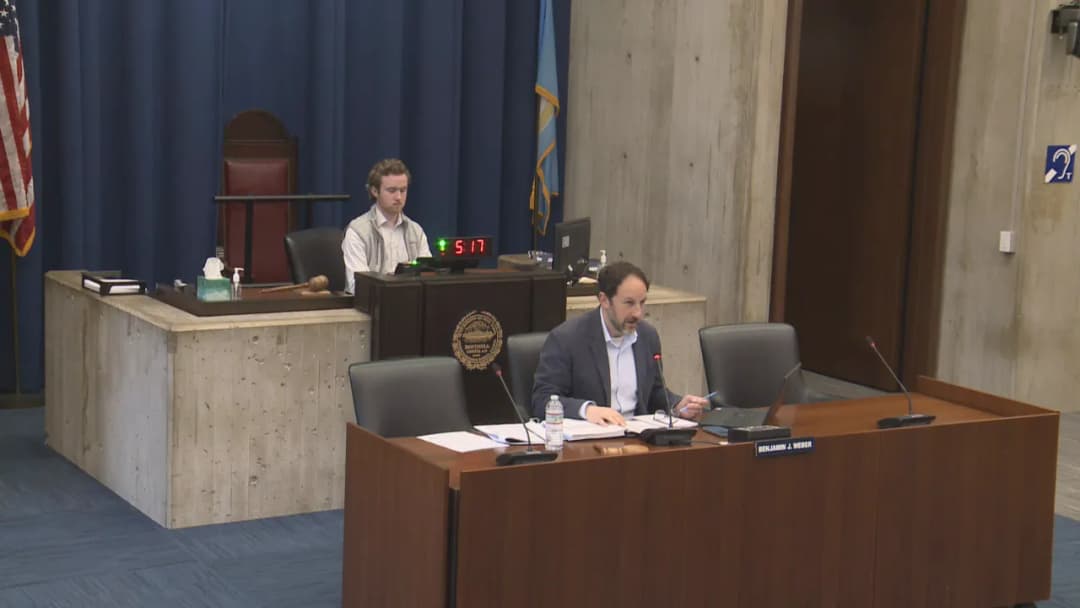
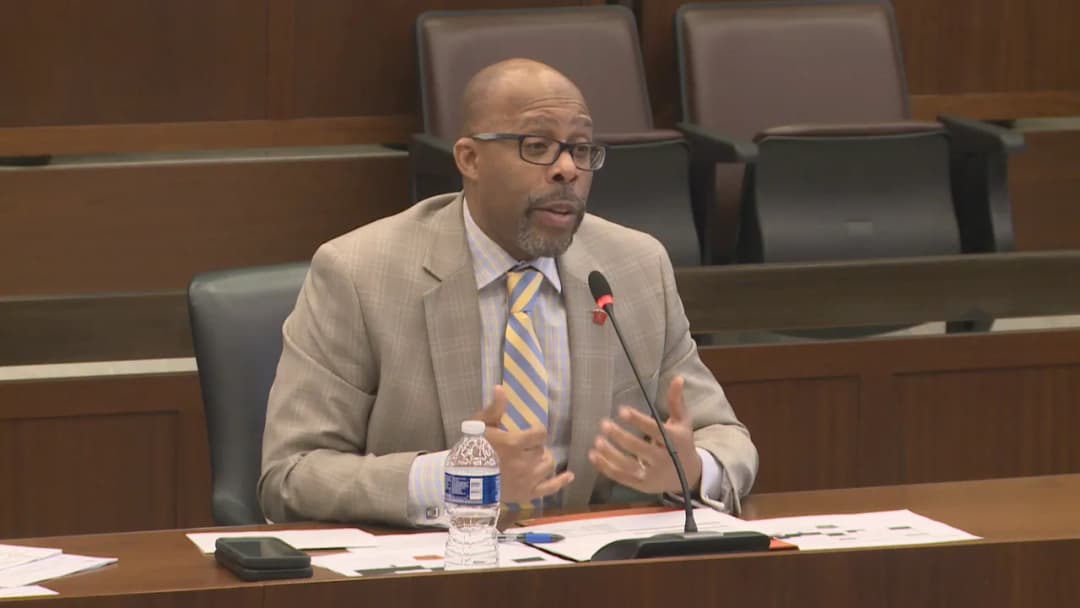
On May 12, 2026, at 2:10 PM, the Boston City Council’s Committee on Ways and Means, chaired by Councillor Ben Weber, held a public hearing on the Fiscal Year 2027 operating budgets for the Office of Immigrant Advancement (MOIA), Office of Language and Communication Access (LCA), Commission for Persons with Disabilities, and the Office of LGBTQIA2S+ Advancement (MOLA). The hearing included presentations from agency heads, a first round of councillor questions, in‑person and virtual public testimony, and closing remarks. A central theme was the impact of proposed budget reductions—particularly cuts to grant programs—on vulnerable communities. Public Comments & Testimony - Aisha Gaskins (Roxbury/Dorchester) raised concerns about immigrant services, disability funding, and LGBTQIA2S+ family building, questioning perceived inequities compared to Black Americans. - Tanya Neslusan (Mass Equality) urged the council to restore MOLA grant funding, stating that community grants are “not symbolic investments” and that eliminating them would cause “immediate and harmful” consequences for LGBTQ residents. - Nina Savaggio (Greater Boston PFLAG) testified that MOLA grants enabled free training for city departments and BPS staff, and that budget cuts would undermine public health and safety at a time of rising anti‑LGBTQ rhetoric. - Trey Andre Valentine (Massachusetts Transgender Political Coalition, MTPC) argued that cutting grants violates the city’s “sanctuary city” promise, stating that more than 60% of MTPC funds go directly to community members for name changes, rent, and food. - Jeff Walker (LGBTQ Senior Housing, Hyde Park) reported that MOLA funding enabled over 300 programs reaching nearly 3,000 individuals in the past year, including LGBTQ elders and BIPOC community members. - Sorella Blyman-Cohen (QNIST) described how a Beyond Pride grant launched a peer support group for LGBTQIA+ youth that expanded from a handful of participants to serve over 25 young people. - Carolyn Cronin (resident of The Pride, Hyde Park) spoke as a “receiver of services,” emphasizing that government funding is critical for keeping LGBTQ elders “safely housed, fully engaged, and feeling welcome.” - Kirsten Keels (LGBTQ Senior Housing) urged rejection of cuts, stating: “Is Boston only a city for the straight, the white, the gender‑conforming … ?” - Claudia Green (English for New Bostonians) asked for level funding of $500,000 for parent English classes, noting that in FY26 an additional $250,000 allowed 10 community‑school partnerships to launch six new classes and sustain ten existing ones, serving 402 parents over two years. - Audrey Martinez (parent and former teacher) submitted letters from 22 parents who rely on English classes to communicate with schools and help their children; she said cuts “desperately” need restoration. - Mercedes Loving Manly (Pride Extended Incorporated) stated that MOLA grants allowed redistribution of over $10,000 annually to individuals for food, housing, and medical support, and called the cuts “a slap in the face” to community organizers. - Andrew Cho (Ability Stands Boston) said MOIA grants provided free movement classes at six BHA locations with 90% immigrant attendance; cuts would reduce offerings and harm marginalized students. - Matisse DuPont (Queer History Boston) warned that losing grant funding echoes the 1981 elimination of the mayoral liaison to the lesbian/gay community, which was “first to be cut and last to be restored.” - Elijah Oyanuga (Save Ourselves/SOS) testified that MOLA’s Beyond Pride grant funds peer‑led support for trans individuals facing homelessness, violence, and discrimination, and that cuts would threaten life‑saving work. - Rainbow (Save Ourselves) shared a personal story of how MOLA funding helped her access clothing, transportation, food, and a sense of safety and belonging. - Mickey Jones urged protection of MOLA funding, stating: “The LGBTQIA2S+ advancement was what saved my life here in Massachusetts.” - Sao Khan (Out Newcomers) opposed cuts, saying small grassroots organizations fill critical gaps for LGBTQ migrants and that city claims of being a sanctuary are undermined by defunding grants. - Jay Lamb (Medford/Somerville) argued cutting funds from LGBTQ+, immigrant, and disabled communities “promotes systematic barriers.” - Rick Boyd (Queer Neighborhood Council) said the cuts signal that “my life and the lives of my neighbors … are negotiable and not valued equally.” - Curtis Santos (BLU Foundation, Boston Black Pride) and a youth mentee testified that MOLA funding has created solidarity and belonging, and that cutting it would harm “youth and elders of the queer community.” - Giselle Byrd (The Theater Offensive, virtual) stated that the recommended budget “has devastating cuts” and that if passed “there will be blood on your hands.” - Shirley Riga (The Pride, Hyde Park, virtual) read an excerpt from a poem displayed in City Hall and warned that “community members like me will lose affirming spaces and trusted resources.” Discussion Items - Councillor Flynn praised Commissioner McCosh and directors, asked about the office’s role regarding non‑city streets and sidewalks. McCosh explained that her office works with the Streets Cabinet to identify ownership and refer issues to state agencies when necessary, and also works with the Licensing Board on service‑animal compliance. - Councillor Flynn asked LCA Director Vivar Wong how the office keeps up with new languages. She replied that the office uses census data, on‑demand interpretation trends, and partnerships with other departments (BPS, BHA, BPHC) to identify emerging language needs. - Councillor Murphy asked about funding and staffing for departments that rely on LCA and the disability commission. McCosh and Vivar Wong explained that LCA centrally funds most language‑access accommodations and gives departments budgets for ASL/CART; other departments can tap into citywide contracts. Murphy also asked MOIA about summer youth jobs: Courtney White said the goal is to serve 500 youth across 33 partner sites, with spots still being filled. - Councillor Pepin asked about constituent casework volume. White reported that MOIA directly supported approximately 2,500 people in FY26 so far, with six staff handling constituent services. Pepin also noted the loss of MOLA grants and asked about future strategy. Lee said the office is having conversations with outside funders, shifting to community recognition and advisory structures, and focusing on events like the flag raising and Pride celebration. - Councillor Santana expressed frustration that equity grants were cut, calling the situation “life and death” for immigrant and LGBTQ communities. Chief of Equity and Inclusion Mary Angelie Solis Cervera noted that FY27 cuts are not limited to equity offices and urged the council to also examine larger grant programs in other agencies. Santana declared that he would work with colleagues on amendments to restore these grants, particularly for MOIA and MOLA. - Councillor Cole Pepper criticized the cuts, asking “How do we continue to do that work if there’s no grant funding?” He requested a specific list of eliminated grants from each office. White listed MOIA cuts: Weaving Well‑Being, ESOL, Mutual Aid (Strengthening Boston’s Diverse Neighborhoods), academic‑year youth advancement, and immigration legal access (partially restored through participatory budgeting). Lee confirmed MOLA’s three grants—Beyond Pride, Gender Affirming Idea Grant, and family/individual legal support—were cut 100%. - Councillor Louijeune asked Commissioner McCosh about curb‑ramp compliance and the captions ordinance. McCosh said about 40% of restaurants are in compliance with the captions ordinance, and the office will prioritize enforcement this summer. Louijeune also asked MOLA about the impact on community‑facing services; Lee said the FY27 budget preserves 45,000 for public events and that an Advisory Council will guide future spending. - Councillor Fitzgerald asked each office what cuts they “feel the most” and how they plan to backfill. LCA noted its equipment line was reduced but operations continue; MOLA will shift to a community awards ceremony and affirming job fair; MOIA will partner with BPHC and BPS for mental‑health and youth work, and focus on free immigration consultations. - Councillor Worrell pressed for detail on specific grants and their impact. White said MOIA’s mental‑health mini‑grants ($230,000 distributed) are being cut, but BPHC partnership may help. Lee provided data that the Gender Affirming IDEA Grant received twice the applications this year; $70,000 supported MTPC and others with document‑change assistance. Worrell noted the total cuts across equity offices: $1.8 M from MOIA, $500K from Black Male Advancement, $400K from Human Rights Commission, $360K from Office of Equity, $283K from MOLA, $157K from Women’s Advancement, $112K from Fair Housing & Equity, and $100K from LCA. He questioned “what is equitable about these cuts.” - Chief Solis Cervera acknowledged that personnel will continue all work and that the reductions do not decrease staffing. She urged the council to also focus on “bigger dollars” in other agencies and to use the budget amendment process to restore funding. Key Outcomes - No votes were taken at this hearing; it was a public budget review session. - Multiple councillors (Santana, Cole Pepper, Louijeune, Fitzgerald, Worrell) indicated they would propose amendments to restore grant funding for MOIA, MOLA, and other equity offices during the formal budget approval process in June. - The council will continue its budget review with additional hearings in May and June. - The committee accepted written testimony and will accept further online comments and two‑minute video submissions through the budget website.
COMMUNITY ENGAGEMENT 25% · IMMIGRATION 14% · MISCELLANEOUS 14% · PROCEDURAL 11%
122
MAY 12, 2026 · BOSTON, MASSACHUSETTS · CITY COUNCIL
Boston City Council FY27 Budget Hearing for Equity Cabinet Offices - May 12, 2026

The City Council Committee on Ways and Means, chaired by Councilor Ben Weber, held a hearing on May 12, 2026, at 10:09 AM to review the FY27 operating budgets for the Office of Equity, Office of Black Male Advancement (BMA), Fair Housing and Equity, and Office of Women's Advancement (Docket Nos. 0733-0740). The panel included Chief of Equity and Inclusion Maria Angelie Solis Cervera, BMA Director Frank Farrow, Women's Advancement Deputy Director Halle Smith, and Equity Cabinet Deputy Director of Operations Maya Getter. The hearing featured presentations, councilor questions, and public testimony, with a focus on significant cuts to grant programs while maintaining personnel. Public Comments & Testimony - Clifton Braithwaite, a community advocate, requested assistance navigating probate to preserve his family's home legacy, expressing feeling "dropped" between programs and needing legal help. - Antonia Edwards commended the cabinet's work but urged reconsideration of budget cuts, noting the negative impact on community grants. - Marjorie Good, Chair of the Black Men and Boys Commission, testified in support of level funding for BMA, including continuation of community empowerment grants, equity study phase two, data dashboard, and MBK/Project Opportunity programs. She emphasized the commission's policy recommendations led to investments in black men's health, fatherhood, and housing. - Aisha Gaskins, representing Young Youth and Women's Development, raised concerns about unequal treatment of Black Americans versus Latin Americans in fair housing and women's advancement. - John Smith St. Cyr, founder of the J.L. Smith Suicide Prevention Center, criticized the budget cuts, arguing that cabinet leaders should speak openly about the impact on vulnerable communities rather than merely defending the mayor's budget. He called for restored funding and new leadership. - Robert Lewis, a former city employee, shared a personal story of termination after 30 years of service, alleging unfair treatment and challenging his unemployment benefits, asking for the council's help. - Kathy Brown, Boston Tenant Coalition, highlighted the critical importance of the Fair Housing Office given HUD attacks on Boston and rampant discrimination, expressing concern over the 25% cut and vacant leadership positions. Discussion Items - Budget Overview: Chief Cervera noted the cabinet grew from fewer than 30 staff in FY22 to 80+ strong, and while personnel and programming remain intact, grant-making is significantly reduced. The cabinet's FY27 budget is approximately $3 million less than FY26, returning to FY24 levels. - Office of Black Male Advancement (BMA): Director Frank Farrow outlined core programs (MBK Boston, Project Opportunity, community empowerment grants) that served over 2,000 youth and 400 individuals in FY26. The community empowerment grant program, which provided $2 million to 240 organizations since inception, will be eliminated in FY27, losing $500,000 in grant funding. The equity study phase two is not funded for FY27, but phase one engaged over 2,000 black men. The data dashboard is launching soon. - Fair Housing and Equity: Maya Getter reported that the office continues casework (over two dozen cases in FY26, with a focus on disability discrimination). A fair housing testing program RFP will be released soon, funded by external sources, though no testing occurred in FY26. The executive director position has been vacant since Bob Terrell's death in early 2025; hiring is expected by fall 2026. The budget decreased 24.8% due to completed research and removal of council amendment funds for testers. - Office of Women's Advancement: Deputy Director Halle Smith highlighted programs: WeBoss summit (served 500 women), Extraordinary Women, menstrual equity, and mental health/domestic violence prevention grants. The FY27 budget eliminates grant funding entirely (contractual services from $216k to $103k). Staffing reduced from five to three over prior years. The office plans to focus on policy advocacy and partnerships. - Councilor Concerns: Multiple councilors questioned the impact of cuts on grassroots organizations, the lack of a fair housing director, the defunding of the Human Rights Commission (no staff for two years, zero funding in FY27), and the message sent by cutting equity grants. Councilors Worrell, Louijeune, Fitzgerald, Murphy, Flynn, and Culpepper pressed for details on grantee lists, case numbers, and plans to backfill funding. - Human Rights Commission: Chief Cervera stated the commission has been inactive for two years, with its functions absorbed by other departments. A consultant report offered four options, including sunsetting. Councilor Flynn opposed defunding, arguing for its role in hate crime investigations. The chair noted the ordinance may require council action to dissolve. Key Outcomes - No formal votes were taken; the hearing was informational as part of the FY27 budget review process. - The panel agreed to provide follow-up data: list of grantees affected by cuts, fair housing case numbers for FY24-26, and HUD payment amounts. - Councilor Culpepper requested a timeline for hiring a fair housing director (within 90 days) and for launching the testing program. - The hearing will continue at 2:00 PM with departments under the Equity Cabinet: Office of Language Access, MOVA, Office of Immigrant Advancement, MOLA, Office of LGBTQIA2S+ Advancement, and Disabilities Commission. - Councilors expressed intent to work with the administration to restore some grant funding through public-private partnerships and other city resources.

RACIAL EQUITY 48% · BUDGET EQUITY ANALYSIS 10% · CIVIL RIGHTS 10% · PERSONNEL MATTERS 8%
123
MAY 11, 2026 · BOSTON, MASSACHUSETTS · CITY COUNCIL
FY2027 Boston Fire Department Budget Hearing - May 11, 2026

On May 11, 2026, at 10:02 AM, the Boston City Council Ways and Means Committee, chaired by Councilor Ben Weber, held a hearing to review the Boston Fire Department's (BFD) Fiscal Year 2027 operating budget (Docket Nos. 0733-0740). The hearing featured presentations from new Fire Commissioner Rodney Marshall and department staff, followed by questions from councilors and public testimony. Key topics included the cadet program, federal and state grant funding, health and wellness initiatives, capital projects, and the department's response to fiscal constraints. Public Comments & Testimony - Sam Dillon, President of Boston Firefighters Local 718: Expressed strong support for restoring $1.4–$1.5 million in funding for health and wellness programs, including cancer screenings, which were previously covered by a federal Assistance to Firefighters Grant (AFG) that the department did not receive this year. Dillon emphasized that early detection saves lives and argued that the city should prioritize this funding even in a tight budget year. Discussion Items - Budget Overview: Commissioner Marshall noted that the BFD's operating budget has remained largely level-funded over the past decade, while costs for equipment, contractual obligations, and emergency response have increased. The FY2027 request reflects a 2.4% increase, primarily driven by collective bargaining agreements. The department has absorbed reductions in state training funding and established a new cadet program. - Grants: Deputy Commissioner Kevin Coyne reported that BFD currently holds eight active federal grants totaling $1.8 million and six state grants totaling $1.4 million (including $1.7 million for the training academy). The department did not receive the competitive AFG grant this year, threatening health screening programs that have screened 587 firefighters, with 94 requiring follow-up and 2 melanomas detected. Councilors expressed concern about the loss of this funding and discussed potential supplemental or amendment options. - Cadet Program and Hiring: Recruitment Officer Michael Gaskins highlighted the success of the cadet program, which targets Boston residents with at least three years of residency. Two cadet classes have graduated, with record numbers of women. The hybrid hiring process (combining civil service with cadet/hybrid pathways) has increased diversity. The department hired 13 from the hybrid list in the most recent recruit class. Cadets earn $32,000/year (up from $29,000 initially). - Health and Safety: The department's health and wellness division, funded largely by grants, has provided comprehensive body scans (637 firefighters), identified 413 with cardiovascular issues, and offered nutritionist sessions (546 sessions). The loss of AFG funding could end these programs. Councilors emphasized the need to prioritize firefighter health, citing the average five-year life expectancy after retirement. - Capital Projects and Firehouse Upgrades: BFD operates over 40 aging buildings. Recent capital investments include three new marine vessels ($9.2 million), a new firehouse (Engine 17), and design studies for Engine 8 and Engine 3. The department spent only 66% of its FY26 capital budget due to delays from the Public Facilities Department. Councilors questioned the slow pace and urged faster improvements to separate living quarters from apparatus bays to reduce carcinogen exposure. - Innovation and Training: The training division developed a custom EV fire nozzle, saving $100,000. The department has acquired a 300-foot red line train for training and is working on energy storage fire training. Concerns about EV and e-bike battery fires were raised, with 16 micromobility battery fires tracked. - Diversity and Promotions: Councilors discussed the impact of the dissolved consent decree on hiring and promotion of minorities. The hybrid process aims to increase Boston resident representation, but veterans' preference points in promotional exams remain a challenge. Councilor Culpepper requested data on hiring and promotion trends since the consent decree ended. Key Outcomes - No formal votes were taken; the hearing was informational. Councilors expressed strong support for restoring the $1.4 million in health and wellness funding, with several suggesting a supplemental budget amendment. Chair Weber noted the need to balance use of reserves and avoid over-reliance on one-time funds. - The department will provide additional data on the cost of PFAS-free gear, firehouse HVAC upgrades, and the impact of the consent decree's dissolution. - The committee will continue budget hearings and consider amendments before the full council vote in June.

PUBLIC SAFETY 41% · MISCELLANEOUS 17% · PERSONNEL MATTERS 15% · ENGINEERING AND INFRASTRUCTURE 6%
124
MAY 8, 2026 · BOSTON, MASSACHUSETTS · CITY COUNCIL
Boston City Council Hearing on Addressing Potholes - May 8, 2026

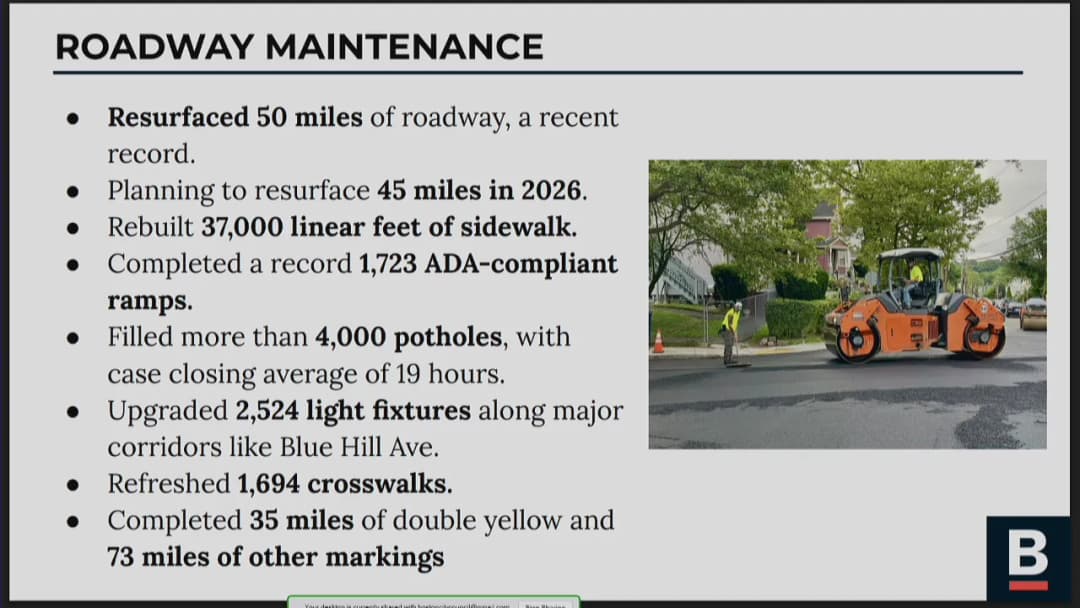
On May 8, 2026, the Boston City Council Committee on City Services held a hearing to discuss the status of addressing potholes. Chaired by Councillor Ed Flynn, the hearing included Councillor John Fitzgerald and administration officials: Chief of Streets Nick Gove, Public Works Superintendent of Street Operations Danny, and Norman Parks. The hearing examined causes of potholes, repair procedures, reporting systems, budget constraints, and safety measures. Public Comments & Testimony - No public testimony was taken during the hearing. Written comments may be submitted to the committee email or directly to Councillor Flynn. Discussion Items - Causes and Seasonal Impact: Chief Gove explained that water infiltration is the primary cause, exacerbated by freeze-thaw cycles. This winter saw 13% more freeze-thaw cycles than the five-year average and over 60 inches of snow (more than twice the average), contributing to a challenging pothole season. - Repair Process and Performance: The Public Works Department uses hot asphalt collected daily from Hyde Park. Crews prioritize 311 requests and also fill unreported potholes in the area. Average resolution time is 18 hours, with over two-thirds of cases completed within 24 hours. In 2026, 74% of pothole cases have been closed by district crews, with the remainder referred to utility companies or planned for resurfacing. - Milling and Resurfacing: Councillor Fitzgerald questioned the timeline between milling and repaving. Officials noted that the process involves three phases (milling, casting reset, overlay) and can take longer on streets with many utility castings. Work on Congress and State Streets was highlighted, with paving expected to begin shortly for the summer events. - Utility Coordination and Reimbursement: The city works with utility companies to maintain their infrastructure. Regarding vehicle damage from milled roads, Chief Gove explained that reimbursement requests are handled case-by-case through the City Clerk's office, and proper signage indemnifies the city. Councillor Fitzgerald shared a personal experience of denied reimbursement, and officials reiterated the importance of slowing down in construction zones. - Budget and Materials: Councillor Fitzgerald raised concerns about last year's budget shortfall for cold patch asphalt. Officials confirmed that they ran out of funding for cold patch, which is more expensive than hot mix. For FY27, they expressed confidence in sufficient funding for the pavement maintenance program, including pothole repairs. - Infrastructure Improvements: Discussion included the federal decree for ADA ramps, coordination with Boston Water and Sewer on water main breaks, and future resurfacing plans for streets like Dorchester Avenue, Washington Street, and Beach Street in Chinatown. Chief Gove mentioned a forthcoming planning effort for sidewalk upgrades in Chinatown. - Safety for Workers: Councillor Flynn emphasized worker safety, noting the high temperature of asphalt and the need for motorists to slow down and move over for repair crews. Officials outlined safety gear and protocols, including high-visibility clothing and traffic management plans. Key Outcomes - The chair, Councillor Flynn, stated that the hearing will be kept open and revisited in approximately six months to review progress. - No formal votes or decisions were taken; the hearing was informational. - Written testimony may be submitted to the committee for inclusion in the record.

ENGINEERING AND INFRASTRUCTURE 96% · FISCAL SUSTAINABILITY 3% · PUBLIC SAFETY 1%
125
MAY 7, 2026 · BOSTON, MASSACHUSETTS · CITY COUNCIL
Boston City Council FY2027 Budget Hearing on BPD Overtime, Details, and Mental Health – May 7, 2026

On May 7, 2026, at 2:15 PM, the Boston City Council Committee on Ways and Means, chaired by Councillor Ben Weber (District 6), held a hearing on Docket 0733-0740, the FY2027 operating budget for the Boston Police Department. The hearing focused on overtime, the detail system, officer mental health, and diversity in recruiting. Panelists included Commissioner Michael Cox, Superintendent John Brown (Bureau of Field Services), Superintendent Paul McLaughlin (Bureau of Investigative Services), and Superintendent Lenita Kulinin (Bureau of Intelligence and Analysis). Councillors Flynn, Fitzgerald, Murphy, Pepin, Durkin, Louie Jen, Santana, Braden, and Culpepper participated. Public Comments & Testimony - Lawrence Brown (South End, representing black and brown areas) criticized police presence as intimidating, questioned community policing, and noted that no black or brown security companies were considered for the flagger program. He also referenced the Stevenson King case. - John Smith St. Seer (Boston resident) argued that the hearing was not a budget conversation, citing whistleblower Marcus Eddings' lawsuit identifying 43 officers involved in 693 paid detail fraud violations. He stated that BPD spent $112 million on overtime in FY24 and $97 million in FY25, far exceeding budgeted amounts, and called for reallocating $20 million to community programs. - Wes Ward (Mattapan) criticized cuts to youth jobs while police overtime is funded, stating that funding police over prevention creates a "subsidized occupation force" in black and brown neighborhoods. - Sakani Rollins (District 4) said Boston is not broke but chooses to spend nearly half a billion on policing, and called for rejecting any police budget increase and restoring cuts to youth jobs, housing, food access, and elder services. - Sean Nelson criticized police overtime, saying officers sit idle, and called for cutting council pay and the mayor's raise. - Kate Crockford (online) detailed that BPD spent over $100 million on overtime in FY24 and FY25, more than every other city department combined. She noted the mass and cast operation costs tens of millions and two-thirds of its drug arrests are for simple possession. She called for an independent staffing study, a cost-benefit analysis of mass and cast enforcement, and reducing police responses to non-violent 911 calls. - Sam Pierce praised CSOs and requested more funding for them, and noted a backlog in homicide investigations (e.g., Glenn Ingram case from 2024). - Janaya, Samai, Genesis, Joaquin Atala Gutierrez, George Lee, Osika, and Priscilla Flint (all youth or community members) opposed police budget increases and cuts to youth jobs, housing, and other services. They urged the council to reject the budget and prioritize youth employment and community needs. Discussion Items - Officer Mental Health and Wellness: Commissioner Cox described a new wellness app, peer support unit, and a contract provision allowing 30 minutes of daily wellness time (e.g., fitness, meditation). Councillor Flynn advocated for longer wellness time and stressed supporting families. Councillor Braden asked about support after critical incidents; the commissioner noted peer support and access to mental health professionals. - Overtime Reduction: The commissioner stated overtime has decreased for the third consecutive year, driven by reimagining staffing for events like the marathon and St. Patrick's Day. The St. Patrick's Day parade alone required 11,826 overtime hours at a cost of roughly $993,000. Mass and cast remains the largest single overtime source, projected at 130,000 hours in FY27. Councillor Weber asked about reclassifying mass and cast as regular duty; the commissioner said it is being coded as a special event for tracking but is now treated as tour of duty. - Detail System and Civilian Flaggers: Superintendent McLaughlin explained that paid details are funded by private vendors, with the city collecting a 10% admin fee (capped by state law). Collection rates are 98% in FY25 and 82% to date in FY26. The civilian flagger program is delayed due to technology customization; user acceptance testing is expected next week, with implementation around end of August/beginning of September 2026. Councillor Louie Jen asked about the delay; the commissioner noted that other public safety agencies and retirees will have priority before civilians, and that the system is customized to Boston's union contracts. - Staffing Minimums: The commissioner explained that minimum staffing levels vary by time, season, and intelligence, and are not a fixed number. Councillor Louie Jen requested a snapshot of past minimums; the commissioner agreed to try to provide data. - Diversity and Recruiting: The commissioner noted the cadet program (28 cadets currently) and outreach efforts including at Celtics games. Councillor Culpepper asked about the impact of the dissolution of the Garretty consent decree on minority hiring; the commissioner said they will provide data. - Court Overtime: Superintendent McLaughlin stated that court overtime represents 6.9% of total overtime costs. Officers called in on their day off receive a four-hour minimum, even if the court appearance is brief. Councillor Fitzgerald asked about injured officers; the commissioner described the occupational health program and the accidental disability retirement process. - Traffic Enforcement and School Bus Stop Signs: Councillor Pepin inquired about civilian traffic controllers and school bus stop sign enforcement. The commissioner said the department will review and participate if an ordinance is passed. Councillor Durkin raised road race details and reimbursable overtime. - Youth Jobs and Public Safety: Commissioner Cox acknowledged a correlation between youth jobs and reduced crime, noting that the city's investment in summer jobs has coincided with lower youth crime rates. - Other Topics: Councillor Culpepper asked about AI in cold cases (not currently used), ghost guns (54 privately manufactured firearms recovered), and the Flock camera program (not in use). Councillor Fitzgerald asked about elderly scams; the commissioner described ongoing education efforts. Councillor Santana asked about the 10% admin fee on details (state law caps it). Key Outcomes - No votes were taken; the hearing was one in a series on the FY2027 budget. - The council requested additional data: overtime spending by category, minimum staffing level snapshots, minority hiring trends since the dissolution of the Garretty consent decree, and details on court overtime hours vs. hours paid. - Public testimony consistently opposed police budget increases and called for restoration of funds for youth jobs, housing, and other community services. Multiple speakers urged the council to reject the mayor's proposed budget. - The hearing adjourned with no set date for follow-up, though the chair noted a public listening session on May 26, 2026.

PUBLIC SAFETY 41% · FISCAL SUSTAINABILITY 15% · PERSONNEL MATTERS 11% · YOUTH PROGRAMS 10%
126
MAY 7, 2026 · BOSTON, MASSACHUSETTS · CITY COUNCIL
Boston Council Budget Hearing on BPD FY27 – May 7, 2026

The Boston City Council Committee on Ways and Means, chaired by Councillor Ben Weber, held a morning hearing on May 7, 2026, to review the FY27 operating budget for the Boston Police Department (BPD). The hearing covered topics including mental health and substance abuse response, community policing, firearms, homicides, crime lab operations, and intelligence. A second hearing on overtime, details, officer mental health, and diversity recruiting was scheduled for the afternoon. Commissioner Michael Cox and his leadership team presented the proposed $431 million personnel services budget (up from $427 million in FY26, primarily due to collective bargaining increases) and an 11% operating budget. Public testimony raised concerns about overtime overspending, surveillance technology oversight, and the displacement of the homelessness/addiction crisis from Mass and Cass to neighborhoods like Nubian Square. Councillors pressed for expanded community policing, increased staffing, and better coordination with mental health and addiction services. Public Comments & Testimony - Gregory Maynard (Boston Policy Institute) stated that BPD has consistently overspent its overtime budget by tens of millions of dollars (77% to 154% in recent years) and argued that the FY27 overtime budget of $55 million is grossly inaccurate, contributing to the city's first deficit since the Great Recession. He called for better budgeting and management. - Kate Crockford (ACLU of Massachusetts) noted that BPD has been responsive but not timely on compliance with the surveillance technology oversight ordinance, and called for annual surveillance reports to be released sooner. She also requested more precise location data in arrest records and questioned whether spending on overtime to arrest people in crisis is effective compared to investing in housing and healthcare. - Antonia Edwards (Roxbury resident) testified that conditions in Nubian Square have become unbearable due to the spillover from Mass and Cass, with open drug use, defecation, and unsafe sidewalks. She said seniors and businesses are terrified, and that BPD's positive reports about Nubian Square do not match reality. She urged the Commissioner to walk through the area day and night. - Aja Jackson (Roxbury resident) echoed that the crisis has been displaced, not solved, and that cuts to youth programming and prevention are harming neighborhoods. She called for real investment in mental health, violence prevention, and safe parks instead of performative safety measures. - Clifton Braithwaite (statesman) raised concerns about runaway youth being harbored in houses with older men, sex offenders, and families being criminalized for disciplining children. He asked for a meeting with BPD to address these issues. Discussion Items - Community Policing and Nubian Square (Councillor Culpepper, Fitzgerald, Louie Jen, others): Councillor Culpepper expressed that BPD's community policing model in B2 (Roxbury) is not as strong as in B4 (South End), with businesses reporting they are told to call 911 rather than seeing officers on the street. Commissioner Cox defended the work of Captain Mamoney and said they are hearing positive feedback, but agreed to walk through Nubian Square with the Councillor. Councillor Fitzgerald highlighted that the NES (Nuisance Enforcement and Support) team and CRT (Coordinated Response Team) have been effective in Mass and Cass and must be expanded citywide. He noted that overtime at Mass and Cass is down 22% in hours (as of May 4, 2026). Superintendent Brown reported the NES team has 1 lieutenant, 1 sergeant, and 14 officers, and is working to train other officers. - Staffing and Vacancies (Councillors Flynn, Louie Jen, Weber): Commissioner Cox reported 2,102 sworn officers plus 132 recruits (total 2,234), with 153 sworn vacancies and 94 civilian vacancies. Retirements are averaging 95–100 per year. Councillor Flynn advocated for hiring 300 officers annually for the next 10 years. Chair Weber questioned why new positions are added when vacancies exist; Chief O'Brien explained that vacancies are prioritized (e.g., 911) and new positions fill critical needs. The FY27 personnel increase is due to collective bargaining raises (2%). Attrition in the current academy class is 14% (152 started, 131 remain). - Crime Lab and Firearms (Councillor Flynn): Councillor Flynn questioned the leadership structure after a period of transitional management. Commissioner Cox pushed back, stating that the current leadership under Sergeant Detective Jefferson, Kevin Larrad, and others is strong and nationally accredited. On ghost guns, Superintendent McLaughlin said BPD works closely with ATF on investigations and recently conducted a significant operation to recover parts. - Mental Health and Crisis Response (Councillors Murphy, Braden, Fitzgerald): BPD partners with Youth Connect and BEST clinicians. The CIT (Crisis Intervention Team) program has trained over 300 officers, and a new ICAT training will improve tactical decisions. Superintendent Brown noted that CIT teams have shrunk due to staffing, but the NES philosophy is being spread to all districts. Commissioner Cox emphasized that de-escalation is a priority, but many encounters are unpredictable. - Surveillance Technology Ordinance (Councillors Durkin, Santana, Louie Jen): Councillor Durkin noted that BPD did not seek City Council approval before implementing a surveillance technology, citing exigent circumstances. Commissioner Cox apologized for any non-compliance and committed to meeting the ordinance's deadlines. Councillor Santana, as Public Safety Chair, will continue oversight. - Cold Cases and Homicides (Councillor Santana): Superintendent McLaughlin explained that active squads revisit unsolved cases, and a cold case squad triages cases with new DNA/forensic genealogy technology. A website lists cases back to 1965. Councillor Weber noted a loss of external funding for a cold case project, which Chief O'Brien said she would look into. - FIFA and Human Trafficking (Councillors Murphy, Flynn): BPD has been working on plans since last year to address anticipated increases in prostitution and human trafficking during FIFA. They are coordinating with the Family Justice Center, FBI, and hotels. Superintendent McLaughlin said a network is ready for demand reduction and incident response. - BRIC and Intelligence (Councillor Louie Jen): The Bureau of Intelligence and Analysis (BRIC) has a $4.18 million operating budget funding 33 city positions and 16.5 grant-funded positions. Partner agencies (FBI, DHS, Boston Fire, EMS) also sit in the BRIC. - Diversity and Promotions (Councillors Pipin, Weber): Of recent promotions, 40% of new captains were women (2 out of 5), 25% of lieutenants were people of color, and 31% of sergeants were people of color. Commissioner Cox stressed that diversity starts with recruiting a diverse patrol force. Key Outcomes - Mass and Cass Overtime: Hours are down 22% compared to the same period last year (43 weeks into FY26 vs FY25). The reduction is attributed to intentional operational changes and the NES/CRT strategy. - Commitment to Nubian Square: Commissioner Cox agreed to walk through Nubian Square with Councillor Culpepper (date to be scheduled, not May 22). Superintendent Brown will attend the emergency community meeting at the Urban League that evening. - Surveillance Compliance: BPD will prioritize timely reporting to the City Council under the surveillance ordinance. - Cold Case Funding: Chair Weber noted a missing $150,000 external grant for the cold case project; Chief O'Brien will investigate. - Future Budget Amendments: Councillor Fitzgerald indicated he will file an amendment to increase funding for the Coordinated Response Team (CRT) to expand citywide. - Staffing: BPD will continue hiring classes of about 150 recruits twice a year. Councillor Flynn plans to advocate for 300 annual hires. The academy attrition rate has improved to 14%. - Next Steps: The afternoon hearing (2:00 PM) will cover overtime, the detail system, officer mental health, and diversity recruiting. Public testimony will be taken after the first round of council questions.

PUBLIC SAFETY 44% · PERSONNEL MATTERS 16% · COMMUNITY ENGAGEMENT 13% · MENTAL HEALTH AWARENESS 8%
127
MAY 7, 2026 · BOSTON, MASSACHUSETTS · CITY COUNCIL
Public Improvement Commission Hearing - May 7, 2026

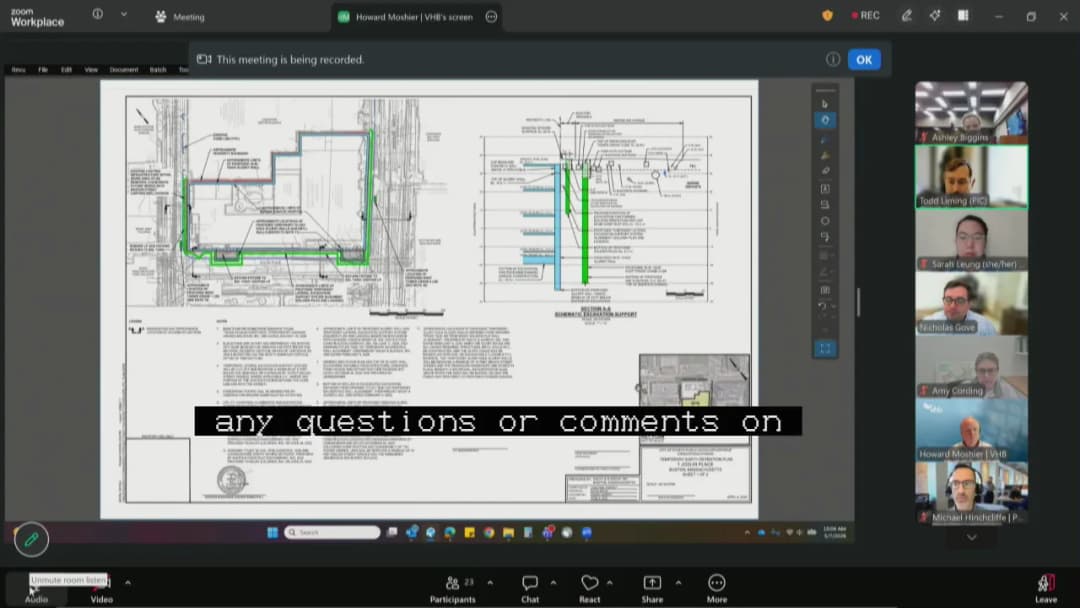
Meeting of the Boston Public Improvement Commission on May 7, 2026, chaired by Interim Chief of Streets McGove. The commission approved three joint petitions from Dana-Farber Cancer Institute and Beth Israel Deaconess Medical Center for temporary earth retention and utility licenses in Roxbury, and heard a new business presentation on a pedestrian easement and specific repairs for a proposed mixed-use development at 3458 Washington Street. Consent Calendar - Approval of minutes from the April 23, 2026 PIC hearing. Public Hearing Items Item 1: Earth Retention License – Joint petition for a temporary earth support system on Jocelyn Place, Brookline Avenue, and Pilgrim Road. Approved unanimously. Item 2: Utility License (Storm Drain) – Joint petition for installation of storm drain infrastructure on Pilgrim Road. Approved unanimously. Item 3: Utility License (Electric) – Joint petition for a temporary electric duct bank on Jocelyn Place and Deaconess Road. Approved unanimously. Discussion Items New Business: 3458 Washington Street – Presentation by Maddie Wynchard of Harristein Hudson on behalf of Washington 3458 LLC. The project proposes a five-story mixed-use building with 36 residential units, ground-floor retail, and seven surface parking spaces accessed from Kenton Road. Specific repairs include sidewalk widening, permeable pavers, street trees, bike racks, bench installation, closure of driveway curb cuts, and reconstruction of a pedestrian ramp. A pedestrian easement is requested on Washington Street (8-foot clear path) and Kenton Road (6-foot clear path) with portions of the building above extending within the easement area (minimum 10-foot vertical clearance). The commission discussed the ramp reconstruction and requested a design sketch. The proponent agreed to work with city staff and will return with updated plans. Key Outcomes - Three public hearing items approved unanimously. - New business item deferred pending updates to the pedestrian easement plan and ramp design.

ENGINEERING AND INFRASTRUCTURE 97% · PROCEDURAL 3%
128
MAY 6, 2026 · BOSTON, MASSACHUSETTS · CITY COUNCIL
Boston City Council Regular Meeting Summary - May 6, 2026

The Boston City Council held a regular meeting on May 6, 2026, at 12:12 PM in the Christopher Iannella Chamber. The meeting included approval of minutes, referral of numerous orders, passage of resolutions, and a detailed update on the FY27 budget process. Key actions included unanimous passage of grants for gravestone conservation, landmark designation for Memorial Hall, adoption of resolutions supporting veterans' services, asthma awareness, George Greenidge Day, and a commission to retain young adults, as well as referral of several hearing orders. Consent Calendar - Approval of the April 29, 2026 meeting minutes. - Adoption of the consent agenda containing 22 resolutions recognizing individuals and organizations, including MissionSAFE, Kayla Clouden-McGill, Boston firefighters, Scout Troop 1, and others. Public Comments & Testimony - No public comments were made during the regular council meeting. However, the Committee on Ways and Means reported receiving over two hours of public testimony on the arts budget and approximately 100 youth testified on the youth jobs program during budget hearings earlier in the week. Discussion Items - Section 17F Requests: Councilor Murphy moved to suspend the regular order to address overdue information requests from the administration. After discussion, the motion was withdrawn after President Breadon stated the administration is working on responses. - FY27 Budget Update: Councilor Weber, Chair of Ways and Means, provided a detailed update on budget hearings held that week, covering cuts to various departments, including a 14% cut ($724,000) to the Office of Veterans' Services, proposed cuts to youth employment programs, and the status of the capital budget. She recommended that the budget dockets (0733-0754) remain in committee. - Veterans' Services Funding: Councilors Flynn and Murphy filed a hearing order (0930) and a resolution (0931) to restore the $724,000 cut to the Veterans' Services budget. Debate ensued on the appropriateness of using a resolution during the budget process. Councilor Weber expressed concern about bypassing the budget amendment process but supported the resolution. Councilor Durkan noted that grant cuts were citywide. The resolution was adopted 11-0-1 (Councilor Durkan present). - Social Media Litigation: Councilor Culpepper and Mejia filed a hearing order (0936) and a resolution (0937) urging Boston Public Schools to join nationwide litigation against social media companies for youth mental health impacts. The resolution was adopted 11-0-1 (Councilor Santana not present). - Other Hearing Orders: The council referred orders for hearings on: - Boston City Council rules review (0929) - Discounts for seniors and disabled by Boston Water and Sewer Commission (0932) - Notice and equity in siting transitional housing (0933) - Impact of proposed HUD immigration eligibility requirements on subsidized housing (0934) - Boston's implementation of marijuana regulations (0935) - BPS participation in social media litigation (0936) - Resolutions Adopted: - Resolution recognizing May as Asthma Awareness Month (0938) – adopted 12-0. - Resolution recognizing May 11th as George Greenidge Day (0939) – adopted by voice vote. - Resolution supporting establishment of a committee to maintain and attract young adults to Boston (0940) – adopted 12-0. - Resolution recognizing May as National Preservation Month in the Landmarks Commission's 50th year (0941) – adopted. Key Outcomes - Dockets 0917 and 0918 (gravestone conservation grants for Dorchester North Burying Ground) were passed unanimously (12-0). - Docket 0928 (Memorial Hall landmark designation in Charlestown) was adopted unanimously (12-0). - Docket 0931 (Resolution urging full funding of the Office of Veterans' Services) was adopted 11-0-1. - Docket 0937 (Resolution calling on Boston Public Schools to join nationwide social media litigation) was adopted 11-0-1. - Dockets 0938, 0939, 0940, 0941 were adopted as noted. - Personnel orders for temporary employees Melvin Brown and Matthew Arnold were passed. - Consent agenda adopted. - Memorials were read and the council adjourned at 3:17 PM in memory of 11 individuals, including Anne M. Galvin, James H. Coveney Jr., and State Trooper Kevin Trainor.

PROCEDURAL 26% · MISCELLANEOUS 15% · VETERANS SERVICES 11% · HISTORIC PRESERVATION 6%
129
MAY 6, 2026 · BOSTON, MASSACHUSETTS · CITY COUNCIL
FY27 Planning Department Budget Hearing - Boston City Council Ways and Means - May 6, 2026

On May 6, 2026, the Boston City Council Ways and Means Committee, chaired by Councillor Ben Weber, held a hearing to review the Fiscal Year 2027 operating budget for the Planning Department (Docket 0733-0740). The hearing began at 10:00 AM and was live-streamed. The panel included Chief of Planning Kyro Shan, Deputy Chief Devin Quirk, and Executive Director Teresa Paulinas. The budget is proposed at $29.4 million, slightly lower than the previous year. The discussion covered the department's mission, achievements, and challenges, followed by questions from councillors and public testimony. Public Comments & Testimony - Gregory Maynard (Co-founder and Executive Director, Boston Policy Institute): Criticized the Planning Department as a "set of half-done reforms," stating that the creation of the department lacked a proper study and that the department has failed to accomplish key zoning and process changes, particularly regarding accessory dwelling units (ADUs). He argued that the lack of follow-through is damaging development and the city's budget, and that Boston is the only city in Massachusetts not allowing ADUs as of right despite a state law passed in August 2024. - Marjorie Skillman: Raised concerns about the city's hiring demographics, particularly for people of color, and requested the department provide workforce demographic data. She also expressed frustration with the lack of community engagement in hiring practices. - Clifton Braithwaite: Spoke as a private citizen seeking help to save his family property, citing deception and betrayal. He asked for assistance in navigating the system and protecting his legacy. Discussion Items - Presentation by Chief Kyro Shan: Outlined the department's mission to transform planning and development culture, focusing on affordability, equity, and resilience. Key accomplishments included adopted plans (Harvard Enterprise Research Campus, Downtown Zoning, Chinatown Zoning), ongoing work on Squares and Streets (Cleary Square, Fields Corner), the Allston-Brighton Community Plan, and a citywide needs assessment. He highlighted the new Planning Academy to educate citizens on planning processes. - Presentation by Deputy Chief Devin Quirk: Reported on the real estate market: in the last year, the BPDA approved 63 new projects and 21 alterations, totaling 3,809 housing units (35% income-restricted), 6.3 million square feet of development, and $4.8 billion in investment. Since 2023, nearly 20,000 housing units have been approved. He discussed the Office-to-Residential Conversion program (24 projects, 1,730 units), the Housing Accelerator Fund ($110 million), and real estate projects including the Chinatown library, Nubian Square residences, and climate resilience infrastructure (deployable seawalls). - Budget Overview by Teresa Paulinas: The FY27 budget is $29.4 million, a decrease from the previous year due to reductions in contractual services, software, and equipment, while protecting personnel costs. - Councillor Questions and Responses: - Councillor Flynn: Asked about flexibility in the Inclusionary Development Policy (IDP) and concerns about rent control ballot initiative affecting investment. Chief Shan noted flexibility in IDP compliance and that long-term developers remain committed to Boston. - Councillor Fitzgerald: Questioned budget cuts and whether the department could help other city departments. Chief Shan explained the department cannot transfer funds but emphasized the importance of continued planning work. Discussion on neighborhood character versus growth, with Chief Shan advocating for balanced conversations. - Councillor Durkin: Pressed on eliminating parking minimums and reducing regulatory barriers. Chief Shan said the city will eventually eliminate parking minimums but with community input. Councillor Durkin expressed disagreement, citing data and staff support. - Councillor Murphy: Raised concerns about abutters’ rights in Article 80 reform and displacement of immigrant businesses in Roslindale. Chief Shan defended the process, noting broader community engagement. Also discussed ADUs and neighborhood housing zoning reform. - Councillor Cole Pepper: Focused on anti-displacement measures, specifically in Roxbury. Chief Shan and Devin Quirk explained the anti-displacement action plan, which requires early disclosure of development impacts and coordination with tenants. Discussed Nubian Square projects, including the Nuba residences and the former police station development. - Councillor Pepin: Thanked staff for work on Squares and Streets, asked about commercial displacement protections, and coordination with the transportation department. Chief Shan confirmed interdepartmental collaboration and noted the challenges of market cycles. - Councillor Braden: Asked about the Allston-Brighton Community Plan cost and timeline, the Planning Advisory Council budget cut (38%), and the Western Ave Transit Way study. Chief Shan explained the plan is ongoing with community input, and the Planning Advisory Council functions are being integrated into the department. He acknowledged the need to address the transit way study. - Councillor Coletta Zapata (questions read by Chair): Inquired about revenues from Charlestown Navy Yard, variance guidance in East Boston, net-zero carbon zoning, and Article 80 outreach to immigrant communities. The panel committed to providing data on these topics. - Chair Weber: Asked about linkage fees, budget mechanics (transfer from BPDA), and position counts. The panel clarified that the $46 million transfer includes centrally budgeted benefits, and there are 192 active employees with 44 vacancies. - Councillor Flynn (second round): Commended the panel for honest answers, discussed Flynn Marine Park status and cruise tourism. Devin Quirk highlighted ongoing developments and challenges. - Councillor Fitzgerald (second round): Discussed the role of planners in pre-file meetings and community engagement, cautioning against planners dictating project designs. Chief Shan emphasized the department's role as mediators, not proponents. - Councillor Durkin (second round): Asked about the public land audit and contracts. The panel clarified that the audit is available online and that contracts for capital projects are separate from the operating transfer. - Councillor Murphy (second round): Raised concerns about young families leaving the city and the affordability of new units. Chief Shan discussed incremental planning and the need for comprehensive approaches including jobs. - Councillor Cole Pepper (second round): Discussed Nubian Square as a starting point for Roxbury development, asking about the pipeline and connection to the strategic master plan. Devin Quirk noted upcoming groundbreaking and the need for tenant recruitment. Also discussed Black Market and IDP. - Councillor Worrell: Asked about tracking where residents move, neighborhood visions, and the role of the Boston Interagency Fair Housing Council (BIFTC). The panel discussed data limitations and the importance of community planning. - Councillor Fitzgerald (third round): Asked about Article 80 modernization implementation. Chief Shan described new templates and staff coordination structures. Also asked about Fields Corner Squares and Streets status (not yet started). - Councillor Cole Pepper (third round): Raised historical harm in Roxbury and asked how the department accounts for it. Chief Shan noted efforts to diversify development teams and partner with community organizations. Also discussed Richard Taylor's Nubian Square project and the need for a tenant (e.g., Dana-Farber). - Councillor Worrell (second round): Asked about homeownership vs. rental, tax value, and parking minimums. The panel explained they do not regulate tenure on private land but promote homeownership on public land. Parking removal is often to reduce costs and increase capacity, but not applied uniformly. Key Outcomes - No formal votes were taken. The hearing was informational as part of the FY27 budget review process. - The panel committed to providing additional data requested by councillors, including: breakdown of linkage fees by neighborhood, demographics of the workforce, vacancy data, details on the Allston-Brighton Community Plan costs, and information on Article 80 outreach to immigrant communities. - The department will continue to work on neighborhood housing zoning reform, with a mailing to 17,000 homeowners in the coming month. - The department will follow up on Councillor Cole Pepper's request to engage Dana-Farber Cancer Institute as a potential tenant in Nubian Square. - The hearing concluded with a promise to revisit the department's work in future meetings.

ECONOMIC DEVELOPMENT 21% · COMMUNITY ENGAGEMENT 19% · AFFORDABLE HOUSING 17% · ENGINEERING AND INFRASTRUCTURE 14%
130
MAY 6, 2026 · BOSTON, MASSACHUSETTS · CITY COUNCIL
Boston School Committee Meeting - May 6, 2026

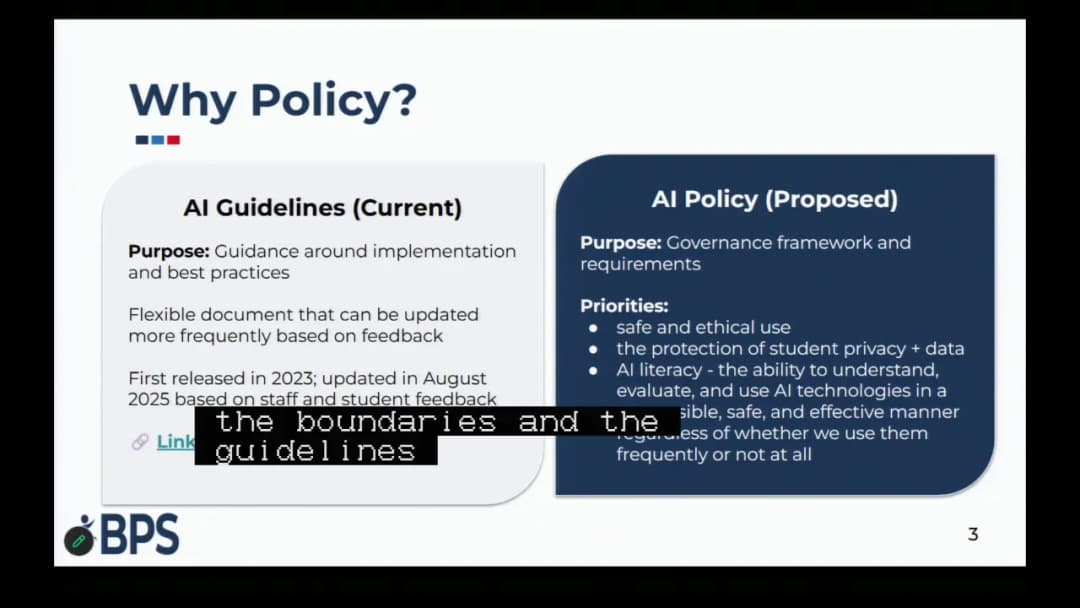
The Boston School Committee met on May 6, 2026, at the Bruce C. Bolling Building. The meeting opened with recognition of BSAC graduating seniors, followed by a hearing on the Massachusetts School Choice Program, a superintendent's report, a BSAC update, public testimony, and action on grants, the school choice vote, a supplemental appropriation, and reports on the FY27 interim salary, Dudley Street charter renewal, and the proposed AI policy. The committee approved the school choice non-participation (6-0-1), the supplemental appropriation (6-0-1), and the grants unanimously. The meeting also included extensive public comment on AI, schoolyard safety, equity, and other topics. Consent Calendar - The minutes of the April 15 meeting were approved by unanimous consent. Public Comments & Testimony - John Mudd (Cambridge resident, grandparent of JFK Elementary student) urged the committee to prioritize SMART goals for achievement gaps, educator diversity, and bilingual education for multilingual learners, noting a contradiction between the inclusive education and bilingual education goals in the strategic roadmap. He advocated for explicit targets in the fall implementation plan. - Ginger Brown (Dorchester parent, JFK Family Council co-chair) advocated for schoolyard improvements at JFK Elementary, citing safety hazards from the geothermal project, including damaged blacktop, exposed mulch with needles, and a compromised chain-link fence. She urged the city to secure funding for safe playground surfaces. - Laura Lara Soto (Sociedad Latina youth leader) testified about AI concerns, stating that teachers are not directly involved in learning, leading to student demotivation and overreliance on AI, which hinders development of critical thinking. She advocated for modifications to BPS AI use. - Kenneth Francisco (student) shared a personal experience where an AI detection tool falsely flagged his essay as AI-generated, resulting in a zero until he proved authorship. He warned against using AI detectors alone to assess student work. - Julia Morales (Sociedad Latina) proposed creation of a Technology Advisory Committee (TAC) with formal recommending authority, including parent, student, educator, and IEP representation, to oversee device policies, AI tools, and transparency. - Robert Jenkins (Roslindale parent) urged the district to apply critical scrutiny to ed tech investments, noting that human relationships between staff and students are fundamental and that budget cuts should not replace personal connection with technology. He also raised concerns about staggered lottery timelines for BPS sixth graders. - Travis Marshall (Roslindale parent) echoed similar concerns about budget cuts and the importance of support staff roles. - Joanne Freeman (Citywide Parent Council) requested that the district maintain designated family liaisons, translation support, district-wide promotion of CPC meetings, consistent liaison contact updates, and quarterly meetings with the superintendent. - Edith Bazile (SPEDPAC Chair) expressed concern about the district's move away from authentic family engagement, citing deep cuts to family and community engagement staff. She requested a scheduled joint meeting with parent organizations and a second required presentation to the school committee before year-end. - Deirdre Manning (Dorchester parent) criticized the exam school admission policy, stating that Tier 3 and Tier 4 students continue to have inequitable access, with a cutoff above 96 at BLS for Tier 4. She urged equitable access and consistent GPA treatment for all city students. Discussion Items Superintendent's Report Superintendent Mary Skipper reported on visits and key metrics: - Transportation on-time performance (OTP): Morning OTP averaged 93% in March and 94% in April; afternoon OTP averaged 88% in March and 89% in April—the highest on record for April. Uncovered morning routes declined from 0.9% in March to 0.6% in April. - FAFSA completion: 2,060 seniors (53%) completed the FAFSA as of April, an 11 percentage point increase from 42% the prior year. - Cell phone policy: Ongoing community engagement; awaiting state guidance from DESE. - Recognitions: EdVestors showcase, It's My Night prom event (400+ students from 19 schools), and Tech Boston athlete Edgar for the NFHS Spirit of Sport Award. - Member Torres noted the increase in FAFSA completion and asked about crosswalking those numbers with enrollment. Chair Robinson highlighted the Boston Opportunity Agenda report showing kindergarten readiness improvements. The superintendent committed to sharing the report. The superintendent reported she would leave early due to a family emergency but would rejoin virtually. BSAC End-of-Year Update Student Representative Mahnoor (Brian High junior) and Director Denise Rory presented: - BSAC had 38 active members from 21 BPS high schools. - Focus on youth-led professional developments for adult allies, addressing themes like building relationships and bridging disconnect. - Advocacy efforts: testimony at City Hall to restore proposed cuts to school year jobs (a proposed $6 million reduction affecting 1,800 positions). Students received paid positions through Success Link, filling 38 of 40 slots. - BSAC representatives contributed to district strategic plan, AI policy, and multilingual education strategic plan. - Upcoming showcase on May 7. - Members discussed the importance of teacher emotional intelligence, and students emphasized the need for non-college career pathways (trade school, cosmetology). Grants for Approval ($1,455,426) - Continuing electric bus rebate: $1.1 million for school year 2026–2027 to support bus fleet electrification. - Special Olympics Massachusetts Unified Champions School Grant: $150,000 (competitive, continuing) serving 800–1,200 students district-wide. - Kendall Foundation New England Food System Grant: $150,000 (competitive) for farm-to-school program development. - Questions: The rebate reimburses the cost of electric buses (approximately 3x diesel); does not affect operating budget. The farm-to-school grant includes culturally representative foods. The Special Olympics grant will have a new outcomes reporting structure in fall. - Approved unanimously. Massachusetts School Choice Program Vote - The committee voted to withdraw from the school choice program for 2026–2027 (6 yes, 1 abstention from Member Tran). - The superintendent recommended continued non-participation to ensure Boston residents have priority access. The surrounding communities (Brookline, Dedham, Needham, Milton, Somerville, Revere) also do not participate. - The district will explore alternative avenues, including collective bargaining agreements that allow non-resident staff children to attend, with guardrails. A community engagement process and data analysis will be conducted, with updates in fall. - Discussion: The financial impact per student is variable; the state cap of $5,000 per pupil is below BPS average per-pupil cost. Options for pilots at specific grade levels versus staff-specific programs were debated. Fiscal Year 2026 Supplemental Appropriation Request ($22,845,672) - The district is facing a projected $28 million deficit due to high health insurance premiums and utility costs. The request covers $22.8 million in health insurance and utility overages. The remaining $5.5 million will be managed through spending controls and grant funding. - The committee approved the request (6 yes, 1 abstention from Member Peralta, who needed more time to review). The matter now goes to the Boston City Council. - Discussion: The FY27 budget had adjusted for health insurance increases; FY26 did not, requiring this mid-year supplement. Future updates will be provided in October. FY27 Interim Salary and Non-Personnel Payments on External Funds - An annual request to authorize interim payments on grants (e.g., Title I $40M, circuit breaker) while awaiting formal awards. This allows hiring staff for the school year start. Committee will vote on this at the June 10 meeting. - Questions focused on unspent Title I funds, data on spending, and the adequacy of McKinney-Vento funds ($72,000) for homeless students. Chief Bloom noted that the district spends additional millions from other sources. Title III funds ($2M) support multilingual learners. A grant outcomes report is expected in fall. Dudley Street Neighborhood Charter School Renewal Application - Principal Elijah Heckstall and Jesse Solomon (Boston Plan for Excellence) presented the renewal request. - The school has moved from Tier 4 to Tier 2 on the BPS School Quality Framework, and its accountability percentile improved from 10 to 16. Foundational literacy gains: K-2 phonological awareness increased from 54% to 83% meeting/exceeding expectations; first graders below grade level dropped from 24% to 3%. - The school serves 265–290 students, with about 50% matriculating to BPS schools and 25–30% to Commonwealth charters. The grade configuration (K-5) is misaligned with BPS's K-6 model; facilities limitations prevent adding a sixth grade. The district is working on solutions. - Teacher retention is 85–95%. The school emphasizes internal coherence, high-quality curriculum (Illustrative Math, Wilson), and embedded professional development. - The committee will vote on the charter renewal at its June 10 meeting. Proposed Artificial Intelligence Policy - Chief Technology Officer Lisa Iri and Deputy Chief Tony Beatrice presented the draft policy, developed with over 500 stakeholders (students, educators, families) through 20+ sessions. - Core values: human-centric, equity, purposeful use, safety, transparency, continuous learning. The policy establishes guardrails for data privacy, ethical use, and prohibitions (e.g., cyberbullying). Guidelines provide implementation strategies, approved tools, and use cases like the Elliott K-8 chatbot for student writing feedback. - The policy includes a student-friendly process for contesting AI detection accusations. The policy applies to both students and staff. A fall launch of AI literacy courses for grades 9–12 is planned, with training for all staff. - Discussion: Members raised concerns about bias in AI tools, screen time, equity of access, environmental footprint, and the need for community partnerships for family education. The committee will vote on the policy at a future meeting after continued feedback. Key Outcomes - Approved (unanimous): Consent agenda (minutes), grants totaling $1,455,426. - Approved (6-0-1): Withdrawal from Massachusetts School Choice Program for 2026–2027 (Member Tran abstained). - Approved (6-0-1): Fiscal Year 2026 supplemental appropriation request of $22,845,672 (Member Peralta abstained). The request will be sent to the Boston City Council. - Tabled: FY27 interim salary and non-personnel payments vote will occur at the June 10 meeting. - Tabled: Dudley Street Neighborhood Charter School renewal vote will occur at the June 10 meeting. - Tabled: AI policy vote will occur at a future meeting after additional feedback. - Upcoming Retreat: Wednesday, May 20, 2026, at 6 PM at the Bruce C. Bolling Building (open to public). - Next Regular Meeting: June 10, 2026, at 6 PM (in-person). - The superintendent committed to providing memos on student assignment timelines post-closures, HR hiring process updates, and FY27 budget monitoring dates.

PUBLIC EDUCATION 38% · TECHNOLOGY AND INNOVATION 28% · YOUTH PROGRAMS 13% · FISCAL SUSTAINABILITY 7%
OPENPUBLICA · PUBLIC MEETING INDEXUPDATED DAILY · openpublica.com