The Committee on City Services, chaired by District 2 Councilor Ed Flynn, met on Monday, September 21, 2026, to hear three dockets: two grant acceptance and expenditure orders and one in-kind gift of HVAC units. Councilor Flynn opened the hearing at 10:03 a.m. per his announcement, though the meeting record's timestamp of 15:00 UTC corresponds to 11:00 a.m. EDT; the discrepancy is noted here as it appears in the record. No public testimony was offered, and no votes were taken during the hearing. Councilor Flynn stated his intent to bring the three dockets to the full Council on Wednesday, September 23, 2026, for a formal vote. Public Comments & Testimony - No members of the public provided testimony in person or virtually, and no signed-up speakers were noted. Discussion Items Docket 1085 — El Centro Fellowship Grant ($20,930) - This is a message and order authorizing the City of Boston to accept and expend $20,930 in grant funds under the El Centro Fellowship Grant, ordered to Catholic Charities. It was referred to the committee on June 3, 2026. - Administration representatives (including Sheila and Peter) described the program's core idea: participants complete IT training and then receive on-the-job training through a fellowship with the City's IT department, with Catholic Charities' El Centro providing space and support. - The City has hired two program participants into full-time entry-level IT positions, and El Centro also helps participants who do not stay with the City find employment pathways elsewhere. - Councilor Flynn expressed appreciation for the program's important work and its results, and apologized that no other members of the public or Council were present. Docket 1395 — MBI Digital Equity Partnership Program ($225,125.11) - This is a message and order authorizing the City of Boston to accept and expend $225,125.11 under the MBI Digital Equity Partnership Program. It was referred to the committee on July 22, 2026. - Administration representatives said these digital equity projects have taken place across every Boston neighborhood, and stated they were very proud of that record. - The new round will fund free service for housing residents at the West Broadway and Archdale properties, and the administration hopes to use this exact funding source to reach at least one more property once the model is proven. - Statistics cited during the hearing: the program's outreach reaches at least 50–100 organizations, the broader network includes well over 500 organizations, recent sessions had about 70 attendees, and 85–95% of participants reported learning something new and being interested in sharing it with others. - Digital literacy office hours cover affordable internet access, résumé help, Gmail, and other basics; this past summer, the program added graphic design and coding sessions for youth and held sessions beyond City Hall, including in housing settings. - The program also supports returning citizens with devices and connectivity to aid re-entry, and works to ensure that having a device and internet access leads to positive outcomes. - Councilor Flynn asked how the program serves elderly residents with limited computer skills and limited English, particularly Mandarin-speaking seniors in Chinatown, the Leather District, and Bay Village. He also asked for more multilingual public-awareness messaging so that new internet users, especially seniors, understand that government agencies will not ask for Social Security or banking information over the telephone. - Administration representatives described translation options, coordination with the City's language and communication access office, and community-based partners who meet residents where they are to gauge what they know and what they fear, and to provide scam-prevention education such as password safety and avoiding sharing personal information over the phone. - Councilor Flynn requested the schedule of upcoming digital-equity office hours so he could attend and observe. - On public housing, administration representatives acknowledged that many Boston Housing Authority (BHA) residents earn around $20,000 per year and face infrastructure-related barriers; a connectivity project at two BHA campuses requires remediation of older-building issues before it can move forward. Docket 1397 — Gift of 43 HVAC Units ($84,210) - This is a message and order authorizing the City of Boston to accept a gift of 43 heating, ventilation, and air-conditioning (HVAC) units of various types, valued at $84,210, from FWC 2026 U.S. It was referred to the committee on July 22, 2026. - The units come in three sizes — 1 ton, 1.5 ton, and 2 ton — suitable for different-sized spaces. - A representative of the Public Facilities Department (Braden) said the donated units were not selected by the department and did not go through its specifications. No determination has been made on final distribution, and the administration has reached out to facility directors for all city departments that manage property. - Councilor Flynn noted that the previous week's hearing with the deputy superintendent covered heating and air conditioning in schools, including the three schools that still lack air conditioning. He expressed support for the donation, saying he thought the units going to Boston Public Schools would be a great addition to helping keep schools cool. Additional Informal Discussion - Administration representatives mentioned a time-sensitive internet program that was not included in today's docket. Councilor Flynn said a separate hearing might not be necessary, and that he would relay preliminary conversations to his colleagues so they are aware of the proposal in the regular course of business. Key Outcomes - No formal votes were taken during the hearing. - Councilor Flynn stated his plan to bring Dockets 1085, 1395, and 1397 forward to the Council floor on Wednesday, September 23, 2026, for a formal vote. - Flynn said he would relay that he had an important discussion with the administration's team and expressed confidence that they could proceed so the docket could get out the door. - No members of the public signed up to testify in person or virtually. - Flynn requested and expected to receive the upcoming schedules for digital-equity office hours.
Public Meetings - Boston, Massachusetts
Public Meetings - Boston, MassachusettsThe Committee on City Services, chaired by Councillor Ed Flynn (District 2), met at 10:08 AM on September 18, 2026, for a hearing on Docket 0773, an order to discuss the status of the City of Boston's curbside food waste program. The docket was sponsored by Councillors Gabriella Coletta Zapata, Sharon Durkin, and Louis Gen, and was referred to the committee on April 8, 2026. Administration officials presented on the curbside program, Project Oscar drop-off bins, the waitlist and capacity, and composting infrastructure. No votes were taken. Public Comments & Testimony - No members of the public testified. The Chair said public testimony would be taken at the end of the hearing or possibly throughout, with a two-minute limit per speaker, but no public testimony was offered. Discussion Items - Opening remarks: Councillor Coletta Zapata said Boston has made meaningful progress on food waste diversion and that the hearing was meant to examine what is working, who still lacks access, and what it will take to scale up. Councillor Durkin said she uses the curbside program herself, freezes her food scraps, and praised the Friday driver, Henri. She stressed the importance of properly sealed bins to address pest-control and public-health concerns, and called for language access and expansion to communities of color, including Chinatown, the Leather District, the South End, and public housing. - Administration presentation: Officials reported that Project Oscar, launched in 2014, provides 24/7/365 food-waste drop-off bins. About 15 to 20% of collected food waste is taken to a North Shore composting facility. The program currently has capacity beyond the existing waitlist. Officials said biweekly pickup cuts transportation in half and described freezing, secondary bins, and Project Oscar drop-off as containment options between pickups. They also discussed the difficulty of siting composting facilities near dense residential areas and the need to prepare for state regulations taking effect in 2028. - Councillor Q&A: Councillor Coletta Zapata asked about transportation changes, the 20 Project Oscar bins, bin cleanliness, contamination reports, and resident-only use of Project Oscar. Councillor Durkin asked whether the issue is density rather than coverage, whether facilities have enough capacity, and whether the city could provide centralized pickup and send food waste from different neighborhoods to different end users based on facility capacity. She also raised pest control in Chinatown and the need for targeted education. One councillor noted the Project Oscar webpage showed a bin in East Boston but none in Mattapan and questioned why the number of bins should be capped at 20. Chair Flynn noted that September 18 is POW/MIA Recognition Day and that he would briefly step out for a City Council Plaza ceremony. Key Outcomes - The hearing was informational; no votes were taken. - The administration agreed to provide a neighborhood-level breakdown of program enrollment and use. - The administration acknowledged the need to review Project Oscar bin siting/maintenance, targeted education, and infrastructure planning ahead of 2028 state rules. - An absence letter from Councillor Pepén (District 5) was read into the record.
The Boston Planning and Development Agency (BPDA) Board and the Economic Development Industrial Corporation (EDIC) Board held a joint hybrid meeting on September 17, 2026, at Boston City Hall. The meeting covered approval of multiple administrative contracts, two new housing development projects, an informational update on the city's anti-displacement plan, and a major federal grant to fund neighborhood shuttle and microtransit services. All votes were unanimous. Consent Calendar - Minutes Approval: Approved the minutes of the August 13, 2026 board meetings (both EDIC and BRA). - EDIC Engineering Contract Amendment (Birth 10): Approved amending the contract with Child's Engineering for repair design at Birth 10, increasing the contract by $49,315 plus a 10% design contingency of $4,931.50, for a total amendment of $54,246.50 and an aggregate contract amount not to exceed $189,090. - EDIC Engineering Contract Amendment (12 Channel Street): Approved amending the contract with Gale Associates for platform and canopy repairs, increasing by $25,000 plus a $2,500 contingency (total $27,500), bringing the total engineering contract to $586,365. - EDIC Trash Removal Contract Amendment: Approved amending the contract with DBI Waste Systems for trash removal in the Raymond L. Flynn Marine Park, adding $25,000 for a total contract amount of $140,008. - EDIC IFB for Trash Removal: Authorized the issuance of an invitation for bids (IFB) for trash removal services for a three-year term with two one-year renewal options, not to exceed $195,000. - EDIC IFB for HVAC Maintenance: Authorized an IFB for inspection, testing, and preventative maintenance of HVAC systems at 12 Channel Street for three years with two one-year options, not to exceed $255,000. - EDIC Workforce Training Contract: Approved a six-month, $130,000 contract with the Peterson School to deliver instruction in HVAC, commercial refrigeration, and construction math for the Power Corps Boston Building Operations Training Program, targeting 18-30 year old Boston residents for green careers. - Personnel Actions (EDIC): Approved a new IT contract hire (Zachary Gagney), an urban design internship (Sheeta Gorla), and accepted a resignation in the research division (Emily Correst). - BRA Parcel Extension (P-12C): Approved a 12-month extension (to September 30, 2027) of the tentative designation for the joint venture between Asian Community Development Corporation and Community Builders Inc. as redeveloper of Parcel P-12C at 290 Tremont Street, Chinatown, for a proposed 111 affordable rental units. - BRA Charlestown Peace Park Transfer: Authorized conveyance of the parcel known as Charlestown Peace Park to the Boston Parks and Recreation Department for $1. - BRA Shipyard Park RFP: Authorized issuance of a request for proposals for landscape and engineering design services for repairs at Shipyard Park in the Charlestown Navy Yard, with a design budget of $150,000 and construction budget of $850,000. - BRA China Trade Center Roof Replacement IFB: Authorized an IFB for construction of the roof replacement at the China Trade Center (2 Boylston Street), with a budget of $1.5 million. - BRA Certificate of Completion: Issued a certificate of completion for the 1003-1013 Harrison Avenue project (Benjamin Franklin Cummings Institute of Technology). - BRA Allston Green Mitigation Payment Schedule: Approved an amended cooperation agreement to adjust the payment schedule for mitigation and public benefits funds (originally $135,000 due at building permit) to two installments of $67,500 each, payable within 90 days of certificates of occupancy for Building C and the first of Buildings A or B. - BRA Affordable Housing Agreements (176 Lincoln Street): Approved an affordable rental housing agreement and contribution agreement for the 176 Lincoln Street development (253 rental units), requiring 23 on-site income-restricted units and a $4.3 million contribution to the IDP special revenue fund. - BRA Tufts Medical Center IMP Renewal: Approved a five-year renewal of the Tufts Medical Center Institutional Master Plan with no changes. - BRA Boston University IMP Renewal: Approved a five-year renewal of the Boston University Charles River Campus Institutional Master Plan with no changes. - BRA Contractual Payments: Authorized payment of bills. Discussion Items Link Up Greater Boston Congestion Relief Program Grant (EDIC Item 8) - Presenter: Jim Fitzgerald (Deputy Director of Planning Review), Amina Scott (Deputy Controller of Strategic Funding), Matt Moran (Deputy Director of Transit, Streets Cabinet). - The board voted to authorize a pass-through contract with the Massachusetts Department of Transportation to access $11,448,556 in federal funding for a three-year program to support first-mile/last-mile shuttle and microtransit services in five Boston neighborhoods: Allston/Brighton, Charlestown, Mattapan, Roxbury, and the Seaport. - Three routes will be run by Transportation Management Associations (TMAs) and two city-organized routes (Mattapan and Roxbury) will undergo community engagement to finalize routes. - Services will be fare-free, accessible, and share a common brand ("Link") and consistent rider information. The first year will focus on understanding demand and ridership; subsequent years will explore additional funding sources. - Board members expressed strong support, noting the importance of tailored neighborhood services and the need to extend transit options to underserved areas like the Southwest Corridor (Hyde Park, Roslindale, West Roxbury). Questions addressed the three-year timeline, fare-free policy, community outreach plans, administrative roles, and financial controls. A Place to Thrive Anti-Displacement Plan – One-Year Progress Update (BRA Item 7) - Presenters: Catherine Lask (Executive Director, Planning Advisory Council) and Joy Armstrong (Implementation Manager). - The board received an informational update on the first year of implementation of "A Place to Thrive," Boston's first citywide anti-displacement action plan adopted in July 2025. - The plan includes 53 initiatives under four pillars (Protect, Preserve, Produce, Prosper). As of September 2026, nearly 70% of commitments are actively being implemented or in development, including 10 new initiatives launched since adoption. 11 policies are in the legislative pipeline; six are paused or under review due to regulatory or resource constraints. - Highlights include: the Article 80 direct displacement disclosure pilot (launched January 2026), the Boston Acquisition Fund ($45M, with recent acquisition of Parkside on Adams preserving 43 units), the Housing Accelerator Fund ($110M, supporting 266 units at Bunker Hill and mixed-income projects), and the Office to Residential Conversion Program (19 projects approved, 1,500 units, 276 income-restricted). - Board members commended the transparency, cross-departmental coordination, and community engagement efforts, and asked for details on the disclosure notice forms and the role of the Planning Advisory Council. Small Project Review – 697 Cambridge Street, Brighton (BRA Item 9) - Approved a three-story addition to an existing two-story commercial building to create 42 residential rental units (7 IZ units), 24 parking spaces, and 44 bicycle spaces. - The development team committed to working with the current tenant, a Brazilian women's group (nonprofit providing translation and immigration services), to find an alternative location, including an extended lease and active search. Board member emphasized the importance of ensuring this commitment is fulfilled. Small Project Review – 2062 Dorchester Avenue, Dorchester (BRA Item 12) - Approved construction of a new four-story plus mezzanine building with 20 homeownership units (4 IZ units), 5 parking spaces, and 34 bicycle spaces, replacing a vacant two-family home. - The project required zoning relief for dimensions and use, which staff supported due to the deep parcel and community input to pull the building back from the neighbor. The units are mostly smaller (compact) to provide natural affordability. The building will be all-electric and comply with the previous version of Article 37 (stretch energy code). Key Outcomes - All 15 items on the EDIC and BRA agendas were approved unanimously by voice vote. - Housing Production: Two new projects approved add 82 housing units (11 income-restricted) and represent $19 million in investment, creating 46 direct construction jobs and 23 indirect jobs. - Transportation Grant: The BPDA will serve as fiscal agent for the $11.45 million federal grant for Link shuttle services, with implementation led by the Streets Cabinet and TMAs. Community engagement for Mattapan and Roxbury routes will begin in the coming months. - Anti-Displacement Plan: The board received the one-year progress report; the Planning Advisory Council will continue tracking and report back at the end of the 12-month pilot for the disclosure requirement. - Upcoming Tax Relief: Director Shen announced that four previously approved projects will be brought before the board next month for potential 121B tax agreements aimed at restarting construction. - Certificate of Completion: The Benjamin Franklin Cummings Institute of Technology building in Nubian Square was formally completed, delivering $600,000 in streetscape improvements and $650,000 in environmental cleanup, along with ongoing community programming.
The Boston City Council Committee on Education, chaired by Vice Chair Brian Warrell (District 4), held a hearing on Docket 0507 to discuss strategies to prevent homelessness among Boston Public Schools students. The hearing began at 2:10 PM and featured opening statements from councilors, followed by two panels: the first from BPS and the Mayor’s Office of Housing Stability, and the second from community partners including United Way, Boston’s Higher Ground, FamilyAid, Greater Boston Legal Services, and a youth representative. Key topics included the scope of student homelessness (5,405 students in 2024-2025, over 10% of BPS enrollment), the effectiveness of programs like the Early Homelessness Intervention Program (EHIP), challenges in identifying at-risk families, and the need for sustained funding and cross-sector coordination. Discussion Items - Opening Remarks and Context: Councilor Weber, lead sponsor, outlined the severity of student homelessness, citing a Boston College School of Social Work report. He shared a personal story of a Boston Latin School graduate and registered nurse currently living in an emergency shelter with her two children. Councilors Braden, Flynn, Colletta Zapata, and Fitzgerald emphasized the need for affordable family housing, expanded prevention programs, and a coordinated response. - First Panel – BPS and City Administration: Corey McCarthy, Chief of Student Support, BPS, detailed the district’s Homeless Education Resource Network (HERN), school-based homeless liaisons, and the EHIP partnership with FamilyAid. Since its inception, EHIP has served 3,000 families and helped 1,300 secure permanent housing. The Access to Counsel program, launched in January 2025, has screened 248 households and provided full legal representation to 170 families. Danielle Johnson, Director of the Mayor’s Office of Housing Stability, presented an Eviction Prevention Action Plan based on over 10 years of data: non-payment is the cause of 70% of evictions, which are concentrated in three zip codes. The panel discussed upstream prevention, early warning indicators, and the difficulty of identifying families before they become homeless. - Second Panel – Community Partners and Lived Experience: Christy Staples (United Way) called for upstream prevention, coordinated response systems, and expanded affordable housing pipeline. Dr. Brandy Brooks (Boston’s Higher Ground) shared her own childhood experience of homelessness and stressed the need for vouchers, prevention investment, and sustained collaboration after housing is obtained. Tom Byrne (Boston College) presented research showing EHIP families experienced improved housing stability (from 49% to 84% in their own housing), reduced chronic absenteeism (from 61% to 52%), and better parent and child well-being. Tom Luciano (FamilyAid) noted that 90% of their clients are people of color, 75% are single mothers, and average household income is $13,500/year; the organization retains 88% of families in housing after placement. Edna Ehrlich (GBLS) highlighted the importance of early legal intervention and noted barriers to entering the state shelter system, including a reduced cap of 3,500 units statewide. Vinnie Schmidt (Boston Youth Action Board) shared his lived experience in the shelter system and called for more staff with lived experience, better treatment of youth, and systemic change. - Funding and Capacity Challenges: Multiple speakers noted that federal ESSER and grant funding for programs like EHIP have sunset or are at risk. BPS currently invests $1.8 million directly in schools for homeless supports ($600 per student), but the need is greater. FamilyAid and other providers reported that they lack the capacity to serve all 5,400+ students and their families without additional resources. The potential loss of EHIP funding ($450,000) and shelter cuts were cited as critical concerns. Key Outcomes - No formal votes were taken; the hearing was informational and aimed at identifying strategies and resources. - Councilors committed to continued advocacy for funding, including state-level changes to shelter eligibility and increased support for EHIP and Access to Counsel. - Councilor Flynn raised the possibility of reconvening a commission similar to one under Mayor Walsh that addressed student homelessness, and Councilor Weber suggested exploring private funding partnerships. - The need for improved early identification tools, such as a screening tool being piloted by Boston College, and better communication about available resources (e.g., flyers, school liaisons, housing authority partnerships) was emphasized. - Next steps include ongoing collaboration among council, BPS, the Mayor’s Office of Housing Stability, and community partners to scale effective interventions and secure sustainable funding.
The Boston City Council Committee on Government Operations, chaired by Councilor Gabriela Coletta Zapata, held a hearing on Docket 1541, an ordinance establishing minimum training requirements for unarmed security guards in Boston. The hearing began at 10:18 AM and included two expert panels, public testimony, and extensive discussion among councilors. The ordinance would mandate 40 hours of initial training (within 90 days for new guards, 180 days for existing guards) and 8 hours annually, with training provided by city-certified nonprofit programs paid for by employers. Public Comments & Testimony - Several members of the public testified in support of the ordinance, including representatives from the NAACP Boston branch, MassCOSH, Amalgamated Bank, Northeastern University (student), and the Committee of Interns and Residents (CIR). They emphasized that security guards, who are predominantly Black and brown workers, frequently face dangerous situations without adequate preparation and deserve standardized training to ensure public and worker safety. - Robert Steadman (Securitas) spoke against the 40-hour mandate, arguing that effective training should be competency-based and site-specific, not driven by an arbitrary hour requirement. He also objected to prohibiting employers from conducting their own training. - Steve Amate (NASCO) opposed the ordinance, stating that the prohibition on employer-led training is flawed and that the city lacks the staff and budget to implement the program effectively. He urged the committee to restart the process. Discussion Items First Panel – Industry Representatives: - Patricia McMullen (Conference of Boston Teaching Hospitals): Supported training but opposed a one-size-fits-all approach. Proposed allowing employers with robust training programs to attest to meeting city standards, and suggested the city first impose requirements on its own employees. - Herbie Duvernay (Winwalker Solutions/Black Economic Council of Massachusetts): Stated that the 40-hour requirement creates barriers for small businesses and entry-level workers, especially students and immigrants. He noted his company provides ongoing, site-specific training and argued the ordinance would increase costs without improving outcomes. - David Console (RedCon Security): Said the 40-hour mandate, plus the ban on employer-led training, would be financially crushing for small firms like his (50 employees). He highlighted existing training tools (e.g., AI-based platform Eptiva) and expressed concern about penalties for minor paperwork errors. - Cameron Kilberg (Allied Universal, via video): Opposed the ordinance, citing its prohibition on employer training, the lack of a grandfather clause, the unrealistic 30-day implementation timeline, and the absence of city funding for enforcement. She noted that a similar law in Philadelphia remains unimplemented. Second Panel – Union and Security Officers: - Carmen Fonseca, Rob Cook, Roberto Brown McCormick, Okel St. Louis, David Williams, and Travina Garrell (all from SEIU 32BJ and affiliated training funds) testified strongly in support of the ordinance. They shared personal stories of receiving minimal or no training despite facing medical emergencies, mental health crises, and violence. They argued that only a uniform, in-person, nonprofit-delivered standard can ensure all guards are prepared, and that currently, training varies widely by employer. Travina Garrell emphasized that in-person training (role-playing, hands-on drills) is far superior to online videos. Several officers described situations where they lacked guidance on de-escalation or emergency response, and were subsequently disciplined regardless of their actions. Councilors’ Questions and Discussion: - Councilor Santana (lead sponsor) noted that security officers at prior hearings testified to receiving little training. He pressed industry panelists on how they ensure all officers are trained, and acknowledged the need to hear all stakeholders. - Councilor Flynn asked about wages (ranging $19–$27/hour) and the impact on small minority-owned businesses. Panelists said about 40–68% of their workforce are people of color. - Councilor Murphy discussed the fine line between a security guard’s role and police responsibilities, and how officers are trained to de-escalate and call for backup when needed. - Councilor Louis Jean emphasized that the goal is to professionalize the industry and protect workers, who are majority Black and brown. She questioned whether the ordinance could be implemented without harming small businesses. - Chair Coletta Zapata asked about additional costs of training (beyond wages) and use of technology. Duvernay noted that small firms cannot absorb costs across as many employees as large companies. Console suggested 12 hours as a more reasonable initial training requirement. Key Outcomes - The ordinance (Docket 1541) was left in committee, with Chair Coletta Zapata stating her intention to hold working sessions with all stakeholders to refine the language. - No vote was taken at this hearing. - Numerous concerns were raised about the 40-hour requirement, the prohibition on employer-led training, the implementation timeline, and the burden on small businesses. Supporters argued that the status quo is inadequate and that standardized training is needed to protect both guards and the public.
The Boston City Council met on Wednesday, September 16, 2026, at 12:14 PM in the Christopher A. Iannella Chamber, adjourning at 4:49 PM. The meeting covered a wide range of business including approval of August 26 minutes, multiple grant acceptances, collective bargaining agreements for police unions, new ordinances, resolutions, and a failed 17F information request. All 13 councilors were present except where noted. Consent Calendar - The consent agenda containing 30 items (resolutions 1737–1766) was adopted unanimously, recognizing individuals and events such as TRUBU CIBAU, the ribbon cutting of 43 Hemenway, Florina Pizzeria & Paninoteca, Dermot Kennedy, June Weinberg, and several memorial resolutions. Discussion Items - Collective Bargaining Agreements (Dockets 1671–1674): Referred to Ways and Means. Two agreements with the Boston Police Detectives Benevolent Society (BPDBS) and its Superior Officers Unit, each providing a 2% base wage increase effective July 2025, updated hazardous duty pay, and changes to sick time buyback/paid details/vacation schedules. Total costs: $1,951,894 and $1,366,093 respectively. - Grant Acceptances (Dockets 1675–1685): Multiple grants accepted and passed, including $13.47 million for urban security (UASI), $1 million for Museum Sundays (BPS Sundays), $750,000 for street operations, $288,221 for DNA capacity, $200,000 for early childhood (BHCCI), and smaller grants for SNAP, food justice, tuition-free community college, and civic technology. The $200,000 early childhood grant was initially referred but later reconsidered and passed unanimously. - Fire Apparatus Contract (Docket 1685): Authorized a 6-year contract (through Dec 2031) for purchasing ladder, pumper, and tower trucks due to 24–36 month lead times. Passed unanimously. - Waterways Board Appointments (Dockets 1686–1694): Referred to Environmental Justice committee. Nine appointments for terms expiring 2027–2029. - Condominium Conversion Ordinance (Docket 1711): Referred to Government Operations. Extends tenant protections to 2- and 3-unit buildings, increases relocation assistance to $10,000 (up to $15,000 for vulnerable tenants), and creates a permitting enforcement structure. - Abutters Meetings Ordinance (Docket 1712): Referred to Government Operations. Would codify requirements for at least one community meeting before ZBA zoning relief hearings. - BPS Fiscal Oversight (Docket 1713): Referred to Government Operations. Home rule petition to give City Council ongoing fiscal oversight of Boston Public Schools, prompted by a state Inspector General report finding $857,000 in improper spending. - Special Law for Age Waiver (Docket 1714): Passed unanimously (12-0, Durkan absent). Waives maximum age requirement for a specific police applicant, Melvin Casseus. - Property Tax Relief for Nonprofits (Docket 1715): Referred to Government Operations. Would provide targeted relief for small community-serving nonprofits. - Hearing on BPS Inspector General Report (Docket 1716): Referred to Post-Audit. Hearing to examine findings and improvements. - San Francisco Housing Study Hearing (Docket 1717): Referred to Housing committee. Councillor Flynn proposed studying San Francisco's reduced affordable housing requirements. - Data Center Zoning Ban (Docket 1718): Referred to Planning, Development & Transportation. Would prohibit data centers citywide due to infrastructure demands. - 17F Information Request on Elections (Docket 1719): Failed (4 yeas, 5 nays, 4 present). Councillor Flynn requested data on voter registration and procedures; the vote failed due to opposition and abstentions. - Financial Literacy Resolution (Docket 1720): Adopted unanimously. Endorses a financial literacy graduation requirement for BPS. - Encore Boston Harbor Workers Resolution (Docket 1721): Adopted unanimously. Supports striking workers at Encore Boston Harbor. - Resolution Condemning Hate Crimes (Docket 1722): Adopted unanimously. Denounces anti-Asian hate crimes, referencing a recent attack on an elderly woman in the South End. - People’s Academy Resolution (Docket 1723): Adopted 12-0. Calls for transparency and city commitment to a Roxbury workforce development organization. - Allston Post Office Closure Resolution (Docket 1724): Adopted. Condemns USPS proposal to permanently close the Allston branch; a hearing was scheduled for the following week. - Mail-in Voting Resolution (Docket 1725): Adopted. Affirms support for mail-in voting amid federal court cases. - Medicare for All Resolution (Docket 1726): Adopted 12-0 (Flynn not present). Supports state legislation H.1405/S.860 for single-payer healthcare. - GI Bill Restoration Act Resolution (Docket 1727): Adopted 12-0 (Coletta Zapata not present). Supports H.R. 1725 to extend benefits to descendants of Black WWII veterans denied the original GI Bill. - Yhinny Matos Day Resolution (Docket 1728): Adopted. Recognizes April 22 as Yhinny Matos Day in Boston. - Suicide Prevention Month Resolution (Docket 1729): Adopted. Recognizes September 2026 as Suicide Prevention Month. - Black Joy Day Resolution (Docket 1730): Adopted. Recognizes September 12 as Black Joy Day. - Latino Heritage Month Resolution (Docket 1731): Adopted. Recognizes Sept 15–Oct 15 as Latino Heritage Month. - Ben Swan Day Resolution (Docket 1732): Adopted. Declares September 18 as Ben Swan Day. - Bi+ Visibility Day Resolution (Docket 1733): Adopted. Recognizes September 23 as International Celebrate Bisexuality Day. - Taiwan Day Resolution (Docket 1734): Adopted. Recognizes 115th anniversary of Republic of China (Taiwan) and flag raising. - Intersex Awareness Day Resolution (Docket 1735): Adopted. Recognizes October 26 as Intersex Awareness Day. - Late-Filed Resolution on Cape Verde Bus Crash: Adopted unanimously after reconsideration. Honors 25 lives lost in a bus crash in Fogo, Cape Verde, and supports victims' families. - Personnel Orders (Dockets 1736, 1767, 1768): Passed. Temporary employee appointments in City Council. - Constable Bonds: Approved under usual terms. Key Outcomes - Failed Action: Docket 1719 (17F request on election procedures) failed with 4 yeas, 5 nays, 4 present. - Unanimous Actions: All grant acceptances (1676, 1677, 1681–1685, 1679 after reconsideration), resolutions 1720–1735, and the fire apparatus contract passed unanimously or with only one absence. - New Ordinances Referred: Condo conversion protections (1711), abutter meetings codification (1712), BPS fiscal oversight petition (1713), property tax relief (1715), and data center zoning ban (1718) sent to committees for further work. - Hearing Orders: BPS Inspector General report hearing (1716) and San Francisco housing study hearing (1717) referred to respective committees. - Adjournment: In memory of 25 individuals, including those lost in the Cape Verde bus crash, with next meeting set for September 23, 2026 at 12:00 PM.
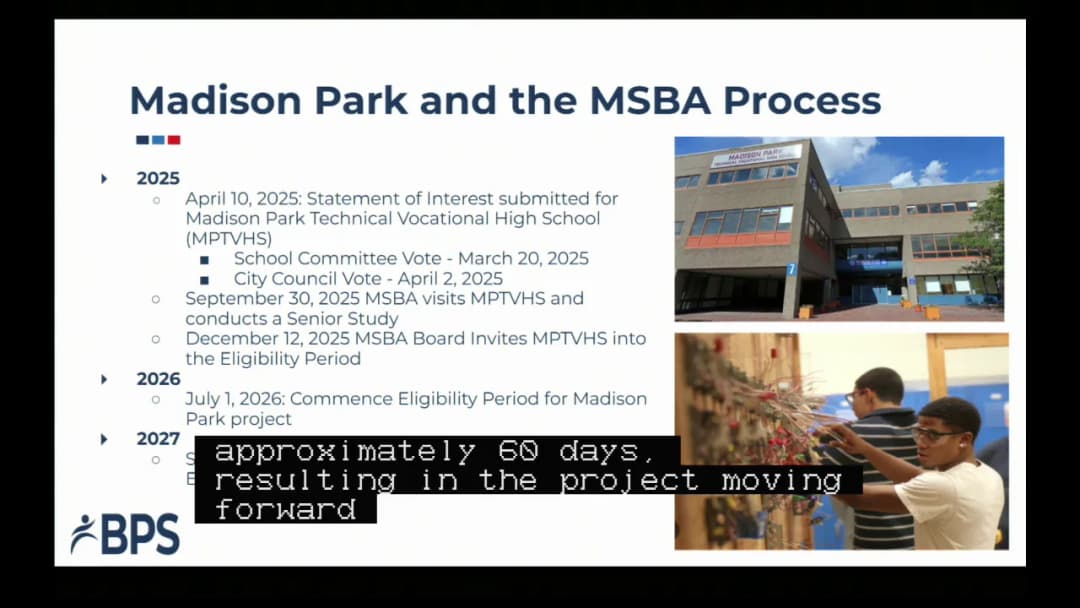
The Boston School Committee convened in person in the Bolling Building in Nubian Square, with Chairperson Jerry Robinson presiding. The agenda covered the superintendent's report on the opening of the 2026-27 school year, public testimony, grant approvals, capital planning and MSBA updates, the "Forward Together" 2026-2031 strategic roadmap, and the schedule for the next meeting. The committee approved the prior meeting minutes, approved two grants and the MASC membership dues, and heard from 14 public speakers. Consent Calendar - The committee approved the minutes of the July 8, 2026, meeting and the August 5, 2026, special grants meeting by unanimous consent with no objection. Superintendent's Report - The Superintendent acknowledged BPS community members who passed away over the summer and thanked Chair Robinson, Vice Chair Scarrett, and committee members Torres and Tran for greeting students on the first days of school. - Educator staffing: All 374 permanent or tenured BTU educators who began the hiring season without permanent positions have now been hired or assigned into a permanent position within BPS. All 205 paraprofessionals with seniority in the BTU paraprofessional unit who started without positions were hired or assigned for 2026-27, with a small number resigning or retiring, which the Superintendent described as typical. Approximately 200 provisional educators have been hired back, and the district continues encouraging provisionals to apply as positions become available. - Transportation: BPS transports approximately 18,000 students. The Superintendent reported far fewer uncovered routes this year than in prior years; when a bus must loop back and cannot reach its next school on time, BPS sends a covering bus or communicates the delay. Executive Director Dan Rosengaard was present to answer questions. Families can download the bus-tracking Zoom app from the BPS website's family resource tab. - Vendor payments: The Superintendent said BPS is working with the Inspector General on a report concerning school vendors not being paid on time, and she will report the report's contents to the committee once steps are identified. Public Comments & Testimony - Fourteen speakers testified; each was allotted three minutes, with reminders when 30 seconds remained. - Exam schools: A speaker cited a recent Boston Globe article reporting that Black enrollment at Boston Latin School has increased each year and approached the district's Black enrollment level in school year 2026. The speaker criticized BPS leadership for enacting an exam school policy that simulations showed would be regressive, and noted the BPS report does not disaggregate the top 20% of invitees by race or neighborhood. - Private fundraising and SMART goals: A speaker urged the committee to consider the role of private fundraising, citing the Reimagining School Funding project's recommendation to collect and make available all revenue information by school, including philanthropy and other private sources, and to require annual updates on board structure, status, and operating revenue. The speaker urged BPS to set SMART goals for disaggregated student groups — including reducing MCAS proficiency and achievement gaps and improving teacher diversity — and asked the committee to set a date for BPS to incorporate new strategies into the 2027-28 budget and submit necessary proposals to the state for fall 2027 implementation. - Written testimony: One speaker confirmed submission of written testimony to all members and asked that it be read carefully. - Committee members thanked all speakers and stated their testimony is extremely important. Action Item: Grants - Madison Park after-school vocational program: Administrators presented year one of a $12 million grant received by the City of Boston to provide after-school vocational opportunities for Madison Park students and students throughout BPS. The committee approved the grant. - Mass Cultural Council Creative Experiences Grant: A continuing competitive grant of $100,000 for the 2026-27 school year, expected to serve more than 600 students at 20 BPS schools and support creative experiences, was approved. - The two grants were approved in separate votes, by unanimous consent. Action Item: MASC Membership Dues - The committee took up the third action item: payment of $8,795 in membership dues to the Massachusetts Association of School Committees (MASC) for the 2026-27 school year. Discussion Item: Horace Mann Charter Schools - The committee discussed the requirement that each Horace Mann charter school operate under a memorandum of understanding with BPS (MOUA). Discussion noted that if not Dearborn, other high schools offer students opportunities to continue career and early college preparation. Discussion Item: Capital Planning and MSBA Feasibility Study - Chief of Capital Planning Del Stanislaus presented the proposed list of 22 capital programs. - On August 26, 2026, the Massachusetts School Building Authority (MSBA) board of directors voted to invite BPS into the feasibility study stage. During this period, BPS and the city must demonstrate the governance, planning, funding, and educational information necessary to move forward. - A member asked about programs connected to Boston's identity as a seaport city. Discussion noted that expanding the early education and care workforce is a priority for both the city and BPS. Discussion Item: Forward Together 2026-2031 Strategic Roadmap - Presenters reviewed the final version of focus areas, objectives, and key actions in "Forward Together," described as BPS's blueprint for actions that will ensure student success and are aligned with the OAG vision that all students, no matter their background, can attain excellence. - Focus areas are organized into two categories — student achievement and culture and climate — with key actions including a professional development plan emphasizing strong teaching practices for diverse learners, ensuring teachers have strong curriculum, and ensuring students have a strong sense of belonging and safety, including support when a school community is uprooted. - Success measures are still under development; climate survey data and MCAS results will be presented at the October meeting. A member requested that 2031 targets use the most recent baseline data. - A member expressed concern that OAG has been an ongoing issue and asked whether educators believe they can educate the students in front of them, adding that students should strive for proficiency — a different approach from historical BPS practice of setting ceilings for students that should never have been set. - A member requested specificity plans outlining benchmarks and steps for each measure. Presenters indicated that the next document needed would lay out targets, what will show progress, and what will be communicated publicly versus internally. - Discussion noted that family liaisons will receive professional development from multiple departments as part of implementation. Key Outcomes - Approved: minutes of July 8 and August 5, 2026; the Madison Park vocational grant (year one of the $12 million grant); the $100,000 Mass Cultural Council Creative Experiences Grant; and $8,795 in MASC membership dues. - The strategic roadmap and capital plan items were presented for action at future meetings. - The next regular school committee meeting is scheduled for Wednesday, October 14, 2026, at 6 PM at the Bolling Building in Nubian Square.
The Boston City Council's Committee on Education, chaired by Councilor Julia Mejia, held a hearing on September 15, 2026, starting at 10:37 AM, to discuss the status of HVAC updates in Boston Public Schools (Docket 1334). The hearing was sponsored by Councilor Pepang and co-sponsored by Councilors Braden and Fitzgerald. Administration officials Brian Ford (Chief of Operations, BPS) and Dr. Sam Depina (Deputy Superintendent, BPS) presented updates and answered questions from council members. The meeting highlighted significant progress from 38 schools with cooling in 2021 to over 100 schools with cooling today, but noted that four schools still lack air conditioning. Public testimony from parents of affected schools urged immediate and permanent solutions. Public Comments & Testimony - Teal Cole (parent at Mozart Elementary, Roslindale): Described temperatures reaching 91°F in classrooms, with averages above 80°F for weeks. She stated that learning cannot occur under these conditions, and that temporary measures like cooling zones and popsicles are ineffective. She requested a concrete plan for permanent cooling, noting that the building's electrical infrastructure is too outdated for window units. She argued that noise from portable generators should not outweigh the need for a cool learning environment. - Ben Engel (parent at Mather Elementary, Dorchester; chair of parent council): Reported classroom temperatures exceeding 100°F during the school year, with some rooms still over 80°F on a 64°F day. He characterized the situation as an emergency and criticized BPS's formal response to the community's petition as lacking substance, with no timeline, funding commitment, or accountable plan. He called on the council to use oversight and budget authority to press BPS for a concrete, funded plan with clear milestones for electrical infrastructure upgrades at Mather. - Katie Williams (parent at Mozart Elementary; pediatric nurse practitioner): Explained the heightened health risks for children, including faster heat absorption, less developed sweating, and quicker dehydration. She described her children coming home tired, with red faces and empty water bottles. She expressed hope that the hearing would lead to updates without threatening school closure or merger, emphasizing the strong school community. Discussion Items - Opening Remarks: Councilors Peppang, Fitzgerald, Flynn, Murphy, Louis Jean, Culpepper, and Chair Mejia all expressed support for HVAC improvements and noted the importance of comfortable learning environments. Chair Mejia highlighted that eight BPS buildings remain without full air conditioning, with average classroom temperatures near 80°F and peaks over 90°F. She referenced a Boston Globe article about Mather students wrapping themselves in wet paper towels. - Administration Presentation (Brian Ford and Dr. Sam Depina): - Reported that over half of BPS buildings were built before World War II. In 2021, only 38 schools had cooling; now over 100 have cooling systems. - Three schools (Lee, Bates, Kenny) are undergoing HVAC installation, targeted for completion by December 31, 2026. - Four schools remain without air conditioning: Community Academy (now Life by Design), Mather Elementary, Mozart Elementary, and Shaw Taylor Elementary (Taylor Building). - For Shaw Taylor, the district has been accepted into the MSBA Core Program to build a new school, with estimated construction completion by December 2030. - Temporary measures include cooling zones (nurse's office and two additional spaces per school), fans, air purifiers, popsicles ($12,000 annually district-wide), misting tents, and encouraging schools to share resources. - Estimated cost for full HVAC/electrical upgrades at the four remaining sites: approximately $35.4 million, or $24 million excluding Shaw Taylor. Costs may increase due to code triggers. - The Lee Academy, a school with HVAC work completed, is in its last year of enrollment but will be kept for educational purposes. BPS spent $4.2 million on HVAC investments there since 2022. - BPS maintains an indoor air quality dashboard with real-time data on temperature, humidity, and CO2, and partners with Boston University for research. - Councilor Questions and Concerns: - Councilor Peppang (District 5) asked for specific timelines for Bates and Mozart. Ford stated that Bates, Lee, and Kenny are on track for December 2026. For Mozart, a $3.4 million (adjusted) electrical upgrade is needed, but the building's age may trigger a larger project. Ford noted the electrical capacity at Mozart is similar to a residential home. - Councilor Fitzgerald (District 3) inquired about Eversource involvement for panel upgrades. Ford clarified that internal panels are BPS's responsibility, but utility companies may need to upgrade transformers and laterals to support higher loads. - Councilor Louis Jean asked about alternative venues for events at non-cooled schools. Ford suggested using nearby schools with AC and exploring neighborhood spaces. - Councilor Culpepper pressed for total cost estimates. Ford provided the $35.4 million and $24 million figures, but noted that the capital plan does not have all those dollars available specifically for these sites due to competing needs. Dr. Depina added that staff capacity limits the pace of project management. - Councilor Mejia questioned spending on triage measures and requested a detailed breakdown. She also raised concerns about the $4.2 million spent on Lee Academy, which is closing, and asked for clarity on repurposing closed school HVAC equipment. Ford confirmed that equipment from closed schools is repurposed where possible. - Councilor Weber asked about the difference between capital budget lines for HVAC repairs and improvements, and about lessons learned from the JFK geothermal pilot. Dr. Depina said the pilot is still being assessed. - Councilor Flynn asked about generators and maintenance. Ford explained that generators are sized to building load and are exercised regularly. - Councilor Mejia also asked about minimum heat standards in winter (66-68°F) and ventilation. Ford assured that all buildings have heat and meet or exceed ventilation standards, with IAQ sensors monitored three times daily. Key Outcomes - No formal votes or decisions were taken; the hearing was informational. - Councilors directed BPS to provide written follow-up on: detailed spending on cooling triage measures (e.g., popsicles, fans, wet towels); specific timelines for electrical upgrades at the four remaining schools; total cost breakdowns with line-item clarity; and a plan for community engagement regarding Lee Academy's future use. - Councilor Mejia requested that the Budget Office participate in future hearings to better address fiscal questions. - The lead sponsor, Councilor Peppang, called for continued oversight and working sessions to track progress until all schools have HVAC. - Public testimony from three parents was entered into the record, and written comments will be shared with all councilors.
The Boston City Council Committee on Environmental Justice, Resiliency, & Parks, chaired by Councillor Brian Warrell, held a hearing on Docket 1241 on September 10, 2026, at 3:02 PM. The hearing examined the concentration of waste transfer facilities, illegal dumping, environmental justice, and fair housing impacts in residential and mixed-use neighborhoods, particularly in Roxbury. The docket was sponsored by Councillors Culpepper and Mejia. The hearing included pre-recorded video testimonies from residents, a panel of experts and community leaders, and live public testimony. Public Comments & Testimony - Diana Salazar (Roxbury resident, via video): Expressed that the community has been forced to deal with the impacts of waste transfer operations, including odors, fires, and hazardous conditions, reflecting long-term neglect. Called for meaningful action and buffer zone protections. - Isabel Barentini (Roxbury resident, via video): Described living within one-tenth of a mile of two waste processing facilities, noting the March 2025 eight-alarm fire at the Gerard Street facility that caused $4 million in damage and hospitalized three firefighters. Argued that the geography of waste infrastructure in Boston is intentional and constitutes environmental injustice under Massachusetts Executive Order 552. - Latoya (Roxbury resident, via video): Recounted experiencing the March 2025 fire, which triggered her asthma for over two days. Stated that the smell and pollution were unbearable and that no family should be forced to live with such conditions. - Karema Rojas (Roxbury resident): Opposed the operation of the Cambridge/Roxbury transfer station near Orchard Gardens, citing fires, odors, and hazardous conditions. Noted that the facility accepts municipal solid waste, tires, and hazardous waste, and is located near a field being renovated into recreational facilities. Called for the city to stop the harmful practice. - Kalamu Kyeta (Lifelong Roxbury resident, community organizer with DSNI): Supported removing waste transfer stations, calling them a "long-lasting stain of Boston's neglectful and racist past." Urged the council to finish the fight started by the "Don't Dump on Us" campaign 45 years ago and reclaim the land for community-led development. - Sean O'Connor (Local resident): Described deafening truck noise at night, horrific summer smells, and a filthy environment around Norfolk and Gerard streets. Said the land could be put to better use, such as green space. - Maranta (Roxbury/Dorchester border resident): Reported unidentified putrid smells and worsening asthma since moving to Boston. Noted that such smells are absent in wealthier neighborhoods like Brookline, and argued that Roxbury residents deserve the same respect and clean air. - Renee Mardones (Boston resident): Proposed relocation of the Republic Services and Roxbury Resource facilities. Requested that the committee extend the comment period to the end of next week and hold a community listening session. Also requested a zoning amendment for the area. - Vickiana Pitom (Community organizer, DSNI): Supported relocation of the trash transfer stations, calling the situation "legalized dumping." Highlighted multiple recent fires at the facilities, workers' strikes over hazardous conditions, and the lack of transparency. Urged re-examining zoning to match the actual residential and commercial use of the area. - Asia Jackson (Lifelong Roxbury resident, Boston Public Health Commission board member): Questioned how many fires and how much exposure is needed before action is taken. Called for independent monitoring, real-time data, health tracking, transparency, and enforceable protections. - Denise January (Coordinator, Environmental Justice Assistance Network at ACE): Expressed disheartenment over the fires and noted that the DEP states the facilities are in compliance despite community concerns. Urged the city council to take action and work collaboratively with the community. Discussion Items - Opening Remarks and Panel Presentations: - Councillor Culpepper (lead sponsor) emphasized that the concentration of waste facilities in Roxbury is a fair housing and environmental justice issue, noting the March 2025 fire and the disproportionate burden on historically disinvested communities. He advocated for stronger monitoring, enforcement, zoning changes, and a more equitable regional approach to waste management. - Chair Warrell highlighted that neighborhoods like Roxbury have more transfer stations and a history of disproportionate dumping, stressing the need for stricter enforcement and equitable siting decisions. - Councillor Murphy, Fitzgerald, Flynn, and Louis Jen each expressed support for the issue, with Flynn noting the high asthma rates in Chinatown and Louis Jen emphasizing environmental racism and health consequences. - Panel Testimony: - John Smith (Executive Director, Dudley Street Neighborhood Initiative - DSNI): Provided historical context, noting that DSNI's first campaign was "Don't Dump on Us" against illegal dumping in the 1980s. Stated that the neighborhood has long borne disproportionate environmental burdens, with asthma and bronchitis rates roughly twice the rest of Boston. Emphasized that environmental issues affect health, housing, and economic development. - Marcos Belice (Roxbury resident, DSNI board member): Shared personal experiences of foul odors, truck noise, and fires over 25 years. Described how the transfer stations have contributed to illicit activity and made the area unsafe. Called for urgent action, noting that recent fires indicate the problem is intensifying. - Dan O'Brien (Professor, Northeastern University; Principal Investigator, Common Senses project): Presented data from 51 heat/noise and 23 air quality sensors deployed in the neighborhood around Blue Hill Avenue. Data from the March 2025 fire showed elevated particulate matter near the Gerard Street facility, though the wind blew most pollutants away from the sensors. He noted that the state's DEP monitoring site 1.5 miles away did not detect the event, highlighting limitations. Recommended tracking volatile organic compounds (VOCs) rather than particulate matter for better regulation, and suggested intentional sensor placement around the transfer station. - Tristan Thomas (Director of Policy and Law, Alternatives for Community and Environment - ACE): Framed the issue as an environmental justice, public health, and civil rights concern. Cited state data showing the area is in the 99th percentile for cumulative environmental burden, 98th for nitrogen dioxide exposure, 95th for diesel particulate matter, and 97th for heavy traffic. Health outcomes include 85th percentile for pediatric asthma and 77th for premature mortality. Noted that these facilities have never undergone a comprehensive environmental review. - Councillor Questions and Discussion: - Councillor Culpepper asked about approaches to move Republic Services from the area. Prof. O'Brien recommended zoning amendments, such as prohibiting certain industrial uses within half a mile of residential zones. Culpepper noted a zoning amendment has already been filed and expressed interest in starting work immediately. - Councillor Culpepper also asked Tristan Thomas about ACE's definition of environmental justice and its application to the waste facilities. Thomas emphasized equal treatment before the law and community voice in decision-making. - Councillor Murphy asked about existing violations and enforcement. Thomas responded that despite repeated complaints, the DEP considers facilities in compliance. A $500,000 study in the state bond bill and provisions for warrantless inspections are being pursued. Murphy also questioned why Cambridge's trash is dumped in Roxbury and suggested reaching out to the Cambridge City Council for support. - Councillor Fitzgerald asked about the duration of the facilities (over 40 years), worker health protections, and the potential for a fee on waste from other communities. He also inquired about what should be tracked instead of particulate matter; Prof. O'Brien recommended VOC sensors. - Councillor Fitzgerald further asked about solutions for relocating the facilities. Panelists emphasized that the need to be near people (for services) does not apply to trash transfer stations; they can be sited away from residential areas. They expressed willingness to work collaboratively on a relocation plan. - Councillor Flynn noted the absence of an environmental study and expressed that he would not accept the Boston Public Health Commission's position as final. He asked about health data; John Smith confirmed links to health impacts through BMC partners. Flynn also expressed empathy for residents' struggles and offered his support. - Councillor Louis Jen asked about methods to bring Mass DEP directly into the community to hear complaints. Panelists agreed to follow up. He also asked about the number of transfer stations (believed to be two active ones) and the legal risks of sensor placement near the facilities. Prof. O'Brien acknowledged historical cease-and-desist threats. Louis Jen also asked about lessons from DSNI's past land reclamation efforts, which John Smith noted could inform community-controlled development of the site. - Senator Liz Miranda (written testimony): Submitted a two-page letter urging the city council to review contractual relationships with Allied Waste Services/Republic Services and examine zoning and land use protections. Her letter highlighted a 2018 DEP penalty of nearly $50,000 and ongoing non-compliance concerns. Key Outcomes - The chair announced that written and virtual testimony will remain open; comments can be emailed to ccc.ep@boston.gov. - Chair Warrell committed to working with Councillor Culpepper on coordinating a community listening session in Roxbury. - Councillor Culpepper noted that a zoning amendment has already been filed and called for moving it forward through the appropriate committee. - Councillor Culpepper also initiated a connection between his legislative director and Prof. O'Brien to begin working on zoning amendments immediately. - No votes were taken; the hearing served as a fact-finding and discussion session. The hearing was adjourned.
Chair Henry Santana convened the Boston City Council Committee on Public Safety and Criminal Justice at 10:09 a.m. on September 10, 2026, for a combined hearing on Dockets 0185, 0999, 1390, 1419, and 1602. The hearing addressed a cross-sector community safety and violence prevention strategy, firearm trafficking and gun violence hotspots in Districts B-2/B-3, a community-based summer public safety plan, noise complaint enforcement, and codification of the Office of Violence Prevention with a biennial violence prevention plan. It continued into the afternoon and included administration officials, community providers, and public testimony; public speakers were generally given three minutes. Councilors Murphy, Culpepper, Flynn, Fitzgerald, Louijeune, Worrell, Weber, Pepen, and President Breadon participated or joined during the hearing. Public Comments & Testimony - Louis Elisa, president of the Garrison Trotter Neighborhood Association and Roxbury resident, called for better police-community communication, advance planning for large Franklin Park events, walking beats, active enforcement of traffic laws, and support for Councillor Flynn's concerns about 16-hour police shifts. - Stephen Wilson of Black Men United Boston urged creation of a standing committee followed by a task force so police, prevention programs, schools, hospitals, and community groups work together rather than in silos; he said residents do not feel safe and the city needs a real prevention strategy. - Asia Jackson, a lifelong Roxbury resident and worker, said residents in Nubian Square do not feel safe, asked for neighborhood-level data rather than citywide averages, and called for walking beats, staggered shifts, youth pathways, mental health support, and long-term resources for neighborhoods most harmed by violence. - Larry Calderon, Patrolmen's Association president, said the department's focus on guns and homicides was convenient while larceny, domestic violence, and non-domestic assaults are up; he said officers are forced into double shifts, morale is damaged, and there are under 1,600 patrol officers against a roughly 2,500-officer ordinance strength. He opposed using drones instead of officers and asked to have rank-and-file officers on future hearing panels. - Terry Dilworth, a Fort Hill/Highland Park resident, described recurring large student parties and noise in his residential neighborhood, said a recent 9:30 p.m.-to-3 a.m. party received no police response despite calls, and urged universities to take responsibility for housing and managing their students. - John Smith St. Cyr, founder of the J.L. Smith Suicide Prevention Center for Young Black Boys, said violence prevention must start with poverty, housing instability, failing schools, and untreated trauma; he argued investment should be concentrated in the neighborhoods carrying the most violence. He said his program served over 30 young Black boys this summer and hired 10 youth peer mentors. - Luann O'Connor supported Councillor Flynn on officer overtime concerns, said BRIC funding was withheld and local ComStat meetings she tried to attend were cancelled, and argued the DA's office is not enforcing existing gun laws. - Jacqueline Fonseca, a Dorchester resident and violence survivor, said mental health is severely underfunded, citing $4.2 million for school-based youth mental health versus $484 million for BPD. She urged mental health first aid, peer-to-peer support, and healing for communities, victims' extended families, and offenders. - Alex Alex proposed a Boston Suburb Games to build community trust and described personal encounters with BPD he found aggressive; he recommended community events that allow police to serve as community members. Discussion Items - Boston Police Department data presented by Director Brian Walsh showed major crime roughly even year to date through September 8, 2026, with violent crime up 2% and down 2% against the five-year average. Summer gunfire incidents totaled 79, the lowest since 2011 and down 34% from 2025; summer shooting incidents totaled 37, the lowest since 2005; shooting victims totaled 57, up from 46 in 2025 but the second-lowest summer total since 2005. Officers recovered at least 126 firearms this summer, including 29 with high-capacity magazines, two sear switches, and 13 privately made firearms. - The 2025 Boston Firearm Trafficking Report, cited by the department and Councilor Culpepper, found BPD processed 819 firearms, about 515 crime-related, including 54 privately manufactured firearms, 11 sear switches, and 71 high-capacity magazines; top origin states for crime guns were Maine, Massachusetts, Georgia, and New Hampshire. Councilor Culpepper said the firearm recovery map showed 90% of recovered firearms in Districts B-2/B-3 and asked why prevention and enforcement were not more concentrated there. - BPD leadership described community policing as foundation, citing 3,681 community engagement events, 315 community meetings, 31,069 walk-and-talk directed patrols, and 614 scooters/motorcycles seized this summer, nearly double last summer's total. They also said non-fatal shooting clearance in B-2/B-3 was over 50%, more than double the national average, and that after-action reports from events like J'ouvert and Caribbean Carnival changed deployment and reduced incidents. - Councilor Murphy asked for an honest conversation about why residents felt less safe despite positive data. Isaac Yablo of the Office of Violence Prevention said trauma does not reset annually and perception is shaped by life experience and social media exposure, while BPD said it used forecasting to keep district coverage during FIFA and other downtown events, with zero incidents at FIFA. - Councilor Culpepper pushed back that Roxbury and Dorchester residents saw shootings while resources were downtown; he requested a stronger community-based summer safety plan, more walking beats, and a sustained presence in Nubian Square. Councilor Flynn said officers are working 14-16 hour days, morale is poor, and the city has a public safety staffing crisis; he called for a citywide commission and restoration of police health and wellness funding. BPD command said exact officer numbers were not immediately available, estimated around 2,000 officers, and stated overtime was often voluntary; Patrolmen's Association witnesses disputed that account. - BPD and OVP officials discussed firearm trafficking, gang involvement, intervention ages, and reentry. Yablo said the average age of gun violence involvement in Boston is about 27, that the Office of Violence Prevention has reorganized SOAR-style street outreach into data-informed intensive case management, response teams, and prevention programs, and that hospital MOUs are signed with three of the four major hospitals outside BMC. He also said evaluation capacity is being expanded with about $150,000 invested. - Councilor Fitzgerald asked about street takeovers and scooters; BPD described training, education, intelligence-led enforcement, and use of criminal and quality-of-life laws when riders are unlicensed, unregistered, or unhelmeted. Councilor Pepen thanked the moped task force and asked for neighborhood-level compliance and seizure data. - Council President Breadon raised recurring off-campus party problems and inconsistent enforcement. BPD detailed Ordinances 16-26 and 16-50, the social host law, the keeper of a disorderly house statute, and the problem property task force as tools for fines, equipment seizure, and landlord accountability. - The second panel focused on prevention and youth opportunity. Robert Lewis Jr., president and CEO of Boys & Girls Club of Boston, said Boston should aim to be the best city for young people, not just the safest; he called for connecting existing youth programs, convening philanthropy and business leaders, investing in public housing communities, and extending youth-serving hours because most organizations close by 7 p.m. and most are closed Saturdays. Kevin Barton, executive director of Youth Connect, said social workers embedded in police stations serve about 500 young people ages 10-24; he called for stable multiyear funding, noting a $595,000 gap, and for continued support for housing, jobs, education, mental health, and record reform. Terry Dilworth repeated his concerns about off-campus party noise and lack of police follow-through. Key Outcomes - No votes were taken on the dockets themselves; the hearing was held for information gathering and public comment, and all five dockets remain under consideration. - Public testimony will be made part of the record and available to all councilors. - Councillors requested follow-up data on neighborhood-level crime, scooter/motorcycle seizures and demographics, and police district-by-district statistics; Councilor Culpepper also proposed monthly BPD-Council briefings. - Councillors indicated they will continue work on the Shannon Grant, youth program funding, and the proposed codification of the Office of Violence Prevention in the next budget cycle. - Per the agenda, Councilor Culpepper invoked Rule 12 to add Councilors Worrell and Flynn as original co-sponsors of the hearing dockets.