Browse by city
Date range
Search help

Search titles, summaries, topics and stored transcripts together. Keywords may match separately; put the whole query in double quotes for a phrase. Matching follows word analysis, so punctuation is not exact. Both dates are included. Documents are not searched.

SHOWING 61–70 ENTRIES
61
AUG 11, 2026 · BOSTON, MASSACHUSETTS · CITY COUNCIL
Boston City Council Hearing on Unarmed Security Guard Training Requirements - August 11, 2026

The Boston City Council Committee on Government Operations, chaired by Vice Chair Ruti Louis Gen (At-Large), held a hearing on August 11, 2026, at 10:06 AM to discuss Docket 1541, an ordinance establishing minimum training requirements for unarmed security guards. The meeting included opening statements from councilors, testimony from the administration (Office of Labor Compliance and Worker Protections), an advocate panel led by 32BJ SEIU, and public testimony from industry representatives, security officers, small business owners, and community members. No votes were taken; the hearing was the first step in a process expected to include future working sessions. Opening Statements - Councillor Henry Santana (Lead Sponsor): Emphasized that public safety begins with preparedness. Noted that unarmed security guards serve on front lines in hospitals, residential buildings, businesses, and public spaces, yet Boston currently has no minimum training requirements. Stated the ordinance is about public safety, worker protection, and ensuring workers are properly prepared. - Councillor Aaron Murphy: Expressed general support for worker training but raised concerns about the 40-hour initial in-person training requirement, 8-hour annual training, employer-paid tuition and wages, annual permitting, and penalties of $300 per guard per day. Asked whether small business security owners had been invited to speak and suggested another hearing may be needed if the other side is not heard. - Councillor Ed Flynn: Expressed strong support based on his experience as a probation officer and part-time security worker at a hospital. Stressed the need for critical training and respect for unarmed security guards. - Council President Liz Braden: Voiced total support for the ordinance, stating minimum training elevates skills and preparedness, enhances safety for workers and the public, and hopes the council moves forward in a timely way. - Councillor Sharon Durkin: Noted she hears concerns about the ordinance from her district (West End, Beacon Hill, Back Bay, Fenway, Mission Hill). Questioned the broadness of the language, potential small business impacts, and the need for more process and hearings. - Councillor Fitzgerald: Supported workers’ right to unionize and standards, looked forward to learning more and asking questions. - Councillor Ben Weber: Emphasized that unarmed security work is part of the public safety landscape, appreciated feedback from industry, and wanted to work in partnership to make the ordinance better. - Councillor Reverend Minute Culpepper: Stated there is broad agreement on the gap but wanted to understand operationalization, implementation, and lessons from Philadelphia. Administration Testimony - Lou Mendarini (Senior Advisor for Labor Policy): Noted the administration had only received the ordinance recently and had not fully analyzed it. Expressed support in concept for training on Narcan administration, de-escalation, and dealing with addiction issues. Highlighted economic mobility benefits of a uniform training standard. Stated the administration needs to engage with industry and other cities (e.g., Philadelphia) to understand implementation requirements. - Jody Sugarman Brazen (Deputy Chief of Worker Empowerment): Supported earn-and-learn models and portable credentials. Admitted the office is small (3 staff plus herself) and would need to assess capacity and timeline for implementation. Stressed the importance of consulting workers, employers, and other stakeholders. Advocate Panel Testimony - Kevin Brown (Executive Vice President, 32BJ SEIU New England): Representing 22,000 service workers in New England, including 1,800 unarmed security officers in Boston. Strongly supported the ordinance. Noted that 61% of security officers identify as Black. Described incidents of violence (e.g., stabbing at Boston Medical Center) and high turnover. Argued that 40-hour initial and 8-hour annual training is a starting point to professionalize the workforce. Noted that the 32BJ Thomas Shortman Training Fund already provides such training in New York and New Jersey and could do so in Boston if employers paid $312 per year per worker. - Stanley Watching III (Security Officer, 32BJ Member): Testified that he received no training when starting at Boston Public Library, then only a few hours before transfer to Faneuil Hall. Described responding to fights, mental health crises, and other emergencies without preparation. Urged training before crises happen. - Tanya Powell Brown (Security Officer, 32BJ Member, Boston Public Library): Stated she received online and basic training but that it was insufficient. Recounted dealing with overdose needles, fights, hatchet attacks, and other incidents where police response is delayed. Supported standardized training. - Jeff Franchetti (Student, Northeastern University): Spoke as a beneficiary of security guards on campus. Argued that guards are essential for student safety and should have proper training. - Sam Rodriguez (Security Officer, Northeastern University, 32BJ Member): Described receiving mostly online video training with no hands-on practice (e.g., CPR without dummies). Stated officers are often first responders and need in-person training. - Rob Cook (Policy Fellow, 32BJ, virtual testimony): Addressed concerns about state preemption (not an issue since state has no unarmed guard training requirements), part-timers (existing employees have 6 months, new employees 3 months to complete training), and the role of officers as eyes and ears – noted they wear uniforms and people look to them in emergencies, so training like CPR and de-escalation saves lives. Public Comments & Testimony - Erby Duvernay (CEO, One Worker Group, security company employing 200): Opposed the ordinance as drafted. Argued it would hurt small and disadvantaged businesses and part-time workers (students, immigrants, those seeking extra income). Stated his career started without a checklist – he received orientation and on-the-job training. Criticized that minority-owned companies were not invited to the panel. Urged the council to hear from all sides. - Steve Amate (Executive Director, National Association of Security Companies, NASCO): Opposed the ordinance. Noted NASCO members already provide on-the-job and site-specific training. Argued the 40-hour requirement is too high and would deter entry into the field. Pointed to Philadelphia’s similar law which initially required 12 hours but is still not implemented after 5 months. Estimated Minnesota would need 8 full-time staff and over $1 million to implement 40-hour training. Warned that requiring training to intervene in violent situations could expose officers and companies to liability. - Gregory Maynard (Executive Director, Boston Policy Institute): Questioned why the hearing was held so quickly (docket filed August 5, hearing August 11). Pointed out that 30 other dockets in Government Operations Committee and 25 in Public Safety Committee (chaired by the lead sponsor) had not been scheduled, including a public safety briefing demanded unanimously on July 8. Argued the council should prioritize other pressing issues. - David (Owner of a security company, grew from ground up): Opposed the ordinance’s current form. Said added costs would be passed to clients, potentially causing them to go in-house, hurting small companies. Noted he learned about the hearing late and asked for more time for employer input. - Liam O’Connell (Attorney, representing Securitas Security Services): Opposed the ordinance as presented. Noted 41 states require training at the state level, not city. Cited Philadelphia scaling back from 40 to 12 hours and grandfathering existing training. Argued the ordinance pushes private security toward a quasi-public safety role, exposing officers to liability without immunity. - Terry Williams (President/CEO, One United Bank): Opposed the ordinance. Hires small local security firms for branches with limited responsibility. Stated he wants guards to call police, not intervene, to avoid risk to employees and customers. Argued the ordinance would reduce flexibility and increase costs. Discussion Items - Implementation and Capacity: Multiple councilors questioned whether the city has the infrastructure to certify training providers, issue permits, and enforce penalties. Administration acknowledged they need more time to assess capacity, consult with Philadelphia and other cities, and conduct stakeholder outreach. The Office of Worker Empowerment has only 4 staff members. - Training Provider Requirements: The ordinance requires training to be provided only by a federally tax-exempt organization, not controlled by a security employer, and exclusively in-person. Councilors questioned why for-profit or hybrid training is excluded. Administration noted the requirement may be adjusted in working sessions. - Definition and Scope: Councilors asked whether the ordinance covers all security guards (definition of “security employer” includes those employing 2+ guards at a covered property) and whether it applies to part-time workers, student workers, and concierge roles. Administration clarified it applies to workers in Boston, estimated at about 9,000 unarmed security guards. - Cost and Economic Impact: Concerns raised about burden on small businesses, pass-through costs to clients, and potential reduction in security coverage. Advocates argued that standardizing training levels the playing field and costs (employers pay $312 per worker per year in New York) become part of the contract. The cost of not training was described as “priceless.” - Role of Security Officers: Some industry representatives worried that training might encourage guards to intervene in dangerous situations, exposing them to liability. Advocates countered that guards already find themselves in harm’s way and need basic skills like CPR and de-escalation. - Timeline and Urgency: Several councilors noted that the hearing was scheduled quickly after filing. Councillor Flynn asked why the urgency. Councillor Santana explained he had been away and the filing was scheduled after his return. He confirmed he does not want to rush and expects working sessions. - Stakeholder Outreach: Multiple councilors emphasized the need to hear from small and minority-owned security businesses, non-union workers, hospitals, schools, and other institutions. Administration stated they have begun conversations but have not yet contacted all relevant groups (e.g., Beckma, minority business associations). Advocates argued the ordinance was created in consultation with workers and the union, but small business owners felt excluded. Key Outcomes - No votes taken. The hearing was informational and exploratory. - Commitment to further working sessions. Vice Chair Louis Gen and lead sponsor Santana indicated the ordinance will undergo additional working sessions to refine language and address concerns raised. - Administration will conduct due diligence: The Office of Labor Compliance and Worker Protections will consult with Philadelphia, New York, and other cities, and engage with industry stakeholders, workers, and employers to develop a realistic implementation plan. - Written comments will be accepted: The committee will receive written testimony via email (ccc.go@boston.gov) to be made part of the record. - Next steps: A second hearing or working session is expected. No deadline for passage was set. Notable Statistics and Facts Mentioned - Approximately 9,000 unarmed security guards work in Boston. - 61% of security officers in Boston identify as Black (per 32BJ). - The ordinance proposes 40 hours of initial in-person training and 8 hours of annual training, employer-paid. - Penalties of $300 per guard per day for noncompliance. - The 32BJ Thomas Shortman Training Fund in New York costs $312 per worker per year (employer-paid) and trains 20,000 officers annually. - Philadelphia’s similar law reduced from 40 to 12 hours; implementation is still pending after 5 months. - Massachusetts does not require any training for unarmed security guards, unlike most states.
WORKFORCE DEVELOPMENT 42% · PUBLIC SAFETY 40% · PROCEDURAL 8% · LABOR 7%
62
AUG 11, 2026 · BOSTON, MASSACHUSETTS · CITY COUNCIL
Boston Zoning Board of Appeal Hearing – August 11, 2026

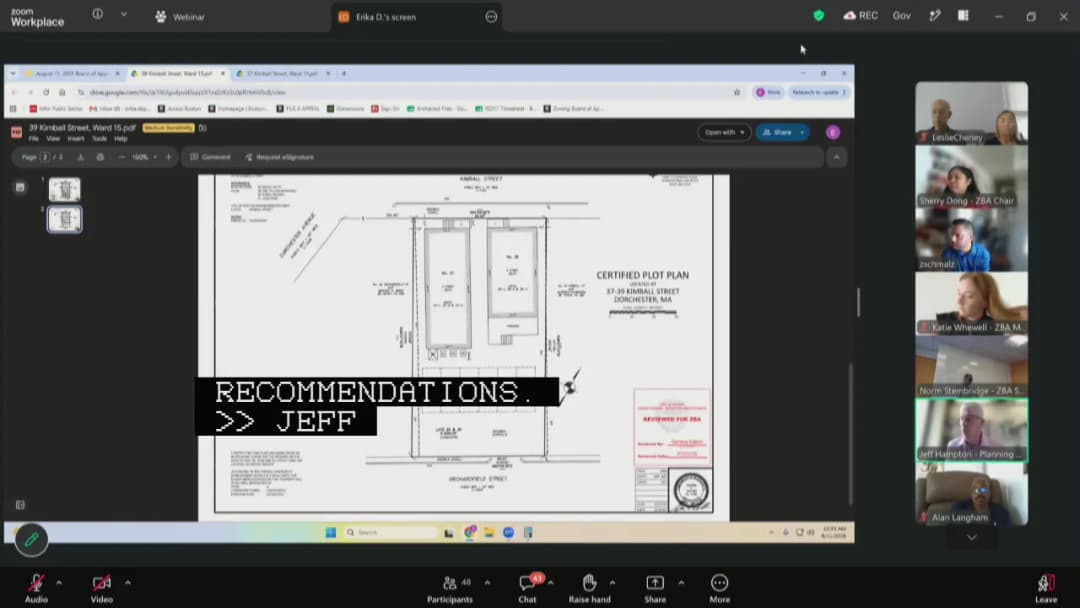
The Boston Zoning Board of Appeal held a virtual hearing on August 11, 2026, starting at 9:30 AM with a six-member board. The hearing covered 20+ cases, including approvals of consent calendar items, administrative deferrals, and substantive decisions on conditional use permits, variances, and proviso removals. Key votes included denials of a proviso removal (later reversed) and a three-unit townhouse proposal, along with approvals of several residential additions, subdivisions, and a rental car agency. Consent Calendar - Approval of Hearing Minutes (July 28, 2026): Approved 6-0. - Extensions (6 cases): Approved 6-0. Public Comments & Testimony - 415–415A Hanover Street (outdoor seating): The Mayor’s Office of Neighborhood Services deferred; Councilor Coletta’s office supported. No public opposition. - 35 Braddock Park (renovation): Community meeting supportive; a 59-year resident spoke in favor, noting existing similar structures. Councillor Flynn’s office supported. - 10 Northampton Street (rental car agency): Planning Department recommended approval; community process found no feedback. No public testimony. - 1013 Harrison Avenue (FC Tech educational use): Community meeting without opposition; Planning Department supported. No public testimony. - 37 & 39 Kimball Street (curb cut/parking): Mayor’s Office reported community support for removing cars from streets; Planning Department recommended denial citing excessive paving. Applicant argued historical context. - 472 Ashmont Street (garage/third unit): Lightly attended community meeting; no opposition. Councillor Fitzgerald’s office supported. - 86 Brown Avenue (four units): Community meeting reflected both support and opposition; letters received with concerns about density, parking, and precedent. Abutters spoke against the project’s size. - 118 Lexington Street (dormer/renovation): Eagle Hill Civic Association voted 10–3 in favor; no public testimony. - 27–29 Ballard Street (attic/basement conversion): Jamaica Plain Neighborhood Council approved; one letter of opposition (sunlight loss) and one in support. - 360 Princeton Street (rear deck): Eagle Hill Civic Association voted 8–0 in support; no public testimony. - 7–9 Marine Court (fourth unit): Jeffries Point Neighborhood Association voted 8–1 in favor; Planning Department had concerns but applicant noted neighborhood context. No public testimony. - 1 Washington Place (three townhouses): Community meeting mixed; abutters’ attorney opposed citing demolition, density, privacy, and access issues; applicant’s attorney rebutted Article 85 concerns. Seven support letters filed. - 176 L Street (fourth story): City Point Neighborhood Association opposed; abutters raised precedent and architectural character concerns. Public testimony opposed. Councillor Flynn’s office supported. - 43–45 Westwood Circuit (subdivision/new homes): West Roxbury Neighborhood Council supported; no public testimony. - 178–180 Weld Street (garage replacement): Community meeting had concerns resolved; West Roxbury Neighborhood Council supported. No public testimony. Discussion Items - 18 Dell Avenue (proviso removal for permeable pavers): Applicant argued stormwater system already approved by BWSC. Board debated timing and whether full picture was presented. Vote on approval failed 4–2; a subsequent motion to deny passed 6–0. - 37 & 39 Kimball Street (curb cut widening): Planning Department recommended straight denial. Applicant cited existing cramped conditions and safety. Board agreed with Planning; motion to deny passed 5–1 (Stembridge voted no). - 86 Brown Avenue (two-to-four-unit conversion): Board discussed lot size, density, and precedent. Motion to approve passed 5–1 (Langham voted no). - 1 Washington Place (three townhouses): Board debated lot frontage, open space, and abutter opposition. Initial motion to approve (with design review proviso) failed 4–2 (Beta Barraza and Turner voted no). A subsequent motion to deny without prejudice passed 5–1 (Stembridge voted no). - 176 L Street (fourth-story addition): Board considered height, setback, and lack of front decks. A motion to approve with provisos (no new decks, 10-ft setback, design review) passed 6–0. Key Outcomes - 18 Dell Avenue: Proviso removal denied (6–0) after initial approval motion failed. - 415–415A Hanover Street: Seasonal outdoor seating approved (6–0). - 35 Braddock Park: Renovation and carport approved (6–0). - 10 Northampton Street: Conditional use permit for Enterprise Rent A Car approved (6–0). - 1013 Harrison Avenue: Conditional use permit for FC Tech educational uses approved (6–0). - 37 & 39 Kimball Street: Curb cut request denied (5–1). - 472 Ashmont Street: Garage and conversion to three units approved (6–0). - 86 Brown Avenue: Four-family use approved (5–1). - 118 Lexington Street: Dormer/renovation approved (6–0). - 34 Vincent Street: Renovation approved (6–0). - 27–29 Ballard Street: FAR/side yard variances approved (6–0). - 360 Princeton Street: Rear deck variance approved (6–0) with proviso for BPD design review. - 7–9 Marine Court: Fourth unit approved (6–0) with proviso for BPD design review on roof access. - 1 Washington Place: Three townhouses denied without prejudice (5–1) to allow revised proposal. - 176 L Street: Fourth-story addition approved (6–0) with provisos: no new decks, front setback per BPD, design review. - 43–45 Westwood Circuit: Subdivision and two new homes approved (6–0). - 178–180 Weld Street: Garage reconstruction approved (6–0) with proviso for BPD design review on driveway maneuverability. - Deferrals granted (8 cases): 86 Walworth St., 425 E 3rd St., 121 River St., 722 E 2nd St., 57 Mount St., 1 & 2 Hopkins Pl., 105 Pleasant View St. – all deferred to September 22, 2026. - Administrative deferral (2 cases): 1 & 2 Hopkins Pl. deferred to September 22, 2026, to address Article 79 (inclusionary zoning) concerns.

ZONING BOARD OF APPEALS 57% · PROCEDURAL 11% · ENGINEERING AND INFRASTRUCTURE 6% · PUBLIC ENGAGEMENT 5%
63
AUG 6, 2026 · BOSTON, MASSACHUSETTS · CITY COUNCIL
Boston Public Improvement Commission Hearing - August 6, 2026

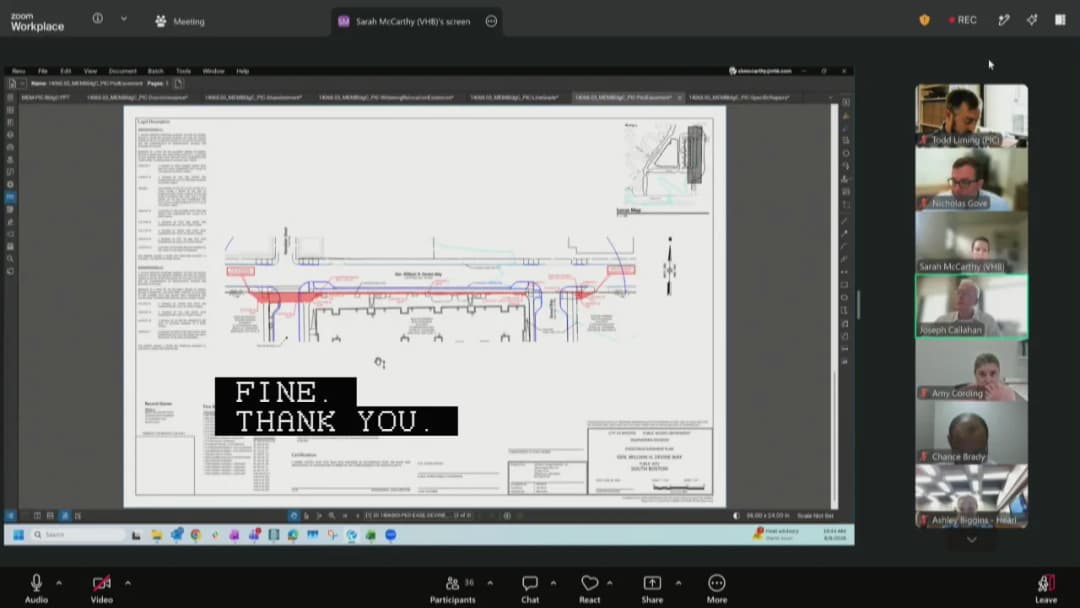
The Public Improvement Commission (PIC), chaired by Nick Gove, convened a public hearing and new business session on August 6, 2026, at 15:00 UTC. The commission unanimously approved 11 public hearing petitions addressing street and sidewalk improvements, including the MBTA’s Downtown Crossing elevator project, Vertex’s Harbor Street upgrades, and the MEM Building C redevelopment in South Boston. Eight new business items were set for a public hearing on August 20, 2026, covering street renaming, safety improvements, and multiple affordable housing developments. Public Hearing – Approvals - Minutes of July 9, 2026: Approved unanimously. - MBTA Petition (Washington, Summer, Tremont, Winter Streets): Installation of three elevators and two mechanical vent shafts at Downtown Crossing and Park Street stations. Dino and Steve Fallon (MBTA) presented. Rebecca asked about signage facing Boston Common; the commission required that vent structures be enclosed with panels on all four sides and that the city’s Office of Arts and Culture oversee future public art or signage, to be memorialized in a license agreement. Approved. - Vertex/EDIC (Harbor Street): Pedestrian easement acceptance and specific repairs to replace an asphalt sidewalk with concrete, add street trees, lighting, and a pedestrian zone. Coordination with disability and planning departments was noted. Approved. - MEM Building C & BHA (South Boston): Discontinuance of a segment of General Lawrence J. Logan Way (9,400 sq ft), abandonment of Colonel Michael J. McDonough Way, widening/relocation of Logan Way to create a 90-degree intersection with Old Colony Avenue, establishment of a new public way (Strandway, 60-ft right-of-way), pedestrian easements along Logan Way and Divine Way, and specific repairs on Logan Way, Strandway, and Divine Way. The project includes 192 units (176 affordable, 172 senior). Maintenance agreement similar to previous phase. A commissioner asked about veteran memorial signposts; no impact was confirmed. Approved. - Rescission of 2020 Approvals (9 Chelsea Street, 144-148 Maverick Street): Both the specific repairs and projection license for 9 Chelsea Street and Maverick Street were rescinded due to ownership changes and a complete redesign. Approved. Public Comments & Testimony - Rebecca (public): Expressed concern about potential advertising signage on the MBTA vent shaft near Boston Common. The commission and project team clarified that the city will control all signage/art, and a written agreement exists with PIC. - Commissioner (name not given): Asked about veteran memorial signposts on Divine Way; project team stated no impact. New Business – Set for Public Hearing on August 20, 2026 - Dearborn Street (Roxbury): Renaming to “New Edition Way,” petition by all five abutters. Approved for hearing. - Wood Avenue (Roxbury): Safety improvements by BTD and PWD: edge line extensions, raised crosswalks, sidewalk reconstruction, green infrastructure (low-maintenance plantings). Maintenance plan to be finalized before hearing. - Norwell Street Park (Dorchester): Widening/relocation and specific repairs to create a park with expanded MBTA platform access, new sidewalks, curb ramps, and reactivation of a discontinued parcel. Presented by Jennifer Ng (Clopper Martin Design Group) and MB Chatfield (Parks & Recreation). Updated plans expected before hearing. - 125 Tremont Street (Hamilton Place): Revised specific repairs for Holocaust Legacy Foundation building: inward curb shift (2.5 ft) for vehicle access, and relocated security bollards due to utility conflicts. Neighbor (Druker) signed off. Approved for hearing. - 59 Bartlett Station Drive (Roxbury): Projection licenses for temporary earth retention system (cut off 6 ft below grade) and canopy over entry (max projection 2 ft 8 in, internal gutter to avoid dripping). 44 affordable units. Approved for hearing. - 50 Herald Street (Chinatown): Pedestrian easement (78 ft x 2 ft) and specific repairs for 117-unit affordable housing: widened sidewalk, two street trees, three acorn lights, bike-sharing station, green infrastructure. Bus shelter maintained. Approved for hearing. - 355 Bennington Street (East Boston): Revised specific repairs to replace previously approved bike lanes with parallel parking, aligning with Plan East Boston’s vision for Day Square. Maintains future flexibility for bike lanes. Approved for hearing. - 25 Wingland Avenue (Dorchester): Specific repairs for 23-unit affordable housing (Talbot Commons 2): new sidewalk, parking lot, street trees, bike racks. Outstanding planning comments must be resolved before vote. Approved for hearing with condition. Key Outcomes - All 11 public hearing petitions (items 1–11) were approved unanimously. - Eight new business items were set for a public hearing on August 20, 2026. - Conditions: MBTA vent structures must have four-sided panels and city-controlled signage; Wood Avenue maintenance plan must be finalized before hearing; 25 Wingland Avenue must address outstanding planning comments prior to any commission vote.

ENGINEERING AND INFRASTRUCTURE 44% · AFFORDABLE HOUSING 15% · TRANSPORTATION SAFETY 12% · PUBLIC WORKS 9%
64
AUG 5, 2026 · BOSTON, MASSACHUSETTS · CITY COUNCIL
Boston City Council Regular Meeting - August 5, 2026

The Boston City Council met on Wednesday, August 5, 2026, at 12:17 PM in the Christopher Iannella Chamber, adjourning at 4:25 PM. Council President Liz Breadon presided. The meeting included approval of minutes, passage of several orders, adoption of multiple resolutions, referrals to committees, and a late-filed emergency resolution. Key actions included funding for school feasibility studies, adoption of resolutions on street takeovers, police staffing, and immigrant protections, as well as recognition of cultural and community events. Consent Calendar - Resolutions Adopted (Dockets 1559–1586): The council adopted a consent agenda consisting of 28 resolutions recognizing individuals, community organizations, and events, including "2026 Sox for Socks," James "Jimmy" Taylor, Commonwealth Shakespeare Company, Natalia Torbina, Mission Main Family Fun Day, Susan L. Curry, memorials for William John Yamarick and Marek Eugeniusz Konka, and many others. All items were severally adopted without objection. Discussion Items - Street Takeovers Ordinance (Docket 1540): Councilor Worrell introduced an ordinance to address street takeovers, imposing civil fines on offenders and spectators, with higher fines for repeat offenders. Co-sponsors supported it as a public safety and quality-of-life measure. Referred to Committee on Government Operations. - Unarmed Security Guard Training (Docket 1541): Councilor Santana introduced an ordinance to establish minimum training requirements for unarmed security guards, including first aid, CPR, and de-escalation. Supporters emphasized worker and public safety. Referred to Committee on Government Operations. - Heavy Commercial Vehicle Safety Hearing (Docket 1542): Councilor Weber filed an order for a hearing to review safety measures for heavy trucks, following a fatal crash. The hearing aims to explore broader application of side guard ordinances and truck routing. Referred to Committee on Planning, Development and Transportation. - Blocked Bike Lanes and Crosswalks (Docket 1543): Councilor Durkan proposed a hearing on traffic enforcement for blocked bike lanes and crosswalks, citing safety risks for pedestrians and cyclists. Referred to Planning, Development and Transportation. - Nighttime Economy Hearing (Docket 1544): Councilor Louijeune called for a hearing to discuss Boston’s nighttime economy, building on lessons from the World Cup. Topics include late-night licensing, transit, and worker protections. Referred to Committee on Arts, Culture, Entertainment, Tourism and Special Events. - Noise Cameras Pilot (Docket 1545): Councilor Worrell introduced a hearing order to explore a pilot program for noise cameras to address noise pollution and street takeovers. Referred to Public Safety and Criminal Justice. - Victims of Violent Crime Services (Docket 1546): Councilor Flynn filed a hearing order to examine services for families of homicide victims, prompted by a case where a family was not notified about a parole hearing. Referred to Public Safety and Criminal Justice. - Police Residency Waiver Hearing (Docket 1547): Councilor Flynn proposed a hearing to study waiving the residency requirement for police officer transfers from other municipalities, citing staffing shortages and mandatory overtime. Referred to Public Safety and Criminal Justice. - Housing Stabilization for Immigrants (Docket 1552): Councilor Louijeune introduced a resolution calling for an immediate housing stabilization response system for residents losing work authorization due to federal immigration changes. After an objection, the resolution was referred to the Committee on Housing and Community Development. - Transdev Oversight (Docket 1554): Councilor Murphy filed a resolution supporting state and federal oversight of Transdev’s safety records. After an objection, it was referred to the Committee on Education. Key Outcomes - HBS Leadership Fellow Grant (Docket 1513): Passed 10–0–2 (2 not present, 1 absent). Authorized acceptance and expenditure of $130,000 from Harvard Business School for a fellowship in the Mayor’s Office. - Constable Appointments (Dockets 1525–1526): Passed 12–0–1. Confirmed renewal constables and a new Inspectional Services constable. - New England Conservatory Landmark (Docket 1539): Passed 11–0–1 (1 not present, 1 absent). Designated the New England Conservatory (290 Huntington Ave) as a Boston landmark, applying only to the exterior. - Energy Revolving Fund Amendment (Docket 1223): Passed 11–0–1 (1 not present, 1 absent). Amended the Distributed Energy Resource Revenue Revolving Fund to capture demand response revenue and reduce greenhouse gas emissions. - Felicia Jacques BPDA Appointment (Docket 1316): Confirmed 11–0–1 (1 not present, 1 absent). Appointed as the first Black woman on the Boston Planning and Development Agency Board, term expiring August 15, 2029. - Madison Park High School Feasibility Study (Docket 1311): Passed 12–0–1. Appropriated $5 million for a feasibility study and schematic design for Madison Park Technical Vocational High School. - School Window/Door/Roof Projects (Docket 1312): Passed 12–0–1. Appropriated $850,000 for feasibility studies at five schools: Boston Adult Academy, Hurley, Mendell, Kilmer, and Lyon. - Retired Police Details Resolution (Docket 1548): Adopted 9–3 (3 present). Urged the Police Commissioner to use existing authority to allow retired officers to work paid details. - Residency Waiver for Police Transfers (Docket 1549): Not adopted (3 yes, 9 no). Resolution to waive residency requirement for lateral transfers failed. - Suffolk Sheriff Critical Incident Leave (Docket 1550): Adopted 11–0–1 (1 present). Called on the Suffolk County Sheriff’s Department to adopt administrative leave standards after a homicide determination in the death of Shacoby Kenny. - Teen Dating Violence Awareness (Docket 1553): Adopted 12–0–1. Recognized the importance of teen dating violence awareness and commitment to resources. - National Farmers Market Week (Docket 1555): Adopted 12–0–1. Recognized August 2–8, 2026, as National Farmers Market Week in Boston. - National Health Center Week (Docket 1556): Adopted 12–0–1. Recognized National Health Center Week and honored Boston’s community health centers. - Jamaica Independence Day (Docket 1557): Adopted 12–0–1. Recognized August 6, 2026, as Jamaica Independence Day. - Dominican Cultural Day (Docket 1558): Adopted unanimously. Recognized August 16, 2026, as Dominican Cultural Day. - Emergency Resolution Opposing ICE Parking Leases (Late File 1588): Adopted 12–0–1. Urged the city to oppose leasing parking spaces to ICE, in line with the Protect Act and sanctuary city policies. - Temporary Employees in City Council (Late File 1587): Passed on suspension of rules, appointing Mohamed Diallo and Kilee Simon effective August 1, 2026. Additional Actions - Zoning Board of Appeal appointments (Dockets 1515–1524) were referred to committee. - Communications from councilors and the Law Department were placed on file or referred. - The council adjourned in memory of Ellen T. Doris O’Rourke, Neila Nelson Christopher, Chaplain Robin D. Holley, Edwige Guillaume, Helen Cox, Janel Jones, Mark Reed, Jr., Rev. Dr. William Means, Mary Cunniff, Denise Toomey, Billy O’Shea, Manuel Peña, and Bill Marchione.

PUBLIC SAFETY 27% · PROCEDURAL 22% · PUBLIC EDUCATION 6% · PUBLIC HEALTH 6%
65
AUG 4, 2026 · BOSTON, MASSACHUSETTS · CITY COUNCIL
Confirmation Hearing for Felicia Jaques Appointment to BPDA Board – August 4, 2026

The Boston City Council Committee on Planning, Development, and Transportation held a virtual hearing on August 4, 2026, to review the nomination of Felicia Jaques to the Boston Planning and Development Agency (BPDA) Board for a term expiring August 15, 2029. The nomination was submitted by Mayor Michelle Wu and referred to the committee on July 8, 2024. Council Chair Dorkin presided, joined by Councillors Flynn, Murphy, Weber, and others. All speakers expressed strong support for the nominee, citing her extensive experience in affordable housing development, historic preservation, and community planning. Discussion Items - Candidate Introduction and Background: Felicia Jaques introduced herself, noting her residency in Boston since 1995 and her career developing thousands of affordable housing units across Massachusetts, including several thousand in Boston. She highlighted her roles on the Community Preservation Act (CPA) Committee, where under her chairmanship nearly $100 million in CPA funds were approved for projects in every neighborhood of the city. She also serves on the Boston Landmarks Commission and the South End Landmarks District. - Chair Dorkin's Questions: Chair Dorkin asked about Jaques' perspective on current development challenges. Jaques emphasized the importance of maintaining an open, community-focused approach and balancing growth with climate resiliency and financial feasibility. When asked about balancing development with preservation, she stressed Boston's character as a "city of neighborhoods" and the need for critical, creative review of projects. On Article 80 modernization, she described it as a "living, breathing document" that should evolve to meet the city's needs. - Councillor Flynn's Questions: Councillor Flynn noted that Jaques would succeed Dr. Ted Landsmark and asked if she would vote independently. Jaques affirmed the importance of individual integrity and open-mindedness, stating that while consensus is common, she supports the ability to cast an individual vote when necessary. Flynn expressed enthusiastic support. - Councillor Weber's Questions: Councillor Weber asked what changes Jaques would like to see in housing development. Jaques called for streamlining the development process to build more housing while ensuring measured growth that respects the city's historic character. She acknowledged the real housing crisis in Boston. - Supporting Statements: Councillors Murphy and Weber offered brief supportive remarks. A letter of support from Councillor Jeanne was read into the record, and a letter of absence from Councillor Peppin was also noted. Chair Dorkin acknowledged the passing of community leader Helen Cox, a long-time advocate for affordable housing. Key Outcomes - The hearing concluded with positive remarks from all committee members. No public testimony was taken. The committee is expected to vote on the nomination at a subsequent meeting, with all present councillors indicating their intention to support confirmation.

AFFORDABLE HOUSING 54% · HISTORIC PRESERVATION 24% · PROCEDURAL 16% · ECONOMIC DEVELOPMENT 6%
66
AUG 4, 2026 · BOSTON, MASSACHUSETTS · CITY COUNCIL
Boston City Council Hearing on Amending Distributed Energy Resource Revenue Revolving Fund - August 4, 2026

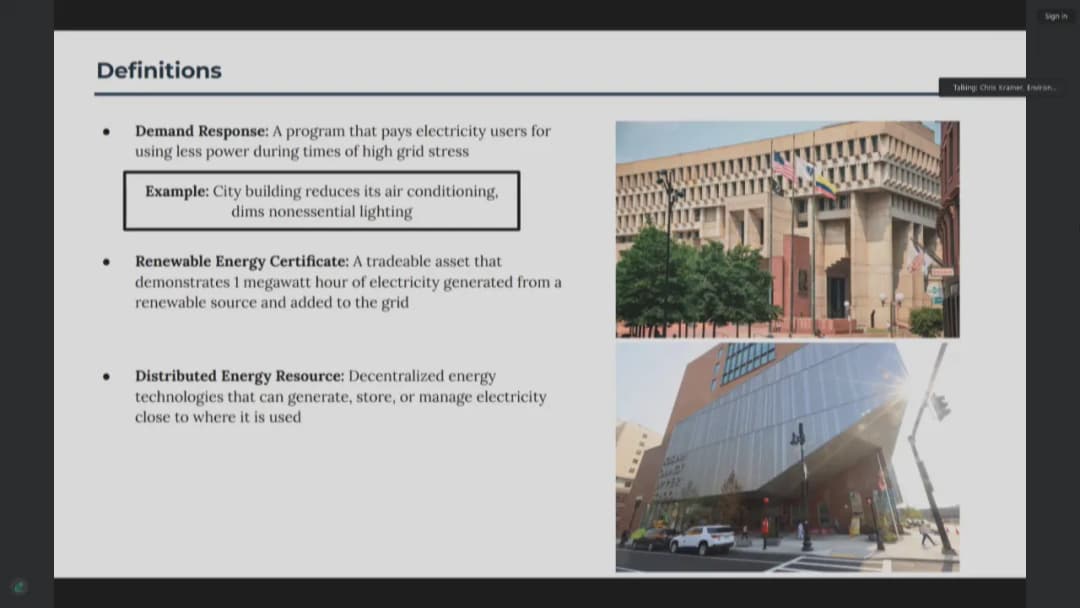
The Boston City Council Committee on Government Operations, chaired by Vice Chair Councilor Rutsi Louis, held a virtual hearing on August 4, 2026, at 10:00 AM to discuss docket number 1223, an ordinance to amend the city's Distributed Energy Resource Revenue Revolving Fund. The proposed amendments aim to expand the fund's revenue sources to include all city buildings (not just Boston Public Schools) and allow expenditures for measures that increase enrollment in demand response programs, thereby increasing energy savings and reducing greenhouse gas emissions. The hearing featured testimony from Oliver Sellers Garcia, Commissioner of the Environment Department, and Chris Kramer, Director of the Municipal Energy Unit. No public testimony was offered. Discussion Items - Presentation by Administration: Oliver Sellers Garcia and Chris Kramer explained that the revolving fund was originally created in the early 2010s to capture revenue from renewable energy certificates (RECs) and demand response programs from a limited set of buildings (school combined heat and power units and city-owned solar arrays). The proposed amendments would expand revenue sources to include all city buildings, and allow expenditures to enroll more buildings in demand response programs. Demand response involves reducing electricity use during grid stress (e.g., turning down AC, dimming lights) to earn payments. The fund currently generates about $50,000 annually; amendments are projected to add $150,000 in new annual revenue, totaling $200,000, subject to weather and grid operator calls. - Councilor Questions: Council President Braden asked about renewable energy certificate generation (currently none due to inverter issues) and battery storage (not yet deployed). She also inquired about the relationship between the fund and the Renew Boston Trust. Councilor Murphy asked whether the expanded revenue would help improve HVAC in Boston Public Schools buildings, especially during hot days. Administration responded that the fund would allow investment in battery storage and building automation systems in schools, improving comfort and efficiency. Councilor Flynn asked about supporting students in older school buildings with challenging HVAC systems; Commissioner Sellers Garcia cited the Otis School project as an example of incremental improvements. Councilor Rutsi Louis asked about the current fund balance (under $10,000) and expenditures (transferred to BPS for combined heat and power plant maintenance). Councilor Gerald had no questions. - Technical Clarifications: The administration clarified that demand response applies only to city-owned properties, not residential. The projected $150,000 in new annual revenue is above the current baseline of approximately $50,000. The fund is intended to be self-sustaining, enabling steady enrollment of additional buildings each year. The presentation also noted that completed efficiency projects avoid approximately $500,000 per year in Boston Building Energy Reporting and Disclosure Ordinance (BERDO) compliance costs. Key Outcomes - No formal vote was taken during the hearing; the committee will likely report the ordinance favorably to the full council. The hearing adjourned after all questions were answered, with no public testimony or opposition expressed. - The proposed amendments will allow the city to capture demand response revenue from all city buildings and reinvest those funds into expanding the demand response program, improving energy efficiency and reducing greenhouse gas emissions. - Next steps: The ordinance will proceed to the full Boston City Council for a vote.

ENVIRONMENTAL PROTECTION 60% · PUBLIC EDUCATION 18% · PROCEDURAL 17% · BUDGET EQUITY ANALYSIS 5%
67
JUL 30, 2026 · BOSTON, MASSACHUSETTS · CITY COUNCIL
City Services Committee Hearing on Animal Control, Leash Laws, and Public Safety – July 30, 2026

The City Services Committee, chaired by City Councillor Ed Flynn, held a hearing on July 30, 2026, to review animal control enforcement, leash law compliance, dog licensing, and public safety in Boston. The hearing examined rising calls for service, staffing shortages, enforcement challenges, and the balance between responsible pet ownership and public safety. Key speakers included Director of Animal Care and Control Alexis Traszinski and MSPCA Vice President Mike Kiley, along with public testimony from residents. Consent Calendar - None. Public Comments & Testimony - Chris (Dorchester Heights Association, South Boston): Reported that off-leash dogs at Dorchester Heights Monument and Carson Beach are a major concern for residents. His neighborhood association brainstormed solutions including a public education media campaign, more signage, community outreach (e.g., "bark rangers"), and better coordination with the Boston National Park Service. He emphasized the need for increased animal control officers in the field. - Kyla (primary care nurse practitioner, community health): Stated she treats dog bite victims and was personally bitten by an off-leash pit bull, but urged against blanket leash laws that treat all off-leash dogs as equally dangerous. She advocated for designated off-leash hours, additional dog parks, and permits for dogs with proven recall and behavioral assessments. She noted that Boston makes responsible dog ownership difficult due to limited housing and few legal off-leash spaces. - Wendy (Brookline resident): Described a traumatic attack on her 11-pound Maltese by an unleashed 110-pound Australian shepherd in her apartment building elevator on June 28, 2026. The attack resulted in her dog losing both eyes, costing $6,000 in emergency care. She criticized delayed response (three days for animal control), lack of enforcement against the unlicensed dog, and the legal classification of dogs as property. She called for more funding, timely hearings, and stronger leash law enforcement. - Myron Adams (Dorchester resident, pedestrian): Expressed fear of being bitten by off-leash dogs, describing two near-incidents with an unleashed pit bull. He asked what recourse pedestrians have if bitten and emphasized the need for safety without reservation. Discussion Items - Staffing and resource constraints: Alexis Traszinski reported that the division has 19 staff members, with 6 field officers and 1 supervisor (one vacant position). They respond to about 9,500 calls annually—a 56% increase since 2020—while covering 50 square miles and 700,000 residents. Officers are on call 24/7 but often must triage higher-priority emergencies (e.g., animal cruelty, bites, strays) over leash law patrols. - Enforcement and citations: Citations increased from 2,400 in 2021 to 2,774 in 2025, while dedicated patrols decreased from 2,400 to 1,700. Many citations are issued during responses to bite investigations or cruelty complaints, not proactive patrols. Officers cannot detain people who refuse to provide identification, limiting citation enforcement for off-leash dogs. - Parks and signage: Traszinski noted that many parks have clear signage, but off-leash violations persist, especially in hotspot parks like Millennium Park, M Street Park, and McConnell Park, where dogs run on softball fields. Deputy Commissioner Breeze Outlaw (Parks Department, new in role) could not provide specific park ranger staffing numbers but committed to follow up. - Equity and communication: Speakers noted that underserved communities (especially Dorchester) have higher call volumes due to housing insecurity, lack of pet-friendly housing, and fear of engaging with authorities. Traszinski emphasized the need for multilingual signage and community outreach (e.g., low-cost vaccination clinics) to build trust. - MSPCA role and collaboration: Mike Kiley described the MSPCA's work on cruelty cases (felony-level), community clinics, and pet food pantries. He stressed that resources—not just punitive measures—are key to reducing incidents, and offered to collaborate on public education campaigns. He noted that intact (unneutered) animals are more likely to be involved in bites. Key Outcomes - No formal votes were taken; the hearing was informational. - Councillors Flynn and Murphy committed to follow up with the Parks Department (which did not appear) with a list of written questions, particularly about park ranger patrols and enforcement data. - A request was made for a list of neighborhoods with and without dog parks (including DCR parks) to identify gaps in off-leash facilities. - All panelists and public speakers agreed that public education and increased animal control resources are needed; no new laws were proposed, but better enforcement of existing laws was urged. - Councillor Flynn emphasized that residents should leash dogs except in designated off-leash areas and that the city aims to increase dog park spaces. He reiterated respect for service animals and the need for inclusive public spaces. - Next steps: The committee will review written comments and potentially schedule follow-up discussions on funding for additional animal control officers and park officers, as well as a coordinated public awareness campaign with the MSPCA.

ANIMAL WELFARE 67% · PUBLIC SAFETY 30% · PARKS AND RECREATION 2% · PUBLIC ENGAGEMENT 1%
68
JUL 29, 2026 · BOSTON, MASSACHUSETTS · CITY COUNCIL
Boston Public Facilities Commission Meeting - July 29, 2026

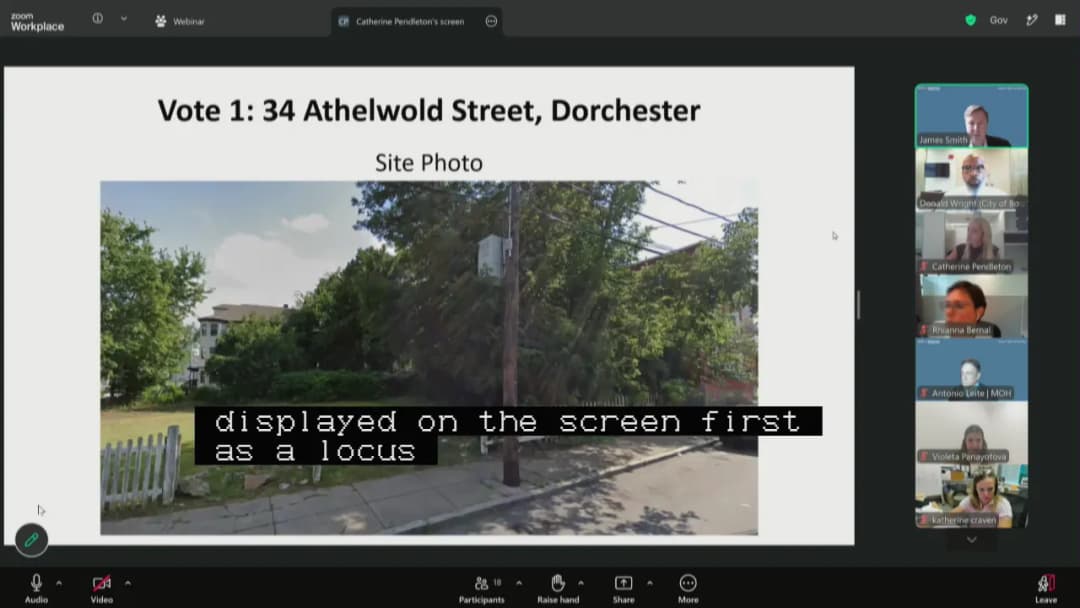
The Boston Public Facilities Commission (PFC) met on July 29, 2026, to consider eight agenda items covering project approvals, contract awards, and land transfers from the Public Facilities Department (PFD) and the Mayor's Office of Housing (MOH). All items were approved unanimously by the three commissioners present: Chair Catherine Craven, Commissioner Larry Mamoli, and Commissioner Donald Wright. Consent Calendar - Approval of meeting minutes from March 25, 2026 (Boston Fire Department) and June 17, 2026 (PFD and MOH). Both sets of minutes were approved by roll call with Chair Craven and Commissioner Wright voting yes. Discussion Items PFD - MSBA Accelerated Repair Program: Margarita Moon's Academy & Orchard Garden School (Votes 1 & 2) - Tim Columber, PFD Project Manager, presented two contract awards for the 2025 Massachusetts School Building Authority (MSBA) Accelerated Repair Program. The projects involve converting existing gas-fired heating and cooling systems to all-electric heat pump systems at both schools, and a roof replacement with PV-ready provisions at Orchard Garden School (99 Albany Street, Roxbury). The roof is approximately 23 years old. - Vote 1: Award of a $20,000 owner project manager services contract to Scanska USA Building Inc. for the feasibility study through schematic design phase, ending September 17, 2027. - Vote 2: Award of a $495,835 design services contract to Ritz Frost Shrumway Engineering (assigned after unsuccessful negotiations with Shakar & Associates) for the same scope and term. - Background: Boston submitted eight statements of interest in March 2025; seven were invited into the program (one moved to a later group). These two projects are the first group. Remaining six are expected before the Commission in September 2026. - No questions; voted unanimously. PFD - William E. Carter School Building Envelope Testing Amendment (Vote 3) - Gee de Acevedo, Senior Project Manager, requested a fourth amendment to the contract with Lero Program Construction Management for owner project manager services. An increase of $25,850 (all in additional services related to whole-building air leakage testing) brings the total not-to-exceed contract amount to $3,676,363. The contract expiration remains October 23, 2026. The testing is part of building envelope commissioning for the school at 396 North Canton Street, South End. - No questions; voted unanimously. MOH - Tentative Designation Extension for Gen Wealth Development LLC (Vote 1) - Jamie Smith, Senior Environmental Compliance Manager, requested a six-month extension (from 12 to 18 months) for tentative developer designation for vacant land at 34 Athwald Street, Dorchester. The developer, Gen Wealth Development LLC, proposes six homeownership units. The extension allows completion of permitting, after which MOH will return for a conveyance vote. Public benefits include new housing, revitalization of vacant land, construction jobs, $250,000 city revenue from sale, and return to tax rolls. - No questions; voted unanimously. MOH - Intra-City Transfer to Boston Centers for Youth & Families (Vote 2) - Jamie Smith requested transfer of three parcels (40, 48, and 54 Geneva Avenue, Roxbury) from MOH to BCYF for a new community center. The parcels total 42,937 sq ft of vacant land. Construction began January 2026 and is expected to complete in early 2028, overseen by PFD. After construction, BCYF will assume care and custody. - No questions; voted unanimously. MOH - Extension for ILYB LLC for Nubian Square Cultural Project (Vote 3) - Rihanna Burnell, Associate Director of Asset Management, requested a six-month extension (from 36 to 42 months) for ILYB LLC for two unnumbered parcels on Washington Street, Roxbury. The project emerged from the Plan Nubian Square process (since 2016) with community input via the Roxbury Strategic Master Plan Oversight Committee (RSM POC). ILYB is Roxbury-based and minority-owned. The proposal includes rehabilitating and extending an existing building to create 10 performing art studios, a media mixing room, and approximately 7,000 sq ft of outdoor park, plus gallery space depicting Nubian Square's cultural influences. The RSM POC has outlined monthly deliverable milestones. - No questions; voted unanimously. MOH - Conveyance to Eco Homes Highland Park LLC for Highland & Marcella Streets (Vote 4) - Antonio Leish, Senior Housing Development Officer, requested conveyance of eight parcels (237, 255, 257, 259 Highland Street and 75, 84, 86, 88 Marcella Street, Roxbury) to Eco Homes Highland Park LLC for a purchase price of $800. The RFP emphasized income-restricted homeownership. Prior tentative designations were approved in April 2024, with extensions in July 2025 and April 2026. Units will be deed-restricted to moderate and middle-income households (80–100% area median income) and owned by the Highland Park Community Land Trust, ensuring perpetual affordability. Construction is slated for fall 2026. - No questions; voted unanimously. MOH - Tentative Developer Designation for 11 Chippman Street, Dorchester (Vote 5) - Minwen Yen, Project Manager, requested tentative developer designation to Regine Foster for a vacant parcel at 11 Chippman Street, Dorchester, with a recommended purchase price of $25,000. An RFP issued in March 2026 yielded one eligible proposal. The developer intends to maintain and landscape the parcel. Public benefits include returning the property to productive use and tax rolls after nine years in MOH inventory, and generating $25,000 in revenue. - No questions; voted unanimously. Key Outcomes - All eight votes were approved unanimously by roll call (Chair Craven, Commissioner Mamoli, Commissioner Wright each voting yes). - Contracts awarded: Scanska USA ($20,000 OPM) and Ritz Frost Shrumway Engineering ($495,835 design) for MSBA school projects; $25,850 amendment to Lero Program Construction Management for Carter School envelope testing. - Extensions granted: Six-month extension for Gen Wealth Development (Dorchester) and six-month extension for ILYB LLC (Roxbury cultural project). - Land transfers approved: Intra-city transfer of three parcels to BCYF for a community center, conveyance of eight parcels to Eco Homes Highland Park LLC for affordable homeownership, and tentative developer designation for Regine Foster at 11 Chippman Street. - Next steps: Remaining six MSBA school projects to come before the Commission in September 2026. Gen Wealth will seek a conveyance vote after building permit. ILYB will report monthly to the RSM POC. Eco Homes and 11 Chippman Street proceed to closing and construction.

PROCEDURAL 35% · HOUSING 30% · ENGINEERING AND INFRASTRUCTURE 26% · ECONOMIC DEVELOPMENT 3%
69
JUL 28, 2026 · BOSTON, MASSACHUSETTS · CITY COUNCIL
Boston Zoning Board of Appeal Hearing - July 28, 2026

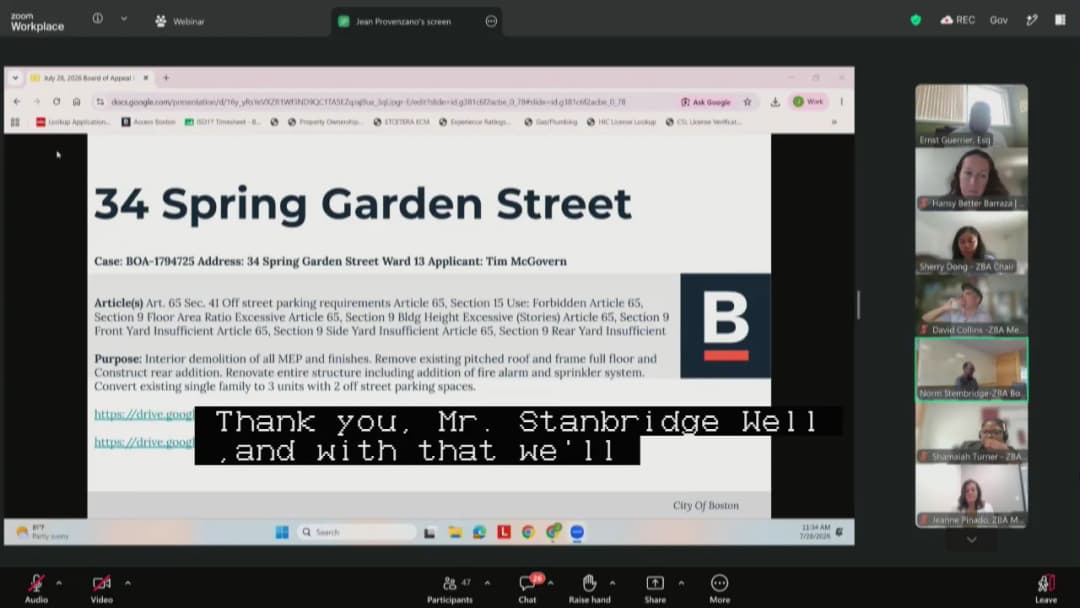
The Zoning Board of Appeal held a virtual hearing on July 28, 2026, starting at 9:30 AM. The meeting included multiple agenda items: a consent calendar for routine approvals, several cases involving building code relief, housing conversions, and new construction projects. The board also deferred three cases to future dates and heard public testimony from city offices, elected officials, and community members. Key decisions included approval of a building code variance with conditions, approval of a six-unit development in East Boston, and approval of several housing conversion projects. Consent Calendar - The board granted extensions for seven cases (BOA 149-4349, 948-352, 948-354, 133-2592, 1632-35, 159-3053, 159-3050) unanimously, with no questions. - The board approved all recommendations from the recent subcommittee meeting: case BOA 1850866 (85 Everett Street), 1819861 (203 Falcon Street) with planning department design review, 183949 (59 Washington Street), 1860034/1860029 (478-484 West Broadway), 1857382 (392-394 Geneva Avenue), 171515 (655 William T. Morrison Boulevard), 18592 (153 Beach Street), and 185194 (16 High Rockeway), all unanimously. Public Comments & Testimony - 97-101 Milton Street (Cedar Grove Cemetery): Emma Jones (Mayor's Office of Neighborhood Services) noted community support from Cedar Grove Civic Association but concerns about density and parking. Liam Remus (Councilor Fitzgerald's office) expressed support. The office deferred to the board. - 32 Fisher Ave: J. Johnson (Office of Neighborhood Services) reported no concerns at the abutters meeting and noted support from the Community Alliance of Mission Hill. The office deferred to the board. - 320 Summer Street (office-to-residential conversion): Ashley (Councilor Flynn's office) expressed support, requesting continued work with neighbors during construction. Dylan Norris (Planning Department) described the Article 80 process. Christian Simonelli (Boston Groundwater Trust) had no comments. The Mayor's Office of Neighborhood Services deferred to the board, noting community concerns about interior configuration but positive reaction to facade preservation. - 47-49 Gray Street: Eva Jones (Mayor's Office of Neighborhood Services) reported 16 letters of support and one letter of opposition from a direct abutter (concerns about privacy and scale). Councilor Flynn's office expressed support based on community process. Christian Simonelli (Boston Groundwater Trust) had no comments. - 97 Salem Street: Eva Jones (Mayor's Office of Neighborhood Services) reported community opposition (concerns about size, scale, impact on historic street) and two letters of support. The North End Waterfront Residents Association opposed; the North End Waterfront Neighborhood Council supported. Public speakers included: Peter Alfay (co-owner) noted 26 years of effort to permit the building, redrawing from 10 units to 5, plans to reopen a bakery. Attorney Derek Small noted 30 letters of support and a letter of support from the neighborhood council. Downey Romano (abutter) opposed, citing lack of detail and potential window blockage. David Kubiak (North End Waterfront Residents Association) opposed, citing excessive mass, density, and impacts on Salem Street. Ken Rothman (direct abutter) supported, noting housing need and first-floor retail. Patrick Tomaro (neighbor, Henchman Street) supported. Lisa Garcia Regnetta (co-owner) noted amendments to address neighbor concerns (shadow studies, no window blockage). - 34 Spring Garden Street: J. Johnson (Office of Neighborhood Services) reported an abutters meeting on December 10, 2025, with concerns about parking; the Columbia Savon Hill Civic Association voted 18-11 in support. Councilor Fitziero’s office had no additional comments. - 163-165 Hillside Street: J. Johnson (Office of Neighborhood Services) reported an abutters meeting on February 19, 2026, with concerns about abandoned vehicles and increased density; the Community Alliance of Mission Hill supported. Councilor Gherkin’s office expressed support. - 62 L Street: J. Johnson (Office of Neighborhood Services) reported multiple abutters meetings, culminating in a revised proposal (balcony instead of deck) with no opposition at the last meeting; the City Point Neighborhood Association took no formal position. Councilor Flynn’s office expressed support. Luann O’Connor (City Point Neighborhood Association) praised the community process. - 183 St. Botolph Street: J. Johnson (Office of Neighborhood Services) reported an abutters meeting on July 28, 2025, with questions about landmark district compliance and trash storage; the St. Botolph Neighborhood Association took no formal position. Christian Simonelli (Boston Groundwater Trust) had no comments. - 78 Bunker Hill Street: J. Johnson (Office of Neighborhood Services) reported an abutters meeting on March 10, 2026, with three opposed abutters; later, the most direct abutter withdrew opposition. No additional public comments. - 3 Moore Street (East Boston): J. Johnson (Office of Neighborhood Services) reported no abutters attended the April 1, 2026 abutters meeting; the Harbor View Neighborhood Association voted 3-11 to oppose. The representative (Richard Lynns) noted parking issues as a likely concern. No additional public comments. - 87 Barr Street (Morris Street): J. Johnson (Office of Neighborhood Services) reported no public comments at the August 22, 2023 abutters meeting; the Maverick Central Neighborhood Association supported. Christian Simonelli (Boston Groundwater Trust) had no comments. Discussion Items - Building Code Relief – 46 Mystic Street (Unit 1): Attorney Richard Lynns represented the condo owners, requesting relief for a utility room in the basement that is only accessible through Unit 1. The condition has existed since the condo conversion in 2003. Options discussed: relocating utilities (exorbitant cost) or allowing the status quo with a condition to correct during any future substantial renovation of Unit 1. The board initially voted on a motion of denial (3-3, motion failed), then passed a motion to approve with the condition that the issue is fixed upon substantial renovation of Unit 1 (6-0). - 97-101 Milton Street (Cedar Grove Cemetery): Attorney Charlie Tetman presented a proposal to construct three two-unit dwellings (six units total) on a 15,876 sq ft lot, rezoned from cemetery land in 2024. The design respects the neighborhood, and community support was noted. Board members questioned the 12 parking spaces (2 per unit) and tree canopy preservation. The motion to approve was passed (6-0) with a proviso for BPD site planning design review to reduce parking and increase open space. - 516 Harvard Street (Mattapan): Attorney Matt Eckle proposed converting a three-family dwelling into a four-family dwelling by renovating the lower level. The project received support from the Wellington Hill Neighborhood Association. The motion to approve passed (6-0). - 32 Fisher Ave (Mission Hill): Luis Santana proposed converting an existing three-family dwelling into a four-family dwelling, with minimal relief needed for FAR, open space, and off-street parking. The project was supported by the Community Alliance of Mission Hill. The motion to approve passed (6-0). - 320 Summer Street (Fort Point): Attorney Joe Hanley presented an office-to-residential conversion under the city’s pilot program (Article 80K). The project will create 145 residential units (20% affordable at 60% AMI) and 7,500 sq ft of ground-floor retail. No parking is provided; the building is near South Station. The board approved (6-0). - 47-49 Gray Street (South End): Julian Miller proposed adding a rear deck on the first floor of a single-family home. The project received 16 letters of support. The motion to approve passed (6-0). - 97 Salem Street (North End): Attorney Derek Small proposed converting a vacant commercial building into retail and five residential units. The project has a 26-year history, with significant community opposition (size, scale, historic street impacts). The board approved (6-0) with a proviso for BPD design review of the exterior elevation, penthouse, and deck locations. - 34 Spring Garden Street (Dorchester): Attorney Matt Eckle proposed converting an existing structure into three homeownership units. The project was designed with input from abutters. The motion to approve passed (6-0) with a proviso for BPD design review of parking access. - 163-165 Hillside Street (Mission Hill): Attorney Ryan Spitz proposed converting a two-family dwelling into a three-family dwelling (basement conversion). The Community Alliance of Mission Hill supported. The motion to approve passed (6-0). - 62 L Street (South Boston): David Luciano proposed replacing an exterior staircase with a rear porch on the second floor. The motion to approve passed (6-0). - 183 St. Botolph Street: Attorney John Pugini proposed adding a fourth floor and a two-story rear addition to increase from four to five units. The motion to approve passed (6-0) with a proviso for review by the St. Botolph Architectural Conservation District. - 78 Bunker Hill Street (Charlestown): Tim Shann (architect) proposed converting a single-family (illegally a three-family) into a two-family duplex. The motion to approve passed (6-0) with a proviso for BPD review of the dormer. - 3 Moore Street (East Boston): Attorney Richard Lynns proposed a six-unit building on a 5,000 sq ft lot in an EVR-3 district. The project requires relief for lot width (50 ft vs. 55 ft required). The board approved (6-0) with provisos for BPD design review of exterior massing and interior layout of the window wells. - 87 Barr Street (Morris Street, East Boston): Attorney Richard Lynns proposed converting a two-family to a three-family, with most violations now moot under amended zoning (Article 53). The project is now solely for a GCOD conditional use permit. The board approved (6-0). Key Outcomes - 46 Mystic Street: Approved with the condition that the building code violation be corrected upon any substantial renovation of Unit 1. (Motion carried 6-0) - 97-101 Milton Street: Approved with proviso for BPD site planning design review to reduce parking and increase open space. (Motion carried 6-0) - 516 Harvard Street: Approved (6-0). - 32 Fisher Ave: Approved (6-0). - 320 Summer Street: Approved (6-0). - 47-49 Gray Street: Approved (6-0). - 97 Salem Street: Approved with proviso for BPD design review of exterior elevation, penthouse, and deck locations. (Motion carried 6-0) - 34 Spring Garden Street: Approved with proviso for BPD design review of parking access. (Motion carried 6-0) - 163-165 Hillside Street: Approved (6-0). - 62 L Street: Approved (6-0). - 183 St. Botolph Street: Approved with proviso for review by the St. Botolph Architectural Conservation District. (Motion carried 6-0) - 78 Bunker Hill Street: Approved with proviso for BPD review of the dormer. (Motion carried 6-0) - 3 Moore Street: Approved with provisos for BPD design review of exterior massing and interior layout of window wells. (Motion carried 6-0) - 87 Barr Street: Approved (6-0). - Deferrals: - 43 Eastwood Circuit: Deferred to August 11, 2026. - 7-9 Martin Court: Deferred to August 11, 2026. - 4018-401 Chelsea Street: Deferred to September 8, 2026. - 26 Birch Street: Deferred to September 8, 2026.

ZONING BOARD OF APPEALS 44% · ENGINEERING AND INFRASTRUCTURE 16% · AFFORDABLE HOUSING 13% · PROCEDURAL 7%
70
JUL 24, 2026 · BOSTON, MASSACHUSETTS · CITY COUNCIL
Boston City Council Hearing on Housing Voucher Discrimination and Fair Housing Enforcement – July 24, 2026

On July 24, 2026, the Boston City Council Committee on Civil Rights, Racial Equity, and Immigrant Advancement, chaired by Councilmember Minyard Culpeper (District 7), held a hearing on Docket O39 – an order regarding housing voucher discrimination and fair housing civil rights enforcement in Boston. The hearing examined persistent discrimination against renters using housing vouchers, six years after the landmark Suffolk University Law School/Boston Foundation report "Qualified Renters Need Not Apply" documented widespread bias. Panelists from Lawyers for Civil Rights, Suffolk University Law School's Center for Housing Justice and Policy, the Boston Foundation, the Massachusetts Commission Against Discrimination (MCAD), and city officials discussed testing results, enforcement gaps, and recommendations. Consent Calendar - None noted. The agenda and minutes were not available. Public Comments & Testimony - T. Lawrence Ware (public testimony via Zoom) described a pattern where landlords receive disparaging verbal references from previous landlords, leaving voucher holders with no written record and risking voucher expiration within 120 days. He requested that the city implement a program requiring references to be submitted in writing or via email so they can be tracked, and that landlords be required to attend discrimination training. He also noted that it is difficult for voucher holders to reach the right person at the Boston Housing Authority when reporting discrimination. Discussion Items - Councilmember Culpeper opened by stating that fair housing is a civil rights issue and that qualified renters should not face barriers due to race, source of income, or lawful rental assistance. He referenced the 2020 Suffolk University/Boston Foundation report finding voucher discrimination in 80% of paired tests and race-based discrimination in 71%. White market-rate renters could view apartments 80% of the time, versus 48% for Black market-rate renters; for voucher holders, rates fell to 12% for white voucher holders and 18% for Black voucher holders. He noted that the city secured $100,000 in the FY27 budget for a Fair Housing Testing Program. As former HUD regional counsel, he had sought to file suit based on the report but could not find a large apartment complex as a target. - Jillian Lenson (Lawyers for Civil Rights) reported that her organization filed a lawsuit in 2024 against 20 Boston-area landlords and brokers for voucher discrimination, but the case was dismissed on a procedural motion. She recommended the city prioritize training and public education for housing providers and tenants, increase penalties for real estate providers who discriminate, ensure fast-acting enforcement given the time-limited nature of vouchers, commit resources for testing and impact litigation, and support families at risk of losing subsidies due to discrimination (e.g., by maximizing program flexibilities and staff resources). She also noted that HUD's investigation into Boston's fair housing efforts is baseless. - Chief Severa (Chief of Equity and Inclusion) reported that the Office of Fair Housing and Equity (OFHE) has received 412 complaints since July 1, 2020, with the largest category (33%) marked as "unknown or not categorized" – attributed by an investigator to data entry errors rather than a lack of investigation. She stated that a new executive director for OFHE will be announced within several weeks, and a director of investigations will start soon. She acknowledged delays due to turnover, grief over the loss of former director Bob Torrell, and a six-month hiring freeze. OFHE is a Fair Housing Assistance Program (FAP) agency contracted with HUD; its goal is to investigate and issue a finding within 100 days. - Virginia Albert (Assistant Director of Civil Rights, Boston Housing Authority – BHA) explained that BHA's Office of Civil Rights (OCR) investigates discrimination complaints from BHA public housing residents, applicants, and employees but does not have authority to investigate complaints against private landlords involving voucher holders. Since 2020, BHA has referred such complaints to OFHE. She noted that BHA helped introduce the Housing Rights Initiative to Boston, leading to the 2024 lawsuit. BHA has created a voucher discrimination guide, and its ECHO program conducts landlord engagement and training. BHA has an internal policy to extend voucher expiration for those experiencing discrimination; the exact time limit is unclear. - Kelly Vieira (Suffolk University Law School, former Director of Investigations and Outreach) described a city-funded testing project conducted from 2020–2022 that found voucher holders were ignored or ghosted, told units were unavailable, subjected to higher income requirements, or asked for additional documentation. In one example, a white tester named "Anne" was offered savings worth $4,440 (free first month's rent, free parking) while a Black tester named "LaToya" touring the same unit was not offered any incentives. Black testers were also told about background and sex offender checks that white testers were not. She emphasized that federal funding cannot be used for voucher discrimination enforcement, making city funding essential. - Ashley Grant (Director of Fair Housing Enforcement, Suffolk University Law School Center for Housing Justice and Policy – CHJP) gave examples of clients helped through testing and enforcement: a disabled veteran with a HUD-VASH voucher who was denied based on rent-to-income ratio (resolved with policy change), and a family with a six-month-old baby who was denied housing because the landlord refused to provide a lead certificate (resolved after CHJP intervention, allowing the family to move in after six weeks in a shelter). She reported that CHJP receives nearly 300 calls per year to its intake line but can only help a fraction. She noted that state funding for the Fair Housing Alliance of Massachusetts will end January 1, 2027, and a lawsuit was filed yesterday (July 23, 2026) by the Massachusetts Fair Housing Center against HUD over potential restrictions on federal funding for fair housing organizations. - Sonia Gupta (Boston Foundation) stated that the Foundation remains open to supporting future testing. She noted that state legislation (Senate Bill S2947), passed by the Senate on February 12, 2026, would mandate fair housing training for real estate professionals, increase license suspensions for repeat offenses, and expand public reporting of complaints – including authorizing the Boston Fair Housing Commission to refer cases to the licensing board. She also emphasized that there are not enough vouchers; only one in four eligible families receives one. - Andrew Espinosa (Deputy Chief of Investigations, MCAD) reported that MCAD received 655 fair housing claims in FY26, with public assistance (voucher) discrimination being the fourth most common claim type (70 claims). Of those, 30% (21 claims) involved properties in Boston. He noted that MCAD’s new online filing portal will soon allow non-attorneys to file complaints directly. He highlighted challenges: MCAD has a small staff, federal funding is uncertain (HUD is rolling back protections and grants may be subject to executive orders on DEI), and the state has provided level funding for the first time, not an increase. He stated that very few cases (two housing-related public hearings last year) reach a hearing; most settle or are dismissed for lack of probable cause. Key Outcomes - Councilmember Culpeper announced he will work with panelists to organize community education events to inform residents about voucher discrimination and their rights, independent of funding. - The OFHE will soon have a new executive director and director of investigations; the city expects to announce these hires within several weeks. - The $100,000 budgeted for the Fair Housing Testing Program will be allocated; panelists urged the city to commit additional funding for testing, enforcement, and education, noting that state and federal funding for voucher discrimination work is being cut or is uncertain. - Councilmember Culpeper indicated he will follow up to obtain copies of the dismissed LCR lawsuit and the multi-state enforcement action against Graystar LLC, and will review data on the 655 MCAD claims and outcomes. - The hearing was adjourned with a commitment to continue working on fair housing enforcement and to hold the city accountable for implementing recommendations from the 2020 report and today’s testimony.

FAIR HOUSING 75% · CIVIL RIGHTS 10% · PUBLIC HOUSING 6% · PENDING LITIGATION 5%
OPENPUBLICA · PUBLIC MEETING INDEXUPDATED DAILY · openpublica.com