The Planning Commission met virtually on Tuesday, April 1, 2025 at 7:00 PM to consider three conditional zoning applications for affordable housing, approve the previous meeting's minutes, and discuss staff appointments. All votes were unanimous with 6 members present. No public comments were received. Consent Calendar - Approval of Minutes (March 18, 2025): The Planning Commission unanimously approved the draft minutes with an amendment to include materials provided by Vice Chair Jonathan Mitchell that were directly relevant to the previous meeting's vote. Discussion Items - MLK Affordable Housing at 607-617 Martin Luther King Jr. Blvd (Hillside Trace): The applicant, Taft Mills Group and Community Home Trust, proposed a Community Priority Conditional Zoning to rezone three parcels from R-1 to Residential Community Priority CZD for a 190-unit 100% affordable rental development (all units at or below 60% Orange County AMI). The project includes structured parking, rooftop amenities, and is located along the future NS+ rapid transit line. Staff found the project consistent with the Comprehensive Plan. The Commission discussed parking ratios (1.3 per unit), stormwater management, and the need to incorporate feedback from the Town's Urban Designer, Brian Peterson. - 2510 Homestead Road (Madry Meadows): The applicant, DHIC, proposed a Community Priority Conditional Zoning for 53 affordable senior rental units (55+), all restricted to households at or below 60% AMI (with deeper targeting: 25% at 30% AMI, an additional 15% at 50% AMI). The site is across from the Seymour Senior Center and near Homestead Park. Staff recommended approval. Discussion focused on minimizing impervious surfaces in the Resource Conservation District (RCD), greenway connections, and parking (approximately 1 space per unit). - 1701 Martin Luther King Jr. Blvd (1701 North Apartments): The applicant, Zimmer Development Company, requested a conditional rezoning to convert long-vacant ground-floor commercial space into six affordable residential units (60% AMI). The existing 154-unit apartment complex is 97% occupied. The change would reduce daily vehicle trips (from 448 to 43). Staff and the Commission supported the proposal, with suggestions to add shade trees to the parking lot and consider noise buffering for units facing MLK Boulevard. Key Outcomes - 607-617 MLK Blvd: The Commission unanimously voted to recommend that the Town Council adopt Ordinance A (approving the application) and Resolution A (finding consistency with the Comprehensive Plan), with a condition that the developer continue to work positively with the Town's Urban Designer. - 2510 Homestead Road: The Commission unanimously voted to recommend that the Town Council adopt Ordinance A and Resolution A, with a condition that the applicant continue to investigate ways to move as much development outside the RCD as practicable. - 1701 MLK Blvd: The Commission unanimously voted to recommend that the Town Council adopt Ordinance A and Resolution A, with a recommendation that the applicant increase shade tree plantings in the parking lot and consider noise mitigation for the new units.
Public Meetings - Chapel Hill, North Carolina
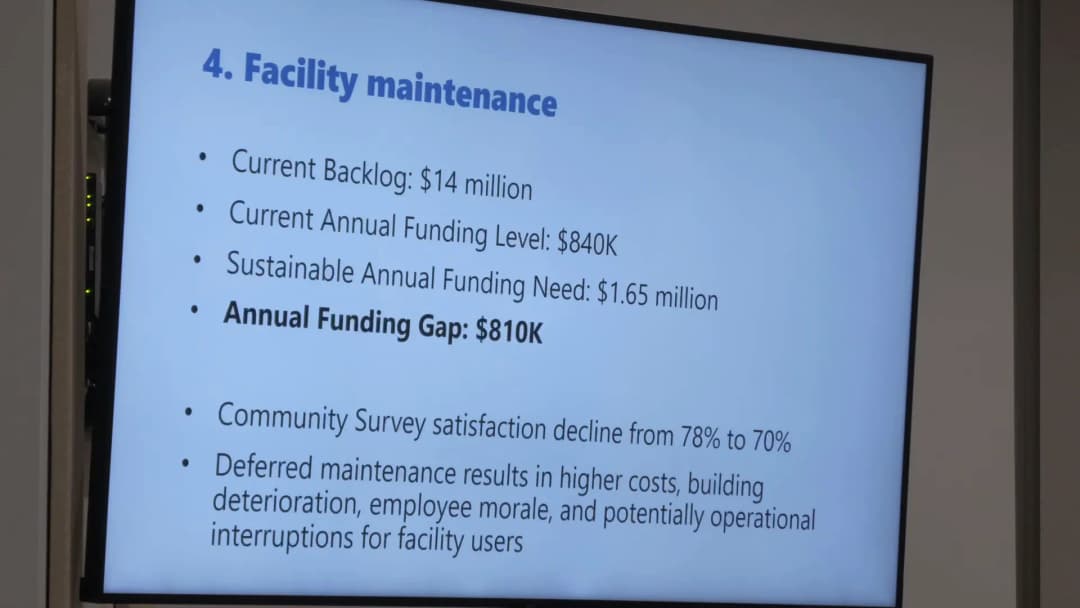
Public Meetings - Chapel Hill, North CarolinaThe Chapel Hill Town Council held a work session on March 26, 2025, beginning at 6:00 PM, to receive an update on the FY 2026 budget. The meeting focused on performance metrics tied to strategic goals, the development of the base operating budget, and the Town's major financial challenges, including a projected $6.4 million budget gap. Council members raised concerns about the timing and detail of budget materials, emphasized the need for clear priorities, and requested additional data for future discussions. The meeting concluded with a unanimous vote to enter closed session. Consent Calendar - There were no consent calendar items on the agenda. Public Comments & Testimony - No public comments were made during this work session. The Mayor noted that public comment opportunities would be scheduled for later in the budget process. Discussion Items - Budget Process and Timeline: Mayor Anderson highlighted that the Council would adopt the budget in mid-June, with Orange County presenting property revaluation on April 16. Council Member Stegman expressed frustration about receiving budget materials only at the end of Monday and the lack of detailed information, while Mayor Anderson encouraged Council to communicate data needs. - Strategic Performance Metrics: Interim Town Manager Mary Jane Nirdlinger presented three initial metrics for each of seven priority areas (Environmental Stewardship, Economic and Financial Stewardship, Affordable Housing, Connected Community, Healthy and Inclusive Community, Safe Community, Employee Recruitment and Retention). Council members discussed the importance of making data understandable to the public, providing context, and ensuring metrics reflect values. Some members preferred fewer or more metrics, but consensus leaned toward maintaining at least three per area. - Base Budget and Budget Gap: Business Management Director Amy Oland explained that the base budget starts with a flat continuation of department budgets, excluding increases. A $6.4 million gap was driven by rising costs (e.g., 6% health insurance increase, 0.75% retirement rate increase), a projected $2.5 million sales tax shortfall, and a decline in building permit fees (from $2.5M projection to $1.6M estimate). The Town can no longer rely on lapsed salaries or fund balance to close the gap. - Budget "Big Rocks": Oland presented backlogs and funding gaps for vehicles ($13M backlog; need $2.8M/year, currently $1.6M), facilities ($14M backlog), streets ($14.6M backlog), and fire apparatus ($13.3M backlog; need $1M/year, currently $250K). Council discussed the need for realistic funding levels, not gold standards, and the cumulative burden on residents. - Enterprise Funds: Parking Fund has a $1-$1.5M shortfall due to Rosemary deck delays; Transit Fund receives $36.6M annual contribution; Stormwater fund hasn't had fee increase since 2020; Public Housing fund relies on $2.7M federal allocation and tenant rents. - Federal Funding Risks: Oland highlighted the risk of losing federal funds for housing, community development, traffic, greenways, and police. A $3.5M fund balance could cover housing for 2-3 years, but other programs lack alternatives. Council requested worst-case and moderate scenarios. - Debt and Capital: The debt fund does not include future borrowing for coal ash removal at 828 MLK, which will be discussed on April 16. Key Outcomes - Council unanimously approved a motion (by Stegman, seconded by Berry) to enter closed session as authorized by G.S. 143-318.11(3). - Staff will return on April 16 with budget scenarios and trade-offs, more detailed departmental cut impacts, and data requested by Council including trend lines, benchmarking, context for numbers, and cumulative burden on residents. - The Council directed staff to provide a chart showing the Town's efforts to adopt a revenue-neutral tax rate and its impact on residential and commercial entities. - Council emphasized avoiding overburdening Town employees and communicating unprecedented federal, state, and local changes to the public. Announcements - Council Member Miller-Foushee wished "Ramadan Mubarak" and "Eid Mubarak" to those celebrating.
The Community Design Commission (CDC) of Chapel Hill met virtually on March 25, 2025, at 5:30 PM. The meeting included approval of previous minutes, adoption of comments on the Hillmont and LUMO projects via consent agenda, and a substantive discussion on public art which led to the formation of a subcommittee. Consent Calendar - February Minutes (25-0127): Approved with minor modifications. Motion by Brennan, seconded by Vice-Chair Lyons; unanimous. - Hillmont Comments (25-0128): Approved as part of the consent agenda. - LUMO Comments (25-0129): Approved as part of the consent agenda. The consent agenda was moved by Washburn, seconded by Brennan; unanimous. Discussion Items - Public Art Discussion (25-0130): Commissioner Brennan initiated a discussion on encouraging the Town Council to incentivize public art. Staff noted that public art is valued but currently lacks specific guidelines. Council Liaison Camille Barry advised the commission to first inventory existing town practices and policies before proceeding. Commissioners debated whether to pass a resolution or form a working group. Concerns were raised about maintenance, funding, and the need to understand current mechanisms (including a former Cultural Arts Commission and a practice policy for public projects). Ultimately, a motion was made by Brennan, seconded by Washburn, to create a subcommittee to explore how the town administers public and private art, including maintenance and support. The motion passed unanimously. Key Outcomes - Consent agenda approved unanimously. - Subcommittee formed: Chair Weis and Commissioner Brennan will serve on the subcommittee to investigate existing public art administration and develop a potential petition to the Town Council. The subcommittee will also examine maintenance and support of art installations. - Next meeting: Tuesday, April 22, 2025.