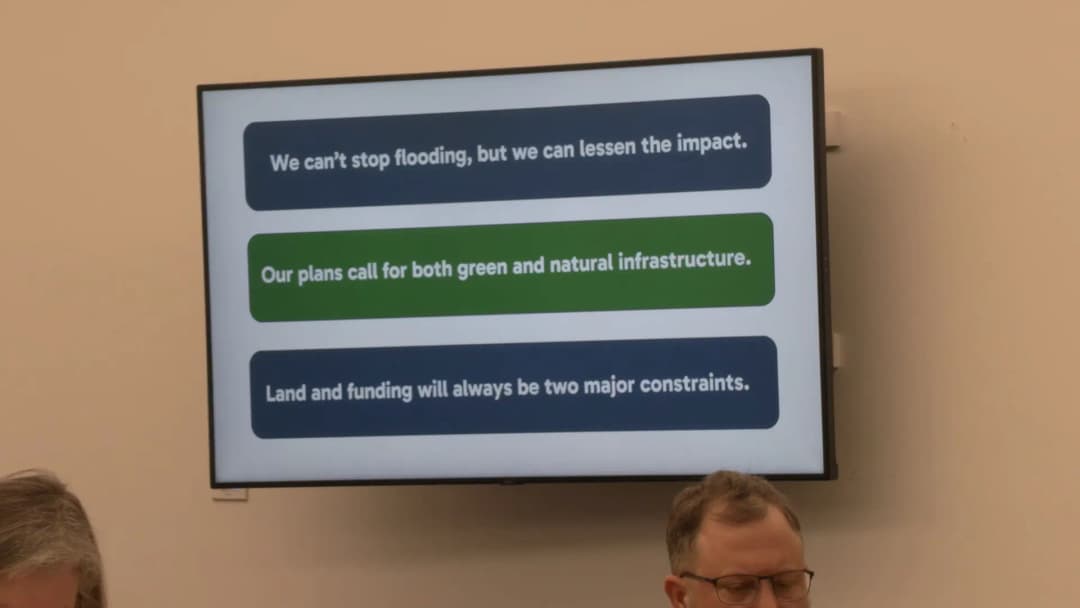
The Chapel Hill Town Council held a work session on March 18, 2026, from 6:00 PM to 9:04 PM at Library Meeting Room B. The meeting focused on the FY 2026-27 budget development and a stormwater program update. No votes were taken; the session was for discussion and direction. Discussion Items FY 2026-27 Budget Development Update Business Management Director Amy Oland presented the budget outlook. Key highlights included: - No tax increase recommended due to stronger-than-expected property tax collections ($2.85 million higher than projected) and a projected 4.2% growth in sales tax revenue. - The five-year budget outlook shows a path toward sustainable funding for core services, workforce, and strategic priorities (community housing, environmental sustainability, organizational resilience). - Council members requested more detailed information on core services, cost-saving innovations, the impact of federal funding threats, and clearer communication to the public about budget trade-offs. - Council also discussed the need for a complete community implementation strategy and requested a list of core services and legally mandated services. Stormwater Program Update Public Works Director Lance Norris, Stormwater Education Coordinator Merrill Robinson, and consultants from Ardurra presented an update on the Stormwater Master Plan. Key points: - The spectrum of stormwater infrastructure (gray, green, natural) was explained, with natural infrastructure (e.g., floodplain reconnection) providing larger-scale benefits. - For the Booker Creek watershed, the cumulative impact of all proposed projects (costing $17 million) would reduce flood elevations by about 2.1 feet at Eastgate, with a FEMA cost-benefit ratio of 0.8 (not including land costs). - Small-scale retrofits (rain gardens, porous pavement) costing $4 million would have negligible flood reduction but water quality benefits. - Council members expressed concerns about the effectiveness of the proposed projects, the need for clearer goals, and the desire to explore alternative strategies such as buyouts, regional solutions, and technical assistance for property owners. - Council requested a second opinion from green infrastructure experts and a more comprehensive evaluation of options, including a local buyout fund. Key Outcomes - No formal votes were taken. The council directed staff to: - Provide more detailed budget information, including core service definitions, cost-saving strategies, and federal funding risk assessments. - For stormwater, bring back a clearer articulation of goals, a range of options (including buyouts, regional solutions, and technical assistance programs), and a second opinion on the plan. - Improve public communication about stormwater risks and available resources. - Future work sessions and public hearings were scheduled: the manager's recommended budget will be presented on May 6, 2026, with a public hearing on May 20, and a budget vote on June 10. The stormwater program will be revisited after further analysis.
Public Meetings - Chapel Hill, North Carolina
Public Meetings - Chapel Hill, North CarolinaThe Chapel Hill Historic District Commission met on Tuesday, March 10, 2026, at 6:30 PM in Room 110 (Council Chamber). Chair Don Tise presided, with Vice-Chair Brian Daniels, Glenn Connolly, Josh Gurlitz, Nancy McCormick, and Laura Moore present (6 members). Staff liaisons Charnika Harrell and Anna Scott Myers, and Counsel Kevin Hornik were also present. The meeting opened with a Women's History Month acknowledgment and a reading of the public charge. The agenda was approved unanimously, as were the February 10, 2026 meeting minutes. Consent Calendar - 304 N. Boundary Street [26-0049]: The commission unanimously approved the written decision for this property. - Administrative COA Approvals and Maintenance Work Report: Received as information; no action taken. New Business – 308 W. Cameron Avenue [26-0050] This item dominated the meeting, involving a request for a Certificate of Appropriateness to renovate the existing house and construct a new detached duplex on the same property. The following key events occurred: Standing Determination - Donald McIver Stanford Jr. and Donna Bryant, owners of abutting property at 129 Mallette Street, requested standing as parties with interest. Mr. Stanford argued special damages due to proximity, potential tree falls, flooding, shading, increased runoff, and visual impact. The applicant, architect Jay Fulkerson, questioned whether special damages could arise if the project met the Land Use Management Ordinance (LUMO). Staff confirmed proper notice was mailed February 24 (10+ days before the meeting). After deliberation, Vice-Chair Daniels moved to grant standing, citing concerns about the size and height of the new house. The motion was amended to include Donna Bryant and passed unanimously (6-0). Applicant’s Presentation - Jay Fulkerson, representing owners Melita and Romulo Colindres, presented plans for the existing house and a new 1.5-story house on the same lot. Key points: - The project is a detached duplex within the allowed floor area limit (combined under 5,000 sq. ft.). - The new house would face Mallette Street, placed as close as possible to the existing house, with parking in a buffer zone next to the north property line. - Grading would lower the new house to minimize height; the retaining wall would be removed to achieve a lower floor. - Materials include Hardy siding, Marvin windows, and a metal porch roof. - Romulo Colindres, son of the owners, supported the application, stating it meets the standards. Cross-Examination by Parties with Standing - Mr. Stanford questioned the condition of the existing concrete block retaining wall and suggested replacing it with stone or metal fencing consistent with the district. Fulkerson was open to discussing changes with his client. - Dr. Donna Bryant presented photographs arguing that the new house’s scale and height (exacerbated by the retaining wall) would ruin the character of Mallette Street, which she described as a historic, narrow street with small family homes. She criticized the parking layout and noted the existing house is a student rental. Public Comment - Elizabeth Sasser (403 W. Cameron Ave.) objected to the doubling of occupants (from 4 to up to 8), expressed safety concerns about parking on narrow Mallette Street, and doubted the property would be well-maintained. Commissioner Discussion & Motion - Commissioners raised concerns about insufficient evidence on scale and massing (Standards 4.2.1, 4.2.2, 4.2.3), the relationship to adjacent historic homes, grading uncertainties, parking configuration, and material choices (e.g., roof shingles). Counsel Hornik advised focusing on the “not incongruous” standard and the special character of the Cameron-Macaulay Historic District. - After extensive debate, the applicant declined to change the application and requested a vote. However, the commission felt they lacked sufficient evidence to make a decision and wanted time to review new evidence presented that evening. - Motion: Vice-Chair Daniels moved to continue the evidentiary hearing to a special meeting on Thursday, April 30, 2026, at 6:30 PM. Commissioners were asked to provide written comments on specific design standards to staff by March 17, 2026; these would be shared with all parties and included in the public agenda for the special meeting. The motion passed unanimously (6-0). Other New Business – Continuances - 208 Glandon Drive [26-0051] and 209 N. Boundary Street [26-0052]: Both applicants consented to continue their items to the regular April 14, 2026 meeting. The motion passed unanimously (6-0). Discussion Items - Design Standards [26-0053] and Education and Outreach [26-0054]: Not discussed due to the length of the 308 W. Cameron hearing. Key Outcomes - Standing granted to Donald Stanford and Donna Bryant for the 308 W. Cameron hearing. - Evidentiary hearing for 308 W. Cameron continued to April 30, 2026, with commissioners to submit written comments on specific design standards by March 17. - 208 Glandon Drive and 209 N. Boundary Street continued to April 14, 2026 regular meeting. - All votes were unanimous (6-0).
The Chapel Hill Town Council met on March 4, 2026, from 6:00 PM to 7:41 PM. The meeting included proclamations, a resolution, public comments, a consent agenda, and two public hearings. Key topics included a resolution supporting constitutional rights, tree protection ordinance violations at Hillmont, a letter to UNC regarding Carolina North development, a bond issuance for affordable housing rehabilitation, and an economic development incentive for a local company. Proclamations and Resolution - Council adopted Resolution R-1 unanimously, affirming support for the 4th and 5th Amendments and civil rights, in response to recent immigration enforcement actions. - Council proclaimed March 2026 as Women's History Month and March 18, 2026 as Transit Team Member Appreciation Day. Announcements by Council Members - Mayor Anderson congratulated primary election winners, announced Severe Weather Preparedness Week (March 1-7), open registration for spring Parks and Rec programs (camp sign-ups March 17 for residents), and the next work session on March 18 on stormwater and budget. Public Comments & Testimony - Members of the Tiger Roots Green Collective (students Marcus Neulander, Samuel Kurz, Teddy Hess, Liam Murphy, Noa Gelber, Hannah Hoffman, Bryer Kalavsky, Atticus Nishimoto, and Craig Nishimoto) addressed tree protection ordinance violations at the Hillmont development on Little John Road. They described silt fencing trenched inside critical root zones of protected trees, causing tree failures and property damage to three families. They requested five actions: (1) formal acknowledgment of violations; (2) affirmation of ordinance importance; (3) commission of a tree risk assessment; (4) commission of a tree appraisal; and (5) compensation for affected residents. They cited a $1,000 challenge that went unanswered by staff for eight months. Craig Nishimoto emphasized the compatibility of tree protection with development and offered pro bono assessments. Mayor Anderson noted extra tree protections included in the 860 Weaver Dairy Road project and acknowledged the ongoing LUMO revision process. Consent Calendar - Council unanimously approved the February 11, 2026 meeting minutes as part of the consent agenda. Item 4 (Authorize Mayor to sign letter on Carolina North and nominees) was pulled by Mayor pro tem Berry for separate discussion. Discussion Items Carolina North Letter and Nominees - The council debated the transmittal of a letter outlining the Town's interests for Carolina North and a list of nominees for the Carolina North Development Advisory Committee. After multiple motions and votes: - A motion to suspend the rule preventing same-day discussion of a pulled consent item failed (6-1, with Council Member Ryan opposing). - A motion to approve the list including council members failed (5-2, with Mayor pro tem Berry and Council Member Ryan dissenting; 2 absent). - A motion to reconsider passed (6-1, Mayor pro tem Berry dissenting). - A motion to divide the question (letter vs. list) passed (6-1, Mayor pro tem Berry dissenting). - A motion to transmit only the letter to UNC-Chapel Hill Chancellor Lee Roberts passed (6-1, Mayor pro tem Berry dissenting). - A motion to transmit the list with council members lacked a second and therefore failed. - Outcome: The letter was transmitted; the list of nominees was deferred to the next meeting. Public Hearing: Bond Issuance for Chase Park and Elliott Woods Apartments - Staff introduced a proposal for the Town to act as conduit bond issuer for $7 million in multifamily housing revenue bonds to facilitate acquisition and rehabilitation of two aging affordable housing communities (Elliott Woods: 39 units; Chase Park: similar size) by developer Vitus. Key points: - Preservation of affordability for 20 years via Section 8 contract extensions and 4% low-income housing tax credits. - No financial risk to the Town; bonds to be repaid by Vitus. - Temporary relocation of residents (maximum 22 days per unit) with all costs paid by developer. - 8 households may exceed 60% AMI income limits; they may remain but rents may be set at tax-credit levels. - Council members asked about resident return guarantees, communication, relocation logistics, and oversight. Developer reiterated experience and plans. - Public hearing was received and filed; staff will return on March 25 for final action. Public Hearing: Project "Seats" Economic Development Incentive - Economic Development Director David Putnam presented an incentive for Eats2Seats, a local tech-enabled stadium concession and staffing company, to establish a headquarters at 462 West Franklin Street. - Proposed incentive: up to 10 parking spaces for 5 years (total value $87,000), conditional on creation and retention of 41 jobs with average wage $122,683. - Company is a Launch Chapel Hill graduate, competing with Austin, Nashville, and Atlanta. - Council closed the public hearing and unanimously adopted Resolution R-2, approving the incentive. Key Outcomes - Adopted Resolution R-1 (4th and 5th Amendment support) unanimously. - Approved February 11 meeting minutes. - Transmitted Carolina North letter to UNC (6-1); nominee list deferred. - Received and filed bond issuance public hearing; final action scheduled for March 25. - Approved Project Seats economic incentive (R-2) unanimously. - Meeting adjourned at 7:41 PM.
The Chapel Hill Town Council met on February 25, 2026, at 6:00 PM in the Council Chamber. The meeting included a Black History Month proclamation, public comments on a proposed Fourth Amendment workplace resolution, approval of a consent agenda, and two conditional zoning public hearings for properties on Weaver Dairy Road. The council voted 8-1 to approve the 860 Weaver Dairy Road project with an amendment allowing flexibility to relocate some townhome density, and unanimously approved the 1165 Weaver Dairy Road project. The meeting adjourned at 9:49 PM after a closed session. Proclamation: Black History Month - Council proclaimed February 2026 as Black History Month, with special recognition of Scouting America Troop 835 and the Chapel Hill Black community. Announcements by Council Members - Mayor Anderson announced the People’s Academy on March 3, Black History Movie Night on February 27, early voting for the March 3 primary, and the next Council meeting on March 4. - Council Member Miller-Foushee extended Ramadan greetings and honored the late Andre Boynton, a Hargraves Center employee of 30 years, by reading a commemorative letter. Public Comments & Testimony - Fourth Amendment Workplace Resolution: Thirteen community members (Ashley Trudeau, Trisha Lester, Mel Soto, Julie Welch, Abby Parcell, Kristen Weigle, Brittany Bryant, Corina Rojas, Maria T Palmer, Cristobal Palmer, Erik Valera, Duncan McLean, and Lib Hutchby) urged the council to adopt a resolution affirming Fourth Amendment protections against federal immigration enforcement. Speakers expressed fear among immigrant families, noted that neighboring communities like Carboro have passed similar resolutions, and argued that the council should uphold its constitutional oath. Several speakers reminded council members of campaign promises to support such a resolution. - Other comments: Jen Costanza raised concerns about elementary school closures and encouraged council engagement with the school board. Lib Hutchby also spoke about water consumption by data centers. Consent Calendar - The council amended the consent agenda to remove the February 26 Chamber Meeting (unanimous). - The amended consent agenda was approved unanimously, including: - Miscellaneous Budget Ordinance Amendment - Town Code Section 14-68 Amendment (designating Veterans Day as a town holiday beginning November 11, 2026) - 2026 Council Meeting Schedule Amendment (as amended) - Approval of January 7, 9, 10, and 21, 2026 meeting minutes Discussion Items 6. Conditional Zoning for 860 Weaver Dairy Road - Applicant Ernie Brown presented a 45-acre mixed-use development with multifamily apartments, townhomes, and a future commercial area. The project includes 10% affordable multifamily units (at 80% AMI) and 15% affordable townhomes (half at 65% AMI, half at 80% AMI), greenway expansion, and stormwater management designed for a 100-year storm. Staff recommended approval. - Public comments: Approximately 15 speakers from neighboring Coventry and Carroll Woods communities raised concerns about stormwater impacts, traffic congestion, density, tree protection, blasting, and the scale of the project. Many urged the council to require more robust buffers, a 30-foot type D buffer along the entrance road, and to move the townhomes off the eastern “leg” to reduce impacts on adjacent properties. Several speakers highlighted the inadequacy of the 100-year storm standard in light of Hurricane Chantal (July 2025) and requested independent review of stormwater studies. - Council discussion: Council members debated the tension between housing needs, greenway connectivity, and neighborhood impacts. Council Member Nollert and Council Member McCullough supported the project, citing the need for housing and transit-oriented development. Council Member Sharp and Mayor Pro Tem Berry opposed, citing unresolved issues with the leg’s density and stormwater concerns. Council Member Ryan proposed an amendment to allow the developer flexibility to move some townhomes from the leg to the middle commercial area if desired. The amendment was accepted. - Votes: - Close public hearing: unanimous (9-0) - Adopt Resolution R-2 (Reasonableness and Consistency): 8-1 (Council Member Sharp nay) - Enact Ordinance O-6 as amended: 8-1 (Council Member Sharp nay) 7. Conditional Zoning for 1165 Weaver Dairy Road - Senior Planner Katherine Shor introduced the applicant’s proposal for a 1.8-acre infill site: a one-story daycare facility and 4-12 townhomes (rental), with shared parking and underground stormwater detention. The project is consistent with the Complete Community goals and the Future Land Use Map. Staff recommended approval. - Public comments: No members of the public spoke on this item. - Council discussion: Council members asked about unit sizes, affordable housing considerations, demand for preschool services, and potential for senior-serving uses. Council Member Miller-Foushee noted the area’s senior population and suggested exploring a mix of uses. The applicant indicated flexibility to increase townhome count if feasible, which would trigger inclusionary zoning requirements. - Votes: - Open and close public hearing: unanimous (9-0) - Adopt Resolution R-3 (Reasonableness and Consistency): unanimous (9-0) - Enact Ordinance O-7: unanimous (9-0) Key Outcomes - 860 Weaver Dairy Road approved 8-1 with an amendment allowing the developer to relocate some townhome density from the eastern leg to the middle mixed-use area, subject to future site plan review. - 1165 Weaver Dairy Road approved unanimously, allowing a daycare and up to 12 townhomes on an infill site. - The council amended the consent agenda to remove the February 26 Chamber Meeting. - The council entered closed session at 9:23 PM to discuss property matters (GS 143-318.11(a)(4) and (a)(5)) and adjourned at 9:49 PM. - No action was taken on the Fourth Amendment resolution; the mayor acknowledged requests but noted the council had not reached consensus.
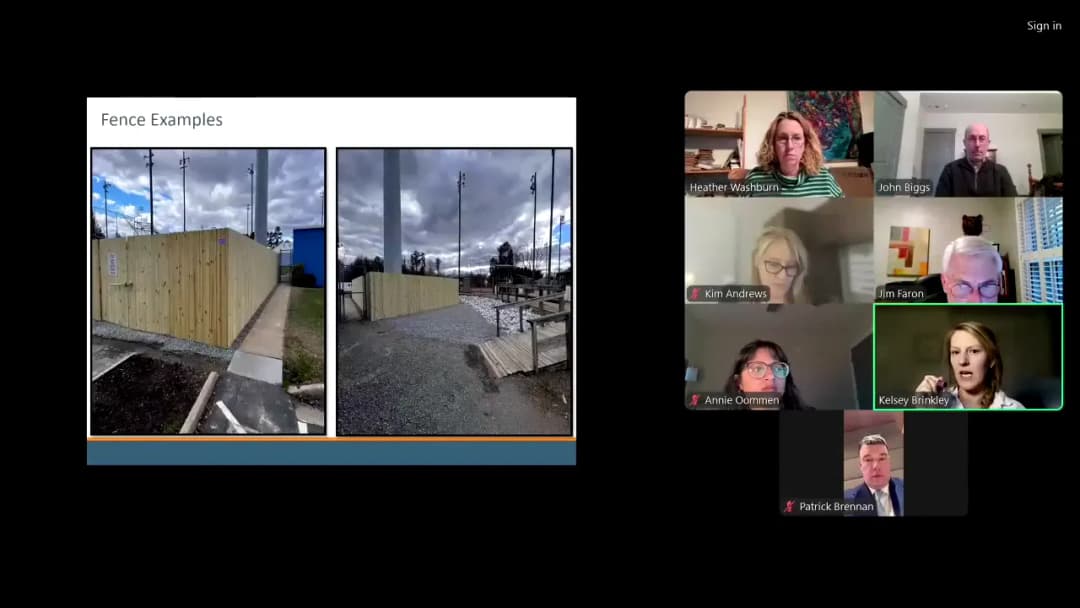
The Chapel Hill Community Design Commission (CDC) met virtually on Tuesday, February 24, 2026, at 5:30 PM to consider a consent agenda and a new business item regarding a cell tower alternative buffer. The meeting included roll call, approval of December minutes with corrections, and a unanimous vote on the consent agenda. The main discussion focused on a proposed alternative buffer for a new 199-foot cell tower at East Franklin Street, which the commission ultimately approved with conditions. Consent Calendar - Sign Permit - Southern Village (Item 26-0044): Approved unanimously. The CDC approved a sign permit for Southern Village, as signs require CDC review in that development. - Trinity Court (Item 26-0045): Approved unanimously. The CDC approved modifications to a recently constructed building involving grade modifications that yielded additional masonry at the foundation. Discussion Items - Cell Tower Alternative Buffer (Item 26-0046): The applicant, Network Towers (represented by Sam O'Vern, land use manager, and Oscar Pesada, project engineer), proposed a seven-foot-tall board-on-board fence in lieu of the required 10-foot-wide vegetative buffer for a new 199-foot monopole communications tower and 35x75-foot compound at East Franklin Street. The site abuts a floodplain/floodway, and the applicant argued that a retaining wall (six feet high) was necessary to elevate the compound out of the flood zone, and that additional planting would increase disturbance in protected areas, as advised by the town's stormwater engineering department. The fence would be pressure-treated wood, consistent with two existing tower compounds on the same property. The commission expressed concerns about the total 13-foot height (retaining wall plus fence) creating a visually imposing structure at the entrance to Chapel Hill, the removal of 16 trees, and the lack of plantings to mitigate stormwater and aesthetics. Commissioners questioned the applicant's willingness to consider native plantings or public art. The applicant stated they were not open to murals or adding plantings outside the fence due to floodplain constraints and stormwater design. The commission noted that the existing towers have painted fences, while this proposal would be unpainted. The stormwater BMP (a soil-based infiltration area at the base of the retaining wall) was described as not suitable for planting. Key Outcomes - Motion: Commissioner Patrick Brennan moved to approve the alternative buffer with three conditions: (1) the retaining wall shall use landscape block that is in keeping with the materials of surrounding buildings (instead of his original proposal for brick facade); (2) the fence shall include public art (e.g., murals) to match existing public art on water retaining towers along the nearby trail; (3) the applicant shall evaluate whether native plantings can be used along the trail. The motion was seconded by Commissioner Kelsey Brinkley. The commission voted unanimously (7-0) to approve with these conditions. The CDC's role is limited to aesthetic review; the project's special use permit was previously approved by the Town Council. The applicant is expected to work within the conditions as part of the approval.
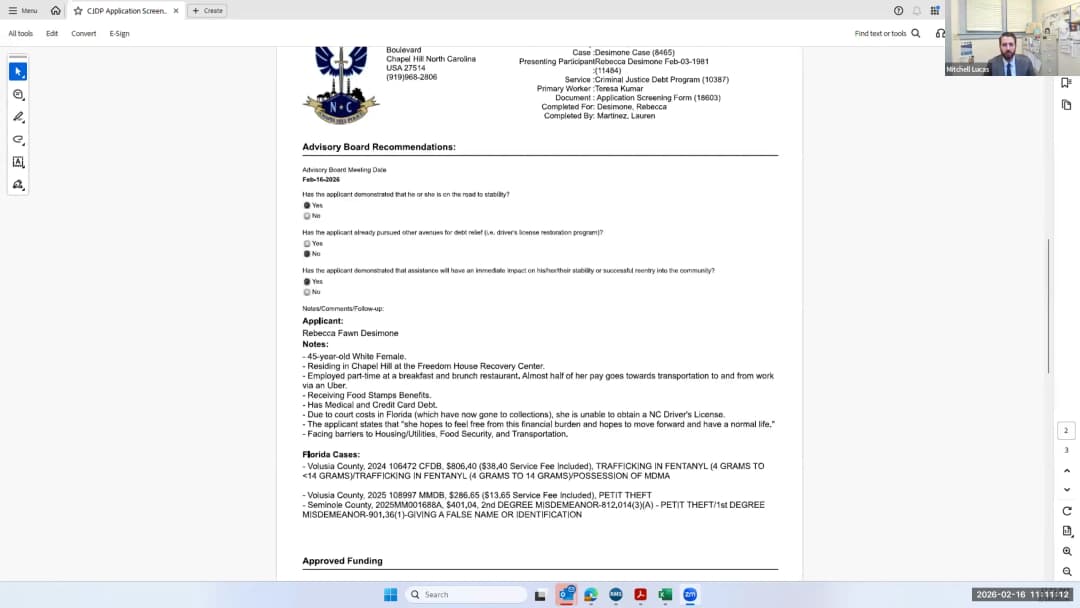
The Chapel Hill Debt Program Board convened on February 16, 2026, with a quorum present. The meeting covered routine approvals, an update to the application portal QR code, and a single applicant review. The board voted to postpone the applicant to March pending verification of her court fees' impact on her driver's license. Consent Calendar - Agenda: Approved unanimously via roll call vote (Donna, Danielle, Ty, Ruby, April, Amber in favor). - January 2026 Meeting Minutes: Approved unanimously by members present at the prior meeting (Donna, Amber, Tiffany, Danielle, Ty in favor; Ruby recused due to early departure). Discussion Items - Application Portal Update: The online application QR code has changed. Board members were instructed to replace any posted flyers with the updated version (attached to Sarah’s Sunday email). Savannah confirmed she will update Carboro flyers. The only change is the QR code. - Funding Balance: The current Chapel Hill fund balance is $8,248. Carboro and Orange County balances were noted but not specified. - Applicant Review – Rebecca Decimone: - Applicant is a 45-year-old white female residing at Freedom House Recovery Center in Chapel Hill, employed part-time. She owes $6,151.37 in court fees, including $806.40 for trafficking fentanyl, $286.65, and $41.04 from Florida cases. She is unable to obtain a driver’s license and spends nearly half her income on Uber transportation. She has no prior assistance from the program in the past three years and no violent felony convictions in the past five. - Board discussion focused on whether the Florida fees are actually preventing her from getting a North Carolina driver’s license. Lauren noted she previously checked the driving record but found no Florida information. It was suggested to verify with the DMV. - Motion made to postpone the application until the March 16 meeting to allow time to confirm with the DMV and applicant whether those fees are the barrier. Motion seconded by Crystal. Key Outcomes - Vote on Postponement: The motion to postpone the applicant to March 16, 2026 passed 8–0–1 (Mark abstained because he missed much of the discussion; all others present voted yes). - Action Items: Lauren and/or Sarah will attempt to contact the applicant and the Florida DMV to confirm if the outstanding fees block the issuance of a North Carolina driver’s license. Results will be presented at the next meeting. - Next Meeting: Scheduled for March 16, 2026. Members were reminded to distribute the updated QR code flyers.
The Town Council held a work session on February 11, 2026, at 6:00 PM in the Library Meeting Room B. Mayor Jessica Anderson called the meeting to order, introduced new Town Attorney Nicholas Yates, and recognized Black History Month. The meeting covered three agenda items: the FY 2025 audit results and FY 2026 financial update, the Land Use Management Ordinance (LUMO) rewrite timeline, and a report on Town Manager evaluation practices. No votes were taken, as work sessions are conversational. FY 2025 Audit Results & FY 2026 Financial Update - External auditor Chad Jackson of Mauldin & Jenkins reported an unmodified (clean) opinion on the Town’s financial statements. The Town received approximately $20.4 million in federal funds and $6.9 million in state funds, with no compliance findings. - Business Management Director Amy Oland presented that the General Fund ended FY 2025 with $3 million in excess fund balance available for one-time uses, after maintaining the 22% unassigned fund balance policy target. She proposed allocating these funds to: Greene Tract MOU ($100,000), FEMA administrative support, street maintenance equipment ($400,000), downtown improvements (including UNC lot 2 activation, holiday lights, PD substation), Fire Station 4 demolition ($1 million), and an infusion to the Debt Fund to keep the bond referendum schedule on track. - Mid-FY 2026 trends: property tax collections on target after revaluation; sales tax up from prior year; inspection revenues exceeded projections; expenditures at 48.6% of budget, with projected $2 million in personnel savings. - Council members requested additional details on downtown funding needs, historical excess fund balance appropriations, prioritization criteria, parking fund performance and revenue strategies, hiring and retention levers for hard-to-fill positions, public safety equipment and fire apparatus needs, public housing capital needs, and support for families displaced by storms. Rewriting Our Rules – Land Use Management Ordinance (LUMO) Update - Long-Range Planning Manager Tas Lagoo presented a proposed timeline: completing a consolidated draft and technical review in spring 2026, releasing the draft for public review in summer 2026 with plain-language guides and educational sessions, and beginning formal legislative hearings in fall 2026. - Council members emphasized the need for materials that clearly connect proposed changes to shared goals (e.g., housing diversity, complete community, environmental resilience, small-scale commercial development). They requested a crosswalk showing where each goal appears in the draft, visual examples, hard-copy versions for review, and clarification of public expectations (summer engagement is educational; formal changes occur during the legislative process). - Discussion included the need for a facilitated work session to confirm shared priorities and prepare briefing materials on missing-middle housing and commercial development thresholds. Council members expressed a desire to agree on a set of “whys” (high-level goals) as a body before diving into the draft. Staff noted that public engagement for broad input is complete; summer efforts will focus on education and helping the public understand how to provide feedback to the Council during the legislative process. - Council member Theo Nollert raised the possibility of a narrow text amendment to legalize triplexes, quadplexes, and cottage courts before the full LUMO adoption. After discussion, a show of hands indicated a majority preferred to wait for the comprehensive rewrite rather than act piecemeal, given the interdependence of changes and the need to maintain public trust. Report on Town Manager Evaluation Practices - Town Manager Ted Voorhees and UNC School of Government professors Carl Stenberg, Julie Beasley, and Colt Jensen presented best practices and a draft evaluation instrument combining quantitative ratings and narrative feedback. The tool is designed to clarify expectations, highlight accomplishments, and set goals. - Council members discussed challenges in evaluating certain sections (e.g., intergovernmental relations, staff effectiveness) due to limited visibility into day-to-day operations. Several members noted they felt unqualified to rate areas like staff effectiveness (Section 9) and university relations. Suggestions included phasing in organizational metrics over time and incorporating staff input through a 360-degree or 180-degree developmental feedback process. - Council member Louie Rivers stressed the importance of evaluating outcomes (e.g., whether town-UNC partnerships advanced) as well as process. Others agreed, noting that a focus solely on process might obscure results. - The mayor suggested that council members submit individual feedback directly to the UNC team rather than via a shared document initially, to avoid undue influence. Manager Voorhees will provide instructions for submitting feedback, propose key dates for the evaluation process, and translate council’s strategic priorities from the retreat into measurable goals for inclusion in the evaluation. Key Outcomes - No actions or votes taken on any agenda item; all matters were received and filed. - FY 2025 Audit & FY 2026 Update: Council will revisit the excess fund balance appropriation at a March 2026 business meeting. Staff will provide additional information on downtown funding, historical appropriations, parking fund analysis, hiring challenges, public safety equipment, public housing capital needs, and storm-displaced families. - LUMO Rewrite: Staff will design supplementary materials (crosswalk, visual examples, hard-copy guides) and schedule a facilitated work session to confirm council’s shared high-level goals (“whys”). The timeline remains: spring drafting/review, summer public education, fall legislative hearings. No piecemeal text amendment will be pursued at this time. - Manager Evaluation: Council members will send individual feedback on the draft instrument to the UNC School of Government team by a date to be announced. Staff will develop organizational performance metrics and propose a phased approach for including staff feedback. The evaluation process will occur in fall 2026.
The Chapel Hill Historic District Commission met on Tuesday, February 10, 2026 at 6:30 PM in Room 110 of the Council Chamber. The meeting was opened with a Black History Month acknowledgement read by the Chair. Four commissioners were present (Chair Don Tise, Glenn Connolly, Josh Gurlitz, Laura Moore), and two were absent (Vice-Chair Brian Daniels, Nancy McCormick). The agenda and minutes from January 13, 2026 were approved unanimously. Consent Calendar - 260 Glandon Drive [26-0028]: The commission unanimously approved the written decision for a Certificate of Appropriateness for a roof over a swimming pool, previously approved at the January meeting. New Business - 304 N. Boundary Street COA Amendment [26-0029]: Applicant and owner Madhu Beriwal presented a proposal to install solar panels and battery backup on a property set back from the road. The panels would be placed on existing flat roofs (garage, existing flat roof, and a future extension) and hidden behind parapet walls. Batteries would be located inside the garage, not visible. Beriwal stated the system would reduce electricity costs and help the environment. There was no public comment. Commissioner Gurlitz moved, seconded by Connolly, that the application was not incongruous with the special character of the district. The motion carried unanimously. Discussion Items - Education and Outreach [26-0030]: The commission discussed a printed copy of the 2025-2034 State Preservation Plan and potential workshops (e.g., “Art of Preservation” held last May with Preservation Chapel Hill and the Orange Chatham Realtor Association). Due to the small number of members present, the commission decided to continue the discussion to the next meeting (March 10, 2026). - Design Standards [26-0031]: Staff proposed allowing staff to approve COAs for solar panels (even if visible, as long as standards are met) and adding additional materials for driveways and walkways (currently limited to red brick and Chapel Hill grit). Commissioner Daniels (via staff) suggested exploring a “catalog of existing structures” (a “lookbook”) to provide precedent photos for applicants and reduce burdens on applicants. Commissioner Moore volunteered to contact Preservation North Carolina and the State Historic Preservation Office (SHPO) about grant funding for such a resource. The commission also discussed whether fieldstone or landscape walls should remain under HDC review (most members felt they were a significant character element). Commissioner Gurlitz asked about exempt signs requiring a COA; staff noted the LUMO sign rewrite may change exemptions. The commission decided to continue the design standards discussion to the next meeting. Key Outcomes - Unanimous approval of the consent item (260 Glandon Drive written decision). - Unanimous approval of the COA amendment for solar panels at 304 N. Boundary Street. - Continued education and outreach and design standards discussions to the March 10, 2026 meeting. - Staff will prepare a written decision for the solar panel COA for approval at the next meeting. - Commissioner Moore will contact SHPO and Preservation North Carolina regarding grant funding for a catalog (lookbook) of historic structures.
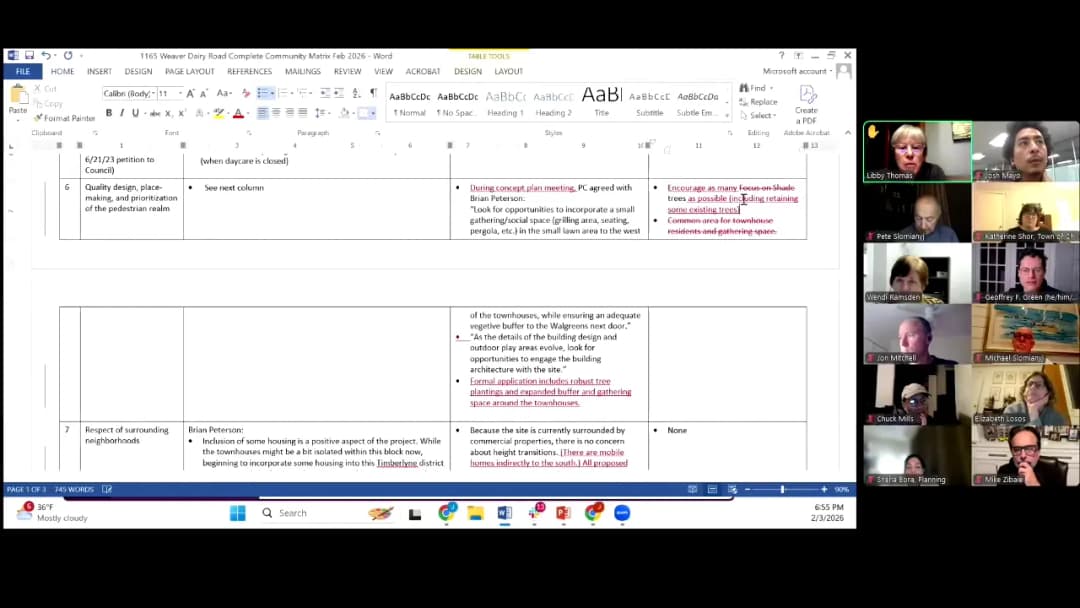
The Chapel Hill Planning Commission held a virtual meeting on Tuesday, February 3, 2026, at 6:00 PM. The primary agenda item was a conditional zoning application for 1165 Weaver Dairy Road, a two-acre infill site on a high-frequency transit corridor. The commission also approved the minutes from December 2, 2025, and discussed administrative updates. No public comments were received. Consent Calendar - Approval of Agenda: Unanimously approved. - Approval of Minutes: The December 2, 2025, meeting minutes were approved unanimously with no changes. Discussion Items Conditional Zoning Application at 1165 Weaver Dairy Road - Staff Presentation: Catherine Shore presented the staff recommendation for approval, citing alignment with Complete Community goals and the comprehensive plan. The site is in the North MLK focus area, currently zoned OI3-CCD, with a proposed change to Mixed-Use Village (MUV) CCD. The applicant proposes up to 19,000 square feet of non-residential use (likely a daycare center) and 4–12 dwelling units (townhomes) in two buildings, with shared parking and refuse facilities. - Applicant Presentation: Wendy Ramson (landscape architect, Thomas and Hutton) detailed the district-specific plan. Key requests for modifications to LUMO standards included: - Reduction of the Weaver Dairy Road buffer from 30 to 20 feet. - 50% reduction of buffer on the west side (adjacent to established buffer). - Reduced buffer on the east side due to utility easements. - Allow half of required tree canopy to be met with understory trees (e.g., dogwoods, redbuds) where overhead power lines limit canopy trees. - Reduction of the minimum parking requirement (later noted moot since the town eliminated parking minimums via the omnibus text amendment effective two weeks prior). - Reduction of bike parking requirement for a daycare from 19 spaces to 4, arguing daycare age children do not bike to daycare. - Disturbance of man-made steep slopes (along utility easement) with a short retaining wall. - Commission Deliberation: Chair Jonathan Mitchell led a review of the Complete Community Matrix (developed during the March 2025 concept plan review). Key discussion points: - Land Use Efficiency: The proposal reduced townhomes from five to four to expand buffer and gathering space. The ordinance allows up to 12 units, but mixed-use requires at least 15% non-residential. - Walkability/Bikeability: New sidewalks connect townhomes to Weaver Dairy Road. A future pedestrian connection to the adjacent Timberline shopping center was discussed but deemed impractical due to separate ownership and a chain-link fence. Commissioner Elizabeth Losos suggested a staircase, but staff noted no ADA access or legal path currently exists. - Transit Access: Within a quarter-mile of future BRT and served by Chapel Transit bus routes. - Parking: 34 spaces proposed; the removal of minimums was noted. Commissioner Mike Zibaie questioned market demand, and applicant agreed users will build what they need. - Design/Placemaking: Enhanced shade trees and a common gathering area for townhomes were added. Commissioner Libby Thomas encouraged preserving existing trees where possible; applicant noted invasive species removal may be needed. - Stormwater: Underground detention for the 100-year storm event. Use of permeable pavers was explored but found to still require detention; the utility easement cannot be used for stormwater. - Buffer Modifications: Commissioner Geoffrey Green argued that the standard buffer requirements are impractical given the utility easement and adjacent existing buffers. He suggested the south buffer (20 ft against an undeveloped lot) could be reduced to allow a fifth townhouse, but the urban designer requested no reduction. - Bike Parking: Discussion on accommodating e-bikes and cargo bikes; applicant agreed to check spacing. Key Outcomes - Motion: Commissioner Elizabeth Losos moved to find the proposal consistent with the comprehensive plan (Resolution A) and recommend approval of Ordinance A (conditional zoning) subject to consideration of the commission’s recommendations in the updated Complete Community Matrix. The motion was seconded by Commissioner Libby Thomas. - Vote: Unanimous 6-0 in favor (all present: Chair Jonathan Mitchell, Vice Chair Geoffrey Green, Commissioners Elizabeth Losos, Chuck Mills, Libby Thomas, Mike Zibaie). - Next Steps: The recommendation and matrix will be transmitted to the Town Council. The commission’s next meeting is scheduled for February 16, 2026, with potential LUMO text amendment presentations.
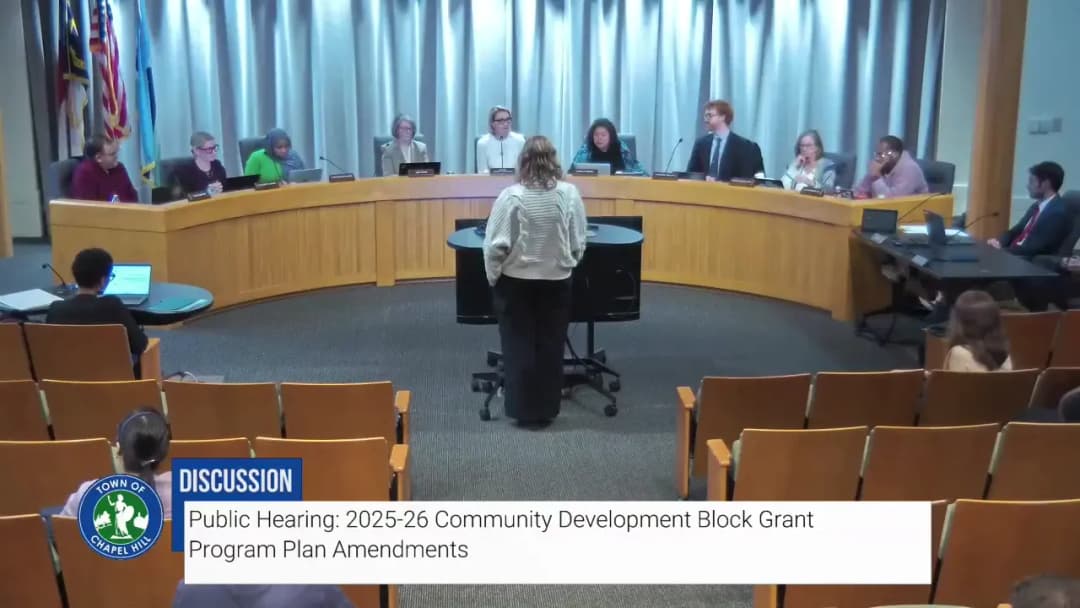
The Chapel Hill Town Council held a regular meeting on January 21, 2026, at 6:00 PM in the Council Chamber. The meeting opened with a proclamation declaring January 2026 as Mentor Month in Chapel Hill, recognizing local mentoring programs. Mayor Jessica Anderson made announcements regarding winter weather preparedness, the People's Academy (March 3, 2026), the appointment of new Town Attorney Nick Yates, and an International Holocaust Remembrance Day program on January 27, 2026. The Council approved a consent agenda that included several routine items plus three additions: the Town Attorney's employment contract, a postponement of the 860 Weaver Dairy Road hearing, and the purchase of six Rectangular Rapid Flashing Beacons for MLK Jr. Blvd and Estes Drive. Two public comments were heard regarding the Glen Lennox development. The Council then held a public hearing and approved amendments to the Community Development Block Grant (CDBG) program plans, and after discussion, approved an omnibus text amendment to the Land Use Management Ordinance (LUMO) with amendments. The meeting adjourned at 9:40 PM. Consent Calendar - R-2.1 Adopted the Town Attorney's Employment Contract for Nick Yates. - R-2.2 Continued the 860 Weaver Dairy Road Conditional Zoning Hearing to February 25, 2026. - R-2.4 Authorized purchase of six Rectangular Rapid Flashing Beacons for MLK Jr. Blvd and Estes Drive. - Approved donations of surplus lockers to Chatham Community Library. - Approved settlement agreement in Valentine v. Town of Chapel Hill. - Approved amendments to 2026 Council Liaisons Board and Committee Assignments. - Approved meeting minutes from November 12, 19, December 3, and December 10, 2025. The consent agenda was approved by a unanimous vote on a motion by Council Member Ryan, seconded by Mayor pro tem Berry. Public Comments & Testimony - Rose Baragwanath (age 9) spoke against the proposed Glen Lennox development, citing potential tree loss and arguing that the developer (Grubb) knows it is wrong. She appealed to the Council to stop the project. - Tim Crothers (journalism professor at UNC and Oakwood Drive resident) expressed strong opposition to the Glen Lennox development, stating that developer Clay Grubb told a working group he needed to build a 50,000 sq ft grocery store on the site or risk bankruptcy. Crothers noted 14 supermarkets within 4 miles and stated the supermarket would be located 30 yards from homes, violating the spirit of the development agreement. He asked the Council to represent residents against what he called a "corporate power play." Discussion Items 6. Public Hearing: 2025-26 Community Development Block Grant (CDBG) Program Plan Amendments - Funding Programs Coordinator Melissa Peters presented the proposed amendments, noting that HUD requires a public hearing for substantial amendments (reallocation over 25% of the current year's award). - The Town’s CDBG program objectives align with affordable housing and community connections priorities. - Staff recommended moving $253,229 in CDBG funding from prior years and this year's grant to current 2025-26 program year activities and neighborhood revitalization funding. - A 30-day public comment period opened December 22, 2025, closing January 22, 2026. - Council Member Ryan requested clarification on moving Hope renovations to local funding. Affordable Housing Manager Emily Holt explained that the project would be supported through the Town's Affordable Housing funding program, with the Town Manager authorized to approve up to $100,000 for specific purposes, allowing more strategic use of CDBG resources. - The public hearing was closed, and the resolution (R-2.3) was adopted, both by unanimous votes (9 ayes). 7. Omnibus Text Amendment to the Chapel Hill Land Use Management Ordinance (LUMO) and Town Code - Long-Range Planning Manager Tas Lagoo presented the package, which followed public hearings on October 22 and November 19, 2025, and a work session on January 7, 2026. The November 19 meeting ended in a 4-4 tie, requiring reconsideration. - The package includes changes to development processes and development standards. The ordinance (O-1) before Council reflected the original staff proposal; a separate document contained amendments discussed on January 7, 2026. - Council Member Ryan expressed support for the omnibus as a step toward Complete Community goals (diverse housing, connectivity, environmental protections) but voiced concern about allowing 5,000 sq ft duplexes, which could encourage larger, less affordable homes. Despite that objection, she supported the package with the work session amendments. - The public hearing was closed, and a resolution of consistency (R-3) was adopted, both by unanimous votes (9 ayes). - Council Member Ryan moved to adopt O-1 as amended per the January 7 work session summary (seconded by Mayor pro tem Berry). Then Council Member McCullough moved to amend O-1 according to the staff-provided January 7 amendments (seconded by Mayor pro tem Berry); the amendment was adopted unanimously (9 ayes). - The main motion (O-1 as amended) was then enacted by a unanimous vote (9 ayes). Key Outcomes - CDBG Plan Amendments (R-2.3) adopted unanimously. Approved reallocation of $253,229 to current program year activities and neighborhood revitalization; moved Hope renovations to local Affordable Housing funding. - Omnibus LUMO Text Amendment (O-1 as amended) enacted unanimously. The package includes changes to both development processes and standards, incorporating amendments discussed at the January 7 work session. The amendments address concerns raised during prior meetings. - Consent agenda approved unanimously with three additions. - 860 Weaver Dairy Road hearing postponed to February 25, 2026. - Acknowledged that the next regular meeting will be on February 11, 2026 (no meeting on January 28).