Browse by city
Date range
Search help

Search titles, summaries, topics and stored transcripts together. Keywords may match separately; put the whole query in double quotes for a phrase. Matching follows word analysis, so punctuation is not exact. Both dates are included. Documents are not searched.

SHOWING 11–20 ENTRIES
11
JUN 22, 2026 · CHARLOTTE, NORTH CAROLINA · CITY COUNCIL
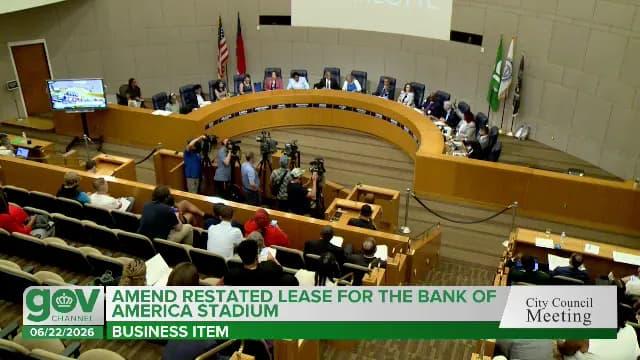
Charlotte City Council Meeting - June 22, 2026: Appointment of Interim Mayor and Recognition of Mayor Lyles

On June 22, 2026, the Charlotte City Council held a business meeting that included the appointment of a new interim mayor following the retirement of Mayor Vi Lyles, approval of a red light camera pilot program, and multiple public hearings. The meeting also featured tributes to Mayor Lyles, who received the Order of the Long Leaf Pine, and proclamations for LGBTQ Pride Month and Vitiligo Awareness Month. The council heard from over 30 public speakers on the mayoral vacancy and other issues, and ultimately appointed Robert Harrington as interim mayor after a two-ballot runoff. Consent Calendar - Consent items 25 through 59 were approved unanimously. Public Comments & Testimony - Trucking Infrastructure: Avante Jackson, a trucker advocate and heart transplant recipient, called for addressing bottleneck traffic on I-77, I-85, and I-485, improved public education on sharing the road with trucks, fair pay for drivers, and better safety for female truck drivers. - District 1 Concerns: Linda Byers (District 1 resident) and Tamara Elise (District 1 resident) raised concerns about safety, quality of life, parking, noise, and loitering in Uptown Charlotte, noting a petition with over 200 signatures. They questioned whether District 1 is being forgotten amid development. - Data Center Opposition: Jeff Cross (Charlotte Metro DSA) urged the council to prevent future data center construction, arguing state gerrymandering limits democratic options. Capri Matthews (Charlotte Metro DSA) suggested using zoning adjustments similar to those used to halt ICE detention centers in Greensboro. Layla Saiya (UNCC student and DSA member) argued data centers provide few jobs and called for a longer-term moratorium. - Cyclist Safety: Jack Adams recounted a June 3 e-bike crash on Elizabeth Avenue due to bike lane ending at streetcar tracks, requesting a dedicated bike lane across the entire Gold Line. - Hispanic Homeownership: Annabelle Rodriguez (President of NARAP Charlotte) presented the 2025 Hispanic Home Ownership Report, noting Hispanic families account for 92.7% of net U.S. homeownership growth and a 50.2% Latino homeownership rate in North Carolina. - Free Laundry Day: Ashton McGrady (Operation Clean Health) announced the inaugural National Back to School Free Laundry Day in August 2026, asking for council support. - Housing Innovation vs. Zoning: Evan (speaker) questioned the Housing Innovation Challenge, arguing the housing crisis requires eliminating restrictive zoning regulations such as setbacks, parking requirements, and double stairwell rules. - Traffic Fatalities: Megan Fenzel (co-chair, Mission Zero Task Force) read the names of 41 people killed in Charlotte traffic crashes in 2026, urging implementation of the red light camera pilot before 2027. - Public Pulse App: Gabriel Joseph Kejik Olshnner proposed a "North Carolina State Communicator" app to help leaders gather verified public input. - Sanitation Worker Pay: Carson Cohn noted that city website claims a $24/hour minimum wage for sanitation workers, but actual pay is $16/hour, and asked for a raise. - Interim Mayor Endorsements: 31 speakers addressed the council on the mayoral vacancy. Multiple speakers endorsed James Mitchell (citing experience, small business advocacy, and crisis management), Carrie Cook (citing community leadership, nonprofit work, and housing advocacy), and Robert Harrington (citing legal experience, cross-sector engagement, and calm leadership). Garland Green urged council to consider crisis management ability. Jasmine Allen and Hannah Hassan spoke for Cook. Nicole Grace, Mindy Mills Henson, Rochelle Stewart, Melinda McVaden, and others spoke for Mitchell. William Youngblood, Molly Barker, Chelsea Evans Okiagu, Gina Esquiville, and Tanya Archer spoke for Harrington. Discussion Items - Recognition of Mayor Lyles: The council presented Mayor Vi Lyles with multiple honors, including a street sign bearing her name and the Order of the Long Leaf Pine (North Carolina's highest civilian honor), presented by Walter Bowers (Governor's Office Director). Council members and the public praised her 30+ years of public service, COVID leadership, and racial equity initiatives. - Proclamations: June 2026 was proclaimed LGBTQ Pride Month and Vitiligo Awareness and Education Month. - Historic Landmark Designation – Dilworth Methodist Church: A public hearing was held. The property owner (speaker) supported the designation as the oldest church in Dilworth (110+ years). Councilmember Mayfield objected to holding the hearing and decision on the same agenda, moving to refer the process issue to the BGIR committee. The motion passed. The item was then adopted with Mayfield opposed. - Historic Landmark Designation – Ford House: Public hearing opened and closed; motion to adopt passed with Mayfield opposed (same process concern). - Historic Landmark Designations – Other: Item 10 (bonds) and other hearings adopted similarly, with Mayfield consistently opposing due to process. - Red Light Camera Pilot Program (Item 12): Councilmember Anderson presented the safety committee's recommendation for a one-year pilot program targeting the top 10 high-accident intersections. Motion to adopt resolution and ordinance amendments passed unanimously. - Solid Waste Apprenticeship Grant (Item 13): Approved a $12,000 grant from Apprenticeship NC for solid waste services apprenticeships. Councilmember Anderson praised the solid waste workforce, noting they have only 12 street sweepers for a nearly million-person city. - Stormwater Financing (Item 14): Initial findings resolution adopted unanimously. - General Obligation Refunding Bonds (Item 15): Approved A through F; Councilmember Watlington recused. - General Obligation Bond Referendum (Item 16): Introduced three bond orders for transportation ($280M), neighborhood improvements ($20M), and housing ($125M). Motion approved. - University City Municipal Service District Boundary Expansion (Item 17): Approved. - Habitat for Humanity/ Robinson Church Road Widening (Item 18): Accepted $52,000 contribution; approved. - Interlocal Agreement with Town of Midland (Item 19): Approved for water/sewer infrastructure. - Bank of America Stadium Lease Amendment (Item 20): Amendment to lease a triangular 0.24-acre parcel (10,500 sq ft) for a 4,400-seat performance venue. Councilmember Mayfield opposed, citing lack of specific community benefits. Councilmember Johnson suggested deferral for market value appraisal (failed 4-7). After debate, the amendment passed 7-3 (Mayfield, Johnson, Watlington opposed). - CRTPO MOU Amendment (Item 21): Approved to add MPTA as a member. - PAVE Act Interlocal Agreement (Item 22): Approved agreement between city and MPTA for transit operations; one opposed. - Salary Adjustment for City Clerk: Council approved an 8% salary increase for City Clerk Stephanie Kelly, effective July 4, 2026. Key Outcomes - Interim Mayor Appointed: Robert Harrington was appointed as interim mayor, receiving six or more council votes on the second ballot (runoff between Harrington and Carrie Cook, after no candidate reached six votes in the first round: Harold Codale 2, Carrie Cook 3, Robert Harrington 4, James Mitchell 2). Harrington will serve until the expiration of the elected mayor's term. The council voted by acclamation to appoint. - Red Light Camera Pilot Approved: One-year pilot program at top 10 intersections, with data-driven evaluation. - Stadium Lease Amendment Passed: The triangular parcel will be added to the Bank of America Stadium lease for a performance venue; council rejected deferral. - Public Hearing Process Referred: Councilmember Mayfield's motion to refer the practice of holding hearings and decisions on the same agenda item to the BGIR committee for process review was approved. - Mayor Lyles Honored: Received Order of the Long Leaf Pine and a street sign. - Future Actions: The council will hold a citywide public safety summit on June 24, 2026. Councilmember Mayfield requested an update from Charlotte Water on non-electricity-dependent water systems amid potential blackouts.
PERSONNEL MATTERS 29% · PROCEDURAL 16% · ECONOMIC DEVELOPMENT 15% · COMMUNITY ENGAGEMENT 13%
12
JUN 18, 2026 · CHARLOTTE, NORTH CAROLINA · CITY COUNCIL
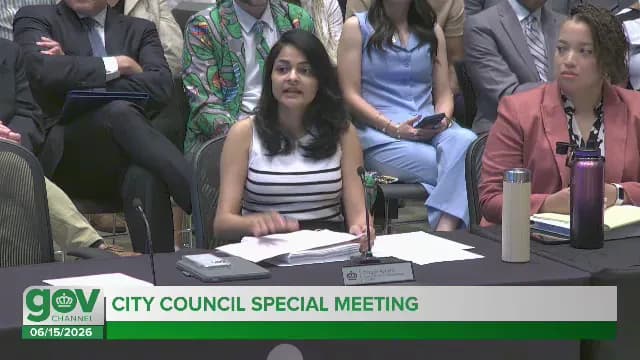
Charlotte City Council Special Meeting to Interview Candidates for Interim Mayor - June 18, 2026

The Charlotte City Council held a special meeting on June 18, 2026, starting at approximately 4:15 PM, to interview five candidates for the position of interim mayor following the vacancy in the Office of the Mayor. The meeting included structured interviews with each candidate, followed by procedural discussions regarding the appointment vote scheduled for June 22. No appointment decision was made at this meeting. Interview Process and Candidate Presentations - The council interviewed five candidates in random order: Senator Caleb Theodros, Harold Cogdell, James Mitchell Jr., Robert Harrington, and Carrie Cook. Each candidate was given up to 30 minutes to answer a set of pre-agreed questions from council members, with a five-minute warning and a one-minute warning before closing remarks. - All candidates were asked the same questions, covering topics such as their biggest challenge facing Charlotte, how to balance growth with equity, strategies for efficient council meetings, maintaining employment while serving, intergovernmental relations, airport governance, homelessness policies, and their approach to council consensus and city manager selection. - Council members adhered to a uniform set of questions, with follow-ups permitted that were germane to the original question. Key Discussion Points During Candidate Interviews - Senator Caleb Theodros emphasized his experience in the state senate, ability to bridge gaps between Raleigh and Charlotte, and metrics-driven approach to corporate partnerships and transportation planning. He noted his full-time availability as a state senator. - Harold Cogdell highlighted his 28 years as a lawyer and past chair of the Board of County Commissioners and Charlotte Housing Authority, advocating for inclusive governance, listening, and rotating council meetings to different districts. - James Mitchell Jr. stressed his 20+ years of public service, including 14 years as a district representative and current at-large member, proposing 90-day check-ins for staff evaluations and fostering a culture of collaboration and trust. - Robert Harrington cited his experience chairing the Charlotte Mecklenburg Public Library Board and the North Carolina Bar Association, focusing on trust, transparency, and committee-driven decision-making. He affirmed he would maintain his law partnership. - Carrie Cook drew on her roles at the Federal Reserve Bank, the Charlotte Chamber, and leading Greenlight Fund Charlotte, emphasizing relationship-building, consensus, and a people-first approach to growth. Procedural Discussion and Key Outcomes - The council reached consensus to advance all five candidates to the ballot for the June 22 vote, as no candidate was eliminated. - A motion was passed (voice vote, ayes prevailed) to determine the runoff process: if no candidate receives six votes (simple majority of 11 council members), the top two vote getters will advance to a runoff. If there is a tie for second place, a runoff between those tied candidates will determine who faces the top vote getter. - The council agreed to move agenda item 22 (appointment of interim mayor) to earlier in the June 22 meeting, immediately after the public forum, to allow public comment and avoid late-night proceedings. The agenda will be republished to reflect this change. - No runoff will be required if a candidate secures six or more votes on the first ballot; if a runoff is needed, it will be conducted on the same evening (June 22) with new ballots. - The meeting adjourned after the procedural discussion.

PROCEDURAL 39% · COMMUNITY ENGAGEMENT 11% · PERSONNEL MATTERS 9% · ECONOMIC DEVELOPMENT 8%
13
JUN 15, 2026 · CHARLOTTE, NORTH CAROLINA · CITY COUNCIL
Charlotte City Council Mayoral Vacancy Candidate Forum – June 15, 2026

The Charlotte City Council convened on June 15, 2026, at 2:00 PM to hold a public candidate forum for the interim mayoral vacancy created by Mayor Lyles’ resignation. The meeting included a two‑minute statement from each candidate and extensive procedural debate about the selection process. After deliberation, the council approved a multi‑step process to narrow the field and conduct interviews. Discussion Items - Candidate Forum (2:00 PM start): 49 individuals applied for the interim mayor position; 32 attended in person. Each candidate was given two minutes to address the council. Statements covered a wide range of priorities including affordable housing, transportation, public safety, economic mobility, and the need for a steady interim leader. - Procedural Debate (approx. 2:15 PM – 4:45 PM): Councilmember Mayfield moved to add a second round where council would collectively interview a shortlist of candidates. The motion sparked extensive discussion about the method of narrowing candidates (motion vs. ballot), the number of nominations per council member, the timeline, and whether Mayor Pro Tem Braxton Mitchell should recuse himself due to being a candidate. - City Attorney Kimberly presented three decision points: (1) motion method vs. nomination‑ballot method, (2) number of nominations per council member, (3) vote threshold for subsequent ballots. - Councilmembers expressed concerns about rushing the process, the lack of a virtual option, and the fairness of Mayor Pro Tem Mitchell participating in the selection while a candidate. Councilmember Owens offered a substitute motion to send the entire process to the Budget & Government Relations (BGR) committee, which failed (4 in favor, 6 opposed). - After further amendments, the council voted on Mayfield’s amended motion. Key Outcomes - Approved Selection Process (7–1 vote): The council adopted the following process: - Each council member may nominate up to three eligible candidates (including those who did not attend the forum) from the full eligible pool. - The clerk will compile nominations and distribute a ballot by the end of day on June 16, 2026. - Council members must return their ballots by close of business on June 16. - The top five vote‑getters will be invited to a public interview session on Thursday, June 18, 2026 (with 48‑hour notice). - The final vote for the interim mayor remains scheduled for June 22, 2026, but may be adjusted. - Recusal of Mayor Pro Tem Mitchell: The council did not vote on a recusal motion. Councilmember Mitchell did not request to be excused. Several council members noted precedent (Patsy Kinsey appointed without recusal) and argued that participating as a candidate does not legally require recusal. The issue of an appearance of impropriety was raised but not formally addressed. - Meeting Adjournment: A motion to adjourn failed (3 in favor, several opposed); the council then proceeded to a zoning meeting (not included in this summary).

PROCEDURAL 53% · PERSONNEL MATTERS 24% · MISCELLANEOUS 10% · COMMUNITY ENGAGEMENT 4%
14
JUN 15, 2026 · CHARLOTTE, NORTH CAROLINA · CITY COUNCIL
Charlotte City Council Zoning Meeting – June 15, 2026

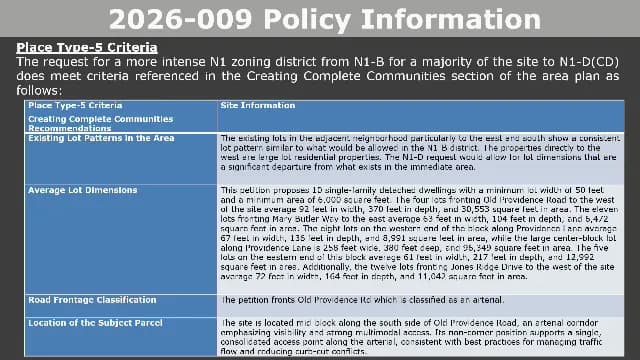
The Charlotte City Council held a regular zoning meeting on the evening of June 15, 2026, beginning at approximately 9:45 AM (the meeting started with afternoon remarks but proceeded into the evening). The agenda included a consent calendar, deferred items, several rezoning petitions for public hearings, and multiple non-consent decisions. Council acted on a few items, deferred others, and heard extensive public testimony and council discussion on a range of proposed developments. Consent Calendar - Deferrals (Items 11, 15, 17): Three petitions were deferred to the August 17, 2026 zoning meeting: Petition 2025-07 (Short Development Group), 2025-133 (Michael Barnes), and 2026-027 (C for Investments). The motion passed unanimously. - Consent Agenda Approval: Items 3, 5, 8, 9, and 10 were approved as a block. Three items were pulled for separate vote (see below). The consent agenda included petitions by Queen City Land LLC, Choda Dimnall, HAD Holdings LLC, Avectar Holding LLC, and Orange Borough Media (Charlotte Hornets). The zoning committee’s statement of consistency was adopted for these petitions. Public Comments & Testimony - Item 22 – Olympia and Wright Homes (2026-025): Talia Nazario, a resident on Rich Lane, expressed opposition to extending Ridge Lane, citing increased traffic and safety concerns for children. She also opposed high density and wanted single‑family homes to preserve neighborhood character. Mr. Sharkey, president of the Hampton Place Property Owners Association, formally opposed the rezoning, asking for single‑family only and no street extension, and requested speed bumps on Hampton Place. - Several other public hearings drew no opposition speakers; only the petitioner and staff presented. Discussion Items - Rezoning Process Explanation: The mayor and zoning committee chair Douglas C. Walton outlined the public hearing procedures, noting that petitioners with opposition or staff opposition receive 10 minutes, others 3 minutes. - Item 4 – Petition 2025-141 (Darway): Councilmember Mayfield pulled this for separate vote. She expressed concerns that a conventional rezoning to N1C could allow a quadplex on a single‑family street. Staff clarified that a quadplex would require an arterial frontage, which the site lacks. The motion to approve passed with two opposing votes. - Item 6 – Petition 2026-005 (Thurman Brooks): Councilmember Johnson inquired about a condition to prohibit data centers. The petitioner had converted from conventional to conditional to add that prohibition. Approved unanimously. - Item 7 – Petition 2026-006 (Good Properties): Councilmember Johnson noted the petitioner’s intent to keep an urgent care facility on the site. Approved unanimously. - Item 13 – Petition 2025-027 (Missions City Church/Freedom Communities): Changes added no‑parking signs on Somerville and Oak streets. Council voted unanimously not to send the petition back to the zoning committee. Councilmember Graham supported after a site visit. Approved with one opposing vote (Mayfield). - Item 14 – Petition 2025-058 (Studio One Nine Architecture): Unit count reduced from 20 to 16 to meet tree‑save and street extension requirements. Not sent back; approved unanimously. - Item 16 – Petition 2025-136: Councilmember Johnson praised the UDO’s flexibility for generational wealth; approved unanimously. - Item 19 – Petition 2026-001 (MPV Properties/Mission Properties): Proposed 176 multifamily units on 12.67 acres near Mount Holly Road and I‑485. Staff opposed due to inconsistency with the newly adopted West Outer Community Area Plan (manufacturing/logistics place type) and proximity to active rail and 1.2 million square feet of industrial development. Petitioner cited support from the Mountain Island Lake Community Association, offered traffic improvements, and noted a housing gap. Council asked about noise mitigation and lower intensity. Public hearing closed; no vote taken (item continued). - Item 20 – Petition 2026-009 (David Simone Signature Homes): Proposed 10 single‑family lots on 3 acres. Staff did not recommend due to lot pattern mismatch. Petitioner showed examples of high‑end developments and argued no predominant pattern exists. Councilmember Driggs expressed interest in working toward approval. Hearing closed; no vote. - Item 21 – Petition 2026-017 (Kevin Kern): Proposed 9 units (7 single‑family, 1 duplex) on 7.85 acres. Staff not recommend because lot widths are too small for the established pattern. Petitioner willing to work with staff on dimensions. Council encouraged further collaboration. Hearing closed; no vote. - Item 22 – Petition 2026-025 (Olympia and Wright Homes): Petitioner agreed to convert from conventional to conditional, commit to single‑family only, and work on the Ridge Lane connection. Staff had opposed the initial N1E request. Council discussed conservation easements, speed bumps, and HOA controls. Hearing closed; no vote. - Item 23 – Petition 2025-130 (Maruti Hotels): Proposed a 160‑room hotel on 3.97 acres. Staff recommended approval. Petitioner noted a separate abandonment petition to avoid a required street extension that neighbors oppose. Hearing closed; no vote. - Items 24–28: These petitions (KT Trading, SR Mosley, ACRO Development, Towilliger Pappas, Hines) all had staff support. Public hearings were closed without votes; they will likely return for action at a future meeting. Key Outcomes - Consent Agenda Deferrals: Three petitions deferred to August 17, 2026. - Consent Agenda Approval: Items 3, 5, 8, 9, and 10 approved with zoning committee consistency statement. - Item 4 (2025-141): Approved with two opposing votes. - Item 6 (2026-005): Approved unanimously. - Item 7 (2026-006): Approved unanimously. - Item 13 (2025-027): Approved with one opposing vote. - Item 14 (2025-058): Approved unanimously. - Item 16 (2025-136): Approved unanimously. - All remaining public hearings (Items 19–28): Public hearings were closed, but no votes were taken on the underlying petitions. These items are expected to be decided at the August 17, 2026 meeting, following further staff and community negotiations.

PLAT 42% · MISCELLANEOUS 29% · PROCEDURAL 11% · ENGINEERING AND INFRASTRUCTURE 8%
15
JUN 8, 2026 · CHARLOTTE, NORTH CAROLINA · CITY COUNCIL
Charlotte City Council Meeting – June 8, 2026: Budget Adoption, MPTA Agreement, Red Light Cameras, Data Center Moratorium

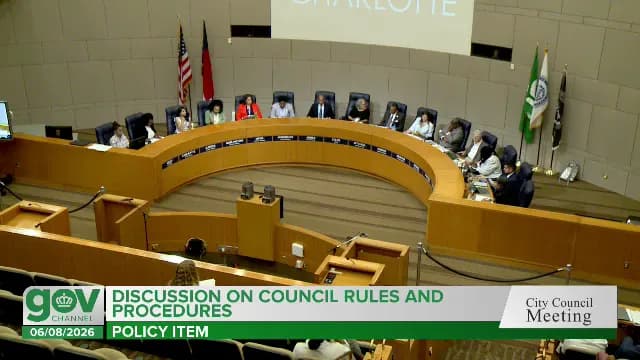
The Charlotte City Council held a regular meeting on June 8, 2026, to consider a consent agenda, receive updates on the MPTA transit transition and red light camera program, adopt the FY2027 operating budget, and approve a 150-day moratorium on new data center facilities. The meeting also included a discussion on council rules and other business items. Consent Calendar - Items 29 through 53 were approved unanimously after Councilmember Mayfield raised procedural concerns about public hearings and decisions on the same night for separate items but did not request an exception. Public Comments & Testimony - No public comments were heard during the meeting; the agenda did not include a separate public comment period for the consent or discussion items. Discussion Items - MPTA Interlocal Agreement Update: City Attorney Catherine (from Parker Poe) presented a phased transition of CATS to the MPTA. Councilmember Driggs, who served on the working group with Councilmembers Owens and Watlington, noted no employee will be worse off, no general fund money will be used for transit, and debt reserves will be maintained. Discussion covered employee career pathing, retirement portability, and the need for ongoing partnership. A vote is scheduled for June 22. - Red Light Cameras Pilot: Charlie Jones, CDOT Deputy Director, presented a one-year pilot at 10 intersections to reduce angle/left-turn collisions and serious injuries. Estimated program cost is $600,000/year, with annual revenue of $4.5 million (90% to CMS) and a $150,000 funding gap covered by Vision Zero funds. Councilmembers discussed rotating cameras, a public dashboard, community notification, and negotiating with CMS on use of proceeds. Next steps: RFP issuance, contract approval, pilot start by early 2027. - FY2027 Budget Adoption: Councilmember Graham moved adoption, highlighting a 1.89 cent property tax increase dedicated to public safety, a $25/hour minimum wage for city employees, $125 million for the housing trust fund, 10% pay parity for CMPD and CFD, $600,000 for business district organizations, and $1.5 million for youth internships. Several council members expressed concerns about cumulative fee and tax impacts on low-income residents, but the budget passed with a majority. Councilmembers Mayfield and Driggs voted against. - Data Center Moratorium: Councilmember Ashmara introduced a 150-day moratorium on accepting or processing applications for new telecommunications and data storage facilities. Discussion emphasized the need for policy guardrails on water/energy consumption, noise, and proximity to schools and neighborhoods. City Attorney Leslie-Byrd clarified state-law exemptions for projects with valid permits or substantial expenditures. The moratorium passed unanimously. - Council Rules Procedures: Councilmember Johnson moved to amend Rule 4D to allow four council members (rather than a majority) to place an item on a future agenda if objected to by the city manager or a council member. After debate, the motion passed with two opposed. - Bank of America Stadium Lease Amendment: A proposal to include a 0.244-acre parcel (conveyed from NCDOT) into the stadium lease for a privately funded performance venue. Councilmembers raised concerns about community benefits and fair market value. A motion to defer to the next business meeting passed narrowly; the item was deferred. - Other Business: Approval of federal funding for the East Charlotte Connector (e-Sharlot) mobility path; authorization for a general obligation bond referendum in November 2026; consent appointments to boards and commissions. Key Outcomes - Consent agenda (items 29-53) approved unanimously. - MPTA interlocal agreement to be voted on June 22. - Red light camera pilot program advanced; staff to develop RFP. - FY2027 budget adopted (7-2 vote; Councilmembers Mayfield and Driggs opposed). - 150-day moratorium on data center facilities adopted unanimously. - Council Rule 4D amended to require four council members to place items on future agenda (passed with two opposed). - Bank of America Stadium lease amendment deferred to a future business meeting. - Appointments approved for multiple boards and commissions by acclamation. - Referrals: Councilmember Anderson will explore rotating camera options; staff to study data center impacts and report within 150 days; city attorney to work on legislative agenda for red light cameras.

PROCEDURAL 27% · PUBLIC SAFETY 12% · TRANSPORTATION SAFETY 10% · COMMUNITY ENGAGEMENT 10%
16
JUN 1, 2026 · CHARLOTTE, NORTH CAROLINA · CITY COUNCIL
Charlotte City Council Budget Adjustment Meeting - June 1, 2026

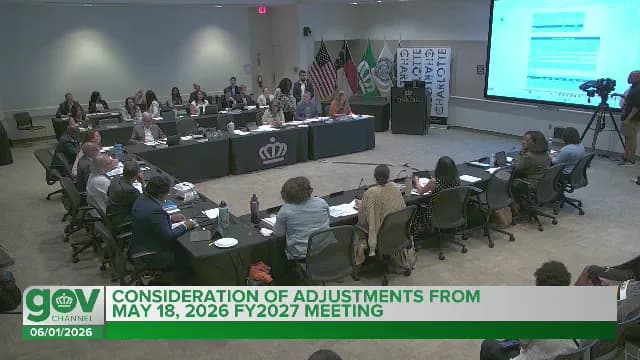
The Charlotte City Council convened on June 1, 2026, at 9:15 AM to discuss and vote on adjustments to the proposed FY2027 budget, following exploration items from the May 18th meeting. The meeting focused on reallocating funds within the existing 1.89 cent property tax increase to address public safety pay parity, technology, overtime, and other council priorities. Key decisions included approving a 10% pay increase for both CMPD and CFD, deferring some policy discussions to committees, and passing several budget adjustments. Consent Calendar - None explicitly identified; the meeting was a special budget adjustment session with no routine approvals. Public Comments & Testimony - No public comments were made during this recorded session. Discussion Items - Fire and Police Pay Parity: The council debated options for firefighter pay increases versus police increases. Manager Jones presented options: a 10% increase for both departments would cost $4.4 million, funded by reducing public safety technology investments ($1.9 million), reducing the proposed increase to fire overtime budget ($2.2 million), and other reallocations. Several council members (Mayfield, Anderson, Ashmir, Driggs) expressed concerns about cutting overtime and technology, given known deficits and response time goals. Chief Johnson noted that a staffing factor study is needed to determine optimal overtime versus hiring costs. The council considered proposals for 7%, 8%, 9%, and 10% across the board, as well as a 7.5% ongoing plus 2.5% one-time for fire. After extensive debate, a motion for a 10% increase for both CMPD and CFD was passed (7-4). - Public Safety Technology and Overtime: Council members questioned the impact of reducing technology investments on response times and core operations. The manager clarified that the technology reduction would not affect base operations (e.g., dash cams) but would slow upgrades. Overtime budget cuts were seen as risky since fire overtime has historically exceeded allocations. A motion to refer pay parity policy to committee passed. - Hourly Employees Merit Component: A motion to remove the merit component and provide a flat 4% increase for hourly city workers was made but withdrawn after discussion about performance differentiation and HR's explanation of the step pay plan for public safety versus merit-based plans for general employees. - Financial Partners (Prospera and For The Struggle): The council debated two organizations that scored below the funded threshold. Council members Mayfield and Anderson argued for respecting the application process. Council member Watlington noted the process nearly eliminated Safe Alliance. A substitute motion passed (7-4) to honor the committee's recommended seven partners and allow For The Struggle to apply for CDBG funding. - International Relations Office: The council discussed adding one new administrative FTE and operating support ($250,000 from fuel contingency) to the proposed manager position. Supporters (JD, Graham) argued it would coordinate efforts across economic development and community relations. Detractors (Mayfield, Anderson) questioned the need for another manager versus direct hires. The motion passed. - Transportation Modeling Partnership with UNC Charlotte: A $300,000 investment for a land use and transportation model, funded from fuel contingency, was debated. Supporters (Watlington, Ashmir, Johnson) said it would improve data and allow alternative analysis. Opponents (Graham, Mayfield, Driggs) cited lack of CDOT input, urgency, and potential duplication. The motion passed (8-4) with an understanding the scope would return to committee. - Housing Bond Increase: The proposal to increase the housing bond from $125 million (proposed) to $150 million or $200 million was discussed. Manager Jones noted an additional $0.06 to $0.16 cents property tax per $100 valuation. Council members expressed concerns about burdening residents and noted existing private sector investments (LISC, Mark Ethridge). A motion to keep the manager's proposed $125 million passed. - Animal Control Fees: Council member Owens proposed increasing adoption and spay/neuter fees to generate $120,000 in additional revenue. Dr. Fisher approved. The motion passed. Key Outcomes - Fire and Police Pay: Approved 10% increase for both CMPD and CFD (7-4). Funded by reducing technology investments and overtime budget increases, plus other reallocations. - Pay Parity Policy: Referred to committee for development of a baseline policy. - Modified Duty Positions: Policy change extending eligibility from 5-year to 10-year maximum referred to committee. - Hospitality Tax and MSD Exploration: Policy referral passed to explore using hospitality funds for public safety and identifying general fund subsidies. - Hourly Employees: No change; merit component retained. - Financial Partners: Seven organizations funded as recommended; For The Struggle directed to apply for CDBG. - International Relations: Additional FTE and operating support approved. - Transportation Modeling: $300,000 approved, pending committee scope review. - Housing Bond: $125 million approved (as proposed). - Animal Control Fees: Increase approved. - Budget Ordinance: Motion passed to direct the city manager to prepare the FY2027 budget ordinance incorporating approved adjustments, to be considered at the June 8th business meeting. - Adjournment: Meeting adjourned.

FISCAL SUSTAINABILITY 19% · PUBLIC SAFETY 19% · ECONOMIC DEVELOPMENT 17% · PERSONNEL MATTERS 14%
17
MAY 26, 2026 · CHARLOTTE, NORTH CAROLINA · CITY COUNCIL
Charlotte City Council Meeting: May 26, 2026 - Data Center Moratorium, Mayoral Vacancy, and Airport Worker Advocacy

This meeting of the Charlotte City Council covered a wide range of topics, including the recognition of state champion basketball teams, a proclamation for Mental Health Awareness Month, public comments on airport worker wages and transit issues, a public hearing on a proposed 150-day moratorium on new data centers, and a detailed discussion on the process to fill the mayoral vacancy created by Mayor Vi Lyles' resignation. The council also addressed several consent agenda items, including a property purchase for CATS and a condemnation resolution. Consent Calendar - Item 42 (pulled): Purchase of 3315/3317 Pelton Street for CATS at $2,415,000. Councilmember Mayfield expressed concern that the price was nearly $800,000 over the tax value of $1,676,000, especially given a soft market. Staff noted the property abuts existing CATS property, a February 2026 appraisal was obtained, and federal FTA requirements mandate fair market value. The motion passed with three opposed (Mayfield, Driggs, and one other). - Item 43 (pulled): Condemnation of 4814 North Haven Drive (originally misprinted as 4184). Approved unanimously after clarification. - Other consent items approved unanimously, except items 42 and 43 as noted. Public Comments & Testimony - Airport Worker Wages: Several airport service workers (Diane Kaiser, Benjamin Andrews, Kiara Thomas) and advocates (Eric Fink, Dr. Enrique Lopez Lira) spoke about low wages ($12.50–$14.50/hour), high turnover, and safety concerns. They urged the council to include wage provisions in the airport lease, citing the living wage of $25.53/hour in Mecklenburg County. Fink argued state law does not prohibit such lease provisions. - Mental Health Awareness: Rebecca Peacock (Sante Behavioral Health), CJ Lenick (NAMI), and Kate Weaver (NAMI Charlotte) spoke in support of the proclamation, highlighting the crisis: 20% of Americans live with mental health issues, 40% of high schoolers feel persistent sadness, and suicide is the second leading cause of death for youth. They advocated for continued funding and support for community-based services. - Microtransit: Chris Wallace, a transit-dependent rider, criticized the CATS microtransit pilot program, calling it unreliable and a waste of funds. He urged the council to redirect funding to fixed-route bus service. - Data Center Moratorium: Over 30 speakers addressed the public hearing. The vast majority supported the 150-day moratorium, citing concerns about water consumption (one facility could use 2% of Charlotte's water capacity), energy demands (400–750 megawatts per facility), environmental justice (siting in minority and low-income communities), noise, light pollution, and health impacts. Opponents, including Colin Brown (Alexander Ricks) and Bobby Joe Laris (NAOP Charlotte), argued that data centers are critical infrastructure and that the city already has regulatory tools. They urged collaboration rather than a moratorium. Discussion Items - Data Center Moratorium Public Hearing: The council opened the hearing and heard extensive testimony. The public hearing was closed, and the item will be considered at a future meeting (June 8, 2026, as referenced later). - Mayoral Vacancy Process: Deputy City Attorney Lena James presented two timeline options (expedited and standard). Council debated internal vs. external recruitment, public forums, and the inclusion of a question about intending to run for election in 2027. After extensive discussion, the council voted to adopt Option B (standard schedule), which opens applications on June 2, 2026, closes on June 9, and sets a target appointment by June 22. The process will be external (open to all qualified candidates), include a mandatory in-person interview for candidates, and require a statement on whether the applicant intends to seek election. The motion included removing the June 1 special meeting and adopting the process immediately. - Other Business: Councilmember Anderson requested a policy referral to address emerging land uses (vape shops, gaming arcades) that create public safety concerns. The referral was approved for the next business meeting. Councilmember Johnson also requested a referral tracking system for council items. Key Outcomes - Data Center Moratorium: The public hearing was held; the council will vote on the 150-day moratorium at the June 8, 2026 meeting. - Mayoral Appointment Process: Adopted Option B (standard timeline) with external applications, mandatory in-person interviews, and a question about election plans. Applications open June 2, close June 9, with interviews and appointment by June 22. - Consent Agenda: Items 42 and 43 approved with votes (three opposed on item 42). - Referrals: A policy referral on vape shops and gaming arcades was approved for the next business meeting. - Recognitions: Mallard Creek High School girls' basketball team (24-6 record, state champions) and West Charlotte High School boys' basketball team (8-A champions) were honored. May 2026 was proclaimed as Mental Health Awareness Month. - Contracts and Grants: Approved several contracts and grants, including a $125,000 grant from the Gambrel Foundation, and housing trust fund allocations for Kimberly Glen and Waterford (totaling $8.1 million). - Eastland Yards: Approved ground leases for a sports complex and other development on the Eastland site.

PROCEDURAL 31% · MISCELLANEOUS 13% · ENVIRONMENTAL PROTECTION 12% · COMMUNITY ENGAGEMENT 8%
18
MAY 18, 2026 · CHARLOTTE, NORTH CAROLINA · CITY COUNCIL
Charlotte City Council Budget Adjustment Meeting - May 18, 2026

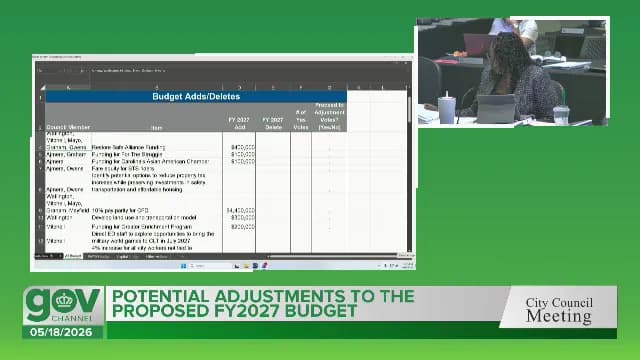
This is a special meeting of the Charlotte City Council to discuss and vote on proposed adjustments to the Fiscal Year 2027 budget. Councilmembers presented requests for funding modifications, debated the use of the financial partner scoring process, and conducted straw votes to determine which items staff would analyze for the final budget on June 1. The meeting began at approximately 6:15 PM and included discussion of public safety, transit equity, housing, economic development, and tax policy. Discussion Items - Process Overview: The Mayor explained that each council member would present budget adjustment requests, which would be recorded. Items receiving at least five votes would be analyzed and costed by staff for a final vote on June 1. The votes were described as "straw votes" to explore options. - Councilmember Ashmir's Proposals: Requested restoration of Safe Alliance funding ($400,000), funding for "For the Struggle" ($100,000) and Carolinas Asian American Chamber of Commerce ($100,000), transit fare equity for STS riders (noting STS fares are $3.50 vs. bus $1.10), and a request to identify options to reduce the proposed property tax increase while maintaining core investments. - Councilmember Watlington: Supported Safe Alliance funding, restoring pay parity for firefighters (estimated $4 million impact), and a land use and transportation model ($300,000) for improved planning. - Letter from Mayor Pro Tem (read by Councilmember Watlington): Recommended raising firefighters to 10% pay level in alignment with CMPD, funding the Greater Enrichment Program ($200,000), supporting Safe Alliance, and exploring bringing the Military World Games to Charlotte in July 2027 (no funding request at this time). - Councilmember Mayo: Proposed a 4% increase for all city workers not tied to performance, firefighter 10% pay parity, Safe Alliance funding, and support for For the Struggle, Hearts for the Invisible, and Just Do It Movement. - Councilmember Owens: Supported modified duty positions for firefighters, Safe Alliance, STS fare equity with operational improvements, reduction of property tax increase (citing concerns about large increase after years of no incremental increases), and housing trust fund increase. Also suggested exploring code enforcement and pet fees to generate revenue. - Councilmember Mayfield: Raised concerns about the financial partner scoring process, noting that several organizations with high scores (90+) were not funded while lower-scoring organizations were being proposed. She argued for adhering to the established process and identified a potential funding source for firefighter pay parity: reducing CMPD's proposed increase from 10% to 7%, which would save $6.4 million and cover the $4.4 million needed for firefighters. Also discussed the housing trust fund capacity (one-time increase to $200 million would add 0.157 cents to property tax perpetuity). - Councilmember Johnson: Supported STS improvements (noting 48% increase in demand), a 7% across-the-board increase for all employees, restoring step increases for firefighters, and removing a $10 million helicopter hangar from the CIP. Also supported Safe Alliance, For the Struggle, Hearts for the Invisible, international relations expansion, property tax reduction options, and the Military World Games. - Councilmember Sanderson: Emphasized firefighter pay parity, Safe Alliance (citing a double-digit increase in domestic violence 911 calls, over 37,000 in 2025), Asian American Chamber funding, and Hearts for the Invisible as part of a broader homelessness strategy. - Councilmember Graham: Advocated for a 4% across-the-board raise for city workers (non-performance-based), firefighter 10% parity, Greater Enrichment Program, Safe Alliance, a dedicated international relations office (merging protocol, language access, and business recruitment), and recurring funding for For the Struggle, Hearts for the Invisible, and Just Do It Movement. Also supported the housing trust fund increase and the helicopter hangar as a need. - Councilmember Anderson: Supported modified duty positions, Safe Alliance (suggesting cobbling funds for this year), land use model, property tax reduction, housing trust fund increase, and removal of helicopter hangar (questioning its necessity given drone technology). Also suggested exploring code enforcement and animal adoption fees. - Manager Jones' Comments: Provided context on pay structures (step vs. merit), noted that 46% of firefighters have topped out (though later clarified as 20% by Councilmember Mayfield), and explained challenges in finding savings. He stated that most enhancements would require a higher property tax rate than proposed. Suggested Safe Alliance could be treated like Tree Charlotte (a non-financial partner) to secure ongoing funding. - Financial Partner Scoring Debate: Multiple councilmembers (Mayfield, Anderson, Owens) argued for adhering to the scoring process approved by council. Organizations like For the Struggle (score 82), Carolinas Asian American Chamber (score 48.8), and Greater Enrichment Program (did not attend mandatory session) were criticized for bypassing the system. Manager Jones confirmed that the scoring was objective and that the proposed budget included only organizations that met all requirements. Key Outcomes - Items that received at least five straw votes and will be analyzed by staff for the June 1 final vote: - Add funding for five modified duty positions for Charlotte Fire (unanimous) - Restore Safe Alliance funding (unanimous) - Explore fare equity for STS riders (5 votes) - Identify potential options to reduce the property tax increase while preserving investments (5 votes) - Explore 10% pay parity for CFD (more than 5 votes) - Explore funding to develop a land use and transportation model (5 votes) - Explore a 4% across-the-board increase for hourly city workers (not merit-based) (7 votes) - Explore increasing housing trust fund to $200 million one-time (7 votes) - Explore funding for Prospera (5 votes) - Restore steps for fire pay plan (unfreeze steps for current year) (5 votes) - Explore increase to animal adoption fees and code enforcement fees (5 votes) - Items that did not receive five votes and will not move forward: - Funding for For the Struggle (4 votes) - Funding for Carolinas Asian American Chamber (4 votes) - Funding for Greater Enrichment Program (4 votes) - Funding for Hearts for the Invisible (4 votes) - Funding for Just Do It Movement (3 votes) - Decrease CMPD increase from 10% to 7% (3 votes) - Increase all employees to 7% (3 votes) - Increase business district organization funding (2 votes) - Remove helicopter hangar (2 votes) - The international relations expansion proposal was discussed at length but not voted on; councilmembers requested a memo from staff outlining the scope and goals before making a decision. - The meeting adjourned to proceed to a zoning meeting.

FISCAL SUSTAINABILITY 30% · MISCELLANEOUS 16% · ECONOMIC DEVELOPMENT 14% · PERSONNEL MATTERS 11%
19
MAY 18, 2026 · CHARLOTTE, NORTH CAROLINA · CITY COUNCIL
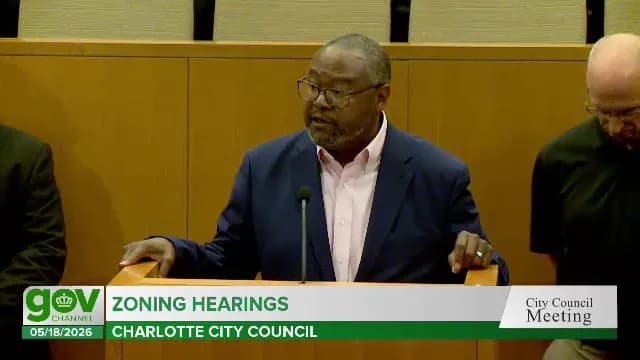
Charlotte City Council Zoning Meeting - May 18, 2026

The Charlotte City Council held a zoning meeting on May 18, 2026, beginning with an invocation recognizing Mental Health Awareness Month, the Pledge of Allegiance, and roll call. The meeting processed multiple rezoning petitions, including consent items, public hearings, and votes. Key topics included affordable housing, transit-oriented development, historic preservation, and infrastructure concerns. Consent Calendar - Items 3 and 5 (petition numbers not specified) were approved unanimously from the consent agenda after items 4, 6, and 7 were pulled by council members. - Item 4 (petition 2025-136 by Larry Cooper): Motion to approve failed (5 in favor, 4 opposed). Subsequently, a motion to defer passed unanimously. - Item 6 (petition 2026-002 by Zing Zhang): Approved with one opposing vote (Councilmember Mayfield). - Item 7 (petition 2026-003, Manor Theater): Approved unanimously after discussion highlighting historic preservation and community support. Public Comments & Testimony - Item 15 (petition 2025-027 by Mission City Church/Freedom Communities): Bridget Harvey, a resident of Oak Street, spoke in opposition, citing traffic hazards on Somerville Road (blind curve, on-street parking), narrow streets, and potential access issues. She requested alternative access via a Family Dollar easement. Petitioner representatives (Eddie Moore, Mark Talbot, Kyle Dillard, Ron Staley) presented support, emphasizing the project's affordable housing component (100% House Charlotte eligible, 7-year deed restriction, no rentals), reduction in daily traffic trips (913 fewer than current zoning), and changes made since the previous hearing (relocation of site access from Goodman Road to Somerville Road). Discussion Items - Item 4 (2025-136): Councilmember Johnson voiced concern over conventional rezoning petitions lacking site plans, stating it does not serve residents. After the motion to approve failed, a deferral was granted. - Item 6 (2026-002): Councilmember Mayfield opposed the TOD-NC zoning in a manufacturing area, arguing the city is losing manufacturing and logistics land. Councilmembers Mayo and Watlington supported the small lot (0.16 acre) as an opportunity for a neighborhood amenity and transition. Councilmember Ejmira noted the lot is too small for manufacturing. The petition was approved. - Item 7 (2026-003): Councilmember Owens led discussion, praising the Manor Theater's history and the mixed-use project's design enhancements. Councilmember Anderson and Arias echoed support. The petition was approved unanimously. - Item 10 (2025-135 by Charlotte Mecklenburg Hospital Authority): Staff noted a minor change (additional EX provision for surface parking). Council voted unanimously not to send the petition back to the zoning committee, then approved it unanimously after a revote for clarity. - Item 15 (2025-027): Councilmembers questioned traffic safety, parking, affordability period (7 years vs. longer), and community engagement. Councilmember Graham offered to walk the site with parties. Deed restrictions against rentals were confirmed. The public hearing was closed. - Item 22 (2026-006 by Good Properties): Councilmember Johnson raised concerns about conventional petitions lacking details and cumulative school impact, sharing a report on CMS utilization data. The public hearing was closed. Key Outcomes - Item 4 (2025-136): Deferred unanimously. - Item 6 (2026-002): Approved (1 opposed). - Item 7 (2026-003): Approved unanimously. - Item 10 (2025-135): Approved unanimously after confirming no return to zoning committee. - Public hearings closed for items 15 through 25 (petitions 2025-027, 2025-058, 2025-131, 2025-133, 2025-141, 2026-004, 2026-005, 2026-006, 2026-010, 2026-013, 2026-022). - Meeting adjourned.

LAND USE AND DEVELOPMENT 37% · MISCELLANEOUS 18% · ECONOMIC DEVELOPMENT 10% · ENVIRONMENTAL PROTECTION 6%
20
MAY 11, 2026 · CHARLOTTE, NORTH CAROLINA · CITY COUNCIL
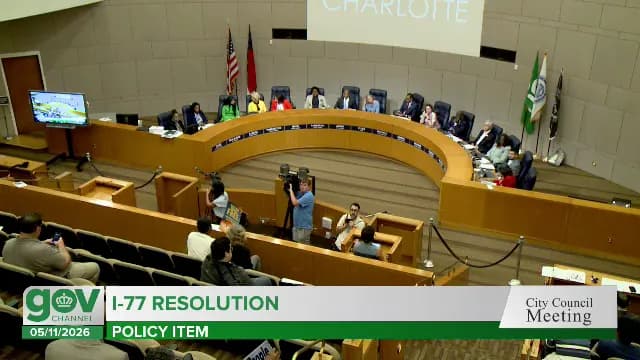
Charlotte City Council Meeting – May 11, 2026: Budget, Data Centers, I-77, and MPTA Transition

The Charlotte City Council met on May 11, 2026, for its regular business meeting. The agenda included a consent calendar with several items pulled for discussion, public hearings on the FY2027 budget and related topics, a detailed presentation on data centers and a proposed moratorium, an update on the MPTA (Metropolitan Public Transportation Authority) transition, and a resolution regarding the I-77 South corridor managed lanes project. Significant debate centered on minority business participation, the environmental and community impacts of data centers, firefighter pay parity, and the future of the I-77 P3 project. Key votes included approval of a 150-day moratorium on data centers (pending a public hearing) and adoption of a non‑binding resolution urging an independent analysis of I-77 alternatives; a motion to rescind P3 approval failed. Consent Calendar - Councilmember Mayfield pulled items 30 (water/sewer service installation, $8.585 million contract) and 31 (contract amendment for $4.317 million) for separate discussion due to low minority‑owned business (MWBE) participation. Item 30 had a 10% aspirational goal but only 4.26% committed ($365,500); item 31 had 3.15% commitment ($136,125). Councilmember Mayfield argued the levels were disrespectful to city policies and small businesses. - Item 34 was pulled by Councilmember Johnson to clarify that federal DBE rule changes do not affect the city’s CBI program; staff confirmed the city’s local program remains active. - Item 30 – Councilmember Mayfield moved to defer; the motion passed unanimously. - Item 31 – A deferral motion failed (4 in favor, insufficient); then a motion to approve passed by majority (with Mayfield and others opposed). - The remaining consent items (24–43, except deferred 35) were approved unanimously. Public Comments & Testimony Approximately 40 speakers addressed the council, primarily on the FY2027 budget and the I-77 project. Key themes: - Affordable Housing & Homelessness: Several speakers (Carol Hardison, Ted Fillette, Greg Jarrell) urged increasing the Housing Trust Fund to $200 million (vs. proposed $125 million), citing 52,625 eviction filings last year and a shortage of 40,000 affordable homes. Oshana Hunter (OneMet) noted that adding $100 million would increase city debt by only 1.5%. - Firefighter Pay & Police Pay Parity: Firefighters (Mark Wilson, Brantley Stylins, Adam Alman, Meredith Barbie) requested a 10% raise and maintained parity with CMPD. They argued that the proposed 7% is effectively 2% after step increases, and that firefighters work 2,700 hours/year vs. 2,184 for police, while starting pay for new firefighters is below the new $25/hour minimum. The Fire Union noted 90% of firefighters work second jobs. - City Worker Wages: Speakers (Cass Otley, Dominique Harris, Khalisma Ortiz) echoed calls for a 10% raise for all city workers, noting that the actual increase after performance reviews is often only 2%. They highlighted that Charlotte Water employees are excluded from public safety pay plans. - Data Centers & Environment: During the evening session (prior to formal public hearings), multiple council members and staff discussed data center impacts. Residents voiced concerns about noise, water usage (1.2 million gallons/day for hyperscale sites), air quality, and proximity to homes. - I-77 South Corridor: Community members (Libba Moore, Rocky McGregor, Cole Garday, and others) urged council to pause or rescind the P3 toll lane project, citing induced demand, displacement of Black neighborhoods, lack of trust in NCDOT, and the need for independent multimodal alternatives. - Other: Support for Safe Alliance funding, animal care and control, bicycle infrastructure, international affairs office, and the People’s Budget coalition. Discussion Items Data Centers & Proposed Moratorium - Alison Craig (Planning) presented a detailed update, noting that state law (Session Law 2024‑57) restricts local zoning authority. Charlotte has one definition for all data centers, ranging from small server rooms to hyperscale campuses (e.g., Powerhouse, Morris Chapel). Current inventory: 1 million sq ft of single‑user facilities; two hyperscale sites (up to 2.5‑3 million sq ft) approved in the ETJ. - Key Statistics: Water usage by hyperscale data centers in summer can reach 1.2 million gallons/day (using reclaimed water); smaller facilities use 64,000 gallons/day total. Data centers account for 0.4% of total water demand. Duke Energy notes data centers are <1% of statewide peak demand now, projected to reach 10% by 2030. - Staff recommended a 150‑day moratorium to study impacts and develop performance standards (noise, water/energy conservation plans). A public hearing would be held May 26, with council action on June 8. The moratorium would not affect existing approved developments. - Councilmembers Anderson, Watlington, and Ashmira expressed support for the moratorium and called for tighter definitions, including requiring closed‑loop cooling, and engaging stakeholders (e.g., Action NC, Clean Air Carolina). Concerns about legal risks from the state law were addressed; staff said a moratorium is permissible under GS 160D‑107. - Vote: Motion to hold a public hearing for a 150‑day moratorium passed unanimously. MPTA Transition Update - City Attorney Leslie‑Fight and Catherine Clodfelter (Parker Poe) presented the draft interlocal agreement required by the PAVE Act, which must be adopted by July 1, 2026. The proposed phased transition: Phase 1 (July 1, 2026 – Jan 1, 2027): city retains asset ownership, MPTA becomes policy body, operational control delegated back to city. Phase 2 (Jan 1 – July 1, 2027): employees transfer to MPTA, unencumbered assets transfer, back‑office services may continue. Phase 3: as debt is paid, additional assets transfer. - Key conditions: employees must receive comparable salaries and benefits; service credit must be recognized; MPTA must have infrastructure to direct funds for debt service. Indemnification provisions remain a placeholder. - Council will receive further updates at TPD committee (June 1) and action review (June 8), with final adoption scheduled for June 22. I-77 South Managed Lanes Resolution - Councilmember Owens introduced the resolution, which was amended by a substitute motion from Councilmember Masweta‑Adios to call for an independent third‑party reevaluation of the corridor, including multimodal options, non‑highway strategies, and a pause on the draft RFP until findings are presented. - After extensive debate, the amended resolution passed 10‑1 (Councilmember Johnson opposed). - Immediately after, Councilmember Johnson moved to rescind the city’s approval of the P3 project, directing the CARTPO representative to seek rescission. The motion failed 5‑6 (in favor: Johnson, Watlington, Anderson, Ashmira, Mayfield; opposed: Mayo, Mitchell, Graham, Driggs, Owens, Mayor Lyles). - Councilmember Driggs noted that rescinding P3 would likely stop the project entirely, as NCDOT stated it cannot be built without private funding. NCDOT representatives confirmed the project remains on the STIP but without alternative funding. Key Outcomes - Consent Calendar: Approved with items 30 and 31 handled separately (30 deferred; 31 approved). - Data Center Moratorium: Passed a motion to hold a public hearing on May 26 for a 150‑day moratorium (vote: unanimous). - I-77 Resolution: Adopted (10‑1) with substitute amendment calling for independent reevaluation and RFP pause; rescission motion failed (5‑6). - Water/Sewer Revenue Bonds (Item 14): Approved unanimously (motion to adopt items A–E). - Mayoral Appointments: Confirmed nominations for various boards, including Darlene Whitfield and Nicole Reina for Business Advisory Committee, Eric Norman for Business Inclusion Advisory Committee, and others. - Budget Timeline: Public hearing held; budget adjustment discussions set for May 18, straw votes June 1, adoption June 8.

TRANSPORTATION PLANNING 21% · PROCEDURAL 11% · TECHNOLOGY AND INNOVATION 11% · LAND USE AND DEVELOPMENT 11%
OPENPUBLICA · PUBLIC MEETING INDEXUPDATED DAILY · openpublica.com