The Charlotte City Council met at 5:00 PM on Monday, April 21, 2025, in the Council Chamber of the Charlotte-Mecklenburg Government Center for a zoning meeting. The meeting included an invocation, Pledge of Allegiance, and explanations of the zoning process. Major actions included the deferral of two petitions, approval of multiple consent agenda items, a rare denial of a rezoning petition, and public hearings on seven contested petitions. Consent Calendar - Deferrals granted for petition 2024-064 and 2024-137 to May 19, 2025. - Consent agenda items (2024-106, 2024-110, 2024-131, 2024-139, 2024-146, 2024-147) approved unanimously. - Item 2024-073 (pulled by Councilmember Brown) approved unanimously. - Item 2024-134 (pulled by Councilmember Molina) approved 6-3 after debate; opposed: Councilmembers Mayfield, Johnson, and Watlington. - Item 2024-136 (pulled by Councilmember Mayfield) approved 6-3; same opposing members. - Item 2024-138 (pulled by Councilmember Brown) approved unanimously. - Item 2024-142 (pulled by Councilmember Mayfield) approved with only Councilmember Mayfield opposed. Public Comments & Testimony - 2023-074 (C Investments 2, LLC): Matt Orlowski, representing the Kuykendall Coalition (approx. 220 households), expressed frustration with the timing of the hearing (Easter Monday) and questioned the petitioner’s intentions due to an online listing for the property. He cited density concerns (220 townhomes on 14 acres vs. existing 7 homes), insufficient open space, and staff’s non-recommendation. He asked for denial but indicated willingness to negotiate. Petitioner Colin Brown noted the proposal includes a downzone of the rear 12 acres to single-family and transportation commitments based on a prior 500-unit plan. - 2024-124 (Aviation Metals of North Carolina, Inc.): John Galagos, a wildlife biologist, opposed citing impacts to Tyson Branch Creek hydrology, loss of forest buffer, and risks to Highway 85 and a petroleum pipeline. Sharon Hendrickson shared personal stories about the Moore’s Park community’s quality of life. Norman Phillips described the neighborhood’s close-knit character and reported negative spillover from an existing warehouse (encampments, traffic, crime). Patricia Tunierelli asked for empathy and against industrial rezoning. Petitioner John Carmichael noted the site already has industrial neighbors and will include a 100-foot buffer and stormwater controls. - 2024-144 (Digital Moores Chapel LLC): Petitioner Colin Brown explained the rezoning would allow a data center’s second floor without increasing building height, reducing the footprint vs. allowed warehouses. Councilmembers asked about environmental impacts, water use (backup generators), and community outreach. No public opposition spoke. - 2024-145 (DavidLand, LLC): Petitioner Colin Brown described a small remainder parcel (8.85 acres) with most development in Cabarrus County; no driveway access from Charlotte. No public attendees; hearing closed. - 2025-002 (Kelsey Miles): Petitioner Kelsey Miles, a physical therapist, requested rezoning for adaptive reuse of a 98-year-old house as a pediatric therapy clinic. No public opposition; neighbors were supportive. Hearing closed. - 2025-006 (Beacon RCP LLC): Petitioner Colin Brown stated the rezoning merely updates the zoning letter from I-1 to ML-1 with no new entitlements; all previous commitments (transportation, prohibited uses) remain. Councilmember Johnson requested improved access to prior petition documents. Hearing closed. - 2025-022 (Bill Scantland): Petitioner Bill Scantland proposed 60 affordable housing units (30-60% AMI) on a brownfield site, with rents from $480 to $1,400. He cited a need for 7,000 such units in the area. Councilmember Molina noted only one community meeting attendee and asked to discuss with the district. Hearing closed. Discussion Items - Consent items 8 and 9 (2024-134, 2024-136): Councilmember Molina supported the petitions due to existing precedent on the street and community acceptance. Councilmembers Mayfield and Johnson opposed, citing concerns about setting a precedent for lot splits that could erode neighborhood character and contradict policy goals for preserving existing communities. Councilmember Driggs argued that current policy supports the petitions and that policy review should be separate. After debate, both petitions were approved 6-3. - Item 12 (2024-142): Councilmember Mayfield opposed rezoning manufacturing land to TOD, citing environmental and quality-of-life concerns from proximity to industry. Councilmember Johnson supported but called for deeper policy review. Councilmember Brown supported. The petition was approved with Mayfield opposed. - Decision on 2024-116: Mayor Pro Tem Anderson moved to deny the petition, citing lack of collaboration with the Hidden Valley neighborhood and disruption to the historic lot pattern. The council voted unanimously to deny, with staff and zoning committee had recommended approval. Councilmember Driggs noted the denial was driven by process rather than merits. Key Outcomes - Deferrals: Petitions 2024-064 and 2024-137 deferred to May 19, 2025 (unanimous). - Consent approvals: See Consent Calendar above for vote tallies. - Decision on 2024-116: Denied unanimously (8-0) – a rare council denial. - Decision on 2024-125: Approved unanimously after minor changes (six-unit building limits, material restrictions) were accepted without sending back to zoning committee. - Referral to committee: Councilmembers Mayfield and Johnson requested a committee review of UDO policies related to lot splits, density, and environmental impacts of manufacturing land conversion. Councilmember Driggs indicated support for a policy review but not to delay decisions. - Next steps for hearings: Public hearings were closed for items 18-24; each petition will proceed to the Zoning Committee of the Planning Commission for recommendation and later return to Council for a final vote.
Public Meetings - Charlotte, North Carolina
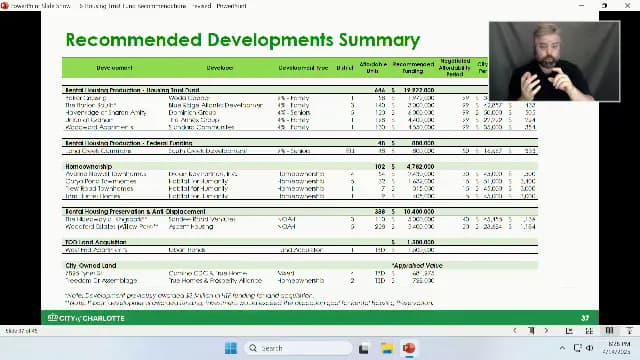
Public Meetings - Charlotte, North CarolinaThe Charlotte City Council met on April 14, 2025, at 5:00 PM in Room 267 of the Charlotte-Mecklenburg Government Center. The meeting opened with recognitions, including proclamations for Autism Awareness Month (April 2025) and Arbor Day (April 25, 2025), as well as honors for the City Clerk’s Office winning the 2025 Program Excellence and Governance Award and the Quill Award. The council then proceeded through the consent agenda, a major Housing Trust Fund action review, and two public hearings, and ended with a closed session. Consent Calendar - Approved consent agenda items 11 through 28 in a single motion, which included: - Pavement Marking Installation and Removal contract ($517,375 to Striping Concepts, LLC) - Elevator equipment, maintenance, and repair services cooperative contracts - Office supplies cooperative contract (American Office Products Distributors, Inc.) - Rental equipment cooperative contract (United Rentals) - Construction engineering and inspection for federal contracts (five firms) - Cross Charlotte Trail Matheson to 36th Street Segment Infrastructure Reimbursement Agreement (up to $12,500,000) - Maintenance and repair of city-owned vehicle and equipment wash services (Cross Systems Inc.) - Monroe Road Multi-Use Path contract ($1,596,858.07 to HUX Contracting, LLC) - Paving and Patching Contract Change Order 2 ($1,000,000 to OnSite Development, LLC) - Storm Drainage Improvement Project – 619 Cedar Street ($935,694.47 to Cinderella Partners Inc.) - Meeting minutes from multiple dates - Resolutions setting public hearings for three voluntary annexations (Brightside Commons, Project Lemmond, Steele Creek Park) for May 12, 2025 - In Rem Remedy for 7214 Lawyers Road - Charlotte Water property transactions (Belmont Lift Station, Oakdale Road Buffer) - Condemnation for 9836 Old Dowd Road Public Comments & Testimony - No members of the public signed up to speak during the public hearings. The council conducted two public hearings (Housing and Community Development Consolidated Plan and Section 108 Loan Guarantee) with a motion and second to close the hearings without any oral testimony. Discussion Items Housing Trust Fund Recommendations (Action Review) - Rebecca Hefner (Housing and Neighborhood Services) presented an overview of the $100 million housing bond’s first funding cycle. Staff received 25 proposals requesting over $75 million, with the largest ask in HTF history ($13.5 million for Brooklyn Village). - Staff recommended 13 Housing Trust Fund (HTF) proposals plus two city-owned land conveyances: - Rental Production (6 of 13): Baker Crossing (58 units, TOD), Barton South (140 units, 99-year affordability), Haven Ridge at Sharon Amity (120 senior units, partnership with Opportunity South Carolina, Matter Health, Mission 1513), Union at Graham (198 units, $22,000/unit investment), Woodward Apartments (130 units, near Camp North End, partner with Ounce of Care), Long Creek Commons (48 senior units, using HOME funds). - Home Ownership (4 of 13): Newell Presbyterian/Dreamkey Partners (54 townhomes, $267k-$276k, 30-year affordability), Habitat for Humanity developments: Caria Pond Townhomes (32 affordable + 41 market-rate), Fru Road Townhomes (8 units), Tom Hunter Townhomes (10 units, mix of attached/detached). - Rental Preservation (2 proposals – both strong but exceed category allocation): Hideaway at King’s Park (110 units, 40-year affordability, new partner Sandy Road Ventures) and Woodford Estates (228 units, partnership with Ascent Housing and Roof Above as equity partner). - TOD Site Acquisition: West End Apartments (carless development, 0.5-acre site, request $1.5M from fee-in-lieu balance, no on-site parking with bike share and EV car share). - City-Owned Land: Tyner Street (12 rental townhomes + 2 transitional, 99-year ground lease, partner Camino CDC and True Homes) and Freedom Drive Assemblage (12 for-sale townhomes, 20-year affordability, partner True Homes and Prosperity Alliance). - Deferred Proposals: Staff recommended deferring Brooklyn Village multifamily (request $13.5M) and five other developments to the next HTF cycle; staff will convene partners (city, county, Inlivian) to explore alternative funding structures and report back in June. - Council members expressed broad support for the package, with specific discussions on: - Home ownership affordability periods: Councilmember Ajmera questioned 15-year vs. 30-year terms; staff clarified that Habitat’s model includes shared appreciation and 45-year effective restrictions. - Community engagement for Haven Ridge: Councilmember Molina noted the developer had not contacted the adjacent Coventry Woods neighborhood; staff confirmed community engagement is required and will follow up. - Parking concerns: Councilmembers Graham and Brown cautioned that carless developments often lead to street parking complaints; staff noted the West End TOD design includes alternative mobility strategies. - Brooklyn Village: Councilmembers urged caution given the decade-long history and $13.5M request; staff recommended further collaboration with partners. - Innovation and speed: Councilmember Graham asked about expediting permitting for affordable housing; staff acknowledged ongoing efforts to streamline approvals. Key Outcomes - Consent agenda approved unanimously. - Public hearings closed without testimony; the Housing and Community Development Consolidated Plan (FY2026-2030) and Section 108 Loan Guarantee application ($25 million) will proceed to a future vote. - Housing Trust Fund recommendations will be voted on at the April 28, 2025 City Council Business Meeting. Staff’s recommended package (subject to council modifications) totals over $35 million, creating 1,100+ affordable units, leaving an approximate $59 million balance in the $100 million bond. - City-owned land conveyances for Tyner Street and Freedom Drive will also be voted on April 28. - Closed session was held to consult with the city attorney on a claim and to review recordings released under state statute. - Next Steps: The second HTF RFP cycle opens in May with recommendations expected in September 2025; the Brooklyn Village proposal will be re-evaluated with partners and brought back in June.
On April 7, 2025, the Charlotte City Council held committee discussions at the Charlotte-Mecklenburg Government Center. Committee chairs provided updates on mobility, housing, government infrastructure, and economic development, including presentations from three Municipal Service District (MSD) agencies. No formal votes were taken, but several policy directions and funding requests were discussed. Mobility Committee - Council Member Ed Driggs reported on two topics: the community area plan drafts (now released) and the strategic energy action plan update. He emphasized that council members must read the plans to inform the public, as the general public will not read the full documents. Council Member Reneé Johnson added that less than 1% of city residents were initially engaged in the community area plans and urged the city to be intentional about transparency and proactive outreach. - Council Member Marjorie Molina noted that Council Member Malcolm Graham raised the need to update the public on the transportation tax. Driggs confirmed that the city is seeking state legislation to allow a November referendum on a one-cent sales tax to fund a $20 billion mobility plan (rail, bus, and road projects). The 2030 plan update is expected in May 2025. Housing, Safety, and Community Committee - The chair (unnamed in transcript) presented an update on the $100 million housing bond implementation. Categories include rental housing production, home ownership, preservation, supportive housing/shelter, rehab/emergency repair, innovation pilot fund, site acquisition, and administration. They detailed the innovation pilot fund, land development strategies (including mixed-purpose projects like housing with fire stations), and a housing policy simulator from UC Berkeley. - Council Member Danté Anderson suggested leveraging UNC Charlotte’s R1 status for the simulator rather than exporting expertise. Council Member Johnson noted that the city is already working with the UNC Charlotte Urban Institute for evaluation. She also questioned the affordability of 50% Area Median Income (AMI) rents, noting that at 50% AMI the rent is $1,271 per month, which is still high for many working-class residents. - Council Member LaWana Mayfield explained that the housing discussion included a pilot for a lower-interest loan product through the Community Impact Revolving Loan Fund, which would extend affordability by 10 years and use a loan rather than grant model. Business, Government, Infrastructure, and Regulation (BGIR) Committee - The chair (likely Council Member Tariq Bokhari) reported on four topics: - Medic Interlocal Agreement: Fire Chief Johnson provided an update. No contract has been received from Medic, and the town of Harnett has canceled its contract. The chair expressed concern and noted the chief may need to take a hardline approach. Council Member Bokhari and Council Member Graham stressed the urgency, with Bokhari stating that unaddressed issues do not improve with age. - Aviation Budget: $30 million increase in operating expenses, but offset by revenue increases (enterprise fund). Leadership is focusing on operational resiliency and passenger safety, especially after the Washington DC mid-air collision. Benchmarking data on parking was requested. - CATS Budget: Interim CEO Brent Cagle reported no fare increases, but a fare study is underway. Capital investments for safety and employee measures are planned. Council Member Anderson praised Cagle’s performance, noting improved service and reduced ghost buses compared to 18 months ago. - Financial Partners Funding Policy Review: Over $8.2 million in funding requests were received. Committee provided feedback on value-based approach, gap analysis, and suggested that organizations like Tree Charlotte might have a line-item budget instead of going through the financial partners process. The chair noted that scoring has perception issues, and the manager will incorporate feedback into the budget proposal. Jobs and Economic Development Committee – MSD Presentations - Council Member Malcolm Graham introduced presentations from the city’s three Municipal Service Districts. Charlotte Center City Partners (Michael Smith) - Reported a $5.4 billion development pipeline, 330 days of professional sports in 2024, and the opening of UNCC’s CoLab. The Uptown Vibrancy Collaborative, co-chaired by Bill Rogers and Lynn Good, raised $1 million per year for two years from private companies to fund marketing, programming, and an expanded ambassador program (currently 16, aiming for 35-40). The ask: raise the millage in MSDs 2 and 3 to generate an additional $1 million annually. For a $100 million building, the increase would be $8,200/year; for condo units, $38/year. Council Member Ajmera expressed support. Council Member Watlington questioned whether the funding aligns with core city services, especially safety, and asked for clarity on how the safety ambassador program is funded. Council Member Anderson emphasized coordination with the county’s new 24-hour park security in uptown parks (starting July 1) and the Home for All program. South Park Community Partners (Adam Bartlett) - Launched the South Park Skipper microtransit in November 2024, providing 16,000 rides by end of March 2025, with an 8-minute average wait time. Announced a $21 million public-private partnership for Symphony Park, which includes a 500-foot South Park Loop segment, two anchor restaurants (privately funded), micro-retail, and park improvements. Funding: $13 million private (Simon Property Group), $5 million from South Park Community Partners, and $8 million request from existing city bond capacity for District 6 (originally allocated in 2018). Construction target: summer 2026, delivery 2027. Council Member Bokhari noted the money is already allocated. Council Member Johnson asked about precedent for mall assistance. Council Member Ajmera supported the project for its green space and economic development. University City Partners (Keith Stanley) - Reported that 20% of Mecklenburg County residential permits are in University City. The lake attracts 3.4 million visitors annually, with average stay of 38 minutes (increasing with events). Six signature events drew 40,000 people. The organization is exploring an ambassador program to address litter, shopping carts, and yard signs, especially on state-maintained roads (WT Harris, North Tryon). Stanley highlighted the R1 status of UNC Charlotte and plans to leverage that for economic development. Council Member Ajmera praised the cleanliness of the lake area. Council Member Anderson suggested using MSD data citywide. Council Member Graham noted the challenge of state-owned roads and the need for council to engage state delegation. Council Member Johnson highlighted the retention of Soul Delish restaurant in University City. Key Outcomes - Policy Directions: Council members emphasized the need for increased community engagement on area plans and transportation tax messaging. The BGIR committee directed staff to continue negotiations with Medic and prepare for potential hardline actions. The financial partners policy will be refined based on committee feedback. - Funding Requests: Center City Partners’ request for a millage increase will be considered as part of the budget process. The Symphony Park project $8 million request is already in allocated bond capacity. Council members expressed general support but asked for additional details on safety investments and core service alignment. - Next Steps: The manager’s budget proposal will incorporate BGIR committee feedback on financial partners. The community area plans and strategic energy action plan will return for further council discussion. The transportation tax referendum depends on state legislative action and county commission approval. - No Formal Votes: As this was a committee discussion, no votes were taken. All items are informational or for future action.
The Charlotte City Council held its second budget workshop for fiscal year 2026 development on March 24, 2025. The workshop covered three major topics: the Financial Partners Program, Solid Waste Services, and the Capital Investment Plan. Council members discussed funding constraints, program effectiveness, and future priorities. No formal votes were taken during the workshop; the meeting concluded with a closed session regarding economic development incentives. Discussion Items Financial Partners Program - Staff presented the FY2026 application cycle: 50 organizations applied (a 177% increase over FY2024), requesting a total of over $8.6 million – the largest request in program history. Current available discretionary funding is approximately $1.5 million. - A new scoring system was introduced using a cross-departmental team of 19 staff members, with each application scored by six people on a 65‑point scale. Criteria included submission completeness, performance and equity measures, and alignment with council’s strategic priorities. - Council members expressed varied views: some emphasized the need for objective, data‑driven selection; others warned against penalizing smaller or newer organizations. Mayor Vi Lyles suggested refocusing the program on investments that lead to sustainability or integration into the city’s formal budget. - Councilmember Mayfield raised concerns about organizations requesting more than the 30% cap of their budget and about duplication of services. Councilmember Driggs called for a more objective value‑added assessment. - City Manager Marcus Jones noted that the budget gap remains in the single‑digit millions and that property taxes will not be increased. He stressed that city programs and partner funding would face cuts based on outcomes. - Next Step: The Budget, Governance, and Intergovernmental Relations (BGIR) Committee will refine selection criteria and bring recommendations in April, prior to the May 5 budget proposal. Solid Waste Services - Residential solid waste services (garbage, yard waste, recycling, bulky items) cost about $86 million annually. Fees cover only 46% of that cost – a low recovery rate compared to peer cities. The city is analyzing splitting fees by service type (curbside roll‑out vs. dumpster). - Staff highlighted ongoing initiatives: transition to paper yard‑waste bags (improving worker safety), a pilot for yard‑waste carts, and the need for a solid waste transfer station (land not yet acquired). The interlocal agreement with Mecklenburg County expires in 2028, requiring negotiation on tipping fees and facility responsibilities. - Council discussion focused on the equity of fee increases, particularly for residents already facing property tax increases from revaluation. Councilmember Mayfield asked about higher fees for multifamily and small businesses (currently $250/year, unchanged for years) versus residents. Councilmember Driggs supported moving toward higher cost recovery to avoid cuts elsewhere. - Councilmember Watlington praised worker safety improvements and asked for data on potential fee impacts. Councilmember Anderson advocated for services for aging residents. Capital Investment Plan (CIP) - Staff reported that 152 active capital projects are underway: 138 on target, 13 at risk, and 1 over budget. In the past year, 17 projects were completed and 20 new ones started. - The COPs (Certificates of Participation) capacity remains at about $26 million per year, totaling $130 million over the five‑year plan. FY2026 is not a bond year. - Advanced planning projects include: an animal care and control satellite facility (earmarked $30 million, currently in design, expected completion Q2 2028) and a CMPD helicopter hangar. The Northwest Division police station (last of six) is at risk but is expected to access previously approved funding. - Councilmember Driggs requested a macro‑level quantification of at‑risk and over‑budget projects to assess overall stability. Councilmember Ashmira questioned the value of advanced planning given continued risk, but City Manager Jones and Councilmember Mitchell defended the process, noting it has reduced large cost overruns by basing budgets on 30% design. - Councilmember Mayfield raised concerns about the animal control facility focus on adoption versus the need for more shelter space, and about investment in the fire training facility (simulator heat issues, water tower leaks). Councilmember Anderson echoed the need for improved fire training facilities. - Councilmember Mitchell commended staff for completing 17 projects while adding 20 new ones, with only one over budget – a strong performance in a challenging construction market. Key Outcomes - Financial Partners: The BGIR Committee will develop refined prioritization criteria and report back in April before the May 5 budget proposal. Council intends to avoid last‑minute “add‑and‑delete” decisions. - Solid Waste: Staff will return with more detailed fee impact analyses and a timeline for potential rate adjustments, including separate rates for roll‑out vs. dumpster service and an increased small‑business fee. - Capital Planning: Council directed staff to provide a consolidated summary of at‑risk and over‑budget project totals. Discussion on the fire training facility and animal control design scope will continue. - Closed Session: After the workshop, council moved into closed session to discuss economic development incentives as authorized by N.C.G.S. § 143‑318.11(a)(4).
The Charlotte City Council met on March 24, 2025, for a business meeting that included a consent agenda review, public hearings, a proclamation, and extensive discussions on the CIAA tournament bid and a public safety update. The council approved multiple business investment grants, a workforce development strategic plan, property leases, and several consent agenda items, while also hearing from numerous public speakers on animal shelter funding, airport worker conditions, and other community issues. Consent Calendar - The council approved the majority of the consent agenda items (items 27–66) in one motion, with the exception of items pulled for separate discussion or vote. Items removed included 27, 29, 33, 44, 51, 52, 59, 60, 61, and 28. Item 65 was withdrawn. Items 27, 29, 33, and 44 were approved after a separate vote. Items 51 and 52 were approved after discussion. Items 59, 60, and 61 (property condemnations) were approved over opposition from Councilmembers Johnson, Mayfield, and Brown. Item 28 (Lowe's contract) was approved on a separate vote, with opposition from Mayfield and Brown. Public Comments & Testimony - Animal Shelter Funding: Multiple speakers (Elena Sapulvida, Anna Radcliffe, Kristen Zarakis) urged the council to increase funding for Charlotte-Mecklenburg Animal Care and Control, citing overcrowding, understaffing, and high euthanasia rates. They called for the shelter to become its own department, for stricter animal breeding regulations, and for a ban on retail pet sales and tethering. - Airport Worker Conditions: Laura Kelly (wheelchair agent) and Maribel McBeth (cabin cleaner) described unsafe working conditions, low wages, and high turnover at Charlotte Douglas International Airport. They requested the council raise standards for contracted airport workers. - Overdose Prevention: Lashonda Carter proposed that the city mandate overdose prevention training for businesses that serve alcohol, offering her program, X-Defender. - Homelessness: Tarica Moser shared her personal experience with homelessness and eviction and proposed a tiny homes program, requesting city support. - Nuclear Weapons: Carson Kong urged the council to support a resolution for the UN Treaty on the Prohibition of Nuclear Weapons. - Small Business Support: Alicia Jeter highlighted gaps in city resources for non-construction small businesses, asking for more accessible training and updated information. - Tree Canopy: Alison Rhodes (Tree Charlotte) thanked the city for its support and reported planting 1,698 trees in the current season. Proclamation – Brain Injury Awareness Month - Councilmember Johnson read a proclamation declaring March 2025 as Brain Injury Awareness Month in Charlotte and Mecklenburg County. Several brain injury survivors and advocates spoke, including Jordan Slate, Cindy Daniel, and Kimberly Wilson, emphasizing the need for awareness and support. Discussion Items CIAA Tournament Update - Steve Bagwell (CRVA) and Mike Butts presented an update on efforts to bring the CIAA basketball tournament back to Charlotte for 2028–2030. Key points: the city is competing with Baltimore; the bid deadline is April 15, 2025; a $1.5 million scholarship fundraise is required; Spectrum Center would host the full week; the CRVA is budgeting about $1 million for venues, marketing, and transportation; and state funding may be available from the Major Events, Games, and Attractions Fund. Councilmembers expressed support but raised concerns about public safety, non-sanctioned events, hotel rate subsidies, and the need for clear public funding commitments. Public Safety Update - Sean Heath (City Manager's Office) presented a 45-day review of public safety strategies. Year-to-date crime data (Jan 1–Mar 17, 2025) showed overall crime down 11%, violent crime down 19%, and property crime down 9% compared to the same period in 2024. Three key themes were identified: geographic concentration of crime, repeat offenders (66% of violent crime arrests had prior arrests), and disproportionate impact on youth/young adults (ages 10–25 account for 50% of violent crime arrests). Nine planned strategies were outlined, including: planning for CMPD sworn position growth by FY2027, developing a local nuisance property ordinance, drones as first responders, expanding Project Boost (hospital-based intervention), a youth-led social norms campaign, enhanced reentry services, support for state legislation (HB 50/SB 320 on officer retention), advocating for more prosecutors and court resources, and exploring a local juvenile detention center. Councilmembers provided feedback, emphasizing the need for community surveys, accountability, property crime focus, and long-term planning. Key Outcomes - Business Investment Grants Approved: DetraPel, Inc. (up to $22,843 over 3 years), Groninger USA, LLC (up to $171,936 over 5 years), and RXO Corporate Solutions LLC (up to $166,874 over 7 years) were all approved unanimously. - Right-of-Way Closure: A resolution to close a portion of right-of-way off Pawley Drive was approved. - Workforce Development Strategic Plan: Approved unanimously, establishing three focus areas: Career Pathway Access & Awareness, Skill Development & Credential Attainment, and Job Placement & Career Advancement. - Lease of City-Owned Property at Archdale Drive: Approved a five-year lease with Mecklenburg County for a greenway trail at $1 per year, with renewal options. - Interlocal Agreement for Street Addresses: Approved to delegate address assignment to Mecklenburg County and establish a multijurisdictional committee. - Board Nominations: The council appointed individuals to the Arts & Science Council, Charlotte Mecklenburg Public Access Corporation, Civil Service Board, Community Relations Committee, Neighborhood Matching Grants Fund, and Waste Management Advisory Board as recommended by the City Clerk. - Property Condemnations: Approved condemnations for sewer outfall projects (Davidson Eastern Rocky River, Mallard Creek Basin) and intersection improvements (Remount Road and West Boulevard), with several owners expressing concerns about compensation. - Tree Canopy Acquisition: Approved the purchase of 7.79 acres at Shallow Pond Road for $918,480 for the Tree Canopy Preservation Program. - INLIVIAN Housing Bonds: Approved resolutions for bond issuances not to exceed $28.4 million (Central at Old Concord) and $17 million (The Vue at Honeywood) for affordable housing developments. - Public Hearing Set: Set a public hearing for April 28, 2025, on the voluntary annexation of the Dixie River Road Firehouse No. 44 site. - Consent Agenda Contracts: Approved numerous contracts for architectural services, maintenance supplies, engineering services, generator maintenance, hydraulic hose repairs, roadway construction, utility locating, pumps, telecommunications, laboratory supplies, stormwater projects, bus filters, airport badges, escalator replacement, office relocation, branded apparel, and phone services.
Meeting Overview The Charlotte City Council Zoning Meeting convened at 5:00 PM on March 17, 2025, in the Council Chamber at the Charlotte-Mecklenburg Government Center. The meeting began with introductions, an invocation by Councilmember Mitchell, and the Pledge of Allegiance. Council considered consent agenda items, decisions on previously heard petitions, and public hearings for new rezoning requests. A brief recess occurred at 6:22 PM due to technical difficulties with the presentation system. Notable events included Councilmember Ajmera reporting that a petitioner appeared unannounced at her home, and recognition of a UNC Charlotte MBA class in attendance. One petition was withdrawn, four were deferred to April 21, 2025, and several hearings were closed without final votes pending Zoning Committee recommendation. Consent Calendar - Approved unanimously (with one separate vote for item 2024-126 and one for 2024-148): - 2024-126 (Greystar): 11.53 acres at Queen City Drive and Tuckaseegee Road from MUDD-O ANDO to N2-C (CD) ANDO. Approved 10-1 (Councilmember Mayfield opposed) after discussion about airport overlay noise concerns. Councilmember Brown expressed support via email, noting community engagement. - 2024-133 (Kenjoh Outdoor Advertising): 1.16 acres east of Rozzelles Ferry Road from I-1(CD) to ML-1(CD). Approved unanimously. - 2024-135 (Harold Carrillo): 0.92 acres on Grove Street from N1-A to N1-C. Approved unanimously. - 2024-140 (Urban Trends Real Estate): 0.45 acres near West Trade Street from NC to TOD-NC. Approved unanimously. - 2024-148 (CSE Communities): 2.60 acres on Couloak Drive from CC to CAC-1(CD). Approved 9-2 (Councilmembers Watlington and Mayfield opposed) after debate on traffic infrastructure and cumulative impacts. Public Comments & Testimony - Rezoning 2024-137 (Wilkes Asset Management): Michael Faust, a 20-year resident of the adjacent Robin's Glen neighborhood, spoke in opposition. He expressed concerns about increased traffic at the Johnston Oehler/Mallard Creek intersection, noting the existing backup and that the proposed 145 units would add over 1,000 daily vehicle trips. He argued the development was out of character with surrounding single-family homes, that three-story units would tower over the neighborhood, and that the petitioner's rental cap commitments might not be enforceable. He also questioned the builder's record. No other speakers signed up, but Faust noted many neighbors could not attend. - Rezoning 2024-138 (Peak Development): No opposition present; the scheduled opponent, Mr. Percy Crosby, did not appear. The petitioner received three minutes. - Other hearings: No public opposition was registered for petitions 2024-146, 2024-064, 2024-073, 2024-106, 2024-110, 2024-139, 2024-142, and 2024-147. Discussion Items - Infrastructure and Cumulative Impact: Multiple councilmembers, particularly Mayfield, Johnson, Watlington, and Graham, raised concerns about traffic and infrastructure strain from cumulative development. For item 2024-148, Mayfield described severe congestion on Mount Holly-Huntersville Road, citing 30-minute delays. Johnson highlighted a map of recent development in District 4, arguing that individual petitions may not trigger traffic studies but collectively have major impacts. CDOT staff confirmed the petition did not meet the 1,500-2,000 trip threshold for a study. Council discussed the need for broader mobility investments, including the upcoming November referendum. - Airport Overlay (2024-126): Mayfield opposed rezoning in the airport noise overlay, warning of future displacement costs. Others, including Driggs and Ajmera, supported it as a housing supply measure, noting the district councilmember's approval and noise mitigation measures. - Rezoning 2024-137: Johnson noted the petition's inconsistency with the N1 place type and asked about height (max 48 feet, same as current). Ajmera questioned the visual impact on adjacent single-family homes. Staff and the petitioner detailed community concessions: unit reduction by 20, increased setbacks, 25-foot buffer, mid-block crossing, for-sale units, and a 20% rental cap. The hearing was closed; the petition will go to Zoning Committee. - Panthers Stadium Rezoning (2024-146): Councilmembers praised collaboration with Tepper Sports and the Third Ward community, led by former Councilmember Al Austin. The petition requests exception (EX) provisions for stadium renovations in exchange for public benefits including publicly accessible open space (min. 25% above requirements) and pedestrian pathway connections, with alternative improvements if constraints prevent. The hearing was closed. - Other Hearings: - 2024-064 (JF Lawrence): Rezoning to bring an existing contractor office/storage into compliance; site split between ML-2 and N1-A. No opposition. - 2024-073 (CLT Operations): Proposed Zaxby's with drive-thru; no new curb cuts; pedestrian improvements at intersection. Councilmember Watlington encouraged further community outreach. - 2024-106 (Drakeford): Phase two townhomes adjacent to earlier approved phase; community support noted. Hearing closed. - 2024-110 (Flournoy): Large mixed-use (560 apartments, commercial) on 51.78 acres with exception requests for build-to standards in exchange for open space dedication and green building. Letter of support from neighborhood organization. Hearing closed. - 2024-139 (True Foundation): 29 single-family homes, all affordable (80-100% AMI) with deed restriction for 7 years; part of Doorway to Prosperity program. Hearing closed. - 2024-142 (Sait's LLC): 1.5 acres to TOD-NC near Tom Hunter station; conventional rezoning, no site plan. Hearing closed. - 2024-147 (Cristina Septimio): 2.11 acres to IMU(CD) with residential prohibited; near North Graham corridor. Councilmember Anderson encouraged more community outreach. Hearing closed. - Petitioner Visit to Councilmember's Home: Ajmera reported that the petitioner for 2024-146 appeared at her home uninvited, startling her family. She requested respect for councilmembers' privacy. Key Outcomes - Consent Agenda Items: Approved as follows: - Items 2024-133, 2024-135, 2024-140: Unanimous (motion by Driggs, second by Mayfield). - Item 2024-126: Approved 10-1 (Mayfield opposed, Brown in support via email). - Item 2024-148: Approved 9-2 (Watlington and Mayfield opposed). - Decision Items: - Item 12 (2024-047, Heaven Properties): Approved unanimously (12.77 acres to N1-D(CD)). - Item 13 (2024-072, Drakeford Company): Approved unanimously (19.58 acres, mixed rezoning, with Councilmember Molina's support conveyed in her absence). - Deferrals/Withdrawals: - Item 8 (2024-118, Weekley Homes): Withdrawn. - Items 9 (2024-131), 10 (2024-134), 11 (2024-136), 14 (2024-116), and 16 (2024-124): Deferred to April 21, 2025. All approved by unanimous vote. - Public Hearings Closed: All 11 hearings (items 15-25) were closed by motion and second. No final votes were taken; these petitions will be reviewed by the Zoning Committee on April 1, 2025, and return to Council for decision at a later date (likely April 21).
The City Council held committee discussions on March 3, 2025, at the Charlotte-Mecklenburg Government Center. The meeting featured reports from four standing committees: Housing, Budget Governance and Intergovernmental Relations, Jobs and Economic Development, and Transportation Planning and Development. Key topics included updates to the minimum housing code, water and stormwater rate increases, a new workforce development strategic plan, the Community Area Planning (CAP) process, and the status of a transit sales tax bill in the state legislature. The meeting also included a closed session and adjournment. Housing Committee Report - Councilmember Johnson (chair) reported on the minimum housing code policy referral. The committee recommended directing staff to advance new processes for in-rim repair and injunctive relief—a legal tool that has not been utilized. Next steps also include procurement for MRIM services and bringing in-rim repair orders forward for council action. Discussion included a pilot for mold testing (about $3 million in PAYGO total) and upstream rental assistance through CDBG funds and Crisis Assistance. Councilmember Mayfield expressed support for examining old practices and moving in a forward direction. Budget, Governance, and Intergovernmental Relations Committee Report - Councilmember Ajmera (chair) reported: - Charlotte Water & Stormwater: Rate increase of approximately 5.6% ($5+ per month for a typical homeowner) to fund aging infrastructure and PFAS compliance. Staff is being proactive in asset management to avoid a backlog like in 2017. - MWSBE Participation in Capital Projects: A draft pilot plan to streamline procurement, expand outreach, and deliver targeted support was approved by committee. The full council will vote on the plan on April 7, 2025. Performance measures will include percent of contract goals met, total MWSBE spend, number of prime contracts, and new certifications. - Charlotte Water Nonprofit: A nonprofit established during the pandemic helps low-income residents pay water bills. Councilmember Mayfield noted its success in connecting families. Jobs and Economic Development Committee Report – Workforce Development Strategic Plan - Councilmember Graham (chair) and Danielle Frazier (Director of Workforce Development) presented the final draft plan, unanimously adopted by committee for a full council vote on March 24, 2025. Key highlights: - Vision: Cultivate a vibrant, diverse, and skilled workforce system. - Three Pillars: Career pathway access, skill development/credential attainment, and job placement/advancement – all data-driven and employer-informed. - Recent Actions: Deployed over $4.5 million in workforce development funding; established the Office of Workforce Development; launched the Education to Employment program; held the first workforce summit. - Next Steps (3–6 months): Deploy career navigators in opportunity corridors, validate labor market data with employers, expand apprenticeships and on-the-job training, and release new funding opportunities. - Councilmember Discussion: Councilmembers Mayfield, Ajmera, Watlington, Driggs, Molina, and the Mayor Pro Tem raised concerns about connecting workforce to housing, addressing language barriers for immigrant residents, targeting the “missing middle” (earners between $50k–$90k), defining clear metrics and budget sustainability (currently using ARPA funds), and leveraging libraries for navigation services. City Manager Marcus Jones emphasized that workforce development is a cross-cutting issue and cautioned against over-scaling City investment. Transportation Planning and Development Committee Report - Councilmember Driggs (chair) and Councilmember Graham reported: - Community Area Planning (CAP): The 2040 comprehensive plan update is on track. A draft will be available for public review in April 2025, with committee action in late April and full council adoption in May 2025. Two rezoning examples (consistent and inconsistent with place types) were discussed to illustrate how plans affect land use decisions. - Strategic Energy Action Plan (CAP Update): Draft updates include community-wide goals: reduce greenhouse gases 72% by 2023 (interim target) and reach net zero by 2050; install 600 MW distributed renewable energy; source 100% zero-carbon electricity for municipal buildings by 2030; achieve net zero in light-duty fleet by 2030 and full fleet by 2050. A side-by-side comparison of the 2018 and 2025 plans was requested. City staff (Ms. Hazel) noted that the update builds on past successes and incorporates a new climate risk analysis focused on urban heat and waste reduction. - Transit Sales Tax Bill (I-77, MTC): Two bills were filed in the state legislature—one for the sales tax (local bill) and one for governance (public bill). Both are moving forward but subject to adjustments. Key concerns: ensuring the governance bill matches local needs; timeline uncertainty; need for public education campaign. Councilmember Bokhari cautioned that a local bill cannot be vetoed by the governor, while a public bill can. Councilmember Ajmera requested an update from the lobbying team. Committee members emphasized bipartisan support and continued engagement with legislators. Key Outcomes - Workforce Development Plan: Unanimously approved by the Jobs and Economic Development Committee; scheduled for full council vote on March 24, 2025. - MWSBE Pilot Plan: Approved by Budget Committee; full council action on April 7, 2025. - Housing Committee: Recommendations to advance in-rim repair processes and injunctive relief, with further budgetary analysis. - CAP and SEAP: Both to be presented for adoption in April/May 2025; staff will provide detailed side-by-side comparisons. - Transit Bill: Two bills filed; continued advocacy and public education planned. No immediate vote.
The meeting included consent agenda approvals, a public forum with 15 speakers, a public hearing on Norfolk Southern O-Line corridor financing, policy discussions including an update on equitable transit-oriented development (ETOD), and several business items. Consent Calendar - Approved consent items 13–30, with the exception of item 16 (McCullough Drive Streetscape Improvements) which drew a comment from Councilmember Johnson, and item 29 (Elvis Storm Drainage Improvement Parcel 4) which was pulled by staff after being settled. - Item 16: Councilmember Johnson highlighted the $6,875,000.22 contract for McCullough Drive Streetscape Improvements, noting it meets MBE/WBE goals and has support from University City Partners. Public Comments & Testimony - Jonathan Gardner (Guard House): Requested partnership with the city's workforce development initiative; described his program connecting underserved college students with employers. - Natalie Yaspas (Oberbeck Farm Neighborhood Association): Requested updating code enforcement rules on neglected premises, citing safety and criminal activity concerns from vacant homes. - Jay Walker: Complained about racial harassment from a neighbor and criticized mediation efforts; said he will not negotiate. - Joseph Morales (Michael's Landing): Asked the city to repurpose a city-owned parcel at North Graham Street and University City Boulevard for placemaking and tree canopy restoration. - Valerie Washington: Expressed gratitude for housing assistance from city staff Kenny Robinson and Danielle. - David Robloso (Operation Clean Health): Proposed a community laundry fund to support various groups; sought a city champion. - Kelsey Joseph (animal advocate): Urged funding for a new animal shelter and independence from CMPD; reported 229 animals entering the shelter in one week. - Kevin Alexander: Supported Kelsey Joseph's remarks; noted the shelter is overwhelmed by the city's growth. - Danine L. Carroll: Asked the city to work with NCDOT to restrict road construction to off-peak hours (7 p.m. to 7 a.m.) to reduce congestion. - Kendall Little: Requested expedited installation of a traffic light at Belmont and North Davidson; recounted witnessing eight accidents and one involving a pregnant woman. - Monica Williams (Park at Oaklawn): Delivered a poem criticizing Enlivion's management of the apartment complex, linking it to gentrification and neglect. - Sean Williams (Park at Oaklawn HOA President): Detailed mismanagement by Enlivion, including maintenance failures and rising violent crime; asked for intervention. - Ann Lambert (theater artist): Thanked council for creating the Arts and Culture Board; urged council to attend independent arts events and implement the Arts and Culture Plan. - Tommy Nichols (PowerWorld BSA, Charlotte Black Film Festival): Highlighted his organization's work with NEA and Sundance; invited council to visit CLT Creative Workspace. - Chef Maria Kent: Advocated for caregiver support programs; cited Forbes that 73% of employees have a second job caregiving. Public Hearing - Norfolk Southern O-Line Corridor Acquisition Financing: No speakers. Council closed the public hearing and adopted a resolution approving a directly placed installment financing contract not to exceed $93,000,000 to reimburse acquisition costs for the Red Line Commuter Rail project. Discussion Items - Evolution of Transit-Oriented Development (TOD): Monica Holmes (Planning Director) and Warren Wooten (Housing and Neighborhood Services) presented an overview and update. Key points: - Early TOD (2001 principles) focused on mixed uses, engaging community spaces, and accessibility; equitable TOD (ETOD) added development centered on equity. - Along the Blue and Gold lines, $12 billion in private investment resulted in 50,000 housing units (2,500 affordable) and 12 million sq ft of non-residential space within half-mile of stations. - Lessons learned: need to build in affordability from the start, use anti-displacement policies, and deploy multiple tools (land acquisition, fee-in-lieu, NOAH preservation, ARR program for single-family, neighborhood stabilization). - Future ETOD strategies include community-led planning, pilot projects, and a scorecard to measure success. - Councilmember comments: Mayor Lyles urged investment in land acquisition and a mirror program for small businesses. Councilmembers Johnson, Ajmera, Mayfield, Watlington, and others emphasized affordable housing goals, homeownership, small business support, and aligning with housing trust fund allocations. Mayor noted that over 70% of CATS riders are people of color and over 60% earn less than $60,000/year. - National League of Cities 2029 City Summit (Item 9): Adopted resolution to host the summit in Charlotte, estimated economic impact of $6.3 million (previous 2017 summit). - Upset Bid Process for City-Owned Property on East 27th Street (Item 10): Adopted resolution authorizing the sale of a 0.065-acre parcel to Gambills II, LLC for $57,000, with publication of notice for upset bids. - Airport 2025 General Airport Revenue Bonds (Item 11): Adopted initial findings resolution authorizing up to $350 million in bonds, and set a public hearing for April 28, 2025. A motion to waive rules to allow public comment immediately failed 3-6. - Appointments to Public Transit Advisory Committee (Item 12): Council appointed Robert Hillman and Tonya Jameson to two-year terms (effective immediately, ending December 31, 2026). Key Outcomes - Consent agenda approved except items 16 and 29 (16 noted for comment; 29 withdrawn). - Public hearing closed and resolution passed for $93M O-Line corridor installment financing. - Resolution adopted to host NLC 2029 City Summit. - Upset bid process authorized for East 27th St property. - Initial findings resolution adopted for $350M airport revenue bonds; public hearing set for April 28, 2025. - Appointments to Public Transit Advisory Committee: Robert Hillman and Tonya Jameson. - Council moved into closed session (prior to business meeting) to consult with attorney on property transactions and a lawsuit (25 CV 007182-590, NATO v. City of Charlotte).
On February 17, 2025, the Charlotte City Council held a Zoning Meeting in the Council Chamber of the Charlotte-Mecklenburg Government Center. The meeting began at 5:00 PM and covered deferrals, a consent agenda, two decision items, and nine public hearings. Key actions included approvals of consent items, a text amendment to comply with Senate Bill 382, a rezoning for a future greenway connection, and multiple hearings on various rezoning petitions. Notably, the transcript does not record final votes on the hearing items after their public hearings were closed, though staff recommended approval and council typically votes after closing. Consent Calendar - Items 3-12 (except pulled items): Approved unanimously. Items pulled for individual votes: - Item 4 (2024-099): Mecklenburg County – 24.75 acres for a community resource center. Approved unanimously after Councilmember Molina highlighted amenities including dentistry. - Item 5 (2024-103): Rocky River Road Partners – 24.46 acres for townhomes. Approved unanimously. Councilmember Johnson noted community support and improvements (road widening, sidewalk, multi-use path). - Item 6 (2024-105): Angelo Tillman – 1.99 acres to N1-F(CD). Approved 10-1 (Councilmember Mayfield opposed). Staff explained the jump from N1-B to N1-F due to lot configuration; the Hidden Valley Neighborhood Association supported. - Item 9 (2024-122): Mintworth Commons Holdings – 0.33 acres to CG(CD). Approved unanimously. Councilmember Molina clarified that uses are consistent with the 2040 policy map and no opposition was recorded. - Item 10 (2024-123): QCRE Investments – 0.30 acres to N1-D. Approved 10-1 (Councilmember Mayfield opposed). No discussion recorded. Public Comments & Testimony - Item 21 (2024-125, Tay Holdings): No opponents spoke. Petitioner described 39 townhomes and a change from a concrete median to a left-turn stripe based on community feedback. - Item 22 (2024-126, Greystar): No opponents spoke. Petitioner proposed 306 multifamily units with a leasing office. Councilmember Mayfield questioned compatibility with airport noise overlay and proximity to highways; she suggested a policy referral for environmental considerations. Councilmembers Johnson, Ajmera, and Watlington supported further study. - Item 23 (2024-131, Pulte Homes): Janaris Washington, an adjacent property owner, spoke in favor contingent on an increased buffer. Petitioner committed to an 80-foot building separation, privacy fence, and extra landscaping. - Item 24 (2024-133, Kenjoh Outdoor Advertising): No opponents. Petitioner listed prohibited uses; Councilmember Graham asked about nearby billboards. - Item 25 (2024-134, St. Charles Avenue LLC): No opponents. Petitioner David Murray explained the lot split. Councilmember Molina expressed concern that neighbors may not understand the process; she sought more community input. - Item 26 (2024-135, Harold Carrillo): No speakers. Staff noted a community meeting with no attendees. - Item 27 (2024-136, Keen Building Company): No opponents. Petitioner David Murray noted the adjacent property owner attended the community meeting. - Item 28 (2024-140, Urban Trends Real Estate): No opponents. Petitioner Matt Langston and Chris Ogon Rinde (Urban Trends) described a mixed-use building with workforce housing near the Gold Line. Councilmember Graham supported the project. - Item 29 (2024-148, CSE Communities): No opponents. Petitioner Tim Cinema (Crosland Southeast) presented an 80-unit affordable senior housing development (30-80% AMI) using housing trust fund financing. Councilmember Watlington questioned the sunset clause if HTF funds are not secured; staff explained it avoids a future rezoning. Councilmember Mayfield requested additional community outreach due to traffic and pedestrian concerns. Discussion Items - Item 14 (2024-121, Text Amendment): Staff presented changes made after the Zoning Committee to comply with Senate Bill 382 (downzoning restrictions) and minor administrative updates. Councilmember Driggs noted the committee found changes non-material and emphasized the amendment leaves room for future legislative adjustments. The motion not to send back to committee passed unanimously; the amendment was approved unanimously. - Item 15 (2024-102, Drakeford Communities): Staff outlined changes to clarify a future greenway connection with Mecklenburg County Park and Rec, including dedication prior to first certificate of occupancy. Motion not to send back passed unanimously; the rezoning was approved unanimously. Key Outcomes - Deferrals: Items 13 (2024-116, Feven Negash), 16 (2024-073, CLT Operations), 17 (2024-112, Dreamkey Partners, deferred to June 16, 2025), 18 (2024-124, Aviation Metals), 19 (2024-137, Wilkes Asset Management), and 20 (2024-138, Peak Development) were all deferred to March 17, 2025 (except item 17). Approved unanimously. - Consent Agenda: Items 3, 7, 8, 11, 12 approved as a block unanimously. Pulled items voted individually (see above). - Decision Items: Item 14 (text amendment) approved unanimously. Item 15 (Drakeford) approved unanimously. - Hearing Items: For items 21 through 29, the public hearings were closed unanimously. However, the transcript does not record subsequent votes on the petitions themselves. According to the agenda, staff recommended approval for all hearing items. Council typically votes after closing hearings, but this was not captured in the provided transcript.
The Charlotte City Council held its first budget workshop for the development of the Fiscal Year 2026 budget on February 10, 2025. The workshop focused on an economic outlook, revenue and expenditure projections, public safety costs, compensation and benefits, and strategies to balance the budget. Council members provided comments and requested additional data. The meeting concluded with a motion to enter closed session. Economic Outlook and Budget Update - Dr. Taza presented the economic outlook: Charlotte MSA GDP grew 4.7% in 2023, faster than state and nation. Major contributors: financial services, professional services, information, and retail trade. Projected 2.5% growth in 2026 with no recession expected. - Housing permits and completions remained strong in 2023-2024; multifamily units take 19-21 months from permit to occupancy. - Inflation fell from 9.1% in 2022 to 2.9% in late 2024; Federal Reserve held interest rates at 4.3%. - Sales tax growth forecast: 3.5% for remainder of FY2025 and for FY2026. - Key risks: potential 25% tariff on steel and aluminum impacting CIP projects, immigration trends, consumer spending, and unemployment. Discussion Items - General Fund Outlook: Incremental growth (contracts, annualizations) requires $30.4M; projected revenue $30.9M, leaving a $0.5M surplus before any pay plan. A typical pay plan would create a $16.5M gap; a more enhanced plan a $22M gap. About one-third of that gap has been addressed through revenue and expenditure strategies. - Public Safety Costs: 62% of general fund allocated to police and fire; 73% of personnel costs are in public safety. Recent investments include new fire positions, technology, gear, and a new Miranda Road fire station. Delay in apparatus ordering (now 4-year lead time) increases maintenance costs. - Medic Reimbursement: Charlotte Fire runs 85,000 calls/year as first responder for Medic, with a flat fee of under $500,000 (about $6/call), while fully loaded cost is estimated at $10.3M ($120/call). Towns get $20.90/call. This cost recovery gap is under active review. - Compensation and Benefits: Since 2018, minimum wage increased 70% to $23/hr; salaries for police, fire, and hourly staff increased over 30% since 2019; 97% of staff make at least $50,000. Health care costs rose 29% since 2018 ($12.4M in FY25). Vacancy rate declining; 723 new positions added. - Council Member Comments: - Councilmember Mayfield asked about fire training facility upgrades and ensuring employees live in city. - Councilmember Bokhari urged early proactive work on budget cuts, efficiency, and policy alignment; highlighted Medic reimbursement as a key issue; requested data on permitting and CMPD employee satisfaction; noted concerns for injured first responders. - Councilmember Driggs requested detail on expenditure growth assumptions; expressed concerns about eroding purchasing power due to property tax revaluation; wants adequate CMPD resources (e.g., speed display screens); cautioned against avoiding tough choices. - Councilmember Graham stressed avoiding surprises and working collaboratively. - Councilmember Molina asked for list of cost recovery models, analysis of Marathon Health clinic service levels, five-year efficiencies list, and fire apparatus reserve status. - Councilmember Johnson urged equitable lens and consideration of hurting residents. - Councilmember Watlington emphasized analyzing real cost of growth and strategic growth policies. - Staff Responses: Manager Jones noted FY24 ended with half-million surplus on expenditure side but revenue drove surplus; current FY is tight. Budget office scrubbing accounts for efficiencies. A facilities needs assessment will be presented later. Key Outcomes - No budget decisions or votes were taken on the FY2026 budget. The workshop was informational. - Council members identified areas for further data and analysis, including cost recovery, health clinic performance, fire apparatus reserve, and permitting efficiency. - The next budget workshop is scheduled for March 24, 2025, covering capital projects, solid waste services, and financial partners. - The meeting concluded with a motion to enter closed session (pursuant to NCGS 143-318.11(a)(3) to consult with city attorney on two pending lawsuits), which was approved by majority vote.