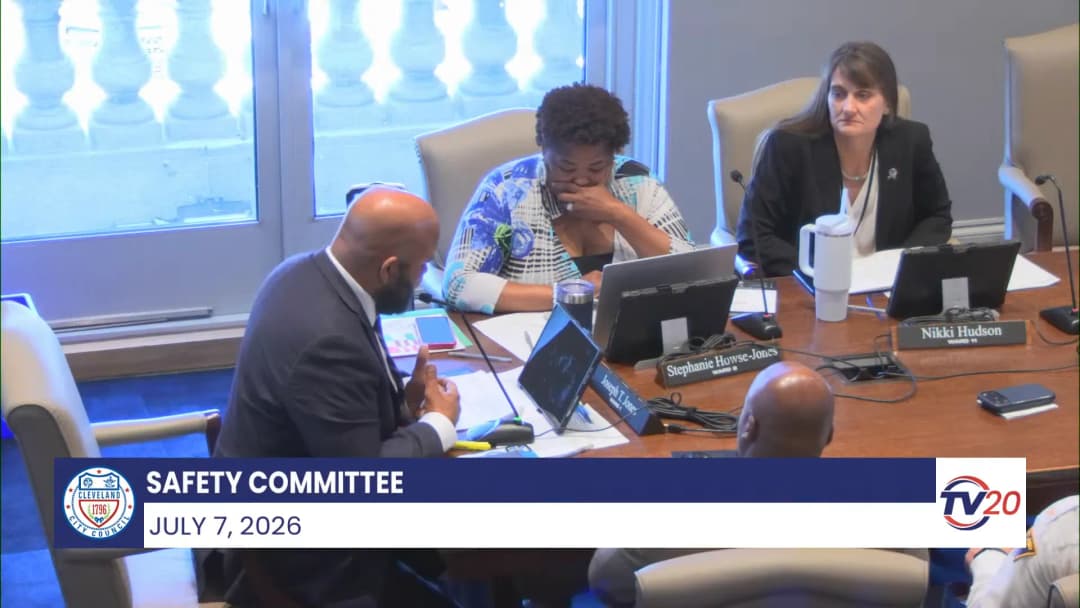
The Cleveland City Council Public Safety Committee held a hearing on July 7, 2026, to reconsider Ordinance 683-2026, which would authorize a one-year, $250,000 contract with Flock Safety for automated license plate readers (ALPRs). The committee heard extensive public testimony, reviewed data on crime-solving impacts, and debated privacy and data-sharing concerns. The committee ultimately voted to recommend the ordinance with amendments, including a six-month contract, reduced funding, and stronger data protections. Public Comments & Testimony - Jennifer Blakene (Ward 10) opposed Flock, citing privacy violations and the risk of federal data access. She argued that public safety should include protecting constitutional rights and that ALPRs violate Fourth Amendment protections. - Brenda Bickerstaff (Ward 9) expressed mixed feelings, noting that cameras have exonerated her clients but distrusting police oversight. She called for a public transparency portal. - Mary Maloney (Ward 10) opposed Flock, detailing security vulnerabilities, immigration-related searches, and the company's ties to venture capital firms supportive of the current federal administration. She noted that at least 30 localities have canceled Flock contracts since 2025. - Walt Gart (Ward 14) opposed the renewal, citing ACLU warnings, concerns about former Councilman McCormick's employment with Flock, and the risk of warrantless surveillance. He argued that the city should require probable cause for tracking. - Antoine Carrington (Maple Heights, active in Ward 10) supported Flock, stating that cameras helped solve church break-ins and provided safety for congregations. - Pastor Mark Smith (Ward 3, Garfield Heights) supported Flock, reporting a 39% reduction in crime in his area and emphasizing that public safety and constitutional rights can coexist with clear policies. - Bishop Owens (Ward 2) supported Flock, saying cameras are needed to revitalize communities and protect church members. - Pastor Aaron Phillips (Ward 6) supported Flock, urging unity on safety issues and noting that other communities use similar technology. - Bishop Eugene Ward (Ward 2) supported Flock, stating that Cleveland ranks 7th in unsafe cities and that cameras are a necessary tool. - Reverend R. A. Prince (Ward 1) supported Flock, citing the solving of Annie Dufries' murder. - Randy Cunningham (Ward 12) opposed Flock, arguing that it contributes to a surveillance state and that the FBI's recent raids show misuse of data. - Bishop Chewy (Ward 8) opposed Flock, citing the Texas abortion case where data from Flock cameras was used to track a woman across state lines. He argued that Cleveland cannot protect residents' data once it enters Flock's network. - Brynn Adams (Ward 12) opposed Flock, noting that the previous committee vote was 3-1 against renewal and that cameras continue operating without a contract. She called for bagging the cameras and banning mass surveillance. - Rebecca Garcia (Ward 3, Avanzamos Unidos) opposed Flock, warning that ALPR data can be used for immigration enforcement, undermining trust in public institutions. - Tessa Wan (Ward 14) opposed Flock, citing abuse by officers, lack of warrant requirements, and the risk of data access by federal agencies under the current administration. She noted that the Supreme Court's recent ruling in Chowtree limits warrantless location data collection. - Trevor Chandler (Flock Safety Senior Director of Public Affairs) defended Flock, stating that the company does not sell data, has no contract with ICE, and has implemented filters to block immigration and reproductive health searches. He noted that CPD opted out of nationwide sharing in June 2026. - Fran Cao Fadis (Ward 6) supported Flock, citing a recent case where Shaker police used a Flock camera to solve a theft within hours. She argued that surveillance and liberties can coexist. - Scott Kalo (Solon, but drives in Cleveland) opposed Flock, presenting evidence of 18 instances of ALPR abuse in 2026, including unauthorized access and stalking. He called Flock's security assurances false. - Darrell Houston (Ward 8, car wash owner) supported Flock but emphasized the need for intervention and investment in youth to prevent crime, not just after-the-fact solving. - Julian Roseman (Ward 7, small business owner) opposed Flock, saying the public should not be forced to repeat testimony. He argued that for-profit companies should not control public safety data and that the city should invest in non-profit solutions. - Councilman Joe Jones (Ward 8) read a letter from Reverend Jeff Jameson supporting Flock, citing safeguards and the technology's role in solving crimes. - Sean McCann (Ward 7, ACLU of Ohio) opposed Flock, calling it a mass surveillance network and noting that the
Public Meetings - Cleveland, Ohio
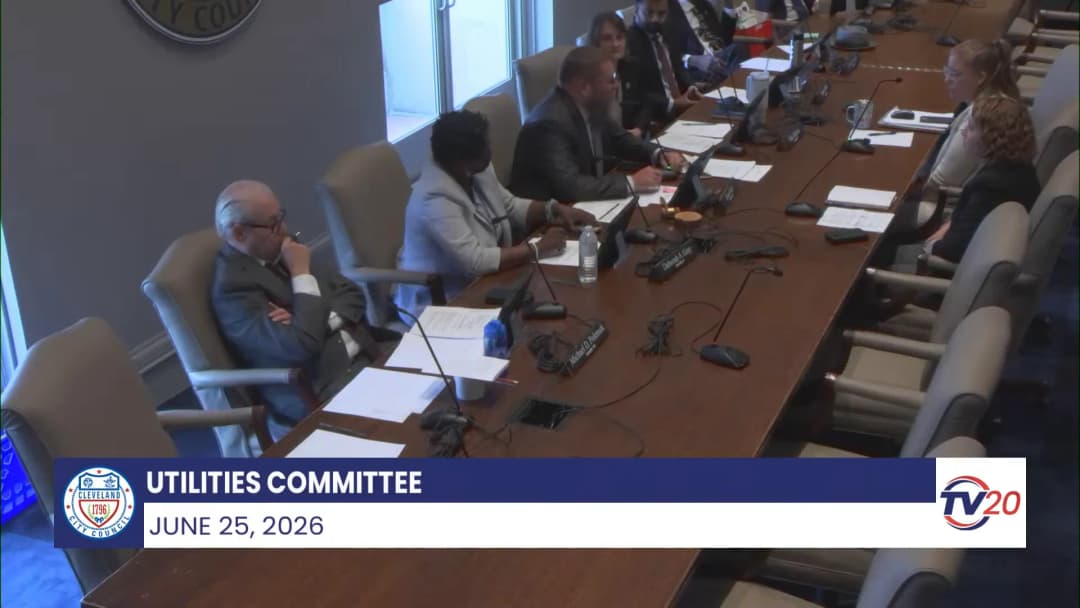
Public Meetings - Cleveland, OhioThe Cleveland Utilities Committee met on Thursday, June 25, 2026, to consider a series of legislative items, a proposed moratorium on data centers, and a rate presentation from First Energy. The meeting included public testimony and extensive council discussion. Legislation Approved The committee approved a package of ordinances as amended, covering electric and water utility operations: - Net Metering and Interconnection (Ords. 587, 588, 621): Updated net metering charges for behind-the-meter renewables (estimated $13/mo summer, $16/mo winter) and authorized interconnection agreements. Amendments added notification requirements. Passed. - Bright City Lighting (Ords. 600, 612): Approved contracts for LED streetlight management and photo cell supply. Amendments set $1M cap and notification. Passed. - Customer Care & Billing (Ords. 586, 598): Authorized requirement contracts for Oracle’s C2M system and renewed hosting with Kendrill. Amendments set $5M cap and notification. Passed. - Utility Location Services (Ord. 596): Renewed contract with One Call Concepts, amended to $2M. Passed. - Lab Equipment (Ord. 599): Sole-source contract with Hach Company for water testing supplies and calibration. Passed. - Water Infrastructure (Ords. 601, 602): Approved rebuilding Pleasant Valley Pump Station ($20M cap) and a transmission main renewal program ($25M cap). Passed. - Water Main Repairs (Ord. 625): Approved two-year requirement contract for water main repairs/restoration ($30M/year). Passed. Public Comments & Testimony Six residents spoke during one-minute public comment on the data center moratorium, urging a longer timeline (one year) and expressing concerns about health, environment, and community input. Discussion Items Data Center Moratorium (Ord. 556-2026) The committee debated an ordinance to impose a moratorium on zoning and utility permits for standalone data centers. The original one-year moratorium was amended to three months (with a possible three-month extension). Proponent Testimony: - Tom Bullock (Citizens Utility Board): Described data centers as industrially important but stressed the need for community benefits and infrastructure investment. He did not take a firm position for or against. - Zach Schiller (Policy Matters Ohio): Criticized secrecy in negotiations and urged rejecting incentives. Supported the moratorium for deliberation. - Molly Brearton (Policy Matters Ohio): Highlighted harms from water use, pollution from backup generators, and inadequate zoning protections. Recommended conditional use permits and transparency. Opponent Testimony: - Tony Long (Ohio Chamber of Commerce): Opposed the moratorium, urging direct zoning updates. Noted the Slavic Village project is not hyperscale and argued it would damage revenue and jobs. - Mike Bremer (IBEW Local 38): Emphasized construction jobs and training opportunities for Cleveland residents. - Jamie Davis (IBEW Local 38): Stressed the value of apprenticeship programs and long-term career skills. - Shikory Davis (Next Gen Construction): Favored negotiation and community benefits over a ban. - Norman Edwards (American Center for Income Equality): Called the moratorium a threat to economic growth and job creation. Council Discussion: - Council President Blaine Griffin urged balance to avoid implying Cleveland is closed for business. - Councilwoman Hudson supported stronger guardrails and a longer moratorium. - Councilman Conwell expressed concerns about environmental justice and historical disinvestment in African American communities. - Councilman Shah proposed an amendment to extend the moratorium to six months, but it failed for lack of a second. - Councilman Polenska stressed the need for accurate data and outside consultants. Outcome: The committee approved Ord. 556 as amended (3-month moratorium, extendable by three months). It will proceed to Committee of the Whole. First Energy Three-Year Rate Plan David Turner and Charles Chico presented a three-year rate plan (2027-2030) with an average annual increase of 2.6% (about $5.15/month for a typical residential customer). The plan includes $50M in substation upgrades, $130M in capital investment, and customer assistance funds. Council Response: - Chair Casey strongly criticized First Energy’s past scandals (including bribery and anti-CPP campaigns) and questioned the need for a raise given $1.2B profit in 2025. - Councilwoman Gray raised reliability issues, including months-long flickering streetlights. - Councilwoman Hudson recounted repeated week-long outages and brownouts, questioning the company’s performance. - The committee took no vote; the presentation was informational. Key Outcomes - Eleven ordinances passed with amendments and will be forwarded to full council. - Ordinance 556-2026 (data center moratorium) passed as amended; a working group will be formed. - First Energy’s rate plan presentation was received without action; council expressed strong skepticism. - The chair announced a working group to study data centers with input from all stakeholders.
The committee met to discuss two forthcoming ordinances from the Department of Port Control (passenger boarding bridges and a building automation system contract) and to hold a detailed hearing on a proposed amendment to the settlement agreement between Cleveland and Brook Park regarding the IX Center and related properties. No votes were taken; these items are scheduled for introduction and passage in July. Port Control – Passenger Boarding Bridges - The Department of Port Control requested authority to purchase up to 12 passenger boarding bridges (including removal, disposal, and installation) for Cleveland Hopkins International Airport, at an estimated cost of $26 million. The bridges are for gates A2, A6, A8, A10; B3, B7; and C3, C5, C6, C7, C9, C11. This is the second phase of replacements; the first group (nine bridges) is already in design-build with Arrow Bridge. - Councilman Casey confirmed the bridges are owned by the city and that FAA and PFC funds will cover costs. Councilman Jones asked about total bridge inventory and the replacement timeline; the assistant director noted the bridges are over 30 years old and that design will begin soon, with installation subject to construction season. - Councilwoman Gray inquired about removal phasing to avoid passenger disruption. The assistant director said the project will coordinate with airlines to ensure seamless and safe operations. - The item will be introduced in July; no action was taken today. Port Control – Building Automation System Contract - The committee discussed a proposed one‑year requirement contract (with three one‑year renewal options) with Siemens Industry Inc. for labor and materials to maintain, repair, upgrade, and expand the Apogee building automation system at the airport. - The assistant director explained the system monitors alarms (fire, flood, HVAC) and automates response. It is somewhat proprietary due to legacy components. Councilman Casey asked about the lack of an RFP; the assistant director stated the contract was awarded without an RFP because of proprietary issues, but future procurements may use an RFP. Councilwoman Gray noted that Siemens’ headquarters is in Georgia, not Cleveland; the assistant director confirmed Siemens maintains local on‑site staff. - The item will be introduced in July; no action was taken today. IX Center Settlement Amendment – Discussion Background and Rationale - The committee heard Ordinance 664‑2026, an emergency ordinance authorizing the mayor and directors of law and port control to enter into a first amendment to the 2001 settlement agreement between Cleveland and Brook Park concerning the IX Center, the Emerald Park Joint Economic Development Zone (JEDZ), and 34 acres of land in Brook Park. The amendment would abolish the JEDZ and all tax‑sharing at the IX Center, giving Cleveland full control of revenues from those properties. - Chief of Development McNair and Chief Legal Officer Griffin explained that the 2001 agreement was based on an expected third runway that was never built. The current arrangement sends a significant portion of tax revenue from Cleveland‑owned land to Brook Park; the proposed deal ends that perpetuity feature. Brook Park has already passed its own legislation approving the terms. Financial Terms - One‑time payment: $2 million to Brook Park (from law department settlement funds). - Annual payment: $650,000 for 33 years (total $21.45 million), paid from a special revenue fund that will collect all tax revenues from the IX Center and Emerald Corporate Park. The annual payment is offset by the $300,000 Cleveland currently sends to Brook Park from the JEDZ. - Land transfer: 34 acres of vacant residential property Cleveland owns in Brook Park (acquired for the never‑built runway) will be returned to Brook Park. An appraisal valued the land at $4.3 million, but the city cannot develop it due to Brook Park zoning and FAA restrictions. - Airport rent: The IX Center pays $2.7 million annually in rent to the airport (to cover bonds/airline costs), which would continue unchanged. Revenue Projections - Currently, Cleveland receives only about $228,000/year in tax revenue from the IX Center (2024); at peak (2018) it was $500,000. The JEDZ (Emerald Corporate Park) currently generates $610,000 total, of which Cleveland gets half ($305,000). - The administration projects that if the 40 developable acres in Emerald Corporate Park were built out similarly to existing uses, they could generate $700,000/year in new tax revenue. A single advanced manufacturing tenant with a $72 million payroll (as described by Executive Attraction Officer Jennifer Sheel) would yield about $1.8 million/year in income tax for Cleveland (after the current sharing, net would be $1.08 million). - Chief McNair stated that over 33 years, a $25 million total payroll would produce a net benefit of $2.5 million; a $70 million payroll (like the prospect discussed) could yield $40+ million in net revenue for the city after incentives and the annual payment. Concerns Raised by Council Members - Confidentiality of prospective tenants: Councilwoman Sheel (under NDA with site selectors) stated she is working with a company that has a $72 million payroll and 700 jobs, but no letter of intent or LOI has been signed. Councilmembers expressed skepticism given prior unfulfilled promises. - Role of the master lessee (ICP/IRG): The IX Center is under a 13‑year master lease with an affiliate of ICP and IRG. The lessee controls all leasing; the city cannot veto tenants. Councilman Casey noted that in five years the lessee has brought in zero industrial tenants. Chief McNair said the lessee wants a lease extension to make capital improvements, but a lease extension may be conditioned on attracting manufacturing jobs. - Potential Haslam Sports Group interest: Multiple councilmembers raised concerns that Haslam Sports Group (HSG) has expressed interest in leasing up to 1.5 million sq. ft. for three years to keep trade shows at the IX Center, then potentially move them to a new facility near the new Browns stadium. Councilman Palencick and Casey argued this would directly compete with downtown convention assets and harm Cleveland’s economy. - Lack of anti‑poaching agreement: Brook Park did not sign an anti‑poaching agreement; Councilman Palencick and others worried the 34 acres returned to Brook Park could be used to lure businesses away from Cleveland. - Absence of detailed financial projections: Councilman Jones and others requested a multi‑year projection spreadsheet showing revenues, costs, and net benefits under various scenarios; the administration committed to providing more detailed projections. Key Outcomes - No votes were taken on any item; all are expected to be introduced and voted on in July. - The administration agreed to provide: (1) a copy of the master lease for the IX Center; (2) names of the principals of ICP/IRG; (3) a projection spreadsheet for the settlement agreement; (4) confirmation of the status of Concourse D’s lease; (5) an appraisal of the 34 acres; and (6) clarification of the annual rental payment amount. - The committee will continue to review the settlement agreement and will likely hold additional discussions before the July vote.
The Cleveland City Council held a regular meeting on April 27, 2026, covering public comments on a range of issues, approval of appointments, introduction of several ordinances including a moratorium on data centers and new short-term rental regulations, and final passage of multiple emergency ordinances. Consent Calendar - File 562-2026: Grant acceptance of $315,000 from Cleveland Foundation for renewable power projects – approved. - File 563-2026: Appointment of Benita G.T.1 to Gateway Economic Development Corporation – approved, but later held pending Ohio Ethics Commission opinion. - File 564-2026: Appointment of Eddie Taylor to Cleveland-Cuyahoga County Port Authority – approved, but later held pending Ohio Ethics Commission opinion. - File 565-2026: Appointment of Stephanie Morrison Herbick to Community Relations Board – approved. - File 566-2026: Appointment of Yasir Hamdala to Community Relations Board – approved. - Various condolence and congratulatory resolutions were read and approved. Public Comments & Testimony - Brenda Bickerstaff (Ward 9): Criticized Fox 8 and reporter Gallagher for misleading coverage of police oversight, explaining the three-tier system (investigation, recommendation, appeal) and urged council to attend meetings rather than rely on media. - Jenna Thomas (Ward 13): Opposed the Trump administration's "Freedom to Drive Initiative," arguing it undermines safety measures and ignores that 76,000 Clevelanders lack cars; urged investment in safe, affordable transportation options. - Matthew Smart Strazinski (Ward 2): Urged preservation of Burke Lakefront Airport, citing potential for air taxis, medical flights, and trade schools; criticized mayor's absence from assigned seats. - Darryl Houston (Bedford, city issues): Criticized council for approving budget without reading, questioned parking hike, and raised concerns about food deserts, bus shelters, and a gas station in Ward 8 without community input; called for follow-through on charter obligations. - James Bentley (Mayfield Village, CPP employee): Described being assaulted by supervisor Don Kleppel, who was rehired, leading to a PTSD episode and a five-day suspension; requested investigation and protection from retaliation. - Adam Rosen (Ward 7): Opposed Ordinance 522-2026 limiting paid parking flexibility; advocated for parking benefit districts to allocate revenue to neighborhoods. - Michael Armstrong (Ward 11): Criticized form-based code (FBC) implementation, noting lack of public notice for developments and errors in the code; urged pause before expanding FBC. - Sabrina Otis (Ward 12): Called for recognition of regular police officers, not just specialty units, and requested education on how to use roundabouts. - Robert Evans (Moreland Hills): Raised concerns about dust and debris from Port Authority sediment facility at Burke, lack of response from officials, and urged council oversight. Discussion Items - Data Center Moratorium (Ordinance 556-2026): Councilman Charles Slife introduced a moratorium on permits for data centers, citing energy/water intensity, low job creation, and potential conflicts with zoning; argued for study before allowing large-scale centers. - Short-Term Rental Regulations (Ordinance 561-2026): Councilman Austin Davis highlighted six years of work, citing public safety issues from unruly Airbnbs; introduced updated legislation to regulate short-term rentals. - Parking Regulations (Ordinance 559-2026): Proposed amendment to parking meter zones in Hingetown/Ohio City pilot program. - Form-Based Code Expansion (Ordinance 1398-2025): Second reading; authorizes consultants to expand FBC to additional districts. - Appointment Holds: Councilwoman House Jones requested that two appointments (Benita G.T.1 and Eddie Taylor) be held until Ohio Ethics Commission opinions are received; council agreed to hold. Key Outcomes - Appointments: Approved four appointments (Files 563-566) initially without objection; two (563 and 564) held pending Ethics Commission opinions. - Second Reading Emergency Ordinances Passed: - Ordinance 232-2026: Passed 13 yes, 1 nay. - Ordinance 234-2026: Passed 12 yes, 2 nays. - All other second reading emergency ordinances passed 14-0. - Resolution 375-2026 (vacate portion of Central Avenue): Adopted unanimously (14-0). - Ordinance 588-2024 (old short-term rental legislation): Tabled unanimously (14-0). - Next Meeting: No meeting on May 4, 2026 (election eve); next meeting May 11, 2026, with Panhellenic Council visit.
The Cleveland City Council Finance Committee met on April 27, 2026, to consider several agenda items, including development projects, tax incentives, zoning updates, and capital improvement plans. Key discussions centered on the North Coast Yard pop-up park, a brownfield redevelopment area, a loan to Guardian Structural Technologies, the expansion of form-based code, and amendments to the city's capital improvement plan (MoCaP) including the removal of funding for City Hall modernization and a failed attempt to redirect golf course funds to Cleveland Public Power. Discussion Items - North Coast Yard Pop-Up Park (Presentation by Scott from Cleveland Development Corporation): Scott presented the temporary park north of FirstEnergy Stadium, which opened last year for 2.5 months and attracted 25,000 unique visitors. The park is 1.2 acres (90 of 2,100 parking spaces) and offers free activities like basketball, roller skating, and live music. It is funded entirely by the organization's operating budget. Council members asked about parking revenue, the harbor fund, and the future of the site. The project is meant to activate the site until permanent development begins. Councilman Brian Kazy requested data on parking revenue generated last year, and the administration agreed to provide it. - Ordinance 401-2026: Midland Development Area Brownfield Designation: The legislation designates 89 acres (52 parcels) along the Norfolk Southern rail line as a Priority Investment Area to access up to $10 million in state brownfield grants. The city is not asked to add funds. Councilwoman Santana requested a list of brownfield sites citywide by ward. The item passed. - Ordinance 402-2026: Loan to Guardian Structural Technologies: The city proposes a $500,000 loan at 5% over 7 years to Guardian Structural Technologies, a manufacturer of building envelope systems, to expand into a second location at 18105 Cleveland Parkway. The company will retain 11 FTEs and create 16 new jobs, adding $967,000 in payroll and $24,000 in annual income tax. Councilman Michael Polensek asked about the company's use of prefabricated wall panels and requested more information on projects in Cleveland. The ordinance passed with Councilman Harsh added as a co-sponsor. - Ordinance 1398-2025 (as amended): Form-Based Code Pilot Expansion: The legislation authorizes hiring a consultant to enhance the existing form-based code pilot and potentially expand it citywide. The contract is capped at $125,000 with three one-year renewal options. Council members discussed the need for public engagement, protection of residential districts, and concerns about gentrification and displacement. Amendments included requiring the director of planning to notify council of cooperative purchases. The ordinance passed as amended. - MoCaP Ordinances 232-2026 and 234-2026 (as amended): Capital Improvement Plan Amendments: These ordinances cover public facilities and recreation improvements. The committee adopted amendments to remove $7 million for City Hall modernization (including ADA upgrades and a new entrance) and $500,000 for relocating Parks and Recreation staff. The administration indicated it would bring back separate legislation for ADA improvements. Councilman Anthony Brancatelli made a motion to strike $1.184 million for Highland Golf Course pump house improvements and redirect the funds to Cleveland Public Power (CPP) for emergency repairs. The motion failed on a roll call vote (2 yeas, 10 nays). The amended ordinances passed. - Ordinance 309-2026: Roadway Maintenance Contract: A two-year requirements contract for asphalt, concrete, ADA ramps, and sidewalks. Councilman Michael Polensek requested a list of contractors from the 50-50 sidewalk program and their performance. The ordinance passed. - Ordinance 131-2026: IRS Declaration of Intent: Authorizes the finance director to sign declarations for reimbursing general fund advances with bond proceeds. An amendment was added requiring the director to notify council of each declaration. The ordinance passed with one opposed (Councilman Harsh). - Ordinance 516-2026: Insurance Procurement: Authorizes centralized insurance procurement for municipal operations (excluding health insurance) for three years with two renewal options. Amendments capped total annual cost at $1.2 million and required notification of purchases. The ordinance passed. Key Outcomes - North Coast Yard: Continued operation for summer 2026 authorized; no formal vote required. - Ordinance 401-2026: Approved. - Ordinance 402-2026: Approved (with Councilman Harsh added). - Ordinance 1398-2025 (as amended): Approved. - MoCaP Ordinances 232-2026 and 234-2026 (as amended): Approved. The $7 million City Hall modernization allocation was removed; the administration will bring separate legislation. The $1.184 million for Highland Golf Course pump house was retained (motion to redirect failed 2-10). - Ordinance 309-2026: Approved. - Ordinance 131-2026 (as amended): Approved (one opposed). - Ordinance 516-2026 (as amended): Approved.
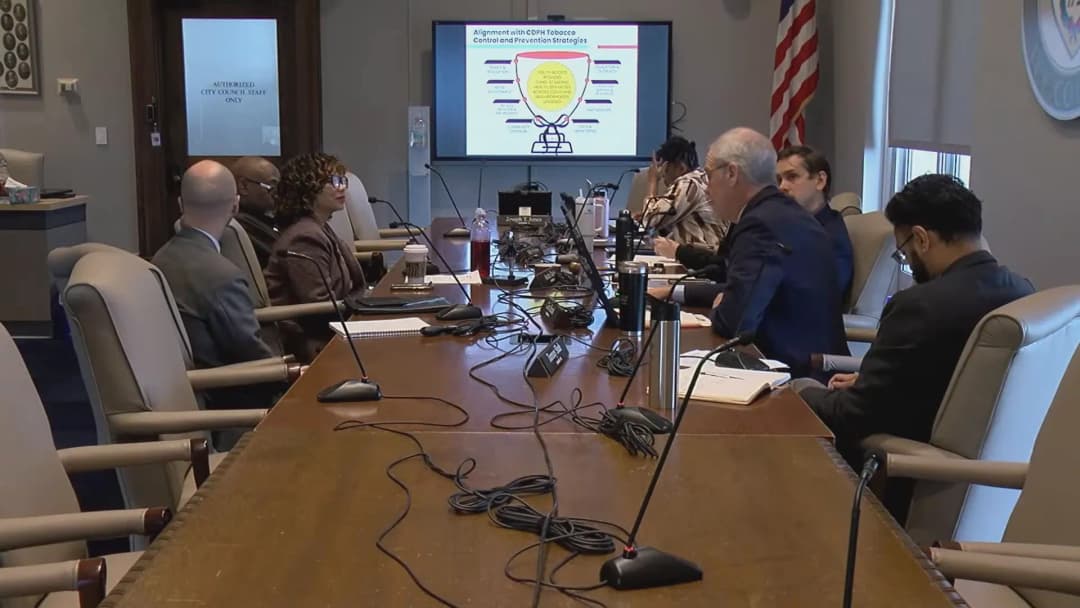
The Cleveland City Council Health, Human Services, and Arts Committee met on April 27, 2026, to hear public comments on the proposed closure of Collinwood High School and receive updates on the city's tobacco retail licensing program and the Transformative Arts Fund. The meeting featured presentations from health department officials and arts administrators, followed by questions and discussion from council members. Public Comments & Testimony - A community member spoke against the proposed closure of Collinwood High School and the elimination of elementary schools in the Euclid Park and St. Clair areas. The speaker argued that the Cleveland Metropolitan School District (CMSD) has misled the mayor and that the closures would result in the loss of after-school programs and voter suppression through the elimination of six voting precincts. The speaker urged the council to reject the plan. Discussion Items - Tobacco Retail Licensing Program Update: The Cleveland Department of Public Health presented an update on the implementation of the tobacco retail licensing (TRL) system. Key points: - Smoking rates in Cleveland declined from 35% in 2015 to 25% in 2025, but disparities remain. - The TRL program requires all tobacco retailers to obtain a license. As of April 24, 2026, 236 licenses had been issued, with 26 pending. 273 citations were issued to unlicensed retailers during a recent enforcement wave. - The program includes a phased enforcement approach: education and outreach, warning and grace period, and active enforcement. Compliance checks found that over half of 100 retailers sold tobacco to minors in a baseline study. - Council members discussed penalties for violations, including fines up to $500 per violation and potential license revocation for repeated offenses or sale of marijuana. The health department clarified that the local law provides stronger enforcement mechanisms than state law. - The department plans to provide regular data updates to council and consider a progressive fee structure. - Transformative Arts Fund Final Impact Report: Senior Advisor for Arts and Culture Ronda Brown, along with partners from Assembly for the Arts, the Transformative Arts Fund committee, and institutional partners, presented the final report on the $3 million pilot program funded by the city. - The fund awarded $2.86 million to seven projects, with 93% of funds going directly to project work. 103 applications were received. - Projects included murals, immersive theater, public park designs, and remediation of a lead-contaminated house. Six of seven projects were completed on the east side of Cleveland. - The fund leveraged additional public and private investments, including the creation of pocket parks, a permanent park in Asia Town, and neighborhood greening initiatives. - The program also prompted a review of the city's public art ordinances, with five work streams underway to update policies by the end of 2026. - Council members expressed strong support for continued arts funding, noting the economic and community benefits. Councilman Conwell and others emphasized the importance of arts for youth development and neighborhood revitalization. Key Outcomes - The committee received the tobacco retail licensing update and the Transformative Arts Fund report without formal votes. - Council members directed the health department to provide a list of licensed tobacco retailers and to continue enforcement efforts. - The health department agreed to provide regular data updates on the TRL program. - No formal action was taken on the Collinwood High School closure issue, as it was a public comment item. - Council members expressed interest in future funding for the arts and in visiting the completed art projects.
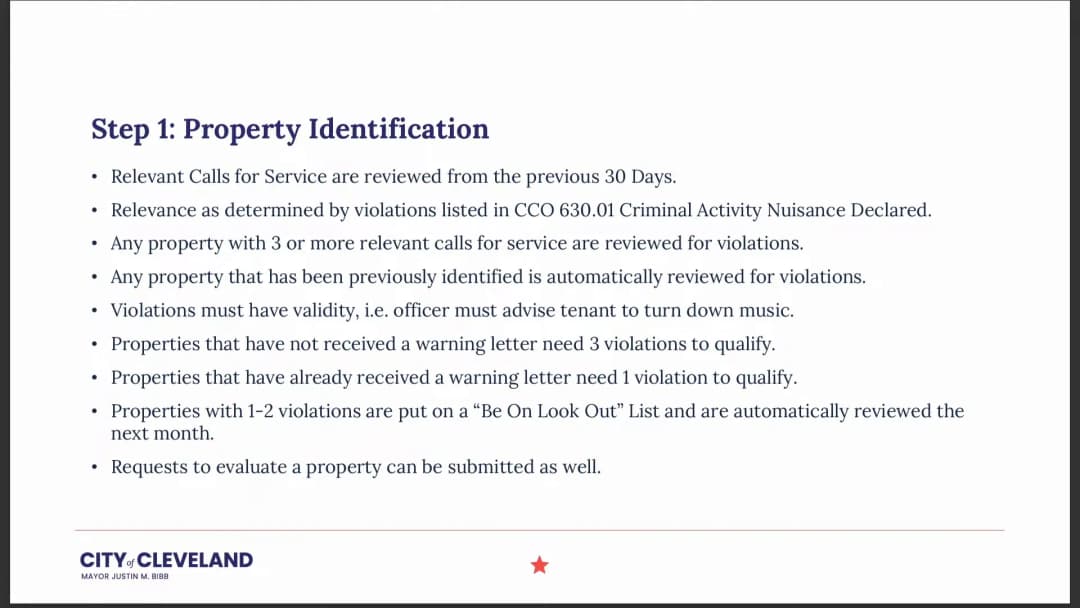
This meeting of the Cleveland City Council Public Safety Committee, chaired by Councilman Polensic, focused on two major topics: the administration's one-year extension of the Sound Thinking (ShotSpotter) gunshot detection contract and the status of the city's nuisance abatement law (Chapter 630). The committee heard presentations from Director of Public Safety Drummond, Assistant Director Shachner, and their team. Key discussions centered on the justification for the contract extension, transparency concerns, and the effectiveness of nuisance enforcement efforts. Discussion Items ShotSpotter/Sound Thinking Contract Extension - Director Drummond explained that the administration extended the Sound Thinking contract for one year at a cost of $853,340, effective April 2026, to avoid a gap in coverage. The original contract (2020) cost $2,758,500 and covered 13 square miles, primarily on the east side. The extension was executed through the Board of Control under Section 181.102 of the city's codified ordinances, which allows software contract extensions without council approval. Director Drummond took responsibility for not notifying council beforehand and apologized, stating it would not happen again. - Council members expressed concerns about the lack of legislative oversight, particularly for contracts over $50,000. Councilman Starr noted that the ordinance could be used to bypass council for high-dollar contracts, and Councilwoman House Jones highlighted that the lack of trust in the administration motivated the $50,000 threshold. Chair Polensic announced he had asked the council president to review and potentially amend Section 181.102 to include a cap. - Director Drummond and Assistant Director Shachner defended the technology's value, citing a February 14, 2026 incident on the west side where approximately 102 rounds were fired, and ShotSpotter alerts led to evidence collection, suspect identification, and arrests. They noted that officers respond to alerts in an average of 81 seconds (median 78 seconds), compared to 3-4 minutes for 911 calls, and that the technology aids in solving crimes, though they acknowledged that the CSU report found no measurable reduction in overall criminal activity. They also stated that the current system is not integrated with cameras, but an RFP for a more integrated system is in development. Councilman Jones and Councilwoman Hudson requested data on effectiveness, response times, and false alarm rates. - Councilwoman House Jones questioned the original contract (Ordinance 909-2022) and noted that the city had not tracked promised benefits such as financial leveraging, gas savings, or reduced insurance costs for small businesses. She expressed frustration that the administration did not consult council before the extension, eroding trust. - The committee discussed the process for a future RFP. Director Drummond indicated that the division had considered a Flock system last year, but that legislation was held by council pending an RFP. The one-year extension is intended as a stopgap until a competitive procurement can be completed. Nuisance Law (Chapter 630) Update - Assistant Director Shachner presented a detailed update on the enforcement of the criminal activity nuisance ordinance, which was revised in 2024 with input from the committee. The program is managed by a team including Ian Aston, Sergeant Lanton, and Detective Brown. They review properties monthly using a Power BI system, focusing on 173 qualifying violations (e.g., unnecessary noise, disorderly conduct, animal nuisances). - Key statistics (as of the meeting): - Average 62 properties reviewed per month. - 71 warning letters sent to date. - 68 current nuisance properties. - 233 total violations. - 57 abatement plans received (84% response rate). - 17 properties later declared a nuisance after warning letters. - 3 properties changed ownership (4%). - Unnecessary noise accounted for 60% of violations. - 60% of property owners are city residents; 17% out-of-state; 9% out-of-country (including one from Canada/Israel). - The process: properties with three or more qualifying violations in 30 days receive a warning letter. Owners must submit an abatement plan within 14 days or face a $100/day fine. Subsequent violations lead to a declared nuisance letter and escalating fines ($250, $500, $750, $1,000). Fines are certified to the property tax bill if unpaid. Eight properties had fines assessed to the county totaling $5,500; two appeals were granted. Total open fines are $132,450. - Council members praised the team's work and requested marketing materials (pamphlets, newsletters) to educate residents on how to report nuisance issues. Chair Polensic offered to work with the team to create such materials. Councilwoman Hudson requested status updates on specific nuisance properties in her ward, particularly those with past abatement plans. Councilman Jones asked for a deeper dive into commercial properties (gas stations, bars) and a meeting within 30 days to develop informational materials. - Assistant Director Shachner noted that nuisance data is shared with the law department for liquor license hearings, and Chair Polensic requested formalizing that protocol. The team also tracks properties with excessive calls for service and sends courtesy letters. Key Outcomes - ShotSpotter Extension: The committee accepted the director's apology for the lack of prior communication. Chair Polensic committed to reviewing and potentially amending Section 181.102 to require council approval for contracts over $50,000. The administration will proceed with an RFP for a more integrated gunshot detection system, and the current Sound Thinking contract will continue for one year as a stopgap. Council members will receive data on effectiveness, response times, and false alarm rates. - Nuisance Law Enforcement: The committee agreed to collaborate on creating marketing materials to inform residents about the nuisance abatement process. The safety team will provide status updates on specific nuisance properties to council members. The protocol for sharing nuisance declarations with the law department for liquor license hearings will be formalized. The team will continue monthly reviews and enforcement, with a focus on commercial properties and out-of-state owners. Councilman Jones requested a meeting within 30 days to develop a pamphlet. - Next Steps: The committee will schedule a follow-up session with Sound Thinking representatives to present their system directly. The ordinance for Section 181.102 will be reviewed for potential amendment. The safety team will continue to refine the nuisance program and report back to the committee.
The Mayor's Appointments Committee considered three appointments: Eddie Taylor to the Port of Cleveland Board, Bonita T. Win to the Gateway Economic Development Corporation, and reappointments of Yasir Hamdala and Stephanie Morrison Herbeck to the Cleveland Community Relations Board. Discussions centered on board member accountability, funding strategies, community relations, and strategic planning. Votes were taken on two of the three appointments. Appointment Consideration: Eddie Taylor – Port of Cleveland Board - Background: Eddie Taylor, President and CEO of Taylor Oswald (an insurance agency), resides in Solon, Ohio, not Cleveland. He was nominated after conversations with outgoing board member Darrell McNair and the administration. - Key Discussion Points: - Councilman Pallinsik emphasized the need for better communication between the port and council, and for the port to serve Cleveland neighborhoods. Taylor agreed that communication is key. - Councilwoman Santana asked about his background; Taylor stated he is an entrepreneur and his firm is the largest Black-owned insurance agency in Ohio. He has a contract with the city through his partner, Oswald Companies, though not directly. - Councilman Casey raised concerns about the port's previous vote to eliminate prevailing wage on funded projects and asked if Taylor would re-evaluate that decision. Taylor said he would be open-minded and vote his conscience, but did not commit to a specific position. - Councilman Shah pressed for commitments to affordable housing, fully publicly financed projects, and restoration of prevailing wage. Taylor agreed in principle but refused to commit to absolutes without knowing deal details, stating he would not make promises on unknown facts. Shah expressed concern, indicating he could not vote in good conscience without hard commitments. - Councilwoman Haigwood asked about Taylor's time commitment and vision. Taylor said he would prioritize the board and sees success in generational impact, neighborhood benefit, and measurable improvements in quality of life. - Conflict of Interest: Councilman Casey noted Taylor's company has a contract with the city. The chair decided to request a formal opinion from the Ohio Ethics Commission before proceeding. - Outcome: No vote was taken. The committee postponed consideration pending the ethics opinion. Appointment Consideration: Bonita T. Win – Gateway Economic Development Corporation - Background: Bonita T. Win (Chief T Win), COO of the City of Cleveland, has been serving on the board since the resignation of a prior member. She is a reappointment for a five-year term expiring June 2027. - Key Discussion Points: - Councilman Casey asked about attendance; Win said she attended all quarterly board meetings and most special meetings. She confirmed she is a city employee and did not contribute to the mayor's campaign. - Win stated that Gateway's capital improvements are funded by the sin tax, but collections are declining due to reduced smoking/drinking. She anticipated a funding shortfall starting in 2027. - Councilman Casey asked about a new community authority (NCA) as an alternative funding source. Win explained that property owners (i.e., Gateway) could opt into additional fees, such as on parking or concessions, which would be passed to users but not impact owner margins. She emphasized that the NCA is a tool, not a tax. - Councilman Shaw noted the net worth of team owners (Dolan family $4.6-5.6B, Dan Gilbert $32.5B) and argued they should cover all costs, not taxpayers. Win agreed that the city's priority is to avoid using general funds. - Councilwoman Haigwood pressed for a sustainability plan by September 2026, not December, to allow thorough council analysis. Win agreed and noted ongoing conversations about a sin tax increase, which would require state legislation and a ballot vote. - Councilman Casey clarified that no conflict of interest exists for a city employee serving on the board, as the code of regulations requires at least one city employee member. - Outcome: The committee voted unanimously (5-0) to recommend the appointment to the full council. Reappointment Consideration: Yasir Hamdala and Stephanie Morrison Herbeck – Cleveland Community Relations Board - Background: Both are incumbents. Hamdala has served over 20 years; Morrison Herbeck has served for several years and is slated to become board chair. The board oversees the Community Relations Department (CRD). - Key Discussion Points: - Councilwoman Santana asked about the board's strategic plan and how it measures success. Morrison Herbeck said she was not aware of a formal plan but noted that the department provides monthly reports. Hamdala described his role as a bridge between the community and City Hall, working on the ground to de-escalate issues and provide services. - Councilman Pallinsik asked the greatest challenge. Hamdala cited politicians making public statements without consulting the CRB, which can escalate tensions. Morrison Herbeck cited the proliferation of guns and the need for community engagement, noting the CRD's small staff. - Councilman Shaw asked about the board's focus on intra-community relations (e.g., between racial/ethnic groups) separate from police relations. Hamdala described efforts to bring law enforcement and community leaders together at mosques to address ICE concerns. Morrison Herbeck noted that the board has historically focused on community-police relations but acknowledged the need for deeper inter-community work. - Councilman Casey praised both nominees but raised a concern about Morrison Herbeck being a city employee receiving a stipend for board service. He requested a legal opinion on whether that is permissible. - Councilwoman Haigwood criticized the lack of published data on interracial/intergroup relations, as required by the board's duties. She stressed the need for measurable goals beyond just showing up at events. Both nominees acknowledged the need for improvement. - Outcome: The committee voted unanimously (5-0) to recommend both reappointments to the full council. Key Outcomes - Eddie Taylor (Port of Cleveland): No vote; consideration postponed pending Ohio Ethics Commission opinion on conflict of interest. - Bonita T. Win (Gateway): Approved unanimously (5-0) for reappointment. - Yasir Hamdala and Stephanie Morrison Herbeck (Community Relations Board): Both approved unanimously (5-0) for reappointment. - Next Steps: The committee will not meet on May 5 (Election Day) but will meet on May 19 to consider two new Community Relations Board appointments and on June 2 for any remaining mayor's appointments. Attendance records will be required for all future reappointments.
The Development, Planning, and Sustainability Committee met on April 21, 2026, to review four items: designating the Saperstein Garage and House as a Cleveland landmark, vacating a portion of Central Avenue for the Bedrock Riverfront project, designating a priority investment area for brownfield remediation in the Midline development area, and authorizing a loan to Guardian Structural Technologies LLC for equipment. All items were approved. Ordinance 403-2026 – Designation of Saperstein Garage and House as a Cleveland Landmark - Rachel Pierce, staff with the Cleveland Landmarks Commission, presented a proposal to designate 852–854 East 95th Street (the Saperstein Garage and House) as a landmark. The property is the founding site of American Greetings (founded by Jacob Saperstein) and meets four nomination criteria, including eligibility for the National Register of Historic Places. The current owner, Henry Shepard, supports the designation. The landmarks commission and planning commission previously voted in favor. Council members discussed the unusual nature of landmarking a garage and a house, the property's condition (the garage roof is unstable and needs significant investment), and potential funding sources. Councilman Harsh expressed initial surprise but acknowledged the story's value. Councilman Starr questioned whether financial resources are available for maintenance. Pierce noted that the owner has been trying for 20 years, and the designation provides a review process that may prevent demolition without oversight. The property owner has had code violations in the past, current status unknown. The landmark designation was approved unanimously. Resolution 375-2026 – Vacation of a Portion of Central Avenue - Norma Romanov (Bedrock) and city engineering staff presented a request to vacate an 88‑foot portion of Central Avenue between West Third Street and the former CSX railroad tracks. The vacation is needed for an access driveway serving the Global Peak Performance Center development. The vacated area will become part of the neighboring LLC (Fundamental Parking LLC). Councilman Davis noted the land is underutilized and expressed full support. Councilman Starr asked about payment; Romanov explained the adjacent LLC already governs the area up to the curb, and this extends it by about 14 feet. The resolution was approved. Ordinance 401-2026 – Designation of Midline Development Area as a Priority Investment Area (PIA) - The committee considered designating 52 parcels (approximately 89 acres) in the Central neighborhood as a Priority Investment Area under the Ohio Brownfield Remediation Program. This designation would allow the city’s Site Readiness Fund for Good Jobs to apply for up to $10 million in state funding for environmental remediation. The lead presenters were Rick Barga (Site Readiness Fund), John Fosbender (city), and Orlando Grant. They emphasized that no city funds are being allocated—only a designation to seek state money—and that the five‑year tax exemption applies only to tangible personal property, not real estate. Councilman Harsh clarified the process is revenue neutral. Councilman Starr, in whose ward the area lies, expressed strong support but stressed the need for equity, community benefits agreements (CBAs), local hiring, and involvement of minority developers. He asked about the timeline (application expected summer 2026, awards early 2027) and how residents will be engaged. Staff replied that they follow state requirements on prevailing wage and local participation, are modeling engagement after current CBA best practices, and have held several community meetings. Councilwoman Gray inquired about applicability to the Bessemer corridor. The ordinance was approved. Ordinance 402-2026 – Loan Agreement with Guardian Structural Technologies LLC - The committee authorized a $500,000 loan (at 5% interest, 7‑year term, fully amortizing, no forgiveness) to Guardian Structural Technologies, an advanced manufacturer of building envelope systems. The company is expanding from 4640 Manufacturing Avenue (Ward 13) to a new 30,000–48,000 square foot space at 18105 Cleveland Parkway (Ward 15). The loan will help purchase a hot‑wire cutting machine (patented by the company) costing $1.5 million; the company provides $1 million in equity. The project will retain 11 existing jobs and create up to 16 new jobs (average wage $30/hour). The city will have a first‑position lien on the equipment, and the company provides corporate and two personal guarantees. Councilman Slife (ward of the new location) voiced full support. Councilman Harsh, who toured the company, praised its innovation in panelized housing and noted three Habitat for Humanity houses are being built using their system. He asked about logistics (garage doors, the hot‑wire system) and confirmed the loan terms are strong. A workforce development agreement is included to encourage local hiring. The ordinance was approved. Key Outcomes - Ordinance 403-2026 (Saperstein landmark): Approved. - Resolution 375-2026 (Central Avenue vacation): Approved. - Ordinance 401-2026 (Midline PIA designation): Approved. - Ordinance 402-2026 (Guardian Structural loan): Approved. - Councilman Harsh requested to be added as a co‑sponsor of Ordinance 402-2026. - The committee requested a map and additional presentation for the Central Avenue vacation before the Finance Committee. - All items passed with no recorded opposition.
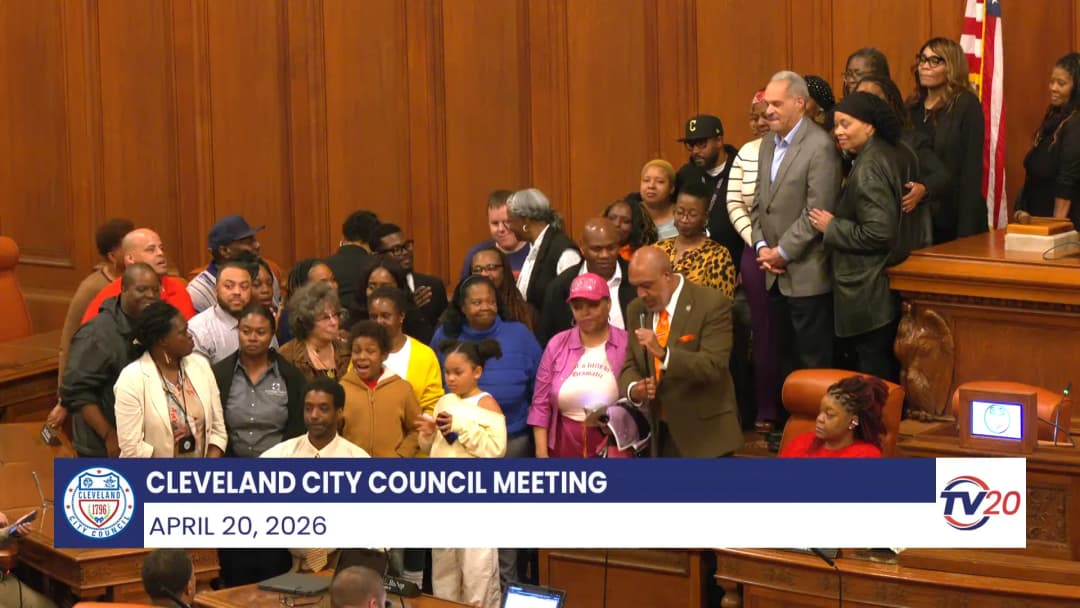
The Cleveland City Council met on Monday, April 20, 2026, at approximately 22:57 UTC. The meeting included public comments on a wide range of issues, passage of numerous emergency ordinances, presentations recognizing community organizations and individuals, and extensive discussion among council members regarding the proposed closure of 18 CMSD schools, particularly on the east side. Public Comments & Testimony - Daryl Houston (Bedford Heights, not a resident) spoke about a recall effort against the mayor. He clarified he was born and raised in Cleveland and supported the recall but not having Mark Griffin become mayor. He stated that if the petition fails, he intends to move back to the city, unseat the current council member in whichever ward he moves into, and consider running for mayor. - Angela Henderson (Cleveland Heights, representing Neighborhood Leadership Institute class 42) provided a historical perspective on the NLI's location at 5246 Broadway Avenue, which has served the community for 150 years. - Matthew Strazinski (Ward 2) addressed the mayor's chair complaint, suggesting the mayor simply pay the $2,500 and move on. He also urged the city to retain Burke Lakefront Airport, citing emerging urban air mobility and drone laws in New Hampshire and Pennsylvania. - Bridget Smith Jackson (East Cleveland) highlighted the upcoming 10-month anniversary of the explosion at Rainbow Terrace Apartments, which killed one resident, burned two children, and displaced 44 families. She argued the incident reflects systemic failures in housing oversight and called on the City Council to hold hearings, coordinate departments, and advance enforceable tenant protections. - Stephanie Thomas (Ward 12) spoke against the carceral system, criticizing rhetoric that equates low-income youth with terrorists. She reported that the nightly cost per bed at the current jail is $150 and will rise to $192 at the proposed new jail, urging that taxpayers not fund oppression. - Lauren Lawler (Cleveland) proposed using criminals to clean up trash in the community, citing trash dumping and unclean bus stops. She praised Councilman Michael Polensek. - Fauzi Bador (Ward 11) presented a petition for Ohio voters to decide on the hyperscale data center issue. He asked council to reject or delay the data center for further study, noting Ohio is the second-largest state for data centers after Virginia. - Justin Streeko (Ward 12) discussed the future of Louisa May Alcott school. He thanked the administration for engagement and shared a neighborhood survey showing 70% of respondents expressed concern about the building remaining vacant or about housing affordability. He warned that tax subsidies for market-rate housing create market distortions that raise property taxes. - Dantez Taylor (Ward 2) asked about illegal dumping on properties and requested a meeting with the Greater Cleveland Regional Transit Authority (GCRTA) to improve transit reliability, particularly for wheelchair users. - James Bentley (Mayfield Village) formally reported a hostile work environment and retaliation. He described being assaulted by a supervisor in October 2024, the supervisor's arrest and dismissal, and subsequent rehire in December 2025. Bentley stated he received a five-day and later a ten-day suspension, which he believes is retaliatory, and requested an investigation. Presentations - National Library Workers Day: Councilwoman Nikki Hudson presented a proclamation recognizing April 21, 2026, as National Library Workers Day. Union representative Terry Metter thanked council and noted the union is in contract negotiations with the library system. - Neighborhood Leadership Institute (NLI): Council President Griffin recognized NLI's more than 1,500 grassroots leaders. Dorcas Johnson, a current class member graduating in May, thanked council for hosting. - Raven Walker and Living for Epilepsy Initiative: Councilman Conwell presented a proclamation to Raven Walker for founding the Living for Epilepsy Initiative. Walker shared her personal experience with epilepsy, noting she is one of 3.5 million Americans living with the condition and that over 6,000 Americans die from epilepsy annually. She emphasized the need for community unity and support. - African American Cultural Garden: Councilman Conwell and representatives from the African American Cultural Garden announced a groundbreaking after 61 years of work. They noted an eagle's nest on the property is pending approval from the Ohio Department of Natural Resources before construction can begin. They invited all to Juneteenth celebrations. Legislation & Votes The council passed a large number of emergency ordinances on first and second reading, many by departmental request. Notable legislation included: - Ordinance 231-2026: Authorizing improvements to Erie Street Cemetery and Highland Park Cemetery Mausoleum. Vote: 13 yeas, 1 nay (Councilman Casey voted no). - All other ordinances passed unanimously with 14 yeas (including ordinance 231-2026 after reconsideration? The transcript shows a count of 14 yeas on the roll for second reading ordinances, then Councilman Casey asked to be marked no on 231, resulting in 13 yeas, 1 nay). - A motion to suspend rules was passed unanimously for several groups of ordinances. - Resolutions of condolence and congratulatory resolutions were adopted. - Appointments to the Community Relations Board (Brandon Ingo, Reverend Anthony Small, Stephanie Morrison Herbick, Yasir Hamdala, Peter Witt, Jay Westbrook, Luce Payot) were received. Discussion Items - Councilman Michael Polensek delivered an extended speech criticizing CMSD's Building Bright Futures plan, which proposes closing 18 schools (16 on the east side) and laying off 410 teachers. He argued that families are leaving the district for charter schools and suburbs, that the closures will lead to voter suppression by eliminating precincts, and that the Mayor appoints the school board and CEO and will bear responsibility. He claimed the administration had been misled by CMSD CEO Dr. Morgan. - Councilman Richard Starr responded by acknowledging the frustration but noted that CMSD received an F grade in 2001 and that past leaders failed to act. He defended the need for tough decisions and expressed willingness to work with the administration to improve education. - Councilman Joseph Jones paid tribute to former council member Bill Patman, who created the first neighborhood equity fund in 2001 and secured concrete paving for Kinsman Avenue. - Councilman Kevin Conwell requested a bus tour for council members and administration officials to view blight and poverty in the Collinwood and Glenville areas, including Quake Playground which has never been renovated. Key Outcomes - All emergency ordinances on first and second reading were passed with the exception of one dissenting vote on Ordinance 231-2026. - The council received appointments to the Community Relations Board and various reports. - Presentations and proclamations were made for National Library Workers Day, Neighborhood Leadership Institute, Raven Walker's epilepsy initiative, and the African American Cultural Garden. - Council members committed to continued advocacy and oversight on school closures and housing system failures.