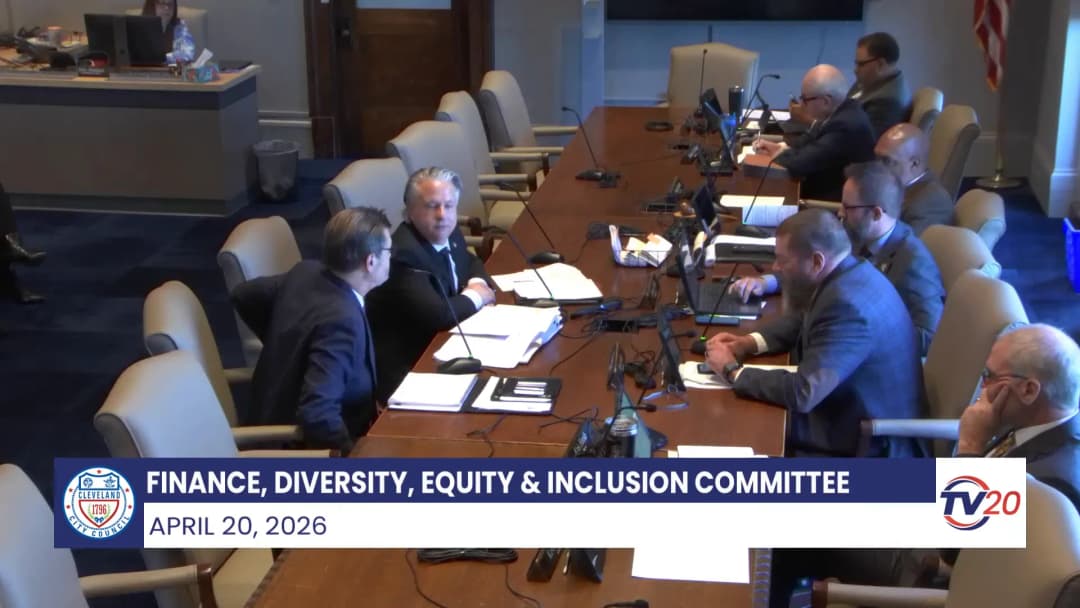
The Committee on Finance, Diversity, Equity, and Inclusion met on April 20, 2026, to consider several ordinances related to parks and recreation, capital projects, utilities, and youth programming. The meeting included approval of funding for downtown landscaping, record investments in roads and bridges, cemetery improvements, an electricity aggregation program, and multiple contracts for out-of-school time programs. Significant concerns were raised about disinvestment in the Collinwood neighborhood following the recommended closure of Collinwood High School. Consent Calendar - Ordinance 226-2026, authorizing payment to Downtown Cleveland Inc. for landscaping maintenance at Malls B and C for 2025, was approved unanimously. Discussion Items - Ordinance 236-2026 (Capital Projects - Roads & Bridges): Director of Capital Projects presented a $52.6 million capital improvement plan for roads and bridges, described as a record investment doubling typical annual expenditure. This includes an additional $8 million for residential resurfacing as requested by council. The ordinance was approved as amended. - Ordinance 231-2026 (Cemeteries): This ordinance authorizes $650,000 for improvements at Erie Street Cemetery ($500,000 for site improvements, road/path repair, drainage, and maintenance building repairs in preparation for its bicentennial in 2026) and Highland Park Cemetery Mausoleum ($150,000 for water intrusion repairs). An amendment to attach a detailed list of projects (file 231-2026-A) was adopted. Councilman Casey expressed opposition, citing lack of investment in Cleveland Public Power (CPP). - Ordinance 406-2026 (Electricity Aggregation): This ordinance authorizes the city to participate in the Sustainable Ohio Public Energy Council (SOPEC) electricity aggregation program for FirstEnergy customers for up to one year, with two one-year renewal options requiring additional legislative authority. Amendments ensured both the Director of Finance and Director of Public Utilities are involved. The program provides stable pricing and a renewable energy component. Six respondents bid on the RFP. - Ordinance 363-2026 (Proprietary Parts - Heavy Equipment): Authorizes a two-year contract with Murphy Tractor for proprietary John Deere parts and maintenance for water, CPP, and water pollution control divisions (approx. $325,000). Approved. - Ordinance 407-2026 (Sewer Replacement Projects): Authorizes a $5.4 million sewer replacement project on multiple streets, including seeking grants and ORSD cost share. Approved. - Ordinance 408-2026 (Plumbing & Backflow Services): Authorizes a two-year contract for plumbing and backflow testing for DPU divisions (approx. $425,000). Approved. - Ordinance 409-2026 (Conduit Materials - CPP): Authorizes a two-year contract for PVC and FRE conduit materials for CPP (approx. $500,000/year). Approved. - Ordinance 410-2026 (Substation Maintenance - CPP): Authorizes a two-year contract for substation maintenance, including roofs, landscaping, and equipment repair (approx. $6 million). Approved. - Ordinance 524-2026 (Pay Band Amendment): Amends the pay band to create Executive Assistant I and II positions for city council and increases the maximum salary for Administrative Officer positions to align with market rates. Forwarded to full council. Public Comments & Testimony - Councilman Kevin Conwell expressed strong concern over the lack of after-school programming in the Collinwood neighborhood following the recommended closure of Collinwood High School and Hannah Gibbons Elementary School. He noted residents are protesting and called on the administration to address what he termed "disinvestment" in the area. Key Outcomes - All eight ordinances presented (226, 236, 231, 406, 363, 407, 408, 409, 410) were approved by the committee. - Seven youth programming contracts (Ordinances 355-362) were approved with Councilman Starr added as a sponsor: Art House Inc. ($56,608), Beat the Streets Cleveland (wrestling/mentoring), Center for Arts Inspired Learning (music lessons), Holden Forests & Gardens (STEM), Kent State University (workshops), Making a Difference Consulting LLC (workforce readiness), and Eleanor B. Rainey Memorial Institute (arts education). - Ordinance 524-2026 was forwarded to full council for consideration. - Meeting adjourned until April 27, 2026.
Public Meetings - Cleveland, Ohio
Public Meetings - Cleveland, OhioThe Municipal Service and Properties Committee met on Monday, April 20, 2026, to consider three ordinances and receive two presentations. The meeting covered a new speed table contracting program, landscaping maintenance for downtown malls, a state highway messaging system, an update on police district energy upgrades, and the city's grass cutting program for vacant lots. Discussion Items Ordinance 1406-2025 – Speed Table Installation Program - The Director of Public Works presented a departmental request to contract with outside vendors for speed table installation due to increased demand and limited internal capacity. The program is funded at up to $1.1 million per year from ARPA and councilmatic discretionary funds, with a two-year contract term. - Council members raised concerns about equitable distribution of money across all 15 wards, noting that only six wards were listed as initial funding sources. The director clarified that the list was not final and that funds would be allocated based on traffic studies and council input. - Councilwoman Gray and others requested improvements to speed table visibility, including reflective posts and advanced signage. - Councilman Harsh offered an amendment to require written notice to the Clerk of Council for any cooperative purchases, which was seconded and approved. - Councilman Shaw initially proposed limiting the contract to one year to encourage in-house capacity building but withdrew after clarification that the contract is supplemental and that internal crews will continue to install speed tables. - The ordinance was approved as amended. Ordinance 226-2026 – Landscape Maintenance at Malls B and C - The Director of Parks and Recreation requested authority to pay Downtown Cleveland Inc. $77,000 for 2025 landscape maintenance services at Malls B and C. The work had previously been handled by Group Plan Commission, which dissolved and transferred responsibilities. - Councilman Casey questioned why council members cannot use discretionary funds for similar landscaping in their wards, and Councilman Polensek requested clarification on the city's total contributions to Downtown Cleveland Inc. and the special improvement district. - Councilman Shaw asked about the usage of the malls by third parties and whether the city receives rental fees. The director confirmed third parties pay permitting and labor fees. - Councilman Jones requested copies of all contracts with Downtown Cleveland Inc. and an executive summary, which the director agreed to provide. - The ordinance was approved. Ordinance 353-2026 – ODOT Dynamic Messaging System - The Director of Public Works presented an ordinance to consent to ODOT installation of a dynamic messaging system, queue warning lights, and detection cameras on I-90 and SR 176. The city would accept gifts and grants and record necessary rights-of-way. - Councilman Harsh proposed an amendment to Section 6, making ODOT solely responsible for maintenance, repair, and replacement of the new devices. ODOT representatives present confirmed agreement. - Councilman Casey raised concerns about surveillance capabilities, noting cameras record video stored for 72 hours and could potentially be used for license plate identification. The ODOT representative stated cameras are high-mounted and not designed for zooming in on plates. - After debate, the amendment was approved. The ordinance passed with a vote of 5 in favor and 2 opposed (Councilman Casey and Councilman Shaw voted no). Presentation: Police District Energy Savings Performance Contract (Leopardo) - The Director of Capital Projects and Leopardo representatives updated the committee on a $21 million design-build contract to improve all five police districts. The project is funded through guaranteed energy and procurement savings under Ohio Revised Code 717.02. - Leopardo reported that work is one-third complete, with new boilers installed, exterior masonry and concrete repairs done at Districts 1, 4, and 5, and HVAC replacements underway. Solar arrays are being installed, and interior renovations are scheduled for late spring/summer. - Procurement savings identified so far include $38,000 annually in apparel, $34,000 in shooting targets, $100,000 in janitorial supplies, and a projected $4 million in telecom consolidation. - Director of Safety noted improved morale and recruitment benefits from the upgrades. - Council members praised the progress and requested a follow-up tour. Presentation: Grass Cutting Program (Vacant Lot Abatement) - The Director of Public Works presented the seasonal grass cutting program, explaining the process under Ordinance 209 for abating nuisances on vacant lots (grass over 8 inches, noxious weeds, refuse). - The program operates on a 7-week cycle, with 22 full-time employees, 57 seasonal workers, and about 90 contract employees. Approximately 27,000 parcels are serviced annually. - Councilwoman Gray asked about cleanup logistics after tractor cuts and about vines growing onto private fences. The director stated the city will address such issues on city-owned lots case by case. - Councilman Jones criticized the quality of cuts and proposed a shift to a contractor-based model with performance metrics. The director responded that the city is gradually moving toward more contractor use but warned against abrupt system shocks. - Councilman Casey requested that tractors blow grass back into lots instead of into streets. - The presentation was informational; no vote taken. Key Outcomes - Ordinance 1406-2025 (speed tables) approved as amended. - Ordinance 226-2026 (malls maintenance) approved. - Ordinance 353-2026 (ODOT messaging system) approved as amended, with a 5-2 vote. - The committee received updates on police district improvements and the grass cutting program; no action required.
The Cleveland City Council Utilities Committee met on April 16, 2026, to consider several ordinances related to the Department of Public Utilities and the Office of Sustainability. The committee approved multiple contracts for equipment, sewer replacements, substation maintenance, and the city's electric aggregation program, with amendments to the aggregation ordinance requiring annual legislative review and joint oversight by the Directors of Public Utilities and Finance. Public Comments & Testimony - David Beach (Ward 3 resident): Expressed strong support for Ordinance 406 (electric aggregation program) and Ordinance 410 (substation investment). He praised the aggregation program for providing affordable 100% green renewable energy to FirstEnergy customers and emphasized the importance of reinvesting in Cleveland Public Power (CPP) substations for the city's future sustainability. Discussion Items - Ordinance 363-2026: Authorized a requirement contract with Murphy Tractor and Equipment Company for proprietary replacement parts and labor for John Deere heavy construction equipment across DPU divisions. Estimated cost: $325,000 over two years. Approved. - Ordinance 407-2026: Approved a $5.4 million capital improvement plan for sewer replacements on Archwood Avenue, West 39th Street, Bradgate Avenue, Clyborne Avenue, East 58th Street, and Luther Avenue. Projects selected based on sewer age, breaks, and flooding complaints. Councilwoman Hudson raised concerns about timing conflicts with street repaving on Clyborne Avenue, requesting a prioritized timeline. Councilman Palency inquired about loan terms (e.g., zero-interest state revolving loans) and requested a list of streets in Ward 10 that experienced basement flooding after a recent storm. - Ordinance 408-2026: Authorized a two-year requirements contract for plumbing services and backflow testing/inspection at DPU facilities, currently with SA Communal. Existing contract expired April 16, 2026, but director confirmed no service disruption. - Ordinance 409-2026: Authorized a two-year requirements contract for PVC and FRE duct line materials for CPP underground distribution. Estimated at $500,000 per year, though historical spending is lower. Director reminded to monitor expiring contracts. - Ordinance 410-2026: Authorized a two-year requirement contract (approx. $6 million over two years, or $3 million per year) for substation maintenance and repair, including roofs, landscaping, and equipment testing/replacement. Councilman Palency expressed frustration over widespread power outages during Easter weekend, particularly in Glenville and Collinwood, citing poor communication and slow restoration. Director acknowledged the issues, explained that multiple storms exhausted system redundancies, and stated that all available resources were deployed. Palency questioned whether CPP employees refused to work; director denied knowledge of such. Chairman emphasized the need for greater investment from administration and council leadership. - Ordinance 406-2026: Authorized the city's participation in the SOPEC electric aggregation program for up to 36 months (beginning August 2026) for FirstEnergy residential and small commercial customers. Current rate: 9.236 cents/kWh (with 0.2 cent admin fee) vs. FirstEnergy's standard offer of 9.88 cents/kWh. The program offers three tiers: default 100% renewable, a less expensive brown power, and an intermediate option. Committee amended the ordinance: (1) reduce term from up to 36 months to up to one year with two one-year renewal options requiring legislative authority; (2) add the Director of Public Utilities as a co-signatory alongside the Director of Finance. Discussion included historical savings of $21 million, education efforts for residents, and fixed annual pricing. Key Outcomes - Ordinance 363-2026: Approved. - Ordinance 407-2026: Approved. - Ordinance 408-2026: Approved. - Ordinance 409-2026: Approved. - Ordinance 410-2026: Approved. - Ordinance 406-2026: Approved as amended. The amendment requires the contract to be for up to one year with two one-year renewal options by council authorization, and adds the Director of Public Utilities to the signing authority. The meeting adjourned. The next Utilities Committee meetings are scheduled for April 30 and May 14, 2026.
The Transportation Committee held its fourth of four scheduled meetings on the proposed closure of Burke Lakefront Airport. The administration and North Coast Waterfront Development Corporation presented high-level redevelopment concepts emphasizing recreation, public access, and economic impact. No legislation or formal votes were taken; the session served as further informational exchange. Presentation Overview - Deputy Chief of Staff Jessica Trevasano introduced the presentation, stating that a recreation-focused concept at Burke would require minimal public funding, increase resident access to 450 acres of lakefront, and generate five times more direct tax revenue to the city than the airport currently does (approximately $2.5 million annually vs. $500,000). - The administration showed two conceptual fit studies: one featuring a large public park, competitive youth sports facilities, a marina, RV camping, walking trails, and a vertiport; the other replacing the park with an 18-hole public golf course. Both are meant to inform decision-making, not as definitive master plans. - Key constraints: the land is submerged land with a lease, limiting ownership possibilities; low-density development minimizes remediation costs; the site has received No Further Action letters for most environmental concerns. Discussion Items & Questions - Councilman Slife asked about absorption of current airline users and whether shifting Burke operations to Hopkins would foreclose other opportunities. The administration responded that nearly all operations can move to Hopkins and that the impact would be positive, with no loss of opportunity. - Councilman Slife also requested case studies on how similar youth sports facilities are financed, noting that a clear understanding of public costs vs. benefits is needed. - Councilman Jones questioned the community survey process, expressing that his ward had not been directly contacted. The administration acknowledged outreach to block clubs and CDCs and committed to better coordination with council offices. - Councilman Palencik raised concerns about the lack of legislation before council, stating he would not delegate his authority. He also asked about lobbying costs for closure (Hallehan Strategies) and requested updated demolition cost estimates. - Councilman Harsh questioned environmental impacts of the confined disposal facilities (CDFs) and whether public access could coexist with private investment. The administration noted that CDF 9 would remain for dredge recycling and that lease agreements could require public access. - Councilwoman Gray asked about the vertiport and air show continuity. The administration stated the air show can continue with a remote viewing area and ticket sales on the site, even without the airport. - Councilman Shaw advocated for centering affordable housing in the vision, criticizing the focus on tourism and destination amenities. The administration responded that housing on Burke is challenging due to land lease and market conditions, but the stadium site master plan will include affordability requirements. - Councilman Casey warned against overreach, questioning whether the city can manage 450 acres of development given existing challenges. Public Comments - Tim Lewis from Akron proposed reconfiguring the shoreline and adding islands to protect against storms, relocating yacht clubs, and improving access roads. - Dennis Turchak was not present. - Mr. Houston criticized the planning process as disconnected from residents' needs, noting that existing lakefront parks lack amenities. He urged the city to engage the community directly and questioned the ethics of large investors. Key Outcomes - No votes or formal decisions were made. The committee will likely hold additional hearings over the summer, including with airport operators and possibly RTA. - The administration committed to providing case studies on youth sports facility financing, updated demolition costs, and ward-specific survey data. - Continued community engagement was emphasized, with the administration pledging to attend council-led ward meetings. - The overall purpose remains to inform council and the public, with any closure decision requiring federal approval and eventual council legislation.
The Workforce Education Training and Youth Development Committee of the Cleveland City Council met on Tuesday, April 14, 2026, at 1:33 PM to consider nine pieces of legislation. The meeting focused on two main agenda items: a proposed Climate Resilience Corps pilot program (Ordinance 400-2026) and a package of eight youth program contracts (Ordinances 354-2026 through 362-2026) from the Mayor's Office of Prevention, Intervention, and Opportunity (OPIO). The committee held Ordinance 400-2026 for further work with the ward councilmember and voted not to recommend Ordinance 354-2026 (After-School All-Stars) while approving the remaining seven youth program contracts. Consent Calendar No consent calendar was presented. Public Comments & Testimony No public testimony was heard. Discussion Items Ordinance 400-2026: Cleveland Climate Resilience Corps Pilot Sarah O'Keefe, Director of Sustainability and Climate Justice, presented a request for authorization to apply for up to $250,000 in grants to establish a two-year pilot program paying youth and seniors as neighborhood climate stewards to maintain green infrastructure and build workforce skills. The pilot is timed with street greening projects in the Huff and St. Clair neighborhoods (Ward 8). Committee members expressed concern that Councilwoman Stephanie House Jones (whose ward includes Huff) had not been briefed. O'Keefe acknowledged the lack of prior consultation and offered to meet. The committee held the ordinance, directing O'Keefe to work with Councilwoman House Jones before rescheduling. OPIO Youth Program Contracts (Ordinances 354-2026 through 362-2026) Interim OPIO Director Sherry Ellery presented an overview of eight contracts totaling $895,165 for out-of-school time programming. She noted that an RFP received 79 proposals requesting over $15 million, and that this year's evaluation team included youth for the first time but not recreation center managers. The committee discussed program quality, attendance data, evaluation methods, and the need for disaggregated data and better communication with recreation center staff. Key concerns raised: - Councilwoman Deborah Gray testified that the After-School All-Stars program at Zelma George Recreation Center had persistent low attendance and uninstructive staff, contradicting attendance figures. - Councilwoman Stephanie House Jones and Councilman Joe Jones questioned the lack of clear metrics and requested comprehensive program lists, budgets, and evaluations. - Councilman Kris Harsh praised Art House Inc. (Ordinance 355-2026) as a well-run program. - Beat the Streets (Ordinance 356-2026) and Making a Difference Consulting (Ordinance 361-2026) provided detailed presentations on their recruitment, evaluation partnerships, and community engagement strategies. Key Outcomes - Ordinance 400-2026: Held in committee; referred back to the director to consult with Councilwoman Stephanie House Jones. - Ordinance 354-2026 (After-School All-Stars): The committee voted not to recommend passage (Chair voted no, Councilman Jones voted no, Councilwoman Gray recused, others voted yes but the no votes carried). The chair stated the ordinance would not advance unless revised and brought back. - Ordinances 355-2026 (Art House), 356-2026 (Beat the Streets), 357-2026 (Center for Arts Inspired Learning), 358-2026 (Holden Forest and Gardens), 360-2026 (Kent State University), 361-2026 (Making a Difference), and 362-2026 (Ramey Institute): All recommended for passage by the committee. - The committee requested that OPIO provide a full list of all contracts, neighborhood locations, program descriptions, and evaluation data to all committee members. - A future joint hearing with the Municipal Services Committee on Civic Rec registration and recreation center programming was suggested.
The Cleveland City Council met on April 13, 2026, for a regular legislative session. After roll call (13 members present, a quorum) and opening ceremonies, the council heard public comment on a range of issues, including a recall effort against Mayor Justin Bibb, chronic power outages, housing conditions, and city services. The council then approved multiple appointments, liquor license transfers, and emergency ordinances and resolutions, all by unanimous 13-0 votes. Announcements highlighted transportation hearings, school layoffs, and concerns over police technology contracts. Public Comments & Testimony - Adrian Freeman (lifelong Cleveland resident) discussed gathering signatures for a safety and energy retrofit initiative, a food desert elimination project, and repurposing old civic buildings. He urged priority for those most in need. - Matthew Strazinski (Ward 2) criticized the absence of the mayor and his councilman, complained about code violations on Fleet Avenue (a junkyard-like gas station), and called for proper boarding of the Stellar Wall Center out of respect for his grandfather. - Christina Hill (Ward 11, owner of Tiny Heroes Academy) described the closure of her child care center after a disputed inspection. She asked for an independent review of her case by someone outside the Department of Public Health and for policy changes to increase transparency and support for small businesses. - Bridget Smith Jackson (East Cleveland) addressed systemic housing issues, sharing stories of a homeless woman, a tenant in a motorized wheelchair who faced retaliation, and a mother of three with disabilities. She argued that speaking up about unsafe conditions can cost residents their housing and called on the council to intervene. - Sabrina Otis (Cleveland) raised three issues: the city’s charter ordinance unfairly penalizing renters with garbage tickets (while homeowners get relief), the lack of compensation for Cleveland Public Power outages (unlike FirstEnergy rebates), and poor street lighting and potholes that harm residents while the city builds for outsiders. - Lauren Lawler (Cleveland) complained about uncollected trash and feces at an RTA stop on Neff Road, a water main break, and murders in her neighborhood. She urged more jobs and cleanup crews. - Larry H. Gardner (Ward 3) opposed the recall of Mayor Bibb, calling it “bad comedy.” He noted that Bibb had an opponent in the last election, argued that a recall would waste taxpayer money, and urged people to vote instead. - One C. Collado Diaz (Ward 12, Accountable Cleveland) supported the recall, announcing that 1,000 signatures had been submitted. He cited opposition to a data center (raising electric bills and harming Lake Erie), the ShotSpotter technology (installed without council approval), and the mayor’s policies. He stated the recall is not personal but aimed at the administration’s “horrible policies.” - Ladonna Wheeler (Ward 9) criticized Councilman Casey’s previous remarks about praying during Easter power outages. She called his apology “half-hearted” and racially overtoned, and demanded that the city fix CPP infrastructure and compensate residents for lost food and damaged appliances. - Greg Wheeler (Ward 9) detailed three power outages in the week of Good Friday, lasting up to 15 hours, damaging appliances, and risking his health (medical condition requiring electricity). He called Councilman Casey’s apology “the worst I’ve ever heard from a public official” and invited him to ward meetings for a different response. He demanded results, not further apologies. Consent Calendar - Appointments to the Cleveland-Cuyahoga County Port Authority (Luis Cartagena, Glenn Shoemate) and Greater Cleveland Regional Transit Authority (Anastasia Elder, Emily Harper, Jeffrey Sleesman) were approved without objection. - Dedication plats for Woodhill Homes Development Project (Phases 5 & 6) – Blue Rock Road and Luna Park Avenue – were approved. Discussion Items - Councilman Michael Palensic criticized the Cleveland Metropolitan School District (CMSD) for laying off approximately 410 teachers and administrators and for planning to sell Collinwood High School. He argued that the east side is being systematically dismantled, with programs stripped and students fleeing to charter schools. He accused CMSD of a lack of transparency and premeditated decimation. - Councilman Christopher Harsh introduced Ordinance 469-2026, which would raise the admission tax exemption limit from 150 to 750 capacity for local clubs. He noted that 75% of local venues are losing money and that the change would cost the city less than $100,000 but provide significant relief to mom-and-pop venues. - Councilman Kevin Conwell expressed full support for the admission tax exemption, emphasizing the importance of protecting local music venues that attract visitors and generate payroll tax. - Councilman Richard Starr praised Director Sally Martin, Chief Sammy Morris, and others for monthly HUD troubled asset roundtables, which are helping address problem properties and creating accountability. - Councilman Tamey Shaw expressed disappointment that the administration authorized contracts with ShotSpotter and Flock without council approval, noting concerns about data sharing with ICE. He also spoke in favor of Councilman Starr’s marijuana tax split resolution, arguing that too little spending goes to neighborhoods. - Council President Griffin acknowledged the concern over the unauthorized contracts, stating that leadership has already begun discussions to ensure legislative protections. He cautioned against creating ward-specific funding mechanisms that could lead to inequity. - Councilman Charles Slife announced a fourth hearing on the proposed closure of Burke Airport for Wednesday, April 14, and upcoming hearings on RTA service cuts, particularly routes 78, 86, and 10, which are critical to residents. - Councilwoman Stephanie House Jones invited Ward 8 residents to the first Neighborhood Network Night on April 14. Key Outcomes - All appointments (Port Authority, RTA) and dedication plats were approved without objection. - Emergency ordinances on first reading (Ordinances 464-471, 474-478, 481) and on second reading (Ordinances 359, 369) were passed unanimously (13-0). - Emergency resolutions on first reading (Resolution 480) and on second reading (Resolution 459, 479, 507) were adopted unanimously (13-0). - The council will continue discussions on the admission tax exemption, police technology contracts, CMSD school closures, and RTA service cuts. - The next regular council meeting was scheduled for April 20, 2026.
The Cleveland Committee on Finance, Diversity, Equity, and Inclusion met on April 13, 2026, to consider two ordinances: one amending a PACE financing agreement for the Erie View Tower project and another authorizing acceptance of a federal port security grant. The committee heard presentations from the development team and city officials, discussed project progress, and forwarded both items to the full council with recommendations. Consent Calendar - No consent calendar items were discussed. Public Comments & Testimony - No public comments or testimony were received. Discussion Items - Ordinance 481-2026 (Erie View Tower PACE Amendment): Bobby Bruno and Rich Moorehouse of KJK Law firm presented on behalf of the Erie View Tower development team. The ordinance amends a previously passed PACE (Property Assessed Clean Energy) financing agreement for the Erie View Tower project, which includes 227 market-rate apartment units, a W Hotel, renovated office space, and reimagined galleria space. The PACE loan amount is increasing from approximately $16.5 million to a maximum of $50,443,913, with New Vein Green Capital as the lender. The developer stated that the senior loan amount is decreasing while the PACE loan increases, providing a different source of financing. The city is providing no additional incentives, and the PACE financing is repaid through a special assessment on the property. Update on project progress: a construction permit for the residential portion was awarded at the end of 2025; demolition for the residential component is 99% complete; hotel drawings will be complete in June 2026; project estimated completion is December 2027. Community benefit agreement (CBA) work is ongoing with AKA Team and Jabali Development. Councilman Polensek expressed strong support, calling the project "critical" for downtown Cleveland amidst challenges like closed hotels and foreclosures. Councilman Casey confirmed the amendment does not cost the city any money or lost property taxes. The Chair requested a future briefing for council on residential PACE financing. - Ordinance 359-2026 (Port Security Grant): The Director of Public Safety presented legislation authorizing acceptance of a $205,790 grant from FEMA's fiscal year 2025 Port Security Grant Program. The grant requires a cash match of $60,000 and will fund safety equipment for the fire boat, supplies, and search and rescue training for the Division of Fire. Key Outcomes - Ordinance 481-2026 (Erie View Tower PACE amendment) was forwarded to the full council for passage that evening. - Ordinance 359-2026 (Port Security Grant) was discussed but no vote was taken during this committee meeting; it will proceed to the full council. - A future briefing on residential PACE financing was requested by the Committee Chair.
The Health, Human Services, and Arts Committee of the Cleveland City Council met on April 13, 2026, to discuss three major items: a contract for indigent burial services, a presentation on epilepsy awareness and support, and an update on food systems initiatives. The meeting included voting on amendments to the indigent burial legislation and discussions on urban agriculture, land access, and community health. Discussion Items Indigent Burial Services Contract - The committee considered legislation authorizing the purchase of one or more requirement contracts for indigent burial services (cremation), exercisable by the Director of Public Health. The contract had been approved by the Health Department on March 24, 2026, the Finance Department, and the Director of Law. - Director of Vital Statistics Andrea Casanari explained that the city provides free cremation services for indigent residents. The previous contract with Bikon Brothers (now Sloan Funeral Home) had been in place for at least 12 years. The annual cost has been around $200,000; this year's contract is not to exceed $250,000. - Councilman Conwell and others discussed issues where families request burial instead of cremation, and noted that some funeral homes work with families to raise funds. Councilman Conwell also noted that the city cannot turn away qualified indigent residents. - The process: next of kin calls the health department, fills out an application, and the vendor checks for assets (e.g., GoFundMe, prepaid funeral, veteran status). If the body has been embalmed by another funeral home, it no longer qualifies. The city handles about 300 cremations per year out of about 400 applications. Cost per cremation is approximately $895–$900, with a reduced rate of $125 for infants. - Councilman Austin Davis asked about the vendor selection process and whether green cremation methods (e.g., water cremation, renewable energy) could be considered. The director stated that the state of Ohio does not currently allow such methods, and renewable-energy-powered cremation is not readily available locally. - Councilwoman Nikki Hudson clarified that the program covers only cremation and burial of ashes in Potter's Field at Highland Park Cemetery. Ashes are held for at least a year before burial; 10–12 urns are buried together on a shared gravestone. - Three amendments were proposed and unanimously adopted: (1) replace all uses of "indignant" with "indigent"; (2) in Section 2, insert "not to exceed $250,000" and update the appropriation account number to 1-1-5-5-5-6-3-8-1; (3) in Section 3, add a requirement that the Director of Public Health provide written notice to the clerk of council for any purchases made through the cooperative process, including details. Epilepsy Awareness and Support Presentation - Raven Walker, founder of the nonprofit Living for Epilepsy, presented on the organization's mission to empower African Americans living with epilepsy through awareness, education, and support. She was joined by program manager Monique Chavis, who was her former teacher and witnessed her seizures in class. - The presentation covered the five types of seizures: tonic-clonic, absence, focal aware, focal impaired awareness, and myoclonic. They emphasized the importance of seizure first aid training and the need for seizure action plans in schools and businesses. - The organization offers seizure first aid training, CPR training, and the Resilient Bracelet Project, a hands-on workshop for building resilience. They have partnered with Cleveland EMS, received 70 CPR training equipment donations from Cuyahoga Community College, and are seeking funding for AEDs, CPR equipment, and educational posters. - Upcoming events: Seizure First Aid training on June 12, 2026, for Frazeon Therapy; CPR training on August 22, 2026. They need space for trainings and are collaborating with organizations like Zelma George and Tri-C. - Councilman Conwell offered to help secure space at University Hospital's community center in Glenville, and to provide a band for fundraising events. He also introduced Francis (director of minority health) to assist with connections. - Councilwoman Hudson noted that seizure first aid is not commonly taught, and that schools and businesses lack preparedness. She offered to help connect with CMSD schools. Councilman Conwell agreed to call Dr. Warren G. Morgan (CMSD CEO) to facilitate access. - The committee expressed support and pledged to provide a resolution on the council floor. Councilman Conwell also offered to introduce the organization to Matthew Cole, head of human resources for the city of Cleveland. Food Systems Update - Zaynab Pixler, Local Food System Strategies Coordinator for the Department of Public Health, presented an overview of food systems work. She has a supply chain degree and food studies minor, and previously worked at the Greater Cleveland Food Bank and the Center for Good Food Purchasing. - She conducted a listening tour and identified seven key insights: land and water access for urban agriculture, transparency in city processes, institutional food procurement, alternative food retail models, workforce development, food rescue and composting, and coalition building. - Major projects include: working with the city's land bank to allow sale of land for urban agriculture (currently not permitted, only leases); developing a cooperatively-owned farm stop in Central-Kinsman; creating a Notion guide for farmers' markets; the Cultivating Cleveland's Next Generation workforce program; the Summer Sprout Community Gardening Program (shifting from CDBG to general fund); and managing the East Side Market after the lease with NEON ended. - Councilwoman Hudson asked about incentives for new grocery stores. Pixler cited the Gardening for Greenbacks grant program and Department of Development grants for equipment, but no dedicated grocery store funding. - Councilman Austin Davis asked about comparative urban agriculture progress. Pixler said Cleveland is historically progressive but other cities now offer land for sale, streamlined hydrant access, and transparent processes. The land bank's current pause on sales is a barrier. - Councilman Chris Harsh raised concerns about the sustainability of community gardens, noting that many small groups fail to maintain them. He suggested partnering with established gardens like Ben Franklin to manage satellite locations. Pixler agreed and noted that Summer Sprout requires at least five unrelated applicants, and they are considering trial periods and training requirements for land sales. - Councilman Conwell proposed using community gardens for youth education in project management, similar to the Wow U program. - Councilman Shaw asked about the timeline for acquiring land through the land bank. Pixler said it is currently paused and can take over a year. She noted that the land bank's Trudy Andresky has been open to conversations about policy changes. - Councilwoman Hudson highlighted the need for separate permitting processes for small events like farmers' markets versus large festivals. Pixler agreed and will draft a proposal. She also noted that hydrant access for urban farms outside Summer Sprout is opaque and has fees. Key Outcomes - Indigent Burial Contract: The committee approved the three amendments unanimously. The legislation itself was then passed (with a voice vote, all in favor). The contract will go out for bid after passage. - Epilepsy Presentation: The committee expressed strong support and committed to providing a resolution on the council floor, connecting the organization with CMSD, city HR, and minority health resources. Councilman Conwell will facilitate a phone call with CMSD CEO Dr. Warren G. Morgan. - Food Systems Update: The committee discussed multiple policy changes to support urban agriculture: land bank sales, streamlined hydrant access, simplified permitting for farmers' markets, and improved community garden management. Pixler will draft a proposal for simplified event permits. The committee will continue to work on these initiatives.
The Mayor's Appointment Committee met on Tuesday, March 24, 2026, to consider candidates for two city boards: the Cleveland Commission on Black Women and Girls and the Cleveland-Cuyahoga County Port Authority. The meeting included interviews, discussions on residency and policy positions, and roll call votes. Two additional candidates were rescheduled due to loss of quorum. Discussion Items - Ann Nelson – Cleveland Commission on Black Women and Girls Ms. Nelson, Senior Assistant Dean at Cleveland State University, introduced herself and discussed her background, including growing up in the Glenville area and her 25-year career in education. Council members expressed concerns about her residence in University Heights rather than Cleveland, but she argued that her work with Cleveland State students (80% Clevelanders) and her deep roots in the city qualified her. She emphasized the importance of supporting career guidance in middle schools and creating pathways for students not pursuing four-year degrees. She also described herself as a “rebel” who speaks up for students, even against authority. The committee voted unanimously (all present in favor) to advance her nomination. - Telly Anjay Thomas and Jay Stephan Holmes – Cleveland-Cuyahoga County Port Authority Both are current board members seeking reappointment. Ms. Thomas resides in Cleveland; Mr. Holmes lives in Orange Village. They answered questions about their roles, the port’s mission (maritime, financing, infrastructure), and their records. Key issues included: - Prevailing Wage Vote (2024): Both voted to repeal the port’s prevailing wage requirement, a decision they defended as necessary to maintain the port’s AA bond rating and level the playing field with other Ohio ports. Councilman Casey and Councilman Shaw criticized the repeal, with Shaw stating he could not support any nominee who voted against prevailing wage. Ms. Thomas noted the complexity of the decision, emphasizing that the port still supports living wages for most workers. - Port’s Role in Cleveland: Council members pressed for a “Cleveland-first” approach, especially regarding potential financing for the proposed Browns stadium and development in Brook Park. Both nominees declined to speculate on future projects but affirmed their commitment to Cleveland. Councilman Polensek expressed deep concern that the port’s involvement in Brook Park would further harm Cleveland, citing loss of jobs, tax base, and opportunity. - Economic Impact: Mr. Holmes noted that the port supports approximately 27,000 jobs and generates $7 billion in economic activity annually. They highlighted recent accomplishments, including a $96 million EPA grant, record financing of $350 million in 2024-25, and efforts to increase neighborhood-level investments. - Disconnect with City Council: Council members Santana, Polensek, and Shaw noted that many small businesses and residents are unaware of the port’s services and financing tools. Both nominees agreed to improve outreach and provide project lists before full council votes. Key Outcomes - Ann Nelson: Approved by the committee (unanimous) for appointment to the Cleveland Commission on Black Women and Girls. - Telly Anjay Thomas: The committee voted 3–2 to advance her reappointment to the Port Authority to full council. - Jay Stephan Holmes: The committee voted 3–2 to advance his reappointment to full council. - Rescheduled Candidates: Mr. Schumach and Mr. Cartenga were not heard due to lost quorum; their appearances were postponed to a future date. - Next Steps: The committee requested that Port Authority nominees provide a list of projects financed in Cleveland over the past year, as well as improved communication materials for small businesses, before the full council vote.
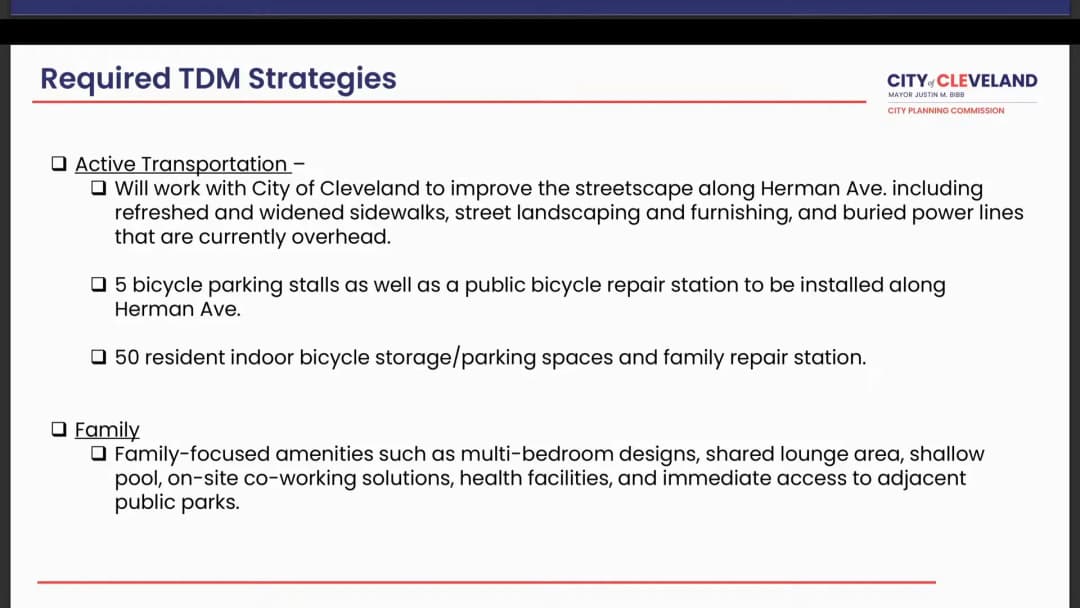
The committee met on March 24, 2026, at 1:25 PM (UTC) to consider two zoning ordinances: one expanding the West 117th Street Design Review District and removing residential parcels, and another rezoning a parcel near Herman Avenue for a mixed-use development. No public comments were presented. Discussion Items - Ordinance 1521-2025 (Council Member Spencer): Xavier Bay of City Planning presented Map Change 2683 to expand the West 117th Street Design Review District to include parcels along Detroit Avenue between West 107th and West 116th Streets, and to remove residential parcels along West 117th Street south of Tower Thornton Road and north of Lorraine Avenue. The addition aims to preserve urban fabric along the transit corridor, while the removal relieves homeowners of extra design review for routine repairs. Council members asked about demolition oversight and the impact on residents. The ordinance was approved. - Ordinance 185-2026 (Council Members Davis and Ornus): Xavier Bay presented Map Change 2697 to rezone a parcel north of Herman Avenue between West 65th and West 58th Streets from semi-industry (G2) to local retail (G2) with a zero-foot setback, incorporating a previously approved site plan. The project includes 135 residential units, 11,000 square feet of amenity space (office, pool, fitness, cafe), 127 parking spaces, and a transit demand management strategy (drop-off zone, repair stations, improved streetscape). Council Member Austin confirmed the project is separate from the Community Benefits Agreement. The ordinance was approved. Key Outcomes - Ordinance 1521-2025 was approved, expanding the design review district on Detroit Avenue and removing residential parcels. - Ordinance 185-2026 was approved, rezoning the Herman Avenue parcel to allow the approved development to proceed.