Browse by city
Date range
Search help

Search titles, summaries, topics and stored transcripts together. Keywords may match separately; put the whole query in double quotes for a phrase. Matching follows word analysis, so punctuation is not exact. Both dates are included. Documents are not searched.

SHOWING 31–40 ENTRIES
31
FEB 17, 2026 · COLUMBUS, OHIO · COUNCIL COMMITTEES
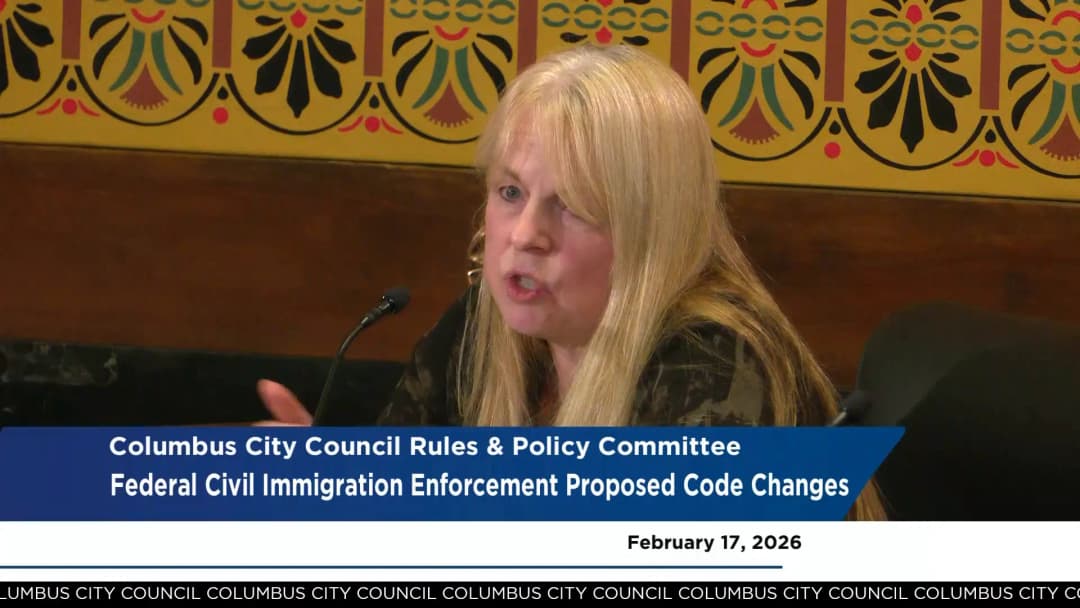
Columbus City Council Hearing on ICE Enforcement and Protective Legislation — February 17, 2026

On February 17, 2026, the Columbus City Council held a special hearing to examine concerns about overreach by U.S. Immigration and Customs Enforcement (ICE) and to consider a package of legislation aimed at protecting the safety, constitutional rights, and dignity of all Columbus residents. The hearing included presentations from the Ohio Immigrant Alliance, Columbus Division of Police, the Commission on Immigrant and Refugee Affairs, and the city's Legislative Research Office, followed by extensive public testimony. Councilmembers heard from over 20 community witnesses, including representatives of resettlement agencies, legal aid organizations, faith groups, and directly impacted residents. Consent Calendar - No consent calendar was presented. Public Comments & Testimony - Dr. Sileshi Ayalo Asfaw (ETSS): Expressed strong support for the legislative package, highlighting protections for public spaces, schools, and daycares; support for requiring council approval of 287(g) agreements; support for creating an evidence repository; and support for zoning restrictions on detention facilities. - Karen Mozenter (Jewish Family Services): Supported the legislation, stating that families with legal status are not safe and that the city cannot stop federal activity but can regulate use of city resources and property. - Angie Plummer (CRIS – Community Refugee & Immigration Services): Supported the legislation, noting that the rescission of sensitive-locations protections has led to fear among residents. She cited examples of a Somali woman considering canceling surgery and crime victims afraid to go to court. - Elizabeth Brown (YWCA Columbus): Strongly supported the ordinance package, urging ongoing conversations with law enforcement about traffic stops, ICE holds, and how low-level violations are defined. - Dania Hamad (Franklin County Public Defender Collective): Described regular, visible ICE presence at the Franklin County Municipal Courthouse, stating that ICE agents often operate in plain clothes with civil warrants (not judicial warrants), infringing on due process rights. She noted that clients are sometimes taken before attorneys are informed. - Anisa Liban (Our Helpers): Shared a story of a family whose car was rammed by ICE, leading to detention of the mother and severe disruption. She urged the council to pass the legislation and invest in nonprofits providing emergency response. - Dorothy Hasan (Our Helpers): Described the Central Ohio Rapid Response Network (CORN), which coordinated food deliveries to 332 families during "Operation Buckeye" in December 2025, and highlighted the need for legal referrals and material support. - Sudarshan Pyakurel (Bhutanese Community of Central Ohio): Expressed strong support, noting that 49 Bhutanese community members have been deported to Bhutan, a country that does not recognize them. He said the pattern of targeting "criminals" initially is repeating. - Emilia Sheeley (Riverview International Center): Supported the legislation, noting that over 2,000 individuals from 60 countries were served in 2025, and that families are fearful. - Sarah DeMeo (Ohio Hispanic Coalition): Strongly supported the code changes, stating that being Latino is being persecuted and that families are already changing behavior out of fear. - Mark Fickey (Haitian Community Network): Spoke in strong support, noting that Haitian TPS holders contribute an estimated $5.9 billion annually to the U.S. economy and tens of millions to Columbus. He described a mother avoiding school drop-offs and a daycare provider facing intimidation. - Jonah Hilario (OPAL – Asian & Pacific Islander Ohioan Alliance): Supported the legislation, noting that AAPIs account for about one in seven undocumented immigrants and that fear is widespread. He called for increased funding for legal defense and urged the city to cut ties with mass surveillance companies like Flock Safety. - Andrew Hash: Asked the city to release a Fourth Amendment workplace flyer with the city seal, and urged prevention of ICE detention facilities in Columbus. - Leo Almeida: Shared a personal story as a naturalized citizen from Brazil and expressed support, stating that local control can limit ICE's harmful tactics. - Charles: Expressed conditional support, calling for abolition of jails and detention centers, rent control, livable wages, and removal of citizenship requirements for public benefits. He criticized increased police budgets. - Colleen O'Connell: Voiced strong support for any policies protecting neighbors targeted by ICE, including preventing city resources from being used by ICE and not contracting with businesses that work with ICE. - Phenon Bon Su: Expressed reservation about ICE's lawlessness and asked what individuals can do in real-time encounters to stay safe without being killed. - Ted Welsh: Expressed support for the legislation, emphasizing the need to protect immigrant communities and called for careful choice of business partners, stating "when we have cancer, we have to do things that are uncomfortable." Discussion Items - Ohio Immigrant Alliance Presentation (Lynn Tramonte): Provided data showing that from February to mid-October 2025, 4,568 people were detained in Ohio on civil immigration charges; 3,924 were Hispanic, 4,130 were men, and only 1,200 had a criminal history of any kind (including traffic offenses). The median length of stay for those without a criminal history was 29 days. Butler County Jail makes at least $105 per person per day and is planning $11 million in revenue for 2025. 701 people from Columbus were detained, with 50% sent to Butler County. Tramonte noted that civil immigration laws are enforced with guns, unlike tax laws, and that ICE uses ruses like smashing car windows. - Columbus Division of Police (Assistant Chief Converse): Stated that CPD has no 287(g) agreement with ICE. CPD does not enforce immigration law solely based on status, does not assist in removal, does not self-deploy to immigration events, and does not escort ICE agents. CPD personnel are trained in active bystander intervention. Officers are required to identify themselves with a Columbus Police badge, badge number, and marked uniform. - Commission on Immigrant and Refugee Affairs: Presented a resolution calling on ICE to visibly display identification, mark vehicles, refrain from non-medical face coverings, be trained to a 22-week standard, and conduct themselves in accordance with all laws. The city attorney noted that the city cannot mandate standards for federal agencies, so the resolution is non-binding and an advocacy tool. - Legislative Research Office (Director Matt Erickson): Presented a package of policies under consideration: - Prohibiting 287(g) Agreements: Would require council approval before CPD could enter into such agreements. This is a draft ordinance. - Evidence Gathering Repository: Would direct the mayor's office to establish a centralized repository for community documentation of ICE transgressions. Concerns include chain of custody, public records requests, and potential liability. Still under discussion. - Staging and Use of Public Spaces: Would prohibit using city-controlled properties as staging areas for civil immigration enforcement unless a judicial warrant is required. Would require signage at city properties and provide template signage for private property owners. - Obstruction and Harassment at Schools and Daycare Centers: Would increase penalties for obstruction or harassment within 15 feet of schools or daycares to a first-degree misdemeanor (previously fourth-degree). Also covers telecommunications harassment of employees. - Secondary Employment Prohibition: Would prohibit city employees from holding secondary employment with ICE or CBP, with exceptions for official anti-terrorism duties unrelated to immigration enforcement. - Detention Center Special Use Permit: Would require ICE detention facilities to obtain a special use permit from the Board of Zoning Adjustments, effectively limiting where such facilities could operate. Key Outcomes - No formal votes were taken. The hearing was held to gather public input and refine the legislative package before a council vote on Monday, February 24, 2026. - Some ordinances will be introduced on Monday; others may be brought forward in subsequent weeks pending further refinement. - Councilmembers committed to continued conversations with the Franklin County Sheriff and municipal court regarding ICE presence and warrant policies. - The council plans to share a one-pager summarizing the legislation with the public.
IMMIGRATION POLICY 65% · PUBLIC SAFETY 22% · COMMUNITY ENGAGEMENT 6% · PROCEDURAL 2%
32
FEB 17, 2026 · COLUMBUS, OHIO · CITY COUNCIL
Columbus City Council Meeting Summary - February 17, 2026

The Columbus City Council met on February 17, 2026, to address a wide range of items including the certification of the Community Crisis Response Amendment petition for the May 2026 ballot, the adoption of a comprehensive immigration enforcement legislative package, recognition of the Merrymakers Club centennial, and approval of numerous infrastructure and budget ordinances. Public comments featured strong support for the immigration measures and advocacy for limiting institutional investor home purchases. Consent Calendar - The council approved the journal and accepted communications from the city clerk. - A large consent agenda was adopted unanimously, including numerous resolutions of expression and routine ordinances across multiple committees (finance, economic development, public service, neighborhoods, health, public safety, housing, public utilities, and appointments). Public Comments & Testimony - Chana Wiley (Co-chair, Columbus Safety Collective) thanked the council for certifying the Community Crisis Response Amendment petitions, noting nearly 30,000 signatures and grassroots support for reimagining public safety. - Claudia Cortez Reinhardt (Central Ohio Workers Center) expressed strong support for the immigration enforcement package, arguing that 287G agreements erode trust and that protecting schools and workers is essential. - Ted Walsh supported the package, urging the council to use all available tools to slow ICE enforcement and protect immigrant rights. - Angie Plummer (Executive Director, CRIS) supported the ordinances, noting that fear of ICE undermines public safety and that local protections are critical. - Ella Moody opposed the immigration measures, expressing support for ICE and anti-immigrant views, and called for enforcement against undocumented residents. - Wayne Diaz spoke about the Jeffrey Epstein/Leslie Wexner connection, criticizing Mayor Suburbs, City Attorney Zach Klein, and Commissioner Kevin Boyce for not pursuing accountability. - Jordan McLaughlin (Evict Private Equity Columbus) urged the council to consider an ordinance limiting institutional investor ownership of single-family homes, presenting data on vacancy rates and affordability impacts. Discussion Items - Community Crisis Response Amendment: Council President Harden reviewed the petition effort, noting that the Board of Elections verified 15,428 valid signatures (56.2% of 27,458) against a threshold of 12,533 (10% of 125,329 voters). Councilmember Bankston highlighted the long history of advocacy for alternative crisis response. The council voted to find the petitions legally sufficient and directed the legislative research office to prepare an ordinance for the May 2026 ballot. - Immigration Enforcement Legislative Package: Councilmember Rosa de Padilla introduced Resolution 0047x-2026 (ICE transparency standards) and five ordinances: ban on 287G agreements (0515-2026), prohibition of city employees working for ICE/CBP (0518-2026), protections for schools and daycares from harassment (0519-2026), zoning special permit for detention facilities (0520-2026), and restriction of city property for ICE staging (0566-2026). After public comments and discussion, all six items passed unanimously. Councilmember Remy emphasized trust between community and police, and Councilmember Bankston framed the package as defending all residents against federal overreach. - Merrymakers Club Centennial: Councilmember Bankston presented Resolution 0040x-2026 recognizing the club’s 100-year history and its $1 million scholarship endowment campaign. The resolution was adopted unanimously. - Home Road Water Plant: Director of Public Utilities announced that the $1.6 billion project will advertise for construction in February 2026, with bids opening June 3, 2026. The plant is expected to come online in 2032, providing 48 million gallons per day (expandable to 80 MGD). - Private Equity Housing: Councilmember Ross invited Jordan McLaughlin to address the council. McLaughlin described his work with Evict Private Equity Columbus and presented a sample ordinance to limit corporate ownership of single-family homes. Council members expressed support for further study and committed to consulting the city attorney on jurisdiction. - Other Announcements: Councilmember Bankston announced a final budget hearing for the 2026 operating budget on February 25. Councilmember Rosa de Padilla urged residents to report potholes via 311. Councilmember Day October highlighted deer management community input, a Black History Month screening, and summer camp registration. Councilmember Weiss noted the water plant milestone. Key Outcomes - The council declared the Community Crisis Response Amendment petitions legally sufficient and directed the preparation of an ordinance for the May 2026 special election ballot. - Adopted Resolution 0047x-2026 urging federal ICE agents to follow transparency standards (visible ID, marked vehicles, no tactical face coverings, proper training, and civil conduct). - Adopted ordinances 0515-2026 (ban on 287G agreements), 0518-2026 (prohibiting secondary city employment with ICE/CBP), 0519-2026 (protecting schools and daycares from harassment), 0520-2026 (requiring special permit for detention facilities), and 0566-2026 (restricting use of city property for ICE operations). - Adopted Resolution 0040x-2026 recognizing the Merrymakers Club Inc. on its centennial anniversary. - Approved numerous routine ordinances: fuel contracts, $10.048 million for the Greater Columbus Arts Council, waiver of bid time issues due to Microsoft platform error, purchase of a property at 84-92 North Front Street for $1.43 million, contract for Leads Online database ($161,296), amendments to affordable housing grants ($3.5 million and $2.652 million), and 13 public utilities ordinances for water, sewer, and power infrastructure projects (totaling tens of millions of dollars). - The council committed to reviewing legal options regarding institutional investor ownership of single-family homes and will work with advocates.

IMMIGRATION POLICY 20% · PUBLIC SAFETY 19% · PROCEDURAL 13% · COMMUNITY ENGAGEMENT 10%
33
FEB 9, 2026 · COLUMBUS, OHIO · CITY COUNCIL
拟议的哥伦布市租房登记处第三次听证会 - 2026年2月9日

2026年2月9日,哥伦布市议会举行了关于建立全市租房登记处的第三次公开听证会。会议听取了行政部门对提案的第三次修订说明以及10位公众证人的证词。提案主要包括每单位15美元的年费(上限1500美元)、每三年一次的预防性教育检查(不额外收费)、以及针对严重违规者的有条件登记机制。下一步,提案将转化为正式法规,并于3月提交议会进行首次和二次宣读。 公众评论与证词 - Dimitri Hatson Fortinos(哥伦布公寓协会):代表约10万套多户住宅运营商,表示如果提案以当前形式成为法律,将提起法律挑战,理由包括与州级登记重复、费用构成违宪税收、惩罚好房东而未能有效打击不良行为者。建议将登记限制在违规者身上。 - Steve Gladman(哥伦布公寓协会):支持聚焦问题房产的有条件登记,但认为预防性教育检查对所有房产施加了不必要的行政负担,且许多检查项目(如锅炉、消防)已被现有法规覆盖。质疑费用的合理性与透明度。 - Cynthia Flaherty(BREAD组织):代表40多个宗教团体,支持提案,但建议增强数据收集(租金范围)、公开跟踪系统、纳入霉菌和虫害检查、降低百户以上房产的有条件登记触发门槛(从10起违规降至6起),并明确对不遵守规定的处罚升级机制。 - Jerry O'Neill(第三方房地产经纪人/物业经理):引用俄亥俄州尤克斯维尔判例(登记费被裁定违宪),认为提案将增加租金成本、减少可负担住房,并指出全行业组织一致反对。建议加强现有州级登记系统的执法。 - John Myers(哥伦布房地产经纪人/物业经理):代表600套单元的小型投资者,认为提案基于0.5%的不良房东惩罚所有房东,增加行政负担并最终转嫁给租客,导致小房东退出市场。 - Aaron Lance(租户):支持登记处,因为朋友和亲人面临供暖、漏水等住房问题,15美元费用(约每月1.25美元)对租户负担很小,且能保障基本住房权利。 - Brian Bainbridge(房地产经纪人/房东):拥有14套房产,认为提案是“过度监管”,增加成本且可能通过租金转嫁,伤害小企业主,而恶意房东不会遵守。 - Sarah Dreyer(租户):分享个人遭遇——继承房产的房东忽视维修、导致黑霉和结构问题,被迫通过311维权。认为登记处本可预防其经历,呼吁通过立法。 - Deb Kranz(房东/私人贷款人):列出维护成本、水费、保险、房产税的大幅上涨(平均每月144美元),认为额外费用和不确定性将驱赶本地投资者,吸引外地资本接管。质疑无搜查令的合宪性。 - S. Holsketer(前法院社工):描述租客因害怕报复性驱逐而不敢投诉住房问题的普遍现象,认为主动检查是关键,支持登记处并引用新奥尔良等城市的成功案例。 讨论项目 - 行政部门介绍第三次修订:局长Scott Messer与副局长Hannah Jones介绍了主要变更:费用从每单位20美元降至15美元(每栋楼上限1500美元);新增每三年一次的预防性教育检查(不检查单元内部,除非发现严重问题或应请求);明确仅通过民事诉讼执行,不涉及刑事;承诺定期审查并报告议会。局长表示,检查旨在教育并帮助房东合规,而非惩罚。 - 法律框架解释:市助理律师Steve Dunbar解释,第四修正案禁止无许可证入内检查,但可通过行政搜查令进行,且需基于合理依据(如违规历史)。他指出该法规很可能面临法律挑战,但市政府将辩护其基于理性基础。 - 委员提问与讨论:委员Wells询问规则与法规的修改流程(需公示于网站及市政公报);委员Ross探讨了检查如何触发进一步行动、自我证明表格、预防性教育检查与有条件登记的关系、租户免受报复的保护(现有法律已涵盖),以及收集数据用于未来政策决策的可能性。局长重申,登记处将提供与房东沟通的新渠道。 关键成果 - 本次听证会为系列听证会的第三场,未进行投票。局长Messer表示,提案已转化为法规草案,将在会后公开供审查。 - 主席Bankston宣布,正式立法将于2026年3月提交市议会,经历首次宣读和二次宣读程序,期间继续收集反馈。 - 提案包含定期审查条款(类似CRA政策),以确保政策随城市发展调整。

AFFORDABLE HOUSING 58% · PUBLIC ENGAGEMENT 20% · PUBLIC SAFETY 8% · PROCEDURAL 6%
34
FEB 5, 2026 · COLUMBUS, OHIO · CITY COUNCIL
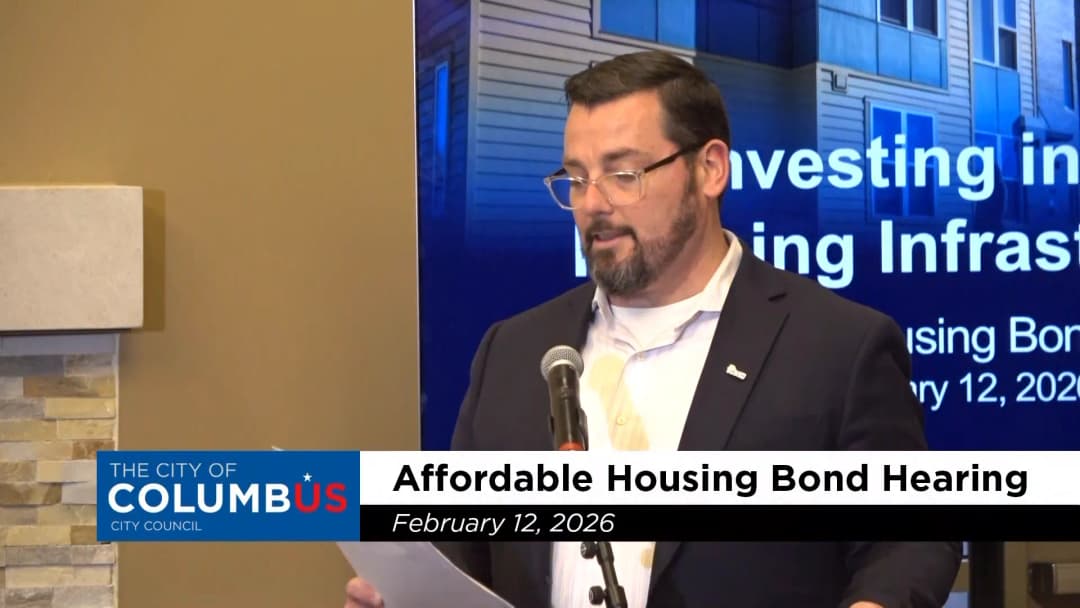
Columbus City Council Affordable Housing Bond Hearing - February 5, 2026

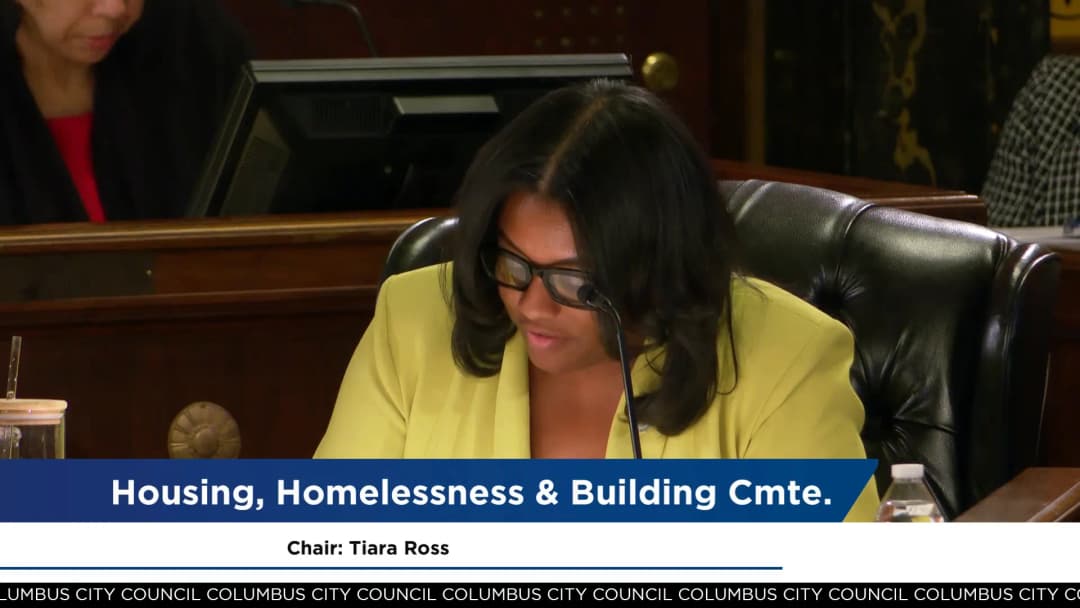
Council President Shannon Hardin, Housing Chair Tiara Ross, and Councilmember Nick Bankston convened a public hearing to gather community input on the deployment of the $500 million affordable housing bond approved by voters in November 2025. The hearing featured presentations from Deputy Director Aaron Proser (Department of Development), Paul Williams (Center for Public Enterprise), and representatives from housing advocacy organizations, followed by testimony from residents and stakeholders. The event was hosted at Poindexter Place, a CMHA senior community. Council emphasized that this hearing was the beginning of an ongoing, transparent process. Public Comments & Testimony - Rob Lowenstein (Zoning Chair, Near East Area Commission): Advocated for a clear, rule-based program for bond funds, separate from Ohio Housing Finance Agency timelines, with per-unit caps and support for smaller projects and special-needs housing (e.g., developmentally disabled). - Amanda King (Spatialist): Urged funding for co-housing for single mothers, citing models from other cities that reduce child care costs and increase stability. Highlighted the need for neighborhood-scale "missing middle" projects. - Tisha Lee (Akari Properties, emerging developer): Called for upfront capital (first $50–$100K) for Black and brown developers, stressing equity and wealth-building alongside unit creation. - Vincent Coleman (Columbus Realtors): Supported missing middle housing, ADUs, and starter homes; offered the "Housing Ohio Tools for Development Initiative" as a resource. - Jeff Beam (OCCH): Noted that the low-income housing tax credit market is tightening, and bond dollars can be used to create financial structures that leverage rather than replace other sources. - Ann Bischoff (Starhouse): Requested investment in nonprofit-led developments with wraparound services for youth aging out of homelessness, emphasizing sustainability through rental revenue. - Sue Valillo (ADAMH Board): Stressed dedicating funds for households at or below 30% AMI, paired with supportive services, to prevent chronic homelessness. - Leo Rodriguez (Community Member): Urged a local revolving fund to insulate housing from federal/state changes, and investment in high-opportunity areas to break cycles of poverty. - Kim Sharp (ULI Columbus): Highlighted the alignment of Zone In, LinkUS, and the bond; recommended focusing on transit-oriented development and supporting emerging developers through infrastructure banks. - Mark Dunham (All Inclusive Living): Advocated for housing that integrates adults with disabilities and older adults, using intergenerational models. - Dana Messer (Bronzeville Neighborhood Association): Championed partnerships with churches to develop their land holdings, citing Shiloh Baptist Church’s successful mixed-income project. - Written Testimony: Over 25 written submissions were received and will be shared with council. Discussion Items - Deputy Director Proser’s Presentation: - Columbus has grown 15% in households over 10 years but only 10% in housing stock; rental vacancy dropped from 5% to 3.6% (2014–2024). - $200 million of the $250 million 2019/2022 bonds deployed, leveraging $1.4 billion in total investment. - Results: 6,000+ income-restricted rental units, 300 permanent affordable homeownership opportunities, 700 permanent supportive housing units, $7 million in homeowner repairs. - Proposed framework: (1) Continue core affordable housing investments, (2) Housing stability (emergency shelter, supportive housing), (3) Access to opportunity (land acquisition near transit), (4) Innovation pilot. - Bond sales are planned annually ($50M capacity); first sale likely in 2027. Process includes two Notice of Funding Opportunity (NOFO) rounds per year (expanding to four in future). - Current criteria: applicant must demonstrate ability to deliver income-restricted units, secure other financing, and show capacity to build/operate. - New staff and a housing administrator are being hired to handle the expanded bond and improve transparency. - Paul Williams (Center for Public Enterprise): - Presented revolving loan fund models from Montgomery County, MD ($50M fund, two projects built, capital revolving), Atlanta ($40M AUDC), and Chattanooga ($20M). - These funds invest “first capital in” as subordinate construction loans that revolve after stabilization, enabling mixed-income production without federal credits. - Example: The Laureate at Shady Grove (270 units, 90 affordable at 50–60% AMI) used no tax credits or vouchers. - Risk is lower than grant-based gap financing because loans are repaid; typical revolve period is 3–5 years. - Carlie Booz (AHACO): Emphasized that bonds are one tool; need to pair with zoning reform, land use, and operating supports. Highlighted LinkUS corridor risks and the importance of equitable TOD. Supported YIGBY ordinance and pro bono legal help for faith-based developers. - Ian Labitu (Affordable Housing Trust): Proposed a dedicated revolving homeownership fund to finance land acquisition and construction for shared-equity models (e.g., Community Land Trusts). Fund would supercharge production of for-sale homes by emerging and established developers. - Community Survey Results: Over 500 respondents. Top priorities: deeply affordable housing (35%), addressing homelessness and utility costs (25%), housing near transit/amenities (70%). Key Outcomes - No formal votes were taken. The hearing was informational and intended to begin a community dialogue. - Council committed to a series of follow-up hearings specifically on the bond process and individual framework components. - Housing Chair Ross urged attendees to stay engaged and provided her contact email (Tiara.Ross@columbus.gov) for continued input. - Deputy Director Proser noted that the department will expand NOFO rounds from two to four per year and increase technical assistance for small/emerging developers. - The city will continue to explore innovative models such as revolving loan funds, co-housing, and nonprofit-led development as part of the innovation bucket. - Council President Hardin emphasized the need to advocate at the state level for a fairer share of low-income housing tax credits for central Ohio. - Written testimony and survey analysis will be shared publicly.

AFFORDABLE HOUSING 75% · COMMUNITY ENGAGEMENT 8% · ECONOMIC DEVELOPMENT 4% · PUBLIC ENGAGEMENT 3%
35
JAN 27, 2026 · COLUMBUS, OHIO · CITY COUNCIL
Columbus City Council Meeting - January 27, 2026

The Columbus City Council held its fifth regular meeting of the year on January 27, 2026, beginning at approximately 5:00 PM with opening ceremonies and concluding with adjournment after 10:00 PM. The meeting included tributes, public comments, numerous ordinance approvals, and the establishment of the Yes in God's Backyard pilot program. Consent Calendar - Approved resolutions of expression and consent agenda ordinances from multiple committees (finance, public service, neighborhoods, workforce, health, public safety, housing, public utilities, and rules). The consent agenda included over 60 items covering routine appropriations, contract authorizations, and administrative actions, all passed unanimously. Public Comments & Testimony - George Wilkins (North Linden resident, 20 years) expressed support for ordinance 0005-2026 (TB medication contract with Crosby Drugs) and requested the contract term be extended through 2027 or 2028. - Rick Kitchen (Greater Hilltop Area Commissioner and HOA trustee) opposed the rezoning at 1100 Georgesville Green (3000-2025), citing safety concerns from increased traffic, lack of recent traffic studies, and neighborhood opposition. He urged the council to respect the area commission's disapproval. - Adam Troy (Director of New Salem Baptist Church Foundation) spoke in favor of the Yes in God's Backyard (YIGBY) ordinance, highlighting faith institutions' role in affordable housing and urging streamlined processes for faith-based development. - Johnny Pitts (President, Day Spring Christian CDC) supported YIGBY, noting Day Spring's 30 years and over 1,500 units of affordable housing, and emphasized the need for greater capacity and debt forgiveness. - Rev. John Edgar (Founding pastor, United Methodist Church for All People) supported YIGBY, citing his experience with Habitat for Humanity and Community Development for All People, and mentioned Bethel International United Methodist Church's plans to develop apartments on two acres. - Anna Tekasongo (Assistant Executive Director, Affordable Housing Alliance of Central Ohio) supported YIGBY, noting 85% of Central Ohio residents favor simplified permitting for faith-based affordable housing, and announced a March 4 educational workshop co-hosted with PACT. Discussion Items - Tribute to Former City Auditor Hugh Dorian: Council members and staff celebrated Mr. Dorian's 50+ years of service, emphasizing his integrity, financial stewardship, and impact on the city's infrastructure. A moment of silence was observed. - Rental Registry Hearing: Councilmember Bankston announced the third hearing on the proposed rental registry ordinance on February 19, 2026, at 4:00 PM, with speaker sign-up deadlines and updated draft language available online. - Snow Operations Update: Public Service Director reported on the unprecedented snowstorm: all 4,600 miles of snow plan routes were covered (priority roads multiple times), with contractor and Franklin County Engineer's Office assistance. Reminded residents of sidewalk clearing responsibility. - Water Main Breaks: Deputy Director for Water reported that 70 main line breaks and about as many service line breaks were completed; with 12 crews working, six still needing investigation. Temperatures rising are expected to reduce further breaks. - Recognitions: - Columbus Underground (25th anniversary) – Resolution 0021-2026. - Duane Casares (retirement from Directions for Youth and Family after 33 years) – Resolution 002X-2026. - Judge James Edward Green (retirement from Franklin County Municipal Court after 31 years) – Resolution 0020X-2026. - 8U and 9U Legacy Gators – American Youth Football Division II national champions (2025). - Yes in God's Backyard Pilot Program: Council President Harden introduced ordinance 0245-2026 to streamline approvals for faith-based, educational, and nonprofit organizations to develop affordable housing on land owned as of January 1, 2025. The program provides expedited reviews and no additional costs, requiring CRA affordability standards. Pilot aims to reduce barriers and produce data for future zoning reform. - Rezoning and Variance Hearings: The council considered several rezoning and variance requests, including a controversial rezoning at 1100 Georgesville Green (from LC3 to AR1 for 48-unit apartment development) which was approved despite the Greater Hilltop Area Commission's disapproval. Other rezonings included 5357 Cleveland Avenue, 7825 Flint Road, 2575 West Dublin Granville Road (474 units), and 1981 South High Street (455 units). Key Outcomes - Approved Ordinances: All ordinances on the agenda were passed, including: - Annual lease payments through River South Authority ($4.6 million debt retirement, $1.84 million mobility enterprise). - Automotive parts for fleet management ($2.8 million). - Municipal court building demolition contract modification ($10.99 million). - Sidewalk installations in South Linden, on Wafford/Sharbot/Northtown, and resurfacing/slurry seal of over 100 streets ($1.89 million for sidewalks, $1.83 million for resurfacing). - Speed limit reduction on Parsons Avenue (Whittier to Broad) from 35 to 25 mph – effective 30 days after passage. - East Side Rail Trail design ($100,000 grant from COTA) and Alum Creek Trail Mock Road connector ($3.92 million, construction expected by summer 2027). - Human Resources modernization contract with August 20 ($458,500). - Tuberculosis medication distribution contract with Crosby Drugs ($110,000). - Ryan White Part A HIV care grant contracts ($3.15 million). - Epic Electronic Medical Record single sign-on software contract ($165,903). - Crosswalk nurse health navigation line – no cost to city, expected operational later in 2026. - Safety camera maintenance contract ($285,000). - Police continuing professional training fund ($1.52 million). - Legal counsel contract for lead water line litigation (Edelson PC, no cost). - Debt forgiveness for home loans: Fairview Homes ($1.98M), Level Green Homes ($1.30M), Kingsford Homes ($1.46M), South Side Homes ($2.13M), Joyce Avenue Homes ($1.36M). - Roof replacement program contract with Revere Roofing ($150,000). - Yes in God's Backyard Pilot Program – established ordinance 0245-2026. - Various public utilities contracts and modifications (blueprint permeable pavement, Jackson Pike digester improvements, Southerly upgrades, water meter reading, sewer chemicals, elevator improvements, etc.), totaling over $30 million. - Recycling services regulation for city facilities (effective January 1, 2027). - Municipal income tax code updates to align with state House Bill 96. - Zoning Decisions: Rezonings and variances passed as noted, with the Georgesville Green project approved despite community opposition (vote: 8-1 with Councilmember Green dissenting on the variance). Conditions included 30% of units at 80% AMI and a commitment to site plan with buffering. - Next Steps: The rental registry hearing scheduled for February 19, 2026. YIGBY pilot implementation rulemaking to follow. Parsons Avenue speed reduction signage to be installed within 30 days.

PROCEDURAL 17% · AFFORDABLE HOUSING 14% · ZONING AND LAND USE 10% · YOUTH PROGRAMS 8%
36
JAN 13, 2026 · COLUMBUS, OHIO · CITY COUNCIL
Columbus City Council Meeting Summary - January 13, 2026

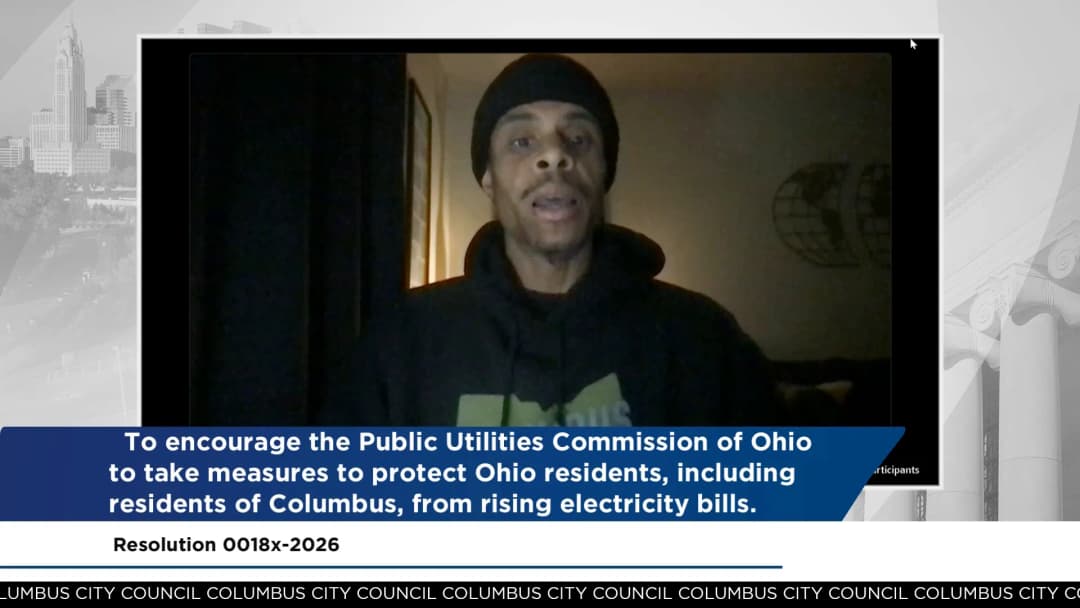
This virtual meeting of the Columbus City Council convened amidst a historic snow emergency, featuring a prayer from Imam Horsat Noah, public safety updates, and the adoption of significant legislation regarding the city's budget, utility rates, and future growth strategy. The council acknowledged the city-wide level two emergency status, thanked emergency responders, and postponed several resolutions to the February 9th in-person meeting to allow for public participation and safety. Consent Calendar - Ordinance 2939-2025 and 2940-2025: Appropriated funds for city other funds and selected other funds (including debt service and tax incentive funds) for fiscal year 2026; Passed. - Ordinance 0028-2026: Authorized a $1,400,000 appropriation from the debt retirement fund to the mobility subfund as a backstop for the Franklin County Convention Facility Authority; Passed. - Ordinance 0234-2026: Authorized a contract with Greater Columbus Convention and Visitor Bureau (Experience Columbus) for $473,600 for destination marketing; Passed. - Ordinance 3305-2025: Authorized a 10-year, 75% tax abatement for C5 Columbus SW Building 1, LLC, to invest $31,260,600 and create 48 jobs; Passed. - Ordinance 3306-2025: Authorized a 10-year, 75% tax abatement for C5 Columbus SW Building 2, LLC, to invest $15,724,800 and create 25 jobs; Passed. - Ordinance 3533-2025: Authorized $357,038 from the Federal Transportation Grant Fund for a "quick build" safety toolkit; Passed. - Ordinance 0036-2026: Appropriated $3,312,787.59 for the Blossom Field Boulevard roadway improvement project in the Vision Zero high-injury network; Passed. - Ordinance 0097-2026: Appropriated $8,250,000 from the municipal motor vehicle license tax fund for Public Service infrastructure; Passed. - Ordinance 3467-2025: Authorized a $30,000 settlement for the lawsuit Ryan Pitts v. Emily Geyer et al.; Passed. - Ordinance 0020-2026: Appropriated $4,921,832.27 from the Municipal Court special funds for anticipated expenses; Passed. - Ordinance 0056-2026: Authorized $350,000 for the home roof replacement program, waiving competitive bidding to expedite repairs for naturally occurring affordable housing; Passed. - Ordinance 0031-2026: Authorized $3,400,000 for the purchase of water treatment chemicals; Passed. - Ordinance 0064-2026: Amended city code to pilot a summer recess shift from August to July for 2026; Passed. Public Comments & Testimony - Imam Horsat Noah (Abakar A Sadiq Islamic Center): Delivered an opening prayer asking for clarity in decision-making, compassion in leadership, and protection for vulnerable residents. - Sarah Lewis (American Heart Association): Expressed strong support for Resolution 1X-2026, urging residents to recognize that cardiovascular disease is the number one killer of women and to seek medical attention for symptoms often dismissed in women. - Max Dixon (Survivor & Board President, Columbus Fashion Council): Shared a personal testimony of nearly dying from congestive heart failure at age 39; emphasized the critical need for women to advocate for themselves when symptoms are ignored. - Annalise Raka (Ohio Environmental Council Action Fund): Expressed full support for Resolution 0018X-2026, arguing that residents are unfairly asked to pay more for an unreliable energy system and urging a pause on further rate increases until 2027. - Quasi Lowe (Co-founder, Columbus Stand Up): Explicitly framed Resolution 0018X-2026 as a moral imperative to resist an "exploitive monopoly," stating that the resolution must not just be a moratorium in spirit but a long-term commitment to holding the PUCO and AEP accountable. - Carly Booz (Affordable Housing Alliance of Central Ohio): Expressed support for the Columbus Growth Strategy, highlighting its ability to expand affordable housing through missing-middle policies and strip mall revitalization. - Kathy Green (Columbus Southside Area Commission): Expressed support for the Columbus Growth Strategy, endorsing increased density on secondary corridors and the evolution of manufacturing parcels into mixed-use areas. - Pat Hamill (Northland Community Council): Expressed support for the Columbus Growth Strategy, emphasizing the need for citywide land use policy to guide responsible development. - Deborah Link (Columbus Northwest Resident): Expressed strong opposition to the Columbus Growth Strategy, stating that the proposed zoning changes lack a community mandate, pose a risk of displacement, and threaten 70 years of zoning protections. Discussion Items - Snow Emergency Response: Council President Harden and Councilmember Padilla detailed the historic snowstorm (10-14 inches), the lifting of the level three emergency, and the current level two status. Director James Young reported 98% service on Priority One arterials, 92% on collectors, and 24% on Priority Three residential streets, noting the ongoing difficulty of hauling snow in downtown. - Rental Registry Hearings: Councilmember Bankston announced three upcoming budget hearings for 2026 and a third hearing on the proposed rental registry ordinance scheduled for February 19th, with virtual testimony options available. - Budget Hearings: Announcements were made regarding virtual budget hearings for Public Safety (Jan 27), Public Utilities (Jan 28), and Neighborhoods/Recreation (Jan 29), subject to road conditions. - Columbus Growth Strategy (Zoning): President Pro Tem Dorns Green provided a detailed presentation on the strategy adopted under the Columbus Zone In project. The presenter noted that over 19,000 changes were made to the land use map based on community feedback (65-75% support). The strategy aims to guide growth toward affordability, sustainability, and equity, transitioning from a 1950s zoning code to a modern framework. - Utility Rates: Councilmember Weish led a discussion on rising electricity costs for AEP customers, with speakers highlighting the disparity between shareholder profits and consumer costs, and the disproportionate impact of data centers on residential rates. Key Outcomes - Passed Resolution 1X-2026: Designated February 6, 2026, as National Wear Red Day and February as American Heart Month, recognizing cardiovascular disease as the leading cause of death for women. - Passed Resolution 0018X-2026: Urged the Public Utilities Commission of Ohio to implement no rate increases for AEP Ohio in 2026 and to extend disconnection protections. - Passed Resolution 001X-2025 (Amended): Formally adopted the Columbus Growth Strategy as an amendment to the citywide planning policies (C2P3), establishing a new land use map and policy framework to guide future zoning (Zone In Phase 2) and capital planning. - Passed Ordinances: All budget-related, economic development, public works, and settlement ordinances listed in the consent calendar and second reading sections were passed. - Adjournment: The regular meeting was adjourned, followed immediately by the zoning committee meeting, which was also adjourned after passing two rezoning ordinances (0041, 0042) and a variance (0142). - Postponements: Resolutions recognizing the 25th anniversary of Columbus Underground, Duane Casares (retirement), and Judge James Edward Green (retirement) were postponed to February 9, 2026. Resolution 0234-2026 was removed from the consent calendar for discussion before passage.

ZONING AND LAND USE 25% · PROCEDURAL 16% · PUBLIC SAFETY 15% · PUBLIC HEALTH 8%
37
JAN 5, 2026 · COLUMBUS, OHIO · CITY COUNCIL
Columbus City Council Meeting Summary - January 5, 2026

The Columbus City Council convened its second regular meeting of 2026 to address critical budgeting matters regarding the Columbus Promise, review the Columbus Growth Strategy (Ordinance 134-2026) for first reading, and process multiple ordinances related to infrastructure, public safety, and sustainability. The meeting featured significant deliberation on land use planning, with area commissions expressing varied levels of concern regarding community engagement and the shift from neighborhood-specific plans to a holistic citywide strategy. Consent Calendar - Ordinances Approved: 140-2026 (Finance), 3304-2025, 3361-2025, 3378-2025 (Workforce), 3399-2025 (Health/Human Services), 3197/3437-2025 (Public Safety), 48/49/62/65-2026 (Housing), 2897/3303-2025 (Utilities), and various appointment resolutions (A08-13, 180-184). Councilmember Daye abstained from 3304-2025. - Motion: Passed unanimously (except Councilmember Daye's abstention) to approve the consent agenda items. Public Comments & Testimony - Nate Wilkins (Resident): Expressed strong support for the Columbus Growth Strategy and the vision of growing the Cleveland Avenue/Linden area, specifically calling for high-density retail, restaurants, housing, and improved accessibility to job and family services via the bus line. He advocated against lowering density for high-rises and noted the need for grocery stores in the area. - Ben Keith (Zoning Committee Chair, North London Area Commission): Expressed general support for the strategy but voiced concern that specific requests were ignored. He highlighted opposition to the removal of the principle requiring high-intensity uses to minimize impacts on adjacent lower-intensity uses. He requested amendments to include a 60-day review period for significant developments, a density increase in a specific zone near the Ohio State Fairgrounds, and tighter noise/light pollution guidelines. - Michael Wyman (Commissioner, Clintonville Area Commission): Expressed strong opposition to Ordinance 134-2026. He argued the Columbus Growth Strategy is a "cookie-cutter" approach that unfairly supersedes the locally developed Clintonville Area Plan without adequate consideration of community nuance or sufficient time for review. He noted the plan was dropped on the commission with an ultimatum response window and expressed disappointment over the lack of tree and green space conservation policies. - Louis Teba (Columbus Growth Strategy Lead) & Director Stevens (Department of Development): Responded to the comments by defending the process and asserting that over 80 presentations, 28 pop-up events, and 65-75% support in surveys indicate robust engagement. They stated that while they acknowledge the feedback, the shift to a holistic, citywide land use map is intended to create equity and predictability compared to outdated, disparate neighborhood plans (some 30 years old). They clarified that area plans are not being eliminated but will be superseded only by land use map conflicts, and that detailed zoning (the "nitty-gritty") will follow in a subsequent 2026 phase with further community engagement. Discussion Items - Columbus Growth Strategy (Ordinance 134-2026): Council engaged in a detailed discussion regarding the transition from neighborhood-specific plans to a comprehensive citywide land use strategy. Councilmember Banks clarified that the Linden, Hilltop, and Eastland plans are comprehensive transformation plans focusing on social determinants and economic development rather than traditional land use, and thus will not be superseded by the new land use map. Council President Harden and others emphasized the need for meaningful two-way dialogue, acknowledging that while the current draft received significant survey data, the timeline and feedback incorporation need to remain a focus for the upcoming zoning phase. - 2026 Operating Budget: The Council held a special amendment to Ordinance 2938-2025 (General Fund Budget) to allocate $2 million to the "Columbus Promise" program. Councilmembers Bankston and Harden argued this was necessary to provide certainty to students and families during the critical FAFSA and college application window, reaffirming the city's commitment to nearly 1,300 scholars. Councilmember Ross de Padilla emphasized the urgency of this funding for first-generation college students. - Infrastructure & Safety: Discussed the North Market Fire Alarm Upgrade ($477,300) and the State Route 161 Phase Two project (acquiring 20-21 properties for roundabouts). Councilmember Dorns questioned the North Market maintenance costs given prior assertions that the Merchant Tower would cover them; Director Stevens clarified the maintenance fund is contingent on the hotel's completion and tax revenue generation, which is expected in 2027. - Recognition: Councilmember De Akauri honored outgoing Human Resources Director Chris Moses for his service. The Council also recognized Councilmember Weish's birthday. Key Outcomes - Ordinance 134-2026 (Columbus Growth Strategy): No vote taken; the ordinance was held for first reading to allow for continued deliberation before a final vote. - Ordinance 2938-2025 (General Fund Budget): Amended to include $2 million for the Columbus Promise and referred back to the Finance and Governance Committee as amended. - Ordinances 2939-2025 & 2940-2025 (Other Funds): Postponed to the January 26, 2026, council meeting due to their non-controversial nature and budgetary efficiency. - Ordinance 3410-2025 (North Market Fire Alarm): Passed. - Public Service Ordinances: Ordinance 3308-2025 (Roadway Maintenance), 3455-2025 (Mount Vernon Avenue), and 3497-2025 (State Route 161 Roundabouts) passed. - Housing Ordinances: Ordinance 0066-2026 (Resilient Housing Initiative software contract) passed. - Public Utilities Ordinances: Ordinance 3196-2025 (Water Contract), 3242-2025 (Food Waste Truck), 3291-2025 (Water Line Inspection), 3334-2025 (Water Line Construction), and 3352-2025 (Water Line Inspection) all passed. - MOK Day: Council confirmed they will attend the MLK Day march and program scheduled for the following Monday, January 19, 2026, to ensure a presence for the community event.

ZONING AND LAND USE 28% · PROCEDURAL 14% · COMMUNITY ENGAGEMENT 14% · BUDGET EQUITY ANALYSIS 11%
38
JAN 5, 2026 · COLUMBUS, OHIO · CITY COUNCIL
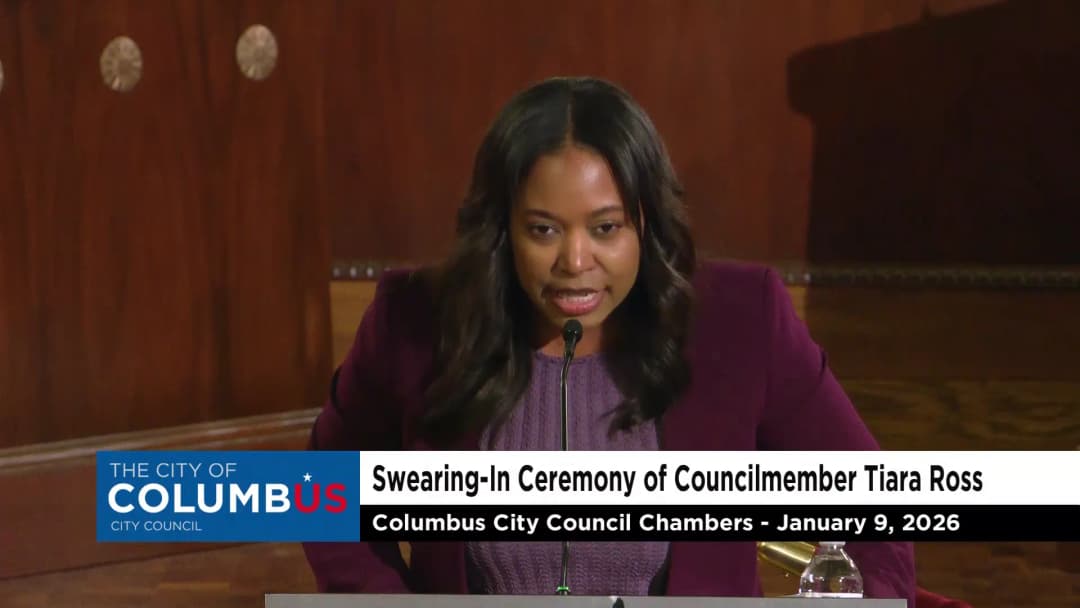
Swearing-In of Councilmember Tierra Ross - Jan 5, 2026

This special session of the Columbus City Council, held on January 5, 2026, was dedicated exclusively to the formal swearing-in of Tierra Ross as the newest member of the Council representing District 7. Translated by Council President Harden as a "People's Living Room" event, the ceremony emphasized continuity of service, faith, and a deep commitment to social justice. The gathering celebrated Ross's transition from Assistant City Attorney to elected official, featuring tributes from mentor City Attorney Zach Klein, former colleagues, and family, all underscoring her decade of dedicated public service. Following the musical performances of the national and black national anthems, an opening prayer, and testimonials highlighting her resilience and work ethic, Ross was administered the oath of office by Judge Laurel Beatty Blunt, officially commencing her term. Discussion Items - Opening Remarks & Context: Council President Harden described the event as a moment of "continuity of service" and highlighted Ross's history of quiet, unwavering advocacy for justice and the voiceless, citing her faith-based leadership style. - Tribute by City Attorney Zach Klein: Klein expressed full support for Ross, noting he invited her out of private practice in 2017 to build a team. He stated her love for Columbus is evident in her actions, specifically citing her presence during the Christmas Day water pipe bursts and her real-time assistance at Colonial Village. He expressed that while he will miss her, he believes in her and is proud of her. - Tribute by Dr. Olivia Nathan: Ross's sister expressed unconditional support and affirmed that Ross's leadership is rooted in a lifelong character of truth-telling and protection. She stated that she witnessed Ross's dedication to justice as a child and affirmed her calling to the role. She noted that while there were smear attempts during the campaign, Ross remained faithful and grounded. - Testimony by Steve Dunbar: A former colleague from the City Attorney's office expressed admiration for Ross's work ethic, distinguishing her from others who claim to "want to help people" by detailing her extreme dedication. He described her actions, such as camping on lawyers' couches to work overnight, spending hours with displaced tenants from Sawyer Towers, and traveling to Wedgwood in 48 hours without sleep for a backpack event. He urged the audience to match her level of service. - Testimony by Steve Dunbar (Continued): Dunbar acknowledged their personal bond and the bittersweet nature of their changing relationship as he left the firm, noting that Ross was the one who took his place. He asserted that Ross represents a model of service that few others emulate. - Testimony by City Attorney Zach Klein (Mentorship): Klein reiterated his praise for Ross's understanding of public policy meeting the law, noting she knows the city "inside and out." - Tribute by a Speaking Colleague/Council Member: A speaker (unnamed in the transcript but addressing Ross) expressed support for Ross's leadership style, highlighting her presence when tenants were displaced from Sawyer Towers and her approach to public safety that centers people rather than force. They referenced Dr. Janelle Green Smith and the Crown Act, stating that justice does not move forward because it is convenient. They charged Ross to lead with courage, humility, and the willingness to speak uncomfortable truths. - Swearing-In Ceremony: Judge Laurel Beatty Blunt administered the oath of office, reciting the standard constitutional requirements to support the charter and ordinances, and to discharge duties honestly, impartially, and to the best of one's ability. Ross recited the oath with the addition of "So help me God." - Acceptance Remarks by Councilmember Tierra Ross: Ross expressed profound gratitude for the community and her mentors. She specifically acknowledged City Attorney Zach Klein for his mentorship, Steve Dunbar for his support over nearly a decade, Prosecutor Sheila Farb (referred to as Shayla) for her trust and sisterhood, and her sister Dr. Olivia Nathan for her steadfast friendship. She thanked her grandparents, mother, and the residents of Columbus. She stated a clear position that the city needs leaders bold enough to name injustice, unafraid to denounce inhumane stewardship of human lives, and willing to get "hands dirty" in the work of community. She vowed to ensure the promise of Columbus becomes a lived reality with access to healthcare, quality education, and safe streets for all. Key Outcomes - Administrative Action: Tierra Ross was officially sworn in as the Member of Columbus City Council for District 7, effective immediately on January 5, 2026. - Oath Recited: Ross affirmed support for the City of Columbus Charter and ordinances, and committed to faithfully, honestly, and impartially discharge the duties of the office. - Ceremonial Completion: The meeting concluded with a benediction by Bishop Jerome Ross (Ross's grandfather), citing the promise that the righteous shall be like a tree planted by rivers of water, bearing fruit and prospering. Public Comments & Testimony - Faith Community & Elected Officials: A standing ovation was given to a broad array of faith leaders (including Bishops Jerome Ross and Timothy Clark), elected officials (Mayor Andrew Ginther, Congresswoman Joyce Beatty), and City Council colleagues to honor the occasion. No opposing testimony was recorded; the session was characterized by unanimous celebration and professional commendation. - Community Leaders: Neighborhood and area commission leaders were acknowledged and asked to stand, reinforcing the community's support for the incoming Councilmember. - Musical Performance: The public (audience) participated in singing the national anthem, the Black National Anthem (performed by Miss Lika Lisa Slocum), and provided vocal support throughout the prayer and benediction. No specific policy objections or public comments regarding city business were made, as the event was a singular ceremonial occasion.

COMMUNITY ENGAGEMENT 37% · PERSONNEL MATTERS 31% · PROCEDURAL 20% · PUBLIC ENGAGEMENT 8%
39
DEC 9, 2025 · COLUMBUS, OHIO · CITY COUNCIL
Columbus City Council Hearing on Alternative Crisis Response - Dec 9, 2025

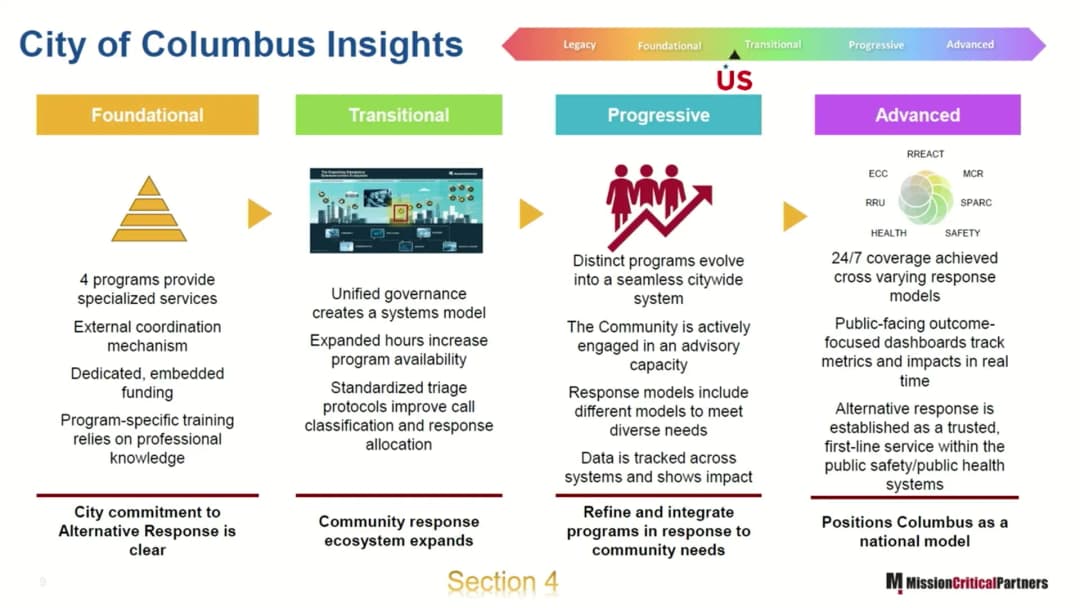
On December 9, 2025, the Columbus City Council convened a joint hearing of the Rules, Public Safety, and Health & Human Services & Equity committees to review the Mission Critical Partners report on the city's alternative crisis response programs. Council President Catherine Parr Harden and Co-Chairs Councilmembers Reamy and Green opened the session by acknowledging the existing portfolio of programs (Right Response Unit, Mobile Crisis Response, React, and Spark) while emphasizing the need for a more integrated, system-wide approach. The hearing featured presentations from Mission Critical Partners on the current state of services versus the desired "advanced" continuum, alongside public testimony from researchers and community advocates calling for immediate implementation of a civilian response unit and stronger community oversight. Consent Calendar - No specific items listed as routine routine approvals in the provided transcript text. Public Comments & Testimony - Dr. Leah Beavis (Professor, Ohio State University): Expressed strong support for the expansion of alternative response, citing data showing MCR reduces arrests and jail time for high-severity cases and lowers repeat calls for low-severity cases. Position: A new civilian crisis response pilot must be sizable (at least five teams, similar to MCR) to be effective and statistically evaluable; recommended dispatch to nonviolent psychiatric acute cases. - Deborah Seltzer (Public Advocate): Expressed full support for all recommendations to reduce harm, specifically urging the early establishment of the community advisory council. Position: Argued that without robust community voice and funding for non-emergency prevention (housing, schools, mental health), harm will continue; emphasized the need to remove barriers for community members to participate in the process. - Local 67 (Firefighters Union), Columbus Safety Collective, and Virginia Vote (Retired Social Worker): Submitted written testimony entering the record in support of alternative crisis response initiatives. Discussion Items - Mission Critical Partners Presentation: - Current State: Identified that Columbus currently sits at the "upper foundational" stage of the alternative response continuum. While individual programs are strong, the city lacks an integrated system with unified coordination. - Program Analysis: - Right Response Unit (RRU): Noted as foundational but with limited collaboration with other teams and restricted weekend hours. - Mobile Crisis Response (MCR): Identified as a "transitional" model with 5 teams covering only 9% of eligible mental health calls. Staffing limitations prevent social workers from responding independently without an officer. - React & Spark: Housed under Fire; praised for internal coordination but noted for limited hours (non-24/7) and reliance on staff with deep tacit knowledge that creates retention risks. - Key Gaps: Highlighted fragmented authority, lack of cross-program data sharing, and a "free range" dispatching model that limits coverage efficiency. Stated that 33-40% of 911 calls are appropriate for alternative response. - Recommendations: - Civilian Response Unit (CRU): Recommended establishing a non-armed, non-uniformed unit staffed by clinicians and peer specialists, suggested to start as a $2.5 million pilot. - Centralized Structure: Proposed a "braided coordinating body" to unify strategy, leading to a permanent municipal entity co-equal to police and fire. - Advisory Panel: Recommended creating a permanent Alternative Response Advisory Panel (blending police review board independence with chief advisory structure) to foster trust and community input. - Dispatch Reform: Suggested coding calls better and assigning dedicated dispatchers for alternative teams. - Cost: Noted that 80-90% of calls coded for MCR are currently handled by police; proposed phasing in the CRU to manage costs and risk. Key Outcomes - Report Acceptance: The Council accepted the Mission Critical Partners report (200 pages) as a roadmap for future action, with Council President Harden noting she will review the full text over the holiday break. - Strategic Direction: Council members expressed agreement on the necessity of a centralized administrative body and the implementation of a $2.5 million pilot for a non-armed Civilian Response Unit to be scaled up over time. - Next Steps: Administration agreed to develop a "Concept of Operations" document and a staffing/phase-in plan, targeting delivery in January 2026. - Budget Integration: Council President Harden directed that the budget hearings (starting immediately after the meeting) should explore the efficiencies and cost savings of these alternatives to address fiscal constraints. - Data & Evaluation: Agreement that any new civilian units must maintain public data sharing protocols for evaluation, with Councilmembers Green expressing concern about current data disparities (e.g., high volume of MCR calls in Northland) pending further inquiry.

PUBLIC SAFETY 54% · COMMUNITY ENGAGEMENT 21% · TECHNOLOGY AND INNOVATION 8% · PUBLIC HEALTH 5%
40
DEC 8, 2025 · COLUMBUS, OHIO · CITY COUNCIL
Columbus City Council Reorganization Meeting – December 15, 2025

Date Discrepancy Note: While the prompt specified a date of December 8, 2025, the transcript refers to the meeting as "Regular Meeting Number One" held on December 15, 2025. The summary below reflects the date explicitly stated in the source text. The Columbus City Council convened for its annual reorganization to elect permanent leadership, appoint key city officials, and assign committee chairs and vice-chairs. Following the election of Councilmember Shannon Harden as President and Rob Dorns as President Pro Tempore, the Council proceeded with unanimous appointments of city staff and finalized committee structures for 2026 under the new leadership. Consent Calendar - Motion to Adjourn Meeting 61 (Dec 15): A motion was made and passed to formally adjourn the previous meeting number 61. - Motion to Dispense with Journal Readings: Council voted unanimously to waive the formal reading of the previous meeting's journal. Public Comments & Testimony - No public comments or testimony were recorded in the provided transcript. The session focused exclusively on organizational elections and appointments. Discussion Items - Election of Officers: - Councilmember Tierra Ross was nominated and elected as a new council member to fill the seat previously held by Sheila Favor and Otto Beatty III. - Council President: Councilmember Shannon Harden was nominated by the existing President and elected unanimously. Harden expressed a commitment to "defederalization" where cities lead community needs, citing housing and job creation as priorities. - President Pro Tempore: Councilmember Rob Dorns was nominated and elected unanimously. - Temporary President: Toya Johnson was appointed as the temporary president solely for the purpose of facilitating the presidential election. - Key Appointments: - City Clerk: Toya Johnson was appointed effective January 5, 2026, with unanimous support. - City Treasurer: Tyler Brown and Talia Brown were appointed as City Treasurer effective January 5, 2026, with unanimous support. - Committee Assignments and Structure Changes (2026): - Housing, Homelessness and Building Committee: Chair Tierra Ross, Vice Chair Shannon Harden. President Harden stated, "Housing continues to be one of my strongest policy priorities," and she intends to remain highly active while passing the chair role to Ross. - Public Safety and Criminal Justice Committee: Chair Emanuel Reamy, Vice Chair Tierra Ross. Ross was assigned this dual leadership role. - Neighborhoods, Recreation and Parks Committee: Chair Nancy Day Akawer, Vice Chair Christopher Weiss. - Public Service and Transportation Committee: Chair Lord S. Barosa de Padilla, Vice Chair Nancy Day Akawer. - Public Utilities and Sustainability Committee: Chair Christopher Weiss, Vice Chair Emanuel Reamy. - Rules and Policy Committee: Chair Shannon Harden, Vice Chair Rob Dorns. - Workforce Education and Labor Committee: Chair Rob Dorns, Vice Chair Melissa Green. - Zoning Committee: Chair Rob Dorns, Vice Chair Shannon Harden. - Health and Human Service and Equity Committee: Lord S. Barosa de Padilla was assigned as Vice Chair (noted by President Harden as a minor adjustment). - Leadership Remarks: - President Harden welcomed new member Tierra Ross, acknowledging the "big shoes" to fill following Sheila Favor's election as county prosecutor. - Harden described the current era as a time of "defederalization," emphasizing the city's role in supporting families and the "least of these" as the federal government steps back. - President Harden confirmed she will step down as Chair of the Housing committee to serve as Vice Chair while maintaining active support for key initiatives like "Yes In God's Backyard." Key Outcomes - Elections Completed: - President: Shannon Harden (Unanimous) - President Pro Tempore: Rob Dorns (Unanimous) - Appointments Approved (Effective Jan 5, 2026): - Toya Johnson: City Clerk (Unanimous) - Tyler Brown & Talia Brown: City Treasurer (Unanimous) - Committee Leadership Finalized: All 8 standing committees assigned with new chairs and vice-chairs as detailed in the Discussion Items. - Adjournment: Meeting adjourned unanimously following a vote by the clerk.

PROCEDURAL 50% · PERSONNEL MATTERS 37% · AFFORDABLE HOUSING 13%
OPENPUBLICA · PUBLIC MEETING INDEXUPDATED DAILY · openpublica.com