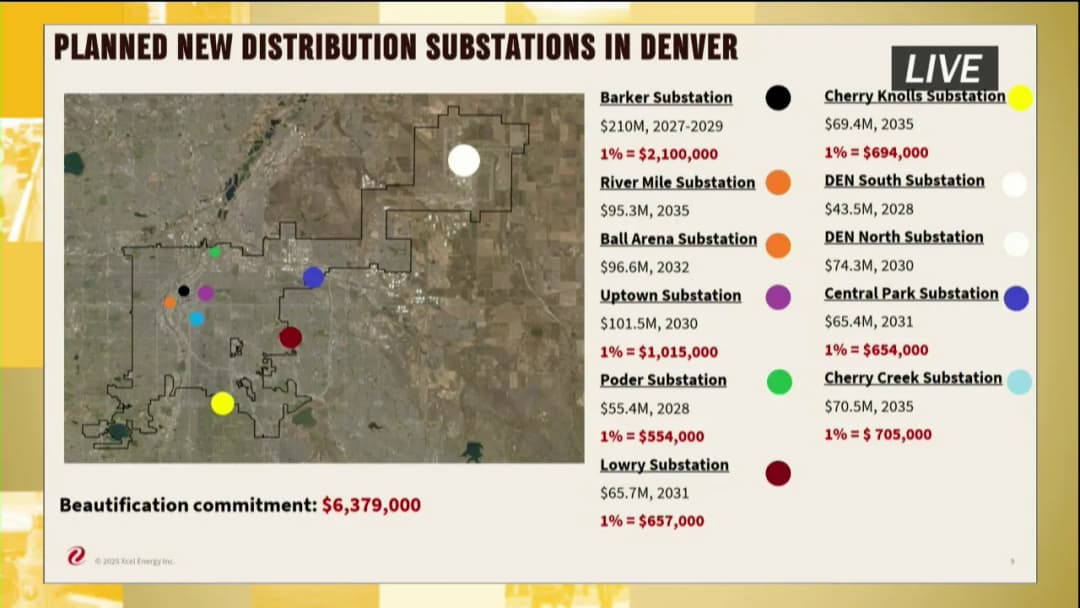
The Governance and Intergovernmental Relations Committee of the Denver City Council met on Tuesday, June 30, 2026, at 10:30 AM to consider several action items, including a package of agreements with Xcel Energy (a 20-year franchise, an energy partnership agreement, and an airport operating agreement) and two bills related to amending the city's budget and appropriation process, both of which would be referred to voters in the November 3, 2026 general election. The committee also approved seven consent items, including appointments to the Denver Community Corrections Board and the Denver American Indian Commission. Consent Calendar - Council Bill 26-0935 – Reappointment of Blake Renner to the Denver Community Corrections Board for a term through 6-30-2030. - Council Bill 26-0936 – Appointment of Jennifer Lobato to the Denver Community Corrections Board through 6-30-2030. - Council Bill 26-0937 – Appointment of Monique Hudley-Taylor to the Denver Community Corrections Board through 6-30-2030. - Council Resolution 26-0938 – Appointment of Nicole Monroe to the Denver Community Corrections Board through 6-30-2030. - Council Bill 26-0939 – Reappointment of Scott Mangino to the Denver Community Corrections Board through 6-30-2030. - Council Resolution 26-0940 – Appointment of Starlene Naranjo to the Denver American Indian Commission from 7-03-2026 through 7-03-2029. - Council Resolution 26-0941 – Amendment of a contract with LINEBARGER GOGGAN BLAIR & SAMPSON, LLP to extend the end date to 8-31-2027 for legal services related to debt collection for parking and photo citation enforcement, with no change to contract capacity. All consent items were approved without discussion. Public Comments & Testimony Seven speakers signed up for public comment, and two additional speakers were accommodated. Key positions: - Jeremy Ross (IBEW Local 111 and working group member): Expressed support for the franchise and companion agreement, noting that labor concerns were heard and met. - Jose Obaya (Xcel Energy employee): Stated support for the franchise agreement, emphasizing safe and efficient access to public rights-of-way. - Joseph Lopez (Servicios de la Raza): Supported the agreement, highlighting Xcel Energy's partnership with his organization on safety and community outreach, particularly for hard-to-reach communities. - Christy Kibler (CEO, Lupus Colorado): Supported the franchise agreement, noting her organization's partnership with Xcel Energy and Energy Outreach Colorado to provide bill assistance; her small organization distributed $280,000 in assistance to 467 Denver families since October. - Adair Andre (working group member): Urged support for referral to the ballot, highlighting $5 million in shareholder investments over time for affordability, energy navigators, a public dashboard, and pilot projects such as the downtown ambient loop and heat pump rates. - Dominique Gomez (Deputy Director, Colorado Energy Office; also Denver Board of Water Commissioners): Supported the franchise, citing decarbonization, affordability, and the relocation benefits of $3 billion over 20 years for major public works (Denver Water, Airport, RTD). Also noted that Xcel Energy indicated it would continue a long-term agreement regarding water releases from the Shoshone plant. - Kate McKenna (CEO, Ballpark General Improvement District): Expressed strong support, noting that Xcel's community engagement is more substantive than other energy companies she has worked with; highlighted the 1% (minimum of $6.3 million) substation beautification commitment and a fully funded green infrastructure project on 20th Street. - Jeff Ackerman (Together Colorado, working group): Praised the work but urged consideration of inflation adjustments for the $125,000 annual contribution and deeper community engagement to build a genuine long-term relationship. - Keith Meyer (INC, working group): Thanked the city and Xcel for listening to the working group, particularly on community engagement and adding substation beautification to the agreement. Discussion Items Xcel Energy Franchise and Partnership Agreements (Council Bills 26-0970, 26-0973, 26-0974) City staff (Dominic Reno, Deputy COO; Cindy Patton; Johnny Rogers, Deputy Executive Director of Climate Action, Sustainability and Resiliency) and Xcel Energy representatives (Holly Velasquez Horvath, Iffy Jennings, Grace Lopez Ramirez) presented the three-bill package: - Franchise Agreement (26-0970): A 20-year franchise, to be referred to voters on November 3, 2026. Financial benefits include $34 million in annual franchise fees to the general fund, payment of utility relocation costs for city and other governmental projects (estimated $3 billion over 20 years), and a 1% undergrounding fee ($10 million per year). Non-financial benefits include council retaining legislative authority over Xcel operations, requiring individual negotiations for utility facilities on non-right-of-way city property, and a stronger voice at the Public Utilities Commission (PUC). - Energy Partnership Agreement (26-0973): A companion agreement outlining shareholder contributions and commitments: - $2.5 million one-time shareholder donation in 2027 for utility bill payment assistance. - $125,000 annually from shareholders for income-qualified energy affordability programs (Denver-specific navigators). - $250,000 annually in shareholder dollars to backfill any state income-qualified energy assistance shortfall in Denver. - $2 million per year carved from franchise fees for carbon reduction and energy programs. - Minimum 1% of substation construction budgets (estimated $6.3 million total) for neighborhood-compatible design (e.g., facades, landscaping). - A city-hosted public dashboard for transparency, five-year evaluations, and a community advisory group similar to the working group. - Commitments to pilot projects, a heat pump rate (to be filed with PUC by August 14, 2026), and the downtown ambient loop district thermal network application. - DEN Operating Agreement (26-0974): Operating agreement for utility services at Denver International Airport, in Council District 11. Budget Charter Amendment (Council Bills 26-0864 and 26-0867) These bills, presented at a prior meeting, propose a charter amendment to adjust the city's budget and appropriation process, with a companion ordinance adding procedures for the Mayor and City Council to consider budget changes and requiring a community engagement process for a two-year budget term. Both would be referred to voters on November 3, 2026. Council Questions and Discussion: - Several council members (Alvidrez, Kashmann, Gilmore, Romero Campbell, Flynn, Gonzales-Gutierrez, Lewis) raised concerns about inflation adjustments for the $125,000 annual contribution over 20 years. Xcel's Holly Velasquez Horvath acknowledged the request and indicated willingness to discuss an inflation escalator with the company. - Councilwoman Gilmore questioned the equity of substation beautification dollars; most future substations are in other districts, not District 11. She requested a map of planned substations (provided). - Councilwoman Romero Campbell asked about metrics for the five-year evaluation (affordability, reliability, decarbonization) and community engagement oversight. Staff noted that proposed community advisors would develop detailed metrics. - Councilman Flynn inquired about the $2.5 million lump sum—whether it must be used for bill payment assistance only (as stated in the agreement) and how it would be conserved over 20 years. Staff confirmed it is restricted to bill payment assistance but emphasized strategic disbursement; the $250,000 annual backstop is separate. - Councilwoman Alvidrez asked about the reporting dashboard; staff described it as publicly tracking key priorities, pilots, dollars, and outcomes. - Chair Sawyer requested clarification on beautification for existing substations (e.g., the Leedsdale substation in District 5). Holly Velasquez Horvath committed to identifying upgrade plans and possible beautification funding for Leedsdale and the University substation, and to provide that answer before the full council vote. - A question about municipalization (like Boulder) was answered: Boulder’s attempted purchase (70,000 meters, 4 substations) was estimated at $460 million; Denver (330,000 meters, 11 substations) would cost roughly $4 to $5 billion. Key Outcomes - Xcel Energy Franchise Package (26-0970, 26-0973, 26-0974): Approved by the committee for filing to the full council on a 5-0 vote (voting members: Flynn, Gilmore, Gonzales-Gutierrez, Kashmann, Sawyer; Sandoval and Torres absent). The package will be referred to the ballot if approved by full council by the August 3, 2026 deadline. - Budget Charter Amendment Package (26-0864, 26-0867): Approved for filing on a 4-1 vote (Aye: Gilmore, Gonzales-Gutierrez, Kashmann, Sawyer; Nay: Flynn; Sandoval and Torres absent). Flynn voted against. - Next Steps: The full City Council will consider both packages. The Xcel franchise must be referred to the ballot by August 3, 2026, for the November 3, 2026 special municipal election. If approved by voters, the franchise will run through December 31, 2046.
Public Meetings - Denver, Colorado
Public Meetings - Denver, ColoradoThe Mayor and Denver City Council held their weekly joint meeting on June 30, 2026, to receive quarterly updates on the Vibrant Denver bond program and the Elevate and Rise bond programs. The meeting also included opening announcements from council members regarding community events, personal news, and condolences. Opening Announcements - Councilman Washman expressed his heart for those affected by wildflower fires across Colorado and for firefighters lost over the weekend. Council President Pro Tem Routin added a note about poor air quality and reminded residents to wear masks if needed, and shared a personal privilege announcement about her son’s wedding on July 4, 2026, as well as the passing of community member Bruce Basket. - Councilman Watson wished his mother a happy birthday and promoted the Park Hill parade on July 4, 2026. Councilman Cashman noted that the Wash Park community would hold a July 4 celebration at the boathouse and that Watson would read Lincoln Portrait with the municipal band. Councilwoman Alvidres promoted the Interdependence Day celebration at Levitt Pavilion and other events including a World Cup watch party and a summer film series. Discussion Items Vibrant Denver Bond Program Update (Patrick) - 56 of 58 projects are now started; the bond team is fully staffed. The team issued May and June newsletters, and the website received over 2,500 unique page hits in Q2. - Upcoming procurements: Garland Park and Platt Park RFQs released today. Selection completed for Red Rocks (SEH firm). Six projects have selected six different firms, two of which are MWBE firms. - The procurement for First and University (Councilwoman Sawyer’s district) will go out within 24 hours. Park Hill Park procurement is ahead of schedule (releasing in June instead of July). - Next update scheduled for September 29, 2026. Major contracts (Red Rocks, libraries) will require council actions in Q3/Q4 2026 and early 2027. Elevate and Rise Bond Program Update (Elena McWarter) - Elevate Denver (2017 voter approval, 10-year, $937 million, 500 projects) and RISE (2021, additional $80 projects) are on track for substantial completion by end of 2027. - Current portfolio: 566 projects, 76 standalone/named projects. 447 projects (80%) are complete and open to the public. Voter-approved $1.2 billion has been leveraged to over $2 billion total investment. Over 100 apprentices worked on these projects, earning $8.9 million in gross wages. - Recent 2026 milestones: groundbreakings for Skyline Park and Globeville Branch Library; ribbon cuttings for Cressmore Park playground, La Rassa Park improvements, and Swansea Rec Center pool. Major upcoming openings include Highline Canal Connections, Monaco Bridge over Cherry Creek, Colfax BRT soft launch, and Morrison Road reconstruction. - Procurement look-ahead: July/August for neighborhood transportation safety (NTSPI); September for community transportation network bike projects and park restroom improvements; November for Sloan’s Lake Boat House; December for park maintenance facility and bike infrastructure. - Council actions expected in coming months: construction contracts for Loreto Heights, DPR maintenance facility, Eugene Field Library, DPD-6 station, and new local maintenance districts for Morrison Road and 5280 Trail. Council Member Questions and Positions - Councilwoman Alvidres expressed concern about the historic nature of the Decker library and asked how community engagement will differ from the Ross Broadway library. The presenters replied that a dedicated community engagement process is already being developed, involving both historic preservation groups and library users, and that they will brief council before engaging the community. - She also asked about public art integration in bond projects. The presenters confirmed that public art is embedded from the start (not bolted on), with a dedicated team working alongside bond project managers. - Regarding the Denver Children’s Advocacy Center (CAC), the presenters said it is part of the first tranche of FAAs coming through now, but the future use of the current building is not yet decided. Councilwoman Alvidres requested a briefing on that and on housing dollar allocation. The presenters clarified that the housing funds can be used for acquisition of vacant land, improvement of existing city properties, or preservation of naturally occurring affordable housing; a survey of council for potential properties was recently conducted. - Councilman Sawyer thanked the team for the detailed timeline (by month) and asked how council offices can partner in community outreach. The presenters replied that outreach plans will be developed with each council office, using different toolboxes per district (e.g., mailings, community meetings) and that outreach staff will contact offices soon. - Councilman Watson requested that slides be removed from the screen during dialogue so viewers can see who is speaking. He asked about the 38th Street underpass project; the presenters said the design procurement is scheduled for September 2026, with heavy public engagement to define scope (lighting, intersection improvements, but not widening). He also asked about the Mestizo-Curtis Park pool art allocation; the presenters said they would follow up with detailed information. - Councilwoman Romero Campbell asked about rapid flashing beacons at Bible Park; Brittany Price from DOTI confirmed they are part of a package of 14 locations going to construction in July 2026. She also asked about the Evans corridor signal improvements; presenters said the design contract is upcoming and they will work with her and Councilman Cashman’s offices. Key Outcomes - Presentations were well received; council members praised the increased transparency and detailed timelines. - Bond office will coordinate community engagement with each council office as projects advance. - The next Vibrant update is scheduled for September 29, 2026. - Council members will receive follow-up briefings on the Decker library engagement plan, housing dollar allocation, public art specifics, and the future of the current CAC building.
The Denver City Council convened on Monday, June 29, 2026, at 3:30 p.m. for its regular session, with 13 members present. The meeting included a consent agenda with numerous resolutions, three public hearings on zoning and sentencing reform, and a proclamation honoring Patricia Calhoun. The council approved all consent items, introduced three bills, and passed the three major agenda items after extensive debate and amendments. Consent Calendar - Approved en bloc (13-0) a series of resolutions, including: - 26-0708: Second Amendatory Agreement with Elevation Community Land Trust to modify scope and use ARPA funds for down payments on condominium units. - 26-0849: Grant agreement with Arapahoe County for $1,049,423.78 for the Denver Regional Council of Government Green Workforce Hub Initiative. - 26-0835 through 26-0842: Appointments to the Denver Asian American Pacific Islander Commission (4 members) and Denver Commission on Aging (4 members). - 26-0843: Appointment to the Career Service Board. - 26-0844: Appointment to the Colfax Ave Business Improvement District. - 26-0845: Appointment to the 14th Street General Improvement District. - 26-0853: Contract with WEX Health Inc. for $500,000 for ACA tracking and reporting. - 26-0832 and 26-0833: Amendatory agreements with Colorado Health Network for behavioral health and syringe access services ($156,749 added; $173,173.15 rolled over). - 26-0968: Settlement of $80,000 for a police-related claim (Buiket Teng and Suni Tjhen v. City and County of Denver). - 26-0613: Contract with Rodriguez Construction for $2,337,485.43 for concrete medians on Federal Boulevard. - 26-0755: Concession agreement with JCDecaux Airport, Inc. for 10 years at Denver International Airport. - 26-0829: Contract with Chato's Concrete for $1,125,000 for citywide concrete panel repair. - 26-0831: Contract with Flatiron Dragados Constructors for $12,138,066.51 for Morrison Road Improvement. - 26-0863: Intergovernmental agreement with Denver Health and Hospital Authority for $4,940,660 for HIV/AIDS services. - Bills for introduction (ordered published): 26-0687 (charter amendment for auditor's wage enforcement), 26-0852 (child care code updates), 26-0618 (CDOT traffic signal maintenance IGA for $6,398,722.80). Public Comments & Testimony - United Airlines Flight Training Facility (26-0619): Six speakers spoke in favor, including representatives from Make-A-Wish Colorado, Girls Inc. Metro Denver, Warren Village, and United Airlines executives. They highlighted United's community partnerships, job creation (11,000 employees, 3,000 new jobs by 2026), and economic impact. No one spoke in opposition. Jesse Parris spoke neither for nor against. - Loretto Heights PUD Amendment (26-0654): One speaker, Jesse Parris, spoke neither for nor against. - Municipal Sentencing Reform (26-0328): 28 individuals signed up; 30-minute courtesy hearing. Speakers included Terrance Carroll (former Speaker of the House, in favor), Jimmy Smrz (opposed), Lindsay Webb (neutral, law professor), Cuica Montoya (in favor, Colorado Village Collaborative), David Howard (opposed), Anaya Robinson (neutral, ACLU), Marilynn Ackermann (in favor), Carey Marin (opposed, business owner), Leann Fickes (neutral, social worker), and Jen Garner (opposed). Positions reflected concerns about proportionality, public safety, and compliance with the Colorado Supreme Court's Camp decision. Discussion Items - United Airlines Flight Training Facility (26-0619): Proposed rezoning of 114 acres at 17671-17675 East 64th Avenue from former Chapter 59 districts to PUD-G 40 to allow a flight training campus. Staff report by Liz Weigle emphasized job creation, economic impact, and consistency with the Far Northeast Area Plan. Council members discussed traffic, public transit, housing needs, and sustainability (e.g., sustainable aviation fuel, net-zero construction). The applicant noted the site is the only United flight training center globally, with 2,500 employees and 31,000 annual visitors. No opposition. Passed 13-0. - Loretto Heights PUD Amendment (26-0654): Rezoning of 58 acres (14,000 sq ft boundary adjustment) to allow a parking garage for theater and library uses. Staff report by Fran Penafiel. Councilmember Flynn noted the change facilitates preservation of historic buildings. No amendments debated. Passed 13-0 after a technical amendment to correct PUD plan dates. - Municipal Sentencing Reform (26-0328): This bill updated municipal criminal penalties to comply with the Camp v. Westminster Supreme Court decision, reducing penalties for municipal-only offenses (e.g., public urination, dog excrement) to a maximum of 10 days in jail and $300 fine. It also created a working group to review further reforms. Two amendments were adopted: Amendment 8 (Councilmember Lewis) added the Denver District Attorney's Office and Colorado Office of the Alternate Defense Counsel to the working group and required mutual agreement on additional members. Amendment 9 (Councilmember Gonzales-Gutierrez) fixed drafting errors. Debate centered on whether the bill went beyond Camp, with opponents (Councilmembers Watson, Flynn, Hinds, Sawyer) arguing for a narrower scope and a working group first. Supporters (Councilmembers Parady, Gonzales-Gutierrez, Lewis, Sandoval, Kashmann, Torres, Alvidrez, Gilmore, Romero Campbell) emphasized fairness, proportionality, and the fact that 96% of sentences are already 10 days or fewer. The bill passed 9-4. Key Outcomes - Consent Agenda: All 17 resolutions and 1 bill on final consideration approved en bloc (13-0). - United Airlines Flight Training Facility (26-0619): Rezoning approved (13-0). - Loretto Heights PUD Amendment (26-0654): Rezoning approved as amended (13-0 for amendment, 13-0 for final passage). - Municipal Sentencing Reform (26-0328): Bill passed as amended (9-4). Ayes: Alvidrez, Gilmore, Gonzales-Gutierrez, Kashmann, Lewis, Parady, Romero Campbell, Torres, Sandoval. Nays: Flynn, Hinds, Sawyer, Watson. - Proclamation 26-0972: Honoring Patricia Calhoun for 49 years as editor of Westword, adopted 12-0 (Lewis absent). - Next Meeting: No meeting on July 6, 2026, due to Independence Day.
On June 25, 2026, the Denver City Council Planning Board Working Group held a special joint session to review the progress of the Unlocking Housing Choices project. Community Planning and Development (CPD) staff presented an update on three key strategies aimed at increasing missing middle housing: improving compatibility of residential design, allowing more homes when an existing home is retained (infill bonus), and allowing more homes when affordability is provided (affordability bonus). The discussion focused on refining these strategies, feasibility testing, community engagement results, and expected outcomes. Council members and planning board members shared their perspectives, with several expressing conditional support for the citywide proposal, while raising concerns about suburban applicability, affordability requirements, infrastructure costs, and the need for parallel anti-displacement policies. Discussion Items - Project Overview and Strategy Refinement: CPD staff reviewed the project goals, including allowing more missing middle housing, updating building forms for compatibility, incentivizing retention of existing homes, and exploring incentives for on-site affordability. They presented three key strategies: (1) improving compatibility through revised building standards and a maximum floor area limitation, (2) an infill bonus allowing additional dwelling units when an existing home is retained, and (3) an affordability bonus permitting a new structure to replace an existing home if at least one unit is deed-restricted as affordable (at 70% AMI for rental or 100% AMI for sale). Staff noted that these strategies are designed to work together, with the infill bonus being the most attractive for market-rate developers while the affordability bonus is likely only feasible for nonprofit or mission-driven developers. - Feasibility and Expected Outcomes: Staff shared results from a consultant report estimating that between 83 and 675 single-unit lots per year could convert to missing middle housing, with most redevelopment focused in areas already experiencing strong markets. The maximum floor area limitation is intended to discourage large single-unit replacements and steer builders toward infill or affordability bonuses. - Community Engagement Results: CPD conducted five public meetings, over 25 registered organization (RO) briefings, and an online survey with over 800 responses. Staff stated that survey responses generally supported the key strategies while highlighting concerns. They emphasized that the engagement supplements the city's adopted plans, which carry more weight due to longer community processes. - Council and Planning Board Feedback: Councilmembers and planning board members raised a variety of issues: - Councilmember Sandoval (Northwest Denver) described firsthand experience with rapid redevelopment in her district, noting both positive and negative impacts, including loss of diverse businesses and affordable homes. She expressed cautious support but stressed the need for more outreach and attention to infrastructure and tree preservation. - Councilmember Torres (West Denver) emphasized the importance of linking this policy with anti-displacement measures and programmatic protections, citing the West Area Plan memo and ongoing gentrification in West Colfax and Villa Park. She expressed interest in the infill bonus but wanted clear safeguards. - Councilmember Campbell (Southeast Denver) questioned how the strategy would work in suburban contexts with larger lots, no alleys, and cul-de-sacs, asking for more modeling and visual examples. - Councilmember Hines (District 10) expressed strong support, comparing the approach to Minneapolis's model of eliminating single-family zoning, and highlighted benefits for sustainability and transit. - Planning board members Alicia Conhammet and Julie Meenan Eck raised concerns about the affordability bonus's limited uptake without subsidies, the need for deeper affordability (lower AMI levels), and the risk that only a few developers would benefit. They also questioned the impact on impervious surfaces and open space. - Planning board member Rachel and others noted the need for tracking outcomes and regular adjustments to the ordinance. - Councilmember Watson (District 9) supported the proposal as a tool for enabling families to stay in place, citing examples in Whittier and Park Hill where elders and young adults need housing options. - Councilmember Cashman (District 6) inquired about the overall unit limits and how zoning districts would interact with the new allowances. - Staff Responses: CPD staff acknowledged many of the concerns, noting that the affordability bonus is intended as a pilot, that work on suburban contexts is ongoing, and that infrastructure capacity is generally adequate but may require case-by-case upgrades. They confirmed that the infill bonus does not require income restrictions and that homeowners can add market-rate units if they retain the existing house. Key Outcomes - Overall Sentiment: Several councilmembers and planning board members expressed conditional support for the citywide proposal, contingent on further refinement of suburban design details, stronger anti-displacement policies, clearer affordability metrics, and expanded community outreach. No formal vote was taken. - Next Steps: CPD will continue refining the strategies through the advisory committee, incorporate feedback from the working group, and conduct additional outreach, particularly in underrepresented neighborhoods. The proposal is expected to return for a vote later in 2026. - Request for More Information: Councilmembers asked for more detailed modeling of suburban lots, analysis of infrastructure costs, and coordination with the Housing Needs Assessment being conducted by the Department of Housing Stability (HOST). Staff committed to sharing the full consultant report and engaging in follow-up conversations.
This meeting of the Finance and Business Committee covered two major items: a comprehensive update to Denver's entertainment licensing code and a proposal to reallocate $1 million in unspent ARPA funds for capital improvements to increase family shelter capacity. Both items advanced to the full City Council. Consent Calendar - Five consent items were moved forward without discussion. Public Comments & Testimony - Donald Coo (Lower Downtown Neighborhood Association board member) expressed support for the licensing changes but requested more accountability for promoters and noted concerns that discretionary hearings shift the burden to neighborhood organizations. - Devin Dewey (Donsterborough Rights, dancer) took a neutral position, requesting that records requests from law enforcement require a warrant to protect the privacy of sex workers. - Regas Christo (40-year Denver business owner) opposed the changes, criticizing the licensing director's qualifications and the shift from mandatory to discretionary decisions. - Rebecca Green (MADD Colorado) opposed the 4 a.m. entertainment provision, citing a lack of data on safety and traffic impacts and requesting a traffic safety analysis before a full council vote. - Gabe Evans (nightlife industry worker) opposed extending hours without alcohol service, arguing it creates operational imbalances. - Adam Stappen (hospitality attorney) expressed mixed views, supporting the intent but cautioning against vague terms and overregulation. - Nico Christelle (venue operator) opposed the plan, citing uncertainty, liability for public sidewalks, and the risk of pushing activity to unregulated markets. Discussion Items - Entertainment Licensing Update: The Department of Licensing and Consumer Protection (DLCP) proposed reducing 14 license types to three (limited entertainment, nightlife entertainment, adult entertainment), simplifying fees, shifting to discretionary hearings, and requiring enhanced safety measures for nightlife and adult venues. Key provisions include allowing entertainment until 4 a.m. for nightlife licenses, requiring background checks for managers, prohibiting weapons, and requiring businesses to make reasonable efforts to prevent disorderly congregation within 25 feet of entrances. The department noted that 95% of current hearings are unopposed, and that the proposal aims to balance safety with reducing overregulation. - Council members raised concerns about privacy of adult workers (records requests), rulemaking transparency, and the impact on young patrons. DLCP committed to adding guardrails on records and continuing community engagement. - Homeless Family Shelter Funding: HOST and the Budget Management Office proposed reallocating $1 million from unspent ARPA funds to free up capital improvement program dollars for family shelter capital improvements. The money would support a new shelter site, with a service contract to follow later in 2026. No specific location has been identified; community engagement will precede finalization. Council members questioned the one-time nature of ARPA funds and long-term operational funding, which HOST indicated would come from the Homelessness Resolution Fund. Key Outcomes - The committee voted to forward the entertainment licensing ordinance (moved by Council President Sandoval, seconded by Council Pro Tem Romero Campbell) to the full City Council. A final vote is scheduled for July 13, 2026. - The committee voted to forward the ARPA reallocation (moved by Council Pro Tem Romero Campbell, seconded by Councilman Watson) to the full City Council. - Five consent items were also advanced.
The South Platte River Committee of Denver City Council met on June 24, 2026, at 1:30 PM (MDT) to consider one action item: approval of Bill 26-0923, an intergovernmental agreement (IGA) with Kroenke Sports and Entertainment Metropolitan Districts No. 2 and 3 for the Wynkoop Crossing pedestrian bridge over Speer Boulevard. The bridge is part of the Ball Arena redevelopment approved in November 2024. Committee members raised procedural concerns about the IGA not being available in Legistar until the meeting started, leading to a motion to postpone the vote. Consent Calendar - No items on the consent calendar. Public Comments & Testimony - No public testimony was heard. Discussion Items - IGA for Wynkoop Crossing Pedestrian Bridge: Stephen Wilson (Community Planning and Development) and Andy Rockmore (architect) presented the IGA. The bridge is designed as a civic gateway, with a single thrust arch, brick pavers, ADA-accessible helix ramp, and integrated lighting. It will connect Lower Downtown (LoDo) to the Ball Arena district, crossing Speer Boulevard. The IGA grants easements to the districts for the bridge landing on city property near the downtown children's playground. Key terms: permanent easement consideration of $3,498,432, temporary construction easement consideration of $30,000 in design services for playground improvements, and the districts assuming all maintenance and safety responsibilities (routine and long-term capital). The IGA also designates the bridge as a regional improvement, permitting the districts to levy an additional 5 mills for 25 years on taxable property within the districts to help fund design and construction. The project timeline is tied to the 2028 Democratic National Convention. A future tier-three encroachment permit for the portion over Speer Boulevard will be presented to the committee on July 22, 2026. - Procedural Concerns: Several councilmembers (Torres, Hinds, Sandoval) noted that the full 29-page IGA was not uploaded to Legistar before the meeting, violating a recent council rule requiring contracts to be available for review prior to committee. The document was available on SharePoint but not discovered in time. Chair Torres offered options: waive the rule and vote, or postpone to allow a week for review. - Maintenance and Safety: Councilmembers Hinds and Sandoval emphasized the importance of clear maintenance responsibility. Presenters confirmed the metropolitan districts will handle all bridge maintenance, including security, storm sewer, and capital repairs. - Tree Removal: Council President Sandoval noted the tree removal plan (Exhibit E) showing 39 trees, two stumps, and one former tree location, including several English oaks. She requested a commitment to replace removed trees. Staff explained that forestry evaluates tree value and the project pays mitigation fees, which go to the city's general fund. A specific fee estimate was not provided at the meeting. - Playground Improvements: Councilwoman Alvidrez questioned whether $30,000 for design services for the children's playground is sufficient. Presenters clarified the funds are for conceptual planning for future playground upgrades, not construction, and that all affected sidewalks and paths will be restored or improved. - Bridge Name: Council President Sandoval suggested that the bridge should have an official name (not just "Wynkoop Crossing") and noted that the Parks and Public Works departments have a naming process. - Committee Member Support: Several members (Watson, Torres, Alvidrez) praised the bridge's inclusive design (no elevators, ADA accessibility, CPTED principles) and the collaborative community process. No formal opposition was expressed. Key Outcomes - Motion to Postpone: Councilmember Hinds moved to postpone Bill 26-0923 to a date certain (the next South Platte River Committee meeting on July 1, 2026, as a consent agenda item). Councilmember Alvidrez seconded. The motion passed 5-0-2 (Flynn and Parady absent). The IGA will therefore be placed on the consent calendar for the July 1 meeting, with any councilmember able to pull it for further discussion by close of business June 25. - Future Agenda: A tier-three encroachment request for the portion of the bridge over Speer Boulevard is scheduled for the July 22, 2026 South Platte River Committee meeting.
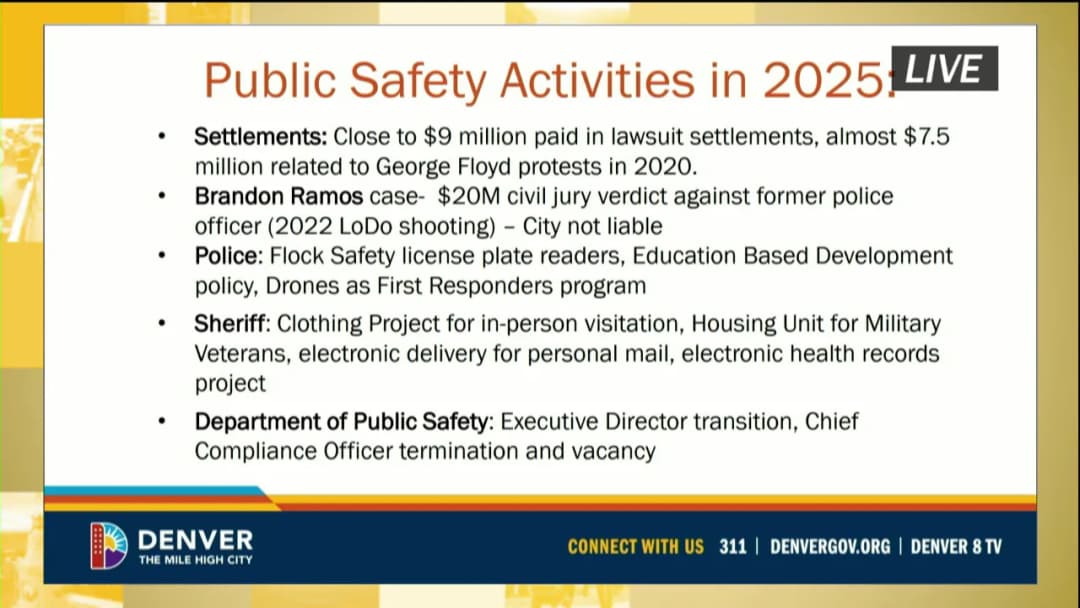
The Health and Safety Committee of the Denver City Council met on June 24, 2026, at 10:30 AM. The meeting included briefings from the Office of the Independent Monitor (OIM) and the Citizen Oversight Board (COB), as well as approval of a consent grant for the Denver Great Kids Head Start Program. The discussions focused on public safety oversight, recent directives limiting accountability, and staffing challenges. Consent Calendar - Council Resolution 26-0920 was approved by consent, accepting a $14,554,975 grant from the US Department of Health & Human Services for the Denver Great Kids Head Start Program through June 30, 2027. Discussion Items - Office of the Independent Monitor Annual Update: Lisabeth Pérez Castle presented the 2025 annual report. She highlighted a 28% increase in DPD use of force policy directives (73 in 2025 vs 2024), a doubling of community complaints regarding use of force (67 in 2025 from 34 in 2024), and a drop in sustained complaints from 18% to 11%. She expressed concern over a new directive (Directive 2026-0001) issued by Director Gardner that rescinded overdose incident reviews and eliminated OIM oversight of certain offenses, calling it a return to self-policing. She noted the OIM was not consulted on these changes. Council members questioned the "duty to obey" specification increase from 32% to 68% and the lack of data sharing. Councilmember Torres asked about needed ordinance or charter changes to enforce collaboration. Councilmember Cashman criticized the administration for underfunding the OIM while funding police. The OIM has 15 staff, with three vacancies, and has faced budget cuts for three years. - Citizen Oversight Board Annual Update: Rufina Hernández, COB Chair, presented the board's 2025 annual report. She noted the board spent most of its time on the Education-Based Development (EBD) policy, which was implemented without community consultation. She reported that DPD issued only one formal disciplinary order from October 2025 to February 2026. The COB has three vacancies (two mayoral, one joint). She asked council to reinforce ordinance mandates for engagement and require significant public safety changes to be brought forward before implementation. Councilmember Alvidrez noted the sheriff and safety director rescheduled quarterly meetings, delaying critical discussions. Key Outcomes - The consent item (26-0920) was approved unanimously. - Chair Watson announced that the Department of Safety is scheduled to appear on August 12, 2026, but may be moved earlier if briefings on the directive are not provided to council members. - Council members committed to exploring ordinance or charter changes to strengthen OIM authority and enforce collaboration. - The OIM and COB will continue to monitor the EBD pilot and directive implementation.
The Finance and Business Committee of the Denver City Council met on June 23, 2026 at 10:30 AM (local time) to consider two action items and five consent items. The committee voted to advance an ordinance modernizing Denver's entertainment licensing code (26-0921) and a resolution reallocating ARPA funds for family homelessness shelters (26-0926) to the full council for final approval. All consent items were approved. Consent Calendar - Approved Purchase Order 26-0913 with Kaiser Premier, LLC for $523,901 for one Kenworth T480 Urban X Vacuum Truck for the Wastewater Division (citywide). - Approved contract 26-0914 with Novus Construction LLC for $1,000,000 for on-call general contractor services at All in Mile High sites. - Approved contract 26-0915 with Catamount Constructors, Inc. for $1,000,000 for on-call general contractor services at All in Mile High sites. - Approved lease amendment 26-0924 with CA New Plan Villa Monaco, L.P. adding $1,119,023.08 (new total $2,293,823) and extending the term to December 31, 2030 for the DMV and business license bureau at 2223 South Monaco Parkway. - Approved Land Acquisition Ordinance 26-0925 for the Smith and Sandown over Quebec Bridge Project, authorizing acquisition via negotiated purchase or condemnation of property interests. Public Comments & Testimony - Donald Coo (LoDo Neighborhood Association board member) expressed support for the entertainment license modernization, but urged the committee to ensure mandatory hearings in high-density areas to maintain balanced relationships between businesses and neighborhoods. - Devin Dewey (Donster Rights founding director, dancer) took a neutral position but requested that the ordinance require a warrant, subpoena, or court order before law enforcement can access records from adult entertainment businesses, citing privacy concerns for sex workers. - Regas Christowe (Denver business owner for 40 years) opposed the changes, arguing that the proposed framework gives too much discretionary power to the licensing director and that the public comment period was insufficient given the complexity. - Rebecca Green (MADD Colorado executive director) opposed the provision allowing nightlife businesses to operate until 4 a.m., stating that the city has not provided data on late-night DUI patterns or crash statistics, and that research from eight countries shows extending bar hours increases alcohol-related harms. She requested a traffic safety analysis and finalized security requirements before the ordinance takes effect. - Gabe Evans (nightlife industry worker) expressed concern that extending hours to 4 a.m. without also extending alcohol service creates an unsustainable business model, as alcohol sales are the primary revenue offsetting increased late-night costs. - Adam Stappen (hospitality attorney) expressed cautious support, noting existing laws already address bad actors, but warned that the ordinance contains vague and ambiguous terms that could harm compliant businesses. He suggested a location-based approach rather than broad changes. - Nico Christelle (would-be venue operator) opposed the ordinance, arguing it creates undefined duties (e.g., requiring businesses to disperse individuals within 25 feet of doors on public sidewalks) and introduces uncertainty around annual renewals and rulemaking standards, which could push demand into the unregulated market. Discussion Items Item 26-0921 – Entertainment Licensing Modernization: Department of Licensing and Consumer Protection staff (Molly Duplechian, Erica Rogers, Abbey Soisson) presented the ordinance. Key components include: - Reducing the current 14 license types (cabaret, amusement, dance hall, social room) to three: Limited Entertainment (live entertainment ending by midnight, with up to 12 late-night events per year), Nightlife Entertainment (live entertainment until 4 a.m. with enhanced safety requirements), and Adult Entertainment (adult entertainment until 4 a.m. with enhanced safety). Low-impact entertainment (trivia, background music, pool) would no longer require a license. - Simplifying fee structures from 30 line items across four code sections to a simplified schedule; the nightlife license fee is set at $1,500, consistent with current fees for comparable licenses. - Moving from mandatory to discretionary hearings for new licenses. Staff noted that in 2025, all 32 cabaret hearings were uncontested; in 2026, 19 hearings were held with only one opposed. The city provided nearly $200,000 in mini grants since 2023 to reimburse hearing-related legal costs. - Enhanced safety requirements for nightlife and adult entertainment businesses: reasonable efforts to prevent disorderly conduct within 25 feet of entrances, security plans (to be developed via rulemaking), weapons prohibition (with exemptions for licensed armed security and law enforcement), manager background checks, and a single point of contact for law enforcement. - Transition provisions: existing licensees may continue under their current license until expiration. Applications from existing licensees will be treated as renewals. Conditions from current licenses will transfer. - Outreach began in November 2025; three drafts published; multiple stakeholder sessions held. The effective date is April 1, 2027. - Council members discussed rulemaking transparency (Council President Sandoval), records access for adult entertainment (Councilwoman Romero Campbell), and the 25-foot dispersal requirement. Staff indicated that rulemaking will involve stakeholder work groups and public hearings, and they are open to amendments on records privacy. An amendment to require community support from neighborhood residents was noted. Item 26-0926 – ARPA Fund Reallocation for Family Homelessness: Cole Chandler (HOST executive director) and Justin Sykes (Budget Management Office director) presented a request to transfer approximately $1 million from ARPA operating funds to the ARPA capital fund for capital improvements to family shelter. Background: - Denver received $308 million in ARPA State and Local Fiscal Recovery Funds. As of June 2026, $298 million has been spent. The remaining $11 million must be spent by December 31, 2026, or returned to the federal government. - The city set three goals in March 2026: no child sleeping outside, reduce family shelter waitlist from 350 to under 100 families, and reduce family homelessness by 20%. - So far, $3.4 million in increased supports have been identified, including $600,000 for 30 non-congregate shelter units with Denver Rescue Mission, plus the $1 million capital request today. An RFP for family shelter services ($1.8 million budget) has been opened. - The reallocation would free up capital improvement program (CIP) dollars that do not have the December 31, 2026 deadline, allowing site selection and community engagement this summer, with service contracts to follow in the fall. No existing ARPA projects are being defunded; the proposal repurposes anticipated underspend. - Additionally, the ordinance would allocate ARPA interest earnings to support ARPA-related personnel and federal grant software through 2027 to ensure audit readiness. - Council members asked about site location (not yet identified), ongoing operational funding (Homelessness Resolution Fund has $1.8 million set aside for services), and alignment with the 2027 budget process. Key Outcomes - Item 26-0921: Motion by Council President Sandoval, seconded by Council Pro-Tem Romero Campbell, to approve Council Bill 26-0921 for filing to the full council. Passed 6-0 (Hinds absent). The ordinance will be considered by the full council on July 13, 2026, with a final draft expected by July 9. Staff committed to continued stakeholder engagement and to bring forward amendments addressing records privacy and other concerns raised in public comment. - Item 26-0926: Motion by Council Pro-Tem Romero Campbell, seconded by Councilman Watson, to approve Council Bill 26-0926 for filing. Passed 6-0 (Hinds absent). The reallocation will allow HOST to proceed with site identification and community engagement for a new family shelter, with a goal of opening during the 2026-2027 winter shelter season. - Consent Items: All five consent resolutions (26-0913, 26-0914, 26-0915, 26-0924, 26-0925) were approved by consent.
This was a regularly scheduled joint meeting of Mayor and Denver City Council. The short general session focused on introductions, member announcements, and a motion to enter executive session. No legislation or public testimony was considered. Discussion Items - Staff Introduction: Council President introduced Lori, the new city attorney joining council staff. Lori previously served as city attorney or manager in Bullburgh, Castle Valley, Moab, Utah, and Leadville, and is a District 1 resident. The Mayor welcomed her. - Accessibility Concern: Councilman Chris Hines, who uses a wheelchair, reported that the accessible door to the chamber is frequently locked. He requested that it be unlocked to ensure full access for committee members with disabilities. The council president committed to addressing the issue. - South Broadway General Improvement District: Councilman Alvidres announced the successful launch of the South Broadway General Improvement District, thanking Chief Thomas and Tim Hoffman, and congratulating new executive director Caitlin Bronn. - Underground Music Showcase: Councilman Darren Watson promoted the Underground Music Showcase, happening July 24–26 in Five Points and the RiNo Art District. He noted 200+ performances across multiple venues, partnerships with RTD for transportation, and encouraged attendance. - Highline Canal Summer Scamper: Council President Pro Tem Diana Romero Campbell announced a 5K run along the Highline Canal at Bible Park on Wednesday, June 24 at 5:30 p.m., with free registrations available. - Paco Sanchez Underpass Improvements: Councilman Tours reported that a safer streets grant (with Denver Police Department and DOTTIE) is funding murals, lighting, cleanups, and community activation for the Federal Boulevard underpass near Paco Sanchez Park. The mural is underway and lighting should be installed this month. - Municipal Sentencing Reform Community Meeting: Councilman Gonzalez announced a virtual community conversation on June 24 at 5 p.m. to discuss amendments to municipal sentencing reform legislation, the fifth such meeting during the process. - Juneteenth and Pride Parade: The Mayor thanked attendees of the Juneteenth celebration and reminded members of the Pride Parade on Sunday, June 28 at 9 a.m., downtown route. Key Outcomes - Motion to Enter Executive Session: A motion was made and seconded to move into executive session pursuant to DRMC 234A sections three, six, and seven to discuss pending litigation and legal advice. The motion passed unanimously, and the meeting moved into executive session.
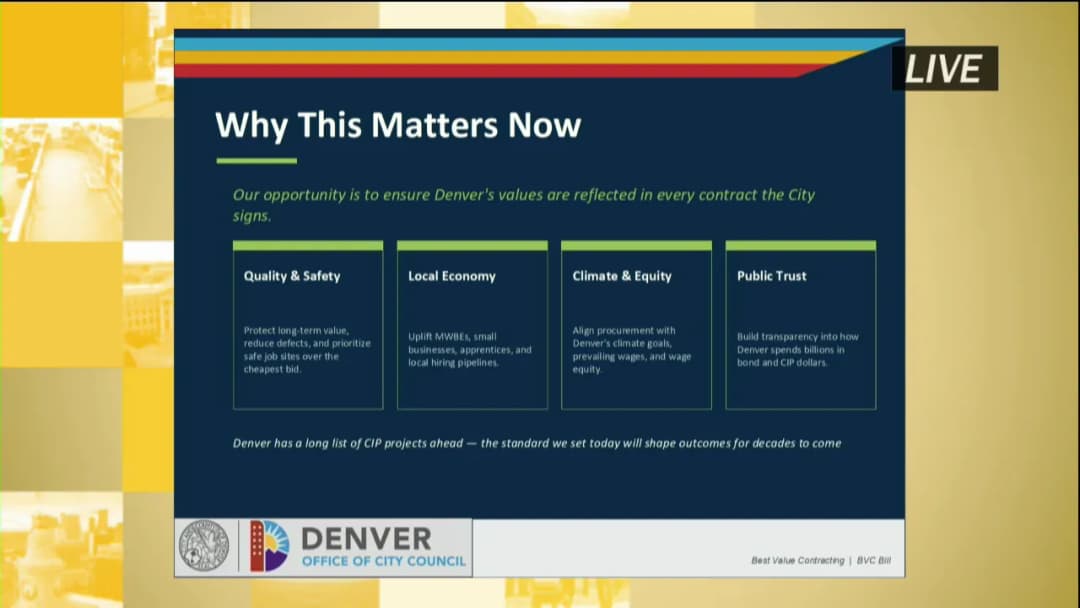
The Denver City Council Budget and Policy Committee met on June 22, 2026, to discuss two major proposals: a best value contracting ordinance for construction projects and a proposed seat tax on large venue tickets to fund safe routes to school and other transportation improvements. The meeting also included public testimony on community initiatives. Public Comments & Testimony - A survivor of abuse and homelessness shared her personal story, describing how she found purpose through a scholarship at Emily Griffith and later founded Latin Fashion Week to promote education, diversity, and culture. She also spoke about a cooking show, Pancho and Pancha, that shares family recipes and cultural stories. - A brief message urged against driving high, emphasizing the risks and calling for community responsibility. Discussion Items - Best Value Contracting (Sponsored by Councilmembers Alvidres and Hines): The sponsors proposed moving from lowest bid to best value contracting for city construction projects over $1 million, using eight evaluation criteria: legal compliance, financial capacity, past performance, workforce practices, safety, compensation and benefits, project approach, and cost. They highlighted adoptions in Adams and Pueblo counties, which reported higher quality, safety, and on-time completion with no net cost increase. The mayor's office (Dominic Moreno) confirmed openness to revising Executive Order 8 to align. Councilmembers questioned the impact on small businesses, pre-qualification burdens, and interaction with existing on-call contracts. A tiered approach (e.g., different criteria for contracts under $2 million) and coordination with the Division of Small Business Opportunity were discussed as potential refinements. - Seat Tax for Safe Routes to School (Sponsored by Councilmembers Parady and Alvidres): The proposal would place a tiered tax (5% on tickets under $100, 10% on $100–$250, 15% on over $250) on venues with over 1,000 seats. Exemptions include city-owned venues, youth athletics, K-12, higher education, and nonprofit events. Estimated revenue of $30 million annually from the three largest venues would fund safe routes to school, the Denver Moves Everyone plan, and multimodal infrastructure. Councilmembers raised concerns about regressivity, economic impact on families, lack of venue outreach, and the need for specific ballot language and financial analysis. Some expressed skepticism, while others supported the concept but requested more data. Key Outcomes - No votes were taken on either proposal. - For best value contracting: The sponsors will continue refining the ordinance with input from the mayor's office and stakeholders, addressing small business impacts and pre-qualification procedures. - For the seat tax: Further outreach to venues and RTD is planned. Ballot language will be developed, and council requested an economic impact study and detailed revenue estimates before any November ballot placement.