The committee met to review and take action on FY2027 budget line items from a spreadsheet, continuing from the previous day. The meeting was scheduled to end by 3:00 PM to accommodate the State of the City address. Members moved items to closing resolution, pinned them for further discussion, or removed them, with significant debate on funding for the Charles H. Wright Museum, DDOT transit, and affordable housing. Public comments were heard at the end. Public Comments & Testimony - Tyson Gersh: Expressed confusion about the public comment process and lack of attached documents. Raised concerns about the BZA budget, alleging math errors in caseload charts and an unexplained tripling of revenue in FY2024 coinciding with unauthorized fee increases for transcripts. - William M. Davis: Requested that remaining ARPA funds be used to provide District 7 with at least one fully functioning recreational center, noting the district currently has only one library. - Beverly A. Varner (President, Soda Elsewhere Black Association): Urged Mayor Sheffield to waive the $1,500 land use hearing fee for Black clubs, associations, and 501(c)(3) organizations. Thanked Councilmember Johnson for suggesting the neighborhood beautification grant but noted the application is difficult. - Owner Papa: Commented that comparisons between Detroit and Birmingham must consider school systems. Questioned the two-year moratorium on data centers (item 152) and expressed concern about bonding with DESC (item 154). Discussion Items - Line 119 (Charles H. Wright Museum capital improvements, $7.788M): Councilmember Benson moved to approve, but Councilmember Johnson noted the lack of resources, warning it would defund the fleet replacement plan for FY2027. The item was pinned for deeper conversation with the administration. - Line 120 (Charles H. Wright Museum operating support, additional $700K): Pro Tem Young requested a pin to explore other funding sources, as the funds were not available. - Line 128 (DDOT general fund support): Councilmember McCampbell moved to closing resolution. Discussion ensued with Councilmember Santiago-Romero questioning the reduction in general fund contribution. OCFO Johnson explained that total DDOT funding increased via MTF transfer, and that the department could not absorb a large increase immediately due to capacity. Councilmember McCampbell pinned the item for possible additional funding. - Line 133 (Fellowship Chapel housing project, $2M one-time): Councilmember Callaway moved to closing resolution and proposed using ARPA funds. OCFO Johnson stated that general fund would not be legally eligible and that ARPA may not allow new projects. Councilmember Callaway cited previous ARPA use for parks. The item was pinned. - Line 142 (Land use fees): Councilmember Waters moved to closing resolution, seeking reduced fees for community organizations. OCFO Johnson explained fees are calculated to offset costs. Councilmember Johnson suggested using neighborhood beautification grant funds, which was noted as a possibility. - Line 144 (Green Grocer Program, $525K): Pro Tem Young requested $525K one-time funding to pilot eight stores. Approved without objection. - Line 145 (DEGC support for card events, $50K): Councilmember Benson moved to approve. Councilmember Callaway asked if funds could be used outside downtown; Benson noted DEGC funds were used for Avenue of Fashion events. Approved. - Line 152 (Data center regulations): Councilmember Benson moved to approve language for closing resolution, including a six-month study and moratorium. Approved. - Line 155 (Skill trades funding, $250K recurring): Councilmember Waters moved to restore funding and transfer from DESC to DWSD. Approved after discussion. - Line 156 (Dining with confidence, amended to $200K): Councilmember Benson moved to reduce from $500K to $200K one-time, training 330 residents. Approved. - Line 157 (B Next program, $1M removed): Council President Tate moved to roll over remaining funds instead of adding $1M. Approved. Key Outcomes - Moved to closing resolution (language to be drafted): Items 117, 118, 131, 133, 135, 139, 140, 141, 142, 127, 129, 132, 146, 147, 152, 153, 154, and 128 (with pin for possible additional funding). - Pinned for further discussion: Items 119, 120, 122, 123, 124, 125, 126, 128 (by McCampbell), 130, 132 (by Benson initially), 134, 136, 137, 138, 146 (dollar amount), 148, 149. - Removed: Items 121, 143, 150, 151. - Approved with specific funding: Item 144 ($525K one-time), Item 145 ($50K one-time), Item 155 ($250K recurring, moved to DWSD), Item 156 ($200K one-time), Item 157 (roll over remaining funds, no new $1M). - Legal concern noted: Item 133 (Fellowship Chapel) general fund contribution deemed ineligible; ARPA exploration requested but not guaranteed. - Meeting adjourned at 3:00 PM, to resume at 10:00 AM on April 1, 2026. Councilmember Benson suggested a consent agenda process for items moved to closing resolution to speed future sessions.
Public Meetings - Detroit, Michigan
Public Meetings - Detroit, MichiganThe Detroit City Council met in executive session on March 30, 2026 to deliberate on Mayor Sheffield's proposed fiscal year 2027 budget. The overall budget is approximately $3 billion, with $1.56 billion in discretionary general fund dollars. The session focused on council-proposed changes, funding sources, and closing resolutions. The council held 47 budget hearings over the prior three weeks. The deadline for final council votes is April 7, 2026, with the mayor's veto deadline set for April 13 and a possible override vote by April 16. Discussion Items - Budget Overview and Constraints – CFO Irv Corley explained that council can only influence the general fund portion of the budget. The general fund surplus totals approximately $138 million, composed of $53.1 million in fund 1000, $38.6 million in the blight remediation fund (1003), and $39.1 million in the capital projects fund (4533). Corley noted that Mayor Sheffield has appropriated all surplus dollars, meaning council must consider reducing some of her priorities to fund their own. A $42 million capital income tax reserve was identified as a potential stable funding source. - Code Enforcement Expansion – Councilmember Benson proposed adding 3 code enforcement officers at a recurring cost of $390,000 ($130,000 each for salary and benefits) (line 6, approved). A separate item (line 10) for a $100,000 public awareness campaign on code enforcement was also approved and will be combined with the FTE funding. - Truck Route Studies – A $300,000 study around Stellantis facilities was proposed (line 17). After discussion, council agreed to expand the study citywide and pin the item to determine a final amount, with a suggestion of $1 million to cover all districts. - Retiree Third Check – Councilmember Waters proposed adding $2 million to Mayor Sheffield's existing $10 million for general city retirees' third check (line 16). The item was pinned for further justification. - Public Restrooms in Parks – Councilmember Santiago Romero moved to add a closing resolution to study implementing public restrooms (line 22). Councilmember Callaway submitted a related memo and will reframe her questions as statements. The motion passed, and the item will be directed to the General Services Department. - Traffic Calming on Kirchoff, Jefferson, and Lafayette – Council President Pro Tem Young requested $2 million one-time for speed humps, curb extensions, and corridor redesign. The motion was approved (line 35). - Mental Health Co-Response – Councilmember Santiago Romero proposed that mental health calls be routed through the Fire Department first (line 48). Councilmember Callaway and Pro Tem Young objected, arguing the Police Department's existing mental health unit is better suited. The motion passed 6-2 (Young and Callaway voting no). - Revenue Options – Council discussed multiple revenue-generating proposals: an amusement/entertainment tax (line 39, moved to closing resolution by Callaway), a local option sales tax study (added by Johnson), and a broader working group on revenue growth (added by Santiago Romero, joined by McCampbell). - Artificial Intelligence Municipal Public Bank – Pro Tem Young proposed a novel concept but acknowledged constitutional and cost barriers (estimated startup $250 million to $2 billion). The item was moved to closing resolution (line 43). Key Outcomes - Approved for Closing Resolution (language forthcoming): Many non-monetary items including coordination on vacant properties (line 8), code enforcement education (line 7), demolition preservation plans (line 14), public restroom planning (line 22), leaf vacuum program (line 23), and others. - Approved with Funding: - Line 6: $390,000 recurring for 3 code enforcement officers. - Line 10: $100,000 for code enforcement education campaign (to be combined with line 6). - Line 20: $50,000 one-time for additional bike racks. - Line 21: $1 million for Chinatown streetscape improvements. - Line 24: $200,000 for streetscape studies on Schaefer Street and James Cousins. - Line 35: $2 million for traffic calming on Kirchoff, Jefferson, and Lafayette. - Pinned Items (to be revisited): Retiree third check ($2M, line 16), truck route study (citywide, line 17), litter campaign funding (line 18), ARPA outstanding funds document (line 41), and items from Councilmember Miller (lines 50-51). - Other Actions: Council approved a motion to have LPD create a document for ARPA spending (line 41, pinned). Line item 45 (plan ahead program) was removed as duplicative. Several items were combined (e.g., line 76 merged into line 18). - Next Steps: The executive session will continue daily until April 7. Council will vote on Schedule A (CDBG/NOF allocations), Schedule B (budget amendments), the closing resolution, the administration's compensation book, and tax millage rates. The mayor has until April 13 to veto any council changes.
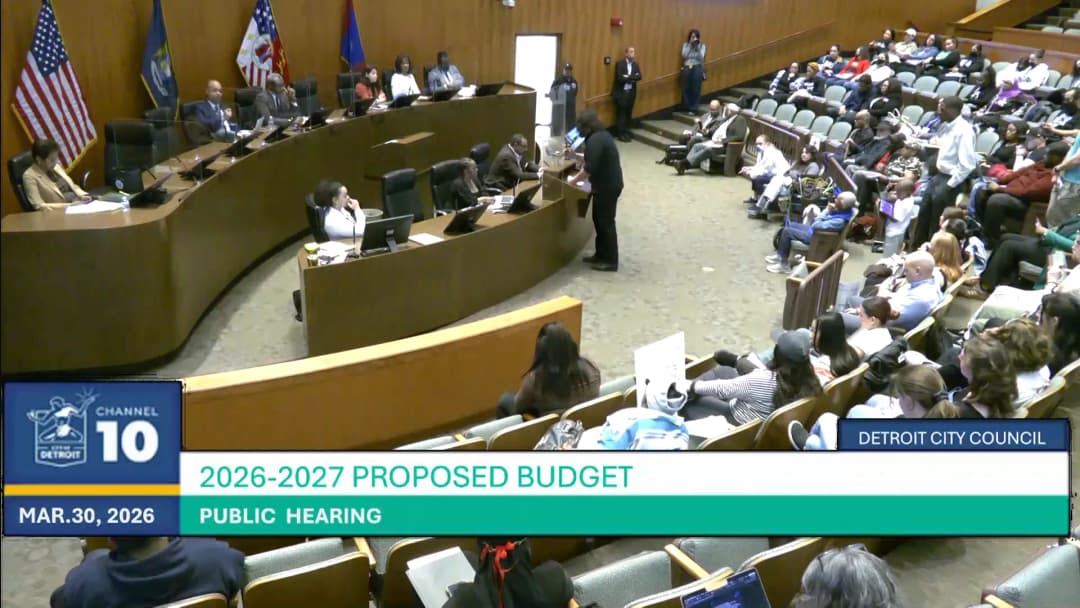
The Detroit City Council held a public hearing on Mayor Mike Duggan's successor Mayor Sheffield's proposed fiscal year 2027 budget on March 30, 2026. Council President James Tate presided, and city official John Corley presented an overview: the proposed general fund budget is $1.55 billion, and the total budget across all city funds is $3 billion. The hearing began in the evening and included more than 60 in-person speakers and 21 online callers, each given 1 minute 45 seconds to comment. Council noted that executive session had already taken place earlier that day to consider amendments to the budget. Public Comments & Testimony Immigration and Immigrant Support - Dozens of speakers, including residents of Districts 2, 5, 6, and 7 and members of the State of Southwest coalition, the People's Assembly, and the Detroit Immigration Task Force, called for $1 million to create a legal defense fund for Detroiters detained by ICE or CBP, $750,000 for a general aid fund to support families affected by ICE abductions, and $250,000 to replace out‑of‑state language interpretation services with local talent (a recurring request from nearly all immigrant‑support speakers). - Many shared personal stories of family separations, deportations, and the community's fear; they stressed that immigration court does not guarantee legal representation and that these funds are critical for due process and family stability. - Several speakers also urged full funding for the Office of Immigrant Affairs and continued support for the Detroit ID program. Housing and Right to Counsel - Members of the Detroit Right to Counsel Coalition (including the Wisdom Institute, United Community Housing Coalition, Michigan Legal Services, and numerous community doulas) asked the council to fully fund the right to counsel program at $32 million. They noted that before the program, only about 4% of tenants had representation; now the program has dramatically improved outcomes and reduced evictions. - Speakers described the eviction crisis, linking housing instability to poor health, pregnancy outcomes, and family trauma. They cited 30,000+ filings per year in the past and stressed that continued funding is essential to prevent homelessness. - A few speakers also requested resources for home repair grants and for supporting black community clubs and neighborhood corridors. Transit (DDOT) Funding and Improvements - ATU Local 26 President Shaq Tron Collier and many other transit advocates, union members, and daily riders expressed strong opposition to any reduction in the city's general fund contribution to the Detroit Department of Transportation. While the mayor's budget includes a $30 million net increase, speakers warned that $13‑14 million of that appears to be a backfill or replacement of previous general fund support, not new money. - The coalition called for doubling DDOT's budget over three years to implement the DDOT Reimagined plan, which would improve frequency, reliability, and wages. Specific requests included more bus shelters and benches, expanded paratransit across city limits, unarmed transit ambassadors, and study of free fares (the QLine and People Mover are already free). - Several speakers noted that improved transit is critical for jobs, education, and health access, and that state and federal transit dollars must be additive, not used to supplant city funding. Disability and Accessibility - Representatives of Detroit Advocates of the Blind and Detroit Disability Power urged the council to protect the Office of Disability Affairs funding ($1.4 million) against a proposed cut of approximately $400,000 (about one‑third of its budget). - Speakers also requested better transit accessibility: training for paratransit workers, same‑day service improvements, accessible bus stops with landing pads, shelters, and seating. Water Affordability - Norell Hemphill (People of Detroit) and others asked for $45–65 million to fund true water affordability programs, noting that enrollment in the Detroit Lifeline Plan dropped from 29,000 to 4,500 as funding ran out. They emphasized water as a public health issue and asked the council to allocate dedicated funds and to resist large‑scale data‑center water withdrawals. Participatory Budgeting - Several speakers (Cassandra Floyd, Theo Pride, Joanne Adams, and others) advocated for establishing participatory budgeting across all city districts. They argued it would increase voter turnout, redistribute resources to underinvested neighborhoods, and build community trust. Other Notable Concerns - Russ Bellant asked to restore $47,000 stolen from the library in 2021 and warned against data centers tied to Palantir, calling them a threat to democracy. - Mia Anderson and others criticized the Detroit Land Bank Authority and Building Authority, demanding accountability and reforms. - Matt Daniels requested simple traffic‑calming measures (daylighting, curb extensions) at intersections where pedestrians have died, arguing that the lack of a dedicated budget for small interventions leaves dangerous sites unfixed. - Celeste Turner opposed housing development on Rogale Park, asking for budget funds to maintain green spaces without needing to give up parkland. - Tyson Gersh called for budget transparency and renewed open checkbook, noting that costs like BZA transcripts are hidden in broad contract categories. - Kendall Cohn asked for clarity on the Office of Sustainability budget, requesting doubling as pledged, and noting that the current staffing is split across departments. Key Outcomes - No votes or formal decisions were taken; the meeting was solely a public hearing for testimony. - Council President Tate reminded attendees that additional opportunities for input exist via email, phone, and future executive sessions. - The council will continue its budget review in executive sessions and will later adopt the budget, with or without amendments, as provided by the city charter. - The hearing adjourned without further action.
The Detroit City Council convened at 4:00 PM on March 30, 2026, to conduct a budget hearing and executive session. The meeting focused on reviewing and voting on a series of departmental budget line items, many of which were either approved, pinned for further discussion, or moved to a closing resolution. The council also heard public comments on housing, land bank, right to counsel, and other community concerns. The session ended with a plan to reconvene on March 31, 2026, at 2:00 PM. Public Comments & Testimony - Jadante Smith criticized the city for alleged waste in salaries of city employees (David Whitaker, David Bowser, Wendy Lau) and urged the council to defund the Detroit Land Bank Authority, stating residents oppose it. - Mia Anderson raised concerns about the Detroit Building Authority’s use of Right of First Refusal to acquire properties and funnel them to the Land Bank, and expressed disappointment with the limited public comment time given the lengthy discussion of a coyote habitat. - Daniel Hayes (community-based doula) urged funding for right to counsel in eviction cases, describing the case of a mother ousted from shelter due to hospitalization. - Cassie Jones McBride (Co-chair of Detroit Right to Counsel Coalition) shared a success story where a right-to-counsel attorney helped a Detroit resident facing eviction from someone claiming ownership, leading to dismissal and referral to deed fraud task force. She requested full funding for the program. - Lorinda Lewis (community doula, Right to Counsel member) supported full funding for right to counsel, citing the impact of eviction on pregnancy and postpartum recovery. - Latanya Bell (Co-executive director of Wisdom Institute) argued that partial investments leave families behind and called for full funding of right to counsel. - Reuben James Crowley Jr. made a heated statement accusing multiple council members of wrongdoing. - Mr. Foster referenced 1 Timothy 5:8, urged keeping resources community-based, and cautioned about AI's limitations in predicting crisis. - Betty A. Varner (president of DeSoda Ellsworth Block Association, age 76) pleaded for equal energy and funds for corridor improvements in her neighborhood as was given to the zoo. - William M. Davis (general fund retiree) requested extra compensation for general fund retirees who took larger pension cuts than police and fire. - Sergio Martinez (homeowner) expressed disappointment at the lack of funding for immigrant defense funds. - iPhone caller asked about meeting procedures and requested help with building repairs. Discussion Items Health Department - Line 52: (Urge coordination on crime hot spots) – Originally health, moved to Planning and Development Department, pinned for more information. - Line 53: (Mental behavioral health at rec centers) – Pinned for cost details. - Line 54: (COVID-19 research study) – Moved to closing resolution; Councilmember Johnson noted lack of follow-up on state disparity report. - Line 55: (Childhood lead prevention program advertising) – Moved to closing resolution; dollar amount pinned pending conversation with HRD. - Line 56: (Health studies for understanding and financial support) – Pinned; health department had just completed a study. - Line 57: (Dining with confidence training coordination) – Approved for closing resolution. - Line 58: (Increase health budget by $250,000 from marijuana excise taxes) – Approved. - Line 59: (Data center moratorium request) – Approved for closing resolution. - Line 60: (Safe storage containers for cannabis products) – Approved with $75,000 one-time for pilot program. Language amended to include "medicinal and non-medicinal substances." - Line 61: (Behavioral health workforce development) – Approved for closing resolution. - Line 62: (Metrics for CBI groups) – Approved for closing resolution. Human Resources - Line 63: (Contracting services in-house) – Pinned for further review. - Line 64: (My Tri-Share program) – Pinned; needed cost details from HRD. - Line 65: (City employee parking) – Removed from spreadsheet. - Line 66: (List of city employees with vehicles/fuel cards) – Pinned; Director Johnson stated fleet audit already underway with capital budget. CREO (Civil Rights, Equity & Opportunity) - Line 67: (Language access program $250,000 recurring) – Approved; amended from $200,000 to $250,000 recurring. - Line 68: (Minority business study $100,000) – Amended to remove funding (study achievable by existing staff), moved to closing resolution. - Line 69: (Language access contractor review) – Pinned for further input from immigrant community. - Line 70: (Disparity study $350,000) – Pinned for conversation with new director Attorney Jade Mathis. Councilmember Callaway explained the study aims to overcome barriers for Black women and men in city contracting, citing Atlanta and Philadelphia models. HHFS (Housing, Homeless, Family Services) - Line 71: (Air monitoring/facility dashboard) – Moved to closing resolution. - Line 72: (Life and Legacy program $1 million one-time) – Pinned; administration requested further discussion. - Line 73: (Mandate Life and Legacy participation for home repair programs) – Approved. - Line 74: (Immigrant legal services fund) – Approved for closing resolution; language to be developed on sustainable funding. - Line 75: (Zero percent loan program) – Approved. - Lines 77, 78: (Lead-based encapsulation program) – Pinned for further discussion. - Line 79: (Homeless services and job opportunities) – Removed. - Line 80: (Quarterly mental health capacity reports) – Approved for closing resolution. Do It (Innovation & Technology) - Line 81: (Cybersecurity/media literacy $50,000 one-time) – Pinned for correct number. - Line 82: (AI/AR/VR technology for public safety) – Moved to closing resolution after discussion on privacy and legality. Law Department - Line 83: (Maintain city public properties) – Approved for closing resolution. - Line 84: (AI rollout policy and safeguards) – Approved for closing resolution. - Line 85: (FOIA response fulfillment) – Approved; quarterly updates required. - Line 86: (Pilot program to address fraud) – Pinned for costs. - Line 87: (Blight/vacant apartments on Greenfield) – Approved for closing resolution with amended language. Councilmembers noted recent cleanup efforts. - Line 88: (Office of Senior Affairs entire budget) – Pinned for information. Mayor's Office - Neighborhoods - Line 89: (Expand food access program to seniors) – Pinned. - Line 90: (Youth affairs programming outside rec centers) – Approved. - Line 91: (Signs for littering/illegal dumping) – Pinned pending DPW discussion. - Line 92: (Brightmore framework plan – training/employment on infrastructure projects) – Approved for closing resolution. - Line 93: (Regular meetings between council, neighborhoods, BSEED, DPW) – Approved. - Line 94: (Millage for cultural institutions) – Approved; amended to focus on Charles H. Wright Museum and Detroit Historical Society, with a standalone resolution. - Line 95: (Determine ROI for cultural millage) – Approved. - Line 96: (Workforce housing fund $500,000 one-time) – Pinned for discussion with HRD. - Line 97: (Hire liaison for Land Bank complaints) – Approved. Board of Police Commissioners - Line 98: (Match stipend to CPC for commissioners) – Pinned; charter prohibits stipends, only mileage reimbursement allowed. - Line 99: (Increase BOPC budget $250,000) – Pinned; discussion on legality and underspending. Detroit Land Bank Authority - Line 100: (Nuisance abatement program discussion) – Approved for closing resolution; Councilmember Waters will provide language. - Line 101: (Inquiry on how nuisance abatement program was created) – Pinned for response. - Line 102: (General land bank authority discussion) – Pinned; reminder that MOU expires November 2026 and fund balance runs out by end of 2027. Historical Museum - Line 103: (Youth programming at museums) – Approved for closing resolution. - Line 104: (Relationship with media services) – Approved. - Line 105: (Museum art in Coleman A. Young Municipal Center) – Approved. - Line 106: (Support of property tax millage) – Removed (duplicative). - Line 107: (Increase budget $3.2 million one-time) – Pinned. - Line 108: (Employment of Detroiters at historical museum) – Approved. Zoological Society (Detroit Zoo) - Line 109: (Senior program $50,000 recurring) – Fund already in mayor's budget; removed dollar amount, moved to closing resolution. - Line 110: (Coyote habitat at Bell Isle Nature Center) – Extensively debated. Original ask $500,000. Councilmember Benson proposed $100,000 with Wayne County match. After objections (Councilmember Callaway citing ethical concerns, others favoring investment in Bell Isle), the item was moved to closing resolution with commitment to match only if county matches. - Line 111: (Support millage for cultural institutions) – Removed. - Line 112: (Increase font size of “Detroit” on zoo water tower) – Approved for closing resolution after a vote with one objection (Councilmember Santiago Romero opposed spending on signage). Eastern Market - Line 113: (Box lunch program and Black Bottom archives) – Pinned for Member Miller. - Line 114: (Urban farmers grant $240,000 one-time) – Approved. Port Authority - Line 115: (Tracking mechanism for youth careers) – Approved for closing resolution. - Line 116: (Mobility innovation terminal $1.5 million one-time) – Pinned after debate; Councilmember Young presented strong ROI case, but Budget Director Johnson cited limited funds. Pinned for further discussion. Key Outcomes - Votes & Approvals: - 17 items approved to closing resolution (Lines 57, 58, 59, 60, 61, 62, 67, 73, 74, 75, 80, 82, 83, 84, 85, 87, 92, 93, 94, 95, 97, 100, 103, 104, 105, 108, 112, 114, 115). - 1 item removed (Line 65, 79, 106, 111). - Several items pinned for further discussion (Lines 52, 53, 55, 56, 63, 64, 66, 69, 70, 72, 77, 78, 81, 86, 88, 89, 91, 96, 98, 99, 101, 102, 107, 113, 116). - Line 67 amended from $200,000 to $250,000 recurring. - Line 68 removed $100,000 but retained in closing resolution. - Line 94 amended to specifically include Charles H. Wright Museum and Detroit Historical Society. - Line 60 amended to cover non-medicinal substances. - Line 110 moved to closing resolution after compromise on $100,000 match with Wayne County; Councilmember Benson withdrew motion after further discussion with Budget Director. - Line 116 pinned despite Councilmember Young’s detailed ROI presentation; Director Johnson stressed limited resources. - New Items Introduced: - Councilmember Waters introduced a motion for $75,000 recurring stipends for the Tenant Rights Commission (9 commissioners at $150/month). Pinned due to charter limitations and need for ordinance change. - Council President Tate introduced a motion to add $1 million recurring to the Detroit City Council budget – unanimously approved. - Procedural Notes: Meeting agenda will continue March 31, 2026, at 2:00 PM (after formal session). Public testimony closed at 5:00 PM with 5 in-person speakers and 5 online callers.
The expanded Budget, Finance, and Audit Standing Committee convened on March 30, 2026, with a quorum present. The meeting focused on presentations from three city oversight agencies—the Ombudsman’s Office, the Office of the Inspector General (OIG), and the Board of Ethics—regarding their requests for proportional funding as mandated by charter and city ordinance. Council President James Tate outlined the truncated process: no questions during presentations, with questions to be submitted later, followed by executive session and a public hearing at 5 p.m. A motion was made and approved to place the funding requests for all four oversight agencies (including the Auditor General, already heard) into executive session for further deliberation. Discussion Items - Procedural Overview: Council President James Tate explained that budget hearings were suspended to allow oversight agencies to present specifically on proportional funding, as approved last year but not included in the mayor’s proposed budget. The agencies were limited to opening statements and presentations on their proportional funding requests. - Ombudsman’s Office Presentation: The Ombudsman reported receiving 3,462 complaints in fiscal year 2025–26, along with 884 online submissions and 2,357 legacy complaints. High-complaint areas included BC (59%), DPW, DWSD, and DPD. The office emphasized a transition to proactive, data-driven oversight. Requested restoration of proportional funding: $314,752 ramp up plus one FTE at $65,000, as outlined in the proportional funding ordinance. - Office of the Inspector General (OIG) Presentation: Inspector General Maribel presented on the charter mandate for proportional funding, noting the 2012 charter required an ordinance, which was passed in July 2024 with a resolution adopting a three-year ramp-up in April 2025. Year one funding results: closure times on non-jurisdictional complaints dropped by 89%, complaint volume more than doubled since 2024. Requested total of $2,577,947 for FY 2026–27, including ramp-up and restoration of a budget cut, to add investigators, an intake specialist, and reclassifications. - Board of Ethics Presentation: The Board detailed achievements from proportional funding: a second investigator, a marketing and outreach coordinator, and a learning management system (ClearCo) launched March 16, 2026, with 6.5% of public servants completing the introductory module in 10 days. The mayor’s proposed budget of $817,554 is an $82,244 decrease from the current $899,788. Requested supplemental of $282,244 ($82,244 shortfall plus $200,000 ramp-up) for a total FY 2026–27 budget of $1,099,788. - Motion and Verification: Councilmember Gabriela Santiago Romero called for a vote on the motion to place the proportional funding amounts into executive session. The motion passed without objection. Councilmember Scott Benson requested that the Legislative Policy Division (LPD) verify that the amounts requested align with the law. Mr. Corley confirmed verification will be performed. Key Outcomes - The committee approved a motion to place the proportional funding requests for all four oversight agencies (Ombudsman, Inspector General, Board of Ethics, and Auditor General) into executive session for further deliberation during the budget process. - The oversight agencies’ requests for proportional funding were formally noted and will be considered in executive session. - The LPD was directed to verify that the requested amounts match the statutory requirements of the proportional funding ordinance. - Public comment and the 5 p.m. public hearing were announced for later in the day but are not reflected in this transcript.
The Health and Safety Standing Committee met on March 30, 2026, chaired by Councilmember Gabriela Santiago Romero, with Vice Chair Councilmember Denzel Anto McCampbell. Due to budget season, the meeting was limited to one hour. The committee approved prior minutes, heard public comments, and addressed several contracts and memos. Public Comments & Testimony - Mr. Foster: Spoke about community engagement and opportunities. No specific agenda item mentioned. - Brother Cunningham: Expressed strong support for a one-month free bus fare pilot, doubling DDOT (the city's bus system), borderless peer transit, and system-wide free fares. He called for on-time buses and benches and shelters at at least 15% of stops, noting that currently only 5% are covered. - Jacqueline Miller (east side Detroit resident): Reported unfilled demolition holes on Tacoma and Woodhall streets that contain water, posing a safety hazard to children. She warned the city could not claim ignorance if a child is harmed. The chair agreed to have staff collect addresses for action. - William M. Davis: Commended the No Kings Day protests. Regarding emergency demolitions (items 6.3 and 6.4), he argued the city should pursue reimbursement from property owners' other assets or acquire neglected commercial properties when demolishing them. - Caller ending in 169: Voiced support for doubling DDOT, the free bus fare pilot proposed by Councilmember GSR, expansion of unarmed transit ambassadors, borderless fare transit, benches and shelters at 15% of stops, and free fares for all students ages 1-120. - Betty A. Varner (President, DeSoda Elsewhere Black Association): Announced a health fair on April 18, 2026, at Mount Zion Missionary Baptist Church offering eye exams and screenings. - Caller “Owner Papa” (Ms. Hughes): Strongly criticized the city's handling of contaminated soil sites, asserting that residents should not have to report locations to the city. She accused Councilmember Romero and the administration of stalling and negligence, and called the chair unproductive. - Anonymous caller: Alleged election fraud and made references to an archived video; not directly tied to committee business. - One caller (ending in 482) was cut off due to time constraints. Discussion Items Memos and Resolutions - 5.1 (Severe Weather Awareness Month): Received and filed. - 5.2 (Rental Certificate of Compliance): Brought back in one week for ordinance drafting. - 5.3 (Eviction Moratorium): Brought back in one week. - 5.4 (Commercial Buildings on Demolition List): Information request pending; brought back in two weeks. Contract 6.1 - Appeals and Hearings Department A contract typically handled by the IOS committee was initially flagged. After discussion, the committee voted to refer it to the president's office for assignment to IOS. Emergency Demolition Contracts (6.2, 6.3, 6.4) Vice Chair McCampbell raised concerns about missing contract end dates and the timing of structural collapses/fires. He questioned the transparency and use of emergency demolition contracts. Staff from the Construction and Demolition Department and Office of Contracting and Procurement provided partial answers. Contracts 6.2 and 6.3 were brought back for one week to obtain missing information. Contract 6.4 (commercial demolition at 3916 Joy Road) was approved. EMS Software Amendment (6.5) Approved to add $14,685.72 for an EMS software platform for the fire department. Health Impact Assessments Amendment (6.6) Approved with no increase for the Gordy Howe International Bridge health impact assessments. WIC Program Contract (6.7) Leah Smith (Detroit Health Department) detailed the Women, Infants, and Children (WIC) supplemental nutrition program offered through CHASS (Community Health and Social Services Center). Services include nutrition counseling, breastfeeding support, and breast pumps. Both the chair and vice chair expressed strong support, noting the program's impact on low-income families. The contract for $1,143,600 was approved and sent to formal. Other Approvals - 6.8: Extension for road improvement agreements with the Detroit Brownfield Redevelopment Authority. - 6.9: Acceptance of Safe Streets for All grant. - 6.10: Acceptance of Aviation Education and Workforce Development grant. - 6.11: Dangerous Buildings findings received and filed. - 6.12: Lead-Based Paint Hazard Reduction grant approved. - 6.13: Resolution recognizing Michigan Severe Weather Awareness Week approved. Miscellaneous Memos (6.15-6.17) Three memos requiring additional responses were brought back in one week. Contaminated Soil (Dirty Dirt) Update Raquel Harrington (Construction and Demolition Department) provided an update on ongoing testing and remediation. The city has posted an interactive map at Detroit.gov/CDDsoiltesting showing sites' testing status and remediation progress. She stated that holes remain open intentionally until soil testing confirms safety, and contractors are required to install orange plastic fencing. The next community downcast meeting is April 6, 2026. Vice Chair McCampbell expressed concern about holes remaining open for months (some since November/December) and questioned the effectiveness of the plastic fencing in preventing access. The vice chair planned to submit a memo for further discussion. The chair suggested using communications channels to promote the website and the upcoming community meeting. Key Outcomes - Approved minutes from the previous session. - Approved contracts: 6.4, 6.5, 6.6, 6.7, 6.8, 6.9, 6.10, 6.12. - Referred contract 6.1 to the president's office for assignment to the IOS committee. - Brought back for additional information or responses: 5.2, 5.3, 5.4, 6.2, 6.3, 6.15, 6.16, 6.17, with typical return times of one week (some two weeks). - Received and filed: 5.1, 6.11. - Approved to new business: 6.7, 6.12, 6.13. - Follow-up: Chair's office to collect addresses from Jacqueline Miller for demolition hole safety. Vice Chair to submit a memo on contaminated soil fencing and timeline concerns.
This was a budget hearing for the newly proposed Human, Homeless and Family Services (HHFS) Department, presented by administration officials. The session included an overview of the department's creation, consolidation of existing programs, proposed budget for fiscal year 2027, and extensive discussion of homelessness, home repair, immigrant services, and policy goals. Council members raised questions and made motions related to funding, performance metrics, shelter conditions, youth homelessness, mental health services, and the budget process timeline. Public Comments & Testimony - James Jacob (homeless veteran) spoke positively about Detroit Power Detroit Community Outreach, stating the program "changed my whole mindset" and helped him get a job. Testimony was cut short. - Jennifer Van Pablo (Detroit Power Detroit Community Outreach) criticized the administration, saying "a lot of things that I've heard today... was a lot of BS" and that grassroots organizations are doing on-the-ground work but are not being funded. She urged council to visit their program. - John Kittleson (resident, Detroit Community Outreach) praised the facility for taking him in when homeless and caring for him after being assaulted. - Douglas Adams (Brightmore) noted his team of veterans is ready to work in the community but needs contracts and funding. He urged council not to close the facility. - James Tank (Detroit Power Detroit) apologized for any disrespect from previous speakers, stated he operates six transitional housing shelters but is expanding to other states because of "so much animosity" in Detroit. He claimed over 40 veterans have started a landscaping company in District 7. - Ruben James Crowley Jr. spoke about teaching formerly homeless individuals to grow their own food. He accused city officials of not living in Detroit and urged using city money for Detroit-based organizations. - Online callers included: William M. Davis calling for greater transparency and dashboards; Betty A. Varner (president of Soda Els World Black Association) expressing disgust that no one could answer a question about application fees; Foster criticizing a $200 million housing deal and noting children died in parking lots; iPhone urging protest against the clerk and calling for election security; Jacqueline complaining about unfilled demolition holes; Owner Baba accusing the city of creating silos; and Christine Savoie (co-chair, Detroit Immigrant Task Force) urging a strategic plan for the Office of Immigrant Affairs and legal services for immigrants. Discussion Items - Creation of HHFS Department: David Bowser (Chief of Staff) explained the department consolidates programs from HRD (home repair, homeless services), Health Department (Detroit ID, Sister Friends), and will include the Office of Immigrant Affairs. The goal is to create a one-stop shop for residents, bridging gaps between people and resources. - Performance Metrics (FY25-26): Julie Schneider (HRD Director) reported nearly 1,500 home repairs expected this fiscal year, 360 repairs through New Detroit, 90 through Stellantis, and 500 lateral main water line repairs. The helpline has connected 80,500 callers to resources. Homelessness solutions expects to serve about 3,400 residents in emergency shelter. Down payment assistance (Phase 3) launched March 11 with $2M CDBG and $2M CDBG-DR funds, expecting 400-500 residents. 39 applications already in process. - Proposed Budget FY27: $39 million allocation, including $17M in general funds, $19M in block grants, $2.7M in ESG. Home repair: $3.8M; homeless services: $9.2M (10% increase); down payment assistance: $2M; neighborhood/housing services: $5M. The budget consolidates existing funding sources under one department. - Policy Objectives: Upstream displacement intervention, case management streamlining, homeless services improvement, land bank service improvement, universal intake and 311 integration, home repair task force to coordinate partners, data-driven policy making. - Poverty Reduction Goals: Luke Schaefer (Chief Executive of Health, Human Services, Poverty Solutions) outlined North Star goals: reduce childhood poverty to its 20-year low, reduce chronic absenteeism, increase wage growth, reduce unsheltered homelessness and length of stay. - Council Questions and Concerns: - Councilmember Santiago Romero asked about breaking silos among outreach providers and creating a platform for data sharing. Administration agreed to work on a map and data sharing. - Councilmember Waters asked about performance indicators and risk/contingency planning. Schaefer mentioned a dashboard for poverty, health, and human services metrics. CFO noted broad funding base reduces risk; general fund is smaller component. - Councilmember Johnson (new COC board member) asked about shelter quality, expressed concern about federal restrictions on permanent supportive housing, and suggested using single-family homes for temporary needs instead of shelters. Administration noted $40M available for shelter rehab, monthly inspections, and technical assistance for new providers. - Councilmember Benson (chair of Wealth Generation Task Force) advocated for middle-income families and continued 0% interest loan program. He also pressed for legal services for immigrants. - Councilmember Callaway asked for breakdown of down payment assistance by district (data provided by Chelsea Dublin). She also requested updates on the lead-based paint encapsulation program: Rico Razo reported 400+ landlords trained, 90 units approved, 680 landlords on waitlist. Councilmember Callaway made motions to secure leftover funds and add $1M for continuation. - Councilmember McCampbell asked about LGBTQ homeless youth. Tara Linsner described the Youth Homelessness Demonstration Project (HUD grant), youth action board, and funding for Ruth Ellis and Detroit Phoenix Center. Councilmember McCampbell also asked about mental health capacity and was informed of co-response teams (D-Wayne) and mobile crisis response. She made a motion for quarterly reports on mental health gaps. - Procedural and Scheduling Issues: Council debated suspending standing committees for the following week to gain time for budget deliberations. After several motions, only BFA (Budget, Finance, Audit) and NCS (Neighborhood Community Services) were suspended for the afternoon. The Department of Elections and City Clerk budget hearings were placed into executive session after the Department of Elections did not return due to an altercation in the hallway. Key Outcomes - Performance Metrics: 1,500 home repairs expected; 80,500 callers connected; 3,400 residents in emergency shelter; 2200 residents connected to permanent housing; 794 DPA loans closed. - Proposed Budget FY27: $39 million for HHFS, including $17M general fund, 10% increase for homeless services. - Motions Approved: - $500,000 leftover from lead-based paint program to remain dedicated (unanimous). - $1 million added for continuation of lead-based paint program (unanimous). - Focus on 18-24 homeless youth added to closing resolution (unanimous). - Quarterly reports on mental health capacity/gaps in homelessness system (unanimous). - Suspension of BFA standing committee for next week (approved 4-3? but noted as approved). - Suspension of NCS standing committee for next week (approved). - City Clerk's budget placed in executive session (approved). - Department of Elections budget placed in executive session (approved). - Air monitoring dashboard executive session with Health Department, BC, Wayne County (approved). - Motion to assign executive protection officer to City Clerk (approved). - Next Steps: Administration to consider council amendments to the Executive Order Plan (EOP) by April 7. Budget amendments to stand up HHFS in the current fiscal year will be brought after EOP approval. Oversight agencies will present on proportional funding on Monday, March 30 at 10 a.m., followed by executive session at 11 a.m.
This budget hearing for the Mayor's Office of Detroit took place on Friday, March 27, 2026. Chief of Staff David Bowser, along with other administration officials, presented the mayor's organizational structure, strategic priorities, and key initiatives. Council members engaged in extensive Q&A and adopted several motions related to neighborhood improvements, senior services, youth engagement, and administrative oversight. Discussion Items - Mayor's Office Organizational Chart: Chief of Staff Bowser outlined the restructured mayor's office, emphasizing new verticals: Chief of Health, Human Services, and Poverty Solutions (led by Dr. Luke Schaefer); Chief of Housing, Planning, Workforce, and Economic Development (led by interim chief Brittany Hoskew); Chief of Neighborhood Affairs (overseeing Office of Senior Affairs, Office of Youth Affairs, Office of Neighborhood and Community Safety, and faith-based initiatives). The COO (Winnie Lau) and Deputy Mayor roles were also described. - Sustainability Initiatives: Tricia Stein, Senior Director of Strategic Initiatives, reported accomplishments: 88 homes completed energy upgrades (target 250) under the Solar Neighborhood Initiative; 135 hybrid light-duty vehicles and 4 electric buses delivered; 8,500 pounds of food waste diverted via composting pilot; senior fresh food program serving 700 seniors weekly at 7 locations, with plans to expand to 25 sites and 2,500 seniors. Air quality monitoring dashboard now live with 75 monitors. - Neighborhood Affairs: Director Brian Peckenpah detailed expanded office hours (Mondays/Fridays 9-5, Wednesdays 2-6) at seven rec centers, block club mentorship, and faith-based engagement. Senior advocates have visited 87 of 91 senior buildings, identifying 14 tenant councils. Youth and Education Senior Director Dr. Chanel Hampton described a focus on absenteeism, transportation, and out-of-school time, plus a mayoral youth cabinet and 40 youth fellows. - Council Questions and Responses: - Member Callaway: Questioned recurring blight and littering; requested littering/illegal dumping signage. Motion to install signage adopted. - Member Johnson: Asked about planning department integration with COO; advocated for continuous community engagement. Made motions for a closed-loop water system at vacant properties (adopted) and later for crime prevention through environmental design (adopted). - Member McCampbell: Praised senior and youth offices; asked about senior outreach beyond buildings and youth engagement outside rec centers. Made motions to extend senior food access program and ensure youth programming is community-based (both adopted). - Member Benson: Discussed inter-departmental cleanups and sustainability; asked about DTE partnership for EV infrastructure. Made motions to support cultural institution millage and to study millage ROI (both adopted). - President Tate: Focused on Brightmore neighborhood; urged a coordinated plan for workforce training and infrastructure projects. Motion to fund next phase of Brightmore framework plan adopted. - Member Waters: Raised concerns about Detroit Land Bank Authority, side lot sales, and lack of transparency; demanded a liaison for complaints. Motions to re-fund workforce housing ($500,000) and for a land bank liaison (both adopted). - Member Santiago Romero: Questioned placement of lean team under chief of staff rather than COO; advocated for human-centered design. Motion for regular meeting cadence between administration and council adopted. Also added motion for Fort Wayne field upgrades (adopted). - President Pro Tem Young: Asked about advanced energy technologies (PISO, bladeless turbines, geothermal, hydrogen) and AI implementation. Motion to restore fresh food program at recreation centers adopted. Key Outcomes - Adopted Motions (all without objection): - Signage for littering and illegal dumping. - Closed-loop water system at vacant properties (DWSD). - Brightmore neighborhood framework plan funding and workforce prioritization. - Disparity study ($350,000) via CREO. - Fort Wayne feasibility study ($40,000 additional). - Blight patrol ordinance implementation ($50,000). - Workforce housing fund ($500,000) for capital improvements. - Land bank liaison in mayor's office. - Extension of senior food access program to more homes. - Youth affairs programming outside rec centers. - Crime prevention through environmental design (multi-department review). - Fort Wayne field upgrades. - Mosquito abatement along Rouge River. - Regular meeting cadence between Department of Neighborhoods and council offices. - Support for cultural institution millage and ROI study. - Other Directives: Administration agreed to form a working group for Brightmore, follow up on land bank complaints, and coordinate on AI policy and energy partnerships. - Roll Call: Councilmember McCampbell arrived late; Councilmember Miller excused; quorum present.
The Planning and Economic Development Standing Committee met on Thursday, March 26, 2026, to consider a public hearing on a rezoning for a mixed-use development, lease agreements, emergency shelter expansions, and other items. The meeting was brief due to a scheduled budget hearing at 10:00 AM. Consent Calendar - Approval of meeting minutes from a previous session. - Line item 6.1 (status of memorandum on Michigan House Bills 5660 and 5661) received and filed. - Line item 6.2 (status of public notice distance requirements, 300-foot rule) received and filed. - Line item 6.3 (community outreach ordinance report) brought back in two weeks. - Line item 6.4 (M4 Green Buffer Text Amendment) brought back in one week. - Line item 7.2 (contract amendment for single family scatter site homeownership program, ARPA-funded) approved. - Line item 7.3 (emergency shelter bed capacity expansions, from 50 to 77 beds) approved. - Line items 7.5 and 7.6 (resolutions supporting or opposing state house bills) approved. - Line item 7.8 (transfer of jurisdiction of two parcels to parks and recreation) approved. - Line item 7.9 (DTE electric easement for Joe Louis Greenway) approved. - Line items 7.10 through 7.13 (various requests to legislative policy division) referred to appropriate departments and brought back in two weeks. Public Comments & Testimony General Public Comment: - William M. Davis urged the city to seek a rebate from the land bank on property sales, arguing the city spends money on maintenance without return. - Betty A. Varner, president of the Soda Elsewhere Black Association, promoted a caregiver assistance program (Helping Hands) and provided contact information. - Owner Papa agreed with Davis, criticized the land bank’s relationship with Wayne County, and questioned costs for stadium access for Detroit residents. - Marguerite Maddox requested that new bus stop developments include accessible doors, height-appropriate buttons, and enforcement against vehicles blocking stops. Public Hearing on Rezoning (4094 Dwayne Street): - Owner Papa asked about the estimated opening date and whether rents would remain affordable for the 45-year period tied to low-income tax credits. - William M. Davis asked about unit square footage for different unit types. - Jadante Smith expressed concern that outside developers have an easier process than local ones, and questioned whether the development would substantially alter the neighborhood or increase rents via AMI calculations. - Another caller (name not clearly stated) asked about stormwater drainage under parking lots, graywater reuse, and the one percent pilot tax abatement. Discussion Items Rezoning for 105 Units at 4094 Dwayne Street (Public Hearing): - The rezoning would change the parcel from R2 (two-family residential) to SD1 (small-scale mixed-use) to allow development of 53 senior units and 52 family units. The site was formerly Alice Burney Elementary. - Graham Welling (Wallach Development) presented: 45-year affordability, eight project-based vouchers for disabled residents, 0.75 parking spaces per senior unit and 1:1 for family units, commercial space, and a greenway linking Monterey Street. - Lolita Williams (Presbyterian Villages) and Debbie Fisher (Hope Village Revitalization) expressed support. - Councilmember Gabriela Santiago-Romero asked about parking, accessibility (zero-step entry, automatic doors, elevator), and whether the project would return for tax abatements (not required to come back). Lease for 127 Campbell (Gordy Howe Bridge Staging): - John Trump (Real Estate Division) explained the lease is new but effectively a continuation of a previous lease that expired December 31, 2025. Councilmember Santiago-Romero asked about the expiry date. Music Hall Expansion Project Bond Issuance: - Nathan (DEGC general counsel) stated the EDC would act as a conduit issuer with no financial obligation to the city or DEGC. The item is a request to set a public hearing for an amended and restated project plan. - Councilmembers clarified that a public hearing was needed due to a change in financing and increased bond amount. Key Outcomes - The rezoning for 4094 Dwayne Street (SD1) was approved by motion to send to formal session with a recommendation to approve. Hearing no objections, the action was taken. - The lease for 127 Campbell (line item 7.1) was approved for formal session. - The Music Hall bond issuance (line item 7.4) was sent to formal session for introduction and setting of a public hearing. - Line item 7.7 (property sale at Springwell Street) was brought back in one week. - Member reports were suspended over one objection but the motion passed.
The expanded Budget, Finance, and Audit Standing Committee convened on March 26, 2026, at 10:00 a.m. to review the Department of Public Works (DPW) Fiscal Year 2027 budget. Director Ron Brundish and his team presented a $212 million budget, a $40 million increase from the current year. Council members discussed sidewalk backlogs, traffic calming, solid waste services, street repaving, contractor oversight, and future technology. Numerous items were moved to executive session for further discussion. Public Comments & Testimony - Ronald Foster reported a police incident (report 260326-010) involving an unidentified person in a private vehicle, urging city personnel to display proper identification. - Talia Van Horn (Power Detroit Community Outreach) requested a budget to support their self-funded program that houses veterans and provides services to families. - Angel Carter invited council to her organization at 19237 West Chicago and refuted complaints from St. Suzanne, stating they have converted a facility into a center for veterans. - Eileen Hammond thanked the shelter operator for providing help out of his own pocket and pleaded for more city assistance. - Betty A. Varner (Sodales World Black Association) asked for funds to help organizations pay land use hearing fees and create a program to beautify neighborhood corridors. - William M. Davis requested public service announcements to remind residents to secure their trash and not stop yard waste collection before leaves have fully fallen. - Rob Volks (Village of CDC) urged permanent traffic calming infrastructure in the area from Mac to the River, St. Jean to Mount Elliot, citing unsafe vehicular traffic. - Chris Sammel (Indian Village resident) echoed the need for traffic calming measures due to increased speeding and danger. - Todd Scott (Detroit Greenways Coalition) supported complete streets efforts and noted that bike racks and poor street maintenance (e.g., East Jefferson) are top concerns. - Josh (caller) requested permanent traffic safety abatement along the Kirchhoff corridor. - Ashley Raleigh (West Village resident) described dangerous speeding on East Lafayette, including drag racing, and asked for traffic calming solutions. - iPhone (caller) opposed asphalt speed humps, suggesting rubber speed cushions with separations, and recommended water fountains and compostable toilets for parks. - Jacob Graham (Island View resident) called for traffic calming on Verner and Charleboy after two houses were hit by speeding cars, criticizing DPW's approach of only acting after pedestrian demand is high. - Caller (name not provided) requested increased funding for Recycle Here! and other programs to educate the 52% of residents without curbside recycling. - Anna Owens (West Village resident) noted that 97% of drivers speed past Moses Field Elementary School and urged traffic calming on Lafayette to protect pedestrians, including elderly church members. - Marguerite Maddox (caller) criticized the city for not following rules and regulations regarding street infrastructure. Discussion Items - DPW Budget Overview (Director Ron Brundish): Presented a $212 million FY2027 budget, up $40 million from the current year. FTE positions decrease from 522 to 485. The budget includes $3.4 million for general fund, $136 million for street fund (up $42 million), $8 million for metro fund (up $5 million), and $64.6 million for solid waste (down $7 million). The solid waste fee for residents will increase from $260 to $270 per year, generating an extra $2 million in revenue. DPW plans to pave 27 miles of residential streets and 17 miles of major roads, install 300 new speed humps and 88 ADA-compliant ramps, and address a backlog of 6,300 sidewalk requests. 48% of residential households (103,000) have opted into curbside recycling. 450 new containers (300 recycling, 150 trash) will be placed along commercial corridors and bus stops. - Contractor Services vs. In-House (Councilmember McCampbell): Questioned why DPW spends $45 million on professional/contractual services versus $36 million on salaries/benefits. Director Brundish said they would evaluate opportunities to bring work in-house on a case-by-case basis to maintain service quality. - Paving of Curtis Street (Councilmember Callaway): Requested permanent paving of Curtis from Livernois to Myers. Director Brundish confirmed Curtis is part of the 2026 resurfacing program. Callaway also praised DPW's responsiveness and partnership with universities for engineering recruitment. - ADA Compliance & Inspection (Councilmember Johnson): Raised concerns about poorly sloped ADA ramps causing water pooling, and deteriorating center joints on newly paved roads. Director Brundish explained inspection processes and cited examples in District 1 where water drainage issues were being fixed. Johnson also requested traffic calming prioritization data. Deputy Director Sam Krasenstein described the speed hump program (10,000+ installed) and Safe Streets for All grants ($70 million federal) for crash-prone intersections, with first installations in 2027. - Quality Control & Street Construction (Council President Tate): Described problems on Long Acre Street (poor grading causing flooding after repaving) and Dawson (catch basin paved over). Director Brundish acknowledged the issues and said inspectors are overseen by project engineers. Tate requested a review of inspection processes and noted the need for better training and technology. - Trash Container Damage (Council President Tate): Reported that an automated trash truck “ate” a resident's container without notification. Director Brundish said the incident was rare and confirmed that cameras on trucks captured the event, but the operator failed to report it. Brundish stated they rely on resident complaints to track lost containers. - Non-Motorized Pathway Maintenance (Councilmember Benson): Asked about maintenance of bike lanes and replacement of damaged bollards. Brundish said three sweepers purchased last year are used for winter snow removal and summer debris removal in protected bike lanes; 500 replacement bollards will be installed soon. Benson also asked about solid waste contractor compliance, noting reports of recyclables being thrown into trash trucks. Brundish said four district constituent relations positions monitor contractor performance, and only one confirmed case of such mixing occurred. - Bike Racks, Chinatown Streetscape, Public Restrooms, Leaf Vacuum (Councilmember Santiago Romero): Requested $50,000 for bike racks, $1 million for Chinatown streetscape, discussed public restroom pilots (e.g., mobile restroom by Detroit Downtown Partnership), and a street vacuum for leaf collection. All moved to executive session. - Vacancies & Employment (Councilmember Waters): Asked for list of vacant positions and types. Brundish noted vacancies in vehicle operators, laborers, and engineers; he will provide specifics. - Smart Roads & Advanced Materials (Councilmember Pro Tempore Young): Proposed implementing self-healing asphalt, green concrete, and hempcrete (non-psychoactive material). Director Brundish acknowledged prior pilot projects (e.g., recycled tire rubber on I-375) but stated they currently follow MDOT-approved asphalt mix. Young cited projected savings and efficiency gains over 20 years. Councilmember Callaway also moved for a $50,000 study on recycled tire use in streets and sidewalks. - AI & Technology (Council Pro Tempore Young): Asked about AI for illegal dumping (cameras, license plate readers) and predictive modeling. Deputy Director Krasenstein said DPW uses AI for traffic safety (Detroit Modes project) and road condition assessment via vehicle-mounted imaging and LIDAR. Council Pro Tempore Young noted they have not yet implemented IoT-based alerts for damaged containers. - Traffic Calming Requests (Multiple Callers): Numerous residents requested traffic calming on Verner, Charleboy, East Lafayette, and Kirchhoff corridors. Council Pro Tempore Young added a motion for a traffic calming study in the area from Mt. Elliott to Connor (LaFayette, Jefferson, Vernor). Key Outcomes - Motions Moved to Executive Session: - Truck route study for the east side (Stellantis/FCA area) – Councilmember Johnson. - Public education campaign on reducing litter – Councilmember Johnson. - Closing resolution urging routine maintenance schedule for non-motorized pathways – Councilmember Benson. - $50,000 for bike racks – Councilmember Santiago Romero. - $1 million for Chinatown streetscape – Councilmember Santiago Romero. - Public restrooms in parks/public spaces – Councilmember Santiago Romero (joined by Councilmembers Pro Tempore Young and Callaway). - Street vacuum for leaf collection – Councilmember Santiago Romero. - Framework study for Boynton neighborhood – Councilmember Santiago Romero. - Streetscape studies ($75,000 each) for Schaefer and James Couzens – Councilmember Callaway. - Study on recycled tire use in roads/sidewalks ($50,000) – Councilmember Callaway (joined by Pro Tempore Young). - Closing resolution on environmental impacts of recycled tire use – Councilmember Callaway. - Streetscape for McClellan between Jefferson and Kirchhoff – Councilmember Johnson. - Closing resolutions on smart roads, self-healing concrete, green concrete, and hempcrete – Councilmember Pro Tempore Young. - Traffic calming study for Lafayette/Jefferson/Vernor area from Mt. Elliott to Connor – Councilmember Pro Tempore Young. - Public Comments Closed: 1 in-person and 13 online speakers were heard. - Meeting Adjourned until 2:00 p.m. for afternoon budget hearings. Note: The agenda and minutes were not available for this meeting; all summary content is derived from the raw transcript.