Browse by city
Date range
Search help

Search titles, summaries, topics and stored transcripts together. Keywords may match separately; put the whole query in double quotes for a phrase. Matching follows word analysis, so punctuation is not exact. Both dates are included. Documents are not searched.

SHOWING 41–47 ENTRIES
41
DEC 1, 2025 · GRAND JUNCTION, COLORADO · CITY COUNCIL
Grand Junction City Council Workshop – December 1, 2025

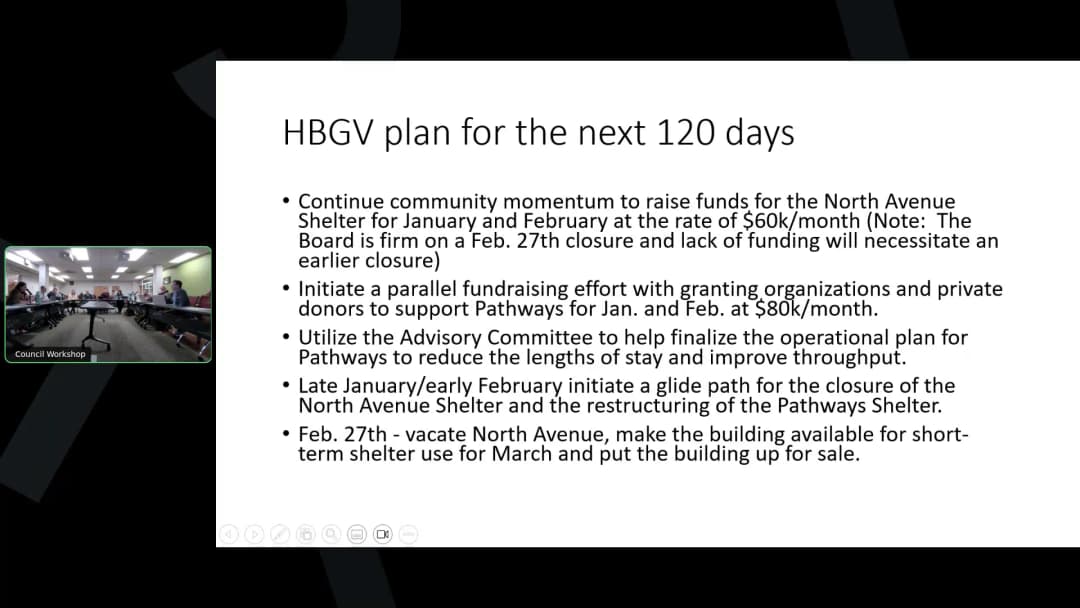
The Grand Junction City Council held a workshop on December 1, 2025, at 5:30 PM in the Fire Department Training Room. The meeting addressed HomewardBound of the Grand Valley's funding request, reviewed civic proclamations, and discussed the 2025-2026 Legislative Policy. The workshop was adjourned at 7:19 PM. HomewardBound of the Grand Valley Funding Request - Interim Executive Director Dan Prinster and Board Chair Brittany Bear presented the organization's financial situation and strategic plan. - North Avenue Shelter: licensed for 150 beds but operating at 90 due to staffing and safety concerns; monthly cost $60,000. - Pathways Shelter: licensed for 134 beds, operating at 100; monthly cost $80,000. - Current combined budget was $2.3M; new lean target is $1.5M. - A community campaign raised $150,000 for North Avenue (October–December); Pathways still needs $40,000 for December. - The total fundraising gap through February 2026 is approximately $300,000. - HomewardBound plans to consolidate both shelters into the Pathways facility by February 27, 2026, creating a 100-bed shelter with improved case management and length-of-stay enforcement. - Council expressed broad support for the strategic pivot but voiced concern about winter shelter availability and downstream community impacts. - Decision: Council directed staff to release the remaining 2025 city funds (approximately $185,000) to HomewardBound for discretionary use, likely prioritizing Pathways. Mesa County has tentatively earmarked $30,000 for early 2026 support. - Council will revisit additional funding in early 2026 and encouraged regional coordination with Mesa County and other municipalities. Museums of Western Colorado - This item was originally listed on the agenda but was postponed to the next workshop on December 15, 2025, as confirmed by city staff. Proclamation Review - The Council reviewed the standard list of recurring civic proclamations. No objections or changes were raised. City Council 2025–2026 Legislative Policy - Assistant City Manager Johnny McFarland presented the policy, which establishes roles for legislative tracking, advocacy, and communication. - Council reaffirmed alignment with Colorado Municipal League (CML) positions and retained the ability to take independent positions. - Staff will provide weekly legislative updates during the session; Council will improve communication through workshops. Council Communication - Councilmembers expressed support for regional planning discussions on homelessness with Mesa County and other municipalities. - Council suggested organizing an appreciation event for outgoing City Attorney John Shaver. Next Workshop Topics - City Manager Bennett outlined upcoming topics: Museums of Western Colorado (December 15), Colorado Mesa University update, and Parks Fee Discussion (tentative). Key Outcomes - Released $185,000 in 2025 city funds to HomewardBound of the Grand Valley. - County support of $30,000 tentatively expected for early 2026. - No changes to the proclamation list. - Legislative policy reaffirmed without amendments. - Museums discussion deferred to December 15, 2025. - Council to consider additional HomewardBound funding in early 2026.

HOMELESSNESS 72% · COMMUNITY ENGAGEMENT 18% · FISCAL SUSTAINABILITY 4% · PROCEDURAL 3%
42
NOV 19, 2025 · GRAND JUNCTION, COLORADO · CITY COUNCIL
Grand Junction City Council Regular Meeting – November 19, 2025

The Grand Junction City Council met on November 19, 2025 at 5:30 PM for its regular meeting, led by Council President Cody Kennedy. The meeting included proclamations, public comments, a city manager report, board liaison reports, a consent agenda, and four items on the regular agenda (including a zoning code continuation, a lease assignment, a wastewater code amendment, and the final approval of the 2026 budget). Key discussions centered on a resident’s flood damage claim, homelessness and the status of Homeward Bound, and the adoption of a $316.5 million budget. Proclamations - National Hospice and Palliative Care Month – proclaimed for November 2025; accepted by Jenny Marquez (Vice President, HopeWest). - Interfaith Awareness Week – proclaimed for November 19–25, 2025; accepted by Sharon Brocious and John Ainslie on behalf of the Grand Valley Interfaith Network. Consent Calendar - Approved minutes for the November 3 workshop, November 5 regular meeting, and November 5 executive session. - Set public hearings for the Ricciardella Annexation (7.37 acres at 2716 B ¼ Road) on January 7, 2026; a communication equipment lease at 2057 South Broadway on December 3, 2025; and supplemental appropriations on December 3, 2025. - Approved a contract amendment for design and engineering services for the city’s Materials Recovery Facility (MRF). - Adopted a series of resolutions: amending the Dos Rios subdivision sale terms; conveying an easement to the Bureau of Reclamation for Lateral 1A; issuing a revocable permit for a building encroachment at 410 Hill Avenue; finding that downtown redevelopment projects support the plan of development; levying 2025 taxes for the city and Downtown Development Authority (DDA); adopting 2026 rates, fees, and charges; and allocating property/sales tax revenues for the DDA. - Approved the 2026 operating plans and budgets for the Downtown Grand Junction and Horizon Drive Business Improvement Districts. - All consent items were approved unanimously by voice vote (5–0, with Councilmember Nguyen absent and Councilmember Stout joining later). Public Comments & Testimony - Douglas Hornok (resident of Canyon View Drive) – Described a September 4 flood that filled his basement with nearly 8 feet of water due to a blocked culvert and drainage ditch he claims were not maintained by the city and School District 51. The city’s insurer denied his claim, stating the culvert is the school district’s responsibility. He asked the council to investigate and ensure fair treatment. - Mark Buchanan (homeowner at 2813 Columbine Park Court) – Reported that the homeless encampment at Columbine Park has prevented him from selling his house since July; families cited safety concerns (needles, discomfort). He urged the city to address the park’s use and to find alternative housing for the homeless. - Nathan Jukes (recovery coach, Pair 180) – Provided updates on unhoused services: the annual point-in-time count will now be conducted annually for both sheltered and unsheltered individuals (date: January 27, 2026); a task force is raising $120,000 to keep the Homeward Bound North Avenue shelter open through January and February; a recent cold-weather gear distribution served 236 individuals; and mobile outreach continues. - Judy Dyrud (public hearing on the budget) – Supported the additional $30,000 for the Arts & Culture Commission, noting that arts grants enable daytime matinees that are accessible to elderly and disabled residents who avoid driving at night. - Porcia Silverberg (public hearing on the budget & member of Arts & Culture Commission) – Thanked the council for restoring arts and culture grants to $70,000, which is less than 0.1% of the city budget but supports a sector generating nearly $29 million in annual economic activity, over 550 jobs, and $800,000 in local tax revenue. Discussion Items - Zoning Code Amendment (Landscaping, Buffering, Screening, Measurements, Definitions) – Item 6.a.i was continued to the December 3, 2025 regular meeting by a unanimous vote (5–0) because a key stakeholder was unavailable. - Lease Assignment from Gray Media Inc. to Scripps Media Inc. – (Item 6.a.ii) City Attorney John Shaver presented the straightforward transfer of a long-standing lease for a television/radio transmitter site on Grand Mesa. Terms ($4,637 per year plus escalator) remain unchanged. The public hearing opened and closed with no comment. Ordinance No. 5284 was adopted 5–0. - Wastewater System Code Amendment (Connection to Sewer Mandatory) – (Item 6.b.i) Utilities Director Randi Kim explained the change: property owners building an accessory dwelling unit (ADU) on a parcel with a functioning septic system serving the primary residence may connect only the ADU to the public sewer; the primary residence can keep its septic until it fails. The Perigo Board had recommended the change. Public hearing: none. Ordinance No. 5285 was adopted 5–0. - 2026 Budget – Appropriation Ordinance (Second Reading & Public Hearing) – (Item 6.b.ii) City Manager Mike Bennett presented. The total 2026 Recommended Budget is $316.5 million, a decrease of $42.6 million (11.9%) from the 2025 adopted budget due to completion of Phase 1 of the Persigo Wastewater Treatment Plant expansion and the major construction phase of the Community Recreation Center. Key updates since prior hearings: council directed $698,443 from general fund reserves for attainable/affordable housing incentives and $450,000 for unhoused services (Hilltop, United Way, Joseph Center, Catholic Outreach); an additional $30,000 was added to the Arts & Culture Commission (for a total of $70,000). The general fund balance is $46.7 million with $29.3 million in minimum reserve and $16.4 million available for future needs. Public comments supported the arts funding. The hearing closed at 6:47 PM. Ordinance No. 5286 was adopted 6–0 (with Councilmember Stout present). Key Outcomes - Zoning code amendment continued to December 3, 2025 (5–0). - Lease assignment to Scripps Media approved (Ordinance 5284, 5–0). - Wastewater code amendment approved, allowing ADU sewer connections while retaining septic for primary residences (Ordinance 5285, 5–0). - 2026 Budget adopted (Ordinance 5286, 6–0). Total budget $316.5 million; includes housing incentives ($698,443) and unhoused services ($450,000) from general fund reserves. - Shoshone Water Rights Update – Councilmember Stout reported that the Colorado Water Conservation Board voted unanimously to clear the way for the Colorado River District’s acquisition of water rights associated with the Shoshone hydroelectric plant, a historic step for Western Colorado. - Discussion on Homeward Bound – Councilmember Beilfuss called for a special meeting, but Council President Kennedy and Councilmember Van Dyke noted that Homeward Bound is scheduled to present at the December 1 workshop and that the organization had previously deferred. The council agreed to continue the discussion at the workshop. - Flood claim follow-up – Council President Kennedy stated he will reach out to Mr. Hornok, noting the city is assessing responsibility while fulfilling its fiduciary duty.

HOMELESSNESS 19% · WATER AND WASTEWATER MANAGEMENT 15% · BUDGET EQUITY ANALYSIS 15% · COMMUNITY ENGAGEMENT 13%
43
NOV 17, 2025 · GRAND JUNCTION, COLORADO · CITY COUNCIL
Grand Junction City Council Workshop: November 17, 2025

The Grand Junction City Council held a workshop on Monday, November 17, 2025, from 5:30 p.m. to 8:09 p.m. at the Fire Department Training Room, 625 Ute Avenue. All seven Councilmembers were present: Mayor Cody Kennedy and Councilmembers Robert Ballard, Scott Beilfuss, Laurel Lutz, Jason Nguyen, Anna Stout, and Ben Van Dyke. The meeting was live-streamed via GoToWebinar. As a workshop, no formal public comment period was held and no formal votes were taken; staff received direction on several upcoming actions. Discussion Items Depot Federal Grant Discussion - The Depot Federal Grant Discussion was moved to the top of the agenda at the request of staff. Dustin Anzures of GJ Union Depot presented alongside Veronica Sanchez, explaining that the project has been in planning for 10 years and the City would need to act as the eligible applicant for a Federal Railroad Administration (FRA) grant, with the Depot as subrecipient. - The grant opportunity comes from the Infrastructure Investment and Jobs Act, with a pool of just over $5 billion, an application deadline of January 7, and an 80/20 federal/local match. The project scope is approximately $6.342 million, consisting of about $5.073 million in federal funds and a $1.27 million local match. Anzures explained that an earlier $4.7 million estimate was adjusted upward to account for Build America, Buy America requirements and Davis-Bacon prevailing wage costs. - Amtrak has a pre-lease agreement for three 20-year terms to return to the depot, has budgeted $6 million for Grand Junction platform improvements by 2029, and currently ranks Grand Junction sixth in revenue among 37 stations on the California Zephyr route. - The project would rehabilitate the depot, add a restaurant, cocktail lounge, retail space, public social lounge, and track-side patio, and acquire about 0.8 acre across the street for surface parking. Funding raised to date includes more than $1 million in private investment, a $500,000 DDA Catalyst grant, over $130,000 in private donations through Friends of GJ Union Depot, and volunteer contributions from AmeriCorps teams totaling about 2,200 hours by December 12. - An economic impact study commissioned through the Grand Junction Economic Partnership estimated a total impact of $38.1 million, with roughly $19 million recurring annually and $19 million occurring at the time of construction. - Councilmembers broadly voiced support, describing the depot as a community asset that could improve downtown activation, safety, tourism, and long-term economic vitality. Mayor Kennedy noted the city was not being asked to put up cash, and Councilmember Stout said the public-private partnership format was one the city should be eager to participate in. - Staff noted the federal grant carries administrative burdens and compliance risks, but safeguards such as an MOU, match verification, and cascading liability provisions would be included. Council directed staff to prepare a December resolution authorizing the City Manager to apply for the grant, to be considered at a regular City Council meeting. Town Hall Update - Communications and Engagement Manager Kelsey Coleman presented a debrief of the October 28 Town Hall, the first held under the Meet You There community engagement initiative and the first City Council town hall in recent memory. - The town hall room had a capacity of 120, the RSVP was capped at 140, and 80 people attended in person. The city hosted its first Facebook Live since 2011, with about 30 live viewers and nearly 6,000 total views. More than 50 questions were submitted. - Feedback was generally positive, especially about transparency, access to council, and informal conversation. Mixed feedback focused on the question format, space limitations and RSVP cap, having only one councilmember respond per question, the need for staff at the table for operational questions, and audio issues during the livestream. - Councilmembers offered suggestions including topic-specific town halls, allowing multiple councilmember responses, adding informal social time before or after events, including staff moderators and subject-matter experts, improving livestream quality, and considering larger venues. Some councilmembers reported constituent feedback that answers sounded like beauty pageant answers and that council was not always equipped to answer operational questions. - Staff recommended a cadence of two general town halls per year, one in the spring and one in the fall, plus additional topic-specific or site-specific engagements when needed. No formal decision was made, but council consensus supported continuing and refining the format. Judicial Review Commission - The Council revisited the structure and appointment process for the Municipal Court Judicial Review Commission. - Councilmember Stout, drawing on her experience serving on the commission, recommended moving away from having active councilmembers serve in order to avoid perceived or actual bias, and instead having appointed citizens compile a report for the full Council to review. - Councilmembers generally agreed with that approach. Councilmember Nguyen recommended a larger commission of five to seven members to avoid any two members dominating the process. - Staff noted the ordinance allows between three and seven members, that terms are four years, and that the current commission includes one sitting councilmember and one former councilmember. The commission is appointed to review the municipal court judge, including docket management, communication skills, and delivery of court services. - Council directed staff to conduct broad outreach rather than have councilmembers select reviewers, and to bring back appointment recommendations. Council also favored a larger commission of five to seven members, with findings reported to the full Council. I-70/29 Road Interchange - City Manager Mike Bennett and Engineering and Transportation Director Trent Prall provided an update on the I-70/29 Road Interchange. Prior councils and the Board of County Commissioners had directed staff to obtain state and federal clearance and return before issuing the final design Request for Proposals (RFP). - Staff confirmed that concurrence from the Colorado Department of Transportation (CDOT) and the Federal Highway Administration (FHWA) has been obtained, and requested confirmation to proceed with issuing the RFP and initiating final design. - Funding includes $2 million in Congressionally Directed Spending, with $220,000 in city matching funds and $220,000 in Mesa County matching funds, plus a pending $1 million application to the Rural and Tribal Lands grant program. If the pending grant is awarded, the project could reach 100% design for both the 29 Road improvements and the interchange; if not, the project would still reach 100% design for 29 Road improvements but only 30% design for the interchange. - Staff emphasized that proceeding with design does not commit the city to building the interchange, that no interchange can be built without a new voter-approved funding source, and that design would help address existing congestion at 29 Road and Patterson Road, support multimodal needs such as sidewalks, a cycle track, and school access, and make the city more competitive for future state and federal construction grants. - Trent Prall noted that final design would include phased options for the 29 Road corridor, with a three-lane section initially and the ability to widen later if needed. He also cited updated state demographic projections reducing the county's anticipated 2050 population from about 218,000 to about 188,000, and said the proposed design still works under the lower projections. - Councilmember Jason Nguyen said he remains intensely skeptical of the interchange itself but supports moving forward with the design because it advances 29 Road improvements. Other councilmembers echoed that they were supporting the design phase, not construction. Councilmember Scott Beilfuss raised ongoing neighborhood concerns about noise, traffic inflow, and the perception that the failed ballot measure is being ignored. - Staff confirmed they will proceed with issuing the design RFP in line with previous council direction unless the Council directed otherwise. No formal vote was taken. Council Communication - Councilmember Stout said she will attend the Colorado Water Conservation Board meeting in Denver regarding Shoshone water rights and may be late to or participate virtually in Wednesday’s council meeting. - Museums of the West financial challenges continue; RFPs are underway and the City and Downtown Development Authority are assisting with feasibility studies, including a possible consolidation study. - Mayor Kennedy reported a recent meeting with Homeward Bound leadership, noting that they intend to provide revised financial clarifications and future goals. Next Workshop Topics - City Manager Bennett outlined upcoming workshop topics, including a Museums of Western Colorado update on December 1, a possible Homeward Bound update, and the annual proclamation review for 2026. Other Business - Councilmembers made brief comments about meetings being held with Homeward Bound. No action was taken. Key Outcomes - Depot Federal Grant: Council directed staff to prepare a December resolution authorizing the City Manager to apply for the FRA grant, with the Depot as subrecipient and a grantee/subrecipient agreement to be completed if the grant is awarded. - Town Hall: Council endorsed continuing the Meet You There initiative and refining future town halls with topic-specific formats, multiple councilmembers responding, staff experts available, social time before or after events, and improved livestream quality and venues. - Judicial Review Commission: Council directed staff to conduct broad outreach and bring back appointment recommendations, with no active councilmembers serving, a preferred commission size of five to seven members, and findings reported to the full Council. - I-70/29 Road Interchange: Staff will proceed with issuing the design RFP per previous council direction; the design phase does not commit the city to constructing the interchange, and construction would require a future voter-approved dedicated funding source.

TRANSPORTATION SAFETY 35% · DOWNTOWN DEVELOPMENT 16% · PUBLIC ENGAGEMENT 11% · JUDICIAL REVIEW 9%
44
NOV 13, 2025 · GRAND JUNCTION, COLORADO · CITY COUNCIL
Grand Junction Housing Affordability Task Force Meeting — November 13, 2025

The Housing Affordability Task Force met on Nov. 13, 2025, at 15:30 UTC. No agenda or minutes were available, so this summary is based solely on the raw transcript. The group reviewed progress on residential code issues, discussed upcoming planning commission workshops, and made or refined recommendations on plat expiration, inclusionary zoning, open-space code, and revocable permits. Process and Workshop Coordination - The task force agreed to adjust its meeting schedule around holidays: next meetings set for Dec. 4 and Dec. 18, with no late-December meetings. - Members asked for better coordination when task force recommendations are sent to planning commission workshops. They want to see staff responses before hearings and avoid having a workshop on Thursday followed by a hearing the following Tuesday. - Two planning commission members on the task force can serve as the canaries to flag misalignment, but members also wanted a formal way for staff reactions to come back to the task force. - Staff's internal spreadsheet of code amendments will be included in future task force packets so members can see what is coming up. - The task force wants to have standing at planning commission and city council hearings, not as applicants but as a group council can question alongside staff, similar to a workshop-style discussion. Plat Expiration and Approval Periods - Keith presented a draft amendment to the final plat expiration process. The current code uses preliminary plat language, allowing automatic one-year renewals when a phase is recorded within two years, but it does not clearly protect plats while construction is underway. - The group identified that a two-year period is often too short; projects can face construction delays, material delays, and other issues. Ron noted that if a plat expires after infrastructure is built, the developer may face a fight over retaining that infrastructure. - The task force generally favored changing the initial approval period to five years and adding two-year extensions, with extensions denied only if there has been a meaningful code change, unless state law requires compliance. - There was discussion about whether the city should be required to send expiration notices. One member questioned making the city responsible for tracking private approvals; others noted an automated reminder from the city's permitting system would be useful. - Keith will redraft the language to include the five-year period, extension criteria, notification language, and potentially apply the same approach to construction plan approvals. The revised draft is expected at the Dec. 4 meeting. Inclusionary Zoning and Linkage Fees - Kevin presented a recommendation against inclusionary zoning and linkage fees as tools for Grand Junction. He cited the city's 2024 housing strategy stakeholder survey, where inclusionary zoning received only one vote out of 100, and said prior consultant work consumed significant city resources. - Mike said city council and staff are not inclined to pursue inclusionary zoning or linkage fees; the housing plan update, due around 2026, will revisit these strategies, but staff view them as evaluated and unlikely to move forward. - Emily, a task force member, said she could accept a statement that inclusionary zoning is not the right fit for Grand Junction but was uncomfortable with a broad policy statement that inclusionary housing is harmful everywhere. - The task force asked Kevin and Emily to refine the wording so it is narrowly focused on Grand Junction. The recommendation will then be forwarded to city council without returning to the task force. Open Space, Significant Trees, and Rock Outcroppings - Kevin reviewed a code section requiring subdivision plats to include and protect open space features such as stream beds, bluffs, ridges, steep slopes, mature trees, rock outcroppings, wetlands, and native ecosystems. He argued this is an overreach when applied to private property features like rock outcroppings and creates additional housing costs. - Members questioned the breadth of the phrase about protecting as much open space as the director deems reasonable, the inclusion of expansive soils, and whether wetlands and canals are already regulated by other agencies. Kevin will check with a surveyor and city staff on legal and plat issues and continue working on the draft for a future meeting. Revocable Permits and Other Assignments - Mike reported that many stakeholders agree the revocable permit process is broken and expensive, especially for landscape and irrigation crossings in right-of-way. Obtaining permits can cost around $2,000 each, with a recent case involving 12 to 15 permits in one filing. - Planning, engineering, and survey staff have said the process is onerous, while one legal representative reportedly characterized it as not a big deal. The next step is to bring stakeholders together, including city attorney, planning, engineering, and survey representatives, to develop a template or blanket revocable permit approach. - Surveyors are being asked for input, but some requested anonymity. The task force will also look for prior survey feedback from the city before the next meeting. - The group also noted that detention facility amendments are on a planning commission workshop agenda but are being re-evaluated because of state law on non-functional turf. TEDS and Broader Policy Connections - The task force discussed how changes to TEDS intersect with the comp plan, complete streets, and bike and ped plan policies. Staff reportedly summarized most TEDS changes as implementing the bike and ped plan. - Some members said a consultant may be needed to trace the policy web and identify where changes upstream would be required to support housing affordability changes in TEDS. Others observed that broad policies often allow multiple interpretations and do not necessarily dictate exact TEDS language. - There was support for establishing policy-development standards, including accurate data, alternatives, cost analysis, and adequate review time, so future code changes do not repeat the same problems. More detailed TEDS discussion is expected at the next meeting. Key Outcomes - No formal votes were taken; outcomes were reached by consensus. - Keith will prepare a revised plat expiration amendment with five-year approvals and two-year extensions and bring it to the Dec. 4 meeting. - Kevin and Emily will revise the inclusionary zoning and linkage fee recommendation and forward it to city council. - Staff's code amendment matrix will be shared with the task force as an ongoing agenda item. - A stakeholder meeting will be arranged to develop revocable permit reforms. - Kevin will continue refining the open space and rock outcropping code item. - The next task force meetings are scheduled for Dec. 4 and Dec. 18, 2025.

ENGINEERING AND INFRASTRUCTURE 24% · ZONING AND DEVELOPMENT 24% · AFFORDABLE HOUSING 20% · COMMUNITY ENGAGEMENT 12%
45
NOV 5, 2025 · GRAND JUNCTION, COLORADO · CITY COUNCIL
Grand Junction City Council Regular Meeting Summary – November 5, 2025

The Grand Junction City Council met in regular session on Wednesday, November 5, 2025, at 5:30 p.m. in the City Hall Auditorium, 250 North 5th Street. Council President Cody Kennedy presided. Present were Councilmembers Robert Ballard, Scott Beilfuss, Jason Nguyen, and Ben Van Dyke; Councilmember Anna Stout attended virtually; Councilmember Laurel Lutz was absent. The meeting included presentations from the Business Incubator Center and Sports Commission, board appointments, public comment, consent agenda approval, and public hearings on the CDBG CAPER and the proposed 2026 budget. The meeting adjourned at 8:49 p.m. Presentations - Business Incubator Center Update: CEO Dalida Bollig reported the incubator, founded in 1986, has assisted one in three businesses in Mesa County. In 2024 it worked with 526 businesses, helped create 519 full-time jobs, and had 84 businesses on campus; it currently houses 102 startups. It provided $2.02 million in direct loans and leveraged $3.18 million in additional funds, and has invested $4.26 million in 22 businesses year-to-date. Bollig highlighted $1.4 million in nonprofit and $3.5 million in for-profit Enterprise Zone tax credits and warned that downtown and 23-to-29 Road areas are being removed from the Enterprise Zone, with grandfathering available before year-end. She invited the public to the Small Business Holiday Expo on November 21. - Grand Junction Sports Commission Update: Executive Director Ben Snyder said the commission is in its 10th year. It receives three-quarters of one percent of the 6% lodging tax, with about $577,000 estimated for 2025, and raises about $343,000 from events and sponsors. About $547,000 goes back into community events, including $48,000 in grants. Notable 2025 events included the World Wake Association event at Highline Lake ($427,000 direct spend), USA Cycling collegiate mountain bike nationals at Powderhorn (projected $950,000 direct spend, 462 athletes, 48 schools), the NCAA triathlon, and the Rim Rock Marathon. The commission partners with more than 72 events, owns/operates 8–10 events, and draws about 25,000 participants and over 200,000 spectators annually. Snyder said lodging tax is 62% of the commission's budget, and additional venues are needed. Appointments - The Council unanimously appointed Dave Fishell, Adam Nikirk, and Sidney Woods to the Historic Preservation Board for terms expiring December 31, 2029. The 6–0 voice vote included virtual participation. - The Council unanimously appointed Christina Schultz and Dora Fang and reappointed Julie Shafer to the Visit Grand Junction Board for terms expiring December 31, 2028. Public Comments & Testimony - Seth Williams, speaking as a citizen and volunteer, expressed concern about rising housing costs and the impending closure of HomewardBound's shelter, which he said lacks funding after January 5, 2026 and has been closed on weekends since October. He argued the city has no clear plan for unhoused residents and called for policies such as Housing First used in Salt Lake City. - Ed Kowalski, a 42-year valley resident, said he had been told bikes could ride anywhere on sidewalks but learned that is not true; he urged accurate information. - Henry Brown criticized the city's housing affordability code task force, saying it felt like a 'protecting developers profit margins task force.' He argued that transportation and car costs affect affordability and asked the Council to consider broader livability and connectivity impacts. City Manager Report - City Manager Mike Bennett reported that Standard & Poor's assigned a AA rating to the city's upcoming general fund revenue bonds and a AA- rating to the certificates of participation, and affirmed ratings on existing debt. He quoted the ratings report praising the city's financial management, reserves, and low fixed-cost profile. (The meeting minutes describe both as AA; the transcript reports AA for bonds and AA- for COPs.) Boards and Commission Liaison Reports - Councilmember Beilfuss reported on the Historic Preservation Board's tour of a Second Street property, a Business Incubator Center board meeting, the Riverside Technical Corporation meeting, a Hilltop meeting, the affordable housing workshop, and the recent City Council Town Hall. - Councilmember Ballard and Councilmember Van Dyke reported on the Town Hall; Van Dyke also echoed the need for businesses to apply for Enterprise Zone grandfathering. - Councilmember Stout reported on Colorado Municipal League legislative positions and an upcoming Parks and Recreation Advisory Board meeting. - Council President Kennedy reported on the Town Hall, modular housing conversations, Strong Schools/Strong Community, Museums of Western Colorado, and ongoing meetings regarding HomewardBound. Consent Calendar - The Council unanimously approved Consent Agenda Items 1 and 2. This approved minutes from October 6 and October 13, 2025 workshops and the October 15, 2025 regular meeting, and set public hearings for: - The Messick-Dangler annexation of 27.2 acres at 378 30 Road, with a public hearing on December 17, 2025; - Assignment of a city land lease from Gray Media Inc. to Scripps Media Inc., with a hearing on November 19, 2025; - Zoning and Development Code amendments on landscaping, buffering, screening, measurements, and definitions, with a hearing on November 19, 2025; - Wastewater System Code Section 13.04.090 mandatory sewer connection amendment, with a hearing on November 19, 2025. Public Hearing: 2024 CDBG CAPER Review - Housing Manager Ashley Chambers presented the Consolidated Annual Performance and Evaluation Report for the 2024 Community Development Block Grant Program Year. The city has been a CDBG entitlement community since 1996. The 2024 year included a $398,577 allocation plus about $80,600 in reallocated prior-year funds, totaling approximately $479,000. Funded projects included $140,000 for Columbine Park, $77,000 for West Lake Park, and safe-routes improvements on Hermosa Avenue and Ellis Street (shown in the raw transcript as $160,004,000, likely intended as a smaller dollar figure). Accomplishments included $672,000 in CDBG spending on affordable housing from 2021–2023, mobile home repairs through Housing Resources of Western Colorado, and $89,000 in pre-development funding for Habitat for Humanity of Mesa County. - The public hearing opened and closed at 6:35 p.m. with no public comments. No motion was required; the report will be submitted to HUD by November 26 after the 15-day public review period. Public Hearing: 2026 Budget Introduction and First Public Hearing - City Manager Mike Bennett presented the proposed 2026 budget of $316.4 million, a decrease from 2025 largely due to the completion of major phases of the Community Recreation Center and Persigo Wastewater Treatment Plant projects and to operational reductions. The council-directed use of $668,443 in general fund reserves for attainable/affordable housing incentives and services for unhoused residents is included. The general fund balance is projected to end 2026 at $46.7 million, with $29.3 million (25%) held as the required minimum reserve. - The budget includes a 9.7% increase in labor costs, 29 new positions (including 13 in public safety), 10 frozen vacant positions, a reduction of five positions, a 32% drop in capital spending, and $16.1 million in debt service. Public safety investments include five new police officers, a Bearcat tactical vehicle, continued ARCTIC real-time information center build-out, a future police annex using certificates of participation, a community paramedic program, three firefighter EMTs, a battalion chief, and a fire inspector, plus a 2026 fire academy. - Other budget highlights included $32.1 million in engineering/transportation capital projects, water and sewer infrastructure replacements, the Salt Flats affordable housing project with more than 324 planned units, an accessory dwelling unit incentive program, $100,000 for Joseph Center and $250,000 for Hilltop for unhoused services, and $61,153 in CDBG funds plus about $13,000 for Grand Valley Catholic Outreach. Bennett also noted the proposed elimination of the vendor fee, continued tourism investment because visitors generate up to 30% of sales tax revenue, and utility/rate adjustments including water, sewer, golf, parking, and solid waste/recycling increases. - Councilmember Beilfuss asked about housing and homeless funding. Bennett explained the budget includes $450,000 in one-time funds for services for unhoused individuals and referenced ongoing discussions with HomewardBound and Mesa County. HomewardBound has announced plans to close the North Avenue shelter on January 5, 2026. - The public hearing opened at 7:48 p.m. and closed at 8:20 p.m. Speakers included Thomas Copp, Dennis Simpson, Portia Silverberg, Ramona Windkeller, Cynthia Zates, David Kenworthy, Peter Booth, Heather McKim, TJ Smith, Jeff Gustofson, and Andrew Price. Multiple speakers urged the Council to restore Commission on Arts & Culture funding from the proposed $40,000 to the prior $70,000, citing economic returns, community connection, free performances, youth theater, and arts-based tourism. Dennis Simpson, a former councilmember, argued the 0.75% sales tax should be considered available for housing and human needs, estimating about $20.4 million in that revenue. - Council discussion focused on the arts funding cut. Councilmembers Beilfuss, Stout, Nguyen, and Kennedy supported restoring $70,000; Councilmembers Ballard and Van Dyke expressed reservations, noting other city arts investments including 1% for the arts capital funding, $700,000 in public art at the Community Recreation Center, and $60,000 for the Avalon Theater dressing rooms. Councilmember Stout also read a letter from a disabled resident asking the Council to maintain the $70,000 arts funding level. Councilmember Van Dyke nevertheless made a motion to introduce the appropriation ordinance with an additional $30,000 for the Commission on Arts & Culture grant program, bringing that line to $70,000; the funding source was not specified in the motion and staff was directed to identify it before the second hearing. Key Outcomes - Appointments to the Historic Preservation Board and Visit Grand Junction Board were approved unanimously. - The Consent Agenda, including minutes and setting of future public hearings, was approved unanimously. - The CDBG CAPER public hearing was held with no public comments; no motion was needed. - The 2026 Budget Appropriation Ordinance was introduced by unanimous 6–0 vote, with the second public hearing and final adoption consideration set for November 19, 2025. The motion included an additional $30,000 to restore the Commission on Arts & Culture grant funding to $70,000; the funding source was to be identified by staff and reported at the second hearing. - The meeting adjourned at 8:49 p.m.

BUDGET EQUITY ANALYSIS 24% · ARTS AND CULTURE 16% · PUBLIC SAFETY 9% · AFFORDABLE HOUSING 8%
46
NOV 3, 2025 · GRAND JUNCTION, COLORADO · CITY COUNCIL
Grand Junction City Council Workshop Summary – November 3, 2025

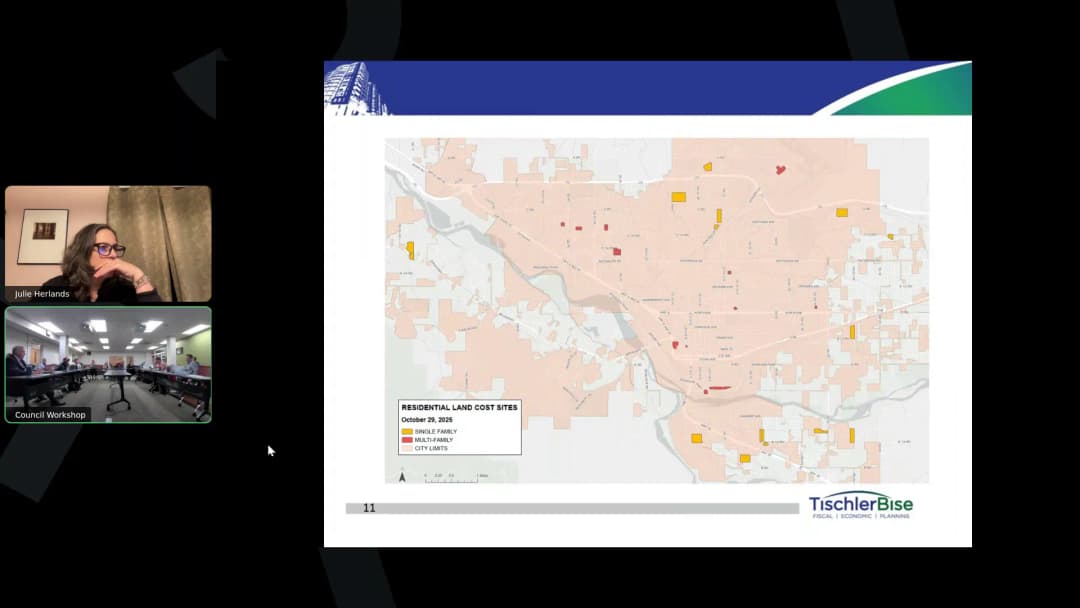
The Grand Junction City Council held a workshop on Monday, November 3, 2025, convening at 5:30 p.m. in the Fire Department Training Room, 625 Ute Avenue, and live-streamed via GoTo Webinar. The workshop covered three discussion topics: a Counseling & Education Center funding request, a Dos Rios development update, and the parks impact fee. Councilmembers Robert Ballard, Scott Beilfuss, Laurel Lutz, Jason Nguyen, Ben Van Dyke, and Mayor Cody Kennedy were present; minutes list Councilmember Anna Stout as absent, although the transcript's opening references a virtual councilmember. Staff included City Manager Mike Bennett, City Attorney John Shaver, Deputy City Manager Kimberly Bullen, CFO Jay Valentine, Community Development Director Tamra Allen, Parks and Recreation Director Ken Sherbenou, Deputy City Clerk Misty Williams, and City Clerk Selestina Sandoval. No formal votes were taken; council gave staff direction. The workshop adjourned at 8:25 p.m. Counseling & Education Center 2025 Funding Request - Hali Nurnberg, Executive Director of the Counseling & Education Center (CEC), presented the request and answered questions. - CEC was awarded approximately $996,000 in American Rescue Plan Act (ARPA) funds from the City in 2023; the City has invested $996,000 in the project. CEC also received state ARPA funding through the Behavioral Health Administration, bringing combined ARPA awards to just under $2 million. - The new Orchard Mesa site is intended to serve an additional 300–400 low-income clients annually, expanding CEC's total capacity to 700–800 clients across two locations. A temporary Orchard Mesa location already serves 120 clients. - Construction costs increased by about $1 million due to change-of-use requirements and infrastructure upgrades (e.g., parking, drainage, ADA compliance), raising the renovation budget from the original $495,000 estimate. CEC has raised 50% of the $1 million gap, leaving about $500,000 to raise. - CEC reported it has increased private donation revenue by 340% since 2022 and operates internship and workforce development programs. It recently received $450,000 from the Regional Employment Council. - CEC requested that the City refund or cover the $20,985.84 Transportation Capacity Payment (Impact Fee) and related engineering inspection fees. Staff noted the fees were disclosed in November 2024 during development review. - Councilmembers expressed strong support for the request, citing the need for mental health services in Orchard Mesa, the historic building's reuse, and alignment with the City's strategic plan. - Staff were directed to prepare a supplemental appropriation ordinance before year-end to potentially refund the fees from the City's reserve fund. Dos Rios Update from Developer May Riegler - Kevin Reigler, representing developer May Riegler, presented a request to extend the closing date for the remaining Part II land at Dos Rios. The agenda spells the developer as 'May Reigler'; the minutes use 'May Riegler.' - Under the purchase and sale agreement authorized by Ordinance 4992 and amended by Resolution 81-24, the developer is currently contracted to close on the remaining Part II land (Lot 1 and Lot 5, Riverfront at Dos Rios Filing Three) by December 1, 2025. The proposed Eleventh Amendment would extend closing to on or before December 31, 2026. - The developer already owns about 82% of the Dos Rios development land and has invested approximately $7 million in the site, not including the Starbucks, townhouses, or city infrastructure. - Reigler attributed the delay to macroeconomic conditions, including high interest rates and construction inflation, and said 2026 may be a better year to restart major vertical development. - Councilmembers asked about alternatives, carrying costs, and financial exposure. City Attorney John Shaver noted that refusing an extension could put the city in a breach situation and that re-marketing the property would be complicated by the existing development plan and infrastructure. - CFO Jay Valentine outlined General Improvement District (GID) debt: the 2025 annual debt payment was $705,000; 2026 payments could be $936,650; and 2027 payments jump to $1,033,000. The current mill levy is 7 mills, with a 50-mill maximum required by the bond documents. - Council consensus favored a one-year extension, citing the developer's investment and better position to advance the project. Staff will bring a formal resolution to the November 19 council meeting. Parks Impact Fee Discussion - City staff reviewed the recently updated impact fee study. The City contracted with TischlerBise to update the study required by code; the last study was completed in 2019. A new fee schedule and municipal code changes were adopted on April 2, 2025, after stakeholder group meetings, multiple council and planning commission workshops, and community meetings. - A TischlerBise consultant explained the parks and recreation fee methodology, which uses a consumption-based approach with three components: park land, open space, and park improvements. It is designed to maintain the citywide level of service, not to fund specific new parks. - The Housing and Building Association (HBA) of Western Colorado requested that the City reconsider the adopted parks fee, including its calculation, collection, and tracking. An HBA representative argued that the $147,513 per-acre average land cost is skewed by outliers; builders' experience on the outskirts is around $42,000 per acre. The representative also said the proposed fee could raise about $20 million over 10 years, while the HBA's suggested approach would raise about $6.5 million, and noted the City spent about $2 million on parkland acquisition in the last 10 years. - Councilmembers discussed alternative methodologies, including removing outliers, using medians, and aligning fees with future park planning areas identified in the PROS plan. Parks and Recreation Director Ken Sherbenou noted the PROS plan identifies priority future parks, including Horizon Park, and that the east side of Grand Junction has a lower level of service. - City Attorney John Shaver cautioned that impact fees must be tied to a legally defensible nexus study and that location-specific future need may not be the correct basis for a citywide fee. - Council directed staff and TischlerBise to explore alternative methodologies and bring options back for review. The code now calls for fee study updates at least every eight years moving forward. Council Communication - Council discussed having partner organizations attend a future workshop to discuss a plan for the houseless community. - City Manager Mike Bennett provided an update on Homeward Bound, noting it may not submit a 2026 funding request and that the North Avenue shelter is expected to operate through January 5, 2026, based on fundraising. He also suggested a possible future joint meeting with Mesa County on the houseless strategy. Next Workshop Topics - Upcoming workshop topics include a Townhall Debrief, Judicial Review Committee, 29 Road Interchange, and Museums of Western Colorado. - City Attorney John Shaver discussed the Judicial Review Commission, noting two citizen-at-large seats need to be filled; they have historically been councilmembers. He will send more information to council, and the matter may be agendized for a future workshop. - Council discussed the 29 Road Interchange next steps before proceeding with a request for proposals for final design. Other Business - Council received proclamation requests for Hospice and Palliative Care Month (November 2025) and Interfaith Awareness Week (November 19–25). Council requested that both proclamations be scheduled for reading at future council meetings. Key Outcomes - CEC funding request: Council directed staff to prepare a supplemental appropriation ordinance before year-end to potentially refund the Transportation Capacity Payment and engineering inspection fees from the City's reserve fund. - Dos Rios: Council consensus supported a one-year extension for the remaining Part II land purchase; staff will bring a formal resolution to the November 19 council meeting. - Parks impact fee: Council directed staff and TischlerBise to explore alternative methodologies, including removing outliers, using medians, and examining future park planning areas, and to bring options back for review. - Proclamations: Both requested proclamations were scheduled for reading at future council meetings.

PARKS AND RECREATION 24% · ECONOMIC DEVELOPMENT 16% · DOWNTOWN DEVELOPMENT 13% · MENTAL HEALTH AWARENESS 12%
47
OCT 30, 2025 · GRAND JUNCTION, COLORADO · CITY COUNCIL
Grand Junction Housing Affordability Task Force Meeting Summary - October 30, 2025

The Grand Junction Housing Affordability Task Force met on October 30, 2025, at 15:30 UTC to continue developing code and policy recommendations aimed at lowering housing costs. Members reviewed pending proposals, assigned new work on transportation engineering design standards (TEDs), approval expirations, and staff review practices, and discussed how to handle commercial code issues without losing focus on residential affordability. Discussion Items Task force scope and commercial code - Mayor Kennedy asked the group to keep its primary focus on residential housing affordability, while allowing adjacent commercial items to be referred to another avenue when they overlap with multifamily or other housing work. - Several members supported forwarding a recommendation that City Council create a separate avenue or subcommittee for commercial code improvements, rather than letting those issues disappear. - Some members noted commercial code crosses over into multifamily, so relevant commercial items should still be considered where they affect housing costs. TEDs consultant scope - Ivan said TEDs are a major cost driver and proposed hiring a consultant, perhaps around $100,000 rather than $200,000, to review street-section standards and multimodal requirements. - Mark and Ivan agreed to draft a narrow scope or RFP for a TEDs consultant by the Monday before the next meeting so the committee could decide whether to request funding. - Staff noted the city faces a 14% operational budget cut, so any consultant funding would likely require a one-time fund-balance decision by Council. - Keith cautioned that TEDs are tied to other adopted policies and codes; Ivan responded that the TEDs standards themselves set unnecessarily high costs, citing the FNFO Parkway at $33 million per half mile. - A member also suggested creating an administrative committee when a project receives a certain number of review comments, at the applicant's choice, to avoid endless review cycles. Certified irrigation design requirement - Ivan and Mark presented a proposal to remove the certified irrigation designer requirement from the landscape code, saying the certification does not exist in practice and landscape architects should be able to stamp irrigation designs within their licensure. - Members agreed the recommendation was directionally sound, but asked Ivan to verify the correct code section because his draft cited an unrelated section (21.06.040) from an AI search. Bicycle parking/storage - Mark and Mike presented a previously submitted recommendation to remove long-term bicycle parking/storage requirements from the code, including for multifamily projects. - The group confirmed this recommendation was already forwarded to staff. Landscaping and irrigation for properties without water access - Ivan and Mark discussed a proposal to reduce or waive landscaping/irrigation requirements where irrigation water is not available or a tract has historically not been irrigated, noting costs of $15,000-$25,000 or more on affected projects. - Speakers stressed that the solution should be a clear code flexibility, not a variance, and that no-irrigation landscaping standards should be developed. - The item was sent back to Ivan and Mark for further work, with input from Kevin and others. Local agency referrals and staff review authority - Mark described repeated instances of city staff adding requirements outside the code, such as directing developers to pipe irrigation ditches and collect signatures from all downstream users, and said staff should cite code sections and refer outside agencies without enforcing risks that belong to the developer. - Members agreed to send a recommendation to staff asking them to outline and define planning staff's review role, including code-citation requirements and how referral-agency comments are handled. - The group also identified survey department demands, such as perfect title requirements, as a related problem needing urgent intervention; Ron, Mike, and Ivan agreed to work on it. Approval expirations - Mike and Keith discussed a proposal to lengthen approval expirations to a five-year minimum, allow multi-year extensions, and prevent approvals from expiring while a project is under construction. - They agreed to draft a recommendation for the committee, including a requirement for city action or notice before an approval expires. Other items discussed - Detention-pond aesthetics: members questioned a mandate to make detention ponds amenities, asked for a status update from city staff, and noted concerns about final acceptance and drainage issues. - Cottage courts: a member said the current code is well-intentioned but does not work in practice; if he proceeds with a potential cottage-court project, he will share the case study. - Inclusionary zoning: one member noted the housing strategy still lists inclusionary zoning even though only one of 100 stakeholders surveyed supported it; others responded that the housing strategy is already being reviewed by the housing division and may be better addressed separately. Key Outcomes - The task force confirmed its focus on residential housing costs and will refer commercial-code items through a separate avenue. - Mark and Ivan will prepare a narrow TEDs consultant scope/RFP for review before the next meeting. - The certified irrigation design repeal will be finalized with a corrected code section and then forwarded as a recommendation. - The bicycle parking/storage recommendation remains forwarded to staff. - Ivan and Mark will continue developing landscaping/irrigation flexibility language, including no-irrigation planting standards. - A request will be sent to staff to define planning staff's review procedure and code-citation expectations. - Ron, Mike, and Ivan will work on survey-related intervention, and the group will seek a city status update on detention-pond requirements. - Mike and Keith will draft approval-expiration recommendations for the next meeting.

ENGINEERING AND INFRASTRUCTURE 29% · ZONING AND DEVELOPMENT 20% · AFFORDABLE HOUSING 19% · WATER AND WASTEWATER MANAGEMENT 13%
← PREVIOUS
01…0405
OPENPUBLICA · PUBLIC MEETING INDEXUPDATED DAILY · openpublica.com