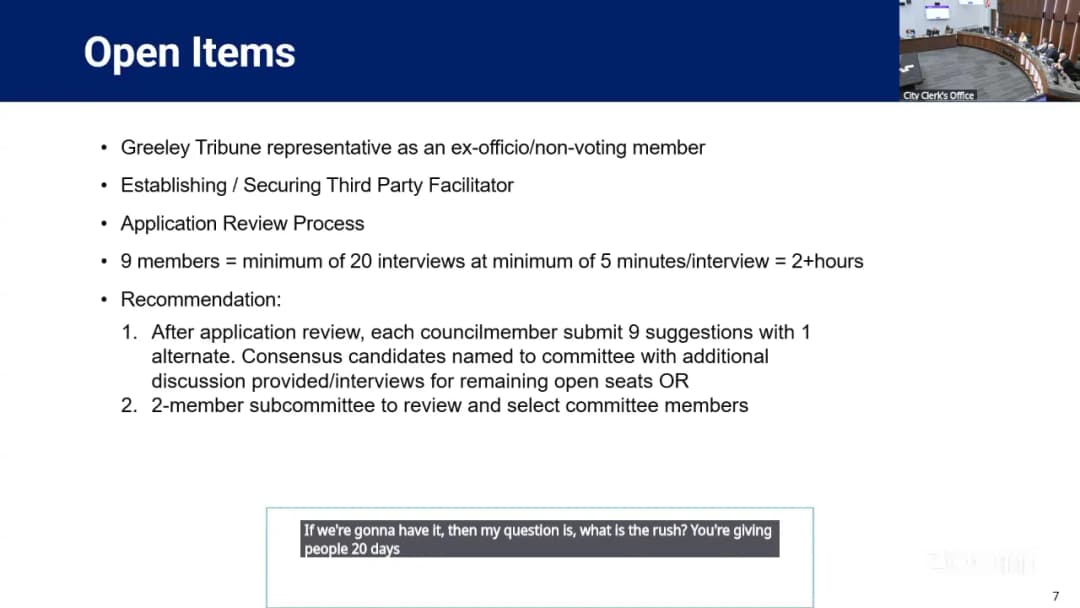
The Greeley City Council held its regularly scheduled meeting on April 7, 2026, at 6:00 PM in the City Council Chambers. The meeting included proclamations, extensive public comment focused heavily on transparency and the West Greeley Project, approval of a consent agenda with two items pulled for discussion, and motions to convene executive sessions. Consent Calendar - Approved meeting minutes from March 3, March 10, and March 17, 2026. - Confirmed appointments to the Island Grove Advisory Board (James Herman) and Human Relations Commission (Natalie Luna). - Established the West Greeley Project Citizen Oversight Committee. - Authorized a Memorandum of Understanding between the Greeley Police Department and Weld County Sheriff's Office for joint Bureau of Justice Assistance funding. - Authorized engineering design contracts for clarifier mechanisms at the Wastewater Treatment and Reclamation Facility (Dewberry Engineers Inc.) and for design and construction administrative services for Calabaza Park (RVi Planning + Landscape Architecture). - Amended the West 10th Street Commercial Corridor Tax Increment Financing (TIF) District boundary. - Introduced on first reading ordinances for the reappointment of Municipal Judge Mark Gonzales, supplementary appropriations, the issuance of up to $50,000,000 in Water Revenue Bonds, the issuance of up to $50,000,000 in First-Lien Sewer Improvement Revenue Bonds, the West Lowell annexation (56.66 acres) and zoning, and an amendment to election definitions in the municipal code. Public Comments & Testimony - Tiffany Simmons expressed opposition to the inclusion of the CareStream property in the three-mile plan and West Greeley GID, alleging a lack of transparency regarding the city's intentions to annex the property and a disregard for Windsor's concerns and the community's stance against AI data centers. - Kathy Hush criticized the lack of transparency and difficult access to information regarding the Cascadia/Catalyst project, noting that public meetings were poorly attended after the first session. - Steve Teats raised concerns about the persistent squeaking noise from city buses and the safety hazards posed by e-bikes and scooters, particularly for citizens with disabilities. - Priscilla Shaner voiced strong concerns about the process for filling the vacant Ward I council seat, arguing that allowing the current council majority to appoint the replacement would consolidate power rather than represent the preferences of Ward I voters. - Tom Sheener advocated for the establishment of contribution and spending limits on issue committees in local elections, arguing that large amounts of outside money drown out the voices of Greeley residents. - Mary Metzger stated that trust is built through meaningful community participation and a Community Benefit Agreement, emphasizing that decisions regarding finite resources like water must prioritize residents over developers. - Jennifer Andrews asked for clear and ongoing transparency regarding water usage for large projects, support for a Community Benefit Agreement (CBA), and for the Ward I appointment to align with the values of the voters who elected Councilmember Butler. - William Gillard strongly criticized the rushed timeline for the West Greeley Project and proposed a "30/60/30 rule" for major developments: 30 days for public release of documents before first reading, 60 days between readings, and 30 days for appeals. He expressed general support for the project but deep dissatisfaction with its handling. - David Heald stated the West Greeley Project's timing was problematic due to rising fuel and water costs, and that the burden on taxpayers would be too high. He expressed disappointment that the results of the special election were not heeded. - Joel Patterson (Virtual) emphasized the need for developer promises regarding water usage to be contractual and subject to penalties, and stressed the need for thorough infrastructure planning before rushing into projects. - Evan Peterson (Virtual) criticized the council's inaction regarding the JBS strike and expressed political views. - Chris Simmons (Virtual) connected the Holocaust Days of Remembrance proclamation to a call for the council to actively protect the constitutional rights of immigrants and community members from federal actions. Discussion Items - West Greeley Project Citizen Oversight Committee (Item 10): Mayor Hall pulled this item and outlined a process to narrow the 59 applicants. Councilmembers will use a rubric to score candidates on relevant experience and their stance (support/oppose/neutral) to select approximately 20 for interview at a special meeting on April 16, 2026. - West Greeley GID Inclusion Area Modification (Item 22): Councilmember DeBeaute pulled this item for clarification. City staff explained the modification removed neighborhoods that do not benefit from planned improvements and added all properties brought into the Three-Mile Plan (CareStream, Great Western Industrial Park, Hankins Farm). Councilmember Olson clarified that the owner of the CareStream property voluntarily sought annexation because Greeley has provided water service to the area for over 50 years and Windsor is unable to service the property. - Ward I Vacancy: Multiple commenters urged the council to prioritize an appointee who reflects the values of the Ward I electorate over the preferences of the existing council majority, warning that failing to do so would further erode public trust. Key Outcomes - The consent agenda was approved excluding Items 10 and 22, with a vote of 6-0. - A special meeting was approved for April 16, 2026, to conduct interviews for the West Greeley Project Citizen Oversight Committee (vote 6-0). - The West Greeley GID boundary amendment was introduced on first reading, with the public hearing and second reading scheduled for April 21, 2026 (vote 6-0). - The council voted 6-0 to enter Executive Session to receive legal advice and instruct negotiators on the West Greeley Project (agenda item 27). - The council voted 6-0 to enter Executive Session to discuss personnel reporting to the city council and to receive legal advice (agenda item 28). - The council authorized the City Attorney to prepare necessary documents reflecting actions taken. - The council entered executive session at 7:23 PM and adjourned the public meeting.
Public Meetings - Greeley, Colorado
Public Meetings - Greeley, ColoradoThe Greeley City Council held a work session on Tuesday, March 24, 2026, at 6:00 PM in the City Council Chambers. The agenda included a legislative update, a downtown stormwater improvements plan, shared micromobility program recommendations, the formation of a citizen oversight committee for the West Greeley project, and the process for filling a council vacancy. Six council members were present. Reports from Mayor and Councilmembers - Councilmember Olson (Ward III) reported on the MERG project, noting partnerships are growing but progress is delayed due to contract rewrites. He defended the West Greeley committee, stating its purpose is to find solutions, not manipulate, and that the council faces an $80 million debt and 110 acres of land out west. He emphasized that this debt cannot be separated from downtown projects. - Councilmember DeBeauty (Ward II) reported on an abandoned hotel on Highway 34 with $241,000 in unpaid fines, and expressed strong support for striking JBS workers, stating they are seeking better pay and safe equipment. - Mayor Pro Tem McDonald announced $3.75 million secured from Gabe Evans for airport tower design, new fire trucks, and upcoming youth commission events. - Mayor Hall noted the successful Greeley Day at the Capitol on March 18. Legislative Update Stacey McNamara, Matt LeCrue, and Ellie Reynolds provided an update on the legislative session. The city has taken positions on roughly 600 bills. - Bills Supported: HB 1330 (entertainment districts, expanding local control), HB 1030 (data center incentives), SB 98 (noise abatement). - Bills Opposed: HB 1001 (Home Act, preempting local housing zoning), SB 70 (restrictions on license plate reader data sharing). - Process Discussion: Councilmember Olson expressed significant discomfort with the current legislative position process, calling it a "staff position more than a council position" and stating he cannot answer constituents on why positions are taken. Council members discussed the need for improved council input in future sessions. Downtown Stormwater Improvements Update Adam Pryor, Aaron Reynolds, and Bryce Janes presented a PMGC (Program Manager General Contractor) model to accelerate downtown stormwater projects. Councilmember Olson questioned the level of owner control in the PMGC model. Staff clarified that the city retains an Independent Cost Estimator, leads the design, and has the ability to accept or deny Guaranteed Maximum Prices, making it a "hybrid" PMGC with strong city controls. The top priority is the downtown City Campus project ($60-80 million), which is at 30% design. Shared Micromobility Pilot & Program Recommendations Hannah Feldman presented findings from the SPIN shared micromobility pilot, which has generated over 30,000 trips since October 2024. Staff and the Citizens Transportation Advisory Board recommended continuing the program and implementing dedicated street corrals using a "mixed approach" where the city installs them and the vendor pays a percentage of the cost. Council feedback supported continuing the program and moving forward with the mixed funding approach for parking infrastructure. Follow Up - West Greeley Citizen Oversight Committee Council debated the timeline and structure of the committee. - Councilmember DeBeauty argued for a slower process to ensure experts (accountants, economists) are part of the committee. - Councilmember Olson argued for speed, stating that delays increase debt costs on the COPs and are detrimental to the city's bonding and financial standing. - Councilmembers Roth and Rudy proposed extending the application deadline to allow for broader outreach. - Outcome: The application period was extended to April 17, 2026. A special meeting for public interviews is scheduled for April 16, with final selection on April 21. The committee will consist of nine members plus a non-voting council member. Discussion of Council Vacancy and Appointment Process Council discussed the process for filling the Ward I vacancy left by Tommy Butler. - Outcome: Applications will be accepted from March 27 to April 17, 2026. Public interviews and the appointment will take place at a council meeting on May 5, 2026. Eligibility requirements include being 21 years old, a Greeley resident for one year, a Ward I resident for 90 days, and having no felony convictions. Key Outcomes - West Greeley Oversight Committee: Application deadline extended to April 17, 2026 (was March 31). Public interviews scheduled for a special meeting on April 16. Committee selection set for April 21. - Council Vacancy (Ward I): Application window set for March 27 to April 17. Appointment scheduled for May 5. - Downtown Stormwater: PMGC contract approach presented; independent cost estimator contract previously approved by council. - Shared Micromobility: Council consensus favored continuing the program and the "mixed approach" for funding street corrals.
The Greeley City Council met on Tuesday, March 17, 2026, at 6:00 PM in City Council Chambers at City Center South, 1001 11th Avenue, Greeley, CO, with hybrid participation via Zoom. The meeting included proclamations, a University of Northern Colorado (UNC) spring update, citizen input, a consent agenda with multiple annexation resolutions, a discussion on creating a citizen oversight committee for the West Greeley Catalyst Project, adoption of the Colorado Wildfire Resiliency Code, appointments to boards and commissions, and a farewell to outgoing Councilmember Tommy Butler. Consent Calendar - Items 10–26 approved unanimously (7-0). These included approval of the February 17, 2026 meeting minutes (Item 10), a resolution establishing City Hall at 1200 11th Avenue (Item 11), a professional services agreement for the 7th & 12th Street Bores (Item 12), and resolutions finding substantial compliance with state annexation laws for Great Western Industrial Park (GWIP) Annexations No. 1–14 (Items 13–26). - Item 27 (GWIP Annexation No. 15, 322.427 acres) was pulled for an amendment. The council voted 7-0 to amend the first whereas clause to include joint applicant GWIP LLC. The amended resolution was then adopted 7-0. - Item 28 (ordinance amending city hall references) was removed from the agenda at staff's request, to be brought back later. Public Comments & Testimony - Rachel Burton (Greeley) expressed skepticism about the oversight committee, saying she hoped it would have real input and that the council would treat people better. She recounted a past interaction with Mayor Hall. - Kathy Hush (Greeley) raised questions about the proposed oversight committee: why have a council if a commission is formed, who chooses members, what authority and duration it will have, and whether only Greeley voters can serve. She noted that citizens are angry and that the West Greeley Catalyst project has been controversial. - Steve Teets (Greeley) spoke about homeless individuals, including a couple where the wife was asked to leave the hospital, and complained about loud brakes on city buses. He said the bus supervisor was rude and urged fixes. - Scott Balstad (Windsor, Director of Planning) argued that the GWIP annexations conflict with state annexation laws because the area is 99% surrounded by Windsor, not contiguous to Greeley, and would create an island requiring Greeley police to drive through Windsor to respond. He said Windsor had previously submitted comments. - Mary Metzger (Greeley) thanked the community for their hard work and urged council to listen to citizens. She said the community has pushed hard to be heard and now is the time for a reset. - Peggy Sue Squires (Greeley) said council needs to be more cohesive and listen. She referenced a recent election and noted that most people speaking against the project are from Greeley, while supporters are from out of town. - Stacey Zwinnica (Greeley, Latino Coalition of Weld County) stressed the need for Latino representation on any new committee, noting Latinos make up 40% of the city but often feel ignored. She offered the coalition's help and said the Cascadia project can succeed if the community comes together. - Pam Sminker (Greeley) commended Councilmember Butler, asked for road repairs (especially 10th Street), urged a halt to new housing due to water and affordability concerns, and called for infrastructure improvements before development. She also noted hazardous broken bricks downtown. - Kathy Ents (Greeley) praised Councilmember Butler for his dedication and honesty. She expressed hope that council would listen to the election results and do what is best for the city, not just for developers. - Kimber Watson (Greeley) urged that any oversight committee be diverse, include ADA compliance expertise, and exclude people with large financial interests. She questioned why TABOR does not require a public vote on the Catalyst project and said the project would bring criminal elements and strain infrastructure. - Jennifer Andreas (Greeley) focused on trust and optics. She asked that the appointment to replace Councilmember Butler reflect Ward 1's voice. She argued that if the same body being overseen selects oversight committee members, it creates a perception problem; the community should have a meaningful role in selection. She also advocated for a community benefit agreement to ensure shared expectations. - Karen Jarman (Greeley, Ward 4) thanked Councilmember Butler for his service and responsiveness, and hoped his replacement would similarly represent Ward 1. - Johan Lindig (Greeley) called for radical transparency in the oversight committee, including sharing all information upfront, establishing clear decision-making processes, and publishing summaries. He supported the idea of a mediator. - Miranda Silis (Greeley, Ward 4) expressed concern that the project initially lacked community input and that the city was not neutral during the election, as it sided with the developer. She urged council to be neutral and open. - David Sheehy (Greeley) opposed the oversight committee, arguing that the low voter turnout (one-third of active voters) indicates most citizens trust the council to decide. He said the committee is an overreach and that younger residents like himself support the project for the future. Discussion Items UNC Spring Update - UNC President Andy Feinstein provided an update. Key points: - Colorado faces an $850 million state budget shortfall affecting higher education. - Greeley Day at the Capitol is March 18, 2026. - The College of Osteopathic Medicine building is on budget and on time; the first cohort of 81 students will begin July 24, 2026, with over 1,200 applications received. - Fall retention rates set a record at 78%, Hispanic student population is over 28%, and four-year graduation rate is 50% (both records). - Student athletes achieved a record 3.4 GPA. - President Feinstein announced he will step down on August 1, 2026, but will remain with the UNC Foundation for a transition year. - Councilmembers thanked President Feinstein for his service and partnership. West Greeley Catalyst Project – Citizen Oversight Committee - Staff proposed a 9-member committee: one council ex-officio, city staff liaison, and community members balanced by ward and opinion. Duties include reviewing financial, zoning, and planning information; providing recommendations; assisting community communications; and recommending improvements. Meetings would be 2–3 hours, in person, over 6–9 months, with an outside mediator. Applications would open March 20 and close April 3, with interviews and formal recommendation on April 7. - Councilmember Olson emphasized in-person meetings, a rigorous schedule (possibly 3–6 hours per week), weekly public reports, a non-voting Tribune reporter seat, and bi-weekly town halls. - Councilmember Butler supported a large applicant pool for diversity and wanted independent voices from both yes and no campaigns. He suggested public meetings with limited public comment. - Mayor Pro Tem McDonald reported a meeting with citizen advocates and suggested that the opposition group provide five names from which council would select three to ensure the committee is not perceived as cherry-picked. - Council agreed to further discuss details at a work session on March 24, 2026. Public Hearing – Colorado Wildfire Resiliency Code - Assistant Fire Chief Jonathan Williams presented Senate Bill 23-166 and the new statewide code, which must be adopted by April 1, 2026. The code applies to new construction and significant alterations (over 500 sq ft or 25% of structure) in designated Wildland Urban Interface (WUI) areas. Greeley's map shows low (yellow) and moderate (orange) intensity zones, with no high-risk (red) areas. Staff intends to petition for a local map that better reflects actual conditions. Cost impact estimated at 2% of construction cost for moderate/high zones, or about $800 for low-risk homes. The code includes structure hardening and defensible space requirements. - No public comment was offered. The ordinance was adopted unanimously (6-0; Councilmember DeBoutez had left). Appointments to Boards and Commissions - Chris Garcia was appointed to the Civil Service Commission for a six-year term. - Zachary Armstrong was appointed to the Stormwater Board for a three-year term. - Jennifer Remers was appointed to the Commission on Disabilities for a three-year term. Key Outcomes - Consent Agenda (Items 10–26): Approved 7-0. - Item 27 (GWIP Annexation No. 15): Amended and adopted 7-0. - Item 28: Removed from agenda. - Wildfire Code Ordinance: Adopted 6-0 on second reading, effective after publication. - Oversight Committee Discussion: Council directed staff to bring the matter to a work session on March 24, 2026, to finalize selection process and membership details. Applications will open March 20, 2026, with a target to formalize the committee on April 7, 2026. - Councilmember Butler Resignation: Councilmember Tommy Butler announced his resignation effective after the meeting due to his acceptance of a nomination for State House District 50. A farewell reception was held in the lobby. The council will need to appoint a replacement for Ward 1. - Meetings scheduled: No additional meetings announced beyond regular schedule.
The Greeley City Council held a work session on Tuesday, March 10, 2026, at 5:00 PM in City Council Chambers. The meeting focused on reports from councilmembers and a motion to enter executive session to discuss personnel matters related to the city manager search. No formal actions were taken during the open session. Reports from Mayor and Councilmembers - Councilmember Lord reported on the Front Range Regional Transportation Plan (RTP), a 18-month process to identify transportation priorities through 2055. He noted that US 34 is expected to be a top priority and that staff will engage with Greeley officials. - Mayor Hall reported that the new city hall at 12th Street and 11th Avenue is nearly fully operational (98.9%) and that an office for councilmembers to meet with constituents is being prepared and should be ready by the end of the week. - Councilmember Roth reported attending Startup Colorado Road Trip at UNC as a lunchtime keynote speaker and the Success Foundation breakfast at Toyton Academy. Executive Session - Council voted 7-0 to enter executive session under CRS 24-6-402(4)(f) and Greeley Municipal Code 2-15-16(A) to discuss personnel matters related to the city manager search. The motion was made by Councilmember Olson, seconded by Councilmember Rudy, and all seven members voted aye. Key Outcomes - The council entered executive session with no further business scheduled for the open session. No formal decisions or directives were issued during the public portion of the meeting.
The Greeley City Council met in regular session on Tuesday, March 3, 2026, at 6:00 p.m. in City Council Chambers, 1001 11th Avenue, Greeley, CO, with virtual participation via Zoom. All seven councilmembers were present: Mayor Dale Hall, Mayor Pro Tem Melissa McDonald, Councilmembers Tommy Butler (Ward I), Deb DeBoutez (Ward II), Johnny Olson (Ward III), Brian Rudy (Ward IV), and Ryan Roth (At-Large). The meeting included proclamations, an extended citizen input period dominated by the recent special election and the Cascadia/Catalyst project, a consent agenda, public hearings on a graywater ordinance and salary ordinances for the City Attorney and Presiding Municipal Judge, and two executive session motions. The council entered executive session at 8:07 p.m. Recognitions and Reports - Mayor Hall proclaimed March 2026 as Women’s History Month. - Mayor Hall proclaimed March 2026 as Brain Injury Awareness Month. Carrie Olenek, executive director of Adeo Colorado, accepted the proclamation and spoke about the lifelong impact of brain injuries and Adeo’s renewed focus on brain injury survivors. - Mayor Pro Tem McDonald presented the ‘What’s Great About Greeley’ report, honoring Greeley Central’s Daniel Romero and Dayspring Christian Academy’s Joseph Noche for state wrestling championships, a $3.5 million federal grant for Phase Two of the Bravo and Echo Taxiway Complex at Greeley-Weld County Airport, Aims Community College’s designation as the first community college authorized to offer both tower and en route air traffic control training, and University of Northern Colorado honors including a faculty award and a ‘most promising places to work’ listing. Consent Calendar The council approved items 9 through 13 by a single 7-0 vote: - Approved the February 3, 2026 City Council meeting minutes and February 10, 2026 work session minutes. - Adopted a resolution finding substantial compliance with state annexation laws for the West Lowell Annexation (ANX2024-0005), a 53.62-acre property located generally east of North 59th Avenue, south of the Cache La Poudre River, and west of North 35th Avenue. - Authorized a professional services contract with TRC Environmental Corporation for design of multiple street intersection upgrades. - Authorized a professional services contract with Ralph L. Wadsworth Construction Company, LLC for program management services for downtown stormwater capital improvement projects. - Introduced on first reading an ordinance adding Chapter 17 to Title 22 of the Greeley Municipal Code adopting the Colorado Wildfire Resiliency Code, with the public hearing and second reading scheduled for March 17, 2026. No items were pulled from the consent agenda. Public Comments & Testimony Citizen input was overwhelmingly focused on the recent special election, Ballot Issue 1A, and the Cascadia/Catalyst project. Speakers differed sharply on the outcome and the path forward. - Tom Dunkel, a speaker associated with Greeley Forward, said his campaign was transparent and blamed opposition misinformation, personal attacks, and undisclosed funding for the loss. He said estimates range from $90 million to $100 million already spent, that the Cascadia certificate-of-participation repayment structure is at risk, and that Greeley faces a projected $20-plus million shortfall in 2026. He called on Councilmember Tommy Butler to resign, accusing him of trying to sabotage the project. - Evan Peterson supported the 54% vote for 1A, demanded return of unused tax money and full financial disclosure, criticized the Catalyst project and developer Martin Lind, and warned that voters reserved the power to recall the mayor and councilmembers. - Kathy Hush, a 50-year Greeley resident, questioned who is ‘minding the store’ on economic development, asked why Loveland obtained a Costco, cited a Greeley Tribune survey in which 52% wanted more restaurants/businesses and 67% thought citizens should have voted on Cascadia, and opposed a potential AI project at the old Kodak property. - An unidentified resident asked about Hensel Phelps, due diligence, and bond market reaction, saying a Colorado Bond Shares investor told him they would never invest in the project; he criticized 100% city financing with nothing from the developer. - Steve Teets read a poem about the hardships of homelessness. - Sandy Cummings thanked Councilmembers DeBoutez and Butler for listening, but said trust in the other five councilmembers was broken by endorsing the no vote, collaborating with Greeley Forward, changing yard sign rules, ignoring feasibility studies, failing to release a study promised in January, and repeated executive sessions. She urged taking an off-ramp and designing a project with both yes and no voters. - Connie Garcia proposed a smaller arena, hotel, and water park and suggested creating a citizen committee to work with council and the developer on a revised Catalyst project. - Bill Gillard criticized council leadership and City Manager Raymond Lee, said the ballot should not have targeted private property, and argued a recall of the then-council would have been more appropriate; he still believed the project could benefit Greeley. - Mary Metzger said council had not listened to residents on the project and the camping ban, called for transparency, and said citizens are the council’s bosses. - Martha Kyler said the election showed residents want to be heard before decisions, and recommended using local boards and commissions, such as the Commission on Disabilities, early in planning for the downtown civic campus to avoid costly accessibility retrofits. - Priscilla Shaner questioned Councilmember Olson’s surprise at the outcome, asked whether the project’s off-ramps were real or talking points, and argued the city could have stopped at about $10 million rather than roughly $100 million. - Rhonda Solis, associated with Greeley Demands Better, celebrated 1A’s passage, cited the city’s consultant Hotel and Leisure Advisors concluding the project did not appear financially feasible and a Newmark analysis finding understated costs, inadequate debt service coverage, and overly aggressive revenue projections. She urged council to consider whether to continue with the developer at all. - Jen Remers described nine years of sewer, water, and safety problems in her mobile home park and asked the city to create a mobile home park committee. - Teresa Gilbert said the community is in it together, suggested the project did not match Greeley’s demographics, and said it was not helpful to blame Martin Lind. - Tiffany Simmons outlined options for the COP debt and urged council to explore allowing marijuana sales in Greeley, citing Colorado’s more than $3 billion in marijuana tax revenue since legalization, about $255 million in 2024, and estimating Greeley could generate $1 million to $3 million annually. - Shohan Lindig recommended ‘radical transparency’ and a citizen committee to review data and communicate decisions. - An unnamed resident thanked Butler and DeBoutez, disagreed with Dunkel’s call for Butler’s resignation, and urged the council to slow down and work with residents. - Jennifer Andrews thanked election staff, criticized Greeley Forward’s social media interactions, raised concern about representation if Butler’s seat is replaced, and supported a community benefits agreement. - Antonio said petitions with many signatures should have stopped the project earlier, thanked DeBoutez for attending a community benefits agreement meeting, and supported a blanket community benefits agreement for future projects. - Kathy Ents accused the council of composing a confusing ballot question, said the five councilmembers were not victims, and demanded transparency and honest representation. - Virtual speaker Brandon Warwick urged council to honor the voters, immediately cease discretionary Cascadia/Catalyst spending, oppose the lawsuit attempting to overturn the election, and include residents in next steps. - Virtual speaker Jennifer Montez, representing the Greeley-Weld Immigrant Partnership Team, opposed Cascadia and asked about safety and ‘know your rights’ resources for the immigrant community, referencing the Hudson/Bighorn facility and the JBS Swift strike. - Virtual speaker David Sheehy said Greeley’s population is 115,000 with 63,000 active registered voters and only one-third voted; he urged council to consider the trust of non-voters and argued construction workers generate sales tax. Public testimony on individual ordinances: - On the graywater ordinance, one resident suggested future rainwater/graywater recapture in new construction but said the cost would not justify doing it now. - On the City Attorney salary ordinance, Bill Gillard and Steve Teets opposed the raise, citing Greeley’s financial shortfall and broader government debt. - On the Municipal Judge salary ordinance, Bill Gillard again opposed the raise, saying public employees should not receive raises while the city is in debt. Council Reports and Initiatives - Councilmember DeBoutez reported on a February 19 homeless vigil honoring 33 people who died while homeless, summarized five themes from a community benefits agreement meeting (local hiring and training, citizen oversight, affordable housing, good neighbor agreements, and adequate infrastructure), and announced office hours at Margie’s. - Councilmember Olson said he still believed the Catalyst project could be transformational, but acknowledged ‘horrendous’ communication and lack of transparency. He proposed a structured three-to-six-month pause and recalibration for Catalyst and the downtown civic campus, with plain-English financial explanations, alternative zoning options, and a balanced citizens’ commission to review information and present a public recommendation. - Councilmember Butler thanked Heidi Leatherwood and election staff and said special election turnout exceeded any municipal election turnout in Greeley’s history. - Mayor Pro Tem McDonald thanked the youth commission, said the council and staff were exhausted, acknowledged early transparency failures, cited a leadership change, and said previous city leadership had gatekept information and made false statements about county road funding. Discussion Items - Graywater ordinance: Deputy Director of Water Resources Leah Hubbard explained that graywater is reused household water from showers, sinks, and similar sources; that House Bill 24-1362 authorized graywater use statewide as of January 1, 2026 unless prohibited locally; and that graywater systems pose public health risks, require permitting and inspection programs, and have poor return on investment. She noted Fort Collins had issued one permit and that typical savings of $69 to $138 per year would take 33 to 65 years to recover a $4,500 retrofit cost. The Water and Sewer Board recommended prohibition on January 21. The council approved the ordinance 7-0. - City Attorney salary: Human Resources Director Martha Lannigan presented a 4% merit increase for City Attorney Stacey Arzeta, from $263,002.62 to $273,547.07 retroactive to February 12, 2026, plus continuation of the city’s 12% 401(k) contribution. Councilmembers praised Arzeta’s performance, and the ordinance passed 7-0. - Municipal Judge salary: The council approved a 3% increase for Presiding Municipal Judge Mark Gonzalez, from $215,173 to $221,628 effective February 12, 2026, with continued 5% matching to his 457 plan and a 6% city contribution to his 401(k). The ordinance passed 7-0. Executive Sessions and Final Actions - The council voted 7-0 to enter executive session to discuss the potential purchase/acquisition of real property, receive negotiation instructions, and receive legal advice if necessary. - The council voted 7-0 to enter a second executive session to receive legal advice and instruct negotiators regarding the West Greeley project and a lawsuit filed against the city related to that project. - Before the executive sessions, the council voted 7-0 by voice vote to authorize the City Attorney to prepare required resolutions, agreements, and ordinances and to authorize the Mayor and City Clerk to sign them. Key Outcomes - Consent agenda approved 7-0. - Graywater collection prohibition ordinance adopted 7-0. - City Attorney salary increase ordinance adopted 7-0. - Presiding Municipal Judge salary increase ordinance adopted 7-0. - Both executive session motions approved 7-0. - City Attorney document-preparation motion approved by voice vote. - The next scheduled public hearing is March 17, 2026, for the Colorado Wildfire Resiliency Code ordinance. - The meeting moved into executive session at 8:07 p.m.; after the executive sessions, the meeting was scheduled to adjourn.
The Greeley City Council met on Tuesday, February 17, 2026, at 6:00 PM in Council Chambers. The meeting included a proclamation for Youth Arts Month, the "What's Great About Greeley" report, extensive public comment (largely focused on the Cascadia project and calls for transparency), approval of consent agenda items, a presentation on the Safe Streets and Roads for All (SS4A) project, board appointments, and a motion to enter executive session for collective bargaining negotiations. Consent Calendar - Approved the City Council Work Session Proceedings of January 27, 2026. - Adopted a resolution authorizing a groundwater production lease agreement with the State Board of Land Commissioners. - Introduced and set a public hearing (March 3, 2026) for ordinances on: (1) acquisition of real property via purchase or eminent domain for Boyd Lake water pipeline relocation (item 11, pulled by Councilmember Butler but later approved unanimously), (2) amending the graywater code, (3) salary increase for the City Attorney, and (4) salary increase for the Presiding Municipal Judge. - Item 11 was pulled by Councilmember Butler who deemed it premature given pending funding decisions; after discussion, it passed 7-0 with a public hearing scheduled for March 3, 2026. Public Comments & Testimony - Evan Peterson – Opposed the Cascadia project, stating hard-earned tax dollars are being siphoned to developers and called for a pause. - Tiffany Simmons – Criticized timing of the Hotel and Leisure Advisors feasibility report (due Oct 1, 2025, but released after the election) and the delayed comprehensive financial model. Cited a lawsuit against community members by developer Martin Lind and alleged lack of transparency, including closed-door trips and Greeley Forward as a front. Urged release of financials before the special election. - Bill Gillard – Supported the Cascadia concept but condemned council’s lack of transparency and hidden information. Wanted clear financial facts and liability details before the vote. - Mary Metzger – Expressed feeling unheard; said council is more receptive to developers than constituents. Questioned school transportation adequacy for new developments and requested a community benefit agreement. Invited council to a meeting on February 23 at Farr Library. - Steve Teats – Announced the Night of Remembrance event (Feb 19 at Lincoln Park) and highlighted a homeless death during the recent cold front. Urged more housing solutions and warned that large projects may increase homelessness. - Todd Lotion – Complained about a dangerous four-way stop in Cedar Woods where his daughter was hit by a semi; criticized council for prioritizing money over safety. Also opposed Cascadia, questioning financing and potential tax increases. - Rhonda Salise – Detailed the dismissed lawsuit by Martin Lind against Greeley Deserves Better, citing undisclosed trips, use of city resources to promote the project, and efforts to block a ballot measure. Time expired before finishing. - Robert Stack – Addressed loss of trust in the council, particularly members from the prior council (Mayor Hall, McDonald, Olson). Urged better communication and warned the division will not end with the election. - Jennifer Andrews – Expressed cautious support for development but requested a binding community benefit agreement. Outlined specific asks: state-registered apprenticeships, best-value contracting, community input on infrastructure, child care support, and affordable housing. Hosted a public meeting on Feb 23. - No virtual speakers. Discussion Items - Sign Code Initiative (Councilmember Butler) – Proposed directing staff to review sign code regarding parkways (area between sidewalk and curb). Sought language explicitly allowing residents to place signs there. Council gave consensus for staff to bring options to a work session. - Election Transparency Initiative (Councilmember McDonald) – Requested daily ballot count updates and easier access to voter lists without requiring a formal CORA request. City staff agreed to provide daily ballot counts starting immediately and to expedite the pending voter list request (due by Feb 20) with redactions as required by law. Council consensus supported this approach. - Safe Streets and Roads for All (SS4A) Presentation – Steve Yonkin (Interim Deputy Public Works Director) presented the $8 million federal grant (with $2 million city match) for 128 quick-build safety projects across the city. Countermeasures include chicanes, rapid flashing beacons, mini roundabouts, speed humps, curb extensions, and centerline hardening. Projects target the high-injury network; between 2014 and 2023 there were 69 fatalities and 269 severe injuries. Additional benefits include improved access to jobs and food. Potential impacts include up to 1,500 parking spaces. Public outreach begins with a Speak Up Greeley page, workshops, and pop-up events. Construction is expected mostly in 2026, with some areas postponed to early 2027. Council questions addressed state highways (limited quick-build options), data on previous installations, and specifics on the 14th Avenue and 8th Street lane reconfiguration. Key Outcomes - Consent Agenda items approved, with item 11 (eminent domain) approved separately 7-0 and public hearing set for March 3, 2026. - SS4A project to proceed with public engagement; council received the presentation. - Board Appointments approved: Wendy Young (CTAB), Kimberly Spencer and Robert Lind (Golf Course Advisory), Justin Watada (Island Grove Advisory), Daniela Hernandez and Greg McIntosh (Parks and Recreation Advisory) – all for three-year terms. - Executive Session – Motion carried 7-0 to enter executive session for legal advice and strategy regarding 2026 Firefighters Union (IAFF Local 888) collective bargaining negotiations. - Motion to Authorize City Attorney – Carried 7-0 to prepare necessary documents reflecting actions taken at this and previous meetings. - Meeting recessed to executive session at 7:33 PM. Other Business - The February 23 meeting (5:30 PM at Farr Library) organized by community members to discuss a community benefit agreement was noted in public comments.
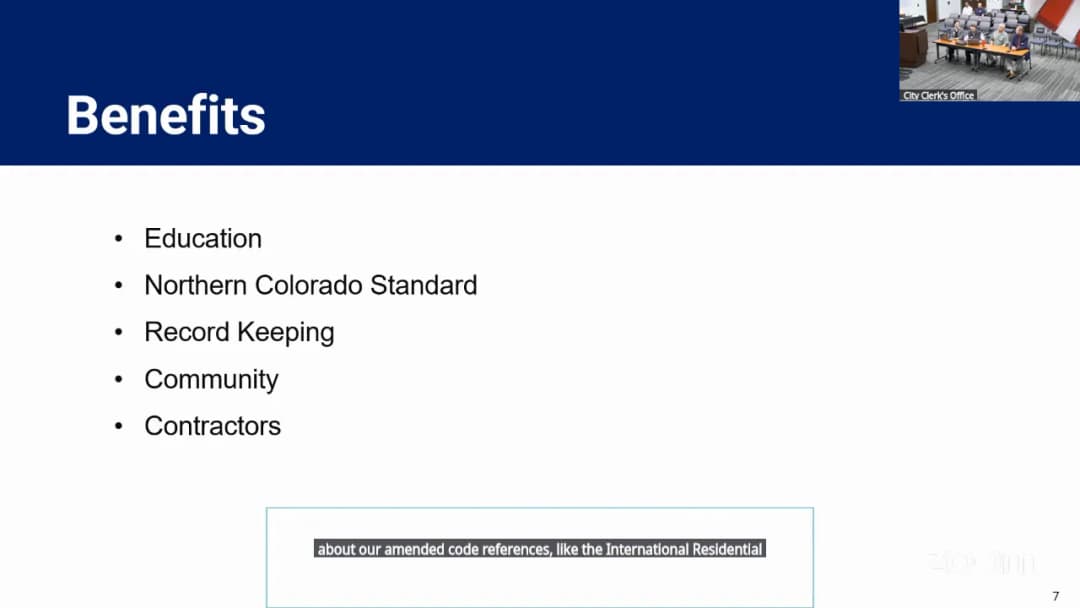
The Greeley City Council held a work session on February 10, 2026, at 6:00 PM. Six members were present (Councilmember Olson was excused). The meeting focused on a contractor licensing proposal and a review of community data highlights ahead of the upcoming council retreat. No formal action was taken, but council reached consensus on a contractor licensing path and voted to enter executive session. Reports from Mayor and Councilmembers - Councilmember Butler highlighted the Downtown Development Authority's (DDA) fourth annual Freezing Days event, noting it supports downtown retailers during their slowest months. - Councilmember Rudy announced that his first Ward 4 meeting, originally scheduled for Monday, February 16, would be rescheduled due to the Presidents' Day holiday. - Councilmember Roth reported attending the DDA annual retreat and planning session, commending the DDA team, Bianca and her staff, city staff, and Chair Annie Feinstein for their work. Contractor Licensing - Presentation: Deputy Building Official Dusty Shepherd presented a contractor licensing proposal in response to Councilmember McDonald's Initiative 11 2025. The presentation covered current contractor numbers (3,162 active contractors, 3,926 permits in 2025), license types available through the International Code Council (ICC), and a comparison to surrounding northern Colorado jurisdictions. - Options: Staff recommended Option 1—licensing all contractors (adding general, specialty, and roofing to existing mechanical, electrical, and plumbing licenses). Option 2 would license only roofers, and Option 3 would maintain the status quo. - Council Discussion: - Councilmember Butler expressed general support, questioned the proposed two-year renewal cycle (preferring three years to reduce costs for small businesses and staff workload), and asked about penalties for unlicensed work. Staff clarified the primary enforcement mechanism is preventing unlicensed contractors from pulling permits. - Councilmember DeBoutez sought clarification on reciprocity; staff confirmed that ICC certifications from Fort Collins, Loveland, and Longmont would be accepted, creating a smooth application process. - Councilmember Roth asked why previous attempts (2003 and 2015) failed. Staff cited older contractors opposing the required exam, noting the current proposal is easier now that many contractors already hold ICC certifications through reciprocity with other jurisdictions. - Councilmember Rudy expressed support, emphasizing the importance of making it seamless and easy to do business in Greeley. - Mayor Pro Tem McDonald made a strong case for Option 1, sharing detailed personal anecdotes from her professional work in insurance to illustrate the harm caused by out-of-state and unlicensed contractors. She described them as "predators" who take advantage of residents, arguing the licensing protects local businesses and consumers. - Outcome: Council reached consensus to proceed with Option 1 (licensing all contractors). Community Data Highlights - Presentation: Acting City Manager Brian McBroom presented a high-level review of community data from multiple sources (citywide survey, ballot measure polling, planning activities, Speak Up Greeley) to inform the upcoming council retreat. - Key Themes: Overall 70% satisfaction with core city services; ongoing concerns about the impacts of growth on streets and congestion; high value placed on safety and cleanliness; cautiousness about taxes; a desire for clear priorities; and broad agreement on the city's major focus areas. - Focus Area Details: - Business Growth: Economic development is valued most when it produces visible results and supports local employers and downtown. - Housing for All: Consistently a top concern; strong support for housing stabilization, emergency sheltering, and rental assistance. - Safe Community: Considered a non-negotiable strength; fire and police services consistently rated very high. - Infrastructure: Residents desire more investment; low satisfaction with the quality of some infrastructure. - Council Questions: - Councilmember Butler asked why the data showed Greeley as "competitive but not exceptional" for business, relating it to his initiative for a mayor's task force on economic development. Staff committed to providing more details on that study. - Councilmember DeBoutez requested a trends analysis and asked how high public safety scores are gauged given few residents interact with those services directly. Staff confirmed the survey appendix contains trend data and pointed to community outreach as a factor. - Councilmember Roth asked about the recency of the housing survey data and speculated that perceptions of encampments may have shifted since the camping ban and the opening of the Starrise year-round shelter. - Mayor Pro Tem McDonald argued that positive housing perception improvements are likely tied to the opening of the Starrise year-round shelter more than the camping ban itself. Key Outcomes - Council reached consensus to direct staff to proceed with licensing all contractors (Option 1), adding general, specialty, and roofing contractors to the city's existing licensing requirements. - The council voted 6-0 to enter an Executive Session to receive legal advice and instruct negotiators regarding the West Greeley project. The work session recessed at 6:43 PM to hold the executive session.
The Greeley City Council met in regular session at 6:00 p.m. on Tuesday, February 3, 2026, in a hybrid format in Council Chambers at City Center South, 1001 11th Avenue, Greeley, CO. Mayor Dale Hall presided; six council members were present, with Councilmember Olson excused. The council approved routine consent items, heard extensive citizen comment on the West Greeley/Cascadia project and Ballot Question 1A, adopted a resolution urging a 'No' vote on that ballot question, received a Homeless Solutions update, discussed performing arts funding options, and then entered executive sessions for annual performance reviews. The meeting moved into executive session at approximately 8:15 p.m. Recognitions & Proclamations - Mayor Hall proclaimed February 2026 as Black History Month in Greeley. Greeley West counselor Marlene Rich introduced student Shiloh, who spoke about Black history as a story of pain, survival, resistance, and empowerment; Autumn Houston of the UNC Marcus Garvey Cultural Center thanked the council for making students feel valued, seen, and heard. - Councilmember Roth presented 'What's Great About Greeley?' honors, including Greeley West students winning first place in a national gingerbread competition, Aims Community College's five-year agreement with AllQuest 3D as the first industry tenant at the Workforce Innovation Center, and WeldWerks Brewing being named Mid-Size Brewery of the Year at the 2026 Colorado Brewers Cup. Consent Calendar - Council approved the Consent Calendar by a 6-0 vote, covering: approval of the January 13, 2026 work session and January 20, 2026 meeting proceedings; professional services contracts with Mark Thomas & Company Inc. (downtown campus project), RS&H, Inc. (MERGE Project), AECOM Technical Services, Inc. (Milton Seaman Reservoir Gate Repair), and Providence Infrastructure Consultants (60-inch Bellvue-Gold Hill Pipeline); a second amendment to the intergovernmental agreement with Weld County for the O Street & 59th Avenue intersection improvements; an external grant agreement with United Way of Weld County to fund a shelter; and Homeless Solutions Department grant award/spending authority for the Fines grant 2025/2026. Public Comments & Testimony Citizen input was taken from in-person speakers under the 3-minute limit. No virtual speakers signed up. - Anarelli Morales, a Greeley Museum advisory board member, opposed board consolidation and said 2025 attendance data (seven quorum meetings, one non-quorum, three canceled for lack of quorum, two canceled for holidays) lacked context. She said museum board concerns were not accurately represented on January 27 and asked council to give Director Bowles time to improve. - Heather Utrod, chair of the Urban Renewal Authority and vice chair of the Greeley Art Commission speaking as a community member, questioned the legal defensibility of using 1% capital improvement/public art funds for private or non-city performing arts projects, citing impact and development fee issues and potential legal action. She also questioned whether the 1% for art fund and Art Commission were correctly adopted in code rather than the charter. - Bill Gillard criticized the special election cost, saying the question should have been placed on the general election ballot, and urged residents to use 24-hour ballot boxes. He said council members are representatives of the whole city, not just donors or political allies. - Kathy Hush asked why voters were not allowed to vote before the project was approved on May 15, 2025. She raised concerns about taxpayer risk, water supply, the economy, and whether council works for constituents or developer Martin Lind. - Mary Mitzger called on council to serve all residents, including immigrants, working families, the unhoused, and small businesses, rather than prioritizing developers, data centers, arenas, and large business interests. She said many in the community feel dismissed and unheard. - Tiffany Simmons criticized coordination between sitting council members and the issue committee Greeley Forward on the 1A campaign, alleged campaign finance irregularities and out-of-town donations, and said Greeley Forward suppresses resident questions on social media. She opposed the council passing a resolution urging a 'No' vote on 1A. - Dennis Houston, representing Water Valley Company, urged a 'No' vote on 1A, saying the project delivers benefits without new taxes, includes a 40-year Colorado Eagles lease, and places risk on landowners and bondholders. He said overturning zoning would halt traffic improvements, burden taxpayers, and impair Greeley's borrowing capacity. - Tony Belfiore, a longtime Greeley resident and businessman, supported the project, saying it went through the proper planning commission and city council process, and asked where opponents were during the public process. - Steve Keats, a homeless advocate, announced the Night of Remembrance event on Thursday, February 19 at Lincoln Park. He criticized the camping ban, said one more person died during recent cold weather, and urged the city to remove the camping ban and focus on housing, homelessness, infrastructure, and transit. - Tom Donkle supported 'No' on 1A, saying the ballot question is confusing by design and that a 'Yes' vote would disrupt project financing, certificates of participation, and the city's credit rating. He argued the zoning process had already been completed properly. - Brianna Harris, a Greeley musician and resident since 2012, said she supports expanding arts funding conversations but worried that shifting 1% public art funds could reduce current Art Commission projects and public art accessibility. - Peggy Sue Squares asked for a public debate and hard copies of the feasibility studies so both sides could be evaluated. She also mentioned recall discussions and the cost of a special election. - Kendra Alby, an Art Commission member speaking as a resident and artist, supported performing arts organizations but opposed reducing public art funding, which she said remains accessible to everyone regardless of income. - Luisa Anderson, speaking as a citizen, raised legal concerns about using 1% for art money from enterprise funds, noted the lack of a clear definition of performing arts, opposed relying on city manager discretion, and suggested discounts for new and up-and-coming performing groups rather than only legacy groups. - Connie Garcia criticized agenda item 18 as partial and trust-eroding, said much of the money spent against 1A came from outside Greeley, and asked council to remove the resolution from the agenda. - David, a Ward 4 resident, compared the proposal to Loveland's Ranch Events Complex, which was voter-approved with a dedicated sales tax and has not traditionally generated a net profit. He noted its planned expansion and hotel could compete with the West Greeley project. - Ben Bernhardt, executive director of the Greeley Philharmonic Orchestra, asked for sustainable and predictable funding. He noted the orchestra's 114-year history, that the UCCC was built with the orchestra in mind, and that the orchestra spends about $36,000 per year on UCCC venue costs, roughly 6% of its annual budget. He said they want a partnership, not a free ride. - Rhonda Silise, a Ward 4 resident, said the Epic Water Park example in Grand Prairie, Texas was an $80 million project approved by voters. She accused the council of finding a way to go around voters and encouraged a 'Yes' vote on 1A. - Tom Shanner, a 30-year resident, said the special election could have been avoided if the question had been placed on the November ballot. He cited paid canvassers, a project cost that began at $1.2 billion, and asked who would pay if costs increase. Councilmember Reports - Councilmember DeButy announced office hours from 9 to 10 a.m. the next morning at Margie's Java Joint. - Mayor Pro Tem McDonald announced nominations are open for the 2026 Ed Clark National Youth Service Day Awards, due March 27, with a $1,000 scholarship. She also promoted the Greeley Philharmonic's 'Wines of Note/Uncorked Romance' event on February 7, from 2 to 5 p.m. at the DoubleTree Hotel. - Councilmember Roth reported on a rapid rehousing ride-along with the Homeless Solutions team and praised the staff's work with clients. - Councilmember Rudy reported attending his first Clearview Library District meeting and a Greeley police ride-along with Officer Vasquez, praising the police department. - Councilmember Butler reported attending the Colorado Farm Show Scholarship Awards dinner at Island Grove. - No council initiatives were offered. Discussion Items Resolution Urging 'No' Vote on Ballot Question 1A - City staff explained that the resolution was requested through an initiative by Councilmember Olson and advanced by a council majority on January 20. Staff noted state law authorizes the council to take a position on a ballot measure by resolution. - Ballot Question 1A is a citizen referendum seeking to repeal the planned unit development (PUD) zoning approval for the West Greeley/Cascadia project. - A motion to table the resolution failed 4-2. During debate, Councilmember Butler opposed the resolution, saying the process lacked legitimate community input, the financing was structured to avoid asking voters, and the project was a gamble with taxpayer dollars. Councilmember DeButy opposed, arguing the council should remain neutral and not campaign against a citizen initiative. Councilmember Rudy supported the resolution, saying the PUD met legal zoning criteria and that overturning it would set a harmful precedent for land-use decisions. Mayor Pro Tem McDonald supported it, emphasizing the importance of protecting the zoning process and Greeley's attractiveness to developers. Councilmember Roth and Mayor Hall also supported the resolution. - The resolution was adopted 4-2, with Councilmembers Butler and DeButy voting no and Mayor Hall, Mayor Pro Tem McDonald, and Councilmembers Rudy and Roth voting yes. Homeless Solutions Update - Mandy Shreve presented the Homeless Solutions Department update. - The 2026 operating budget is approximately $6.2 million, including $1.4 million in grant funding. About $1.2 million in state rent vouchers also come into the community, bringing total resources to roughly $7.4 million. - For the first time, the shelter is open year-round, using $1 million in one-time general fund money, and current shelter capacity is considered sufficient. - Federal and state funding has become more constricted. The department applied for a $1 million state grant and received $125,000. It applied for a $750,000 opioid-related grant over three years to serve homeless individuals with substance use disorders. - A HUD funding opportunity initially shifted toward outreach and transitional housing but was sent back due to litigation; the department filed a renewal grant to continue rapid rehousing. - Medicaid reimbursement for tenancy support services dropped from an estimated $500,000 to about $70,000, making it not worth the compliance return on investment. - Rapid rehousing served 97 households, successfully exited 30 people, and expected six more exits within two weeks. Funding runs through September. - Permanent supportive housing used about 67 vouchers. The outreach team provided approximately 6,000 services and helped 114 people obtain housing from April through the end of 2025. - The United Way of Weld County housing navigation center has a budget of about $1 million; its funding is expiring later this year, and the city is seeking another nonprofit partner. - Shreve highlighted success stories including Elijah, who experienced homelessness for four years and is now pursuing peer specialist certification, and Tim, a veteran connected to housing. - Councilmember DeButy confirmed the navigation center budget is about $1 million. Mayor Hall noted that a task force is working on homelessness solutions and that a meeting with potential navigation center providers had occurred that afternoon. Culture, Parks & Recreation Performing Arts Funding - Diana Frick, Culture, Parks & Recreation Director, and Megan Wheeler, Cultural Affairs Division Manager, presented the follow-up on performing arts funding. - The UCCC legacy partner program was established in the 2025-2026 season. Current partners receive reduced rent, marketing support, fundraising opportunities, and ancillary services. Commercial rent is $2,250, nonprofit rent is $1,450, and legacy partner rent is $1,200. - Three funding options were presented: - Option A: UCCC rental waiver for legacy performing arts partners. This is targeted but would require general fund backfill and does not change the public art fund. - Option B: Transfer a limited percentage (illustrated at 1%, 3%, and 5%) of the anticipated public art fund to performing arts organizations. This would require a code amendment and funding would fluctuate with capital construction activity. - Option C: City manager discretionary sponsorship. This is flexible but not predictable or recurring. - Councilmember DeButy said her initiative was to expand the 1% public art fund by removing the cap that excludes projects over $50 million from contributing, estimating that 1% of upcoming large capital projects could generate about $9 million. She wanted to support legacy nonprofit performing arts groups without touching the general fund. - Councilmember Butler supported exploring Option B and removing the cap, and asked that performing arts funding include open-access components such as reduced-price or free events. He also asked the legal team to examine the legality of using impact fees for performing arts. - Councilmember Roth supported exploring Option B, saying the general fund is not appropriate in a difficult budget cycle and that city manager discretion would not provide reliable funding. - Mayor Pro Tem McDonald supported Option B, saying performing arts is an art form and should be included in the public art fund. - Mayor Hall expressed reservations about all options, particularly general fund backfill, but council ultimately reached consensus to direct staff to explore Option B further, including legal analysis of cap removal, development/impact fees, bond restrictions, and grant restrictions. No percentage was selected. Executive Sessions & Administrative Motions - Council voted 6-0 to enter executive session to complete the annual performance review of Municipal Judge Mark Gonzales. - Council voted 6-0 to enter executive session to complete the annual performance review of City Attorney Stacey Aurzada. - Council approved the motion authorizing the City Attorney to prepare required resolutions, agreements, and ordinances and authorizing the Mayor and City Clerk to sign them, with a 6-0 voice vote. - During scheduling discussion, staff indicated the West Greeley update was not ready for the February 10 meeting and would be placed on the February 17 agenda. Council did not reach consensus to move it earlier. Key Outcomes - Consent Calendar approved 6-0. - Motion to table the Ballot Question 1A resolution failed 4-2. - Resolution urging voters to vote 'No' on Ballot Question 1A adopted 4-2. - Council directed staff to further explore Option B for performing arts funding, including removing the capital project cap and addressing legal questions around funding sources. - Two executive sessions were approved 6-0 for annual performance reviews. - The administrative documents motion was approved 6-0. - The meeting entered executive session at approximately 8:15 p.m.; after the executive sessions, the meeting was scheduled to adjourn.
Mayor Dale Hall called the work session to order at 6:00 p.m. on Tuesday, January 27, 2026, in the City Council Chambers at 1001 11th Avenue, Greeley, Colorado. All seven councilmembers were present, with hybrid participation via Zoom. The work session was for discussion and direction only; no formal ordinances or resolutions were adopted. Agenda items included council reports, a proposed culture board consolidation, the Westside Area Plan and Form-Based Code draft, a grants/financial/budget update, and the Colorado Wildfire Resiliency Code. Reports from Mayor and Councilmembers - Councilmember Johnny Olson reported on the US 34 MERGE project, saying Greeley will be the direct federal grant recipient and will pass funds to CDOT through an intergovernmental agreement (IGA) for construction and owner's representation, with an executive oversight committee to control budget and scope. He said the grant had advanced past the first federal review round and signatures were expected in two to four months. Councilmember Tommy Butler asked about TIFIA loan finalization; Acting City Manager Brian McBroom said staff would provide that timeline. - Olson listed his priorities for the upcoming Council retreat, which he would miss: budget foundations, safety and security, deferred maintenance, the US 34 MERGE project, the downtown stormwater project, the catalyst project, and the downtown civic center. - Mayor Pro Tem Melissa McDonald reported that Wreaths Across America raised enough money to place wreaths on every veteran's grave in December and that she met with water and sewer staff about Poudre River restoration and flood mitigation opportunities. - Councilmember Ryan Roth presented at the District 6 Success Foundation Awards event, which recognized 154 nominees among District 6 staff, teachers, and administrators. Culture Parks & Recreation Department Culture Board Consolidation - Staff members Diana Frick and Megan Weiler presented a proposal to consolidate the Museum Board, the Union Colony Civic Center Board, and the Art Commission into a single Arts and Culture Commission. They said the goal was not to reduce arts and culture voices but to strengthen advisory work, citing repeated quorum failures and 11 canceled meetings across the three boards in 2025. - Staff reported 2025 meeting data: the Art Commission had one quorum issue and one cancellation; the Museum Board had five cancellations and one no-quorum meeting, plus one vacancy; and the UCCC Board had five cancellations. - Staff said they met with each board twice. Board members raised concerns about less focus on specific programs and facilities, while others saw potential for a stronger unified cultural advocacy. Recommendations included maintaining relationships with nonprofit friends groups and preserving the public art process in the municipal code. - Councilmembers asked about membership selection. Staff said an initial transition could start with the most engaged current members, but the City Clerk noted that creating a new board would require council appointment and a new application process. Councilmember Butler requested a survey of current board members to gauge individual support. - Council reached consensus on Option 3, the consolidation of the three boards into one Arts and Culture Commission. Staff will develop a transition plan, new membership process, and code changes to return to Council. Westside Area Plan & Form-Based Code - Interim Planning Manager Caleb Jackson introduced consultant Jeff Speck (Speck Dempsey Partner) and Jason King (Able City) at 6:41 p.m. The plan area covers 22 square miles on Greeley's west side, mostly agricultural but becoming suburban. Public interest was high: about 200 people attended the kickoff and more than 120 attended the plan unveiling. - The plan projects Greeley's population to reach about 200,000 by 2055. It emphasizes three components: preserving land through the existing green print, identifying and enhancing transportation corridors, and building complete walkable neighborhoods rather than single-use pods. Bradburn Village in Westminster was presented as a successful local example. - Mayor Hall noted positive public feedback and asked whether developers were on board. Speck said walkable communities are more profitable for developers, but implementing them requires developers to shift from current practices. He suggested the form-based code could replace the city's PUD ordinance. - Councilmember Olson expressed support for smart growth but raised concerns about overemphasizing density and about transit viability and costs, citing low Front Range ridership figures. Speck replied that about 50% of Americans prefer walkable urbanism but that the option is not widely available. - Councilmember Butler supported the form-based code concept and allowing more uses by right without PUD processes. Councilmember DeBoutez encouraged Council to visit Bradburn. Councilmember Rudy asked whether neighborhood restaurants could draw customers from outside the neighborhood; Speck said successful retail is placed along visible corridors. - Acting City Manager McBroom thanked staff and consultants and recognized former Deputy City Manager Rachel Flynn for bringing the consultants to Greeley. 2025 Grant Update, 2025 Financial Review, and 2027 Budget Update - Division Treasurer Robert Miller reported that the 2024 Schedule of Expenditures of Federal Awards was completed on December 31, 2025. The city spent approximately $9.5 million in federal grant funds in 2025 and has 81 open grants. - Sales tax growth was slower than budgeted: 1.8% growth compared with the budgeted 5%. New construction revenues were $5.9 million below the 2025 budget, and severance tax revenues were $2 million below budget. Operational savings, additional oil and gas revenues, and interest earnings partially offset those declines. - Cash and investments totaled $394 million at the end of 2025, exceeding the adopted budget of $300 million, largely due to the issuance of 2025 Certificates of Participation. Interest earnings were $14.3 million, exceeding the budget by $6 million. - General fund projections show sales and use taxes $2 million lower than projected, but $4.8 million in expected expenditure savings, producing a projected $2.8 million surplus at the end of 2025. - Director of Budget and Policy Nathan Mosley said the 2026 budget had a $21 million gap, closed using about $11 million in 2024 carryover, about $3 million in departmental realignment savings, and a transfer from the public improvement fund. Only about $3 million in carryover is expected from 2025, so those stopgap measures will not be available for 2027. - Mosley announced a target-based budgeting approach for 2027 instead of the traditional incremental approach. Councilmembers will receive preparatory materials and pre-work due by February 9; the Council retreat is February 12–13; the formal 2027 budget kickoff is March 11; and the proposed budget is expected in October. - Council discussion included requests for return-on-investment information and deferred-maintenance details, concerns that one-time COVID-era programs became permanent, the need for clearer line-item transparency, restricted funding buckets, and whether to pursue a ballot initiative early. Councilmember Olson said the city has a spending problem; Councilmember Butler said the city also has a revenue problem, especially for public safety funding. Wildfire Resiliency Adoption - Fire Chief Brian Kuznik presented the Colorado Wildfire Resiliency Code, created under Senate Bill 23-166. The state requires local jurisdictions to adopt the code by April 1, 2026. It applies to new construction and significant exterior alterations within designated Wildland Urban Interface (WUI) areas. - The code has three key elements: WUI areas classified as low, moderate, or high fire intensity; structure hardening with fire-resistant materials; and defensible space around structures. It is not a retrofit code: existing structures generally must comply only when there is a significant alteration, defined as increasing the footprint by more than 500 square feet or repairs affecting 25% or more of the structure. - Chief Kuznik noted that more than 4,000 homes and structures have been destroyed by Colorado wildfires since 2010. Affected Greeley areas include parts of West Greeley, Promontory, Poudre River Ranch, and portions of the airport property. - Chief Building Official Matthew Wagy provided cost estimates: cement-based siding would cost about 16% more than standard OSB lap siding, metal soffits about 32% more, and some higher-end textured sidings about 60% more. - Councilmembers questioned the state mapping criteria. Interim Deputy Director of Community Development Brittany Hathaway explained a potential ground truthing process that could allow new developments to be exempt once graded and built, but the state has not yet established a clear process for map amendments. City Attorney Bobbier Cranston said if the city does not adopt the code, the state would still enforce it, but Greeley would lose the ability to modify the code, use a local map, or implement ground truthing. - Councilmember McDonald discussed insurance implications and suggested considering whether the code should apply citywide. Councilmember Olson strongly disagreed, calling the code an unfunded state mandate and expressing concerns about local control, Greeley's tree city status, and housing costs. Councilmember DeBoutez said she was not in favor of making the whole city a WUI district. - The item is scheduled to return to Council for first and second reading in March, with adoption required by April 1, 2026. Key Outcomes - Council gave consensus direction to proceed with Option 3 for the culture board consolidation, consolidating the Museum Board, UCCC Board, and Art Commission into a single Arts and Culture Commission. Staff will return with a transition plan, membership process, and code changes. - The Westside Area Plan and Form-Based Code will continue as a draft with public comment and Council input; final consideration is expected in spring/summer 2026. - The 2027 budget will use target-based budgeting. Council pre-work is due February 9, 2026, and the Council retreat will be held February 12–13, 2026. - The Wildfire Resiliency Code will return for first and second reading in March 2026, ahead of the state's April 1, 2026 adoption deadline. Note on Record Discrepancies - The minutes record adjournment at 7:46 p.m., while the raw transcript states the meeting adjourned at 8:24 p.m. The raw transcript also contains an apparent verbal slip referring to January 26, while the agenda and minutes identify the date as January 27, 2026.
The Greeley City Council held a regular hybrid meeting on Tuesday, January 20, 2026, at 6:00 PM in City Council Chambers. The agenda included citizen input heavily focused on the Cascadia project, a floodplain management ordinance update, a $350,000 special election funding appropriation, an informational housing affordability presentation, and several sponsored councilmember initiatives. Consent Calendar - Approved the meeting proceedings of January 6, 2026. - Appointed Weld County Commissioner Lynette Peppler to the Island Grove Advisory Board with a term to expire December 31, 2026. - Authorized a contract for professional services with Mark Thomas & Company Inc. for the downtown campus project. - Vote: Passed 7-0. Public Comments & Testimony - Steve Teets: Expressed distrust regarding the Cascadia project and emphasized poor transit infrastructure, specifically the difficulty veterans face accessing medical appointments. Asked the council to prioritize transit and broader community needs. - Kathy Hasch: Questioned why the council decided on the Cascadia project in May 2025 before feasibility studies were completed. Raised fiscal concerns about the $350,000 special election cost and urged the city to attract businesses directly rather than relying on the project. - Rhonda Solis (Greeley Demands Better): Presented findings from a Newmark Valuation Advisory independent analysis, arguing the project cannot cover its debt service, arena revenue is overstated, and the city's own HLA consultant explicitly acknowledges the project is not financially feasible without ongoing subsidies. Requested the council exercise contractual "off-ramps" to cease non-essential spending and inform voters. - Greg Hammer: Spoke on behalf of a neighbor who received a $132,468 water bill for 110,000 gallons of consumption, attributing it to a defective meter under the new city billing system. Criticized the city's customer service response and warned other citizens to watch their bills closely. - Mary Metzger: Argued the Cascadia project is fiscally irresponsible. Called for greater transparency and active listening from council, stating the broader community (homeless, elderly, infrastructure) is being ignored. Reports from Mayor and Councilmembers - Councilmember Olson (Recognitions): Presented the "What's Great About Greeley" report, recognizing band director Jennifer Daigle for marching in the Rose Parade, Kristen Daniel for appointment to the 9th Judicial District Judicial Performance Commission, and Greeley-Evans School District 6 for posting graduation rates more than 4 percentage points above the state average. Later in the meeting, he defended the Cascadia project process, stating it was guided by top-tier consultants and is a common public-private partnership where a 501(c)(3) would own and operate the stadium. He also responded to a citizen who questioned his Christian faith. - Councilmember DeBoutez: Announced office hours on January 21st at Starbucks on 11th Avenue from 5-6 PM. - Mayor Pro Tem McDonald: Asked for patience with the new water billing system transition from the 30-year-old system. Provided airport authority updates (new fire trucks, taxiway phase expansion). Reported on CML policy committee items, including potential distillery liquor licensing changes, marijuana hospitality regulations, and a proposal to grant statutory municipalities the authority to implement a local lodging tax. Councilmember Initiatives - Councilmember Butler: Requested staff to provide a preliminary look at the cost, feasibility, and potential revenue of legalizing and taxing retail marijuana sales to address the city's structural deficit. Council consensus was reached. - Councilmember Olson: Proposed drafting a council resolution recommending a "no" vote on Ballot Measure 1A (Cascadia), arguing the ballot initiative undermines the city's quasi-judicial planning and land use process. Council consensus was reached. - Councilmember Rudy: Proposed establishing a regular council representative radio appearance on KFKA after each city council meeting to increase public transparency. Council consensus was reached. Discussion & Action Items - Floodplain Management Ordinance (Item 13): Water Quality Manager Brian Hathaway presented the second reading of an ordinance updating the floodplain regulations to resolve deficiencies found in a 2019 FEMA and Colorado Water Conservation Board audit. He explained the updates are administrative and necessary to maintain the city's good standing in the National Flood Insurance Program (NFIP). Failure to adopt could result in probation or suspension, affecting residents' access to federally backed flood insurance. The public hearing had no speakers. Adopted 7-0. - Special Election Appropriation (Item 14): Budget Director Nathan Mosley presented a $350,000 supplemental appropriation for the February 24, 2026 special election regarding the Cascadia project. Costs include printing, postage, and election judges. The funds will be drawn from approximately $3 million in unspent 2025 general fund balance. The public hearing had no speakers. Adopted 7-0. - Housing Affordability Presentation (Item 15): Housing Director Deb Callies provided an informational overview on the financing and incentives needed for affordable housing. Key points included: - The median-priced single-family home in Greeley is now affordable only to households at 120% Area Median Income (AMI), an increase from 110% AMI last year. - A household needs to earn $136,000 annually to afford the median home, while the "cost per door" subsidy gap for affordable units ranges from $140,000 to over $200,000 per unit. - The city has made progress by creating a Private Activity Bond program, cleaning up unspent federal funds, and opting into state Proposition 123 programs. - A draft Housing Incentive Policy is expected to be brought forward in Q1 2026 to create a framework for custom incentive packages per development. - Council discussed the impact of out-of-state cash investors, interest rates on affordability, and the potential for infill development on city-owned vacant properties. - Appointments (Item 16): Riley Bowen appointed to the Human Relations Commission for a 3-year term. Elijah Kindred appointed to the Youth Commission for a 2-year term. Additional applicants will be recruited for the Parks and Recreation Advisory Board. - Authorizing Motion (Item 17): Motion to authorize the City Attorney to prepare required documents and the Mayor and City Clerk to sign all such resolutions, agreements, and ordinances. Adopted 7-0 via voice vote. Key Outcomes - Ordinances Adopted: Floodplain management update (7-0) and $350,000 supplemental appropriation for the special election (7-0). - Initiatives Approved: Council reached consensus to explore retail marijuana taxation feasibility, draft a council resolution opposing Ballot Measure 1A (Cascadia), and establish a regular post-meeting radio appearance on KFKA. - Board Appointments: Riley Bowen (Human Relations Commission) and Elijah Kindred (Youth Commission) appointed. Parks and Recreation Advisory Board recruitment will continue. - Policy Direction: Housing Director to bring forward a Housing Incentive Policy. Staff to research feasibility of marijuana sales. Resolution on Ballot Measure 1A to be drafted for future consideration. - Meeting Adjourned: Adjourned at 7:26 PM.