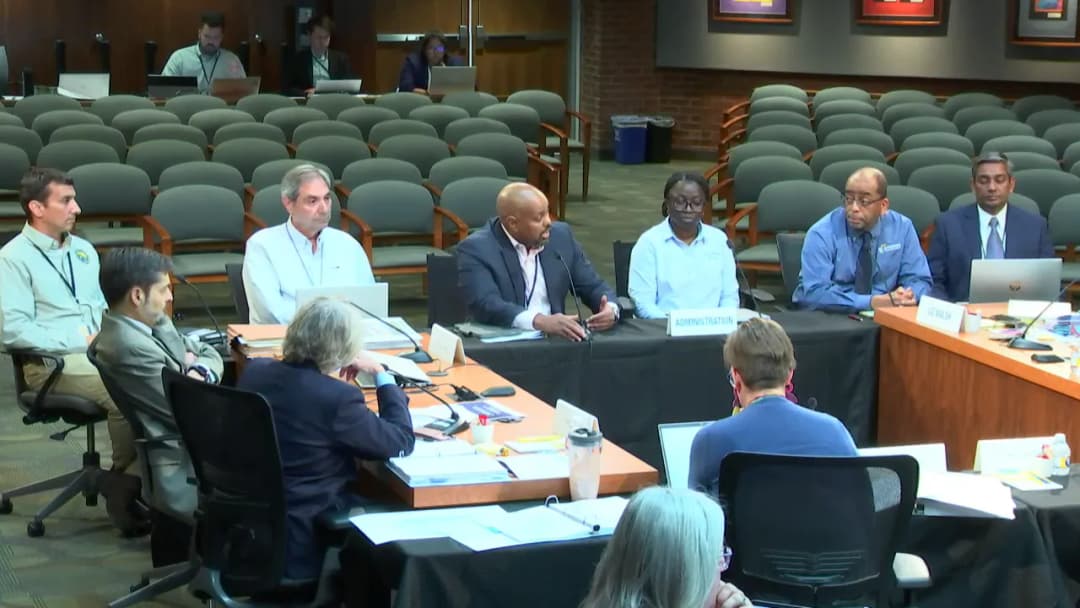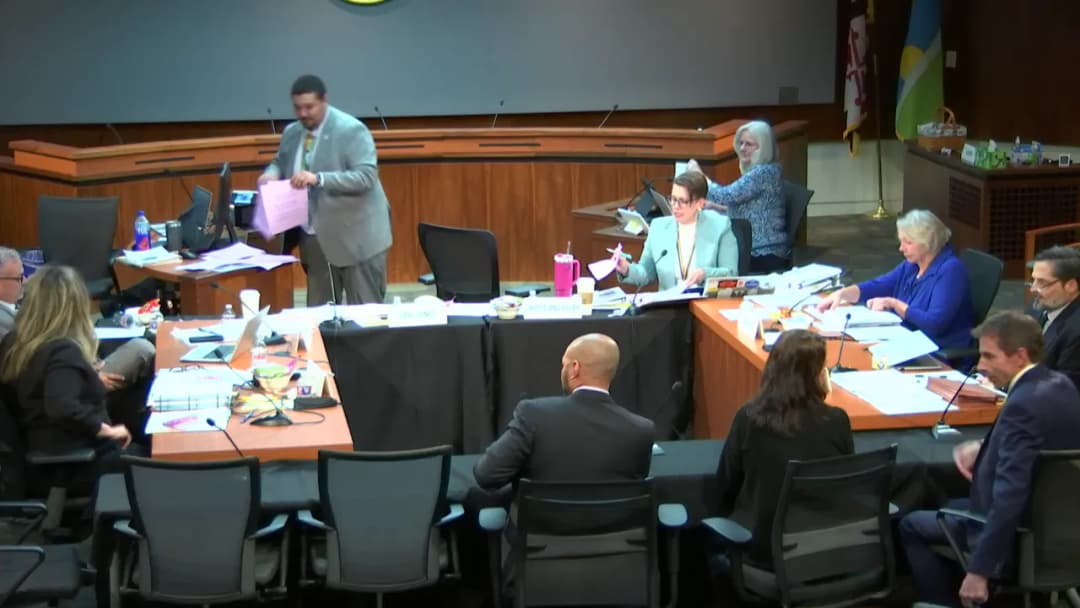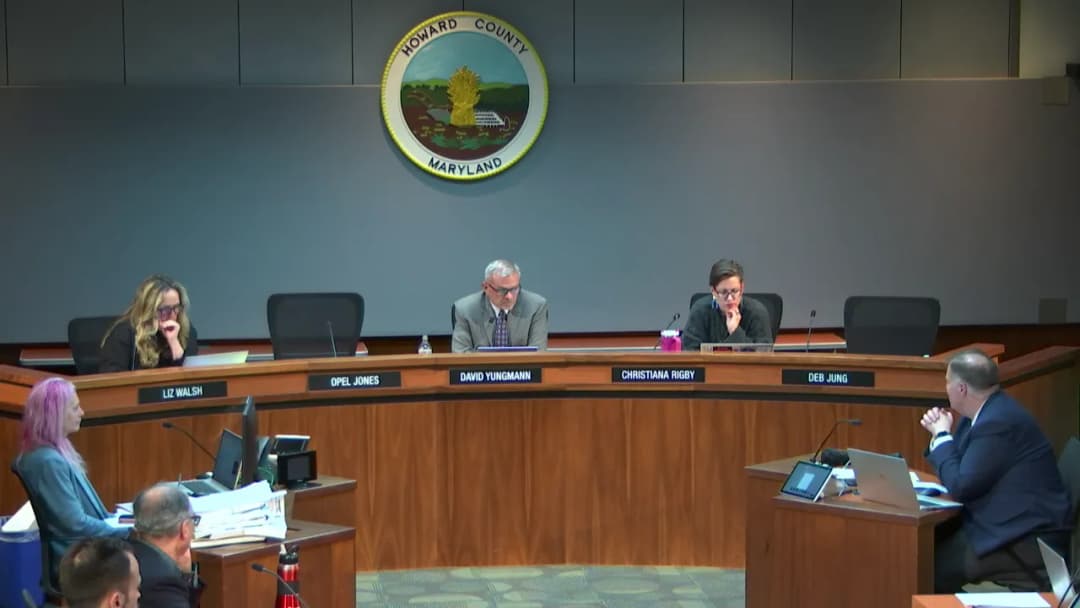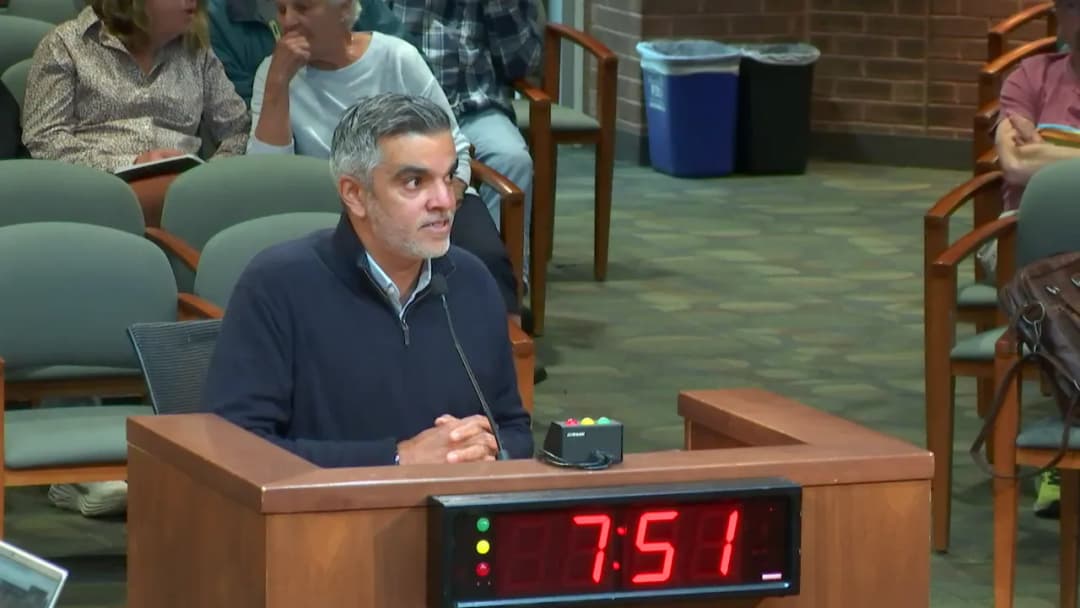
The Howard County Planning Board met on May 7, 2026, in the Banneker Room at the George Howard Building, Ellicott City, MD, with virtual attendance options. The board considered three items: a quasi-judicial hearing for the Mullinix Overlook subdivision, an amendment for a deck setback variance, and a site development plan for two lots in Cascade Ridge. All items were approved unanimously. Consent Calendar - Agenda and Minutes: The board approved an amended agenda (reordering items to accommodate the engineer for Mullinix Overlook) and adopted the recording of the April 23, 2026 WebEx meeting as the minutes. (Motion: Move, Second, All in favor; one abstention from newly attending board member.) Public Comments & Testimony - Mullinix Overlook (PB 460 SP-25-005): Multiple residents testified in opposition. Concerns included: aging pipelines on the property posing leakage risks, potential well depletion or contamination from 10 new septic systems, inadequate stormwater runoff and culvert capacity, increased traffic on narrow roads (A.E. Mullinix and Duvall Roads), and safety hazards for pedestrians. Specific residents: James Wingo (2201 Duvall Road), Timothy Totis (2821 Duvall Road), Laura Weeder (16210 A.E. Mullinix Road), Carol Zenter (16474 A.E. Mullinix Road), James A. Massey Sr. (2019 Duvall Road), Evelyn E. Furley (16371 A.E. Mullinix Road). The developer (Vikram Puri) testified that they are in close contact with Colonial Pipeline and have reviewed plans for driveway crossings. - Cascade Ridge (SDP-26-039): Two residents testified. Steven Burns (4954 Pale Morning Dunn Road) raised stormwater management concerns: overgrown vegetation in swales, uncleared underground drains, and sediment runoff during a March storm that left a ribbon of sediment hundreds of feet long. Ed Kinales (4848 Royal Coachman Drive) cited noise from construction, loss of privacy due to insufficient tree buffers, and dead/diseased trees in the forest conservation area. He requested commitments from the developer for additional evergreen planting. Staff noted that trees are typically planted at the end of construction with a three-year survival bond, and that sediment control issues should be reported to the county's construction inspection division. Discussion Items - PB 460 - Mullinix Overlook (SP-25-005): Staff presentation by Jason Lenker (DPZ) and petitioner engineer Sam Alomar (Mildenberg Boender & Associates) for a 23-acre site at 1639 A.E. Mullinix Road, Woodbine. Proposed 10 residential lots (reduced from 3-acre minimum via cluster subdivision), 1 buildable preservation parcel, and 3 non-buildable preservation parcels. The site is in Growth Tier 3, zoned Rural Conservation. The state law (SB 236) requires the board to consider environmental impacts and cost of services; the county’s Adequate Public Facilities Ordinance addresses the latter. Staff found no environmentally sensitive features on site; 0 acres of forest will become 4 acres of afforestation in conservation easements. One specimen tree will be removed and replaced with four mitigation trees. The health department approved well and septic locations with primary and backup systems. Colonial Pipeline has been contacted for crossings. Board approved without conditions. - ASDP-96-088 David A. Medearis: Staff presentation by Catherine Bolton (DPZ) for a deck at 6217 Twenty Chase, Columbia (Long Reach). Request to reduce the side yard setback from 7.5 feet to 3.3 feet (encroachment of 4.2 feet). The deck meets all other setbacks, height, and lot coverage (23% vs. max 30%). The Long Reach Community Association approved the variance on June 6, 2025. No public comments. Board approved. - SDP-26-039 Cascade Ridge (Lots 20 & 21): Staff presentation by Derek Jones (DPZ) and petitioner David Thompson (Benchmark Engineering) for two single-family detached dwellings on lots 20 (6,855 sq ft) and 21 (6,930 sq ft) in the Cascade Ridge subdivision (17 lots total). The lots were created via a resubdivision of Lot 5, adding one extra lot to the originally approved 16. No public road improvements were required. The site development plan complied with RED zoning bulk regulations (min 6,000 sq ft lots, 30 ft front setback, 10 ft side, 30 ft rear). No environmental, historic, or open space features are impacted. Stormwater management uses on-lot dry wells. Forest conservation easements buffer adjacent properties along Coachman Drive (82–154 ft). Board approved. Key Outcomes - PB 460 SP-25-005 Mullinix Overlook: Approved (motion by board member, seconded, all in favor). The board found the proposal meets the environmental criteria under SB 236. Conditions: future plans must address stormwater, sediment control, and utility approvals. - ASDP-96-088 David A. Medearis: Approved (motion, second, all in favor). The board determined the deck adjustment will not alter neighborhood character, impair adjacent properties, or harm public welfare, and results in a better design. - SDP-26-039 Cascade Ridge (Lots 20 & 21): Approved (motion, second, all in favor). The board found the plan meets criteria under Section 107.OF.6 for protecting environmental/historic resources, taking advantage of topography, and providing buffers. - Adjournment: Motion to adjourn, seconded, all in favor. The meeting ended.
Public Meetings - Howard County, Maryland
Public Meetings - Howard County, MarylandThe Howard County Hearing Examiner convened on Wednesday, May 6, 2026, at 5:30 pm in a hybrid format (Banneker Room and WebEx) to consider Case BA 26-007C – Rock Realty, LLC. The petitioner sought a conditional use approval to increase the number of age-restricted adult housing (55+) units on the property at 12170 Lime Kiln Road, Fulton, from the previously approved 58 units to 63 units. The hearing included testimony from the petitioner's experts, public comments from homeowners, and discussion of amenities and construction issues. The record was left open for a proposed condition on the walking trail. Public Comments & Testimony - Richard Robbins (homeowner, 8509 Lolly Brock Lane) testified in favor of the additional five units but expressed concerns about the community's amenities. He stated that the walking trail made of wood mulch is unstable, unsteady, and difficult for residents aged 55 and over to use. He presented photographs (marked as Opposition Exhibits A–D) showing a high step-up onto the trail and debris. He also noted the lack of lighting at the mailboxes and questioned whether the water and sewer permits allowed for more than 58 lots. He requested that the trail be improved to a compacted gravel surface (e.g., crusher-run gravel) to be more usable and ADA-compliant. - Stanley Surfling (homeowner, 8527 Lolly Brock Lane) supported the additional units but criticized the trail and construction management. He described his experience with a similar wood-chip trail in a previous community that failed and was replaced with crusher-run gravel, which worked well for over 15 years. He also reported a septic backup in his backyard where untreated wastewater had to be removed, and noted poor grading and erosion along the trail. He expressed frustration with construction debris and lack of cleanup. - Warren Buckalter (online attendee) asked about traffic impact on the single ingress/egress point and later agreed with concerns about the trail's steepness and instability after rain. Discussion Items - Petitioner's Case (Rock Realty, LLC) - Brandon Rao (civil engineer, Bowler Engineering) testified as the project manager. He explained that the original approval for 58 units was granted on September 22, 2020. The proposed increase to 63 units is possible because additional septic capacity was identified during construction, and the total remains below the maximum density. He confirmed that the technical staff report from the Department of Planning and Zoning found no issues with compatibility, buffering, or architectural transition. He stated the project continues to meet all criteria. - Mickey Cornelius (traffic engineer, senior vice president) testified that the five additional age-restricted units would generate only one additional weekday morning peak-hour trip and two additional weekday evening peak-hour trips. He stated this negligible impact satisfies Howard County's adequate public facilities requirements without needing a new traffic study. Under cross-examination by Mr. Buckalter, he acknowledged the minimal traffic effect on the single ingress/egress but deferred on the second access point. - Brandon Rao (recalled) clarified that the second entrance (Nicolar Drive) is intended only for emergency egress and construction; the permanent entrance will be off Lime Kiln Road via Lollybrock. He confirmed that a single ingress/egress is legally sufficient for 63 units. - Petitioner's Rebuttal (Jamie Frazier, developer) - Mr. Frazier addressed concerns raised by Mr. Robbins and Mr. Surfling. He acknowledged that the clubhouse would be enlarged from 1,160 to 1,260 square feet to accommodate the additional units, and that building permits were being sought. Regarding the trail, he stated the development is obligated to provide a natural surface trail, and the wood mulch surface will compact over time. He committed to having the contractor remove larger debris and improve the surface, but noted that an asphalt trail would increase impervious surface and require significant plan revisions. He disputed marketing materials that may have shown an asphalt trail, stating they were withdrawn. On mailbox lighting, he said he would explore solar lighting but noted no existing electrical circuit. He expressed a commitment to delivering amenities as the community nears completion (about 65% settled). - Hearing Examiner's Remarks - The Hearing Examiner expressed concern that the trail is not ADA-compliant and stated that the condition for the trail must be addressed. She directed Mr. O (petitioner's counsel) to propose language for a condition that ensures the trail is usable and accessible. She noted the trail appears unsafe for a 55+ community and asked the petitioner to seriously consider an alternative surface like crusher-run gravel, as suggested by Mr. Surfling. Key Outcomes - Evidentiary Hearing Concluded: The Hearing Examiner closed the evidentiary portion of the hearing. - Record Kept Open: The record will remain open for 30 days to allow Mr. O to submit a proposed condition regarding the walking trail. The Hearing Examiner requested that the condition ensure the trail is safe, usable, and appropriate for the age-restricted population, with consideration of ADA compliance. - Decision and Order Pending: A final decision and order will be issued after receipt of the proposed condition and review of the record. - No opposition testimony: No persons testified in opposition to the application, and no additional public comment was received from virtual attendees.
This meeting, held on May 5, 2026, was the second work session for the FY2027 operating budget. The council reviewed budgets for Circuit Court, Police, Fire and Rescue, Corrections, Planning and Zoning, Public Works, General Services, Inspections, Soil Conservation, Recreation and Parks, Transportation, Health, and Social Services. Discussions focused on workload increases, staffing, chargebacks, and impacts of state and federal policy changes. Circuit Court - Chief Judge Tucker reported a 38% increase in juvenile cases since FY23 and a 25% increase last year. The court requested an additional court reporter and a case manager to handle workload due to complex cases and body-worn camera evidence. - The court's budget increase of about 10% (excluding new positions) is largely driven by health insurance chargebacks (26% increase per position) and transfer of mental health court funding ($187,000) from the Health Department. Police - The proposed budget is $172.1 million (5.7% increase). 76% of the increase is for fixed personnel costs and chargebacks. The department is restructuring (Homeland Security Bureau, Information and Forensics Bureau) and implementing a real-time information center. - Council members questioned behavioral crisis response following the death of Alex Lemori. The department confirmed that crisis intervention is embedded throughout, not a separate unit. They have purchased tasers and are training officers. - Councilmember Walsh expressed concern about the lack of a dedicated behavioral crisis unit and inadequate less-lethal options. Councilmember Youngman noted that speed camera revenue is projected to increase despite adding cameras, and raised concerns about overtime costs for Merriweather detail. Fire and Rescue - The budget request is a 3.4% increase, maintaining service levels. The mobile integrated health program has reduced 911 calls by 70-80% for participants. The department plans to replace all self-contained breathing apparatus (SCBA) at a cost of $6-6.5 million. - Councilmembers praised efforts to reduce overtime. The fire fund remains solvent through 2033, but a state-mandated 42-hour workweek (starting Oct 2028) will require monitoring. The department is suing hedge funds over rising vehicle costs. Corrections - The department requested five new positions. Overtime is a significant cost due to mandatory minimum staffing and backfilling for illness, injuries, and training. The vacancy rate is low (2%). - Councilmember Jung questioned the sustainability of using overtime rather than hiring more staff. The department noted that mental health cases often lead to recidivism. Planning and Zoning (DPZ) - The maintenance-of-effort budget is $9 million (2.7% increase). Three positions remain frozen. Code enforcement has three inspectors; councilmembers criticized response to citizen complaints (e.g., Manor Hill Brewery, WR Grace). - Councilmember Walsh argued that DPZ lacks due diligence in investigating violations. Director Eisenberg defended their work. Councilmember Rigby noted that inspectors are not available on weekends, and suggested contract inspectors for off-hours enforcement. Public Works - Water and sewer capacity adequate for projected growth; agreements from 1982/84 secure capacity at Patapsco plant. The water and sewer operating fund balance is low ($4.9 million), prompting a requested rate increase. - The department faces significant vacancies (14%), partly due to non-competitive salaries. Councilmembers urged better compensation and a compensation study from HR. The fleet fund is being depleted; an operating transfer of $5.5 million was made to the general fund. General Services - The facilities master plan was provided. Councilmember Jung criticized energy savings days, arguing they saved only an estimated $100,000 but inconvenienced employees and the public. The program will continue until November. Fleet fund balance is projected to drop to $300,000; increased chargebacks needed. Inspections, Licenses, and Permits (DILP) - Permit revenue is declining due to shift from new construction to multifamily and alterations. New permitting software is expected by end of calendar year 2026, with AI to improve customer experience. Council requested tracking of accessory dwelling units. Soil Conservation - The cost-share program saw 30 farmers install 67 best management practices, including grassed waterways and manure storage. Federal and state funding provide most of the program funds; county AgPres cost-share helps incentivize projects. Recreation and Parks - Child care program recovered: staff increased from 115 to 151, waitlist reduced from 733 to 328. The department is using ARPA funds for stipends but will need to replace $360,000 after Dec 2026. Field fees are being increased after 15 years to address deficits. - Councilmember Youngman questioned fee increases given the county's overall revenue growth, but the department explained rising fixed costs (health insurance chargebacks) and the need to fund field maintenance. Transportation - Rapid Ride has tripled ridership; the office is studying expansion. The downtown circulator remains stalled due to insufficient density and free parking. Councilmember Jung pressed for a pedestrian safety plan for downtown Columbia, noting lack of progress. Bike/Walk Howard plans are being updated. Health Department - The total operating budget is $55 million; county provides $16.7 million (30%). State core funding was cut by approximately $2 million (20%) over 18 months, leading to elimination of 13 positions through attrition. Environmental health fees have not increased, causing a $357,000 deficit. - Councilmembers expressed concern about rising uninsured rates and the impact of federal/state cuts. The department's strategic priorities include maternal-infant health, behavioral health, and essential public health functions. Social Services - Federal changes to SNAP (food stamps) reduced benefits for 105 asylum refugees in Howard County. An error rate penalty could cost Maryland $50-75 million statewide. The office has created a small food pantry and strengthened referrals. - The non-custodial parent program is working with workforce development and a fatherhood group. Councilmembers acknowledged the challenges of underfunded state and federal programs. Key Outcomes - No formal votes were taken during this work session. Council members will use the information to inform budget decisions in subsequent meetings. Several councilmembers noted the need to address health insurance chargebacks, salary competitiveness, and the impact of state and federal policy changes on county services.
The Howard County Council held its hybrid legislative session on Monday, May 4, 2026, at 7:00 p.m., chaired by Opel Jones. The session included approval of prior minutes and journals, introduction of numerous new bills covering appointments, collective bargaining agreements, emergency appropriations, zoning amendments, and the FY2027 budget, followed by final consideration and votes on a slate of appointments, transfers, bond authorizations, and zoning measures. All votes were unanimous except for one zoning bill that passed 4–1. Consent Calendar - Approval of Journal – Unanimously approved the journal of the April 6, 2026 legislative session. - Approval of Minutes – Unanimously approved minutes from eight meetings: Monthly Meeting (April 13), Budget Public Hearing (Capital, April 13), Budget Work Session (Capital 1, April 15), Budget Presentation (April 20), Legislative Public Hearing (April 20), Budget Work Session (Capital 2, April 22), Budget Public Hearing (April 27), and Budget Work Session (Operating 1, April 29). Introductions - Appointments and Reappointments – Introduced 22 council resolutions (CR52‑CR73) and four reappointments (CR69‑CR72) to boards and commissions including the Adult Public Guardianship Review Board, Asian American and Pacific Islander Commission, Commission for Women, Martin Luther King, Jr. Holiday Commission, La Alianza Latina Commission, Recreation and Parks Board, and Multimodal Transportation Board. - Financial (Non‑Budget) – Introduced CB26‑2026 (Police Officers Lodge 21 collective bargaining agreement), CB27‑2026 (Police Supervisors Lodge 143 agreement amendment), CB28‑2026 (Public Safety Dispatchers agreement), SAO1‑FY2026 (transfer of $1,000,000 from General Fund Contingency Reserve to Department of Public Works for snow removal), CB29‑2026 (emergency appropriations for snow removal, Corrections overtime, and SDAT billing), CB30‑2026 (emergency appropriation of $5,200,000 for Employee Benefits Self‑Insurance Fund due to medical claim increases), and CR74‑2026 (Board of Education FY2026 operating budget transfers of $3,635,000). - General Legislation – Introduced CB25‑2026 (ZRA 224 – Age‑Restricted Adult Housing Cottage Clusters) and CB31‑2026 (S.M.A.R.T. Siting Act, temporarily prohibiting data center development approvals and creating a task force to study impacts). - Budget Items – Introduced CR75‑2026 (FY2027 Retirement Incentive Program), CB32‑2026 (FY2027 Pay Plan), CB33‑2026 (FY2027 Budget and Appropriation Ordinance), CB34‑CB39‑2026 (various bond authorizations totaling approximately $365,340,969 for capital projects, road construction, water/sewer, water quality, watershed protection, and broadband), CR76‑CR99‑2026 (approving the Capital Program, budgets for Howard Community College, Library System, Board of Education, Health Department, and fee/resolution schedules). Final Consideration - Appointments (CR42‑CR48) – Unanimously approved seven appointments: Property Tax Assessment Appeal Board, two Animal Matters Hearing Board members, Public Works Board, LGBTQIA+ Commission, Board of Health, and Inspector General Advisory Board. - Faulkner Ridge Center Early Learning Center (TAO2‑FY2026 and CB22‑2026) – Unanimously approved a transfer of $3,500,000 from various school capital projects to address a budget shortfall, and authorized bonds of $3,500,000 for the project. - Maryland Transit Administration Grant (CR49‑2026) – Unanimously endorsed the County Executive’s application for federal and state transit grants. - State Financing for Feast & Fettle (CR50‑2026) – Unanimously endorsed the project as consistent with the county’s economic development goals. - Payment in Lieu of Taxes – Midway 32, LLC (CR51‑2026) – Unanimously approved a PILOT agreement for redevelopment of an office building into 623 housing units in a Transit Oriented Development District at 10010 Junction Drive, Annapolis Junction. Councilmember Rigby noted the development will double the number of housing units available to residents with disabilities. - ZRA 221 – Adaptive Reuse of Motel/Hotel Sites in Route 1 Corridor (CB23‑2026) – Unanimously approved, sponsored by Northeast Properties Developers, LLC. - ZRA 222 – Optional Design Projects in Route 1 Corridor (CB24‑2026) – Passed 4–1 after adopting an amendment (Amendment One) clarifying criteria the Planning Board must consider, including conformance to purpose, enhancement of the community, and supporting documentation. Councilmember Jung voted no, stating the area has been ignored and the proposal lacks assurance of community benefits. Councilmember Rigby argued optional design provides meaningful change and more transparent community engagement. Key Outcomes - All introduced bills and resolutions were placed on the agenda for a public hearing on May 18, 2026, with a possible work session on May 26, 2026. - Final consideration votes: All items passed unanimously except CB24‑2026 (ZRA 222), which passed 4–1 (Jung opposed). - No public testimony was taken during this legislative session.
The Howard County Council held its first FY2027 operating and capital budget work session on April 29, 2026, from 10:00 a.m. to approximately 4:30 p.m. The session covered revenue overview, education funding for HCPSS, Howard Community College, and the Howard County Library System, as well as operating budgets for the State’s Attorney, Board of Elections, and the new Inspector General’s office. Discussions highlighted a proposed $1.6 billion general fund budget, a $67 million budget gap closed without tax increases, significant revenue volatility, and long-term sustainability concerns. No formal votes were taken; the session was informational and will continue on May 11 and May 15, 2026. Revenue Overview - County Administrator Dr. Holly Sun presented a $1.6 billion FY27 general fund budget, closing a $67 million gap using multiple strategies including a $3 million transfer from the fleet fund, updated income tax projections (11.6% growth over FY26 budget, but only 2.4% over current year estimate), and $41 million in reductions from other agencies. - Key revenue drivers: property tax (slowing but positive), income tax (highly volatile, driven by capital gains and one-time factors), and interest income (declining with federal rate cuts). - Risks include potential federal layoffs (over 11% of county residents are direct federal employees), state tax law changes, and uncertain economic outlook. The state’s March revenue forecast projects 0% growth in FY27. - Use of pay-go (one-time funds) is $106 million, primarily for school capital projects. The county’s recurring revenue growth of $116 million is allocated 66% to schools, followed by public safety and community services. - Councilmembers expressed concerns about structural deficits, the need for sustainable revenue growth, and the importance of diversifying the tax base through housing and commercial development. Education – Howard County Public Schools (HCPSS) - Superintendent Bill Barnes and Board Chair Antonia Watts presented the board’s FY27 operating and capital budget request. The county executive proposed funding 99.3% of the request, leaving a $6.2 million gap that the school system plans to close using fund balance ($9.2 million total one-time funds), reducing dependency on reserves from previous years. - Discussion focused on the Blueprint for Maryland’s Future implementation, rising special education and multilingual learner costs, declining enrollment, and the need to redirect resources from non-Blueprint programs (e.g., GT, strings) to meet mandates. - Councilmembers questioned the use of fund balance, long-term projections showing significant future funding gaps (e.g., $75 million increase needed in FY28), and the impact of Blueprint’s unfunded mandates. Superintendent Barnes emphasized that increased funding alone is not the solution; the system is undergoing strategic transformation. - Capital budget: $98 million from the county, with a focus on deferred maintenance (growing $30-40 million annually), new Elementary School 43 (addressing overcrowding at a Title I school), and maximizing state Built to Learn funds before 2031 expiration. A sufficiency study will be completed in fall 2026 to inform future priorities. - On block scheduling: Superintendent noted it was discussed but shelved after strong staff opposition; it remains a potential future conversation to improve student opportunity and manage class sizes. Education – Howard Community College (HCC) - President Dr. Daria Willis and team presented the FY27 request: $47.2 million operating (3% increase) and $3 million capital. Key initiatives include the workforce development and trade center (opening fall 2026), the mathematics and athletics complex (already hosting events), and expanded programs. - State aid increased by $1 million, but future state funding caps are a concern. Enrollment has grown 8.2% over five years. - Discussion covered contract with CampusWorks ($2.2 million annually, stepping down), a compensation study for full-time employees (excluding adjuncts, due October 2026), and a $3,500 one-time bonus for all employees in FY25. - Councilmembers asked about administrative positions, legal spending, and the percentage of budget increases allocated to compensation (currently $2.3 million set aside for all employees, with negotiations ongoing for unionized faculty). Education – Howard County Library System (HCLS) - Library leadership presented the operating budget (county funding of $29.2 million, up 7%) supporting wage increases, negotiated agreements, and collection needs. Highlights include early childhood programs, teen engagement, and community connection initiatives. - Capital project: New Central Library in downtown Columbia – updated budget of $129 million (down 10% from prior estimate), with 38% from external sources (state grants, federal funding, philanthropy). The project targets a fall 2029 construction start, with land purchase in spring 2027. - Councilmembers questioned project cost realism, operational costs ($600,000 estimate for building maintenance, to be updated), parking arrangements, and the design-build approach for cost control. Director of General Services addressed safety concerns at Savage Branch, stating no hazardous chemical found after extensive testing; carbon monoxide detectors will be integrated into HVAC. Legislative/Judicial/IG – State’s Attorney - State’s Attorney Rich Gibson presented a $15.6 million budget for 95 employees. Priority initiatives include reclassifying five victim-witness assistants (funded), adding paralegals for body-worn camera review (half funded) and juvenile unit (not funded), and planning a mental health court for 2027. - Body-worn camera unit currently has 12 staff and reviewed 11,456 hours of footage in FY25; workload pressures necessitate additional resources. The office handles approximately 11,000 cases annually. Legislative/Judicial/IG – Board of Elections - Director Guy Mickley (appearing virtually) reported on FY27 budget, which covers the gubernatorial general election. Key items: 56 polling places, 1,100 election judges, and planned replacement of all voting equipment by 2028 (paid in three installments starting FY27). Unfunded mandates from the state (equipment leasing) comprise about a quarter of the budget. Legislative/Judicial/IG – Inspector General - New Inspector General Missy Madigan presented her first budget, with 96% of expenses in salaries for four positions (reclassified administrative assistant to investigator). Total FY27 request is $601,869. - She reported receiving 52 complaints in her first four months, developing policies, a website, and a case management system. She requested read-only access to county data systems and use of salary savings to purchase a $46,000 fleet vehicle. - Councilmembers emphasized the importance of full and unrestricted access to records per the enabling legislation, expressing concern about delays in obtaining such access. The Office of Law indicated a data use agreement is nearly complete. Key Outcomes - No formal votes were taken. The work session was informational, with follow-up questions and additional discussion scheduled for May 11 and May 15, 2026. - The council decided to defer remaining agenda items (Sheriff’s Office, County Council/Auditor, other judicial departments) to the May 15 spillover session. - Councilmembers directed staff to investigate the Inspector General’s need for system access and to expedite agreements. - The council expects updated revenue projections and more detailed capital project information from the county administration and school system before final budget adoption.
This meeting of the Howard County Zoning Board was held on April 29, 2026, starting at 7:00 PM, to review the hearing examiner's report and discuss exceptions for ZB 1130M, a petition to reclassify parcels from TOD to B-2 zoning with a fueling facility, convenience store, and car wash. Due to multiple procedural disputes and the need for additional time, the board voted to continue the entire hearing (including the hearing examiner's report, exceptions, and responses) to June 3, 2026, starting at 5:30 PM. Consent Calendar - Unanimous approval of the April 15, 2026 Zoning Board meeting minutes (moved and seconded; Chair Youngman, Dr. Jones, Ms. Jung, Ms. Rigby all voted yes). Discussion Items - Preliminary Objection on Scheduling: Attorneys for protestants (Mr. Gill on behalf of Shaheed Mahmood, and Mr. Hurowitz) objected to hearing the hearing examiner's report and exceptions on the same night, arguing that the rules allow 20 business days for responses to exceptions. Petitioner's attorney (Chris DeCarlo) and the protestants eventually agreed all parties preferred a single hearing, but disagreed on timing. - Zoning Counsel Opinion: Nate Foreman (zoning counsel) argued that the rules distinguish between exceptions (triggering oral argument) and responses (which can be filed later without a separate oral argument). He suggested hearing the report and exceptions that night and allowing responses to be submitted later. - Board Discussion on Process: Board members expressed a preference for efficiency. Member Walsh raised concerns about completeness of ethics disclosures under Maryland Public Ethics Law, noting that only two LLC affidavits were provided. Petitioner's counsel stated that full ownership disclosures were filed with DPZ in April 2025, and offered to provide paper copies. The board agreed to resolve this at the next hearing. - Exhibits Attached to Exceptions: Petitioner objected that some exceptions included exhibits not admitted into the record. The board decided to address this preliminary matter at the continued hearing on June 3. - Scheduling: After discussion, Chair Youngman decided to continue the entire matter to June 3, 2026, starting at 5:30 PM. The board noted that June 3 avoids the May 27 conflict (sunset) and allows a single hearing for all elements. Key Outcomes - Approved minutes of April 15, 2026 (unanimous). - Continued the hearing on ZB 1130M to June 3, 2026, starting at 5:30 PM. At that meeting, the board will: (a) address ethics disclosures and the preliminary matter of exhibits attached to exceptions, (b) hear the hearing examiner's report, and (c) hear oral arguments on all exceptions and responses. The meeting will recess for a previously advertised administrative meeting on another case, then reconvene to finish.
On April 28, 2026, the Howard County Hearing Examiner, Joyce Nichols, held an evidentiary hearing for Case BA 25-027V, a variance petition by John Lynn. The petition requested a reduction of the rear setback from 25 feet to 7 feet (an 18-foot incursion) for an existing deck at 11168 Eugene Avenue, Fulton, MD. The hearing focused on the five required findings for variance approval. Discussion Items - Applicant's Testimony: John Lynn testified that he built the deck after obtaining HOA approval and neighbor signatures, but discovered after construction that a county building permit and variance were required due to the setback incursion. He described the lot as irregularly shaped (rhombus/parallelogram), leaving limited rear yard space. The property slopes downward toward a drainage swale and HOA open space. Lynn stated that neighboring properties have similar decks and that he has learned the importance of following county procedures. - Hearing Examiner's Findings Review: - First Finding – Unusual Physical Conditions: The examiner found that the lot's shape (narrow, irregular) and the house's placement (tight against both front and rear setbacks) created a practical difficulty, as a reasonably sized deck could not be built within the building restriction line. Lynn agreed. - Second Finding – Character of Neighborhood: The examiner noted that neighboring properties have similar decks, so granting the variance would not alter the neighborhood character, impair adjacent property use, or be detrimental to public welfare. Lynn confirmed. - Third Finding – Self-Created Hardship: The examiner determined that Lynn attempted proper steps (HOA approval, reputable contractor) and the difficulty was not self-created; Lynn stated he took responsibility but did not intentionally violate codes. - Fourth Finding – Minimum Relief Necessary: The variance request was only for the deck's depth, as the deck is already built. Lynn confirmed this was the minimum relief needed. - Fifth Finding – Historic District: Not applicable; property is not in a historic district. Key Outcomes - The evidentiary hearing was concluded. The Hearing Examiner will issue a written decision and order at a later date. No immediate vote or decision was rendered during the hearing. - The examiner advised Lynn that if the variance is granted, he must then work with county representative Justin Tyler to reactivate the building permit and complete inspection.
The Howard County Council held its second public hearing on the proposed FY2027 Operating Budget on April 27, 2026 at 6:00 p.m. in a hybrid format. The hearing focused on testimony regarding the Executive Proposed Operating Budget, which includes funding for education (Howard County Public School System, Howard Community College, Howard County Library System), public safety, public facilities, community services, and general government. Over 20 speakers provided testimony, with many advocating for full funding of the school board's budget request. The council will hold work sessions in April and May before final adoption. Public Comments & Testimony - Liam Hartner (student, Howard County FFA) testified in support of the Howard County Public School System (HCPSS) budget, specifically requesting funding for a second educator in the Agri-Science Academy to support a plant and environmental sciences pathway, and highlighted the program's impact on students. - Superintendent Bill Barnes (HCPSS) urged the council to maintain the county executive's proposed funding level of $57 million in new recurring operating revenue, which funds 99.3% of the Board of Education's request. He emphasized collaboration with stakeholders. - Brian Hull (CFO, HCPSS) detailed the Board of Education's approved $1.285 billion operating budget request (5.7% increase over FY26). He noted the county executive's proposal funds 99.3%, and the remaining gap of approximately $6.2 million could be covered by updated state aid projections and fund balance ($6.2 million from fund balance, leaving about $14 million projected year-end balance). - Jennifer Webster (Chief Academic Officer, HCPSS) highlighted three critical investments: pre-kindergarten expansion, special education, and multilingual learner support. She described budget shifts to align with the strategic plan. - Meg Ricks (Vice Chair, Board of Education) requested full funding of the board's request, expressing gratitude for the county executive's proposal and emphasizing the need for stability to protect programs and staff. - Dr. Lin F. Chen (Board of Education member, District 4) urged full funding, noting the $6.2 million gap and the need to avoid using fund balance for recurring costs. She cited inflation eroding purchasing power and the county's increased revenue. - Benjamin Schmidt (President, Howard County Education Association) representing 6,300 educators, argued that "close is not good enough" and called for full funding with recurring dollars, not fund balance. He cited past staffing cuts, increased class sizes, and declining resources. - Yi Han (parent of two children with autism, PTA representative) expressed appreciation for the proposed budget and urged full funding to support special education improvements, noting that the gap should be closed. - Katie Merza (elementary special education teacher) testified that the school system's reputation is eroding due to cuts, and urged full funding to avoid continued reliance on one-time funds. She emphasized the need for sustained investment in special education. - Anthony Fulmore (Vice President, AFSCME Local 1899, custodian at Bonnie Branch Middle School) requested full funding to support custodial, maintenance, and grounds staff. He noted 99.3% of custodial vacancies are filled but more positions are needed. - Aaron Parker (Ellicott City resident) urged funding for the science of reading professional development, diagnostic assessments, and literacy coaches. He cited that only 26 central office staff and 329 pre-K-3 teachers have met training standards, and that 81% of grade 3-5 students are flagged on screeners. - Karina Fisher (PTAC) supported full funding, arguing that the county has sufficient revenue ($116 million new general fund revenue vs. $96 million projected) and that using fund balance would violate HCPSS policy 4070. She noted that per-pupil spending has dropped 2.5% over 10 years while state spending rose 5.6%. - Anthony DeBella (Mayfield and Homewood dad) called for 100% funding, stating that county revenue is strong and that using fund balance creates a collision course. He noted that past cuts have diminished academic programs. - Cindy LaFollette (District 1 resident, advocate) urged the council to amend the budget to close the $6.2 million gap, arguing that the money exists and that using fund balance is unsustainable. - Dr. Daria Willis (President, Howard Community College) requested adoption of the county executive's proposed $47.2 million operating budget (3% increase, $1.3 million more than FY26). She noted that state aid is flat for the second year, and the college is managing costs internally. - Vivian Moore Lawyer (Chair, Board of Trustees, HCC) supported the proposed budget, highlighting HCC's role as an economic engine and its fiscal discipline. - Deanne Alexander (HCC student and employee) shared her personal story and thanked the council for supporting HCC, which enabled her to achieve a 3.8 GPA and join the honors program. - Steve Abler (Ellicott City resident, parent of a prospective student) advocated for expanding the Diagnostic Sonography Program at HCC, citing a lottery system with limited clinical spots (16-24 students per year) and high demand (up to 400 applications). He urged the council to invest in workforce training. - Tonya Aikens (President & CEO, Howard County Library System) requested full funding of the county executive's proposed budget, highlighting early literacy programs (81,000 parents and children attended classes), teen programming, and community connections. - Liz Banak (Trustee, HCLS) focused on the library's role in connecting diverse populations, including seniors (16.3% of county population), through programs like The Longest Table and bilingual classes. - Tiffany Tupper (Friends of the Library Board) supported full funding, emphasizing the library's value for education, equity, and economic vitality. - Amanda Hoff (Director, Howard County Tourism Council) requested full funding of the community service partnership grant, noting that tourism generated $830 million in visitor spending, supported 9,800 jobs, and returned $34 for every $1 invested. - Aaron Shapiro (Executive Director, Patapsco Heritage Greenway) requested $80,000 in community service partnership funding, highlighting environmental stewardship, heritage tourism, and volunteer programs. He noted the organization's contributions to water quality, trash removal, and invasive plant removal. Discussion Items - Councilmember Jung asked Brian Hull about the sources to close the $6.2 million gap. Hull responded that updated state aid and fund balance ($6.2 million) would be used, with a projected year-end fund balance of $14 million. - Councilmember Jung asked Anthony Fulmore about the number of custodial vacancies. Fulmore noted that 99.3% of positions are filled but more are needed. - Councilmember Rigby discussed with Katie Merza the impact of state funding and Blueprint, noting that the state's funding formula is inadequate and that the county is working to address the gap. - Councilmember Rigby acknowledged Steve Abler's concern about the sonography program and noted that HCC is expanding the workforce and trade center, including skilled nursing positions. - Councilmember Jung thanked Aaron Shapiro for mentioning Grace Kubofsick. Key Outcomes - No votes were taken at this public hearing. The council will hold work sessions on the FY2027 Capital and Operating Budget in April and May. The next work session on education is scheduled for Wednesday, April 29, 2026. - Written testimony will continue to be accepted and considered by the council prior to taking action.
On Thursday, April 23, 2026, at 10:00 a.m. (agenda time), the Howard County Hearing Examiner, Joyce Nichols, held a hybrid evidentiary hearing in the Banneker Room of the George Howard Building in Ellicott City, Maryland, and via WebEx on application BA 26-002V. Robert Warner petitioned for a residential district variance at 8496 Thomas Williams Way, Columbia, Maryland. The agenda listed a request to reduce the side-yard setback from 10 feet to 4 feet 4 inches to build a 28-foot by 18-foot attached garage. At the hearing, the parties also addressed an existing shed on the property, with a requested setback of 4 feet 2 inches. No minutes were available to reconcile that additional item with the agenda. Public Comments & Testimony - Robert Warner, the applicant, testified in support of the variance. He said the garage would be placed beside the existing parking pad, would be 4 feet 4 inches from the side property line, and would meet the neighborhood's character with vinyl siding. He described the lot as unusually narrow and parallelogram-shaped, and said the house was built around 1998 and was tightly positioned in the front corner. - Mr. Warner stated that no trees would be removed and that a group of evergreen privacy trees would be protected. He also said the rear yard was too narrow for a detached garage and that the existing shed predated his purchase, so the shed's encroachment issue was not self-created. - Donna J. Williams, who resides at 8490 Thomas Williams Way and stated she had lived in the neighborhood for 35 years, testified in opposition. She said she did not want another structure added closer to her property, and noted that the applicant had already placed a fence on or very close to the property line. She also described other neighborhood disputes involving the applicant. - Gertie Thomas Williams, the 90-year-old mother of Donna J. Williams, stated that she did not object to a structure if it followed the 10-foot setback law, but she did not want any structure too close to the property. She also supported the property line and referenced the same fence concern. - Mr. Warner responded that he built the fence only after a survey showed the previous owner's driveway crossed the neighboring property line and used the neighbor's property for parking. He said the fence kept vehicles on his own property. Discussion Items - The hearing officer reviewed the relevant variance findings with the applicant, including taking a nonconforming structure as a unique condition of the narrow, unusually shaped property. - The officer and applicant stated that the garage would be no closer than 4.4 feet to the property and that the proposed relief was the minimum necessary to avoid locating the garage in the concentration of the backyard. - The applicant said adjacent land was already developed, including one residential lot and a church parking lot, and that the garage would not alter the essential character of the neighborhood. - The property is not located in a historic district, although the applicant acknowledged a nearby church with a historic status. Key Outcomes - The evidentiary hearing was concluded at that hearing. - The hearing officer did not announce a final decision during the meeting. - The hearing officer stated that a decision and order would be forthcoming. - No vote was held because the matter is decided by the Hearing Officer's written decision rather than a motion.
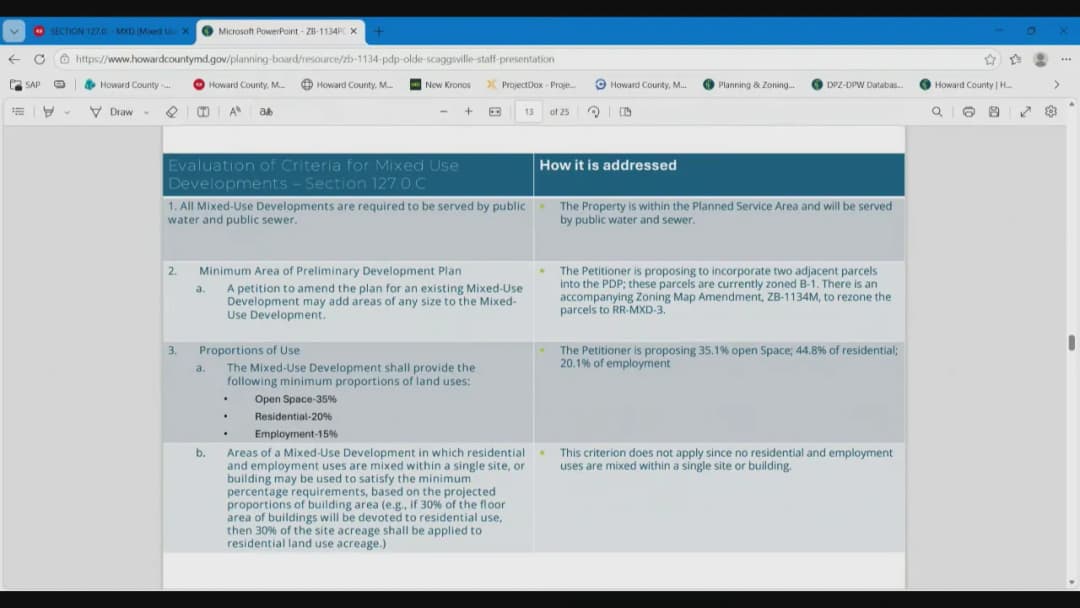
The Howard County Planning Board met on April 23, 2026, at the Banneker Room of the George Howard Building in Ellicott City, to consider a zoning map amendment and a preliminary development plan (PDP) amendment related to the Maple Lawn community. The board unanimously recommended favorable approval for both items to the Zoning Board. Consent Calendar - Unanimously approved the meeting agenda. - Approved the minutes of the April 9, 2026 meeting, adopting the WebEx recording as the official minutes. Public Comments & Testimony ZB-1134M (Zoning Map Amendment) - Steven Puchak (7518 Carpenter Street, Maple Lawn) questioned the change argument, stating that the 2016 approval of B1 zoning was correct then and that commercial demand has rebounded post‑COVID. He argued the rezoning request was built on questionable claims. - Two virtual speakers did not connect and did not testify. ZB-1134PDP (Preliminary Development Plan Amendment) - William England (9455 Ellsworth Court, representing Greater Beaufort Park Citizens Association) expressed concerns about traffic (four‑hour study considered insufficient, cut‑through traffic not addressed), school capacity, and a projected $110 million net fiscal loss over 30 years from the apartment component. - Steven Puchak (again) acknowledged improvements since the 2021 proposal but urged splitting the West district and apartment components into separate petitions. He highlighted school utilization and traffic concerns, and noted the 36% increase in residential units vs. an 18% increase in land area. - John Sandoval (8524 Reservoir Road) spoke generally in favor of the project but urged better preservation of agricultural features (silo, barn) for placemaking. Discussion Items ZB-1134M – Olde Scaggsville, LLC; G&R Maple Lawn Inc. (Map Amendment) Staff (Linda Eisenberg, Director of Planning and Zoning) presented the request to rezone 1.47 acres at 11292 Buckway from B‑1 to RR‑MXD‑3, based on a change in neighborhood character since 2016. The petitioner (attorney Mandy Heinel, developers Michael Greenbaum and Mike Cook, engineer Dan Sweeney) argued that the 2016 decision was correct then, but substantial unanticipated changes have occurred: adoption of HoCo by Design directing residential growth to activity centers, the COVID‑19 pandemic reducing demand for standalone commercial, and the new ability to integrate the parcel into the Maple Lawn PDP. The board discussed the change standard, noting the cumulative effect of policy shifts, the pandemic, and the functional integration of the parcel. A board member found the change argument supported, especially given the underutilized parking lots and shift to remote work. The board voted unanimously to make a favorable recommendation to the Zoning Board. ZB-1134PDP – Olde Scaggsville, LLC; G&R Maple Lawn Inc. (PDP Amendment) Staff and petitioners presented a multi‑part request: (1) increase overall residential density from 2.2 to the maximum 3 dwelling units per gross acre; (2) increase permitted dwelling units in Maple Lawn West (Old Farm) from 32 to 253 single‑family detached; (3) incorporate the rezoned parcels (from ZB‑1134M) into the PDP boundary as “other residential” land use; and (4) change a portion of the business district from employment to other residential to allow a 260‑unit apartment building with 15% moderate‑income housing (voluntary commitment beyond the already satisfied MIHU requirement). Staff confirmed the proposal meets all MXD and PDP criteria. Petitioners emphasized compliance with HoCo by Design, integration across ownership boundaries, and the role of the apartments in strengthening the business district by adding year‑round residents. Public comment raised traffic, school, and fiscal concerns, which board members acknowledged but noted would be addressed at later comprehensive sketch plan (CSP) and site development plan (SDP) stages. The board discussed the phasing (apartments first in 2029, then West district in three waves) and confirmed that the West district is the last undeveloped portion of Maple Lawn. A motion to favorably recommend the PDP amendment passed unanimously. Key Outcomes - ZB-1134M (Map Amendment): The Planning Board made a favorable recommendation to the Zoning Board to rezone the subject parcel from B‑1 to RR‑MXD‑3. Vote: unanimous (3‑0). - ZB-1134PDP (PDP Amendment): The Planning Board made a favorable recommendation to the Zoning Board for the amended Maple Lawn Farms Preliminary Development Plan, including density increase, unit count, parcel incorporation, and land use change. Vote: unanimous (3‑0). - Next steps: Both matters will proceed to the Zoning Board, which must issue a decision by June 23, 2026 due to the election cycle. Subsequent approvals (CSP, SDP) will include additional public hearings. - The meeting adjourned; the next Planning Board meeting is scheduled for May 7, 2026.