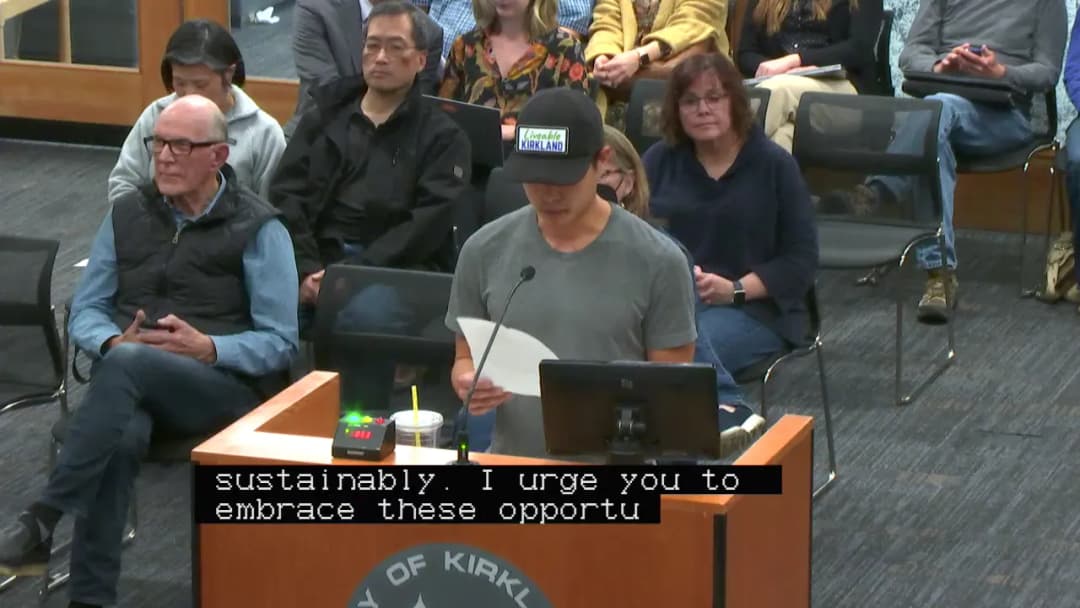
The Kirkland City Council held a study session starting at 5:30 p.m. followed by a regular meeting at 7:30 p.m. on May 7, 2024. The study session covered council operations policies (travel guidelines, special projects reserve, items from the audience rules, and council coin) and a proposed resolution (R-5631) on homelessness. The regular meeting included honors, proclamations, special presentations, a consent calendar, and business items on a sustainability ambassador program, miscellaneous code amendments, support for King County Metro's RapidRide K Line, and the annual striping program. All votes were 7-0. The meeting adjourned at 10:30 p.m. after an executive session on potential litigation. Consent Calendar - Approved unanimously (7-0) with the exception of item 8.e.(1) (Annual Striping Program 2024 Project) which was pulled for separate consideration. - Items approved included: - Minutes of April 16, 2024 - Audit of accounts: Payroll $5,738,677.00; Bills $11,176,984.41 - Claims for damages from Heidi Hiatt, Ameya Karvir, Esther LaMarche, Jessica Stundze, and Diane Wambheim - Award of bid for Water Quality Treatment and Infiltration at NE 111th Place/127th Place NE Project to Northwest Cascade Inc. ($842,769.93) - Proclamations: Asian American and Pacific Islander Heritage Month, Jewish American Heritage Month, Building Safety Month, Affordable Housing Week, Safe Boating and Paddling Week - 2023 Surface Water Annual Progress Report, March 2024 Sales Tax Report, Procurement Report Public Comments & Testimony - Ruji Ding (property owner on NE 87th Street) expressed opposition to night construction work authorized by the city, citing severe noise impacts on residents and property values. Requested limiting night work hours. - Josh Phua (concerned citizen) expressed full support for draft resolution R-5631 on homelessness and urged adoption of the action plan. Also advocated for “missing middle” housing options (duplexes, triplexes) in zoning. - Jennifer Loy (resident, volunteer with Jubilee Reach) raised concerns about insufficient park maintenance at Caroline Woods Park playground area, stating city policy leads to neglected, unsafe conditions. Urged elevated parks maintenance standards in the Comprehensive Plan. - Nicole McKenzie (resident) expressed concern about some policies being discussed in R-5631, noting that Kirkland does not have an emergency homelessness crisis (citing 160 unhoused individuals vs. 82,000 population) and urged caution. - Chuck Pilcher (resident) argued that the root causes of homelessness are mental health and addiction, not lack of housing. Opposed tent cities or pallet homes, stating they do not solve the problem. Questioned the cost of proposed programs versus investments in healthcare (e.g., Evergreen Hospital tower). - Forest Whitehouse (resident) expressed strong support for a compassionate, person-centered approach to homelessness, emphasizing prevention and affordable housing. Disagreed with oversimplifying homelessness as a crisis of mental health or drugs. - Laura Blackett (interim senior director, Friends of Youth, Willows Emergency Shelter) and Ron Abram (director, Willows Youth Service Center) reported on the new Willows shelter in Kirkland, thanking the city for support. Provided statistics: since February 2024, drop-in averaged 16 young adults daily, serving 91 unduplicated clients; shelter provided 1,797 bednights to 97 young adults. Highlighted positive collaboration with Kirkland Police and outreach. Special Presentations - Community Emergency Response Training (CERT) Class 33 Graduation Recognition – Emergency Manager Heather Kelly introduced five graduates present: Scarlett Arnold, Bernard Morgan, Yola Palliswaite, Lane Schultz, and Carla Walker. The 12-person class completed training in disaster preparedness, fire suppression, first aid, and search and rescue. - Capital Improvement Program (CIP) Update-at-a-Glance – Capital Projects Manager Rod Steitzer reported that the city is managing 75 active projects worth nearly $200 million (21 in construction at $84M, 54 in design). Highlights: Fire stations ahead of schedule and on budget; Lake Street intersection reopening in 3 weeks; 100th Avenue improvements; Safer Routes to School projects underway; Sound Transit 85th Connection at 90% design; earthquake-resilient water main installed under I-405. 32 active grants, with $2M grant pending for 85th connection. 22 of 24 CIP process improvements completed. Discussion Items Study Session: Council Operations - Travel Interests & Guidelines – Deputy City Manager Julie Underwood reviewed proposed policy for individual council travel/training budgets (allocated per biennium, unused funds carry over within biennium but not to next). Councilmembers expressed a desire for adequate funding to attend national conferences (e.g., NLC, AWC) and for staff to proactively identify opportunities. Mayor Curtis noted the need for staff support in booking travel and suggested separate funding for dinners/luncheons as city business. - Special Projects Reserve Guidelines – Staff presented three options: status quo, criteria-based (e.g., no ongoing operating funds), or staff review with recommendation. Council consensus leaned toward a “soft” version of option 2 (establish criteria) while retaining flexibility via supermajority vote. Staff will bring back formal language. - Items from the Audience Rules – Proposed changes: remove second items from audience (rarely used); allow presiding officer to reorder speakers; possibly restrict comments to “city matters.” Council discussion noted challenges in defining “city matters” and content neutrality. Consensus to retain current rules but continue exploring disability accommodations and visual aids. Item will return. - Council Outstanding Service Awards (Council Coin) – Ad hoc subcommittee proposed criteria for extraordinary service, nominations by council members, final authority to mayor. Deputy Mayor Arnold suggested requiring majority council approval for awards and consent calendar acknowledgment. Further refinement needed. Study Session: Homelessness Resolution R-5631 - Discussion of Proposed Resolution – Senior Management Analyst Carly Joerger reviewed revisions made after the April 16 study session: added statement that Kirkland will not become a regional service provider; changed “transitional housing” to “temporary housing”; added task to explore a dedicated phone line for the Homeless Assistance and Response Team (HART). - Councilmember Positions - Councilmember Black expressed strong support for the resolution, stating it represents how government should work (professional staff identifying needs). Emphasized four pillars: make homelessness rare/brief/non-recurring, deliver on existing programs, plan for sudden changes, and use best practices/data. Supported adding businesses to stakeholder list. Suggested paring down detail in final resolution. - Councilmember Falcone praised Kirkland for leading on homelessness preparedness, called the current situation a crisis, and supported exploring housing options and funding sources including a possible levy (revised language to allow regional options). Liked adding business community and school district to engagement list. - Councilmember Pascal urged careful consideration of details, robust two-way community dialogue (town halls, public hearings). Wanted to first define the problem with Kirkland-specific data before identifying solutions. Opposed premature talk of ballot measures; preferred reprioritizing existing revenues. Supported exploring regional funding but not a local levy. Requested accountability and evaluation of success stories. - Councilmember Sweet strongly supported the resolution as proactive and praised staff work. Acknowledged 15 years of council effort on homelessness. Agreed with Councilmember Black’s comments as comprehensive. - Councilmember Tim Chisholm expressed concerns about language: “reduce barriers” should be specified as code amendments; suggested striking subsection H (explore levy in 2025-26) and adding “emergency” trigger for temporary housing solutions. Wanted community engagement before further council meetings. - Mayor Curtis noted Kirkland’s responsibility to prepare for potential crises, highlighted need for education on solutions (tiny homes, safe parking). Supported moving forward. - Staff will incorporate feedback and bring resolution back for additional input. Business: Sustainability Ambassadors – Fiscal Note - Presentation – Financial Planning Manager George Dugdale proposed a $20,000 fiscal note from the Council Special Projects Reserve to continue the Sustainable Neighborhoods Ambassador Program (SNAP!) for 2024. Program places high school interns on sustainability goals (heat pump, solar, bike campaigns). Ongoing funding to be considered in 2025-26 budget. - Decision – Approved 7-0. Councilmember Black requested performance indicators; Councilmember Falcone added equity focus; Mayor Curtis requested demographics data and noted concern about staff support burden. Business: 2024 Miscellaneous Code Amendments - Presentation – Planning Supervisor Denise Russell and Deputy Director Allison Zike reviewed amendments in three categories: consistency/error corrections (15), clarifications (17), and minor policy updates (e.g., vegetative buffer standards for parks, parking standards in CBD, extension to homeless encampment permits). Planning Commission unanimously recommended approval. - Amendments – Councilmember Black noted two scrivener’s errors (item 28 and tree code hedge removal), which staff incorporated. - Ordinance O-4876 (zoning code amendments) – Approved 7-0 as amended. - Ordinance O-4877 (code enforcement and subdivisions) – Approved 7-0. Business: Kirkland Support of King County Metro RapidRide K Line - Presentation – Transportation Planner Kim Scrivner explained the process to select a Locally Preferred Alternative (LPA) for the K Line, a high-quality bus rapid transit. Council was asked to approve a record of support for the Totem Lake alignment on 120th Avenue NE, which requires minor roadway modifications (curb, landscape, parking) to accommodate 60-foot coaches. Potential loss of 10 parking stalls. - Council Discussion – Deputy Mayor Arnold sought details on width modifications; Councilmember Pascal urged immediate interim bus operations and parking enforcement. Councilmember Black confirmed no plans to extend the line further north (would require restarting planning). Staff noted Metro’s timeline to LPA by end of 2024. - Decision – Motion to authorize City Manager to send a letter of support for the proposed 120th Avenue NE alignment. Approved 7-0. Business: Annual Striping Program 2024 Project - Presentation – Pulled from consent for discussion. Contract awarded to Specialized Pavement Marking, Inc., Tualatin, OR, for $1,317,434.75, including Neighborhood Traffic Control Program (NTCP) and Safer Routes to School (SRTS) funds ($812,000 fiscal note). - Council Discussion – Councilmember Pascal raised concerns about adding center lines on Finhill (90th Ave) potentially making it feel more arterial; requested speed monitoring. Councilmember Falcone advocated for a default policy to automatically implement active transportation improvements during roadway overlays, absent council approval. - Decision – Approved 7-0. Key Outcomes - Approved 7-0: Consent calendar (as modified), Sustainability Ambassadors fiscal note ($20,000), Ordinance O-4876 (zoning code amendments) with staff amendments, Ordinance O-4877 (code enforcement/subdivisions), Record of Support for RapidRide K Line Totem Lake alignment, Annual Striping Program 2024 contract. - Study Session Feedback: Staff to return with revised council operations policies (travel, special projects reserve, items from audience, council coin) and an updated homelessness resolution (R-5631) incorporating council direction. - Proclamations: Older Americans Month, Bike Everywhere Month, Asian American and Pacific Islander Heritage Month, Jewish American Heritage Month, Building Safety Month, Affordable Housing Week, Safe Boating and Paddling Week proclaimed by Mayor. - Executive Session: Council entered closed session at 10:08 p.m. to discuss potential litigation, returning at 10:27 p.m. to adjourn.
Public Meetings - Kirkland, Washington
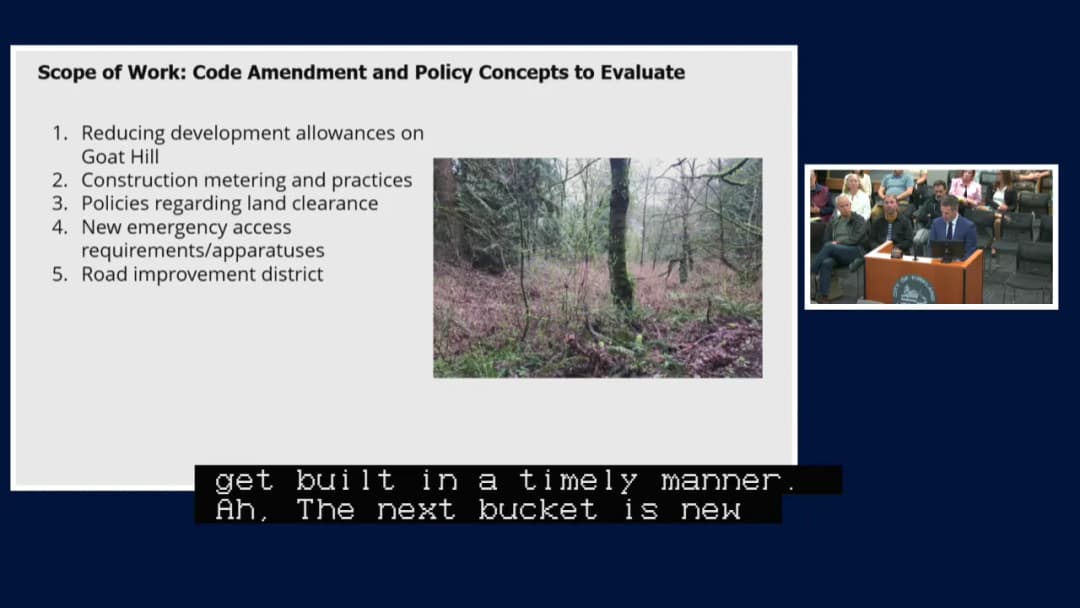
Public Meetings - Kirkland, WashingtonThe Kirkland Planning Commission met on April 25, 2024, at 7:00 PM in the Council Chamber. The meeting included a public hearing on the 2024 Miscellaneous Code Amendments, approval of previous meeting minutes, and an administrative report on the Goat Hill moratorium. All seven commissioners were present. No public testimony was offered. Public Hearings - 2024 Miscellaneous Code Amendments (File No. CAM23-00134) – Staff presented three categories of amendments: (1) consistency and error corrections (15 items), (2) clarifications (17 items), and (3) minor code updates (5 items). Key amendments included: - Amendment 15: For parks projects, vegetative buffer requirements in critical areas will be reduced to a 1:1 ratio of new vegetative buffer to added impervious surface, easing the burden on city parks. - Amendment 26: In the downtown central business district, changes of use for existing square footage will no longer require additional parking, intended to help fill vacant spaces. - Amendment 37: The Planning and Building Director may extend the duration of city-permitted homeless encampments up to an additional 92 days (from the current 92-day maximum), with a one-time extension per calendar year. - Commissioners asked questions about definitions (e.g., "alteration" and "commercial community facility"), the 92-day duration rationale, and the removal of two previously discussed amendments (affordable housing in-lieu fees and shoreline master program changes). Staff confirmed the 92-day figure simply doubles the existing code provision and that the dropped items will return in future packages. - No public testimony was provided. Key Outcomes - Motion to Recommend Approval – The Planning Commission voted 7-0 to recommend City Council approval of the 2024 Miscellaneous Code Amendments as drafted. - Approval of Minutes – The Commission unanimously approved the minutes from February 8, February 22, March 14, and March 28, 2024. Administrative Reports and Discussion - Goat Hill Moratorium Update – Planning & Building Director Adam Weinstein briefed the Commission on the City Council’s moratorium (effective February 6 to August 6, 2024) on new dwelling units on Goat Hill. The moratorium does not apply to additions, infrastructure, or vested permits. Staff reviewed past efforts (stormwater infrastructure, geologic hazard regulations, environmental review thresholds) and public concerns (traffic, emergency access, abandoned projects, drainage). Five potential code amendment concepts were discussed: 1. Reducing development allowances (density, lot coverage, floor area ratio). 2. Construction metering (limiting concurrent projects). 3. Policies for land clearance and abandoned projects (e.g., improved bonding, hydroseeding instead of plastic sheeting). 4. New emergency access requirements or apparatuses. 5. A road improvement district (a long-term option requiring further study). - Commissioners discussed the need to balance development limits with unintended consequences, the feasibility of metering, encouragement of modular construction, and the importance of focusing on actual transportation and safety impacts rather than simply limiting units. Staff noted that a white paper on the road improvement district would be produced, and zoning code amendments are expected to return to the Commission in late spring (May/June). Future Meetings & Reminders - Joint Workshop with City Council: May 3, 2024, 12:00–5:00 PM, Peter Kirk Room, focusing on Comprehensive Plan elements. - Comprehensive Plan Public Hearing: May 9, 2024, 6:00 PM start (open house from 4:00–5:30 PM). - Officer Elections: Scheduled for the May 9 meeting. - Community Appreciation Night: May 15, 2024, 6:00 PM at Kirkland Performing Arts Center.
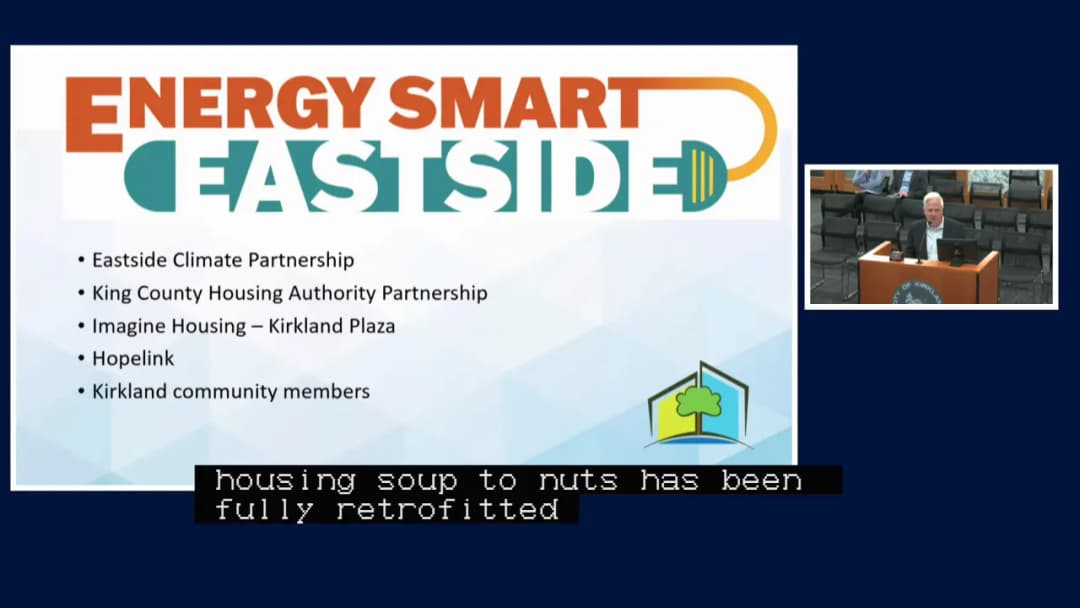
The Kirkland City Council held a regular meeting on April 16, 2024, beginning with a study session at 5:30 PM and the regular meeting at 7:30 PM. The meeting covered a broad range of topics including a proposed homelessness resolution, the ARCH strategic plan, Earth Month proclamation, public comments on various issues, approval of a consent calendar, updates on community surveys, expansion of the Mobile Integrated Health program, adoption of an organizational statement on international conflict, a sustainability strategic plan report card, changes to the Tourism Development Committee, and a community flag initiative. The meeting concluded with council reports and adjournment at 9:52 PM. Consent Calendar - Minutes: Approved the minutes of the April 2, 2024 regular meeting. - Audit of Accounts: Approved payroll ($4,356,284.18) and bills ($6,013,317.52). - Claims: Acknowledged claims from John Busuttil and Julie Day. - Agreements: Approved the Interlocal Agreement with the City of Redmond to co-locate paramedics at New Fire Station 27 in Totem Lake. - Reports: Acknowledged the First Quarter 2024 Capital Projects Completed and Accepted Report. - Surplus Equipment: Approved declaration and disposal of surplus equipment. - Electric Leaf Blower Initiative: Acknowledged the update. - Financial Dashboard: Acknowledged the February 2024 Financial Dashboard Report. - Procurement Report: Acknowledged the Procurement Report. - Vote: Motion carried 7-0. Public Comments & Testimony - Juanita Public Pathway: Multiple speakers (Mahdi El Husseini, Kayleigh Flaks, Nora Myers) advocated for a 500-foot trail segment south of Juanita High School, citing safety and environmental benefits. Anthony Jonas opposed the northern route, citing safety concerns for students. Joella Bennett-Gold supported extending the Burke-Gilman Trail. - Housing Affordability: Kyle Sullivan urged the city to rezone for more housing, remove parking minimums, and expedite permitting to address cost burdens. - Business Impact: Ozcan Saribas, downtown restaurant owner, reported a 75% sales loss due to construction, requesting faster work hours and relocation of a portable toilet. - Homelessness: Susan Davis cautioned about costs of expanded homeless services and suggested designated camping areas. - International Conflict: Alex Zimmerman made controversial remarks about Bellevue's deputy mayor; Mayor Curtis disavowed the comments, affirming Kirkland's commitment to inclusivity. - Sustainability: Ronald Snell and Sarah Richards from People for Climate Action Kirkland expressed support for the city's sustainability efforts. Discussion Items - Proposed Resolution R-5631 on Homelessness: City Manager Kurt Triplett introduced a person-centered approach and a continuum of care framework. Staff presented data on homelessness trends (124 households contacted, 9 moved to permanent housing). Discussion focused on philosophy, action plan development, safe camping, and legal context (Martin v. Boise, Grants Pass pending Supreme Court). Council provided feedback; continuation planned for future meetings. - ARCH Strategic Plan: ARCH Executive Director Lindsay Masters presented a strategic plan focusing on building affordable housing faster, policy advocacy, governance study, and stakeholder engagement. Council discussed the need to address political risk, streamline decision-making, and explore governance changes. The plan aims to support the region's need for over 80,000 affordable homes. - Biennial Community Survey Check-In: Communications Program Manager David Wolbrecht reviewed the survey process. Council considered adding a question on belonging (DEIB goal) and discussed potential changes to questions on crisis responders, homelessness response, and climate change. Staff will incorporate feedback and finalize for fielding by April 29. - Mobile Integrated Health (MIH) Program Update and Expansion: Social Worker Taryn Robinson presented data: 76% reduction in 911 calls from top users, 456 referrals in 2023. Staff recommended $232,637 to fund a temporary firefighter/EMT position through 2025 using King County Medic One Levy funds. Council approved the fiscal note (7-0). - Organizational Statement on International Conflict (Resolution R-5630): Deputy City Manager James Lopez presented the updated resolution, adding veteran status and clarifying that international conflicts are beyond city scope. Council adopted the resolution (7-0). - Sustainability Strategic Plan Year Three Report Card: Senior Planner David Barnes highlighted progress: 10 actions completed, including youth transportation outreach, tree canopy mapping (40% goal requiring 62,000 trees), circular economy events, electric leaf blower advocacy, and Energy Smart Eastside heat pump program (24 units at Kirkland Plaza). Council acknowledged the work and emphasized the need to track metrics to meet 2030 emission targets. - Tourism Development Committee (TDC) Membership Increase: After tabling previously, council removed the issue from the table. Substitute Ordinance O-4874 (adding an alternate member) failed 2-5 (Pascal, Tymczyszyn in favor; Arnold, Black, Curtis, Falcone, Sweet opposed). Original Ordinance O-4874 (adding a voting member) passed 6-1 (Pascal opposed). The ordinance amends KMC 5.19.220 and 5.19.250. - City Flag Creation: Council approved Option A as modified by Deputy Mayor Arnold to launch a community engagement process at City Hall for All and conclude by July 4, 2025 (unveiling at parade). Motion carried 7-0. Key Outcomes - Consent Calendar: Approved unanimously (7-0). - MIH Program Expansion: Fiscal note of $232,637 approved (7-0) for temporary firefighter/EMT position. - Resolution R-5630 (International Conflict): Adopted (7-0). - Ordinance O-4874 (TDC Membership): Approved (6-1) to increase voting membership; substitute ordinance failed (2-5). - City Flag Process: Approved Option A with extended timeline to July 4, 2025 (7-0). - Homelessness Resolution: No action; discussion to continue at future meetings. - Community Survey: Staff to finalize instrument based on council feedback for fielding by April 29. - ARCH Strategic Plan: Received; staff to return with budget and work plan recommendations. Council Reports & Calendar Updates - Councilmember Reports: Included updates on Eastrail Regional Advisory Council (e-bike regulation, King County Parks Levy), Bellevue Light Rail opening (April 27), meeting with Highlands Neighborhood Association, Youth Council, and TDC, State of the City address, AWC DEIB forum, Lake Washington High School Green Team tour, legislative session debrief, Regional Transit Committee (Metro safety, Metro Flex), and Eastside Transportation Partnership (ST3 progress). - City Manager Reports: Informed of a conversation with King County Councilmember Claudia Balducci regarding potential county ballot measures (no climate action measure in 2024; exploring human services measure). Upcoming retreat on Comprehensive Plan on May 3, 2024. Future housing discussions scheduled. - Legislative Request Memorandum: Approved community engagement process for a new city flag, concluding by July 4, 2025.
The Kirkland Planning Commission held a study session on April 11, 2024, to review proposed policies for the 2044 Comprehensive Plan elements (Utilities, Public Services, Capital Facilities) and discuss updates to the Juanita and Kingsgate Neighborhood Plans. Commissioners heard public testimony on housing growth, transit, pedestrian safety, and specific development proposals. The meeting also addressed the public hearing schedule for upcoming comprehensive plan adoption. Public Comments & Testimony - Meridith Everist (Bayliss Architects, representing Karl Petersson, owner of Michaels site) expressed support for neighborhood plan policies, especially Policy 16 allowing increased height, stating additional density is needed to support site amenities. - Gale Ballard (Kirkland resident) questioned the rapid housing growth, citing 13,000 new units target, and expressed concerns about overcrowding, crime, and loss of natural spaces. - Susan Milke (Kingsgate focus group) argued Kingsgate is already well-planned and questioned the need for 13,000 additional housing units, warning of increased costs, congestion, and crime. - Ingrid Salmon (Juanita resident) encouraged the Commission to look for pedestrian "cut throughs" to allow safe walking between neighborhoods. - Susan Puez (Kirkland, blind resident) highlighted difficulty using transit and urged the city to involve Metro in planning for accessible bus service. - Bob Warren (Kirkland, Finn Hill) noted damaged sidewalks make walking unsafe and urged pedestrian improvements as the city encourages getting out of cars. - Theresa Rakowski (Juanita Working Group) requested removal of Policy 16 from the Juanita plan, arguing increased height and density at JBD4 would burden traffic and obscure lake views; she urged the city to acquire parcels for parks and wetlands. - Alison Warner (representing Balboa Retail Partners, owner of Juanita Goodwill site) expressed support for staff recommendations and continued community engagement. - Margaret Bouniol (Juanita Neighborhood Association board) opposed redevelopment of the Michaels site, stating the proposed bulk and mass are out of character for the neighborhood. Discussion Items 2044 Comprehensive Plan - Utilities, Public Services, and Capital Facilities Elements - Utilities Element: Senior Planner Lindsay Levine presented proposed goals and policies covering water, sewer, surface water, energy, telecoms, and solid waste transfer. Commissioners discussed policy U-1.2 (needed facilities for growth), U-7 (transition to renewable energy), and specific policies on EV charging (U7-5), composting (U7-6), and compatibility with land uses. Concerns raised about grid capacity, energy choice, and wording of "support" vs. "incentivize". - Public Services Element: Levine highlighted policies on fire/EMS, police, schools, libraries, and new initiatives like HART and RACER. Commissioners discussed coordination with Lake Washington School District on school capacity and use of facilities for community needs. Commissioner Jacobson suggested adding a policy to address city employee housing affordability. - Capital Facilities Element: Senior Planner Scott Guter presented updates on equity and sustainability, including policy CF2.2 (sustainable development principles) and CF2.3 (fiscal responsibility). Commissioners emphasized resilience planning and lifecycle cost analysis. Commissioner Heiser asked about embodied carbon analysis. Juanita and Kingsgate Neighborhood Plan Updates - Juanita Plan: Senior Planner LeAndra Baker-Lewis reviewed draft policies. Commissioners provided feedback on: - Policy J7 (affordable housing near major arterials): Concerns about placing housing on major arterials not served by transit; suggested focusing near parks and transit. - Policy J8 (transitions between land uses): Debate on whether transitions reduce capacity; some commissioners wanted more flexibility. - Policy J12 (new development enhancing connectivity): Appreciated multimodal connections and inclusion of grocery stores. - Policy J14 (park-to-park trail between Juanita Beach and Juanita Bay): Strong support. - Policy J21 (mixed use in North Juanita neighborhood center): Commission asked for more specifics on heights. - Optional policies J16 and J20 for community-initiated amendment requests at Michaels and Goodwill sites: Commissioners Allen and Rutherford expressed reluctance to include site-specific policies; others noted the commission's duty to consider the requests. Staff clarified these are optional policies to support future zoning changes, not final approvals. - Kingsgate Plan: Policies K3 (diverse housing), K5 (compact infill development), K6 (neighborhood center as mixed-use), and transportation policy K10 (transit-supportive land use) were discussed. Commissioners supported focusing growth where infrastructure exists and reiterated need for transit improvements. Commissioner Heiser raised concern about the impact if the ice arena closes. Key Outcomes - Public Hearing Schedule: The joint Council/Planning Commission workshop on the Comprehensive Plan was scheduled for May 3, 2024 (noon–5 PM). Public hearings were rescheduled: April 25 hearing moved to May 9 (vision, guiding principles, etc.); May 9 hearing moved to May 23 (land use, neighborhood plans, community-initiated amendment requests). Commissioners agreed to start public hearings at 6 PM for the May meetings. - Next Steps for Comprehensive Plan: Staff will refine draft policies based on commission feedback; public hearings will occur in May and June; council adoption by end of 2024. - Juanita and Kingsgate Plans: Staff will produce Draft 2 of policies, incorporate feedback from working groups, and prepare for the May 23 public hearing where the commission will make a recommendation on the community-initiated amendment requests.
The Kirkland City Council met on Tuesday, April 2, 2024, convening a study session at 5:30 p.m. and the regular meeting at 7:30 p.m., adjourning at 11:14 p.m. All seven council members were present. The evening included a joint study session with the Human Services Commission, an NPDES stormwater permit briefing, two proclamations, a public hearing on the Goat Hill building moratorium, a 14-item consent calendar, and five business items. A highlight was the adoption of a childcare stipend program for board and commission members. Study Session Joint Meeting with Human Services Commission: Council and commissioners discussed a possible community needs assessment (estimated at $75,000-$100,000), the 2023-2024 work plan, and the upcoming 2025-2026 grant cycle. Commission Chair Jory Hamilton said "you can't solve a problem that you don't see," advocating for a qualitative assessment; Commissioner Sriram Rajagopalan emphasized reaching communities that "Hopelink does not reach." Councilmember Sweet questioned spending on an assessment when Hopelink data exists; Councilmember Falcone called for clear research questions and regional partnerships; Councilmember Tymczyszyn suggested exploring internal staff capacity; Deputy Mayor Arnold asked what Kirkland-specific findings would justify the cost. City Manager Kurt Triplett said the work could not be done this year and would likely require added staff or a contracted study next year. Council expressed support for continuing the three-tier (A/B/C) grant funding structure. NPDES Permit Requirements: Surface Water Manager Kelli Jones and Surface Water Planning Supervisor Rachel Konrady briefed the council on the draft National Pollution Discharge Elimination System (NPDES) Phase II Municipal Stormwater Permit (2024-2029) and Draft 2024 Ecology Stormwater Design Manual. Notable changes include requiring mitigation for replaced impervious surfaces in transportation projects, stormwater mitigation for 9.2 acres of existing development, a street-sweeping program (three times per year citywide, once between July and September) by July 1, 2027, and tree canopy mapping. Councilmembers expressed concern about increased project costs (roughly 10% for a sample vault), trade-offs with other capital priorities, and the option to appeal the final permit within 30 days of release. Honors and Proclamations - Autism and Other Neurodivergence Acceptance and Appreciation Month: Proclaimed April 2024, read by Councilmember Black, accepted by Kirkland resident MJ Carlson, who is autistic and appeared with her child River. - Sexual Assault Awareness Month: Proclaimed April 2024, read by Councilmember Pascal, accepted by his daughter Emma Pascal (a survivor and Juanita High School senior) and Veena Gonugunta, CFO of the King County Sexual Assault Resource Center (KCSARC). Emma cited statistics: 1 in 9 girls under 18 experience sexual assault; 1 in 4 women and 1 in 6 men are assaulted in their lifetimes; 77% of assaults go unreported; only 25 of every 1,000 perpetrators are incarcerated. Gonugunta noted KCSARC assisted more than 4,800 survivors in 2023, nearly half of them teens or children. Consent Calendar Approved 7-0 by roll call. Items included: - Approval of minutes: March 1, March 5, March 19, and March 26, 2024 meetings. - Audit of accounts: payroll $5,896,668.16; bills $3,978,934.87. - Claim for damages from Rosemary Liddle acknowledged. - Awards: Fire Station 24 Training Props to Taylor'd Systems, LLC of Spokane Valley ($1,975,505.81 including sales tax); NE Juanita Drive Storm Drain Failure project to RRJ Company, LLC of Monroe ($340,090.57); Pedestrian Safety Improvements (Downtown & NE 124th Street) to Kamins Construction, Inc. of Bothell ($1,055,290.20). - YWCA "Until Justice Just Is" Month proclamation for April. - Houghton Park & Ride interim uses fiscal note for $585,000. - Kirkland Cares Low-Income Support Program update. - Resolution R-5626 (revised investment policy for city funds). - Ordinance O-4873 (amendments to Title 21 building and construction codes). - Resolution R-5627 (vacation of unopened right-of-way requested by Curtis and Michelle Ferguson). - Resolution R-5628 (Transportation Commission 2024-2025 work plan). - 2015 Transportation Strategic Plan annual progress report. - 2024 Legislative Session wrap-up. - First Quarter 2024 Information Technology operations update. - February 2024 sales tax report. - Procurement report. Public Comments & Testimony - Eva Odderson and Marianna Makowska (Sustainability Ambassadors) urged the city to fully fund SNAP (Sustainable Neighborhood Ambassador Program) for 2024. Makowska compared Kirkland unfavorably with Bellevue (pop. 149,440, eight sustainability staff) and Issaquah (pop. 39,505, two staff plus interns), noting Kirkland (pop. 97,107) funds one sustainability staff position. - Kyle Sullivan (Livable Kirkland / Eastside Urbanism) called for more ambitious housing and transportation policy, noting the bicycle network is 81% complete (up from 79% in 2021) and greenways only 18% complete, and that the RapidRide K Line lacks bus lanes. - Chris Fox (Norkirk) presented a 163-signature petition requesting a sidewalk along the north side of 19th Avenue between Market and 4th Streets. - James Hoff and Betsy Lewis (South Rose Hill) urged strengthening the city's NERTS comment letter on traffic queuing, 132nd Avenue traffic estimates, and neighborhood quality-of-life impacts. - Alex Tsimmerman used Nazi-related rhetoric; Mayor Curtis stated the council allows free speech regardless of content but finds the comments hurtful, divisive, and at odds with Kirkland's values. - Ozcan and Eylem Saribas spoke (accepted as items from the audience) about potential business impacts from downtown construction and student parking difficulties near Lake Washington High School. Public Hearing - Goat Hill Moratorium: Planning and Building Director Adam Weinstein and Planning Supervisor Denise Russell presented the outreach conducted (website, listserv, mailed notices, a March 22 community meeting) and the proposed scope of work. Testimony included: Mary Rumpf (Goat Hill resident) on road damage from concrete trucks and concern about a four-acre housing project at the top of the hill; Scott Morris (Finn Hill Neighborhood Alliance) urging exploration of open-space acquisition; Josh Friedmann (attorney for Montbank Management) noting the developer's willingness to build emergency access and dedicate up to 40% of the property as open space; Kevin Stigerts (12-year resident) supporting the moratorium and a road improvement district; Andrea Thompson opposing further multi-home development; and Jake Atkinson (scout and 13-year resident) describing erosion and wildlife loss. Discussion Items 2025-2030 Capital Improvement Program Policy Principles (Resolution R-5622): Financial Planning Manager George Dugdale reviewed amendments from the March 19 meeting: broadening the transportation capacity goal beyond "concurrency," adding a new principle tied to the 2024 Transportation Strategic Plan, and adding water/sewer/stormwater regulatory requirements (including NPDES permit changes). Approved 7-0. NERTS Draft EIS Comment Letter: Solid Waste Program Lead Jenna McInnis presented the staff draft comment letter to King County on the Northeast Recycling and Transfer Station (NERTS) Draft EIS, containing over 75 comments from city subject-matter experts. Key themes: missing transportation data, Taylor Fields amenities, excavation of the closed landfill (Alternatives 1A/1B), and King County policy compliance. Council feedback included: strengthen language on on-site queuing (Pascal); consider affordable housing if the existing Houghton site is freed up (Sweet); assert that any unspent $28 million property acquisition surplus be used for mitigation (Tymczyszyn); elevate noise ordinance compliance for 6 a.m. operations and ensure mitigation covers people who bike and walk (Curtis). The minutes record a motion by Deputy Mayor Arnold (no second required) with no roll-call vote before recess; staff was directed to incorporate feedback and transmit the final letter before King County's April 9 comment deadline. Childcare Stipend for Board and Commission Members (Resolution R-5629): Deputy City Manager James Lopez presented the pilot program: flat-fee stipend, quarterly prepayments, attestation, and a report back by December 1, 2024. The council adopted two amendments: (1) extending eligibility from children 10 and under to 13 and under; (2) renumbering sections and clarifying the required report language. The resolution was approved as amended 7-0, and a fiscal note authorizing a one-time use of $20,000 from the Council Special Projects Reserve was approved 7-0. Tourism Development Committee Membership (Ordinance O-4874): City Attorney Kevin Raymond presented two versions: the original increasing voting membership from seven to eight (adding a second councilmember as vice chair), and a substitute ordinance (offered by Councilmember Pascal) keeping seven voting members with the second councilmember serving as non-voting vice chair. Councilmember Tymczyszyn moved to table until the TDC could weigh in; the motion carried 4-3 (Yes: Arnold, Pascal, Sweet, Tymczyszyn; No: Black, Curtis, Falcone). The council then selected Deputy Mayor Arnold, Mayor Curtis, and Councilmember Sweet (7-0) to discuss the proposal with the Tourism Development Committee on Friday. Organizational Statement on Conflict (Draft Resolution R-5630): Discussion only. The proposed statement condemns atrocities, violence, and aggression by any party and reaffirms the city's commitment to an inclusive community. Council feedback: allow city manager designees (e.g., police chief, DEIB manager) to engage in community dialogue (Arnold); make clear the city will still take stands on controversial issues that directly impact community members (Falcone); narrow Section 3 language to within the city's scope of powers and functions (Black); align language with the Washington Law Against Discrimination, including veterans (Tymczyszyn); and add "international" before "events" with an option for stronger statements (Curtis). Staff will bring back a revised resolution. Key Outcomes - Ordinance O-4875 (affirming the Goat Hill emergency moratorium on new dwelling unit permits): approved 7-0. - Consent calendar: approved 7-0. - Resolution R-5622 (2025-2030 CIP policy principles): approved 7-0. - NERTS comment letter: council feedback provided for incorporation; final letter due to King County by April 9, 2024. - Resolution R-5629 (childcare stipend): approved as amended 7-0; $20,000 fiscal note approved 7-0. - Ordinance O-4874 (TDC expansion): tabled 4-3 for discussion with the Tourism Development Committee; a three-member council delegation (Curtis, Arnold, Sweet) will meet with the TDC on Friday, April 5. - Draft Resolution R-5630 (organizational statement on conflict): revisions requested; no action taken. - Council directed the City Manager to bring a fiscal note (7-0) allocating $20,000 from the Council Special Projects Reserve to fund the SNAP program for 2024, to be paired with a broader discussion of special projects fund policies around May 7. City Manager Reports City Manager Kurt Triplett announced the birth of Special Project Coordinator Andreana Campbell's baby, Nolan; reminded the council of the Mayor's State of the City address at the Greater Kirkland Chamber of Commerce on April 11; and noted the upcoming May 3 council retreat on Housing and Comprehensive Plan issues.
The Kirkland Planning Commission held a study session on March 28, 2024, from 7:00 PM to 9:42 PM to review three policy briefings for the 2044 Comprehensive Plan update: Human Services Element, Housing Element (second briefing), and Land Use Element (second briefing). Commissioners provided feedback on draft goals and policies, discussed capacity analysis results, and considered potential land use changes. No public comments were received, and no formal votes were taken. Discussion Items Human Services Element Policy Briefing Senior Planner Lindsay Levine presented the Human Services element, covering background, community engagement themes, and proposed draft policies. Key discussion points: - Commissioner Angela Rozmyn suggested stronger language to encourage active collaboration with nonprofit and community organizations beyond just supporting them when they seek help. Staff noted existing policy HS 1.11 on partnerships. - Commissioner Aaron Jacobson supported making all homes accessible but noted the high cost of elevators in the U.S., suggesting that building code changes to reduce costs would be more effective than mandates. - Commissioner Sandeep Singhal proposed broadening an age-focused policy to include other life stages and mobility issues, but Commissioner Rozmyn argued for retaining a specific policy for seniors. - Commissioner Jacobson advocated for adding a goal and policies to increase child care availability and affordability, including state-level advocacy and partnerships for non-standard hours. Staff noted this may fall outside the human services scope but would explore it further. - Commissioner Singhal questioned whether an unmodified policy (HS 5.10) on administering a community donation program should be more directional; staff agreed to clarify with the human services manager. Housing Element Policy Briefing 2 Senior Planner Scott Guter presented housing element policies focused on stability and subsidy. Key discussion points: - Goal H1: Commissioners stressed the importance of measuring results and accountability, with Commissioner Rozmyn repeatedly emphasizing that outcomes matter more than policies. - Policy on addressing vacancy: Commissioner Jacobson expressed skepticism about a vacancy tax due to low potential yield (estimated 60 homes) and administrative burden. Commissioner Scott Reusser warned of unintended consequences during economic downturns. Commissioner Allen Katya noted challenges with short-term rentals and suggested collecting hotel taxes. - Policy on residential intensity minimums: Commissioner Jacobson and Commissioner Rozmyn favored incentives over mandates and a no-net-loss requirement to avoid losing existing housing. Commissioner Rodney Rutherford supported incentives for ADUs and duplexes. - Policy on supporting innovative housing (e.g., HUD-code manufactured homes): Commissioner Jacobson cautioned against over-regulating and suggested simply legalizing them. Commissioner Rutherford proposed an inventory of land for portable tiny homes, including on public and institutional lands. - Policy on preserving existing housing: Commissioners supported retaining naturally occurring affordable housing and incentivizing keeping existing homes while allowing additional development on the lot. - Policy on tenant protections: Commissioners asked about data on unintended consequences (e.g., landlords avoiding low-income renters). Staff will check with Bellevue and Seattle. Commissioner Allen noted the need to balance rent increases with rising property taxes and insurance. - Policy on energy efficiency: Commissioners preferred incentives over requirements, and Commissioner Rutherford suggested utility partnerships to reduce upfront costs. - Policy on in-lieu fees: Commissioner Allen worried that in-lieu fees concentrate affordable housing elsewhere, but staff explained current sparing use and potential benefits for single-family inclusionary zoning. Commissioner Rozmyn supported keeping multiple options. - Policy on collaborating with faith and community organizations: Commissioner Rozmyn liked proactive identification of underutilized properties. Commissioner Rutherford extended the idea to parks and public land for park host programs. - Commissioner Rutherford raised several additional points: exploring multifamily condominium development by addressing state liability issues; shifting affordable housing cost burdens to commercial uses (e.g., linkage fees); providing subsidies directly to critical workers; and supporting homeownership for underrepresented groups. Land Use Element Policy Briefing 2 Deputy Director Allison Zike presented updated land use policies, capacity analysis methodology, and results. Key topics: - Growth targets: 13,200 additional housing units and 26,490 new jobs by 2044. Both the existing zoning and action alternative (including potential land use changes) show capacity exceeding targets. - Capacity analysis methodology: Uses King County parcel data; excludes recently developed, condo, and institutional parcels; applies reasonability factors (e.g., steep slopes, right-of-way). For employment, assumes 4 employees per 1,000 sq ft office, 2 per commercial, 1.7 per industrial, plus 0.09 home-based employees per dwelling unit. Commissioner Jacobson and Commissioner Allen questioned the low home-based employee estimate; staff acknowledged it is conservative but acceptable for showing capacity. - Potential land use changes: ParMac Business Center, Goodwill site, Michaels site, and upzones along frequent transit corridors (up to 50 units/acre within quarter-mile buffer). Commissioner Jacobson argued that 50 units/acre is too low to support high-quality transit and meet affordable housing needs, especially for 50% AMI households. He shared bus ridership data showing that only a few stops drive most ridership. Commissioner Rutherford sought flexibility to go above 50 units/acre in some corridors; staff confirmed the EIS is designed to allow flexibility and future additional study. - Draft policies: Staff revisited several policies based on previous commission feedback. - Goal LU-1 and policy 1.3: Updated to address permitting and clarity. - Goal LU-3 and policies 3.2, 3.7: Commissioner Rutherford proposed adding parks and open space near high-density housing. Commissioner Singhal stressed the need for quality transit service, not just infrastructure. Commissioner Jacobson noted tension between concentrating housing near transit and spreading it across all neighborhoods; staff acknowledged both goals. - Goal LU-4 and new policy 4.3: Lowering minimum lot sizes to encourage fee-simple ownership. Commissioner Jacobson asked about incorporation into EIS; staff said no specific minimum yet but noted legislation proposing 2,500 sq ft. - Policy 5.8 (mid-block connections): Commissioner Rutherford suggested moving it to LU-3 for better fit. - Policy 9.2: Minor wordsmithing on energy-efficient development. - Historic preservation goal and policies moved from repealed Community Character element: Acknowledged native history and equity lens. - Next steps: Public hearings scheduled April–September; draft supplemental EIS expected end of May/early June; council adoption by end of 2024. Key Outcomes - No formal votes were taken; all items were study session discussions to inform policy refinement. - Staff will incorporate commissioner feedback into draft policies and return for public hearings. - Staff will investigate data on tenant protection policies in other jurisdictions and the feasibility of including child care policies. - The commission will hold its next policy briefing on April 11, 2024, for Public Services, Utilities, and Capital Facilities elements, and neighborhood plan updates. - Commissioner Sandeep Singhal was recognized for his eight years of service; the commission presented him with a gift.
The Kirkland City Council held a regular meeting on March 19, 2024, starting with a study session at 5:30 p.m. and the regular meeting at 7:30 p.m., adjourning at 10:26 p.m. The agenda included a joint study session with the Transportation Commission, honors, public comments, a special presentation from Puget Sound Energy, consent calendar approvals, and several business items. Key decisions included renaming a school access road to "Raven Way," suspending a 2024 community pool ballot measure, authorizing interim uses of the Houghton Park & Ride, approving a $168,000 grant to Attain Housing, and approving a $10,000 fiscal note for Leadership Eastside. Consent Calendar - Approved minutes from March 1 and March 5, 2024 were pulled to be considered at the April 2, 2024 meeting. - Audit of Accounts: Payroll $4,253,716.30; Bills $7,630,339.63. - Acknowledged a claim for damages from Darin Benson. - Awarded contracts: 8th Avenue W Sewermain and Watermain Improvements to In Depth Excavation LLC ($2,129,803.95); 83rd Avenue NE and NE 110th Place Pipe Replacement to Kamins Construction ($446,735.96). - Approved Resolution R-5623 (Tenth Amended and Restated Employment Agreement with City Manager Kurt Triplett). - Acknowledged 2023 Fourth Quarter Police Dashboard, Animal Services Report, Automated Safety Camera Program Update, January 2024 Financial Dashboard, and Procurement Report. - The Leadership Eastside Fiscal Note was pulled for separate consideration under Business item 9.f. - Motion to approve consent calendar (with exceptions) carried 7-0. Public Comments & Testimony - Seven community members addressed the council during Items from the Audience: - Jon Barbour (Norkirk resident) urged sidewalk installation on 19th Avenue, citing safety concerns for children walking to school and increased traffic. - Susan Pappalardo (co-founder of Splash Board) supported suspending the 2024 pool ballot measure but called for continued private partnerships and funding for aquatics. - Jane Ainbinder (Norkirk resident) echoed the need for a sidewalk on 19th Avenue, emphasizing danger from cut-through traffic. - Kevin Kirkpatrick (19th Avenue resident) reported collecting 100 signatures in three days for the sidewalk petition, noting increased enrollment at Kirkland Middle School. - Corky Trewin advocated for a Kraken-sponsored hockey/ice facility at the Houghton Park & Ride, highlighting the need for event space and ice time. - Alex Tsimerman made divisive remarks; the mayor interrupted, stating the council does not condone hateful comments and reaffirmed commitment to inclusivity. - Paul Quinn (Sammamish resident) urged citywide actions to improve recycling/composting, such as providing free indoor recycling and kitchen scrap containers to all households and businesses. Discussion Items - Joint Study Session with Transportation Commission (2024-2025 Work Plan): Transportation Manager Doug McIntyre presented the draft work plan. Councilmembers provided feedback: emphasis on safety (speed limit study), transit (K-line, erosion of bus service), coordination with Planning Commission on missing middle housing, and complete streets ordinance update. The commission chair supported formalizing early CIP project check-ins. The work plan will be revised and brought back for council approval on April 2, 2024. - Transportation Strategic Plan Update: Staff presented the first cut of the project list (450 projects, 20-year fiscally constrained at $317 million). Council requested a more digestible view (e.g., safety package, transit package), full corridor networks, pilot projects, and consideration of equity (socioeconomic status). Staff will refine the list and return in May. - Special Presentation – Puget Sound Energy (PSE): PSE representatives explained electrical capacity planning, distribution/transmission systems, and current timelines for new hookups (typical 4-12 months). They noted increased load from infill development and electric vehicles, and ongoing coordination with the city’s comprehensive plan. - Raven Way Street Name Dedication (Ordinance O-4872): Approved unanimously (7-0) to rename the unnamed access road to Juanita High School as “Raven Way,” led by student ASB members. - Community Pool Next Steps (Resolution R-5624): Council approved suspending further exploration of a 2024 ballot measure and authorized the city manager to develop options for year-round use of Peter Kirk Pool and alternative uses of Houghton Park & Ride. An amendment added a whereas clause and direction to pursue King County parks levy funding. Resolution passed 7-0. - Houghton Park & Ride Interim Use Options: Parks Deputy Director John Lloyd presented options for temporary park amenities (pickleball courts, skate park/bike playground, community gardens, events). Estimated capital cost $500,000 (eligible for park impact fees). Council supported the concept, emphasizing temporary signage, shade, accessibility, and security. Staff will bring back a fiscal note for next meeting. - Attain Housing Funding Request (Resolution R-5625): Council approved a $168,000 secured grant to Attain Housing to preserve 29 affordable housing units in Kirkland. The resolution requires a management plan and budget review. Attain announced a partnership with Hopelink for ongoing operations. Passed 7-0. - Draft 2025-2030 Capital Improvement Program (CIP) Priorities: Financial Planning Supervisor Kevin Pelstring presented eight policy principles for discussion. Council requested broader language on concurrency and land use goals, and inclusion of transportation strategic plan priorities. Final resolution to be adopted April 2, 2024. - Leadership Eastside Fiscal Note: Approved a one-time $10,000 grant from council’s special projects reserve for 2024, with future funding to be considered during the budget process. Passed 7-0. Key Outcomes - Ordinance O-4872 (Raven Way) approved 7-0. - Petition G-24-241 (19th Ave Sidewalk) accepted and referred to staff for follow-up, 7-0. - Resolution R-5624 (Community Pool Next Steps) approved 7-0, with amendment. - Resolution R-5625 (Attain Housing Grant) approved 7-0. - Fiscal note for Leadership Eastside ($10,000) approved 7-0. - Consent calendar approved (with exceptions) 7-0. - Staff directed to bring back revised Transportation Commission Work Plan (April 2), Houghton Park & Ride interim use fiscal note, and updated CIP priorities resolution (April 2).
The Kirkland Planning Commission met on March 14, 2024, from 7:00 PM to 9:14 PM in the Council Chamber. All seven commissioners were present: Chair Scott Reusser, Vice Chair Rodney Rutherford, Katya Allen, Bria Heiser, Aaron Jacobson, Angela Rozymn, and Sandeep Singhal. Staff included Planning & Building Director Adam Weinstein, Deputy Director Allison Zike, Transportation Manager Doug McIntyre, Planning Supervisor Denise Russell, Senior Planner Janice Swenson, Transportation Planner Kim Scrivner, and others. The meeting covered three study-session topics: an update on the Transportation Strategic Plan (TSP), a policy briefing on the Economic Development Element of the 2044 Comprehensive Plan, and a review of 2024 Miscellaneous Zoning and Municipal Code Amendments. Consent Calendar - Minutes Approval (unanimous, 7-0): The commission approved the minutes of October 25, 2023 (as amended to note Commissioner Allen attended the joint Planning/Transportation Commission meeting but not the regular Planning Commission meeting that day), January 11, 2024, and January 25, 2024. Motion by Angela Rozymn, seconded by Vice Chair Rutherford. Public Comments & Testimony - Samuel Rodriguez (Kirkland business owner, Busy Diversity): Speaking during public comment on the Economic Development Element, he asked about opportunities for diverse small businesses to contract with the City as primes or subcontractors, seeking assurance of sustainability and job creation beyond pop-up or temporary models. Staff committed to follow up with him. - Doug Rough (Chair, Juanita Neighborhood Association): Requested that the Juanita Public Pathway be included in the Transportation Strategic Plan, citing benefits such as increased health, lower medical costs, reduced crime, environmental improvements, safety for Juanita High School students, and reduced air pollution. He noted the project was proposed over 10 years ago. Discussion Items Transportation Strategic Plan (TSP) Update - Overview (Presenter Kim Scrivner, Transportation Planner): The TSP is a standalone document that will become the transportation element of the Comprehensive Plan. It includes goals, policies, a fiscally constrained 20‑year project list, and a project web‑map. - Project Identification: 450 projects have been identified through previous planning processes (active transportation plan, safe routes to school, corridor studies) and reconciled for overlaps. - Public Engagement: The project web‑map generated over 2,600 reactions (likes/dislikes/comments) and 600+ unique comments. Approximately half of comments were project-specific; the rest were service requests. Likes outnumbered dislikes by more than 1,000 to about 300. - Revenue Projections: Estimated $317 million over 20 years (approx. $15 million/year), excluding Transportation Benefit District funds, school and safety cameras, and unpredictable grants. This funding level is a high‑level estimate and will shift as the plan is implemented. - Cost Estimation: High‑level planning cost estimates exclude right‑of‑way costs but include stormwater costs and anticipated new requirements effective in 2027 that will increase project costs. - Commissioner Feedback: - Commissioner Allen praised the web‑map tool and suggested replicating it for other city surveys. - Commissioner Jacobson asked about the portion of funding dedicated to maintenance (street levy, striping, etc.); Manager McIntyre clarified that maintenance is funded from a separate budget source, not the capital projects under the TSP. - Commissioner Singhal raised the need to modernize concurrency/level‑of‑service metrics to emphasize multimodal and active transportation, not just vehicular traffic. Staff confirmed they are exploring this approach and that it may be reflected in the Comprehensive Plan. - Chair Reusser acknowledged the $317 million figure is modest relative to the scope of identified projects and asked about funding flexibility; Scrivner noted that grants, coordination savings, and an unfunded project list will allow the prioritization framework to adjust over time. - Next Steps: Council briefing scheduled for March 19, 2024; public hearing on the draft TSP anticipated in June 2024. 2044 Comprehensive Plan Update – Economic Development Element Policy Briefing - Overview (Senior Planner Janice Swenson): The element must align with regional frameworks (PSRC, VISION 2050, King County Countywide Planning Policies). Key focus areas include business development, diversity/equity/retention, home occupations, and neighborhood commercial. Study issues include startup incubator spaces, pop‑up shops, affordable stores, arts destination promotion, and local investment. - Student Presentation (McKenzie Boyle and Damian Morden‑Snipper, UW Evans School): - They evaluated the draft goals and policies against community feedback (surveys, focus groups with general population, youth council, seniors). - Three themes warranting additional policy attention: (1) commercial rent affordability (caps not feasible at city level, but strategies like tax incentives, eviction prevention, limiting personal‑guarantee requirements are possible); (2) youth‑focused pop‑up commerce spaces; (3) development of third spaces (indoor/outdoor places where people can gather without required consumption) near businesses to drive foot traffic. - Incubator Space Case Studies: Pike Place Market (1971 public development authority, now supports 90+ farmers, 200 craftspeople, 240 food purveyors daily); Spice Bridge Global Food Hall in Tukwila (2020, 2,800 sq ft, 8 rotating vendor spots, kitchen space for 5 off‑site pop‑ups, serves East African immigrant/refugee community); CTAC International Mall (Somali community hub). Success factors include connection to community priorities, unique local context, deep collaboration with nonprofits, reduced rent, technical assistance, and planning for growth. - Recommendations: (1) Conduct targeted community‑needs assessment for underrepresented businesses before launching any incubator space; (2) connect equitable development initiatives to a larger community purpose; (3) consider Houghton Village as a potential pilot site. - Commissioners questioned the Houghton Village choice due to size and transportation constraints, and suggested alternative sites like Rose Hill. Students noted that farmers markets could also serve as laboratories for pop‑up and incubator concepts, including interest in year‑round/weekend markets. - Policy Review (Commission Discussion): - Economic Development Strategy: Commissioners generally supported the revised overarching strategy. Added language emphasizing goods/services for the entire community, diversity/equity/inclusion, and distribution of economic growth. Commissioner Rozymn suggested explicitly referencing neighborhood commercial; the word “vibrant” for business districts was debated—Commissioner Singhal proposed a more descriptive adjective to capture destination and community value. Commissioner Allen cautioned against forgetting the role of part‑time and service‑sector jobs that may not be “living wage.” - Policy ED1.3 (Diversify Tax Base): Supported as a lesson from over‑reliance on a single industry (e.g., Boeing in Everett). - Policy ED1.5 (Home‑Based Businesses): Discussion on whether to focus on businesses serving neighborhood needs vs. allowing any compatible use. Commissioner Rutherford worried about drive‑through espresso stands; staff noted detailed use regulation occurs at zoning‑code stage. Commissioner Heiser suggested “surrounding community” instead of “neighborhood.” Commissioner Jacobson asked that drive‑throughs and alcohol sales be included in implementation discussions. - Policy ED1.8 (Incubator Spaces/Pop‑Ups): Supported. Commissioner Rozymn noted the high cost of ground‑floor retail in new buildings and suggested incorporating shared/lower‑rent spaces into new developments. Commissioners asked for re‑wording to clarify size categories and added semicolons for readability. Commissioner Singhal proposed a policy encouraging small‑business licensing fee adjustments to support early‑stage hiring, and suggested exploring early notice of commercial rent increases. - Next Steps: Staff will revise draft goals/policies based on commission input and prepare the element for public hearing in June 2024. 2024 Miscellaneous Zoning and Municipal Code Amendments - Overview (Deputy Director Zike & Planning Supervisor Russell): 39 proposed amendments in three buckets: (1) 16 error corrections (obsolete references, sign categories, missing uses in station‑area form‑based code); (2) 18 clarifications (definitions, cross‑references, tree‑code alignment); (3) 5 minor code updates that change how the code is applied. - Minor Updates Discussed: 1. Shoreline Development Standards: Propose a narrow public‑safety exception to allow over‑water coverage for emergency‑response watercraft (e.g., fire‑department jet ski canopy at a public marina). Would require state Department of Ecology approval of the Shoreline Master Program amendment; may not proceed if timing does not align with city needs. 2. Vegetative Buffer Standards for Parks: Currently, parks projects (e.g., restrooms, shelters) adding 1,000 sq ft of impervious surface must restore the entire on‑site vegetative buffer, which can be tens of thousands of square feet on large park properties. Proposed change: apply a one‑to‑one restoration ratio instead of full restoration for parks, when the impact is small relative to total park size. Commissioners generally supported, with Commissioner Singhal suggesting a threshold above which full restoration would still be required. 3. Affordable Housing In‑Lieu Fee Calculation: Allow the Planning & Building Director (in coordination with ARCH) to adjust the in‑lieu fee calculation to better reflect actual costs of purchasing affordable units. Currently the fee is insufficient to buy a unit. Commissioner Heiser raised concerns about delegating fee‑setting to a third party; staff clarified this is already the collaborative process and the change would further align fees with real costs. Commissioner Rozymn noted that inclusionary‑zoning units are a net loss of $350,000/unit, so the in‑lieu fee should be realistic. 4. Downtown (CBD) Parking Standards: Eliminate the requirement to provide additional on‑site parking when a change of use triggers a higher parking ratio (e.g., restaurant replacing retail) in the entire Central Business District. Currently, such changes have stalled tenanting vacancies; public parking data shows ample available spaces. Commissioners supportive, with Commissioner Singhal suggesting a reasonable delta threshold to prevent gaming. Commissioner Rozymn and Rutherford expressed interest in extending the change to other districts (e.g., Totem Lake) with more community outreach. 5. Homeless Encampment Duration: Permit the Planning & Building Director to grant a one‑time extension of the current 92‑day maximum for city‑permitted homeless encampments, based on public health and safety reasons (e.g., no alternative location available). Motivated by Camp Unity/United’s situation in fall 2023. Commissioner Heiser stressed the need for a clear time limit to reassure neighbors; Commissioner Singhal suggested “exigent circumstances” as clearer framing. Staff will include extension limits and noticing provisions. - Next Steps: Public hearing tentatively scheduled for April 11, 2024; commission recommendation expected same evening. City Council adoption anticipated May 7, 2024. Administrative Reports – Public Meeting Calendar - Deputy Director Zike previewed the March 28, 2024 meeting: second policy briefings on the Housing Element (supply, stability, subsidy), Human Services Element, and Land Use Element (including historic preservation policies moved from the retired Community Character Element). She noted City Council expressed interest in more front‑end involvement, so a joint council‑commission retreat on housing and land use policies is being considered. Key Outcomes - The commission unanimously approved the minutes of October 25, 2023 (as amended), January 11, 2024, and January 25, 2024 (7‑0). - Staff received direction on the Economic Development Element to: add neighborhood commercial references; refine language on business‑district vitality, home‑based businesses (with safety and noise as key concerns), and incubator/pop‑up policies; consider small‑business licensing fee adjustments; and explore early‑notice protections for commercial rent increases. - Staff will incorporate commissioner feedback on the five minor code updates (shoreline exception, park buffer ratio, affordable‑housing fee flexibility, downtown parking relief, encampment extension) and bring revised language to a public hearing on April 11, 2024. - The TSP update will proceed to City Council on March 19, 2024, with a public hearing in June 2024. - A joint meeting with City Council on housing policies is under consideration. - No decisions were taken on the TSP or Economic Development Element; both are in study‑session/policy‑briefing phases.
The Kirkland City Council held a regular meeting on March 5, 2024, beginning with a study session at 5:30 p.m. and the regular meeting at 7:30 p.m., adjourning at 11 p.m. after an executive session. The study session covered updates on Cascade Water Alliance water supply negotiations and the 2044 Comprehensive Plan housing element. The regular meeting included honors, public comments, consent calendar approval, and several business items including the Pride Flag crosswalk, debt issuance, purchasing code amendments, legislative update, interview selection committee recommendations, and urban forest progress. All council members were present. Consent Calendar - Approval of Minutes: Minutes of February 20, 2024, approved unanimously. - Audit of Accounts: Payroll $5,639,103.85 and bills $10,663,736.27 acknowledged. - Claims for Damages: Claims from Mai Maki, Ian Joughin, and Sushil Mantri acknowledged. - Automated External Defibrillators (AEDs) in Parks: Authorized use of $71,250 from King County EMS BLS core services grant and $42,750 from 2020 Fire Proposition 1 reserves to install AEDs in parks. - Civil Service Commission Appointment: Confirmed appointment of Karen Graybeal to a six-year term effective March 6, 2024. - January 2024 Sales Tax Report, Fourth Quarter 2023 Financial Management Report, and Procurement Report: All acknowledged. - Motion: Approved 7-0. Public Comments & Testimony - Benjamin Greschler (Kirkland resident, LGBTQIA+ advocate): Expressed strong support for the Pride crosswalk as a symbol of inclusion, urging continued funding despite vandalism. - Susan Pappalardo (31-year resident, Splash Forward co-founder): Urged private funding partnerships for a community pool, noting majority support but unwillingness to fund publicly. - Abraham Willner-Martin (Pride Across the Bridge): Supported crosswalk refinishing, offered community collaboration on design and funding. - Lisa McConnell: Criticized Resolution 5604 banning electronic presentations by the public, requesting its rescission and a secure submission process. - Paul Morris (CPR instructor): Praised AED installations, offered free training and additional life-saving equipment. - Luke Travis: Urged council to allow more housing construction to address rising costs and gentrification. - Alex Tsimerman: Expressed grievances about free speech and trespassing, making statements council deemed hurtful; Mayor Curtis reaffirmed commitment to inclusivity. - Liz Hunt (community member): Called for increased housing density to be paired with safer streets, noting current traffic and emergency access issues. Discussion Items Study Session: Cascade Water Alliance Water Supply Negotiations Update Chuck Clarke, former CEO of Cascade Water Alliance (CWA), presented an update on negotiations with Seattle and Tacoma. CWA purchases 33.3 million gallons per day from Seattle under a take-or-pay contract through 2039, with block declining after. Seattle offered a 10-year extension with an additional $14 million extraction, plus two 5-year options for $20 million more, and a conditional 40-year extension with a 25% rate premium that Clarke called a "phantom offer." Tacoma offered a 25-year extension at rates 20% lower than Seattle's, requiring pipeline construction but allowing delay of Lake Taps treatment facility (estimated $2 billion). Preliminary staff recommendation favors Tacoma, with board decision expected fall 2024. Councilmember Penny Sweet noted excitement for regionalization. Councilmember Jon Pascal asked about relationships: Clarke described Tacoma as cooperative and Seattle as challenging, shifting risk to CWA. Study Session: 2044 Comprehensive Plan – Guiding Principles and Housing Element Policy Briefing 1 Senior Planner Scott Guter presented draft guiding principles and select housing element policies. Key data: Kirkland has twice as many jobs as housing units; 74% of households at 0-30% AMI are cost-burdened; need for 2,150+ units from community-initiated amendments; studying 50 units/acre density along corridors for EIS. Council provided feedback: Deputy Mayor Arnold and Councilmember Black urged including climate change language; Councilmember Falcone requested equity lens, belonging language, hyperlocal connectivity, and inclusivity for people with disabilities and students; Mayor Curtis noted vision statement not yet revisited; Councilmember Falcone and Black supported deeper housing discussions. Staff will bring back revised principles. Business Item: Pride Flag Crosswalk Replacement Options Capital Projects Manager Rod Steitzer reported the crosswalk, installed June 2023, has been vandalized four times (one with car burnout damaging thermoplastic). Proposed repair using more durable MMA material (estimated $35,000-$45,000). Long-term options: city crews, contractors, or combination. City Manager noted Amazon offered $20,000 and Parks Foundation offered fundraising. Council discussion: Councilmember Falcone supported moving forward with MMA and community engagement in design; Deputy Mayor Arnold's original motion to proceed with repairs and bring back payment/maintenance options passed 7-0. An amendment by Falcone to include community collaboration failed 4-3 (Yes: Arnold, Black, Falcone, Sweet; No: Curtis, Pascal, Tymczyszyn). Business Item: Debt Issuance Ordinance – Second Reading (Ordinance O-4871) Deputy Finance Director Sri Krishnan presented ordinance authorizing up to $43,900,000 in limited tax general obligation bonds for transportation projects and fire/public safety facilities ($21.5M for fire station 27 and renovations, $21.3M for safe routes to schools). Approved unanimously 7-0. Business Item: Purchasing Code Amendments (Ordinance O-4861) Finance Director Michael Olson presented amendments to Chapter 3.85 to improve transparency and streamline procurement. Key changes: contracts over $350,000 for public works go to council; goods/services over $75,000 (amended to $100,000) go to council; pre-authorization for bids under $2 million under certain conditions added via amendment. Two amendments: (1) Deputy Mayor Arnold's pre-authorization amendment passed 6-1 (Pascal no); (2) threshold increase to $100,000 passed 7-0. Final ordinance as amended passed 7-0. Business Item: 2024 Legislative Session Update Governmental Affairs Manager Diana Hart reported on day 58 of session. Key wins: behavioral health bills advancing; $300,000 for Everest Park in capital budget compromise. Transit-oriented development bill (2160) stalled; rent stabilization unlikely; three initiatives passed (parental rights, income tax ban, vehicular pursuits) and three going to ballot (carbon tax repeal, long-term care opt-out, capital gains tax repeal). Traffic safety camera bill passed with $145 fine cap. Business Item: Interview Selection Committee (ISC) Recommendations Councilmember Falcone reported the ISC (with Black and Tymczyszyn) reviewed applicants and recommends reappointments and interviews at a special meeting March 26. Motion to adopt recommendations passed 7-0. Business Item: Urban Forest Six-Year Work Plan Progress Update Environmental Program Coordinator Katie Hogan reported 90% of 27 actions completed or underway. Key achievements: public tree inventory (422 species, 3,000+ trees planted, 200 new planting sites identified); tree canopy data to be updated (2021 data coming, 2023 in fall); $200,000 from forestry account used for restoration. Next steps: update strategic plan (2025), enhance code enforcement. Council discussion: Councilmember Tymczyszyn emphasized maintaining 40% canopy and asked about fines; Councilmember Black asked about tree bank program and code enforcement; Councilmember Falcone supported frequent canopy updates and environmental justice. Planning Director Adam Weinstein noted upcoming code enforcement regulation revisions. Key Outcomes - Consent Calendar: Approved 7-0, including AED funding, Civil Service appointment, and financial reports. - Pride Crosswalk Repairs: Motion passed 7-0 to proceed with MMA replacement and bring back options for payment and maintenance (community engagement amendment failed 4-3). - Debt Issuance Ordinance (O-4871): Approved 7-0, authorizing up to $43.9 million in bonds. - Purchasing Code Amendments (O-4861): Approved as amended (pre-authorization 6-1; threshold to $100,000 7-0; final 7-0). - ISC Recommendations: Approved 7-0, scheduling interviews March 26. - Leadership Eastside Funding: Motion passed 7-0 to allocate $10,000 from Council Special Projects Reserve for 2024, with fiscal note to March 19 meeting. - Pool Exploration: Council consensus to cease 2024 pool ballot exploration; City Manager to bring resolution with next steps including Peter Kirk pool feasibility. - Kraken Proposal for Houghton Park & Ride: Council agreed to engage proposal and bring back options. - Council Retreat Items: Postponed items to be scheduled in March/April council meetings. - Executive Session: Council entered executive session to discuss potential litigation, reconvened at 11 p.m. to adjourn.
The Kirkland Planning Commission held a study session on February 22, 2024, to review the Housing Element of the 2044 Comprehensive Plan. The session included a policy briefing by staff, followed by commission discussion, approval of previous meeting minutes, and administrative updates. Six commissioners were present, with one absent. Consent Calendar - Approved the minutes of November 9, 2023 and December 14, 2023 by a 6-0 vote. Public Comments & Testimony - Jessica Rowe, land use attorney with McCullough Hill, representing Carl Peterson (owner of the Michaels site), expressed general support for the draft housing policies, particularly those related to parking reduction. She thanked the commission and staff for considering the Michaels site as one of four locations for potential new housing. Discussion Items - 2044 Comprehensive Plan - Housing Element Policy Briefing 1: Senior Planner Scott Guter and Deputy Director Allison Zike presented background on housing needs, including regional housing projections, Kirkland's housing allocation breakdown, cost-burden data by race and income, survey results, and potential land use changes to add capacity. The presentation highlighted that nearly 80% of allocated housing is likely to be apartments serving lower income levels. - The commission reviewed a set of draft supply-side goals and policies (H1D through H1P). Key topics of discussion included: - Reducing the cost of building housing by modifying development regulations, streamlining permitting, and considering SEPA exemptions for infill. - Policies to support permanent supportive housing and unhoused populations. - Reducing minimum lot sizes, setbacks, and parking requirements near transit. - Allowing single-exit stairways in buildings up to six stories and increasing family-sized units. - Adjusting modulation and articulation standards in urban centers to reduce costs. - Commissioners raised concerns about focusing capacity only along transit corridors, recommending consideration of walkable amenities and parks. Some commissioners cautioned against citywide minimum intensity requirements, citing potential legal issues and impacts on existing neighborhoods. - Staff noted that the environmental analysis will cover a broad range of capacity to allow future flexibility. Key Outcomes - The planning work program was approved by City Council, including a new state-mandated impact fee study. - Council directed staff to prepare a legislative review memo on options for increasing school capacity by enabling housing production on school sites, to be presented in March. - Council adopted a six-month moratorium on new dwelling units on Goat Hill to study environmental issues; this was added to the commission's work program. - A parking study presented to City Council will be shared with the commission; additional presentations may be scheduled. - The commission provided direction to refine several housing policies for the second briefing on March 28, 2024. - The next meeting on March 14, 2024 will include economic development and transportation policy briefings, plus the 2024 miscellaneous code amendments. - The meeting adjourned at 9:21 PM.