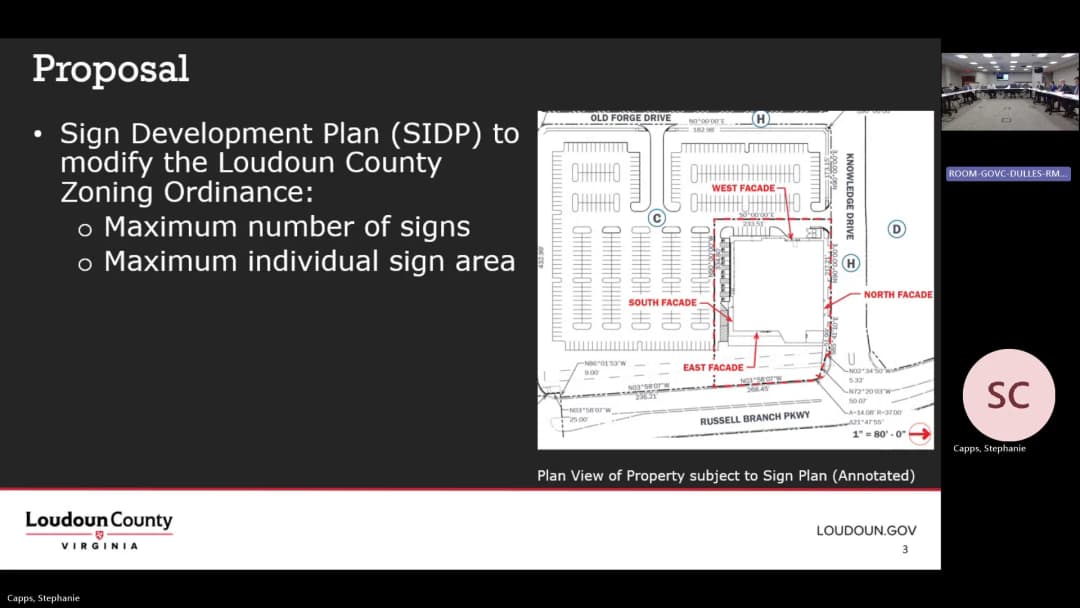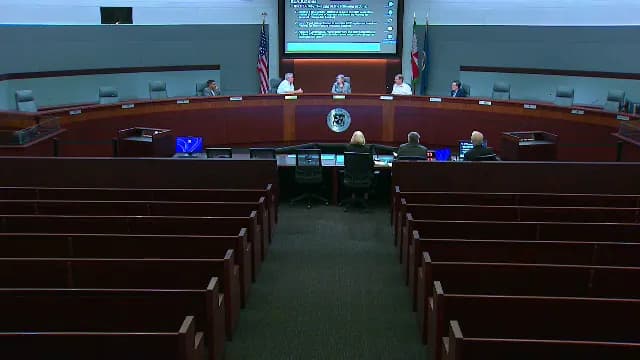
The Board of Zoning Appeals (BZA) held a business meeting on Thursday, October 24, 2024, at 6:00 PM in the Board Room of the Loudoun County Government Center. The primary agenda item was a detailed presentation and discussion on sign development plan applications under the recently amended Zoning Ordinance. The meeting also included reports from the Assistant County Attorney and the Zoning Administrator, covering procedural guidance, upcoming cases, and staffing transitions. Discussion Items - Sign Plan Applications & Legal Framework: Assistant County Attorney Hugh Green presented an overview of sign development plans (SIDPs) as special exceptions, which are legislative acts delegated to the BZA. He explained that these plans are distinct from quasi-judicial appeals and are subject to a “fairly debatable” standard of review, meaning the BZA’s decision is presumed correct unless shown to be plainly wrong or in violation of ordinance intent. - Context of Ordinance Changes: Marshawn Schneider, Program Manager for Land Use Review, provided background: the 2023 ordinance overhaul allowed larger and more signs overall, but also created a standalone SIDP process for applicants to seek modifications based on site-specific circumstances (e.g., building layout, road configurations). The intent was to provide flexibility while keeping decisions within 90 days. - Approval Criteria & Staff Role: The board reviewed the seven criteria for evaluating SIDPs: artistic features, design standards, safety hazards (visual clutter), compatibility, night sky standards, energy efficiency, and redundancy. Staff noted they analyze plans, negotiate conditions, and provide recommendations, but the BZA retains discretion. Members discussed the importance of clear findings of fact to support decisions on appeal. - Procedural Challenges: A significant portion of the discussion focused on parliamentary procedure following a contentious motion at a prior meeting. Members explored options for handling motions that fail to achieve majority, including: amending motions, continuing cases for negotiation, and the need to keep public hearings open or re-advertise if conditions change substantially. The chair suggested including suggested motions in future staff reports to aid deliberation. - Future Caseload: Zoning Administrator David N. reported that the next BZA meeting on November 21, 2024, will include an appeal regarding a fence in the floodplain overlay district (deferred from September) and a variance application for lot coverage on Unison Road. A previously scheduled sign plan was deferred to December or January. Key Outcomes - No Formal Votes: No applications were presented for decision; the meeting was purely informational and procedural. - Staff Retirements Announced: Zoning Administrator David N. and Deputy Administrator Michelle Lore both announced their retirements effective at the end of 2024. The BZA expressed appreciation and noted a transition plan is being developed. - Holiday Gathering Planned: Members agreed to hold a potluck celebration before the December 19, 2024 meeting at 5:00 PM to honor departing staff. - Procedural Guidance for Future Meetings: The board acknowledged the need to develop a consistent approach for handling sign plan motions, including using continuances or alternative motions to articulate denial findings. Staff will incorporate sample motions into future reports.
Public Meetings - Loudoun County, Virginia
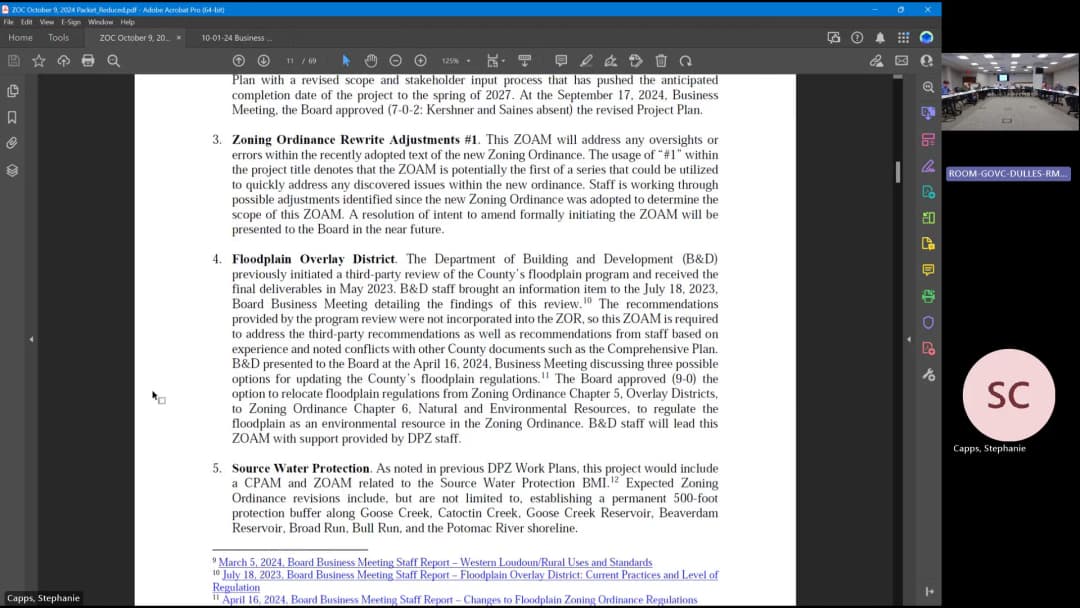
Public Meetings - Loudoun County, VirginiaThe Zoning Ordinance Committee (ZOC) met on October 9, 2024, from 9:30-11:00 AM in the Dulles Room at the Government Center. The meeting focused on proposed amendments to the ZOC Bylaws, updates to the Department of Planning and Zoning (DPZ) Work Plan, and status reports on several current zoning ordinance amendments (ZOAMs) and comprehensive plan amendments (CPAMs). Consent Calendar - The action report from the September 4, 2024 meeting was approved by unanimous consent. Discussion Items 1. ZOC Bylaws Amendments - Staff presented proposed amendments to the ZOC Bylaws, as directed by the Transportation and Land Use Committee (TLUC) on July 17, 2024. The three changes are: - Amend Section A.1.b to add "as voting members" to the restriction that ZOC members may serve on only one other Loudoun County advisory body. - Replace one At-Large seat with a seat designated for Visit Loudoun (leaving one At-Large seat). e - Add an Agri-Business seat and update the number of voting members to 17. - The motion passed in TLUC 3-1-1 (Supervisor Turner moved, Supervisor Kershner seconded; Supervisor TeKrony opposed; Supervisor Glass absent). - ZOC members discussed the definition of "agri-business" and potential conflicts of interest (e.g., Visit Loudoun receives county funding). Staff noted the board seeks ZOC's input before the TLUC meeting on October 17th. - A motion was made to support the redline changes and recommend that the Board of Supervisors define "agri-business" for applicants. The motion passed (with one dissenting vote citing a desire for further clarification before voting). 2. Updated DPZ Work Plan - Staff reviewed Table 1 of the work plan, which lists ZOAM projects: - Data Center Standards & Locations ZOAM (Phase 1): Being considered by the Planning Commission; a special work session is scheduled before October 22. - A ZOC member requested a map showing areas where data centers are permitted by-right (excluding existing/pipeline projects) and an associated acreage table. - Western Loudoun Rural Uses & Standards ZOAM: Board approved the project plan (7-0-2; Kershner and Sands absent). First stakeholder input session on November 21, 2024 at 5 PM (rathr than during work hours, which a member questioned). e - Zoning Ordnance Rewrite Adjustments ("lean-up ZAM"): Staff is working on an aggressive timeline; project manager Teresa Miller assigned. Expected to come to ZOC in December or January. e - Floodplain Overlay Distrit ZOAM: No project manager assigned yet; projected completion winter 2026 (calendar year beginning). e - Source Water Protection ZOAM: No projected date. 3. Status Updates on Current ZOAMs and CPAMs - Data Center Standards & Locations CPAM/ZOAM: Planning Commission held a public hearing on September 24 and referred to work session. Next steps include a special work session before Octoer 22. e- Western Loudoun Rural Uses ZOAM: Board approved the project plan (7-0-2). First stakeholder input session set for November 21 (5 PM). – ZOC members questioned the time and noted the need for a public comment link on the project page (still under construction). e- Clean-up ZOAM: Staff is scheduling the initial project plan presentation to the board. Teresa Miller assigned as project manager. 4. Confirmation of ZOC Members - New members (confirmed by BOS on October 1, 2024, terms ending 9/30/2028): Michael Capretti (At-Large Representative), Dale Polen Myers (Planning Commissioner Representative), and Larry Malone (Subject Matter Expert: Urban Land Use Planner). ZOC also acknowledged approvals for other members but noted some nominations are pending. Key Outcomes - The ZOC voted to support the three Bylaws amendments as presented in the redline and recommended that the Board of Supervisors define "agri-business" for applicants. e- Staff will update the TLUC staff report to reflect ZOC's recommendation. e- DPZ Work Plan updates were noted; ZOC will receive further updates at future meetings. e- The next ZOC meeting is scheduled for November 6, 2024, 9:30-11:00 AM in the Dulles Room.
The Loudoun County Communications Commission (LCC) convened on October 1, 2024, to address franchisee updates, broadband progress, and preparations for the annual Board of Supervisors report. Key topics included the VATI broadband project, Comcast's service improvements, and a discussion on wireless coverage challenges. No formal votes were taken except the approval of the agenda and prior meeting minutes. Consent Calendar - Agenda and Minutes: The agenda was amended to include introductions, and the July 22, 2024 meeting minutes were approved by general consent. Public Comments & Testimony - Jeff Rogers (resident near the West Virginia border) expressed interest in the VATI project, particularly its progress and how to interpret visual aids. Staff provided an update: over 70 miles of middle-mile fiber completed (nearly 50% of total), with approximately 90% either complete or under construction. The first customer connection is expected by year-end, likely in FSA2 (the area where Mr. Rogers lives). Staff clarified that Mr. Rogers's home is part of a secondary 200-home ARPA-funded expansion, not the original VATI grant, but could be served concurrently if infrastructure passes by. Discussion Items - Comcast Update: Christopher Mulhall and Dexter Williams (incoming Government Affairs Manager) reported progress on LEx tickets (6 open tickets, some delayed due to hard-to-find pedestals). The PEG channel upgrade for schools was completed on the day of the meeting, delayed earlier due to school hardware changes. - Verizon: No representative present; item skipped. - 2024 Board of Supervisors (BoS) Status Report: Chair Ron DeSilva apologized for lacking an updated slide deck. Commissioners discussed dividing sections; Dave Frederick (staff) will handle the VATI update. Rich Bibeau offered mapping support; staff will explore licensing FCC data via the state to improve maps. The discussion also covered the recent School Board decision to ban new cell towers on school property, noting the vote was 8-1 and the policy affects only locations with school children. Some commissioners expressed interest in formal guidance from the BoS on wireless coverage issues, while others argued for keeping the topic on the action list pending further engagement. - Staff Report: Dave Frederick shared an updated VATI map (from July) showing FSA2 (red) ahead in middle-mile construction. LEx tickets remain low (6 between Comcast and Verizon). HOAs are being directed to open tickets directly with providers first. Staff noted October 29th as the deadline if the BoS annual update is to be presented in November. Key Outcomes - Action Item Updates: Aaron Smith reviewed open action items. Motion to close item 253 ("speak to supervisors regarding wireless coverage") was made and seconded, but after debate the motion was withdrawn pending a more defined action item. Two new action items were added: (1) Ron DeSilva will circulate a draft presentation outline for the BoS report, and (2) staff will work on overlay maps for county coverage. A third new item directs commissioners to resend the earlier list of wireless questions to staff. - Next Meeting: October 28, 2024.
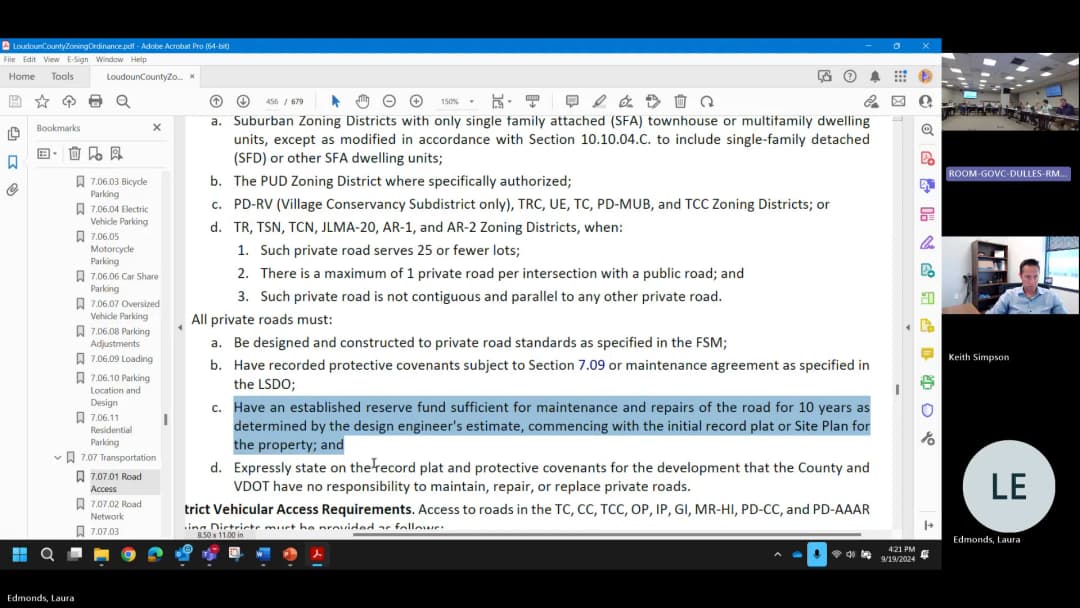
Note: The agenda lists the meeting as September 19, 2024, but the provided timestamp indicates September 29, 2024. This summary uses the given date. The Facility Standards Manual Public Review Committee (FSM PRC) met to discuss proposed amendments for roadways over dams, a new 10-year reserve fund requirement for private streets, and administrative updates. The meeting included approval of previous minutes, a DOAM update, and a preliminary discussion on stormwater regulation transitions. Consent Calendar - Approval of Minutes: The minutes from the September 5, 2024, meeting were approved unanimously. - DOAM ROIA Update: Staff reported that the Board of Supervisors approved two resolutions of intent to amend on September 17, 2024—one for inundation zone amendments and one for the first three zoning ordinance rewrite amendments. The next step is a Planning Commission public hearing on October 22, 2024, with a Board hearing in November and adoption targeted for January 2025. Public Comments & Testimony - No public comments were made. Discussion Items Roadways Over Dams (Proposed Text Amendments) - Kevin Federline (Fire Marshal’s Office) presented revised text for fire apparatus access roads crossing dam embankments or causeways. Key points included: - Public vs. Private Roads: The proposed text requires that at least one publicly maintained fire apparatus access road not cross a dam embankment or causeway, while privately maintained such roads shall not cross at all. Committee members questioned the differing standards, citing maintenance concerns for HOAs. Staff explained that public roads have enforcement mechanisms (e.g., VDOT involvement) that private roads lack, making stricter rules for private roads necessary. - Bridges and Culverts: The discussion expanded to include bridges, with concern about long-term maintenance of structures with abutments or piers. Members clarified that open-bottom arches (e.g., Bebo arches, conspan) and box culverts are acceptable, but bridges with traditional abutments or piers are problematic. The committee refined the language to define a bridge as a structure with abutments or piers, excluding open-bottom arches and box culverts. Definitions for roadway dam and roadway causeway were drawn from the VDOT Drainage Manual. - Next Steps: The committee agreed to send the proposed amendments (including a previously approved plat note) out for agency referral. No objections were raised. The text will be updated with the refined definitions. 10-Year Reserve Fund for Private Streets - Staff introduced a new requirement in the zoning ordinance (Section 7-701) that all private roads must have an established reserve fund sufficient for maintenance and repairs for 10 years, commencing with the initial record plat or site plan. The committee discussed: - Funding Mechanism: Whether the fund must be fully funded upfront (lump sum) or can be an accruing sinking fund. Members noted that HOAs typically use reserve studies with a budget plan, not full upfront funding. Questions arose about the timing—roads are under bond for several years, and the 10-year period seems misaligned. - Developer vs. HOA Obligation: The ordinance does not specify who funds the reserve. Some members suggested that developers may already contribute through initial capital contributions, but the intent of the requirement remains unclear. - Administration and Monitoring: Staff expressed concern about verifying compliance and the county’s capacity to oversee such funds. - Decision: The committee decided to seek clarification from the Department of Planning and Zoning on the original intent of the requirement and to request examples of existing reserve studies used by developers to inform potential FSM guidance. No action was taken on the language itself. Stormwater Regulation Transition (Version 3 to Version 4) - A committee member raised concerns about the upcoming July 1, 2025 deadline for the state’s switch from version 3 to version 4 of stormwater regulations. Key points: - Version 3 requires a phosphorus load of 0.41 lb/acre/year; version 4 reduces it to 0.26. The state has issued guidance on completing plans under version 3 if submitted by the deadline. - The committee questioned whether Loudoun County will follow the state’s timeline or impose stricter rules. Members noted that western Loudoun may be disproportionately affected. - Next Step: Staff will consider issuing a technical memo to clarify the county’s position and will bring the topic back for further discussion. Key Outcomes - Roadways Over Dams: The proposed text (including bridge definitions) will be sent for agency referral. The committee supported the refined definitions and the distinction between public and private roads. - Reserve Fund for Private Streets: Staff will gather more information from zoning and developers; no formal action taken. - Stormwater Regulations: Staff will explore a tech memo to address version 3/4 transition concerns. - Next Meetings: Scheduled for Thursday, October 3, and Thursday, October 17, 2024. Upcoming topics include sidewalks, DCR/DWR information, remedial revegetation plans, and ADU conversion processes.
The Board of Zoning Appeals met on September 26, 2024, at 6:00 PM in the Board Room of the Loudoun County Government Center. The agenda included three public hearing items: a deferral request for an appeal, a special exception for an error in structure location (swimming pool), and a crossroads sign plan. The Board deferred the appeal, approved the special exception, and denied the sign plan. Administrative items included a report on a resolution of appreciation for a former member and discussion of future processes for sign plan applications. Preliminary Matters – Deferral of Appeal APPL-2024-0001 - The appellant, Mohan Sunkara, requested a 60-day extension to obtain legal representation, stating he was unprepared for the hearing. Staff had no objection. The Board voted to defer the appeal to a date certain of November 21, 2024, with the understanding that supplemental materials would be due under standard rules. The motion carried unanimously. Discussion Items BOZA-2024-0001 – Special Exception for Error in Structure Location (Swimming Pool) - Applicant Joseph Mason requested approval for an existing in-ground swimming pool located 0.14 feet (about 1.5 inches) from the rear property line, where a minimum five-foot setback is required for non-habitable accessory structures. The applicant stated that the pool was built by a licensed contractor who later abandoned the project, and that the county had issued permits and conducted inspections. The Board found that the applicant acted in good faith and that the pool posed no safety hazards. The Board approved the special exception based on findings A through F in Section 101104D of the Zoning Ordinance, with the condition that the approval applies only to the pool water area and not to other structures. The motion carried unanimously. LEGI-2024-0007 – Crossroads Sign Plan (ZMOD-2024-0003) - The applicant proposed a sign development plan to replace existing mismatched signs with nine cohesive signs, increasing total sign area from 12.2 square feet to 96.12 square feet. Three signs (Signs 1, 2, and 3) would exceed by-right size limits: Sign 1 doubling from 15 to 30 sq ft, Signs 2 and 3 increasing from 10 sq ft to 24 sq ft and 20.8 sq ft respectively, with heights increasing from 5 to 6 feet. Staff recommended approval with conditions (e.g., lighting restrictions, no digital signage, landscaping maintenance). The applicant argued that the proposed signs were smaller than existing ones and would create uniformity. Board members expressed concern about the magnitude of size increases and lack of justification for why larger signs were needed. The motion to approve failed with three votes in opposition (Mr. Walker, Mr. Kenaiko, and the Chair? Actually the Chair voted in favor, but the transcript shows the Chair said "Aye" and then "All opposed? I'm opposed. I opposed. Mr. Walker is opposed. Mr. Kenaiko is opposed." So three opposed, one in favor – motion failed. The Board then determined the application was denied without further motion. Administrative Items - The Zoning Administrator reported that the Board of Supervisors will issue a resolution of appreciation for former member Mr. Moffat at its business meeting on November 7, 2024, starting at 4:00 PM. - The Board discussed scheduling a business meeting in October (no cases scheduled) to review the new zoning ordinance and develop criteria for evaluating sign plan applications. Members noted the need for clearer justification from applicants, such as scale comparisons and necessity for larger signs. The possibility of establishing a process for continuances to allow applicants to address concerns was raised, but no action was taken pending further discussion with staff and the county attorney. Key Outcomes - Deferred: Appeal APPL-2024-0001 deferred to November 21, 2024. - Approved: Special Exception BOZA-2024-0001 for the swimming pool setback error (unanimous). - Denied: Sign Plan LEGI-2024-0007 (motion failed 1-3; application denied). - Next Steps: Board to consider scheduling a work session in October to discuss sign plan criteria and receive training on the new zoning ordinance.
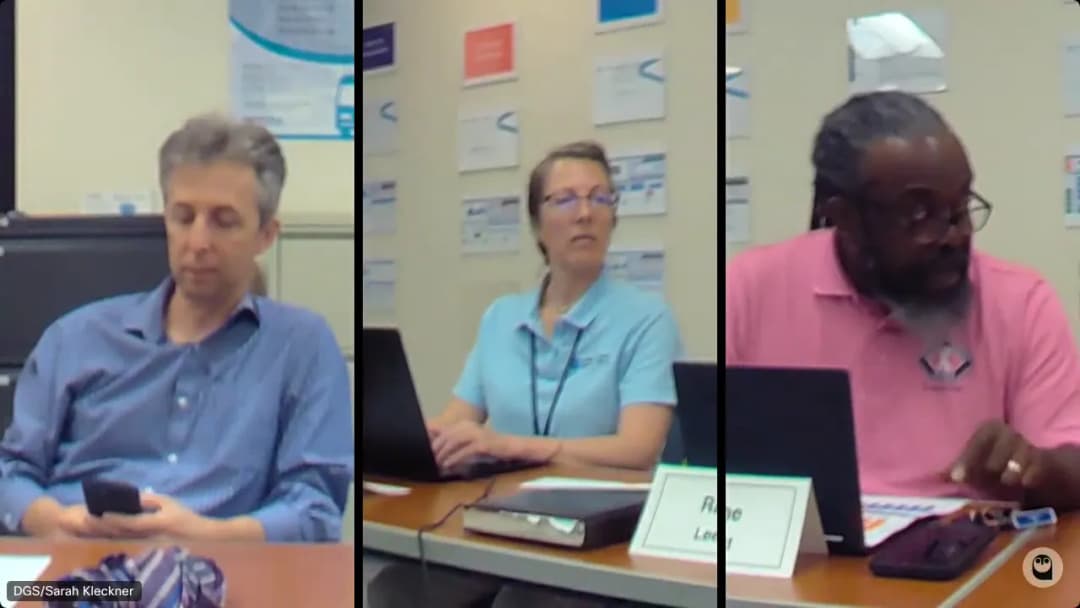
The Transit Advisory Board (TAB) convened on Wednesday, September 18, 2024, at 7:00 PM at the Transit & Commuter Services Office in Leesburg, Virginia. Chair Ray Delpesche led the meeting, which focused on public comments regarding fare equity, transit service updates, ridership trends, and future planning including microtransit and weekend service expansion. Board members discussed the 2024 Annual Report and received detailed staff updates on local, commuter, paratransit, and Silver Line ridership. Consent Calendar - Approval of July 10, 2024, Meeting Minutes: The minutes from the July 10, 2024 TAB business meeting were approved unanimously (motion by Vice-Chair Suzi Wilson, seconded by Member Vlad Ovchynnikov). Public Comments & Testimony - Emily Reese (Leesburg/Long Haul Commuter rider): Expressed concern about fare equity, noting that local buses will become fare-free on January 1, 2025, while commuter bus fares are set to increase $1 in 2025 and another $1 in 2026. She noted she spends approximately $400 per month commuting to work for a nonprofit organization and requested that future annual reports include financial data on both local and commuter bus costs. Staff (Scott Gross) responded that the policy decision was based on ridership demographics: most local fixed route riders earn under $50,000 annually, while most commuter bus riders earn over $150,000. He also noted that many commuter riders receive a $340/month transit subsidy from their employers, and the board of supervisors has historically required commuter bus to be revenue-neutral. Reese further expressed concern that if the commuter bus stop moves from Dulles Transit Center to Ashburn Metro, the paid parking at Ashburn would be prohibitive for her. - Member Vlad Ovchynnikov commented that local buses serve a critical need for low-income residents, older immigrants, and people without driver's licenses, citing an example of a Brazilian immigrant in Sterling who relies on the bus to get to work in Leesburg. Discussion Items - 2024 Annual Report: Staff (Sarah Kleckner) outlined a timeline for the annual report, with the final version due at the November 13 TAB meeting and presentation to the Board of Supervisors in December. Vice-Chair Suzi Wilson volunteered to consolidate input and will circulate a skeleton draft within a two-week deadline. Members discussed including anecdotal feedback (e.g., Metro use by youth) and ensuring the report covers accomplishments, future goals, and financial data. - Transit Service & Ridership Updates (Scott Gross): - Commuter Bus: Ridership remains flat, not growing or shrinking. Ten routes with fewer than 10 riders per day will be eliminated starting December 2, 2024 (e.g., Brambleton, Loudoun Center). The revenue generated from eliminating these routes will fund weekend service on all two-digit local routes. - Local Fixed Route Bus: Ridership is above pre-COVID levels. Silver Line connection routes (three-digit) are underperforming, with ridership as low as 1.5 riders per revenue hour. Staff is considering consolidating or converting these to microtransit in FY2026. The two-digit routes (e.g., 70, 80, 82) have higher ridership and serve lower-income areas, but headways are long (45-60 minutes). Staff plans to request FY26 budget adjustments to improve headways on two-digit routes to 20-30 minutes. - Paratransit: Ridership has exploded — 2,043 rides in August 2024, compared to a pre-COVID peak of 11,000 per year. The service boundary was expanded in June 2024. Staff will request five additional vehicles and funding due to capacity constraints. Challenges were discussed, including a Disability Services Board member who experienced a late pickup and was left waiting; staff acknowledged a gap in after-hours dispatch availability and will examine driver training for wheelchair securement. - Weekend Service: Staff is proposing to add Saturday and Sunday service on all two-digit local routes using savings from commuter bus cuts, which would be budget-neutral. - Future Planning: A microtransit study is underway to identify pilot areas, with potential to integrate with paratransit and improve connectivity in underserved areas. A feasibility study for reverse commuter bus service (bringing commuters into Loudoun) will be presented to the Board of Supervisors in October. - Paratransit Operations: Discussion highlighted the need for improved dispatch communication and driver training after an incident where a board member could not get timely assistance. Staff noted that paratransit hours match transit operating hours, but the reservation center closes at 7:00 PM, creating a gap for riders needing last-minute changes. - Coordination with Childcare Services: Member Dorri O’Brien raised a question about how transit can help low-income parents get to childcare and work. Staff noted that a cross-departmental meeting occurred that morning (including Parks, DFS, Area Agency on Aging) to explore a one-stop phone number for ride options and potential use of microtransit or subsidized rideshare. Key Outcomes - Approval of July 10, 2024, Minutes: Unanimously approved. - 2024 Annual Report: Draft will be circulated by Vice-Chair Wilson within two weeks; final report due at November TAB meeting. - Commuter Bus Cuts: Staff confirmed that 10 low-ridership commuter routes will be eliminated on December 2, 2024, freeing funds for weekend local service. - Weekend Service Proposal: Staff will formally propose adding Saturday and Sunday service on all two-digit local routes in the FY26 budget request. - Paratransit Expansion: Staff will request five additional vehicles and operating funds due to surging demand; dispatch improvements and driver training will be addressed. - Microtransit Study: A pilot study is expected to begin shortly, with results to inform future service design. - Next Meeting: The next TAB business meeting is scheduled for Wednesday, November 13, 2024, at 7:00 PM at the Transit & Commuter Services Office. - Adjournment: The meeting was adjourned at [time not specified in transcript].
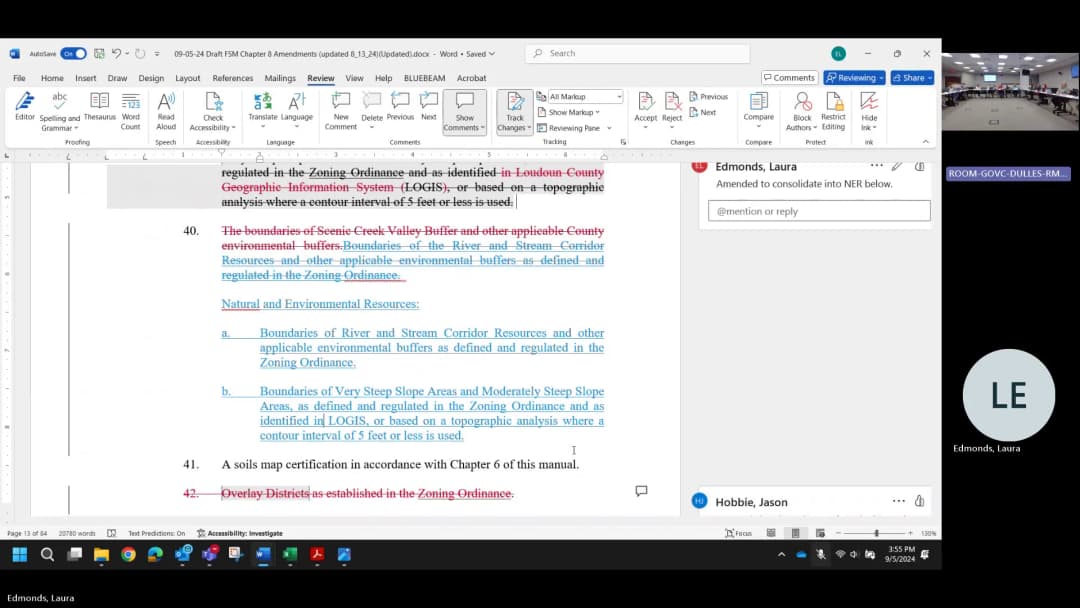
The Facility Standards Manual Public Review Committee (FSM PRC) met on September 16, 2024, from 3:00 to 5:00 p.m. The meeting covered approval of previous minutes, updates on interim technical memos, the 2025 meeting calendar, tree cover inventory sample map, ongoing review of FSM Chapter 8 amendments, and the annual report. Key decisions included approving the calendar with a venue change, declining to add a sample map, and continuing the Chapter 8 discussion. Consent Calendar - Approval of Minutes: The minutes from the July 18, 2024 meeting were approved by consensus. Megan, a new member, abstained as she was not present at that meeting. - Public Comment: No members of the public signed up to speak. Public Comments & Testimony - No public comments were made. Discussion Items - Interim ZOR Tech Memo Update: Laura and Kevin reported on the Board of Supervisors’ business meeting the previous day. The Board was supportive of the tech memo concept, noting that memos are interim until official amendments are adopted. A question about requiring 100% native species (vs. the current 80% standard) was raised, but staff explained that the FSM aligns with the zoning ordinance’s 80% requirement and that the approved species list is vetted. No action was taken. - 2025 Meeting Calendar: Due to renovations to the Dulles Room (March 26 – August 8, 2025), the committee approved switching to Conference Room 102 at 8 Siclin Road (Department of General Services) as the primary meeting space, with the Lovettsville Room as a backup. The schedule remains the first and third Thursdays, 3–5 p.m., with August meetings canceled as usual. - Tree Cover Inventory Sample Map: The committee discussed a proposed sample map for the FSM to illustrate tree cover within the Mountainside Development Overlay (MOD). Staff presented a simplified version, but members expressed concerns about missing details (e.g., MOD boundary line, forested areas outside MOD). After debate, the committee decided not to include the sample map, noting that existing guidance is sufficient and that adding a map could create confusion. - FSM Chapter 8 Amendments: Review of Chapter 8 (Natural Resources and Environmental Features) continued from the July 18 meeting. Key topics included: - Section 8.101: Clarifying that zoning districts, overlay districts, and jurisdictional boundaries must be shown. The committee agreed to add “overlay districts” to the heading. - Section 8.102: Floodplain boundaries – discussion on using GIS layers vs. floodplain studies. Staff confirmed that if no study exists, GIS boundaries are acceptable. - Section 8.103: Record plats and exhibits – The committee reaffirmed that environmental features (LOD, MOD, NER, buffers) should be shown on a separate informational exhibit (not on the recorded plat). This is current practice. Debate arose over whether this applies to all plat types (e.g., easements, BLAs). Staff agreed to review which sections reference 8.103 and bring clarifications to the next meeting. - Steep Slopes: Debate over topographic analysis requirements. The committee noted that the current language is ambiguous and will be revised for clarity. - PRC Annual Report: Laura presented the Fiscal Year 2024 annual report. Highlights included: - One approved DOAM (stormwater management program amendments). - Two pending DOAMs (dam break inundation zone and zoning ordinance rewrite). - Seven technical and procedural newsletters issued. - No appeals in the reporting period. - The committee approved the report, which will be presented to the TLUC on October 17, 2024, and the Board of Supervisors in November 2024. Key Outcomes - Decisions: - Approved the 2025 meeting calendar with venue change to Conference Room 102. - Declined to add a tree cover inventory sample map to the FSM. - Affirmed that environmental features exhibit should remain informational, not recorded on plats. - Approved the FY2024 annual report. - Votes: All decisions were made by consensus without formal roll call votes. - Next Steps: - Staff will review which sections of Chapter 8 require the informational exhibit and report back. - Revision of steep slope language for clarity. - Continued review of Chapter 8 amendments at the next meeting (October 3, 2024). - The annual report will be submitted to TLUC and the Board of Supervisors. - New Business: Items raised for future discussion included stormwater access and trail conflicts, roundabout standards, C-factor errors in the FSM, grandfathering provisions, and a work group on soil volume. No immediate action was taken.
The Zoning Ordinance Committee (ZOC) of Loudoun County met on September 4, 2024, from 9:30 to 11:00 AM in the Dulles Room. The committee reviewed an updated work plan, discussed the 2024 list of issues, considered recent changes to committee membership, and received an update on the Western Loudoun Rural Uses & Standards amendment. Several motions were passed, and a subcommittee was formed to align ZOC issues with Board priorities. Consent Calendar - Approved the June 5, 2024 action report with four corrections (adding Larry and Rust to attendance, correcting Jeff Browning's status, and removing absent member from present list). No vote tally recorded; corrections were acknowledged and the report was approved. Public Comments & Testimony - No public input was offered. Discussion Items - Updated DPZ Work Plan (Item 5): Staff presented the work plan introduced to the Board in July. Key updates included: - Data center standards ZOAM: Phase 1 projected February 2025, Phase 2 projected April 2026. - Western Loudoun Rural Uses ZOAM (CPAM-2024-0002 / ZOAM-2024-0002): Planning Commission work session September 12, public hearing September 24. - Zoning ordinance rewrite adjustments (cleanup ZOAM): No set timeline; staff continues to collect issues. Member Bridge expressed frustration and moved to "encourage staff to stop collecting information for the first adjustment and to proceed with it as soon as possible" to expedite corrections. The motion passed unanimously (all present voted in favor). - Floodplain overlay district ZOAM: Tentative completion winter 2026. - Source water protection ZOAM: Under development. - A new manufactured housing ZOAM will be proposed in the October work plan. - 2024 List of Issues (Item 6): The 30-item list from members was not in the meeting packet. The committee agreed to form a subcommittee (members Mark, Michael, Morantia, Larry, Richard volunteered) to sort the list and align it with the Board of Supervisors’ ZOAM priorities. The subcommittee will meet virtually before the October ZOC meeting, and a member noted that any non-reappointed ZOC member could still attend as public. - Board of Supervisors Changes to ZOC (Item 7): Staff reported three bylaw changes adopted by TLUC: (1) ZOC members may serve as voting members on only one other county advisory board; (2) one at-large seat replaced by a seat designated for Visit Loudoun; (3) an agribusiness seat added, increasing voting members to 17. These changes go to the Board on September 17. Eight committee members’ terms expire on September 30; they were reminded to submit letters from appointing organizations to the Board package by 5 PM that day. - Western Loudoun Rural Uses & Standards (Item 9): Staff provided an updated timeline. The TLUC originally planned four work sessions on major use topics but added three more, extending the process by an estimated six to nine months. ZOC will likely receive draft language at least a year from now. A member expressed concern that multiple topics (e.g., ag processing, signage, MOD) are scheduled for the same meeting, requiring separate subject matter experts. A motion was made to "get clarification of the scheduling matches the subject matter experts for the topic." The motion was seconded and passed by voice vote (all aye). Key Outcomes - The committee passed a motion encouraging staff to immediately proceed with the first batch of zoning ordinance adjustments (cleanup ZOAM) rather than continuing to collect issues. - A subcommittee was formed to reconcile the ZOC’s 2024 issue list with the Board’s ZOAM priorities; the subcommittee will report back at the October meeting. - The committee passed a motion requesting clarification on scheduling subject matter experts for TLUC’s Western Loudoun work sessions, ensuring experts match specific topics. - Next regular ZOC meetings: October 2, 2024, and November 6, 2024, both 9:30-11:00 AM in the Dulles Room. One virtual meeting remains available for the 2024 calendar year.
The Transit Advisory Board (TAB) held a business meeting on August 1, 2024, to review recent transit initiatives, discuss the Board of Supervisors Transit Summit outcomes, and receive staff updates on ridership and service changes. The meeting included public comment, approval of prior minutes, and planning for the 2024 annual report. Consent Calendar - Approval of May 8, 2024, Minutes: The minutes from the May 8, 2024, TAB business meeting were approved unanimously (6-0-3) with three members absent. Public Comments & Testimony - Weekend Service Concerns: A member of the public (identified as Brian) expressed frustration with limited Saturday transit service, noting that returning from the Metro to Leesburg required three bus transfers. He urged expanded weekend service, including Sundays and holidays, to support non-drivers like himself. Staff responded that weekend service is a top priority and is part of future planning but is not yet funded. The initiative will also explore replicating Saturday service on Sundays. - Bus Stop Parking Issues: A board member raised a concern about a bus stop on Bentwood Circle (possibly Route 18) being persistently blocked by parked cars, making stops unsafe. Staff noted that a program to install “No Parking” signs is underway as part of stop improvements, but enforcement requires posted signage. The issue will be considered in ongoing stop development. Discussion Items - Recap of May 29, 2024, Transit Summit: Staff presented outcomes from the Board of Supervisors Transit Summit, including multiple actions: - Paratransit Service: The existing service area was expanded to include the Suburban, Urban, Leesburg JLMA, and Town of Leesburg policy areas, beyond the federal minimum of ¾ mile from new routes. This took effect immediately. - Commuter Bus Service: The revenue neutrality policy was suspended; ten underperforming routes will be discontinued as soon as practicable in FY2025 (pending an equity analysis); the one-way fare will increase to $11.00 in FY2025 and $12.00 in FY2026; the Brambleton Park-and-Ride lot will close (possibly by October 1, 2024); and a motion to relocate buses from Dulles Transit Center to Ashburn South Metro garage was tabled until board members receive a briefing on parking agreements. - Local Fixed Route Service: The Board endorsed the “Hybrid Strategy” and seven operational/equity objectives. - Fare-Free Program: Local fixed route and paratransit services will become fare-free starting January 1, 2025 (motion passed 5-1-2-1, with one abstention). - Additional Items: Staff were directed to evaluate accelerating the Bus Shelter CIP, develop trash/recycling containers at stops, and include a request to eliminate fares on Senior Bus Service in FY2026 budget. - 2024 Annual Report Planning: The board discussed preparing the 2024 annual report (deadline: November 2024 meeting). Members were encouraged to start brainstorming content and send suggestions to staff. Formal discussion will occur at the September meeting for approval in November. - Ridership and Service Updates (presented by Steven Pairo): - Local Bus: Ridership is trending upward, with strong growth on Silver Line routes (newer, maturing). Recent improvements in timing and a new marketing campaign (Spotify, Pandora, Facebook) are credited. Average riders per trip rose from 3 to 3.9 year-over-year. - Commuter Bus: Ridership is relatively flat, with Tuesday–Wednesday–Thursday trips stronger than Mondays and Fridays. Staff may adjust Friday schedules. - Paratransit: Daily rides remain near 70–80 (nearly double pre-pandemic levels). Service area expansion is expected to increase demand further; staff are preparing for potential growth in vehicles and drivers. - Marketing & Tools: Staff emphasized using the “Transit” app and Google Maps for trip planning, rather than PDF schedules. Members suggested better promotion of these tools, including QR codes at stops and targeted social media (Instagram, TikTok) to reach younger riders. - Data and Demographics: Staff shared that Title VI data on minority and low-income populations is available via census and onboard surveys; age demographics were not tracked in current reporting. Key Outcomes - Minutes Approved: May 8, 2024, meeting minutes were approved unanimously. - Transit Summit Actions: The TAB acknowledged and discussed the Board of Supervisors’ decisions; staff will proceed with implementation as directed. - Next Steps: The 2024 annual report content will be developed in September 2024; the next TAB meeting is scheduled for September 11, 2024, at 7:00 PM at the Transit and Commuter Services Office in Leesburg. - Public Feedback: Staff will continue to evaluate weekend service expansion, stop parking enforcement, and marketing strategies to increase ridership.
The Loudoun County Board of Zoning Appeals held a public hearing on July 26, 2024, to consider one application: a sign development plan for the Kincora Pinstack indoor recreation facility. The board heard staff presentations and applicant testimony, deliberated on the proposal's compliance with seven evaluation criteria, and ultimately voted to approve the plan subject to conditions. Discussion Items - LEGI-2024-0013 – Kincora Pinstack Sign Development Plan: The applicant proposed modifications to the zoning ordinance's maximum number of signs (from 4 to 12) and maximum individual sign area (to 506 square feet) for a 54,000-square-foot, two-story entertainment venue (including bowling, laser tag, rock climbing, bumper cars, a ropes course, and a restaurant) at the Kincora mixed-use development. Staff Planner Nick Cicero presented that the building is approximately 100 feet tall with 45,175 square feet of facade area, and the proposed signs would occupy only 3.4% of facade area, meeting the criteria of unusual design, traffic safety, compatibility, night sky impact (internal illumination with LED), energy efficiency, and avoidance of redundancy. Board members questioned the rationale for the size increase compared to the 20% facade benchmark and discussed the building's visibility from surrounding roadways and future development phases. The applicant (represented by a spokesperson) emphasized that the prototype requires iconic signage to identify the facility from all four sides and that the sign development plan allows flexibility for large-scale buildings not properly served by standard zoning rules. Key Outcomes - Approval: The board voted unanimously to approve the sign development plan (LEGI-2024-0013) subject to the conditions of approval dated July 9, 2024, and based on the findings for approval provided as attachments to the July 25, 2024 staff report (with a minor clerical correction to the zoning modification number). The motion carried with all five members present voting in favor.