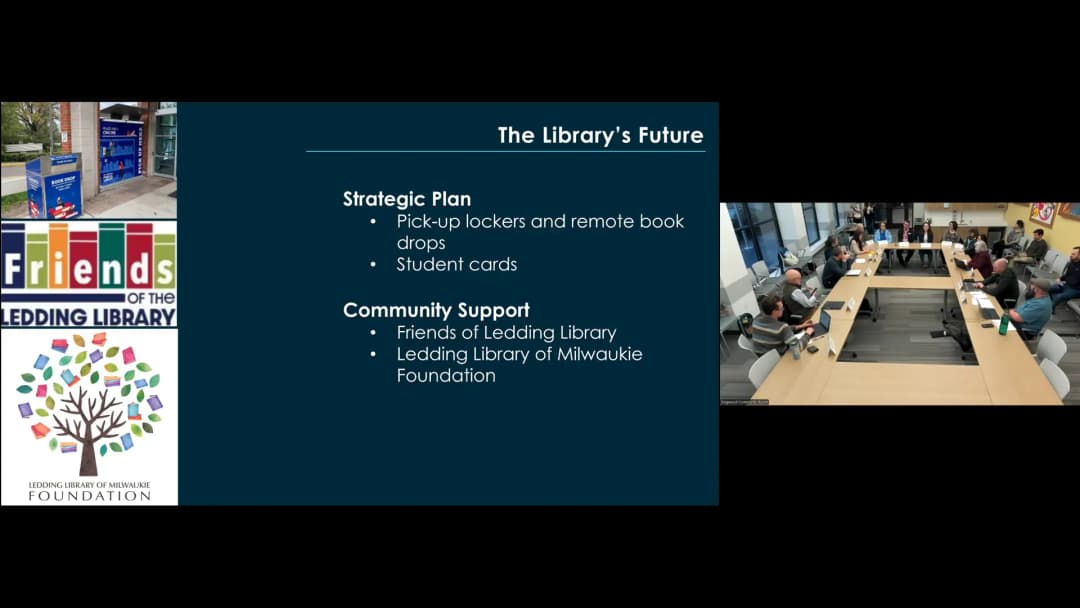
This study session featured annual updates from six city boards and committees: the Arts Committee, Equity Steering Committee, Library Board, Parks and Recreation Board, Public Safety Advisory Committee (PSAC)/SPOT program, and Tree Board. The council asked clarifying questions and provided direction on several items. Note: The transcript begins by stating "March 10th, 2026 study session," but the official timestamp indicates the meeting took place on March 11, 2026. Arts Committee Update - Sculpture Garden: Two new sculptures ("Buffalo" by new artist Crabice, and a second piece) were installed; the "Sphere of Spheres" was purchased. Committee members also assisted in selecting art for Scott Park ("Peculiar Pod") and the "Art Sphere". - Porch Fest 2025: 115 performances across all Milwaukee neighborhoods, six meeting sponsors (including new sponsor Made in Milwaukee), over 30 vendors, 800 wishing tags, 600 alcohol bracelets (a proxy for attendance). - Library Art Shows: New quarterly art shows in the library community room, curated with the Friends of the Library; artist receptions held in conjunction with First Friday and an artist panel co-hosted by the Clackamas County Arts Alliance. - Arts Foundation: Formed with three members, allowing tax-deductible donations. Received a $5,000 grant; fundraising has been building a reserve (previously raised $10–15,000 with $2,000 leftover). - Goals for Coming Year: Cultivate community engagement (building on existing opportunities), promote Milwaukee as a regional arts center, expand funding streams (e.g., curation fees), and recruit non‑committee volunteers to reduce burnout. - Upcoming Projects: Porch Fest 2026 (21st year, more artists signed up than venues), a student-led mural at Milwaukee High School (youth member Adair working with mentor Chris Haberman, pending intergovernmental agreement), a mini Comic‑Con style event at the library, continued library art shows, and regular contests (scarecrow, umbrella). - Council Q&A: Council asked about the youth ambassador’s experience, the need for additional volunteers, and how extra funding might be used (e.g., hiring a part‑time Porch Fest coordinator). The committee expressed interest in eventually hiring staff to manage large events. Equity Steering Committee (ESC) Update - Background: ESC is an advisory body to the mayor, city manager, and council; 10 community members; one vacancy opening in July 2026. - 2025 Activities: Reviewed city website user‑friendliness (demo before July launch), drafted community outreach materials (stickers, postcards), held biannual review of the Milwaukee Community Events Fund (four rounds completed), organized Juneteenth celebration when previous organizer dropped out, and co‑developed the city’s naming and memorial/donation policies (adopted January 6, 2026). Confederated Tribes of the Grand Ronde gave a placekeeping presentation (recording pending). - Community Events Fund: Awards have supported events like Chinese New Year and cross‑cultural meals; eight applications pending for spring 2026. Council noted challenges with event reporting and accessibility of application materials. - 2026 Priorities: Continue staff engagement on accessibility, meet with Urban Renewal Authority (URA) on five‑year action plan, build partnerships with local organizations, finalize outreach materials, resume equity performance metrics, and plan Juneteenth. They also seek greater collaboration with other boards/committees and plan to table at city events. Library Board Update - Usage & Resources: 700,000 checkouts in 2025 (highest since 2015). E‑books/audiobooks, Library of Things (canning kits, sewing machines, musical instruments), seed library, food pantry, and community/study rooms are heavily used. - Strategic Plan (2024–2027): Focus on connecting with Milwaukee Momentum, improving services at point of need, and organizational health. Initiatives include installing library lockers for after‑hours pickup (three sets planned, with URA and city budget support) and implementing student library cards for K‑12 students in the North Clackamas school district (data‐sharing privacy concerns being addressed; superintendent meeting scheduled). Council expressed strong interest in the student card program. - Friends of the Library: Provided 4,242 hours of volunteer service, raised $46,000+ from bookstore and plant sales. Seeking new storage/workspace (900–1,000 sq. ft., near library) due to current space being torn down. - Library Foundation: Being built to provide long‑term support; seeking additional board members. Upcoming events: two screenings of the documentary “The Librarians” (April 18 and 26). - Board Recruitment: Two openings (one youth) due to term limits; council noted that library board typically receives many applicants. Parks and Recreation Board Update - Membership: 9 members (including 2 youth); two youth positions opening in July 2026; one alternate and one permanent position also open. - 2025 Accomplishments: Advocated for Milwaukee Park, partnered with Milwaukie City USA, reviewed naming/memorial policies, completed board bylaws revision, supported Earth Day event and Metro Community Choice Grant outreach, and co‑hosted a successful Metro project presentation (Metro praised board members’ preparation). - Goals for 2026–2027: Engage community to learn what they want for Milwaukee Parks (e.g., surveys beyond satisfaction), collaborate with public/community groups to leverage resources, strengthen inclusive recreation programming (both culturally and disability inclusive), and create a task force to research additional funding sources. Council encouraged exploring corporate and foundation support, and mentioned adaptive recreation equipment (e.g., all‑terrain wheelchairs) as a potential rental through the library. Public Safety Advisory Committee (PSAC) & SPOT Program Update - SPOT Program: Funded initially with $350,000 (slated to expire end of fiscal year; funds can roll over). City budget includes another $200,000 for next biennium. PSAC reviews community proposals (up to $25,000 cap) for transportation safety projects. Two‑phase process: initial review, then detailed engineering estimate. - Project Status: Many projects approved and in progress; 10 speed feedback signs on order. Some proposals denied due to maintenance constraints or scope (e.g., stormwater issues, CERT funding). - Parking and Visibility Concerns: PSAC identified systemic problems with large vehicles parking too close to crosswalks, creating blind spots. They proposed an education campaign, thermoplastic pavement markings, and possible height restrictions (citing Florence, Oregon, as an example). Council asked PSAC to bring specific policy recommendations for council consideration. - Data Needs: PSAC lacks official pedestrian/bicycle traffic counters; they requested funding for such equipment to better evaluate safety projects. Council acknowledged the value but noted budget constraints. - Council Feedback: Council praised the SPOT program’s responsiveness but cautioned against over‑obligating staff. They recommended PSAC bring themes to council during budget/CIP cycles, and that projects with broader impact may need to move through the normal CIP process. Council also asked for clearer timelines and status definitions on the SPOT website. - Broader Role of PSAC: PSAC asked for guidance on whether to remain focused on transportation safety or expand to other public safety issues (e.g., CERT). Council suggested that policy recommendations are welcome, and that separate processes could be created if needed. Tree Board Update - Membership: 9 members; one ISA‑certified arborist (John Brown); outgoing chair Kathleen completing tenure; several positions opening (including youth alternate). - 2025 Accomplishments: Tree City USA designation (10th consecutive year), Arbor Day event (100+ volunteers planted 50 trees), tree maintenance walk, contributed to natural resources and tree code updates (including mitigation fee structure), approved consolidated tree list (expanded invasive species list), and a programmatic tree permit for utilities/agencies. - 2026 Goals: Increase tree planting (understand funding, expand Arbor Day, equitable replanting for ash loss), improve tree preservation during development (track code changes, higher fees effectiveness, developer outreach), update urban forest management plan with community engagement, assess feasibility of a heritage tree program and commercial tree code, and explore making trees more affordable. Staff noted capacity limits; regulatory work currently dominates, leaving less room for planting and stewardship. - Data Tracking: Staff are compiling multiple data sources to report on canopy goals (40% by 2040) and permit trends; council encouraged sharing this data soon. - Council Q&A: Council asked about split opinions on a commercial tree code (some board members prefer focusing on community stewardship over new regulations). Council supported balancing regulation with tree‑planting incentives. They also thanked Kathleen for her service. Additional Items - Council Reports: One council member (Robert) raised that NBA (Neighborhood Business Association) event funding has become restricted due to policy changes on sponsorship criteria; they asked to discuss this in the budget cycle. Council agreed to follow up. Key Outcomes - PSAC will develop specific policy recommendations (e.g., parking restrictions near crosswalks) for council consideration. - Council encouraged PSAC to bring systemic themes to budget/CIP discussions and to clearly communicate project phases and timelines on the website. - The library will continue working toward student cards and library lockers; council expressed support and will raise the student card topic with the school superintendent. - The library and parks boards will coordinate on possible adaptive equipment rentals. - Tree board will focus on data compilation and a future urban forest plan update, with potential policy discussions on commercial tree code and heritage trees. - The city will revisit event funding eligibility rules to address NBA concerns. - Several board and committee openings were noted (arts, equity, library, parks, PSAC, tree board); council emphasized recruiting youth members.
Public Meetings - Milwaukie, Oregon
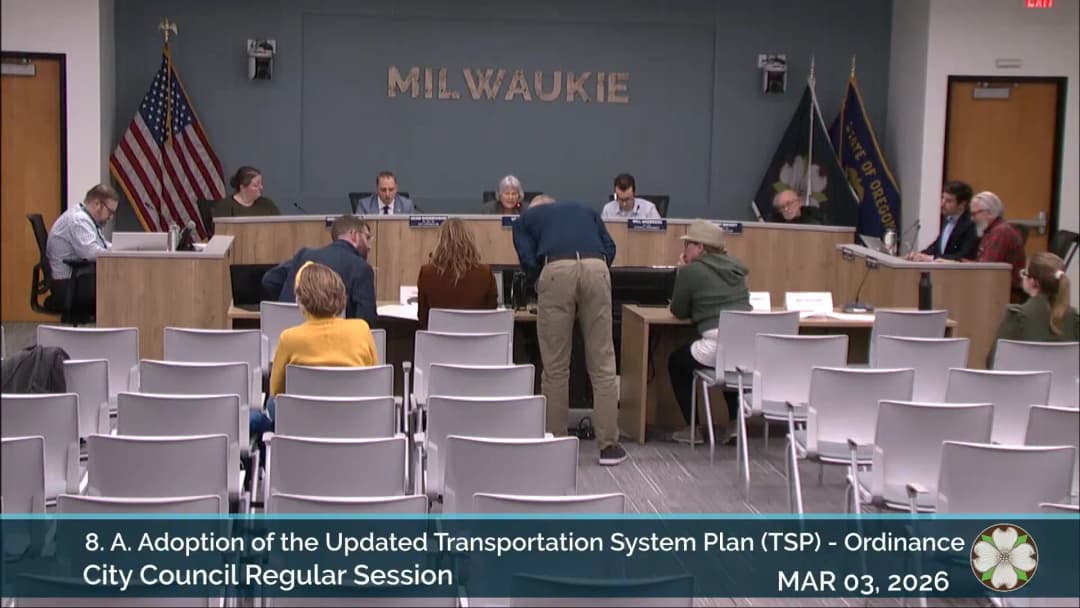
Public Meetings - Milwaukie, OregonThe Milwaukie City Council held its 2,444th meeting on March 4, 2026, in a hybrid format. The meeting included a Women's History Month proclamation, the selection of the 2025 Volunteer of the Year, approval of revised public contracting rules, a presentation on the city's new emergency management and resilience framework, and the adoption of an updated Transportation System Plan (TSP). Proclamation and Announcements - Mayor Lisa Beatty proclaimed March 2026 as Women's History Month, read by Linda Carr of the Milwaukie Historical Society. Councilor Jordan announced a downtown 'Wine Walk' event on March 8, 2026, featuring women-owned businesses and wineries. - Upcoming community events were announced: a talk with David Harrelson (Confederated Tribes of Grand Ronde) on March 5, 2026, Johnson Creek Watershed Council restoration event on March 7, 2026, Earth Day event on April 25, 2026, and a park work party on March 14, 2026. Volunteer of the Year Selection - Community Engagement Coordinator Jason Wax presented 12 nominees for the 2025 Volunteer of the Year award. Council members highlighted each nominee's contributions, including: Allie Callos Spencer and Linda Hedges (CERT team leaders, expanded program from 38 to 53 volunteers) Lisa Gunyanranker (Parks Foundation, neighborhood association, 8+ years service) Nick Hess, Tom Hogan, Amanda McAdams, Howie Oakes, Lynn Porta, Colleen Rockwell, Lane Rollins, Christina Thomas, Nancy Whitting were also nominated. - The council voted using a ranked-choice ballot. Colleen Rockwell was selected as the 2025 Volunteer of the Year. (Vote: 5-0) Public Comments & Testimony - David Ashenbrenner (Vice President, Milwaukie Historical Society) thanked the council for a grant that funded window and siding replacements at the Milwaukie Museum, noting the contractor donated supplies and labor. - Kenny Wirth (ODOT) spoke in support of the TSP adoption, stating Milwaukie's plan is the first in the state to implement new state transportation planning rules, and ODOT is sharing the city's discoveries with other communities. Consent Calendar - The council unanimously approved the consent agenda, which included: Minutes from Feb 3, 2026 work session and regular session A resolution opting into recreational liability limitations (ORS 105.668) A contract with Century West Engineering for wastewater collection engineering services A personal service agreement with FCS Group (Bowman) for transportation SDC study services Public Contracting Rules Update (Resolution) - Kelly Tucker (Accounting & Contract Specialist) presented adopted revisions to the city's public contracting rules, which had last been updated in July 2023. Key changes include: Increasing intermediate procurement threshold from $150,000 to $250,000 Raising federal micro-purchase threshold from $10,000 to $15,000 Increasing director authorization for surplusing personal property from $1,000 to $10,000 Removing a five-year limitation on purchases from cooperative price agreements Adding a requirement to invite at least one COBID-certified contractor on intermediate solicitations Allowing electronic publication of advertisements instead of printed newspaper - The council unanimously approved the resolution adopting the revised public contracting rules. (Vote: 5-0) Emergency Management & Resilience Framework - City Manager Joseph and staff (Climate & Natural Resources Manager Katie Guevara, Emergency Management Coordinator Marta Patenty) presented a new framework organized around mitigation, preparedness, response, and recovery. - Key discussion points: City Manager Joseph reported a gas line was struck during the Harvey Street project on Feb 25, 2026, requiring a 40-minute emergency shutdown and evacuation notice from the county. Staff is conducting an internal after-action review to improve communication. The framework outlines three incident activation levels (Level 0–3), with the city typically operating at Level 1 for events like atmospheric rivers while the county may activate Level 2. Goals include: tracking natural hazard mitigation plan items, developing community resilience hubs (e.g., Ledding Library), expanding CERT from 38 to 51 active volunteers, conducting staff training, updating the 2012 Emergency Operations Plan, and creating a continuity of governance plan. Council members suggested incorporating equity considerations for vulnerable populations, connecting with amateur radio operators, and coordinating with North Clackamas Parks & Recreation District and a new early learning center that received PGE funding for a resilience hub. Councilor Massey cautioned against overtaxing the framework with over-certification and noted the Cascadia earthquake risk is less severe in Milwaukie, with wildfire being the city's worst-case scenario. Transportation System Plan (TSP) Adoption (Ordinance 2262) - Community Development Director Laura Weigel, City Engineer Jennifer Garley, Senior Planner Ryan Dyer, and consultants from Kittelson & Associates presented the updated TSP, a five-year effort funded in part by a $350,000 ODOT grant. - Plan highlights: Financially constrained projects: 79% focus on bicycle and pedestrian improvements. New functional classification maps for pedestrian, bicycle, freight, and transit networks (previously only existed for roadways). Performance standards: Pedestrian Level of Traffic Stress (PLTS) minimum of 2, Bicycle Level of Traffic Stress (BLTS) minimum of 1. Baseline system completeness for major city walkways is 53%; implementing all tier-one projects would raise it to 65%. Code amendments include requiring street-facing building entrances, parking behind or beside buildings, and drive-through design standards for pedestrian safety in commercial zones. - Council discussion: Councilor Massey raised concerns about freight routes, clarifying that Linwood Avenue's freight designation is not new, and trucks have long used the route. The council discussed ensuring that the Level of Service (LOS) standard for vehicles is properly defined and footnoted (staff agreed to add a clarifying footnote before final publication). Councilor Anderson asked about the freight project prioritization; staff noted that 3–4 businesses participated in 2007 but no new freight concerns emerged in the 2026 business survey. Councilor Massey and Councilor Anderson also discussed the need for realistic expectations about sidewalk installation on local streets and proper numbering of transit projects. - Public testimony: Kenny Wirth (ODOT) confirmed the TSP is the first to implement new state rules and praised the partnership. - Final vote: The ordinance adopting the TSP and amending code passed unanimously. (Vote: 5-0; Ordinance 2262) Council Reports & Legislative Update - Council President Anderson reported on state legislation: four of six tracked bills appear likely to pass, including changes to public meeting laws and an affordable housing revolving loan program. Two bills, including one related to safe routes to school funding, may not advance. The governor signed a transportation package moving to the May ballot. - Mayor Beatty noted that $67,750 from council budgets will go toward the Wichita purchase, with a consent item at the next meeting. - Councilor Stevan Jordan and Mayor Beatty announced using parts of their budgets for a historic homes inventory project in partnership with the Milwaukie Museum. - The dedication ceremony of the first artworks in Milwaukie Bay Park will occur on March 16, 2026. Key Outcomes - Approved the consent agenda (5-0). - Selected Colleen Rockwell as the 2025 Volunteer of the Year. - Adopted revised public contracting rules (5-0). - Received the emergency management resilience framework for further development; no formal vote was taken. - Adopted the updated Transportation System Plan (Ordinance 2262) via a 5-0 vote. - Allocated $67,750 from council budgets for the Wichita purchase, to be formalized at the next meeting. - The meeting adjourned following council reports.
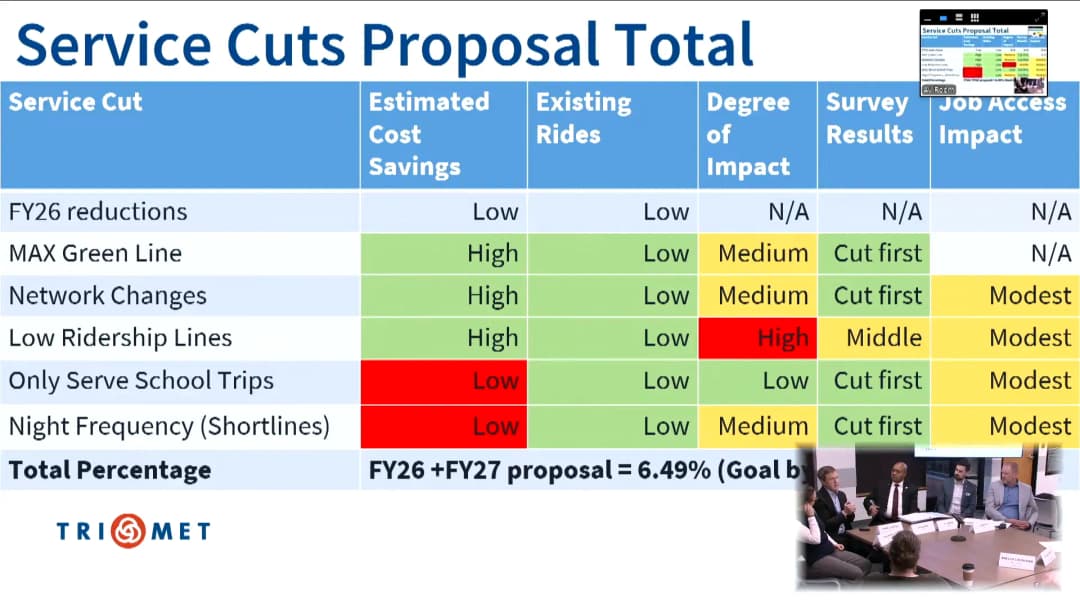
The Milwaukee City Council held a work session on March 3, 2026, with two one-hour agenda items. The first item was an update on behavioral health and housing services from the police department, library, and Love One partners. The second item was a presentation from TriMet on proposed service cuts due to a structural deficit. Discussion Items - Behavioral Health and Housing Services Update: Police officer Greg Elkins, library director Brad Hush, and Love One executive director Brandy reported on their partnership. Glenn (behavioral health specialist) presented statistics: 569 contacts in the previous year, 315 in the current year, indicating reduced need due to effective resource connections. A new behavioral health case manager, Trista Erickson, will start March 9, 2026, increasing coverage from 4 to 6 days per week. The stabilization center (23-hour) has had 17 to 18 stays from Milwaukee since mid-December. The 13-bed shelter (90-day stay) is full. Library staff reported increased numbers: PITTS (Patron Incident Tracking System) reports up from 40 to 72, water bottles distributed from 184 to 1,779. Parole and probation services at the library served 300 people. The library also provides a private phone for calls. Council members expressed appreciation and discussed the importance of relationships and trust. Business community collaboration was suggested for outreach. - TriMet Budget and Service Cuts Presentation: TriMet General Manager Samu Sue and team presented a $300 million structural deficit requiring cuts. Proposed service cuts include reducing the Green Line to operate only between Clackamas Town Center and Gateway (requiring transfer), combining bus lines 32 and 34, shifting line 29, and other adjustments. TriMet aims to cut 10% of service, but the board may vote on a 5% cut. TriMet has reduced internal spending by $150 million, laid off staff, and increased fares. Public outreach included 5,000 survey responses and 8,100 respondents. TriMet is working on a transit funding task force (HB 4008) and seeking help from local governments. Council members expressed concern about rolling back progress in Clackamas County and the impact on transit-dependent riders, especially students and seniors. TriMet committed to working with Clackamas County to mitigate impacts. Key Outcomes - No formal votes were taken (work session). Next steps: TriMet board hearing March 18, first reading March 25, board vote in April, implementation August 23, 2026. Further service cuts expected in fall 2026.
The City of Milwaukee City Council convened on January 21, 2026, with Council President Anderson presiding in the absence of Mayor Bailey. The meeting began with community updates, including the announcement of the winner of "Milie the Goose's Pet Power Challenge" and the presentation of the Milwaukee Student of the Month. The Council then proceeded with public comments regarding public safety committees and snow removal, followed by unanimous approval of the Consent Agenda. The primary legislative focus was the adoption of significant Tree Code amendments, which were passed for first and second reading, with the final adoption scheduled for the next meeting. Housekeeping code amendments were also unanimously adopted to clarify various zoning and land division regulations. The meeting concluded with a discussion on a potential county-wide fundraiser to support the Wichita Center and a neighborhood update regarding the future of the Milwaukee Floral site. Consent Calendar - Approval of minutes from previous sessions dated December 2nd, 9th, 14th, and 16th, 2025, as well as the Council Committee assignments update and a resolution to authorize cellular device purchases. - Action: The motion to approve the consent agenda passed unanimously. Public Comments & Testimony Community Commons Follow-up - Chris Scott: Expressed frustration regarding a new 3% convenience fee on credit and debit card transactions for utility bills. Staff responded by explaining the fee was implemented to cover actual transaction processing costs ($342,000 annually) that were previously subsidized by other utility payers and to ensure sustainability, directing those with financial hardships to utility billing staff. - Lisa McGulley: Submitted general comments and email inquiries regarding neighborhood hubs and development projects in the Linwood area, noting ongoing staff communication to address her questions. Public Safety and Snow Removal - Ms. More (Public Commenter): Expressed concern regarding snow and ice safety compared to neighboring cities. She argued that unlike Kansas City, Milwaukee lacks emergency snow routes that mandate traction devices or impose fines for vehicles with no traction that cause gridlock. She advocated for similar mandatory traction laws to prevent unsafe driving and street blockages. Discussion Items Tree Code Amendments and Fee Revisions (Proposed) - Staff Proposal: The Climate and Natural Resources Department proposed increasing canopy mitigation fees (from 30% to 40% canopy reduction thresholds) and establishing new fees for significant tree removal (defined as 30 inches diameter and larger). Fees would range from $150 to $200 per inch based on size, and unpermitted removal of rare/threatened trees would incur a $350 fee. - Position of Councilor Bassie: Expressed strong support for protecting large canopy trees, noting a specific 100-foot, 36-inch tree on Stanley Street that could be removed for a significantly lower fee under current proposals. She argued that the proposed fees might be too low to deter market-rate developers but too high to absorb costs without passing them to home buyers, suggesting the city consider making certain tree sizes unremovable or implementing a heritage tree program. - Position of Councilor Marty: Supported the implementation of the code to prevent developers from clearing-cutting lots during the deliberation period. Acknowledged the legal complexities regarding property rights but emphasized the need for financial deterrents to protect tree canopy. - Position of Councilor Massie: Expressed hesitation regarding the fee increases, fearing they would be passed on to home buyers. However, supported the vote to pass the code to stop immediate clear-cutting and suggested revisiting affordable housing fee carve-outs in future sessions. - Position of Councilor Bothabati: Emphasized the balance between development needs and environmental protection. Questioned the legal limitations of outright bans on tree removal but supported the fee structure as a necessary tool for preservation. - Staff Responses: Clarified that the fees act as incentives for developers to reconfigure projects (e.g., moving ADUs) to retain trees. Noted that affordable housing projects retain significantly reduced fees compared to market-rate projects. Highlighted legal ambiguities regarding declaring trees as public resources that cannot be removed without further analysis. Housekeeping Code Amendments - Planning Department Proposal: A suite of amendments to Title 17 (Land Division) and Title 19 (Zoning) to ensure consistency with state law, clarify definitions (e.g., triplex/quadruplex, front lot lines), and update administrative processes (e.g., signing authority, middle housing land divisions). Specific changes included reducing street side yard setbacks to 5 feet for townhouses to accommodate existing plat lines and clarifying ADU standards. - Council Reaction: Councilor Bassie commended the staff for the thorough work, comparing the process to "cleaning under the couch," while Councilor Bothabati praised the attention to detail and lack of AI use. The amendments were described as necessary for code effectiveness and clarity. Community Initiative: Wichita Center Fundraiser - Councilor Bassie Proposal: Proposed a county-wide fundraiser to purchase commercial refrigeration units ($15,000) for the Wichita Center, which loses food to spoilage due to inadequate storage. Bassie offered to contribute a significant portion of her unused council budget, and Councilor Marty pledged $1,000. - Council Discussion: Councillor Massie questioned the eligibility of council budgets for this expenditure, citing restrictions on funds intended for education and training. Councilor Bassie argued the funds should support emerging community needs, while the Acting City Manager agreed to review legal constraints on the budget expenditure. Milwaukee Floral Site Neighborhood Concerns - Councilor Stappenborg Position: Expressed concern from the Lake Road neighborhood regarding the loss of commercial space to housing at the Milwaukee Floral site. She argued that the area is losing a walkable community hub and urged the city to engage with developers to explore options for preserving mixed-use nature, rather than simply allowing full conversion to housing. Key Outcomes - Tree Code Amendments: Passed for first and second reading by title only. The ordinance is not yet fully effective; final adoption and fee implementation are scheduled for the February 3, 2026, meeting due to the non-unanimous vote. (Vote tally: Passed, but not unanimously). - Fee Resolution: The motion to approve the fee resolution revision was tabled pending the final adoption of the Tree Code amendments at the next meeting. - Housekeeping Code: Adopted unanimously. Amended Municipal Code Title 17 (Land Division) and Title 19 (Zoning) to clarify regulations and align with state law, effective immediately upon filing (File : ZA-2025 004). - Adjournment: The meeting was adjourned pending further review of the Wichita Center fundraising budget eligibility. Note on Discrepancy: The transcript contains references to "Portland" regarding snow removal comparisons and heritage tree programs, while the meeting is explicitly called the "Milwaukee City Council" and references "Milwaukee.gov." This suggests the transcript may contain transcription errors regarding the city name in comparative contexts.
The Milwaukee City Council convened to review the status of negotiations with Washington County regarding the Milwaukee Bay Park, present Q4 2025 and forecast metrics for economic development, discuss board and committee recruitment timelines, address legislative updates, and hear from various council members on community issues. The meeting highlighted positive momentum in intergovernmental negotiations, detailed discussions on improving business friendliness metrics, and a strong emphasis on intentional, community-driven placemaking strategies for the upcoming year. Consent Calendar - No specific consent calendar items were explicitly read or voted upon in the transcript; routine approvals appear to be embedded within the staff reports and meeting flow. Public Comments & Testimony - No formal public comment section was recorded in the provided transcript transcript; however, the Mayor and Councillor Massie acknowledged the "Friends of the Library" and community partners regarding the library's fundraising and the "Milwaukee Passport" program. Discussion Items County Negotiations & Milwaukee Bay Park Funding - Project Status: The Council discussed a positive response from Washington County regarding the financial agreement for the Milwaukee Bay Park. The County countered the City's original ask of $5.6 million with an offer of $4.86 million (specifically $3.3 million in current Shared Taxable Capacity/StCs, rather than the original $3.1 million, and $1.56 million in accrued StCs interest, though the transcript cites a total of $4.86 million on the table). - Agreement Status: The County did not grant "modesty waivers" (likely a transcription error for "monetized waivers" or similar financial instrument), but staff will draft the updated Intergovernmental Agreement (IGA) based on these new terms. A draft IGA is expected next week for staff-to-staff review. - Speaker Positions: - Councillor Massie: Expressed urgency regarding the timeline, noting that pending resolution prevents the City from securing other external grants that require established partnerships. She emphasized that a resolution is necessary to facilitate future grant submissions. - Council Mayor/Members: Expressed gratitude for the County's "good faith negotiations" and constructive approach despite historical tensions. They emphasized the need to move quickly to finalize terms before applying for additional funding sources. - Councillor Savage: Suggested that the City should look at the upcoming budget process to identify capacity for the Milwaukee Community Center's maintenance and inquired about the obligation to have the park "on the ground" given the financing timeline. - Councillor Savender: Noted the importance of securing funding windows soon and thanked the County for moving forward despite challenges. Economic Development Metrics & Q4 Review - Metrics Review: Staff presented Q4 2025 metrics, including $850,000 invested in 24 local business grants (with 11% going to BIPOC and LGBTQ+ IA plus businesses) and a 70-77% completion rate on the five-year action plan. - Business Friendliness Survey: The "Impressions of Business Friendliness" metric showed a 71% overall grade but only 44% reported satisfaction. Councillors questioned the metric's granularity, suggesting a need to distinguish between "somewhat satisfied" and "very satisfied" and to analyze qualitative feedback to determine corrective actions. - Events & Tourism: Councilors discussed the need to differentiate between "supporting" an event versus "financing" or providing "logistical support" (e.g., staff, trailers). There was a discussion on the need for a formal Tourism Strategy to address seasonal dips (winter vs. summer foot traffic) and to better brand Milwaukee for out-of-town visitors. - Placemaking Strategy: Councilors requested a shift from large-scale market analyses to immediate, low-cost, community-driven interventions. Suggestions included wrapping electrical boxes, adding street planters, or hosting neighborhood potlucks. Staff agreed to vet specific low-cost strategies (e.g., PGE electrical box wrap costs) to bring back to Council for community engagement. - Business Round Tables: Council decided to hold informal round tables in early Q1 to discuss survey results. The format will involve multiple small group sessions in different locations and times (including evenings/weekends) to gather specific feedback on dissatisfaction and business needs, moving away from grand luncheons. - Emergency Support for Businesses: Councillor Savage highlighted the closure of businesses (K-Marie, Windhorse) due to asbestos remediation on Harvey Street. Council discussed the potential need for a business rainy-day fund (similar to models in Portland/Multnomah County) to assist with sudden closures or repairs, using business registration fees. Board & Committee Recruitment - Timeline Changes: The annual recruitment cycle has been accelerated. Applications are due March 15, 2026 (two weeks earlier than usual), with interviews scheduled for April 8, 11, 15, and 18 to accommodate the upcoming May budget process. This year, 46 positions are expected to be filled or reappointed. Legislative Updates - Legislative Session: The legislative session begins February 2, 2026. Key deadlines include Feb 16 (1st chamber), Feb 26 (2nd chamber), and March 8 (signing deadline). Council discussed potential bills regarding public meeting rules and housing omnibus bills. Council Reports - Friends of the Library: Councillor Mass highlighted the $40,000 raised annually by the "Friends of the Library" for outreach programs and the need to secure a new storage location for book donations as the current Harvey Street facility is being sold. - Metro Water & Power (MWP) / West: Councillor Stop discussed the impact of recent atmospheric rivers, noting that infrastructure was near capacity but managed to prevent overflows. He highlighted the necessity of the new 90-inch outfall (106 million gallon capacity) to handle such events in the future. - Community Action Board (CAB): Councillor Stop expressed disappointment with the County Commission's lack of engagement on poverty issues and advocated for the continuation of the "Milwaukee Heart" rent/utility support program with a formal Council letter of support. - Clackamas Service Center: Councillor Mass praised the "Milwaukee Heart" program pilot and the Clackamas Service Center's partnership, urging Council to advocate for its continued funding. Key Outcomes - IGA Drafting: Staff directed to draft updated IGA based on the County's $4.86 million offer for review next week. - Placemaking Strategy: Council directed staff to vet specific low-cost, high-impact placemaking strategies (e.g., electrical box wrapping, street furniture) to present for community engagement and potential immediate implementation. - Business Round Tables: Council agreed to the concept of holding informal, targeted round tables based on Q4 survey results to address business dissatisfaction. - Recruitment Timeline: Finalized the earlier deadline (March 15) for board and committee applications to ensure interviews occur before the budget process. - Tourism Strategy: Council expressed interest in developing a formal tourism strategy to address seasonal dips and enhance city branding. - Emergency Fund Inquiry: Council requested staff to research the feasibility of a business rainy-day fund similar to models in Portland/Multnomah County. - Legislative Tracking: Council instructed staff to track and report on housing and public meeting bills as soon as bill numbers are assigned.
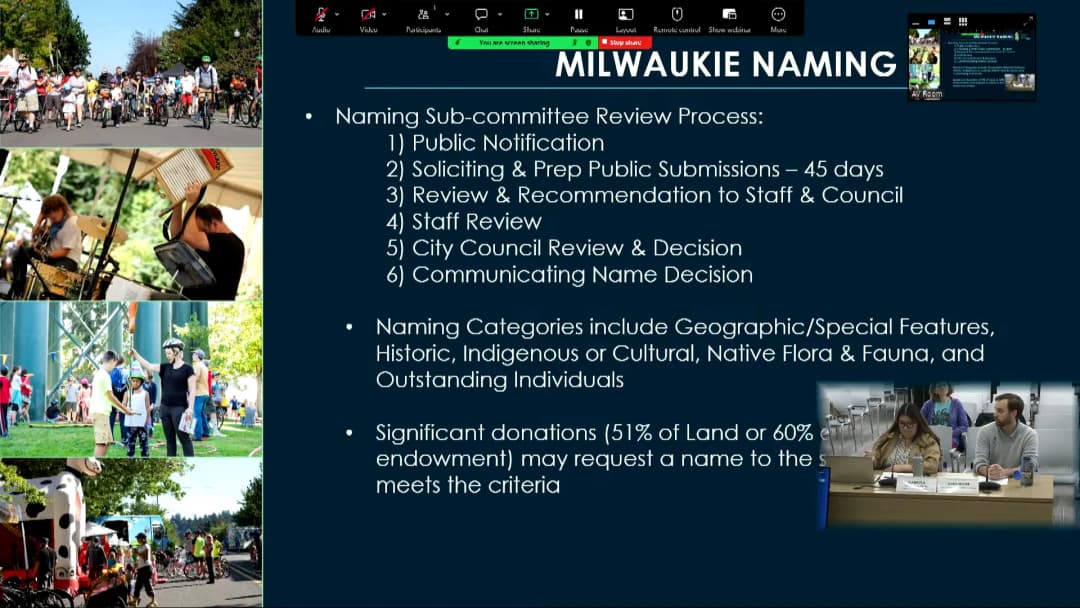
The two thousand four hundred and fortieth meeting of the Milwaukee City Council was called to order on January 7, 2026, combining in-person attendance at City Hall with remote participation via Zoom. The agenda primarily focused on the adoption of new naming and memorial policies for city assets, following extensive community engagement and subcommittee review. Public comments addressed water bill processing fees and concerns regarding affordable housing density and property tax implications in the Linwood area. The council also reviewed routine consent items, discussed upcoming administrative initiatives, and made informal arrangements for future council gatherings. Consent Calendar - Unanimously approved the minutes for the November 2025 work and regular sessions. - Adopted the 2026 City Council meeting schedule and designated newspapers of record for 2026. - Removed Stefan Lashbrook and appointed Philip Stos to the Public Safety Advisory Committee to represent the Llewellyn Neighborhood District Association. - Authorized contracts with PACE Inc. and Mario Design LLC for on-call surveying services. - Approved an Oregon Liquor and Cannabis Commission application for a location at 1847 Park 1915 Southeast Scotland Street. Public Comments & Testimony - Chris Scott: Expressed confusion and concern regarding a new 3 percent processing fee added to water bill payments made via credit card. Scott argued that the fee acts as a penalty preventing digital payments for those unable to set up direct bank debits or write checks, creating a financial burden inconsistent with the city's digital transition. Scott sought clarification on the definition of "processing" and the necessity of the fee, which staff noted was to offset credit card transaction costs and would be addressed by the City Manager in the following week. - Lisa McKelly Sprague: Expressed balanced concern regarding the push for affordable housing in the Linwood neighborhood, specifically around Lynnwood Elementary School. Sprague highlighted the density of 73 new units (45 in a townhouse project and 28 in clusters) proposed near the school and a lack of surrounding community services like parks or hubs. Sprague voiced apprehension about the financial risk to taxpayers regarding the Multiple Income Rental Loan (MIRL) program and rising property taxes, emphasizing the need to maintain neighborhood balance and existing community hopes. Discussion Items - Naming and Memorial Policies: Equity and Inclusion Coordinator Gabriela Sandoyo Gutierrez and Parks Manager Adam War presented the adoption of updated policies for naming city assets and handling donations. The process involved a year-long development with four community members, the Equity Steering Committee, and the Parks and Recreation Board. Key outcomes of the engagement included: - Honorary Street Naming: The community survey and subcommittee agreed to strike this category from the policy, citing that it was not currently needed. - Fundraising Impact: The community indicated only moderate impacts to fundraising; therefore, policies did not allow for selling naming rights but maintained recognition for significant donations. - Outstanding Individuals: The committee agreed to expand the category to include individuals with a global impact, not just national, and condensed the criteria to focus on local history and historically marginalized groups, removing specific bullet points regarding risking one's life or specific commitments to equity in the final text to reduce ambiguity. - Subcommittee Structure: Council directed staff to add library board representatives to the naming subcommittee and increase the quorum requirement to at least three members to foster diverse discussion. - Renaming Justifications: Language was added to clarify justification for removing names due to changes in function/ownership, outdated identity, or cultural/ethical concerns. - Tree Code and Development Conflicts: Council members discussed the tension between the city's 40 percent tree canopy goal and housing development needs. Specific attention was drawn to a large tree (approximately 30 feet tall) slated for removal to make way for market-rate housing on Stanley Street. A council member proposed that the tree code might need revision to place limits on the size of trees that can be cut down, or to introduce different cost structures that differentiate between market-rate and affordable housing developments to incentivize preserving large, mature trees. - TriMet Service Cuts: A council member raised concerns regarding proposed TriMet service cuts affecting Milwaukee. The council agreed to delay specific advocacy strategies until the February 14th workshop to understand the full scope of the proposed changes. - Council Logistics: The council agreed to reinstate the "Pizza Once a Month" tradition for internal meetings to foster camaraderie, opting for delivered pizza to simplify logistics. A site visit to the Clackamas Service Center was also coordinated for the following week, with carpooling arrangements discussed. Key Outcomes - Unanimous Approval: The resolution adopting the new Policies and Procedures for Naming Assets and Facilities was passed unanimously. - Subcommittee Formation: Staff is directed to establish a naming subcommittee of no more than six people, including library board representatives. - Next Steps: The Acting City Manager and Finance Director are tasked with addressing Chris Scott's inquiry regarding water bill processing fees at the next meeting. The Council President agreed to review the specific costs of the tree removal under the new vs. existing code to inform future legislative discussions. - Administrative Action: The 2026 meeting schedule and newspaper of record designations are officially adopted.
The Milwaukee City Council convened for a meeting focused on upcoming legislative priorities for the 2026 session, local land banking strategies, and the review of committee assignments. State Senator Mark Sorensen provided a detailed briefing on his two primary legislative bills for the 2027 session: a transport funding reform to separate maintenance from new projects, and a modification to the state "kicker" mechanism to stabilize the state budget. The council also held a strategic discussion on implementing a formal land banking strategy to address housing and park deficits, exploring the use of URA funds and partnerships rather than a full standalone land bank. Finally, the council reviewed and adjusted their external committee liaisons to better align with member expertise and current organizational needs. Discussion Items - State Legislative Priorities (Senator Mark Sorensen): - Senator Sorensen outlined two major bills for 2027. The first addresses the state's broken revenue system by proposing to change how the state economist predicts revenues (using a high-end estimate for the budget and a low-end estimate for reporting) to prevent the "kicker" from refunding billions to the wealthy, thereby allowing funds to be used for bond redemption, PERS mandates, and emergencies. He noted that without this fix, the state is cutting services like housing assistance and mental health care. - The second bill proposes a transportation funding model that separates maintenance/preservation from new project funding. This would establish a criteria-based revenue system (potentially including a sales tax on used/new cars at 2%) to fund a "rock road user charge" program updated every two years, preventing the need for sporadic, contentious tax increases for new projects while ensuring maintenance of existing assets. - Sorensen discussed the "disconnect" from federal tax law as a critical goal for the state but noted that a complete disconnect is unlikely this session, with cherry-picking being the likely outcome. - Senator Misslin is reintroducing a bill for Virtual Power Plants (VPPs) and transmission studies. Sorensen plans to co-sponsor this, noting that VPPs are a necessary short-term solution to rolling blackouts caused by a grid at capacity, though utilities are currently slow-walking the program. Public Comments & Testimony - Land Banking Proposal (Staff): - City staff presented a proposal to create a "land banking strategy" rather than a formal land bank department. The strategy focuses on intentional partnerships with developers, creating a matrix of preferred parcels based on specific criteria (size, location, alignment with goals), and utilizing existing tools like ground leases, right of first refusal, and funding-linked agreements. - Staff acknowledged the city's history of "ad hoc" land banking using utility funds or URA bonds for opportunistic purchases (e.g., Coho property) and proposed formalizing guardrails to ensure agility and accountability in future acquisitions. Key Outcomes - Land Banking Strategy: The council directed staff to refine the proposed land banking strategy document based on the discussion. They emphasized the need for specific criteria regarding parcel location (specifically targeting park-deficient areas and neighborhood hubs) and the use of URA/CET funds as potential sources for agile acquisition. A study session was identified as necessary to finalize the framework. - Committee Assignments: - The council decided to remove the following committees from their active liaison list: Milwaukie Bay Park (dormant), the Bond Advisory Committee (concluded), and the Homeless Solutions Coalition (restructured/focused on Caring Place). - A request was made to recruit a Milwaukie resident for the Fire District board, which currently lacks one. - Councilmember D. was requested to assume the North Clackamas Chamber of Commerce liaison role, with Councilmember E. acting as an alternate to mitigate perceived conflicts of interest. - It was decided that the City Clerk's office would provide monthly summaries of Chamber meetings to the full council to maintain awareness without requiring full council attendance. - Legislative Timeline: Members noted the bill drop deadline is January 9, with the session moving quickly following the budget adoption.
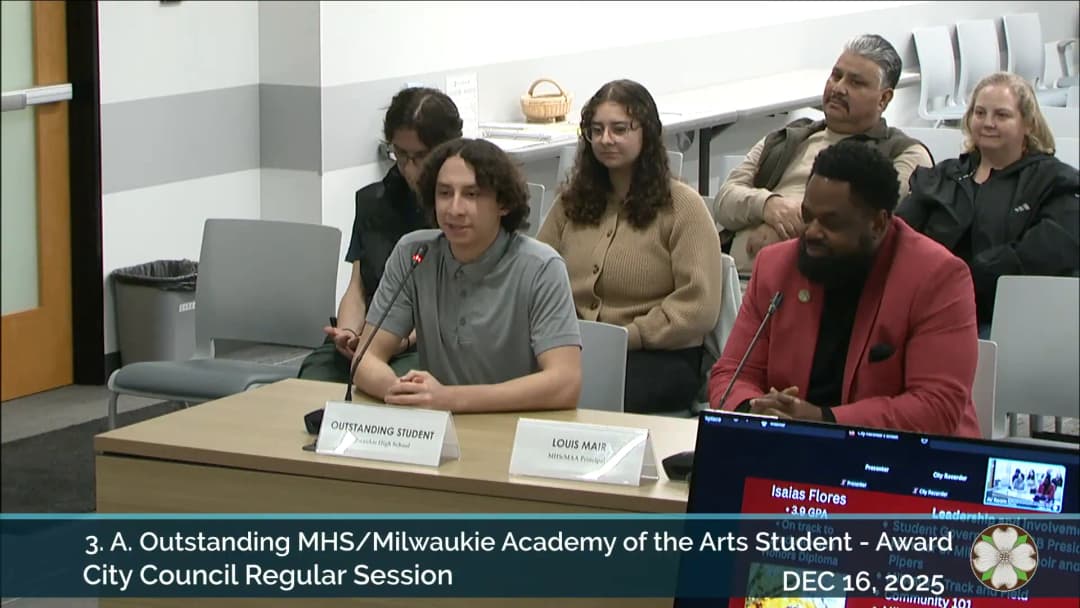
The 2439th regular meeting of the Milwaukee City Council convened to address community announcements, recognize a student of the month, provide a staff response regarding the state's Middle-Income Revolving Loan (MURAL) program, and deliberate on a long-standing intergovernmental agreement (IGA) regarding Milwaukee Bay Park. The council also held a public hearing and voted on a right-of-way vacation for the Hillside Park development. The session concluded with administrative updates and an executive session scheduled for real property negotiations. Consent Calendar - Actions Approved: The council unanimously approved the consent agenda, which included: - Minutes from the October 21, 2025, group and regular sessions. - A resolution removing Lee Garnett and appointing Linda Callahan to the Tree Board. - A resolution defining certain benefits as official compensation. - A resolution reinstating a banking services agreement with Columbia Bank. - A resolution authorizing the award of the Sparrow Site Design and Development Project to Dev Northwest and granting the City Manager authority to enter an exclusive negotiating agreement. - A resolution authorizing a partnership between the city and Related Northwest to apply for an Infrastructure Finance Authority grant for Hillside Park. - Approval of an Oregon Liquor and Cannabis Commission application for Bigfoot Cider Company. - Minor Correction: Mayor Beatty noted a factual error in the minutes regarding her arrival time (noted as late, though she arrived before the start time), which the council accepted with good humor. Public Comments & Testimony - City Manager's Response on MURAL: The City Manager provided a detailed rebuttal to testimony given at the December 2nd meeting regarding the MURAL program. - Position: The City Manager clarified that the Council did not intend to permanently reject MURAL but rather directed staff to further explore the program as of November 18. She expressed concern that immediate adoption would impose significant operational burdens (requiring approximately 2 Full-Time Equivalents) without clear guidance or funding from the state, and noted that other cities are proceeding slowly while awaiting state clarification. - Defense: She defended the city's existing housing tools, citing 243 affordable units added since 2019 and the use of the Construction Excise Tax fund. - Councilor Cross Body's Clarification: Councilor Cross Body addressed a press release that inaccurately quoted him as being "in no support of the ordinance." He clarified to the record that he was not in support of an ordinance at this point, distinguishing his position from a final rejection of the program, noting the Council's directive was to seek further clarification. - No Public Testimony: No members of the public or Zoom attendees appeared to speak during the designated public comment period. Discussion Items - MURAL Program Review: Staff and the Council discussed the feasibility of adopting a MURAL ordinance. Staff emphasized that while community support exists, the administrative capacity, state rule changes (anticipated in 2026), and lack of immediate urgency regarding fund exhaustion (vs. other cities like Coos Bay) warrant a cautious approach until a follow-up conversation in March. - Historic Resources Inventory Pilot: Mayor Beatty and Council President introduced a concept for a volunteer-led historic resources inventory pilot. - - Proposal: A $5,000 investment to hire a University of Oregon graduate student to manage a pilot involving the photo-documentation of 500 houses using iPads, with oversight from a community committee including the Milwaukee Museum and Planning Commission. - Positions: The Council expressed strong support for a volunteer-led approach to avoid straining current staffing. Questions were raised regarding data collection protocols, bilingual accessibility, and the future regulatory use of the inventory. Staff indicated this pilot could inform a larger project once the planning department is fully staffed in 2026. - Milwaukee Bay Park IGA Negotiations: Council members deliberated on the status of the 12-month-long negotiations with the North Clackamas Parks and Recreation District (NCPRD) regarding the Milwaukee Bay Park IGA. - Staff Analysis: The City Manager presented a "gives and gains" analysis, noting the City stands to assume $11 million in maintenance and fundraising responsibilities to gain control of Phase 3, while the district receives $5.1 million in contributions and relief from maintenance. - Positions: - Councilor Scavenger and others expressed pessimism, noting that the district has rejected every city counter-proposal since November, including requests for full Zone 1 STC balances, fee waivers for city events, and control over project management. - Several Council members discussed the possibility of a "last and final" proposal that might concede specific non-financial terms (e.g., depreciation standards, fee waivers) while holding firm on financial terms (STCs and Metro Local Share) to force a decision. - Consensus: The Council generally agreed to prepare a refined response that highlights the economic benefits and clarity of their position, set a timeline for a response by January 6th, and prepared the Council for a "Plan B" discussion regarding independent funding if negotiations fail. - Hillside Park Right-of-Way Vacation: The Council held a public hearing on an ordinance to vacate portions of Southeast Hillside Court and Streets A, B, and C to facilitate Phase 2 of the Hillside Park affordable housing development. - Outcome: No written objections were received (one comment regarding Canada geese was addressed by confirming compliance with federal environmental reviews). The Council voted to close the hearing and adopt the ordinance. Key Outcomes - Unanimous Vote: The Hillside Park right-of-way vacation ordinance was adopted unanimously (5-0) on its first and second reading by title only. - Consent Agenda: Adopted unanimously (5-0). - Student of the Month: Isaiah Flores, a senior at Milwaukee Academy of the Arts, was recognized for his academic achievements (3.9 GPA, six AP courses), leadership as ASB President, and extracurricular involvement. He plans to pursue environmental law. - Action on Bay Park IGA: The Council directed staff to prepare a response proposal to NCPRD by January 6th, which will reiterate the City's financial terms (full Zone 1 STCs and Metro Local Share) while potentially deferring to staff on non-financial compromises to see if an agreement can still be reached. The Council agreed to discuss "Plan B" (independent development) if the district does not respond favorably by the January 6th meeting. - Housing Initiatives: Council acknowledged the need for further work on the historic resources inventory pilot and continued the timeline for MURAL program exploration to March 2026. - Executive Session: The regular meeting adjourned to conduct an executive session pursuant to ORS 192.660 for real property transaction negotiations.
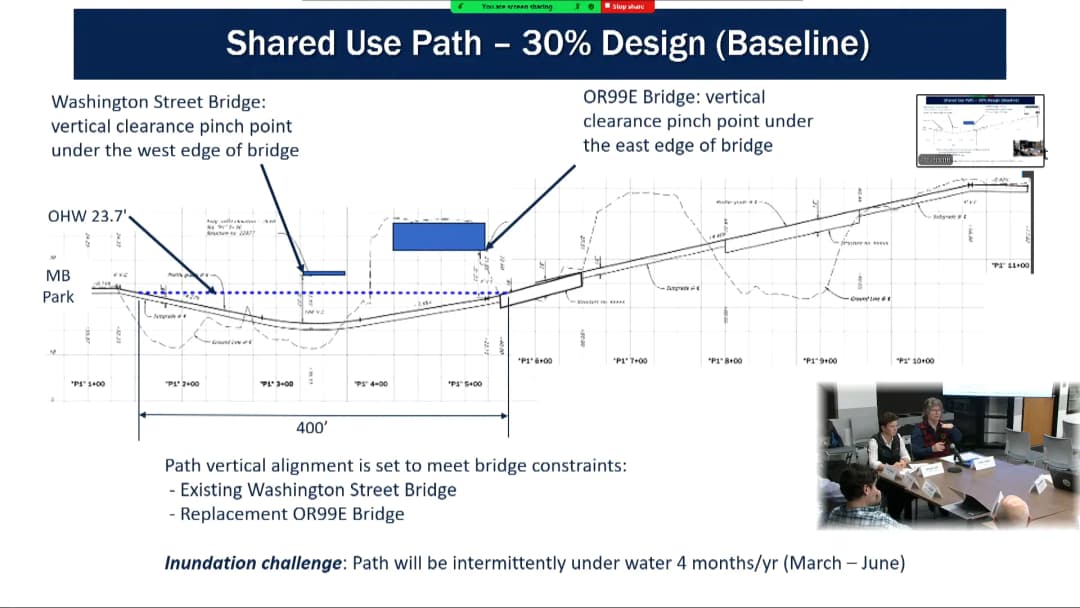
This meeting featured updates from the City Court, a detailed presentation on the Kellogg Creek restoration and modernization project with the City Council leadership team, and a dialogue with PGE leadership regarding grid capacity and rate impacts. Key discussions centered on the logistical challenges of the Kellogg project, specifically regarding sewer line relocation and shared-use path flooding, as well as city concerns over utility rate increases and data center cost allocation. Consent Calendar - No specific consent calendar items were explicitly listed or voted on in the provided transcript segment. Public Comments & Testimony - Councilor Mass and Councilor [Last Name Unknown] expressed concern regarding the city's financial capacity to absorb the costs of the Kellogg project, specifically the potential $5$ million sewer relocation cost, without triggering rate hikes. They emphasized the need to explore all funding avenues, including the Clean Water Revolving Loan, to protect ratepayers from increases beyond the projected $2.75\%$ annual rate hike over six years. - Councilor [Last Name Unknown] (Data Center/Utility Representative) expressed strong skepticism regarding PGE's profitability, noting the company's nearly $300$ million net profit and $9\%$ shareholder return. They argued that PGE should absorb storm-related repair costs and right-of-way fee surcharges rather than passing them to ratepayers, questioning why the utility cannot "eat" a $5$ surcharge increase. Discussion Items Court Update (Judge Graves & City Court Staff) - Court Operations: The court is transitioning to a cloud-based recording service and anticipates equipment updates within the next year. A new "Court Specialist" position is being hired to manage an increasing caseload driven by traffic citations and code enforcement. - Caseload Trends: Traffic violations remain the primary driver, with B violations at $265$ and C violations at $165$ being most common. There is a noted increase in attorneys representing defendants, which may be due to economic factors affecting the ability to fight citations. - Credit Card Fees: A convenience fee of up to $3\%$ has been approved by the Council for credit card payments on fines. Implementation is pending the acquisition of a payment processor. - Enforcement Technology: Police research is underway for stationary red light and speed cameras, with RFPs expected in spring and implementation targeted for next summer, potentially at NE 224th and OR 99. Kellogg Creek Restoration Project Update - Leadership Team: April McEwen (River Lord), Karen Capman (ODOT), Shelley Romero (ODOT), and Amy Dan Ring (North Clackamas Park & Recreation District) presented the project status. The project goal integrates dam removal, fish passage, bridge modernization, and habitat restoration. - Shared-Use Path Flooding: The value engineering study confirmed that the baseline path design, which passes under the Washington Street Bridge, will experience flooding for four months a year (March–June). At the low point, water depth could reach $6.5$ to $7$ feet, necessitating a four-month closure or active management, which is resource-intensive and presents safety risks. Alternatives involving tunnels were deemed infeasible due to ADA grade requirements (max $5\%$) and safety concerns. - Sewer Line Relocation: The existing $8$-inch gravity sewer line obstructs the new creek profile. After evaluating $9$ alternatives, the team concluded a pump station is required regardless of the solution. The recommended alternative involves relocating the sewer line, raising it over the creek where possible, and installing a new pump station at 28th Avenue to connect to an existing force main. - Funding & Timeline: The city's $1$ million URA contribution is critical for leveraging Metro and federal funds. There was a disagreement on priorities; the project team urged early decision-making to stay on track for federal funding (deadline December 2027), while the City Council expressed caution about committing CIP funds without full federal certainty, fearing stranded assets if funding is delayed. - Timeline Milestones: The city is considering including the sewer relocation in the April CIP application deadline for the Clean Water Revolving Loan. A draft response to the Council's letter is expected before the February CIP meeting. PGE Leadership Presentation (Larry Beckdal & Heidi Bell) - Grid Capacity & Data Centers: PGE noted significant growth in demand due to heat pumps, EVs, and data centers (avg $100$ MW per facility). The existing transmission system is near capacity. - Rate Structure (UM 2377): PGE proposed a three-year rolling review where data centers pay a higher rate (projected $25\%$ increase) to cover new infrastructure costs, which would allow residential rates to remain flat or potentially dip. Council members emphasized the legal requirement that data centers pay for the full cost of infrastructure. PGE clarified this is an ongoing review, not a one-time three-year exemption. - Affordability & Storm Costs: PGE stated they set aside funds for storm repairs but recover excess costs via ratepayers if estimates are exceeded. PGE defended not absorbing costs like the $5$ right-of-way fee surcharge, citing the necessity of profit for shareholder returns and capital access, though they noted a $25$ million expense reduction for the current year. Key Outcomes - Sewer Relocation Recommendation: The project team officially recommended the sewer relocation with a new pump station at 28th Avenue as the lowest-risk option, though no final decision has been made pending further technical evaluation of city capacity. - Path Maintenance Strategy: The city must prepare for a shared-use path closure period of approximately four months annually during high water, or commit to active maintenance resources to manage the flooding. - Funding Decision Points: The Council will review the Sewer Relocation proposal in the context of the February CIP draft. An application for the Clean Water Revolving Loan is targeted for April, contingent on the city's decision to proceed with the sewer work. - PGE Rate Review: The Council requested written details on the data center rate structure (UM 2377) and the specific calculations for cost causation to ensure they are paying the full cost of new transmission infrastructure. - Next Steps: A follow-up meeting is suggested before the February CIP meeting to review the written response on the Kellogg project, and PGE will provide further written clarification on the rate proposals and storm cost recovery mechanisms.
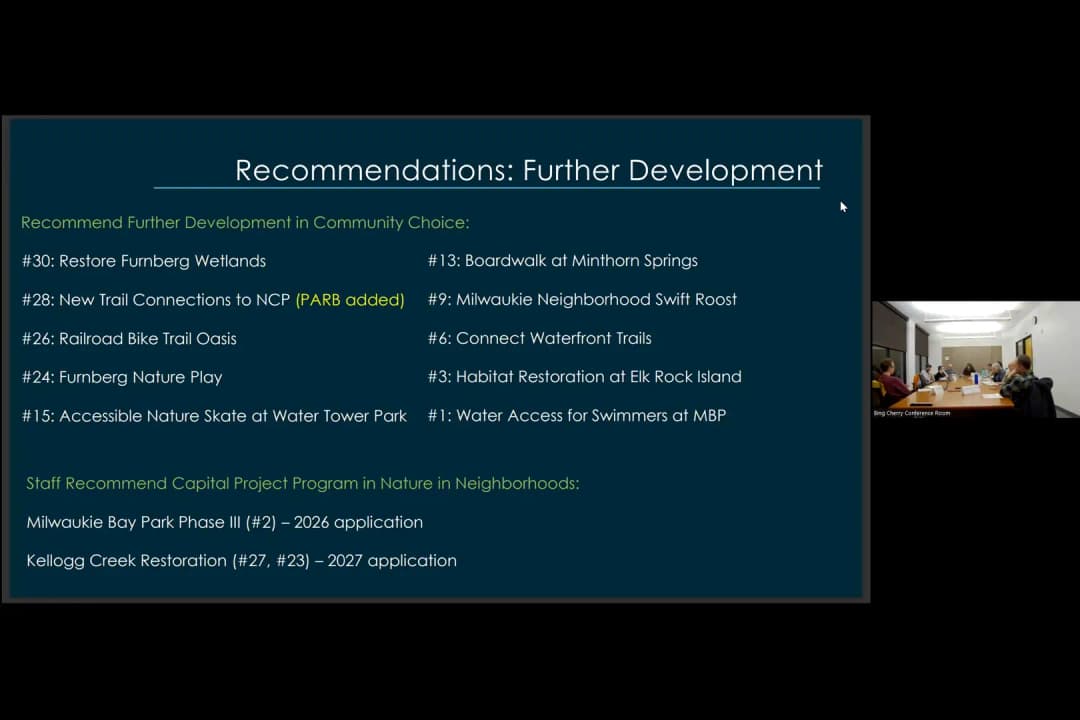
On December 10, 2025, the Milwaukee City Council held a study session in the new council chamber, marked by an introduction of newly hired staff specializing in emergency management and urban forestry, followed by a detailed strategic review of the Metro Nature & Neighborhoods Community Choice grant program. Discussions focused on aligning project proposals with city goals, addressing the Emerald Ash Borer infestation, and navigating the complexities of the current housing and development landscape. Consent Calendar - The meeting proceeded with staff introductions and community grant discussions; no formal consent calendar actions were recorded in the transcript. Public Comments & Testimony - Councilor Robert Massey: Expressed interest in the Water Consortium and asked the new staff about their approach to water management. He highlighted his background as a naval officer and his role as the goal lead for Parks and Green Space, noting the importance of water vitality in city policy. - Councilor Adam Glassrotty: Addressed concerns regarding "accessible nature skate" projects at Water Tower Park, citing community feedback about potential safety conflicts between skaters and playground users. He expressed a desire for a compromise through the design phase. - Councilor Will (President): voiced full support for the new staff hires, specifically citing CERT's long-standing need for dedicated emergency management staff and the critical role of urban forestry in the city's identity. - General Discussion: Council members noted that while some projects on the community choice list had high popularity scores (e.g., increased tree canopy), the team's position was that these should be deprioritized in this specific grant round to allow for other nature-based access projects due to funding availability in other channels. Discussion Items - New Staff Introductions: - Lata Paffetti (Emergency Management): Presented her background in disaster reconstruction and tiny home villages from the Red Cross. She expressed strong support for the intersection of equity, inclusion, and emergency management in Milwaukee. - Alfred Sali (Urban Forestry): Discussed his consulting experience in Southern California. He expressed significant concern regarding the Emerald Ash Borer, arguing against a blanket removal policy and advocating for a meted approach involving assessment and treatment to preserve the canopy, which he believes could lead to significant loss if mishandled. - Councilor Adam Glassrotty & Councilor Robert Massey: Both expressed full support for the new hires, noting their immediate value during the current atmospheric river event and in ongoing tree code deliberations. - Emerald Ash Borer Strategy: - Alfred Sali: Stated his position that cities which removed all ash trees historically lost major canopy portions and failed to utilize treatment options. He argued that a "metered approach" involving assessment is necessary, though he acknowledged the complexity of the situation. - Councilor Adam Glassrotty: Expressed concern that current development codes might be too lenient on tree removal, arguing that the current balance leans too heavily toward removal because trees are viewed as "inconvenient." He supported tightening development rules to favor preservation over replacement, noting the long-term resource waste of young trees. - Councilor Robert Massey: Questioned the realistic nature of the 40% tree canopy goal given the beetle infestation and development pressures, suggesting a re-evaluation of the timeline or strategy. - Staff Position: Stated that while the 40% goal is a commitment, the strategy must involve immediate replanting and policy shifts to account for the slow-moving threat of the beetle. - Metro Community Choice Grants: - Adam Glassrotty: Provided a comprehensive analysis of the 19 Milwaukee projects on the shortlist of 50. He expressed the position that the list must be strategically pared down to 10 projects to ensure fiscal responsibility and feasibility, as the program only funds 15 countywide and requires an $85,000 city match per project. - Recommendations for Removal: Glassrotty advocated for removing Projects 2 (Activate Milwaukee Waterfront), 23 & 27 (Kellogg Creek), 42 (Mintport Creek), and 43 (Ardenwald Community Garden) from Community Choice. He argued these are better suited for the larger Capital Improvement Program (CIP) or specific partner matches. - Position on "Water Access for Swimmers" (Project 1): Glassrotty expressed that this project should remain on the Community Choice list as a "Phase 3.5" because the main Milwaukee Bay Park Phase 3 project is intentionally designed to stay above ordinary high water. He cautioned that while a swim dock is a community desire, the $250,000 grant cap may not support a full-scale dock, necessitating further fundraising or CIP funding for a full dock. - Councilor Robert Massey: Expressed concern regarding the removal of the Kellogg Creek stormwater project, noting its long history in the watershed action plan and partnership with Rao Middle School, though he acknowledged the project scope exceeds the single grant limit. - Councilor Adam Glassrotty (on Skate Parks): Reiterated skepticism about the "Accessible Nature Skate" concept at Water Tower Park without a finalized scope, suggesting the design phase workshops are the appropriate venue to resolve potential safety conflicts. Key Outcomes - Strategic Reduction of Grant Candidates: The Council accepted the staff recommendation to move forward with 10 projects for the second round of Community Choice development, down from the initial 19 Milwaukee-specific finalists. This decision aims to ensure the projects are feasible within the $250,000 grant cap and the $850,000 potential city match requirement. - Projected Timeline: If selected in the upcoming Metro round (February 2026), the selected projects will have two years to finalize an Inter-Local Agreement (IGA) and three years for implementation, potentially concluding by 2031. - Policy Direction on Trees: The Council acknowledged the need to revisit the 40% canopy goal timeline and development codes in light of the Emerald Ash Borer, with staff promising to present further assessment data and policy options in upcoming cycles. - Future Meetings: The second round of public design workshops and voting is scheduled for February 2026, during which Metro will present refined site plans and budgets for the 10 selected projects.