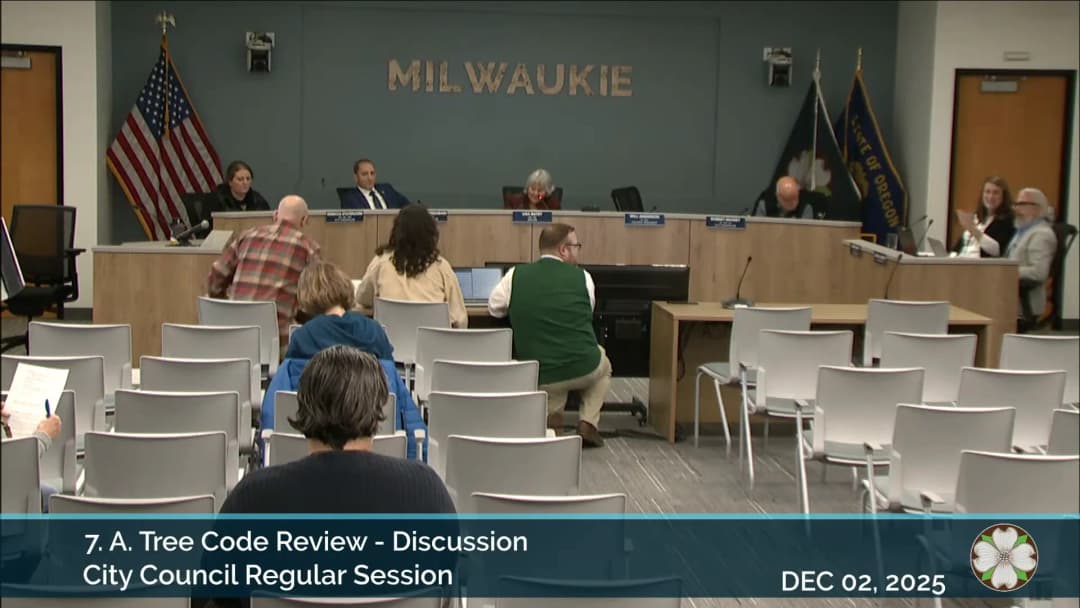
The City Council convened its 438th meeting at City Hall to address community concerns regarding affordable housing and tree preservation, approve a catalytic redevelopment project in the downtown Historic District, and conclude the Milwaukee Redevelopment Commission (MRC) session. The meeting featured extended public testimony supporting an originating ordinance for the Moderate Income Revolving Loan (MIRL) program and significant deliberation on updates to the city's tree code, including new fees for significant and rare tree removals. Consent Calendar - Unanimous Approval: The Consent Calendar, consisting solely of the minutes from the October 14, 2025, Council Retreat, was approved. Public Comments & Testimony - Support for Affordable Housing: Multiple community members, including resident Brianna Diamond, expressed full support for the MIRL ordinance, citing personal struggles with housing insecurity and the inability of young families to afford homes in Milwaukee. - Developer Testimony Positions: - Bruce Bruns (Pastor of Milwaukee Covenant Church) expressed support for the MIRL program and the proposed Linwood property project, arguing the city faces low risk and should not delay to secure funding for 44 families. - Tyler King (Local Realtor) expressed full support for adopting the originating ordinance to leverage state funding and meet affordability goals, noting the current median home price of $517,000 exceeds what families can afford. - Austin Turner (Developer) requested clarification on the city's staffing capacity required for program oversight, specifically questioning the estimated need for two full-time staff. - Charmin Martin and Michael Straits expressed strong support for the MIRL program, lamenting the inability for their children to live in Milwaukee. - Andy Fisher (Developer) expressed support for the program and opposed the council's hesitation, stating that misinformation regarding staff requirements and process timelines was shared by OHCS. - Opposition and Concerns to Developer's Statements: Councilor Maddie Massey expressed strong opposition to the misinformation she alleged was disseminated by the developer and testifiers, stating that claims regarding OHCS confirming no need for city staff and immediate fund access were untrue. She emphasized the need for due diligence and rejected the narrative that the council is obstructing affordability. - Tree Preservation Support: Robert Ha (identified as a community member, previously associated with Lee Garnett) expressed strong support for the tree code updates, urging the council to set a "pain point" fee that prevents the replacement of the city's urban forest with grassland. Discussion Items - Tree Code Review (Development and Residential): Public Works and Climate/Natural Resources staff proposed five recommendations to strengthen tree protection: - Significant Tree Removal Fee: A new fee for trees 30 inches DBH or greater ($150 per inch for 30-35.99 inches; $200 per inch for 36+ inches) to be paid in addition to standard canopy mitigation. - Canopy Mitigation Fee Increase: The fee structure shifts to trigger at 40% canopy loss (previously 30%) with increased cumulative penalties ($2,000 per 8% reduction) to reach a maximum of $40,000 for clear-cutting, up from $16,000. - Rare and Threatened Species: Adoption of a new list of rare and threatened species (e.g., Oregon White Oak, Coast Redwood) with a specific removal fee of $350 per inch DBH. - Unpermitted Removal Fee: A $350 per inch fee for unpermitted removal of rare/threatened species during development. - Residential Code Updates: Staff proposed allowing removal of trees within 10 feet of a dwelling causing infrastructure damage without requiring expensive "reasonable alternative construction techniques," and establishing cost thresholds for reasonableness for trees outside that zone (20% for small repairs, 3x cost for infrastructure, 5x cost for significant trees). - Milwaukee Park / NCPRD Negotiations: The City Manager provided an update on negotiations with the North Clackamas Parks and Recreation District (NCPRD) regarding the Milwaukee Bay Park project. The city expressed strong preference for receiving the full $2.5 million Metro Local Share grant without strings, while the county appears to seek a loan or clawback arrangement. A formal response from the county is expected in early January, with staff estimating a year-end agreement is unlikely. - Budget and Data Center Issues: Council received a budget update showing the council line items are on track. Councilor Massey proposed a letter to the Public Utility Commission (PUC) objecting to ratepayers funding data center infrastructure costs, which the council agreed to draft and co-sign. - MRC Grant Program: The Milwaukee Redevelopment Commission discussed a consolidated grant application ($400,000) for the redevelopment of the Rexville/Ward/Collector's Mall building at Main and Monroe streets into eight commercial suites. Key Outcomes - Tree Code Updates: The Council gave thumbs up for the proposed significant tree removal fees, increased canopy mitigation fees, and the adoption of a rare and threatened species list for the development code. Staff will refine the residential code flexibility and reasonableness thresholds before final code adoption. - MRC Grant Approval: The MRC approved the consolidated grant application for the Main and Monroe building redevelopment ($400,000 requested). The applicant confirmed they are actively coordinating with tenants regarding grant eligibility restrictions and are providing additional in-kind construction services to lower barriers for new small businesses. - Milwaukee Park Update: No immediate vote; staff will return with the county's formal response in January to negotiate the structure of the Metro Local Share funding (preferably a full grant). - Adjournment: The City Council meeting adjourned, followed immediately by the adjournment of the Milwaukee Redevelopment Commission meeting.
Public Meetings - Milwaukie, Oregon
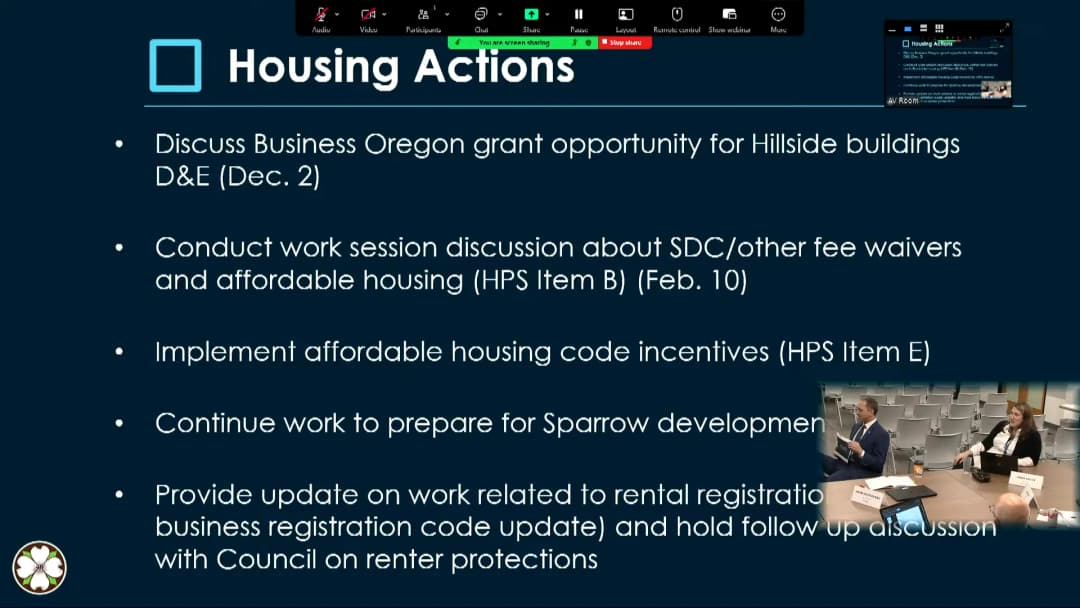
Public Meetings - Milwaukie, OregonThe City of Milwaukee Council held a quarterly work session on December 2025 to review staff progress and council accomplishments regarding the "Affordability" goal. The meeting focused on utility rate studies, housing development updates including the NorthWest project, and strategic planning for the 2026 budget cycle. Staff presentations detailed the shift toward realistic capital planning, the expansion of low-income assistance programs, and the implementation of the newly adopted Affordable Housing Code. Councilmembers emphasized the importance of these efforts, highlighted recent housing openings, and directed staff to explore further initiatives including land banking, tenant screening fees, and potential state-level policy adjustments. Consent Calendar - No items listed for the Consent Calendar during this work session. Public Comments & Testimony - No public comments were recorded or taken during the work session portion of the meeting. Utility Actions & Updates - Rate Study & Realistic Planning: Assistant City Manager Joseph Brillo noted a shift in philosophy toward "realistic" capital improvement programming to manage ratepayer impacts. Projects previously identified in the six-year CIP are being spread out or removed to avoid large rate hikes. - Stormwater Data Updates: Public Works Director Peter Passerelli reported that the city is updating impervious surface data using LIDAR and GIS to ensure accurate billing, noting historical gaps in customer updates since 2019. Councilor Cost-Rodney expressed interest in potential incentives or rebates for de-paving unused commercial lots to reduce impervious surface. - Low-Income Assistance: Instructor Michael Osborne highlighted the success of recent open houses for utility billing assistance, where staff connected residents with low-income relief resources. Staff plans to hold additional sessions prior to June renewals. - Future Rate Design: Councillor Coaster Body noted that tiered rate structures to disincentivize high water use will be presented in March, with public engagement sessions planned for the Community Utility Advisory Committee prior to the April/May adoption. Housing Development & Policy - NorthWest Project: Staff confirmed that development firm NorthWest received the highest scores in the recent affordable housing request for proposals. They are proposing 22 units of ownership on a constrained site. Staff will bring a proposal for exclusive negotiations to the next meeting. - Hillside Park & Infrastructure Grant: Councillor Scavenger noted that Development Northwest and the Housing Authority are seeking to apply for a Business and Property Infrastructure Grant to address the infrastructure costs of the Hillside Park project. Council is asked to authorize the application by December 16th. - Stabilization Center: Councillors Jordan and Scavenger expressed strong support for the new Stabilization Center, noting the significant effort to secure a "good neighbor agreement" with the county. They requested that the city include updates on the Center's operation in the 2026 forecast. - Tenant Screening Fees: Councillor Scavenger noted that a work session was held on limiting tenant screening fees, with staff continuing to research implementation mechanisms. - Mural Discussion: Councillor Scavenger clarified that the council is not opposing the community mural but has delayed a final decision to allow for due diligence and community input. A future date has been set to revisit the project in March. - 2026 Housing Focus: Council directed staff to prioritize "build more, build better" in 2026, aligning housing with economic development and transit goals. Specific areas of interest include: - SDC (System Development Charge) waivers for Accessory Dwelling Units (ADUs). - Analysis of cost-benefit models for modular housing and housing on wheels. - Revitalization of the Down Payment Assistance program (referred to as "Carl" or "Moral" jokingly). - Implementation of the new Affordable Housing Code. Economic Development & Business Climate - Business License Renewal & Survey: The city is launching a business registration renewal campaign that includes a survey on business challenges, utility costs, and support needs. Incentives include a raffle for five business license discounts. - Energy Data: Councillor Scavenger inquired about data on electricity bills for apartments. Staff noted an upcoming meeting with PGE on December 16th to discuss rate adjustments, data center impacts, and transmission challenges. Transit & Regional Issues - TriMet Service Cuts: Staff reported that TriMet is proposing service cuts, including shortening the Green Line to an end-to-end connector and reducing frequency on overlapping routes. Councilors expressed concern regarding the impact on residents who rely on transit, noting the high cost of car ownership ($750/month average). - Regional Advocacy: Councilors emphasized the need for continued regional advocacy at JPEC (Joint Powers Employment Authority Council) to address disparities in transit funding and service between East and West Multnomah County. Key Outcomes - Authorization for Grant Application: Council is directed to authorize the application for the Business and Property Infrastructure Grant for the Hillside Park project by December 16th. - Exclusive Negotiations: Staff to bring a motion for an Exclusive Negotiations Agreement with NorthWest for the affordable housing project to the next meeting. - Rate Design Timeline: Initial discussions on tiered water/wastewater rate designs are scheduled for March, with fee schedules to be adopted in May/June alongside the budget. - Future Forecasting: Directions were set to include ADU code analysis, SDC waiver discussions, and a study on modular/wheel-based housing models in the 2026 forecast. - Executive Session: The work session was adjourned to reconvene in Executive Session under ORS 192.660(2)(d) for labor negotiations and ORS 192.660(2)(e) for real property negotiations.
The Milwaukee City Council convened on November 19, 2025, to approve a student of the month, the consent agenda, and discuss speed limit modifications and housing programs. The meeting featured significant deliberation on adopting the Middle-Income Revolving Loan (MIRL) program, public hearings regarding solid waste franchise terms, and the adoption of budget adjustments. Council members addressed community concerns regarding hate flyers, police transparency, and local transportation funding. Consent Calendar - Unanimously approved the minutes of the October 14, 2025, retreat. - Unanimously approved the resolution appointing the inaugural membership to the Climate Action Committee. - Unanimously approved the resolution reinstating a personal service agreement with FCS Group (Bauman Company) for water and wastewater rate study services. Public Comments & Testimony Solid Waste Franchise Public Hearing: - Beth Vargas Duncan (Oregon Refuse and Recycling Association): Representing franchise haulers (Clackamas Garbage, Hoodview Disposal, Waste Connections, WM), she expressed opposition to terminating the current franchise agreement. She stated that terminating creates unnecessary costs and instability, arguing that the city should amend the existing agreement instead, which can be done seamlessly without starting a new RFP process. - Keith Miller (Clackamas Garbage Owner): Expressed concern that terminating the franchise would significantly diminish the asset value required for securing financing for his small business. He requested the retention of the existing agreement to maintain stability for capital investment. Solid Waste Council Discussion: - Councilor Justin Passar: Clarified that the municipal code does not currently provide a mechanism to unilaterally amend the franchise term, necessitating termination to change the agreement structure. He noted that while termination is the only current path to amend, the city is not prevented from revisiting code changes in future years. Discussion Items - Student of the Month: Principal Louis Mayer introduced Pailoli Bibles, a senior at Milwaukee Academy of the Arts. Bibles discussed her 4.0 GPA, leadership roles, and future plans to study political science and law school following her work with Cornell University's international law scholarship. - Speed Limits on Local Streets: - Staff Presentation: Engineer Jennifer Gargale presented a proposal to reduce speed limits on local streets and bikeways from 25 mph to 20 mph to enhance safety for cyclists and pedestrians. She stated that 54.5% of survey respondents were against reducing speeds, but the proposed implementation would be phased over multipleyears to utilize in-house staff and save costs compared to a $400,000 contractor bid. - Council Positions: - Councilor Mayor: Supported the phased approach to manage budget and staff capacity, though expressed concern regarding data transparency and cost clarity for the public. - Councilor Rancy: Supported the incremental approach, noting that bundling speed changes with other street work acts as a safety multiplier. - Councilor Costrabati: Expressed support for in-house implementation to save money, noting that most local streets lack clear signage, making a 20 mph limit a necessary clarifying standard. - Councilor Mayor (Alternative View): Advocated for a "do it big" approach (implementing citywide quickly), stating that rolling out changes gradually could lead to enforcement nightmares and lower public compliance. - Councilor Mayor (Follow-up): Acknowledged that phasing allows for better education and integration with other traffic calming projects. - Middle-Income Revolving Loan (MIRL) Program: - Staff Presentation: Assistant City Manager Joseph Reilly outlined the state program which provides no-interest loans that convert to grants for developers building moderate-income housing (80-120% AMI). He stated that while the program offers a revolving fund to the city, it carries liability risks, requires complex Inter-Governmental Agreements (IGAs), and imposes a significant administrative burden on city staff for compliance and enforcement. - OHCS Testimony (Jason Mackey & Megan Ellertson): - Clarified that the program does not require the "51% rule" (approval from taxing districts) that applies to other tax exemptions; only fire districts are preserved. - Confirmed that the state does not mandate a January 1st deadline for rule implementation, though agencies intend to have rules ready by early 2026. - Stated that adopting an originating ordinance does not obligate the city to accept projects; the city retains full discretion over project selection, risk assessment, and affordability criteria (e.g., selecting projects under 80% AMI even if the ordinance allows up to 120% AMI). - Confirmed that the county is a required stakeholder for IGAs, which must be finalized before the city can accept projects. - Developer Testimony (Austin): - Argumented that the program is essential for financing middle-income housing, stating that without the seed loan to de-risk land costs, the proposed 42-50 units at Linwood would not be affordable. - Reassured the council that deed restrictions and covenants handle long-term compliance, minimizing ongoing administrative burden compared to rental programs. - Council Positions: - Councilor Massey: Opposed proceeding with the ordinance at this time, stating that administering loans and assessing risk is not a core competency of the city and poses an undue administrative burden. - Councilor Costrabati: Expressed hesitation, noting the program is "clunky" and complex, stating that the city is not yet prepared to take on the liability risk given the uncertainty of the state rules. - Council President Anderson: Proposed a delay until March to allow time for county coordination and further clarification on state rulemaking, stating that proceeding hastily could be offensive to those struggling with housing costs but prioritizes careful preparation. - Councilor Calbari: Opposed the move, stating the program puts the city in a compromising position and that the state "needs to go back to the drawing board" before cities should adopt it. - Councilor Mayor (Pro-MIRL): Supported adopting the originating ordinance immediately, stating that it allows developers to engage with the state now and does not bind the city to accept projects, arguing that delaying is counterproductive to the affordability crisis. - Solid Waste Franchise (Public Hearing): Council members discussed the trade-off between terminating the rolling 10-year franchise to create a fixed 10-year term (expiring 2035) versus amending the current agreement. Staff confirmed that the code does not currently allow for unilateral amendment of the term, making termination the necessary step to change the contract structure. - Budget Adjustments: Finance Director Michael Osborne presented a supplemental budget adjustment of $890,000 funded by the public safety fee to add two police officers, a behavioral health specialist, a library assistant, a court clerk, and a public works admin. - Council Reports: - Police Transparency: The Council discussed potential statements regarding police masking and use of force following federal trends. The City Manager stated a website with clear expectations (no masks, identification displayed) is being drafted. - Hate Flyers: The Council discussed whether to issue a formal statement condemning recent white supremacist flyers. The consensus positioned was to decline to give the incidents additional attention, favoring an approach that uplifts community values instead. Key Outcomes - Ordinance 225E (Solid Waste): The Council voted unanimously (4-0) to adopt the ordinance terminating the continuing solid waste franchise system pursuant to Chapter 13.24 of the Milwaukee Municipal Code. This action transitions the franchise to a fixed 10-year term expiring January 1, 2035. - Budget Resolution: The Council voted unanimously to approve the supplemental budget adjustment of $890,000 for the 2025-2026 biennium. - Student Recognition: The City Council formally recognized Bellile Bibles as the Student of the Month. - MIRL Program Direction: The Council declined to direct staff to draft an originating ordinance for the MIRL program at this time, deferring the decision to allow for further clarity on state rules and county coordination (proposed return in March). - Speed Limit Study: Council generally agreed to support the staff's recommendation for a phased implementation of speed limit reductions (25 mph to 20 mph) on bikeways and local streets, with direction to include cost and data in the upcoming Capital Improvement Plan (CIP). - Adjournment: The meeting was adjourned at approximately 9:55 PM.
The Milwaukee Parks and Recreation (PAR) Council convened on November 18, 2025, to review third-quarter staff accomplishments, discuss the Community Choice park project pipeline with Metro, address the Green Space Management Plan strategy, and initiate a dialogue on land banking for affordable housing and park development. Council President Anderson presided, with Counselor Steven Jordan absent. Consent Calendar - No items were placed on the consent calendar during this session. Public Comments & Testimony - General Public/Concerned Residents: Several speakers and council members raised concerns regarding the lack of playground equipment replacement at Fernbush and Water Tower parks, noting that the city's budget is currently unable to fund new equipment without independent fundraising. Council President Anderson expressed skepticism about residents' hopes for immediate playground replacements, stating it is unlikely without significant external fundraising efforts. - Community Stakeholders: Participants emphasized the need for the city to engage with the public who submitted original project ideas (e.g., swim docks, wetlands) to understand the feasibility of their proposals and costs, particularly given the lack of representation from non-Par members during previous voting rounds. - Council Member Adam Gostkowski: Expressed concern that the City does not have the core competency to market real estate effectively, cautioning against overcommitting to property acquisition strategies without a robust team or proven model like Portland's Right of First Refusal. Discussion Items - Nature Neighborhoods & Community Choice Program: Staff reported that the first round of voting for the Community Choice program yielded high engagement (1,400+ participants) but resulted in an over-concentration of selected projects in Milwaukee (19 of the 50 finalists). Staff noted the need to narrow the list to fit the funding match requirements ($85,000 match required for $165,000 in total project funds) and ensure geographical equity across Washington, Clackamas, and Multnomah counties. The staff recommends holding public workshops in February to finalize the list of 15 projects eligible for Metro funding. - Metro Property Acquisition (Elk Rock Island, Willow Place, etc.): Staff discussed Metro's $15 million set-aside for acquiring private properties adjacent to existing parks to fill "green space deserts." However, staff noted that community suggestions did not align with identified gaps in access; instead, proposals focused on expanding existing sites (Elk Rock, Willow Place, Price Farm, Scott Park). Metro is currently negotiating with willing sellers; if the cost exceeds $15 million, a competitive process may be instituted. - Good Neighbor Grants: Staff outlined the six awarded grants (Elk Rock, Port Springs, etc.) and highlighted ongoing negotiations regarding insurance, NDAs, and fiscal sponsorship for coalitions like Elk Rock Valley Restoration, where the Parks Foundation serves as the fiscal agent. - Green Space Management Plan: Council debated the structure of a comprehensive green space management plan. Staff presented the plan as a tool to address gaps in service levels, stormwater management, and urban forest integration. Council members suggested utilizing a technical advisory committee comprising subject matter experts alongside the PAR board, rather than relying solely on the board's capacity. Council President Anderson noted that the board handles policy and rules, and a technical advisory body would better serve the engineering and specific technical aspects of the plan. - Milwaukee Greenway & Cal O Restoration: Staff reported that county commissioners are on recess and have not yet responded to the city's December 1st negotiation deadline. A technical advisory team meeting is scheduled for December 6th to address staff time allocations and strategic priorities. - Land Banking Strategy for Affordable Housing: Staff presented a middle-ground approach to land banking, distinct from a formal, high-density land bank. Key proposals included a "Right of First Refusal" ordinance (similar to the state's model for mobile home parks) for targeted properties and utilizing existing scattered site assets from the county. Council members expressed interest in the concept but raised significant concerns regarding the lack of dedicated funding, the potential legal pushback from property owners, and whether the city has the resources to purchase and hold properties without a clear funding mechanism (e.g., using CET or URA funds). Key Outcomes - Next Steps for Community Choice: Staff will share recommendations with PAR by December 9th, hold public workshops in February, and present a finalized list to Metro for the January/February development phase. - Green Space Management Planning: Council directed staff to explore a hybrid engagement model involving a technical advisory committee and stakeholder roundtables to inform the comprehensive management plan, with further discussion scheduled for December. - Land Banking: Council requested staff to investigate funding mechanisms (e.g., density bonuses, fee locks, URA/CET reallocation) and the legal precedents for Right of First Refusal ordinances before finalizing a strategy. The topic was deferred to a future work session to allow for deeper research into funding models and specific property targets. - Milwaukee Greenway: Staff agreed to follow up with Metro regarding the green space loan proposal and the county's response to the December 1st deadline. - Adjournment: The meeting adjourned at 5:30 PM to convene an executive session regarding the performance review of the City Manager.
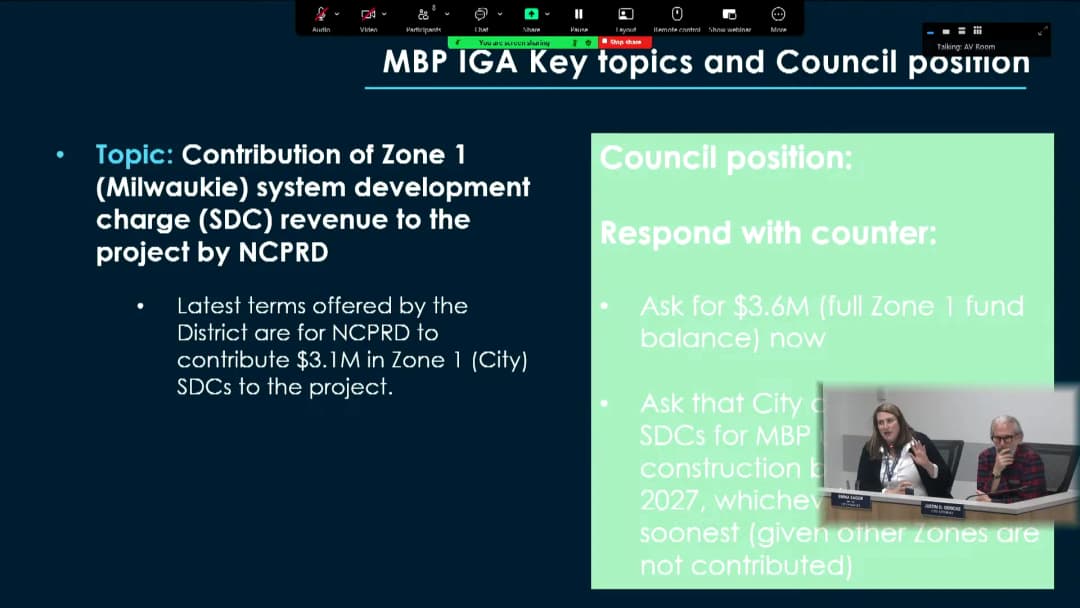
On November 13, 2025, the Milwaukee City Council convened a special session to review the latest proposed terms from the North Clackamas Parks and Recreation District (NCPRD) regarding the Cooperative Intergovernmental Agreement (IGA) and the Milwaukee Bay Park IGA. Staff provided a transparent update on negotiations initiated in January 2025, aiming to resolve a long-standing impasse and deliver the third phase of Milwaukee Bay Park by late 2027. The session featured an overview of the technical terms on the table, public testimony regarding equity and funding, and a unanimous vote authorizing staff to submit formal counter-proposals by December 2nd. Consent Calendar - No items were listed for the Consent Calendar in this special session transcript. Public Comments & Testimony - Dave Cadwallader (Resident, Island Station): Expressed a position favoring complete transparency on System Development Charge (SDC) history. He requested explicit documentation detailing how much SDC money generated by Milwaukee has been spent on Milwaukee versus other district areas to resolve ambiguity regarding equity and subsidies. He hoped such documentation would solidify the basis for future IGA proposals. - Gary Klein (Former Park Board Member, Resident): Expressed full support for advancing Phase 3 of Milwaukee Bay Park. He cited his history of donating property (Klein Points) for the project's earlier phases and stated he is "100% for" seeing the project completed. Discussion Items Amendment to the 2008 Cooperative IGA - Asset Capitalization: Staff presented a provision clarifying that if the district funds a capital improvement, they capitalize it; if the city funds it, the city capitalizes it. In a future withdrawal, the city would pay the district for the depreciated value of assets on the district's books. The Council expressed support for this provision. - Depreciation and Thresholds: Staff proposed adopting a shared depreciation schedule based on government accounting standards, with a dollar threshold of $5,000 indexed to inflation. The Council expressed support for this approach. - Construction Authority: The NCPRD requested approval authority over all city construction drawings/specifications. The Council indicated a position to reject this as written, affirming that the city should retain authority over improvements on city-owned land, though they are willing to coordinate. - Programming Preferences: Staff noted the current draft lacks language giving preference to city-affiliated groups or waiving permit fees for them. The Council stated a position to support adding a provision granting preference and fee waivers for city groups using the parks. - Milwaukee Community Center: The draft assigns the city responsibility for capital improvements/repairs and the district for programming/maintenance. The Council expressed support but requested modifications to clearly define "capital improvement" versus "general maintenance" and equipment. - Funding Support: A proposal allowing either party to request statements of support for securing funding was supported by the Council. Milwaukee Bay Park IGA - SDC Funding: NCPRD offered $3.1 million in Zone 1 SDCs. Staff noted the city holds $3.6 million currently. The Council proposed a counter-offer to receive the full balance of Zone 1 SDCs upon signing and retain future SDC accruals until construction begins or December 31, 2027. - Metro Local Share Loan: NCPRD offered a $2.5 million loan of Metro Local Share funds to be repaid over 10 years. The Council indicated they could not determine their position pending clarification from Metro regarding the permissibility of such a loan structure. - Trolley Trail Grants: $658,000 in Metro grant dollars originally allocated for the Trolley Trail was proposed for transfer to Milwaukee Bay Park. The Council expressed support for accepting this contribution. - Project Management: NCPRD proposed transferring design, construction, and permitting responsibilities to the city. The Council expressed acceptance of transfers for design and construction (currently at 50% design) and accepting maintenance responsibility. - Maintenance Timeline: While accepting maintenance responsibility, the Council requested the transfer date be moved from July 1, 2027, to the start of construction or no later than December 31, 2027. - Permitting: NCPRD requested to retain rights for scheduling programs and issuing special use permits. The Council expressed a position to reject this as written, asserting that the city, assuming maintenance, should also assume permitting rights, though they agreed NCPRD should retain programming rights without unreasonable withholding of permissions. Public Accountability and SDC Clarification - The Mayor addressed public comments regarding SDC equity, clarifying that previous claims of "subsidization" likely referred to maintenance costs rather than SDC expenditures, noting that NCPRD had not produced an accounting of maintenance cost disparities. She agreed that documenting the history of SDC spending would be a positive step to resolve ambiguity. Key Outcomes - Motion Approved: The Council unanimously voted (Aye: All) to direct staff to respond to the NCPRD board with the counter-positions outlined during the session. - Deadline Set: Staff were instructed to request a formal response from the NCPRD board by December 2, 2025, to accelerate the timeline for potential agreement signing before the end of the year. - Adjournment: The meeting was adjourned after five minutes to spare. - Strategic Goal: The Council reiterated the objective to substantially deliver Milwaukee Bay Park by the end of 2027.
This special session was convened to review the latest proposed terms for two intergovernmental agreements (IGAs) between the City of Milwaukee and the North Clackamas Parks & Recreation District (NCPRD) regarding the funding, design, construction, and operation of Milwaukee Bay Park Phase III. Council Staff provided a detailed update on negotiations initiated in January 2025, outlining the City's positions on capital asset capitalization, permit fees, System Development Charges (SDCs), and the transfer of project management responsibilities. Following public testimony regarding equity in funding and support for the project, the Council voted unanimously to authorize Staff to respond to the NCPRD Board with the proposed terms, requesting a response by December 2, 2025, to facilitate adoption before the end of the year. Consent Calendar - None; the meeting focused entirely on negotiation updates and specific directives regarding the Milwaukee Bay Park IGAs. Public Comments & Testimony - Dave Cadwalleter (Island Station): Expressed a desire for transparency and requested documented, "black and white" accounting of how System Development Charges (SDCs) have been generated and allocated over time to resolve ambiguity regarding equity and whether Milwaukee has been subsidized by the rest of the district. He sought clear documentation to support the negotiations. - Gary Klein (Milwaukee): Stated a background of involvement in the Portland Park and Rec Board and the Milwaukee Bay Park program. He expressed full support for the continuation of Milwaukee Bay Park Phase Three (“100% for it”) and emphasized his community’s prior contribution of the Klein Points property to initiate Phase One. - Mayor Beatty (Response): Addressed the comment regarding SDCs, clarifying that while an accounting of SDCs would be valuable, the narrative of "subsidy" cited by the NCPRD Board likely referred to the disproportionate cost of maintaining parks in Milwaukee relative to the district's size, rather than SDC allocation. Discussion Items - Historical Context: Staff outlined the history of the 1990 Cooperative IGA, the stagnation of Phase III design after 2017, the dispute over withdrawal terms in the 2008 IGA currently before the Court of Appeals, and the resumption of "two-on-two" negotiations in January 2025. - Amendment to the 2008 Cooperative IGA: - Capital Assets: Council position is supportive of a provision clarifying that the paying entity (City or District) capitalizes assets. In the event of future withdrawal, the City would pay the District the depreciated value of assets on the District's books. A depreciation schedule and a threshold (proposed at $5,000, indexed to inflation) were discussed. - Construction Authority: Council is supportive of City-owned land improvements but rejected the District's request for approval authority over all construction drawings. The City seeks to retain approval authority while coordinating with the District. - Programming: Council supports a provision granting preference and fee waivers for City and City-affiliated groups using Milwaukee parks. - Milwaukee Community Center: Council is supportive of the District retaining programming and general maintenance, and the City retaining responsibility for capital improvements, repairs, and replacements, provided definitions of these terms are clarified. - Funding Support: Council is supportive of language allowing either party to request a statement of support from the other for securing additional funding. - Milwaukee Bay Park IGA: - SDCs: Council proposed a counter-offer asking for the full Zone 1 fund balance at signing and retaining future accruals until construction begins or December 31, 2027. - Metro Loan: The District's offer to loan $2.5 million in Metro Local Share grants is under review; Council positioned to wait for Metro clarification before formulating a counter-offer. - Grant Reassignment: Council accepted the reassignment of approximately $658,000 in Metro grant dollars from the Trolley Trail to Milwaukee Bay Park. - Project Management: Council accepted the transfer of design and construction responsibilities to the City. - Maintenance Responsibility: Council accepted the transfer of maintenance responsibilities but requested a delay of the transfer date to the start of construction or no later than December 31, 2027. - Permitting: Council rejected the District's request to retain rights for special use permits if the City assumes maintenance, arguing that operational control requires permitting authority, though District programming rights must not be unreasonably withheld. Key Outcomes - Motion Adopted: The Council unanimously voted 5-0 in favor of Staff responding to the NCPRD Board with the positions outlined during the meeting. - Deadline Set: Staff requested a response from the NCPRD Board by December 2, 2025, to allow potential finalization and signing of agreements at the final City Council meeting of the year. - Adjournment: The meeting was adjourned with five minutes remaining, with the Mayor expressing optimism about reaching an agreement by the end of the calendar year.
The Milwaukee City Council convened on November 5, 2025, to address community announcements, the November 11 Veterans Day proclamation, and three substantive park and nature-related business items regarding the Milwaukee Bay Park negotiations, public-private green space partnerships, and water quality testing. A special session was scheduled for November 13 to review draft interlocal agreements, and the council directed staff to compile existing water quality data into a website without committing to new, costly testing programs. Consent Calendar - Approved unanimously: Minutes from September 16, September 20, October 7 (Work Session and Regular Session), and a resolution authorizing a financing application with the Oregon Health Authority for a raw water pipeline and treatment site. Public Comments & Testimony - Sagar (City Council Member): Provided follow-up on October 21 comments; confirmed engineering staff will contact Dave Ash regarding parking on Home Avenue and attend the Ardenwald Johnson Creek Neighborhood Association meeting on November 24 to discuss safety concerns on 37th and Harrison. Encouraged participation in the speed limit survey and noted a plan to produce more "Slow the Flock" signs. - Councillor Massey: Apologized for having private conversations with County Commissioner Helm regarding Milwaukee Bay Park negotiations, acknowledging they may have caused mischaracterizations and a loss of trust within the council. - Councillor Telser: Clarified that he had not initiated conversations with county commissioners to lobby for park agreements and emphasized that all side conversations should not derail the negotiated process. - Councillor Pusa Matty: Expressed frustration regarding the lack of transparency about side conversations with the county, stating that such actions erode trust and provide opponents with ammunition to delay the park project. - Councillor Stavens: Suggested using a less burdensome process like a Request for Qualifications (RFQ) or Request for Interest instead of a full Request for Proposal (RFP) to encourage small business participation in green space partnerships. - Michael Talcano (Resident/Small Business Owner): Expressed concern that the proposed process for reviewing green space partnerships would take years, delaying immediate community contributions like permanent raised beds. Argued that a testing program for the Willamette River is an equity issue necessary to combat the stigma preventing families from accessing the water. - Jacob Sherman (Neighborhood Resident): Testified in support of water quality testing to combat misinformation and stigma regarding the river's safety, emphasizing the economic and recreational benefits of swimming. Discussion Items - Milwaukee Bay Park Negotiations: - City Manager reported receiving draft Interlocal Agreements (IGAs) from the North Clackamas Parks and Recreation District (NCPRD) after a letter from the City Council on October 23. The City Council had requested terms including the city taking over project management and NCPRD contributing $3.1 million in SDCs and $2.5 million in Metro funds. - The council addressed a breakdown in communication where individual members held side conversations with county commissioners, leading to confusion about the city's negotiation stance. Councillors Massey admitted to regrettable off-record conversations that caused mischaracterizations, while Councillor Telser clarified he was compelled to speak after being cornered by commissioners. - Outcome: Councillors Massey and Telser, along with the Mayor, proposed a special session for Thursday, November 13, at 5 p.m. to review the draft IGAs before the regular council meeting. - Public-Private Green Space Partnerships: - Parks and Recreation Management presented four partnership types: program-based, capital improvements, operations/maintenance, and revenue-generating. The Parks and Recreation Board recommended a transparent process starting with a comprehensive "Green Space Management Plan" due in late 2026. - Council members expressed skepticism about permanent commercial structures in public parks, citing concerns over equity (pay-to-play barriers) and ensuring public access. - Recommendations: Councillor Massey noted the Parks and Recreation Board should not approve individual permits but guide policy. Councillor Costa Body suggested a middle ground: using the existing temporary event permit process for short-term activations (3-4 months) while developing the long-term framework, with staff directed to seek council approval for specific long-term proposals via the Engage Milwaukee website. - Public Input: A resident opposed delaying permanent community contributions (like raised beds) until a management plan is finished, while a business owner argued that testing water quality is a necessary equity step to remove the stigma against swimming in the Willamette River. - Willamette River Water Quality Testing: - Staff recommended against the city initiating its own water quality testing program due to high costs ($10,000-$15,000/season), lack of internal lab capacity, and regulatory liability risks regarding NPDES permits and public safety expectations. - It was noted that the City of Portland, West Linn, and DEQ already conduct routine testing, primarily for E. coli, though data is not always easily accessible to the public in a centralized location. - Discussion: Council members acknowledged the community's desire for data to dispel the stigma against swimming but agreed the city cannot legally guarantee the water is "safe." Councillor Massey questioned if additional pollutants beyond E. coli are a concern, while staff explained that chronic heavy metal exposure requires long-term contact and that E. coli is the primary indicator for recreational health. - Public Input: Advocates argued that periodic reporting or even one-time testing would help build trust and economic activity, while others cautioned that sporadic sampling might create false security. Key Outcomes - Special Session Scheduled: A special session is noticed for Thursday, November 13, at 5 p.m., to review draft Interlocal Agreements for the Milwaukee Bay Park. - Green Space Strategy Directed: Staff is directed to continue using the temporary event permit process for short-term proposals (<14 days) while developing a Green Space Management Plan. Long-term or profit-generating proposals will require a new framework, potentially utilizing a case-by-case review with public feedback via Engage Milwaukee before council approval. - Water Quality Data Centralization Directed: Staff is directed to create a webpage on the city website that aggregates existing water quality data from the City of Portland, West Linn, and the DEQ (including links to their reports). The page will provide context on the river's history and remediation efforts but will not include a one-time additional testing program or assert that the water is "safe to swim" without legal caveats, as the city lacks regulatory authority and liability protection for such claims. No additional testing for other substances was authorized at this time." ]
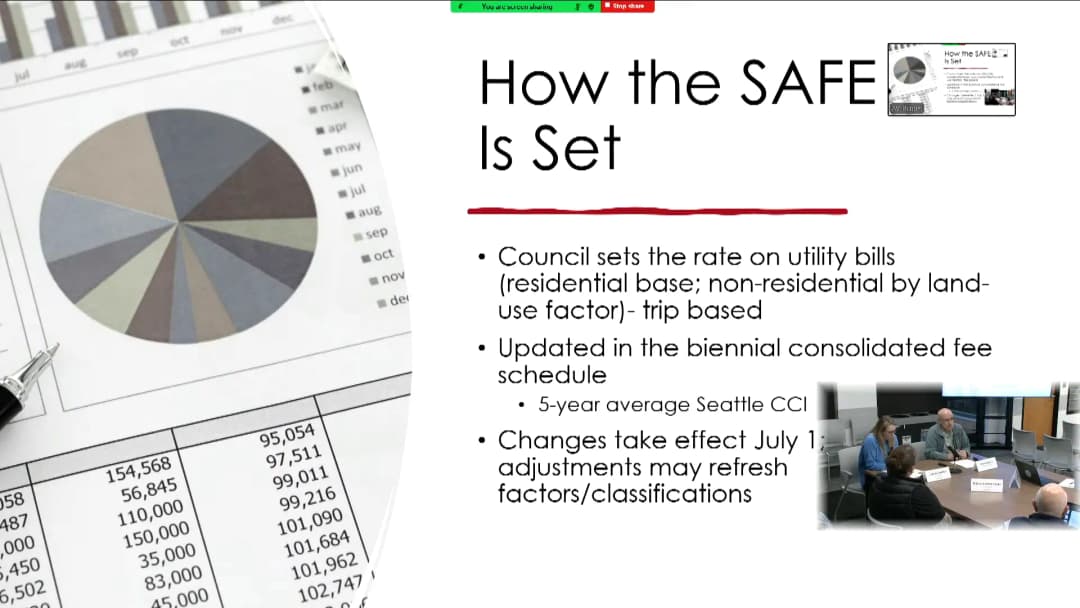
The Milwaukee City Council convened for a work session on November 4, 2025, to hear updates on upcoming winter events, discuss financial strategies for the Safe Access for Everyone (SAFE) transportation program, and explore the potential implementation of Ranked Choice Voting (RCV). The session began with a focus on community engagement and infrastructure funding, followed by a strategic discussion on electoral reform. Consent Calendar - No specific consent calendar items requiring a vote were listed in this work session transcript; the session primarily focused on informational updates and policy exploration. Public Comments & Testimony - No formal public comment period was recorded in this specific transcript segment. Discussion Items - Winter Events Update: Events and Volunteer Coordinator Dan Harris provided updates on upcoming activities. He noted that the Umbrella Decorating Contest and Solstice Celebration will proceed as planned in December. Harris expressed a position of caution regarding the future of the Solstice event's food vendor model, stating that the core group of organizers has historically provided this service, but their retirement marks a "sea change." He confirmed that no other Neighborhood Design Associations (NDAs) expressed sufficient interest to take over these roles currently, though Island Station expressed a "maybe" for a partnership. Harris expressed a position of openness to adopting a "privatized model" or hiring food trucks if community interest remains low, but emphasized a commitment to ensuring the event continues. He confirmed volunteer recruitment is progressing with 6-8 volunteers for solstice and 6 for the umbrella parade. - SAFE Program Financial Review: Public Works Director Peter Passerelli and Engineer Jennifer Garvely presented a structural analysis of the SAFE program. They identified that the revenue generated does not cover current debt service and transfers, citing a gap of approximately $172,000. They attributed this to lower-than-forecasted residential and commercial growth (a 1% assumption vs. actual 0.2%), under-collection during the pandemic, and construction cost inflation. Staff recommended Scenario 2, which involves fees increasing by approximately 13% followed by 6% over a biennium, generating a $600,000 surplus. However, they expressed a position that this funding level will shift the program away from large-scale capital projects (like full sidewalk rebuilds) toward a "pay-as-you-go" model focused on smaller spot enhancements and wayfinding. Staff emphasized that this is not a reduction in safety but a necessary scale adjustment due to financial constraints. - Ranked Choice Voting (RCV) Exploration: Councilor Rasse introduced the topic of implementing Ranked Choice Voting following the statewide measure in 2024, which passed in Milwaukee by approximately 5%. Councilor Rasse expressed a position of support for RCV, arguing it provides a more representative democracy and reduces wasted votes in multi-candidate races. Other Council members and staff noted the significant administrative challenges, including a 4-6 year implementation timeline, potential software costs, and the need for significant community education. Councilor Sam Jordan expressed skepticism regarding a November ballot initiative but expressed a position in favor of a broader C4 (Cities of Clackamas 4) countywide discussion to standardize a model before local implementation. Several members expressed a position against putting a measure on the November ballot due to the complexity and lack of immediate consensus on the specific voting scheme. Key Outcomes - SAFE Program Direction: The Council indicated general direction toward staff's recommended Scenario 2 (moderate fee increases and a shift to a pay-as-you-go model for smaller enhancements). This decision effectively defers large-scale sidewalk projects in the immediate biennium unless a new bond measure is pursued later. - SAFE Sub-Programs: Staff confirmed the creation of two new $300,000 biennium programs: a "SAFE Spot" program managed via the PSAC process for community proposals, and a new "SAFE Streets Enhancements" program run by staff focusing on wayfinding, markings, and small safety treatments. It was clarified that funds do not automatically roll over; unspent funds will be re-evaluated during the next budget cycle. - RCV Strategy: The Council rejected the immediate proposal to place an RCV measure on the November ballot. Instead, they directed staff and council to pursue further research and engage in a discussion at the C4 county level to establish a standard model before considering future voter initiatives. - Event Logistics: The City will proceed with the Umbrella Decorating Contest on December 6 and the Solstice Celebration on December 20, utilizing a hybrid model of community volunteers and professional audio support to prevent past technical issues.
The Milwaukee City Council held a regular meeting on October 8, 2025, at City Hall and via video conference. The meeting included two proclamations, a unanimous vote to designate Milwaukee as an International City of Peace, discussion on a new naming policy, a decision to proceed with a hearing on solid waste franchise termination, and council letters regarding the Kellogg dam restoration project and ICE actions. Consent Calendar - Approved unanimously: minutes from September 2, 2025 work session and regular session, and an OLCC application for a new liquor license at 11812 Stanley Avenue. Proclamations - Indigenous People's Day: Proclaimed October 13, 2025 as Indigenous People's Day in Milwaukee. Council noted an intergovernmental agreement with Confederated Tribes of Grand Ronde for seasonal heron sculptures at Milwaukee Bay Park, with construction starting soon. - U.S. Navy 250th Anniversary: Proclaimed October 13, 2025 as Navy 250th Anniversary Day. Councilmember Massey shared personal Navy history before reading the proclamation. Public Comments & Testimony - Deborah (last name unclear) submitted a written comment but did not speak; the city manager will respond at the October 21 meeting. - Three haulers spoke during the solid waste discussion: Chris Wright (Hoodview/ Waste Connections), Dave Huber (WM), and Beth Vargas Duncan (Oregon Refuse & Recycling Association). All expressed strong support for the current rolling 10-year franchise system, arguing it ensures stable rates and long-term investment. Wright cited a 39% rate increase in Washington cities that went to bid. Huber noted Beaverton approved a fixed 10-year term that night. Vargas Duncan emphasized the franchise system gives the city regulatory control. Discussion Items - International City of Peace Designation: David Potts from the Rotary Club of Milwaukee presented a proposal to register Milwaukee as an International City of Peace. Council expressed support, and the motion to sign on passed unanimously. - Naming Policy Draft: Equity & Inclusion Coordinator Gabriela Santoyo Gutierrez and Parks & Green Space Development Manager Adam Moore presented a new citywide naming policy (and a related memorial & donation policy). The policy creates a systematic, equity-based process for naming parks, facilities, and green spaces, with community input and a naming subcommittee. Council discussed several amendments: (1) consolidate the “outstanding individuals” criteria into a broad statement (remove sub-bullets, include international recognition); (2) change the ad-hoc naming subcommittee to an annual standing committee with representatives from ESC, Parks Board, and Library Board; (3) add a public engagement period before final approval. Staff will incorporate edits, post for public feedback, and return in December. - Solid Waste Franchise Agreements: Finance Director Michael Osborne presented the option to hold a hearing on November 18 to terminate the current rolling 10-year franchise. He and expert Chris Bell noted termination would give the city flexibility to restructure services or go to bid in the future. Councilmember Anderson and others expressed support for termination to avoid binding future councils. After hearing testimony from haulers, council agreed to hold the November 18 hearing. - Council Letter on Kellogg Restoration Project: Councilmember Massey introduced a letter requesting the restoration project team (American Rivers, watershed council) to appear November 18 to answer questions about funding, sewer line relocation, and project governance. The letter emphasizes the project's connection to parks, economic development, and affordability. Council approved the letter with minor edits. - Council Letter on ICE Actions: Council President Anderson presented a draft letter to Secretary of Homeland Security regarding the alleged unlawful detention of a Milwaukee-area U.S. citizen by ICE. After extensive discussion, council voted to extend the meeting and approved a revised letter (removing specific references to the individual, citations, and some language). The letter condemns ICE’s pattern of unconstitutional behavior. Council directed staff to forward to Secretary Noem and CC congressional delegation and media. Council also agreed to contact the individual’s attorney. Key Outcomes - Unanimous vote to designate Milwaukee as an International City of Peace. - Council will hold a hearing on November 18, 2025 to consider terminating the rolling solid waste franchise agreement. - Naming policy will be revised per council direction and brought back for approval in December 2025. - Letter to the restoration project team approved; team invited to November 18 work session. - Letter to Secretary of Homeland Security condemning ICE actions approved; to be sent immediately. Other Business - Council received a follow-up from the city manager on prior correspondence, including increased patrols on 99E and code enforcement actions on Lake Road. - Two proclamations read. - Meeting extended to finalize the ICE letter; adjourned after approval.
The City Council held a work session on October 7, 2025, to receive updates on economic development activities, including quarterly accomplishments, business engagement efforts, grants, infrastructure projects, and partnership negotiations. Staff and council members discussed progress, challenges, and next steps across multiple initiatives. No formal votes were taken, but direction was provided for future actions. Economic Development Quarterly Update (Q3 2025) - Model Milwaukee Best Event: Successful event with strong local business participation; feedback survey planned for Q4. - Business Friendliness Survey: Draft completed; will establish baseline metrics for council work plan. Expected launch in January 2026 after the holiday season. Distribution via email list and in-person outreach. - Business License Code Update: Survey will ask businesses how registration dollars should be used (e.g., chamber membership, business associations). Council discussed concerns about using funds for the regional chamber due to advocacy stances and geographic scope. - Grant Program Launch (URA and Citywide): Launched October 1, 2025. As of October 7, 11 applications received, 13 interested parties, over $550,000 requested out of URA funds and $25,000+ from CET funds. Staff improved outreach and application materials. - Bike Rack Request Form: Now live under Economic Development pages. - Website Refinement: Ongoing; updating outdated content and missing pages. - Marketing and Branding Strategy: ICMA film shot on October 5, 2025, to rebrand Milwaukee; will debut October 25. Efforts focus on retention, expansion, and attraction. - Main Street CIP: Scope being finalized, covering from the block near City Hall to South Downtown Plaza. Includes water, sewer, electrical, and aesthetic upgrades. Construction likely 1–2 years out; will be disruptive but coordinated. Expected to replicate the previous one-block improvement across six blocks. - Hubs and Corridors: Planning discussion to be rolled into upcoming residential density conversation. - URA Action Plan Update: Five-year plan nearing end; will reinitiate with MerCAC advisory committee. - Market Analysis for Hubs: Possibly starting Q4 or Q1 2026; to be done in-house if capacity allows. - Q1 2026 Preview: Housing corridor scope refinement, business license code review, revisit Harrison and Main. Council Member Feedback from Business Outreach - Council members relayed concerns from local business owners, including: - High utility costs (electric bill over $1,300/month) and lack of incentives for solar or energy efficiency. - Difficulty navigating grants; need for hands-on assistance. - Concerns about large-scale developments (e.g., mall redevelopment) pricing out small businesses despite city grants. - Frustration with previous county construction project on Linwood. - Staff noted the Sustainability, Equity, and Economic Development (SEED) team can connect businesses to resources. - Council member shared positive feedback from URA grant recipients: many feel Milwaukee is in a “renaissance.” Business owners want better signage, a pedestrian map, and improved wayfinding. Events like First Friday and “Where’s Waldo” passports have mixed impact. - Discussion on creating a physical or digital downtown map; D.A.N. is working on a similar project. Milwaukee Bay Park Update - Council President and Mayor have been negotiating with NCPRD board members since January 2025; six meetings held. - Progress was slow, but after setting an October 1 deadline, more substantive movement occurred. Optimistic about having an agreement ready for council review and potential adoption at the October 21, 2025 meeting. - Goals: near-term delivery, equitable funding, and original community vision. - Staff (Joseph and Kia) conducted many behind-the-scenes meetings on the comprehensive IGA. Gateway Development Project (Cohort/BlackRock Site) Update - Developer (referred to as “Free”) presented on the status of the project at the gateway to Milwaukee (McLoughlin area). - Project history: DDA signed in 2017, many extensions due to floodplain mitigation (took 18 months), COVID, rising costs, and market changes. - Current challenges: Construction costs up from 3.7% to 10% interest, labor costs, occupancy rates in Portland metro around 80-88%, crime/homelessness concerns, and difficulty securing financing. - Developer stated project cost has risen from $45-50 million to north of $70 million; equity needed has grown from $20-25 million to over $30 million. - Alternatives considered: converting to 100% affordable housing (would require redesign, smaller units, fewer commercial spaces, and starting from scratch). Developer expressed personal investment in the original vision but is open to input. - Requested extension of due diligence for 12-18 months (to mid-2027) to allow market conditions to improve. Current extension runs through January 2026. - Council members asked clarifying questions about timelines, design, and affordable housing feasibility. No decision made; further council discussion needed. Key Outcomes - No formal votes taken during the work session. - Staff directed to proceed with business survey launch in January 2026 and continue outreach for grants and programs. - Council will receive a more detailed Milwaukee Bay Park update and potential agreement at the October 21, 2025 regular meeting. - For the gateway development project, council will consider the extension request at a future meeting; further analysis of DDA terms and affordable housing options is required. - Council encouraged continued interdepartmental collaboration (SEED team) to address business challenges.