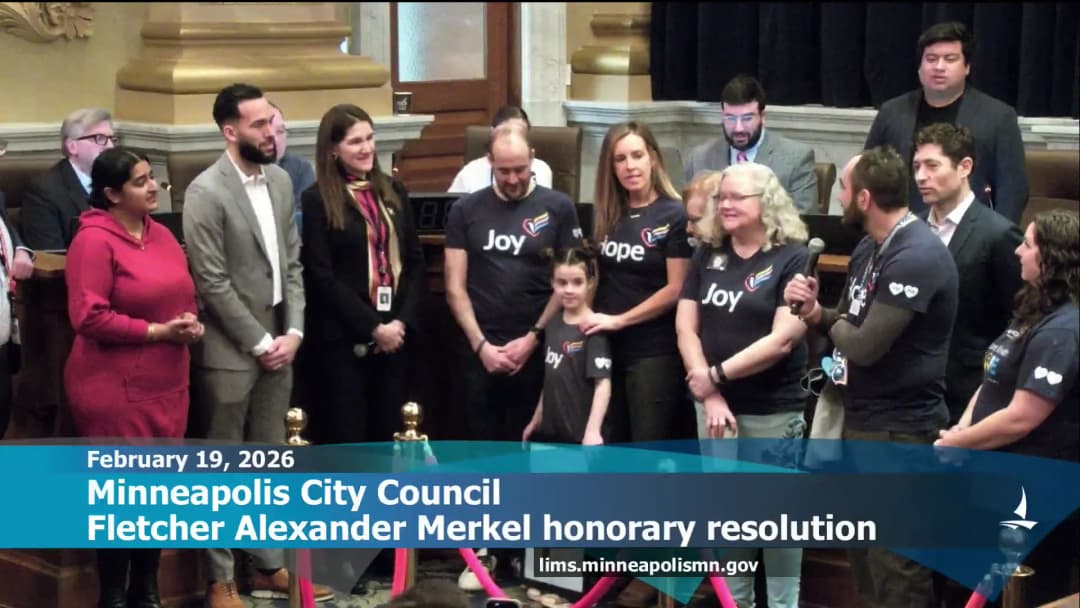
The Minneapolis City Council convened its regular meeting on February 19, 2026, at 7:40 a.m. The meeting opened with an honorary resolution for Fletcher Alexander Merkel, a victim of the August 2025 mass shooting at Annunciation School. Following the presentation, the council conducted its regular business, including a consent calendar, discussion on a quasi-judicial fence appeal, debate over liquor license renewals for hotels that housed ICE agents, deletion of a procurement suspension item, appointment of board members, and other legislative items. Honorary Resolution - The council presented an honorary resolution honoring the life and memory of Fletcher Merkel, born January 7, 2017, who died on August 27, 2025, in the shooting at Annunciation School. Speakers included Councilmember Paul Masano and Whiting, Annunciation School Principal De Boer, and first-grade teacher Sarah Slack. The resolution was adopted by acclamation, and attendees sang “This Little Light of Mine.” Consent Calendar - Agenda Amendment: The agenda was amended to include a legislative directive related to the small business resiliency fund; adopted unanimously (13 ayes). - Minutes Approval: Minutes from February 5, 2026, were accepted (12 ayes, Councilmember Whiting absent). - Referrals: Petitions, communications, and reports were referred to proper committees (12 ayes). - Committee of the Whole Report: 64 consent items were approved, with items 3, 5, 6, 53, 54, 55, and 57 pulled for separate votes. Item 48.1 (appointment) was deleted. Resolution 58 (denouncing immigration enforcement funding) was approved with a Whiting amendment. Expired ordinances from Councilmember Rainville were reintroduced by unanimous consent later in the meeting. Discussion Items - Item 3 – Variance Appeal (Fence Height): Councilmember Shugtai moved to deny the appeal and uphold the Zoning Board of Adjustment’s decision, adopting staff findings. Passed 13–0. Councilmembers noted the decision was based on a lack of legal findings to overturn the variance denial and emphasized that legislative fixes must come through ordinance changes, not quasi-judicial appeals. - Items 5 & 6 – Workers’ Compensation Settlements: Pulled for separate vote by Councilmember Wandsley. Passed 9–4 (Councilmembers Shugtai, Chavez, Wandsley, and President Payne voting nay). - Item 54 – Liquor License Renewals for Canopy by Hilton and Depot Minneapolis: Staff presented an investigation report finding no cause to deny renewals, as concerns related to hotel occupancy, not liquor licenses. After extensive debate over worker safety and ICE presence, the motion to approve passed 8–5. Ayes: Councilmembers Schaefer, Whiting, Stevenson, Rainville, Vita, Palmasano, Warren, and Vice President Osman. Nays: Councilmembers Shugtai, Chavez, Wandsley, Chowdhury, and President Payne (after vote switches). - Item 55 – Suspending Procurement Requirements for Operation Metro Surge: Councilmember Shugtai moved to delete the item from the agenda, arguing the emergency management declaration process is sufficient. The motion passed 7–6. Ayes: Councilmembers Shugtai, Chowdhury, Stevenson, Palmasano, Chavez, President Payne, and likely one additional member. Nays: Councilmembers Schaefer, Whiting, Rainville, Vita, Warren, and Vice President Osman. - Item 53 – Appointments to Boards and Commissions: After tabling earlier, the council considered an amendment to the Meet Minneapolis Executive Committee appointment. Councilmember Schaefer moved to replace Councilmember Wandsley with herself, citing the longstanding representation of Ward 7 (downtown) on the committee. The amendment passed 7–6, with supporters including Schaefer, Shugtai, Whiting, Stevenson, Rainville, Vita, Palmasano, and opponents including Wandsley, Chowdhury, Chavez, Warren, Osman, and President Payne. The full appointments list was then approved 13–0. - Small Business Resiliency Fund Legislative Directive: Accompanying the budget resolution, the legislative directive requests detailed parameters for program implementation from CPED. Adopted unanimously (13 ayes). Key Outcomes - Consent agenda adopted with amendments. - Fence variance appeal denied; staff findings upheld. - Liquor licenses for Canopy by Hilton and Depot Minneapolis renewed (8–5). - Procurement suspension for Operation Metro Surge deleted from agenda (7–6). - Board and commission appointments approved, with Councilmember Schaefer joining the Meet Minneapolis Executive Committee (7–6). - Legislative directive for small business resiliency fund passed unanimously. - Notices of intent to introduce ordinances on welcoming all genders and immigration protections in housing were given. - Introduction and referral of 35 items approved, including ordinances on decriminalizing drug paraphernalia, extending pre-eviction notice length, and others. - Two resolutions adopted unanimously. - Announcements included the proclamation of “Diane Moa Day,” Ramadan greetings, and reflections on school shootings.
Public Meetings - Minneapolis, Minnesota
Public Meetings - Minneapolis, MinnesotaThe Minneapolis City Council met as the Super Committee of the Whole on February 17, 2026, from approximately 9:30 a.m. to 5:00 p.m. CDT. The meeting addressed a wide range of items, including three quasi-judicial hearings, public testimony on liquor license renewals for two hotels allegedly housing ICE agents, emergency procurement authority for Operation Metro Surge, a $7 million small business resiliency fund, and several resolutions responding to federal immigration enforcement and other issues. The meeting was broadcast live with captioning. Consent Calendar - Approved consent agenda items 4–56 (excluding items 21, 25, 49, 4, 5, and 6 that were pulled) by voice vote. This included routine approvals for contracts, grants, license renewals, appointments, and other administrative matters. A correction was noted that a rescheduled hearing (item 53) will be moved to March 24 instead of March 17. - Items 4, 5, and 6 (settlements) were voted on separately: Item 4 passed 13-0; Items 5 and 6 passed 10-3 (with Councilmembers Wandsley, Chavez, and Vice Chair Chugtek voting no). Public Comments & Testimony - Liquor License Renewals (Canopy Hilton and Depot Renaissance Hotel – Item 57): Ten speakers registered. Key testimony: - Joan Soholt (hotel worker, Unite Here Local 17): Urged renewal, stating ICE activity is not limited to these hotels and that targeting them harms workers; called for rejection of punitive actions without legal cause. - John Eric Haynes (attorney for Unite Here): Argued that liquor licenses are a privilege, not a right, and that the city has broad discretion to deny renewal if the general welfare is threatened. He stated that housing ICE agents could be a rational basis for non-renewal. - Jeffrey Packett (internal organizing director, Unite Here): Read a statement from an anonymous worker at the Depot describing ICE presence, covering of windows, and safety measures that limited worker movement. - Uriel Perez Espinoza (Unite Here): Shared worker accounts of ICE agents staying at the hotels, wearing camouflage, and arriving/leaving at specific times. - Wade Luneburg (Ward 3 resident): Requested that hotel operators deny lodging to ICE; cited safety risks to workers and guests. - Shelley Stein (Restaurant Opportunity Center): Stated workers fear ICE presence and that businesses have the right to refuse service to ICE. - Additional speakers raised concerns about due process, public safety, and the impact on workers and community. - Note: A speaker from Arizona Taco Company mistakenly addressed the committee; he was informed his item was not on the docket. Discussion Items - Item 21 – 2% Loan Program Revision: Director Eric Hansen (CPED) explained the program's cap would be raised from $75,000 to $125,000 to meet modern business needs. The program has had $2.2 million annually for 15 years. Councilmember Schaefer requested a detailed memo on program history. Passed 13-0. - Item 49 – Stadium Village Special Service District Advisory Board Appointments: Councilmember Wandsley moved to deny the appointment of Michael Burke (Graduate Hotel general manager) due to the hotel's alleged housing of ICE agents and its response to protests. After debate, the motion to deny 49.1 passed 8-4-1. The appointment of Amy Campbell (49.2) was approved 12-1. - Quasi-Judicial Hearings: - Item 1 – Interim Use Permit for Parking Lot at 1901 East Lake Street (Tocali): Applicant sought a five-year surface parking lot for La Alborada Market. Staff recommended approval. No public testimony. Council approved 13-0, adopting findings of fact. - Item 2 – Appeal of Certificate of Appropriateness for 201 Franklin Avenue East: Property owner Nicholas Bates appealed two conditions requiring removal of newly installed vinyl siding. The HPC had required fiber cement or composite wood siding. Council Vice Chair Chugtek moved to strike conditions 1 and 2, citing economic hardship and improved appearance. Approved 13-0. - Item 3 – Variance Appeal for Fence Height at 3906 York Avenue South: Applicant Patrick Hargarten sought a variance to allow a six-foot fence on a corner side yard. Staff recommended denial, citing lack of unique circumstances. Councilmember Vita and others noted ongoing ordinance work. Motion to approve variance failed; motion to recommend without approval passed 13-0. - Item 58 – Suspension of Procurement Policies (Emergency Operations): Director Rachel Sayer requested authority to bypass procurement rules for catastrophic emergencies during Operation Metro Surge. After extensive debate, an amendment was adopted with reporting requirements and a March 26 expiration. Passed 13-0. - Item 59 – Small Business Resiliency Fund (Downtown Assets Fund): Councilmember Chavez moved to allocate $5 million from the downtown assets fund to support businesses impacted by the ICE occupation. Councilmembers Chowdhury and others amended to increase to $7 million. Despite concerns about fund depletion and program design, the motion passed 11-2 (Rainville and Schaefer opposed). - Items 60–63 – Resolutions: - Item 60: Supporting Small Business and calling on federal/state/county aid. Passed 13-0. - Item 61: Opposing immigration enforcement funding and asking Congress to act. After debate on language, passed 8-4-1 (Rainville, Vita, Warren, Schaefer opposed; Whiting abstained). - Item 62: Electric and gas shutoff moratorium. Passed 13-0. - Item 63: Denouncing attacks on gender-affirming care for youth. Passed 13-0. - Item 64 – City Auditor Position (Director of Special Review and Advisory Services): Presentation by Brenda Miller and Tartha Paudell. Context provided by Council President Payne. Approved by voice vote. - Item 25 – Eviction Moratorium Referral: Councilmember Schaefer sought clarity on the process. Staff explained the standard legislative procedure. Motion to approve referral passed. - Expired Actions Report: Clerk Casey Carl presented a list of 44 expiring items from the 2024–2025 term. Council approved 15 claims for reintroduction; remaining items will expire if not claimed by Thursday. - Council Tracking Report: Clerk Carl presented the final report of official acts (2,940 actions) from the past term. Andrew Hawkins (Legislative Research and Oversight) previewed enhanced tracking dashboards. - Walk-On Items: Councilmember Wandsley introduced a legislative directive regarding preservation of evidence related to ICE misconduct – approved. Councilmember Vita introduced a lease non-disturbance agreement for 1500 44th Avenue North – approved. - El Cerrito Resolution: Council received and filed a resolution of solidarity from El Cerrito, California. Key Outcomes - Consent agenda approved (items 4–56) with pulled items voted separately. - Quasi-judicial hearings: Parking lot permited, siding appeal granted, fence variance denied. - Liquor license renewals for Canopy Hilton and Depot Renaissance moved without recommendation to full council (motion to refer to staff failed 6-7). - Emergency procurement authority approved with amendments (expires March 26, 2026). - $7 million small business resiliency fund approved (from downtown assets fund). - Four resolutions passed (items 60–63) with varying vote tallies. - City auditor position approved. - Expired actions report accepted; 15 items reclaimed. - Walk-on legislative directive and lease agreement approved. - All items forwarded to the full council for final action on February 19, 2026.
This meeting addressed urgent responses to federal immigration enforcement operations while conducting regular city business under extraordinary circumstances. The council operated under a temporary "super committee of the whole" structure due to the ongoing ICE occupation. Opening and Context Council President Elliot Payne opened the meeting acknowledging the federal occupation of Minneapolis, noting that claims made by the Trump administration do not match residents' experiences on the ground. The council has adjusted its calendar to reflect this reality while maintaining essential city operations. Consent Calendar The Super Committee of the Whole, chaired by Councilmember Chowdhury, brought forward 67 items originally intended for various committees: - Items 1-6 (Enterprise Labor Relations): Collective bargaining agreements, worker compensation claims, and a grant acceptance for the Minneapolis Democracy Center - Items 7-16 (Business Housing and Zoning): Liquor and gambling licenses, contracts, grants, and demolition appropriations - Items 17-34 (Public Health Safety and Equity): Gift acceptances, contract amendments, funding redistribution, and legislative directives - Items 35-58 (Climate and Infrastructure): Street reconstruction projects, grants, service agreements, and bids - Items 59-66: Budget amendments, gift acceptances, police misconduct training contract, 2026 legislative agenda, U of M lease agreement, and MPD training annex bid All items except Item 67 were approved unanimously (12 ayes). Emergency Rental Assistance Debate (Item 67) The most contentious discussion centered on a $1 million emergency rental assistance proposal to address the housing crisis created by Operation Metro Surge. The Need Council members described dire circumstances: - Families losing income due to breadwinners being detained by ICE - Workers afraid to leave homes due to racial profiling threats - Loss of childcare access and workplace closures - Minneapolis Public School families have already raised over $1 million through grassroots fundraising - Councilmember Chugtai reported personally tracking $76,000 in rental assistance needs since Monday - The program would serve approximately 250 families Funding Source Debate Three funding sources were proposed: 1. Contingency Fund (Failed 8-5, required 10 votes) - Supporters argued this met the definition of "unanticipated expenses" and "emergency" - Contingency is 1% of general fund expenditures set aside specifically for emergencies - Opponents cited concerns about the city's financial position and bond rating - Deputy CFO reported $5 million already spent on ICE response (including $4.3 million in police overtime) - Motion to delay until March 19 failed (6-6) 2. Affordable Housing Trust Fund (Failed 6-7) - Proposed by Councilmember Whiting as a compromise - Would return unused funds after Operation Metro Surge ends - Opponents argued it would reduce affordable housing development for 20-30 years - The Trust Fund typically receives $18 million annually but faces a fiscal cliff in 2027-2029 - Critics noted taking $1 million would reduce housing units available for three decades 3. Cash Balance (Passed 9-4) - Final approved source after other options failed - Councilmember Chugtai called it the "last option" due to the city's compromised financial position - The $20 million police department overspend in 2025 significantly diminished available cushion - Deputies CFO warned about risks to the city's AAA bond rating Program Details RentHelp Hennepin County will administer the funds: - Total county allocation: approximately $10 million annually (fully utilized each year) - Last year required additional fourth-quarter funding - Average processing time: 14 days from application - Currently no backlog or waiting list - Eligibility requires court summons for eviction and income at approximately 30% area median income - Fully covers rent arrears for seniors, families with children, or people with disabilities - 50% of RentHelp Hennepin awards already go to Minneapolis residents Key Concerns Raised Data Privacy: Some members expressed concern about immigrants providing information to government agencies, though others countered that applicants already appear in eviction court records. Discrimination: Debate occurred about whether targeting assistance to ICE-impacted residents was discriminatory, though the resolution language specified "residents in need" without restrictions. Timing: Rental assistance fundraisers raised over $10 million, but this wouldn't sustain long-term needs. County assistance is a one-time annual opportunity per household. Scale: Vice President Osmond and others emphasized $1 million is "a drop in the bucket" compared to actual need, but represents critical government response. Pre-Eviction Notice Extension Councilmember Wansley introduced an ordinance to temporarily extend pre-eviction notice from 30 to 60 days until July 31, 2026. Expedited Process Failed (8-5, required unanimous consent) - Would have provided protection by March 1 rent deadline - Full ordinance was drafted and available for review - Will now proceed through regular notice process with later implementation - Public hearing scheduled for Committee of the Whole Black History Month Celebration The council unanimously (11 ayes) adopted a resolution designating February 2026 as Black History Month. A breakfast celebration was held in the historic rotunda, organized by the Minneapolis Black Employee Network (MBEN). Councilmember Vita recognized Destiny Prosper, who independently raised $40,000 for Lucy Laney school families. Notices of Intent Three ordinance notices were given: 1. Decriminalization of drug paraphernalia possession (Chavez, Chowdhury, Wansley, Payne, Stevenson) 2. Alcohol licensing regulations for parking lot premises (Vice President Osmond) 3. Regulations for owner entry into rented dwelling units (Chugtai) Key Outcomes - $1 million emergency rental assistance approved using cash balance funding (9-4 vote) - 67 routine city business items approved through super committee process - Pre-eviction notice extension will proceed through regular process after expedited consideration failed - Financial concerns highlighted: City facing significant budget pressures from ICE response costs and previous department overspending - Community response recognized: Over $11 million raised through private fundraising, but government intervention deemed necessary for long-term stability Ongoing Crisis Context Council members reported continued ICE activity despite federal claims of reduced operations: - Councilmember Chugtai described a 6 AM raid involving two dozen agents breaking into an apartment building - A two-year-old child was detained in Ward 9 - Two Minneapolis residents murdered by federal agents - A Latino resident shot in the leg in North Minneapolis - Another resident died in Texas custody after detention in Minnesota - Businesses reporting up to 80% decrease in customer base The meeting adjourned at 1:19 PM following a closed attorney-client session regarding State of Minnesota et al v. Noem et al litigation.
Meeting Overview On February 3, 2026, the Minneapolis City Council held its first "Super Committee of the Whole" meeting—a temporary restructuring consolidating all standing committees to enable more timely responses to the ongoing ICE occupation in Minneapolis. Chair Aune Chowdhury opened by acknowledging that federal immigration enforcement (Operation Metro Surge) has caused unprecedented disruption, with three deaths (Renee Good, Victor Manuel Diaz, and Alex Preddy), significant economic losses ($10-20 million per week in business revenue), and widespread community trauma. Opening Remarks and Moment of Reflection The Council held a moment of silence for the three individuals who died as a direct result of federal immigration enforcement activities. Chair Chowdhury emphasized that Minneapolis has been forced to respond to a crisis created by the federal government, with ICE agents operating outside schools, circling apartment buildings, and staging in neighborhood parks. She noted the meeting structure shifts from a two-week cycle to a compressed one-week cycle, with the next Super Committee meeting scheduled for February 17, 2026. 2026 Legislative Agenda and Policy Positions The Intergovernmental Relations (IGR) team presented the city's 2026 state and federal legislative priorities: State Legislative Priorities - Immigration Enforcement Impact: New agenda item requesting state funding for immediate and long-term recovery needs, including rental assistance, mental health supports, and business relief. Minneapolis businesses are losing an estimated $10-20 million weekly. - Gun Violence Prevention: Elevated priority following the Annunciation Church tragedy, supporting assault weapons bans and high-capacity magazine restrictions - Public Official Safety: Support for weapons bans in city buildings and enhanced security for local government officials - Economic Development: Tax credits for converting vacant commercial space, expanding downtown taxing boundaries to include North Loop, entertainment districts with digital signage revenue for public art - Property Tax Relief: Continued advocacy for increased Local Government Aid (LGA) - Affordable Housing: Funding to address the "fiscal cliff" for homeless services (approximately $13 million shortfall from expired ARPA funds) - Infrastructure: Transit funding, ADA compliance improvements ($400 million backlog), complete streets and traffic calming, zero waste initiatives - Capital Investment: $19 million community safety training facility, water main connections, flood mitigation projects The legislative session begins February 17, 2026, in a closely divided legislature (even split in House, one-seat DFL majority in Senate). Federal Budget Update Lauren Olson reported on the partial federal government shutdown and fiscal year 2026 budget negotiations. Key highlights: - Five appropriations bills passed for full fiscal year; Department of Homeland Security funded only through February 13 for additional reform discussions - Proposed DHS reforms include ending roving ICE patrols, requiring judicial warrants, mandating body cameras and visible identification, and banning masks - LIHEAP (heating assistance) slightly increased; Title X (reproductive health) flat funded - Head Start increased; refugee assistance decreased to $5.2 billion - FEMA funding increased to $32 billion; ICE enforcement funding at $5.5 billion with $75 billion additional from reconciliation bill - Community Development Block Grant and HOME program maintained at current levels; homeless assistance grants increased Council members expressed frustration that proposed reforms (body cameras, codes of conduct) mirror failed police reform efforts and won't prevent harm from ICE operations. Fourth Quarter 2024 Encampment Closure Report Director Enrique Velasquez reported: - Zero city-supported encampment closures in Q4 2024 - 13 active encampments and 30 vehicle-only sites with approximately 97 individuals experiencing unsheltered homelessness - Homeless Response Team engaged at encampments 433 times, provided supplies 125 times benefiting 300 individuals - Mobile Medical Unit engaged 1,100+ individuals, distributed 207 Narcan packages (414 doses), provided medical assistance 161 times - Housing outcomes: 247 engagements led to 66 housing referrals, 10 shelter reservations, 2 intake assessments - Hennepin County reported 133 individuals moved from unsheltered to stable housing in Q4 (86% remain stably housed) - Six individuals unable to secure shelter reservations due to capacity Council members raised concerns about: - Hamilton School (SOC) location in residential Ward 4 neighborhood causing ongoing trauma - Need for coordinated response to MDOT and county-owned land encampments (particularly Hiawatha/Cedar intersection) - Impact of police special directive preventing encampment formation, leading to more dispersed unsheltered populations - Homeless Response Team's reputation in community as "snitches" due to association with MPD sweeps - Increased vulnerability of unsheltered Indigenous residents and immigrants during ICE operations Director Velasquez noted staff have modified engagement approaches during the ICE occupation, including wearing plainclothes without face coverings to avoid being mistaken for federal agents. Police Department Facilities Two related items addressed MPD training needs: University of Minnesota Lease (Item 68) Approved $1/year lease renewal for 32.3-acre Rosemount facility used since 1986 for explosive materials storage/detonation and training. One-year term with unlimited automatic renewals. Shared with St. Paul PD. In exchange, MPD provides timely explosive materials removal services. MPD Training Annex - Former First Precinct (Item 69) Approved $398,000 contract with Roshan Corporation for minor demolition/construction at 19 North 4th Street (former First Precinct) to create flexible training space. This temporary auxiliary space addresses overcrowding at Hamilton School (SOC), which was designed as an elementary school and is inadequate for current training demands including: - Settlement agreement requirements for hands-on, large-group scenario training - 35-recruit academy, 70+ Community Service Officers, 30-cadet program, ongoing in-service training - Limited large-group space (only gym and auditorium at SOC) Council discussion centered on: - Whether this advances or delays the proposed $38-40 million comprehensive training and wellness facility - Alternative approaches using partnerships with other agencies (like the UMN lease) as more cost-effective - Fire Department's ongoing need for new station (not addressed by these facilities) - Deputy Commissioner Jeffries confirmed the comprehensive facility plan was approved by Alefa (consent decree monitor) but noted settlement agreement permits alternative proposals - Capital request indicates comprehensive facility intended for police only, despite some references to multi-department use Vote: Item 68 passed unanimously (13-0); Item 69 passed 12-1 (Vita dissenting) Human Trafficking Services - South Side Safety Center (Item 60) Director Amanda Harrington requested moving $500,000 from the $4 million Public Safety Aid set aside for pilot programs to fund a contract with The Link and partner organizations for human trafficking prevention/intervention services at the South Minneapolis Community Safety Center (2633 Minnehaha Avenue). Services include: - Case management for trafficking victims - Training for city staff (fire, police) and community organizations - Community outreach beyond center location - Services begin when center opens (anticipated late 2026) Construction bidding closed January 22, 2026. Council members emphasized importance of services beyond police functions at the center, addressing community engagement feedback from March-May 2024. Vote: Approved unanimously (13-0) Immigration Legal Services Funding (Item 70) Councilmember Chavez presented resolution allocating $500,000 for immigration legal services expansion through Office of Immigrant and Refugee Affairs (OIRA). Key points: - Funded by transferring from Fire Department base salary expenses, backfilled with Public Safety Aid - Addresses unprecedented demand: recent case of 2-year-old detained, flown to Texas, reunited with mother only due to legal intervention - Current OIRA funding: $275,000 ongoing + $246,000 supplemental for 2026; this adds $500,000 - Five legal service providers offer in-person/virtual consultations, detention line services (4 days/week), full representation - Nearly 90% of individuals with legal representation win removal cases; 90% without representation lose - Minneapolis significantly underfunds immigration legal services compared to peer cities (Portland, Seattle, Denver) - Services accessible via city website (OIRA Minneapolis), community hours, direct referrals Council emphasized: - Citizens also being detained/questioned, then released - Indigenous residents disproportionately targeted - Service providers working 15+ hour days, stretched beyond capacity - Need for systemic funding increase in future budgets beyond one-time fixes All 13 council members added as co-authors. Vote: Approved unanimously (13-0) Rental Assistance for ICE-Impacted Families (Item 71) Councilmember Wansley proposed allocating $1 million from contingency fund to Hennepin County for rental assistance for families impacted by Operation Metro Surge. Motion was to forward without recommendation to full council (February 5, 2026) to allow further discussion. Key arguments in support: - Rent was due February 1; many families cannot work due to ICE targeting - Some workplaces closed/reduced hours; some breadwinners detained - Hennepin County emergency rental assistance has $50 million backlog (applications through August 2025) - Tens of millions in need estimated; city cannot meet need alone but should be first government entity to act - Contingency fund explicitly for unanticipated urgent costs - Examples: worker followed home from work, chased with guns near elementary school; single mother cannot return to known workplace - No family should choose between rent and risk of ICE abduction Key concerns raised: - Size of County's existing backlog and program capacity - Need for protections against fraud/abuse (though no evidence of issues with County programs) - Desire for detailed joint powers agreement specifying: - How funds separated from general rental assistance pool - Criteria for ICE-impact verification - Number of families assisted - Reporting/accountability mechanisms - Eligibility requirements: household income at/below minimum wage ($2,317/month for household of one), eviction filing already initiated - Alternative funding sources explored; Mayor proposed using Emergency Housing Voucher funds (serves 50 families/50 individuals experiencing chronic homelessness)—Council rejected pitting vulnerable populations against each other Director Eric Hanson (CPED) noted: - Existing joint powers agreement with County for rental assistance - County currently has 2,500 people in system; targets families with children, people with disabilities, seniors - Specific terms for ICE-impact targeting to be negotiated between city/county attorneys - May not require council approval of final agreement (staff to confirm) Vote to forward without recommendation: 13-0 Liquor License Renewals - Hotels Housing ICE Agents (Items 8.18 & 8.100) Chair Chowdhury moved to delay renewal of liquor licenses for Canopy by Hilton (Mill District) and Depot Minneapolis Renaissance Hotel for one cycle to next Super Committee meeting, with public comment period added. Both hotels have federal contracts housing ICE/Border Patrol agents. Arguments for delay: - Multiple reports of drunk, armed off-duty agents at hotel bars creating public safety concerns - At least two incidents of armed agents pulling weapons on Minneapolis residents - Significant community disruption around hotels; constituents feeling unsafe - University students near hotels experiencing disrupted lives - Need for fact-finding to determine if legal basis exists for license conditions or denial - Precedent: city regularly reviews licenses when community raises public nuisance concerns - Opportunity for license holders to present public safety plans - Hotels profiting from federal contracts while community suffers Arguments against delay: - Business Licensing staff certified both licenses meet all legal requirements - City Attorney confirmed no current grounds for denial - Concern about discrimination against specific businesses - Hotels not responsible for who books rooms - Hotels already suffered: violent damage during protests, staff beaten, banquet cancellations, layoffs, hundreds of thousands in losses - Risk of legal liability if council acts without proper legal basis - Other businesses may also serve ICE agents unknowingly - "False hope" for constituents if no legal basis for denial exists City Attorney clarified: - Licenses meet renewal requirements based on current facts - Additional fact-finding could reveal basis for conditions or revocation - Would need to follow proper process/ordinance for any denial Amy Lingo (Business Licensing Manager) confirmed delay won't affect operations—licenses continue until withdrawn or denied. Vote to delay one cycle with public comment: 9-5 (Rainville, Vita, Warren, Schaefer, Palmisano dissenting) Consent Agenda The consent agenda (items 1-64) included: - Collective bargaining agreements - Workers' compensation settlement (Tracy McDougall, forensic scientist, 30+ years service, physical injury—voted separately, approved 13-0) - Liquor and gambling license approvals/renewals - Various contracts, grants, appropriations for city departments - Quarterly updates from Office of Community Safety and summer safety plan - Street reconstruction projects - Budget amendment for public safety (item 59) - Gift acceptances - Ordinance introductions for salaries/wages and zoning text amendments Vote: Approved (excluding three items pulled for separate votes) Key Themes and Context Federal Immigration Enforcement Impact: The meeting was dominated by discussion of Operation Metro Surge's devastating effects on Minneapolis: - Economic: $10-20M weekly business losses, workers unable to go to jobs, rising rental assistance need - Human: 3 deaths, families separated, children detained, widespread trauma - Infrastructure: Strained city resources (police overtime, public works, emergency services) - Housing: Looming eviction crisis as rent comes due with families unable to work - Legal: Unprecedented demand for immigration legal services, detention cases Government Response Coordination: Council emphasized need for multi-level government response: - Federal: Pushing for DHS reforms (though skeptical of effectiveness) - State: Requesting rental assistance, business relief, emergency funding in upcoming legislative session - County: Partnering on rental assistance, homeless services, legal service coordination - City: Immigration legal services expansion, rental assistance, protecting residents Tension Between Legal Requirements and Community Demands: Multiple discussions highlighted friction between legal obligations (liquor license renewals, settlement agreement compliance) and community pressure for accountability/protection during crisis. Facilities and Infrastructure Needs: Ongoing debate about balance between immediate/temporary solutions (training annex, partnerships) versus long-term capital investments (comprehensive facility), with fiscal constraints and competing priorities. Homelessness Response: Continued challenges with capacity, funding cliffs, coordination between jurisdictions, and increased vulnerability of unsheltered populations during ICE operations. The meeting adjourned at approximately 4:00 PM with next Super Committee meeting scheduled for February 17, 2026, at 9:30 AM, followed by full council February 19, 2026.
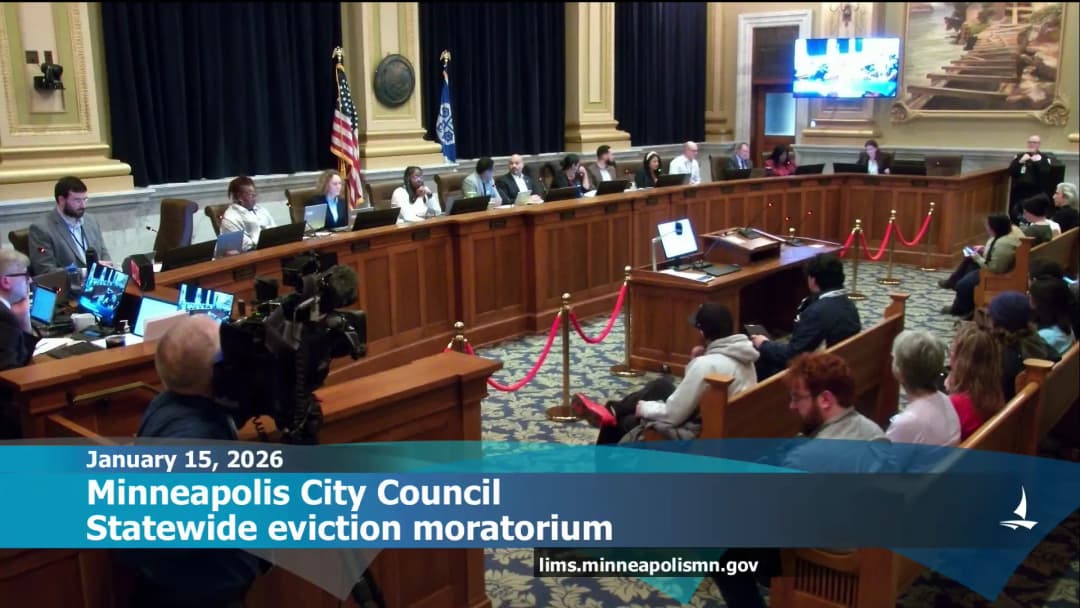
This emergency meeting of the Minneapolis City Council addressed time-sensitive business related to the federal Immigration and Customs Enforcement (ICE) Operation Metro Surge and its impact on Minneapolis residents. The meeting included public comment on an eviction moratorium resolution and consideration of routine city business that could not wait until regular committee meetings beginning January 26th. Opening and Agenda Adoption Council President Elliot Payne called the meeting to order at approximately 2:00 PM with 12 members present (Council Member Chowdhury initially absent, joining later). The council suspended rules to allow public comment on the eviction moratorium resolution, as full council meetings typically do not permit public testimony. The agenda was adopted 10-2 with an additional resolution condemning Operation Metro Surge added as new business item 9. Minutes from four previous meetings (December 9, 11, 16, 2025, and the January 5, 2026 organizational meeting) were unanimously accepted. Veto Override Attempt The council reconsidered Mayor Frey's veto of the Humane Encampment Response Ordinance passed December 11, 2025. The override attempt failed 7-6, falling short of the required nine votes (two-thirds majority). The mayor's veto was sustained and the ordinance was not adopted. Grant Acceptances and Applications The council unanimously approved: - Health Department grants: Year 4 of the Public Health Infrastructure Grant from CDC and Strong Foundations Grant for evidence-based home visiting services - Public Works grants: Two Metropolitan Council grant applications to reduce inflow and infiltration into the sanitary sewer system - Police Department: Four-month extension of existing grant due to delivery issues with vehicle parts and upfitting Salary Adjustments The council unanimously approved 2026 salary increases: - Non-represented employees: 4% increase effective January 4, 2026 - Politically appointed employees: 2.5% increase effective January 4, 2026 Budget numbers include salary increases, step progression, and longevity payments. Eviction Moratorium Resolution - Public Comment Period The meeting featured an extensive public comment period on a resolution calling for Governor Tim Walz to enact a statewide eviction moratorium. Approximately 50 speakers registered, with 40+ providing testimony over nearly 2 hours. Key themes from public testimony: - Fear and economic hardship: Residents, particularly immigrants and people of color, reported being afraid to leave homes for work, school, or groceries due to ICE presence. Many described lost income and inability to pay rent while sheltering in place. - Community response: Speakers described extensive mutual aid efforts including neighborhood patrols, food delivery, driving neighbors to work, fundraising for rent (one school raised $20,000-$50,000), and "Know Your Rights" kit distribution. - Violence and trauma: Multiple speakers referenced the shooting death of Renee Good and other violent encounters with federal agents, including tear gas, rubber bullets, and flash grenades. A six-month-old infant was hospitalized after flash grenade exposure. - Business impact: A liquor sales representative reported restaurants across the city closing or operating with reduced staff. Lake Street and Franklin Avenue businesses have been significantly affected. - Comparisons to COVID-19: Many speakers noted that Governor Walz issued an eviction moratorium during the pandemic when people couldn't work, arguing the current crisis warrants similar action. - Healthcare sector impacts: Nursing students reported 10% of their cohort (future nurses who are immigrants) dropping out. Healthcare workers described ethical dilemmas about what to do if ICE enters hospitals. - Calls for expanded protections: Several speakers urged the moratorium include protections for unhoused residents in encampments, not just those in rental housing. - Criticism of inaction: Some speakers criticized council members for insufficient response and warned they would remember votes during future elections. Opposition testimony: Cecil Smith from Minnesota Multi-Housing Association opposed the moratorium, arguing: - COVID-19 moratorium showed renters fell too far behind to recover - Insufficient rental assistance currently available - Public exposure of renters on government lists creates additional risk - Policy discussions damage capital flows needed for housing development - Affordable housing providers still recovering from previous moratorium would need financial support Council Discussion on Eviction Moratorium Council Member Palmisano attempted to reconsider the vote allowing public comment, arguing insufficient notice was given for a "real public hearing." The motion to reconsider failed 6-7. Supporting council members argued: - Council Member Wansley (primary author): Hundreds of residents unable to work safely; eviction moratorium critical to allow sheltering in place - Council Member Chowdhury: This is an emergency requiring extraordinary measures; housing is people's safety and anchor - Council Member Chavez: Residents choosing between safety and homelessness; federal government targeting people based on skin color - Vice President Osman: Businesses on Lake Street and Franklin closed; immigrant communities terrified; history will document leaders' responses - Council President Payne: Every resident being punished for who Minneapolis is as a city Concerns raised: - Council Member Warren: Questions about long-term sustainability; need for comprehensive planning beyond moratorium - Council Member Vito: Clarified this resolution only asks the governor to consider action; council taking no direct action; concerned about public confusion - Council Member Whiting: Offered amendment to address housing provider concerns; emphasized need for rental assistance alongside moratorium Eviction Moratorium Resolution - Final Action Council Member Whiting introduced amendments addressing concerns about affordable housing providers. The resolution as amended: - Calls on Governor Walz to declare a state of emergency and enact a statewide eviction moratorium - Recognizes that residents cannot safely work or earn rent due to ICE operation - Notes sheltering in place is necessary for survival - Includes language acknowledging needs of housing providers serving vulnerable residents The resolution passed unanimously 13-0 after Council Member Rainville called the question to force a vote before leaving for a prior commitment. Resolution Condemning Operation Metro Surge Council President Payne introduced a resolution condemning "the egregious disregard of constitutional rights and the reprehensible unsanctioned commission of violent acts against the Minneapolis community during Operation Metro Surge." All 13 council members signed on as co-authors without objection. Council Member Schaefer thanked Minneapolis Police Department officers for continuing to answer 911 calls during the crisis. The resolution passed unanimously 13-0. Ordinance Introduction Notice Council Member Wansley provided notice of intent to introduce an ordinance at the February 5th meeting to "amend the housing code to authorize eviction moratoria during states of emergency." This would provide city-level eviction moratorium authority beyond requesting state action. Key Outcomes - Mayor's veto of Humane Encampment Response Ordinance sustained (override failed 7-6) - Six grant-related items approved unanimously - Salary increases for non-represented and politically appointed employees approved unanimously - Resolution calling for statewide eviction moratorium passed unanimously 13-0 - Resolution condemning Operation Metro Surge passed unanimously 13-0 with all members as co-authors - Notice given for future ordinance on city-level eviction moratorium authority - Meetings scheduled for January 20th and 22nd may be cancelled pending final decision The meeting adjourned at 5:50 PM following a closed session on litigation matters. The next regular committee meeting cycle begins January 26th, with the next regular full council meeting scheduled for February 5th.
The Minneapolis City Council convened its organizational meeting to begin the 2026–2029 term following the 2025 general municipal election (results certified by the Municipal Canvassing Board on November 10, 2025; certificates issued November 18). City Clerk Casey Carl conducted the call to order and officer elections. All 13 council members were present (quorum). The Council adopted its agenda; elected a Council President and Vice President by roll call; debated and voted to reinstate Majority and Minority Leader positions (nonpartisan offices, but heavily discussed in relation to political diversity and Democratic Socialists on the Council); approved a charter-required line of succession; adopted a new committee structure (with amendments); adopted the 2026 meeting calendar; adopted updated Council rules; designated members to the Audit Committee; postponed external board/commission appointments; and introduced/referred two routine ordinances for later committee action. Key Administrative Steps - Notice: Meeting notice was posted Monday, December 22, 2025 (per the Clerk). - Agenda: Adopted by voice vote (no tally stated). - Mayor’s inaugural address: Received and filed; directed to be spread upon the journal (no vote recorded). Discussion Items - Reinstating Majority Leader & Minority Leader roles - Council President Elliott Payne proposed restoring these leadership positions to expand the leadership team under Council Rule 2.2.D (other officers), with duties “as may be assigned or delegated” and inclusion in the proposed succession plan. - Questions/concerns raised (Rainville, Vita, Whiting, Warren, Palmisano, Schaefer): lack of clear job descriptions; confusion over what “majority/minority” means in a nonpartisan council; concerns about transparency/process and perceptions of factionalism. - Clarifications: - City Attorney: council offices are nonpartisan and cannot be organized around political parties. - City Clerk (history): majority/minority leadership previously related to the former Executive Committee structure (removed by 2021 government structure amendment), not necessarily party labels alone. - Council Member Robin Wansley stated her understanding of “minority leader” as formal recognition of political diversity, specifically representation of Democratic Socialists on the Council, while also asserting ability to work across the body. - Committee structure and leadership assignments - President Payne proposed largely retaining the prior structure: 6 standing committees + 1 special committee; policy committee membership increased from 6 to 7 members. - Committees were scheduled largely at 1:30 p.m. on assigned days, with regular full Council meetings continuing at 9:30 a.m. on Thursdays (second week of the cycle). - Members raised concerns about decisions being made without adequate consultation (Warren, Palmisano) and about leadership distribution. - Amendments were offered and voted on (see Key Outcomes). Key Outcomes - Roll call / quorum: 13 members present. - Council President election (absolute majority required = 7 votes) - Nominations: Elliott Payne (nominated by Chowdhury); Lisa Palmisano (nominated by Warren). - Payne elected Council President on first ballot: 8–5. - Council Vice President election - Nominations: Jamal Osman (nominated by Chughtai); Lisa Palmisano (nominated by Whiting). - Osman elected Vice President: 7–6. - Motion to postpone Majority/Minority Leader elections - Motion to postpone (raised by Palmisano; supported by others) failed: 6–7. - Majority Leader election - Aisha Chughtai elected Majority Leader: 8–5. - Minority Leader election - Robin Wansley elected Minority Leader: 7–6. - Resolution: Line of succession (Mayor and Council President) - Explained as charter-required; identified succession order including President, Vice President, then Majority Leader and Minority Leader, followed by additional ordering. - Adopted (roll call reflected 12 ayes; transcript indicates all but one name was omitted from the readout, but no “no” votes were stated). - Resolution: Standing committees established (structure, membership, quorums, and meeting dates) - Adopted after amendments. - Notable structural changes: - “Administration & Enterprise Oversight” re-formed as Enterprise and Labor Relations Committee. - “Public Health and Safety” renamed/modified to Public Health, Safety, and Equity Committee. - Four policy committees meet week 1; Budget and Committee of the Whole meet week 2; Intergovernmental Relations is a special committee. - Amendment 1 (passed): Replace Council Member Warren with Council Member Schaefer as Budget Committee Vice Chair. - Vote: 11–2. - Amendment 2 (failed): Replace Council Member Stevenson with Council Member Warren as Climate & Infrastructure Vice Chair. - Vote: 5 ayes, 7 nays, 1 abstention. - Final vote on committee resolution (as amended): 12–1. - 2026 calendar of regular meetings - Council noted first regular cycle begins the week of January 26. - Two tentative one-week cycles already scheduled for January 12 and January 19 to address time-sensitive matters; use/cancellation to be communicated via email and the Legislative Information Management System. - Adopted unanimously: 13–0. - Council Rules of Order (2026 version) - Adopted (incorporating Majority/Minority Leader positions and committee structure). - Adopted: 12–1. - Audit Committee designations - President Payne designated himself as Audit Committee Chair and Council Member Chughtai as the second council representative. - Clerk clarified: no vote required; noted and filed. - External appointments (boards/commissions/other bodies) - Item postponed without objection to allow staff and members time to review/finalize the list; intended to return at the next Committee of the Whole. - Ordinance introductions and referrals (routine organizational items) - Title II, Chapter 20 (wages and salaries): referred to Enterprise and Labor Relations Committee. - Title 20, Chapter 530 (rezonings): referred to Business, Housing, and Zoning Committee. - Approved unanimously: 13–0. Leadership and Committee Chairs (as approved) - Council President: Elliott Payne - Vice President: Jamal Osman - Majority Leader: Aisha Chughtai - Minority Leader: Robin Wansley - Committee leadership highlights (chairs / vice chairs): - Enterprise & Labor Relations: Palmisano (Chair) / Whiting (Vice Chair) - Business, Housing, & Zoning: Osman (Chair) / Chowdhury (Vice Chair) - Public Health, Safety, & Equity: Chavez (Chair) / Stevenson (Vice Chair) - Climate & Infrastructure: Wansley (Chair) / Stevenson (Vice Chair) - Budget: Chughtai (Chair) / Schaefer (Vice Chair) (amended) - Committee of the Whole: Chowdhury (Chair) / Chughtai (Vice Chair) - Settlement Agreement & Consent Decree Subcommittee: Whiting (Chair) / Payne (Vice Chair) - Intergovernmental Relations (special): Chowdhury (Chair) / Rainville (Vice Chair) Public Comments & Testimony - The meeting stated there was no public comment during these proceedings.
The Minneapolis City Council convened an adjourned meeting for December 16 to address procedural follow-up to the FY 2026 budget package adopted on December 9, 2025 and transmitted to the Mayor on December 10. The City Clerk reported the Mayor returned the budget acts with no vetoes (some signed, some returned unsigned but deemed approved), and the Council’s main decision was whether to reopen (“reconsider”) the previously adopted general appropriation resolution in order to make targeted refinements negotiated with the Mayor’s administration. Discussion Items - Procedural status of FY 2026 budget actions (City Clerk) - The Clerk explained the City Charter process and that no mayoral vetoes were issued on the budget acts. - The meeting’s remaining purpose was to consider whether the Council wished to refine/perfect its prior budget actions. - The Clerk advised that reopening prior adopted budget actions required a motion to amend/reconsider prior action with a two-thirds vote of members present. With 12 members present, 8 affirmative votes were required. - Motion: Reconsider the 2026 General Appropriation Resolution to adopt three refinements (Vice President Aisha Chughtai, Budget Chair) - Vice President Chughtai moved to reconsider the 2026 general appropriation resolution to make three amendments described as the result of discussions/negotiations with the Mayor’s administration intended to secure a signed/accepted budget framework. - Chughtai summarized the three changes: 1. Non-fatal shooting task force language: a language-only change intended to keep funding whole, replacing phrasing about “staffing to implement” with language to “support the administration’s plan to create a non-fatal shooting task force.” 2. Emergency housing vouchers: revised the funding approach to achieve $1.4 million for implementation by decreasing the Health Department by $1.0 million and reappropriating existing resources from an overage to the City Clerk’s Office, along with maintaining an identified source from the City Attorney’s Office. Chughtai stated this was paired with a written mayoral commitment (to be attached in the legislative file) for three years of resources to implement emergency housing vouchers. 3. Civilian investigators: a clarifying language change as approved by the City Attorney’s Office. - Chughtai also referenced a letter from the Mayor committing to implement Council-adopted budget amendments, including the three-year emergency housing voucher commitment. - Recess to allow additional time related to ordinance signatures (Council Member Robin Wonsley, Council Member Katie Cashman, Council President Elliot Payne) - Council Member Cashman raised concern that two ordinances passed the prior Thursday—gas and electric franchise fee ordinances—were needed to provide funding for the budget (including $4 million for weatherization/retrofitting she had worked on for six months), and requested waiting until those ordinances were signed. - The Council voted to recess the meeting (captioning noted as available until 7:00 p.m.), returning later the same evening. - Vote to recess until 6:30 p.m.: 12–0. - Debate on reconsideration and emergency housing voucher funding structure (multiple members) - Council Member Palmisano urged honoring the negotiated approach and stated the Mayor signed the budget “in good faith,” framing last-minute changes as harmful to governance relationships. - Council Member Ellison supported reconsideration, arguing one prior amendment risked layoffs—specifically warning that removing funds from ongoing personnel lines could cause “four” AFSCME (union) positions to be eliminated. Ellison stated the revised approach would kick-start work and included a three-year commitment while avoiding layoffs. - Council Member Wonsley opposed reconsideration, stating the Council had already adopted the budget unanimously after a transparent public process and criticizing “closed-door negotiations.” - Wonsley argued the shift for emergency housing vouchers from ongoing funding to one-time/limited commitments would create a fiscal cliff and could result in “hundreds of people” returning to the street between 2027 and 2029. - Wonsley also argued layoffs are operational decisions controlled by the Mayor and characterized the pressure as misleading. - Council Member Chavez stated the decision was difficult; expressed concern that reliance on a letter commitment felt like a “pinky promise” and worried about a three-year fiscal cliff and implementation delays, but said she would support reconsideration based on the stated risk of veto/layoffs. - Council Member Rainville expressed trust in the Budget Chair and referenced the Mayor’s veto authority as part of the governing system. Key Outcomes - Recess (procedural) - Approved recess to 6:30 p.m.: 12–0. - Motion to reconsider / reopen the FY 2026 general appropriation resolution - Approved: 9–3 - Ayes (9): Palmisano, Chowdhury, Cashman, Rainville, Chavez, Ellison, Jenkins, Chughtai, Payne - Nays (3): Osmond, Kosky, Wonsley - Result: The Council opened the previously adopted budget resolution to allow the proposed refinements. - Adoption of the three refinements/amendments (taken together as a single vote) - Approved: 11–0 (with one member absent at vote call) - The Clerk called Council Member Wonsley as absent during the amendments vote (despite Wonsley participating earlier), and recorded 11 ayes. - Result: The FY 2026 budget packet adopted on December 9 remained in place with three changes: - Adjusted language regarding the non-fatal shooting task force to align with the administration plan (no funding change stated). - Revised the funding structure for $1.4 million in emergency housing voucher implementation, including a $1.0 million Health Department decrease and reappropriation of existing resources from an overage in the City Clerk’s Office, paired with a stated three-year mayoral commitment to resources. - Clarified language related to civilian investigators (City Attorney-approved). - Adjournment - The Clerk stated the Council had completed the business before it and that the budget was complete as amended; the meeting adjourned.
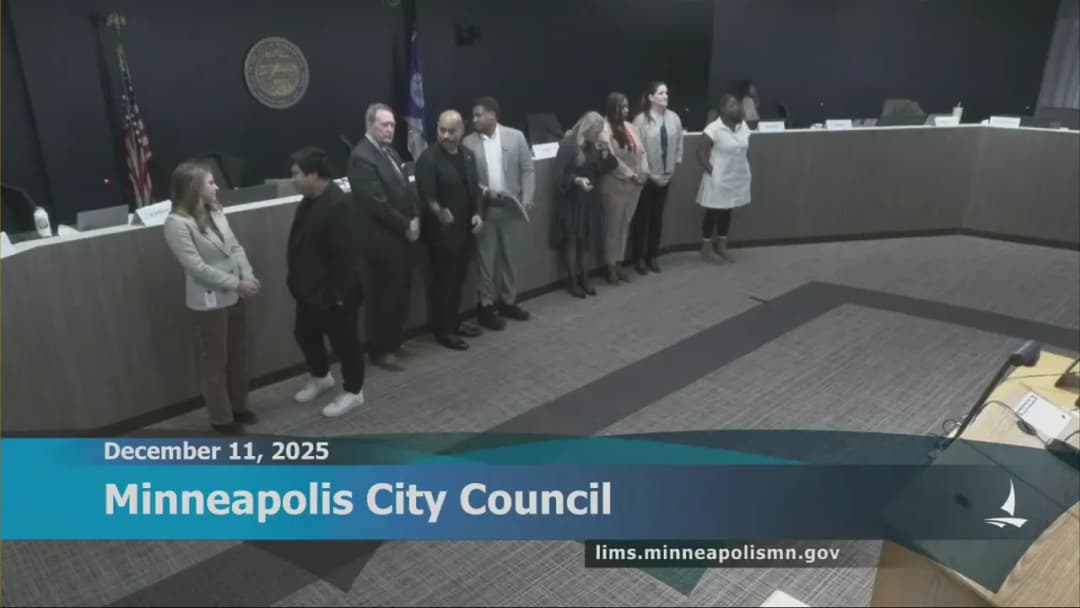
The Minneapolis City Council met on December 11, 2025 (regular meeting; reconvened after an earlier recess and pre-meeting honorary presentations). Council President Elliot Payne presided. The council adopted multiple walk-on agenda items, approved extensive committee reports, debated and adopted major ordinances on immigration-related “separation” policy and a Humane Encampment Response framework, took action on George Floyd Square (38th & Chicago) design/implementation items, adopted gas and electric franchise fee increases to support climate/weatherization programs, and passed resolutions related to immigrant community protections and MPD accountability. Attendance/Quorum: Roll call reflected 12 members present initially with Councilmember Osmond absent, then Osmond joined and the meeting proceeded with 13 members. Several later votes included members temporarily out of the chamber; the Clerk later recorded additional votes for members who confirmed how they intended to vote. Recess/Timing: A 20-minute recess was announced earlier with a plan to return at 12:15 p.m. Council later adjourned to Dec. 16, 2025 at 5:00 p.m. as a placeholder date in case mayoral actions required council reconsideration. Agenda Amendments (Walk-ons) - Council adopted agenda amendments to add six walk-on items, including: - Honorary resolutions (Human Rights Day/International Migrants Day; Somali-American community recognition) - Statements of position/resolutions relating to MPD oversight/accountability and immigrant community protection - New business items: Great Northern Winter Festival block event permit; Q3 Contracting amendment for lead service line replacements - Vote: Agenda amendments adopted 13–0; agenda adopted as amended 13–0. Honorary Resolutions & Recognitions (presented before regular agenda) - Human Rights Day & International Migrants Day - Recognized Dec. 10, 2025 as Human Rights Day and Dec. 18, 2025 as International Migrants Day. - Speakers included: - Viviana Salazar, Chair, Minneapolis Commission on Civil Rights: expressed apology and solidarity with targeted communities. - Michelle Rivera, Director, Office of Immigrant and Refugee Affairs (OIRA): urged residents to use the OIRA webpage for rights information and resources. - Service recognitions (honorary resolutions): - Samantha Priest-Denson, Vice President, Board of Estimate and Taxation (BET) - Cited achievements including accessibility improvements and support for investments such as $2.6 million for youth programming. - Councilmember Katie Cashman (Ward 7) - Noted 3,749 constituent cases by Nov. 2025; Cashman personally responded to 1,747; 3-day average response time. - Cited 200+ pieces of legislation authored in a two-year term. - Councilmember Emily Kosky (Ward 11) - Cited creation of a dedicated public safety auditor, expansion of behavioral crisis response, and the Labor Standards Intervention Pilot Project. - Councilmember Jeremiah Ellison (Ward 5) - Cited housing/renter policies (e.g., right to return, relocation assistance, right to counsel), environmental justice work, and tenant ownership pathways. - Councilmember Andrea Jenkins (Ward 8) - Recognized as the first openly Black transgender city council member and first Black transgender council president in the U.S.; cited 20 years of City service (staff + elected). - Fire Chief Brian Tyner - Career began 1995; appointed Fire Chief Dec. 5, 2020; retirement Dec. 31, 2025. - Cited Safe Stations at Stations 14 and 7, and Narcan vending expansion at Stations 5, 14, 21. - Somali-American community resolution (presentation) - Recognized Minneapolis as home to the largest Somali-American community in the U.S., described as “tens of thousands of residents.” - A councilmember described ICE activity and stated the community was “under attack,” urging recognition that Somali-American citizens were being targeted. Consent Calendar - No standalone consent calendar was identified in the transcript. (Routine items were primarily handled through committee reports and roll-call votes.) Public Comments & Testimony - Committee of the Whole public hearing on separation and encampment ordinances was referenced during debate (not transcribed here). - During encampment ordinance debate, Councilmember Palmisano cited that “the public made it very clear in their public hearing that they do not support this ordinance.” Discussion Items Administration & Enterprise Oversight Committee (AEO) – 49 items - Chair: Councilmember Wansley. - Notable items included: - Contracting, bids, and settlements; polling locations designation for 2026. - Health Department master contracts (2026–2028) revised from 69 to 53 master contracts; amount revised to not-to-exceed $5.7 million (temporary, intended to avoid service disruption and allow the next council to develop a longer-term RCA). - Low-barrier employment program contract with Task Unlimited Inc. (pilot focused on the Southside Green Zone, including Greater Phillips and Cedar Riverside) for tasks like trash collection, graffiti removal, snow/ice control. - AEO Item 43 (Workers’ compensation claim of William Palmer) was voted separately. - Votes: - AEO report (minus item 43): 13–0. - Item 43 separately: 10–3 (No votes: Chavez, Wansley, Vice President Chughtai). Business, Housing & Zoning Committee (BHZ) – 25 items - Chair: Councilmember Osmond. - Highlights: - Modification to 59 TIF districts (Item 4) was pulled for separate action. - Great Streets Gap loan supporting a cannabis-related business project in Ward 4; Councilmember Vita stated it would create 100 jobs. - Emergency Solutions Grant (ESG) 2025 recommendations. - Blue Line Extension grant acceptance (FTA). - Wrecking permit notice/environmental mitigation ordinance (Councilmember Chavez described expanded notice to owners within 350 feet and potential required environmental mitigation plans for hazardous materials/waste criteria). - Interim use permit for a shelter near City Hall. - Votes: - BHZ report (minus Item 4; with some item-specific handling): most items 12–0; Item 2 passed 11–1. - Item 4 (TIF modification): - Motion to return to staff failed 3–9. - Approval then passed 11–1 (No: Wansley). Climate & Infrastructure Committee – 14 items - Chair: Councilmember Cashman. - Highlights: - Multiple reconstruction/variance items; Winterapolis Curling Plaza block event permit Feb. 13–22 (Nicollet Mall). - Hennepin County waste disposal contract revised to 1 year and reduced from $15 million to $7 million. - Legislative directive on proposed closure of Hennepin Energy Recovery Center (HERC): requested staff return around June with answers; members reiterated support for closing HERC while seeking additional information. - Gas and electric franchise fee ordinances to expand climate/weatherization funding. - Votes: - Items 1–11 (incl. revised waste contract): 11–0. - HERC legislative directive: 11–0. - Gas/electric franchise fees: 10–3 (No: Palmisano, Rainville, Vita). - Debate included concerns about burden on low-income residents and business impacts versus arguments that climate/weatherization investments reduce long-term costs and address climate impacts. - Councilmember Cashman stated that in 2025, 62% of projects completed through the Green Cost Share Program were in green zones or environmental justice areas. Committee of the Whole – 8 items - Chair: Councilmember Chavez. - Items 1–2 were pulled for separate votes: 1) Separation ordinance (immigration enforcement separation) 2) Humane Encampment Response ordinance - Item 6 (Enterprise policy framework) was pulled briefly for clarification. - Votes: - Remaining items (excluding pulled items): 13–0. Separation Ordinance (immigration enforcement separation) - Co-authors referenced: Chavez, Chowdhury, Vice President Chughtai; Osmond later added as co-author. - Key points stated by supporters: - Strengthens separation of city activities/resources from federal immigration enforcement. - Emphasizes training, reporting, and limits on sharing data/resources absent compulsory legal process. - Speakers stated that since Dec. 1, ICE arrested 400+ people in the Twin Cities, “a majority…with no criminal convictions” (presented as context for urgency). - Vote: Adopted 13–0. Humane Encampment Response Ordinance - Co-authors: Vice President Chughtai, Chowdhury, Chavez. - Core provisions described: - Public-health-centered response; sanitation and waste planning. - Standardized pre-closure notice (authors referenced 7 days), coordination with providers, and property storage. - Exceptions for imminent threats/emergencies. - Positions: - Palmisano opposed, citing safety concerns, cost, and public testimony opposition. - Osmond supported, stating the city lacked consistent policy and describing Ward 6 encampment challenges. - Cashman opposed, citing concerns with longer closure timelines but supported some provisions (storage, reducing police-centric responses). - Vote: Adopted 8–5 (No: Palmisano, Cashman, Rainville, Vita, Jenkins). Enterprise Policy Framework (Item 6) - Discussion emphasized the framework does not delegate council policymaking authority; enterprise policies still require council adoption. - Vote: Approved (roll call showed 11–0 at the time; Clerk later recorded Jenkins as aye, resulting in 12 ayes). Public Health & Safety Committee – 6 items - Chair: Councilmember Chavez. - Included ordinances (e.g., city resources reporting; small & underutilized business enterprise updates) and agreements. - Vote: Adopted (initial roll-call details were truncated in transcript; Clerk later recorded Jenkins as aye). Resolutions (post-committee reports) - Council adopted resolutions that had been presented earlier (including Human Rights Day/International Migrants Day, Somali-American community support, and multiple service recognitions). - Vote: Adopted with 12 ayes at time of roll call; later adjustments indicated additional member vote recording. Unfinished Business – George Floyd Square (38th St & Chicago Ave) - Items: 1) Concept layout approval (“open flexible street” concept) 2) Council resolution supporting additional commitments (including elements tied to the Community Vision Council/CVC) 3) Pedestrian mall ordinance (returned to author) - Positions and concerns: - Chavez opposed the open flexible concept plan, supported the resolution; emphasized distrust and urged serious implementation of CVC work. - Payne supported the CVC vision but said the open flexible concept differs technically from the CVC’s preferred layout; supported the resolution but not the concept layout. - Chowdhury added amendments to the resolution, including urging completion of the “24 demands,” community engagement on closure procedures, reducing barriers (including permitting), and support/funding for memorial maintenance. - Jenkins supported moving forward; said the pedestrian mall approach was constrained by requirements tied to property owners/business support. - Votes: - Concept layout approved 10–3 (No: Chavez, Vice President Chughtai, Payne). Wansley changed vote to nay after the roll call (without objection), making the final tally effectively 9–4. - Resolution adopted 13–0. - Pedestrian mall ordinance returned to author 13–0. New Business 1) Great Northern Winter Festival large block event permit - Vote: 13–0. 2) Q3 Contracting amendment for lead service line replacements - Vote: 13–0. 3) Resolution urging mayor to direct MPD to protect residents/immigrant communities (presented by Wansley) - Described as urging MPD to differentiate between verified federal immigration enforcement and potential kidnappings/impersonation of law enforcement, and to intervene when not verified. - Vote: Passed 8–3. 4) Resolution expressing positions on MPD oversight/accountability relating to the separation ordinance (authored by Chowdhury and others) - Requested consequences for officers who violate separation requirements via police contract or discipline matrix; asked that violations be categorized at high discipline levels (Category D/E). - Also stated council opposition to use of “less lethal” weapons for crowd control. - Vote: Passed 7–3. Key Outcomes - Separation ordinance strengthening city separation from federal immigration enforcement: adopted 13–0. - Humane Encampment Response ordinance establishing notice/storage/public health framework: adopted 8–5. - Gas & electric franchise fee increases for climate/weatherization programming: adopted 10–3. - TIF district modification (59 districts) approved after motion to return to staff failed: approved 11–1. - George Floyd Square: - Open flexible concept layout approved (10–3, later vote change recorded). - Unanimous council resolution adopted supporting community-centered commitments and memorial support: 13–0. - Pedestrian mall ordinance returned to author: 13–0. - Walk-on new business approvals: - Great Northern Winter Festival permit: 13–0. - Lead service line replacement contract amendment (Q3): 13–0. - Resolutions on MPD direction/accountability related to immigrant protections: passed (8–3 and 7–3). - Meeting adjourned to Dec. 16, 2025 at 5:00 p.m. as a contingency date to address potential mayoral actions; council requested prompt communication from the mayor if further action is needed.
The Minneapolis City Council convened an adjourned meeting on December 9, 2025 to complete action on the City’s 2026 budget, including the property tax levy, the 2026 general appropriation (operating) budget, the 2026–2031 Capital Improvement Program (CIP), bonding requests totaling $213,111,460, and 2026 utility rates effective January 1, 2026. The meeting opened with the 4th and final public hearing on the 2026 budget, then recessed and returned for formal votes on budget resolutions, late amendments, and related directives. Public Hearing (2026 Budget) - Mayor’s recommended 2026 budget: presented August 13, totaling $2.03 billion. - Maximum levy growth: set by the Board of Estimate and Taxation at 8% above 2025 (certified to Hennepin County by Sept. 30; expected final certification by Dec. 29). - Levy impact (staff estimate): under an 8% levy increase scenario, citywide residential homesteaded properties would see a median increase of $242 on the 2026 tax bill. - Forecast noted: estimated 2027 current service level levy increase of 5.4% (based on “current known factors”). - Budget staff highlighted improvements to the online budget book, including clearer staffing (FTE) information and a new “2026 budget changes” section on department pages. Public Comments & Testimony - 38th & Chicago / George Floyd Square area: Multiple speakers urged alignment of budget and city actions with the 38th Street Thrive Plan and related business/community support plans, and several opposed a pedestrian mall concept. - Erica Thorne (Community Visioning Council, Ward 9): expressed support for the 38th & Chicago Business Coalition, the “24 demands” made after George Floyd’s murder, and asked council to advance the 38th Street Thrive Plan; also expressed support for separating ICE and the City of Minneapolis. - Lachelle Cunningham (business/property owner at 38th & Chicago; 38th & Chicago Business Coalition, Ward 8): urged “people-centered” investment alongside infrastructure spending; opposed a pedestrian mall and supported a “flexible open design.” - Mylisha Smith (Community Visioning Council co-chair): urged support for neighborhood orgs around the corridor, the business support plan, the community street plan, the Thrive budget amendment, the Roof Depot sale to EP&I, and the ICE separation ordinance. - Ace Rice (business owner, Ward 8): supported the Thrive budget amendment, business support plan, ICE separation ordinance, and additional corridor-focused programming. - Bridget Stewart: asked council to refer to an “Open Street Flex Plan” and requested consideration of property tax assessment relief/deferral for corridor businesses. - Worker rights / Labor Standards Co-Enforcement Program: Many speakers thanked council for restoring funding and urged permanent/ongoing commitment. - Maria Palacios (District 8) and Veronica (CETUL leader): expressed gratitude that council restored the co-enforcement funding after proposed reductions. - Speakers shared experiences of wage theft, paid sick and safe time access, and fear of retaliation, emphasizing the need for enforcement and worker education. - Shelly Stein: cited program results “in the last six months” (contract started late): nearly 2,000 workers reached via Know Your Rights trainings, 500+ worksites, nearly 300 workers supported in resolving violations, and 220 workers trained as workplace rights trainers. - Immigration enforcement and community safety: - Russ Adams (Lake Street Council): supported amendments expanding immigration legal services and immigrant/refugee affairs staffing; also supported co-enforcement and street vendor supports. - Yusra Muhammad: reported an uptick in hate crimes/vandalism threats and possibly another mosque arson incident; supported amendments increasing staff capacity to assist immigrant communities. - Public safety / policing: - Peter Rickmeyer: requested more funding for police investigators focused on non-lethal shootings; suggested using savings from snowplow “light priority mechanisms” (claimed about $600,000 in savings). - Jane Lansing (League of Women Voters of Minneapolis, Reimagining Public Safety Committee): asked council to reconsider Amendment No. 7 and fund a $5.5 million public safety wellness and training center, arguing it is necessary to implement training and the settlement agreement. - Housing and neighborhood investment: - Lane Brown (CANDO, Central Area Neighborhood Development Organization): urged increased dollars for community-controlled Equitable Engagement Fund to support neighborhood-led initiatives. - Jay Randolph (Phillips West Neighborhood Organization): urged increased Equitable Engagement Fund support; noted many neighborhood orgs operate with less than $100,000/year. - Other testimony highlights: - Satish Desai (Ward 8): expressed support for the East Phillips Neighborhood Institute (EP&I) vision (indoor urban farm, community solar, community hub). - Howard Dodson: urged funding to track frostbite injuries, overnight Blue/Green Line service (1 a.m.–5 a.m.), more low-barrier shelter beds and fewer encampment clearings, and asked to lift the city’s moratorium on sister city relationships to pursue a sister city in Ukraine; also cited a 26% drop in overdose rates (attributing to city opioid response efforts). Discussion Items 2025 Property Tax Levies Payable in 2026 - Council adopted the resolution approving the 2025 property tax levies payable in fiscal year 2026. - Vote: 10–0 (with later note allowing Council Member Wansley to be recorded as an “aye”). 2026 General Appropriation (Operating) Budget - Council adopted the 2026 General Appropriation Resolution (department operating budgets funded by taxes and fees) as amended. - Vote: 12–0. Late/Final Markup Amendments Adopted (All Unanimous) - Amendment 38 (Budgetary control / financial policy), as amended by 38B - 38B (Wansley): required quarterly cost reporting and forecasting of costs related to implementing the City–Minnesota Department of Human Rights settlement agreement. - Votes: 38B 11–0; Amendment 38 as amended 11–0. - Amendment 39 (City Auditor Office Remodel) — rollover appropriation to complete office buildout so the City Auditor can office with their team. - Vote: 11–0. - Amendment 40 (Economic Development & Cultural Activation Grant Program) (Chowdhury) - Established a grant program for culturally significant events/festivals (examples cited: Juneteenth, Somali Heritage Month, Indigenous Peoples Day, Latino Heritage Month). - Discussion included whether Ukrainian cultural events could be eligible (author said yes), and a caution raised about cumulative transfers from the Downtown Assets Fund. - Vote: 12–0. - Amendment 41 (Wansley) — Protecting civilian investigators - Earmarked $3.6 million for 31 civilian investigator positions in MPD (including two positions council had restored earlier), to prevent these roles from being cut to fund other initiatives. - Vote: 12–0. - Revised Amendment 9 (Immigration Legal Services) (Chavez/Wansley; Osmond added as author) - Added additional one-time dollars (on top of previously approved ongoing funding) to meet increased demand; funding source discussions referenced concerns about impacts on school-based clinic funding, with assurances stated that the chosen source would not disrupt services. - Vote: 12–0. - Revised Amendments 11 & 12 (Speak Minneapolis and Cultural Media Programming) - Revisions were presented as technical/source corrections requested by administration. - Vote: 12–0. - Amendment 22D (Emergency Housing Voucher CPED implementation) (Wansley) - Clarified rollover/availability of $400,000 one-time administrative funding into 2026; discussion clarified total referenced as $1.8 million, consisting of $1.4 million ongoing plus $400,000 one-time. - Vote: 12–0. 2026–2031 Capital Improvement Program (CIP) - Council adopted the six-year CIP for 2026–2031. - Debate centered on the police training facility being included in the capital plan; Council Member Palmisano opposed the overall plan due to this issue. - Initial vote recorded: 8–4 to adopt; Council Member Osmond then changed vote to “no” on the full capital plan, resulting in 7–5 (still adopted). Bonding Resolutions (Items 4–6) - Council adopted three bonding resolutions requesting the Board of Estimate and Taxation authorize issuance/sale of city bonds totaling $213,111,460. - Vote: 12–0. Utility Rates Effective January 1, 2026 - Council adopted resolution setting municipal utility rates (including water, sewer, stormwater, and solid waste) effective Jan. 1, 2026. - Vote: 12–0. Additional Budget-Related Directives/Resolutions (Separate Votes on Some) - Council considered a package of items connected to the budget but “not technically included” in the adopted budget; items 2, 3, and 7 were pulled for separate votes. - Passed as a package (items 4, 5, 6 + addendum items 1 & 2): 12–0. - Item 2 — Community Connections Conference (resolution & legislative directive): passed 11–1 (Cashman “no”). - Item 3 — Resolution urging termination of city contract with Zen City: passed 11–1 (Palmisano “no”). - Item 7 — Resolution setting annual salaries for Mayor and Council Members for 2026–2029 term: passed 11–1 (Chavez “no”). Key Outcomes - Adopted 2026 budget actions, including: - 2025 property tax levies payable in 2026: adopted 10–0. - 2026 operating budget (General Appropriation Resolution): adopted 12–0. - Late amendments adopted unanimously, including: - Settlement agreement cost transparency via quarterly reporting and forecasts (financial policy change). - City Auditor office remodel rollover. - Creation of an Economic Development & Cultural Activation Grant program. - Earmarking $3.6 million to protect 31 MPD civilian investigator positions. - Additional funding actions for immigration legal services, Speak Minneapolis/cultural media programming, and Emergency Housing Voucher implementation (including $400,000 one-time rollover). - Adopted the 2026–2031 CIP (final recorded vote 7–5 after a vote change). - Approved bonding requests totaling $213,111,460 (12–0). - Set municipal utility rates effective January 1, 2026 (12–0). - Approved multiple budget-adjacent directives/resolutions, including: - Community Connections Conference (11–1) - Urging termination of Zen City contract (11–1) - Setting elected official salaries for 2026–2029 (11–1) - Closing announcement: Council Member Osmond described incidents he said involved ICE actions affecting community members and businesses, stating residents—including U.S. citizens—felt targeted and fearful, and urging neighbor support and continued city response.
On Tuesday, December 9, 2025, the Committee of the Whole met (Chair Jason Chavez) to advance a large slate of items to the full City Council. The committee received presentations and extensive public testimony on two major ordinances: a Humane Encampment Response Ordinance (standardizing public-health-centered encampment response and closure practices) and updates to the City’s Separation Ordinance (limiting City involvement in federal immigration enforcement and adding training/reporting/complaint provisions). The meeting also included a closed session for attorney-client briefings on two litigation matters, after which the committee reconvened and forwarded items to full council. Attendance/Quorum: Roll call at the start reflected 10 members present and a quorum (with several absences noted). After closed session, the committee reconvened at 4:58 p.m. with 10 members present. Consent Calendar - Agenda amendments (added items): Chair Chavez amended the agenda (without objection) to add two travel gift acceptances to the consent agenda and an additional litigation matter for closed session discussion. - Consent items approved (voice vote): - Approved two agreements with CUNY and NYU (both contingent on federal approval). - Authorized contract extension with Danny Murphy Consulting Services. - Accepted a bid for reconstruction of the 10th Avenue Bridge over Midtown Greenway. - Accepted travel gift for Health Commissioner Damone Chaplin to attend the National Association of County and City Health Officials. - Accepted travel gift for Public Works Director Tim Sexton to attend the Advisory Network for Brookings State/Local Transportation Initiative meeting. - Question raised on consent: Council Member Cashman asked for administrative follow-up on the Danny Murphy LLC consulting contract, citing concern about a $200,000 amount and asking why it is necessary for settlement agreement compliance amid what he described as a larger overspend; the Chair directed administration to follow up before the full council meeting. Public Comments & Testimony Ethical Practices Board Appointment – Patrick Burns - Presentation: Kuma Blake (appointing authority representative) recommended Patrick Burns, citing close to 30 years with the State of Minnesota Office of Professional Responsibility and investigative experience. - Public hearing: No speakers. - Action: Public comments were received and filed; the appointment was advanced. Humane Encampment Response Ordinance (Public Hearing) Authors/presenters: Council Vice President Chukty (spoke to context and goals), Vice Chair Chowdhury (detailed ordinance provisions), and Chair Chavez (procedural direction and later remarks). Key proposal elements described in presentation (policy description): - Establishes a consistent standard operating procedure for encampment response. - Public health response requirement: Within 10 days of an encampment forming with at least 20 individuals, the City must coordinate measures including: portable toilets, menstrual hygiene products, hand-washing stations (or functional alternatives in below-freezing temps), first aid, fire extinguishers, naloxone with weather-safe storage, scheduled solid waste collection, needle disposal supplies, multilingual severe-weather relief information, and coordination for housing services/case management. - Pre-closure notice: Requires posting no less than 7 days before closure, with oral conveyance to residents present and notice sent to community partners; exception for imminent threat to life (e.g., fire/natural disaster), with a stated requirement to notify residents of adequate alternative housing or shelter space. - Personal property storage: Beginning with posting of pre-closure notice until closure, the City must offer free storage for personal property; storage must be accessible by public transit and available in Northside and Southside Green Zones. - Day-of-closure provisions: Deploy personnel trained in homelessness response; assist residents in locating alternative shelter/housing. - Law enforcement presence: City to use the minimum number of law enforcement personnel needed for safety. Public testimony—positions expressed (selected themes): - Multiple speakers (e.g., Nicole Mason, Naomi Wilson, Kristen Crabtree, Levi Invick, Sarah Anderson, Kate Vickery) expressed that the ordinance is insufficient, arguing it still enables displacement/sweeps and lacks long-term housing commitments (permanent supportive housing, culturally grounded services, behavioral health supports). Several specifically criticized the 7-day notice as not enough time to secure stability. - Several speakers emphasized impacts on Indigenous people and other disproportionately affected groups; speakers argued current enforcement approaches are harmful and destabilizing. - Byron Richard spoke in support, framing the ordinance as an opportunity to align governmental policy with volunteer/community efforts and cited a Wilder Foundation count of 10,522 unhoused people in Minnesota on Oct. 26, 2023. - Some speakers cited cost claims and enforcement concerns, including: - Statements that the City spends over $330,000 on encampment clearings (one speaker framed this as “every year”; another cited over $330,000 in six months clearing 17 encampments, with more than 80% going to police enforcement). - Chair/presenters stated that closures have cost taxpayers millions over the last five years, and “each closure costs tens of thousands of dollars.” - Some speakers questioned how “minimum police presence” would be enforced and described negative experiences with police presence at closures. Author remarks after testimony: Vice Chair Chowdhury and Council Vice President Chukty thanked speakers, described the ordinance as a “baby step” and linked the issue to broader concerns about state-sanctioned violence. Separation Ordinance Updates (Title II, Chapter 19) – Immigration/City Employee Authority (Public Hearing) Authors/presenters: Chair Chavez, Vice Chair Chowdhury, and Council Vice President Chukty. Context cited by presenters (policy rationale): - Cited a City Auditor after-action review presented Aug. 5 regarding the June 3 Lake & Bloomington federal operation, including recommendations for: - Communication sequencing protocols to notify council leadership during incidents of great public interest. - Reviewing and updating the Separation Ordinance first adopted in 2003. - Presenters described community concern about federal immigration activity and stated they had heard of Somali and Latino residents being detained/stopped. Key proposal elements described in presentation (policy description): - Updates purpose/policy language emphasizing that residents of any immigration status are valued; asserts City resources should not be used for federal immigration enforcement due to public safety impacts and chilling effects. - City resources restrictions: City facilities/properties/monies/equipment/technology not to be used for immigration enforcement, except to comply with a properly issued judicial subpoena or other compulsory legal process when required by law. - Training: Requires new-employee and ongoing training, including distinctions between administrative vs. judicial warrants, public vs. non-public spaces, how to respond to federal inquiries, and rapid-contact protocols. - Non-public city spaces: Limits access to non-public spaces (e.g., employee-only areas, certain lots/ramps/garages not open to the public without restrictions) absent appropriate legal process. - Public safety services: Clarifies City public safety officials do not enforce civil immigration law, including during traffic stops or checkpoints; addresses limits on entering agreements with federal agencies that would require participation in civil immigration enforcement. - Reporting requirements: Administration to report to the Mayor, Council, and publicly (to the extent practical) when public safety personnel are deployed related to federal agency requests, including request source, decision-making process, timing, staffing levels, arrests and reasons, and costs (including overtime). - Complaints/discipline: Summary data on number/disposition of complaints reported to Council by June 30 and December 31 each year; complainants/witnesses not compelled to provide immigration status; complaint data preserved for at least 12 months after closure; authors noted intent to add a public reporting mechanism. - Procedural note on amendments: Presenters explained formatting (underlines for earlier language; yellow highlights for new amendments). Chair Chavez also indicated intent to add an amendment requiring Council be notified “as soon as possible” once administration becomes aware of immigration enforcement. Public testimony—positions expressed (selected themes): - Many speakers (including members/leaders of UNIDOS, MIRAC/Minnesota Immigrant Rights Action Committee, clergy, attorneys, educators, and residents) urged adoption of the strongest possible separation ordinance and expressed fear and concern about masked federal agents, due process, and community impacts. - Several speakers referenced specific incidents and/or dates as part of their positions: - Nov. 25: multiple speakers described witnessing an ICE raid in St. Paul and interactions involving pepper spray or aggressive tactics. - One speaker stated that since the meeting began around 1:50, another raid occurred and was viewed on a live feed. - One speaker described a client who paid a $10,000 ICE bond in May 2011 and was transferred to Texas, with a future hearing date of Jan. 5. - Some speakers urged non-cooperation with all federal law enforcement broadly (not only civil immigration), arguing that immigration violations can be criminalized and that limiting language to “civil immigration” could become ineffective. - Additional requested protections raised by speakers included: ICE-free zones for all city property, preventing MPD “crowd control” at immigration actions, banning face coverings and requiring clear identification for law enforcement, and stronger enforcement/accountability for violations. Closed Session (Attorney-Client Briefings) - Legal basis: City Attorney Anderson cited Minnesota Open Meeting Law Minn. Stat. § 13D.05, subd. 3(b) (attorney-client privilege) and advised the Council to weigh the public’s right to know against the need to preserve confidentiality. - Litigation matters briefed: - City and County of San Francisco et al. v. Trump et al. - United States of America v. State of Minnesota et al. - Vote to enter closed session: Motion approved by voice vote. - Reconvened: Committee reconvened in open session at 4:58 p.m. Key Outcomes - Consent agenda approved (voice vote), including two added travel gift acceptances and contract/bid items. - Ethical Practices Board appointment (Patrick Burns) advanced after receiving/filing public comment (no public speakers). - Public hearings held for: - Humane Encampment Response Ordinance (discussion/vote deferred until after closed session). - Separation Ordinance updates (discussion/vote deferred until after closed session). - Post–closed session action: Upon reconvening, Chair Chavez moved (without objection) to move all items to the full City Council meeting “as amended.” - Adjournment: With no objection, the meeting was adjourned after reconvening.