Browse by city
Date range
Search help

Search titles, summaries, topics and stored transcripts together. Keywords may match separately; put the whole query in double quotes for a phrase. Matching follows word analysis, so punctuation is not exact. Both dates are included. Documents are not searched.

SHOWING 31–40 ENTRIES
31
SEP 29, 2026 · MONTGOMERY COUNTY, MARYLAND · COUNTY COUNCIL & COMMITTEES
Montgomery County Council Meeting – September 29, 2026

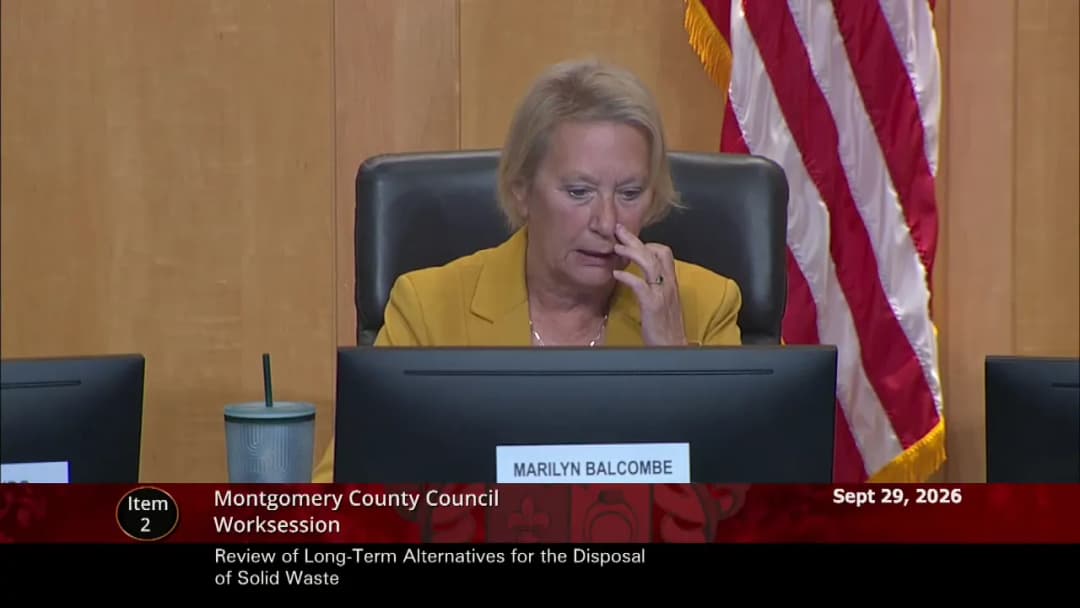
The Montgomery County Council convened on September 29, 2026, for a full-day session that began with two proclamations (Dolly Parton Day and Economic Development Week), followed by a consent calendar, a worksession on long-term solid waste disposal alternatives, public hearings on water and sewer plans and an OZAH fee schedule, and a district council session that took action on several zoning items. The meeting also included a closed session for legal advice and a youth town hall in the evening. Consent Calendar - The Council acknowledged receipt of two Inspector General publications: one concerning alleged misconduct by an Office of the County Attorney employee, and one concerning alleged misconduct by a Montgomery County Police Department executive. - Introduced a resolution to declare no further need for a portion of the Gude Landfill and to dispose of it via a long-term lease to Community Power Group LLC (public hearing scheduled for October 13, 2026). - Introduced and adopted a resolution approving a state grant petition for Montgomery College's Theatre Arts Building Renovation Project ($4,325,000). - Introduced and adopted a resolution approving a state grant petition for Montgomery College's Macklin Tower Library Project ($912,000). - Introduced and adopted a resolution confirming the appointment of Julie Anderson to the Friendship Heights Village Council. - Adopted resolutions confirming County Executive appointments to the Department of Permitting Services Advisory Committee (Radwan Chowdhury), Historic Preservation Commission (Marc Dominianni, Jennifer Kirwan, Karl Pitt), Commission on Landlord-Tenant Affairs (Donald Cooksey, Craig Kundrot), Commission for Women (Tiffany Boiman, Ana Bonilla, Stephanie Cardot, Georgia Coffey, Sheena Foster, Alyssa Sanders), and Commission on Children and Youth (14 appointees). - The consent calendar was approved with 10 votes in favor (one abstention noted as WJ ta). Public Comments & Testimony - Water and Sewer Plan Public Hearing (1:30 p.m.): Two speakers addressed the 2026-2035 Comprehensive Water Supply and Sewerage Systems Plan. - Joan Parrish (Friends of Ten Mile Creek and Little Seneca Reservoir) opposed granting sewer connections to RE1-zoned properties on Clarksburg Road, arguing that such changes would undermine the master plan and increase development pressure. She urged the Council to maintain the current policy excluding RE1 zoning from public water and sewer access. - Susina Lemma Ashame (applicant for a sewer connection at 21820 Clarksburg Road) supported the connection, explaining that she plans to develop an assisted living facility for a nearby 55+ community. She stated that the facility would allow seniors to remain close to friends and family as they age. Discussion Items - Worksession: Long-Term Alternatives for Solid Waste Disposal (9:30 a.m. – 11:15 a.m.): The Council heard a detailed presentation from ReWorld, the operator of the county’s Resource Recovery Facility (RRF). ReWorld emphasized that the RRF is a world-class system that diverts 90 million tons from landfills annually, generates 250,000 MWh of electricity (powering about 24,000 homes), recycles 10,000 tons of metal per year, and avoids 901,000 metric tons of greenhouse gases. They argued that trucking waste to landfills would be more expensive (citing a $1.4–1.8 billion higher lifecycle cost over 30 years compared to upgrading the RRF), increase truck traffic (100–160 trucks per day from the transfer station), and pose greater safety and environmental risks. ReWorld proposed a phased capital investment of $100 million less than the Arcadis estimate, with per-ton pricing and performance guarantees. Council members questioned ReWorld on emission exceedances (two events in 2025), continuous monitoring feasibility, PFAS destruction (99% at grate temperatures of 2,000°F), ash disposal options (including potential reuse as aggregate and a non-EJ landfill in Pennsylvania), and the financial implications of reduced waste volumes. Council Vice President Balcom and Councilmember Glass highlighted the deferred maintenance issue, noting that major capital needs were only brought to the Council’s attention two years ago. Councilmember Mink pressed for cost comparisons including selective catalytic reduction and more frequent testing. DEP Director Macedonia noted that a competitive procurement process would be needed for any long-term contract. - District Council Session (1:35 p.m.): - LMA H-161 (495 Self Storage LLC): Introduced; action tentatively scheduled for October 6, 2026. - ZTA 26-09 (Rural Village Center Overlay Zone – Vehicle Repair – Limited Use): The PHP Committee recommended enactment with amendments, including clarifying setbacks (50 feet from residential lot lines, with Planning Board authority to modify), allowing alternative shade tree structures (requiring equivalent tree planting elsewhere), and technical corrections. Councilmember Sales asked why heavy commercial vehicles (up to 16,000 lbs) were not included; staff explained that such repair is only allowed in industrial zones and a broader ZTA would be needed. - SMA H-163 (University Boulevard Corridor Plan): Adopted after re-noticing due to a duplicate application number. The vote was 8-3 (Councilmembers Mink, Katz, and Jawando voting no). Key Outcomes - Solid Waste Disposal Worksession: No vote taken; the Council will continue discussions at a future worksession with a comparative chart of environmental, fiscal, and community impacts. Staff will follow up on ReWorld’s answers regarding costs, emission controls, and ash reuse. - OZAH Fee Schedule: The Council adopted a resolution adding fees (25% of the prevailing conditional use fee or $540 plus $960 per square foot) for reinstatement of non-conforming uses (unanimous). - Zoning Ordinance Amendment Process: The Council approved revisions to the process for introducing and considering zoning text amendments, clarifying who may recommend a ZTA, transmission requirements, and withdrawal procedures (unanimous). - ZTA 26-09 (RVC Vehicle Repair): Enacted as amended (unanimous roll call vote, 11-0). - SMA H-163 (University Boulevard Corridor Plan): Adopted (8-3; Councilmembers Mink, Katz, and Jawando opposed). - Public Hearings: The hearing on the OZAH fee schedule was closed; the hearings on WSSC water spending control limits and the water/sewer plan remain open (record closes October 5, 2026, and September 29, 2026, respectively). - Closed Session: The Council met in closed session from 11:15 a.m. to discuss legal advice and litigation strategy regarding contractual rights and facilities. - Youth Town Hall: Scheduled for 6:00 p.m.
WASTE MANAGEMENT 35% · PROCEDURAL 13% · ENVIRONMENTAL PROTECTION 12% · PLANNING AND ZONING 8%
32
SEP 29, 2026 · MONTGOMERY COUNTY, MARYLAND · COUNTY COUNCIL & COMMITTEES
Montgomery County Youth Town Hall - September 29, 2026

On September 29, 2026, the Montgomery County Council held a Youth Town Hall hybrid meeting at the Council Office Building in Rockville and via Zoom. Council President Natalie Fanny Gonzalez led opening remarks, emphasizing that youth represent 22% of the county's population and that the goal was to uplift student voices. Council members and Board of Education members introduced themselves. Students asked questions on topics including affordability, community involvement, school safety, AI job displacement, immigrant protections, recreation spaces, and pedestrian safety. Council members responded with information on existing programs and future plans. Public Comments & Testimony - Lou DeWitt, Student Member of the Board of Education, asked what the council is doing to ensure current students can afford to live, work, and raise families in Montgomery County in the future. - Anaya Tim Lusagonta (Nelsville school) asked how middle schoolers can help their community. - Harold Sir (Rosa Parks Middle School) asked about plans to improve security and prevent firearm threats in schools. - Sumia Tahira (Seneca Valley, virtual) asked about strategies to address job displacement from AI and how students can prepare. - Advik Sink (Russland Middle School, virtual) asked how Montgomery County has improved in healthcare, education, and governance compared to other counties. - Sophia Salin Cafe (Clarksburg High School) asked for specific steps to protect immigrant and undocumented students from fear due to immigration enforcement. - Miles Chen (Pyle Middle School, virtual) asked about safe and affordable places for kids to hang out, play sports, and spend time with friends. - Arshan Sadiqi (Robert Frost Middle School, virtual) asked what the county is doing to improve pedestrian safety around middle schools. Discussion Items - In response to Lou DeWitt, Council President Fanny Gonzalez highlighted efforts in economic development, life sciences, workforce training through Worksource Montgomery, and housing affordability to retain graduates in the county. - Councilmember Katz responded to Anaya by encouraging use of the Montgomery County volunteer website, hosting food drives, volunteering at parks, and emphasizing the value of being a friend and smiling. - Councilmember Mink responded to Harold on school safety, stressing early intervention, conflict de-escalation, street outreach networks, and the importance of after-school activities. She noted that preventing a firearm from entering a building requires addressing earlier missed opportunities. - Councilmember Will Jawando responded to Sumia on AI: he cited NVIDIA’s CEO suggesting that infrastructure jobs (electricians, etc.) will be valuable, and advised students to do well in school and stay curious. - Councilmember Laurie-Anne Sayles responded to Advik, citing life expectancy, AARP recognition, vaping funding, mental health expansion, improved MCPS test scores, graduation rates, partnerships with UMD, and the county’s AAA bond rating for 53 years. - Councilmember Evan Glass responded to Sophia, listing legislative actions: Trust Act, County Values Act, unmasked ICE Act, ICE Out Act, and vehicle recovery bill. He emphasized that Montgomery County Police are clearly identified and that schools are limiting ICE access. - Councilmember Kate Stewart responded to Miles on safe recreation spaces, highlighting recreation department partnerships, events like Buckets and Beats, skateboarding lessons, and upcoming MoCo Pride Center in Silver Spring. - Councilmember Andrew Friedson responded to Arshan on pedestrian safety, noting that road incidents kill more than homicides, and the council has funded safe routes to school, collaborated with MCPS and DOT on school access, and focuses on transportation in out-of-school time planning. Key Outcomes - No formal votes were taken. - Students were informed about SSL (Student Service Learning) hours: participants must complete a reflection Google form by 5 p.m. the following day to earn credit. In-person students received forms from MCPS; virtual students received instructions on Zoom. - Council members invited students to apply for internships and fellowships in county government, and to stay engaged via future work sessions.

PUBLIC ENGAGEMENT 22% · PUBLIC EDUCATION 16% · YOUTH PROGRAMS 13% · IMMIGRATION POLICY 11%
33
SEP 28, 2026 · MONTGOMERY COUNTY, MARYLAND · COUNTY COUNCIL & COMMITTEES
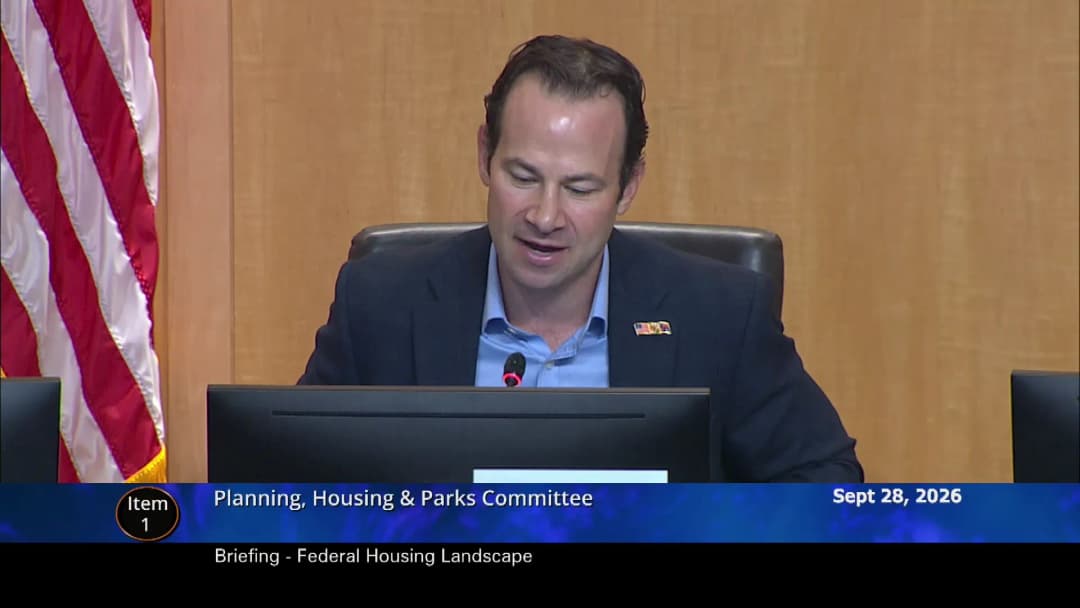
Montgomery County Planning, Housing & Parks Committee Meeting on Federal Housing Landscape and OLO Affordable Housing Report - September 28, 2026

On September 28, 2026, at 1:30 p.m., the Planning, Housing & Parks (PHP) Committee met in Rockville, Maryland, to review the federal housing landscape and a new Office of Legislative Oversight report on affordable housing production and preservation across the Washington region. Chair Andrew Friedson led the meeting, joined by Council President Natali Fani-González and Councilmember Will Jawando (virtually). The committee heard from state, county, public housing authority, municipal housing authority, and planning staff. No votes were taken. Federal Housing Landscape Briefing - Maryland DHCD perspective: Chuck Cook, senior advisor, and Mira Morgan, senior policy analyst, described the 21st Century ROAD to Housing Act, enacted July 11, 2026, with votes of 85-5 in the Senate and 358-32 in the House. Morgan said the package includes over 60 housing provisions focused on supply, including reauthorizing the HOME program, making affordable housing construction eligible for CDBG, and creating seven new grant programs for state and local governments. She noted HUD faces at least 125 required actions and is down about 30% of staff compared with fiscal year 2025, and the Act includes no new appropriations; funding may not come until fiscal year 2028 at the earliest. Asked about state legislation, Cook said DHCD expects to draft a single-stair building bill in mid-December based on the Maryland Department of Labor study due December 1. Cook said the department's "evergreen position" is that "more federal money is better." - County DHCA perspective: Scott Bruton, director of the Department of Housing and Community Affairs, with Matt Cornower, reviewed DHCA-administered HUD funds (CDBG, HOME, ESG). He reported that in the House FY27 THUD appropriations bill, CDBG and ESG appeared level-funded, while HOME funding was reduced by 60%. He highlighted ROAD changes: CDBG can now fund new affordable housing construction, capped at 20% of a grantee's CDBG allocation; HOME eligibility for homeownership assistance rises from 80% to 100% of area median income; HOME purchase price limits are increased; and 24-month HOME commitment deadlines are removed. Bruton cautioned that the 2021 Build America, Buy America Act raises costs by about 25%, and that potential CDBG formula changes could cut allocations by 10% for jurisdictions below median housing growth. - Housing Opportunities Commission (HOC): HOC President Andrews and Vice President of Government Affairs Ken Silverman highlighted nine ROAD provisions relevant to housing authorities, including the public welfare investment cap increase for bank investment in low-income housing tax credits, rental assistance demonstration (RAD) permanence, a family self-sufficiency escrow pilot, streamlined inspections, and Moving to Work expansion. Silverman noted the FHA-Federal Financing Bank risk-share enhancement remains paused by the Trump administration and is not in ROAD; HOC hopes ROAD 2.0 will authorize it. Andrews reported that HOC administers about 7,800 vouchers and 1,787 project-based rental assistance units, and has issued nearly $900 million in federally supported multifamily mortgages. She said HUD recaptured $5.8 million from HOC reserves, the agency is not currently issuing vouchers, more than 50% of housing authorities are in shortfall, and HOC expects to begin reissuing vouchers in spring after projected shortfall resolution by January. HOC also received a $1 million congressional earmark for its Wheaton Gateway project. - Rockville Housing Enterprises (RHE): Executive Director James Hedrick said RHE serves roughly 1,300-1,400 families. He emphasized that RHE's 76-unit David Scull Courts public housing site needs RAD conversion because federal operating and capital funding is insufficient for rehabilitation. RHE has 80 public housing units total (76 at David Scull, 4 at Parkside). Hedrick supported ROAD provisions on inspections, family self-sufficiency, opportunity zones, and CDBG flexibility, noting some are already implemented through RHE's Moving to Work waivers. OLO Report 2026-8: Local Affordable Housing Production and Preservation Programs - Presentation: Office of Legislative Oversight analysts Williet Finn and Natalia Carrizosa presented findings from interviews with 15 Washington-region jurisdictions. They reported that the Metropolitan Washington Council of Governments set a 2020-2030 regional target of 320,000 new housing units, with 75% affordable to low- and middle-income households. Montgomery County supported the regional target but has not adopted its own affordable housing target. From 2021 to 2025, the county produced 2,592 units affordable at 80% AMI or below, 18% of total units built; this exceeded Fairfax and Prince George's counties but trailed the District of Columbia. - Regional approaches: Fourteen of 15 jurisdictions have dedicated housing trust funds; Montgomery County's is the Housing Initiative Fund. The county's MPDU program, adopted in 1973, was the first inclusionary zoning program in the U.S. and requires 12.5% to 15% affordable units in developments of 20 or more units, with no fee-in-lieu. Nine of 15 jurisdictions fund local rental assistance, and 10 fund local homeownership assistance; Montgomery County's maximum down payment assistance is a $50,000 deferred, zero-interest loan, more than Frederick County but less than Loudoun, Arlington, and D.C. - Equity data: OLO reported that about 75% of white and Asian households in Montgomery County own their homes, compared with 54% of Latinx and 40% of Black households. Latinx and Black households are 50% more likely than white and Asian households to spend at least 30% of income on rent, and 84% of adults experiencing homelessness on the 2025 point-in-time count identified as people of color. - Stakeholder feedback: OLO said community stakeholders reported that residents lack awareness of rental assistance options, that county program complexity can deter developers, and that help often comes only at crisis. Municipalities including Rockville and Gaithersburg view Montgomery County as a model and see opportunities for collaboration on public land and financing. - Recommended issues: OLO recommended the council discuss adopting affordable housing targets, improving data transparency through a cross-departmental housing dashboard, deepening community engagement, and increasing policy alignment with Rockville and Gaithersburg. Discussion Highlights - Chair Friedson expressed strong support for measurable housing targets, noting targets help the region and could unlock federal and state incentives; he said the target conversation should return by the end of October. Councilmember Jawando emphasized the human urgency, citing three new eviction and homelessness cases in his office in 24 hours, and said he looks forward to advancing his anti-algorithmic price-fixing bill. Council President Fani-González defended HOC against unfair blame during the voucher shortfall, said the county cannot solve housing alone, and advocated including HOC data in any new dashboard. - Lisa Gavoni of Montgomery County Planning said the county recently completed a statistically valid housing preferences survey, which will go to the Planning Board on November 12 and can be briefed to the committee afterward. She noted 11 projects are using the commercial-to-residential reconstruction (CRR) tool, producing at least 17.5% MPDUs. On housing targets, Planning is open to developing affordable housing goals but needs to account for the county's diverse geography. - In response to Jawando, DHCA Director Bruton said the county is building a cross-departmental housing production pipeline dashboard, with a common property identifier already in place; the goal is a working model by Thanksgiving or the end of 2026. Key Outcomes - The committee took no votes; the items were briefings and information-gathering. - The committee plans to continue the affordable housing target discussion in the coming weeks and to schedule a briefing on the housing preferences survey after November 12. - DHCA, Planning, and Permitting Services are on track to deliver a working housing pipeline dashboard by the end of 2026. - State DHCD will monitor ROAD implementation and share its draft single-stair legislation with the county after the Department of Labor study is released December 1.

AFFORDABLE HOUSING 40% · HOUSING 38% · PUBLIC ENGAGEMENT 13% · HOMELESSNESS 2%
34
SEP 28, 2026 · MONTGOMERY COUNTY, MARYLAND · COUNTY COUNCIL & COMMITTEES
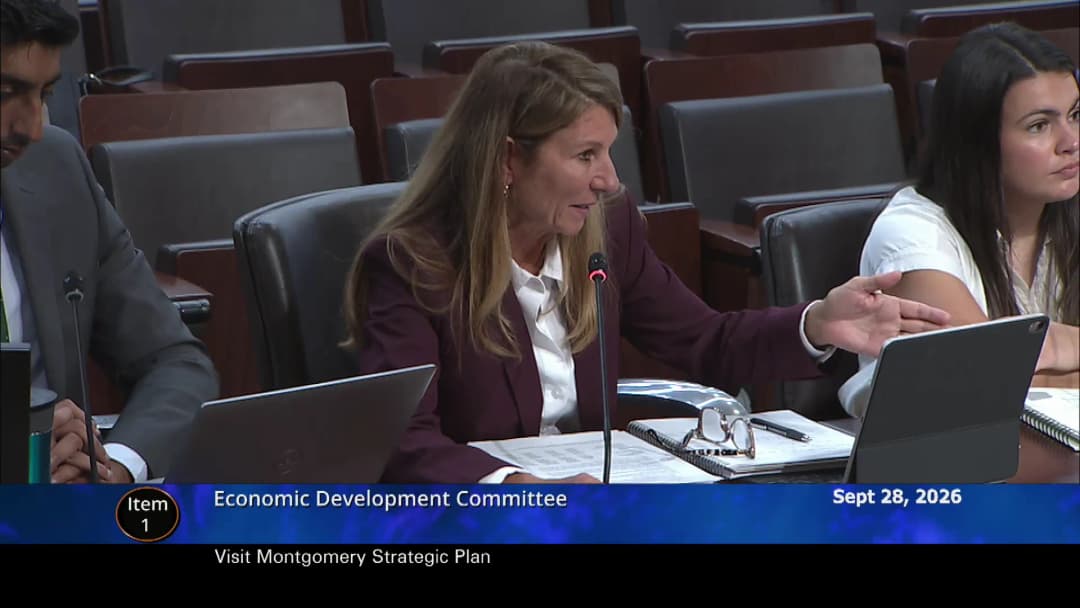
Economic Development Committee Work Session on Visit Montgomery Strategic Plan – September 28, 2026

On September 28, 2026, the Montgomery County Council’s Economic Development (ECON) Committee held a work session to review the Visit Montgomery Strategic Plan, funding structure, and the future of the Sports Tourism Task Force. Chair Natali Fani-González opened by highlighting the new MARC train connections to Baltimore and previewing the fall work session schedule. No public testimony was taken. The committee heard presentations from Visit Montgomery CEO Kelly Groff and consultant Aviva North (Caragio Group) on the brand assessment and the five-year strategic plan. Discussion Items - Brand Assessment & Strategic Plan: The brand assessment, conducted by Miles Partnership, concluded that Montgomery County has a meaningful claim as Maryland’s cultural capital but that sub‑brands (e.g., Tastemakers Trail, MoCo Eats) remain fragmented. The strategic plan contains five imperatives: brand unity, visitation growth & balance, destination connectivity, community & stakeholder engagement, and organizational capacity. A key finding was that overnight visitors have declined by 1.35 million since 2019 (from 3.95 million to 2.6 million), while day‑trip visitors held steady at 5.6 million. The plan aims to boost overnight stays and diversify beyond federal government travel. - Competitive Funding Analysis: Visit Montgomery’s current budget is approximately $2.5 million, derived from a 7% hotel motel tax plus county enhancements. The consultant compared this to peer DMOs: Fairfax County’s budget rose from $3.1 million to $9.9 million; Arlington is studying a Tourism Improvement District (TID). Visit Montgomery’s budget is lower per hotel room than many competitors, and its advertising budget ($600,000) is managed without an external agency. Overnight visitation recovery lags behind regional peers. - Funding Structure Options: Council staff (Bilal Ali) proposed moving to a “base budget” of $2.5 million (same services) regardless of hotel tax fluctuations, and a separate “grants, incentives, and programming fund” (starting at $200,000) to pilot new initiatives, attract events, and support sport tourism. This would decouple Visit Montgomery’s funding from the volatile hotel tax and provide stability. A TID—adding an assessment on hotels—was also discussed but not recommended at this time. - Sports Tourism Task Force: The task force, created jointly with the Education & Culture Committee, has helped coordinate events across agencies (e.g., an Asian food festival redirected to the fairgrounds). The committee discussed formalizing the task force as a permanent forum housed at Visit Montgomery to ensure continued cross‑agency collaboration. A joint committee work session with Education & Culture will be held to amend the original resolution. Key Outcomes 1. Funding Recommendation: The committee decided to send a letter to the incoming county executive (due after the November 3 election) suggesting (a) a stable base budget of $2.5 million for Visit Montgomery, and (b) establishment of a flexible grants/incentives fund (suggested minimum $200,000). No formal vote was taken; the letter is to be drafted by staff and reviewed by the committee by end of October. 2. Sports Tourism Task Force: The committee will schedule a joint work session with the Education & Culture Committee to vote on an amended resolution that gives a permanent home for the task force at Visit Montgomery. The task force will continue coordinating leads among MCPS, Recreation, Parks, and the private sector. 3. No Immediate Legislation: The committee clarified that the strategic plan briefings do not require a council vote; the county executive will submit comments by January 15, 2027, with a council vote on the plan required by March 15, 2027.

TOURISM 53% · ECONOMIC DEVELOPMENT 19% · BUDGET EQUITY ANALYSIS 18% · TECHNOLOGY AND INNOVATION 4%
35
SEP 24, 2026 · MONTGOMERY COUNTY, MARYLAND · COUNTY COUNCIL & COMMITTEES
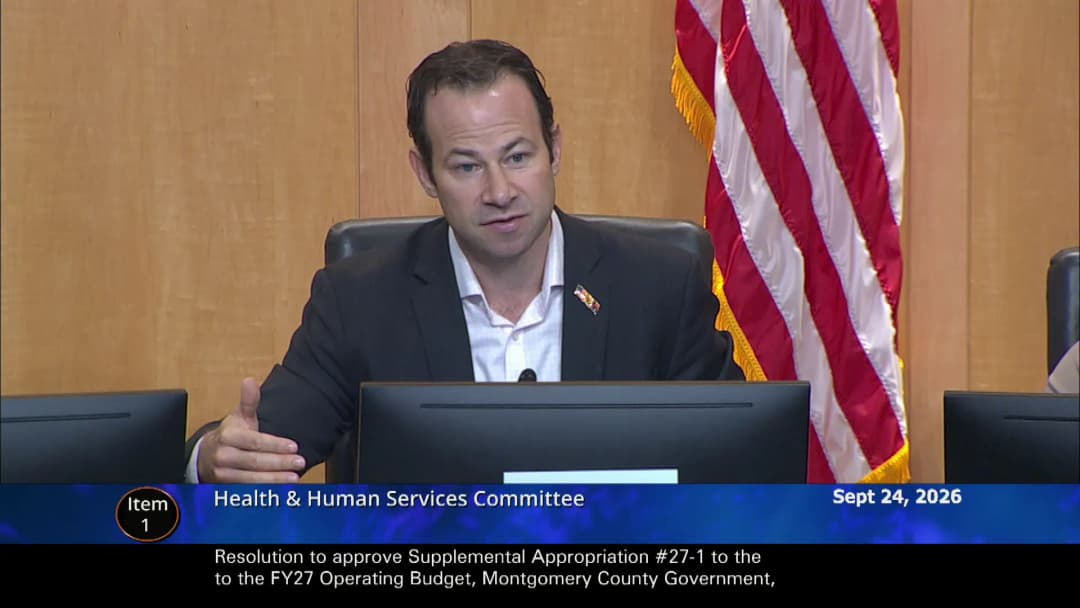
Health and Human Services Committee Work Session – September 24, 2026: Supplemental Appropriation for Youth Vaping and Nicotine Addiction Response

The Health and Human Services (HHS) Committee met on September 24, 2026, from 9:30 a.m. to 10:30 a.m. to review and make a recommendation on FY27 Supplemental Appropriation 27-1 for the Department of Health and Human Services (DHHS) totaling $390,000. The funds, drawn from the JUUL/Altria settlement restricted revenue, are earmarked for youth vaping and nicotine addiction response programs. The committee heard from Legislative Analyst Nicole Rodríguez-Hernández and DHHS staff, and after discussion unanimously recommended approval. Discussion Items - Context and Data: Rodríguez-Hernández reported that nearly one in five surveyed Montgomery County high school students has used an electronic vapor product, and 10.2% currently use a tobacco or vaping product. The county has received approximately $3.9 million from settlements to date, with no expectation of additional funds. - FY25 Grant Programs: The first $1.6 million appropriation supported three community grants (Elite Soccer Youth Development Academy, Identity Inc., Tree of Hope Association) focused on peer-led initiatives and cessation support. These programs are currently under implementation with a no-cost extension through October 2026. - Re-appropriation of Unspent Funds: The $390,000 request re-appropriates $250,000 for RecMode Fitness and Boxing LLC’s “Beyond the Gloves” 12-month project, $100,000 for the Street Outreach Network (to purchase two passenger vans), and $40,000 for a contracted administrative specialist. Earlier appropriations for these projects went unspent in FY25 due to staffing vacancies and late notification of fund availability, a problem that DHHS acknowledged and is addressing. - Program Metrics and Evaluation: DHHS staff described planned evaluations including pre/post tests, tracking of academic performance, attendance, and knowledge/attitude changes for the 120 unduplicated youth targeted by RecMode. For the Street Outreach Network, vans will help address transportation gaps during peak after-school hours (3–6 p.m.) when substance experimentation is highest. Council members requested baseline data on current youth served and requested a report on grant utilization rates and outcomes. - Communication and Data Sharing: Councilmember Mink pressed for improved communication and timeline for distributing funds to community organizations. strengthening data sharing with Montgomery County Public Schools (MCPS) to measure outcomes beyond participation. DHHS noted plans to hire additional grants manager and support staff coordination with systems. - Community Engagement for Remaining Funds: DHHS announced a community-based engagement process using Cancer Tobacco, Cannabis Resource to develop FY27 expenditure with the coalition), led partnership voice youth believes input council. Key Outcomes - Motion and Vote: Chair Sayles moved to recommend approval of FY27 Supplemental Appropriation 27-1 for $390,000. The motion passed unanimously Councilmembers Friedson Luedtke ( Sayles)- Rodríguez Unanimous vote). - Requests for Additional Information: Council recorded request a report on DHHS grant and baseline utilization requested Justin Friedson request data on current youth participation and report to oversight. Mink review grant outcomes Streighter request data sharing with MCPS of data sharing of youth outcomes. - Next Step: Council action on September 2027 at later date. - Meeting Adjourned: Chair Adjourned the meeting.

YOUTH PROGRAMS 46% · PUBLIC HEALTH 14% · PUBLIC HEALTH SERVICES 12% · PUBLIC ENGAGEMENT 11%
36
SEP 22, 2026 · MONTGOMERY COUNTY, MARYLAND · COUNTY COUNCIL & COMMITTEES
Montgomery County Council Meeting Summary for September 22, 2026

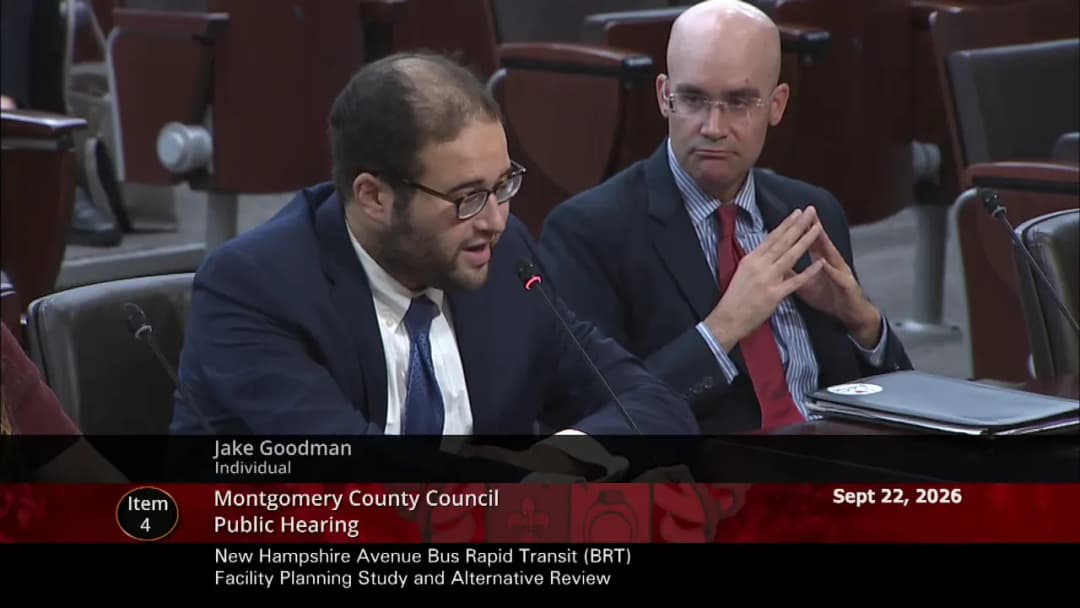
The Montgomery County Council met on September 22, 2026, for a full-day session that began with two proclamations—recognizing National Senior Citizens Day and celebrating the county's 250th anniversary—and continued with four public hearings and a district council session. Key actions included a resolution to approve an amendment to the FY27-32 Capital Improvements Program for road resurfacing, which was adopted after a public hearing, and the introduction of a resolution to revise the process for zoning text amendments. Presentations & Proclamations - National Senior Citizens Day (11:45 a.m.): Councilmember Sayles presented a proclamation recognizing National Senior Citizens Day. Remarks were delivered by Wayne Berman (co-chair, Commission on Aging), Wina Dixon (program manager, African American Health Program), Jennifer Holes (senior associate state director, AARP), and Dr. Patrice McGee (director, Aging and Disability Services, DHHS). Speakers highlighted the contributions of older adults and advocated for equitable transportation, affordable housing, caregiving, and social connection. Dr. McGee noted that residents aged 60 and older will make up 25% of the county’s population by 2030 and 27% by 2040. - 250th Anniversary of Montgomery County (1:00 p.m.): Council President Natalie Fani Gonzalez led a ceremony recognizing the county’s 250th anniversary. Speakers included County Executive Mark Elrich, former County Executive Ike Leggett, Maryland Secretary of State Susan Lee, Delegate Lily Chi, former Councilmember Nancy Navarro, Matt Bohn (president, Montgomery History), and Michelle Johnson (Maryland 250 Commission). Speakers reflected on the county’s transformation from a segregated, mostly white community to a diverse, inclusive population (currently 16% Asian, 21% Black, 22% Hispanic, 43% White). The proclamation was read and presented. Public Hearings & Testimony Amendment to FY27-32 CIP – Resurfacing: Residential/Rural Roads (No. 500511) - The public hearing was held at 1:30 p.m. with no registered speakers. The record was closed immediately, and the Council proceeded to action. Bill 36-26 – Fire and Emergency Services Commission – Duties and Responsibilities - A public hearing was held; no speakers registered. The record remained open until September 23, 2026. A Public Safety Committee worksession was scheduled for September 30, 2026. Bill 37-26 – Disruptive Behavior – Public Facilities – Amendments - The Council heard testimony from nine speakers. In support: Earl Stoddard (Assistant Chief Administrative Officer, for County Executive Mark Elrich) argued the bill is necessary to address rare but egregious behavior, clarified that the current process (since 2004) has been used only once for a juvenile, and announced the Executive’s intent to seek input from the Intellectual and Developmental Disabilities Commission and to develop a community engagement mechanism prior to the October 19 joint committee worksession. In opposition: - Dina Ilebewitz (Jews United for Justice, in collaboration with Black United Front of Montgomery County) expressed concern that the bill would disproportionately affect vulnerable residents, could restrict free speech, and would increase police contacts. - Patricia Tumi (We the People Civil Rights Organization) argued the bill is improperly filed under civil rights jurisdiction and could lead to criminalization of presence in public spaces. - Brenna Olsen (Shepherd’s Table) supported the possibility of longer-term orders in extreme cases but opposed bans covering multiple facilities, warning it could criminalize access to essential services for unhoused individuals. - Thomas Gibson (Neville Street Emergency Men’s Shelter resident, Housing Justice Montgomery) testified that since 2019, 739 disruptive behavior orders had been issued, 78% from libraries, and that Black residents (18% of county population) constitute over 61% of the unhoused population. He argued the bill would effectively criminalize homelessness and urged investment in behavioral health outreach instead of expanded exclusion. - Robert Gravit (plaintiff in a federal lawsuit against the county) described receiving a DBO at a Bethesda pool in 2021, claiming the process lacked due process and the underlying statute was not violated. - Marley Polito (Young People for Progress) opposed the bill as written, citing insufficient safeguards, potential equity impacts on youth and communities of color, and the need for narrow criteria limiting bans to single facilities and shorter durations. - The hearing record remained open until October 12, 2026. New Hampshire Avenue Bus Rapid Transit (BRT) Facility Planning Study and Alternatives Review - Seven speakers testified, all in support of advancing the hybrid alternative recommended by MCDOT and the Planning Board. - Mike Larkin (Action Committee for Transit) supported the hybrid alternative for allowing both Ride-On and Metrobus to use curbside bus lanes, called for repurposing travel lanes, and emphasized the need for immediate safety improvements on New Hampshire Avenue (citing a pedestrian strike less than two weeks prior). - Jake Woodman urged immediate frequency improvements countywide, noting he could not travel car-free due to long headways. - Julian Beckett supported the hybrid alternative and bus priority lanes to improve safety and reduce emissions, referencing recent fatal accidents on the corridor. - Bill Pugh (Coalition for Smarter Growth) supported the plan, noting New Hampshire Avenue serves 14,000 daily bus trips, aligning with Thrive 2050 goals and safety needs. - David Schneider supported BRT and called for incremental improvements like priority turn signals. - Alexis Larames (White Oak resident) supported bus lanes to make transit competitive with driving. - The hearing record remained open until October 12, 2026. Key Outcomes - Resolution to approve CIP amendment (Resurfacing: Residential/Rural Roads): The public hearing was held and the record closed. The Council then voted to adopt the amendment. According to the meeting minutes, the resolution was adopted with 9 votes in favor (DL voted yes; EG abstained). (The transcript described the vote as unanimous, but the official minutes indicate the abstention.) - Bill 36-26: Public hearing held; record open until 9/23/26. - Bill 37-26: Public hearing held; record open until 10/12/26. The County Executive’s office announced it would seek input from the Intellectual and Developmental Disabilities Commission and develop a community engagement mechanism before the joint worksession scheduled for 10/19/26. - New Hampshire Avenue BRT: Public hearing held; record open until 10/12/26. A Transportation and Environment Committee worksession is scheduled for 10/19/26. - District Council Session: A resolution to approve revisions to the Process for the Introduction and Consideration of Amendments to the Text of the Zoning Ordinance was introduced (sponsored by Councilmember Ndou). Action is tentatively scheduled for September 29, 2026.

HISTORIC PRESERVATION 13% · PROCEDURAL 12% · COMMUNITY ENGAGEMENT 12% · SENIOR SERVICES 11%
37
SEP 17, 2026 · MONTGOMERY COUNTY, MARYLAND · COUNTY COUNCIL & COMMITTEES
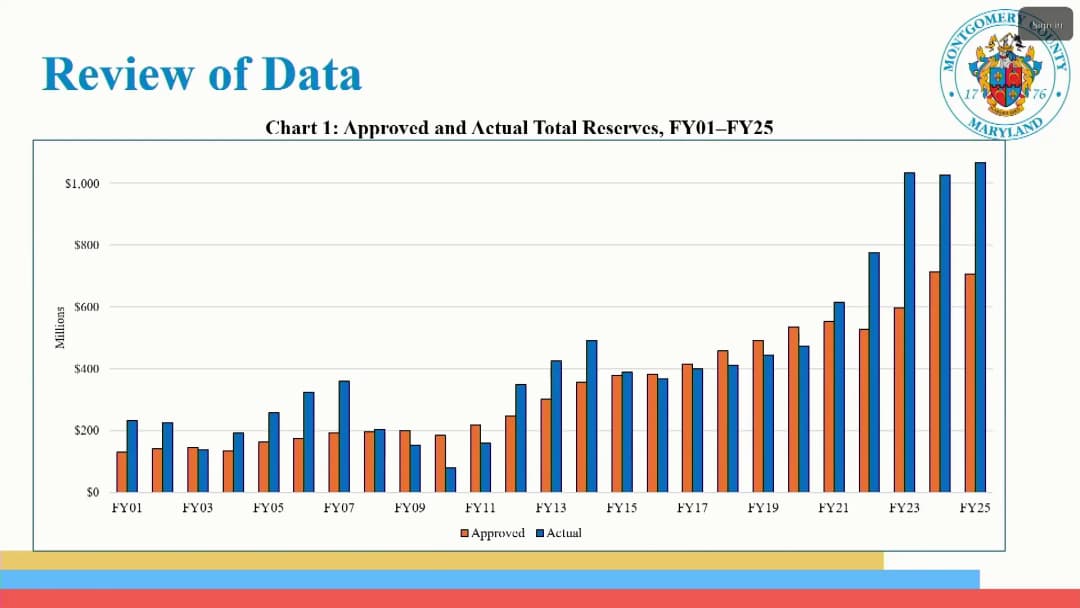
Government Operations & Fiscal Policy Committee: Infrastructure Funding and Reserves Review (September 17, 2026)

The Government Operations and Fiscal Policy (GO) Committee, chaired by Councilmember Kate Stewart and joined by Councilmembers Shebra Evans and Sidney Katz, along with Council Vice President Marilyn Balcombe, convened on September 17, 2026, to receive the final report from the Infrastructure Funding Workgroup and to discuss strengthening the County's Reserve Policy. The session focused on quantifying the county's $1.2 billion annual infrastructure funding gap and developing a more robust fiscal framework for maintenance, capacity, and fiscal resilience. Infrastructure Funding Workgroup Report Council staff Mr. Smith and Ms. Ndou presented the findings of the year-long Infrastructure Funding Workgroup. The workgroup found the county does not lack funding tools but needs a strategy to match tools to specific needs. - Needs Analysis: The county faces approximately $559.3 million per year in deferred maintenance (71% unfunded) and approximately $700 million per year for new capacity and upgrades (totaling about $14.1 billion over 20 years). - Stakeholder Engagement: The workgroup conducted surveys in 6 languages (receiving 200 responses) and held listening sessions. Industry stakeholders argued that development impact taxes stifle growth and that economic conditions are the primary driver for development. Community feedback indicated a perception that the county has a spending problem rather than a revenue problem, but no consensus existed on specific investment priorities between schools and transportation. - Funding Options Reviewed: The workgroup evaluated a countywide property tax increase as the most equitable, predictable, and sustainable option for raising new revenue. Options such as land value taxes, vacancy taxes, excise taxes, and local sales taxes (which require state authority) were considered but had significant drawbacks regarding equity, sustainability, or feasibility. The group did not identify a strong replacement for current development impact taxes. - Recommendation: For maintenance needs, the workgroup recommended prioritizing existing tax revenue differently rather than creating new taxes. For new capacity and upgrades, the workgroup suggested the county build a broad-based coalition to support a specific project or suite of projects before proposing a tax increase. - Council Discussion: Councilmember Katz discussed the need to consider operating costs alongside capital costs and questioned the impact of large transit projects like BRT versus placemaking. Chair Stewart asked the workgroup to elaborate on land value and vacancy taxes, which the group noted were challenging due to limited available underutilized land in the county. Council Vice President Balcombe highlighted the persistent disconnect between impact tax collections and the Capital Improvements Program (CIP) geographic nexus. Review of Montgomery County Reserve Policy The committee revisited the 2025 Davenport Report, which recommended strengthening the county's reserves. - Current Policy: The county targets total reserves equal to 10% of Adjusted Governmental Revenues (AGR), composed of the Unrestricted General Fund Balance and the Revenue Stabilization Fund (RSF). - Davenport Recommendation: Increase the total reserve target to 13% of AGR to meet the Government Finance Officers Association (GFOA) 60-day minimum expenditure threshold and align with top AAA-rated peers. - Current Risk: Mr. Smith noted that while the county has met the 10% target, the composition has shifted heavily toward the RSF, leaving the undesignated balance dangerously low. Because revenues have exceeded projections, the county has used budget resolutions to skip mandatory RSF contributions. - Committee Direction: The committee reached a consensus directing Mr. Smith to draft a memo to the full County Council proposing: 1. Increasing the total reserve target to 13% of AGR, with the RSF set at 10.5% and the undesignated reserve at 2.5%. 2. Amending the fiscal policy resolution to include a specific maintenance funding target as a percentage of AGR, directly tying the reserve policy to the infrastructure needs identified by the Workgroup. Chair Stewart expressed a preference for this integrated approach over creating multiple separate funds, which the committee felt could create unnecessary complexity and confuse the public. Key Outcomes - Directive: Staff (Mr. Smith) was instructed to draft a memo to the full County Council reflecting the committee's consensus on strengthening the reserve policy and integrating infrastructure maintenance funding goals into fiscal policy. - Future Agenda: The committee announced a separate review of the county's Tax Increment Financing (TIF) process, scheduled for the GO Committee on October 22, 2026.

FISCAL SUSTAINABILITY 47% · ENGINEERING AND INFRASTRUCTURE 23% · PUBLIC TRANSPORTATION 12% · COMMUNITY ENGAGEMENT 9%
38
SEP 15, 2026 · MONTGOMERY COUNTY, MARYLAND · COUNTY COUNCIL & COMMITTEES
Montgomery County Council Session - September 15, 2026: Proclamations, Legislation, Public Hearings, and Solid Waste Worksession

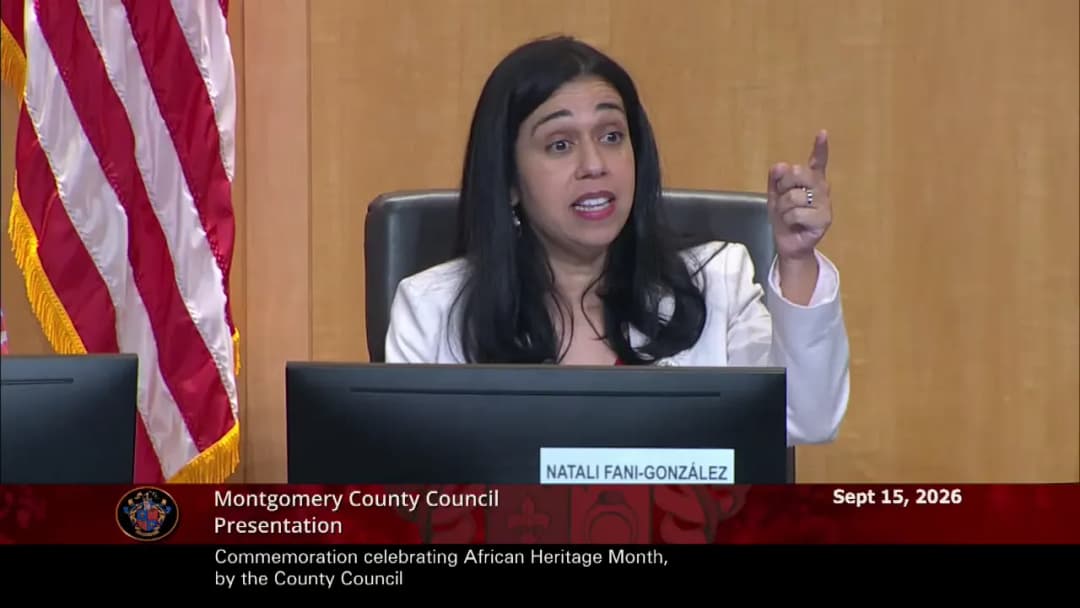
Overview The Montgomery County Council met on September 15, 2026, beginning at 9:00 a.m. The session featured three proclamations (National Preparedness Month, Glenstone Museum’s 20th Anniversary, and Montgomery College’s 80th Anniversary), general business including approval of minutes from July 21 and 28, a closed session for a performance evaluation, reaffirmation of a Planning Board appointment, legislative introductions of 10 bills, final reading of one bill, district council action on zoning text amendments, a consent calendar with 11 items, an African Heritage Month commemoration, multiple public hearings, and a worksession on long-term solid waste disposal alternatives. Proclamations - National Preparedness Month (September 2026) – presented by Councilmember Katz and County Executive Elrich. The Office of Emergency Management and Homeland Security highlighted the “Ready Together” campaign. - Glenstone Museum’s 20th Anniversary – celebrated by Councilmember Sayles; speakers praised environmental stewardship and community partnerships. - Montgomery College’s 80th Anniversary – recognized by Council President Fani-González; the college now serves over 47,000 students and had an estimated $1.4 billion annual economic impact. Consent Calendar - Approved items (10-0; Councilmember Jawando absent): - Acknowledged receipt of Inspector General publications. - Introduced resolution for 2026-2035 Comprehensive Water Supply and Sewerage Systems Plan (public hearing 9/29/26). - Introduced/adopted resolution to appoint Erek L. Barron, Esq. and Mintz Levin for Self-Insurance Fund matters. - Confirmed appointments to: Board of Investment Trustees/Consolidated Retiree Health Benefits Trust (Joshua Burge, Michael Sinoway); East County Citizens Advisory Board (Collins Odongo); Silver Spring Citizens Advisory Board (6 members); Commission on Children and Youth (Marhonda Williams); Pedestrian, Bicycle, and Traffic Safety Advisory Committee (Patrick Kepp); Commission on Child Care (14 members); Animal Matters Hearing Board (4 members); Early Care and Education Coordinating Entity Board (5 members). Legislative Session – Introductions (Day 23) - Bill 39-26 (Wheaton Urban District Boundaries – amendments) – lead sponsor Council President Fani-González; public hearing 10/13/26. - Bill 40-26 (Landlord-Tenant Relations – accepted forms of payment) – lead sponsor Fani-González; public hearing 10/6/26; received co-sponsors from nearly all members. - Bill 41-26 (ADU licensing procedures/fees) – lead sponsors Friedson and Fani-González; public hearing 10/6/26; removes owner-occupancy requirement and waives fees for affordable ADUs. - Bill 42-26 (Short-term rental online platform compliance) – lead sponsor Evans; public hearing 10/6/26; requires platforms to verify licenses. - Bill 43-26 (Smoke escape hoods in multifamily buildings ≥5 stories) – lead sponsor Stewart; public hearing 10/6/26; requires hoods equal to 5% of occupancy. - Bills 44-26 and 45-26 (Data Centers) were deleted from the agenda. - Bill 46-26 (Child Tax Credit – supplemental grant) – lead sponsors Stewart and Evans; public hearing 10/13/26; $500 credit per child for incomes ≤$15,000. - Bill 47-26 (Homeowners Property Tax Credit – expand eligibility) – lead sponsors Stewart, Friedson, Katz, Evans; public hearing 10/13/26; raises income limit from $75,000 to $106,800. - Bill 48-26 (Property Tax Credit – public school employees) – lead sponsor Stewart; public hearing 10/13/26; $2,500 credit for bargaining unit members. Final Reading and Enactments - Bill 28-26 (Intellectual and Developmental Disabilities Commission – membership) – enacted 10-0 (one absent). Renamed the “Jake Dinsky Advocacy Act.” District Council Session - Introduction: Resolution to add fees to OZAH fee schedule (public hearing/action 9/29/26). - Action: ZTA 26-06 (Accessory Dwelling Units – consistency with state law) – enacted 10-0. - Action: ZTA 26-07 (Solar Collection Systems – use standards) – enacted 10-0. Public Hearings (1:30 p.m. portion) - Item 7: CIP amendment for Olney Community Building and Police Satellite Station – public hearing held, record closed; resolution adopted 10-0. Multiple speakers expressed strong support. - Item 8: Expedited Bill 32-26 (Survivor benefits – line-of-duty death) – public hearing held, record open until 10/1/26; no registered speakers. - Item 9: Bill 33-26 (Cable Communications – community media requirements) – record open until 10/1/26. Speakers (CEO of Montgomery Community Media and board VP) urged amendments to preserve editorial independence. - Item 10: Bill 34-26 (Bodywork establishments – licensing) – record open until 10/21/26. Debbie Feinstein (State’s Attorney’s Office) spoke in strong support. - Item 11: Bill 35-26 (Forest Conservation – brush management on agricultural land) – record open until 9/28/26. Multiple farmers and the Planning Board supported with proposed amendment tying to soil conservation plans. - Item 12: Bill 38-26 (Discriminatory housing practices – immigration status) – record open until 10/9/26. Over a dozen speakers testified in strong support; some suggested amendments on notice and reporting. - Items 13–15: ZTA 26-10 (driveway access), ZTA 26-11 (benefit performances), SRA 26-02 (street type design) – records open until 9/28/26. Several speakers supported ZTA 26-11 with amendment; Planning Board offered recommendations. - Item 16: SMA H-163 (University Boulevard Corridor Plan) – record open until 9/18/26. Civic leaders and residents opposed citing equity, infrastructure, and environmental concerns; sought delay or denial. Worksession: Long-Term Solid Waste Disposal (2:30 p.m.) The council reviewed four options: keep/upgrade the Resource Recovery Facility (RRF/incinerator) (Option 1); close RRF and long-haul waste to landfill (Option 2); close RRF, implement Advanced Waste Processing (AWP), then long-haul residual (Option 3 – County Executive’s recommendation); close RRF later after developing AWP (Option 4). Key points: - Long-term costs between Options 1 and 3 are similar (≈$1/year difference for single-family homes by FY32). - Option 3 allows a per-ton cost that decreases with waste diversion; Option 1 has fixed capital costs. - DEP presented environmental justice screening and traffic study showing minimal additional truck impacts (80 additional loads/day). - Food waste composting expansion timelines differ: with Sugar Loaf agreement, 2 years; without, 7 years and $51 million. - Council members requested more side-by-side comparisons, cost data for monofill landfill, details on rail vs. truck, and noise/mitigation plans. - A decision is targeted by Thanksgiving 2026; further worksessions set for Sept 29, Oct 13, and Oct 27. Key Outcomes - Approved minutes from July 21 and 28, 2026 (10-0). - Reaffirmed James Hedrick to Planning Board (10-0), overriding County Executive’s veto. - Enacted Bill 28-26 (IDD Commission), ZTA 26-06 (ADUs), ZTA 26-07 (Solar). - Adopted consent calendar resolutions (appointments and acknowledgments) (10-0). - Adopted CIP amendment for Olney Community Building/Police Station (10-0). - Public hearings held on Bills 32, 33, 34, 35, 38; ZTAs 26-10, 26-11; SRA 26-02; and SMA H-163. Records remain open for written testimony. - Closed session held (9:45 a.m.) for a performance evaluation. - African Heritage Month commemorated with a video highlighting African immigrant entrepreneurs. - Next steps: Solid waste worksessions continue; council aims for a decision by late November 2026.

WASTE MANAGEMENT 24% · PROCEDURAL 9% · COMMUNITY ENGAGEMENT 6% · PERSONNEL MATTERS 6%
39
SEP 14, 2026 · MONTGOMERY COUNTY, MARYLAND · COUNTY COUNCIL & COMMITTEES
Montgomery County Council PHP Committee Meeting on ZTA 26-09 – September 14, 2026

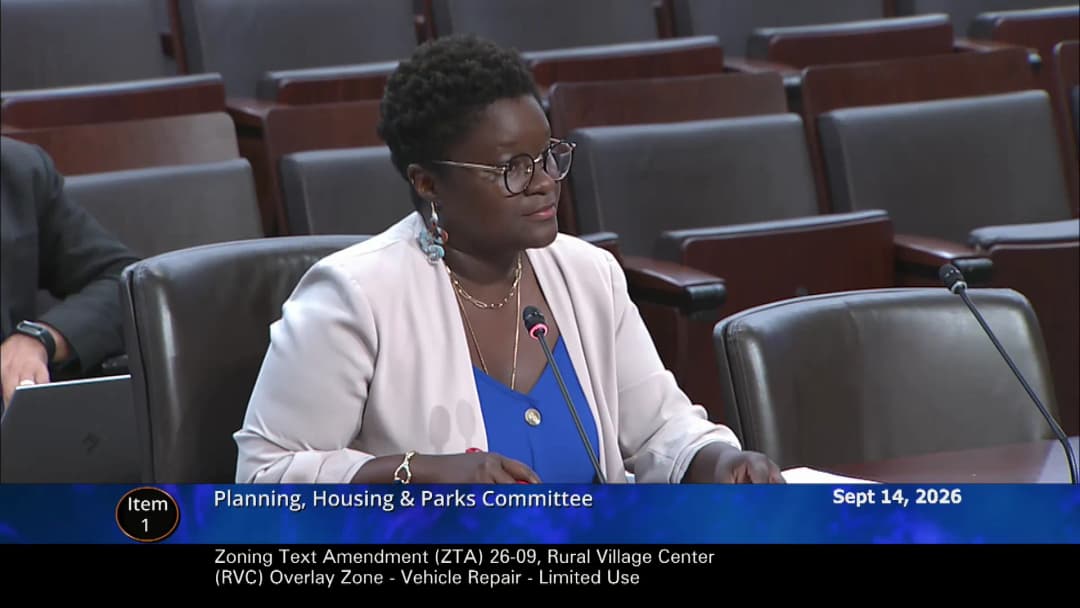
The Planning, Housing and Parks (PHP) Committee met on September 14, 2026, at 1:30 p.m. to consider Zoning Text Amendment (ZTA) 26-09, which would change vehicle repair uses in the Rural Village Center (RVC) Overlay Zone from a conditional to a limited use. Two other items (Bill 9-26 and SRA 26-01) were removed from the agenda at the sponsor’s request. The committee approved the ZTA with amendments and forwarded it to the full Council. Public Comments & Testimony - Four speakers testified in support during the July 21 public hearing, emphasizing the needs of auto businesses and the importance of community-serving local businesses in rural areas. - The County Executive submitted a letter expressing concerns about the reduced setback and allowing alternative structures in lieu of tree planting—concerns consistent with those of the Planning Board. - Written testimony also supported the changes. Discussion Items - ZTA 26-09 Overview: The amendment reclassifies “repair major” and “repair minor” from conditional uses to limited uses in the RVC Overlay Zone, retaining the same use standards from other zones with specific tweaks for the overlay. - Setback Reduction: The current 100-foot setback from residential lot lines would be reduced to 50 feet for new buildings and parking facilities to avoid creating non‑conforming uses and to limit environmental disruption from demolition. - Tree Shading Alternative: The ZTA allows alternative structures (e.g., canopies, cool pavements) to meet shading requirements, as trees can damage parked cars and increase insurance costs. However, the Planning Board and County Executive wanted on‑site tree planting preserved; a compromise was adopted requiring the equivalent number of trees to be planted elsewhere on the property. - Planning Board Amendment: The committee accepted an amendment giving the Planning Board discretion to modify setbacks for new buildings, parking facilities, vehicle storage, or expansions if sufficient compatibility with adjacent uses and the overlay’s intent is demonstrated. A technical edit extended this to vehicle storage. - Technical Amendments: Two corrections were accepted without objection: (1) specifying a cross‑reference to Chapter 50, Section 3.3 of the Subdivision Ordinance (as amended) rather than a general reference; (2) clarifying that repair major and repair minor uses follow only the limited use standards in Section 35.13 (not conditional use standards). - Commercial Vehicle Amendment: A public‑testimony suggestion to allow repair of light commercial vehicles (up to 16,000 lbs., excluding semi‑trailers) was not introduced by any council member. Council staff recommended against it, noting that commercial vehicle repair is already a distinct use, it would conflict with definitions, would be allowed only in the RVC overlay (inconsistent with other zones), and would exceed the scope of the introduced ZTA. - Impact Statements: The Racial Equity and Social Justice (RESJ) statement found minimal impact, noting the ZTA likely applies to 20 or fewer properties—predominantly in majority‑white areas (Damascus and Darnestown). The climate assessment cited both negative (reduced tree planting) and positive (better access to repair shops) impacts. Key Outcomes - The committee voted unanimously (all members present) to approve the amended ZTA 26-09 and forward it to the full County Council for a final vote. - The deadline for all zoning matters is the end of October 2026. - The two removed items (Bill 9-26 and SRA 26-01) will be rescheduled by the sponsor at a future date.

ZONING REGULATION 90% · PUBLIC SAFETY 10%
40
JUL 28, 2026 · MONTGOMERY COUNTY, MARYLAND · COUNTY COUNCIL & COMMITTEES
Montgomery County Council Full Session Summary – July 28, 2026

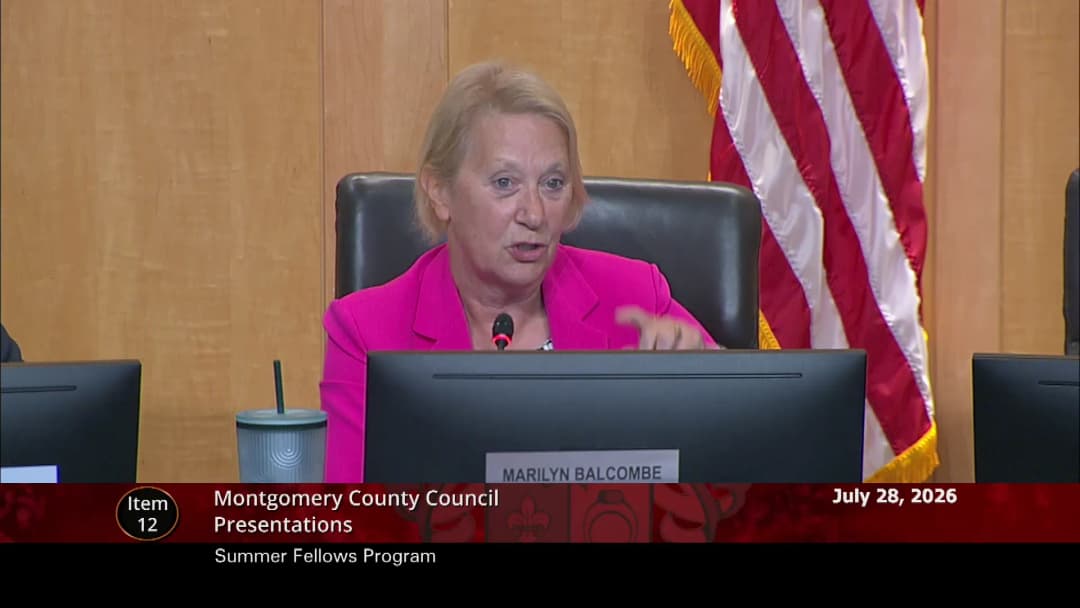
The Montgomery County Council held its last full session before the August summer break on July 28, 2026, beginning at 9:15 a.m. and reconvening at 1:30 p.m. The Council recognized National Farmers Market Week, received a lengthy briefing on long-term solid waste disposal options, approved the consent calendar, enacted several zoning and fiscal measures, and heard eight Summer Fellows present research projects. Proclamation - Councilmember Friedson presented a proclamation recognizing National Farmers Market Week (first full week of August). Farmers market leaders and county food officials spoke in support of farmers markets' economic, community, and food-access benefits. General Business - The Council announced a public hearing for September 22, 2026, at 1:30 p.m. on the New Hampshire Avenue Bus Rapid Transit (BRT) facility planning study and alternatives review; advance registration is required. - Minutes of the July 14, 2026 session were approved. - James Hendrick was appointed to the Montgomery County Planning Board on a 10-0 roll-call vote; Councilmember Sayles was absent. Discussion: Long-Term Solid Waste Disposal Alternatives - Council staff briefed the Council on the county's once-in-a-generation solid waste decision. The county executive has recommended closing the Resource Recovery Facility (RRF) as soon as possible, transitioning to long-haul trucking of waste, and later adding advanced waste processing. The Council postponed this decision until after the FY27 budget, and this session began a series of fall work sessions aimed at a possible decision by Thanksgiving. - Key facts presented: the RRF opened in Dickerson in August 1995; it burned roughly 549,000 tons of waste in FY25; burning reduces waste volume by about 90% and weight by about 70%; ash is shipped by rail to Henrico County, Virginia; the operating contract with ReWorld now runs to April 2031; short-term capital work was estimated at about $64.5 million. Four main options were described: close the RRF and long-haul with advanced waste processing; continue long-term RRF operation with a major renovation/upgrade; close the RRF and long-haul without assuming advanced waste processing; or long-haul only after advanced waste processing comes online. - Council President Fannie Gonzalez strongly criticized a video by the Sugarloaf Citizens Association and Zero Waste Montgomery, calling it misleading, racially problematic, and based on misrepresented council voices. Councilmember Evans said her record on fighting inequities was mischaracterized. Councilmember Luedtke echoed that he would not give oxygen to disingenuous content. - Members raised concerns about market volatility in long-haul contracts, landfill host-community demographics, environmental justice, dioxin leaks and RRF age, methane capture, truck traffic, contract transparency, municipal impacts, advanced waste processing feasibility, and the need for full written analyses. Several members asked DEP to provide detailed written responses before the fall. Consent Calendar - The Council suspended Rule 7(d) to allow immediate action on Item D, a resolution acknowledging receipt of a charter amendment petition and placing Question A on the 2026 general election ballot. The consent calendar was approved 11-0. - Items included receipt/release of two OLO reports (opioid response and data center impacts), approval of Executive Regulation 6-26 on pet license fees, approval of a WSSCWater debt refunding plan, and numerous board/committee appointments. - Item E, a Shentel Asset Entity I, LLC franchise agreement for non-cable wireline facilities in the right-of-way, was pulled for separate discussion. Staff explained it is a 10-year franchise for broadband service crossing a small portion of Montgomery County; it is supported by ARPA funds and must be completed by December 31, 2026. The Council approved it unanimously. Public Comments & Testimony - David Kennedy, co-owner of Rec Move Fitness and Boxing, testified at the youth vaping/nicotine public hearing. He supported youth mentorship and prevention programming, described his gym's workshops on vaping and fentanyl, and shared the personal loss of his son to an accidental fentanyl overdose. Afternoon Appropriations Hearings/Actions - Special Appropriation 27-2 ($4,251,202 federal aid) for the FiberNet capital project was approved. - Supplemental Appropriation 27-4 ($6,049,358 state grant) for MCPS Maryland Grow Your Own Educators was approved. - Special Appropriation 27-5 ($12,000,000 state grant) for DHHS Community Health Resources Commission was approved. - A public hearing was held on Supplemental Appropriation 27-1 ($390,000 from JUUL/Altria settlement) for Youth Vaping and Nicotine Addiction Response; the record remained open until September 10, 2026, with an HHS committee worksession scheduled for September 17, 2026. District Council Session - ZTA 26-11, Temporary Uses – Benefit Performance, was introduced by Councilmember Luedtke. It would ease neighbor-consent requirements for short benefit performances and add public safety notification; public hearing is set for September 15, 2026. - ZTA 26-05, Expedited Approval Plan – Job Creation Project, was enacted 11-0 with committee amendments. It lowers the job threshold from 20,000 to 200 net new jobs and requires companies to meet listed strategic-industry or funding criteria. Three amendments proposed by Councilmember Glass failed for lack of a second. - ZTA 26-08, Nonconforming Use Reinstatement, was enacted 11-0. It allows reinstatement of a nonconforming use abandoned for less than five years with hearing examiner approval. - SMA H-162, Clarksburg Gateway Sector Plan, was adopted 11-0. - ZTA 26-01, Commercial Uses – Data Center, was enacted 11-0. As amended, it defines a large load data center as a building or group of buildings with at least 25 megawatts of aggregate monthly electricity demand, prohibits such data centers countywide for now, and applies to applications without a building permit. Legislative Session - Expedited Bill 19-26 (Buildings – Moratorium on Permits for Data Centers) was enacted 11-0 as amended, imposing an 18-month moratorium. The Council aligned the bill's definition with ZTA 26-01 and noted pending state and OLO data-center studies. - Bill 12-26 (Finance – Payments to Service Providers for Persons with Developmental Disabilities) was enacted 11-0, updating how the developmental disability supplement is calculated and aligning code with current practices. - Expedited Bill 31-26 (Bond Authorization – VIVA White Oak Development District) was enacted 11-0. It authorizes up to $420 million in special obligation bonds, with an amendment requiring council approval before cumulative debt exceeds $220 million and $320 million. Bills Introduced - Bill 33-26 (Cable Communications – Community Media Organizations – Requirements), lead sponsor Stewart, was introduced; public hearing set for September 15, 2026. It would require contracted community media organizations to adopt a racial equity and social justice statement, include council/executive board members, and meet public ethics/access standards. - Bill 38-26 (Discriminatory Housing Practices and Early Lease Termination – Amendments), lead sponsor Mink, was introduced; Evans, Luedtke, and Sayles added as co-sponsors. It would prohibit housing discrimination based on citizenship or immigration status and allow early lease termination when detention or deportation due to immigration enforcement makes rent payment impossible; public hearing is September 15, 2026. Water and Sewer Category Change Requests - The Council adopted the T&E Committee recommendations unanimously. It deferred requests for 12721 Piney Meeting House Road and 21820 Clarksburg Road, approved the Spencerville Seventh-day Adventist Church request, and denied the request for 6112 Monocacy Mill Road. Summer Fellows Program Presentations - Eight Summer Fellows presented final research projects. Topics included emergency preparedness in socially vulnerable communities, arts impact evaluation, police community outreach, economic development fund ROI, CTE workforce outcome tracking, pedestrian access to Ride On stops, health care access in Poolesville, and private road-salt application. Council members said the work would inform upcoming committee sessions, legislation, and fall work. Key Outcomes - 10-0 confirmed James Hendrick to the Planning Board; Councilmember Sayles absent. - Consent calendar approved 11-0; Shentel franchise approved unanimously. - The Council enacted ZTA 26-05, ZTA 26-08, SMA H-162, ZTA 26-01, Expedited Bill 19-26, Bill 12-26, and Expedited Bill 31-26, all on unanimous roll-call votes. - Data-center moratorium of 18 months established; large-load data centers defined and prohibited countywide temporarily. - Solid waste disposal work sessions will continue in the fall, with written staff/DEP responses expected before the sessions.

WASTE MANAGEMENT 16% · PROCEDURAL 14% · ENVIRONMENTAL PROTECTION 14% · PUBLIC ENGAGEMENT 8%
OPENPUBLICA · PUBLIC MEETING INDEXUPDATED DAILY · openpublica.com