Browse by city
Date range
Search help

Search titles, summaries, topics and stored transcripts together. Keywords may match separately; put the whole query in double quotes for a phrase. Matching follows word analysis, so punctuation is not exact. Both dates are included. Documents are not searched.

SHOWING 41–50 ENTRIES
41
JUL 27, 2026 · MONTGOMERY COUNTY, MARYLAND · COUNTY COUNCIL & COMMITTEES
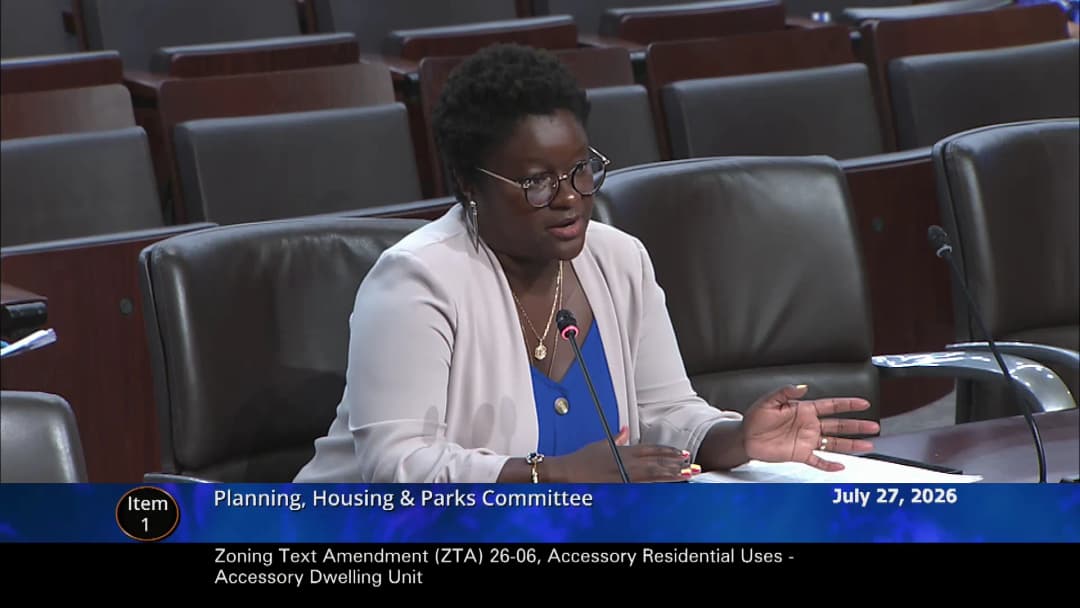
Montgomery County Planning, Housing and Parks Committee Work Session - July 27, 2026

On July 27, 2026, from 1:32 p.m. to 4:30 p.m., the Montgomery County Council's Planning, Housing and Parks (PHP) Committee met in the Council Hearing Room. Chair Andrew Friedson presided with Councilmembers Natali Fani-González and Will Jawando; Councilmember Marilyn Balcombe was also present. The committee considered two state-law compliance zoning text amendments, ZTA 26-06 on accessory dwelling units and ZTA 26-07 on solar collection systems, and deferred action on Bill 9-26 concerning rental housing air-conditioning requirements. Public Comments & Testimony - For ZTA 26-06, staff summarized that public hearing speakers were all in support of the accessory dwelling unit amendments, although multiple speakers asked to remove the owner-occupancy and two-adult occupancy requirements. - For ZTA 26-07, a resident supported relaxing solar standards, stating it could help encourage young farmers. Written testimony also debated whether rooftop solar should be preferred over ground-mounted solar, citing agrivoltaics and the potential to generate more electricity. - For Bill 9-26, staff summarized that DHCA Director Bruton strongly supported the bill and the Housing Justice Coalition supported it. The Apartment and Office Building Association of Metropolitan Washington (AOBA) opposed the bill, arguing that centrally controlled heating and cooling systems cannot quickly switch between modes, the May 15 start date lacked flexibility, and weather patterns did not support the earlier date. ZTA 26-06 - Accessory Residential Uses - Accessory Dwelling Unit - Staff explained that House Bill 1466, passed by the General Assembly in April 2025, requires local jurisdictions to adopt laws authorizing accessory dwelling unit development by October 1, 2026. - The ZTA expands ADUs from the currently allowed agricultural, rural residential, and residential detached zones to all zones; updates definitions; retains the one off-street parking space requirement with a transit exemption near the Purple Line or MARC; adds a hearing examiner waiver for small or irregular lots; and replaces many size and setback standards with the state-law standard allowing ADUs up to 75 percent of the primary dwelling's size, relying on underlying accessory structure setbacks. - Staff summarized OLO's racial equity impact statement as negative, noting that ADUs mostly benefit wealthier white homeowners in affluent neighborhoods with larger lots, and that high construction costs are a barrier. OLO recommended low-interest loans, training, permit-ready designs, and incentives for affordability covenants. - The committee supported, without objection, a clarifying amendment removing redundant setback-related language, including the phrase unless modified by the use standards for an Accessory Dwelling Unit and language about minimum side and rear setbacks for detached ADUs. - Council staff noted that the owner-occupancy requirement is not in the zoning ordinance and would require a separate bill; Planning indicated support for examining that issue, and a bill was possible before December. AARP's national checklist reportedly gave the county green checks except on the owner-occupancy requirement. - Committee members discussed ADU fee waivers, especially for property owners who enter affordability agreements, and noted construction costs have risen from an earlier estimate of $150,000 to $200,000 to a current realistic baseline of about $250,000 to $300,000. The committee voted 3-0 to recommend approval of ZTA 26-06 as amended. ZTA 26-07 - Solar Collection System - Use Standards - Staff explained that House Bill 1036, passed in April 2025, preempts local jurisdictions from enforcing land-use regulations on solar collection systems under 1 megawatt, down from the previous 2 megawatt threshold. The ZTA brings the county zoning code into consistency with state law. - The ZTA creates separate definitions for ground-mounted and rooftop-mounted solar systems, reorganizes limited use standards, and establishes that rooftop-mounted systems in the AR zone may be a limited use if they comply with state law. - Outside the AR zone, the existing limited use standard for systems producing 120 percent or less of on-site energy use is retained for ground-mounted systems. Systems producing more than 120 percent require a site plan, a minimum site size of three acres, setbacks, landscaping, screening, and equipment removal provisions. Rooftop-mounted systems outside the AR zone need only written utility authorization and compliance with state-law energy generation limits. - Existing provisions were retained in the conditional use standards because the county could regain authority if solar development reaches five percent of priority preservation areas. - OLO's racial equity impact statement was summarized as a small negative, noting the ZTA would primarily benefit high-income property owners who can afford solar panels; OLO recommended grants or low-interest loans for lower-income property owners. The climate assessment found moderate positive impacts. - The committee adopted Planning Board amendments 1 through 4 without objection: clarifying that the referenced state code provisions are in the Public Utilities Article; clarifying that the preemption applies to local zoning regulation, not to solar projects themselves; clarifying that onsite energy usage is measured as the annual baseline of onsite energy use; and reorganizing the AR zone limited use standards into separate ground-mounted and rooftop-mounted subsections. - The committee declined Planning Board amendment 5, which would have added the prefix 59- before internal references to the Zoning Ordinance. Council staff noted that internal references throughout the Zoning Ordinance are not preceded by the chapter number and that amendment 1 sufficiently distinguishes local zoning references from state code references. The committee voted 3-0 to recommend approval of ZTA 26-07 as amended. Bill 9-26 - Rental Housing - Maintenance Standards and Essential Services - Air Conditioning - Bill 9-26, introduced February 10, 2026 and heard publicly on March 10, 2026, would amend the 2020 legislation that requires landlords to provide air conditioning in rental units from June 1 through September 30. - The bill would remove the existing exemption for detached single-family homes and extend the required cooling period to May 15 through September 30. - Staff summarized impact statements: a negative but complex economic impact for landlords, a positive racial equity impact, and a small positive climate impact. - Staff noted that Maryland's 2026 General Assembly session passed a new state law, Section 8-222 of the Real Property Article, which applies to new construction and, effective October 1, to substantially renovated properties. The state law aligns with the county's 80-degree standard measured three feet above floor level in each habitable space. - DHCA presented three informal recommendations: differentiating between central plant buildings, which need a later seasonal switchover from heating to cooling and should be required to switch by June 1, and units with individual thermostat control, which could use May 15; and creating a hardship exemption for single-family units without existing air conditioning that need to install a new system or electrical upgrade, allowing an automatic application and one year to comply. - DHCA did not provide formal written amendment language. Councilmembers expressed disappointment that the recommendations were not submitted in advance, and lead sponsor Councilmember Mink said the informal position did not reflect the position expressed by the DHCA director an hour earlier, noting that constituents in central plant buildings have been overheating and should not be excluded from relief. - The committee deferred action on Bill 9-26 and agreed to reschedule a worksession after DHCA provides a formal position and amendment language coordinated with Council staff and the lead sponsor. Key Outcomes - ZTA 26-06 was recommended to the full Council as amended by a 3-0 vote; council action will be scheduled for a later date. - ZTA 26-07 was recommended to the full Council as amended by a 3-0 vote; council action will be scheduled for a later date. - The committee requested that the Planning Department return with recommendations and examples of ADU fee waivers, potentially tied to affordability agreements, for possible future legislation. - Bill 9-26 was deferred; a second worksession will be scheduled after DHCA submits formal, vetted amendment language.
AFFORDABLE HOUSING 33% · ENGINEERING AND INFRASTRUCTURE 18% · TECHNOLOGY AND INNOVATION 16% · PROCEDURAL 12%
42
JUL 27, 2026 · MONTGOMERY COUNTY, MARYLAND · COUNTY COUNCIL & COMMITTEES
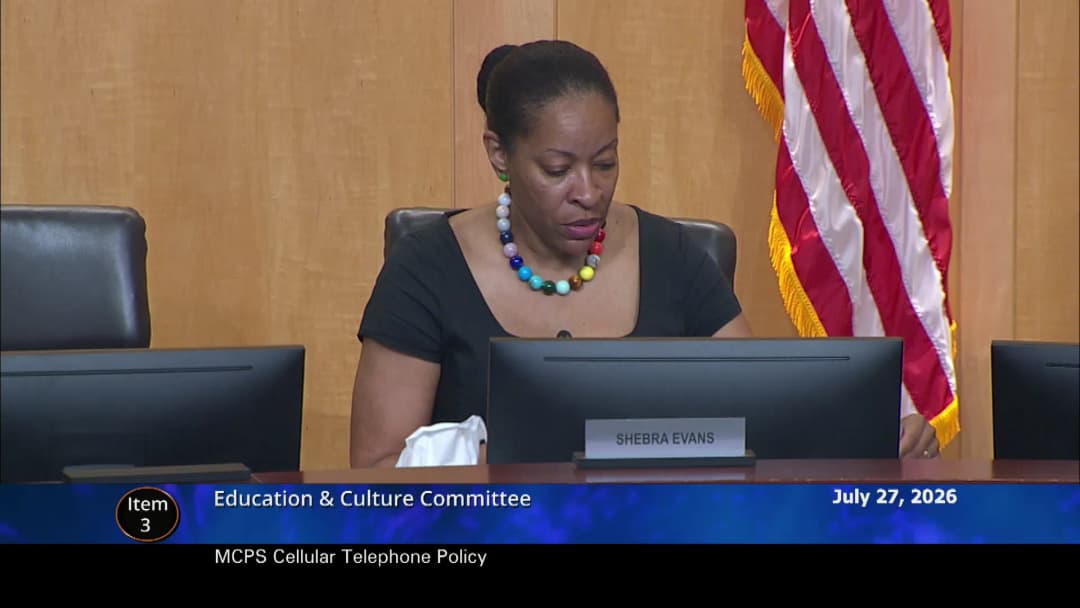
Education & Culture Committee Meeting on MCPS Technology Policies – July 27, 2026

The Education & Culture Committee (Councilmembers Jawando, Evans, Mink) met from 9:47 a.m. to 11:18 a.m. on July 27, 2026, to discuss Montgomery County Public Schools (MCPS) technology issues: the cellular telephone policy, student screen time, the technology modernization budget, and artificial intelligence (AI) policy and practice. MCPS representatives Dr. Moran (Chief, Division of School Leadership and Improvement) and Kimberly Fields (Chief, Division of Technology Services) presented updates and answered questions. Discussion Items - Cellular Telephone Policy: MCPS reported that the ‘Away All Day’ policy, which prohibits personal mobile devices during the instructional day, was implemented in elementary and middle schools during the 2025–26 school year and received positive feedback from parents, staff, and students. Based on surveys and the new Joanne C. Benson Maryland Phone-Free Schools Act, MCPS will expand the policy to high schools for the 2026–27 school year, including lunch and transition times. Implementation options include cell phone cubbies and locking pouches; schools may choose their preferred approach. Dr. Moran emphasized a restorative, non-punitive approach to enforcement, with conferencing and parent engagement, and acknowledged the mental health challenges of separating students from devices. Councilmember Evans stressed the need for clear emergency communication to build parent trust. Councilmember Mink noted that even fourth graders understand the benefits of phone-free learning. - Screen Time: The Board of Education passed a resolution on July 16, 2026, to conduct a comprehensive audit of screen time for grades K–8, including content filtering, costs, and benefits. MCPS will develop K–5 guidance for the 2026–27 school year, with a formal regulation expected by the 2027–28 school year. Dr. Moran and Ms. Fields discussed distinguishing between instructional technology (e.g., coding, research) and technology used as a classroom management tool, which should be minimized. Equity considerations were raised: students with disabilities (IEP/504) or English learners may require different screen time allowances. Councilmember Evans requested a chart showing screen time breakdown by purpose. Councilmember Mink asked about vetting “educational” apps and games that may be largely recreational; Ms. Fields said MCPS works with the Division of Teaching and Learning to filter and block non-educational content. - Technology Modernization Budget: The FY27 Technology Modernization program requested $33.9 million but received $16.9 million, an $11 million reduction. MCPS reported that this will impact device refreshes, network/server updates, security infrastructure, and training that supports classroom technology (e.g., 3D printing, coding). Global hardware prices have increased 15–40%. Ms. Fields noted that e-rate rebates (expected 80% return this year) are under federal review, adding uncertainty. MCPS has created a standard operating procedure for Chromebook inventory management in response to an Inspector General’s report. Councilmember Evans asked what specifically will be delayed; Ms. Fields cited device refreshes, staff training, and infrastructure upgrades. - Artificial Intelligence Policy: MCPS updated its IGS Educational Technology Policy to include academic honesty regarding AI, and is drafting a formal AI regulation aligned with Senate Bill 720 (AI Ready Schools Act). An employee compliance training module launched July 1, 2026, developed with input from a third-party (University of Maryland) and internal subject matter experts who completed a graduate certificate program at Notre Dame of Maryland University. Vendor vetting includes security reports (e.g., SOC2, ISO 27001), but independent verification beyond vendor claims is limited; security reports are proprietary. No current licenses for AI detection tools. MCPS is considering prohibiting AI for younger grades (K–5) while allowing it in grades 6–12, with emphasis on teaching students to critically evaluate AI outputs, validate information, and understand bias and privacy risks. Councilmember Jawando asked about using predictive AI—Ms. Fields said MCPS requires vendors to complete an algorithmic impact assessment covering bias, training data, and privacy. Councilmember Mink highlighted the need for student and parent feedback on the AI regulation. Councilmember Jawando also requested data on MCPS spending on AI tools and licenses. - Mental Health and Community Engagement: Throughout the discussion, Dr. Moran stressed that technology changes require an empathetic, partnership-based approach with families and students. Peer-to-peer education (student ambassadors) and restorative practices will be key to reducing anxiety and building buy-in. Councilmember Evans suggested leveraging council partnerships to address equity gaps in home internet access and devices. Key Outcomes - The Committee will monitor MCPS technology issues during the 2026–27 school year and schedule another worksession in the winter or spring of 2027. - MCPS will expand the ‘Away All Day’ cell phone policy to all high schools starting in the 2026–27 school year, with implementation support and a focus on restorative discipline. - MCPS will conduct a comprehensive screen time audit for grades K–8, develop K–5 guidance by the start of the 2026–27 school year, and work toward a formal regulation by 2027–28. - MCPS will draft a formal AI regulation with public and student feedback, and continue to provide staff professional development on AI. They will also investigate the use of AI detection tools and consider age-appropriate restrictions. - MCPS will report back to the Committee on spending on AI-related tools, licenses, and training.

TECHNOLOGY AND INNOVATION 75% · MENTAL HEALTH AWARENESS 7% · PUBLIC ENGAGEMENT 6% · BUDGET EQUITY ANALYSIS 4%
43
JUL 23, 2026 · MONTGOMERY COUNTY, MARYLAND · COUNTY COUNCIL & COMMITTEES
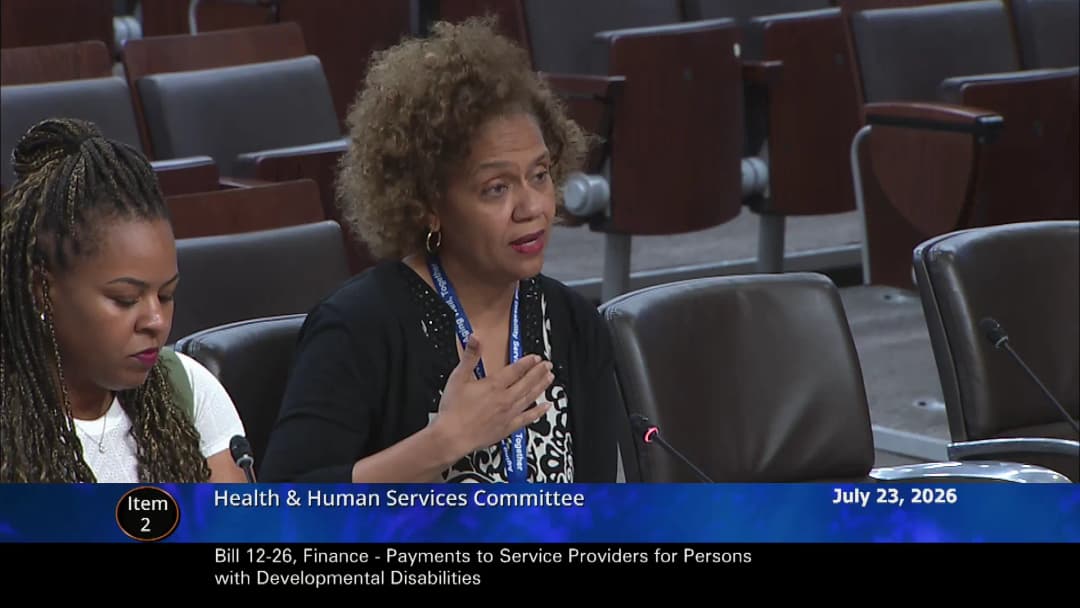
Health and Human Services Committee Meeting on IDD Services - July 23, 2026

The Montgomery County Council Health and Human Services Committee met on July 23, 2026, from 1:02 p.m. to 1:31 p.m., chaired by Councilmember Laurie-Anne Sayles. The committee discussed two bills aimed at strengthening services for individuals with intellectual and developmental disabilities (IDD). Public Comments & Testimony - Multiple speakers testified at the public hearing for Bill 28-26, all in support of the legislation, which expands the IDD Commission membership and renames the bill the “Jake Didinsky Advocacy Act.” No public testimony was heard during the committee meeting for Bill 12-26. Discussion Items - Bill 28-26 – IDD Commission Membership and Terms: Legislative Attorney Ogorzalek presented the bill, which expands the number of voting members representing individuals with IDD and their families from 11 to 15 (split into five individuals with IDD, five family members/guardians, and five from either category), increasing the total commission from 19 to 23. The bill also requires that at least three of the 15 members participate in self-directed services. Councilmember Luedtke proposed an amendment to name the bill the “Jake Didinsky Advocacy Act” in honor of a former commission member and advocate. The amendment was supported without objection. - Bill 12-26 – Payments to Service Providers for Persons with Developmental Disabilities: Chief Legislative Attorney Wellons explained that the bill updates current law to align with actual budgeting practices by removing an outdated requirement for DHHS to annually recommend payment amounts based on a 125% minimum wage metric. It also clarifies that providers must serve Montgomery County residents within the county. Dr. Patrice McGee, Chief of Aging and Disability Services, and Kim Mayo, Administrator of Community Support Network, noted that the provider consortium (Interact) now submits budget requests directly, and wage surveys and customer satisfaction surveys are conducted annually to ensure compliance with the county minimum wage. - Concerns about DDA Funding and Provider Sustainability: Councilmember Friedson expressed strong support for DD providers but voiced concern about the compression between rising county minimum wages and potential state funding cuts. He noted a possible 2% reduction in Maryland Developmental Disabilities Administration (DDA) funding, currently on hold pending CMS review, with an anticipated effective date of October 1, 2026. Dr. McGee estimated a potential $22 million shortfall if the cut is implemented. Friedson requested timely updates on any DDA changes and their impact on providers and direct support professionals. Chair Sayles requested that DHHS provide an overview of collected data including wage information, turnover rates, and customer satisfaction survey results. Key Outcomes - Bill 28-26: The committee unanimously supported the amendment to rename the bill the “Jake Didinsky Advocacy Act” and recommended enactment of the bill as amended. Council action will be scheduled for a later date. - Bill 12-26: The committee recommended enactment of the bill as introduced. Council action is scheduled for July 28, 2026.

DISABILITY RIGHTS 76% · BUDGET EQUITY ANALYSIS 24%
44
JUL 23, 2026 · MONTGOMERY COUNTY, MARYLAND · COUNTY COUNCIL & COMMITTEES
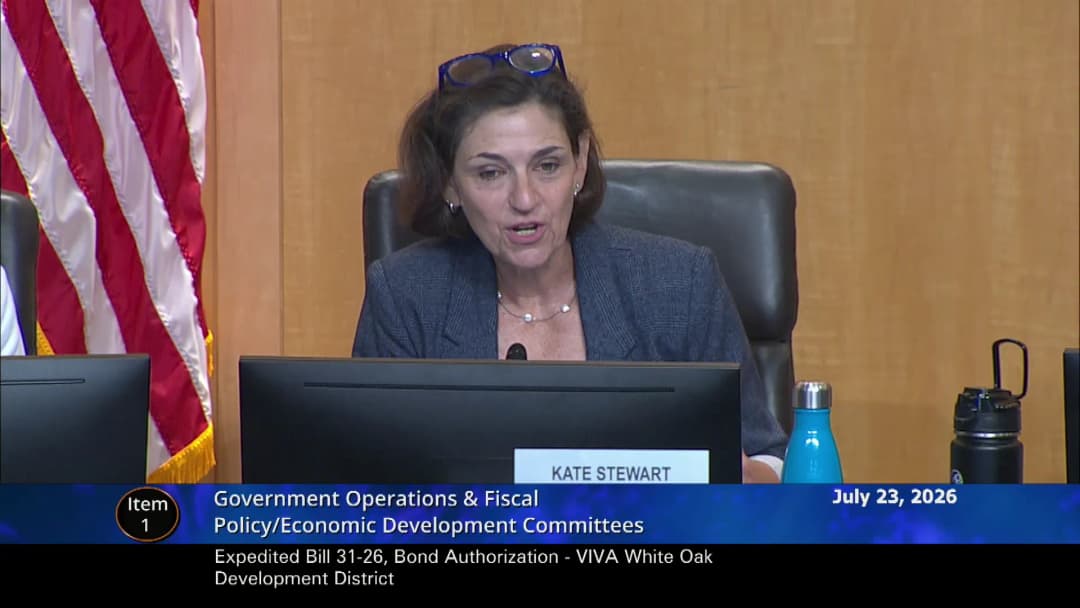
Joint GO/ECON Committee Meeting on VIVA White Oak Bond Authorization – July 23, 2026

Date: July 23, 2026 Time: 9:30 a.m. – 9:42 a.m. Location: 3rd Floor Council Hearing Room, Rockville, MD This joint committee meeting considered Expedited Bill 31-26, which would authorize the County Executive to issue and sell up to $420 million in bonds to fund improvements for the VIVA White Oak Development District – the county’s first Tax Increment Financing (TIF) project. After a technical amendment, the committees voted unanimously to recommend enactment to the full Council. Public Comments & Testimony - A public hearing was held on July 14, 2026. Testimony was largely in support of the bond authorization, noting the TIF structure does not obligate the county’s full faith and credit. Some commenters raised concerns about transportation infrastructure needs and requested that those be developed concurrently with the broader project to avoid further strain on the area and neighboring jurisdictions. Discussion Items - Expedited Bill 31-26 – Bond Authorization: The bill authorizes up to $420 million in bonds for phase one of the VIVA White Oak development. Staff noted a climate assessment, delivered the day before the meeting, was deemed “indeterminate” because the broader development’s specifics are not yet fully defined. - Technical Amendment: The committee adopted an amendment requiring the County Executive to obtain Council approval by resolution before issuing bonds that would bring cumulative debt under the authorization above $220 million and $320 million. This preserves a legislative check for later phases while allowing the first $220 million tranche (covering all of phase one) to proceed without further Council action. The amendment was developed in coordination with the Office of the County Attorney and was described as clarifying a shared understanding. - Committee Discussion: Councilmember Kristin Mink (District 5, where the project is located) thanked staff and developers, stating the amendment balances legislative oversight with developer flexibility. Councilmember Natali Fani-González emphasized the responsibility to taxpayers and the importance of avoiding surprises. Chair Kate Stewart noted that a follow-up GO committee session in September will review TIFs and Chapter 14 requirements generally. Key Outcomes - Amendment adopted without objection. - Motion to recommend enactment of Expedited Bill 31-26, as amended, passed unanimously by all present members of both committees (Councilmember Evan Glass was absent). - Next Step: Full Council consideration is tentatively scheduled for July 28, 2026.

ECONOMIC DEVELOPMENT 80% · PROCEDURAL 11% · TRANSPORTATION SAFETY 9%
45
JUL 22, 2026 · MONTGOMERY COUNTY, MARYLAND · COUNTY COUNCIL & COMMITTEES
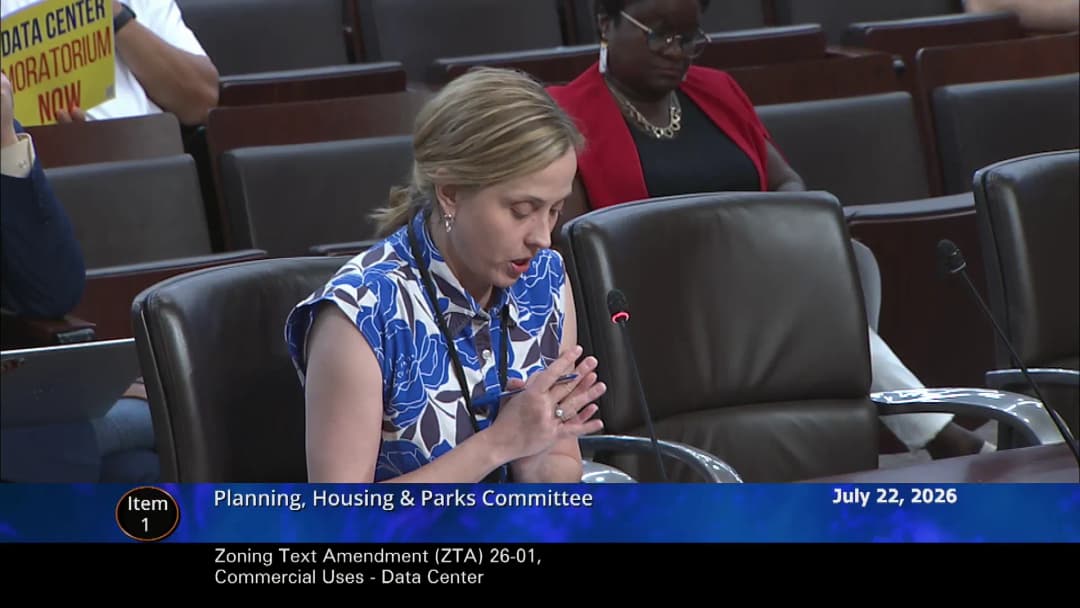
Planning, Housing & Parks Committee Work Session on ZTA 26-01: Data Center Definition and Prohibition - July 22, 2026

The Montgomery County Planning, Housing & Parks (PHP) Committee met on July 22, 2026, from 1:30 p.m. to 1:55 p.m. (3rd floor Council Hearing Room) to consider Zoning Text Amendment (ZTA) 26-01, Commercial Uses – Data Center. The meeting followed a related Economic Development (ECON) Committee session earlier that morning, which voted unanimously on an 18-month moratorium for large data centers (Expedited Bill 19-26). The PHP Committee focused on aligning the ZTA’s definition of "Data Center" with the moratorium and prohibiting data centers countywide while further studies proceed. Discussion Items - Background and Proposed Amendment: Council President Natali Fani-González and Council Vice President Marilyn Balcombe, co-leads on the issue, explained that the ZTA originally would have defined data centers and permitted them as conditional uses in industrial zones with guardrails. However, after months of work and unresolved concerns over energy, water, noise, and setbacks, the sponsors requested a global amendment to simply define a large data center (≥25 MW monthly electricity demand) and prohibit it in all zones, maintaining the status quo while the county awaits an Office of Legislative Oversight (OLO) report and a state study. - Definition Details: Chief Legislative Attorney Christine Wellons presented the proposed definition, derived from existing county definitions and Maryland’s Utility Relief Act of 2026. The definition includes a 25 MW threshold, exclusions for higher education, hospitals, and other specified uses, and mirrors the definition in the companion moratorium bill. - Use Table and Transition Clause: The amendment adds “Data Center” to the use table with all cells blank, rendering the use not allowed in any zone. A transition clause applies the prohibition to any application that has not received a building permit before the ZTA’s effective date. - Clarifications: Councilmember Will Jawando asked how data centers under 25 MW would be treated. Staff clarified that existing facilities under the threshold would not be affected, but any expansion that would push a facility above 25 MW (e.g., from 24 to 26 MW) would be prohibited under this ZTA. The moratorium and ZTA together ensure no new large data centers can be built or expanded during the study period. - Chair’s Comments: Chair Andrew Friedson emphasized that the 18-month moratorium should not pause ongoing work; rather, it provides time to continue thorough analysis on energy, water, noise, taxes, and community impacts. He noted that significant work has already begun. Key Outcomes - Vote on Global Amendment: The committee voted 3-0 (Friedson, Fani-González, Jawando) to support the amendment defining “Data Center” as proposed and updating the use table to prohibit the use in all zones. Councilmember Balcombe, not a committee member, expressed support but did not vote. - Vote on Transition Clause: The committee voted 3-0 to adopt the transition clause ensuring the prohibition applies to any application without a building permit before the effective date. - Recommendation for Enactment: The committee voted 3-0 to recommend enactment of ZTA 26-01 as amended. - Next Step: The full County Council is scheduled to consider the ZTA on July 28, 2026, along with the companion moratorium bill.

DATA CENTER REGULATION 86% · ECONOMIC DEVELOPMENT 6% · ENVIRONMENTAL PROTECTION 4% · PROCEDURAL 4%
46
JUL 22, 2026 · MONTGOMERY COUNTY, MARYLAND · COUNTY COUNCIL & COMMITTEES
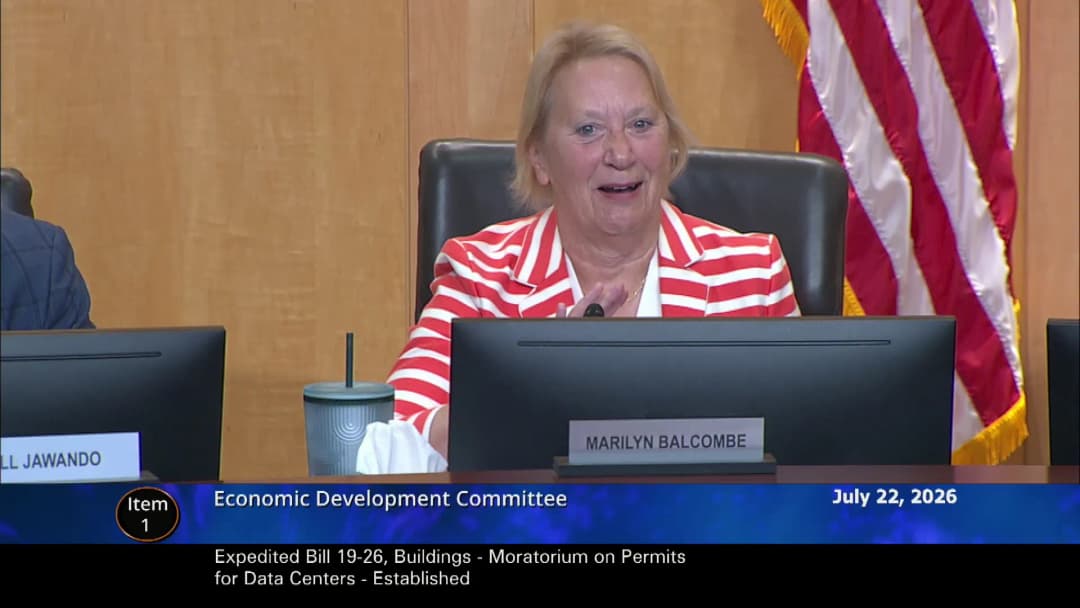
Economic Development Committee Meeting – July 22, 2026

The Economic Development Committee (ECON) convened on July 22, 2026, at 9:30 a.m. to consider two expedited bills establishing a moratorium on building permits for data centers. After discussion and amendments, the committee voted to recommend enactment of Expedited Bill 19-26, as amended, and Expedited Bill 24-26 was withdrawn. Public Comments & Testimony - At the June 16, 2026 public hearing, residents raised concerns about public health risks, environmental health impacts, energy consumption, noise, and climate impacts from large-scale data centers. Several speakers urged a longer moratorium than the initial six months and suggested merging the two bills. Discussion Items - Definition of “data center”: Councilmember Glass offered an amendment to remove the exclusion of “Cable Communications System” from the definition. Approved without objection. - Transition language: Councilmember Glass clarified that the moratorium applies to conditional use applications filed before or after the effective date, including those pending regulatory review or approved by OZAH but without a permit from DPS. Approved without objection. - Sunset clause: An amendment extended the moratorium from six to 18 months, supported by Chair Fani-González, Councilmembers Glass, Balcombe, Sayles, and guest Councilmember Jawando. Approved without objection. - Task force amendment: Councilmember Glass proposed a 16-member advisory task force on data centers. The amendment did not receive a second and was not adopted. Other members argued that existing processes (county executive work, OLO report, state study, community meetings) would suffice. - Expedited Bill 24-26: Councilmember Jawando withdrew this bill after the amendments to Bill 19-26 incorporated its key elements. No further action expected. Key Outcomes - The committee recommended enactment of Expedited Bill 19-26, as amended, with the understanding that the “data center” definition would be further amended at full Council to align with the definition under ZTA 26-01. - The vote to approve the amended bill passed unanimously (all present: Fani-González, Balcombe, Glass, Sayles). - Next step: Full Council action tentatively scheduled for July 28, 2026. - The meeting adjourned at 9:58 a.m.

DATA CENTER REGULATION 66% · PUBLIC ENGAGEMENT 25% · ENVIRONMENTAL PROTECTION 5% · PROCEDURAL 4%
47
JUL 21, 2026 · MONTGOMERY COUNTY, MARYLAND · COUNTY COUNCIL & COMMITTEES
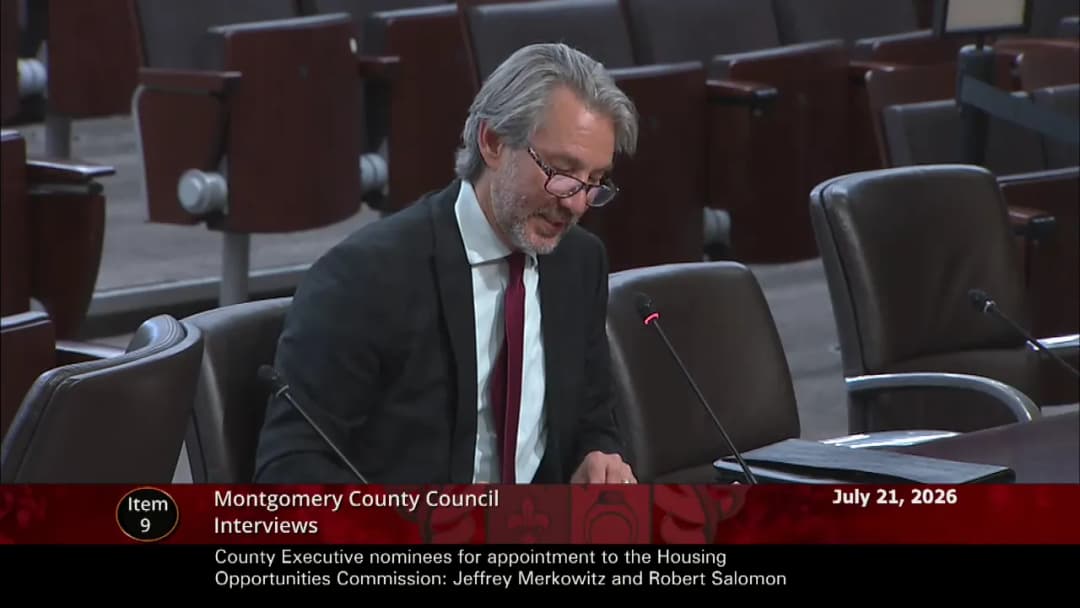
Montgomery County Council Meeting - July 21, 2026: Legislative Actions, Public Hearings, and Appointments

The Montgomery County Council convened on July 21, 2026, starting at 9:30 a.m., for a full-day session that included a public hearing on stormwater bond authorization, legislative session (Day 18) with five bill introductions and five final readings, a district council session, a consent calendar, and afternoon public hearings on the Clarksburg Gateway Sector Plan and a rural village center zoning text amendment. The council also interviewed candidates for the Board of Investment Trustees and the Housing Opportunities Commission. Consent Calendar - Approved minutes of June 30, 2026 (Council and Closed sessions) (8 yes, 3 absent/tardy). - Received and Released OLO Report 2026-13 on resident hiring preferences in other jurisdictions. - Introduced resolutions: franchise agreement with Shentel Asset Entity I, LLC; amendment to FY27-32 CIP for Olney Community Building and Police satellite station; WSSCWater June 2, 2026 debt refunding plan; Special Appropriation 27-5 (State grant $12M for Health and Human Services). - Adopted resolutions: OLO FY27 work program (20-1178); FY27 Schedule of Revenue Estimates and Appropriations (20-1179); appointments to East County Citizens Advisory Board, MCEDC Board, Montgomery Cares Program Advisory Board, and Sports Advisory Committee (20-1180 through 20-1183). All consent items passed 11-0. Public Comments & Testimony - Expedited Bill 30-26 (Stormwater Bonds): Four speakers opposed the bill. Gordy Bernie (Taxpayers League) argued the bond proposal was unnecessary, questioned the transfer of DOT staff to DEP capital budget, and suggested cutting the amount or requiring an OLO study. Kenneth Bauer (Coalition to Stop Stream Destruction) opposed due to misuse of funds for failed engineered stream restorations. Marion Ebay (Sierra Club) objected to delegating debt authority to the county executive and urged using the water quality protection charge instead. Danila Cheveco argued the bill transfers legislative power of the purse and lacks justification for emergency. - ZTA 26-09 (Rural Village Center Vehicle Repair): Two speakers and one written supporter testified in favor. Andrew Leit (resident and real estate agent) supported Will Neek Auto, noting the business is LGBT-friendly and minority/woman-owned, and that the property was previously a car shop. Casey Cerner (attorney for Will Neek) urged adoption with Planning Board recommended amendments to allow flexibility on setbacks and alternative shade structures. Denise Fredericks (longtime customer) testified in support, highlighting the business's eco-friendly practices and need to stay in the underserved upcounty area. Legislative Session - Bill Introductions - Expedited Bill 32-26: Survivor benefits for line-of-duty death – expanded eligibility to Groups E and J (sheriff’s deputies, corrections officers). Lead sponsors: Luedtke, Glass, Katz. All council members added as co-sponsors. Public hearing 9/15/26. - Bill 34-26: Health and sanitation – bodywork establishments amendments to combat human trafficking. Lead sponsor: Luedtke. Co-sponsors: Council President Fani-González, Stewart, Katz; others added. Public hearing 9/15/26. - Bill 35-26: Forest conservation – brush management clarification for agricultural community. Lead sponsors: Sayles, Balcombe; co-sponsor Luedtke; Katz and Evans added as co-sponsors. Public hearing 9/15/26. - Bill 36-26: Fire and Emergency Services Commission duties and responsibilities. Lead sponsor Luedtke. Public hearing 9/22/26. - Bill 37-26: Disruptive behavior in public facilities amendments. Lead sponsor Council President at request of County Executive. Public hearing 9/22/26. Discussion Items - Legislative Session - Final Readings: - Bill 15-26 (Property Tax Credits for Habitat for Humanity): Enacted 11-0. Creates 100% tax credit for properties held by Habitat for Humanity for rehabilitation and conveyance. Lead sponsor Friedson highlighted partnership for affordable homeownership. - Bill 21-26 (Employee Retirement System Amendments): Enacted 11-0. Implements negotiated changes from collective bargaining agreements. Committee adopted a technical amendment. - Bill 22-26 (SBIR/STTR Matching Grant - Repeal of Sunset): Enacted 11-0 after a floor amendment by Councilmember Sales to require an annual survey (adding workforce and procurement questions) failed 4-7. The underlying bill removes sunset and codifies phase zero grants. Council Vice President Balcom noted the grant is a small sliver ($200K) of $25M in total grants. - Expedited Bill 23-26 (Ghost Guns/Firearms Restrictions): Enacted 10-1, with Councilmember Sales voting no. Brings county law into conformity with Maryland Supreme Court decision. Councilmember Sales expressed concerns about enforcement leading to over-policing. - Expedited Bill 30-26 (Stormwater Bond Authorization): Enacted 11-0. Authorizes up to $125M in bonds for stormwater management projects, including flood mitigation and structural repairs. Councilmember Glass noted the state's MS4 permit constraints and planned letter to MDE. Council President emphasized the projects are already in the CIP. - District Council Session: - ZTA 26-10 (Driveway Access and Shared Parking): Introduced; public hearing 9/15/26. - SRA 26-02 (Road Street Types - Design Standards): Introduced; public hearing 9/15/26. - Interviews (Board of Investment Trustees): Interviewed Joshua Burge (AARP) and Michael Sinoway (Penn State). Both expressed no conflicts and availability. Council will select one representative. - Interviews (Housing Opportunities Commission): Interviewed incumbents Jeffrey Merkowitz and Robert Salomon for reappointment. They discussed affordable housing supply, federal funding constraints, and improved collaboration with county. Councilmember Mink asked about transparency; both affirmed support for regular communication. - Public Hearings (Afternoon): - SMA H-162 (Clarksburg Gateway Sector Plan): No registered speakers; record open until July 24, 2026. - ZTA 26-09 (Rural Village Center Vehicle Repair): Hearing held; record open until July 30, 2026. Testimony in support from business owner's representatives and customers. PHP committee work session to be scheduled. Key Outcomes - Enacted 5 bills: 15-26, 21-26, 22-26, Exp. 23-26 (10-1), Exp. 30-26 (all 11-0 except 23-26). - Introduced 5 bills and 2 zoning/subdivision amendments with scheduled public hearings in September. - Approved consent calendar including OLO work program, revenue estimates, and multiple appointments. - Held public hearings on stormwater bonds (record closed), Clarksburg sector plan (open to 7/24), and ZTA 26-09 (open to 7/30). - Completed interviews for investment trustee and HOC commissioner positions; confirmation votes pending. - Councilmember Glass announced a letter to MDE requesting MS4 permit updates to allow more flexible stormwater projects.

PROCEDURAL 17% · AFFORDABLE HOUSING 13% · RACIAL EQUITY 13% · ECONOMIC DEVELOPMENT 12%
48
JUL 16, 2026 · MONTGOMERY COUNTY, MARYLAND · COUNTY COUNCIL & COMMITTEES
Education and Culture Committee Receives Update on Montgomery County Cultural Plan on July 16, 2026

Education and Culture Committee Receives Update on Montgomery County Cultural Plan on July 16, 2026\n\nThe Education and Culture (EC) Committee of the Montgomery County Council met on July 16, 2026, from 1:38 p.m. to 3:09 p.m. to receive an update on the Montgomery County Cultural Plan, presented by the Arts and Humanities Council of Montgomery County (AHCMC) and Metris Arts Consulting. The plan, developed over 15 months with intensive community engagement, aims to guide cultural policy and investment over the next decade (2026–2036). The last comprehensive cultural plan was completed in 2001.\n\n Discussion Items\n- Presentation Overview: The plan is rooted in three pillars: fostering belonging, creating connections between arts/culture and county priorities, and building cultural sector resilience. It was informed by 2,425 participants through 91 distinct engagements, including focus groups, surveys, creative pop-ups, and a youth town hall.\n- Key Findings: Residents see a direct link between arts/culture and quality of life; they value both cultural affirmation (sharing one’s own culture) and cultural sharing (learning about others). There is no single countywide identity; residents identify with hyperlocal communities. The cultural sector faces capacity concerns including funding, space, and business skills.\n- Six Goals and associated "big ideas": 1) Arts in Everything (embedding arts in county government via a Creative Officer and an Artist Service Corps), 2) Arts for Everyone (building a connected network of facilities and closing geographic gaps, especially in Up County and East County), 3) Culture Connecting Community (protecting and expanding community connections, e.g., a multicultural festival), 4) Places and Spaces for Culture (addressing lack of affordable space through vacancy inventory and a broker role), 5) Strong Creative Engine (simplifying funding, raising revenue, creating an arts accelerator), and 6) Recognition for Art and Artists (elevating profile via a poet laureate, case statement, and better marketing).\n- Implementation Phasing: Recommendations are categorized as "now," "next," or "later" based on urgency and infrastructure needs. The plan includes a recommendation for a formal cost assessment as an early step.\n- Councilmember Discussion: Councilmembers Jawando, Mink, and Evans engaged actively. Jawando noted the importance of belonging and safety, and asked about other jurisdictions with similar roles (poet laureate, arts officer). Evans emphasized identifying low-cost, immediate actions and suggested leveraging regional service centers and county-owned vacant spaces for temporary arts use. Mink highlighted the need to embed arts across departments and cited examples like the La Abuelina campaign. Councilmember (designate) Baker, who attended as a community member, spoke about opportunities for East County and the potential for a landmark arts hub.\n- Alignment with Other Plans: The plan aligns with Thrive 2050, the Economic Development Strategic Plan, Parks Recreation and Open Space Plan, Climate Action Plan, and Placemaking Plan.\n\n Key Outcomes\n- The full plan (109 pages plus appendices) will be released for public review by July 22, 2026, with a 30-day comment period. Executive summaries will be available in seven languages.\n- After public review, the plan will be presented to the AHCMC board and Montgomery Planning for endorsement, followed by formal adoption by the County Council, with a target of fall 2026.\n- No votes were taken; the committee received the update and provided feedback. The committee emphasized the need for a cost assessment and phased implementation, especially given upcoming budget constraints.\n- Councilmembers committed to promoting public engagement and using the plan to guide future cultural investment.

ARTS AND CULTURE 62% · COMMUNITY ENGAGEMENT 23% · PUBLIC ENGAGEMENT 5% · BUDGET EQUITY ANALYSIS 4%
49
JUL 14, 2026 · MONTGOMERY COUNTY, MARYLAND · COUNTY COUNCIL & COMMITTEES
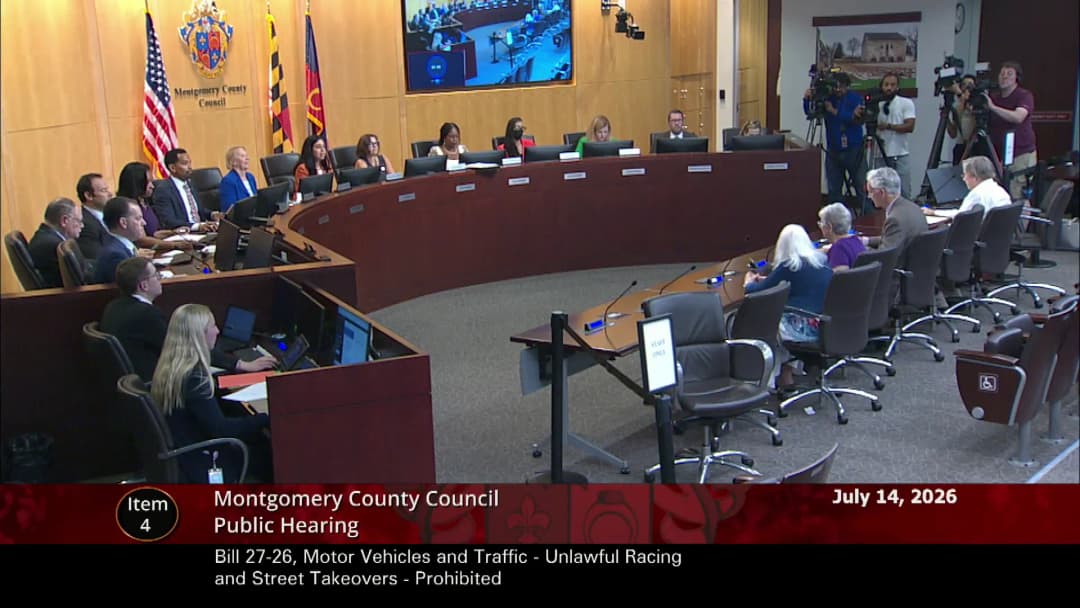
Montgomery County Council Session – July 14, 2026

The Montgomery County Council convened on Tuesday, July 14, 2026, at 10:00 a.m. in the Council Hearing Room, Rockville, Maryland. The session included proclamations, interviews for a Planning Board vacancy, a consent calendar, and afternoon public hearings. The Council recessed at 11:46 a.m., reconvened at 1:06 p.m., and adjourned at 2:34 p.m. Consent Calendar - Approved the minutes of the June 16, 2026 Council session unanimously (11y). - Received and released OLO Report 2026-09, Budget Equity in Montgomery County Public Schools, and OLO Report 2026-12, A Review of the Local Small Business Reserve Program (LSBRP) and the Minority, Female, and Disabled-Owned (MFD) Business Program. - Introduced resolutions to approve the OLO FY27 Work Program and the FY27 Schedule of Revenue Estimates and Appropriations (action scheduled for 7/21/26). - Introduced Supplemental Appropriation 27-1 ($390,000, Youth Vaping and Nicotine Addiction Response, funded by JUUL/Altria Settlement), 27-2 ($4,251,202, FiberNet, federal aid), and 27-4 ($6,049,358, Maryland Grow Your Own Educators Grant, state grant). - Introduced resolutions on the Dickerson Area Facilities Implementation Group membership modification and the FY27-32 CIP amendment for Resurfacing: Residential/Rural Roads. - Introduced and adopted Resolution 20-1172 (Executive Regulation 5-26, Personnel Regulations sunset extension), Resolution 20-1173 (extension for Executive Regulation 25-25), and Resolution 20-1174 (extension for Executive Regulation 26-25). - Adopted Resolution 20-1175 confirming 12 appointments to the Agricultural Advisory Committee and Resolution 20-1176 confirming 5 appointments to the Commission on Landlord-Tenant Affairs. Public Comments & Testimony - Special Appropriation 26-90 (Montgomery College, $1,100,000 from Tuition and Fees): Amanda Broadnax testified in support, citing enrollment growth and the need to address library closure due to pipe bursts from an ice storm. - Bill 27-26 (Prohibiting Unlawful Racing and Street Takeovers): John Sang (Chair, Maryland Coalition for Roadway Safety) spoke in strong support, requesting the bill not weaken state sanctions and emphasizing enforcement. Mindy Baden (Greater Olney Civic Association, Safe Roads Maryland, Families for Safe Streets) supported the bill, sharing the loss of her son in a traffic crash and requested the bill include parking lots and private property. John Becker (Americana Center homeowner) supported the bill, noting a street takeover near the council chamber and another on private property. Meredith McCain (District 6 resident) supported the bill, citing rising reckless driving and a recent fatal motorcycle crash on Norbeck Road. - Bill 28-26 (Intellectual and Developmental Disabilities Commission Membership): Lisa Lorraine (Commission member) testified in support, explaining the bill strengthens representation of individuals with IDD based on the principle “Nothing about us without us.” Jake Dedinski (former Commissioner, self-advocate) supported the bill, emphasizing the importance of self-directed services seats. Susan Hartung (Commission Chair) supported the bill, noted three vacancies (nearly 15% of seats) and requested timely appointments, and advocated for restoring the Customized Employment Program. - Bill 29-26 (Community Trust in County Employees Act): Gabriela Rivera (Montgomery County Immigrant Rights Collective) testified in support, citing fear among immigrant families accessing county services. Esther Wells testified in strong opposition, calling the bill inconsistent with Bill 18-26, citing missing fiscal and racial equity impact statements, and raising county budget and tax concerns. - Bill 31-26 (VIVA White Oak Bond Authorization): Adriana Hoshberg (Acting Development Ombudsman, for the County Executive) testified in support, describing the 280-acre redevelopment, the first TIF district, and that bonds will not be a full faith and credit obligation. Redwan Chaudry (East County Citizen Advisory Board Chair) supported the bill and stressed that transportation improvements must accompany development. Teresa Stegman (MCB Real Estate) supported the bill, warning that without bond authorization progress would halt and noting $160 million in public infrastructure is needed. Shayna Davis Cook (Friends of White Oak) supported, citing estimates of $4.9 billion in annual economic output, 19,000 construction jobs, 9,000 permanent jobs, and $60 million in new annual county revenue. Anthony Stahl (Adventist Healthcare White Oak Medical Center) supported, noting housing needs for hospital staff. Barry White (North White Oak Civic Association) raised concerns, stating no updated transportation analysis exists and that the bill allocates $25 million for off-site road improvements without demonstrating adequacy. Discussion Items - Planning Board Candidate Interviews: The Council interviewed two candidates for appointment to the Montgomery County Planning Board: James Hedrick (incumbent) and John Schlichting. Hedrick highlighted his affordable housing finance background and service on the board; Schlichting cited his architecture, real estate development, and Gaithersburg planning experience. Candidates answered questions on housing supply, affordability, equity, community engagement, and board priorities. Councilmembers noted the county’s housing crisis, including the average cost of a single-family home exceeding $1 million and rents rising 40% since 2010. No appointment vote was taken during this session. Key Outcomes - Approved the consent calendar unanimously (11y). - Adopted Resolution 20-1177 approving Special Appropriation 26-90 for Montgomery College unanimously (11y), after closing the public hearing. - Held public hearings and kept records open: Bill 27-26 (until 9/28/26), Bill 28-26 (until 7/16/26), Bill 29-26 (until 9/24/26), and Bill 31-26 (until 7/16/26). Committee worksessions are scheduled for 10/5/26, 7/23/26, 10/1/26, and 7/23/26 respectively. - Announced that the public hearing on Sectional Map Amendment (SMA) H-161 was canceled due to a clerical error and rescheduled as SMA H-163 for September 15, 2026, at 1:30 p.m. for the University Boulevard Corridor Plan.

COMMUNITY ENGAGEMENT 24% · PROCEDURAL 14% · AFFORDABLE HOUSING 13% · PARKS AND RECREATION 8%
50
JUL 14, 2026 · MONTGOMERY COUNTY, MARYLAND · COUNTY COUNCIL & COMMITTEES
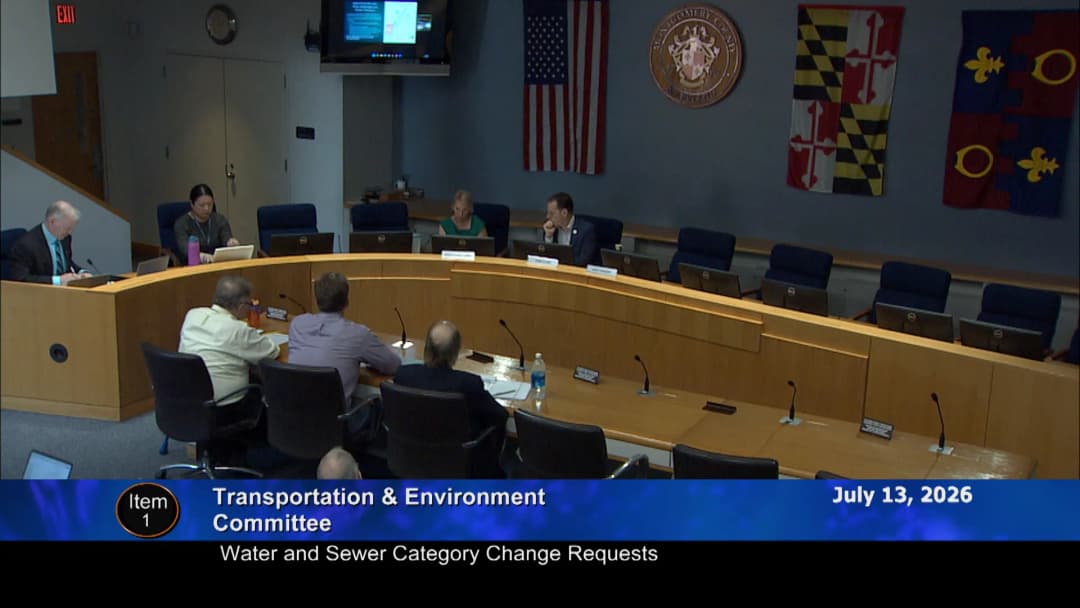
Transportation and Environment Committee Meeting on Water and Sewer Category Changes - July 14, 2026

The Transportation and Environment Committee of the Montgomery County Council met on July 14, 2026, to discuss a resolution approving amendments to the Comprehensive Water Supply and Sewerage Systems Plan, specifically four Water and Sewer Category Change Requests (WSCCRs). The committee considered properties in Potomac, Boyds, Spencerville, and Derwood. After discussion, the committee voted on recommendations for each request, with two deferrals, one approval, and one denial. Discussion Items - WSCCR 26-TRV-05A (12721 Piney Meetinghouse Road, Potomac): The applicant seeks sewer service for a proposed single-family home on a vacant 1.5-acre RE2-zoned property outside the planned sewer envelope and within the Piney Branch Special Protection Area. The required 1,700-foot extension from the Palatine Low Pressure sewer system would not be eligible under existing policies because the property does not have a septic failure, is not in a designated sewer service area, does not abut a main, and the Potomac Peripheral Sewer Service Policy does not apply due to the Special Protection Area. However, a related case (WSCCR-24-TRV-03A) across the street with a failed septic system could potentially make this property eligible if that case proceeds and the extension is built. The committee discussed the complexity and decided to defer the request pending resolution of the related case and upcoming council consideration of the 10-year comprehensive plan update, which may address the peripheral sewer service policy. - WSCCR 26-CKB-01A (21820 Clarksburg Road, Boyds): The applicant proposes a 40-bed assisted living facility on a 5.7-acre RE1-zoned property outside the planned sewer envelope. Sewer service would require a 200-foot extension and easements. The property does not meet exceptions for septic failure, abutting main, or private institutional facility policy (for-profit use). The Planning Board recommended approval based on the community need for senior housing, but the Executive and Council staff recommended denial or deferral due to MDE's previous rejection of a similar commercial sewer service policy. The committee noted the property is an isolated island surrounded by developed areas and decided to defer the request pending the comprehensive water and sewer plan update this fall, which may consider policies for such properties. - WSCCR 26-PAT-01A (Spencerville Seventh Day Adventist Church, Spencerville): The church seeks sewer service to rebuild after a 2024 fire. The property, located on New Hampshire Avenue, is a nonprofit use with an abutting gravity sewer main along the road. Because it meets the abutting main criteria and is consistent with the Cloverly Master Plan, the Executive, Planning Board, and Council staff all recommended approval. The committee unanimously supported approval. - WSCCR 26-URC-01A (6112 Muncaster Mill Road, Derwood): The applicant seeks sewer service for an existing home and additional unpermitted apartment units on a 2-acre RE2-zoned property. The property does not abut a sewer main and no special policies apply. The unpermitted structures are subject to separate legal proceedings. The Executive, Planning Board, and Council staff recommended denial, and the committee agreed, voting to deny the request. Key Outcomes - The committee deferred WSCCR 26-TRV-05A (Potomac) and WSCCR 26-CKB-01A (Boyds), pending the comprehensive water and sewer plan update scheduled for fall 2026 and related policy discussions. - The committee approved WSCCR 26-PAT-01A (Spencerville Seventh Day Adventist Church) as recommended. - The committee denied WSCCR 26-URC-01A (Muncaster Mill Road, Derwood) as recommended. - Council action on the resolution is tentatively scheduled for July 28, 2026.

WATER AND WASTEWATER MANAGEMENT 70% · ENGINEERING AND INFRASTRUCTURE 25% · PROCEDURAL 5%
OPENPUBLICA · PUBLIC MEETING INDEXUPDATED DAILY · openpublica.com