Browse by city
Date range
Search help

Search titles, summaries, topics and stored transcripts together. Keywords may match separately; put the whole query in double quotes for a phrase. Matching follows word analysis, so punctuation is not exact. Both dates are included. Documents are not searched.

SHOWING 21–30 ENTRIES
21
OCT 12, 2026 · MONTGOMERY COUNTY, MARYLAND · COUNTY COUNCIL & COMMITTEES
Transportation and Environment Committee Meeting - October 12, 2026

The Transportation and Environment (T&E) Committee met on Monday, October 12, 2026, from 1:30 p.m. to 4:30 p.m. to discuss four agenda items: two related executive regulations on road design and complete streets, the WSSC Water FY28 spending control limits, and the 2026-2035 Comprehensive Water Supply and Sewerage Systems Plan update. Key outcomes included approval of updated road design regulations, support for a 7% rate increase base case for WSSC Water, and committee action on several water and sewer policy amendments. Consent Calendar - None explicitly designated as consent; however, the two executive regulations (2-25 and 26-25) were adopted together without objection after brief discussion. Discussion Items - Executive Regulations , Adoption of Context Sensitive Road Design Standards - Repeal, and 26-25, Complete Streets: Presented by Mr. Kenny (MCDOT). These regulations repeal previous pre-complete streets regulations and adopt new ones consistent with 2022 county code and the Complete Streets Design Guide. The regulations detail minimum/default widths for street zones, bikeways, sidewalks, medians, bus stops, crosswalks, and stormwater management. MCDOT staff noted a few technical correctionss (parking lane definition, pickup/drop-off length from 21 to 40 feet, a code reference fix, and a numbering error) that could not be amended within current regultatory process but could be included in a future update. The planning department (David Anspacher) requested a clarification on the side path table (a single 19-foot dimension versus components) but agreed to wait for a future update if needed. The committee adopted both regulations (25-25 and 26-25) without objection. - WSSC Water FY28 Spending Control Limits: WSSC Water GM KaChapelle, CFO Munetsi Masara, Chief Engineer Alan Wong, and Director Priscilla Toh presented the proposed budget. The FY28 preliminary budget is $2 billion ($1.27 billion operating, $742.8 million capital). The cost of service study recommended rate enhancements of 11.7% for FY28 (declining in future years). WSSC proposed a base case of 7% rate increase ( requiring $29 million in reductions) and an alternative 5% scenario (requiring deeper cuts). Committee members (Glass, Balcombe, Stewart) expressed support for the 7% base case, noting the national trend of rising water bills (62% average increase over 10 years per Food & Water Watch) and the need for infrastructure investment. The average residential customer impact is about $3.10 per quarter for each 1% rate increase. The committee supported staff recommendations and the WSSC guidence, with a goal to reach agreement with Prince George's County by November 1. - 2026-2035 Comprensive Water Supply and Sewerage Systems Plan Update: Council staff (Mr. Levchenko) led the discussion on remaining policy items from the previous meeting (October 5). Three policies were addressed: 1) Transfer of Abbutting Mains Rights: A policy to allow property owners to transfer abbutting main rights from one parcel to another, with guardrails. Supported by staff; committee agreed to work with DEP on land record codification to ensure future property owners are notified. No objection to include in the plan. 2) Comercial Sewer Service Policy: A new policy to allow commercial properties (with current WS, W6, S6 categories) outside planned envelopes to request water/sewer extensions, modeled after the existing Private Institutional Facilities policy. WSSC Water (Tom Hilton) opposed, citing six concerns: potential for long extensions with low flow leading to water quality/sewerage problems, commingling issues with low-pressure systems, unknown capacity, costly booster pumps, inequitable burden on other ratepayers, and lack of systematic planning. The planning board was supportive, and the committee discussed the balance between ad-hoc approvals and comprehensive planning. Councilmember Balcombe noted no technical difference between a non-profit and for-profit in terms of impact. The committee ultimately supported including the policy in the plan, with the addition of language tying it to Thrive Montgomery 2050's 15-minute living concept. The policy will be reviewed case-by-case with checks from WSSC and MDE. 3) Potomac Perpheral Sewer Service Policy – Palatine Exclusion: Hydraulic capacity analysis by WSSC showed sufficient capacity in the low-pressure system to serve additional properties in the Palatine neighborhood, which had been excluded for 24 years. The committee agreed to remove the exclusion to allow deferred properties to seek approval under the peripheral sewer policy. Key Outcomes - Executive Regulations: Adopted Reg. 25-25 (repeal) and 26-25 (new standards) without objection. - WSSC FY2 Spending Control Limits: Committee supported the 7% rate increase base case, directing staff to work toward agreement with Prince George's County by November 1. - Water and Sewer Plan: Committee directed staff to incorporate: (a) transfer of abbutting mains rights policy with land record clarification language; (b) commercial sewer service policy with Thrive 2050 consistency language; (c) removal of Palatine exclusion in Potomac Peripheral Sewer Service Policy. All changes to be documented in the resolution for full council work session next week and consent action by Oct. 27.
WATER AND WASTEWATER MANAGEMENT 61% · TRANSPORTATION SAFETY 9% · URBAN PLANNING 8% · ENGINEERING AND INFRASTRUCTURE 8%
22
OCT 12, 2026 · MONTGOMERY COUNTY, MARYLAND · COUNTY COUNCIL & COMMITTEES
Economic Development Committee Work Session on EDF Policy and MCEDC Strategic Plan - October 12, 2026

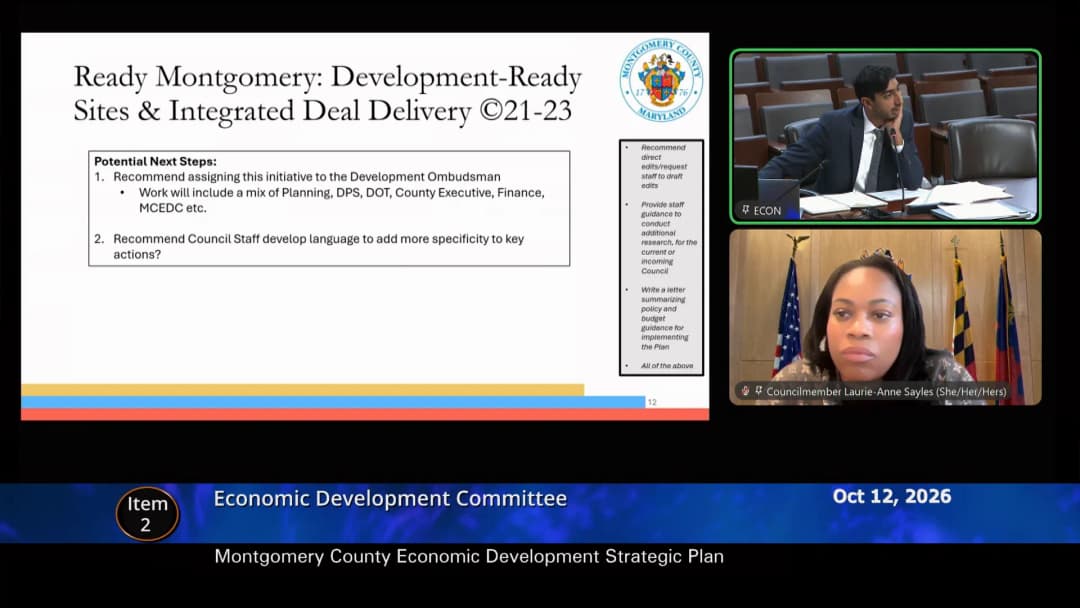
The Montgomery County Council's Economic Development (ECON) Committee met on October 12, 2026, from 9:30 a.m. to 12:30 p.m. in the Council Hearing Room, Rockville, Maryland. The work session focused on two major items: the Economic Development Fund (EDF) policy considerations and the first work session on the Montgomery 2030 Economic Development Strategic Plan. Chair Natali Fani-González presided, with Councilmembers Marilyn Balcombe, Evan Glass, and Laurie-Anne Sayles present; Councilmember Lorig Charkoudian participated virtually. The session featured presentations and discussion aimed at guiding the incoming county executive and council on program restructuring, funding sustainability, and strategic priorities. Economic Development Fund Policy Considerations - Council staff, led by Bilal Ali, presented the status of EDF programs, noting that the MOVE program and Jobs Initiative have exhausted funding. Annual appropriations for the five ongoing EDF programs were reviewed: MOVE ($1.65M), EDF Grant and Loan Program ($2.9M), Job Creation Fund, Technology Innovation Fund, and Founders Fund. Staff noted that all programs are fully committed or nearly exhausted. - Key structural issues identified: MOVE and Job Creation Fund are both attraction/retention programs but focus on different outcomes (MOVE on office vacancy, Jobs on strategic industry jobs). MOVE is a by-right program with a $150K maximum award; Job Creation Fund has a $500K cap. Both lack ROI measurement due to by-right design. The EDF GLP is discretionary, has no award cap, and collects comprehensive data but is more administratively burdensome. - Staff suggested consolidating the three attraction/retention programs (MOVE, EDF GLP, Job Creation Fund) and repurposing MOVE to focus on non-strategic sector businesses or equity goals. Potential updates include lowering MOVE maximum award, implementing scoring criteria, and requiring robust data collection with demographic emphasis. - Teresa Vicela, Program Manager, provided detailed data on MOVE recipients: 92 applications in FY26 (up from 19/year previously); 42% female applicants; 18% Asian, 27% Black/African American, 10% Hispanic, 42% White; geographic distribution: Rockville 34%, Silver Spring and Bethesda 20% each; 19% attraction (relocation), 30% retention (expansion), 48% new businesses; 22% life science, 27% business services; 1,400 initial jobs reported, with 2,400+ projected over three years. - Executive branch (Dennis Hetman, Department of Finance) concurred with analysis, recommending a reframed MOVE program with smaller maximum awards, equity focus (e.g., minority- and women-owned businesses), and a scoring regime prioritizing strategic industries, job quality, and location in low-income census tracts. - Councilmembers raised concerns about public transparency of recipients (especially for Job Creation Fund), need for a consistent ROI matrix across all programs, and the ability to measure whether grants truly alter business decisions. Councilmember Glass stressed the public's right to know where taxpayer funds go, especially for awards up to $500K. Councilmember Balcombe noted the need to balance strategic targeting with community-level services (e.g., child care, veterinary). Councilmember Sayles called for a uniform ROI data collection requirement and better tracking of county revenue generated. - Discussion on Founders Fund: Challenges include restrictive eligibility criteria (MDOT certification or location in Community Equity Index area). Office of the County Executive (Judy Costello) is awaiting County Attorney opinion on expanding definitions to include socially and economically disadvantaged businesses as per federal SBA standards, but noted that would require additional staff resources. Public Comments & Testimony - No separate public comment period was held; public input was gathered during the strategic plan development process (633 survey responses, 75 open comments). - George Smith, MCEDC President and CEO, provided an overview of the Montgomery 2030 plan, which includes five signature initiatives: Ready Montgomery (development-ready sites), Scale 25 (support 25 high-growth firms), MoCo Talent Exchange (connecting employers to talent), Brand Montgomery (unified marketing), and Focus Place-Based Economic Development (community-level growth). - Smith noted the county's growth from 2020-2025 was only 3.5%, lagging behind regional competitors (some growing 8%+). The plan aims to convert assets (federal labs, educated workforce) into private sector growth. - Implementation phases: Year 1 builds foundation with coordination, not necessarily new funding; Years 2-3 expand; Year 4 institutionalizes. Each year will have an action plan and performance report. - Smith stated MCEDC does not intend to lead all five initiatives: MCEDC raises hand for Brand Montgomery and Scale 25; the county is asked to lead Ready Montgomery and Place-Based; Worksource Montgomery to lead the Talent Exchange. Discussion Items - Councilmembers reviewed the strategic plan's target industries (life sciences, technology, aerospace/defense, clean energy/environmental innovation, corporate headquarters) and intersectional industries. Bilal Ali raised concern about aligning definitions with incentive programs; agreed to seek County Attorney input for the November 5 work session. - On implementation leads, committee agreed to explicitly assign leads in the plan for accountability. County government (Office of the County Executive) would lead Ready Montgomery and Place-Based; Finance Department's Dennis Hetman confirmed they are prepared for that role. - Discussion on Scale 25: Bilal Ali presented scenarios for how it might interact with existing incubator programs; committee members (Balcombe, Glass, Sayles) agreed the initiatives should remain separate to avoid confusion, with incubators potentially feeding into Scale 25 later. Cost and resource implications were noted; no specific funding amounts have been attached yet. - On MoCo Talent Exchange, Councilmember Balcombe stressed the need for true partnership among MCPS, Montgomery College, University of Shady Grove, and employers. Councilmember Sayles asked for explicit inclusion of underserved communities and demographic targets in workforce opportunities. - Councilmembers noted the plan lacked Montgomery County-specific context and a strong racial equity and social justice (RESJ) lens. Chair Fani-González observed the plan felt generic; she asked staff to incorporate more local flavor and RESJ elements via data and explicit goals. - Implementation plan: The committee decided not to codify the implementation plan within the strategic plan but expects MCEDC to provide cost estimates and lead assignments before final approval. A companion implementation document with resource needs is anticipated by the time of full council action (by March 15, 2027). Key Outcomes - The committee directed Council staff (Bilal Ali) to draft a letter to the incoming county executive summarizing the committee's views on EDF restructuring and strategic plan priorities. The letter will be reviewed at the November 5 work session and will accompany the council's comments on the strategic plan. - The letter will not demand specific actions or timelines but will inform the new executive of the program status and need for coordinated updates before the FY28 budget. - The committee scheduled a second work session for November 5, 2026, to continue discussion on the strategic plan, incorporating feedback from today: clarifying incentive alignment with target industry definitions, adding RESJ language and data, specifying leads for each initiative, and including Montgomery County-specific context. - Councilmember Glass requested public disclosure of all EDF recipients once funds are dispersed, including Job Creation Fund recipients. Council staff will provide recipients list for all programs to the committee. - The quarterly economic indicators update at ECON committee will be synchronized with EDF program updates to ensure ongoing oversight. - No formal votes were taken; the committee provided guidance for further staff work and preparation for the next work session.

ECONOMIC DEVELOPMENT 74% · PUBLIC ENGAGEMENT 11% · WORKFORCE DEVELOPMENT 4% · PROCEDURAL 4%
23
OCT 8, 2026 · MONTGOMERY COUNTY, MARYLAND · COUNTY COUNCIL & COMMITTEES
Montgomery County Government Operations and Fiscal Policy Committee Reviews Bills 32-26 and 33-26, October 8, 2026

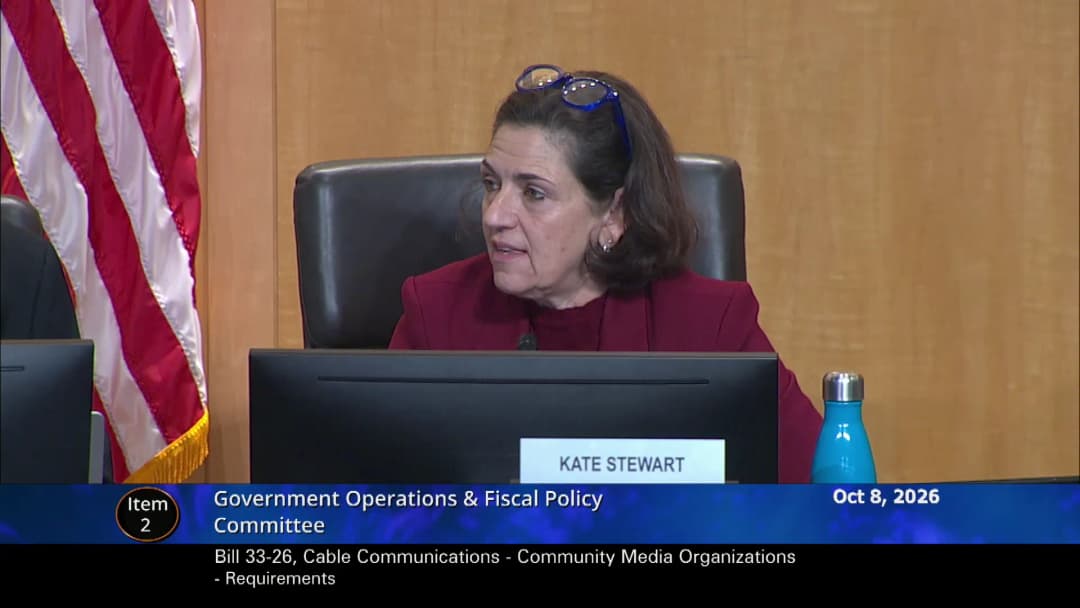
The Montgomery County Council's Government Operations and Fiscal Policy (GO) Committee met on October 8, 2026, for a scheduled 9:30 a.m. to 12:30 p.m. session in Room 3CHR. The committee reviewed two bills: Expedited Bill 32-26 on expanded survivor benefits and Bill 33-26 on community media organization contracting requirements. Both bills received unanimous favorable recommendations to the full council. Expedited Bill 32-26 - Employees' Retirement System: Survivor Benefits for Line-of-Duty Deaths - Councilmember Katz, the lead on the bill, expressed strong support, saying the change 'should have been done a long time ago' and that families of employees who give their lives in county service deserve all survivor benefits. He noted all councilmembers co-sponsored the legislation. - Councilmember Luedtke (referred to as 'Lukey' in the transcript) said the bill extends the HERO Act work from 2025 to additional retirement groups and thanked MCGEO for working with the council on timing, respecting collective bargaining. - Staff explained that Expedited Bill 32-26 expands the HERO Act (Council Bill 35-25, enacted 2025), which increased survivor benefits for police officers and firefighters killed in the line of duty, to retirement Groups E and J: correctional facility employees, emergency communications personnel, correctional officers, and sworn deputy sheriffs. - Staff presented an amendment to align the bill with Bill 21-26, recently enacted in conformance with MCGEO collective bargaining agreements, by removing certain age requirements for retirement eligibility. The committee adopted the amendment without objection. - Councilmember Evans called the bill a 'no-brainer' and expressed full support. - The committee voted unanimously to recommend the bill favorably to the full council. Bill 33-26 - Cable Communications: Community Media Organization Requirements - Chair Stewart provided context that the bill amends Section 8A-32 of the County Code, which enables the county to contract with one or more community media organizations using cable TV special revenue funds or other funds designated for community media. She clarified that the bill does not affect nonprofits that are not defined as community media organizations. - She said the legislation follows the 2023 OLO report, addresses drastically dwindling cable funds, and reflects work with TEBS, MCM, Montgomery College, and MCPS to update county code and align with other county entities and national practices. - Staff summarized current bill provisions: a contracting community media organization must adopt a racial equity and social justice statement, board members must file financial disclosure statements, the board must include up to seven voting residents, with at least one member nominated by the county council and one by the county executive, and the organization must comply with the Open Meetings Act and the Maryland Public Information Act as originally drafted. - Staff noted the county has contracted with MCM since 2004 and that the packet inadvertently included a 2024 production services contract rather than the 2004 contract; staff said the correct contract would be added to the packet. - MCM's executive officer, Ms. White, submitted recommendations and analysis on the legislation. MCM board members and partner organizations were present in the audience. - The committee adopted amendments to require county-nominated board members to have experience in administration or financial management of a nonprofit media organization or governmental entity and to bar them from holding elected office while serving. The committee also removed the Maryland Public Information Act compliance requirement while retaining Open Meetings Act compliance. - The committee adopted an amendment, requested through the MCM board chair, changing the board residency requirement from 'up to seven voting members who must be residents' to 'a majority of voting members must be residents' because MCM's current board has 13 members and its bylaws allow 15. - The committee adopted a supplemental editorial independence amendment requiring bylaws to address board responsibilities, prohibit board members from exercising editorial control over news, ensure independent and unbiased news coverage free from pre-publication review by charitable donors, government interference, or political influence, and establish an editorial independence policy aligned with industry standards. During discussion, the phrase 'financial donors' was changed to 'charitable donors' to avoid conflicting with county contracts for collaborative production work. - Councilmember Evans voiced support, saying the goal was good governance and to set MCM up for success, not to interfere with MCM's operations or mission. - The committee voted unanimously to recommend the bill favorably to the full council as amended. Key Outcomes - Expedited Bill 32-26: The committee unanimously recommended favorable action to the full council, with the technical alignment amendment. - Bill 33-26: The committee unanimously recommended favorable action to the full council as amended, including amendments on board qualifications, board size/residency, removal of MPIA compliance, and editorial independence provisions. - Staff will supplement the Bill 33-26 packet with the correct 2004 contract. - Chair Stewart thanked Susan Madden, who is retiring from Montgomery College, and recognized TEBS, MCM, Montgomery College, and MCPS for their collaboration before adjourning the meeting.

PUBLIC ENGAGEMENT 49% · PUBLIC INFORMATION ACT 12% · PERSONNEL MATTERS 11% · COMMUNITY ENGAGEMENT 10%
24
OCT 8, 2026 · MONTGOMERY COUNTY, MARYLAND · COUNTY COUNCIL & COMMITTEES
Economic Development Committee Work Session on Urban Districts and Placemaking Organizations - October 8, 2026

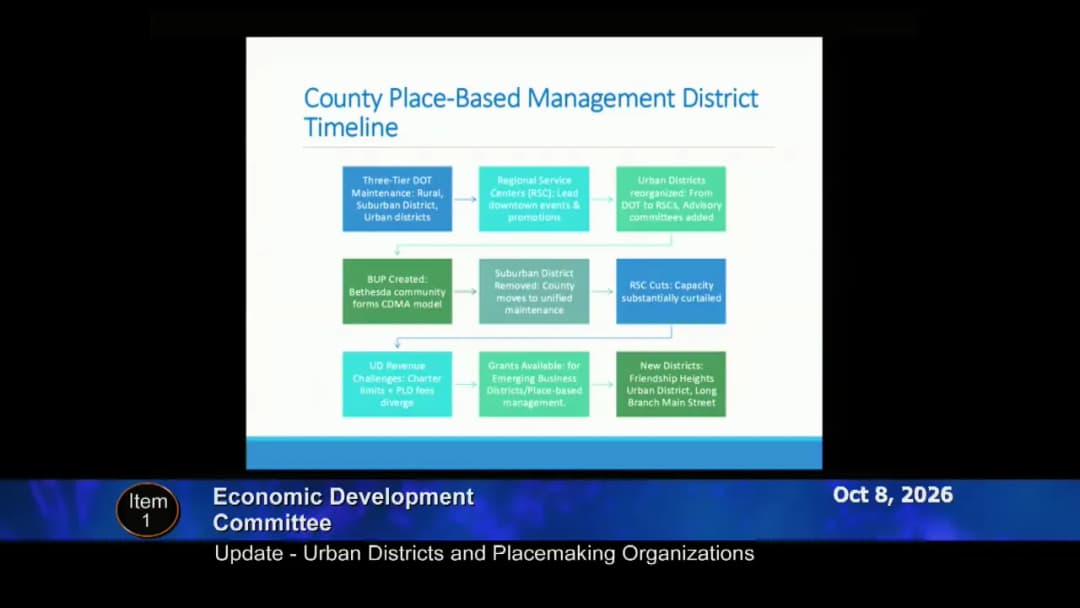
The Montgomery County Council’s Economic Development Committee (ECON) held a work session on October 8, 2026, from 9:30 a.m. to 12:30 p.m. to discuss the modernization of urban districts and placemaking organizations. Chair Natali Fani-González emphasized the need for countywide pride and equitable support across all districts, including emerging ones. The session included presentations from county staff, representatives from urban districts, main streets, business improvement districts, and regional service center directors. Discussions focused on funding models, transitioning to community-led models, and ensuring sustainable, locally owned placemaking efforts. Consent Calendar - No consent calendar items were considered. Public Comments & Testimony - No separate public testimony segment was held; invited speakers presented as part of the agenda. Discussion Items Staff Presentation on Urban Districts and Placemaking Ken Hartman-Espada, Assistant Chief Administrative Officer, provided a historical overview of the county’s urban districts (Bethesda, Silver Spring, Wheaton, and Friendship Heights) and alternative models such as main streets (e.g., Long Branch, Tacoma Park) and business improvement districts (e.g., Pike District Partnership). He noted that the parking lot district revenue, historically used to supplement urban districts, has declined, leading to greater reliance on the general fund. He proposed considering a transition of county-run urban districts (Wheaton and Silver Spring) to community-led models, with the county retaining heavy maintenance responsibilities. He stressed that any transition must be community-driven and locally funded. Placemaking Organization Presentations Representatives from several organizations described their work and challenges: - Martin Smith (Creative Wheaton) – Newly formed nonprofit pursuing Maryland Main Street designation; focused on arts-driven economic development and small business advocacy. - Paula Ross (Gaithersburg Germantown Up County Chamber) – Leading efforts to establish an urban district in Germantown Town Center; called for clarity on county investment and implementation of master plans. - Laura Barclay (Main Street Tacoma) – Reported distributing $352,000 in grants to local businesses, leveraging $5 million in private investment; urged creation of operational grants and shared data tools (e.g., Placer AI). - Teresa Cameron (Pike District Partnership) – Organized around committees for events, placemaking, transportation, and economic development; exploring feasibility of a business improvement district or urban district. - Chris Gillis (Montgomery Housing Partnership / Long Branch Main Street) – Emphasized that place-based management takes time; requested moving established programs to base budget to free competitive grants for emerging districts. Reported $1.5 million in capital investment and acquiring first commercial property. - Natalie Avery (Friendship Heights Alliance) – Cross-jurisdictional organization formed in 2022; highlighted 400 events, 75 planter gardens, 7 murals, and a net fiscal benefit analysis. Advocated for more housing near transit to support retail. Regional Directors’ Perspectives - TJ Dant (Bethesda/Chevy Chase) – Noted small team managing Bethesda and Friendship Heights urban districts; highlighted partnerships with Bethesda Urban Partnership (BUP) and others. - Jeff Burton (Bethesda Urban Partnership) – Described BUP as a national model; runs programs without additional county funds (e.g., Bethesda Circulator, art prizes, capital reserve of $2 million). Emphasized that strong county connection enables efficiency. - Nadia Kuth (Mid-County/Wheaton) – Stated that 95% of Wheaton’s urban district funding now comes from the general fund; supports clean and safe teams, events, and partnerships. - Jacob Newman (Silver Spring) – Noted challenges from pandemic, federal workforce layoffs, and immigration enforcement impacts (40% revenue decline reported by some businesses). Highlighted upcoming Purple Line implementation and anti-displacement work. - Jaru Bande (East County) – Described placemaking with minimal funding; requested resources for White Oak, Burtonsville, and other commercial centers. - Ruben Rosario (Up County) – Noted staffing constraints and need for sidewalk, landscaping, and safety improvements in Germantown; timing crucial with ongoing sector plan amendment. Councilmember Discussion - Vice President Marilyn Balcombe questioned who implements master plans, noting the lack of nexus between impact taxes and infrastructure. She argued for equitable baseline services across the county, noting urban districts have received over $10 million each in general fund transfers while emerging districts get little. - Councilmember Evan Glass highlighted the link between density, housing, and small business viability. He urged rethinking funding mechanisms, including property owner contributions, and noted the symbiotic relationship between placemaking organizations and chambers of commerce. - Councilmember Laurie-Anne Sayles called for clearer metrics to evaluate return on investment, a matrix of resources across organizations, and clarification on the role of advocacy (vs. lobbying) for nonprofits using taxpayer funds. She supported including Visit Montgomery in future coordination. - Chair Fani-González announced she will convene a face-to-face meeting of all the placemaking organizations and regional directors before the end of the year to exchange ideas and develop recommendations for the incoming administration. Key Outcomes - No formal votes were taken; the session served as a discussion and information-gathering exercise. - Chair Fani-González directed the placemaking organizations and regional directors to meet together before the end of 2026 to share best practices and develop recommendations for transitioning urban districts and supporting emerging districts. - Staff and councilmembers acknowledged the need to: (1) identify sustainable, locally controlled funding sources; (2) establish baseline service levels and equitable support across the county; (3) develop standardized metrics to measure economic development ROI; and (4) clarify the distinction between advocacy and lobbying for organizations receiving public funds. - The council will continue discussions as part of the broader economic development strategic plan.

ECONOMIC DEVELOPMENT 70% · URBAN PLANNING 12% · PUBLIC ENGAGEMENT 6% · COMMUNITY ENGAGEMENT 2%
25
OCT 6, 2026 · MONTGOMERY COUNTY, MARYLAND · COUNTY COUNCIL & COMMITTEES
Montgomery County Council Meeting - October 6, 2026

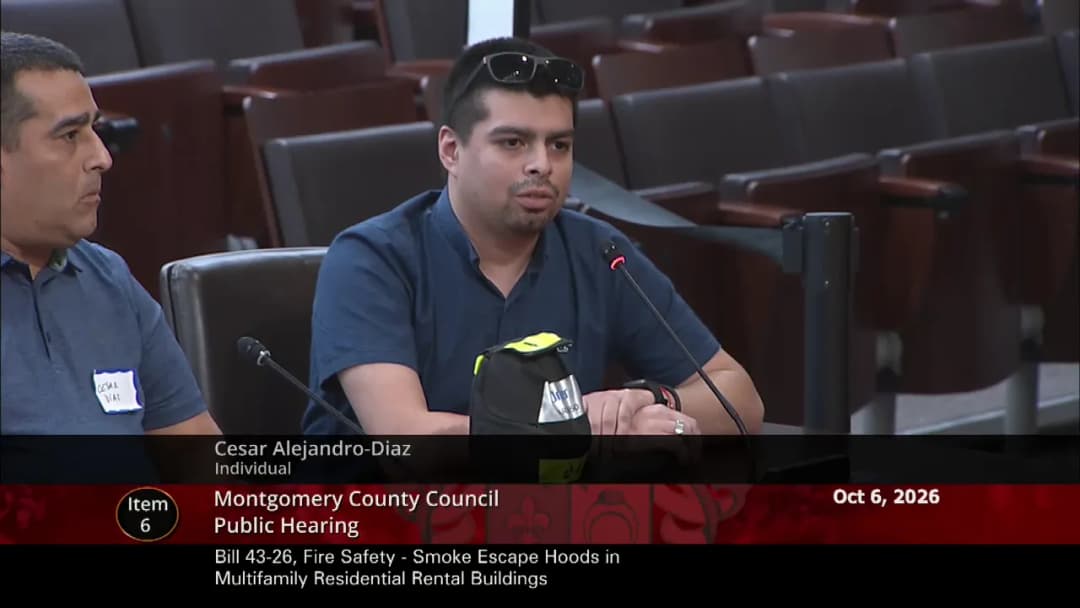
The Montgomery County Council met on Tuesday, October 6, 2026, beginning at 9:00 a.m. The session included proclamations, a Board of Health biannual update, a consent calendar, a Hispanic Heritage Month commemoration, public hearings on four bills, and a District Council session. Key topics included mental health, suicide prevention, Medicaid cuts, accessory dwelling units, short-term rental platform compliance, and smoke escape hoods in multifamily buildings. Presentations & Proclamations - World Mental Health Day Proclamation: Councilmember Stewart recognized October 10 as World Mental Health Day, highlighting the theme "Lived Experiences Heard, Real Voices, Real Change." Multiple mental health leaders and advocates attended, emphasizing culturally competent care and the importance of listening to youth. - National Principals Month Proclamation: Councilmembers Evans and Mink honored principals, with remarks on their critical role. Award recipients were recognized, including Brandy Overton (Mark Mann Award) and Roshonda Piles (Dr. Edward Shirley Award). - Hispanic Heritage Month Commemoration: The council celebrated the 13th annual commemoration, featuring performances, a video honoring three awardees (David Zambrano, Amanda Santiago Alvarez, and Jose Campos), and a proclamation recognizing the contributions of the Latino community, which now makes up over 22% of the county's population. Consent Calendar - Approved unanimously (10-0; Councilmember Jawando absent). Items included: - Introduction of Supplemental Appropriation 27-17 (Capital Budget) for energy conservation and parking renovations totaling $1,375,039 (state aid). - Introduction of Supplemental Appropriation 27-8 (Operating Budget) for utilities, $4,530,830 (state grant). - Introduction of Supplemental Appropriation 27-15 for Economic Development Fund, $1,650,000 (general fund reserves). - Introduction of resolution for special tax in Viva White Oak Development District. - Introduction/Action to approve entities for non-competitive contract awards (e.g., Interfaith Works, Capital Area Food Bank). - Action to approve Supplemental Appropriation 27-1 for Youth Vaping and Nicotine Addiction Response, $390,000 (JUUL/Altria settlement). - Confirmation of appointments to Mental Health Advisory Committee (Kelly Gruitt), Montgomery Cares Program Advisory Board (Kathryn Kelly), and Commission on Veterans Affairs (Vincent Briley). Board of Health Biannual Update (9:30 a.m. – 11:30 a.m.) - Medicaid Updates (Dr. Keisha Davis): - As of October 1, non-citizen eligibility for Medicaid ended for asylum seekers and refugees; an estimated fewer than 2,000 Montgomery County residents will lose coverage. - Starting January 1, 2027, work requirements (80 hours/month or equivalent) will apply to adults 19-64, with recertification every six months. - A Medicaid symposium in August drew 280+ attendees; the county is working with safety-net clinics to absorb affected patients, though Montgomery Cares cannot immediately handle the surge. - Behavioral Health Update (Monica Martin, Chief of Behavioral Health & Crisis Services): - State grant cuts of $964,888 for FY27 were absorbed, reducing administrative grants and some services (e.g., jail addiction services, CIT training for trainers). - The Community Health Resources Commission (CHRC) grant expanded from $9.5M to $12M for FY27, funding 17 providers to serve over 18,000 students across all MCPS schools (up from 7 providers and 10,000 students in FY26). - Alarming Youth Suicide Data: ER visits due to suicide attempts among youth ages 5-17 increased 46% from FY25 to FY26 (from 66 to 523 visits countywide? Wait, the transcript says 523 for all ages, youth 5-17 increase 46%? Actually: Countywide ER visits for suicide attempts increased from 489 to 523 (7% rise), but among youth 5-17, the increase was 46% (from 66 to 96? The slide shows absolute numbers: FY25 = 66? The transcript says "the suicide related ER visits among again youth ages 5 to 17 over that same period saw an increase of 46% due to suicide attempts." It also says "20 of the 66 increased ER visits in fiscal year 26 compared to fiscal year 25 are for a group of high utilizers." So FY25 youth attempts = ? Let's use the 46% figure and note that 9 youth accounted for 20 visits.) - Disproportionate increases: 58% increase among non-Hispanic African American youth; females saw 50% increases for African American and Hispanic females. - Two zip codes with highest rates for two consecutive years: 20850 (Rockville) and 20871 (Germantown). - A Suicide Fatality Review Team is being planned (required by state law but unfunded); expected to start by January 2027. - A youth crisis stabilization center (first in the state) is slated to reopen in November 2026. - Other Updates: - Community Health Transformation Program: $2 million/year from Germantown Emergency Center savings will fund expanded primary care, a 24/7 nurse triage line, urgent care access, and an EMS pilot (nurse practitioner + paramedic) for low-acuity 911 calls, serving about 250 patients/year. - Maternal Health: No freestanding birth centers exist in Maryland; challenges include low Medicaid reimbursement and regulatory barriers. Maryland ranks 50th in C-section rates (30% vs. national 25% and healthy goal of 23%). - School Health: Over 98% compliance with required vaccinations. Lice policy updated: no exclusion for head lice, consistent with AAP guidelines. - Mobile Dental Van: Served 400 seniors, provided 34 sets of dentures. - Respiratory Season: Flu and COVID vaccines available; vaccination rates lower among Latino and Black populations. Public Comments & Testimony (1:30 p.m. – 2:00 p.m.) - Bill 40-26 (Accepted Forms of Payment): Tenants and advocates supported requiring landlords to accept cash, checks, and money orders, citing barriers for seniors and low-income renters forced to use online portals. One tenant from Gardens of Treville described retaliation for activism. The Maryland Hotel Lodging Association supported platform accountability in related bill 42-26. - Bill 41-26 (ADU Licensing and Fees): - Supporters: Greater Greater Washington, Montgomery for All, and a resident argued that removing the owner-occupancy requirement would expand housing options and allow tenants to stay if owners move. They also advocated for pre-approved plans and HOA protections. - Opponents: County Executive's office (Ken Hartman-Espada), Town of Somerset, Montgomery County Civic Federation, and Citizens Coordinating Committee on Friendship Heights argued that eliminating owner-occupancy would allow investors to buy single-family homes, convert them to two-unit rentals, driving up home prices and harming first-time buyers. They urged a limited hardship waiver instead. - Bill 42-26 (Short-Term Rental Platform Compliance): Supporters (hotel association, OIG follow-up) called for monthly reporting and reconciliation of transient tax. Some hosts opposed, citing privacy concerns and burdensome county processes. - Bill 43-26 (Smoke Escape Hoods): - Supporters: Fire Chief Dominic Colletti, the Diaz family (father Cesar Augusto Diaz and brother Cesar Alejandro Diaz), survivors of the 2023 Arrive fire, and Renters Alliance urged passage, noting that smoke inhalation is the leading cause of fire deaths and that hoods provide 15 minutes of filtered air. They argued the cost is minimal ($350/hood, 15-year warranty). - Opponents: Apartment owners and property managers (e.g., Washington Property Company, Southern Management, Commodore Management, Grady Management) argued that hoods should be carried by firefighters, not stored in buildings, citing storage, inspection, and deployment challenges. They noted no other U.S. jurisdiction has such a mandate and that it would add costs without clear safety benefit. Key Outcomes - Consent Calendar: Approved unanimously (10-0). - Public Hearings: Held for Bills 40-26, 41-26, 42-26, and 43-26. Records remain open until specified dates (Oct 12, 19, 19, and Nov 2 respectively). Committee worksessions scheduled. - District Council Session: - Introduced Local Map Amendment H-160 (Foundation for Advanced Education in the Sciences, 9101 Old Georgetown Road, Bethesda) – reclassification to CRTF zone; action tentatively Oct 13. - Adopted Local Map Amendment H-161 (495 Self Storage LLC, 12330 Parklawn Drive, Rockville) unanimously (10-0) – allows redevelopment of aging self-storage facility with higher density (ILF 2.25) and binding elements limiting use and parking waiver. - Adjournment: Meeting adjourned after District Council action.

PUBLIC HEALTH 23% · MENTAL HEALTH AWARENESS 12% · FIRE SAFETY 10% · PUBLIC EDUCATION 8%
26
OCT 5, 2026 · MONTGOMERY COUNTY, MARYLAND · COUNTY COUNCIL & COMMITTEES
PHP Committee Meeting: Landlord-Tenant Bill, ZTA, SRA, and Temporary Uses - October 5, 2026

The Montgomery County Council's Planning, Housing & Parks (PHP) Committee met on October 5, 2026 at 1:30 PM to consider four agenda items. The committee voted unanimously on all items, with amendments adopted for two of them. Public Comments & Testimony - Bill 8-26 (Landlord-Tenant Relations): The City of Rockville and numerous residents testified in support. Councilmember Jawando noted that 86 multifamily properties in Montgomery County are alleged to have used algorithmic software, affecting thousands of residents. Rockville recently passed its own ban on algorithmic devices in multifamily housing, effective January 1, 2027. - ZTA 26-10 (Driveway Access and Shared Parking): No written testimony was received; the Planning Board was the only speaker in support. - SRA 26-02 (Roads – Street Types): The Planning Board was the only speaker at the public hearing. - ZTA 26-11 (Temporary Uses – Benefit Performance): Several speakers testified mostly in support, including chambers of commerce, countryside alliance, and individuals. They cited the high burden of obtaining 75% consent from neighbors, particularly in rural areas with few dwellings. Discussion Items Bill 8-26 – Landlord-Tenant Relations: Prohibition Against Price Coordination and Rent-Setting Algorithms - Sponsor Councilmember Jawando introduced the bill, emphasizing it would address anti-competitive rent-setting through algorithmic devices using non-public competitor data. - Staff attorney Wellons explained the definitions and exclusions. The committee considered two amendments. - Amendment 1 (unanimously adopted 3-0): Aligned the bill with Rockville's ordinance by removing references to public databases, focusing solely on non-public competitor data. Chair Friedson and Council President supported this to ensure consistency and address legal questions. - Amendment 2 (proposed by Chair Friedson): Would create an exemption for joint owners sharing data about properties they co-own. Councilmember Jawando and Director Bruton raised concerns that it could create a loophole and is not found in other jurisdictions. After discussion, the amendment was not moved forward; Chair Friedson indicated the issue could be revisited if needed. - Vote: Bill 8-26 approved 3-0 as amended by Amendment 1. ZTA 26-10 – General Development Requirements: Driveway Access and Shared Parking - Staff attorney Ndou presented two minor changes: adding a reference to Chapter 49, Article 3 for on-site parking from an improved alley, and updating the shared parking model to the latest version. - No questions from colleagues. Voted 3-0 to approve as introduced. SRA 26-02 – Roads: Street Types – Design Standards - Staff attorney Ndou presented changes to Chapter 50: adding the "growth corridor boulevard" street type (with 600-foot intersection spacing) and removing the "parkway" type; also updating horizontal alignment standards to reference the latest AASHTO publication for flexibility. - No questions. Voted 3-0 to approve as introduced. ZTA 26-11 – Temporary Uses: Benefit Performance - Sponsor Councilmember Luedtke explained the bill removes the 75% neighbor consent requirement for temporary benefit performances (e.g., National Night Out) and replaces it with a notice requirement, plus notification to public safety agencies. - Planning Board recommended an amendment to treat outdoor activities differently (require notice to dwellings within 600 feet regardless of duration). Accepted without objection. - County Executive suggested amendments; staff and DPS indicated most could be handled via internal procedures. The committee agreed to set a minimum advance notice of 7 days, as recommended by DPS. - DPS confirmed they would require mailed notice and audit compliance via applicant-provided recipient lists. - Vote: ZTA 26-11 approved 3-0 as amended (planning board amendment and 7-day notice requirement). Key Outcomes - Bill 8-26 approved 3-0 (with Amendment 1 aligning with Rockville's ordinance). Will proceed to full Council. - ZTA 26-10 approved 3-0 as introduced. - SRA 26-02 approved 3-0 as introduced. - ZTA 26-11 approved 3-0 as amended (planning board amendment and 7-day notice requirement). - All votes were unanimous.

AFFORDABLE HOUSING 35% · PLANNING AND ZONING 30% · PENDING LITIGATION 22% · PUBLIC SAFETY 13%
27
OCT 5, 2026 · MONTGOMERY COUNTY, MARYLAND · COUNTY COUNCIL & COMMITTEES
Transportation and Environment Committee Meeting: October 5, 2026

Date: October 5, 2026 Time: 9:30 a.m. – approximately 12:30 p.m. Location: Council Hearing Room, Rockville, MD The Transportation and Environment (T&E) Committee met to discuss four agenda items: a Purple Line construction update, a facility planning review for Old Columbia Pike, the 2026-2035 Comprehensive Water Supply and Sewerage Systems Plan, and Bill 17-26 on speed monitoring cameras. The committee received briefings, deliberated, and made several decisions, including advancing Alternative 5 for Old Columbia Pike, supporting a septic pump-out rebate pilot program, and approving Bill 17-26 with an expedited effective date. Public Comments & Testimony - Old Columbia Pike: David Dunmeyer, representing the Eyes of Paint Branch, raised concerns about environmental impacts of bridge replacement options, particularly in the special protection area of Paint Branch watershed. - Water & Sewer Plan: Testimony was received from an applicant for a proposed elder care facility in Clarksburg, as well as from Friends of Ten Mile Creek, who voiced opposition to approvals in the Clarksburg area due to environmental concerns. Additional written testimony requested more detailed definitions of septic failures and on-site repairs. - Speed Monitoring Bill (Bill 17-26): The public hearing on June 23, 2026, featured five speakers who were largely supportive, though some raised concerns about transparency and accountability. Discussion Items 1. Purple Line Construction Update The committee received a briefing from the Maryland Transit Administration (MTA) and its partners. Key updates: - Construction is over 92% complete; 100% of track installed; all 28 light rail vehicles delivered. - Dynamic testing is underway on more than 70% of the 16-mile alignment, with the remaining sections (including Silver Spring) expected to be tested next. - The contractual opening date remains December 30, 2027, but the project schedule update (April 2028) is considered more realistic, pending completion of systems testing and safety validation. - The Capital Crescent Trail is planned to open in phases, with the first segment (Elm Street to Connecticut Avenue) expected in the first quarter of 2027, though a fence request from Columbia Country Club may cause a slight delay. - Fare payment will accept SmarTrip, CharmPass, and cash, with an open payment system (tap-and-go) being developed for compatibility with WMATA. - Community safety outreach continues, including school programs, virtual public meetings (Oct. 13–Nov. 2026), and a small business grant program that has awarded $1.96 million to 173 businesses. 2. Facility Planning Review: Old Columbia Pike MCDOT presented five alternatives for improvements to Old Columbia Pike and the Paint Branch bridge. Alternatives 3 and 4 would reopen the bridge to vehicle traffic with one or two lanes, requiring demolition and new construction. Alternatives 2 and 5 would retain the bridge for pedestrians and cyclists. Alternative 5, a scaled-back version of Alternative 2, was developed in response to planning board recommendations to avoid conflicts with the Viva White Oak development and reduce environmental impacts. Alternative 5 includes bridge rehabilitation, 290 feet of new sidewalk, and 2,500 feet of side path. Cost estimates range from $1.62 million (Alternative 5) to $6.88 million (Alternative 4). The committee supported Alternative 5 as a first phase, acknowledging future opportunities for expansion. 3. 2026-2035 Comprehensive Water Supply and Sewerage Systems Plan The committee reviewed the three-year update, focusing on outstanding policy issues. Key discussions: - Septic Pump-Out Rebate Program: A pilot program offering a $100 rebate every five years to encourage regular septic tank pumping. DEP noted that pump-outs cost $300–$400, and the rebate could cover 25%–33%. The program would offer 400 rebates annually. The committee expressed support for the pilot as an incentive-based approach to prevent failures. - Abutting Mains Rights Transfer Policy & Commercial Sewer Service Policy: These were deferred from the previous plan update after MDE denied them. Staff proposed revised language for resubmission; discussion was postponed to the next committee session. - Peripheral Sewer Service Policy (Palatine, Potomac): Staff recommended removing the exclusion for the Palatine neighborhood based on a WSSC capacity analysis showing sufficient sewer capacity. The committee agreed to consider this change. - Laytonsville Septic Concerns: A survey of 80 homes is under consideration but requires additional funding; no recommendation in the current plan. - The committee noted a tight timeline (council action by October 27) and agreed to continue the discussion on October 12. 4. Bill 17-26: Motor Vehicles and Traffic – Speed Monitoring Systems Authorized – Amendments The committee considered a bill to enable speed cameras on high-injury network (HIN) corridors, as permitted by state law. Key points: - The bill authorizes cameras on all 100 miles of HIN corridors (currently only 60 miles are eligible). - It also clarifies that school zones with posted speeds above 20 mph are eligible. - The county executive would have authority to implement future state expansions of speed camera authority via executive order, but new technologies (e.g., distracted driving cameras) would still require council approval. - The bill does not require purchasing new cameras; cameras will be moved around eligible corridors based on data. The existing contract allows for quick expansion if needed. - The committee approved the bill with an amendment to expedite its effective date, making it effective upon passage and signing, to allow immediate state permitting. Key Outcomes - Old Columbia Pike: The committee approved the staff recommendation to proceed with Alternative 5, with notes to consider cost-effective sidewalk connections at White Oak Towers and potential side-path improvements north of the bridge. A letter will be sent to MCDOT. - Water & Sewer Plan: The committee supported the septic pump-out rebate pilot program and agreed to consider removing the Palatine exclusion from the peripheral sewer policy. Discussion on the commercial sewer service policy and abutting mains policy is deferred to the October 12 committee session. - Bill 17-26: The committee voted to approve the bill and adopted an amendment to expedite its effective date. The bill will proceed to the full council for final action.

PUBLIC TRANSPORTATION 26% · WATER AND WASTEWATER MANAGEMENT 18% · TRANSPORTATION SAFETY 15% · URBAN PLANNING 12%
28
OCT 5, 2026 · MONTGOMERY COUNTY, MARYLAND · COUNTY COUNCIL & COMMITTEES
Public Safety Committee Work Session - October 5, 2026

The Montgomery County Public Safety Committee met on Monday, October 5, 2026, to discuss two agenda items: Bill 27-26, which would prohibit unlawful racing and street takeovers, and a briefing on the Drone as First Responder (DFR) program. Councilmember Sidney Katz chaired the meeting, joined by Councilmembers Dawn Luedtke and Kristin Mink. The committee heard from Montgomery County Police Department officials and staff, and took public testimony. Public Comments & Testimony - Several individuals submitted testimony in favor of Bill 27-26. No oral public testimony was given during the meeting, but the staff report noted all written testimony supported the bill. Discussion Items - Bill 27-26 – Unlawful Racing and Street Takeovers: Lead sponsor Councilmember Andrew Friedson (not present) and co-sponsors Councilmembers Balcombe, Luedtke, and Katz. Staff Attorney Mr. Ogorzalek presented the bill, which would prohibit participation in unlawful racing, street takeovers, exhibition driving, and related activities on public highways/roadways. It would also prohibit aiding, betting, promoting, organizing, and refusing to disperse. Violations would be Class A misdemeanors with a $1,000 fine. Councilmember Luedtke proposed two amendments: (1) cleaning up language to avoid preemption conflicts with state law; (2) raising the maximum fine to $5,000 (the county cap). Discussion focused on the definition of "street takeover" and protecting First Amendment activities. Councilmember Mink expressed concern that the definition could be used against peaceful protests (e.g., slow-moving caravans) even if not dangerous. She suggested changing "such as" to "including with limitation" to create an exhaustive list of prohibited maneuvers (burnouts, drifting, spinning donuts, acceleration exhibitions) plus "or other similar maneuvers." Councilmember Luedtke and Acting Police Chief Darren Frank argued that the current language, with prosecutorial discretion, is sufficient and that adding "with limitation" could create loopholes. Councilmember Mink also noted a parade exemption in state law. After debate, the committee voted to approve the bill as amended (with the two proposed amendments) to full council: Chair Katz and Councilmember Luedtke voted in favor; Councilmember Mink abstained, indicating she would work on further amendments at full council. The committee also agreed to a technical amendment to change "county highway" to "any highway or roadway" and authorized staff to finalize language. - Drone as First Responder (DFR) Update: Captain Tony Galidora presented a briefing on the program’s progress. Key statistics: Over 6,300 calls for service since launch in late 2023; 2,400 calls in 2026 (through September); coverage expanded to 84 square miles via six dock locations (Silver Spring, Wheaton, Bethesda, Gaithersburg/Montgomery Village, Germantown, White Oak). Transitioned to an American-made dock-based system with FAA permission to fly beyond visual line of sight (200 ft altitude, 2-mile radius per dock). Seven-day-a-week coverage (not 24hrs). A randomized trial with an academic partner (December 2025 to April 2026) found: drone was on scene before officer dispatched 41% of the time; first on scene when both dispatched 74% of the time; 19.5% of calls were resolved remotely (e.g., trespassing). Example cases: missing children found within 10 minutes; stolen vehicle located and suspect arrested. The department stressed the program is a force multiplier, not a replacement for officers. Future expansion areas considered: along I-270 corridor, Aspen Hill, Burtonsville area, pending budget and further academic study. Public transparency measures include a dashboard and no audio/microphones on drones; video treated as evidence with same retention as body cameras. No facial recognition. The committee expressed strong support for the program. Key Outcomes - Bill 27-26: Approved as amended (fine raised to $5,000; preemption cleanup) by a vote of 2-0-1 (Katz and Luedtke in favor, Mink abstained). The bill will proceed to the full County Council for final action. Staff will also incorporate technical changes (roadway definition) and include clarifying language about the exhaustive list of street takeover maneuvers as discussed, but the exact language will be finalized by staff and approved by the committee chair for the record. - Drone program: No vote required. The committee thanked staff and encouraged further expansion as budget allows.

PUBLIC SAFETY 69% · LEGAL AFFAIRS 16% · TECHNOLOGY AND INNOVATION 12% · CIVIL RIGHTS 3%
29
OCT 1, 2026 · MONTGOMERY COUNTY, MARYLAND · COUNTY COUNCIL & COMMITTEES
Montgomery County Joint PS/GO Committee Work Session - October 1, 2026

The joint committee (Public Safety and Government Operations & Fiscal Policy) met on October 1, 2026, from approximately 9:30 a.m. to early afternoon in the Council Hearing Room (3CHR). The session, chaired by Sidney Katz and co-chaired by Kate Stewart, addressed three agenda items: Bill 18-26 (Police – Powers and Duties of Director – DHS Law Enforcement Agency Hiring), Expedited Bill 29-26 (Personnel and Human Resources – Eligibility for County Employment, aka the "Community Trust in County Employees Act"), and a briefing on the unauthorized disclosure of personally identifiable information (PII) by the Fire and Rescue Service. The discussion centered on balancing community trust, hiring standards, legal concerns, and the county’s response to federal immigration enforcement. Discussion Items - Bill 18-26 (Continued Excellence and Public Service Act) – Lead Sponsor: Evan Glass - The bill would require the Montgomery County Police Department (MCPD) to verify specific information before extending a final offer of employment to applicants who were federal law enforcement officers for the Department of Homeland Security (DHS) or its subcomponents (including ICE, CBP, FEMA, HSI) on or after January 21, 2025, and who engaged in deportation, expulsion, or removal operations in the interior of the United States. Exceptions are made for individuals working at ports of entry or along the border. - The verification would include assignment and deployment locations, participation in or witnessing of use of force during operations, and any complaints filed. - MCPD Acting Chief Darren Frank noted that the department is already down over 200 officers and that out of 118 lateral applicants with law enforcement backgrounds, only 2 were hired. He emphasized that the current hiring process includes a 60-page background questionnaire, polygraph, social media scrubs, psychological evaluations, a 30-week academy, and 15 weeks of field training. - Chief Frank expressed concern that the bill would require MCPD to rely on federal agencies (e.g., via FOIA) to verify information, but those agencies are under no obligation to respond, potentially penalizing good candidates whose prior employers do not cooperate. - Councilmember Katz questioned the inclusion of FEMA (a DHS component) and the risk of disqualifying whistleblowers or individuals who tried to do good within ICE/CBP. - Councilmember Luedtke highlighted the tension between the “targeted” approach of Bill 18-26 (focusing on conduct) and the broader categorical ban in Bill 29-26. - Expedited Bill 29-26 (Community Trust in County Employees Act) – Lead Sponsor: Kristin Mink - The bill would prohibit all county public-facing departments (listed as 17 agencies, including police, libraries, recreation, health and human services, etc.) from hiring any “restricted applicant,” defined as anyone employed by ICE or CBP on or after October 1, 2025, or anyone employed or contracted by the U.S. government to support enforcement of federal immigration laws. - Councilmember Mink argued that a narrow assessment of an individual’s role is “too squishy” and undermines community trust; thus a clear prohibition is necessary to reassure residents. - The County Executive’s Office (represented by Luisa Cardona) requested amendments: (1) give HR time to amend personnel regulations; (2) shift the burden from HR to hiring departments to certify if a position is sensitive/public-facing; (3) remove the list of departments and instead use a mechanism where each department self-identifies sensitive positions. - A revised fiscal impact statement (addendum) indicated that the bill could be implemented with no new staff if applicants simply self-attest (yes/no) to having worked for ICE/CBP, and the county would not verify those answers. - Councilmember Glass called the approach “overly broad” and “guilt by association,” noting that it would affect not just law enforcement but over 250,000 federal contractors in Maryland and many non-sworn staff. - Councilmember Luedtke raised constitutional concerns under the Supremacy Clause and Article 24 of the Maryland Declaration of Rights, and questioned how the bill aligns with the county’s “ban the box” policies (not asking about prior convictions). - Councilmember Evans supported the purpose but expressed unease about disqualifying people based on association rather than conduct, and asked for clearer measurement of community trust improvement. - The committee agreed to continue the discussion on October 19, 2026, with a focus on Bill 29-26, while incorporating insights from Bill 18-26. - Briefing – Unauthorized Disclosure of PII by Fire and Rescue Service - On June 4, 2026, a Fire and Rescue Service employee inadvertently distributed an Excel spreadsheet containing names, addresses, bank account numbers, and routing numbers for approximately 7,500 county retirees, career firefighters, and volunteers. - The spreadsheet was created by Finance for a transition to electronic direct deposit for volunteer reimbursements; it contained four worksheets, but only one was intended to be sent. - The email was sent to 6 county employees and 62 volunteer fire chiefs/presidents. Within 1.5 hours, MCFRS realized the error and contacted the county’s IT security team (Tebs). Within 2 hours, over 3,300 messages were deleted from the county email system. For the 11 recipients outside the county email system, each was contacted and asked to delete the email. - The county notified affected individuals by email and mail within 4 days, and provided call scripts to 311 and the retirement contact center. The Chief Administrative Officer also attended a retiree association meeting. - The county’s Chief Information Security Officer (Keith Young) confirmed that this was human error, not a cyberattack. Recommendations include enhanced training, checklists for non-standard reports, data classification projects (already identified 2.5 million sensitive files), and encryption awareness. - Councilmember Glass noted that encryption alone would not have prevented the disclosure because recipients could still forward the email. He urged consideration of requiring all volunteer fire leaders to use county email accounts. Acting Deputy Chief Howard Richards said the department is not opposed but cited costs. - Councilmember Stewart recommended the county consider an internal audit of the new procedures and more direct communication (beyond 311) for affected retirees. Key Outcomes - Bills 18-26 and 29-26: The committee decided to continue the joint discussion on October 19, 2026, with a focus on refining Bill 29-26. Staff were asked to provide further legal analysis on constitutional issues and to circulate proposed amendments from the County Executive’s Office. No votes were taken. - Data Breach Briefing: The committee accepted the briefing and noted the corrective actions already underway. The chair will forward a letter received from a concerned volunteer to the executive team. No formal action was taken, but the committee expects follow-up on: (1) consideration of providing county email accounts to all volunteer fire leaders, (2) potential internal audit of new procedures, and (3) enhanced proactive outreach to affected individuals.

PUBLIC SAFETY 25% · CYBERSECURITY 20% · IMMIGRATION POLICY 17% · LAW ENFORCEMENT HIRING 15%
30
SEP 30, 2026 · MONTGOMERY COUNTY, MARYLAND · COUNTY COUNCIL & COMMITTEES
Montgomery County Council Public Safety Committee Work Session – September 30, 2026

The Montgomery County Council Public Safety Committee met on September 30, 2026, for a morning work session (agenda time 9:30 a.m.–12:30 p.m.) to review two bills: Expedited Bill 16-26, the Financial Exploitation Protection Act, and Bill 36-26, updating the Fire and Emergency Services Commission (FESC). The committee advanced both bills to the full County Council. Public Comments & Testimony - Staff reported that public hearing testimony on Bill 16-26 was entirely in favor of the bill, and no amendments were pending. - Tim Mulligan, a volunteer with the Office of Consumer Protection, said FBI estimates show scams are by far the largest source of financial losses in the United States. He described a case involving a 72-year-old woman with $450,000 missing from her bank account; the funds were traced to Canada and a front person was arrested, but the money was not recovered. - Russell Hartongue, president of the Montgomery County Volunteer Fire Rescue Association (MCVFRA), representing 19 local fire rescue departments, presented the association’s position that the FESC must review and approve all applicable fire and rescue policy documents, including fire chief general orders. He argued interim orders should not be used to circumvent required stakeholder and commission review. - A county executive branch representative said the executive appreciates the FESC’s work, does not want to undermine career and volunteer support, and believes legal ambiguities should be clarified in the law rather than left to interpretation. - Battalion Chief Ashley Robinson said Fire Chief Smedley has directed a collaborative policy process and that the department has adopted MCVFRA suggestions; she noted that when no feedback is received, the department assumes agreement. Discussion Items Expedited Bill 16-26 – Consumer Protection Amendments (Financial Exploitation Protection Act) - Chair Sidney Katz explained the bill aligns Montgomery County consumer protection law with Maryland state law and gives the Office of Consumer Protection additional tools to deter deceptive trade practices targeting vulnerable residents and adults 68 years or older. - Staff said the bill also expressly authorizes mediation programs, expands the current narrow definition of consumer transactions, and has minimal fiscal impact, indeterminate economic impact, a positive racial equity and social justice impact, and no climate impact. - Eric Friedman of the Office of Consumer Protection and Tim Mulligan said the expanded authority would allow investigation of romance scams, investment scams, fake utilities or government agencies, and cases where jurisdiction under the old code was unclear. - Councilmember Kristin Mink voiced strong support, calling the prior lack of authority a major gap that needed to be fixed. Chair Katz also thanked groups serving people with intellectual disabilities, such as SEAC, noting the protections are important for residents living independently. - The committee voted 3–0 by acclamation to recommend the bill to the full Council; Chair Katz noted it would be 4–0 with Councilmember Stewart’s vote. Bill 36-26 – Fire and Emergency Services Commission Duties and Responsibilities - Lead sponsor Councilmember Dawn Luedtke said the FESC was created when the county blended its fire service and is an extra procedural layer for volunteer, career, and public input on department policy. She said the bill fixes open-ended issues such as the timing of the annual report, tiebreakers, and interim health and safety orders. - Staff summarized key changes: at least a 30-day public comment period for proposed policies or regulations; a 60-day FESC review window; deemed approval if FESC does not act; regulations then move through the county’s Administrative Procedure Act process; notice of disapproval within five days; and interim orders lasting 90 days that can continue while full review is pending. - MCVFRA representatives raised concerns that fire chief general orders are no longer sent to the FESC and that association comments are sometimes not acted on. Councilmember Luedtke responded that the career and volunteer groups already have review rights under collective bargaining agreements, and that notice-and-comment processes require consideration, not adoption, of every comment. - The committee reviewed last-minute county executive amendments: expanding FESC public membership from three to five members to match the five regional service centers, limiting FESC review of emergency communication center dispatch matters to fire and rescue protocols, adding an explicit collective bargaining agreement exclusion, and allowing the fire chief to withdraw a pending policy before FESC action. - Committee members and panelists discussed whether expanding public members would shift the FESC's voting balance; the committee did not finalize that decision and directed staff to prepare the amendments for the full Council packet instead of voting on them in committee. - It was clarified that the withdrawal provision would apply only to items pending before the FESC, not to rescission of existing policies, which remains governed by collective bargaining and Office of Labor Relations processes. A suggestion was made to continue discussions on rescissions separately with the Office of Labor Relations. Key Outcomes - Bill 16-26 was recommended to the full County Council by a 3–0 vote, with no amendments. - Bill 36-26 was recommended to the full County Council by acclamation. Staff was directed to draft amendments for full Council covering public membership expansion (from three to five, with details to be resolved), limiting ECC dispatch review to fire and rescue matters, adding a collective bargaining agreement exclusion, and allowing withdrawal of pending FESC items. - The committee agreed that continued conversations are needed with MCVFRA and the Office of Labor Relations on policy-rescission concerns and that the FESC annual report should be discussed by the Public Safety Committee in the future.

PUBLIC SAFETY 35% · FIRE SAFETY 27% · CONSUMER PROTECTION 18% · LEGAL AFFAIRS 9%
OPENPUBLICA · PUBLIC MEETING INDEXUPDATED DAILY · openpublica.com