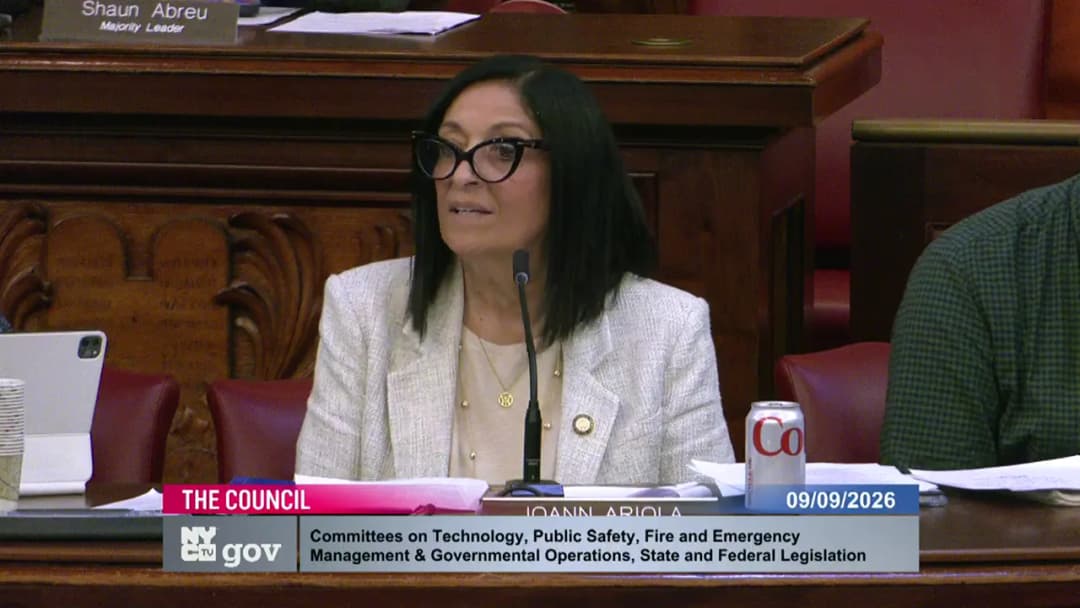
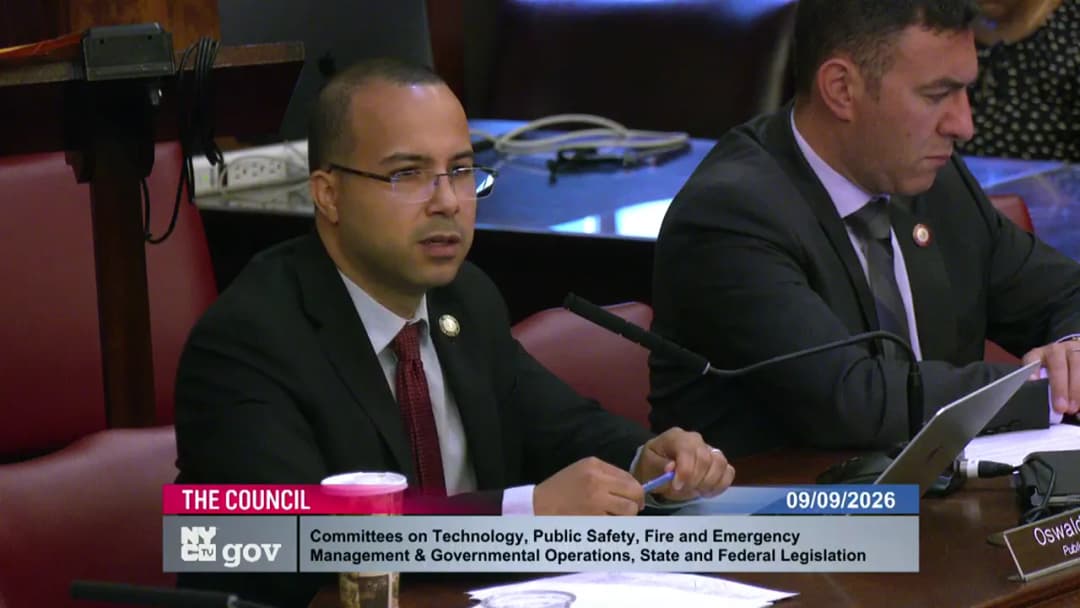
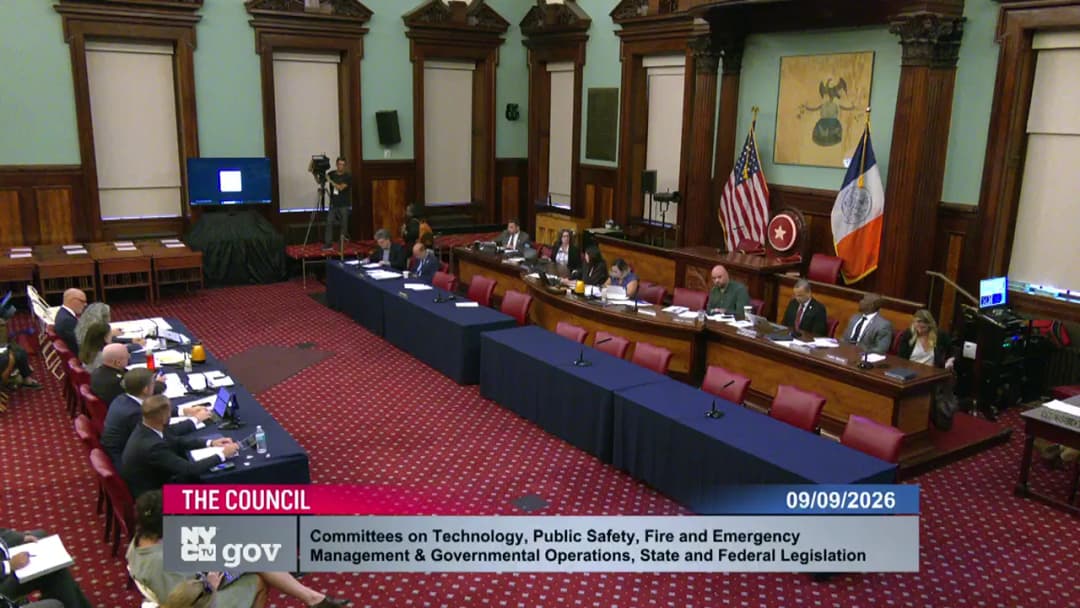
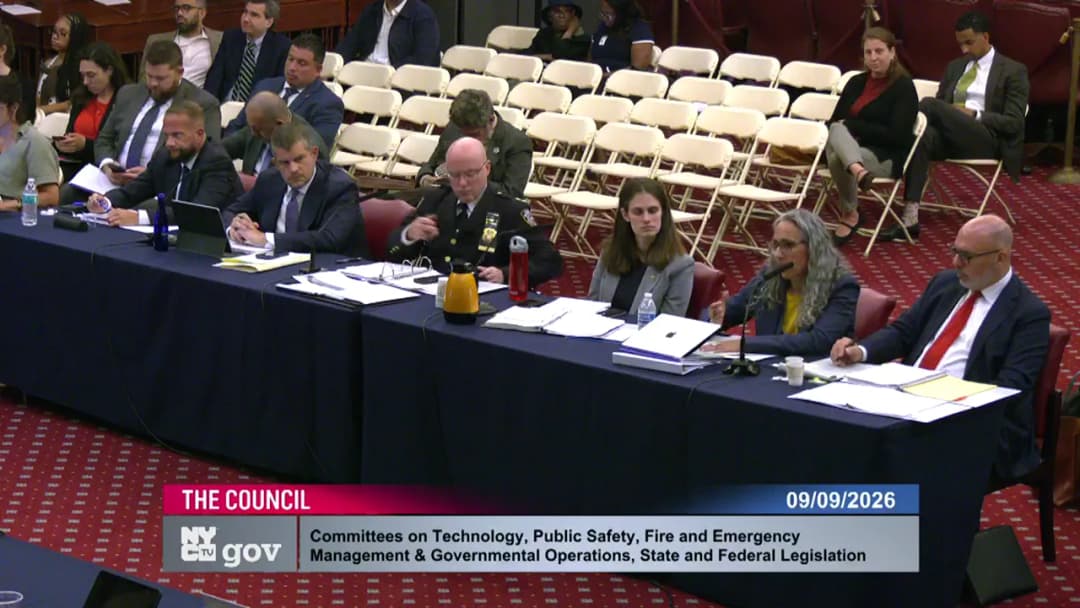
This joint oversight hearing, held by the Committees on Technology, Public Safety, Fire and Emergency Management, and Governmental Operations, State & Federal Legislation, examined the seven-hour 911 system outage that occurred on August 18, 2026. The outage, caused by a Motorola firmware update at the Bronx Public Safety Answering Center (PSAC 2), left approximately 113 unique 911 callers unable to reach emergency services. Officials from the Office of Technology and Innovation (OTI), NYPD, and FDNY testified, and council members expressed strong concerns about delayed detection, lack of public notification, and insufficient redundancy. Public Comments & Testimony - Jordan Rosenthal (Director of Advocacy, Community Access / Correct Crisis Intervention Today coalition) argued for an independent 911 system separate from the NYPD, citing best practices from Seattle and Austin, and a University of Chicago Health Lab report recommending equal status for emergency communication centers. - Michelle Amp Lomanville and Beverly Lonmanville spoke on behalf of Havana syndrome victims, raising concerns about potential misuse of 911 technology and requested meetings to discuss protections. Discussion Items - Timeline and Detection Failures: Councilmembers highlighted that the outage began at 3:13 AM, but the first call-taker alert came around 6:00 AM, a ticket was filed at 6:40 AM, and the full scope (affecting 911 calls) was not understood until 9:30 AM. OTI Commissioner Galopter acknowledged that electronic monitoring did not catch the issue and that manual monitoring has since been instituted. - Public Notification: Multiple councilmembers (Feliz, Ariola, Brewer, Morano, Riley) criticized the city for not notifying the public during the outage. OTI stated that once they knew 911 calls were affected (9:30 AM), the focus was on remediation, and only 45 minutes elapsed before resolution, so they chose not to deter callers. Councilmembers argued that notification should be immediate, especially given a similar texting outage in May 2026. - Vendor Accountability: Councilmembers pressed on Motorola's role, asking why the firmware update was deemed low risk, why testing failed, and what contractual remedies exist. OTI declined to assign blame until a root cause analysis is complete but noted a freeze on new deployments and daily executive-level meetings. - Redundancy and System Design: Questions were raised about why calls did not automatically failover from PSAC 2 (Bronx) to PSAC 1 (Brooklyn). OTI explained that the redundancy did not trigger because 70% of calls were still being handled, making the issue appear intermittent. Councilmembers called for automatic failover mechanisms. - Staffing and Next-Gen 911: NYPD reported progress on 911 operator staffing (1,370 operators currently, up 10% from last year) and projected voluntary overtime within 3–6 months. Next-gen 911, originally slated for summer 2026, is now expected in Q3 2027; OTI committed to a disciplined review. - Prior Outages: The hearing referenced a May 2026 texting outage (110 minutes) and a 2024 configuration error. OTI noted that the May outage affected 12 texters who received bounce-back messages. Key Outcomes - The hearing was filed by committee without immediate action. - Council committees will send a follow-up letter with unanswered questions, including details on the 113 unserviced callers, Motorola's liability, and public notification protocols. - OTI committed to completing a root cause analysis (timeline not specified) and to revisiting risk assessment criteria, change management, and public communication policies. - NYPD committed to honoring the call-taker and principal who escalated the issue with a Commander's Day. - No deaths or injuries were attributed to the outage based on preliminary review, but outreach to affected callers continues.
Public Meetings - New York City, New York
Public Meetings - New York City, New YorkThis joint oversight hearing, convened by the Committees on Technology, Public Safety, Fire and Emergency Management, and Governmental Operations, examined the seven-hour 911 system outage on August 18, 2026. City officials from OTI, NYPD, and FDNY testified about the cause, response, and impact of the outage, which affected approximately 1,696 calls, including 742 911 calls. The hearing focused on delayed detection, failure to notify the public, vendor accountability, and systemic improvements. Public Comments & Testimony - Jordan Rosenthal (Director of Advocacy, Community Access): Testified in favor of making the 911 system independent of the NYPD, citing best practices from Seattle and Austin, and a recommendation from the University of Chicago Health Lab. Argued that the current multi-agency structure complicates accountability. - Michelle Amp Lomanville: Spoke as a health educator and advocate for Havana syndrome victims, alleging unlawful experimentation and technology-based harassment. Raised concerns about 911 system involvement in surveillance. - Beverly Lonmanville: A retired technology analyst who testified about personal concerns regarding biometric data access and security. Discussion Items - Timeline and Detection: Chairs Feliz, Ariola, and others pressed on why the issue was not detected for hours. The first indication of a problem came at 6 a.m. from an NYPD call taker, but OTI did not confirm that 911 calls were affected until 9:30 a.m. The outage lasted from 3:13 a.m. to 10:19 a.m. OTI Commissioner Galopter acknowledged that automated monitoring failed to catch the issue. - Public Notification Failure: Multiple council members criticized the administration for not notifying the public during the outage. OTI stated that because 70% of calls were still going through and the issue was resolved within 45 minutes of detection, they prioritized remediation over notification. Chairs Feliz and Ariola strongly disagreed, noting that even partial outages require immediate public alerts. - Motorola's Role and Contractual Liability: OTI confirmed that Motorola's firmware upgrade caused the outage, but would not assign blame until a root cause analysis is complete. Council members questioned why Motorola was not present, why the upgrade was deemed low-risk, and what contractual remedies exist. OTI noted that Motorola is a managed service provider and that the city is self-insured. - Staffing of 911 Operators: NYPD Chief of Staff Ryan Merola reported that the department has added 400 operators in the last year, with 1,370 operators currently. Overtime averages 32 hours per month per operator, and they aim to make overtime entirely voluntary within 3-6 months. - Next Generation 911 (NG911): Commissioner Galopter stated NG911 is now expected to be completed in Q3 2027, delayed from earlier projections. She committed to a disciplined review of the project's schedule and scope. - Independent Verification and Vendor Management: Councilmember Morano raised concerns that Motorola is involved in its own root cause analysis and asked who independently verifies the city's findings. OTI said they are reviewing governance and contract terms. - Previous Outages: The hearing reviewed several past 911 system failures: a May 2026 texting outage (110 minutes), a September 2024 configuration error, a 2022 accidental power-off by a contractor, and 2021 FDNY dispatch outages. OTI and FDNY described corrective measures but council members noted a pattern of insufficient public disclosure. Key Outcomes - Root Cause Analysis: OTI committed to a comprehensive root cause analysis, but could not provide a deadline for completion. A freeze on non-critical system changes is in place pending the analysis. - Interim Monitoring: OTI has implemented manual hourly call recording reviews and daily executive-level status meetings. A freeze on new deployments is in effect except for critical updates under strict exception protocols. - Public Notification Policy: OTI agreed to revisit internal and external communication protocols, including coordination with NYCEM and Notify NYC. No specific policy changes were announced. - Council Follow-Up: The committee chairs will send a joint letter to OTI requesting additional information on contract terms, vendor liability, and detailed callback data for the 113 callers who never reached an operator.
On September 9, 2026, the New York City Council Committees on Technology, Fire and Emergency Management, Public Safety, and Governmental Operations, State & Federal Legislation held a joint oversight hearing to examine the 911 system outage that occurred on August 18, 2026. The outage, caused by a Motorola firmware update at the Bronx Public Safety Answering Center 2 (PSAC 2), lasted approximately seven hours (3:13 AM to 10:19 AM), affecting 1,696 calls, including 742 911 calls. Of those, 319 unique callers were impacted, with 206 eventually connected and 113 unserviced. The hearing focused on the timeline, lack of public notification, redundancy failures, vendor accountability, and steps to prevent recurrence. Public Comments & Testimony - Jordan Rosenthal (Director of Advocacy at Community Access) testified in support of making the city's 911 system independent of the NYPD, citing a University of Chicago Health Lab study and the example of Seattle’s independent crisis response system. He argued that independence would clarify accountability and improve responses to mental health calls. - Michelle Amp Lomanville and Beverly Lonmanville testified about Havana syndrome victims and concerns regarding biometric technology abuse, requesting a meeting to discuss 911's role in potential surveillance. Discussion Items - Timeline and Detection: OTI Commissioner Lisa Golopter testified that Motorola performed a low-risk firmware upgrade at PSAC 2 on the night of August 17, completed at 4:13 AM. The first indication of trouble came at 6 AM when a call taker reported audio issues with alarm company calls, but the full impact on 911 was not realized until 9:30 AM. NYPD first notified OTI of alarm call problems at 6:40 AM. The outage was resolved by rerouting traffic to PSAC 1 by 10:19 AM. - Public Notification: Multiple council members criticized the failure to promptly notify the public. Chair Felice and others argued that by 6:40 AM, the city knew of a partial outage and should have alerted New Yorkers via Notify NYC. The administration defended the delay, saying the focus was on restoring service and that 70% of calls were still being handled; they committed to revisiting notification protocols. - Redundancy and Monitoring: OTI acknowledged that existing redundancy (PSAC 1 and PSAC 2) did not automatically reroute calls during the outage. Monitoring systems failed to detect the error, prompting interim manual monitoring of call recordings. Commissioner Golopter stated that a root cause analysis is ongoing and that a freeze on non-critical updates has been implemented. - Vendor Responsibility: Motorola performed the firmware update that triggered the outage but was not aware of the problem. OTI stated it is premature to assign blame or discuss contractual penalties until the root cause analysis is complete. NYPD did not have advance notification of the upgrade beyond a standard change advisory board process. - Staffing and Next-Gen 911: NYPD reported progress in hiring 911 operators (1,370 currently, up 10% from last year) and expects to reduce mandatory overtime within 3-6 months. Next-Gen 911, originally due in 2018, is now scheduled for Q3 2027, with OTI promising a disciplined review. - Earlier Outages: The hearing also reviewed a May 2026 text-to-911 outage lasting 110 minutes (12 callers affected), a 2024 configuration error, and a 2022 accidental power shutoff. FDNY noted that separate dispatch systems have been stable since initial 2021 glitches. Key Outcomes - The committee will send a follow-up letter requesting additional information on the root cause analysis, contractual penalties for Motorola, and a timeline for notification protocols. - OTI committed to completing a thorough root cause analysis (estimated months) and will reevaluate risk classification for software updates, vendor oversight, and public communication policies. - No injury or death attributable to the outage has been identified to date; NYPD called back hundreds of affected callers, reaching 32 individuals who reported no remaining crisis. - The hearing was adjourned with plans for continued oversight and legislative action if necessary.
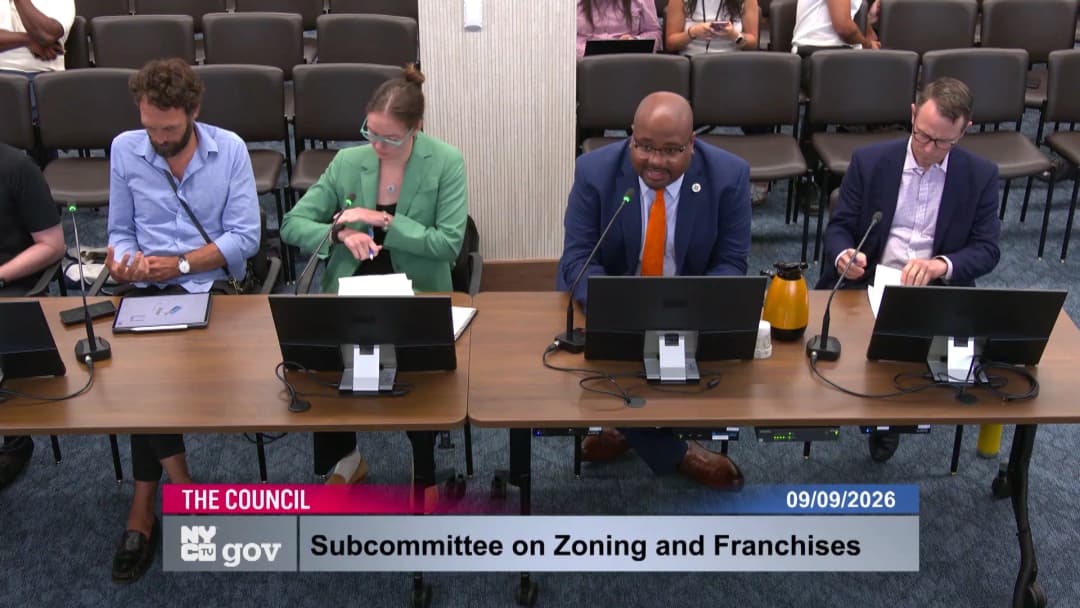
The New York City Council Subcommittee on Zoning and Franchises met in hybrid format on Wednesday, September 9, 2026, at 11:00 AM in Hearing Room 3 at 250 Broadway. Chair Farah N. Louis presided. Present were Councilmembers Carr, Encarnación, Farías, Salaam, Sanchez, Schulman, and Thomas-Henry; Felder was medically absent. Councilmembers Santosuosso, Won, Restler, Feliz, and Riley also attended. The subcommittee approved three land-use applications by roll call and held hearings on six rezoning proposals, all of which were laid over without a subcommittee vote. Votes and Land Use Actions - LU 0120-2026 (815 Hutchinson River Parkway Rezoning, Bronx): Approved. The zoning map amendment changes an M1-2 District to a C8-3 District to allow large retail establishments of 10,000 square feet or larger at an existing commercial center in Ferry Point. The district's councilmember expressed support for the application. - LU 0121-2026 / LU 0122-2026 (862-868 Kent Avenue, Brooklyn): Approved. The actions change an M1-1 District to an M1-4/R6A District, establish a Special Mixed Use District (MX-4), and map a Mandatory Inclusionary Housing Area. The applicant proposes approximately 74 apartments, with approximately 19 permanently affordable. - LU 0125-2026 / LU 0126-2026 (132 Melrose Street, Brooklyn): Approved with modifications and referred to the City Planning Commission. The actions change an M1-1 District to an M1-2A/R6A District, establish MX-22, and map a Mandatory Inclusionary Housing Area. The applicant proposes approximately 18 apartments, with approximately 5 permanently affordable. - LU 0123-2026 / LU 0124-2026 (158-06 Northern Boulevard Rezoning, Queens): Laid over; no vote taken. - The final roll call for the three approved items was 8 in the affirmative and 1 medical absence. After an initial 7-vote count, the chair reopened the vote so Councilmember Schulman could vote, making the final count 8. Public Comments & Testimony - Fort Hamilton Mews (T2026-2499 / T2026-2500): Sarah Penenberg of SEIU Local 32BJ announced that the union was about to sign a neutrality agreement with the developer ensuring prevailing wage and good jobs. Veronica Urovoski and Logan Ferris of Open New York spoke in favor; Ferris said the project would more than triple affordable homes built in that community district from 2014 to 2025 and cited the city's estimated need for 700,000 new homes over the next decade. - 21-31 46th Avenue (LU 0127-2026 / LU 0128-2026): Numerous residents and property owners testified in opposition. Concerns included an outdated 70-unit environmental review revised to 84 units, flooding risks from cellar parking and excavation, shadows on neighboring low-rise buildings, traffic and congestion, a severe open-space deficit in the area, loss of the TD Bank site, and a notarized petition signed by more than 100 surrounding property owners. Several speakers asked for a contextual lower-rise building and stronger community benefits. - Sojourner Truth - Mapes (T2026-2503 / T2026-2504): Karan Banks, deputy political director of 32BJ, opposed the rezoning because Phipps Houses had not signed a new development agreement covering prevailing wage for future workers. April Hurley of TIME Action, Bronx Community Board 6 District Manager Raphael Mori Panet, board members Laura James and Bridget Brantley, and tenants including Eugenia Austin testified against the application, citing Phipps's management record, HPD violations, relocation and recertification failures, and calling for co-op/homeownership, parking, small-business space, and community input. Councilmember Felice said he had not decided how he would vote. - Park Avenue Brooklyn, 289 Kent Avenue, and 69-67 108th Street: No members of the public signed up to testify. Discussion Items - Park Avenue Brooklyn (T2026-2501 / T2026-2502), preconsidered: The applicant, a coalition of property owners and Jewish educational institutions, proposed rezoning five blocks from legacy manufacturing districts to M1-4/R6-1 and M1-4/R7D with MX-4 and a Mandatory Inclusionary Housing Area. The proposal includes about 391 residential units, 98 to 117 permanently affordable units under MIH Options 1 and 3, more than 2,500 private school seats across four educational facilities, and ground-floor retail. Councilmember Restler strongly supported the project, called it a tremendous community investment, and criticized the Department of Transportation's environmental review process. No public testimony was given. Laid over. - 289 Kent Avenue (T2026-2507 / T2026-2508), preconsidered: Webb Holdings LLC proposes changing an M3-1 District to an M1-3A/R7X District and an M1-2A District with MX-8 and MIH to build approximately 278 apartments. Chair Lewis described the affordable requirement as 70 to 83 permanently affordable units; the applicant's counsel later cited 56 to 83 depending on the MIH option selected. Councilmember Restler raised design transition and union-labor questions; the applicant said it had begun conversations with 32BJ and intended to move forward quickly. No public testimony. Laid over. - Fort Hamilton Mews (T2026-2499 / T2026-2500), preconsidered: 9305 5th Ave LLC proposes rezoning in Bay Ridge from R5B/R6B to R7X with a C2-4 overlay, yielding about 292 apartments and 88 income-restricted units under MIH Option 2. Councilmember Santosuosso expressed significant concerns about the project setting a precedent in the Bay Ridge Triangle and asked the applicant to withdraw until a community planning process was complete; the applicant declined. In response to community board feedback, the applicant presented a revised R7D design with a 115-foot height and a six-story street-wall base, and said it would not withdraw. If disapproved, the applicant stated it would pursue an appeals-board route or a January ULURP filing without council approval, potentially at greater density. Public testimony included 32BJ's announced neutrality agreement and two supporters. Laid over. - 21-31 46th Avenue (LU 0127-2026 / LU 0128-2026): 21-31 Holdings LLC proposes an R7X rezoning with a C2-5 overlay in Long Island City for an 11-story, roughly 84-unit mixed-use building. Roughly 21 units would be permanently affordable under MIH; the applicant emphasized that 52 of the 84 units have two or three bedrooms, and that Community Board 2 voted 32-2 in favor. Councilmember Won noted more than 30 emails of opposition and only two in support, and pressed the applicant on affordability, ground-floor community uses, early childhood space, greenery, and engagement beyond the community board. The applicant committed to further conversations but had not programmed ground-floor tenants. Laid over. - 69-67 108th Street (T2026-2505 / T2026-2506), preconsidered: The applicant proposes an R7D rezoning with a C2-4 overlay in Forest Hills for an 11-story building with 59 units, about 15 affordable under MIH Option 1, and ground-floor commercial or community facility space. The applicant reported Community Board 6 approval by a 36-4 vote and noted the site is near transit. Councilmember Schulman asked about deeper affordability, ground-floor tenants, community board design recommendations, and nearby McDonald Park improvements; the applicant said it would consider park funding. No public testimony. Laid over. - Sojourner Truth - Mapes (T2026-2503 / T2026-2504), preconsidered: Phipps Houses, a nonprofit affordable-housing developer, proposes two Bronx rezonings from R7-1 to R8 with MIH to build 100 percent affordable housing: 159 units at the Sojourner Truth site and 298 units at the Mapes Court site. Fifty percent of Sojourner units would be reserved for relocated Mapes Court tenants. More than 60 percent of Sojourner units and 55 percent of Mapes units would be two- or three-bedroom homes, with affordability ranging from 30 percent to 80 percent AMI. The Mapes site would include about 15,000 square feet of community facility space, with a potential YMCA conversation scheduled. Bronx Community Board 6 voted no, and 32BJ and several community speakers opposed the application. Laid over. Key Outcomes - LU 0120, LU 0121/0122, and LU 0125/0126 were approved by the subcommittee and referred to the Land Use Committee; LU 0125/0126 were approved with modifications. - All six hearing items were laid over, meaning the subcommittee took no vote on them. - Councilmember Santosuosso announced the Bay Ridge Triangle Community Plan and stated the Fort Hamilton Mews applicant declined to withdraw. - The Fort Hamilton Mews applicant indicated possible fallback legal and expedited ULURP options if the rezoning is not approved. - Councilmember Felice and Councilmember Won signaled that continued community negotiations would be needed before the Sojourner Truth-Mapes and 21-31 46th Avenue proposals could advance.
The New York City Council Committee on Housing and Buildings, chaired by Councilmember Pierina Ana Sanchez, held a hearing on Wednesday, September 9, 2026, to conduct oversight of Mayor Zoran Mamdani's comprehensive housing plan, "Block by Block: The Housing Plan for a New Era." The committee also heard testimony on seven proposed local laws, including the Community Opportunity to Purchase Act (COPA, Int. 0905), the reauthorization of the J51 tax incentive (Int. 1015), and bills addressing office conversions, property owner identification, permit sign-offs, street numbers, and electronic property registration. The hearing featured extensive testimony from administration officials, council members, advocates, tenants, property owners, and labor representatives. All introductions were heard and laid over by the committee. Public Comments & Testimony - Support for COPA (Int. 0905): A broad coalition of tenant organizers, community land trusts (e.g., East New York CLT, Queens CLT, Chinatown CLT), legal aid groups (NYLAG, Communities Resist), affordable housing developers (VOA, Goddard Riverside), and advocacy organizations (ANHD, UHAB, New Economy Project, ARP, LiveOn NY) urged passage, arguing it would preserve affordable housing, combat speculation, and empower tenants. Testifiers shared stories of living with mold, vermin, broken elevators, and landlord neglect, emphasizing that COPA would give qualified nonprofits a first right of refusal to purchase distressed buildings. - Opposition to COPA: Small Property Owners of New York (SPONY) and individual testifier Christopher Johnson opposed COPA, calling it unconstitutional and arguing it would penalize owners financially distressed by city policies (rent freezes, high taxes). SPONY questioned HPD's capacity to handle up to 2,100 potential eligible transactions per year. - Support for J51 Reauthorization (Int. 1015): Urban Green Council, Climate Works for All Coalition, and co-op/condo advocates (CNYC) stressed the importance of J51 for helping buildings comply with Local Law 97, citing that over 300,000 residential units in co-ops and condos could benefit. - Support for Electronic Registration (Preconsidered bill): SPONY and others thanked Councilmember Banks for the bill, saying it would modernize a paper-based system that often loses documents. - Support for Office of Conversion Assistance (Int. 0178): Open New York and others supported the bill, noting that office-to-residential conversions have already yielded 10,000 new housing permits this year and that an assistance office would streamline the process. - Concerns from Labor: IBEW Local 3, Plumbers Local 1, Mason Tenders District Council, and Local 79 testified in support of the Construction Justice Act (CJA) and project labor agreements, urging that affordable housing construction provide family-sustaining wages and benefits, not poverty wages through labor brokers. They highlighted cases where workers on subsidized projects earned $21-$22/hour without benefits. - Concerns from Senior and Homeless Advocates: Urban Pathways, New Destiny Housing, Supportive Housing Network, and LiveOn NY called for more deeply affordable units (12,000/year for ELI households) and supportive housing preservation. They noted that 73% of extremely low-income households are rent-burdened and that seniors are the fastest-growing homeless population. - Concerns from Property Owners: SPONY opposed Int. 0649 (posting owner sign), arguing it would invade privacy and that current HPD registration already provides emergency contacts. Discussion Items - Oversight of the Mayor’s Housing Plan: Chair Sanchez and council members questioned HPD Commissioner Adolfo Levy and DOB Commissioner Amant Tagani on implementation, staffing, enforcement, and preservation strategies. Key topics included: - Staffing and Capacity: HPD reported 993 enforcement staff (11% increase over 5 years) and 353 development staff (19% increase), with 41 new positions allocated for the housing plan. DOB had 604 inspectors (7% vacancy rate) with 25 in pipeline. Both commissioners expressed confidence in morale but acknowledged competition with private sector pay. - Enforcement Tools: The administration described "Fix the City" initiative targeting 10 distressed portfolios, new OCA directive expediting 7A cases (hearings within 5 days), and coordinated interagency inspections. HPD committed to investigating every unit-specific heat complaint this winter and launching a new reinspection scheduling system. - Preservation vs. Production: The plan aims to build 200,000 new affordable units and preserve 200,000 existing units over 10 years. HPD highlighted the "Tools" program for stabilizing at-risk buildings, a $100 million city-backed insurance program (22 responses to RFEI), and expansion of the J51 tax abatement. - COPA Implementation: HPD estimated 2,100 buildings currently eligible under the revised distress criteria (rolling code violations). Commissioner Levy noted that HPD would need rulemaking for qualified purchasers list, penalties, and tenant notification, and that financing would rely on existing programs (PLP, Article 11) plus potential partnerships with CDFIs. - ADU and Conversion Progress: DOB reported 27 ADU applications in pipeline (plus 17 expected), with 48% of basement/seller conversions. The pre-approved plan model has not yet been used due to lot constraints. DOB will finalize rules for manufactured ADUs by end of 2026. - Rent-Stabilized Vacancies: HPD questioned DHCR data showing 57,000 vacant rent-stabilized units, noting that the Housing Vacancy Survey (due February 2027) will provide deeper analysis and that many vacancies are temporary (turnover, lease-up). - Homelessness and Vouchers: HPD reported converting 2,000 EHV families to TBRA, and moving 1,700 from NYCHA to HPD's home ARP. For the remaining 3,400 NYCHA EHV families, NYCHA is offering PACT/Section 8 applications, but Councilmember Restler criticized the slow pace. - Intro 0905 (COPA): Councilmember Nurse, the sponsor, highlighted that 62% of New Yorkers (5 million people) cannot meet basic cost of living, and that COPA would disrupt the cycle of landlord neglect by giving nonprofits first right to purchase distressed buildings. Commissioner Levy expressed administration support, aligning with preservation goals. - Intro 0178 (Office of Conversion Assistance): Councilmember Epstein explained the bill would help developers navigate complex conversions and report data. Commissioner Levy and DOB supported the intent. - Intro 0649 (Owner Identification Sign): Councilmember Restler's bill requires posting beneficial owners. SPONY opposed, citing privacy; administration supported goals but wanted enforcement discussions. - Intro 0717 (Permit Sign-Off Notices): Councilmember Salaam's bill would require DOB to notify owners of open permits every 90 days. DOB supported intent but cautioned that too-frequent notices (every 2 weeks near expiration) might be ignored. - Intro 0860 (Street Number Enforcement): Councilmember Brewer's bill would allow HPD and FDNY to inspect and enforce street number display. Administration supported, noting coordination with DCP on rules. - Intro 1015 (J51 Reauthorization): Chair Sanchez's bill extends J51 for 10 years, raises assessed value threshold to $60,000, and allows HPD to update covered projects. Administration strongly supported and urged quick passage. - Preconsidered Bill (Electronic Registration): Councilmember Banks' bill would allow online property registration with electronic signatures. HPD supported and is already seeking a vendor. Key Outcomes - All seven introductions were heard and laid over by the committee (no final vote). The minutes confirm hearings held and laid over for Ints 0178, 0649, 0717, 0860, 0905, 1015, and the preconsidered bill. - Oversight hearing filed (no further action required). - Administration commitments: HPD and DOB committed to follow up on specific data (e.g., inspector tenure, 420C utilization, permit sign-off open permits on 1-4 family homes). - Next steps: The legislative task force on housing code reforms will launch later in September. HPD will release draft Housing Vacancy Survey report in February 2027. The Bronx plan community engagement begins late fall 2026. DOB will finalize ADU rules by end of 2026.
On September 9, 2026, the New York City Council Committees on Technology, Public Safety, Fire and Emergency Management, and Governmental Operations held a joint oversight hearing to examine the seven-hour 911 system outage that occurred on August 18, 2026. The outage affected the Bronx Public Safety Answering Center 2 (PSAC 2) and left approximately 113 unique callers without service. City officials from the Office of Technology and Innovation (OTI), FDNY, and NYPD testified, and two members of the public provided testimony. The hearing focused on the root cause, response timeline, lack of public notification, redundancies, and accountability. Public Comments & Testimony - Jordan Rosenthal (Director of Advocacy at Community Access, leader of Correct Crisis Intervention Today coalition) advocated for a fully independent 911 system separate from the NYPD, citing best practices from Seattle and Austin. He noted that a University of Chicago Health Lab report recommends 911 centers be equal and separate from police and other agencies to improve clarity and outcomes. - Michelle Amp Lomanville and Beverly Lonmanville (health educators and former NYU lecturer, retired technology analyst) spoke on behalf of victims of Havana syndrome and anomalous health incidents, calling for protections against technological weaponization and requesting a meeting to discuss 911 system scanning concerns. Discussion Items - Timeline of the Outage: OTI Commissioner Lisa Galopter detailed that at 3:13 a.m. on August 18, 2026, after a routine Motorola firewall firmware upgrade at PSAC 2, calls began failing. The issue was first reported at 6:00 a.m. by an NYPD call taker, a ticket was filed at 6:40 a.m., and the city did not determine that 911 calls were affected until 9:30 a.m. The outage was resolved by 10:19 a.m. after rerouting all traffic to PSAC 1 in Brooklyn. - Call Impact Statistics: Of 5,489 total emergency calls during the disruption (including alarm company calls), 1,696 encountered issues. Of these, 742 were 911 calls, from 319 unique phone numbers. 206 of those callers eventually connected; 113 unique callers did not receive service. No deaths or injuries have been attributed to the outage. - Public Notification Failure: Multiple councilmembers criticized the lack of public alert during the outage. OTI acknowledged that because they only knew 911 calls were impacted for about 45 minutes before resolution, primary focus was on remediation, but they will revisit communication protocols. A separate text-to-911 outage in May 2026 (110 minutes, 12 callers affected) also lacked public notification beyond bounce-back messages. - Redundancy and Testing: The system has redundant architecture (PSAC 1 and PSAC 2 can each handle full volume), but the failure did not trigger automatic failover. Testing protocols failed to detect the session-timeout issue. OTI has implemented immediate manual monitoring and a freeze on new deployments pending a full root cause analysis. - Vendor Accountability: Motorola performed the upgrade and deemed it low risk, but the city did not independently verify. OTI stated it would be premature to assign liability until the root cause analysis is complete, though Motorola is contractually subject to service-level agreements and potential remedies. - Next-Gen 911: The city’s next-generation 911 modernization, initiated in 2020, is now expected to be completed in Q3 2027 (previously summer 2026). Commissioner Galopter committed to a disciplined review of the project. - Staffing: NYPD testified that 911 operator staffing is a top priority; overtime currently averages 32 hours per month per operator. The goal is to reach voluntary overtime only within three to six months. Key Outcomes - The committees will send a joint letter requesting additional information on unresolved questions, including the root cause analysis timeline, specific caller outcomes, and Motorola’s contractual liabilities. - OTI has instituted an immediate freeze on new system changes except critical updates, increased executive-level oversight, and daily interagency status meetings. - A full root cause analysis is ongoing, with no set deadline; Commissioner Galopter indicated it could take months. - The city will re-evaluate risk assessment criteria, change management procedures, and public notification policies with NYC Emergency Management (NYCEM) and the Notify NYC system. - Independent verification of Motorola’s findings and a review of alternative vendor options were raised as future considerations. - Councilmember Lincoln advocated for relocating the PSAC 1 facility from the Metrotech campus in downtown Brooklyn due to its negative impact on the neighborhood.
On September 9, 2026, the New York City Council Committee on Education, chaired by Councilmember Eric Dinowitz, met to consider and vote on Proposed Resolution 7-A, which calls on the New York State Legislature and Governor to pass legislation requiring a 9/11 curriculum in all New York schools. The meeting took place two days before the 25th anniversary of the September 11, 2001 attacks. Discussion Items - Chair Dinowitz opened by noting the significance of the 25th anniversary and the lack of a required 9/11 curriculum, leading to uneven coverage in schools. He urged support for the resolution, which proposes age-appropriate curriculum including core information on the events and global impact. - Councilmember Rita Joseph, a co-sponsor, shared a personal account of being a fifth-grade teacher on 9/11, describing how her class watched the towers fall live. She emphasized that a moment of silence is not enough and that a standardized curriculum is needed statewide, not just in New York City. She also noted existing resources from the DOE and 9/11 Memorial Museum but stressed the importance of state legislation. - The committee considered an amendment to the resolution (the specific amendment details were not provided in the transcript, but the minutes indicate the resolution was amended and adopted as Res. No. 7-A). Key Outcomes - The committee voted to approve the amended resolution (Res. No. 7-A) by a roll call vote of 12 in favor, 0 opposed, and 0 abstentions. Councilmember Shekar Krishnan was absent. - Affirmative: Dinowitz, Brewer, De La Rosa, Farías, Gutiérrez, Joseph, Lee, Louis, Narcisse, Schulman, Wong, Zhuang. - The resolution will now proceed to the full City Council for consideration.
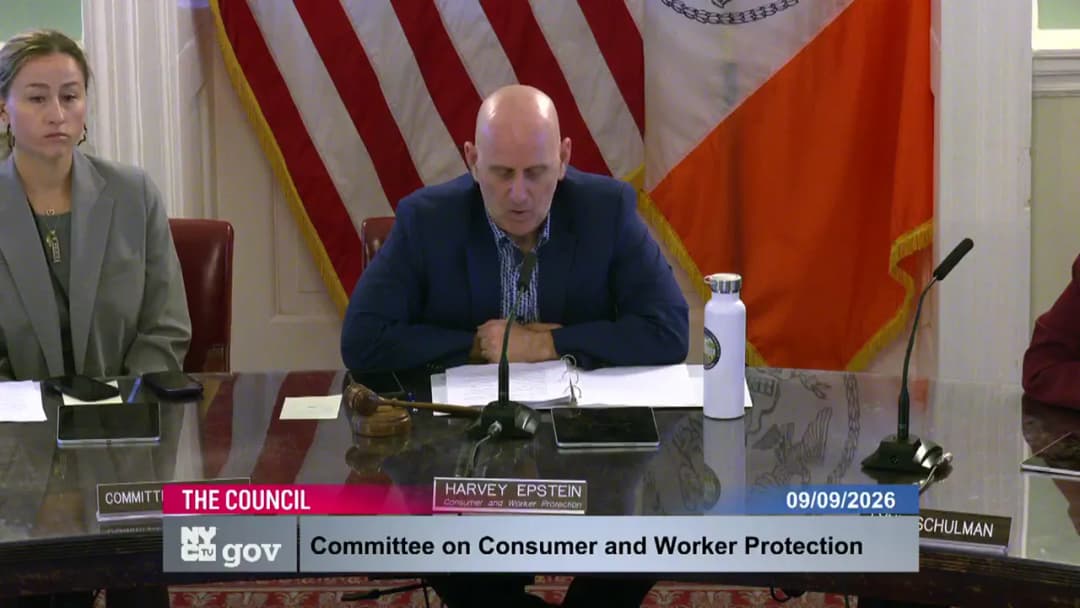
The Committee on Consumer and Worker Protection held a meeting on September 9, 2026, to vote on Proposed Int. No. 813-A, a local law amending the administrative code to allow the Department of Consumer and Worker Protection (DCWP) to refuse to renew, suspend, or revoke a license of a tobacco retail dealer or an electronic cigarette retail dealer that has violated certain authorization requirements of the cannabis law. Chair Harvey Epstein sponsored the bill, stating it aims to address the illegal cannabis market by enabling enforcement against dealers illegally selling cannabis. Key Outcomes - The committee voted 8-0 in favor of approving Int. No. 813-A, with no negative votes or abstentions. - Members voting in favor: Chair Epstein, Aldebol, Ariola, Banks, Hanks, Ossé, Schulman, and Wilson. - Members absent: Brewer, De La Rosa, and Krishnan. - The bill was amended by the committee prior to the vote (as noted in the minutes) and subsequently approved.
On Tuesday, September 8, 2026, at 11:00 AM, the New York City Council Subcommittee on Landmarks, Public Sitings, Resiliency and Dispositions, chaired by Councilmember Christopher Marte, held a hybrid hearing at 250 Broadway, 8th Floor, Hearing Room 3. Present were Councilmembers Marte, Alexa Avilés, Oswald J. Feliz, and Shanel Thomas-Henry; Councilmembers Sandy Nurse and Chi A. Ossé were absent; Kamillah Hanks was medically excused. The subcommittee considered two pre-considered land use applications (T2026-2497 and T2026-2498) related to the 48-50 Convent Avenue cluster (ANCP) project in Manhattan Community District 9, Council District 7, represented by the Majority Leader's district. Discussion Items - Project Presentation: Emily Adler and Asher Toparovsky (representing the developer Novus Living LLC) and Daniel Tomkins (HPD) presented the proposal for the 48-50 Convent Avenue cluster, which includes four buildings at 48 Convent Avenue, 50 Convent Avenue, 453-455 West 125th Street, and 12-14 Old Broadway. The project involves a total gut rehabilitation of 77 affordable homeownership units through the Affordable Neighborhood Cooperative Program (ANCP). Of these, 44 units are for existing tenants (insiders) who will become homeowners, 31 units will be sold to first-time outside buyers via the NYC Housing Connect lottery, and 2 units are for live-in superintendents. - Financial Details: The project relies on approximately $800,000 per unit in city capital (no debt, 40-year no-interest), a 40-year Article 11 tax exemption, acquisition subsidies ($1 per building/land), and state grants (Affordable Housing Corporation and electrification READY grant). Existing residents can purchase units for $2,500 (or $250 through a purchase savings plan if below income threshold). Outside buyers at 80% AMI would pay no more than 30% of income on housing, with monthly maintenance fees estimated at $1,191 per unit. A resale (flip tax) schedule balances equity building and permanent affordability: insiders start with a 90-95% flip tax decreasing to 10% over time; new purchasers face a 10% flip tax in perpetuity. - Relocation Plan: Tenants will be temporarily relocated by the sponsor, Novus Living, during the 18-24 month construction period. Relocation units will be found within the neighborhood where possible, and tenants continue paying their current rent; the project budget covers the difference. All insiders have a right to return or can receive a permanent voucher if they choose not to return. Right-sizing options are available pending approval. - Readiness Training: The Urban Homesteading Assistance Board (UHAB) administers comprehensive co-op readiness training covering bylaws, board operations, budgeting, elections, and property management. At least 80% of insider tenants must attend eight training sessions and remain current on rent to qualify for homeownership; otherwise, the building would convert to rent-stabilized rentals. - Councilmember Questions: Councilmember Marte inquired about relocation logistics, and Councilmember Thomas Henry asked about readiness training, marketing of vacant units (via Housing Connect lottery), per-unit costs ($800,000), and resale restrictions. Councilmember Avilés sought clarification on relocation scope (no out-of-state unless family), right to return, right-sizing, and the proportion of existing residents expected to need rental vouchers (likely a large majority due to low incomes). Public Comments & Testimony - No members of the public testified either in person or remotely. Key Outcomes - The subcommittee held a public hearing on the two pre-considered items (T2026-2497 and T2026-2498). - Both items were laid over by the subcommittee (no vote taken), meaning they will be considered at a future meeting.
On September 2, 2026, the New York City Council Committee on Health held an oversight hearing on the city's response to the 2026 Legionnaires' disease cluster on the Upper East Side, which sickened 94 people, hospitalized 79, and killed 11 New Yorkers. The committee also considered eight legislative proposals aimed at strengthening prevention, enforcement, and public outreach. Chair Lynn C. Schulman presided, joined by Speaker Adrienne Menin and other council members. The hearing included testimony from family members of victims, community advocates, the Department of Health and Mental Hygiene (DOHMH) Commissioner Dr. Alistair Martin and deputies, and public witnesses. Public Comments & Testimony - Family Members and Victims: Ida Goldstein testified about the death of her husband Robert, an Air Force veteran, after a 50-year marriage. Daniel Thomas spoke about the death of his father, Judge Charles Thomas, describing it as a "completely preventable random act of violence." Minister Sandria Coleman called Legionnaires' disease "100% preventable" and criticized the health department for inadequate preparation. Valerie Mason, Chair of Community Board 8, praised local elected officials for pushing the city to act more aggressively and noted the mayor had not visited the affected community. She recommended drones to identify unregistered cooling towers and mobile testing units. - Harlem Legionnaires Task Force: Heaven Barhana from 3333 Broadway criticized DOHMH for sending untrained staff, lacking Spanish translators, and failing to provide resources. Kim Smith demanded greater accountability and enforcement, noting that only 56 water ecologists are insufficient for 5,000 cooling towers. - Other Public Witnesses: Gwen Hanlin, whose husband Kevin died in 2017, urged comprehensive investigation of every case. Bob Bocock, a water treatment expert, called for a source-to-tap approach. Union representatives (Plumbing Foundation, MCA, Local 94) supported parts of the legislation but urged broader focus on potable water systems and better training. Discussion Items - Oversight of 2026 Outbreak: Council members questioned DOHMH Commissioner Martin and deputies about the delayed identification of the source, staffing shortfalls, and enforcement gaps. Speaker Menin highlighted that only 35 of 56 authorized water ecologist positions were staffed during the outbreak. Chair Schulman presented data showing a 50% decline in cooling tower inspections since 2017, with only 20 summonses issued in the affected zip codes before July, but 180 summonses in July after the outbreak was public. DOHMH acknowledged 50 of 56 positions are now filled but cited difficulties recruiting specialized staff. The commissioner defended the response, noting aggressive PCR-based remediation and public transparency, but admitted the source match is still pending via whole genome sequencing. - Legislative Proposals: Eight bills were considered: Int. 0181 (shower hoses for tenants), Int. 0999 (temporary testing sites and digital map), Int. 1005 (education and outreach), Int. 1006 (cleaning cooling towers at least three times per year), Int. 1016 (Legionnaires' disease hotline), Int. 1017 (post-cluster analysis), and two pre-considered bills on interagency compliance review and public database. DOHMH expressed support for some but opposed Int. 0999 and Int. 1006, arguing pop-up testing is inappropriate and unnecessary cleaning can damage systems. Council members and public witnesses stressed the need for proactive enforcement, higher fines, and better communication. Key Outcomes - All eight introductions were heard and laid over by the committee (no votes taken). The oversight item was filed. - DOHMH announced five new measures: cross-referencing DOB data to identify unregistered cooling towers, enhancing the address-based lookup map, exploring faster culture testing, accelerating OATH hearing dates for violations, and convening a scientific advisory panel on new technology. - The committee noted discrepancies in staffing data and the timing of public communications. A follow-up request for detailed staffing numbers and comparison with other cities was made. - Written testimony may be submitted within 72 hours.