121
SEP 9, 2026 · NEW YORK CITY, NEW YORK · CITY COUNCIL
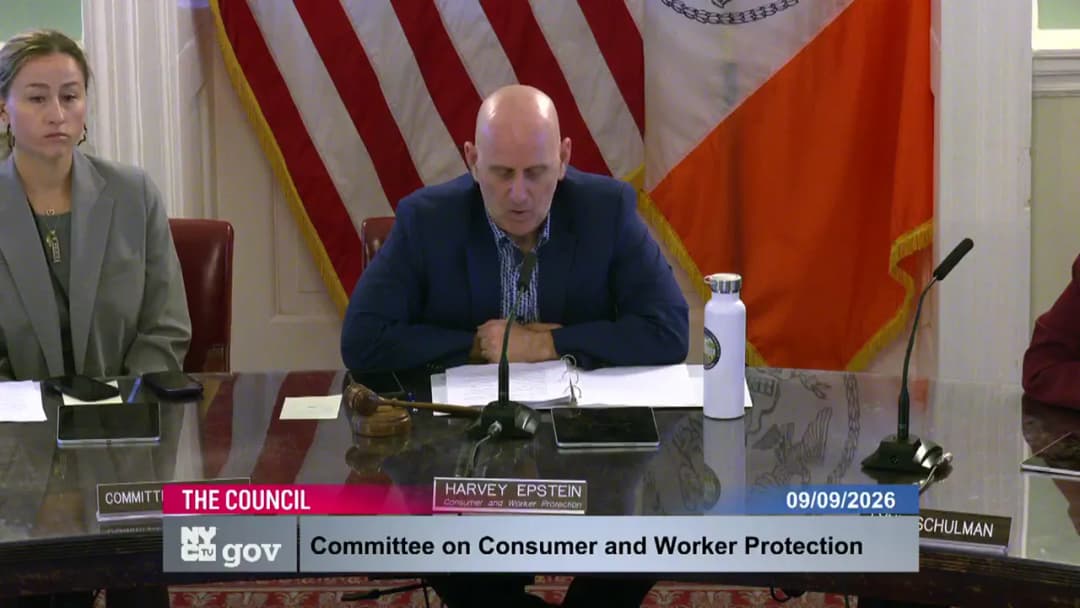
New York City Council Committee on Consumer and Worker Protection Votes on Int. No. 813-A (September 9, 2026)
CONSUMER PROTECTION 80% · CANNABIS REGULATION 20%
The Committee on Consumer and Worker Protection held a meeting on September 9, 2026, to vote on Proposed Int. No. 813-A, a local law amending the administrative code to allow the Department of Consumer and Worker Protection (DCWP) to refuse to renew, suspend, or revoke a license of a tobacco retail dealer or an electronic cigarette retail dealer that has violated certain authorization requirements of the cannabis law. Chair Harvey Epstein sponsored the bill, stating it aims to address the illegal cannabis market by enabling enforcement against dealers illegally selling cannabis. Key Outcomes - The committee voted 8-0 in favor of approving Int. No. 813-A, with no negative votes or abstentions. - Members voting in favor: Chair Epstein, Aldebol, Ariola, Banks, Hanks, Ossé, Schulman, and Wilson. - Members absent: Brewer, De La Rosa, and Krishnan. - The bill was amended by the committee prior to the vote (as noted in the minutes) and subsequently approved.
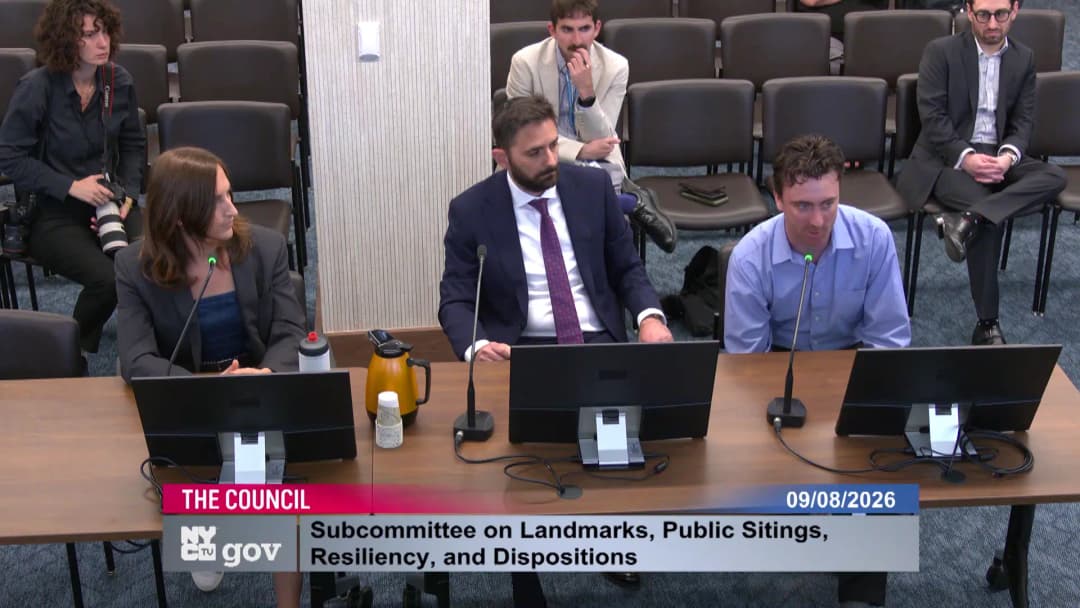
On Tuesday, September 8, 2026, at 11:00 AM, the New York City Council Subcommittee on Landmarks, Public Sitings, Resiliency and Dispositions, chaired by Councilmember Christopher Marte, held a hybrid hearing at 250 Broadway, 8th Floor, Hearing Room 3. Present were Councilmembers Marte, Alexa Avilés, Oswald J. Feliz, and Shanel Thomas-Henry; Councilmembers Sandy Nurse and Chi A. Ossé were absent; Kamillah Hanks was medically excused. The subcommittee considered two pre-considered land use applications (T2026-2497 and T2026-2498) related to the 48-50 Convent Avenue cluster (ANCP) project in Manhattan Community District 9, Council District 7, represented by the Majority Leader's district. Discussion Items - Project Presentation: Emily Adler and Asher Toparovsky (representing the developer Novus Living LLC) and Daniel Tomkins (HPD) presented the proposal for the 48-50 Convent Avenue cluster, which includes four buildings at 48 Convent Avenue, 50 Convent Avenue, 453-455 West 125th Street, and 12-14 Old Broadway. The project involves a total gut rehabilitation of 77 affordable homeownership units through the Affordable Neighborhood Cooperative Program (ANCP). Of these, 44 units are for existing tenants (insiders) who will become homeowners, 31 units will be sold to first-time outside buyers via the NYC Housing Connect lottery, and 2 units are for live-in superintendents. - Financial Details: The project relies on approximately $800,000 per unit in city capital (no debt, 40-year no-interest), a 40-year Article 11 tax exemption, acquisition subsidies ($1 per building/land), and state grants (Affordable Housing Corporation and electrification READY grant). Existing residents can purchase units for $2,500 (or $250 through a purchase savings plan if below income threshold). Outside buyers at 80% AMI would pay no more than 30% of income on housing, with monthly maintenance fees estimated at $1,191 per unit. A resale (flip tax) schedule balances equity building and permanent affordability: insiders start with a 90-95% flip tax decreasing to 10% over time; new purchasers face a 10% flip tax in perpetuity. - Relocation Plan: Tenants will be temporarily relocated by the sponsor, Novus Living, during the 18-24 month construction period. Relocation units will be found within the neighborhood where possible, and tenants continue paying their current rent; the project budget covers the difference. All insiders have a right to return or can receive a permanent voucher if they choose not to return. Right-sizing options are available pending approval. - Readiness Training: The Urban Homesteading Assistance Board (UHAB) administers comprehensive co-op readiness training covering bylaws, board operations, budgeting, elections, and property management. At least 80% of insider tenants must attend eight training sessions and remain current on rent to qualify for homeownership; otherwise, the building would convert to rent-stabilized rentals. - Councilmember Questions: Councilmember Marte inquired about relocation logistics, and Councilmember Thomas Henry asked about readiness training, marketing of vacant units (via Housing Connect lottery), per-unit costs ($800,000), and resale restrictions. Councilmember Avilés sought clarification on relocation scope (no out-of-state unless family), right to return, right-sizing, and the proportion of existing residents expected to need rental vouchers (likely a large majority due to low incomes). Public Comments & Testimony - No members of the public testified either in person or remotely. Key Outcomes - The subcommittee held a public hearing on the two pre-considered items (T2026-2497 and T2026-2498). - Both items were laid over by the subcommittee (no vote taken), meaning they will be considered at a future meeting.
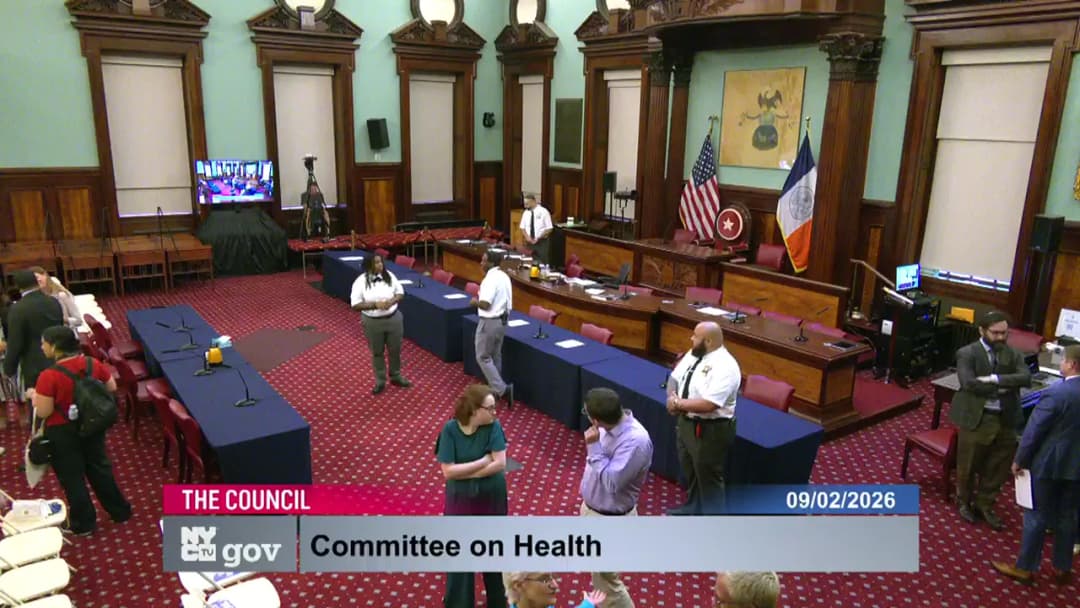
On September 2, 2026, the New York City Council Committee on Health held an oversight hearing on the city's response to the 2026 Legionnaires' disease cluster on the Upper East Side, which sickened 94 people, hospitalized 79, and killed 11 New Yorkers. The committee also considered eight legislative proposals aimed at strengthening prevention, enforcement, and public outreach. Chair Lynn C. Schulman presided, joined by Speaker Adrienne Menin and other council members. The hearing included testimony from family members of victims, community advocates, the Department of Health and Mental Hygiene (DOHMH) Commissioner Dr. Alistair Martin and deputies, and public witnesses. Public Comments & Testimony - Family Members and Victims: Ida Goldstein testified about the death of her husband Robert, an Air Force veteran, after a 50-year marriage. Daniel Thomas spoke about the death of his father, Judge Charles Thomas, describing it as a "completely preventable random act of violence." Minister Sandria Coleman called Legionnaires' disease "100% preventable" and criticized the health department for inadequate preparation. Valerie Mason, Chair of Community Board 8, praised local elected officials for pushing the city to act more aggressively and noted the mayor had not visited the affected community. She recommended drones to identify unregistered cooling towers and mobile testing units. - Harlem Legionnaires Task Force: Heaven Barhana from 3333 Broadway criticized DOHMH for sending untrained staff, lacking Spanish translators, and failing to provide resources. Kim Smith demanded greater accountability and enforcement, noting that only 56 water ecologists are insufficient for 5,000 cooling towers. - Other Public Witnesses: Gwen Hanlin, whose husband Kevin died in 2017, urged comprehensive investigation of every case. Bob Bocock, a water treatment expert, called for a source-to-tap approach. Union representatives (Plumbing Foundation, MCA, Local 94) supported parts of the legislation but urged broader focus on potable water systems and better training. Discussion Items - Oversight of 2026 Outbreak: Council members questioned DOHMH Commissioner Martin and deputies about the delayed identification of the source, staffing shortfalls, and enforcement gaps. Speaker Menin highlighted that only 35 of 56 authorized water ecologist positions were staffed during the outbreak. Chair Schulman presented data showing a 50% decline in cooling tower inspections since 2017, with only 20 summonses issued in the affected zip codes before July, but 180 summonses in July after the outbreak was public. DOHMH acknowledged 50 of 56 positions are now filled but cited difficulties recruiting specialized staff. The commissioner defended the response, noting aggressive PCR-based remediation and public transparency, but admitted the source match is still pending via whole genome sequencing. - Legislative Proposals: Eight bills were considered: Int. 0181 (shower hoses for tenants), Int. 0999 (temporary testing sites and digital map), Int. 1005 (education and outreach), Int. 1006 (cleaning cooling towers at least three times per year), Int. 1016 (Legionnaires' disease hotline), Int. 1017 (post-cluster analysis), and two pre-considered bills on interagency compliance review and public database. DOHMH expressed support for some but opposed Int. 0999 and Int. 1006, arguing pop-up testing is inappropriate and unnecessary cleaning can damage systems. Council members and public witnesses stressed the need for proactive enforcement, higher fines, and better communication. Key Outcomes - All eight introductions were heard and laid over by the committee (no votes taken). The oversight item was filed. - DOHMH announced five new measures: cross-referencing DOB data to identify unregistered cooling towers, enhancing the address-based lookup map, exploring faster culture testing, accelerating OATH hearing dates for violations, and convening a scientific advisory panel on new technology. - The committee noted discrepancies in staffing data and the timing of public communications. A follow-up request for detailed staffing numbers and comparison with other cities was made. - Written testimony may be submitted within 72 hours.
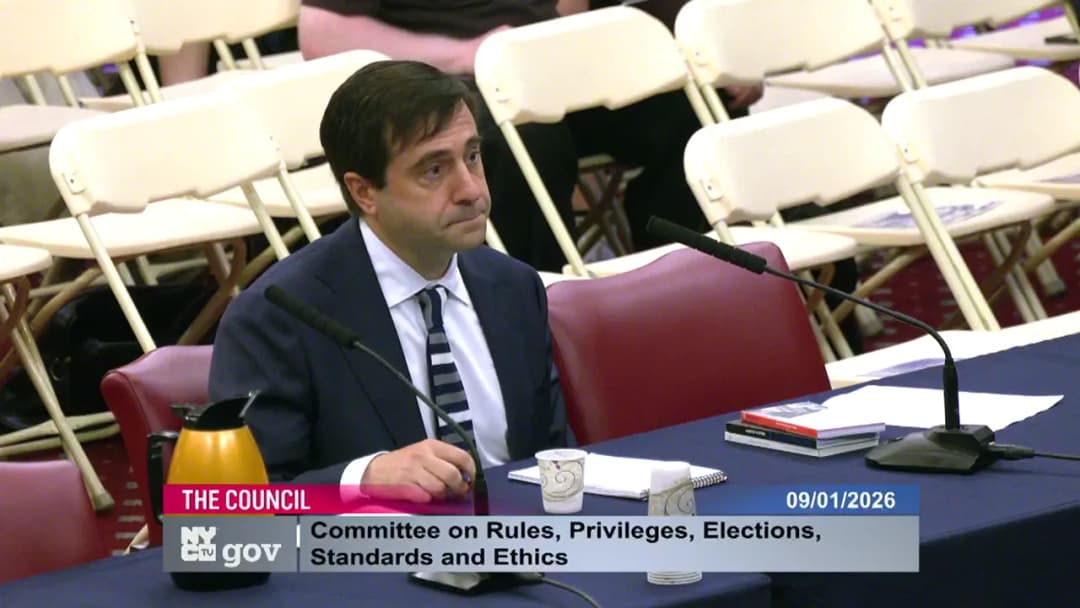
The New York City Council Committee on Rules, Privileges, Elections, Standards and Ethics, chaired by Councilmember Sandra Ung, met on September 1, 2026, at 10:00 AM in Council Chambers to consider three nominations from Mayor Mandani: Lisa Garcia to the NYC Land Bank Board, Dr. Dave A. Chokshi to the Board of Health, and John Mangin as Chair of the Board of Standards and Appeals. All three nominations received hearings but were laid over without a final vote. Public Comments & Testimony - Support for John Mangin: Multiple speakers, including former DCP Chair Dan Garodnick, Open New York Executive Director Ann-Marie Gray, NYU Furman Center Executive Director Brad Greenberg, UHAB Policy Director Ariel Hirsch, community members, and housing advocacy organizations, testified in strong support of Mangin’s nomination. They cited his expertise in land use, his role in creating City of Yes for Housing Opportunity and Mandatory Inclusionary Housing, his commitment to transparency, and his ability to fairly apply the law at the BSA. - Community Concerns about Mangin: Urban planner George James testified against Mangin, stating he was “temperamentally ill-suited” for government, citing a past interaction and alleging misleading statements during City of Yes hearings. One public speaker criticized the committee for prioritizing remote testimony over in-person testimony, but expressed support for Mangin’s nomination. Discussion Items Nomination of Lisa Garcia to the NYC Land Bank Board - Chair Ung introduced the nomination. Commissioner Garcia, currently DEP Commissioner, described her background in environmental justice, community engagement, and law. She stated the Land Bank’s mission is to transition from the lien sale to a more equitable, transparent process, with dual goals of revenue collection and converting delinquent properties to beneficial uses like affordable housing. She emphasized stakeholder engagement and commitment to equity. - Councilmembers questioned her on the Land Bank’s powers, challenges, and her relevant experience. Garcia noted the Land Bank offers flexibility not available under the current lien sale process. She said a key challenge is ensuring effectiveness and efficiency, and that she would draw on her experience with contentious public meetings. - Majority Leader Shaun Abreu asked about the publication of lien sale lists, which can target Black and Brown homeowners. Garcia said she would consider improvements to the process. Councilmember Brewer, the bill’s sponsor, asked about the types of projects that might fall under the Land Bank; Garcia could not predict numbers but noted DEP has expanded affordability programs. Nomination of Dr. Dave A. Chokshi to the Board of Health - Chair Ung introduced Dr. Chokshi, former NYC Health Commissioner. In his opening statement, he highlighted his work leading the COVID-19 vaccination campaign (6 million New Yorkers in just over a year), declaring racism a public health crisis, and founding the Health and Opportunity Leadership Institute. He identified the greatest challenge as modernizing the health system amid federal funding cuts and coverage losses. - Councilmembers asked about his accountability to the public, his views on the Board’s role regarding youth screen time, vaccination rates, AI in public health, and mental health. Dr. Chokshi emphasized data-driven decision-making, community engagement, and prevention. He supported the judicious use of vaccine requirements and said the Board must remain responsive to public input. - Minority Leader David Carr questioned him about COVID-19 mandates and regrets. Dr. Chokshi stood by the decisions, stating the vaccination campaign saved lives. Leader Carr criticized the mandate for city workers, arguing it was not necessary. Dr. Chokshi defended the public health rationale. Nomination of John Mangin as Chair of the Board of Standards and Appeals - Chair Ung introduced Mangin, currently Director of the Housing Division at DCP, with a background in fair housing law and city planning. He led City of Yes for Housing Opportunity, Mandatory Inclusionary Housing, and served as policy director for the 2025 Charter Revision Commission which expanded BSA’s powers for affordable housing fast-track. - Mangin stated he would bring a commitment to openness, transparency, and community voice. He emphasized that BSA decisions are legally constrained and that local voices are paramount but not solely decisive. He committed to improving the BSA website, posting all application materials, and addressing councilmember input in the decision record. - Councilmembers challenged him on his past academic writings (e.g., calling homeowners “cartels” and comparing NIMBY participation to the Tea Party). Mangin explained these were terms of art from the literature and not directed at New York. He stated he has evolved through on-the-ground experience and would apply the law neutrally. - Deputy Speaker Williams questioned him about the 2025 Charter Revision’s impact on council powers. Mangin argued the changes were minor adjustments to enable housing where ULAURP had failed. He acknowledged the distinction between historically excluded Black homeowners using democratic process and affluent exclusionary zoning. - Councilmember Banks pressed him on community benefit agreements and the “cartel” language. Mangin said CBAs are useful tools but must keep feasibility in mind. He denied characterizing all homeowners as cartels. - Councilmember Brewer criticized the affordable housing fast-track, arguing it should not apply to neighborhoods like the Upper West Side that already want affordable housing but get market-rate. Mangin replied that the fast-track is limited to projects under public control and that the charter language does not mandate 100% affordability but expects it. Key Outcomes - All three nominations (M 0087-2026, M 0088-2026, M 0089-2026) were heard by the committee and then laid over without a vote. No final action was taken during the meeting. The committee will consider them at a future date.
The New York City Council Committees on Finance and on Governmental Operations, State & Federal Legislation held a joint oversight hearing on August 18, 2026, to examine the rollout of the Pied-à-Terre tax (non-primary residence property surcharge). The tax, enacted as part of the state fiscal year 2026-27 budget, applies to high-value properties not used as primary residences. The Department of Finance did not send a representative to testify, citing pending litigation; instead, written testimony from Finance Commissioner Richard Lee was read into the record. Council members criticized the administration’s absence and questioned the implementation, including the publication of a list of over 900,000 properties, the sending of notices to 17,000 property owners, and the burden placed on homeowners to prove primary residency. Multiple panels of public testimony were heard, reflecting both support for the tax’s goals and strong criticism of its execution. The hearing concluded with the chairs reading over 20 written questions that will be submitted to the administration for response. Public Comments & Testimony - Kyle Bragg (private citizen) expressed general support for taxing the wealthy but criticized the unclear rollout, citing a friend who retired and kept a brownstone worth over $5 million but is unsure if he is subject to the tax. - Jason Haber (co-founder, American Real Estate Association; president, NIRAC) criticized the publication of 959,710 names and addresses, calling it a “dox” that creates risks for fraud and scams. He argued the burden of proof should be on the city, not homeowners. - Mary Ann Rothman (Executive Director, Council of New York Cooperatives and Condominiums) stated that co-ops are unfairly required to collect and remit the surcharge from shareholders, potentially jeopardizing building finances. She urged DOF to collect directly from non-resident owners. - Rebecca Poole (Director of Membership and Communication, CNYC) highlighted concerns about the $1 million imputed market value for condos/co-ops not equating to $5 million sale price, and retroactive application causing hardship for longtime owners. - Tor Tours (private citizen, co-op owner) said his building was included because of a penthouse unit, and he personally downloaded a list with apartment values, calling it an invasion of privacy and a result of “socialist policies.” - Charles Diamond (former city employee, speaking personally) criticized the release of over 98% irrelevant PII and called the administration’s absence “utterly bizarre,” urging the council to condemn it. - Anna Champany (Vice President for Research, Citizens Budget Commission) stated CBC does not support the tax but focused on implementation problems: limited vetting, compressed timeline, and insufficient communication. She recommended evaluation of impacts. - Leonard Steinberg (real estate professional) argued the messaging is misleading because DOF’s market value does not equal sale price, creating unfair targeting. - Heather Domy (real estate broker) outlined unintended consequences: retired owners, trusts, tenants in place, and sold properties all facing uncertainty and legal costs. - Beverly Solo, Isabel Peñaranda Curry, Dave Backer, Lala Peñaranda all expressed support for the tax itself, arguing it funds essential services and targets the wealthy. Curry noted that property value is socially produced. Backer said wealthy homeowners “doth protest a little too much.” Peñaranda urged the council to stand with public sector workers. - Lucy Sexton (New Yorkers for Culture and Arts) supported the tax but asked for an exemption for artists in Joint Live-Work Quarters (JLWQA), citing a case where an inheritor of a dance studio loft received a $90,000 notice despite using the space for nonprofit arts. - Ed Lee (private citizen, Republican) generally supported the tax in spirit but questioned spending priorities and noted homeless issues. - June Barwick (treasurer of a small co-op) argued that co-op valuations are unfairly high compared to single-family homes and that exemptions should be based on assessed value, not market value. - Robert Vertigani (homeowner of 30 years) received a $52,000 notice despite clear evidence of primary residency, calling the process “socialist government intrusion” and shifting the burden to citizens. - Ryan Foley (attorney for condo developers) noted that unsold condominium units that should be excluded under the statute still received notices, indicating implementation failures. - Shannon Richter, Elizabeth Valdez, Baka Champ, Alison Klemp all spoke in strong support of the tax, emphasizing the need for revenue for schools, child care, disability services, and affordable housing. Klemp argued that uploading a PDF is a minor burden compared to struggles faced by low-income New Yorkers. - Christopher Leon Johnson opposed the tax, calling it a “scam” by nonprofits and the DSA, penalizing success and rewarding laziness. - Valerie Mason criticized the administration’s absence and called for transparency, noting co-ops’ difficulties and the retroactive nature of the tax. Discussion Items - Council members repeatedly condemned the Department of Finance’s failure to appear, with Councilmember Morano calling it “outrageous” and stating that litigation does not suspend legislative oversight. Councilmember Sanchez echoed that the administration’s absence showed disrespect. Councilmember Carr said the rollout was “botched” and the burden of proof was inverted. Councilmember Wong noted the administration could share data but chose not to, and asked about safety concerns from the published list. Councilmember Narcisse expressed concern for seniors and co-op shareholders. Councilmember Dinowitz asked about legal costs for co-ops and suggested steps the city could take. Councilmember Zwang questioned the administration’s identification method. Councilmember Paladino on Zoom accused the administration of using the tax as a tool for eminent domain. - The committee chairs, Gail Brewer and Linda Lee, affirmed their support for the Pied-à-Terre tax itself but criticized its implementation. They noted that the council would send written questions to DOF for follow-up. - Written testimony from Commissioner Richard Lee was read, defending the supplemental role as required by law and explaining the process. He cited ongoing litigation as the reason for not appearing in person. Key Outcomes - The hearing was filed by the committee (as noted in minutes) and concluded with a commitment to submit over 20 written questions to the Department of Finance. The questions covered topics such as the publication of the 900,000-property list, criteria for sending 17,000 notices, use of existing data to verify residency, the appeals process, and co-op/condo implementation issues. - Councilmembers urged the administration to provide clear answers and consider recommendations from former Finance Commissioner Martha Stark and others, including limiting the published list to properties meeting statutory thresholds, improving online tools, and shifting the burden of proof to the city. - No legislation was voted on; the hearing was solely for oversight.
Joint Committee on Governmental Operations, State & Federal Legislation and Finance – Chair Gale A. Brewer and Chair Linda Lee presided over an oversight hearing on the rollout of the Pied-à-Terre (non-primary residence property) surcharge. The New York City Department of Finance (DOF) declined to appear, citing pending litigation, but submitted written testimony that was read into the record. The council heard from over 20 public witnesses and announced it will send written questions to the administration. Public Comments & Testimony - Kyle Bragg (union leader) expressed support for taxing the wealthy but criticized the unclear rollout, noting that a retired friend with a long-time brownstone is unsure if he owes the tax. He called for clarity. - Jason Haber (American Real Estate Association) called the publication of 959,710 names and addresses a “doxing” that invites fraud and scams. He argued the burden of proof should be on the city, not homeowners. - Mary Ann Rothman (Council of New York Cooperatives and Condominiums) stated that requiring co-ops to collect the surcharge from shareholders is unprecedented and could destabilize building finances. She urged DOF to collect directly from non-resident owners. - Tor Thors (co-op owner) said the published list exposed personal property values and felt like a “socialist” attack on homeowners. - Rebecca Poole (CNYC) noted that the $1 million imputed market value for co-ops/condos often does not equal a $5 million sale price, and that the retroactive nature of the tax penalizes long-term owners who left the city after retirement. - Charles Diamond (former city employee, personal capacity) condemned the release of over 98% irrelevant PII, calling it unprecedented and warning that the administration’s absence sets a dangerous precedent for oversight. - Anna Champerney (Citizens Budget Commission) criticized the compressed timeline, insufficient public vetting, and poor communication, but noted that the underlying data is already public. She recommended evaluating the tax’s impact. - Leonard Steinberg (real estate) argued the tax messaging is inaccurate because DOF’s market values do not reflect actual sale prices, and urged an apology and clarification to New Yorkers. - Heather Domey (real estate broker) highlighted unintended consequences for retirement, trusts, renovations, and rental properties, and called for more nuanced exemptions. - Beverly Solo (resident) supported the tax, urging revenue go to schools and child care, and noted public support for taxing the rich. - Isabel Peñaranda Curry (researcher) defended the tax as economically sound, arguing that property values are socially produced and that the wealthiest should contribute more. She criticized references to the list as a “hit list” as ideological. - David Backer (parent and professor) supported the tax, noting the effective tax rate disparity between single-family and multifamily homes, and argued that the wealthy “doth protest too much.” - Lala Peñaranda (CUNY worker) urged the council to stand with public sector workers and implement the tax to fund public services. - Lucy Sexton (New Yorkers for Culture and Arts) asked for an exemption for Joint Live-Work Quarters (JLWQA) used by artists, citing a case of a $90,000 surcharge on a nonprofit rehearsal space. - Ed Lee (Republican) said he supports the spirit of the tax but questioned spending priorities and noted that the tax unfairly targets real estate over other assets. - June Barwick (co-op treasurer) argued that co-ops are valued at only 20% of single-family homes, causing unfair surcharges, and asked for an exemption for co-ops under $2 million. - Ken Fisher (resident) described a personal case where his apartment was listed on a notice sent to a neighbor, and the online portal would not accept his proof of residency. He called the process “botched.” - Jamel Henderson (Citizen Action of New York) supported the tax, noting that $500 million could fund after-school programs, seniors, and public housing. He urged the council not to let the wealthy dictate policy. - Bravan Runga (Invest in Our New York) supported the tax as a step toward progressive revenue, arguing the ultra-rich are fighting back with bad-faith attacks. - Robert Bertania (homeowner) received a $52,000 surcharge notice for his 30-year primary residence. He called the presumption of guilt “socialist” and urged the council to check executive overreach. - Valerie Mason (resident) condemned the administration’s absence and called for subpoena power to ensure accountability. - Christopher Leon Johnson (public speaker) opposed the tax, calling it a “scam” by nonprofits and the DSA, and argued it penalizes success. - Elizabeth Valdez, Shannon Richter, Bakari Champ, and Alison Klemp (disability and education advocates) supported the tax, urging that revenue be used for affordable/accessible housing, child care, and services for people with disabilities. Discussion Items - Chair Brewer opened by noting that DOF published a list of 900,000 properties even though the controller estimated only 13,000 are subject to the tax. She emphasized that the tax is supported but the rollout caused confusion and placed an unfair burden on homeowners to prove primary residence. - Chair Lee reiterated support for the tax and highlighted the extension of the exemption deadline to September 18, 2026, due to litigation. - Councilmembers Narcisse, Carr, Wong, Hanks, Morano, Dinowitz, Zwang, Paladino, and others expressed frustration at the administration’s absence. They questioned the accuracy of the published list, the privacy and security risks, the inversion of burden of proof, and the lack of cross-checking with existing city records (e.g., STAR, co-op/condo abatement). - Councilmember Morano called the administration’s refusal to testify “outrageous” and noted that city agencies routinely appear during litigation. He demanded to know the error rate and why the city did not use existing data. - Councilmember Hanks said the publication of names and addresses showed disrespect and created a “scarlet letter.” - Councilmember Carr challenged the legal necessity of publishing the full list and criticized DOF’s flawed property valuations. - Councilmember Wong noted that the mayor’s Charter Revision Commission showed disregard for council checks and balances, and that the administration’s absence reinforces that pattern. - Councilmember Dinowitz supported the tax but expressed concern about unintended costs for co-ops, including legal fees for lease amendments and potential insurance issues. - Councilmember Zwang raised concerns about homeowners in Italy, military members, and the difficulty of proving residency. He asked how the 17,000 were identified and what happens if deadlines are missed. - Councilmember Mealy asked about the options for those who received letters, noting that many are not truly wealthy and face high legal costs. - Chair Brewer and Chair Lee read the 20 written questions that would have been posed to DOF, covering: the discrepancy between the 900,000 published list and 17,000 notices; the failure to use existing residency data; the burden on co-ops; privacy and security; the appeals process; and more. The council committed to sending these questions to the administration. Key Outcomes - The hearing was held with no testimony from the administration due to pending litigation. Council members unanimously condemned the absence. - The council will submit written questions to the Department of Finance, including those from the co-op/condo council and other stakeholders, and expects answers. - The deadline for homeowners to file exemptions was extended to September 18, 2026, but the council expressed concern that this may still be insufficient. - The council will continue oversight and may consider next steps, including potential subpoenas, if the administration does not respond adequately. - No votes were taken; the hearing was informational and aimed at gathering public input and preparing formal inquiries.
On August 13, 2026, the New York City Council Committee on Finance, chaired by Councilmember Linda Lee (who was absent and replaced by Acting Chair Shaun Abreu), met to consider and vote on two pre-considered agenda items. The meeting began at 11:00 AM in City Hall. Present members included Abreu, Aldebol, Brooks-Powers, Feliz, Hudson, Maloney, Marte, Morano, Narcisse, Restler, Sanchez, Williams, and Wong. Absent members were Lee, Avilés, Gennaro, and Mealy. Key Outcomes - Resolution 0595-2026 (Pre-considered): Approving new designations and changes in the designation of certain organizations to receive funding in the Expense Budget. Passed by a roll call vote of 12 in favor, 1 opposed (Councilmember Morano voted no), with 4 absent. - Introduction 1002-2026 (Pre-considered): A local law to establish a temporary program to resolve outstanding judgments imposed by the Environmental Control Board (ECB). Passed by a roll call vote of 10 in favor, 1 opposed (Councilmember Wong voted no), with 4 absent. (The initial tally was 9-1, but later updated to 10-1 as additional members voted affirmatively.) Discussion Items - No substantive discussion or debate on the agenda items was recorded. Several members made disclosures: Councilmember Aldebol disclosed that his brother-in-law works for the Department for the Aging, and Councilmember Brooks-Powers disclosed that her child is affiliated with Larissa Jane Music Perform and Arts Program, which receives funding. Both voted affirmatively on all items. Councilmember Wong requested clarification on bill numbers before casting a split vote (yes on Resolution 595, no on Intro 1002). Administrative Notes - The committee left the vote open to allow additional members to vote; final tallies were recorded after Councilmember Hudson's vote. The meeting concluded with technical arrangements for future sessions.
The New York City Council Committee on Parks and Recreation, chaired by Councilmember Ty Hankerson, met on Thursday, August 13, 2026, at 10:30 AM in Hearing Room 3 at 250 Broadway to vote on two proposed local laws. The meeting focused on bills addressing dog waste management: a pilot program for composting dog feces from dog runs and a requirement to post signs about dog waste removal penalties. Discussion Items - Int 0864-2026-A (Sponsored by Councilmember Epstein, absent): This bill would require the Parks Department to establish a pilot program designating volunteer-led dog run groups with experience maintaining dog runs to collect dog waste from parks' dog runs for composting. The designated groups, with aid from the Parks Department when requested, would install dog feces collection bins and provide compostable bags. The bill also requires the Parks Department to report to the mayor and the Speaker of the Council and post online details about the pilot's implementation. Chair Hankerson noted the bill was previously considered by the committee on June 16, 2026. - Int 0880-2026-A (Sponsored by Councilmember Mercedes Narcisse): This bill would require the Department of Parks and Recreation (DPR) to post signs at park entrances, exits, and certain facilities summarizing the rule prohibiting leaving dog waste on the ground and the associated penalties. Councilmember Narcisse spoke in support, stating that the signs set clear expectations and aid enforcement, noting that most dog owners do the right thing but that the signs help address those who do not. She emphasized the quality-of-life impact, particularly for children and park staff. Key Outcomes - Int 0864-2026-A was approved by the committee on a roll call vote of 9 in favor, 1 against, 0 abstentions. Voting in favor: Hankerson, Krishnan, Marte, Narcisse, Nurse, Salaam, Sanchez, Santosuosso, and Ung. Voting against: Morano. Councilmember Lee was absent. - Int 0880-2026-A was approved by the committee on a roll call vote of 10 in favor, 0 against, 0 abstentions. Voting in favor: Hankerson, Krishnan, Marte, Morano, Narcisse, Nurse, Salaam, Sanchez, Santosuosso, and Ung. Councilmember Lee was absent. Both bills were adopted by the committee and will proceed to the full City Council.
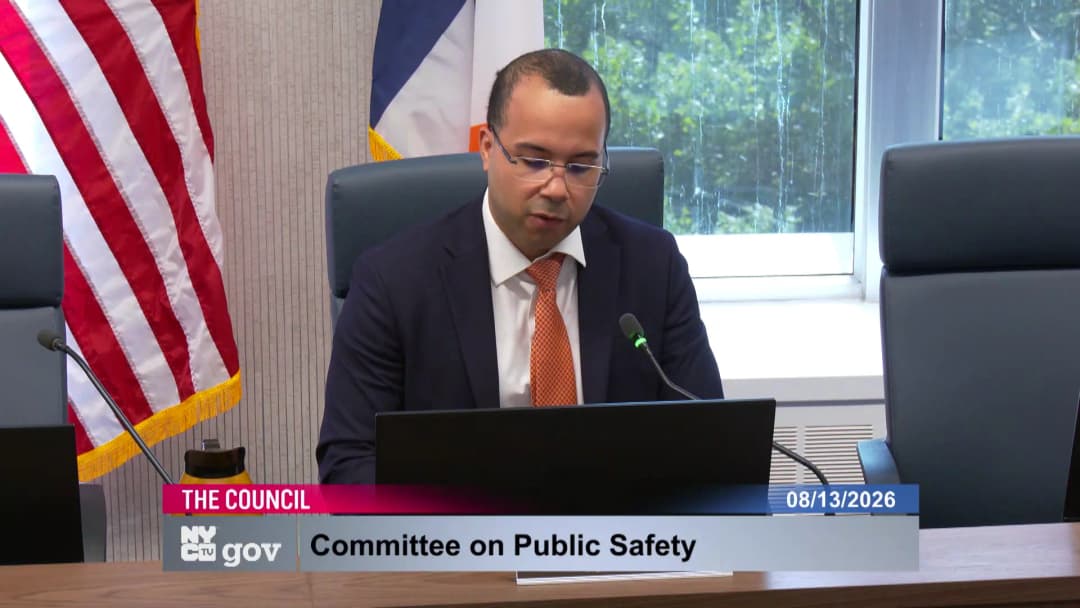
On Thursday, August 13, 2026, the New York City Council Committee on Public Safety, chaired by Councilmember Oswald Feliz, met at 250 Broadway to vote on Proposed Introduction No. 935-A. The bill requires the NYPD to report quarterly on confirmed shots-fired incidents, including those where no one is struck, providing borough, precinct, date, time, and location data. The committee voted 8-0 in favor (with one member absent), approving the amended introduction. Discussion Items - Chair Feliz explained that existing NYPD data on shooting victims and incidents does not capture shots-fired incidents where no one is struck. Proposed Int. 935-A would close this gap by mandating quarterly reports on all confirmed firearm discharges, offering a clearer picture of gun violence across the city. The bill was amended by the committee prior to the vote. Key Outcomes - The committee voted 8-0 to approve Proposed Int. 935-A (Int 0935-2026-A). Voting in favor: Chair Feliz, and Councilmembers Gutierrez, Hanks, Nurse, Banks, Hankerson, Sanchez, and Wong. Councilmember Ariola was absent. The bill now moves to the full City Council for consideration.
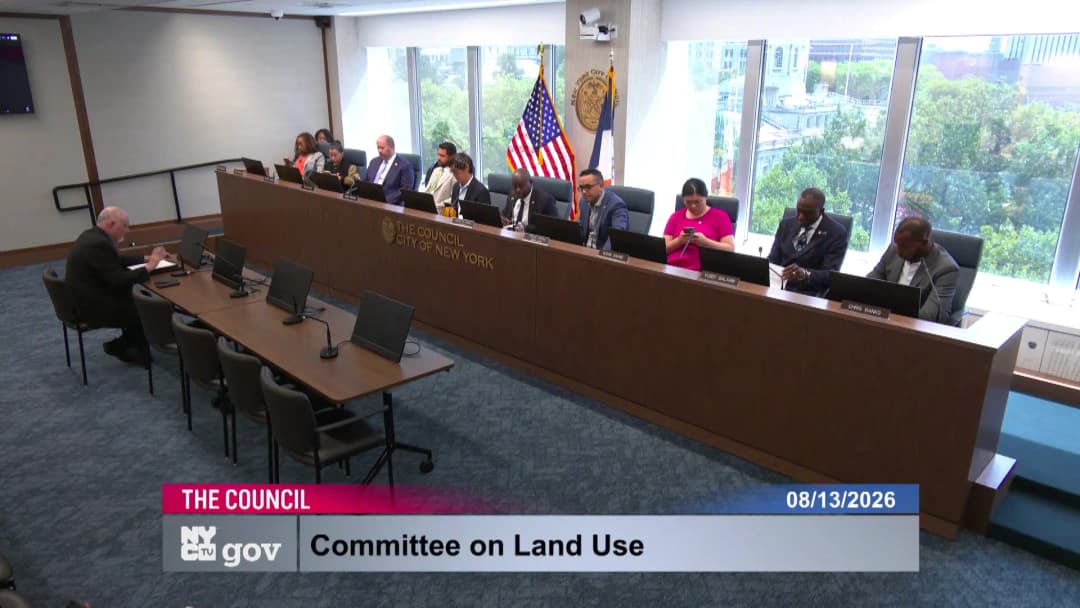
The Committee on Land Use, chaired by Councilmember Kevin C. Riley, met on August 13, 2026, to vote on four land use proposals referred from subcommittees. The committee approved all items by a vote of 11-0, with one member absent (Councilmember Ossé) and one on bereavement (Councilmember Louis). Discussion Items - LU 0114-2026 (Queens CD 2 Walk to Park Site Selection/Acquisition): The committee approved the application submitted by the NYC Department of Citywide Administrative Services and the Department of Parks and Recreation to acquire multiple properties in Queens Community District 2 for park use. The action aims to address the "walk to park gap" in the district. Approved with companion resolution. - LU 0115-2026 & LU 0116-2026 (200 Kent Avenue Rezoning, Brooklyn): The committee approved with modifications the rezoning application by 206 Kent LLC and Kent Investor LLC to change the zoning map from M1-4 to M1-4A/R7X and establish a Mandatory Inclusionary Housing (MIH) area. The modification removed MIH option two. The project is expected to include up to 36 permanently affordable units through the MIH program. - LU 0117-2026 (Flatiron NoMad Major Concessions, Manhattan): The committee approved the application by the NYC Department of Transportation to expand the existing Flatiron District concession area along portions of Broadway and Fifth Avenue between East 19th Street and West 31st Street, intended to improve the public realm for pedestrians and cyclists. Approved with companion resolution. - LU 0118-2026 & LU 0119-2026 (47-03 108th Street Rezoning, Queens): The committee approved with modifications the rezoning application by 108 Realty Group Inc. to change the zoning map from R6B to R7X and establish an MIH area. The modification changed the designation to R7D instead of R7X, based on existing development patterns. The project will facilitate a mixed-use development with approximately 119 units, including up to 30 affordable units through MIH. Key Outcomes - All five applications (six land use items) were approved by a roll call vote of 11 in favor, 0 opposed, with 1 absent and 1 on bereavement. - Specific modifications were applied to the 200 Kent Avenue and 47-03 108th Street rezoning proposals as described above. - The next steps include referral to the City Planning Commission (CPC) for the items approved with modifications (LU 0115, 0116, 0118, 0119) and direct approval for the others (LU 0114, 0117). Note: The agenda listed six applications (LU 0114-0119), but the chair referred to them as four proposals, grouping the two zoning map and text amendments per project.