The special public safety committee meeting on September 30, 2025, focused on updates regarding the Oakland Police Department's compliance with the Negotiated Settlement Agreement (NSA), community violence intervention programs, and grant amendments for violence prevention services. Key discussions included progress on NSA tasks, a contract for technical assistance, and a no-cost agreement for a peace academy. Public Comments & Testimony - Alexandria Jones, a mother and nurse, requested adding items to the schedule to improve transparency between victims, OPD, and the District Attorney's Office, expressing support for protocols to reduce victim trauma and opposing wasteful resource use. - Sharon Cornew, director of St. Mary's Center, invited committee members to visit and discuss encampment abatement policies, emphasizing collaborative solutions. - Jennifer Finley raised concerns about OPD's policies on interacting with ICE and masked individuals, arguing for updated procedures to protect residents from potential kidnappings. - Ranjit Ghati recommended reconsidering or disbanding the police commission to reallocate funds to boots on the ground or victim support. - Brad Morgan advocated for ending federal NSA oversight, stating it is costly and outdated, and expressed trust in Chief Mitchell's leadership. - Rajni Mandal criticized the federal monitor for changing compliance criteria and extorting money, arguing that the NSA contributes to officer attrition. - Ms. Asada emphasized the need for broader violence prevention programs, including job training and rehabilitation, and questioned the focus on data over cultural change. - In open forum, Rajni Mandal discussed officer recruitment challenges and anti-police activism, Sharice Gash described domestic terrorism from gang violence in her neighborhood, and Jennifer Finley called for action on Palestinian issues and divestment from Israel. Discussion Items - OPD NSA Compliance Report: Deputy Chief Lisa Osmus presented on progress towards compliance with tasks 2 (internal affairs timelines), 5 (complaint procedures), and 45 (consistency of discipline). Council members discussed their limited role but acknowledged the importance of public updates. - Contract for Technical Assistance: Kristen Burgess Menderos presented on a $750,000 contract with Dr. Jennifer Eberhart for technical assistance on NSA tasks, highlighting her expertise in reducing racial disparities. - Community Violence Intervention Academy: Chief Holly Joshi presented on a no-cost agreement with Green Light Fund and Urban Peace Institute to develop a peace academy for certifying CVI workers, valued at $1 million over four years. - Grant Amendments: Jenny Lynche presented on amendments to grants for employment services, emergency relocation, and school-based violence intervention, funded by Measure NN revenues. Key Outcomes - Item 2: Motion to accept determination and schedule outstanding committee items passed with four ayes. - Item 3: Motion to receive and file the informational report on OPD's NSA compliance passed with four ayes. - Item 4: Motion to approve the contract with Dr. Jennifer Eberhart and forward to the City Council on consent passed with three ayes and one absent (Councilmember Houston). - Item 5: Motion to approve the no-cost agreement for the Community Violence Intervention Academy and forward to the City Council on consent passed with four ayes. - Item 6: Motion to approve grant amendments and forward to the City Council on consent passed with four ayes.
Public Meetings - Oakland, California
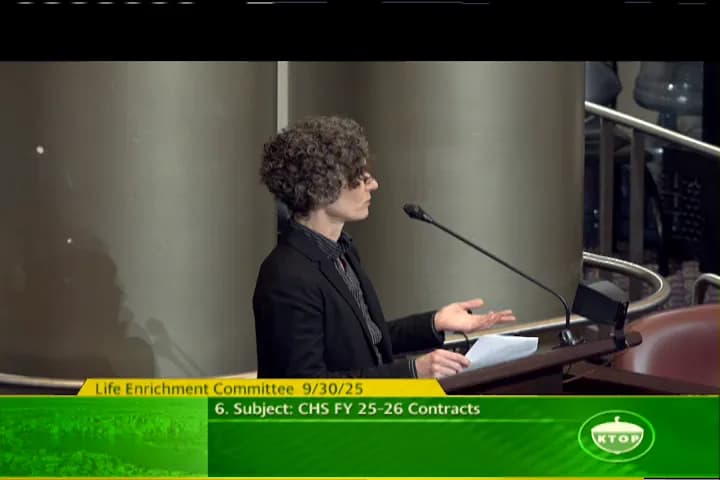
Public Meetings - Oakland, CaliforniaThe Life Enrichment Committee met on September 30, 2025, with a full agenda covering organizational honors, grant amendments, homelessness services, and paratransit funding. The committee heard staff presentations and public testimony, resulting in several items being advanced to the City Council. Consent Calendar - Item 2: Schedule of outstanding committee items accepted unanimously. - Item 3: Resolution honoring Creative Growth Arts Center for 50th anniversary. A representative expressed gratitude for the recognition. - Item 4: Resolution honoring Diamano Cura West African Dance Company for 50th anniversary. Speakers thanked the city and emphasized cultural preservation. - Item 5: Amendment to Oakland Fund for Children and Youth grants to correct amounts and change lead agencies. Public speakers raised concerns about nonprofit management and program effectiveness. - Item 7: Acceptance of Medi-Cal Administrative Activities Program funds. A public speaker criticized inequitable resource distribution. - Item 8: Appropriation of paratransit services funding. Similar equity concerns were voiced by a speaker. Public Comments & Testimony - Creative Growth representative expressed full support for the resolution and appreciation for the city's acknowledgment of their work. - Diamano Cura representatives expressed thanks and highlighted their commitment to West African dance and culture. - On item 5, Mrs. Olabala questioned the voluntary nature of agency changes and stressed the need for culturally competent programs. Johanna Macis from Girls Inc. presented data on literacy improvements and affirmed responsible fund use. - On item 6, Armando opposed cuts to homeless services, arguing it would exacerbate the crisis and advocating for community-led solutions. Rachel Cohen expressed concern about reducing housing options and called for more safe parking and encampment sites. Asado Olavala criticized the city's lack of respect and commitment to the homeless community. - On items 7 and 8, Mrs. Olawala criticized the city for inequitable treatment of Black residents compared to immigrant communities, demanding fair resource allocation. - In open forum, Mrs. Olawala expanded on equity issues, noting disparities in services for Black children versus newcomer students in OUSD. Discussion Items - Item 6: Homeless service providers grants. Sasha Housewald presented on a $22 million funding shortfall, proposing six-month awards for programs with lower performance metrics (e.g., exits to permanent housing). Committee members debated the criteria, per-bed costs, and impact on encampment resolution. Concerns were raised about outdoor programs being costlier and less effective. The discussion highlighted the need for improved city-provider partnerships and planning for future funds like Measure W and HAP6. Key Outcomes - All items (2, 3, 4, 5, 6, 7, 8) were approved with four ayes (Councilmembers Guile, Houston, Wong, and Chair Fife) and forwarded to the October 7, 2025, City Council agenda on consent. - Next steps: Staff to work with homeless service providers during the six-month planning period to enhance outcomes and secure additional funding.
The committee convened to discuss several key initiatives to spur affordable housing production and economic development. Major items included the creation of new funding programs for affordable housing pre-development and middle-income housing acquisition, the appropriation of Measure U bond funds for affordable housing, the sale of a blighted city-owned property, and the presentation of a five-year Economic Development Action Plan. Public Comments & Testimony - On Permit Ready Express Program (Item 3): Speakers from Eden Housing and East Bay Housing Organizations expressed strong support, stating the program would help close financing gaps and expedite affordable housing delivery. - On Middle-Income JPA Program (Item 4): Project sponsors for 4400 MLK Way supported the program but requested flexibility in parameters (e.g., appraisal value, AMI caps) to allow their distressed project to move forward. A community member questioned the focus on middle-income housing and raised concerns about gentrification and impacts on citizens from Oakland's sanctuary city status. - On Affordable Housing Fund Appropriation (Item 5): Multiple nonprofit affordable housing developers (Unity Council, RCD, EAH Housing, SAHA, St. Mary's Center, Eden Housing) expressed strong support for releasing Measure U funds, emphasizing the critical need to close project financing gaps, build supportive housing, and rehabilitate existing affordable stock. A community member criticized perceived inequities in the distribution of funded projects and homeless units across council districts. - On Sale of City Property (Item 6): A community member criticized the city for failing to maintain the property, acting as "slum landlords," and allowing assets designated for homeless and low-income communities to deteriorate. - On Economic Development Plan (Item 7): A community member criticized the department's analysis of racial disparities, arguing it improperly grouped all people of color together instead of addressing specific, severe unemployment in the Black community. They also requested data on the impact of Oakland's sanctuary city status on housing and jobs for African American citizens. - Open Forum: A speaker congratulated former Oakland staff on new roles, reiterated criticism of the economic department's racial equity analysis, and again requested data on the impact of sanctuary city policies. Discussion Items - Permit Ready Express Program (Item 3): Staff proposed using a $5.2M federal grant to create a revolving loan fund. One pool would help affordable housing developers pay building permit fees to accelerate construction timelines. A second pool, with a set-aside for emerging developers, would provide pre-development loans for feasibility studies and early design work. - Middle-Income Housing JPA Bond Program (Item 4): Staff proposed a new program allowing the use of Joint Powers Authorities to acquire existing market-rate buildings and place long-term affordability covenants on them, targeting households at or below 80% of Area Median Income. The program is designed with conservative underwriting to avoid past pitfalls seen in other cities. The city's role is as an approver with no liability for the bonds. A key trade-off is the forgone property tax revenue, which is weighed against tenant rent savings in a cost-benefit analysis. - Affordable Housing Fund Appropriation (Item 5): Staff sought authorization to appropriate and deploy up to $66 million from Measure U and other sources to fund new construction, rapid response homeless housing, acquisition/conversion, and rehabilitation of affordable housing. The annual re-appropriation of funds is intended to streamline and expedite awards to ready projects. - Sale of City-Owned Property at 1226 73rd Ave (Item 6): Staff recommended declaring the fire-damaged, blighted triplex as surplus and selling it to the highest bidder on the open market. The property, acquired for right-of-way in 1970 and later used for low-income housing, requires significant capital to repair. Proceeds would go to the General Fund. - 2025-2029 Economic Development Action Plan (Item 7): Staff presented the draft five-year plan centered on five goals: attracting/growing key industries, supporting existing businesses, workforce development, strategic place-based investment, and supporting arts/culture. The plan was developed with extensive community input and includes an implementation matrix. Priorities include activating corridors, filling vacancies, advancing public-private development projects, and supporting sector-specific workforce strategies. Key Outcomes - Item 2 (Schedule): Motion passed (4-0) to accept the schedule of outstanding items. An informational report on permitting hurdles was requested for a future date (tentatively November). - Item 3 (Permit Ready Express): Motion passed (4-0) to approve the resolution and forward it to the October 7 City Council consent agenda. - Item 4 (Middle-Income JPA): Motion passed (4-0) to approve the ordinance (first reading) and forward it to the October 7 City Council consent agenda. - Item 5 (Housing Fund Appropriation): Motion passed (3-0-1, Ramachandran excused during vote) to approve the resolution as amended (changing $60M to $66M in the text) and forward it to the October 7 City Council consent agenda. - Item 6 (Property Sale): Motion passed (4-0) to approve the ordinance and forward it to the October 7 City Council consent agenda. - Item 7 (Economic Development Plan): Motion passed (4-0) to receive the informational report and forward it to the October 7 City Council consent agenda.
The Rules and Legislation Committee met on September 25, 2025, to review and schedule agenda items for upcoming committee and city council meetings. The session covered routine consent items, public testimony, and discussions on specific proposals, resulting in withdrawals, amendments, and reschedulings. Consent Calendar - Routine scheduling of numerous resolutions and agreements to various committee agendas, including items related to finance, public works, community development, life enrichment, and public safety. These were moved forward without debate unless noted. Public Comments & Testimony - Rajni Mandel (District 4 resident) expressed strong opposition to the appointment of Omar Farmer to the Police Commission, citing unauthorized actions, Brown Act violations, and conflicts of interest. She also voiced disappointment that Jim Donatell was not appointed to the Privacy Advisory Commission. - Stephanie Tran (President, Oakland Chinatown Chamber of Commerce) expressed full support for the appointment of Isaac Chang to the Privacy Advisory Commission, highlighting his legal background and community involvement. - Gene Hazard raised concerns about item 3.52 (citywide security services contract), urging consideration of litigation and ICE affiliations among bidders. He also alleged Brown Act violations in a previous special city council meeting. - Kathy Itams (President, Oakland African American Chamber of Commerce) emphasized the need for fair hiring processes and local contracts for minority-owned businesses regarding item 3.52. - Kevin Daly suggested making public comment procedures more accessible for community members. Discussion Items - Councilmember Houston discussed item 3.52 (security contract), recommending it be sent back to bid due to complexities and concerns. The item was subsequently withdrawn. - Councilmember Ramachandran requested the addition of Councilmember Gallo to the AC Transit Interagency Liaison Committee (item 3.40), which was amended. - Title changes and rule 24 bypasses were discussed for items like 3.39, 3.54, and 3.56, allowing them to go directly to city council without committee review. - The committee reviewed draft agendas, withdrawing and rescheduling items from upcoming committee meetings, such as from the Community and Economic Development Committee and Finance and Management Committee. Key Outcomes - Withdrawn items: 3.41 (Police Commission appointments) with no new date specified; 3.52 (citywide security services contract) with no new date; item 5 (rules of procedure amendment) rescheduled to October 16, 2025. - Amendments: Added Councilmember Ramachandran as co-sponsor to item 3.48 (LGBTQ+ Pride resolution); updated item 3.40 to include Councilmember Gallo in AC Transit committee appointments. - Motions passed: Item 3 (new scheduling) and item 4 (agenda review) were accepted as amended with unanimous votes (4 ayes). - Scheduled a special city council meeting for November 4, 2025, at 9 a.m., replacing the regular meeting due to election day.
The first joint committee meeting of 2025 between the Oakland City Council and OUSD School Board focused on strengthening collaboration, centering student voices, and addressing key issues such as school safety, literacy, and technology pathways. The meeting included informational reports, public testimony, and discussions on partnership opportunities. Consent Calendar - Approval of draft minutes from the committee meeting of September 30, 2024, passed with three ayes and one abstention. Public Comments & Testimony - Students and staff from Lodestar School advocated for gun violence prevention through their Vision Quilt project, expressing support for social-emotional learning and school safety initiatives. - Youth poet laureates Sahenna and Kael performed poems emphasizing the importance of ethnic studies and education as tools for empowerment and community uplift. - Public speaker Asada Olabala raised concerns about inadequate support for African American students, anti-blackness in schools, and the need for diversity and reparations. - Speaker Sheila Haynes expressed opposition to cuts in music and arts education, highlighting the need for consistent services for special education students. - Other speakers, including Haley Hester, thanked the committee for reconvening and emphasized the importance of city-school collaboration on public safety and infrastructure. Discussion Items - Alameda County Superintendent Elise Castro reported on the state of education, noting that OUSD has exited state receivership but faces financial challenges. She emphasized opportunities for partnership to maximize resources and support vulnerable student populations. - OUSD Superintendent Denise Sadler discussed district initiatives focused on improving literacy rates, graduation rates, and creating joyful schools. She called for enhanced collaboration with the city on issues like facility sharing, immigrant student support, and community partnerships. - Executive Director of School Safety Nelson Allegria, along with students from the All City Council Safety Committee, presented on school safety measures, including the implementation of the George Floyd resolution and partnerships with the Department of Violence Prevention. They highlighted needs such as prioritized street cleaning near schools and improved crossing guard staffing. - Computer Science Coordinator Sam Berg and Bridge to AI Director Ali Chaggy Starr reported on tech pathways in OUSD, showcasing programs like Bridge to AI and tech repair internships. They emphasized ethical AI education and opportunities for student scholarships and industry connections. Key Outcomes - The committee approved the minutes and received all informational reports, with motions to receive and file each item. - Identified key areas for future collaboration: school safety (e.g., crossing guards, violence prevention), literacy improvement, technology pathways, and shared use of facilities like parks and libraries. - Agreed to schedule next meetings in mid-February and late spring to continue partnership discussions. - Committee members expressed support for ongoing dialogue and action to address student needs and strengthen city-school alignment.
The Oakland Public Ethics Commission (PEC) held its regular meeting on Wednesday, September 17, 2025, at 6:30 p.m. in City Hall Hearing Room 2. Chair Francis Upton IV presided, with Commissioners Tanya Bayeva, Ryan Micik, Vincent Steele, and Karun Tilak present; Commissioner Alea Gage was absent. The Commission addressed several action items, including postponing the Democracy Dollars program for the 2026 election cycle, finding probable cause in a long-standing campaign finance case against OUSD Board member Mike Hutchinson, and approving a case closure plan for two enforcement matters. Commissioners also discussed recruitment for two commission-appointed seats, received enforcement and executive director reports, and heard public comment on various topics. Public Comments & Testimony - Gene Hazard (multiple appearances) argued that his complaints regarding ballot Measure A were improperly dismissed by staff, asserting that the City Attorney exceeded authority by altering ballot language. He urged the Commission to override staff dismissals and reiterated claims of charter and election code violations. He also commented on the Democracy Dollars program, questioning its funding priority given the city's fiscal deficit. - Asada Olibala expressed confusion about ballot summary language for Measure A (transaction and use tax versus sales tax) and questioned the scope of open forum. She urged the Commission to consider fiscal impacts on property owners before supporting any parcel tax for PEC funding. - Gail Wallace (during approval of minutes) urged the Commission to conduct a fiscal impact study before supporting a parcel tax, noting that many property owners are already burdened by high property taxes. - Layla Williams asked under whose jurisdiction Mr. Hazard's complaint fell if not the PEC, and received a response from Enforcement Chief Ackerman suggesting the city administrator or courts. - Unnamed speaker (during subcommittee reports) emphasized the need for cultural competence in commissioner recruitment and expressed frustration over feeling unheard as a Black man. Discussion Items - Postponement of Democracy Dollars Program for 2026: Acting Executive Director Suzanne Doran presented the staff recommendation to postpone the program due to the FY 2025-2027 budget not funding vouchers or administration, citing the City Council's extreme fiscal necessity declaration. Commissioners asked about technology build-out timeline (contract with MapLight expected to start summer 2026 for a 2028 launch) and staffing (additional Ethics Analyst II in January 2027). After public comment, the Commission voted to adopt the recommendation. - In the Matter of Mike Hutchinson (PEC 17-09(a)): Enforcement Chief Tovah Ackerman presented the probable cause report detailing 19 counts of failure to file campaign statements for his 2016 Oakland School Board campaign, despite years of outreach, court orders, and unpaid sanctions. Commissioners discussed the prolonged timeline, resource constraints, and the fact that Hutchinson is a current OUSD board member who has since complied with filing requirements for later campaigns. The Commission voted to find probable cause and refer the matter to an administrative hearing before an outside hearing officer. - 2025 Case Closure Plan: Enforcement Chief Ackerman presented two cases for closure under the seven-point rubric: (1) Joel Velasquez for Oakland School Board 2022 – recommended closure with a warning letter due to mitigating circumstances (low financial balance, administrative termination by FPPC); (2) Hugo Barron and Wing Loo (PEC 18-18) – recommended closure with no action due to insufficient evidence. Commissioners asked about the FPPC termination and staff workload. The Commission voted to adopt both recommendations. - Commissioner Recruitment: Ethics Analyst Jelani Killings presented the recruitment plan for two commission-appointed seats (terms starting January 2026, deadline November 2, 2025). To date two applications have been received. Commissioners discussed attendance requirements (live meeting required by Charter), the possibility of Zoom public comment, and outreach strategies. A subcommittee for candidate review was formed: Chair Upton, Commissioner Steele, and Commissioner Tilak. - Enforcement Program Report: Enforcement Chief Ackerman presented the updated report with a new data-driven format. She noted three recent dismissals, including two complaints against City Attorney Ryan Richardson regarding ballot Measure A, which staff found outside PEC jurisdiction. Commissioners discussed metrics for tracking backlog, the distinction between open complaints (35) and active cases (83), and the need to better reflect informal inquiries. The report also indicated three new administrative hearing cases were discovered during file review. - Executive Director Report: Acting Director Doran provided updates on staffing (new Executive Director hire pending, vacancies in Investigator and Law Clerk positions), the new office location (250 Frank Ogawa Plaza, renovations expected by early 2027), and Democracy Dollars progress (MapLight contract executed, partnerships with Local Policy Lab, Open Oakland, and Northeastern University). Commissioners asked about mediation statistics (six closed, three open) and priority-setting. Doran noted plans for a program evaluation and ongoing transparency work. - Reports on Subcommittees: Commissioners reviewed activities of three subcommittees: (1) Revenue Options Ad Hoc – no recent meetings; pending data from Finance and potential interaction with Mayor's charter reform task force; (2) Democracy Dollars Engagement Ad Hoc – not met recently; Local Policy Lab conducting stakeholder interviews; subcommittee to meet after report; (3) Executive Director Recruitment Ad Hoc – concluded; final report and minutes included in packet. The Commission officially closed this subcommittee. Key Outcomes - Approved Minutes: May 21, 2025 regular meeting minutes (4-0, Chair Upton abstained) and June 25, 2025 special meeting minutes (5-0). - Postponed Democracy Dollars: Voted unanimously (5-0) to postpone distribution and use of Democracy Dollars vouchers for the November 2026 election, while continuing infrastructure development for a possible 2028 launch. - Probable Cause Finding: Voted unanimously (5-0) to find probable cause that Mike Hutchinson and his committee committed 19 violations of the Oakland Campaign Reform Act, and to refer the matter to an administrative hearing. - Case Closures: Voted unanimously (5-0) to close PEC 24-09.04 (Joel Velasquez) with a warning letter and PEC 18-18 (Barron/Loo) with no action. - Recruitment Subcommittee Formed: Commissioners Upton, Steele, and Tilak appointed to the Commissioner Recruitment Subcommittee to review applicants and recommend candidates by December 2025. - Calendar Changes Announced: November 2025 regular meeting canceled; special meetings scheduled for November 19 (executive director update) and December 10 (commissioner interviews and appointments).
A special concurrent meeting was held to address urgent legislative items, including building code adoptions mandated by state deadlines, labor agreements, the issuance of general obligation bonds, and routine consent calendar approvals. Significant public comment focused on homelessness policies, equitable funding, and honoring local figures. Consent Calendar - The consent calendar, containing items 5.1 through 5.18, was approved unanimously. Items included resolutions on local emergencies (AIDS, medical cannabis, homelessness), animal control ordinance revisions, honors for community members and organizations, commission appointments, and grant acceptances. Councilmember Wong gave remarks honoring Michael Morgan following public testimony. Public Comments & Testimony - On Homelessness & Encampment Policies: Multiple speakers expressed opposition to proposed ordinances, arguing they criminalized homelessness, lacked a public health approach, and could lead to racialized displacement. One speaker argued the city should adopt best practices, not minimum legal standards. - On Honoring Michael Morgan: Speakers from the Oakland Symphony and community members expressed full support for renaming 21st Street near the Paramount Theater "Michael Morgan Way," highlighting his legacy of promoting diversity in classical music. - On Affordable Housing & Bond Funding: Representatives from housing nonprofits (e.g., Unity Council, EAH Housing, Eden Housing, EBALDC) expressed urgent support for releasing Measure U bond funds to finance affordable housing projects, warning that delays risked losing state funding. - On Oakland Ice Center Funding: Multiple users, parents, and staff of the Oakland Ice Center expressed strong support for using bond funds to repair and modernize the facility, sharing personal stories of its community impact and role in developing champion athletes. - On Fiscal Responsibility: One speaker expressed concern that issuing general obligation bonds amid the city's budget deficit and credit rating downgrade was fiscally irresponsible and posed a risk of higher debt service costs. - On General City Operations: Speakers raised concerns about equitable distribution of Measure U funds, the performance of city lobbyists, construction debris dumping, and procedural issues regarding the calling of the special meeting. Discussion Items - Item 6.1 - CAPER Public Hearing: The Housing and Community Development Department presented the Consolidated Annual Performance and Evaluation Report (CAPER) for HUD grants, detailing expenditures on affordable housing production, preservation, homelessness services, and small business support. A public hearing was opened, received public comment, and closed, with the report accepted. - Item 6.2 - Building Decarbonization Code (Emergency Ordinance): Staff presented an emergency ordinance to adopt local amendments to the California Energy and Green Building Codes, aimed at meeting Oakland's climate goals. The urgency was driven by a new state deadline of September 30th for local amendments. The ordinance includes pathways for electrification and efficiency in new construction and major alterations. The public hearing was opened and closed, and the ordinance was adopted. - Item 6.3 - General Building Codes (Emergency Ordinance): Staff presented an emergency ordinance to adopt local amendments to the 2025 California Model Building Construction Codes, also under the state's expedited deadline. Amendments covered administrative procedures, grading, fire zones, seismic standards, and provisions for tiny homes. The public hearing was opened and closed, and the ordinance was adopted. - Item 8 - Traffic Safety Grant: The Oakland Police Department requested acceptance of a $470,000 grant from the Office of Traffic Safety for enforcement and education programs. Council amended the resolution to correct the amount from $500,000. Concerns were raised about rising collision rates and the recent disbanding of the traffic enforcement unit. - Item 9 & 10 - General Obligation Bonds: The Council held a second reading and adopted ordinances and resolutions to issue up to $300 million in new general obligation bonds (Measure U) and $55 million in refunding bonds. Proceeds are allocated for streets/sidewalks ($78M), city facilities including the Oakland Ice Center ($15M), and affordable housing ($180M+). Finance staff affirmed the city's strong credit rating and that bond debt is serviced by property taxes, not the general fund. - Item 11 - Labor Agreements: The Council adopted resolutions approving one-year MOUs with four miscellaneous employee unions (CMEA, IBEW 1245, IFPTE Local 21, SEIU 1021). Agreements include a one-time signing bonus and a conditional wage increase of up to 3%, contingent on FY 2025-26 revenues exceeding budget projections. - Item 12 - Lobbyist Contracts: The Council approved amendments to extend and fund contracts with the city's state and federal lobbyists. Staff and a council member highlighted the lobbyists' successful track record in securing funding for the city. Key Outcomes - Votes: All action items were approved. The consent calendar and most discussion items passed with 8-0 or 7-0 votes (with Councilmember Houston excused for part of the meeting). Item 8 passed 7-0 (Houston excused). Item 9 passed 7-0 (Houston excused). Item 10 passed 7-0 (Houston excused). Item 11 passed 7-0 as amended (Houston excused). Item 12 passed 6-0 (Houston and Ramachandran excused). - Decisions: Adopted emergency ordinances for building and energy codes to meet state deadlines. Accepted a $470,000 traffic safety grant. Authorized the issuance of up to $355 million in general obligation bonds. Approved labor agreements with four unions. Extended lobbyist contracts. - Directives/Next Steps: Finance staff will proceed with bond issuance, targeting a sale date of October 21, 2025. Planning and Building staff will publicize the new code amendments and their effective date of January 1, 2026. Adjournment - The meeting was adjourned in memory of Dr. Shirley Block, a former youth counselor and community activist.
A special committee meeting convened to discuss the proposed 2025 Encampment Abatement Policy, which aims to repeal and replace the 2020 Encampment Management Policy. The meeting featured extensive public comment, a presentation by the policy's author, Councilmember Ken Houston, and questioning of city department heads regarding enforcement and resource implications. The committee ultimately voted to continue the item for further review and amendment. Consent Calendar - The committee unanimously approved the schedule of outstanding committee items. Public Comments & Testimony - Opponents: The majority of speakers, including unhoused individuals, service providers (e.g., Operation Dignity, East Bay Community Law Center), and advocacy groups (e.g., Anti-Police Terror Project, APEN), strongly opposed the policy. They argued it criminalizes poverty, lacks housing solutions, risks state funding, and will traumatize and displace people without providing adequate shelter or services. Many speakers shared personal experiences of homelessness. - Supporters: A smaller number of speakers, including some business owners and residents (e.g., from the Rainbow Neighborhood Council), expressed support. They cited concerns about blocked sidewalks, trash, crime near encampments, and impacts on businesses and children's safety. They urged the council to take action to reclaim public spaces. - Key Themes: Opposition centered on the policy's perceived cruelty, fiscal waste, and threat to Measure W and HAP 6 funding. Support focused on the need for order, public safety, and enforcement of existing laws. Discussion Items - Presentation by Councilmember Houston & Staff: Councilmember Houston framed the policy as a compassionate yet necessary step to address unsafe conditions, sharing personal and familial experiences with homelessness. Chief of Staff Patricia Brooks outlined the draft policy's highlights, including defining encampments (excluding single vehicles), authorizing towing under vehicle codes, establishing high/low sensitivity areas for closures, and requiring shelter offers when available. She emphasized the policy was drafted in response to the 2024 Grants Pass Supreme Court decision and aims to balance enforcement with housing-first principles. - Questions to City Departments: - Oakland Department of Transportation (DOT): Director Josh Rowan clarified that DOT tows only abandoned, uninhabited vehicles and defers to OPD for occupied ones. He stated the policy provides clarity but DOT lacks resources for a significant increase in tows. He suggested identifying "pavement" (low-sensitivity areas) as transitional spaces. - Oakland Police Department (OPD): Chief Floyd Tedesco stated the current policy creates "ambiguity" for officers regarding vehicle enforcement. He argued the new policy provides needed clarity, allowing patrol officers to enforce vehicle codes more readily, rather than relying solely on the understaffed Encampment Management Team. He denied the policy criminalizes homelessness for simply being unhoused. - Office of Homelessness Solutions: Interim Chief Sasha Hauswald clarified that the California Interagency Council on Homelessness (Cal ICH) had indicated the draft policy does not comply with state guidance, primarily due to the lack of a guaranteed shelter offer before closure. This non-compliance risks the city's share ($23M) of a $45M state HAP 6 grant. HCD makes the final award decision, guided by Cal ICH. - Department of Race and Equity: Director Darlene Flynn noted no race equity analysis had been completed on the draft. She highlighted the disproportionate impact on Black Oaklanders and expressed skepticism that enforcement alone, without significant new housing resources, would solve the problem. - Councilmember Deliberation: Councilmembers raised concerns about the policy's lack of identified housing or shelter destinations, potential to worsen street homelessness, risk to funding, and insufficient resources for enforcement. Councilmember Fife (District 3) emphasized the need for real solutions and expressed frustration with the process. Councilmember Brown sought clarifications on enforcement and funding. Council President Jenkins (non-committee member) acknowledged the need for action but suggested amendments were necessary. Key Outcomes - The committee did not vote on the proposed Encampment Abatement Policy. - A motion was made by Councilmember Brown, seconded by Councilmember Houston, and passed unanimously (4-0) to schedule the item to the Public Safety Committee pending list with no specific date. - The intent is to allow councilmembers to draft and submit amendments for review by the City Attorney's office. A future special Public Safety Committee meeting will be scheduled to consider the amended policy. - The decision effectively delays any action, pending further analysis and amendment discussions.
The meeting began with Mayor Lee's remarks on recruiting and retaining Oakland police officers, addressing Measure N requirements, and the need for a cultural shift within the police department. The commission discussed the work plan for implementing Measure N, including smaller workshops with core departments and community engagement events. Public Comments & Testimony - Paula Hawthorne expressed concerns that ceasefire is not the only solution to violence reduction and emphasized the importance of supporting community-based organizations. - Michael Yu Bill discussed City Camp, an unconference organized by Open Oakland, and invited commissioners to attend and propose topics related to Measure N implementation. - Lisa Watkins Tanner advocated for reforming Measure N's structure to allow for annual reviews and funding shifts, citing examples from other cities. - Jose Antonio Dorado emphasized the importance of community policing and building infrastructure at the block level. - Lee John Loggins suggested prioritizing emergency support funds and looking into technical bills that impact the community. Discussion Items - The commission discussed the work plan, including the consultant RFP process, technical assistance and evaluation services, and community engagement events. - Captain Alan U from OPD presented on the department's progress and challenges, including the use of rental cars and recruitment efforts. Key Outcomes - The commission adopted their bylaws with amendments recommended by the city attorney's office. - The meeting concluded with a decision to reschedule the OPD presentation on their data-sharing policy and to continue discussions on various ad hoc committee reports.
The meeting began with an introduction and a presentation about the Crucible, a nonprofit organization providing arts and industrial arts education in West Oakland. Mike Brown, a young volunteer and committee member, shared his experiences and the impact of the Crucible on his life. Various instructors and members of the Crucible discussed their programs and the importance of preserving industrial arts. Oakland Police Commission Update - OPD reported on staffing, with 651 sworn officers filled out of 678 authorized positions. - IAB cases and other departmental statistics were discussed. - Commissioner questions focused on IAB case numbers, community policing, and interactions with ICE. Public Comments & Testimony - Concerns were raised about OPD's budget, community policing, and the NSA reform implementation. - Speakers expressed the need for written policies on OPD's interaction with ICE. CIPRA Report - CIPRA reported on their caseload, hiring progress, and transitioning IAB responsibilities. - The commission discussed sustained cases and administrative leave. Ad Hoc Committee Updates - Various ad hoc committees reported on their activities and future plans. Key Outcomes - The commission discussed future agenda items, including a community meeting on September 11th. The meeting adjourned after discussing various agenda items and hearing public comments.