21
AUG 19, 2026 · OLYMPIA, WASHINGTON · CITY COUNCIL & COMMISSIONS
City Meeting of August 19, 2026 - No Substantive Proceedings
PROCEDURAL 100%
The provided transcript contains only preliminary recording attempts and no substantive discussion, decisions, or public comments. No agenda or minutes were available. As a result, no meeting content can be summarized.

Note: The meeting minutes and transcript indicate the meeting occurred on Monday, July 20, 2026, but the provided instruction specifies the date as July 29, 2026. This summary uses the specified date with a note of the discrepancy. The Finance Committee of the Olympia City Council met on July 29, 2026 at 4:30 PM in the Council Chambers and online. The meeting included briefings on city-wide debt, city investments, the 2025 financial audit, and the Washington Center for the Performing Arts funding strategy. No public comments were made. Consent Calendar - Agenda Approval: The agenda was approved unanimously. - Minutes Approval: The minutes of the June 15, 2026 Finance Committee meeting were approved. Public Comments & Testimony - None. Discussion Items - Budget Spotlight: City-Wide Debt Financial Audit Briefing (6.A) – Accounting Manager Kensey Wang presented an overview of city debt, including debt types (general obligation, revenue bonds, special assessments), constitutional debt limits, current outstanding debt, and debt service projections through 2055. Committee members asked about debt capacity for a potential maintenance facility and waste resources project. City Manager Bernie noted the waste resources project would use revenue debt, while a maintenance center could be financed through general obligation debt or a voted measure. The committee discussed the financial impact of adding $7–8 million in annual debt service. - City Investments Briefing (6.B) – Kensey Wang and Government Portfolio Advisor Mitch Henke (Government Portfolio Advisors) presented a detailed briefing on city investments. Topics included interest rate trends (inversion to normalization), Federal Reserve policy, inflation expectations, GDP, labor market, credit spreads, and portfolio performance. The total portfolio book yield is 3.3% with an effective duration of 1.34 years. The core pooled investments returned 3.23% over the past year, outperforming the benchmark (0–5 year US Treasury index) at 2.97%. Henke explained the liquidity strategy, annual review findings, compliance monitoring, and shock analysis. Committee members asked about the impact of inflation on purchasing power and the possibility of investing in other local governments (social investing). The city manager noted the partnership with GPA and the balance between liquidity and yield. - 2025 Financial Audit Update (6.C) – Kensey Wang reported that the 2025 annual comprehensive financial report received an unmodified (clean) opinion with no findings or management letter items—a significant improvement from prior years following the implementation of Workday. The single audit (federal funding) and accountability audit are upcoming; no issues are anticipated. The clean audit is attributed to citywide efforts. Director Mike Githens praised the finance team’s stewardship. - History of the Washington Center Funding Strategy Briefing (6.D) – Finance Director Mike Githens presented an overview of the partnership between the city and the Washington Center for the Performing Arts (WCPA). The city owns the building, WCPA operates it. The operating agreement extends to 2042. Two funds support WCPA: Fund 021 (endowment/revenues from property sales) and Fund 025 (operations and maintenance, funded by lodging tax and transfers). The city contributed $3.8 million to the $8.8 million interior renovation in 2022, with the remainder raised by WCPA. Githens explained the two components of the 4% lodging tax: the first 2% (credit against sales tax) historically allocated automatically to WCPA, and the second 2% (separate tax) distributed through the Lodging Tax Advisory Committee (LTAC) per RCW. Discussion revealed that a 2013 RCW change may require the first 2% to also go through an application process, and the city is working to ensure compliance. Committee members requested further clarification on the RCW and other cities’ practices. The city manager indicated the first 2% will likely go through LTAC going forward. The former landfill site (Black Lake/Cooper Point) is actively marketed; an updated appraisal is pending. Key Outcomes - All four briefings were received by the committee; no formal votes were taken. - The committee requested additional information on the RCW requirements for the first 2% lodging tax and how other municipalities handle it, to be provided at a future meeting. - Finance Director Githens announced that the June monthly financial report is available on the city website, and he will present the mid-year financial update to the City Council on Tuesday, July 28 (noted as Tuesday, but this meeting is dated July 29). - No other decisions or next steps were recorded. Adjournment The meeting was adjourned at 6:14 PM.
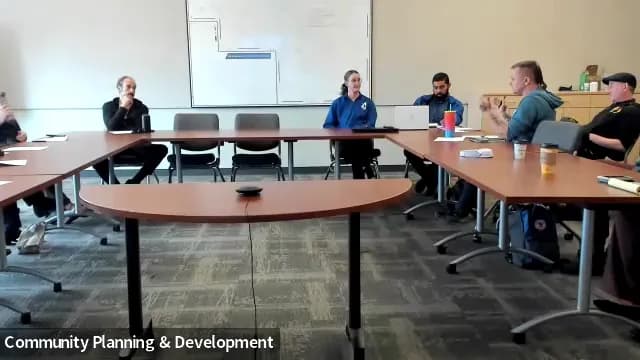
The PBIA Advisory Board, chaired by Jacob David, met to discuss a restructuring of the organization (Phase 2), recent controversial parking changes, and board member recruitment. The meeting featured extensive debate on the composition of a new leadership group and significant frustration from board members regarding a lack of communication from the city's Parking Services. A note on the schedule: the official minutes and transcript for this specific agenda are dated July 1, 2026. Consent Calendar - The meeting agenda and the minutes from the June 3, 2026 meeting were both approved unanimously. Public Comments & Testimony - No formal public comments were made at the start of the meeting. - During the Phase 2 discussion, Boardmember Sophie Landis made a statement explicitly as a member of the public, strongly advocating for the inclusion of small, independent "mom and pop" businesses in the leadership group to ensure it is not dominated by larger corporate interests. Discussion Items Board Nomination Discussion (Item 6A) - Jennica Machado reported four open PBIA seats. To expand the board's diversity, board members suggested candidates beyond the one formal survey applicant, including Alana Carr (Catherine Little/Compass Rose), a neighbor named Tanner, and Luis, who owns a bar, a barbershop, and a tattoo studio downtown. The goal was to finalize nominations to send ballots immediately, with elections in July and seating in August. PBIA Phase 2 Discussion (Item 6B) - Michael Cade from the Thurston Economic Development Council presented next steps for a complete financial and structural overhaul of the PBIA, aiming for a Q1 2027 presentation to council. - Leadership Group: A 10-member leadership group was proposed to guide the project. Jacob David and Alden Davis volunteered to represent the board. - Composition Debate: - Alden Davis argued the group must consist primarily of ratepayers, specifically those who are currently disenfranchised or frustrated, to build genuine trust and address the "alienation" felt by the business community. - Jacob David countered that the group needs "influencers" and civic advocates (such as Daniel from the Heel Oli project) to champion the changes, gather support, and effectively communicate the mission to a wider audience, advocating for a focus on people who are "bought in immediately." - Anne Gavzer suggested former board members like Melissa (BroCo) and Connie (Fuli Fuli Pizzeria), who have deep institutional knowledge of the board's history and frustrations. - Other candidates discussed for their sector representation included Olympia Federal Savings, Ember Coffee, Olympia Coffee Company, and Childhood's End Gallery. - Outreach Strategy: The board advised Michael Cade that "boots on the ground" outreach by trusted peers is the most effective method in Olympia, recommending Monday/Tuesday afternoons for visits and suggesting "action teams" of industry peers (retail talking to retail, restaurants to restaurants). Parking Services Update (Item 6C) - Chelsea Baker von Drood and Gustavo Del Castillo Ramirez presented on recent parking changes. - Core Issues: - Payment Crisis: The transition to the District Court has made it impossible to pay tickets online or at City Hall, causing widespread customer anger. An online payment fix is not expected until mid-2027. - Communication Breakdown: Board members reported hearing about changes (like the court transition and meter removal) from customers or tickets, not from the city. They expressed intense frustration at the operational impact of this silence. - Meters and 15-Minute Parking: - New Loading Zones: The city is replacing 15-minute meter spots with "curbside pickup" zones. - Language Dispute: The board universally panned the term "curbside pickup" as confusing and outdated. They demanded the signs simply say "15-Minute Parking" to ensure regular customers understand it is for quick errands. - Free Parking Demand: The board strongly pushed for the direct return of free 15-minute parking. Parking Services stated that transaction fees for free transactions alone would cost the city over $30,000 per year. A proposed PayByPhone validation program was rejected by the board as too administratively complex and burdensome for small businesses to feasibly use. - Path Forward: Parking Services acknowledged the communication failure and committed to using the PBIA newsletter as a channel for immediate updates. The board offered to serve as a formal, ongoing feedback loop for parking policy. Key Outcomes - Board Elections: Ballots for the four open board seats were ordered to be sent out immediately following the meeting. - Phase 2 Leadership: A leadership group was initiated with Jacob David and Alden Davis. Michael Cade will build a participation matrix to identify additional members based on the board's input. - Parking Communication: A new direct communication channel was established to share parking updates via the PBIA newsletter. Parking Services agreed to review the signage language for the new short-term parking zones based on the board's strong objection. - Sales Tax Increase: The board reminded all businesses that the sales tax rate increased to 10% effective that day and urged everyone to verify their POS systems.
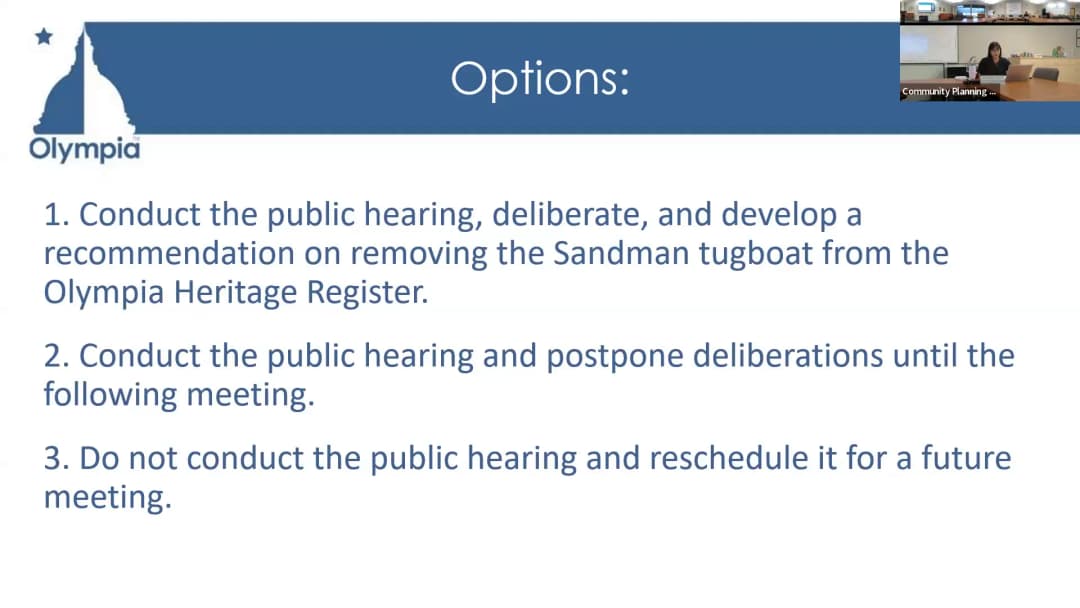
The Olympia Heritage Commission convened on July 27, 2026, at 5:30 PM in Room 207 of City Hall, with five commissioners present and four absent. The primary business item was a public hearing and deliberation on the removal of the Sandman tugboat from the Olympia Heritage Register. The commission also received staff announcements, discussed committee reports, and approved a letter of support for a student adaptive reuse proposal. The meeting adjourned at 6:34 PM. Consent Calendar - The agenda was approved unanimously. - Minutes from the June 24, 2026 Heritage Commission meeting were approved unanimously. Public Comments & Testimony - No members of the public provided testimony during the public hearing for the Sandman tugboat removal, which was opened at 6:10 PM and closed immediately with no speakers. Discussion Items - Sandman Tugboat Removal from Olympia Heritage Register: Staff (Brittany Gillia, Historic Preservation Officer) presented a briefing on the 60-foot wooden tugboat built in 1910. The vessel suffered from extensive rot and structural decay after being out of water since 2023, with condition worse than anticipated. The Port of Olympia held an impound auction in July 2025 with no bidders and assumed responsibility. Aaron LaPointe, Director of the Historic Maritime Foundation, detailed the severe damage: over 75% of the planking is rotted, decking has disintegrated, and the boat poses a safety hazard. Estimated repair costs for hood ends alone exceed $200,000. The Port and Foundation proposed a mitigation plan including artifact distribution to public organizations, a 3D scan and archaeological survey (already completed), and a community send-off at Olympia Harbor Days. Commissioners expressed strong support for the plan, noting the thoughtful approach and the benefit of reusing parts on working historic vessels. - Reports & Updates: - Heritage Review Committee has completed one site visit and scheduled another for window replacement permit review. - The upcoming CLG grant cycle: staff recommended focusing on outreach/education rather than a survey, and invited commissioners to attend a preservation training (Preservation in Action) in Ellensburg, October 6–8. Two commissioners indicated interest. - A Historic Preservation Field School was announced, offering three week-long sessions (Aug 30–Sep 4, Sep 6–11, Sep 13–18) at Ginkgo Petrified Forest State Park, covering window restoration, metalworking, masonry, and stone preservation. - The MORE committee reported progress on planning a trivia night, with a potential date of August 24 or 25 at Three Magnets Brewing, possibly in partnership with the Big Little House Museum and Olympic Historical Society. A second meeting is scheduled for early August. - Staff shared a drafted memo of support for University of Washington student Nora Yao's adaptive reuse proposal for the historic KGY building at 1700 Marine Drive NE, which included options for a community meeting house or a history café. The commission approved the letter. Key Outcomes - Vote on Sandman Removal: Commissioner Cotter moved to remove the Sandman tugboat from the Olympia Heritage Register; the motion passed unanimously (5–0). This decision allows the Port of Olympia to proceed with deconstruction and artifact distribution as outlined. - Letter of Support Approved: The commission voted to send a letter to Port of Olympia endorsing the student proposal for adaptive reuse of the KGY building. - Upcoming Deadlines: CLG grant application due July 31; commissioners interested in field school or training must notify staff soon. - Next Steps: Staff will prepare formal notice of the delisting and coordinate with the Port and Historic Maritime Foundation on mitigation activities.
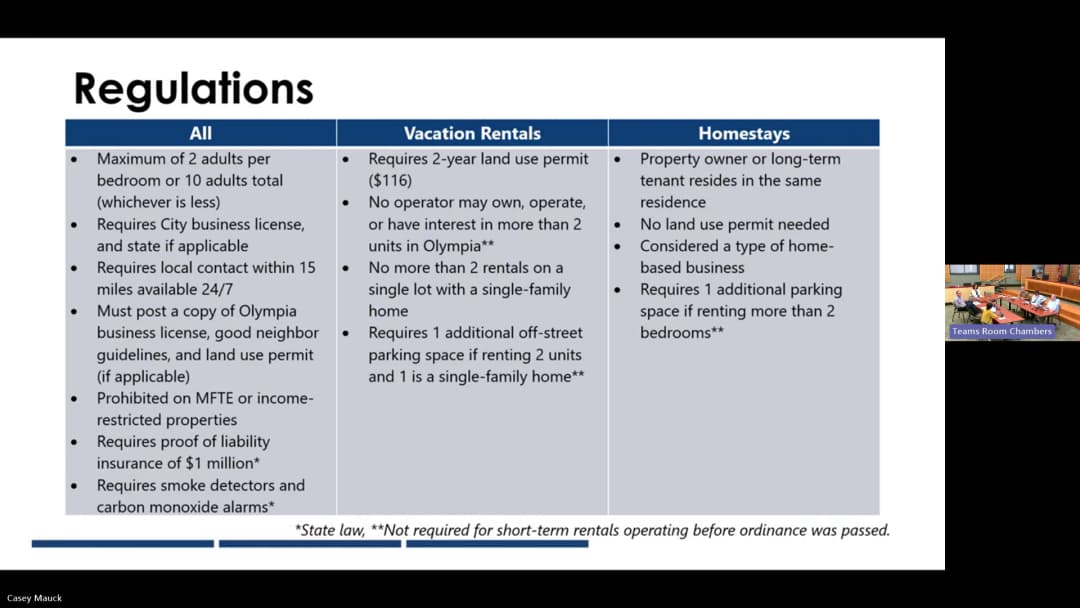
Land Use & Environment Committee Meeting Summary: July 27, 2026 The Olympia Land Use & Environment Committee met to discuss two main agenda items: Tenant Opportunity to Purchase (TOPA) arrangements and short-term rental permitting and enforcement. The committee also received reports on alternatives to a tree-cutting moratorium, the West Bay Yards decision, and the arrival of a new Housing Director. No public comments were made. Consent Calendar - Approval of Agenda: Approved unanimously. - Approval of Minutes (June 25, 2026): Approved unanimously. Public Comments & Testimony - None. Discussion Items - 6A: Tenant Opportunity to Purchase Arrangements (TOPA) – Senior Program Specialist Christa Lenssen presented a debrief from a June 11 stakeholder meeting. Key findings: Resident Owned Communities Northwest (ROC Northwest) estimates a 30–40% subsidy is needed for resident acquisition (e.g., $1.6M on a $4M property); the Regional Housing Council's Opportunity Fund has $3M annually but is limited; a 16-unit minimum threshold was recommended for viability; a 90–180 day timeframe is realistic. Staff proposed actions: track statewide conversations, partner with Thurston Housing Land Trust, offer renter education, and explore a pilot program. Committee members (Chair Vanderpool, Gilman, Berendt) expressed strong support for the concept but concern about funding and capacity. They directed staff to gather additional data (e.g., number of eligible properties coming to market each year) and bring a refined recommendation in October. - 6B: Briefing on Short-Term Rental Permitting and Enforcement – Planner Casey Mauck presented: 30 active vacation rental permits; two complaint-driven enforcement cases since ordinance adoption. Homestays (owner-occupied) require no permit; vacation rentals require a 2-year permit (cost $116) and are capped at two units per operator. Committee members discussed equity, the need for an audit to identify unregistered rentals, and the collection of lodging tax (collected via Airbnb/VRBO). They asked staff to explore audit options through the Business & Occupation (B&O) tax team, coordinate with listing sites, and potentially create a
Note: Meeting minutes and transcript indicate the meeting occurred on July 20, 2026, but the provided metadata states July 21, 2026. This summary uses the given date but notes the discrepancy. The Olympia Planning Commission met on [given date] to receive a briefing on proposed amendments to the home-based business (home occupation) code, hear public comment, and select a finance subcommittee for the Capital Facilities Plan. The meeting began with unanimous approval of the agenda and minutes from June 15, 2026, with one abstention from Commissioner Ibrahimovic (absent). Consent Calendar - The agenda was approved unanimously. - The minutes of the June 15, 2026 meeting were approved, with one abstention from Commissioner Ibrahimovic (absent). Public Comments & Testimony - Briahna Murray, a lobbyist and resident of the South Capitol neighborhood, expressed concern that the proposed amendments target specific professions (lobbyists) rather than regulating objective impacts like noise, traffic, parking, and signage. She stated that she uses her home for seasonal work and rents rooms to colleagues, and she fears the amendments would unfairly restrict her use. She urged the commission to reject the draft and adopt impact-based standards. - Julia Gorton, a lifelong Olympia resident and working mother, urged the commission to table the amendments and conduct an equity analysis. She argued that the amendments could prohibit ordinary remote work activities like meeting with coworkers at home, and would disproportionately affect women, as 36% of employed women work from home (U.S. Bureau of Labor Statistics). She emphasized the importance of flexibility for working parents. Discussion Items - Staff Briefing: David Ginther, Senior Planner, presented the proposed amendments. Key changes included removing permit references (no permit required since 2008), allowing on-site sales if not visible, allowing structural alterations consistent with residential character, removing redundant sections (adult daycare homes addressed by state law), and adding a definition for "remote work" to exclude it from home-based business requirements. The amendments were prompted by concerns from the South Capitol neighborhood about homes allegedly used by lobbyists. Ginther noted that only 3 of the 20 homes identified by neighbors have business licenses with the home-based business addendum. He also presented a GIS map showing 49 businesses and 76 home-based businesses in the South Capitol neighborhood association. - Commissioner Questions and Deliberation: - The two off-street parking limit was questioned; staff suggested it might be unnecessary and could be addressed via impervious surface limits. Commissioner Taellious recommended striking the limit. - The lack of a definition for "primary residence" was noted; staff indicated they may revert to "principal residence" to align with other city code. - The 500 square foot/25% size limit was questioned; some commissioners suggested using only a percentage to avoid limiting uses like personal training in large homes. - The prohibition on group counseling, including substance abuse counseling, was questioned given the opioid crisis. Commissioner R. Garcia asked for reconsideration. - The broad prohibition on meetings for off-site work was clarified by Chair Quetin and Staff: it is intended to prevent using a home as a motor pool for work crews, not to prohibit social gatherings. - Enforcement is complaint-based; staff acknowledged that many home-based businesses operate without licenses. - Commissioners expressed concern that the amendments unfairly target lobbyists and could impact remote workers and working mothers. Commissioner D. Garcia noted that state employees who lobby (e.g., agency legislative affairs) are also required to file with the Public Disclosure Commission, and the term "lobbyist" carries a negative connotation that could affect many. - Commissioner Grubb requested revisiting public comments from the comprehensive plan process for context. - Other Business: The commission selected a finance subcommittee for the 2027–2032 Capital Facilities Plan. Commissioner Berger volunteered as chair, Vice Chair R. Garcia also volunteered, and the possibility of adding Commissioner Ibrahimovic (absent) was discussed. The subcommittee will meet 3–4 times to review chapters, prepare questions, and draft a comment letter to city council. Key Outcomes - The briefing on home-based business code amendments was received; no vote was taken. - A public hearing on the amendments is scheduled for August 17, 2026 (the August 3 meeting is canceled). - Finance subcommittee formed: Chair – Commissioner Elle Berger, Member – Vice Chair Raphael Garcia, with potential addition of Commissioner Semir Ibrahimovic. - Next regular meeting: August 17, 2026.
The meeting occurred on July 17, 2026, at 14:00 UTC. No agenda, minutes, or transcript content were provided, so no details about the meeting discussions, decisions, or public comments are available.
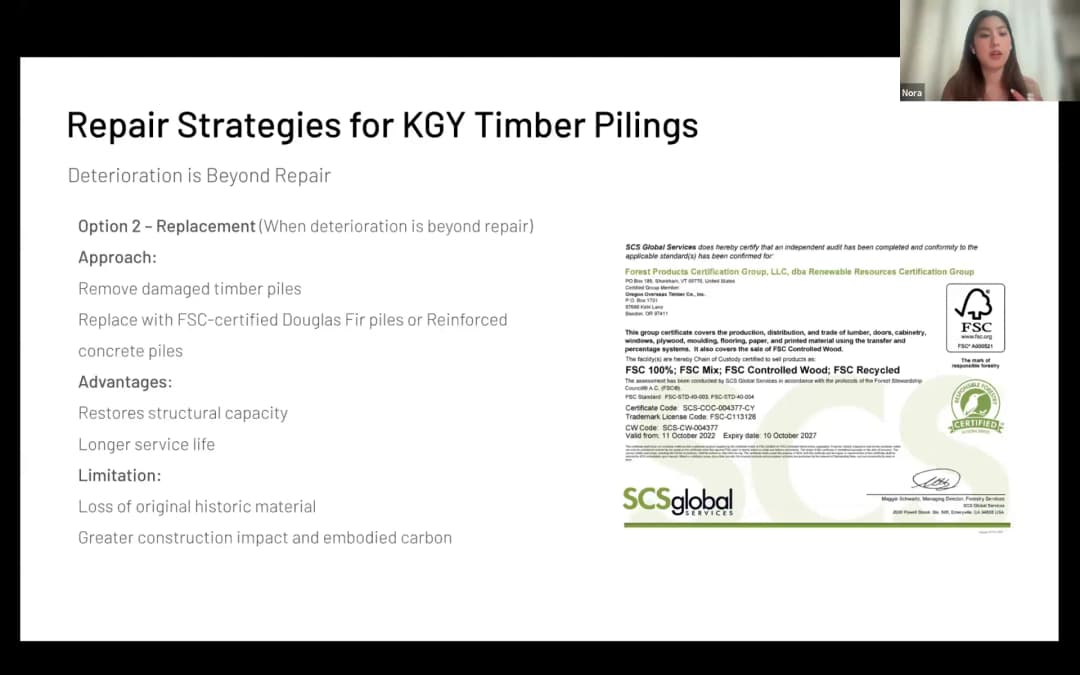
The Olympia Heritage Commission held a hybrid meeting on June 26, 2026 from 5:30 PM to 7:11 PM. The meeting included briefings on sea level rise impacts on cultural assets, a presentation on saving the Nisqually Delta, a student proposal for adaptive reuse of the historic KGY radio station, and committee reports on the Sandman tugboat mitigation, CLG grant application, and plans for a heritage trivia night. Consent Calendar - The agenda and the minutes from the May 27, 2026 meeting were approved by consensus. Public Comments & Testimony - No public comments were received. Discussion Items - Sea Level Rise and Cultural Assets Briefing: Natalie Weiss, Climate Resilience Coordinator, presented the city's sea level rise response plan. She highlighted that Olympia has one of the largest tidal ranges in the continental US, and that projected sea level rise of 1-2 feet by 2050 and 3-5.5 feet by 2100 will primarily affect downtown, including historic properties and districts. The city has completed its five-year strategy period, installing backflow prevention on stormwater outfalls and improving operational readiness. Adaptation strategies include nature-based solutions, raised landscaping, and flood walls, all within public rights-of-way. The restoration of Capitol Lake to an estuary will incorporate sea level rise projections into Heritage Park redesign. - Presentation - Janine Gates, Saving the Nisqually Delta: Janine Gates, a local journalist and author, presented her book and research on the history and threats to the Nisqually Delta. She discussed the historical significance of the Squalachew Creek area in DuPont, which is eligible as a national landmark and has been threatened by warehouse development and sand and gravel mining. She expressed the importance of transferring institutional knowledge and protecting the delta's heritage. - University of Washington Student Presentation - Nora Yao: Nora Yao, a Master of Architecture student, presented a proposal for adaptive reuse of the historic KGY radio station building, designed by Robert H. Willum. The proposal includes two concepts: a community meeting house or a Port of Olympia History Cafe with exhibitions on coastal Salish life, industrial port history, and present port activities. The design preserves the building's iconic mid-century style, waterfront location, and timber pilings. The commission voted unanimously to send a memo to the Port of Olympia endorsing the proposal. Committee Reports - Sandman Tugboat Status: A public hearing is scheduled for next month. Mitigation efforts include a 3D scan, video production, and inventory of artifacts for public display. The port is working with the Historic Maritime Foundation, and the commission agreed to form a subcommittee to assist with programming at Harbor Days (September 4-6). - Heritage Review Committee: Two projects are being scheduled for review. - MORE Committee: The committee provided a recap of the OHS/BHM meeting. Plans include trialing a heritage trivia night on August 24 at Three Magnets Brewing, with South Sound Block Party tickets as a prize, and creating a one-pager on the significance of being on the register. - POG Committee: The CLG Grant application for a reconnaissance survey of the South Capitol neighborhood is under deliberation. An extended survey would cost approximately $30,000. The commission is considering alternative approaches, such as expanding the period of significance, and will consult with DAP’s Michelle Thompson for guidance. Key Outcomes - Approved the agenda and minutes of May 27, 2026. - Unanimously passed a motion (Becker/Cotter) to send a memo to the Port of Olympia endorsing Nora Yao's adaptive reuse proposal for the KGY radio station. - Unanimously passed a motion to form a subcommittee to assist with the Sandman tugboat presence at Harbor Days (September 4-6). - Commissioner Stephen Becker volunteered to serve on the Sandman artifacts review committee. - The MORE committee will proceed with planning a heritage trivia night on August 24. - The POG committee will continue discussions on the CLG grant direction after consultation with DAP.
The Land Use & Environment Committee of the Olympia City Council met on June 26, 2026 (note: the minutes indicate June 25, 2026; the date used here follows the provided timestamp). The meeting included a briefing on the Urban Forest Management Plan (UFMP), a preliminary discussion of 2027 work plans for the Planning Commission and other advisory bodies, and public comments urging immediate protection for large trees. Consent Calendar - The agenda for the June 25 meeting was approved. - Minutes from the May 28, 2026 Land Use & Environment Committee meeting and the June 11, 2026 special meeting were approved. Public Comments & Testimony - Lynn Fitz-Hugh, Executive Director of Restoring Earth Connection, expressed strong support for a moratorium on cutting the largest trees (over 40 inches diameter at breast height) while the UFMP is developed. She noted that in neighboring cities, large trees have been lost even while tree policies were being drafted, and she urged the city to act immediately to protect heritage trees. - Heather Penns, an Olympia resident, also supported a temporary resolution to protect trees over 40 inches DBH, emphasizing that large trees sequester more carbon, reduce flooding, and cannot be replaced by saplings in the short term. Discussion Items 6.A Briefing on the Urban Forest Management Plan - Kim Foley, Public Works Associate Planner, and Leanne Wells, Urban Forester, presented the scope and timeline for the UFMP. The plan, funded in part by a federal grant, aims to address tree canopy goals, update tree code, and incorporate environmental justice. Key points: - Olympia's current tree canopy is 42%, which is high compared to regional targets of 30%. - The plan will take approximately two years, with final delivery by May 2028. - Challenges include conflicting priorities (e.g., housing vs. trees), limited staff capacity, and infrastructure impacts (e.g., sidewalks, sewers). - A robust public participation plan includes focus groups with overburdened communities, open houses, and an online story map. - Committee members expressed a need for more education before making policy decisions. They raised concerns about tree loss during the two-year process, sidewalk damage from mature trees, and the effectiveness of the existing tree unit system (which incentivizes preservation of larger trees but is often circumvented). - Tim Smith, Community Planning & Economic Development Director, noted that the city's tree code already requires soil and vegetation conservation plans and that a blanket moratorium could be drafted with flexibility for staff to grant exceptions where preservation is impractical. 6.B Preliminary Discussion of 2027 Work Plans - The committee, joined by Greg Quetin (Planning Commission Chair) and Daniel Garcia (Vice Chair, online), discussed priorities for 2027. Topics included: - Aligning work plans among the committee, Planning Commission, and Bicycle & Pedestrian Advisory Committee (BPAC). - Transportation planning: updates to the Transportation Master Plan, shared streets, speed cameras, and traffic calming. - Parking management: exploring shared parking, land value tax adjustments, and the high cost of parking garages ($50,000–$100,000 per space). - Zoning simplification: consolidating the city's many zoning districts (currently 18–21) to reduce complexity, with a focus on the Plum Street corridor. - Other items: sea level rise funding, design review board future, and monitoring state legislation on ADUs and design review. - Staff noted capacity constraints after losing a planner position and emphasized the need to prioritize projects that can be accomplished with existing resources. Key Outcomes - Referral to Full Council: The committee agreed to send a referral to the City Council requesting a temporary ordinance to protect trees 24 inches DBH or larger (based on Leanne Wells's recommendation) during the UFMP process. The ordinance would give the urban forester authority to grant exceptions where preservation is not feasible. - Next Steps for UFMP: Staff will continue internal and public engagement; a draft action plan is expected by mid-2027. The committee will receive updates and provide input before the plan goes to Council. - Work Plan Alignment: Future meetings will include transportation planners and BPAC representatives to coordinate work plans. A follow-up discussion is planned for later in 2026 to refine priorities based on staff capacity. - Reports: Tim Smith reported on recent development projects, including 272 affordable housing units at Harbor Pines, a 35-unit apartment building on Henderson, and the West Bay Yards appeal (decision expected by early August). He also announced new staff hires: Kern Lean as Planning Manager and Ashley Chambers as Housing Director.
On June 23, 2026, Olympia Hearing Examiner Mark Scheipmeyer convened a public hearing to consider a conditional use permit application by the City of Olympia Parks, Arts and Recreation Department for the proposed Kaiser Woods Park (now officially named Marge Young Park). The project is located at 2549 Black Lake Boulevard Southwest, spanning approximately 71 acres. The proposal includes 3.5 miles of new mountain bike trails, 1.9 miles of existing trails to be formalized, pump tracks, skill stations, a 25-stall parking lot, restroom, stormwater detention facilities, and frontage improvements along Black Lake Boulevard. The hearing examiner approved the permit with additional conditions. Public Comments & Testimony - Neighbors (Park Drive/Westbrook area): Patricia Bracken, John Rich, Beth Gallatin, and Michael Godar expressed concerns about increased traffic, parking spillover onto Park Drive, safety, noise, and the lack of operational standards. They requested signage directing visitors to the main Black Lake Boulevard entrance and asked for measures to discourage use of the Park Drive access. Some also questioned the adequacy of critical area assessments and fire risk. - Mountain bikers and supporters: Dan Albach, Beth Provo, Nathan Hamilton, Lisa Sweet, Rip Hemingway, Chris Song, and others voiced strong support. They emphasized the lack of dedicated mountain bike trails in Olympia, the family-friendly nature of the sport, and the community's stewardship ethic. They noted that the park would provide a safe, local venue for youth programs and skill-building, reducing the need to travel to other counties. - Online participants: Chris Kernerk, Ryan McCord, Calvin O, Natalie Hibard, and Sam Ham (professor emeritus of natural resource management) also expressed support, with Sam Ham raising fire risk concerns and requesting a smoking ban (already in place in city parks) and active monitoring for homeless encampments. Discussion Items - City Planning Staff Presentation (Casey Mock): Mock reviewed the application process, noting the city served as both applicant and reviewer. The proposal complies with the comprehensive plan and development regulations. Key points: the project is a conditional use because it includes more than 10 parking stalls; it is allowed in the RLI (residential low-impact) zone. Critical areas reports addressed stream buffers, wetland buffer averaging, and steep slopes. The project removes 90 trees (66 diseased) out of 24,000 on site. Staff recommended approval with conditions, including monitoring of critical areas, engineering permits from Tumwater, and a holding tank permit from Thurston County. Mock clarified that the city permitting staff does not dictate trail type (hiking vs. biking)—that is the parks department’s role. - Applicant’s (Parks Department) Presentation (Diane Utter): Utter corrected that the project is a park with mountain bike trails, not solely a mountain bike park. She emphasized that the park was purchased specifically to address the lack of dedicated mountain bike trails in Olympia. She displayed a detailed map (Exhibit 25) showing trail designations: gray (new bike-only), yellow (existing bike-only), blue (shared use). She explained that 93% of the site remains forested, and trails are three to six feet wide. She addressed signage, e-bike policy (following state guidelines), lighting (only in pump track and skills area, but later clarified no lighting), and planned abandonment of half-mile of existing trails with physical barriers and better trail alternatives. She noted a 150-foot buffer of no new trails along neighborhood boundaries, with one exception at the request of Ken Lake residents for a walking-only connection. The garage on site will be retained for storage. Future expansion is not planned; monitoring will address any erosion or runoff issues. - Hearing Examiner Questions: The examiner asked about the final plan vs. exhibits, cultural trees, fencing, informal access points, signage, hours of operation, e-bike policy, lighting, and the future road connection between Kaiser Road and Black Lake Boulevard. Staff clarified that the plan is substantially final, fencing is not required, and the road connection is not in the six-year transportation plan. Key Outcomes - Decision: Hearing Examiner Mark Scheipmeyer approved the conditional use permit for Kaiser Woods Park (Marge Young Park). - Additional Conditions Imposed: - Hours of Operation: Park use is limited to dawn to dusk. - Signage: The city must install directional signage on Black Lake Boulevard directing visitors to the main entrance, and signage at the Park Drive entrance indicating that the main entrance is located elsewhere. The examiner noted he lacks authority to prohibit parking on public streets. - Standard Conditions from Staff: The approval includes conditions requiring monitoring of critical areas for three years, an engineering permit from Tumwater for the access lane and parking lot, a holding tank permit for the restroom, removal of noxious weeds, and compliance with state historic preservation processes. The parking lot is located in potential future right-of-way; if the road connection is built, the city must provide alternative parking. - Next Steps: The hearing examiner will issue a written decision with findings of fact and conclusions of law within two weeks. Affected parties may request a copy from the city.