The Pittsburgh City Council Standing Committees met on March 18, 2026, starting at 10:00 AM, with all nine members present. The meeting covered public comments, multiple committee agendas, and included key discussions on the comprehensive plan termination and creation of a fleet vehicle fund. Public Comments & Testimony - Jim Craig (South): Expressed concerns about a rape problem in the city. - Carlino Giampolo (Panther Hollow): Accused Councilmembers Warwick and Charland of complicity in illegal skate park activities, threatening legal action if harm comes to residents. - Yvonne Brown (Bedford Avenue): Criticized Tim Stevens for controlling question selection at police review meetings and questioned funding. - Special Agent Sunshine: Alleged fraud by the government, claiming identity theft and homelessness, and called for divine intervention. - Unique Brown (Janique Brown) (White Sap Road): Criticized the system for not listening, shared personal experiences with a shelter CEO lying, and demanded city council investigate. Discussion Items Finance and Law Committee - 2026-0006 & 2026-0007 (Termination of Comprehensive Plan Contracts): Councilmember Coghill explained negotiations that resulted in $750,000 from the Heinz Foundation and $250,000 refund from the previous administration, for a total saving of $1 million. The funds will allow completion of the plan with remaining $1.5 million. The bills were tabled (9-0 vote) to free up funding. - 2026-0016 (Fleet Vehicle Fund): Councilmember Warwick highlighted the city's fleet crisis: 40 snowplows broke down during a storm, $400,000/month in repairs, and a need for $20 million/year over 10 years. The bill was held for six weeks to allow the budget reopening process to address fleet funding. - 2026-0227 (Warrant for Court Reporting Services): Approved by affirmative recommendation. - Invoices and P-Card Approvals: Councilmember Gross raised concerns about Cyclops Technologies’ PlateSmart software, which allows license plate searches, and confirmed no data sharing with federal law enforcement. Invoices and P-cards were approved. Public Safety and Wellness Committee - 2026-0222 (Police Vehicle Repair): Approved. - 2026-0223 (Major Cities Chiefs Association Dues): Councilmember Coghill inquired about benefits; Lt. Cunningham confirmed participation in conferences. Approved. Public Works and Infrastructure Committee - 2026-0113 (Right-of-Way Accessibility Needs Inventory): Councilmember Warwick explained it will guide pedestrian infrastructure improvements after snowstorms. Approved. - 2026-0225 (Natural Gas Service for Riverview Park): Approved at no cost to city. - 2026-0226 (Spring Hill Park Stormwater Covenant): Christopher Hortzlan confirmed it is a routine requirement for development permits. Approved. - 2026-0243 (Crafton Borough Eminent Domain): Approved. Human Resources Committee - 2026-0221 (Police Recruit Examination Services): Contract with I/O Solutions for $151,980 over three years. Approved. Land Use and Economic Development Committee - 2026-0228 (Greenway Signage Grant from Trust for Public Land): $25,000 grant. Approved. - 2026-0229 (CDBG-CV Reallocation to Greater Pittsburgh Community Food Bank): Amended to reduce the amount from $55,692.60 to $30,000 after determining the food bank could only spend that. Approved as amended. Intergovernmental and Educational Affairs Committee - 2026-0224 (ALCOSAN Monitoring Boreholes Easement): Councilmember Mosley moved to hold for four weeks to address community concerns. Approved. Key Outcomes - 2026-0006 & 2026-0007: Tabled (9-0). - 2026-0016: Held in committee for six weeks. - 2026-0227: Affirmatively recommended. - Invoices and P-cards: Approved. - 2026-0222, 2026-0223, 2026-0113, 2026-0225, 2026-0226, 2026-0243, 2026-0221, 2026-0228: All affirmatively recommended. - 2026-0229: Amended, then affirmatively recommended. - 2026-0224: Held in committee for four weeks. - Executive Session: Motion approved to hold an executive session on litigation matters.
Public Meetings - Pittsburgh, Pennsylvania
Public Meetings - Pittsburgh, PennsylvaniaThe Pittsburgh City Council held its regular meeting on Tuesday, March 17, 2026, at 10:00 AM in Council Chambers. All nine council members were present. The meeting included proclamations, a will of council urging state violence prevention funding, public comments, introduction of numerous resolutions and ordinances, appointments to city boards, and final passage of multiple committee reports. Key actions included the adoption of resolutions supporting community violence intervention and the approval of contracts and grants totaling over $1.5 million. Consent Calendar - Proclamations: Adopted Resolution 2026-0249 declaring March 19-20, 2026 as "Women in Data Science Days" in Pittsburgh. Adopted Resolution 2026-0266 declaring March 18, 2026 as "Streets on Carson Day." - Will of Council: Adopted Resolution 2026-0267 urging the Pennsylvania General Assembly to include no less than $80 million for the Violence Intervention and Prevention (VIP) program and $12.5 million for the Building Opportunity through Out of School Time (BOOST) program, for a total investment of $92.5 million in violence prevention. Council Member Barbara Warwick expressed strong support, noting that community violence intervention is associated with a 46.5% reduction in shootings and firearm homicides across Pennsylvania and that every dollar invested returns at least five dollars in value. Multiple community advocates spoke in favor, citing reduced violence in their neighborhoods. - Appointments: Approved the reappointment of Steve Mazza to the Board of License and Inspection Review (term to March 1, 2029) and the appointment of Will Allison to the Clean Pittsburgh Commission (term to March 1, 2030). Also approved seven earlier-held appointments to the Historic Review Commission and Public Art and Civic Design Commission (Resolutions 2026-0131 through 2026-0150). Public Comments & Testimony - Deborah Wiley (Banksville) opposed the proposed Dismas charity halfway house at the former FOP building, citing documented public safety failures at Dismas facilities in Memphis, Tucson, and St. Louis, including walkaways, contraband, and inadequate supervision. She urged the council to consider this record if the issue comes before the Planning Commission. - Dr. Ronald Lynn Miller (Swahili neighborhood network) advocated for careful verification of AI outputs, particularly ChatGPT, and proposed rules for interacting with AI to avoid misinformation. - Bethany Cameron (Overbrook, representing informop.org) presented a community survey of 49 respondents from seven of nine districts. Key findings: 37% prioritized traffic and crowd management for the NFL draft, 98% supported giving Pittsburgh-based vendors priority for draft vending locations, and 78% favored maintaining or increasing the city's 50% renewable electricity sourcing. - Ikhana hal-makina criticized the closure of bars due to isolated incidents and called for more aggressive action to get illegal guns off the streets, stating that funding violence prevention alone is insufficient. - Unique Brown (no neighborhood given) criticized council members for inconsistent attendance at public comment sessions and for not adequately addressing the needs of Black residents. She referenced a protest in West Mifflin where police pepper-sprayed children and called for accountability. - Special Agent Sunshine (no neighborhood given) spoke about property rights, alleging that the government stole her house and placed her under illegal conservatorship. She cited the 14th Amendment and called for justice. Discussion Items - Introduction of Legislation: Council members introduced 16 new resolutions and one ordinance, covering topics such as software maintenance for the Office of Municipal Investigations (OMI) with Versaterm ($23,413.48 over three years), a professional services agreement with Fair Housing Partnership ($30,000 for one year), police supervisor training with North Star Leadership ($20,000), legal representation for the Citizen Police Review Board ($45,000 per year for three years), the designation of Upper Lawrenceville properties as permanent open space as part of the Greenways for Pittsburgh program, amendments to the PAYGO-funded projects budget (adding $157,175 for Land Bank Personnel), revisions to the Official Sewage Facilities Plan for several properties, land sale agreements, supplemental agreements for project management and engineering services (including $121,861.99 for CDR Maguire and $178,939.11 for Penn Ave Phase 2), eminent domain for Andover Terrace repairs ($35,000), an ordinance to allow overhead wires on Kinsmen Road and Worth Street, and a warrant for emergency snow removal ($109,847.58). All were read and referred to appropriate committees. - Councilman Mosley’s Remarks: Councilman Khari Mosley thanked colleagues and the city for their support following his father’s passing, expressing gratitude for the outpouring of love from the community. - Councilwoman Warwick’s Comments: Councilwoman Barbara Warwick highlighted two recent incidents: a Haitian refugee named Daffy Michelle found dead on the South Side after being released by ICE without notification, and a protest in West Mifflin where police pepper-sprayed children. She called for an investigation into the South Side incident and urged caution about law enforcement culture at the federal level influencing local police. Key Outcomes - Final Passage of Committee Reports: The council unanimously passed (9-0) the following items from the committees: - Finance and Law: Unified vending fee schedule (Resolution 2026-0242). - Public Safety and Wellness: Contract with Operation Better Block for group violence intervention technology services ($300,000 over three years), and two license agreements with The Buncher Company for police training space (four days) and Gateway View Plaza space (45 days, at no cost). - Public Works and Infrastructure: Acceptance of an $805,533 Automated Red Light Enforcement grant for signal replacement at Fifth Avenue and Dithridge Street, vacation of an unopened portion of Savoy Street, and a six-year energy advisory services agreement with Enel X (at no additional cost). - Land Use and Economic Development: Authorization for the Pittsburgh Land Bank to acquire a property at 635 Kirkpatrick Street (no cost). - Intergovernmental and Educational Affairs: Payment of membership dues for the United States Conference of Mayors ($21,824), Pennsylvania Municipal League ($52,962.24), and National League of Cities ($19,626); adoption of sewage facilities plan revisions for 2111 Penn Avenue, 1717-1719 Cliff Street, and 544 Lincoln Avenue; and an agreement with the Stadium Authority of Pittsburgh and Allegheny County ($1) for public safety equipment installation. - Unanimous Votes: All final passage votes were 9-0 in favor.
The City Council Committee on Hearings and Policy convened at 1:30 PM on March 11, 2026, to conduct pre‑agenda interviews for seven nominees to the Historic Review Commission (HRC), the Public Art Committee, and the Civic Design Committee. The session featured candidate introductions, discussion of preservation philosophy, and councilmember questions regarding balance, community engagement, and the risk of weaponizing historic designations. Discussion Items - Historic Review Commission nominees (4 positions): - K. Chase Patterson (term ending 2027) – Lifelong Pittsburgher, CEO of Urban Academy; stressed that preservation and progress can coexist, and that historic buildings are “opportunities to connect the past to the future.” - Catherine Blauvelt (term ending 2029) – Librarian with expertise in rare books and architectural history; described her passion for Pittsburgh’s diverse architecture and her family’s daily use of historic buildings. - Luna Fruendsgaard (term ending 2029) – Design principal at Indivina Associates Architects; highlighted experience repurposing historic structures (Terminal Building, Gulf Tower) while respecting architectural integrity. - Martha Isler (term ending 2028) – Secretary of CCAC Board of Trustees, 43‑year Squirrel Hill resident; led restoration of the Neal Log House (c. 1795) and raised over $300,000 for its historic preservation. - Public Art Committee nominee: - Emily Stedge (term concurrent with Mayor) – Director of Education & Communications at Pittsburgh Center for Arts and Media; emphasized community arts education and the power of public art to break down boundaries. - Civic Design Committee nominees (2 positions): - James Hill (term concurrent with Mayor) – Lifelong Pittsburgher, worked at Cultural Trust and city; focused on the civic role of public buildings (fire stations, parks) in shaping neighborhood identity. - Kendall Soler (term concurrent with Mayor) – Interior design director at Shelton Design, master’s from Chatham; interested in balancing preservation with modern function, and in underutilized industrial spaces. Councilmember Questions and Dialogue: - Councilmember Strasberger asked how nominees weigh architectural significance versus historical events inside a building. Nominees generally agreed on a case‑by‑case approach, guided by staff recommendations and community input. - Councilmember (likely Warwick) raised concerns about the “weaponization” of the HRC to block housing or development. Nominees stressed using clear guidelines, avoiding political use, and ensuring that preservation does not lead to long‑term vacancy. - Councilmember Woolworth discussed the tension between rigid historic standards and practical reuse (e.g., replacing wood windows with vinyl to reduce costs). Nominees favored flexibility and common sense, and noted that the 1979 regulations may need updating. - Councilmember Warwick referenced the East Carson Street Historic District and the “volcano” restaurant project that was killed, leaving a vacant building. Nominees acknowledged the double‑edged sword of preservation. - Councilmember (Strasberger) asked about equitable community engagement, especially when only a loud minority shows up. Nominees emphasized the need to discern genuine community support from organized opposition. - Councilmember Woolworth also asked about making city processes more accessible to artists. Emily Stedge advocated for transparent funding and community education. Key Outcomes - All seven nominees completed their pre‑agenda interviews; each interview was formally recorded as “Held” in the minutes. - Councilmembers expressed appreciation for the nominees’ qualifications and commitment. - No votes were taken during the interviews; formal appointment resolutions are expected to be advanced to a future Council meeting. - Notable interruption: a tornado warning alert sounded during Councilmember (Strasberger’s) questioning, briefly pausing the proceedings.
A Standing Committees meeting of the Pittsburgh City Council was held on March 11, 2026, at 10:00 AM in Council Chambers. Eight council members were present (Wilson, Salinetro, Charland, Coghill, Warwick, Lavelle, Gross, Strassburger); Council Member Mosley was absent. The committees reviewed and voted on a range of legislative items including fee schedules, contracts, grants, property dedications, and membership dues, with most items receiving affirmative recommendations. Three members of the public provided comment. Public Comments - Yvonne F. Brown (715 Mercer Street) spoke about a refrigerator she believes was taken by former council president Krause, criticized his conduct, and endorsed Will Anderson for office. - Unique Brown (neighborhood not stated) described discriminatory treatment she experienced in a domestic violence shelter system, arguing that Black women are often treated differently and that white women disproportionately hold power in these organizations. - Special Agent Sunshine delivered a prayer and spoke about spiritual protection and remaining faithful. Finance and Law Committee - Vending Fee Schedule (2026-0242): Approved unanimously. Director Green explained that the resolution amends the 2026 fee schedule to consolidate vending license fees into unified fees, as recommended by the Department of Permits, Licenses & Inspections. The change is revenue-neutral and includes new administrative fees for Department of Mobility and Infrastructure work related to the vending program. It is intended to simplify the application process for vendors ahead of the NFL draft. - Budget Referendum (2026-0039): Held in committee for 12 weeks, due back by June 3, 2026. The ordinance would place a referendum on the May 2026 primary ballot to amend the Home Rule Charter regarding budget approval rules. - Invoices and P-Cards: Approved unanimously. Public Safety and Wellness Committee - Group Violence Intervention Technology (2026-0193): Affirmatively recommended. Resolution authorizes a $300,000, three-year professional services agreement with Operation Better Block for technology services to track data from law enforcement and outreach workers, and to distribute public information on housing, food, and social services. - Buncher Warehouse for Police Training (2026-0194): Affirmatively recommended. Licenses warehouse space from The Buncher Company for four days over 90 days at no cost. - Buncher Gateway View Plaza Space (2026-0195): Affirmatively recommended. Licenses space at Gateway View Plaza for 45 days at no cost. Public Works and Infrastructure Committee - Automated Red Light Enforcement Grant (2026-0196): Affirmatively recommended. Authorizes acceptance of $805,533 from PennDOT to replace signals at Fifth Avenue and Dithridge Street. - Parcel Dedication at Main Street/Liberty Avenue (2026-0203): Held in committee for three weeks, due back by April 1, 2026. Councilwoman Gross requested a hold to conduct community outreach regarding the intersection, citing 20 years of planning and stakeholder concerns. - Savoy Street Vacation (2026-0204): Affirmatively recommended. Vacates an unopened, unimproved paper portion of Savoy Street. - Energy Advisory Services (2026-0205): Affirmatively recommended after discussion. Resolution authorizes a six-year agreement with Enel X Advisory Services USA, LLC, at no additional cost, to provide energy evaluation and consultant services for the City’s participation in the Western Pennsylvania Energy Consortium (WPEC). City officials (Don Mudrick, Bat Mahoney, Joel McLear) explained that WPEC leverages collective purchasing power for electricity procurement, has achieved over 50% renewable energy, and helped identify 350 misattributed accounts, leading to cost savings. Councilwoman Warwick raised concerns about the process for renewing WPEC’s memorandum of understanding without council approval, but ultimately supported the resolution. Land Use and Economic Development Committee - Land Bank Acquisition (2026-0207): Affirmatively recommended. Authorizes the Pittsburgh Land Bank to acquire the City’s interest in the property at 635 Kirkpatrick Street (Council District 6) at no cost. Intergovernmental and Educational Affairs Committee - Membership Dues: Affirmatively recommended for: - United States Conference of Mayors ($21,824) - Pennsylvania Municipal League ($52,962.24) - National League of Cities ($19,626) - Sewage Facilities Plan Revisions: Affirmatively recommended for properties at 2111 Penn Avenue, 1717-1719 Cliff Street, and 544 Lincoln Avenue, all at no cost to the City. - Stadium Authority Agreement (2026-0202): Affirmatively recommended. Resolution authorizes a $1 agreement with the Stadium Authority of Pittsburgh and Allegheny County for installation of public safety equipment. Dan Shack from the Office of Public Safety Technology explained that the agreement covers relocating a single camera from a light pole to the rooftop of a parking garage owned by the Stadium Authority for the duration of the NFL draft, after which it will be moved back. Council members discussed privacy concerns and the scale of the relocation. Key Outcomes - All resolutions received affirmative recommendations from their respective committees, with two exceptions: (1) Budget Referendum (2026-0039) was held for 12 weeks, and (2) Parcel Dedication (2026-0203) was held for 3 weeks for community outreach. - Invoices and P-card approvals were passed unanimously. - The meeting adjourned following announcements of future meetings and pre-agenda interviews.
On March 10, 2026, at 1:30 PM in Council Chambers, Pittsburgh City Council held a post-agenda discussion on the Climate Action Plan (CAP) 3.0. The meeting was convened by Council Member Erika Strassburger and featured presentations from Ivette Mongalo-Winston, Director of the Department of City Planning, and Flore Marion, Assistant Director of Sustainability & Resilience. The session provided an update on the city’s climate progress, ongoing projects, and next steps toward a CAP 4.0. Council Member Barbara Warwick also participated in the discussion. Discussion Items - Climate Action Plan 3.0 Overview: Flore Marion presented the CAP 3.0, adopted in 2018, which organizes goals into seven chapters: greenhouse gas inventory, energy, building efficiency, transportation and land use, waste, food and urban agriculture, and ecosystem. Key targets include a 50% reduction in emissions by 2030, 100% clean electricity by 2030, 50% reduction in energy and water consumption by 2030, 50% reduction in on-road transportation emissions, zero waste to landfill by 2030 (defined as 90% reduction), and increased carbon sequestration. - Climate Change Impacts in Pittsburgh: Marion highlighted that precipitation is 30% more intense than in the 1970s, temperatures have risen 3.4°F, and there are 17 fewer freezing nights per year. The number of tornadoes and flood events has increased, and landslide repair costs have risen. She noted that 41% of Americans are very concerned about environmental issues, and public support for climate action is higher than policymakers perceive. - Progress on Energy and Buildings: The city has switched to LED streetlights, replacing 35,000 fixtures, with an estimated $1 million annual savings once completed. The Medic 4 building is the first to comply with the net-zero ready ordinance. Over half of the city’s electricity came from clean energy in 2024 through a consortium bulk-purchasing program. Solar panels are being investigated for city facilities, including a ground-mounted project at the forestry division (129% of site consumption). - Transportation and EV Infrastructure: 12,000 EVs are registered in Pittsburgh, with a 40% increase in ownership since 2024. The city is deploying 100 EV chargers at 21 sites, pending federal grant resolution. A study with RMI and Bike Pittsburgh identified e-bike charging stations near multifamily buildings. Council Member Warwick expressed concern about the sustainability of POGO bikes after AHN announced it would pull support, and emphasized the need for expanded bike infrastructure and better transit coordination with PRT. - Waste and Composting: A composting pilot concluded, and the city created an ITQ to pre-qualify local composters. A vendor sustainability pilot with Clupify (formerly PGH Lab startup) evaluated ESG practices. Updates to the city’s sustainable event guide were developed with the Plastic Collaborative. - Food and Urban Agriculture: The adopt-a-lot program was revamped, expanding approved garden elements and extending lease terms. Pittsburgh has three city farmers advancing local food access. - Ecosystem and Green Infrastructure: A data-driven tree planting program planted 148 trees in a pilot site, winning a Smart City Award. The city released 7,000 vacant parcels to the market and preserved 3,000 for greenways. A green infrastructure framework was developed with the Waternow Alliance, now being piloted in Lincoln-Lemington. - Comprehensive Plan and CAP 4.0 Timeline: Director Mongalo-Winston stated that the comprehensive plan will lay the groundwork for CAP 4.0, with a target to launch the update in spring/summer 2026, complete by late summer/early fall. Annual updates on the CAP are intended going forward. The team will leverage public engagement data from the comprehensive plan. - Home Energy Scores and Building Retrofits: Council Member Warwick raised the idea of a home energy score for home sales. Marion supported transparency, noting the EPA tool is used in other cities. For city-owned buildings, a 2019 study found that 15 buildings per year needed retrofitting to meet the 2030 energy goal; COVID derailed progress. Marion suggested using the state’s Guaranteed Energy Savings Act (GESA) for the City-County Building, which could fund retrofits without upfront taxpayer money. - Costs of Inaction and Utility Relief: Council Member Strassburger asked for quantified costs of climate inaction (e.g., flooding, landslides). Marion agreed to provide more data. On reducing utility costs for residents, Strassburger suggested the city take a stronger role at the PUC and promote free energy audits from Duquesne Light. - Equity and Engagement: The tree planting and green infrastructure projects prioritize vulnerable communities through data-driven selection and community input to identify precise locations. Key Outcomes - Commitment to Annual Updates: Council Member Strassburger and Director Mongalo-Winston reaffirmed the intention to hold annual post-agenda hearings on the Climate Action Plan, moving forward with CAP 4.0 after the comprehensive plan is completed. - Pending Legislation: The team will bring forward legislation on greenways and stormwater code updates later in 2026. - Ongoing Federal Grant Uncertainty: The EV charger deployment and solar panel projects are on hold due to paused federal funding; the city is awaiting resolution through the courts. - Data Improvements: The city gained access to Clearview 2.0 for annual GHG inventory reporting and is working to obtain data from gas utilities, requesting council assistance to improve data access. - Workforce Development Potential: Council Member Strassburger noted opportunities to pair building retrofits with workforce development training for energy efficiency trades. - Next Steps for CAP 4.0: The city will continue research, engagement, and project implementation, with an RFP for a zero waste and compost plan currently open. The team will also pursue thermal imaging of neighborhoods via drones through the PGH Lab program.
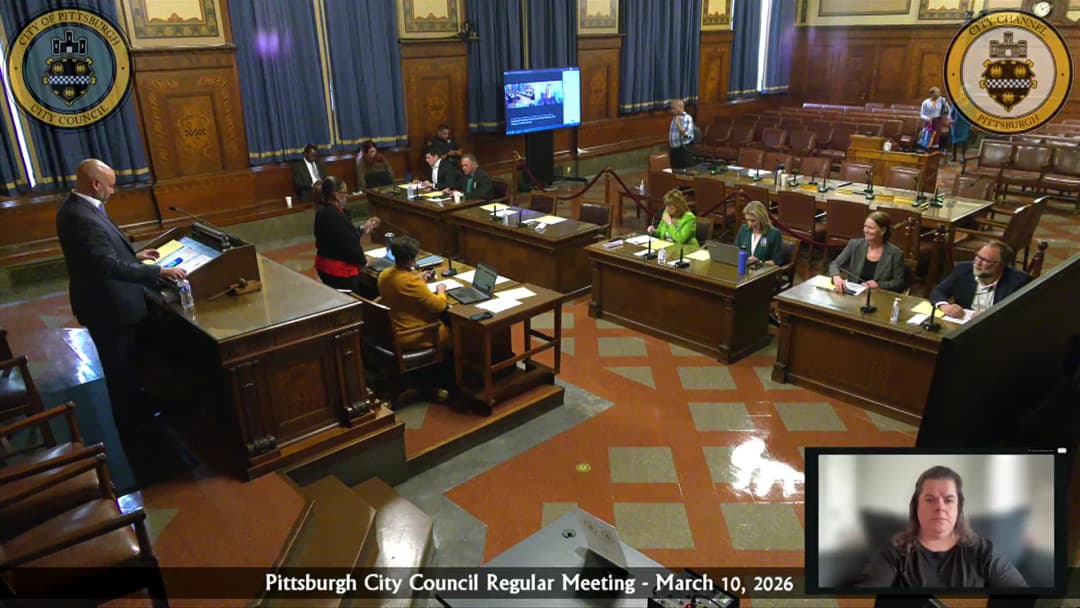
The Pittsburgh City Council held its regular meeting on Tuesday, March 10, 2026, at 10:00 AM in Council Chambers. The meeting began with a moment of silence for former Councilwoman Darlene Harris and Councilman Khari Mosley's father. Eight members were present (Charland, Coghill, Gross, Lavelle, Salinetro, Strassburger, Warwick, Wilson); Council Member Mosley was absent. The agenda was amended and approved. The meeting included four proclamations, public comments, presentation of new legislation, action on multiple appointments, and final passage of several committee-recommended items. Proclamations - 2026-0238 – Declared March 10, 2026, as “Central Outreach Wellness Center Day” in Pittsburgh. Adopted unanimously (Enactment No. 88). - 2026-0239 – Recognized the Pittsburgh St. Patrick’s Day Parade Committee and declared March 8–14, 2026, as “St. Patrick’s Day Parade Week.” Adopted unanimously (Enactment No. 89). - 2026-0240 – Commended Arlene Saavedra and declared March 15, 2026, as “Arlene Saavedra Day.” Adopted unanimously (Enactment No. 90). - 2026-0241 – Honored Calliope’s 50th anniversary and declared March 12, 2026, as “Calliope Day.” Adopted unanimously (Enactment No. 91). Public Comments & Testimony - Deborah Wiley (speaker not identified by neighborhood in transcript) opposed a proposed halfway house on Banksville Road, citing 307 documented crimes per year in that corridor, the presence of a beer distributor, nearby schools, and a counseling center for children and adults in recovery. She argued that the Bureau of Prisons requires a “positive environment free from criminal and drug use activity,” which the site cannot provide. - Ikhana hal-makina (no neighborhood stated) honored sculptor Daddy Gilmore Mosley (born 1926) and urged the council to eliminate carcinogenic chemicals from food, water, and soil. - Carlino Giampolo (Panther Hollow) called for the removal of an “illegal skate park” in Panther Hollow, proposing instead two bocce courts, a playground, and an Italian American museum. He noted a new partnership with the University of Pittsburgh for tree planting and plaques. - Unique Brown (no neighborhood stated) criticized council members for inattention during public comment (phones, side conversations) and described a situation where a housing voucher offer was rescinded after paperwork was completed, affecting multiple people. - Yvonne F. Brown (Hill District) apologized for a previous disruption and questioned whether a former council president took a refrigerator from his office when he left. - Special Agent Sunshine (no neighborhood stated) made religious and personal statements about identity theft, abduction, and homelessness. Presentation of Papers (New Legislation) The following resolutions were read and referred to the appropriate committees: - 2026-0221 (Charland) – Professional services agreement with I/O Solutions for police recruit testing, not to exceed $151,980 over three years. → Referred to Human Resources. - 2026-0222 (Coghill) – Warrant for Precision Auto Express Repair ($6,347.85) for police vehicle repairs. → Referred to Public Safety and Wellness. - 2026-0223 (Coghill) – Warrant for Major Cities Chiefs Association dues ($7,500). → Referred to Public Safety and Wellness. - 2026-0224 (Mosley) – Easement with ALCOSAN for monitoring boreholes on city-owned parcels at no cost. → Referred to Intergovernmental and Educational Affairs. - 2026-0225 (Salinetro) – Agreement with Peoples Natural Gas for natural gas service at Riverview Park, at no cost. → Referred to Public Works and Infrastructure. - 2026-0226 (Salinetro) – Declaration of Restrictions and Covenants for Spring Hill Park as condition of NPDES permit, at no cost. → Referred to Public Works and Infrastructure. - 2026-0243 (Salinetro) – Authorizing the Borough of Crafton to take by eminent domain a portion of parcel 39-F-280 within Pittsburgh. → Referred to Public Works and Infrastructure. - 2026-0227 (Strassburger) – Warrant for Sargent’s Court Reporting Services ($5,556.40) for transcripts. → Referred to Finance and Law. - 2026-0242 (Strassburger) – Amending 2026 fee schedule to unify vending fees (Rule 8 waived). → Referred to Finance and Law. - 2026-0228 (Wilson) – Grant agreement with Trust for Public Land ($25,000) for greenway signage. → Referred to Land Use and Economic Development. - 2026-0229 (Wilson) – Reallocating $55,692.60 of CDBG-CV funds to the Greater Pittsburgh Community Food Bank. → Referred to Land Use and Economic Development. - 2026-0230 (Lavelle) – Appointment of John McClory as Director of Public Works. → Held pending interview. - 2026-0231 (Lavelle) – Appointment of Jeff Skalican as Director of Mobility and Infrastructure. → Held pending interview. - 2026-0232 (Lavelle) – Appointment of the Honorable Barbara Warwick to the Equipment Leasing Authority (ELA) for term ending June 15, 2026. → Approved 8-0 (Enactment No. 92). - 2026-0233 (Lavelle) – Appointment of Helen Cestra to the Historic Review Commission (term to expire Jan. 1, 2028). → Held pending interview. - 2026-0234 (Lavelle) – Reappointment of Julie Asciolla to the Board of License and Inspection Review (term to expire Mar. 1, 2029). → Approved (Enactment No. 93). - 2026-0235 – Communication from OMB (Grants Office status update). → Read, received, and filed. - 2026-0236 – Communication from City Controller (Pittsburgh Public Schools procurement report). → Read, received, and filed. - 2026-0237 – Communication from PLI (amended business licensing and vending rules). → Read, received, and filed. Unfinished Business (Appointments) The council took final votes on appointments previously held for interviews: - 2026-0128 – Shatara Murphy to ALCOSAN board (term to Jan. 1, 2031). Approved 8-0 (Enactment No. 94). - 2026-0136 – Scott Kunka to Pittsburgh Water board (term to Jan. 1, 2031). Approved 8-0 (Enactment No. 95). - 2026-0139 – Darrin Kelly to Planning Commission (term to Jan. 30, 2030, remainder of Steve Mazza’s seat). Amended to correct expiration date, then Approved 8-0 (Enactment No. 96). - 2026-0140 – David Vatz to Planning Commission (term to Jan. 1, 2030, remainder of Jean Holland Dick’s seat). Approved 6-2 (Gross and Warwick voted no; Enactment No. 97). - 2026-0141 – Diamonte Walker to Planning Commission (term to Jan. 1, 2032). Approved 8-0 (Enactment No. 98). - 2026-0142 – Gerardo Interiano to Planning Commission (term to Jan. 1, 2028, remainder of Monica Ruiz’s seat). Approved 7-1 (Warwick voted no; Enactment No. 99). - 2026-0143 – Justin Hunt to Planning Commission (term to Jan. 1, 2028, remainder of Phillip Wu’s seat). Approved 8-0 (Enactment No. 100). - 2026-0144 – Bob Reppe to Planning Commission (term to Jan. 1, 2032). Approved 8-0 (Enactment No. 101). - 2026-0145 – LaShawn Burton-Faulk reappointed to Planning Commission (term to Jan. 1, 2032). Approved 7-1 (Charland voted no; Enactment No. 102). Reports of Committee – Final Action - 2026-0178 – Island Marina stewardship agreement with Three Rivers Waterkeeper ($1/year, 5 years + 5-year renewal). Passed finally 8-0. - 2026-0208 – Historic district design guidelines for Mexican War Streets and Manchester (contract with Evolve Environment::Architecture, not to exceed $37,500). Passed finally 8-0. - 2026-0176 – Increasing ELA cooperation agreement by $1,000,000 (new total $28,188,019) for additional vehicles/equipment. Passed finally 8-0. - 2026-0177 – Pittsburgh Water access to South Side Park for stormwater tank maintenance (Phase 1). Passed finally 8-0. Key Outcomes - Four proclamations adopted unanimously. - All new legislation was referred to standing committees; Bill 2026-0242 was waived under Rule 8 and placed on the next standing committee agenda. - Two department director appointments and one historic review commission appointment were held for interviews. - Barbara Warwick was appointed to the Equipment Leasing Authority (8-0). - Julie Asciolla was reappointed to the Board of License and Inspection Review. - Nine appointments (ALCOSAN, Pittsburgh Water, Planning Commission) were approved with varied votes; notable dissents: Gross and Warwick against David Vatz; Warwick against Gerardo Interiano; Charland against LaShawn Burton-Faulk. - Four bills received final passage unanimously (8-0). - Discrepancy note: The roll call in the transcript indicates seven members present initially, but the minutes list eight members present (Mosley absent). The transcript shows “Mr. Mosley” called without a response; the minutes confirm Mosley absent. The final vote tally consistently shows 8 ayes or 1 absent, consistent with Mosley’s absence. Meeting Adjournment The meeting adjourned after motions and resolutions.
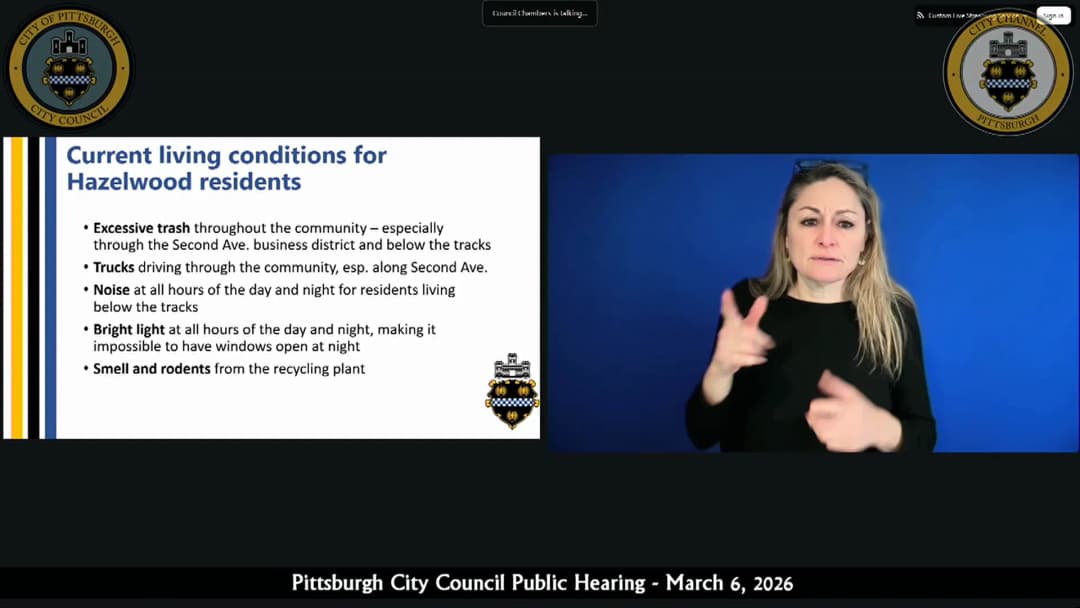
A public hearing was held by the Pittsburgh City Council on March 6, 2026, at 10:00 AM in Council Chambers to consider Bill 2025-1993, which would rezone approximately 230+ acres of riverfront parcels in Hazelwood from RIV-GI (Riverfront General Industrial) to RIV-IMU (Riverfront Industrial Mixed-Use). The Planning Commission had issued a positive recommendation on November 18, 2025, with a condition that the Council office and majority property owners meet with residents to address health and safety concerns. The hearing included staff presentations, testimony from 12 registered speakers, and remarks from Councilman Warwick, the sponsor. Public Comments & Testimony - Brandon O'Donnell (attorney for Allegheny Valley Railroad, AVR) opposed the rezoning, arguing that the area is economically active, that federal law preempts local regulation of rail freight terminals (which would become a special exception under RIV-IMU), and that the Planning Commission’s action was untimely (deadline was October 13, 2025). He expressed willingness to discuss community concerns but said rezoning is not the appropriate remedy. - Jody Chowder (Highland Park resident) expressed concern that the rezoning process lacked the thorough community input of the 2015-2018 riverfront zoning process. She praised AVR as a responsive neighbor. - Bill Siddick (representing CSX Transportation) opposed, stating CSX owns about 80% of the land (operated by AVR) and that the rail yard is not blighted. He argued the Planning Commission ignored preemption and that CSX was never consulted. He noted productive meetings with Hazelwood Initiative and trust in the Law Department’s pending opinion on preemption. - Michael Fallone (Chief Marketing Officer, AVR) opposed, stating rail usage is increasing (traffic more than doubled in 20 years, with $50 million invested). He described the yard as an irreplaceable regional asset and said the rezoning is based on incorrect assumptions. - John Ashbridge (President, AVR) opposed, stating AVR removes over 200,000 trucks from PA roads annually (equivalent to planting 4.5 million trees). He characterized the rezoning as an effort to make rail operations more difficult and said AVR has a track record of collaboration (e.g., Brilliant Branch trail, Duck Hollow project). - Brett Sebastian (Go Rail, from Houston) opposed, providing national context: rail generated $233 billion in economic output in 2023; Pennsylvania has 50+ freight railroads on 5,000+ miles of track, employing 4,300 people. He warned that once rail land is rezoned, it is difficult to bring back, citing Houston’s 26-lane freeway as a consequence. - Michael Tettler (Executive VP, Parlow Express, for AVR) opposed, calling the rezoning inconsistent with adjacent industrial zoning and arguing that it uses zoning to address day-to-day concerns without solving them. He urged a collaborative planning process. - Clay Spangler (General Manager, Steel Dynamics / The Techs) opposed, noting his facilities employ 235 workers (average salary $125,000) and that AVR service eliminated 12,000 trucks from Second Avenue and 10,000 from local roads in 2025. He emphasized the importance of rail for his operations. - Christopher Voltz (employee of Tucker Arensberg, for Republic Services) opposed, stating that the change would make recycling processing (currently permitted by right) a non-conforming use, limiting expansion to 25% and prohibiting lot acquisition. He argued that existing uses would become non-conforming, harming Republic Services’ ability to serve the city. - Sonia Tillman (Executive Director, Hazelwood Initiative) supported the rezoning, stating it aligns with community goals and that the RIV-IMU district allows residential, retail, educational, and cultural uses while limiting high-intensity industrial activity. She noted that quality-of-life issues (trash, noise, light) were raised by residents and that the Planning Commission’s condition for collaboration is being met. - Lori Kolczynski (General Manager, BFI Waste Services / Republic Services) opposed, noting Republic Services handles all city residential recycling processing and has a revenue-share contract. She said eliminating recycling processing as a permitted use harms the city’s financial future and urged the council to either reject the rezoning or carve out recycling processing to remain by right. Discussion Items - Councilman Warwick (sponsor) presented a slide deck supporting the rezoning. He argued that Pittsburgh has rezoned other riverfronts (North Shore, Strip District, Lawrenceville) from heavy industrial to mixed use, and that Hazelwood’s RIV-GI zoning allows hazardous uses (incinerators, solid waste) incompatible with nearby homes. He highlighted the environmental justice angle: Hazelwood is a low-income community with higher asthma rates. He displayed photos of the recycling plant’s bright lights at night, trash, and proximity to homes. He noted that the railroads’ federal preemption limits city action, but for non-rail businesses, the rezoning would require them to come to the city for expansion approvals, ensuring community engagement. He acknowledged that conversations with companies have begun and thanked them for engaging with Hazelwood Initiative. - No other council members offered comments. Key Outcomes - The public hearing was conducted as scheduled on March 6, 2026. No vote was taken. - The bill was forwarded to the Committee on Land Use and Economic Development for further consideration. - Councilman Warwick noted that the council has 90 days to take a vote on the ordinance.
The Committee on Hearings and Policy of the Pittsburgh City Council held pre-agenda interviews on Wednesday, March 4, 2026, at 1:30 PM in Council Chambers. The purpose was to interview two nominees for board positions: Shatara Murphy for the Allegheny County Sanitary Authority (ALCOSAN) and Scott Kunka for the Pittsburgh Water and Sewer Authority (PWSA). Councilmembers Schlossberger, Warwick, and Gross participated. No votes were taken; the interviews are a precursor to formal consideration of the resolutions. Discussion Items - Shatara Murphy – ALCOSAN Board Appointment (Resolution 2026-0128): Ms. Murphy introduced herself as Assistant Vice Chancellor for Community Connected Economic Strategies at the University of Pittsburgh. She emphasized her background in community impact, economic stability, and governance. When asked about procurement, she expressed a focus on local procurement, increasing awareness of contracting opportunities, and connecting vendors with capacity-building resources such as the Institute for Entrepreneurial Excellence. She stated her lens would prioritize workforce and community impact. She committed to learning about the ALCOSAN clean water plan and ensuring community input on major projects. - Scott Kunka – Pittsburgh Water Board Appointment (Resolution 2026-0136): Mr. Kunka, a retired city finance and budget director (and former PWSA board member), described his extensive government experience. He expressed opposition to privatization of water authorities, stating it is “not necessary” and should remain under citizen control. He advocated for a budget approach that prioritizes available resources over rate increases to cover all needs. He raised concerns about non-billable water loss (historically 50%) and the need for transparency in the budget process. He noted the challenge of small contractors bidding on large projects due to scale requirements and suggested considering workforce diversity in contractor evaluations. On the consent decree and stormwater management, he acknowledged the need to study current plans and called for community engagement. - Councilmember Questions and Discussion: - Councilmember Warwick raised stormwater management and flood mitigation, noting the defunded Four Mile Run project and the need for community input on ALCOSAN’s tunnel project. She highlighted the Panther Hollow Lake restoration as a potential low-hanging fruit for stormwater improvement and community asset. She also discussed the problem of water bill evictions, where tenants not paying leads to landlord-tenant disputes, and the difficulty low-income tenants face accessing rebates when bills are in landlords’ names. She urged board members to advocate for redesigning the system. - Councilmember Gross explored privatization history, referencing the Veolia operate-maintain lease that led to infrastructure decline and inaccurate billing. She questioned Mr. Kunka’s past role in the parking asset lease proposal (which Council did not approve), noting it was considered a privatization scheme. Mr. Kunka defended the parking lease as a response to state pension mandates and argued it differed from Chicago’s deal. Councilmember Gross also discussed ALCOSAN’s “big dig” project (EPA-mandated tunnels under rivers) and its cost burden on ratepayers, urging the board to seek community benefits and green infrastructure investments. She highlighted the need for better coordination between utilities and city paving to avoid repeated street cuts. Key Outcomes - Interviews were held for both nominees; no votes were taken. The resolutions appointing Shatara Murphy to ALCOSAN and Scott Kunka to PWSA will proceed to a formal council vote at a later date. - Councilmembers’ questions and concerns—particularly on affordability, procurement equity, transparency, stormwater management, and privatization—were noted for the nominees’ future board service.
The Pittsburgh City Council Standing Committees met on Wednesday, March 4, 2026, at 10:00 AM in Council Chambers. The meeting covered routine approvals, public testimony, and legislative items from the Public Works & Infrastructure, Land Use & Economic Development, and Intergovernmental & Educational Affairs committees. One council member (Mosley) was absent. Consent Calendar - Invoices for Council Approval: A large batch of departmental invoices (totaling tens of thousands of dollars) covering expenditures such as donations, reimbursements, equipment, training, and security monitoring were approved by a voice vote with no discussion. - P-Card Approvals: Weekly P-card reports for February 17–23, 2026, were approved by a voice vote with no discussion. Public Comments & Testimony - Ikhana hal-makina (neighborhood not stated) spoke about dangers facing American travelers abroad, referencing recent global events and urging the council to act to secure the return of Americans stranded overseas. - Daniel Shaffer (neighborhood not stated) reiterated strong opposition to Mr. Vance’s appointment to the Planning Commission. Shaffer argued that Vance’s past statements—calling the planning commission a “kangaroo court,” referring to inclusionary zoning supporters as “paid activists,” and blocking critics on social media—show he cannot separate personal views from official duties. Shaffer urged council to vote against the appointment. - Carleno Giampolo (Panther Hollow) testified against the illegal skate park in Panther Hollow. He criticized Councilmembers Warwick and Charland for silence on the issue and described a dismissive interaction with a Pitt student overseeing construction. Giampolo argued the skate park harms residents and called on the administration to shut it down. - Unique Brown (neighborhood not stated) expressed frustration with homeless shelters and agencies receiving public funding. She described difficulty accessing shelter space, including being told to call daily and then removed from a list because she was “comfortable in her car.” Brown questioned what oversight council provides and demanded that public complaints lead to action. - Special Agent Sunshine (neighborhood not stated) offered a spiritual exhortation, prayed for the council, and urged them to love and build each other up. She also mentioned the missing child Cerese Taylor and criticized the absent council member Mosley for blocking her praise. Discussion Items - Public Works & Infrastructure Committee (Chair Salinetro) - Deferred Paper 2026-0113 (Right-of-Way Accessibility Needs Inventory): Councilmember Warwick motioned to hold the ordinance for two weeks pending a call with a city director. The motion carried, and the item will return by March 18, 2026. - New Paper 2026-0178 (Island Marina Stewardship with Three Rivers Waterkeeper): A resolution to lease the Island Marina to Three Rivers Waterkeeper for $1 per year for five years, with a five-year renewal option. Approved by voice vote with an affirmative recommendation. - Land Use & Economic Development Committee (Chair Wilson) - New Paper 2026-0208 (Historic District Design Guidelines): A resolution amending a prior agreement to increase the contract with Evolve Environment::Architecture to $37,500 for design guidelines for the Mexican War Streets and Manchester Historic Districts. Approved by voice vote with an affirmative recommendation. - Intergovernmental & Educational Affairs Committee (Chair Mosley, absent) - New Paper 2026-0176 (ELA Cooperation Agreement Increase): A resolution to increase the equipment leasing authority cooperation agreement by $1,000,000 to a new total of $28,188,019 for additional vehicles, equipment, and services. During discussion, Councilmember Warwick asked the fleet manager about fire truck purchases. The fleet manager stated that a plan for 2026 purchases is being finalized, including purchase of a fire engine, and that they are awaiting final approvals. Councilmember Strassburger inquired about public access to the vehicle priority list, and the fleet manager noted it was included in a fleet report to council. Councilmember Gross asked about allocation of a $10–12 million grant from UPMC for ambulances; the fleet manager confirmed the funds have not yet been received but that a first order for ambulances is ready once funds arrive, and they are also planning to use the grant for fire equipment. Approved by voice vote with an affirmative recommendation. - New Paper 2026-0177 (South Side Park Stormwater Maintenance Agreement): A resolution authorizing an agreement with Pittsburgh Water to access city property in South Side Park for maintenance of stormwater retention tanks at no cost to the city. Approved by voice vote with an affirmative recommendation. Key Outcomes - Approved: All invoices and P-cards as consent items. - Held: Ordinance 2026-0113 (Right-of-Way Accessibility Needs Inventory) held for two weeks until March 18, 2026. - Affirmatively Recommended (approved for full council vote): - Resolution 2026-0178 (Island Marina stewardship with Three Rivers Waterkeeper) - Resolution 2026-0208 (Historic district design guidelines contract amendment) - Resolution 2026-0176 (Equipment leasing authority cooperation agreement increase by $1M) - Resolution 2026-0177 (South Side Park stormwater maintenance access) - Meeting Announcements: Pre-agenda interviews for Alcosan and Pittsburgh Water nominees at 1:30 PM same day; public hearing on rezoning Hazelwood parcels (Bill 2025-1993) on Friday, March 6 at 10 AM; regular council meeting on March 10 and standing committees on March 11, both at 10 AM. - The meeting adjourned after excusing absent members.
The Committee on Hearings and Policy of the Pittsburgh City Council held pre-agenda interviews on March 3, 2026, beginning at 1:30 PM in Council Chambers, for seven nominees to the Planning Commission. Council President led the meeting with members present except Councilman Coghill and Councilwoman Gross (who later joined). The meeting lasted approximately three and a half hours and featured detailed questioning on housing policy, zoning reform, community engagement, racial equity, and infrastructure. Each nominee introduced themselves and answered questions from council members. Discussion Items - Nominee Introductions and Backgrounds: Each nominee gave a brief biography. - Darrin Kelly: Retired Pittsburgh firefighter, former president of Allegheny County Labor Council, stressed the importance of family-sustaining wages and local labor in development. - David Vatz: Founder of Pro-Housing Pittsburgh, advocated for making housing easier to build through zoning reform and emphasized market-rate housing as part of the solution alongside deeply affordable units. - Diamonte Walker: Former URA deputy executive director, now COO at Rising Tide, spoke forcefully about racial segregation, the need to treat Pittsburgh as a single city, and using a full toolbox of policies rather than a single tool like inclusionary zoning. - Gerardo Interiano: An immigrant from El Salvador, technology executive, stressed the power to convene stakeholders and learn from other cities. - Justin Hunt: Real estate development director at Elmhurst, emphasized effective partnerships and learning from other markets like Charlotte. - Bob Reppe: Former city planner and zoning administrator, now university architect at Carnegie Mellon, focused on the importance of consistent, transparent process and addressing infrastructure deficits. - LaShawn Burton-Faulk: Incumbent planning commissioner, highlighted the role of zoning in enabling developments like the Esplanade in Manchester-Chateau and the need for neighborhood plans. - Housing Growth vs. Neighborhood Change: Councilman Wilson asked how nominees would handle the tension between building much-needed housing and residents’ fears of change. Nominees generally called for robust community engagement, predictable processes, and honesty about trade-offs. - Community Engagement and Whose Voice Matters: Councilwoman Warwick pressed David Vatz on past social media comments dismissing community engagement. Vatz responded that he has evolved and sees public testimony as a data point, but also noted that engagement often excludes working people. Other nominees emphasized listening to council members and respecting elected voices. - Racial Segregation and Equitable Development: Councilwoman Warwick and Councilwoman Gross discussed Pittsburgh’s deep segregation and the displacement of 10,000 Black residents from 2010-2020. Diamonte Walker argued that the market alone cannot fix this and that the city must proactively invest in neglected neighborhoods, use tools like LITEC and New Markets Tax Credits, and address wage stagnation. Justin Hunt and others acknowledged past racist policies and the need to rectify them. - Infrastructure Deficiencies: Bob Reppe and others noted that aging sewers, water lines, and roads are a competitive disadvantage. Walker suggested a “housing in our sites” program similar to business-attraction programs to prepare pad-ready sites with infrastructure. Councilwoman Gross emphasized that infrastructure repair has been deferred for decades and must be addressed alongside new development. - Comprehensive Plan and Zoning Reform: Several nominees expressed support for a comprehensive plan but criticized the current process for low engagement. Bob Reppe advocated for first tackling land-use controls and updating the outdated zoning code. - Inclusionary Zoning: Nominees offered nuanced views. David Vatz and Justin Hunt opposed the previous mayor’s unfunded mandate but supported voluntary, funded versions. Diamonte Walker cautioned against a one-size-fits-all approach and stressed the need for multiple tools. Key Outcomes - All seven pre-agenda interviews were held; no votes were taken. The council will consider the appointments (Resolutions 2026-0139 through 2026-0145) at a future meeting. The interviews serve as the council’s primary check on appointments, as the mayor can remove commissioners at will after confirmation. Notable Quotations - “We are not in the business of standing still.” — Darrin Kelly - “The market will be fine. Our responsibility is to send healthy market signals and directly invest in neglected places.” — Diamonte Walker - “Community engagement is a data point, but we must remove bias and look at each case.” — David Vatz - “Our infrastructure is a competitive disadvantage; we need to plan elevator outages before they plan themselves.” — Bob Reppe