The finance and law committee of the Pittsburgh City Council convened on Sunday, December 21, 2025, to address a severe fiscal gap in the 2026 budget, resulting in a contentious debate and vote to increase the property tax millage rate. Public testimony highlighted concerns regarding neighborhood inequities and the need for economic growth, while council members were sharply divided between those advocating for immediate tax increases to fund essential services, particularly public safety and fleet maintenance, and those demanding further cost-cutting, revenue diversification, and a delay until the new administration takes office. Consent Calendar - Routine administrative resolutions authorizing cooperative purchasing agreements, facility rentals, and contract letting for the 2026 fiscal year were approved without discussion. Public Comments & Testimony - Dr. Ronald Miller: Expressed strong support for shifting fiscal resources from high-density tax-exempt neighborhoods (Oakland, Squirrel Hill) to the East vs. West Pittsburgh "beehive" neighborhoods, arguing that the current tax structure has led to the decimation of West Pittsburgh neighborhoods, citing a 50% population loss (14,000 to 7,000) in the Beachview area between 1970 and 2020. - Kahana How Malkina: Stated full support for addressing tax disparities and urged the council to stop subjugating the American way of life, specifically condemning a prior proposal to increase the tax rate that would add $242 annually to homeowner costs. - Patrick Solomon: Expressed a position that economic growth, not austerity, is the solution; advocated for cutting red tape, incentivizing business, and implementing a voluntary "pilot program" for major downtown property owners (including U.S. Steel Tower) to stabilize the tax base, arguing that the current system allows revenue to escape through appeals. Discussion Items - Bill 2632 (Millage Increase): Councilwoman Warwick originally proposed raising the millage rate from 8.06 to 10.48 (a 30% increase) to fill a $30 million gap in utility costs, overtime, and fleet replacements. She argued the city cannot safely operate without this revenue to maintain core services. - Amendment to Bill 2632: Councilman Mosley and Councilman Charland proposed an amendment to lower the proposed rate to 9.67 (approx. 20% increase), which would result in an additional $161 per year for a median assessed property value ($77,000). Councilwoman Warwick described this as a necessary compromise. - Opposition to Tax Hikes: Councilman Wilson, Councilman Coggill, and Councilwoman Smith expressed opposition to an emergency increase, citing different calculated gap figures (suggesting the gap was overestimated), pointing to historical wasteful spending (e.g., a $62M bond for affordable housing while the fleet deteriorated), and arguing that more revenue could be generated through vacancies, negotiations with nonprofits, or cost-saving measures before taxing residents. - Service Delivery vs. Cuts: Councilwoman Gross and Councilman Wilson highlighted that the city has already reduced its staff by nearly 700 employees since the millage was last raised, arguing that further cuts would compromise essential services like garbage collection and pool operations, whereas the current budget does not cover the true cost of operations. - Legality of the Vote: A motion to hold the vote pending a legal opinion on the legality of the percentage increase was made by Councilwoman Smith but failed on a roll call vote (6 Ayes, 3 Noes, 2 Abstentions). The Acting Solicitor later confirmed the council has the legal authority to propose the hike under the Home Rule Charter. - Budget Amendments (Bill 2454): Numerous amendments were debated, including funding for the mounted police unit (stricken from cuts to maintain for crowd control during the NFL Draft), seasonal laborers (kept due to community needs), and reorganizations of the Mayor's Office based on requests from the incoming O'Connor administration. Key Outcomes - Millage Rate Approved: The bill was amended to fix the real estate taxation rate at 9.67 mills for 2026, representing a 20% increase from the previous 8.06 mills. The vote tallied 6 in favor, 3 against, and 2 abstentions. - Budget Appropriations: The General Budget (Bill 2454) was approved as amended, reflecting the increased revenue and incorporating specific line item adjustments for fleet funding, utility costs, and police overtime. - Personnel & Structure: The 2026 Personnel Budget (Bill 2455) and Capital Budget (Bill 2453) were approved, including the approval of 11 new positions and the creation of a new operations coordinator, while striking cuts to seasonal labor and the mounted unit funding. - Next Steps: The budget remains open for the incoming administration to amend in January. Council members committed to further negotiations on a nonprofit "pilot program" and city reassessment. - Adjournment: The meeting was adjourned following the final approvals.
Public Meetings - Pittsburgh, Pennsylvania
Public Meetings - Pittsburgh, PennsylvaniaThe City Council convened on Sunday, December 21, 2025, for a special regular meeting to conclude the fiscal year 2026 budget process, which the President described as "trying" and requiring long hours on a weekend. After amending the agenda, the council addressed public testimony, reviewed committee reports, and voted on a series of ordinances and resolutions pertaining to the 2026 operating and capital budgets. Consent Calendar - The agenda was amended to allow for the separate handling of specific bills regarding the 2026 budget. Public Comments & Testimony - Dr. Ronald Lynn Miller: Dr. Miller expressed strong opposition to current funding inequities between Pittsburgh's East and West neighborhoods. He argued that while "tens of millions of dollars pour" into East-side institutions like CMU and Pitt, "only hundreds of thousands" go into the West. He proposed the creation of a "5B neighborhood" (Beachview, Bell Shoover, Bon Air, Brookline, Banksville) public council and a new university at the intersection of Route 51 to provide "pollen" for economic and educational self-sufficiency in the West. - Dr. Tysana Jones: Dr. Jones expressed full support for the funding of the Stop the Violence Fund and the Office of Community Service and Violence Prevention. She highlighted that the proposed $10 million investment is necessary to support community-based organizations addressing the needs of youth and families. Drawing on personal trauma from the 1990s and noting that "half of those programs that helped me... no longer exist," she argued the city cannot afford to lose more talent to the "plague" of Pittsburgh. - Unregistered Speakers: No additional speakers were present in the chambers. Discussion Items - Budget and Tax Adjustments (Bill 2463 and Ordinance 2632): Councilwoman Kill Smith stated her opposition to Bill 2463 and Ordinance 2632, noting she was "not okay" with increasing taxes. She argued that residents are paying park taxes yet facing increased charges, and she suggested a discount on park rentals for residents. - Budget Outcomes: Council President Lavell acknowledged the difficulty of the process, thanking the budget office, clerk's office, and members for their service. Councilman Mosley shared that while the week was professionally difficult, it was personally challenging due to family health issues, expressing deep gratitude for the council's empathy. - Final Budget Discussion: Councilman Gross expressed that while they saved the Housing Opportunity Fund, the budget was "much harder" than anticipated and acknowledged a sense of collective dissatisfaction with the outcome. He emphasized that the current situation places the "onus" on the next administration to revitalize the economy of Pittsburgh. Key Outcomes - Bill 2632 (Tax Ordinance): Passed by a vote of 6 ayes to 2 noes (Councilwoman Kill Smith and Councilman Wilson opposed). - Bill 2454 (Budget Appropriations): Passed unanimously (8 ayes, 0 noes) after an amendment to reflect final budget amounts. - Bill 2460 (Account Strings): Passed unanimously (8 ayes, 0 noes) after an amendment to correct a JDE account number. - Bill 2455 (Capital Budget): Passed with 7 ayes and 1 no (Councilwoman Kill Smith opposed). - Bill 2463 (Fee Schedule/Tax Interest): Passed with 7 ayes and 1 no (Councilwoman Kill Smith opposed). - Remaining Budget Bills: All other bills (2461, 2451, 2452, 2462, 2459, 2458, 2457) related to the 2026 operating and capital budgets, cooperative purchasing, and the Stop the Violence Fund were passed unanimously (8 ayes, 0 noes). - Adjournment: The meeting was adjourned following motions to approve minutes.
On December 20, 2025, Pittsburgh City Council convened a public hearing to deliberate on the 2026 fiscal year budget amendments, specifically focusing on three bills (2451, 2452, 2461) regarding procurement, contract letting, and tax interest rates, alongside a proposed 30% property millage increase to address a projected budget shortfall. Budget Director Pete McDevitt presented a five-year forecast, noting that without intervention, the city faces critical deficits, though he cautioned that a 20% increase is also a viable option to balance the budget without immediate deep cuts. The hearing featured extensive public testimony regarding the necessity of the funds for essential services like the Food Justice Fund and Stop the Violence Initiative, while simultaneously debating the fairness of the tax proposal against the backdrop of under-assessed properties and non-paying major nonprofits. Consent Calendar - Adoption of Bill 2451: Resolution authorizing participation in cooperative purchasing agreements for the 2026 fiscal year. - Adoption of Bill 2452: Resolution providing for the letting of contracts and use of existing contracts for city department purchases, maintenance, and repairs for 2026. - Adoption of Bill 2461: Ordinance fixing the interest rates on delinquent earned income and home rule taxes for the year 2026. - Adoption of Resolution 2455: Fixing the authorized number of city employees for 2026 (noted for potential discrepancy with current Fire Bureau staffing levels). Public Comments & Testimony - Support for Social Services & Food Justice: Several speakers, including Dan McCarthy (Just Harvest), Gabriel Mitnick, Jamie Marie Christian (Let Us Start Up the Beat Sustainability Collective), Joel Malloy (C.A.R.I.C.), Forrest Kesterson, and Dr. Karen Hall (OzNo, Inc.), expressed strong support for maintaining or increasing funding for the Food Justice Fund and Stop the Violence Initiative. They argued these programs are essential infrastructure for public health, community stability, and violence prevention, noting that federal cuts and SNAP delays have significantly increased food insecurity (citing a 25% increase in food insecurity and a 10% increase in child food insecurity). - Opposition to 30% Tax Increase: The majority of registered speakers, including Faith Mews, Chris Parsnik, Stormy Morris, Alita Hermanowski, Bailey Passano, John Seifer, Gina Polaris (later identified as Gina P.), April Clissora, and Harvey Holtz, expressed strong opposition to the proposed 30% property tax increase. They argued the burden falls disproportionately on working-class residents, small landlords, and renters (via rent hikes), while large non-profits (UPMC, universities) remain under-taxed. Many called for a reassessment of property values by Allegheny County and urged the city to negotiate better Payments in Lieu of Taxes (PILOT) from major nonprofits. - Alternative Revenue Proposals: Multiple speakers, including Chris Beam, Faith Mews, Bailey Passano, Russell Dreyer, and Alison Escobar, suggested that the city should target the five largest non-profits (UPMC, AHN, Pitt, CMU, Duquesne), noting they hold over 20% of property value but pay negligible taxes. Others proposed taxing capital gains, sports betting revenues, or implementing a split-rate tax structure (taxing land higher than buildings) to address the deficit more equitably. - Concerns Regarding Basic Services: Ralph Socorro and John Kett emphasized the critical need for additional revenue to address the Pittsburgh Bureau of Fire's fleet replacement gaps (estimated at $30 million for 2026) and general infrastructure deficits, questioning if a tax increase alone would translate to tangible service improvements without strict accountability measures. - Balanced Perspectives & Nuance: - Laura Shew Weens expressed support for the tax increase to ensure the city remains fully funded and to support the PRT Partner Pass program. - Mel Packer acknowledged the deep fiscal crisis, stating that "chopping a piece" of the budget is insufficient, and that while a 30% hike might feel excessive, a 20% increase might be necessary to fund basic services, arguing that some long-term residents can afford it despite local disparities in assessment. - Aaron Bergen expressed willingness to accept a 30% increase specifically to fund pool reopenings for his daughter. - Addy Lord and Casey Brown advocated for holding the line on social services while acknowledging the necessity of revenue, suggesting that the city must prioritize "fairness" in tax structures, such as capital gains taxes, to protect lower-income homeowners. Discussion Items - Budget Forecast & Fiscal Reality: Budget Director Pete McDevitt presented a five-year forecast showing positive operating results only if a tax millage increase is implemented. He outlined scenarios for 10%, 15%, 20%, and 30% increases, noting that a 20% increase would result in an approximate $240 annual bill increase for a home with a $100,000 taxable value, though senior exemptions could lower this significantly. - Fire Fleet & Staffing: Councilman Rosario and others raised specific concerns that Resolution 2455, fixing the number of firefighters for 2026, does not accurately reflect current staffing levels (696 firefighters), potentially putting the city in violation of authorized limits immediately upon enactment. They called for a transparent funding strategy to address the $30-40 million gap in fire apparatus replacement. - Tax Increase vs. Cuts: A significant debate occurred regarding the necessity of a tax increase versus budget cuts. Councilwoman Gross expressed reluctance to vote for a 30% increase, citing recent savings ($8 million in one week on comp plans and salt dome issues) and the need to explore deeper cuts and private sponsorships first. Councilman Strasberger emphasized the historical context of the city being under-occupied post-1979, necessitating revenue to fund infrastructure designed for a larger population, while Councilman Warwick noted the lack of consensus on the exact budget gap and the difficulty of making a final decision within 24 hours. Key Outcomes - No Final Vote on Tax Bill: The meeting concluded with the council acknowledging the urgency but deferring a final vote on the 30% millage increase. Councilwoman Warwick stated she is willing to consider a smaller increase if significant budget cuts are made first, while Council members Strasberger and Warwick emphasized their commitment to finding a solution that balances fiscal responsibility with community needs. - Commitment to Transparency: Councilwoman Strasberger and Councilman Wilson pledged to ensure any additional revenue generated is transparently allocated to specific needs, including the fire fleet, snow plows, and essential public services, while protecting the fund balance (rainy day fund) for future unknowns. - Continued Advocacy on Nonprofits: Council members reaffirmed the city's stance on holding non-profits accountable, with Councilman Mosley noting the historical difficulty of legal challenges against entities like UPMC and advocating for legislative changes at the state level to allow for a more equitable tax structure. - Moment of Silence: Council President convened a moment of silence for I Shir Kami, a Carrick High School student who passed away after being hit by a sliding car. - Adjournment: The public hearing was adjourned with instructions for the council to deliberate further within 24 hours before a final budget vote.
The Pittsburgh City Council Committee on Finance and Law convened for a budget hearing to review and vote on numerous operating and capital amendments, many of which were received by council members less than an hour prior to the meeting. The session focused on addressing significant fiscal gaps, proposed cuts to departmental budgets, and necessary funding for city services and infrastructure, with several council members expressing concern over the lack of transparency and time to review the complex proposals before casting votes. Consent Calendar Public Comments & Testimony Discussion Items Administration Operating Amendments - Amendment 1 (Lifeguard Allowance): Councilperson Strasberger raised concerns about a potential cut to the lifeguard allowance, fearing the impact on pool operations. Chief Financial Officer Patrick Cornell clarified the issue was a data entry error (410974 instead of 241974) that would correct the funding to the intended level of $240,000–$250,000, prompting a unanimous "aye" vote for the correction. - Amendment 2 (Vacancy Allowances): This amendment proposed shifting funds from vacancy allowances to premium pay allocations in a budget-neutral manner. Council President Lavelle and the budget director did not recommend the measure, and no motion was made to vote on it at this time, leaving it open for Sunday's special meeting. Administration Capital Amendments - Amendments 1 & 2 (Fire Station & Shenley Heights Pavilion): Council approved two linked amendments to reduce the Fire Station 20/Medic 12 construction budget by $1.2 million and increase the Shenley Heights Pavilion construction by the same amount. CFP clarified the additional $1.2 million for the pavilion was necessary because construction bids came in $7 million higher than budgeted; the funds were shifted rather than added. - Amendment 3 (Brownsville Road Safety): Approved an increase to the Congestion Mitigation and Air Quality (CMAC) program for the Brownsville Road Safety Improvement Project, confirmed to be covered by federal grant funds. - Amendment 4 (Heron Avenue Bridge): Approved a $27,500 increase to the Federal Highway Administration allocation for the Heron Avenue Bridge right-of-way acquisition and final design. City Council Operating Amendments - Amendment 1 (Vehicle Fleet): Sponsored by Councilperson Warwick, this amendment proposed a $10 million increase to the pay-go transfer for vehicle and equipment (raising the total to $20 million). Warwick argued the fleet investment was urgent following recent snow events. Councilmembers Coghill, Kale Smith, and Wilson expressed significant concerns about the budget gap and the implied need for a tax increase to cover the cost, with Coghill and Kale Smith abstaining and Wilson stating he would likely vote "no" on a final vote if no new revenue is secured. - Amendment 2 & 3 (URA & Stop the Violence Fund): Amendment 2 proposed a $1 million increase to URA small business development funding, while Amendment 3 proposed a $5 million decrease to the Stop the Violence Trust Fund transfer for 2026. Together, these amendments reallocate funds, reducing the Stop the Violence transfer by $5 million, keeping $1 million for the URA, and leaving $4 million in the Stop the Violence fund for future use. Councilwoman Kale Smith abstained to allow for further analysis of the combined budget impact. - Amendments 4 & 5 (Premium Pay & Utilities): Approved increases of $8 million (2026) for fire/EMS premium pay and $6.5 million (2026) for Public Works utilities. These increases are partially offset by subsequent proposed cuts. Councilmembers noted the reliance on potential millage bills to balance the budget; if those fail, further cuts would be necessary to cover these new costs. - Amendment 6 (Police Vacancy Allowance): Approved a budget-neutral amendment to create a vacancy allowance in the Bureau of Police to better align premium pay funding with staffing realities. - Amendment 7 (City Council Solicitor): Approved swapping one City Council solicitor position for increased legal fees funding ($112,276). Councilmembers expressed concern over losing immediate access to in-house legal counsel and worried that hourly rates from outside firms might exceed the position's value. Despite concerns, the amendment passed with one abstention. - Amendment 8 (Software Funding): Approved moving spreadsheet software funding from the Department of Innovation and Performance to the Office of the City Controller. - Amendment 9 (Postage): Failed to pass due to a lack of a second for the motion to move postage funding. - Amendment 10 (Public Engagement Specialist): Approved the removal of one public engagement specialist position in the Office of the City Clerk. - Amendment 11 (Mounted Patrol): Approved a $140,000 decrease to defund the non-union cost of the mounted patrol unit. This came after discussion noting the unit was previously defunded in 2024 but remained in the budget. Councilmembers supported the cut due to the unit's perceived lack of utility for crowd control and its high cost, though some expressed sadness over the loss of a positive community relations tool. - Amendment 12 (Non-union COLA): Failed (2 ayes, 5 noes, 2 abstentions). This amendment proposed a 1% cut to the non-union cost of living adjustment (from 3% to 2%). Councilmembers strongly opposed the cut, citing high turnover, inflation impacts, and the difficulty of recruiting staff in a competitive market. - Amendment 13 (Clean and Lien Allowance): Approved the elimination of the seasonal laborer allowance used for the "Clean and Lien" program. The vote (6 ayes, 4 noes, 1 abstention) was contentious; proponents argued the program is inefficient and reliant on a bloated seasonal workforce, while opponents highlighted the program's success in clearing blight and its value to underserved neighborhoods. - Amendment 14 (Rockwell Lease): Approved the removal of $425,390 for a proposed police station lease at Rockwell Avenue in 2026. Council members noted the preliminary nature of the consolidation plan but agreed to defer the funding for now. - Amendment 15 (Computer Devices): Approved a $500,000 decrease in funding for computer devices in the Department of Innovation and Performance. Councilperson Warwick abstained and expressed strong concern that cutting IT resources hinders basic city operations, while others supported the cut as a necessary belt-tightening measure. - Amendment 16 (Training & Conferences): Approved a decrease in funding for training and conference sponsorships in OMB. - Amendment 17 (Cleaning & Landscaping): Approved a decrease in funding for cleaning, landscaping, and litter can sensors in DPW. City Council Operating Personnel Requests (Amendments 18-22) - Amendment 18 (Playground Project Manager): Approved a promotion for a playground team member from associate to project manager. - Amendment 19 (Transportation Demand Coordinator): Passed with a divided vote (4 ayes, 2 noes, 2 abstentions). This adds a position to replace expiring grant funding. Councilmembers debated the necessity of a new position versus existing vacancies. - Amendment 20 (Inspector III): Approved a new Inspector III position in Domi to replace a retiring "paving guru" on the paving team. - Amendment 21 (Litter Operations Coordinator): Passed (5 ayes, 1 no, 1 abstention). Sponsored by Councilperson Warwick to coordinate city-wide litter and illegal dumping efforts. Some members noted the role of a previous anti-litter coordinator was unclear but supported the new coordination efforts. - Amendment 22 (Operations Analyst): Approved swapping a program specialist for an operational performance analyst in DPW. City Council Capital Amendments - Amendment 1 (Fleet Acquisition): Approved a $10 million increase to the pay-go funding for vehicle acquisition (complementary to Operating Amendment 1). This amendment was noted as contingent on a successful millage increase to fund the pay-go transfer legally; otherwise, it would not take effect. - Amendment 2 (Baldor Street Landslide): Approved a $220,000 bond deliverable for slope failure remediation by reducing urgent flood control funds. This is a critical first step to save approximately 12 homes in the South Side Slopes. - Amendment 3 (JAC Stack Roof): Approved a $250,000 bond deliverable for roof repairs at the JAC Stack pool concessions building. - Amendment 4 (Let It Go Street Repair): Approved a $150,000 bond deliverable for street repairs in the "Let It Go" area. - Amendment 5 (Neighborhood Business District Support): Approved a $1 million increase in pay-go funding to align with the operating budget increase for small business development. - Amendment 6 (Bus Shelters): Approved an $110,000 bond deliverable for bus shelter improvements, reducing asphalt replacement funds. Councilmembers expressed support for the safety and comfort of riders but some abstained regarding specific site locations. - Amendment 7: Struck by Council President Lavelle. Key Outcomes - Passed: 23 out of 27 amendments passed, including most administrative corrections, infrastructure bond transfers, and specific personnel promotions. - Failed: - Administration Capital Amendment 1 was initially confused but clarified and passed. - Amendment 12 (Non-union COLA cut) failed decisively (5 no, 2 aye). - Amendment 9 (Postage) failed due to lack of a second. - Deferred/Unvoted: Administration Operating Amendment 2 (Vacancy allowances) was not voted on due to the recommendation against it. - Critical Contingencies: Several major financial decisions, particularly the $10 million fleet funding and the premium pay/utility increases, are effectively contingent on the approval of a millage tax increase during the upcoming Sunday special meeting. Without new revenue, the city faces a significant structural deficit. - Next Steps: Council President Lavelle announced a memo would be issued detailing the complex procedural steps required for Sunday's meetings, including the necessity of voting on the millage first before finalizing the budget amendments.
On December 17, 2025, Pittsburgh City Council convened a post-agenda hearing to review the county and city's preparation for the 2025-2026 winter season regarding homelessness. The meeting featured presentations from Allegheny County Department of Human Services (DHS) officials and Office of Community Health and Safety (OCHS) representatives. Speakers reported a stable shelter capacity compared to previous years, a strategic shift in Point in Time (PIT) counting methodology, and ongoing challenges regarding involuntary commitment laws, safe discharge planning, and access to shelter for vulnerable populations. Consent Calendar - [No items recorded as routine approvals within the transcript scope; this was a discussion-based post-agenda session.] Public Comments & Testimony - Councilwoman Gross: Expressed gratitude for the success in housing families with children and the increased participation in overflow and winter shelters. She emphasized the critical role of transportation (shuttles) and food access as motivators for shelter uptake. She raised concerns regarding the lack of citywide coverage for drop-in warming centers, noting constituents in certain areas were advised to travel to suburban locations like Penn Hills, which creates access barriers. - Councilperson Strasberger: Expressed concern for constituents who worry that the county is not doing enough to compel individuals to seek shelter during extreme weather, often comparing Pittsburgh's approach to New York City. She sought confirmation that no legal or operational steps are being overlooked for those who refuse help. - Councilman Gill Smith: voiced deep concern regarding individuals with addiction or mental health crises who lack the capacity to make decisions about shelter, arguing that safety should not be left solely to individual choice. He demanded answers on shelter oversight, specifically regarding safety, trauma (e.g., sexual assault in shelters), and who manages the shelters to ensure they are welcoming. He also asked about preventive resources beyond immediate housing aid. - Councilman Sherlin: Requested an update on the operational status of Second Avenue Commons following the fire, specifically inquiring if it is fully functional and at capacity. He also raised questions about the new Point in Time counting methodology and trends, and inquired about the rising number of individuals sleeping in abandoned homes versus encampments. Discussion Items - Winter Shelter Capacity and Strategy: Mr. Andy Hafill (DHS) and Mr. Ben Tallock (OCHS) detailed the winter plan, which maintains sufficient capacity to ensure no individual is turned away. Key components include 232 additional seasonal beds, the dedicated North Side Partnership Project shelter (141 beds), and overflow programs at Second Avenue Commons, East End Cooperative Ministry, and the Salvation Army. Councilman Gill Smith noted that medical screening at intake has expanded, and outreach teams have adjusted routes to include shuttle stops at Unity Recovery to increase engagement. - Legal Restrictions on Involuntary Commitment: In response to Councilman Gill Smith and Councilperson Strasberger, Ms. Camila Larcon (OCHS) and Mr. Aaron Dalton (DHS) clarified that Allegheny County currently lacks state or local laws allowing for long-term involuntary commitments of individuals who are voluntarily refusing help but are at risk, except in acute, short-term 302 (emergency) situations. They explained that Pennsylvania law offers fewer tools than states like New York. However, the county is scheduled to opt into the "Assisted Outpatient Treatment" (AOT) law on January 1, 2026, which lowers the threshold for civil commitment to outpatient care. - Shelter Safety and Oversight: Councilman Gill Smith questioned who oversees shelter management to prevent trauma and ensure safety. Mr. Andy Hafill responded that the County oversees all shelters, monitors critical incidents (including violence between staff and residents), and maintains a "Director's Action Line" for complaints. He noted that the system offers "scattered site" shelters for those unable to tolerate congregate settings and that private providers run some shelters with varied environments to offer choice. - Point in Time (PIT) Count Methodology: Councilman Sherlin inquired about the upcoming count. Ms. Camila Larcon explained that the 2026 count will utilize a new methodology developed with Bloomberg Associates. Unlike previous daytime counts, this version will occur at night (10 p.m. to 4 a.m.) to better capture the unsheltered population and will employ random sampling across the county rather than just known hotspots to allow for year-over-year trend analysis. Approximately 300 volunteers are being recruited. - Abandoned Homes and Outreach: Mr. Aaron Dalton and Mr. Ben Tallock discussed the trend of increased homelessness in abandoned houses, particularly in Zone 3 (Councilman Sherlin's district) and Zone 2. They explained that outreach teams cannot legally break into private property, so they conduct safety checks and rely on the Property Lot Inspection (PLI) team to board or condemn properties. They requested a city policy to clarify legal pathways for operating on private abandoned properties and emphasized the need for better data sharing regarding 311 calls related to abandoned homes. - Next Steps and Discharge Planning: Mr. Ben Tallock identified "safe discharge planning" from hospitals and treatment centers as a critical gap, noting that patients are often discharged directly to the street without coordination. He suggested that future plans should focus on increasing transportation access (specifically in the East End/Homewood area) and investing in permanent housing to reduce reliance on emergency shelters. The "Community Counts" branding is being adopted for the new PIT count methodology. Key Outcomes - Shelter Capacity Status: The winter shelter system is fully operational with no nights of turned-away individuals; all seasonal beds opened on November 15th. - Methodology Change: The county will transition to a nighttime, randomized sampling-based Point in Time count starting the last Tuesday of January 2026. - Legislative Action (Planned): Allegheny County is scheduled to officially opt into the Assisted Outpatient Treatment (AOT) law on January 1, 2026, to provide a lower-threshold civil commitment option for mental health and substance use. - Resource Solicitations: The County issued a solicitation last week to engage new outreach partners and will soon issue a solicitation to increase the capacity of scattered-site shelter beds. - Volunteer Recruitment: A call for approximately 300 volunteers has been launched to support the new nighttime PIT count methodology. - Policy Gap Identified: Council members and officials identified a specific lack of legal guidance and policy for accessing abandoned private homes to ensure safety, requesting future collaboration with the city to address this.
The standing committees of the Pittsburgh City Council convened to review budget-related public testimony, approve financial settlements, debate property sales and historic designations, and authorize new contracts for public safety and recreation. Key topics included the defense of the Housing Opportunity Fund and Stop the Violence Fund against potential budget reallocation, a vote to table a major salt storage facility project, and significant discussions regarding the preservation of city-owned historic properties versus development. Consent Calendar - The meeting proceeded to a roll call for routine approvals on the Consent Calendar documents, which included multiple financial resolutions and invoices approved without opposition. Public Comments & Testimony - Dalen Davis (Allentown/Bellevue neighborhoods): Expressed strong opposition to utilizing the Housing Opportunity Fund or Stop the Violence Fund as "gap fillers" for general budget shortfalls. Davis argued these funds were established specifically for housing instability and violence prevention and diverting them undermines core purposes and community trust. Davis also criticized corrupt politics, called for higher ethical standards in the police department, stated that "Lando must go," and emphasized the need for local leadership. - Lori Kolczynski (BFI Waste Services): Objected to Bill 2025-2385 regarding the transfer station tax amendment. Kolczynski stated the legislation contradicts the city's sustainability goals, exaggerated claims regarding the facility's impact, and ignored existing state permits granted in 2024. She argued the transfer station is vital for waste reduction and sustainability. - Reverend Robert Teter (Project Destiny): Expressed deep concern regarding proposals to pause funding transfers to the Stop the Violence Fund. Teter argued that relying on the unspent balance and transferring funds to other sources would disrupt the continuity and sustainability of grassroots organizations. He cited the 37% reduction in gun violence as evidence of the fund's success and urged the council to maintain current funding levels. - Yvonne F. Brown: Criticized council members for tardiness (arriving 10:30 instead of 10:25) and for being distracted by phones while listening to public testimony. Brown stated that council members were not respecting the public and failed to listen to community problems, calling their behavior a negative example for children. - Ross Teter: Echoed previous speakers by stating strong opposition to taking funds from the Stop the Violence Fund, characterizing such actions as “robbing Peter to pay Paul.” Teter argued that community governance and safety must be protected and that removing power from the community is not acceptable. - Unnamed Speaker: Delivered a lengthy testimony focused on faith and trusting God’s will while recounting personal struggles, including an attempt on their life, and forgiving those involved in the case. - Unnamed Speaker: Strongly encouraged the council not to use the Housing Opportunity Fund or Stop the Violence Fund to resolve fiscal challenges. The speaker argued that diverting these funds undermines their purposes regarding housing instability and violence prevention, noting that recent declines in violent crime rely on consistency and trust. Discussion Items Bill 2614 - 2618 (Litigation Settlements): Approved resolutions authorizing payments under $5,000 to settle litigation with the Manker Estate, Jordan Estate, and Sabrina Kite (§2614-2616). Approved professional services agreements for building department training (§2617). Approved the repeal of property sale items due to buyer non-completion (§2618), confirming properties are forfeited and returned to the market. Bill 2619 (Tax Sale Properties): A contentious discussion arose regarding the sale of tax-sale properties owned by LLCs. Councilmembers Wilson, Cale Smith, and Warwick raised concerns about out-of-town investors buying properties in their districts, potentially driving up rents or leaving lots vacant. Councilwoman Warwick noted that she could strike sales in her district if she felt uncertain about the buyer. Councilman Wilson moved to delete items C and D (property in the South East area) and later strike items G and H (properties linked to LLCs from Florida and Virginia), which passed by voice vote. The bill was subsequently approved as amended. Bill 2621 (Debt Management Policy): Councilwoman Gross requested a one-week hold to review the updated Debt Management Policy (Bill 2621), stating she could not vote on fiscal policy without reading the text. The motion to hold the bill for one week passed. Bill 2632 (Property Tax Rate): Held for a public hearing on December 20th. Councilman requested a legal opinion on the legality of the tax increase percentage, which the Law Department had already been asked to review. Bill 2636 (REACH Program Contract): Approves a $6 million contract with Center that Cares (REACH) for group violence intervention. Multiple speakers, including Councilmembers Wilson, Warwick, and Coghill, expressed strong support for the program, citing specific instances where they personally witnessed REACH staff de-escalating violence. Councilwoman Cale Smith sought clarification on prohibitions regarding political speech by contract recipients, which the Public Safety Director noted is not currently in the contract but could be added. Salt Storage Facility (Bill 2583): Tabled the motion to authorize a $6.9 million contract for a new salt storage facility. Councilman Wilson expressed opposition to the spending during a tight budget, suggesting existing facilities be used with tarps. Councilman Coghill voiced support for the tabled motion to further assess the condemned dome and ensure proper location selection. 8th Street Vacation (Bill 2583): Approved a resolution to vacate 8th Street for the Pittsburgh Cultural Trust. A verbal amendment was added to explicitly authorize a public access easement for pedestrians and safety vehicles, correcting an omission from the original text where the intention existed only in the preamble. Councilman Wilson noted the land would remain private property, but the easement ensures access. Bill 2333 (Historic Designation): Defeated (1 Aye, 6 No, 2 Abstain). The motion to designate the former Police Station No. 3 in the Strip District as a historic site was voted down. Councilman Wilson recommended a "no" vote, arguing for an RFP process to determine the building's future use rather than a historic designation that might deter developers. Councilwoman Gross expressed strong support for the designation to protect city history and prevent the demolition of a city-owned asset. Councilwoman Cale Smith noted the emotional weight of displacement from historic sites but deferred to Wilson regarding his district's needs. Bill 2467 (Zoning Districts): Held for one week for further review of the West End Trolley Trail Accessory Parking District. Pogo Bike Expansion (Bill 2628): Approved an application for a state grant to expand the POGO bike-share program. Councilwoman Warwick expressed strong support, calling the expansion a potential “transformer” for the city’s economic well-being and a way to reduce car dependency. Councilman Coghill voiced strong support but noted the lack of stations in District 4 and the need for better connectivity to the T-line. Councilwoman Gross endorsed the expansion, highlighting the need for stations at destinations to allow longer rides. Facility Usage Agreements: Approved agreements with Bell-Silver, Voices Against Violence, Oz and M, Josh Gibson Foundation, Mount Washington Community Center, and Shadow Student Athletes to use city recreation centers. Councilmembers expressed appreciation for the volunteer staff and community work of these organizations, with some suggesting the city should consider providing direct staff support to these nonprofits in the future. Housing Opportunity Fund (Bill 2510): Approved the 2026 allocation plan despite initial calls to hold. Councilman Lavelle urged members to approve the plan to allow the URA to continue operations, noting that while the fund is under pressure, it provides significant cost savings. Councilman Coghill expressed strong support for the fund, stating it is one of the last places he would cut. Key Outcomes - Held for Public Hearing: Bill 2385 (Transfer Station Tax), Bill 1964 (Sewage Plan), and Bill 2510 was approved with a note to revisit if cuts occur later. - Held for Further Review: Bill 2632 (Tax Rate) held one week for final vote; Bill 2621 (Debt Policy) held one week for final review. - Tabled: Bill 2583 (Salt Storage Facility) tabled to assess the condemned dome and budget priorities. - Approved with Amendment: Bill 2583 (8th Street Vacation) approved with added public access easement language; Bill 2619 (Tax Sales) approved with items C, D, G, and H struck. - Defeated: Bill 2333 (Historic Designation for Police Station No. 3) voted 1-6 against. - Approved: Bill 2636 (REACH Contract at $6M), Bill 2628 (POGO Grant Application), Bills 2608-2613 (Recreation Center Agreements), and Bills 2614-2618 (Litigation Settlements and Property Sales). - Budget Clarification (Council President Lavelle): Explicitly stated the council is not defunding the Stop the Violence Fund. While the annual transfer from the General Fund to the Stop the Balance Fund will be paused or reduced (proposing a 5 million transfer instead of the full 10 million) to manage cash flow due to unspent balances, all current services funded by the Trust will continue. The 5 million remaining unspent will be reallocated to fleet maintenance or returned in future fiscal years. - Meeting Announcements: Scheduled a cable cast post-agenda on homelessness (Dec 18), line item vote on 2026 budget (Dec 20), special standing committees meeting (Dec 21), and special regular meeting (Dec 21). Regular meetings scheduled for Dec 22.
This regular meeting of the City Council of Pittsburgh, held on December 16, 2025, was dominated by a series of ceremonial proclamations honoring local community champions, including a City League football champion, long-time public servants, and a historic EMS pioneer. The session also featured robust public comment on municipal services and policy, followed by the unanimous passage of multiple bills regarding land acquisition, bridge construction funding, and service agreements. A focal point of the agenda was the formal retirement tribute to Councilwoman Teresa Cale Smith after nearly 17 years of service. Consent Calendar - Bill 2647: Adopted a cooperative agreement with Allegheny County entities to manage affordable housing services for the home ARP program at no cost to the city. - Bills 2648–2652: Authorizing the Pittsburgh Land Bank to acquire various publicly owned properties in the 12th, 13th, 5th, and 24th wards at no cost to the city. - Bill 2654: Authorized an agreement with Eastern Research Group Inc. for recycling education outreach services (up to $100,000). - Bill 2655: Authorized permanent access for the Fort Pitt Park Road to a city parcel behind former Fort Pitt Elementary School at no cost. - Bill 2656: Extended the Planning Commission's deadline for Bill 2025-2250 (Bat Shop expansion) (8 Ayes, 0 Noes). - Bills 2563 & 2566–2581: Passed committee reports with affirmative recommendations regarding sewage facilities, land condemnation, bridge project funding (28th Street, Charles Anderson, West Carson, Elizabeth Street), easements, and legal settlements. Public Comments & Testimony - Dr. Ronald Lynn Miller (South Shore): Expressed opposition to the proposed neighborhood boundary changes between South Shore North and Squirrel Hill South. He argued the demography and resources are inequitable, noting South Shore North has only 50 residents compared to 15,000 in Squirrel Hill South, and cited a lack of public input on the new borders. - Ikahana Halmalkina: Expressed opposition to a proposed tax increase, citing high costs for basic necessities due to Trump's tariffs and utility hikes. She supported Councilwoman Cale Smith for opposing the tax and opposed the appointment of Jason Landon as Police Chief due to recent conduct allegations. - Max Blair & Ellen Denton: Expressed support for the adoption of a plant-based treaty and advocated for immediate city action on food policy to mitigate climate tipping points, noting animal agriculture's significant contribution to greenhouse gas emissions. - David Beer: Expressed support for designating Westinghouse Park as a historic landmark, highlighting the site's role in the invention of modern electricity and its historical significance to George Westinghouse. - Chris Morey (Inform Up): Presented survey results indicating mixed positions from residents: 25.5% favored keeping streets fully public (no transfer to Cultural Trust), 29.3% supported funding a new salt storage facility at the current site, and 64% prioritized measurable improvements to city services for PGH Lab startups. Privacy concerns regarding drone startup pilots were noted by respondents. - Madeline McGrady: Expressed concern regarding potential austerity measures in the upcoming budget. She advocated for maintaining funding for social services, including the Housing Opportunity Fund and Stop the Violence Fund, and urged consideration of revenue sources from major city players rather than cutting social safety nets. - Yvonne F. Brown: Expressed strong opposition to the operations of a local food bank, alleging that staff members and their families receive preferential treatment (boxes of food) while struggling residents receive insufficient portions (e.g., one onion for the month). She stated she was denied food despite her husband being disabled. - Stormy Morris: Expressed concern regarding the impact of civil rights-era community divisions on current Black children in Pittsburgh, blaming the "foolish burning" of communities during that era for current resource gaps. Discussion Items - OSU City League Football Championship: Superintendent Walters, Councilman Mosley, and Mayor Ganey celebrated the University Prep (OSU) team's victory. They praised the team's discipline and academic achievements, noting their victory over the back-to-back champion Westinghouse (26-0). Councilman Mosley contextualized the win within Pittsburgh's rich legacy of sports and social advancement. - Mark C. Johnson Day: Councilman Mosley introduced a proclamation for Mark C. Johnson, a school-based probation officer and founder of MOTU LLC. Johnson emphasized that true leadership requires a "why" rooted in community uplift rather than ego. - Darnella Wilson Day: Councilwoman Smith and Council President Lavelle presented a proclamation to Darnella Wilson, the first Black female paramedic in the US and a Freedom House Ambulance pioneer. Wilson expressed deep gratitude for the recognition, highlighted the historical significance of Freedom House as the nation's first paramedic program, and thanked her cousin Deborah James Bailey for driving the initiative. - Westinghouse Park Historic Designation: Councilman Wilson strongly supported the historic site designation, arguing the park's significance transcends recreation due to its connection to modern electricity's invention by Nikola Tesla and George Westinghouse. Councilman Shayland voted against the historic designation (1 No, 7 Ayes), though voted in favor of all other bills on the card. - Mayor's Comments: Mayor Ganey praised the OSU team's resilience in defeating a champion and congratulated Coach Lou Barry. He also acknowledged the long-standing service of former Magistrate Kevin Cooper. Key Outcomes - Proclamations Approved: - December 16, 2025 recognized as OSU City Champion Football Day. - December 16, 2025 recognized as Mark C. Johnson Day. - December 16, 2025 recognized as Darnella Wilson Day. - December 16, 2025 recognized as Greater West End Community Alliance Day. - December 18, 2025 recognized as Tom Croft Day. - December 16, 2025 recognized as Marilyn and Frank Mans Day. - December 11, 2025 recognized as Bob Palmasina Day. - December 16, 2025 recognized as Teresa Cale Smith Day. - Legislative Actions: - Bill 2296 (Westinghouse Park Historic Site) passed with 7 Ayes, 1 No (Shayland). - 80+ other bills passed unanimously (8 Ayes, 0 Noes). - Communications from the Office of Management and Budget (Grants status) and Mayor Ganey (Paid Sick Days Act amendment) received and filed. - Bill 2667 passed to pause the "Stop the Violet Fund" schedule for budget year 2026, resuming in 2027. - Councilwoman Smith's Retirement: Council President Lavelle commended Councilwoman Teresa Cale Smith for 17 years of service, mentorship, and leadership as Council President. She stated she would miss the work but urged the council to maintain power and independence. - Next Steps: A meeting announcement scheduled a special hearing for the 2026 tax budget on Saturday, December 20th, at 11 a.m.
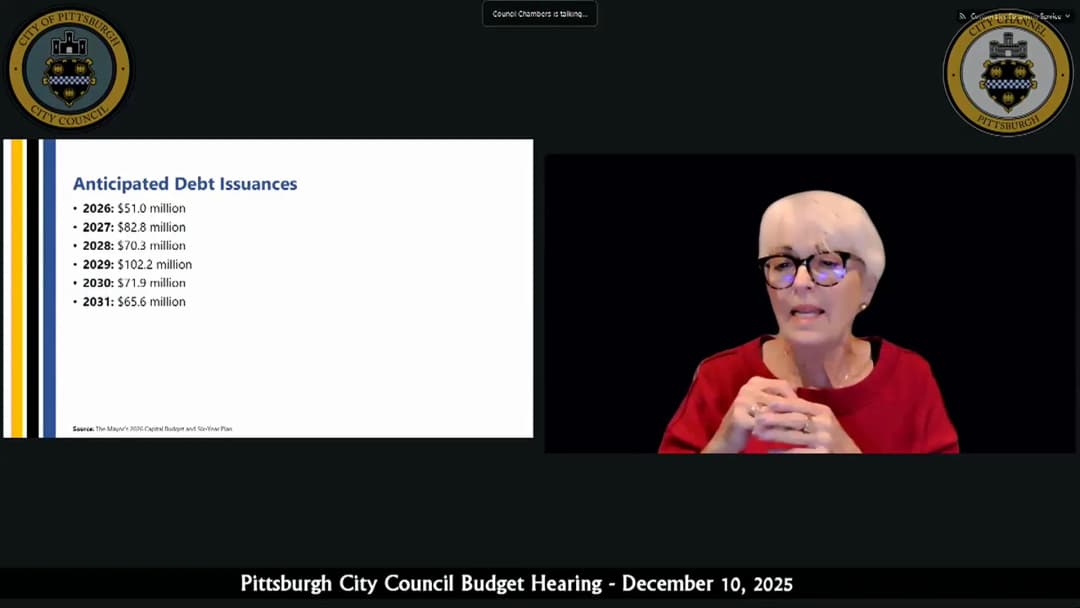
This hearing featured the Office of Management and Budget (OMB) presenting the proposed 2026 operating and capital budgets to City Council. Director Jake Pollack and Chief Financial Officer Patrick Cornell defended the proposal as balanced and compliant with city financial criteria, despite a "narrow margin for error" driven by a debt service "cliff" and significant structural revenue challenges. Council members expressed concern over a reported $30 million deficit, particularly regarding overtime, utilities, and fleet funding, leading to a debate on whether the city must propose a tax increase or rely on deeper operational cuts to achieve solvency. Consent Calendar - No specific consent calendar items were discussed or voted on during this transcript segment; the meeting proceeded directly to budget deliberations. Public Comments & Testimony - No formal public comments or testimony from community members were recorded in this transcript segment. Discussion Items - Revenue Outlook and Common Level Ratio (CLR): Director Pollack explained that the city faces "artificially depressed" real estate tax revenue growth due to a court-ordered decline in the CLR, which has resulted in an estimated $20 million annual reduction in tax revenue compared to prior forecasts. He noted that this trend is unsustainable and that a resolution (reassessment or litigation) is expected before 2030, at which point revenue would stabilize. Council members identified this as a primary driver of the budget shortfall. - Overtime and Premium Pay Variance: The core dispute centered on the "$20 million" gap in overtime costs. OMB officials argued that when offset against $16 million in savings from lower-than-budgeted regular wages and vacancy allowances, the net deficit is only approximately $3.2 million. Council members countered that using vacant positions to fund overtime is "shoddy record keeping" and not a sustainable long-term solution, with some members maintaining that the actual unfunded liability is closer to $20 million if vacancy savings are not counted. - Utility Costs (Water and Electricity): Concerns were raised regarding rising costs for Pittsburgh Water (estimated at $10 million for 2025 and projected for 2026) and electricity. OMB explained that water costs are partially offset by "true-ups" from fees the city collects on behalf of the water authority, and that the 2026 budget of $8.5 million is adequate for the transition away from the true-up process. They also clarified that electricity costs for streetlights are partially covered by the Liquid Fuels Trust Fund, though reconciliation has not yet occurred for the current year. - Fleet Funding: Councilmember Barb Warwick emphasized that public works and safety directors have stated the city needs $20 million annually for fleet maintenance (the "target"), whereas the proposed budget only includes $10 million (a $7.4 million increase from the prior year). OMB confirmed that the current proposal does not include full fleet funding and that doubling the allocation to $20 million would require additional revenue. - Debt Service: The budget faces a "debt cliff" in 2026 due to balloon payments from 2020 COVID-related refinancing. While debt service is projected to drop significantly in 2027, 2026 operates with a surplus of under $2.5 million, leaving little room for error. - Fleet and Capital Strategy: Council member Charland questioned the city's reliance on long-term bonds for short-term assets (like vehicles) versus the county's approach of shorter-term financing. OMB defended the long-term bond strategy, citing GFOA best practices and the risk of higher long-term debt service costs associated with shorter-term bonds, though they acknowledged the county's method is not illegal. - Affordable Housing: Councilmember Wilson questioned the return on investment for the over $100 million spent on affordable housing via ARPA and bonds, arguing it did not improve the city's financial position. Director Pollack countered that the primary benefit is a public service (preventing displacement) rather than direct financial return. Key Outcomes - No Final Vote on Budget: The hearing concluded without a final vote, as Council President Laval moved to recess the hearing with the intention of keeping it open for potential further discussion or testimony. - Confirmation of Negotiation Stance: Director Pollack stated the administration is open to discussing modifications to the budget to increase the "margin for error" (cushion) but explicitly declined to propose a new tax increase, maintaining that the current proposal is balanced if the $30 million deficit is rejected in favor of the $3.2 million net variance figure. - Agreement on Future Discussions: OMB agreed to engage in a conversation with Council regarding potential amendments to address specific deficiencies (e.g., fleet, litter management, out-of-school-time programs) raised during the hearing, though they did not commit to submitting a revised budget document immediately. - Operational Adjustments: OMB confirmed that 50 positions have been eliminated and $3.5 million in non-personnel spending has been cut to achieve the proposed balanced state, acknowledging these cuts impact operational capacity.
The Standing Committee of the Pittsburgh City Council convened on December 10, 2025, with six members present to address public comments, finance resolutions, infrastructure contracts, land designations, and innovation pilots. The meeting featured significant public discourse regarding community safety, historical preservation, and municipal spending efficiency, followed by detailed deliberations on bridge projects, a controversial salt storage facility, and street vacations. Consent Calendar - Bill 2566: Approved by voice vote to issue a warrant of up to $2,950 to Joya Petty for vehicle damage. - Bill 2567: Approved by voice vote to convey city-owned property at 5472 Broad Street to Charles McKinney Jr. and Shirley Simmons McKinney. - Bill 2568: Approved by voice vote to issue a warrant of up to $499,999 to Bloomfield Garfall Corporation for litigation settlement. - Bill 2569: Approved by voice vote to amend the 2025 Capital Budget, shifting funds for bridge preservation (decreasing total), increasing the 28th Street Bridge TIP by $145,000, and increasing the Charles Anderson Bridge TIP by $5,429,382 (reimbursable). - Bill 2570: Approved by voice vote to add six professional service agreements with three vendors to the existing open services agreements. - Bill 2571: Approved by voice vote to increase the authorized amount for the City of Pittsburgh Equipment Leasing Authority by $150,000 for a new total of $13,262,081. - Bill 2573: Approved by voice vote to extend a legal services agreement with Dickey, McCaymie, and Chilcoat with an additional $50,000 for a new total of $80,000. - Invoices, Interdepartmental Transfers, and P cards: All approved by voice vote. - Bill 2526: Held for one week to allow further review of technical assistance services for nonprofits. Public Comments & Testimony - Yvonne (Mercer Street): Expressed full support and deep gratitude for Carmen Brown's legacy. She recounted a specific instance where Carmen Brown successfully intervened to stop a scheme by "Burgess" involving a $1-2 million church fund that was intended to fix a personal building rather than the community, arguing that the money was returned to the homewood neighborhood only after Carmen's advocacy. - Anonymous Speaker (Male): Expressed extreme opposition toward specific council members (referring to LaVale as the "main person that wants me dead") and individuals he accused of stealing from him. He utilized religious rhetoric to assert his own innocence and potential for "incredible potential," while expressing a belief that his adversaries would face destruction and a "domino effect" due to their perceived evil. - Chief Ekahana Almakina (Anishinabe Confederacy): Expressed full support for Carmen Brown and speakers who defend truth, stating that they are rarely celebrated. He characterized Carmen as a "truth teller" who bore a cross of unpopularity and praised her for not being "well behaved," hoping her legacy produces similar figures. Discussion Items - RCO Standards Reform (Bill 2109): Councilmember Warwick reported feedback from a virtual meeting with Registered Community Organizations (RCOs). Speakers noted concerns regarding complex changes to board structures, submission timelines, the "dam waiver," and the requirement for resident votes. There was division among attendees regarding Historic District "dam" meetings, with some viewing them as bureaucratic burdens and others seeing them as necessary for community consultation on facade changes. Position: Councilmember Warwick recommended holding the bill for four weeks (or one week) to allow RCOs more time to review details, noting the bill would die if not reintroduced next year. - Contract Terminations (Bills 2482 & 2483): Council President Lavelle discussed meetings with Dr. Bay and his team (SASACE) and HRNA Advisors. - Position: The Council agreed to hold both bills for one week to allow for further discussion and a potential second meeting with the contractors. - Trolley Trail Easements (Bill 2625): Councilwoman Cale Smith provided historical context, noting the project was initiated 22 years ago and has faced political hurdles. - Position: Councilwoman Smith and Councilman Coghew expressed strong support for the project's advancement, specifically praising the connections to the West End, North Side, and potential future ties to the Fort Pitt tunnels. Councilman Coghew also inquired about the feasibility of connecting the trail over the Parkway via abandoned rail lines owned by PennDOT, expressing willingness to assist in pursuing that connection. - Bridge Projects (Bills 2576, 2577, 2578, 2579, 2580, 2581): - 28th Street Bridge (Bill 2576 & 2578): Councilman Gross and Director Settle confirmed the project involves rehabilitation, a new deck, widened sidewalks, and roadway reconstruction. Councilman Gross expressed support for making bridges safe. - Larmor Avenue Bridge (Bill 2577): Approved with no discussion. - Charles Anderson Bridge (Bill 2579): Approved; Councilman Coghew highlighted the project's importance to the "Esquina" (Esplanade) neighborhood, noting local advocacy and excitement. - West Carson Street Bridge (Bill 2580): Approved with no further discussion. - Elizabeth Street Bridge (Bill 2581): Councilman Coghew expressed a position favoring future community engagement to address neighbor concerns regarding the construction timeline and impact. - Street Vacation - Arts Landing (Bill 2583): Councilwoman Gross and Councilman Charland expressed strong opposition to vacating public right-of-way for the Cultural Trust's Arts Landing Park. - Position: Councilwoman Gross argued that vacationing public property sets a dangerous precedent that could lead to future hidden costs (utility relocation) or loss of pedestrian access, citing the "Peter Busa" (Peter Busa) sewer debacle and the "Produce Terminal" precedent. She argued that streets should remain public or retain easements for public access rather than being transferred to private ownership. Councilman Charland expressed concern about the loss of public access, citing the PPG Fountain precedent where public play was phased out. Councilman Wilson and others noted the need for more information and support holding the bill. - Outcome: The Council voted to hold the bill for one week. - Salt Storage Facility (Bill 2574): Councilwoman Cale Smith and Councilman Gross questioned the $6.9 million cost and the justification for a full rebuild versus repair or alternative storage (e.g., under tarps). - Position: DPW Director Goss and Public Works personnel explained that the dome is structurally unsafe (delaminating concrete, failing ventilation) and that alternative sites would cost significantly more due to site work, stormwater requirements near Sawmill Run, and the inability to use parkland. Councilwoman Smith maintained a position that the cost was unjustified given the budget constraints and suggested tarp storage as a viable interim solution. Councilman Coghew expressed trust in DPW's engineering judgment but noted the high site-work costs were a relief from the perception of "gouging." The Council voted to hold the bill for one week. - Historic Site Designation (Bill 2296): - Position: Councilman Mosley and Councilwoman Kelsman expressed full support, citing the site's significance to George Westinghouse and Nikola Tesla. Councilperson Charlotte expressed skepticism about "freezing" city-owned parks in amber and limiting future modernization (e.g., ADA compliance), but was won over by Councilwoman Kelsman's assurance that guidelines allow for non-contributing structure changes. Councilperson Charlotte ultimately moved to support the bill based on the council member's district representation. - Outcome: The bill passed with an affirmative recommendation. - B3 Solutions Contract (Bill 2559): Councilwoman Gross raised concerns about the long-term contract history with B3 Solutions. - Position: B3 Solutions was acknowledged as the creator of the legacy tax collection system. The extension was explained as necessary for 18 months to allow for data migration and testing of the new system (CSS) for the single annual billing cycle. Councilwoman Gross and others expressed a position that while the extension is cost-free, the city needs to eventually transition away from reliance on B3 for critical data access. - PGH Lab Pilot Program (Bill 2560): Senior Manager Andrew Hayhurst presented the program's 10-year history and the shift to a "customer-first" model paying startups $25,000 per pilot. - Position: Councilmembers expressed enthusiastic support for the program's low-risk innovation, specifically noting the underwater drone technology for Search and Rescue (River Rescue) and the digital twin project. Councilwoman Cale Smith noted a position of caution regarding public data governance and AI policies but acknowledged the need for public education to build trust. Key Outcomes - Hold Bills: Bill 2109 (Held 4 weeks), Bill 2482 (Held 1 week), Bill 2483 (Held 1 week), Bill 2526 (Held 1 week), Bill 2574 (Held 1 week), and Bill 2583 (Held 1 week). - Approved by Voice Vote/Affirmative Recommendation: Bills 2566, 2567, 2568, 2569, 2570, 2571, 2573, 2575, 2576, 2577, 2578, 2579, 2580, 2581, 2582, 2584, 2585, 2588, 2558, 2563, 2561, and Invoices/Transfers/P-cards. - Approved with No Opposition: Bill 2296 (Westinghouse Park Historic Site) and Bills 2565, 2583 (Vacation of 8th Street) were initially brought forward, but Bill 2583 was held; Bill 2296 passed. - Public Safety: Councilmember Warwick and Councilman Cogham called for additional professional training for city employees to prevent the use of slurs and maintain public trust, urging HR to increase awareness and de-escalation training. - Next Steps: Budget Line Item Vote scheduled for Thursday, December 18; next Council meeting Tuesday, December 16; next Standing Committee meeting Wednesday, December 17.
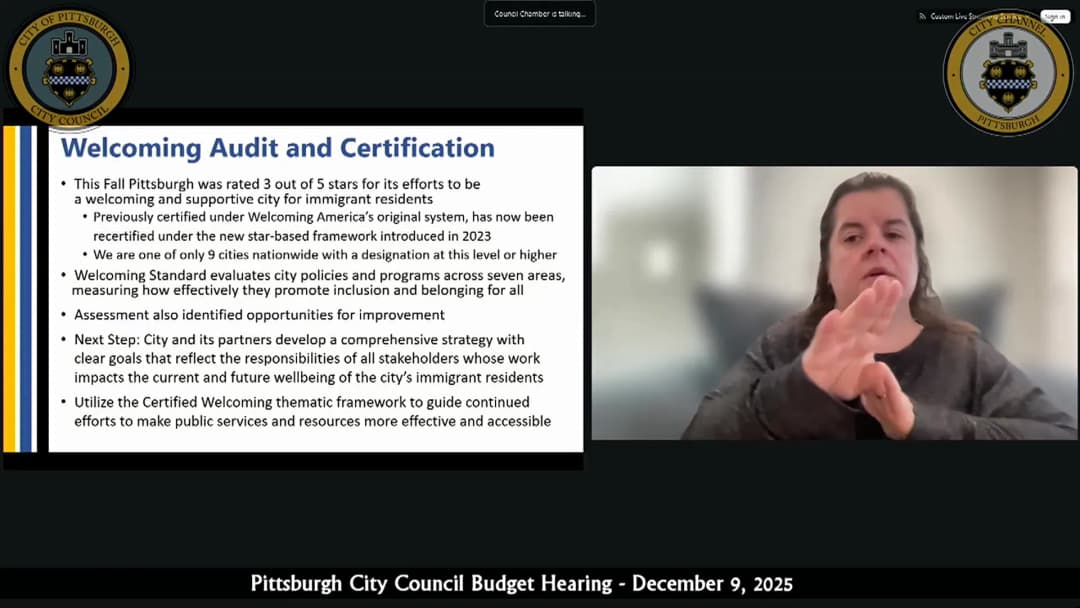
On December 9, 2025, the Pittsburgh City Council Committee on Hearings and Policy held a budget hearing to review the Office of the Mayor's proposed fiscal year 2026 budget and strategic priorities. City officials, including Chief of Staff Kyle Chintilopoli and Deputy Chief of Staff Felicia Williams, presented a summary of key accomplishments from 2025, including the ADA Transition Plan, the Regional Disparity Study, and procurement modernization. They addressed a proposed budget reduction of approximately $3.3 million, largely explained as the result of transferring 15 positions to other departments rather than eliminating them, aligning the office's size with pre-2023 levels. The hearing concluded with a Q&A session covering funding for the disparity study, the status of the 311 operation, and the Mayor's absence from the hearing. Consent Calendar - No items were presented for the Consent Calendar. Public Comments & Testimony - Felicity Williams (Deputy Chief of Staff): Expressed pride in the Office of Immigrant and Refugee Affairs' achievement of a three-star rating from Welcoming America, noting the office had successfully moved from a two-star rating through internal partnership. She emphasized that the certification looks at the broader ecosystem, including partners like PPS and Allegheny County. - Kyle Chintilopoli (Chief of Staff): Stated that the office has completed approximately 75% of the ADA Transition Plan self-assessment and warned that future corrective actions will require integration with capital planning. He expressed full support for moving from a reactive to a proactive approach to disability rights. He also affirmed the legal necessity of the Regional Disparity Study to maintain business diversity programs under current Supreme Court precedents and federal scrutiny. - Councilman Schlossberger: Expressed strong support and appreciation for the Office of the Mayor's work on procurement modernization, DBE accomplishments, and the ongoing regional disparity study, describing the work as "really excellent." - Councilman Mosley: Expressed gratitude for the Mayor's team's service and partnership on economic development, the Stop the Violence Fund, and procurement efforts, noting it was a pleasure working with them. - Councilman Sherlin: Expressed discomfort and concern regarding the Mayor's absence from his own budget hearing, noting it breaks a prior precedent where the Mayor was expected to attend, though he did not express opposition to the budget proposals. - Councilwoman Kale Smith: Expressed a desire for more inclusive discussions involving the disabled community's voice in economic inclusion efforts, which she felt was often missing. She asked how the Office of the Mayor ensures such voices are heard in procurement processes. - Councilman Smith (Speaker of the Council): Stated he does not want to increase taxes at all but expressed a willingness to engage in open, public conversations with residents to reduce city spending where possible to avoid tax hikes. He emphasized that public dollars are not personal accounts. Discussion Items - Budget Structure and Personnel: Councilwoman Kale Smith inquired about the discrepancy between noted personnel transfers (15) and the budget sheet (11). Kyle Chintilopoli clarified that the discrepancy arises from counting multiple roles or single positions split across categories. He explained that the significant $3.3 million aggregate decrease was primarily driven by transferring 15 positions to other departments (including 311) and removing city cuts for landscaping, rather than eliminating core functions. - Position of Councilwoman Kale Smith: Expressed skepticism regarding the transfer of the 311 team to the Office of Management and Budget (OMB), questioning the logic of moving from IMP/Mayor's Office to OMB. - Response (Kyle Chintilopoli): Expressed the position that the move is logical because the 311 team functions as an administrative operations loop, making it suitable for the management component of the city. - Professional Services Funding: Councilwoman Kale Smith asked why professional and technical services dropped from nearly $1 million to $57,000. Kyle Chintilopoli explained that the previous high figure included a large one-time contribution to the Pittsburgh Regional Disparity Study, which is now a completed (or ongoing multi-year funded) legal requirement not needing new budget allocations in this specific line item. - Mayor's Absence: Councilman Sherlin questioned how the Council should interpret the Mayor not attending his own budget hearing. Kyle Chintilopoli defended the absence, stating that the Mayor serves as the city's CEO and does not attend every department hearing; his Chief of Staff and Deputy serve as the equivalent directors for this office. Councilman Smith countered that the lack of the Mayor creates an uncomfortable situation and that the Mayor, not staff, is ultimately responsible for the budget. - Tax and Budget Accuracy: Councilman Smith asked if the Mayor believes the budget is accurate enough to avoid tax increases. Felicia Williams stated the Mayor believes the current budget delivers core services without layoffs or tax hikes but expressed willingness to engage in conversations regarding further cuts or tax increases if Council determines it necessary. - Procurement Modernization and Legal Compliance: Councilman Sherlin asked for recommendations on fulfilling the work outlined in the disparity study and procurement modernization. Kyle Chintilopoli recommended: 1) Urgent legislative action to codify administrative policies (e.g., pre-bid requirements) into city code to protect economic inclusion programs from potential litigation under the current federal administration; 2) Convening stakeholder briefings; and 3) Ensuring partner agencies (authorities, county) adopt similar standardized, race/gender-neutral but outcome-focused criteria for job opportunities (e.g., targeting residents of high-need neighborhoods). - Inclusivity and Diversity: Councilwoman Kale Smith asked if veterans are tracked. Felicia Williams confirmed that VOSB (Veteran-Owned Small Business) status is included in the disparity study and that while legal standards for veterans differ from race/gender programs, they are definitely counted. She also noted the inclusion of LGBTQBE certifications. Councilwoman Smith advocated for expanding these definitions to include geographic discrimination, which Kyle Chintilopoli confirmed is being piloted via the "Workforce Hub" focusing on residents from extreme-need neighborhoods rather than just protected classes. Key Outcomes - Budget Adjustment: The Mayor's Office accepted a reduction of approximately $1.7 million in personnel and $1.18 million in non-personnel costs, resulting in a total of 14 full-time positions (a decrease of 25 positions from FY25). - Position Transfers: 15 positions were transferred to other departments, specifically noted as the 311 team moving to OMB. - Legislative Directives: The Committee was urged to consider codifying procurement policies (such as pre-bid meeting requirements) into city code to ensure long-term legal compliance of business diversity programs. - Study Continuation: The Office of the Mayor committed to continuing the Pittsburgh Regional Disparity Study through summer 2026 and will coordinate with Council Districts to ensure local business engagement. - Meeting Adjournment: The meeting was adjourned following the conclusion of questions and remarks.