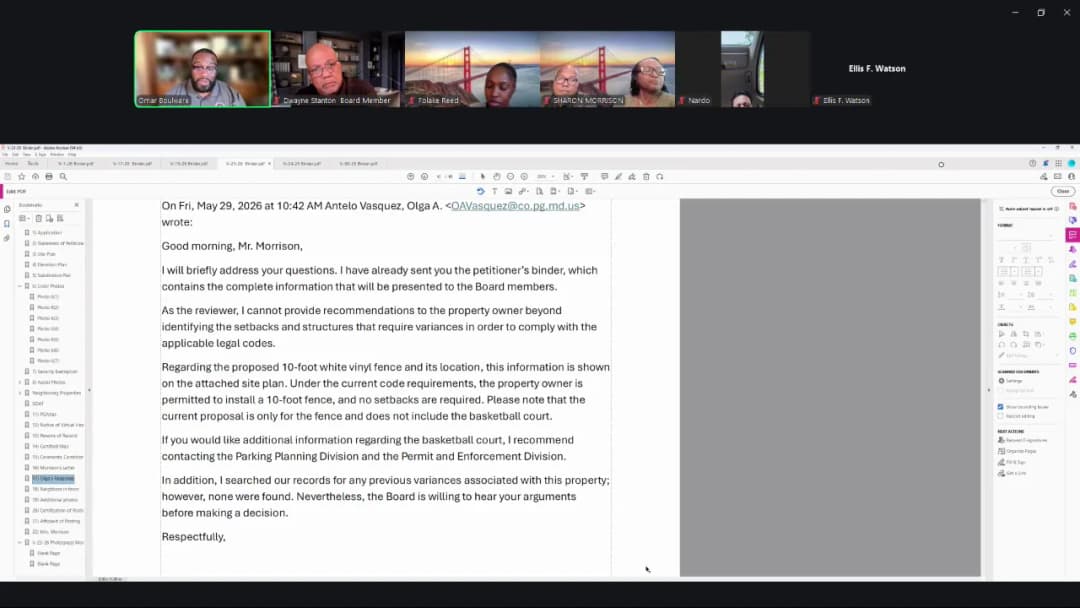
The Prince George's County Board of Appeals held a virtual hearing on June 3, 2026, at 6:01 PM, chaired by Chair Bulware. The board heard five new variance and security exemption cases and one continued discussion case. Decisions resulted in three approvals, one denial, and two cases postponed due to petitioner absence. The meeting adjourned at 7:06 PM. Public Comments & Testimony - Sharon and Anthony Morrison (neighbors of 15601 Taylerton Lane) testified in opposition to V-23-26, the Reeds' request for a 10-foot security exemption fence for a basketball court. They stated that basketballs frequently entered their yard, that there was no communication from the Reeds, and that a 10-foot fence was unnecessary. They requested clarification on setback requirements for fences over 6 feet and noted the proposed fence only covered two sides, not all four. Discussion Items - V-1-26 (Carlos Perez del Cid and Maria D. Rodriguez Chinchilla) – A request for variances to validate existing conditions (covering a deck, shed, and driveway) at 4407 Sellman Road, Beltsville. The petitioners did not join the meeting, and the Spanish-language interpreter had already been excused. The case was rescheduled. - V-17-26 (Juan Guzman) – A request for variances for a proposed driveway at 1406 Nye Street, Capitol Heights. The petitioner was not present, and the interpreter was no longer available. The case was rescheduled. - V-19-26 (Adassa Grant) – A request for variances of 30 feet lot width, 18 feet lot frontage, and a parking area waiver to build a 10' x 33' concrete driveway at 6904 Flagstaff Street, Landover. Ms. Grant testified that her lot is unusually narrow, she currently has no driveway, and she has medical issues that make walking from street parking difficult. The board noted the lot's uniqueness and that neighbors have driveways. Approved unanimously. - V-23-26 (Folake F and Lenardo T Reed) – A request for a security exemption for a 10-foot white vinyl fence around a basketball court at 15601 Taylerton Lane, Brandywine. The Reeds argued their lot is the first in the neighborhood, creating unique traffic and safety risks; balls frequently go into neighbor yards and woods, which contain copperhead snakes and poisonous spiders; a 6-foot fence would not contain the balls. Opposing neighbors (Morrisons) stated balls were a nuisance and questioned the fence's placement and the need for 10 feet. The board discussed that a 10-foot fence was excessive and the request did not meet the security exemption criteria. A motion to deny the variance passed. Denied 3–0. The board noted that a 6-foot fence is allowable by code in the rear yard and encouraged the parties to resolve the issue. - V-24-26 (Houston Jerami Grant) – A request for a variance of 43.4 feet lot frontage and a security exemption for a 6-foot wrought iron fence in the front yard (2 feet above allowable height) for a pool at 2908 Westbrook Lane, Bowie. Attorney Drew Cole and architect Alex Davis testified the property is uniquely narrow at the front with a conservation easement and an adjacent access road; a 6-foot fence is consistent with other neighborhood fences and needed to deter burglaries targeting professional athletes. Approved unanimously. - V-80-25 (Loving Memory Revocable Living Trust) – Continued from the previous meeting. The petitioner had been required to pay fines to the Town of Capitol Heights for unauthorized construction at 915 Brooke Road, Capitol Heights. Evidence of payment was provided, and the town raised no objection. The board noted the petitioner acted in good faith after being misled by a contractor. Approved unanimously. Key Outcomes - V-19-26 (Adassa Grant): Approved 3–0. - V-23-26 (Folake F and Lenardo T Reed): Denied 3–0. - V-24-26 (Houston Jerami Grant): Approved 3–0. - V-80-25 (Loving Memory Revocable Living Trust): Approved 3–0. - V-1-26 and V-17-26: Postponed due to petitioner absence; staff will reschedule. - Minutes from May 20, 2026: Approved 3–0.
Public Meetings - Prince Georges County, Maryland
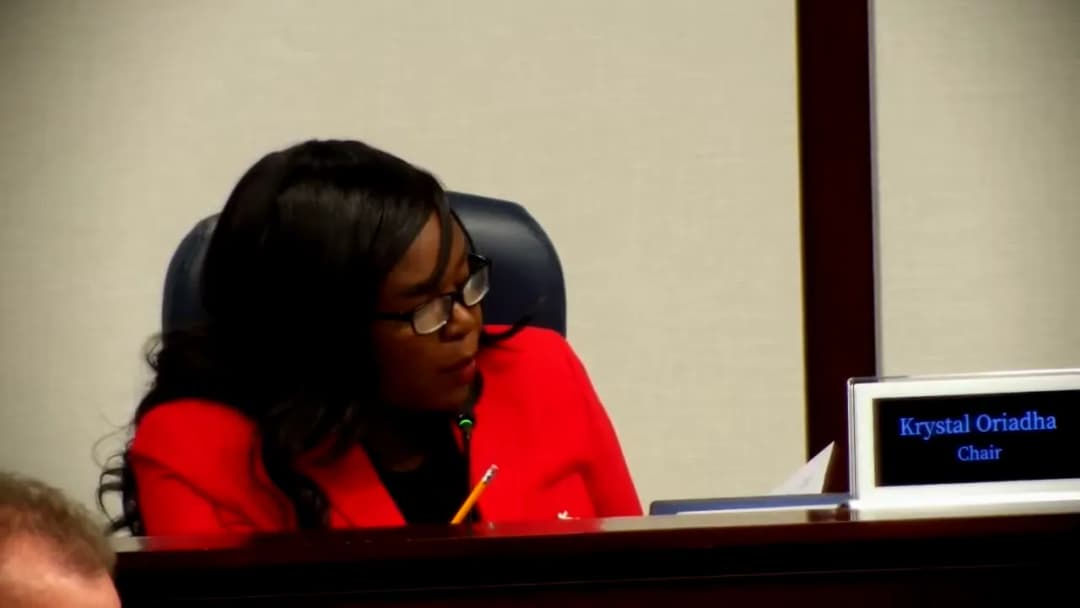
Public Meetings - Prince Georges County, MarylandThe Prince George's County Council, sitting as the Committee of the Whole, convened on Tuesday, June 2, 2026, at 11:51 a.m. in the Council Hearing Room, chaired by Council Chair Krystal Oriadha. Eight members were present. The meeting focused on a package of six beautification-related bills sponsored by Chair Oriadha, all of which were amended and favorably recommended to the full County Council. The meeting was adjourned at 12:08 p.m. Discussion Items - CB-041-2026 (Clean Corridors and Rapid Response Act): This bill creates a program for expedited removal of illegal dumping and litter in designated corridors. Amendments included replacing references to the Department of Public Works and Transportation with the agency designated by the County Executive, adding an uncodified section expressing the council's expectation that the program be implemented by the existing Strike Force 311 program, and changing the designation authority from the council to the executive (with council request option). Council Member Dernoga asked about the designation process; it was clarified that a letter from the council chair would suffice. The 48-hour response time for litter removal was discussed, with flexibility for weekends. The County Executive's office expressed support as amended. - CB-042-2026 (Clean Communities Transparency Dashboard Act): This bill requires the Office of Community Relations to create a dashboard on illegal dumping and litter cleanup efforts. The only amendment changed the effective date from 45 days to six months after enactment. The County Executive's office supported the bill as amended. - CB-043-2026 (Vacant Property Maintenance and Abatement Act): This bill strengthens enforcement on vacant properties, including administrative citations and increased fines for repeat violations. Amendments corrected a typographical error (moving a bracket) and updated references from the Department of Permitting, Inspections and Enforcement to the Office of Homeland Security Code Compliance to reflect an upcoming reorganization. The County Executive's office supported the bill as amended. - CB-044-2026 (Illegal Signage Enforcement Act): This bill enhances enforcement against illegal signs and objects in county rights-of-way, including requiring utilities to remove signs from their infrastructure. An amendment deleted language that attempted to impose an evidentiary standard on state courts, which was beyond the county's authority. The County Executive's office did not comment on this bill in the transcript. - CB-045-2026 (See It, Snap It, Get Paid Act): This bill establishes a beautification enforcement incentive program allowing residents to report violations and receive compensation. Amendments replaced references to the Department of Permitting, Inspections and Enforcement with the Office of Homeland Security Code Compliance and changed the effective date from 45 days to six months. The County Executive's office supported the bill as amended. - CB-046-2026 (Vacant Real Properties Tax Rate): This bill establishes a higher property tax rate for vacant and unfit properties, with proceeds deposited into a non-lapsing fund. An amendment inserted the words "whether residential or commercial" to clarify the scope of the tax. The County Executive's office supported the bill as amended. Key Outcomes - CB-041-2026: Amended (7-0, with 4 absent) and favorably recommended to the County Council as amended (7-0, with 4 absent). - CB-042-2026: Amended (7-0, with 4 absent) and favorably recommended as amended (6-0, with 5 absent; Council Member Adams was absent for the final vote). - CB-043-2026: Amended (6-0, with 5 absent; Council Member Adams absent) and favorably recommended as amended (6-0, with 5 absent). - CB-044-2026: Amended (7-0, with 4 absent) and favorably recommended as amended (7-0, with 4 absent). - CB-045-2026: Amended (6-0, with 5 absent) and favorably recommended as amended (6-0, with 5 absent). - CB-046-2026: Amended (7-0, with 4 absent) and favorably recommended as amended (7-0, with 4 absent). All six bills were moved to the full County Council for a public hearing on June 9, 2026. Chair Oriadha noted that the legislative package addresses community concerns about vacant properties and community cleanliness.
The Prince George's County Council met on Tuesday, June 2, 2026, at 10:23 a.m. in the Council Hearing Room, Largo, MD. The meeting included adoption of the consent agenda, public comments on data centers and government transparency, introduction of an apprenticeship incentive bill, and public hearings on the Responsible Pet Ownership Act and amendments to the 2018 Water and Sewer Plan. The meeting adjourned at 11:19 a.m. Consent Calendar - Approved minutes of May 19, 26, and 27, 2026. - First reading of bills: CB-059-2026 (Supplementary Appropriations in the FY2026 Capital Budget) referred to Committee of the Whole; CB-060-2026 (Procurement Refinements Act) and CB-061-2026 (County Real Property as Surplus Property) referred to Government Operations and Fiscal Policy Committee; CB-062-2026 (Prevailing Hours and Wage Rates on Public Works – Apprenticeable Trades) referred to Committee of the Whole. - Introduction of CR-059-2026 (FY2026 Annual Action Plan for Housing and Community Development amendment to reprogram $1,170,000 in CDBG funds to the Housing Rehabilitation Fund and $130,000 to the Housing Rehabilitation Assistance Program Administration) referred to Planning, Housing and Economic Development Committee; requires a public hearing. - Motion to adopt the consent agenda carried 9-0 (Council Members Burroughs and Hunter absent). Public Comments & Testimony - General Public Comments (before agenda): Six speakers addressed the council. Ursula Franklin, Jermaine Hargraves, Demetri Gamble, Claude Rucker, and Eric James spoke about data centers, urging the council to move forward with clarity, transparency, and safeguards. Sherman Hardy raised concerns about transparency within county government and questioned the budget process and accountability of staff. Nikeshia Stryker requested partnership and grant funding for her non-emergency medical transportation business, Christus Carnel, and her upcoming nonprofit, Be Better Together. - Public Hearing on CR-029-2026 (Water and Sewer Plan amendments): Eight speakers registered. In favor: Edward Gibbs (attorney for Pulte Homes), Mark Ferguson (land planner), and Ken Dunn (civil engineer) argued that the Corridor Center project in Laurel meets all six criteria for a category change from Category 4 to Category 3, citing approvals for conceptual site plan, preliminary subdivision plan, and detailed site plan, as well as compliance with stormwater management and forest conservation. They also noted the project will provide affordable for-sale housing and remove a junkyard. Opposed: Michael Maxwell (neighborhood resident), Virginia Melissa Holland (Laurel resident, Ward 2), Maria Oszwaldowska (Laurel resident), and Jonathon Haight (member of Law for the Patuxent) raised concerns about traffic congestion on Cherry Lane and Pirate Lane, loss of green space, overcrowding at Laurel High School, inadequate public notice of the hearing, and potential for WSSC costs to be passed to ratepayers. Matt Tedesco spoke in favor of a separate application (Allied Burney Wine property) within the same resolution, arguing it meets criteria for advancement from Category 5 to Category 4 and has support from the county executive and planning board. Discussion Items - Second Reading of CB-037-2026 (Apprenticeship Incentive Program): Introduced by Council Member Adams-Stafford. Dr. Arun Puracken, Director of the Education and Workforce Development Committee, reported that the committee voted favorably 3-0 on May 11, 2026. The bill requires Employ Prince George’s to strategically provide a package of incentives to increase apprenticeships in technology, construction, building trades, and healthcare. The county executive’s office supports the bill. Additional sponsors (Adams, Oriadha, Olson, Fisher, Ivey, Dernoga, Harrison) were added. The bill was introduced and stands referred to committee. - Public Hearing on CB-025-2026 (Responsible Pet Ownership Act): No speakers signed up. The public hearing was held and the bill was enacted by a vote of 9-0. Council Member Olson thanked colleagues and the director of animal services for their support. - Public Hearing on CR-029-2026 (Water and Sewer Plan – December 2025 Cycle of Amendments): After testimony, the council noted that the resolution will be scheduled for a work session in the Transportation, Infrastructure, Energy and Environment (TIEE) Committee on June 25, 2026. Key Outcomes - Consent agenda adopted (9-0). - CB-025-2026 enacted (9-0) – Responsible Pet Ownership Act. - CB-037-2026 introduced and referred to committee – Apprenticeship Incentive Program. - CR-029-2026 public hearing held; referred to TIEE Committee work session on June 25, 2026. - Proposed joint letter to Maryland Department of Planning regarding Priority Funding Areas referred to PHED Committee. - Motion to adjourn carried unanimously.
The Streamlining Development Review Work Group met on June 1, 2026, to continue discussions on improving the development review process. The primary agenda item was a presentation by Sherry Connor of the Planning Department on zoning applications, including rezoning types, processes, timelines, and opportunities for streamlining. Work group members asked clarifying questions, debated procedural aspects, and offered initial recommendations. Presentation on Zoning Applications - Sherry Connor presented an overview of zoning application types under Subtitle 27: zoning map amendments (change-mistake rule and sectional map amendments), plan development (PD) rezonings, special exceptions, special permits, certifications of non-conforming uses, variances, major/minor departures, minor administrative waivers/modifications, and zoning ordinance text amendments (ZTAs). - She highlighted that PD rezonings require establishing individual development standards and typically take longer (example: 20 months) than standard zoning map amendments (example: 13 months). Special exception cases for daycares ranged from 19 to 24 months. Standalone variances average 3–5 months; minor departures can take 3 weeks to 2 months. - Ms. Connor noted that PD zoning map amendments must be approved before subsequent applications can be accepted, limiting concurrency. She also suggested removing special exception requirements for less impactful uses by incorporating use-specific standards. Discussion Items - Mr. Smith questioned the “multiple hearing process,” noting that remands (due to errors by applicant, staff, or board) often drive additional hearings, not baseline ordinance requirements. He proposed adjusting the 70-day rule to 90 days with a mid-point deadline for document submission to reduce errors. - Ms. Anna (Camp) responded that the process is collaborative and that comments implying developer failure are misleading; remands can arise from legitimate interpretive issues (e.g., new vs. old zoning ordinances). - Victoria suggested consolidating pre-application and review steps into a single, longer codified period (e.g., 90 days) to hold all parties accountable and reduce confusion for residents. She noted the current process is convoluted from a citizen perspective. - Mr. Rivera/chair clarified that in MUTC zones, both a detailed site plan (DSP) and special permit (SP) may be required. - Ms. McNeil explained the origin of special exceptions: they allow neighbors to speak about uses that are permitted but not by right, because they may have specific local impacts. She cautioned that removing special exceptions would require clear, objective criteria to ensure hearings are still possible for truly impactful uses. - Mr. Smith raised concerns about lack of direct notice to adjacent property owners when ZTAs effectively rezone properties (e.g., allowing townhouses on open space). He argued that residents should have an opportunity to participate. Matt Tedesco countered that zoning text amendments are legislative acts no different from other laws; requiring special notice would be inconsistent. - Dr. Gilchrist (via chat) asked about public notice timeframes and accountability for inadequate notice; the chair deferred to email follow-up. - Mr. Monroe asked about certification of non-conforming uses when a new tenant takes over a non-conforming building with a conforming use. Ms. Connor clarified that if the use is permitted, certification is not required. Key Outcomes - No formal votes were taken. The chair announced that recommendations from work group members (submitted verbally during meetings, via email, or via the shared Excel spreadsheet) will be compiled and later voted on by the group. The goal is to make the development process less convoluted and shorter, including potential legislative changes. - The next meeting, originally scheduled for May 27, was postponed to June 3 due to county budget adoption. Minutes from each meeting will be prepared and circulated for approval.
The Education and Workforce Development Committee met on June 1, 2026, as an informational gathering due to the lack of a quorum. Chair Shayla Adams-Stafford and Council Member Sydney Harrison were present. The committee received two briefings: one on chronic absenteeism and one on high school graduation outcomes. Discussion Items Chronic Absenteeism Briefing PGCPS officials (Dr. Elizabeth Faison, Dr. Tisa Holley, Anthony Whittington, Principal Warren Tweedy) presented on chronic absenteeism. They defined chronic absenteeism as missing 10% or more of school days, noted a 0.4 percentage point reduction in the overall rate compared to the prior year, and highlighted that elementary and K-8 schools saw the most improvement. Root causes identified through staff surveys included family responsibilities/economic pressures, lack of school engagement, and mental health challenges. The school system has implemented a truancy reduction plan, launched an Attendance Ambassador program, and partnered with county agencies (State's Attorney, library, CASA). Council Member Harrison asked about the impact of immigration enforcement on absenteeism; presenters acknowledged that fear of immigration actions has been a factor but noted that enrollment, not attendance, showed the most significant decline among immigrant families. They described efforts to better educate immigrant families on attendance expectations. Chair Adams-Stafford inquired about school design initiatives to improve engagement, such as project-based learning and social-emotional learning. Dr. Holley responded that the system is focusing on teacher training in social-emotional learning and bullying prevention. High School Graduation Report Caleb Callender (Council Budget & Policy Analyst) presented the SY 2024-2025 graduation report, showing an overall graduation rate of approximately 79% (a slight decrease from the prior year). Breakdowns by gender, race, and service groups showed increases in dropout rates for Hispanic and multilingual learners. Dr. Douglas Strader (Chief Accountability Officer, PGCPS) provided context, explaining that the graduation cohort includes many immigrant students who enter high school overage and under-credited, making them more likely to be counted as dropouts. He noted that African American students in PGCPS outperform their statewide peers. Anthony Whittington presented a current cohort tracker predicting a 79% graduation rate for the 2025-2026 school year, with potential improvement from summer school. Chair Adams-Stafford raised concerns about the use of high-stakes testing and advocated for portfolio-based assessments, especially given the unique population. She also asked about ninth-grade academies and cohort models. Presenters described a restructuring toward cohort models in some high schools and said that the Maryland State Department of Education is implementing a new adaptive assessment system without portfolio options. The Chair expressed interest in working with the school system to advocate for portfolio options and to organize trade tours for career exploration. Key Outcomes - No formal votes or decisions were made due to the informational nature of the gathering and lack of quorum. - The committee received the presentations and discussed the need to continue focusing on immigrant family outreach, engagement initiatives, and support for multilingual learners and students with disabilities. - Chair Adams-Stafford committed to working with PGCPS on advocating for portfolio-based assessments to the state and facilitating trade tours for students in her district. - The meeting adjourned at 3:06 p.m.
The Government Operations and Fiscal Policy Committee of the Prince George's County Council met on Thursday, May 28, 2026, at 1:17 PM in Committee Room 2027. Chair Edward P. Burroughs III presided. The committee considered two bills: CB-040-2026 concerning human trafficking awareness notices in hotels, and CB-039-2026 concerning election day administrative leave for county employees. Both bills were favorably recommended with amendments by a vote of 4-0 (Council Member Jolene Ivey excused). CB-040-2026: Human Trafficking Awareness Notice - Sponsor: Council Member Eric Olson - Purpose: To require hotels, motels, and similar lodging establishments to post a human trafficking awareness notice in each guest room to increase public awareness, support victims, and encourage safe reporting. - Discussion: Committee staff provided an overview. The Office of Law found the bill legally sufficient. The County Executive’s office supported the bill as amended. Sponsor Olson noted the bill was inspired by a similar notice he saw in a New York hotel and emphasized the importance of awareness along the I-95 corridor. - Amendments (Draft 2): Specified the notice size as 8.5x11 inches with 12-point font, and added contact information including the Prince George’s County Family Justice Center and the Domestic Violence and Sexual Assault Center at Capitol Region Health (24-hour hotline for human sex and labor trafficking). - Vote: Motion by Council Member Blegay, seconded by Vice Chair Adams. Favorably recommended with amendments. Vote: 4 ayes (Burroughs, Blegay, Oriadha, Adams); 1 absent (Ivey). CB-039-2026: Election Day Administrative Leave - Sponsor: Council Member Wala Blegay - Purpose: Originally to designate general election day as a holiday for county employees; amended to provide 4 hours of administrative leave for voting. - Discussion: Sponsor Blegay expressed concern about attacks on voting rights at the federal level and the need to make voting easier. The Office of Law found the bill legally sufficient. The County Executive supported it as amended. The amendment changed the title from "Election Day Holiday" to "Election Day Administrative Leave" and replaced the full-day holiday with a provision granting up to 4 hours of administrative leave for voting (previously 2 hours) under County Code Section 16-22 A3. - Amendments: Approved as per Draft 2. - Vote: Motion by Council Member Blegay, seconded by Vice Chair Adams. Favorably recommended with amendments. Vote: 4 ayes; 1 absent (Ivey). Key Outcomes - Both bills (CB-040-2026 and CB-039-2026) were favorably recommended with amendments by a 4-0 vote. - The committee adjourned at an unspecified time after the votes.
The Transportation, Infrastructure, Energy and Environment Committee of the Prince George's County Council met on May 28, 2026, at 10:07 AM in Committee Room 2027. Chair Thomas Dernoga, Vice Chair Eric Olson, and Council Member Sydney Harrison were present; Council Members Danielle Hunter and Timothy Adams were absent. The committee considered four legislative items, all of which were approved. Discussion Items - CB-032-2026 – Housing and Property Standards for Non-Residential Property – This bill amends the county code to increase civil penalties for non-residential property owners who violate property maintenance standards. The current fine of $1,000 per violation would be replaced with a two-tier structure: $2,000 for the first violation and $5,000 for subsequent violations. Residential property fines remain unchanged. Sponsor Council Member Fisher explained the bill targets derelict commercial properties, including open green spaces that become attractive nuisances and sites for illegal activity. Committee staff noted the bill would have a nominal fiscal impact, with potential revenue increases. The Office of Law found it legally sufficient; the County Executive's Office took no official position but acknowledged the importance of addressing property vacancy. After discussion, a motion to recommend favorably carried 3–0. - CB-033-2026 – Vehicle Access and Recovery Emergency Act – This emergency act amends towing and impoundment laws to allow vehicle owners, authorized agents, and family members to redeem an impounded vehicle by providing specific identification and proof of relationship. The bill includes indemnification and a $500 fine for false statements. An amendment, proposed by Legislative Attorney Kathleen Canning and supported by sponsor Vice Chair Olson, removed the requirement that vehicle registration be issued by the Maryland Motor Vehicle Administration, thereby allowing registrations from any jurisdiction. The Office of Law found the bill legally sufficient; the County Executive's Office raised concerns about potential unintended risks but did not take an official position. The amendment passed 3–0, and the bill as amended was recommended favorably 3–0. - CR-034-2026 – Stop Sign Monitoring Systems, City of New Carrollton – This resolution approves locations for stop sign monitoring (cameras) in the City of New Carrollton. The city submitted all required documentation, including a request for up to 100 potential camera locations within a half-mile radius of three schools. Committee staff noted that not all locations would necessarily have cameras; the list provides flexibility. The resolution would have no fiscal impact on the county, as the municipality bears all costs and retains revenue. The Office of Law found it legally sufficient; the County Executive's Office had no position. A motion to recommend favorably carried 3–0. - CR-037-2026 – Stop Sign Monitoring Systems, Town of Bladensburg – This resolution approves similar stop sign monitoring for the Town of Bladensburg, which identified 48 eligible locations. All requirements were met. The Office of Law found it legally sufficient; the County Executive's Office had no position. A motion to recommend favorably carried 3–0. Key Outcomes - CB-032-2026: Recommended favorably (3–0). Moves to the full County Council. - CB-033-2026: Amended (removed 'Maryland' from vehicle registration requirement) and recommended favorably as amended (3–0). Moves to the full County Council. - CR-034-2026: Recommended favorably (3–0). Moves to the full County Council. - CR-037-2026: Recommended favorably (3–0). Moves to the full County Council. - The committee adjourned after completing its agenda. The next meeting is scheduled for June 25, 2026.
The Prince George's County Council convened at 7:00 p.m. on May 27, 2026 (despite the agenda listing 11:00 a.m.) to adopt the Fiscal Year 2027 budgets for multiple agencies and the county's overall operating and capital budgets. Chair Krystal Oriadha presided with eight members present (Council Members Adams-Stafford, Adams, Burroughs, Dernoga, Hunter, Ivey, and Vice Chair Olson) and three excused (Blegay, Fisher, Harrison). The meeting included a brief recess to convene as a Committee of the Whole. Adoption of WSSC, WSTC, Revenue Authority, and Redevelopment Authority Budgets - CR-047-2026: Adopted the WSSC FY2027 operating and capital budgets totaling $1,966,865,100, including a 5.0% combined rate increase in fixed fees and water/sewer rates. (Vote: 8-0) - CR-048-2026: Adopted the WSSC FY2027-2032 Capital Improvements Program with a FY2027 capital budget of $778.6 million and total program of $4.8 billion. (Vote: 8-0) - CR-049-2026: Approved the Washington Suburban Transit Commission FY2027 budget and tax rates, including a property tax levy of $0.026 per $100 of assessed real property and $0.065 per $100 personal property. (Vote: 8-0) - CR-050-2026: Approved the Revenue Authority's FY2027 operating budget of $59,749,100 and capital improvement program for FY2027-2032, with $500,000 in capital expenditures for FY2027. (Vote: 8-0) - CR-051-2026: Approved the Redevelopment Authority's FY2027 capital budget of $3,000,000 (for Cheverly Development and Mount Rainier Artist's Lofts) and an operating budget of approximately $2,528,200. (Vote: 8-0) Adoption of the M-NCPPC Budget - CB-057-2026: Enacted the Prince George's County portion of the Maryland-National Capital Park and Planning Commission budget and levying taxes for FY2027. (Vote: 8-0) Adoption of the County Current Expense and Capital Budget - CB-058-2026: Enacted the FY2027 Annual Budget and Appropriation Ordinance, adopting a General Fund appropriation of $5.005 billion (a 3.9% increase over FY2026). Education receives 63.0% of General Funds, Public Safety 20.7%, fixed charges/debt service 10.8%, and the remaining 5.5% for other services. Total all-funds budget is $6.0 billion. (Vote: 8-0) Proposed Correspondence - LTR 05272026: Authorized a letter to the Prince George's County Board of Education transmitting the FY2027 Operating Budget. (Vote: 8-0) Introduction and Adoption of Resolutions - CR-052-2026 (introduced): Modifies the Washington Suburban Sanitary Commission System Development Charge (SDC), increasing the base water fixture fee from $90 to $92 and sewer fixture fee from $118 to $121, with future ceilings up to $164 and $214 respectively. (Vote in Committee of the Whole: 8-0; later adopted: 8-0) - CR-058-2026 (introduced): Reconciles appropriations between the M-NCPPC budget and the County's FY2027 appropriation ordinance. (Vote in Committee of the Whole: 8-0; later adopted: 7-0, with Council Member Burroughs absent) Key Outcomes - All resolutions and bills were adopted unanimously. The council approved the full suite of FY2027 budgets, including notable increases in funding for childcare grants ($2 million), housing trust/land bank, senior meals, animal neuter programs, and code enforcement positions. Chair Oriadha and Vice Chair Olson thanked the County Executive and staff for collaboration. The meeting adjourned at 7:30 p.m., despite the agenda listing an 11:00 a.m. start time.
The Prince George's County Council, sitting as the Committee of the Whole, convened at 7:15 PM on Wednesday, May 27, 2026, in the Council Hearing Room. Chair Krystal Oriadha presided with 8 members present (Oriadha, Olson, Adams-Stafford, Burroughs, Dernoga, Ivey, Hunter, Adams) and 3 members excused (Blegay, Fisher, Harrison). The meeting was brief, lasting only three minutes, and addressed two resolutions related to water/sewer system development charges and budget reconciliation. Consent Calendar - CR-052-2026 (Draft 1) – A resolution concerning the Washington Suburban Sanitary Commission (WSSC) to modify the System Development Charge (SDC) to help finance capital costs for expanding water and sewage systems in the Washington Suburban Sanitary District and to provide a financing mechanism for the Commission. Sponsored by Council Member Oriadha. The Committee voted 8–0 to recommend favorable approval to the County Council. - CR-058-2026 (Draft 1) – A resolution concerning Fiscal Year 2027 Budget Reconciliation to reconcile appropriations in Prince George's County's portion of the Maryland-National Capital Park and Planning Commission (M-NCPPC) annual budget with the county's FY2027 Annual Budget and Appropriation Ordinance. Sponsored by Council Member Oriadha. The Committee voted 8–0 to recommend favorable approval to the County Council. Key Outcomes - Both resolutions (CR-052-2026 and CR-058-2026) received unanimous favorable recommendations from the Committee (8 ayes, 0 nays) and will be forwarded to the full County Council for final action. - The meeting was adjourned at 7:18 PM following a unanimous motion.
The Prince George's County Council, sitting as the Committee of the Whole, convened at 12:57 p.m. on Tuesday, May 26, 2026, and adjourned at 2:26 p.m. The meeting addressed 13 legislative items: six county bills (CB-041 through CB-046) related to clean communities, vacant properties, illegal signage, and a beautification incentive program; five bond bills (CB-051 through CB-055) for capital projects; and five charter amendment resolutions (CR-053 through CR-057). All items were presented with staff overviews and sponsor comments, followed by votes. Consent Calendar - No consent calendar was used; each item was discussed and voted individually. Public Comments & Testimony - No members of the public provided testimony. Only council members, staff, the County Executive's liaison, and the Office of Law participated. Discussion Items - CB-041-2026 (Clean Corridors and Rapid Response Program): Creates a program for expedited removal of illegal dumping in designated corridors. Sponsor Council Chair Oriadha noted potential amendments to shift enforcement to the Strike Force team. Held unanimously (8-0) to allow for amendments. - CB-042-2026 (Clean Communities Transparency Dashboard): Requires a dashboard for illegal dumping and litter cleanup data. Held unanimously (9-0) for amendment discussions. - CB-043-2026 (Vacant Property Maintenance and Abatement Act): Strengthens enforcement and increases fines for vacant property violations. Held unanimously (9-0) pending agency restructuring amendments. - CB-044-2026 (Illegal Signage Enforcement Act): Increases fines and requires utility removal of illegal signs. Held unanimously (9-0) for agency adjustments. - CB-045-2026 (See It, Snap It, Get Paid Act): Establishes a program allowing residents to submit photo evidence of violations and receive 50% of collected fines. Held (8-0) for amendments. - CB-046-2026 (Vacant Real Property Tax Rate): Creates a special tax rate for vacant properties to incentivize rehabilitation. Revenue estimated at $5.5 million from 452 unresolved accounts. Held (9-0) with a request to delay implementation to FY28 by the County Executive's office. - CB-051-2026 (Borrowing for Community College Facilities): Authorizes up to $67,306,000 in bonds for community college capital projects. Favorably recommended to the County Council (7-0). - CB-052-2026 (Borrowing for Public Works and Transportation Facilities): Authorizes up to $140,089,000 for roads, bridges, parking, and maintenance. Technical amendments corrected a typo and underline. Favorably recommended as amended (8-0). - CB-053-2026 (Borrowing for County Buildings): Authorizes up to $117,848,000 for county building projects. Favorably recommended (8-0). - CB-054-2026 (Borrowing for Library Facilities): Authorizes up to $33,656,000 for libraries. Amended to add the word "will" on page 3. Favorably recommended as amended (7-0). - CB-055-2026 (Borrowing for Public Safety Facilities): Authorizes up to $53,503,000 for public safety and fire department facilities. Amended to remove underline from "including Fire Department Facilities." Favorably recommended as amended (7-0). - CR-053-2026 (Charter Amendment – Section 813 – Exempting Certain Business Taxes from Referendum): Exempts taxes/fees on businesses with adverse health or economic impacts from referendum requirements. Favorably recommended (8-0, with 2 abstentions: Harrison and Ivey). - CR-054-2026 (Charter Amendment – Section 305 – Redistricting by Bill): Requires changes to redistricting plans to be done by bill, not resolution. Amendments addressed SB29 compliance (removed double negative and legal mechanism language). Favorably recommended as amended (6-0). - CR-055-2026 (Charter Amendment – Section 908 – Federal Mediation for Labor Disputes): Adds the Federal Mediation and Conciliation Service for arbitration of labor disputes. Favorably recommended (6-0). - CR-056-2026 (Charter Amendment – Section 602 – Purchasing Agent Signature Authority): Grants full signature authority to the County Purchasing Agent and allows cooperative purchasing. Amended to change "not expand" to "maintain." Favorably recommended as amended (6-0). - CR-057-2026 (Charter Amendment – Sections 301, 303, 307, 307A – Repealing At-Large Council Seats): Repeals at-large council member positions, effective December 2030. Staff noted possible legal concerns about prior charter amendments due to state law SB29. Favorably recommended (7-0, with 2 abstentions: Harrison and Ivey). Key Outcomes - Six county bills (CB-041 through CB-046) were held unanimously to allow the County Executive's office to prepare amendments regarding agency restructuring and implementation timing. All are expected to return for further committee discussion. - Five bond bills (CB-051 through CB-055) were favorably recommended to the full County Council, with some receiving technical amendments. Votes ranged from 7-0 to 8-0. These bonds will appear on the November 3, 2026 general election ballot for voter approval. - Four charter amendment resolutions (CR-053, CR-055, CR-056, CR-057) were favorably recommended to the full Council. CR-054 was favorably recommended after amendments to comply with state plain-language requirements (SB 29). Vote tallies varied due to absences and abstentions, with most passing 6-0 or 7-0. - The meeting adjourned at 2:26 p.m. by unanimous consent.