The Prince George's County Council convened on Tuesday, May 26, 2026, at 10:20 a.m. (Legislative Day No. 18) in the Council Hearing Room, with a recess from 11:13 a.m. to 2:41 p.m. for a Committee of the Whole session. The meeting adjourned at 2:58 p.m. Nine members were present at roll call; Council Members Burroughs and Blegay were absent for the morning session, with Blegay arriving at 2:41 p.m. The council enacted two bills, adopted two resolutions, introduced multiple bills and resolutions, and handled routine consent items. Consent Calendar - Approval of Minutes: Minutes from May 11, 2026 (6 p.m. and 7 p.m.) and May 12, 2026 (10 a.m.) were approved unanimously. - First Reading of Bills (Presentation): - CB-047-2026: Development Standards – Off-Street Parking and Loading (sponsors Olson and Oriadha) – referred to PHED. - CB-048-2026: Prohibited Home Business (sponsor Dernoga) – referred to TIEE. - CB-049-2026: Supplementary Appropriations (by request of County Executive) – referred to GOFP. - CB-050-2026: Destination Prince George’s (by request of County Executive) – referred to GOFP. - CB-051-2026 through CB-055-2026: Bond bills for Community College (up to $67,306,000), Public Works & Transportation (up to $140,089,000), County Buildings (up to $117,848,000), Library Facilities (up to $33,656,000), and Public Safety Facilities (up to $53,503,000) – all referred to Committee of the Whole. - CB-056-2026: Executive Order No. 13-2026 (transfer of Enforcement Division to Office of Homeland Security) – referred to Committee of the Whole. - Introduction of Resolutions: - CR-042-2026: PILOT Agreement for Herman Apartments (sponsor Harrison) – referred to C.O.W. - CR-043-2026: HITF allocation of $2,500,000 to Holly Place (sponsors Harrison, Fisher, Oriadha, Adams) – referred to C.O.W. - CR-044-2026: PILOT for Holly Place (sponsors Harrison, Hunter, Adams, Fisher, Oriadha) – referred to C.O.W. - CR-045-2026: HITF allocation of $2,500,000 to Herman Apartments (sponsors Harrison, Hunter, Adams, Fisher, Dernoga) – referred to C.O.W. - CR-046-2026: FY2027 Federal/State Transportation Grant Authorization (sponsors Harrison, Hunter, Adams, Dernoga, Olson) – referred to TIEE. - CR-053-2026 through CR-057-2026: Charter amendments regarding referendum exemption, redistricting, collective bargaining, procurement, and repeal of at-large council members (various sponsors) – all referred to C.O.W. - Motion to Adopt Consent Agenda: Carried 9-0 (Blegay and Burroughs absent). Public Comments & Testimony - Public Comment (General): Sherman Hardy signed up to address the Council, but no testimony was recorded in the minutes or transcript. - Public Hearing – CB-021-2026 (Community Resources Information): No speakers signed up. The public hearing was held and the bill was enacted (9-0). - Public Hearing – CB-024-2026 (Service Disabled Veteran Owned Business Act): Six speakers testified in favor: - Beverly Simmons (founder, Praying for Pennies): Stated the bill would help her establish a consignment shop; noted the bill does not apply to nonprofits but would assist veterans. - Henry Turner (former chair of Veterans Commission): Emphasized the county’s large veteran population and potential revenue; called the bill “the right thing.” - Rodney Norwood (retired Navy veteran, local business owner): Expressed strong support, stating the 51% preference would level the playing field for disabled veteran-owned small businesses. - Glenn Bydume (CEO, Diverse Solutions Associates): Noted the bill’s timeliness after Memorial Day; praised veterans’ work ethic. - Wonzie Gardner (retired Air Force colonel, former federal executive): Said the bill would be “exponential” for veterans and the county; urged passage. - Lawrence Shaw (100% disabled veteran): Called the bill “overdue” and urged expeditious passage to attract businesses. The public hearing was held, and the bill was enacted (9-0). - Public Hearing – CR-036-2026 (Contract Approvals): No speakers signed up. The public hearing was held, and Draft 2 of the resolution was adopted (10-0, Blegay absent). Discussion Items - Committee Reports: - Sandra Eubanks (GOFP Director) reported on CR-036-2026 from the Committee of the Whole (May 5, 2026): The committee voted 6-0 with no recommendation due to concerns about TBD vendors and limited review time; Draft 2 clarified that contracts with designated vendors are approved, while TBD contracts are approved in concept and must return to the council. - Dr. Arun Puracken (EWD Director) reported on CR-033-2026 (Quantum Science Workforce Development) from the EWD Committee (May 11, 2026): The committee voted 3-0 favorably with amendments, adding a whereas clause about the Capital of Quantum Initiative. The resolution supports workforce development in quantum science. - Kathy Canning (Legislative Attorney) provided verbal reports on bond bills CB-051 through CB-055 from the Committee of the Whole, detailing project counts and compliance with state law (SB29). All bond bills will appear on the November 3, 2026 ballot. - Rana Hightower (PHED Director) reported on CB-031-2026 (Detention Centers) from the PHED Committee (April 22, 2026): The committee voted 5-0 favorably with amendments; the bill prohibits building permits for privately owned civil immigration detention centers. - Nathaniel Tutt (PSHHS Director) reported on CB-038-2026 (Impersonation of Utility Companies) from the PSHHS Committee (May 14, 2026): The committee voted 3-0 favorably; penalties range from $2,000 to $5,000 and up to 60 days confinement. - Second Reading of Bills (Introduction): - CB-030-2026 (Charter amendment on at-large members) was removed from the agenda. - CB-031-2026 (Detention Centers) was introduced with additional sponsors (Blegay, Oriadha, Olson, Dernoga, Hunter). - CB-037-2026 (Apprenticeship Incentive Program) was removed from the agenda. - CB-038-2026 (Impersonation of Utility Companies) was introduced via an additions package (motion carried 6-0, with five absent); sponsors Fisher, Oriadha, Olson, Dernoga, Hunter. - Bond bills CB-051 through CB-055 were introduced as noted. - Briefing: The Fiscal Impact Analysis Study Briefing (Chad Williams, M-NCPPC) was rescheduled to a later date. Key Outcomes - Bills Enacted: - CB-021-2026 (Community Resources Information on ambulances) – enacted 9-0. - CB-024-2026 (Service Disabled Veteran Owned Business Act) – enacted 9-0. - Resolutions Adopted: - CR-036-2026 (Contract Approvals) – Draft 2 adopted 10-0. - CR-033-2026 (Quantum Science Workforce Development) – Draft 2 substituted and adopted 10-0. - Bills Introduced (Second Reading): CB-031-2026, CB-038-2026, CB-051-2026, CB-052-2026, CB-053-2026, CB-054-2026, CB-055-2026. - Items Removed from Agenda: CB-030-2026 and CB-037-2026. - Future Meetings: Council Budget Adoption on May 27, 2026 at 11:00 a.m.; TIEE Committee on May 28 at 10:00 a.m.; GOFP Committee on May 28 at 1:30 p.m.
Public Meetings - Prince Georges County, Maryland
Public Meetings - Prince Georges County, MarylandOn May 22, 2026, from approximately 1:15 PM to 3:07 PM EDT, the Prince George's County Literacy Commission held its second meeting virtually. Dr. Arun Barack, Director of the Education and Workforce Development Committee, opened the meeting. Chair Dr. Felton Moss (District 7 Board of Education member) presided. The meeting focused on high-level literacy data, the science of reading, and presentations from partner organizations. Key discussions emphasized building a countywide literacy ecosystem spanning birth through adulthood. Consent Calendar - Approval of April 22, 2026 Meeting Minutes: The minutes were approved unanimously by a show of hands, with no corrections. Discussion Items - High-Level Literacy Data Presentation: Dr. Arun Barack presented key data points: - Kindergarten Readiness Assessment (KRA): 34% of Prince George's County kindergartners demonstrated readiness in 2023-2024 (range across Maryland jurisdictions: 34%–79%). Language literacy is one of four domains assessed. - MCAP ELA Proficiency (Grades 3-8 and high school): PrGe gor ge County's K-12 proficiency hovers around 40% (range across Maryland LEAs: 31.2%–68.5%). - English Learner Enrollment: Over 33,000 students in PGCPS as of 2024, the second-highest in Maryland. - Adult Literacy: Prince George's County ranked fourth from the bottom in the 2017 PIAAC adult literacy scale score survey. - Prince George's Community College (2024-2025): 450 students enrolled in adult basic education (primarily GED) and 2,247 in English language acquisition courses. - Science of Reading Overview: Chair Moss explained the evidence-based framework (word recognition and language comprehension) and emphasized explicit, systematic instruction. Dr. Bolger added the importance of writing and contextualizing the science for diverse populations (e.g., English learners). Simons and Dr. Collins noted PGCPS's comprehensive literacy plan and professional learning, including training provided through MSDE-approved coursework (LETRS, SUNY, AIMS). - Partner Perspectives: - PGCPS (Dr. Collins and Simone): Presented the district's new strategic plan, "Forward by Design, Acceleration 2029," which prioritizes student success, staff/leaders, equity, family partnerships, and organizational culture. They outlined a literacy vision focused on developing strong readers, writers, speakers, and thinkers, with collaboration across schools, families, and community partners. - Prince George's County Memorial Library System: Represented by a staff member who highlighted: - Over 643,000 cardholders, 19 branches, 1.5 million visits, 3.5 million circulations in FY2025. - Books from Birth program (Dolly Parton Imagination Library): distributed over 1.3 million books since 2018. - Story times using Every Child Ready to Read (talking, singing, reading, writing, playing). - LINK accounts allowing all PGCPS students free access to library resources. - Kids Achieve Club (homework help and reading practice) at six branches. - Seasonal reading challenges (Winter and Summer). - Spanish literacy classes for adults via partnership with Sinai. - Books by Mail for homebound residents. - Maryland Initiative for Literacy and Equity (MILE) – Dr. Bolger: Described MILE as the state's research and technical assistance hub, a partnership between University of Maryland and Morgan State University. Work includes evidence-based tutoring (Milestones), professional learning for educators (e.g., science of reading conferences, dual language educator conference), assessment practices analysis, and community engagement (e.g., library programs, parent support for Latinx families). - Commissioner Comments and Requests: - Senator Washington requested data on PGCPS teachers trained in science of reading and baseline data on implementation of the 2019 state law requiring universal early literacy screening, supplemental instruction, progress monitoring, and parent notifications. - Senator Washington also asked for the number of teachers per school with science of reading training. - Pastor Crawford emphasized focusing on early grades (K-3) to prevent later problems, citing that two-thirds of students are not reading at grade level by third grade and the 2028 potential retention law. He advocated treating the issue like a business process failure. - Candace Perkins requested a public-facing progress dashboard showing how schools move from "yellow" (concern) to "green" (performance goals) to help community stakeholders track improvement. - Ellen O'Neill asked if the county has data on community college students needing remedial reading upon entry, noting it could show dropout rates. Key Outcomes - Data Requests: Commission staff will follow up on requests for teacher training numbers, implementation of the 2019 state law, and potential additional data points (remedial reading at community college, progress tracker dashboards). - Next Meeting: Scheduled for Wednesday, July 15, 2026, virtually at the same time (1:15 PM EDT). - Upcoming Deliverable: Members are asked to submit, prior to the next meeting, their perspectives on: 1) priority challenges and gaps impacting literacy outcomes in their sectors, 2) how their organization can specifically impact those areas, and 3) how their organization can collaborate with others to close gaps. - Community Convening: Pastor Crawford announced a community event on July 17, 2026 (8:00 AM – 2:00 PM) at Suitland High School, sponsored by Chair Moss. The event will focus on system-wide change, family support, engagement with decision makers, and coordinating community groups to support PGCPS. Details and flyer to follow. - Adjournment: The meeting adjourned at 3:07 PM EDT.
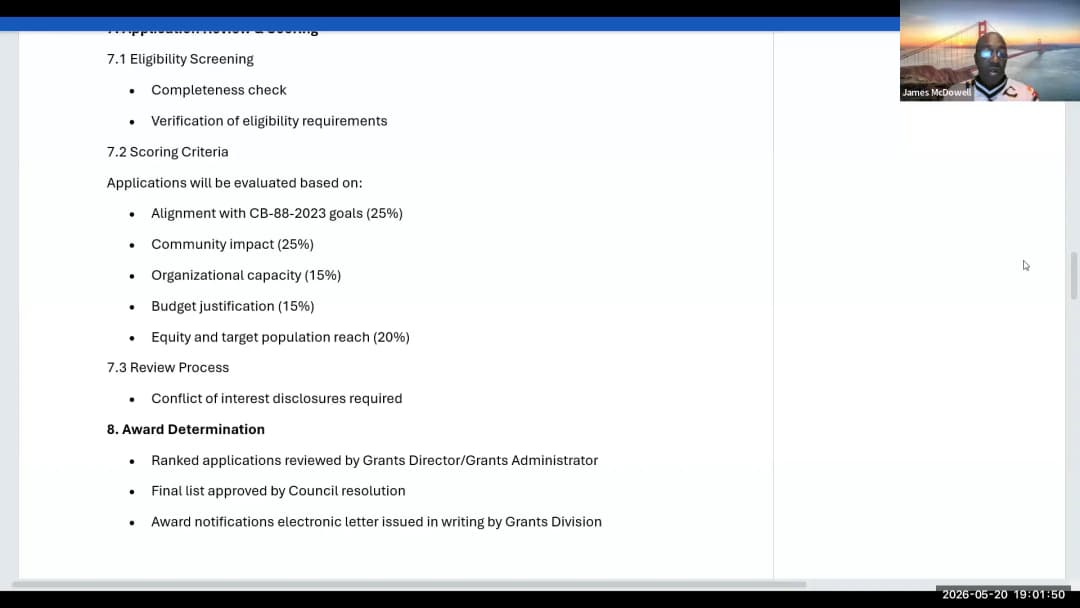
Note: The transcript indicates the meeting was held on Wednesday, May 20, 2026, but the provided instruction specifies the date as May 22, 2026. This summary uses the provided date. The Cannabis Reinvestment and Restoration Board met virtually to discuss legislative updates, finalize the grant methodology, and plan next steps. The meeting began with a delay due to lack of quorum but later achieved seven members. Consent Calendar - Minutes from May 6, 2026, were approved with a correction on the adjournment motion. Vote: 7-0. Public Comments & Testimony - No public comments were made. Discussion Items - Legislative Update: Vice Chair McDowell reported that the executive branch had decided not to submit legislation with a lead agency, as previously discussed. Council member Ayala expressed that she was not comfortable releasing administrative fees (15%) and preferred that they go toward grants. Board members discussed the need for administrative funding to manage the process, including town halls and application review. Shannon Rogers (Grants Director) agreed to follow up with OMB and the chair. - Methodology Finalization: The board reviewed the Standard Operating Procedure (SOP) for grant administration. Key debates and decisions included: - Section 6.1: Adjusted language to read "based on one of the 89 disproportionately impacted areas within the designated zip codes in Prince George's County as identified by the Office of Social Equity and confirmed by the state's attorney's office." The phrase "confirmed by the state's attorney's office" was clarified as operational. - Funding Categories: The board agreed to align the categories with state law (A through H) and to add subcategories/examples for clarity. Marion Nyang volunteered to draft example subcategories. - Role of the Board in Award Determination: A lengthy discussion occurred over whether the board should directly select grantees or rely on an external panel. Several members (e.g., Nyang, Doris, Garrett) argued the board should be heavily involved, while others (e.g., Campbell, Eubanks) cautioned about appearance of impropriety and noted that the grant department typically manages such processes. It was clarified that the board can design its own process for prioritizing requests. - Timeline: Council Chair Ayala requested that grant recommendations be submitted to the council by August. Many members, including Doris and Mims, expressed that this timeline was unrealistic given the remaining work. The board agreed to prioritize finalizing the methodology first. - Subcommittees: Members volunteered for specific funding categories: Mental Health/Substance Use (Campbell, Jordan), Education/Youth (McDowell), Housing/Homeless Prevention (Doris), Workforce Development (Nyang), Justice Involved (Mills), Accessibility/Transportation (Mims, Atchison). Key Outcomes - The board will meet again on May 27, 2026, as a working session to finalize the methodology, including subcategories. - The council chair will be invited to the next regular meeting on June 3, 2026. The board voted 5-0 (with two staff abstaining) not to invite her to the May 27 meeting. - Subcommittees will develop lists of example subcategories for each funding area. - The methodology document will be updated by staff and circulated for final input before the next meeting. - The board acknowledged the need for administrative support to meet the accelerated timeline and will communicate this to the council chair.
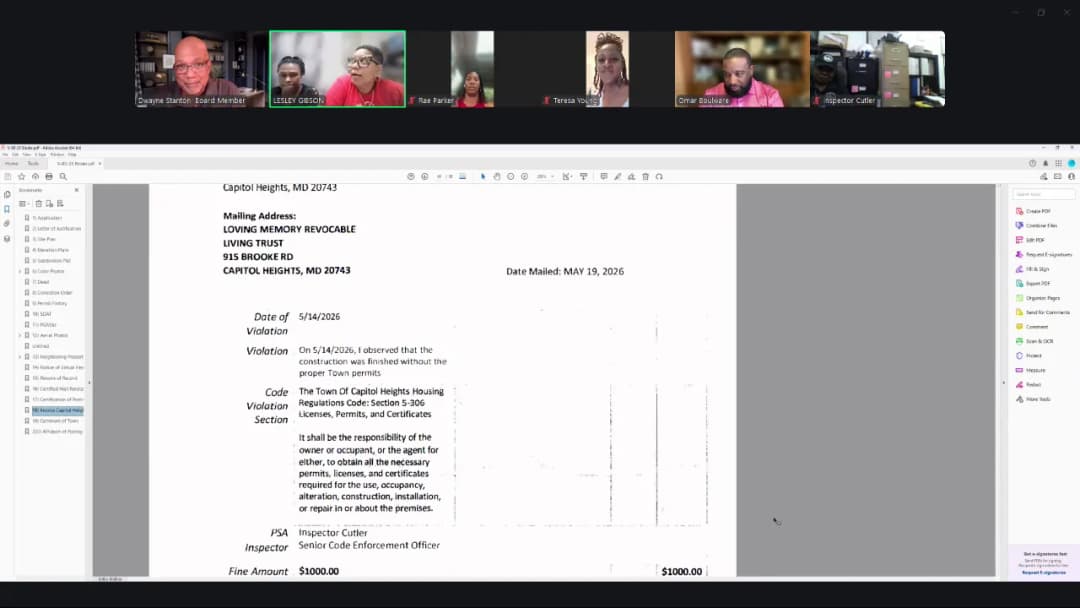
The Board of Appeals convened virtually at 6:04 PM on May 20, 2026, with Chair Bulware and Member Stanton present (Vice Chair absent, Ms. Johnson out of town). The hearing began with the announcement of the passing of former Chair Bobby Mack and a moment of silence. The board heard one variance case (V-80-25), postponed one zoning appeal (V-16-26) by agreement, and approved the minutes from the May 6, 2026 meeting. The meeting adjourned at 6:48 PM. Announcements & Preliminaries - Postponement: The zoning appeal V-16-26 (OZA Arcadian House Apartments, LLC) was postponed by agreement of the parties; a new date will be scheduled. - Tribute: Chair Bulware announced the passing of former Chair Bobby Mack on May 2, 2026, honoring her 20 years of service and leadership. The board observed a moment of silence. New Variance: V-80-25 (Loving Memory Revocable Living Trust) Case: Request for variances of 1,300 square feet net lot area, 9 feet rear yard depth, and 1-foot side lot line for an accessory building (carport) to validate existing conditions and obtain a building permit for the unauthorized construction of a 16' x 16' one-story addition at 915 Brooke Road, Capitol Heights. Petitioner's Testimony (Leslie Gibson): - Purchased the home 24+ years ago; desired to add a bedroom to age in place. Hired a contractor (Will and Davis Construction) after a microburst caused $20,000 in damage in June 2025. The contractor discouraged permits, claiming they were optional; a neighbor (Juliana Letron) informed her permits were required. Contractor did not pull permits, and a violation notice was issued. Gibson stated she had no knowledge of the permit requirement until after construction began. She described her lot as uniquely smaller and narrower (55.183 feet vs. 6,500 sq ft minimum) than neighboring properties. All adjacent neighbors already have additions; the addition is not visible from the street and does not cross property lines. She has a fine of $1,000 from the Town of Capitol Heights, which she plans to pay the morning after the hearing. She has since hired new plumbers and electricians to obtain proper permits. Town of Capitol Heights Testimony (Inspector Levy Cutler and Town Administrator Joy Ren): - The town has no opposition to the construction as long as the petitioner complies with Prince George's County guidelines, obtains necessary permits, and pays the $1,000 fine. They confirmed the fine invoice was delivered on the day of the hearing. Witness Testimony (Supporting Petitioner): - Ray Parker (neighbor): Expressed support, noting Gibson is a responsible neighbor. The addition has not negatively impacted the neighborhood or quality of life; the structure fits appropriately within the community. - Teresa Young (friend): Described Gibson as very responsible and noted the addition is beautiful with no complaints from neighbors. Expressed frustration that the contractor misled Gibson. - Juliana Letron (neighbor): Recalled advising Gibson about permits. Her own addition required permits and was done through an architect. She testified that Gibson relied on the contractor's promises and was rushed. Board Deliberation: - Board members questioned Gibson about her awareness of permit requirements, efforts to contact the contractor, and the uniqueness of her lot (narrower than others, built circa 1954-56). The board noted the practical difficulty was not self-inflicted. Key Outcomes - Motion to Hold Open Variance Case V-80-25: Member Stanton moved to hold the case open until written confirmation is received from the Town of Capitol Heights that all fines have been paid. Chair Bulware seconded. The motion carried 2–0. The petitioner is not required to attend the next meeting; the board will make a final decision at the June 3, 2026 meeting upon receipt of confirmation. - Minutes Approval: The board unanimously approved the minutes from the May 6, 2026 hearing (motion by Member Stanton, seconded by Chair Bulware; vote 2–0). - Next Steps for Petitioner: Gibson was advised to pay the $1,000 fine to the Town of Capitol Heights and request written confirmation to the board administrator. Once received, the case will be placed on the June 3, 2026 agenda for decision.
The Prince George's County Domestic Violence Work Group, chaired by Council Member Wanika Fisher, met on Monday, May 18, 2026, at 1:30 PM. The meeting included approval of prior minutes, a survivor testimony from the Family Justice Center, a presentation from the Home Builders Care Foundation, and a discussion on housing and services for domestic violence survivors. Consent Calendar - Minutes Approval: The group unanimously approved minutes from the March 30, 2026 in-person meeting and the April 20, 2026 virtual meeting. Motion by an unnamed member, seconded by Miss Paris from DePI, with all present voting in favor. Public Comments & Testimony - Survivor Testimony (Ms. Brittany Johnson): Ms. Johnson, a client of the Family Justice Center (FJC), shared her positive experience with the FJC, detailing support received including mental health therapy, medication management, relocation assistance, legal aid for custody, and child essentials. She identified housing affordability and the need for an outreach program as key challenges. She praised her advocates, Miss Monique and Miss Smalls, for their help. Council Member Fisher thanked her for her vulnerability. Discussion Items - Home Builders Care Foundation Presentation: Director Patty B. King presented via video and slides. The foundation is a 501(c)(3) nonprofit that partners with housing-related nonprofits. Key statistics: 24 projects in Prince George's County since 2020 ($200,000 investment); $2.7 million in total projects across Maryland over five years; partnered with 55 nonprofits; upgraded 1,200+ shelter units; served 30,000 men, women, and children. A notable project was a $100,000 renovation at the Community Crisis Center's Safe Haven shelter, including deck, windows, playground grading, and handicap ramp repairs. Ms. King noted challenges with permitting, e.g., needing a site plan for a front stoop replacement. The foundation does not fund individual homeowner repairs but works through nonprofits like Christmas in April. On a question from Ms. Jackie about survivor home repairs, Ms. King indicated the foundation could not directly fund such work but might contribute to a dedicated fund managed by a nonprofit. She mentioned a board member from Harkins Builders who could discuss tax-credit affordable housing projects. - Housing Discussion: Council Member Fisher emphasized the lack of a comprehensive county plan for domestic violence housing. She raised the possibility of using surplus county property for shelters or long-term housing and incentivizing partnerships with houses of worship. The Redevelopment Authority (Ms. Smith) noted ongoing collaboration with a special projects manager for a women's shelter and mentioned a future project: "Suitland Women and Children's Family Supportive Housing" with Mid-Atlantic Real Estate Investments. Lori Paris (DePI) offered to assist with permitting issues. The group agreed to invite developers and the Harkins Builders representative to future meetings. Key Outcomes - Next Meeting: Scheduled for Monday, June 15, 2026, at 1:30 PM. The topic will be housing, with invited representatives from the development community including Harkins Builders. - Action Items: Mr. Tut will follow up with Ms. King to invite her board member to the next meeting. The group will share information about the Home Builders Care Foundation's upcoming outreach breakfast. Council Member Fisher directed Mr. Tut to collect contacts for a potential new fund for small security repairs in survivors' homes. - Adjournment: Motion to adjourn by Miss Paris, seconded, meeting ended around 2:30 PM.
The committee met on May 14, 2026, at 1:30 PM (called to order at 1:50 PM) and adjourned at 3:06 PM. Present: Chair Wanika Fisher, Vice Chair Wala Blegay, Council Member Danielle Hunter, and Council Member Krystal Oriadha. Council Member Edward Burroughs was absent. The committee considered five pieces of legislation and advanced all to the full County Council. Public Comments & Testimony - Fibroid-related bills (CR-030, CR-031, CB-036): Multiple speakers testified in support, sharing personal experiences with uterine fibroids. Speakers included Kim Lee King (fibroid ambassador), Nicole McCriman (Communications Director, Fibroid Foundation), and Dr. Claudine Wadiozer (family medicine physician and county resident). They emphasized the need for public awareness, early diagnosis, and workplace accommodations, noting that up to 80% of Black women develop fibroids by age 50. - Accessibility Task Force (CR-024): Janice Samuels, Carolyn Scales, Lakeisha Butler, and another resident advocated for greater representation of blind, low-vision, deaf, and hard-of-hearing residents on the task force. They argued that the initial proposal of only one blind or low-vision resident was insufficient to reflect the diversity of needs, and that lived experience is critical for effective recommendations. Discussion Items - CR-024-2026 – Accessibility Task Force for the Blind and Deaf: Committee staff presented the resolution and proposed amendments (draft two). Amendments expanded the membership to include one resident each who is blind, low-vision, deaf, hard-of-hearing, or deaf-blind; added a commissioner from the Prince George’s County Commission for Individuals with Disabilities and a member from the Coalition of Blind Residents; and required that 50% of task force members be individuals with disabilities. The task force must begin within 90 days, with preliminary findings due October 6, 2026, and final recommendations by December 8, 2026. The Office of Law and County Executive expressed no objections. - CR-030-2026 – Fibroid Healthcare Support: The resolution encourages the county health department to raise awareness, publish an annual report on reproductive health disparities, and promote early screening. The County Executive’s office noted no fiscal impact for the reporting requirement but stated the health department would partner with providers for screenings. The Office of Law found it legally sufficient. - CR-031-2026 – Insurance and Healthcare Access for Fibroids: This resolution urges state and federal governments to increase fibroid research funding and improve insurance coverage. The Office of Law and County Executive supported it. No fiscal impact to the county was identified. - CB-036-2026 – Women’s Health Workplace Protections: The bill originally required both county employees and contractor employees to receive accommodations for severe menstrual or fibroid-related symptoms. After debate, the committee adopted three amendments: (1) removed contractor requirements, replacing them with a notification to contractors; (2) moved the definitions section into the personnel code; (3) changed the bill’s mandate from “the county shall” provide accommodations to a requirement that OHRM notify county employees that existing FMLA/ADA rights cover fibroids. The Office of Law and County Executive supported the amended version. OHRM noted that serious health conditions are already covered under FMLA and ADA. - CB-038-2026 – Impersonation of Utility Companies and Government Agencies: The act creates penalties for falsely impersonating a utility company or government agency, with fines of $2,000 (first offense) to $5,000 (third offense) and up to 60 days imprisonment. Police data showed impersonation cases increasing, including six utility company cases in 2025 and a rise in law enforcement impersonation from 9 to 15 cases year-to-date. The Office of Law, County Executive, and bill sponsor (Council Member Fisher) supported the bill as a consumer protection measure. Key Outcomes - CR-024-2026: Favorably recommended with amendments (4-0, all present voted aye). - CR-030-2026: Favorably recommended. Note: Minutes record a vote of 3-0 with Vice Chair Blegay absent, but the transcript shows Blegay voting aye, resulting in a 4-0 vote. The discrepancy is noted. - CR-031-2026: Favorably recommended (4-0). - CB-036-2026: Favorably recommended with amendments (4-0). - CB-038-2026: Favorably recommended (3-0, with Blegay absent). All items will be sent to the full County Council for consideration.
The Government Operations and Fiscal Policy (GOFP) Committee of the Prince George's County Council met on Thursday, May 14, 2026, at 12:17 PM in Committee Room 2027. Chair Edward Burroughs presided. Three members were present: Chair Burroughs, Council Member Jolene Ivey, and Council Chair Krystal Oriadha. Vice Chair Timothy Adams and Council Member Wala Blegay were excused. The committee considered two items: CB-039-2026 (Election Day holiday) and CR-032-2026 (council budget parity). The meeting adjourned at 12:24 PM. Discussion Items CB-039-2026 – An Act concerning the Election Day holiday, sponsored by Council Member Blegay. Because the sponsor was excused, the item was deferred to a later date. CR-032-2026 – A Resolution concerning County Council budget parity, sponsored by Council Members Ivey and Harrison. Council Member Ivey presented the resolution, stating that during the previous budget cycle she was the only council member who did not receive additional funding for her office, despite representing the entire county as an at-large member. She expressed frustration that her requests for equal resources were not addressed. Chair Burroughs responded that Council Member Ivey had refused to attend a scheduled budget meeting and had not requested additional funding in her submitted budget priorities. He provided email correspondence to support his account. A motion to move the resolution favorably was made by Council Member Ivey but failed for lack of a second. Council Member Oriadha did not second the motion. The resolution did not advance. Key Outcomes - CB-039-2026 was deferred to a later date due to the sponsor's absence. - CR-032-2026: The motion to move the resolution favorably failed for lack of a second; the resolution was not adopted.
On Thursday, May 14, 2026, the Prince George's County Council and Montgomery County Council held a joint virtual bi-county meeting to review and adopt the Fiscal Year 2027 budgets for the Washington Suburban Sanitary Commission (WSSC Water), the bi-county portion of the Maryland-National Capital Park and Planning Commission (M-NCPPC), and the Washington Suburban Transit Commission. The meeting began with introductions from council members of both jurisdictions, followed by staff presentations and a unanimous vote to approve the proposed budgets. Discussion Items - FY2027 Budget Recommendations: Council staff from both counties presented joint recommendations: - For the M-NCPPC Central Administrative Services (CAS) budget, staff recommended approval with a reduction of $223,795 for Prince George's County and $202,123 for Montgomery County, resulting in revised FY2027 CAS budgets of $14,961,244 (Prince George's) and $13,541,014 (Montgomery). - For agency-wide collective bargaining and compensation policies, staff recommended supporting the amounts allocated in the commission's FY2027 budget – $8.2 million for Prince George's County and $5.5 million for Montgomery County – and that compensation adjustments not exceed these figures. - For WSSC Water, staff recommended approval of the budgets and Capital Improvements Program as submitted by WSSC Water. - For the Washington Suburban Transit Commission, staff recommended approval of the proposed FY2027 amounts: $149,293 for Prince George's County and $171,793 for Montgomery County. - Voting Procedure: Chair Oriadha outlined the traditional voting procedure requiring a motion by one council member, a second by a member of the other council, and a majority vote from each council to pass. - Motion and Vote: Councilmember Don Lidke (Montgomery County) made a motion to approve all three budgets; Vice Chair Eric Olson (Prince George's County) seconded. The motion passed unanimously with all council members voting aye, no opposition. Key Outcomes - The councils unanimously approved the FY2027 budgets for WSSC Water (as submitted), the M-NCPPC CAS budget (with reductions as recommended), and the Washington Suburban Transit Commission (as proposed). - The councils also endorsed the compensation policies and amounts for M-NCPPC employees, limiting adjustments to the proposed totals ($5.5M for Montgomery, $8.2M for Prince George's). - The meeting adjourned after the vote, with no further business.
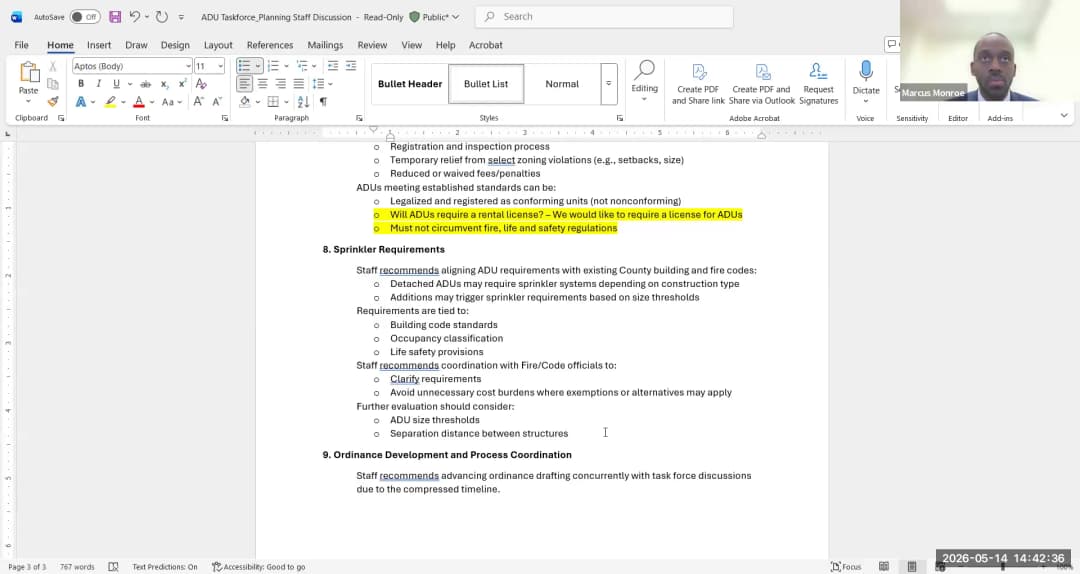
The Prince George's County Accessory Dwelling Units Task Force met on May 14, 2026, to finalize recommendations with the Planning Department. The meeting focused on refining key provisions for an ADU ordinance, including definitions, height standards, zoning, setbacks, owner-occupancy, amnesty for existing units, and sprinkler requirements. The task force engaged in detailed discussions and reached several consensus points, while leaving some items for further deliberation. Public Comments & Testimony - Ms. Monroe raised concerns about height compatibility, illegal structures, and the need for consistent code enforcement. She emphasized that ADUs should not tower over existing homes and supported a maximum height of 22 feet with the requirement that attached ADUs not exceed the primary structure's height. - Ms. Russell questioned whether the rear setback could be reduced from 5 feet to 2 feet to accommodate existing structures, but after hearing fire safety and cost concerns, agreed that 5 feet was feasible. - Ms. Abrams Davis supported owner-occupancy with carve-outs (e.g., for the sandwich generation) and advocated for an amnesty program to legalize safe existing ADUs. She also highlighted the need for minimum height standards and referenced universal design. - Ms. Jo argued against mandatory owner-occupancy, stating it would unfairly restrict small homeowners who already rent out primary residences and wish to add ADUs for affordable housing. She urged the council not to overlook individual landlords in favor of large corporations. - Ms. Sorrow strongly supported owner-occupancy to prevent ADUs from becoming investment businesses, noting that rental licensing already provides safety oversight. - Mr. Campbell outlined added costs of small setbacks (surveys, access, fire safety) and supported 5 feet. He also noted the state bill HB1538 (requiring both internal and external ADUs) stalled in committee and is not law. - Mr. Andrew supported amnesty but emphasized that life-safety requirements must not be waived. He cautioned against allowing ADUs to circumvent safety codes. - Ms. Martin Russell raised concerns about maximum occupancy in ADUs and requested that occupancy limits be clearly referenced in the ordinance. Discussion Items - ADU Definition: The planning department recommended defining ADUs as a distinct residential use separate from accessory structures, explicitly as a self-contained dwelling unit with kitchen, bathroom, and sleeping area. Task force members agreed. - Height Standards: The task force debated whether to restrict attached ADUs to the primary structure's roofline and set a 22-foot cap for detached units. Issues of slope and neighborhood compatibility were discussed. Consensus emerged: attached ADUs shall not exceed the height of the primary structure; detached ADUs shall not exceed 22 feet nor the height of the primary structure, with exceptions for slope to be addressed in code language. - Zoning Applicability: The task force originally limited ADUs to single-family detached zones. Planning staff suggested allowing ADUs in all zones where single-family detached dwellings are permitted (e.g., RSFA, AG). A clear table for residents was recommended. The task force did not revisit the exclusion of townhouses. - Setback Requirements: Planning staff recommended a minimum 5-foot setback for detached ADUs due to fire safety and livability standards. Task force members acknowledged the rationale and supported 5 feet, despite earlier consideration of 2 feet. - Owner Occupancy: The task force had previously recommended that one dwelling unit be owner-occupied. Planning staff proposed flexibility for exemptions (e.g., medical, caregiving). After debate, the task force leaned toward requiring owner-occupancy with carve-outs for temporary absences and caregiving situations. No final vote was taken; further research was requested. - Amnesty Framework: Planning staff presented a concept to legalize existing unpermitted ADUs by bringing them into compliance, focusing on safety rather than demolition. Several members supported the idea but stressed that life-safety codes must be met. The task force agreed to include an amnesty recommendation. - Sprinkler Requirements: The existing county code requires sprinklers for new residential structures. Task force previously endorsed this. Planning staff raised cost concerns, especially for existing homes without sprinklers. Discussion included size thresholds and exemptions if the primary dwelling lacks sprinklers. No change was made to the recommendation, but staff were asked to explore cost-mitigation options. Key Outcomes - Consensus on Key Points: - ADU definition as a dwelling unit with kitchen, bathroom, sleeping area, distinct from accessory structures. - Height: Attached ADU not exceed primary structure; detached ADU not exceed 22 feet nor primary structure height, with slope considerations. - Setbacks: Minimum 5 feet for detached ADUs. - Zoning: ADUs by right where single-family detached is permitted; clear table to be created. - Amnesty: Task force supports a framework to legalize existing unpermitted ADUs through safety compliance. - Owner Occupancy: No final vote; task force directed further research on carve-outs and potential limitations. - Sprinklers: Requirement affirmed; planning department to explore thresholds and cost relief. - Drafting Authorized: The planning department will begin drafting ordinance language concurrent with finalizing recommendations. - Next Steps: The task force may hold one more meeting to finalize recommendations before the June 8 legislative deadline. Members will vote by email on any updates to previous decisions. The chair will compile a unified document.
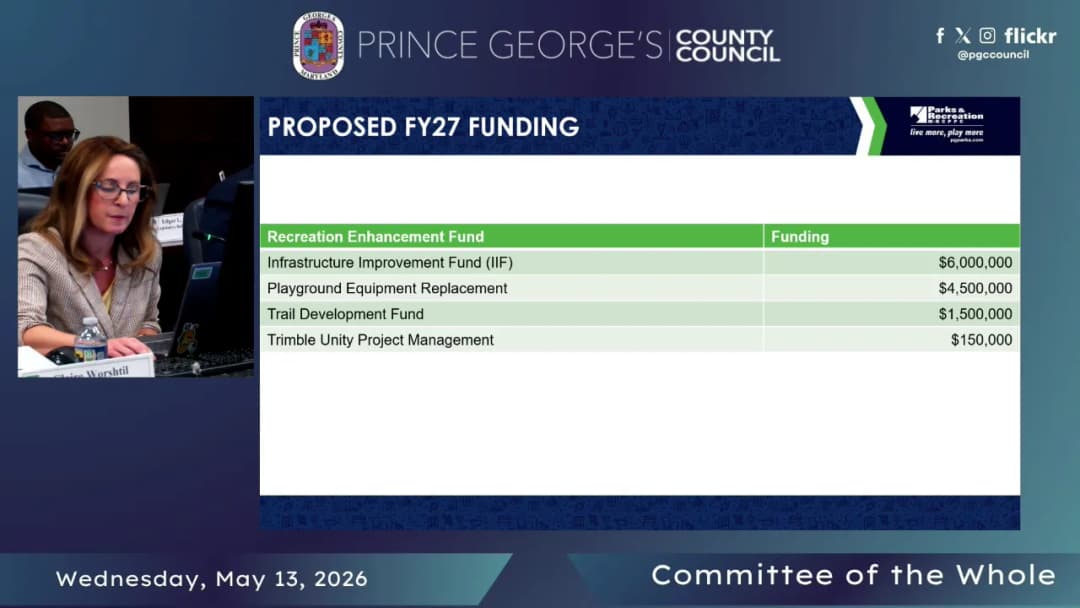
The Prince George's County Council, sitting as the Committee of the Whole, convened on Wednesday, May 13, 2026, at 10:34 a.m. to conduct a budget worksession on the Maryland-National Capital Park and Planning Commission (M-NCPPC) proposed Capital Improvement Program (CIP) for Fiscal Year 2027. The meeting, which concluded at 10:53 a.m., featured a presentation from M-NCPPC leadership detailing the Commission's six-year capital plan, funding sources, project priorities, and equity goals. No votes were taken on the budget item. Discussion Items - CIP Overview and Development Process: Claire Worshtil, CIP Budget Manager, outlined the CIP creation process, which is guided by planning documents (Formula 2040, Land Preservation and Parks Recreation Plan), community needs, staff capacity, and available funding. The proposed CIP must adhere to county spending affordability guidelines. - Funding Sources and Fiscal Context: Funding for the CIP comes from six sources: tax revenue (pay-go), general obligation bonds, state Program Open Space (POS), developer contributions, grants, and transfers from completed projects. The FY27 proposed CIP is $118 million (a $9.8 million increase in general obligation bonds, $7.55 million in state bonds, and $4.7 million in POS), reduced from prior years due to fiscal uncertainty. The six-year plan (FY27-32) totals $441 million. - Equity and Distribution: Staff presented an equity map showing that 19% of CIP projects (over 12 years) are in low-equity areas and 37% in medium-low equity areas, totaling more than half of all projects. The department aims to increase project numbers and value in both high- and low-equity areas. - Project Highlights and Investments: The FY27 CIP includes investments in park building replacements, Glendale Aquatics (implementing Formula 2040), Henson Creek Golf Course (golf study recommendations), Walker Mill and Watkins Regional Parks, and community-desired facilities such as Prince George's Stadium, Equestrian Center, SPLEX, and Public Playhouse. Recreation enhancement funds support playground replacements (9 per year), trail development, infrastructure improvements (roofs, HVAC), and bridge replacements (over 200 bridges managed). - Amendments and Updated Projects: Since the initial January proposal, the amended CIP added $4.7 million in POS for Service Area 7 Aquatic Complex and William Beans Playground; state grants for Park Police Headquarters, Rollingcrest Chillum Community Center, Surratts Outdoor Facilities, Wilmer's Park, Gunpowder Golf Course, and Dinosaur Park; a new Bridge Replacement Fund; and increased funding for Lane Manor Splash Park, Bladensburg Waterfront Park Playground, Campus Drive Trail, and the Trail Development Fund due to rising costs. - FY26 Accomplishments: Staff reported completing 18 playground replacements, 6 field upgrades, 17 pavilion replacements, improved College Park Airport runway, built a new boat landing, acquired three new park properties, and completed 67 projects totaling $82 million in investment. Key Outcomes - No vote was taken on the budget item; the session was held for discussion only. - The meeting adjourned at 10:53 a.m. via a unanimous motion (Vice Chair Olson moved, Council Member Dernoga seconded).