Browse by city
Date range
Search help

Search titles, summaries, topics and stored transcripts together. Keywords may match separately; put the whole query in double quotes for a phrase. Matching follows word analysis, so punctuation is not exact. Both dates are included. Documents are not searched.

SHOWING 141–150 ENTRIES
141
MAY 13, 2026 · PRINCE GEORGES COUNTY, MARYLAND · COUNTY COUNCIL & BOARDS
Streamlining Development Review Work Group Meeting - May 13, 2026

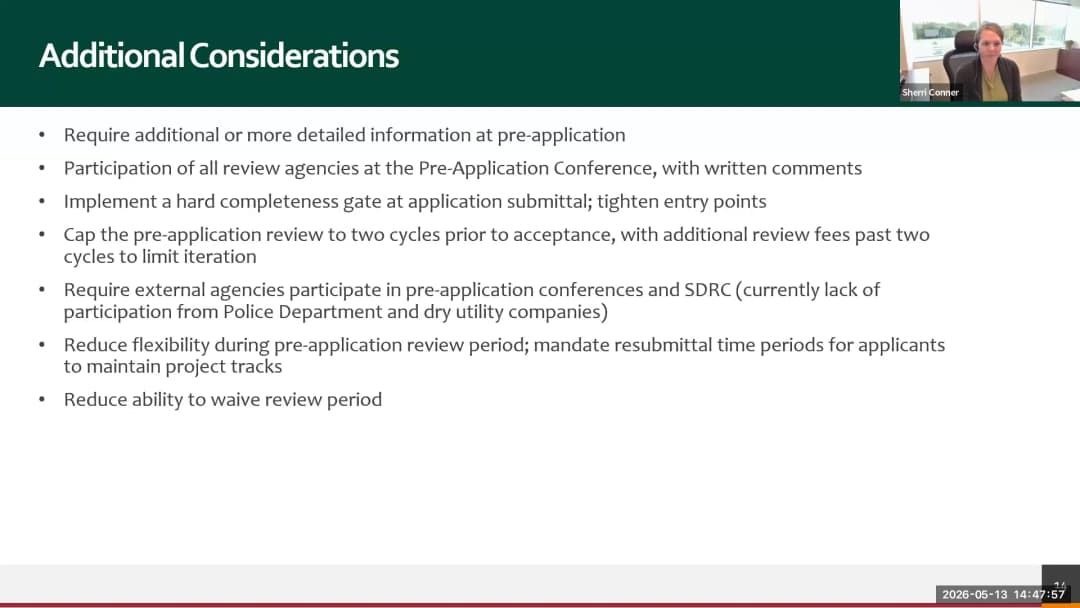
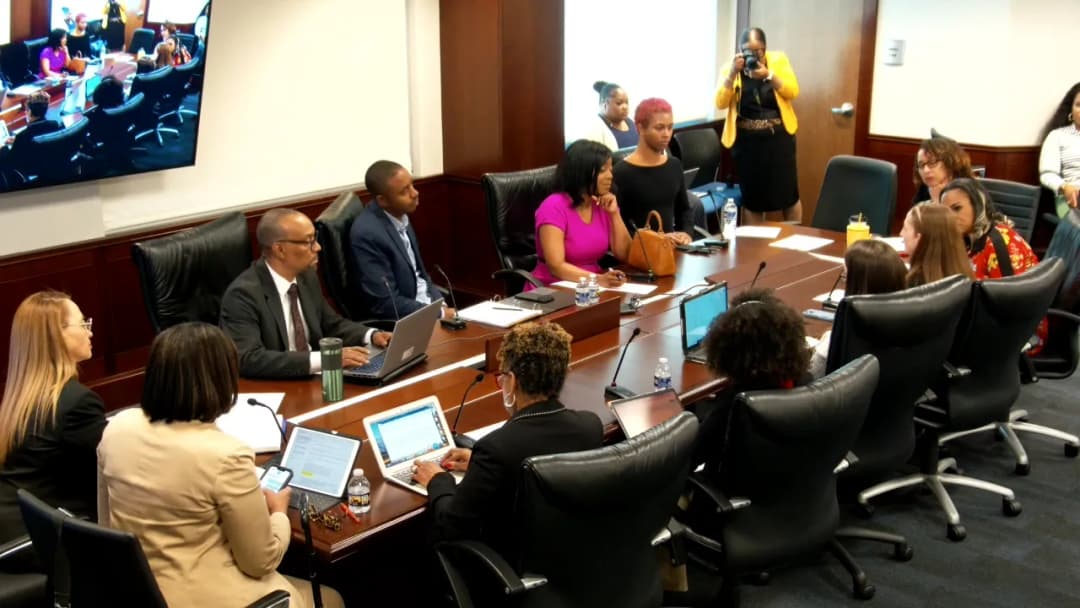
The Prince George's County Streamlining Development Review Work Group held its second meeting on May 13, 2026, to discuss improving the timing and processes for development review applications, particularly detailed site plans. The meeting featured a presentation from Sherry Connor, Division Chief of the Planning Department, on the site plan process, followed by discussion among work group members on challenges, opportunities, and potential recommendations. Discussion Items - Presentation on Detailed Site Plan Process: Sherry Connor presented an overview of the detailed site plan process under Subtitle 27 of the zoning ordinance. She explained that detailed site plans depict site development details such as building location, landscaping, parking, and signage, and must demonstrate conformance with applicable zone standards. The process includes a pre-application conference, pre-application neighborhood meetings, submittal to the planning department, staff review, and a public hearing before the planning board. Key challenges include lead times for pre-application conferences, limited information at early stages, and the applicant's investment in plans without certainty of requirements. Opportunities include overlapping public notices, concurrent review with subdivision and permitting, and possible exemptions for smaller projects. Risks include incomplete submittals leading to multiple resubmissions and extended timelines. - Timeline Variability: Connor presented examples of recent detailed site plan timelines, showing significant variation. A multifamily development of 405 units took about 18 months from pre-application to planning board. A townhouse development took 22 months, while a non-residential development took over two years. Most time was attributed to applicant-led activities such as preparing submissions and addressing comments, with no mandatory time frames for those steps. The planning department's codified time frames are generally met once an application is accepted. - Work Group Discussion: Work group members raised several points: - Greg Smith (community representative) observed that presentations and agendas are not posted online in advance, hindering meaningful discussion and public transparency. He noted that applicants sometimes submit incomplete applications and that the planning director waives requirements without explanation. He suggested extending the statutory review deadline from 70 to 120 days to give staff and agencies more time for thorough review. - Matt Dedesco (developer representative) countered that delays between pre-application and submission are often due to prerequisite approvals (e.g., natural resource inventory, site development concept plans) which are required before acceptance, not applicant choice. He emphasized that applicants are not intentionally delaying. - Ms. Camp (work group member) supported that view, saying both applicants and staff work hard, and the process should not be seen as adversarial. She noted that the new zoning ordinance requires learning by all parties. - Mr. Jordan (work group member) echoed the need for materials beforehand and asked for Connor’s recommendations for streamlining. Connor mentioned that the planning department held a charrette with the development community and is synthesizing feedback into a white paper. - Mr. Villegas (work group member) suggested aligning the cycles of prerequisite plans (e.g., stormwater concept plans) with the detailed site plan to avoid months of sequential processing. - Mr. Franklin (work group member) recommended allowing stormwater management concept plans, natural resource inventory, and sediment control plans to be filed concurrently with the detailed site plan rather than required before acceptance. - Mr. Monroe (work group member) identified four key areas: concurrent vs. sequential processing, reducing submission cycles, clarity around checklists, and early inter-agency coordination. He also suggested a unified dashboard for applicants to track review progress. - Director Hightower (chair) proposed creating a guidebook for participants with different knowledge levels, which received general agreement. Key Outcomes - The work group identified several potential recommendations to expedite site plan review: - Create a guidebook explaining the development process for applicants and community members. - Allow concurrent filing of prerequisite plans (stormwater, natural resource inventory, sediment control) with the detailed site plan, rather than requiring prior approval. - Enforce a hard completeness gate at application submission, with a capped number of review cycles (e.g., two) or fees for additional iterations. - Mandate early coordination meetings with all relevant agencies during pre-application to provide integrated comments. - Reduce the ability to waive the review period for detailed site plans. - Extend the statutory review deadline from 70 to 90 or 120 days to allow more thorough review. - Leverage AI technology for pre-check of applications to identify missing information early. - Expand applicability of site plan exemptions for smaller residential projects. - Develop a unified dashboard for applicants to track the status of their review across agencies (noted as a heavy lift). - No formal votes were taken; recommendations will be submitted via an Excel spreadsheet or email to staff for inclusion in the streamlining work group's spreadsheet. - The next meeting is scheduled for May 20, 2026, at 2 p.m., to discuss master plans, sectional map amendments, zoning map amendments, and other topics.
DEVELOPMENT REVIEW PROCESS 80% · PUBLIC ENGAGEMENT 18% · TECHNOLOGY AND INNOVATION 2%
142
MAY 12, 2026 · PRINCE GEORGES COUNTY, MARYLAND · COUNTY COUNCIL & BOARDS
Foster Care Task Force Meeting - May 12, 2026

The Foster Care Task Force held its inaugural meeting on May 12, 2026, at 6:45 PM, chaired by Councilmember Edward Burroughs. The meeting began with introductions from members representing various agencies, including the Department of Social Services, Department of Family Services, Prince George's County Public Schools, CASA, Paths for Families, and youth representatives. The task force's charge, established by CR-126-2025, is to examine county practices, recommend policies, and propose budget actions to improve outcomes for foster care youth and children whose parents are incarcerated. The discussion focused on identifying gaps, hearing from lived experiences, and planning initial steps. Discussion Items - Youth Perspectives on Activities and Safe Spaces: Youth members Morocco Battle and Psalm Folks emphasized the need for safe, fun activities and a community where foster youth can connect with peers who share similar experiences. They highlighted that many foster youth lack stable, supportive environments and that structured programs like the Student Leadership Academy (SLA) provide critical stability and opportunities. - Foster Parent Challenges: Jocelyn Rao, a licensed foster parent of 19 years, described the lack of support for foster parents, especially those caring for medically fragile or therapeutic children. She noted that foster parents often face disruptions to their workday, lack of respite, and difficulty accessing services like tutoring, extracurricular activities, and mental health support. She called for innovative coordination among agencies and automatic enrollment in county recreation programs. - Barriers of Placement Outside the County: Sarah Boskin from CASA reported that of 44 youth on their waitlist, only 8 reside in Prince George's County. Many foster youth are placed in other counties, making it difficult to engage them in local programs and maintain connections with family. The need for more in-county resource families and kin placements was stressed. - Support for Birth Families and Kinship Care: Members discussed the importance of including birth families and kinship caregivers (grandparents, aunts, uncles) in support systems. Jocelyn Rao suggested mentoring birth parents to aid reunification, and Elena Balan Butler (Director of Family Services) noted that the county is prioritizing kin-first placements and providing stipends to kinship caregivers. - Leveraging Community Resources: Councilmember Burroughs proposed making all park and planning and school system activities free for children in foster care or with incarcerated parents. He also suggested engaging churches and businesses to provide holiday gifts and ongoing support, noting that current systems may not be well-known. Jennifer Maya Thompson (Director of DSS) acknowledged that the department has many services (respite, financial literacy, employment support) but needs to improve public awareness. - Proposed Summit/Event: Autumn Joy (radio personality and ambassador) proposed organizing a summer event for foster youth and parents, combining fun activities with resource tables (e.g., banking, mental health). The group agreed to plan a gathering to collect input from youth and foster parents directly. Key Outcomes - Next Meeting: The next meeting will include a presentation from the Department of Social Services to outline current services, programs, and gaps. - Event Planning: A subgroup will be formed to plan a summit for foster youth and parents, designed to gather feedback and provide resources. Volunteers were requested to join the planning group. - Data Collection: The task force will send correspondence to foster parents and youth to identify their needs and preferences before the event. - No formal votes were taken, but all members expressed consensus on the proposed next steps. The chair emphasized the need for actionable policy and budget recommendations, noting that the county budget is currently under negotiation.

YOUTH PROGRAMS 41% · FOSTER CARE 32% · MENTAL HEALTH AWARENESS 9% · OUT OF HOME CARE 8%
143
MAY 12, 2026 · PRINCE GEORGES COUNTY, MARYLAND · COUNTY COUNCIL & BOARDS
Planning, Housing and Economic Development Committee Meeting - May 12, 2026

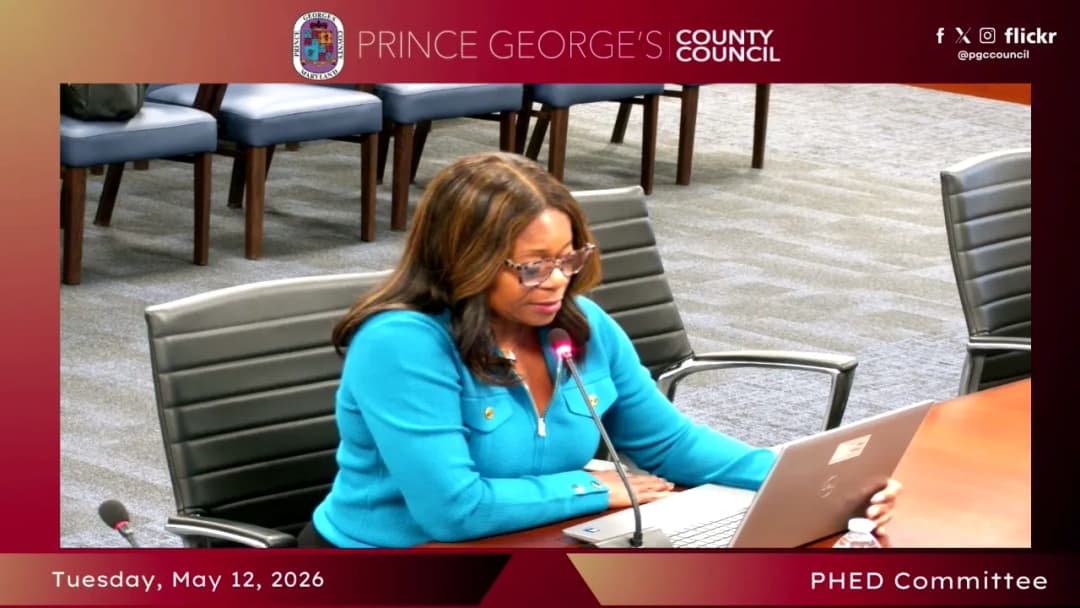
This meeting of the Prince George's County Council's Planning, Housing and Economic Development (PHED) Committee on May 12, 2026, covered two main agenda items: a legislative bill (CB-035-2026) to expand daycare access by easing zoning regulations, and a budget worksession for Experience Prince George's, the county's current destination marketing organization. The committee voted to hold the daycare bill to allow the sponsor to review proposed amendments, engaged in discussion about the significant budget cuts and planned replacement of Experience Prince George's with a new entity, Destination Prince George's. Public Comments & Testimony - Bradley Farrar (public speaker) expressed support for CB-035-2026 but requested an important clarification: the bill’s definition of “daycare center for children” currently excludes recreational before- and after-school programs. He argued that for working families, before- and after-care are child care, not recreation, and asked the committee to amend the definition to include those programs. He noted the bill already preserves safeguards for licensing, outdoor play, fencing, lighting, and drop-off/pickup. Discussion Items - CB-035-2026 – Day Care Centers for Children: Committee staff summarized the bill, which would allow daycare centers as a permitted use in all zones (removing special exception and detailed site plan requirements), provide community notification, reduce parking minimums in transit-oriented and activity zones, and allow alternative parking compliance in other zones. The Planning Board supported the bill but recommended technical amendments: removing the detailed site plan exemption (since sites under 25,000 sq ft are already exempt, and larger projects would benefit from review), eliminating the notice provision (since there would be no public hearing for a permitted use), and correcting a parking citation to refer to existing right-of-way use rules. The Zoning Hearing Examiner also submitted technical amendments. The bill sponsor, Vice Chair Oriadha, arrived late and requested a hold to review all amendments, including the public testimony request to expand the definition. The sponsor noted ongoing state-level work on before/after-school care and was open to including the provision. Councilmember Dernoga highlighted the Planning Board's point about the detailed site plan exemption being unnecessary. - Budget Worksession – BU 2026-53 Experience Prince George's: David Noto, Legislative Budget and Policy Analyst, presented the FY27 proposed budget for Experience Prince George's. The county is transitioning to a new destination marketing organization, Destination Prince George's, which will receive $1 million in FY27. The proposed budget for Experience Prince George's is $729,100, a decrease of $914,000, mainly due to the planned replacement. The agency is funded over 80% by a county grant and receives at least 5% of hotel/motel tax (estimated $69,100 in FY27, up $6,000). Noto noted an error in the budget book regarding the hotel tax revenue amount. The agency is eliminating a position and converting another to part-time. He cautioned that fully defunding Experience Prince George's cannot occur until county law is changed and the state recognizes Destination Prince George's. Tracy Benjamin, Deputy Chief Administrative Officer for Economic Development, explained the county executive’s decision to refresh the DMO, citing plans for a nationwide search for a new CEO, creating a nonprofit and bylaws for Destination Prince George's, and offering employment to current employees. Councilmember Adams-Stafford asked about branding and a promotional video for the county, noting that current promotion focuses on National Harbor and the stadium, missing other assets. Benjamin responded that branding and a comprehensive video would be job one for the new DMO, and that the county has many assets (wineries, sports, entertainment, transit). Discussion also touched on the need for a unified campaign. Key Outcomes - CB-035-2026: A motion by Vice Chair Oriadha, seconded by Councilmember Olson, to hold the bill in committee was carried by a vote of 4-0 (Chair Blagey, Oriadha, Dernoga, Olson in favor; Councilmember Adams-Stafford absent). The sponsor will review all proposed amendments (from the Planning Board, Zoning Hearing Examiner, and the public testimony request) and bring a revised version to the next PHED meeting. - Budget Worksession (BU 2026-53): No vote was taken. The committee held an overview and discussion. The committee did not approve or reject the budget, but the discussion informed future actions. The meeting adjourned on a motion by Councilmember Adams-Stafford, seconded by Councilmember Olson, carried 4-0 (Oriadha absent at that time).

TOURISM PROMOTION 38% · ZONING AND LAND USE 36% · PROCEDURAL 12% · AFFORDABLE HOUSING 10%
144
MAY 12, 2026 · PRINCE GEORGES COUNTY, MARYLAND · COUNTY COUNCIL & BOARDS
Prince George's County Council Committee of the Whole Meeting – May 12, 2026

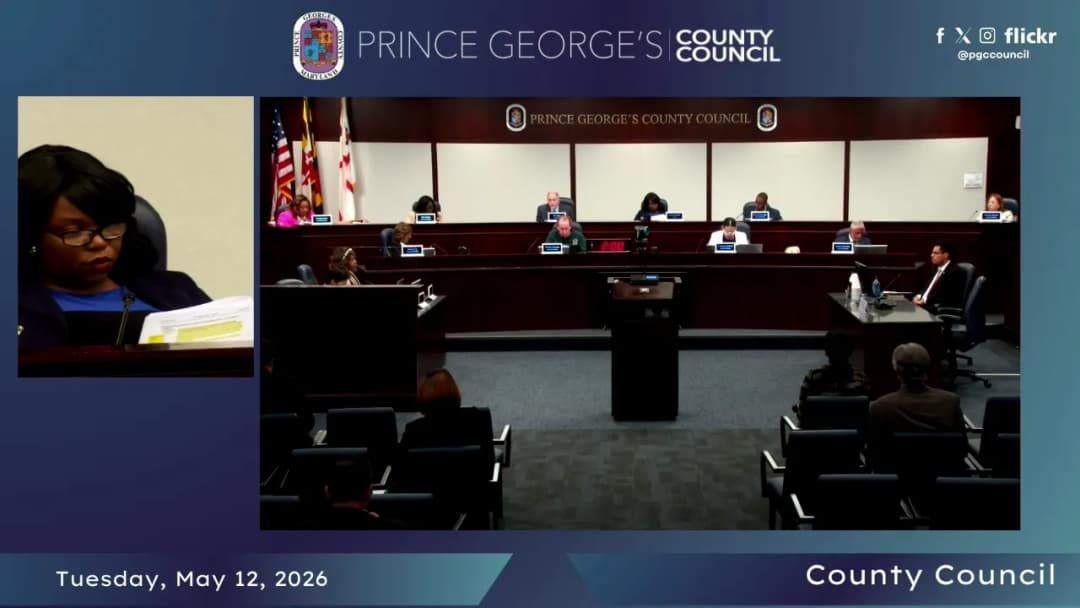
On Tuesday, May 12, 2026, the Prince George's County Council, sitting as the Committee of the Whole, convened at 11:20 a.m. with seven members present (Chair Oriadha, Vice Chair Olson, and Councilmembers Adams-Stafford, Blegay, Dernoga, Fisher, and Hunter; four members absent). The meeting addressed two items: a resolution approving the FY2027 Annual Action Plan for Housing and Community Development and a briefing on a supplemental allocation for the FY2026 Local Impact Grant Funds Multi-Year Plan. The meeting adjourned at 11:28 a.m. Discussion Items - CR-022-2026 – FY2027 Annual Action Plan for Housing and Community Development Staff presented the final federal formula allocations, totaling $10.9 million in official federal grant funds for FY2027. The county executive liaison expressed support for the legislation with amendments (Proposed Draft 2A). Chair Oriadha acknowledged offline discussions that resulted in dedicated resources for the southern part of the county and a commitment to include more countywide organizations in future funding lists. No public testimony was heard. - Local Impact Grant Funds Multi-Year Plan – Supplemental Allocation Staff briefed the committee on a proposed supplemental allocation of $4,053,700 for the approved FY2026 Local Impact Grant Funds Multi-Year Plan. The county code requires council review and comment before submission to the Local Development Council. Key Outcomes - CR-022-2026 was recommended favorably with amendments (Draft 2A) on a motion by Chair Oriadha, seconded by Councilmember Blegay. The vote was 7-0. - The Local Impact Grant Funds briefing was referred for preparation of an agenda letter (motion by Councilmember Dernoga, seconded by Vice Chair Olson; vote 7-0). - The meeting adjourned by unanimous consent.

PROCEDURAL 65% · BUDGET EQUITY ANALYSIS 26% · GRANT APPLICATIONS 9%
145
MAY 12, 2026 · PRINCE GEORGES COUNTY, MARYLAND · COUNTY COUNCIL & BOARDS
Prince George's County Council Meeting May 12, 2026: Proclamations, Legislation, and Enforcement Briefing

The Prince George's County Council convened at 10:24 a.m. on May 12, 2026 for Legislative Day No. 16. The meeting included proclamations, a consent agenda, public hearings, a briefing on enforcement of prior legislation, and adoption of several resolutions. The meeting recessed at 11:11 a.m. for the Committee of the Whole, reconvened at 12:43 p.m., and adjourned at 1:02 p.m. Consent Calendar - Approved minutes from May 4 (5:30 PM and 6 PM) and May 5 (regular and Board of Health). - First reading of CB-040-2026 (Human Trafficking Awareness Notice) referred to Government Operations and Fiscal Policy (GOFP) Committee. - First reading of CB-041 through CB-046 (Clean Corridors and Rapid Response, Clean Communities Transparency Dashboard, Vacant Property Maintenance and Abatement, Illegal Signage Enforcement, See It Snap It Get Paid, Vacant Real Properties Tax) all referred to Committee of the Whole. - Introduced CR-037-2026 (Stop Sign Monitoring Systems in Bladensburg) referred to Transportation, Infrastructure, Energy and Environment (TIEE) Committee. - Introduced CR-038-2026 (Temporary Moratorium on Convenience Store Growth in District 7) – removed from consent for separate consideration. - Introduced CR-039-2026 (Rural Promotion for Agri-Tourism) and CR-040-2026 (Agritourism and Winery Promotion Pilot Program) referred to Planning, Housing and Economic Development (PHED) Committee. - The consent agenda was adopted by a vote of 9-0 (Council Members Burroughs and Adams absent). Public Comments & Testimony - Calvin Hawkins, former Councilmember, addressed the Council expressing appreciation for their support of the county's youth. Discussion Items - Briefing: Prior Legislation Enforcement Action Plan – Chair Oriadha led a discussion on enforcement of prior legislation regulating tobacco stores and convenience stores. Deputy Director Lamont Hinton (Department of Permitting, Inspections and Enforcement, DPIE) presented a 90-day enforcement action plan including GIS mapping, compliance notifications, phased inspections, and penalties. Chair Oriadha noted that notifications required by previous legislation were not sent to stores under the prior administration. A loophole allowing tobacco sales under food and beverage use and occupancy was identified. The Council will introduce new legislation to close the loophole and regulate tobacco sales more strictly. - CR-022-2026 (FY2027 Annual Action Plan for Housing and Community Development) – After Committee of the Whole discussion, a new draft (2A) was substituted. The resolution was adopted by a vote of 10-0. - CR-041-2026 (Public Facilities and Transportation Element of Central Avenue-Blue/Silver Line Sector Plan) – Staff overview confirmed no inconsistencies with existing or proposed facilities. Rules were suspended and the resolution adopted by a vote of 10-0. Key Outcomes - Enactment of Bills (third reading): - CB-026-2026 (Locally-Owned and Operated Business Assistance) – enacted 10-0 (Adams absent). - CB-027-2026 (Fine Dining Incentive Act) – enacted 10-0. Council Member Adams-Stafford spoke in support. - CB-028-2026 (Local Diverse Supplier Prime Contractor Program) – enacted 10-0. - CB-029-2026 (Dine-In Restaurant Permitting Incentive Act) – enacted 10-0. Council Member Burroughs added as co-sponsor. - Adoption of Resolutions: - CR-038-2026 (Moratorium on Convenience Store Growth in District 7) – amended to include tobacco shop, e-cigarette shop, and food/beverage store uses. Rules suspended and adopted 10-0. - CR-022-2026 (FY2027 Annual Action Plan) – adopted 10-0. - CR-041-2026 (Public Facilities/Transportation Element) – adopted 10-0. - Authorized Correspondence: - Letter to Montgomery County Council transmitting FY2027 recommendations for the Washington Suburban Sanitary Commission (WSSC), Maryland-National Capital Park and Planning Commission (M-NCPPC), and Washington Suburban Transit Commission (WSTC) budgets. WSSC budget recommended at $42.5 million increase (3.8% over FY2026). Authorized by vote of 10-0 (Council Member Blegay absent). - Letter to County Executive Aisha Braveboy regarding the FY2026 Local Impact Grant (LIG) Multi-Year Spending Plan Supplemental, allocating $4,053,700 to Victory Church International for youth jobs, apprenticeship, leadership academy, and community programming. Authorized 10-0. - Public Hearing Rescheduled: CB-024-2026 (Service Disabled Veteran Owned Business Act) rescheduled to May 26, 2026.

PROCEDURAL 34% · LEGISLATIVE IMPACT 16% · PUBLIC WORKS 13% · COMMUNITY ENGAGEMENT 7%
146
MAY 11, 2026 · PRINCE GEORGES COUNTY, MARYLAND · COUNTY COUNCIL & BOARDS
Education and Workforce Development Committee Meeting - May 11, 2026

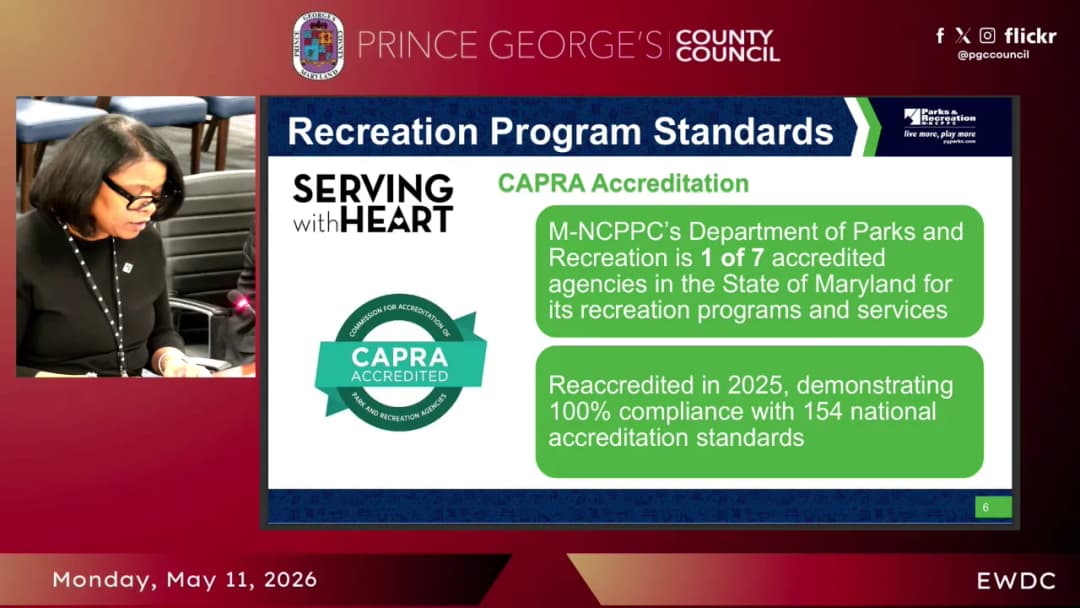
The Education and Workforce Development Committee of the Prince George's County Council met on Monday, May 11, 2026, at 1:39 PM in Committee Room 2027. Chair Shayla Adams-Stafford presided with Council Members Eric Olson and Thomas Dernoga present at roll call; Vice Chair Edward Burroughs arrived at 2:30 PM, and Council Member Sydney Harrison was excused. The meeting covered two pieces of legislation (CB-037-2026 and CR-033-2026) and three briefings (Summer Youth Enrichment Program, Literacy Throughline by PGCPS, and After School/Out-of-School Time Programming by Parks and Recreation). The meeting adjourned at 3:11 PM. Legislation CB-037-2026 – Apprenticeship Incentive Program - This act requires Employ Prince George’s and other relevant County agencies to strategically provide a package of incentives to increase the prevalence of apprenticeships across Prince George’s County, particularly in technology, construction, building trades, and healthcare. The legislation also requires annual reporting of apprenticeship data to the County Council. - Staff analysis indicated an adverse fiscal impact of $200,000 to $750,000 annually, partially offset by potential increased tax revenues. The County Executive’s office expressed support and noted existing grant funding for similar work. The Office of Law found the bill legally sufficient. - Council Member Dernoga moved for favorable recommendation, seconded by Council Member Olson. The motion carried 3-0 (Adams-Stafford, Olson, Dernoga aye; Harrison excused; Burroughs absent). CR-033-2026 – Quantum Science Workforce Development Resolution - This resolution expresses support for advancing the quantum science and technology workforce in Prince George’s County, encouraging collaboration among educational institutions, workforce development organizations, employers, and public agencies, and urging stakeholders to discuss strategies for preparing residents for the quantum economy. - Staff analysis found no immediate fiscal impact but noted potential future economic growth and security considerations. The County Executive’s office supported the resolution. The Office of Law found it legally sufficient. - An amendment (draft two) inserted an additional whereas clause referencing the Capital of Quantum Initiative. The amendment was moved by Council Member Dernoga, seconded by Council Member Olson, and carried 3-0. The resolution as amended was then favorably recommended by a 3-0 vote (same voting pattern). Briefings Summer Youth Enrichment Program (SYEP) – Office of Human Resource Management (OHRM) - The program is a six-week initiative (July 6 – August 14, 2026) serving youth ages 14–24. Budget includes $1 million from the county and $1.3 million from the U.S. Department of Labor. Projected to serve over 2,000 youth. - Participants receive stipends ($300–$500 based on age) or hourly wages ($13–$15 per hour for 16+; 14–15 year olds receive stipends only). Job categories include public safety, IT, business, and healthcare. - David Williams (Youth Employment Manager) reported that 8,000 applications were received, partly due to the closure of Six Flags, which previously employed 1,000–2,000 youth. The program partners with county agencies and local businesses; efforts to recruit healthcare and IT employers are ongoing. - Committee members asked about placement in hospitals, impact of Six Flags closure, and strengthening partnerships with the Equity and Excellence Foundation. OHRM staff noted they are exploring business incentives and need for greater financial investment. Literacy Throughline – Prince George’s County Public Schools (PGCPS) - Dr. Victoria Holmes and team presented a shared vision for literacy from Pre-K through grade 12, grounded in the science of reading and the five pillars of literacy. They described high-leverage skills: oral language, structured discussion, vocabulary, reading/thinking with evidence, and writing. - Community partners were encouraged to reinforce these skills through read-alouds, discussions, academic vocabulary use, and written reflection. Tools like the “How Community Partners Can Support Students” document were shared. - Chair Adams-Stafford asked about parental support for pre-kindergarten literacy, explicit vocabulary instruction, and alignment with Parks and Planning and library programs. PGCPS representatives noted existing parent academy offerings, vocabulary instruction embedded in curricula, and willingness to synthesize initiatives. After School and Out-of-School Time Academic/Literacy Programming – Maryland-National Capital Park and Planning Commission, Parks & Recreation Department - Tara Stewart and Anthony Nolan explained that the department offers licensed child care programs (kids’ care, kids’ club, therapeutic recreation) at community centers and athletic complexes, with fees of $232.50/month eligible for fee assistance and state scholarships. - They reported 6,828 participants in academic/enrichment registration programs (FY25 year-to-date) and over 560 summer camps planned for FY26, with potential to serve 18,576 children. The department is developing a summer enrichment pilot with three weekly academic sessions focusing on early literacy, STEM, digital literacy, career readiness, and more. - The department seeks to partner with PGCPS to align activities with student learner profiles and to co-locate recreation activities at schools. Committee members discussed transportation, capacity in specific districts, and advertising through schools. Key Outcomes - CB-037-2026: Favorably recommended to the County Council by a vote of 3-0. Next step: full Council consideration. - CR-033-2026: Amended and favorably recommended to the County Council by a vote of 3-0. Next step: full Council consideration. - Briefings: All three briefings were held and accepted as informational. Committee directed staff to facilitate further coordination between PGCPS, Parks and Recreation, and other entities regarding literacy and workforce pipeline alignment.

YOUTH PROGRAMS 29% · EDUCATION POLICY 27% · EDUCATION AND WORKFORCE DEVELOPMENT 19% · LITERACY PROGRAMS 12%
147
MAY 11, 2026 · PRINCE GEORGES COUNTY, MARYLAND · COUNTY COUNCIL & BOARDS
Prince George's County Council Holds M-NCPPC FY 2026-2027 Budget Hearing, May 11, 2026

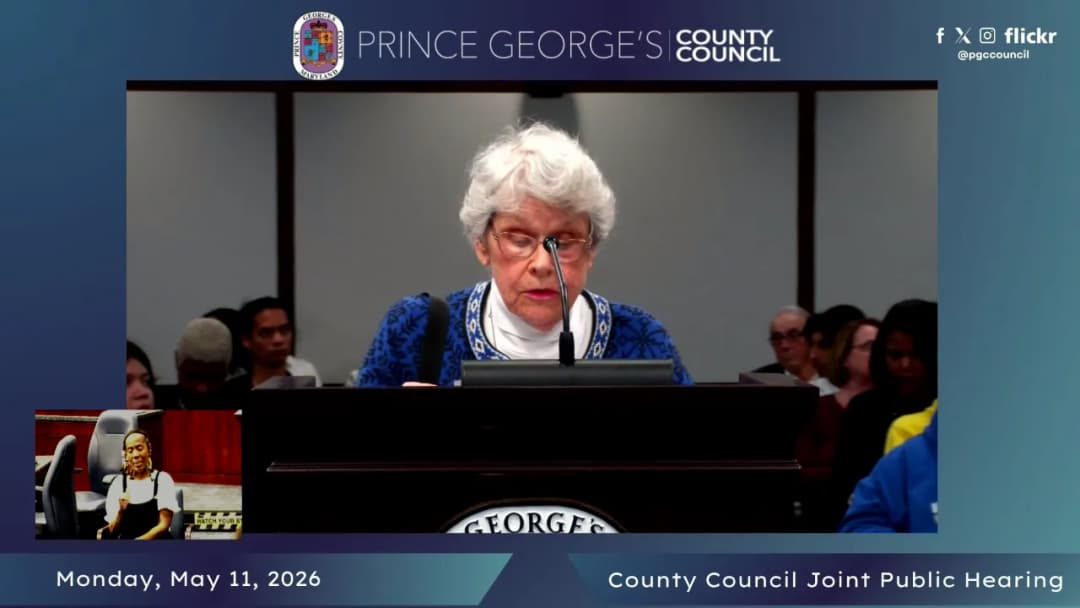
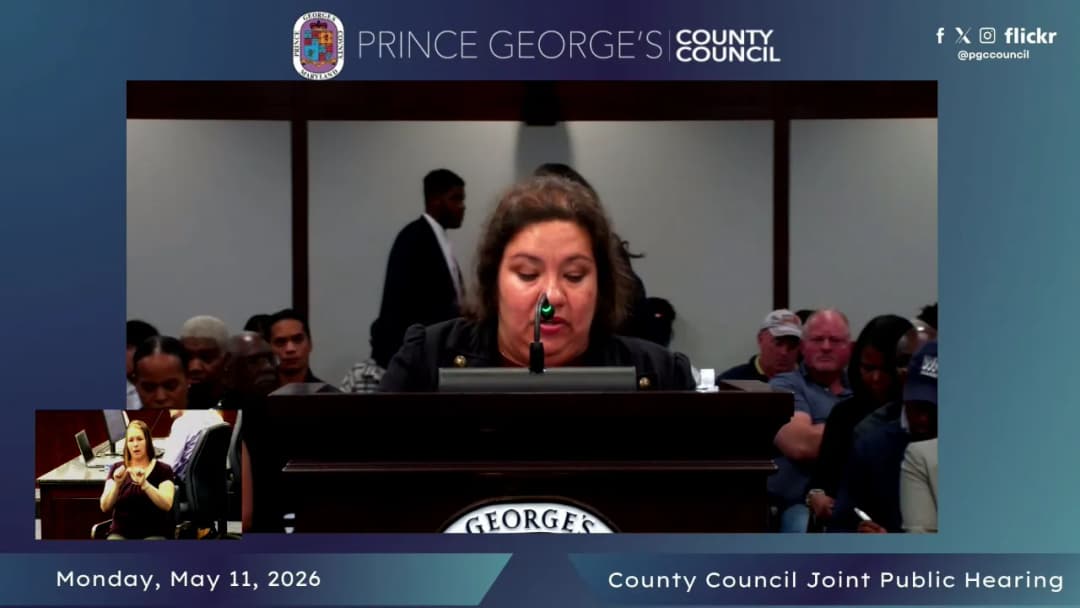
The Prince George's County Council reconvened its business meeting on Monday, May 11, 2026, at 7:16 p.m. in the Council Hearing Room in Largo, Maryland, to hold a joint public hearing on the Maryland-National Capital Park and Planning Commission (M-NCPPC) proposed fiscal year 2026-2027 operating and capital budgets and the M-NCPPC Capital Improvement Program for fiscal years 2027-2032. Chair Krystal Oriadha presided; seven members were present at roll call, with Thomas Dernoga and Timothy Adams participating remotely and on camera; Sydney Harrison and Danielle Hunter were absent. Council Members Fisher and Adams-Stafford arrived later. The public hearing concluded at 9:10 p.m., and the council adjourned at 10:00 p.m. Staff Budget Analysis - Arian Albear, Director of Legislative Impact, presented a budget analysis prepared with Karen Zavakos. General trends: revenue is usually under-budgeted and finishes higher than budgeted; expenditures are usually over-budgeted and finish lower. - For the administrative fund, revenues trend about $4.5 million higher than budget; for parks, about $7 million higher; for recreation, about $5 million higher. FY 2026 year-to-date still includes six months of unrealized revenues. - Expenditures trend about $15 million lower for administration, $10 million lower for parks, and $13 million lower for recreation, with about three months of FY 2026 spending not yet included. - Fund-balance use correlated with M-NCPPC headquarters construction in FY 2022 and FY 2024; fund balance increased in FY 2021, FY 2023, and FY 2026 year-to-date. - Council Member Burroughs asked for the total spent on the headquarters. Staff said the original building was $155 million, a requested increase was lowered from $300 million to $85 million, and the total was about $195 million, to be verified for the record. Chair Oriadha criticized the headquarters as a vanity project and referenced a '$495 million dollar building' in the transcript; the discrepancy with the $195 million estimate was not resolved on the record. Public Comments & Testimony - Student Leadership Academy (SLA): Dozens of District 8 SLA students, parents, success coaches, and program staff testified in support of continued and increased funding. Program director Jonathan Harris said SLA grew from 75 students last year to 300 this year. Students described workshops, mock interviews, CPR certification, travel experiences, and gains in confidence, public speaking, and career readiness. Many explicitly asked the council to continue or increase funding. Chair Oriadha noted that more than a hundred additional students were present but had to leave before testifying. - Landover Data Center: Taylor Frazier McCollum, on behalf of more than 60 local organizations, small businesses, and elected officials, opposed the proposed Landover Data Center. She said more than 23,000 people signed her petition, that tax waivers for hyperscale data centers would cost the county and state money, and that residents want a permanent ban on AI data centers. She also said SLA should be countywide, not limited to District 8. - University of Maryland Extension and Project Charge: Matt Parker requested restoring and strengthening extension funding for FY 2027, citing a core county allocation of $208,000 that leverages over $1 million in programming, more than 8,500 direct participants, and outreach to over 14,000 residents. He asked for an additional $95,000 to replace youth nutrition education capacity after losing SNAP-Ed, which served more than 2,600 participants, including over 2,500 youth. Daniel Donahue, president of the PG County Farm Bureau, said the Farm Bureau supports 100 percent of the University of Maryland Extension budget request. - Project Charge access: Mel Johnson, executive director of The Storehouse, said the reimbursement model hurts small minority-led organizations that cannot front costs. Megan Baco, executive director of Anacostia Trails Heritage Area, requested an increase in Project Charge funding to support countywide cultural tourism and match up to $200,000 in state funding. Susan Pearl of the Prince George's Philharmonic asked for continued Project Charge support, citing the orchestra's 61st season and student music lessons. A Lake Arbor Foundation representative asked for continued and increased support to expand its summer camp and hire a program director. - Parks, trails, and facilities: Mayor Fazlul Kabir of College Park requested trail maintenance after winter storms, winterizing a restroom at Acredale Community Park (transcribed as 'Arkville'), and a water fountain/filling station. Melissa Schweisguth requested more trail investment, South County and east-west connections, lighting and cameras at Chillham Park, invasive-species work, and dog parks. Halley Fernando of MORE urged funding for natural-surface trails, citing about $30,000 per dirt-trail mile versus $1 million per paved-trail mile and offering 17,000 volunteer hours annually. Rory Lehman asked M-NCPPC to buy a used Wurlitzer 153 band organ for the Watkins Park Carousel. Henry Wixon of the Glendale Citizens Association requested funding for historic Glendale Hospital stabilization, adaptive reuse, and a regional park master plan, and objected to bond funding for a multi-generational facility at the Glendale Community Center. Brian Willis requested upgrades to the Sports and Learning Complex, citing 5,000 youth athletes, an annual international meet with 2,500 athletes, and events lost because of inadequate facilities. Janet Gingold urged more programming for natural places and reported student calls for safer parks, lighting, ranger presence, and better transit access. Jocelyn Alexander, chair of the Parks and Recreation Advisory Board, encouraged asset stewardship, safety, and capital planning and highlighted needs at the Sugar Ray Leonard Boxing Center. - Community support for M-NCPPC and specific services: Tyrone Patterson, Robert Pettis, Terry Cotton, and Wilbert Nicholson spoke in support of M-NCPPC funding and Boys and Girls Club partnerships. Belinda Queen Cunningham requested completion of a regional park and investment in the Wilburn community, which she said lacks basic park amenities despite decades of tax payments. Elise Thompson, a District 2 parent, praised M-NCPPC disability services after her child with complex disabilities was welcomed, and Chair Oriadha said the budget will direct more money to disability services. Renee Gibbons asked the council to preserve and expand senior programs; Chair Oriadha said senior services will expand. Dr. George Hodge requested support for Community Kinship Coalition's violence intervention and Hoops for Peace programs. Key Outcomes - The joint public hearing was declared held after registered speakers testified; no budget vote was taken. - Chair Oriadha stated the council will not increase taxes, will balance the budget without drawing down fund balance, and will shift spending from headquarters and top-heavy overhead to direct services such as rec centers, seniors, and disability programs. - Council staff committed to providing the exact M-NCPPC headquarters project cost for the record. - The council adjourned at 10:00 p.m. by unanimous vote on a motion by Council Member Dernoga, seconded by Council Member Adams.

YOUTH PROGRAMS 55% · PARKS AND RECREATION 11% · COMMUNITY ENGAGEMENT 6% · EDUCATION POLICY 6%
148
MAY 11, 2026 · PRINCE GEORGES COUNTY, MARYLAND · COUNTY COUNCIL & BOARDS
Joint Public Hearing on Preliminary Port Towns Sector Plan and SMA - May 11, 2026

On Monday, May 11, 2026, the Prince George's County Council, sitting as the District Council, and the Prince George's County Planning Board of M-NCPPC held a joint public hearing at the Council Hearing Room (1301 McCormick Dr, Largo, MD) to receive testimony on the Preliminary Port Towns Sector Plan and Proposed Sectional Map Amendment (SMA) (CR-094-2023). The hearing was convened at 6:17 p.m. by Chair Krystal Oriadha and adjourned at 7:01 p.m. Nine Council Members were present, with Council Member Timothy Adams participating remotely. The purpose was to gather public input before the planning board and council take final action. Staff Presentation - Emily Lutz (Project Manager) and Arnaldo Ruiz (Deputy Project Manager) presented the plan, developed over 24 months with community engagement. They highlighted community outreach: thousands of participants, one-on-one conversations with over 350 attendees, more than 540 comments, and about 215 comments from youth events. - The plan covers the municipalities of Bladensburg, Colmar Manor, Cottage City, and Edmonston, and replaces the 2009 Port Towns Sector Plan. It proposes 54 zoning changes across approximately 168 acres through the SMA. - Seven opportunity sites were presented (e.g., Port Towns Shopping Center, Buchanan St. Industrial Area, Publick Playhouse vicinity, etc.) as conceptual frameworks, not existing proposals. Public Comments & Testimony - Takisha James, Mayor of Bladensburg, expressed strong support for the plan and the SMA, praising the engagement process. - Mayor Casanas (Colmar Manor) spoke on behalf of the town, supporting many recommendations but requesting three changes: (1) removal of proposed zoning changes ZC-35 and ZC-36 (rezoning from RSF-65 to RSFA) due to neighborhood character, density, parking, and infrastructure concerns; (2) expanding the opportunity site along Bladensburg Road; (3) strengthening river access recommendations. - Keith Brooks, on behalf of concerned residents of Colmar Manor, opposed policies LU6 and LU6.1 and the rezoning, arguing that long-time residents are being asked to bear risk without guaranteed affordability ("a rare chance" of affordable development). He urged the council not to gamble with residents' community and homes. - Douglas (former Colmar Manor council member and mayor pro tem, 16-year resident) opposed the RSFA zoning changes, asserting that Colmar Manor already offers mixed housing types and that increased density would make the town "unlivably urban." He expressed support for the business district development. - John Coleman, property owner at 5322 Chesapeake Road and 5409 Decatur Street, expressed support for the proposed rezoning to single-family attached, which he said would provide new opportunity to develop his lots. Key Outcomes - The joint public hearing was declared held; the record will remain open for written comments through 5 p.m. on Tuesday, May 26, 2026. - The Planning Board will hold a work session on July 23, 2026, followed by a District Council work session in September, with final action anticipated around October 2026 (or possibly January 2027 if a second hearing is needed). - The hearing adjourned at 7:01 p.m. by unanimous vote on a motion by Vice Chair Olson, seconded by Council Member Adams-Stafford.

ZONING AND LAND USE 65% · COMMUNITY ENGAGEMENT 19% · PROCEDURAL 9% · ECONOMIC DEVELOPMENT 7%
149
MAY 9, 2026 · PRINCE GEORGES COUNTY, MARYLAND · COUNTY COUNCIL & BOARDS
Prince George's County Maternal Health Advisory Board Meeting - May 9, 2026

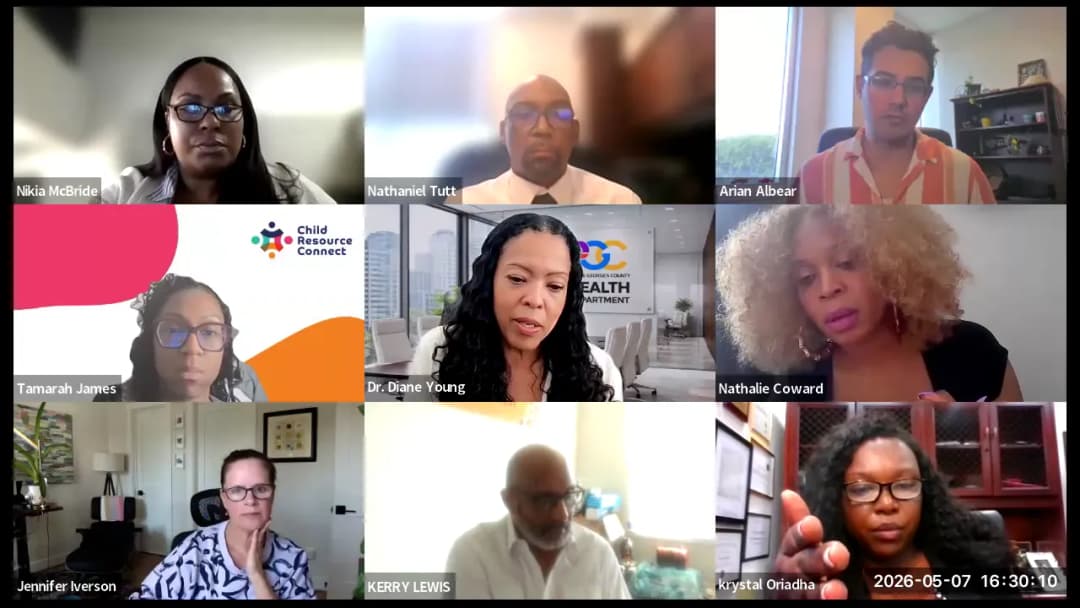
On May 9, 2026, the Prince George's County Maternal Health Advisory Board met to finalize recommendations for allocating $250,000 in funds from legislation CR99 2025. The funds were originally intended to support doula services, but the health department identified separate doula funding, leaving the full $250,000 for the advisory board to allocate to community organizations. The board discussed using Healthcare Dynamics International (HCDI) as a fiscal manager to expedite spending before the June 30 deadline. Discussion Items - Overview and Process: The chair reviewed the legislative requirements: recommendations must include expenditure rationale, alignment with equity goals and documented community needs. The board agreed to proceed with allocating the funds to HCDI as a pass-through entity. - Overhead Costs: HCDI typically charges 10–15% indirect costs. The board settled on a 10% fee ($25,000) for technical assistance and coordination. - Child Resource Connect (CRC): Jennifer, representing CRC, noted she had been told since August of $400,000 in additional county funding that had not materialized. She described severe cash flow issues, including lack of a purchase order for the current contract, and warned she might need to shut down her home visiting program in May. The board discussed allocating $95,000 to CRC for home visiting services, with the flexibility to pivot to other approved services (e.g., mental health, postpartum education) if the $400,000 arrives. - She Rises: A smaller, first-time grantee. The board allocated $30,000 for activity kits for children and postpartum/prenatal webinar series, pending a meeting with She Rises on the following Monday. - Additional Funds: A $100,000 bucket was created for other services (blood pressure machines, home equipment, respite care, transportation stipends). HCDI will manage this bucket, with disbursements requiring advisory board approval and a 12-month spending timeline. - Meeting Schedule: The board expressed hope to meet again soon to advocate for larger funding in FY27. Key Outcomes - Motion and Vote: The chair moved to recommend the following allocation to the health department: $25,000 to HCDI (10% overhead); $30,000 to She Rises; $95,000 to Child Resource Connect (for home visiting or alternate services); and $100,000 for additional services as identified, with HCDI managing disbursements subject to board approval and a 12-month spending window. The motion was seconded and passed unanimously (no opposition, no abstentions). - Next Steps: The recommendations will be sent to the health department. The chair will contact the Office of Management and Budget to follow up on the missing $400,000 promised to CRC. Meeting notes will be distributed immediately to finalize HCDI's contract by the Monday deadline.

FUNDING ALLOCATION 64% · PUBLIC HEALTH 22% · PROCEDURAL 14%
150
MAY 7, 2026 · PRINCE GEORGES COUNTY, MARYLAND · COUNTY COUNCIL & BOARDS
Cannabis Reinvestment and Restoration Board Meeting – May 7, 2026

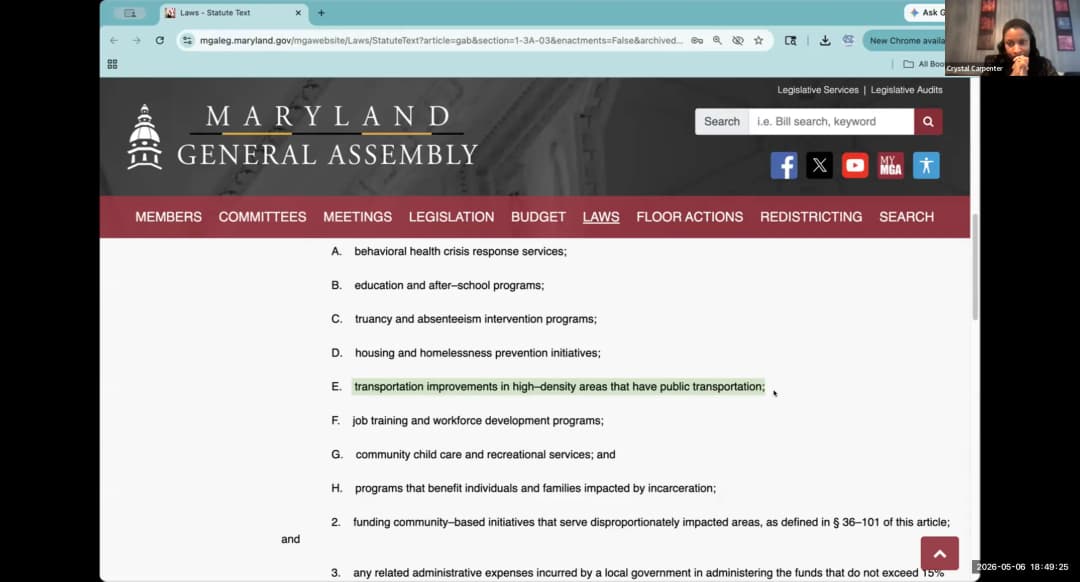
The Cannabis Reinvestment and Restoration Board met on May 7, 2026 (the transcript references May 6, 2026, but the official date used is May 7, 2026 per the instruction). The meeting was called to order at 5:38 PM with quorum. Members present: Dr. Rachel Jordan, Natalie Doris, Dr. Ron Garrett, Crystal Carpenter, Andrew Pierce, and later Bianca Mills joined. The board approved previous meeting minutes, discussed legal requirements for fund use, administrative expenses, community engagement plans, and formed subcommittees for grant categories. Consent Calendar - Approval of Meeting Minutes: Motion to approve the previous meeting minutes was made and seconded. No opposition. Minutes were approved as submitted. Discussion Items - Legal Requirements for Fund Use (Zip Codes): Mr. Maddox presented the legal basis for the fund, citing Maryland Code section 1-3A-03 and 36-101. The fund may only be used for community-based initiatives serving disproportionately impacted areas (DIAs), defined by the Office of Social Equity as 18 specific zip codes in Prince George’s County. The board clarified that the recipient organization does not need to be located in those zip codes, but the services must be provided there. Members discussed whether to prioritize Prince George’s County-based businesses and whether the DIA zip codes cover all low-income communities. Mr. Maddox confirmed that the law requires funds to be used only for those 18 zip codes; any other interpretation is not permissible. The board noted that Prince George’s County has 18 impacted zip codes, indicating a high level of historical impact from cannabis enforcement. - Administrative Expenses and Grant Administration: Andrew Pierce presented draft language for administrative expenses, proposing that the board be supported by a county executive designated agency. The original draft mentioned the health department, but after discussion, the board preferred to keep the language broad. Dr. Garrett and others urged that the board should separately recommend that the council’s grants office administer the funds, to avoid delays. Ms. Rogers (grants office) confirmed her office has capacity to handle grant administration, with a typical 6–8 week cycle. The board agreed to move forward with legislation that allows administrative expenses (up to 15% of annual revenues, $2M) and to submit a separate recommendation to the county executive to designate the grants office. - Community Engagement and Public Hearings: The board discussed holding public town halls to gather community input on fund priorities, as required by legislation. Members favored hybrid (in-person and virtual) sessions, with at least three meetings across the county. Dr. Jordan suggested a soft structure for the hearings to keep focus on the board’s mission. Ms. Rogers offered to coordinate scheduling via the county’s tech team. The board agreed to finalize dates by email and to develop a presentation outline for the next meeting. Concerns about potential conflicts with primary election season were noted. - Subcommittee Categories: The board debated the grant categories used by other counties (Anne Arundel and Montgomery). After discussion, members voted to approve six categories for Prince George’s County: 1) Mental Health and Substance Use Services, 2) Education, Youth Enrichment, and After-School Activities, 3) Housing and Homeless Prevention Services, 4) Workforce Development and Employment Training, 5) Justice Involved, and 6) Accessibility and Public Transportation. The motion carried unanimously. Key Outcomes - Vote: The board voted unanimously to approve the six subcommittee categories as listed above. - Subcommittee Leads Assigned: - Mental Health and Substance Use: Dr. Rachel Jordan - Housing and Homeless Prevention: Natalie Doris - Justice Involved: Bianca Mills - Accessibility and Public Transportation: (volunteer from the board, later assigned to Crystal Carpenter? Actually, the transcript shows Crystal Carpenter offered to help with communications, and the lead for accessibility was taken by a member – unclear who. The summary can state that leads were assigned, but not all named. To be accurate, we note that leads were assigned for most categories, with workforce development and education remaining open. The board agreed to contact missing members. - Next Meeting: Scheduled for May 20, 2026 at 6:00 PM. The board discussed shifting to a later time (6:00 PM) to accommodate members. - Administrative Legislation: The board agreed to proceed with draft legislation that allows administrative expenses from the fund, with the administering agency designated by the county executive. A separate recommendation to designate the council’s grants office will be submitted. - Financial Disclosure: Members expressed difficulty with the online financial disclosure system. Ms. Rogers offered to provide a contact person for assistance. - Meeting Adjourned: 7:09 PM.

CANNABIS REGULATION 25% · COMMUNITY ENGAGEMENT 20% · GRANT APPLICATIONS 14% · GOVERNMENT OPERATIONS 13%
OPENPUBLICA · PUBLIC MEETING INDEXUPDATED DAILY · openpublica.com