Browse by city
Date range
Search help

Search titles, summaries, topics and stored transcripts together. Keywords may match separately; put the whole query in double quotes for a phrase. Matching follows word analysis, so punctuation is not exact. Both dates are included. Documents are not searched.

SHOWING 81–90 ENTRIES
81
JUN 22, 2026 · RICHMOND, VIRGINIA · CITY COUNCIL
Richmond City Council Formal Meeting – June 22, 2026

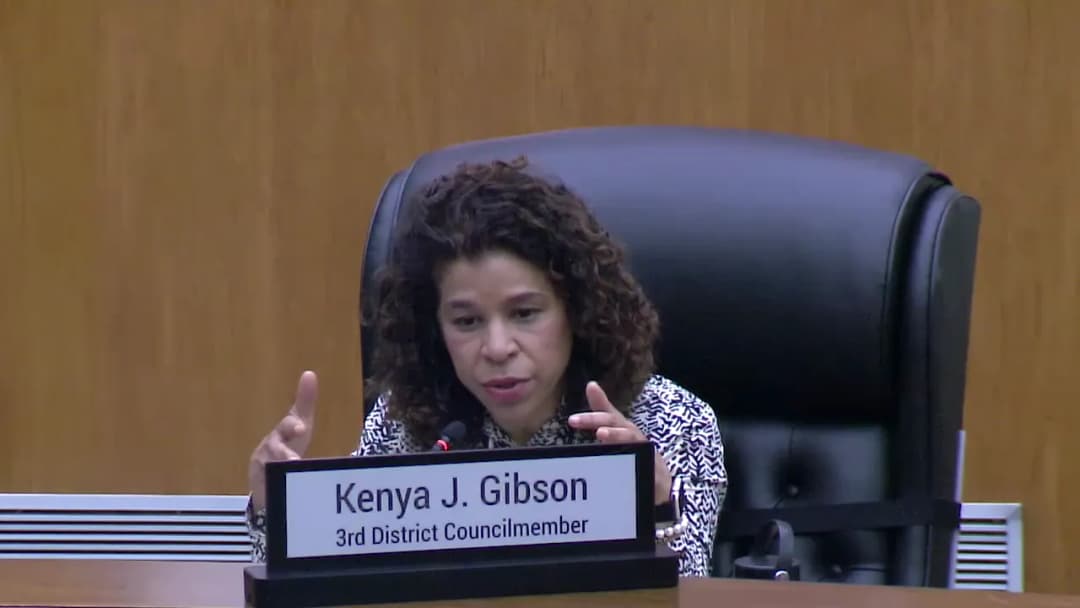
The Richmond City Council met formally on Monday, June 22, 2026, at 6:00 PM. The meeting opened with an invocation, the Pledge of Allegiance, and a public comment period. The council considered a consent agenda, a special use permit for a residential development, and two ordinances to establish citizen review commissions for the ongoing code refresh process. The council also approved multiple items on the consent agenda and continued several items to a future meeting. Consent Calendar - All items on the consent agenda were approved unanimously (8-0) after a public hearing. The consent agenda included: Ordinances 2026-125 through 151, Resolution 2026-R025, and Ordinance 2026-090 (an amendment to the city's collective bargaining ordinance). - Ordinance 2026-090 was moved from the regular agenda to the consent agenda after receiving full patronage from all councilmembers and the mayor. Public Comments & Testimony - Tanita Caleb (resident of 872 Jessamine Street) spoke during the public comment period about a proposed 16-unit project by Baker Development Resources next to her home. She expressed concerns about density, trash, and rodent issues from a nearby affordable housing project (Citadel of Hope) and asked the developer to reduce the number of units and scale the building to two stories. - Bill Pantley (Richmond Coalition of Police, RCOP) and Brendan Levy (RCOP president) spoke in favor of Ordinance 2026-090, thanking the council and administration for clarifying the collective bargaining ordinance regarding promotion and vacancy processes. They stated this amendment restores the original intent of the ordinance passed four years ago. - Keith Andes (president, Richmond Professional Firefighters Association Local 995) supported Ordinance 2026-090, praising the improved employer-employee relationship under collective bargaining. - Latissa Williams (vice chair, SEIU Richmond Chapter) and Felicia Boney (chapter chair, SEIU Virginia 512) also expressed support for the collective bargaining amendment, stating it shows the city is uniting employees. - Juan Braxton (speaking as a deacon at Trinity Baptist Church) spoke in favor of naming the 2800 block of Pendall Avenue after the late Pastor James, a separate consent item. - Michael Berlotas (resident of 3213 Tuxedo Boulevard) and Laura Stevens (Sherwood Park resident) spoke in opposition to Item 34 (special use permit for 3219 Tuxedo Boulevard). Berlotas cited a petition signed by 16 neighbors, concerns about parking on the narrow loop street, and the demolition of an existing affordable home. Stevens detailed procedural issues, rising property assessments (68% increase since 2021), and the lack of an alley. Both argued the project does not fit the neighborhood and would remove existing affordability. - Multiple speakers addressed Items 37 and 38 (proposed citizen review commissions). Speakers in favor included: a representative of West Hampton Citizens Association, Betsy Gardner (Stonewall Court), Errol Somay (Museum District), Pierce Homer (Floyd Avenue), Donna Hughes (Sherwood Park Civic Association), John Gaas (homeowner), David Mayer (Sherwood Park), Robert Hood (Sherwood Park), Kevin Randizi (8th district), Jacob Peters (2nd district), Tanita Caleb (again, as a homeowner), Reverend Jeanette Brown (Westwood), Tammy Rose (1st district), and Juan Braxton (5th district). They argued for transparency, resident input, and slowing the code refresh process. - Speakers against the commissions included: Maria Deuster (Community Climate Collaborative, speaking for Homes for All Our Neighbors coalition), Tavarus Spinks (North Church Hill), Flora Worthington (1st district renter), and Miles Kojel (renter). They argued that the commissions would replicate existing inequities, exclude renters and working families, and delay needed zoning reforms. They urged the city to conduct better direct outreach instead. - Councilmember discussion on the commissions included remarks from Councilmembers Jones, Abubaker, Jordan, Trammell, Breton, Robertson, Gibson, and President Newbill. Many highlighted the need for deeper resident engagement but disagreed on creating new bodies, suggesting instead that the city use existing offices (e.g., Office of Neighborhood Engagement, Participatory Budgeting) to improve outreach. Discussion Items - Item 34 – Special Use Permit for 3219 Tuxedo Boulevard: The applicant sought to build four single-family detached homes on a lot zoned for two. Planning staff (Kevin Vonk) reported that the original proposal for five homes was denied by the Planning Commission. After Councilmember Trammell met with residents and the developer, the number was reduced to four. Councilmember Trammell stated she walked the street and heard that five was too many. The council voted on the ordinance after closing the public hearing. - Item 37 – Ordinance 2026-092 (Code Refresh Commission): Proposed by Councilmember Trammell to establish a commission to develop recommendations for the zoning rewrite based on best practices and community input. - Item 38 – Ordinance 2026-096 (Resident Planning Review Commission): Proposed by Councilmember Gibson to establish a commission to advise the council on the implementation of the master plan (Richmond 300), including annual reporting and ensuring alignment with zoning changes. Key Outcomes - Consent agenda adopted (8-0) with all items approved, including the collective bargaining amendment (Ordinance 2026-090). - Item 34 (special use permit for 3219 Tuxedo Boulevard) adopted with a vote of 6-0-2 (Councilmembers Gibson and Abubaker abstained). The permit allows four single-family detached homes on the site. - Item 37 (Ordinance 2026-092) failed with a vote of 2-6 (Councilmembers Trammell and Abubaker in favor; Breton, Gibson, Jones, Robertson, Jordan, Newbill opposed). - Item 38 (Ordinance 2026-096) failed with a vote of 2-6 (Councilmembers Gibson and Abubaker in favor; Breton, Jones, Robertson, Trammell, Jordan, Newbill opposed). - Several items were continued to the Monday, July 27, 2026 council meeting: Ordinances 2026-102, 2026-109, 2026-113, 2026-120, 2026-081, and Resolutions 2026-R024 and 2026-R019. - The minutes from the June 8, 2026 meetings were approved as presented. - New legislation (items 1-13) was introduced. - Councilmembers made announcements about upcoming district meetings, community events, and public safety concerns.
COMMUNITY ENGAGEMENT 54% · AFFORDABLE HOUSING 20% · PROCEDURAL 12% · PERSONNEL MATTERS 9%
82
JUN 22, 2026 · RICHMOND, VIRGINIA · CITY COUNCIL
Richmond City Council Regular Meeting – June 22, 2026

The Richmond City Council convened at 6:00 PM for a formal meeting that included public comments, a consent agenda, and several regular agenda items. Key topics included a collective bargaining ordinance, a special use permit for a housing development, and proposals to establish citizens’ review commissions for the city’s zoning rewrite (Code Refresh) and master plan implementation. All council members were present except Councilmember Lynch. Consent Calendar Items 5–15, 16–25, 26–31, and 33 (Resolution R025) were approved as part of the consent agenda. Item 36 (Ordinance 2026-090) was moved from the regular agenda to the consent agenda after receiving full support from council and the mayor. This ordinance relates to collective bargaining processes for city employees. Public Comments & Testimony Public Comment Period: Tanita Caleb, a Richmond resident at 872 Jessamine Street, expressed opposition to a pending 16‑unit project by Baker Development Resources near her home. She asked for a reduction in units and height, citing concerns about density, trash, and rodents in the neighborhood. Consent Agenda – Collective Bargaining: Several union representatives spoke in favor of Ordinance 2026-090: Bill Pantle (SEIU Local 512), Brendan Levy (Richmond Coalition of Police), Keith Andes (Richmond Professional Firefighters Association Local 995), Latissa Williams (SEIU Richmond Chapter), Felicia Boney (SEIU Virginia 512), and Eric Radman. All thanked council for supporting collective bargaining and improving employee relations. Consent Agenda – Street Naming: Juan Braxton spoke in favor of naming the 2800 block of Pendall Avenue after the late Pastor James, representing Trinity Baptist Church. Item 34 (Tuxedo Boulevard SUP): Michael Berlotus (resident at 3213 Tuxedo) and Laura Stevens (Sherwood Park) spoke in opposition. They cited parking congestion, neighborhood fit, loss of naturally occurring affordable housing, and the planning commission’s initial denial. A petition with 16 signatures was submitted. No speakers spoke in favor. Items 37 & 38 (Citizen Commissions): Dozens of community members spoke. Supporters included Betsy Gardner, Errol Somay, Pierce Homer, Donna Hughes, John Gass, David Mayer, Robert Hood, Tanita Caleb (second appearance), Rev. Jeanette Brown, Tammy Rose, and Warren Braxton. They argued for more transparency, resident input, and protection against displacement. Opponents included Maria Deuster (Community Climate Collaborative, Homes for All Our Neighbors), Tavara Spinks, Flora Worthington, and Miles Kojel. They warned that unpaid commissions would disenfranchise renters and low‑income residents, and urged the city to conduct deeper outreach rather than creating new bodies. Discussion Items Collective Bargaining (Item 36): Councilmember Gibson praised Richmond’s leadership on collective bargaining, noting reduced turnover. Councilmember Trammell thanked colleagues and the CAO. CAO Odie Donald commended council for working with administration and highlighted low vacancy rates and historic investments. President Newbill echoed thanks and noted the landmark moment. The item was adopted unanimously. Tuxedo Boulevard SUP (Item 34): Kevin Vonk (Planning & Development Review) explained the project was reduced from five to four homes after councilmember Trammell walked the neighborhood. The planning commission had denied the original five‑unit proposal. Councilmember Gibson expressed concern about not hearing from supporters. The ordinance was adopted with votes 7 aye, 2 abstentions (Gibson and Abbacher). Code Refresh Commission (Item 37) & Resident Planning Review Commission (Item 38): Councilmembers Trammell and Gibson, the patrons, argued that citizens need a formal role in the zoning rewrite and master plan implementation. Councilmember Jones stressed the city already has offices (Neighborhood Engagement, Participatory Budgeting, Communications) that should be used for outreach. Councilmember Abbacher agreed but thought commissions could help slow the process for better engagement. Vice President Jordan worried that new layers would confuse and narrow involvement. Councilmember Breton said he is acting as a watchdog and passing resident questions to administration. Councilmember Robertson, who served on the advisory board, opposed the papers, calling for clear engagement percentage targets and answers to prior questions. President Newbill emphasized using existing engagement infrastructure to get broad resident input. Both ordinances failed on floor votes: Item 37 received 2 ayes, 6 noes; Item 38 received 2 ayes, 6 noes. Key Outcomes Consent Agenda: All items approved unanimously. Ordinance 2026-090 (Collective Bargaining): Adopted unanimously. Ordinance 2025-231 (Tuxedo Boulevard SUP): Adopted, 7‑0‑2 (Gibson abstained, Abbacher abstained). Ordinance 2026-092 (Code Refresh Commission): Defeated, 2‑6 (Trammell and Abbacher in favor; others opposed). Ordinance 2026-096 (Resident Planning Review Commission): Defeated, 2‑6 (Gibson and Abbacher in favor; others opposed). Next Steps: Councilmembers agreed to revisit engagement strategies using existing city infrastructure. Councilmember Trammell announced she is pursuing a referendum on Code Refresh, allowing voters to decide. Minutes: The minutes from the June 8, 2026 meetings were approved as presented. New Legislation: Items 1–13 on the introduction list were introduced and will be available on the city website. Announcements: Several district meetings and community events were announced, including a public safety committee meeting the next day regarding the courthouse incident.

COMMUNITY ENGAGEMENT 42% · MISCELLANEOUS 19% · AFFORDABLE HOUSING 18% · PROCEDURAL 8%
83
JUN 17, 2026 · RICHMOND, VIRGINIA · CITY COUNCIL
Richmond Finance and Economic Development Committee Meeting – June 17, 2026

The Finance and Economic Development Standing Committee of the Richmond City Council met on June 17, 2026, at approximately 2:00 PM. The committee considered multiple ordinances and resolutions, including a continuation of an item related to public payment registers, approval of grant funding for historic cemeteries, opioid abatement, park improvements, tree maintenance, recovery court support, procurement policy updates, and a commercial tax abatement extension. A major presentation was given on the overhaul of the city’s Purchasing Card (PCard) program, followed by extensive discussion on audit findings, controls, and future expansion metrics. Public Comments & Testimony - Item 2 (Historic African American Cemetery Grant): Kimberly Jackson, Community Engagement Manager for Cemeteries with Parks, Recreation, and Community Facilities, spoke in support, requesting acceptance of $69,920 in state funding for preservation and reclamation activities. - Item 6 (Investigation into Payment Register Publication): Amante Gonzalo, a resident of the 6th district, voiced support for Resolution 2026-R019, arguing the city should investigate its failure to publish a monthly payment register before considering lowering transparency standards. He cited the city’s “City of Darkness Award” from the Electronic Frontier Foundation and MuckRock as evidence of FOIA system deficiencies. - No other public testimony was offered for any agenda item. Consent Calendar - Item 1 – Ordinance 2026-081: Continued to the July 15, 2026, meeting (motion approved unanimously). - Item 2 – Ordinance 2026-130: Authorized acceptance of $69,920 from the Virginia Department of Historic Resources for African American cemetery preservation; forwarded to council with recommendation to approve. - Item 3 – Ordinance 2026-131: Authorized acceptance of $611,807.50 from the National Opioid Settlement Fund for opioid abatement strategies; forwarded to council with recommendation to approve. - Item 4 – Ordinance 2026-132: Authorized acceptance of $1,000,000 from the National Park Service Land and Water Conservation Fund for Broad Rock Creek Park improvements; forwarded to council with recommendation to approve. - Item 5 – Ordinance 2026-133: Authorized a right-of-entry agreement with Capital Trees for tree improvements at three parks; forwarded to council with recommendation to approve. - Item 7 – Ordinance 2026-148: Authorized acceptance of $150,000 from the Virginia Department of Criminal Justice Services for the Richmond Recovery Court; forwarded to council with recommendation to approve. - Items 8 & 9 – Ordinances 2026-149 and 2026-150: Amendments to city code on procurement definitions and cooperative procurement to conform to state optional provisions; forwarded to council with recommendation to approve. - Item 10 – Ordinance 2026-151: Extended the partial tax exemption for rehabilitated commercial/industrial structures from June 30, 2026, to June 30, 2027; forwarded to council with recommendation to approve. (Councilmember Gibson later requested additional information on this item.) Discussion Items - Resolution 2026-R019 – Investigation into Payment Register Publication: Councilmember Gibson introduced the resolution, citing media reports of financial misuse (P card payments, fire department and electoral department charges) and the city’s removal of the monthly payment register. She argued that redacting protected data (e.g., DSS payments) could be done programmatically and would increase public trust. Council members debated the relationship between this resolution and a separate administration-sponsored paper (continued earlier). Council Chief of Staff R.J. Warren explained that if adopted, the Organizational Development Committee would direct staff to gather documents and hold hearings, with potential for subpoenas if information is withheld. The committee voted to continue the resolution to the July 15 meeting alongside the administration’s paper, aiming to align both efforts. - PCard Program Overhaul Presentation: Director of Procurement Renee Almaraz, along with Deputy Directors and the PCard Supervisor, presented a comprehensive update. Key points: - A city audit produced 16 recommendations with 58 action items. As of the meeting, 12 recommendations were closed (confirmed by the City Auditor), 3 were submitted for closure (pending auditor review), and 1 (recommendation 12) was still pending submission. - Immediate actions: Suspended and restructured the program, reduced cards from 320 to 73 active cards, blocked food, travel, and Amazon purchases (except narrow exceptions), introduced mandatory pre-purchase forms, and partnered with Card Integrity for data analytics. - Policy changes: Revised PCard Policy 15, new Discretionary Spend Policy, travel meal restrictions, limited payment platforms (no Venmo; only Square and PayPal), prohibited department heads from being cardholders, enforced a 5-day reconciliation rule for cardholders and approvers, and limited approvers to no more than 3 cardholders. - Training: 100% of cardholders (145 people) and approvers completed mandatory training (including fraud indicators and conflict of interest). The City Auditor praised the training as among the best he had seen in local government. - A 90-day “soft relaunch” is underway with no new cards issued. Expansion will occur only if citywide metrics are met: 100% training completion, 90% transaction compliance, 95% documentation compliance, and ≤5% violation rate. - Councilmembers asked about staffing (increased from 1 to 3), the cost of Card Integrity ($1,400 per month), and how the program balances control with operational efficiency. The City Auditor noted that the $50,000 single-quote threshold remains a concern and that a discretionary spending policy is needed before the first audit recommendation can be closed. Key Outcomes - Item 1 (Ordinance 2026-081): Continued to July 15, 2026, by unanimous vote. - Item 6 (Resolution 2026-R019): Continued to July 15, 2026, by unanimous vote, to be considered alongside the administration’s companion paper. - Items 2, 3, 4, 5, 7, 8, 9, and 10: All forwarded to the full City Council with recommendations to approve. Votes were unanimous on each item. - The administration will present on delinquent real estate taxes and tax sale program relaunch at the next meeting. The Department of Economic Development is also scheduled to present on its plans, project pipeline, and performance metrics. - The Chair committed to reviewing financial report formats and schedules at a pre-meeting before the next Finance Committee meeting, and to ensuring councilmembers receive advance information on continued papers.

PROCUREMENT 61% · MISCELLANEOUS 27% · PROCEDURAL 10% · ECONOMIC DEVELOPMENT 1%
84
JUN 17, 2026 · RICHMOND, VIRGINIA · CITY COUNCIL
Richmond Planning Commission Regular Meeting - June 17, 2026

The Richmond Planning Commission met on June 17, 2026 (minutes indicate the meeting was called to order at 6:04 p.m. on Tuesday, June 16, 2026 local time; the discrepancy is noted) in the 5th Floor Conference Room of City Hall. The meeting lasted approximately 18 minutes. Commissioners voted unanimously to allow Commissioner Dakia K. Knight to participate virtually from Washington D.C. due to work travel. The meeting included approval of two sets of minutes, a consent agenda with eight items, and a presentation on the 2026 Public Art Commission Work Plan. No members of the public spoke during the meeting. Consent Calendar - Minutes of December 2, 2025 – Approved 7‑0‑1 (Commissioner Ebert abstained). - Minutes of June 2, 2026 – Approved 7‑0‑1 (Commissioner Greenfield abstained). - ORD. 2026‑127 – Special Use Permit for 902 North 28th Street (up to one single‑family detached and one single‑family attached dwelling). Recommended for approval to City Council. - ORD. 2026‑128 – Special Use Permit for 3012 Grayland Avenue (up to two single‑family detached dwellings). Recommended for approval to City Council. - ORD. 2026‑129 – Special Use Permit for 2518 Grove Avenue (multifamily dwelling). Recommended for approval to City Council. - ORD. 2026‑147 – Acceptance of $295,267 from VDOT for the Chamberlayne Avenue resurfacing project (Walton Avenue to Hammond Avenue) and amendment of the FY2025‑2026 Capital Budget. Recommended for approval to City Council. - CPCR.2026.003 – Resolution adopting “Richmond Inspire: A Citywide Vision Plan for Parks, Recreation & Community Facilities” as an amendment to the Richmond 300 master plan. Approved. - CPCR.2026.004 – Resolution adopting “Richmond Connects Strategic Plan: A Strategic Plan for Improving Transportation Equity in Richmond” as an amendment to the Richmond 300 master plan. Approved. All consent agenda items were approved unanimously with no public comment. Public Comments & Testimony - No members of the public spoke on the consent agenda or on the regular agenda item. Discussion Items - 2026 Public Art Commission Work Plan – Monica Kinsey, Public Art Commission Secretary, presented the work plan for the coming fiscal year. She highlighted recently completed projects: - Fire Station 12: A public art installation by the artist group Gang of Three, working with historian Sylvia Lynch. The artwork integrates archival images into the facade and a sculptural ladder element symbolizing the struggle toward an inclusive fire department. The project received a FIERO award for top fire station design. - Gilpin Community Farm: A project by artist Barry O’Keefe, featuring a gateway arch and wrought‑iron details referencing flora, fauna, Charles S. Gilpin, and Lily A. Estee. The community turnout at the December 2025 celebration was strong. - Forthcoming projects and their statuses: - Broadrock Community Garden (third community garden project): Artist Silly Genius installed a shipping container and murals; solar panel hookup is pending. - City Hall lobby art: Increasing exhibition opportunities for local artists. - Main Street Station: Public art to enhance the station as an arts destination (budget TBD, pending partnerships). - South Side Community Center Phase 2: Sculpture evoking rain and water cycle. - Ancarrow’s Landing trailhead: Complementing interpretation at the site. - Fire Station 21, Police Precinct 1, Brown’s Island, T.B. Smith Community Center: In early planning or stakeholder engagement phases. - Commissioner Robertson requested that future director’s reports on SUP timelines include information on how items have been continued at City Council, to provide a more complete picture. The director acknowledged the request. Key Outcomes - Consent Agenda approved unanimously – All eight items (minutes, four special use permits, one funding ordinance, and two master plan amendments) were adopted or recommended for approval as recorded above. - Public Art Work Plan received – The presentation was informational; no vote was taken. The Commission acknowledged the plan. - Council Action Update – Secretary Shaianna Trump reported on the June 8, 2026 City Council meeting: five new special use ordinances introduced for the July 7, 2026 Planning Commission meeting, four special use permits continued at Council, and five items adopted by Council. - Next steps – The meeting adjourned at 6:22 p.m.

ARTS AND CULTURE 59% · PROCEDURAL 34% · COMMUNITY ENGAGEMENT 4% · LAND USE AND ZONING 3%
85
JUN 17, 2026 · RICHMOND, VIRGINIA · CITY COUNCIL
Richmond Land Use, Housing & Transportation Standing Committee Meeting - June 17, 2026

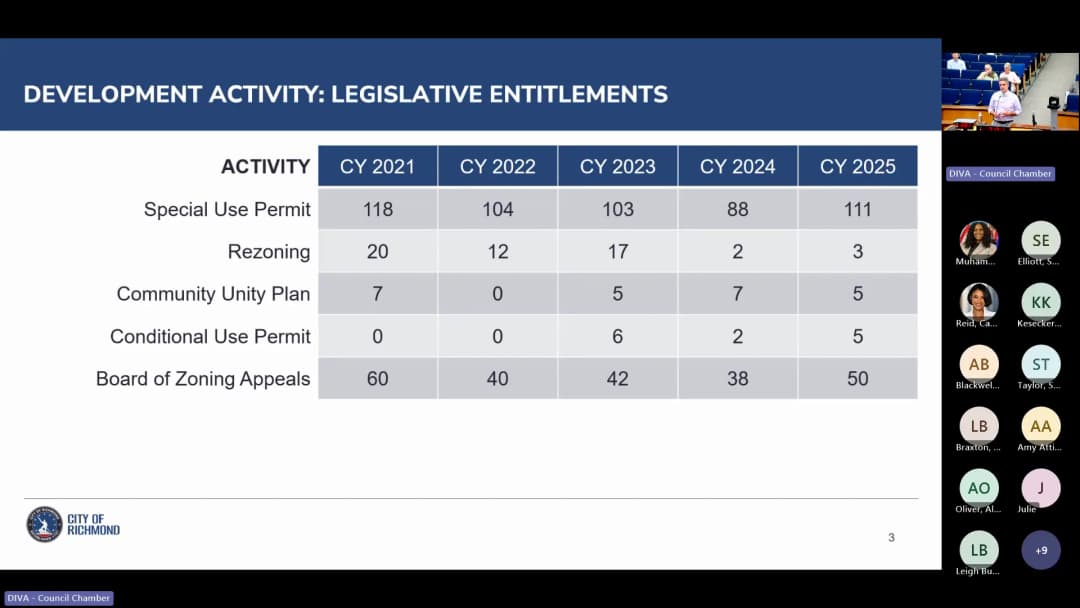
The Land Use, Housing and Transportation Standing Committee met on June 17, 2026, starting shortly after 2:15 PM. The meeting included public comments, approval of street naming ordinances, and two major presentations: an update on housing and business permitting timelines, and a plan to issue a request for qualifications (RFQ) for surplus city-owned properties to create affordable housing. Public Comments & Testimony - Rich Saucer spoke about concerns with the process for approving large infrastructure projects, specifically the proposed $400 million North South Bus Rapid Transit (BRT) project. He argued that GRTC’s justification is skimpy, the service area has half the population normally needed, and population projections have been downgraded. He supports strong public transit but believes the money could be better invested. - Thomas Courtney raised unresolved land use issues regarding the VMFA Grove Avenue Storage Facility, including pending zoning confirmation letters, landscaping deficiencies, and potential operational use before certificates of occupancy are issued. He asked the city to ensure the record is clear. - Dr. Lisa Johnson spoke in support of naming the 1000 block of North Lombardy Street after Coach Howard D. Hopkins, citing his decades of mentorship and impact on Richmond students. - Pierre Johnson also supported the Hopkins street naming, emphasizing his role at Maggie Walker High School. - Reverend Wendy Bullock supported naming the 2800 block of Fendle Avenue after Reverend A. Lincoln James Jr., highlighting his 45+ years of ministry and community service. Discussion Items 1. Continuances of Agenda Items 1 and 6 - The committee unanimously voted to continue Item 1 (Ordinance 2026-113) and Item 6 (Resolution 2026-R024) to the July 21, 2026, meeting for 30 days. No details were provided about the content of these items. 2. Ordinance 2026-125 – Chamberlain Avenue Paving Project - Kenny Horek, Paving Division Program Manager, presented a project to resurface a portion of Chamberlain Avenue. It is a state-of-good-repair project, 100% reimbursable by VDOT. The committee approved forwarding it to the full council. 3. Presentation: Housing and Business Permitting Timelines - Director of Planning and Development Review Kevin J. Fong presented data on permitting times. Key points: - Average application processing time reduced from about a month in 2021 to near the 5-business-day goal by 2023, but crept up slightly in 2025 due to staffing turnover and complexity. - Plan review for 99% of projects (under $1.5 million) meets a 10-business-day turnaround target; 2025 performance is much higher than 2022. - The city issues 18,000 building permits per year, generating nearly $11 million in building code fees in 2025. - Goals include reducing legislative entitlement times (e.g., special use permits) through zoning code refresh, raising the threshold for site plan review from 3 to 6 dwelling units, and implementing a new software system by February 2027. - Council members asked about support for small builders, partnership with the Office of Minority Business Development, and quality control of third-party reviewers. Director Fong noted improvements and acknowledged the need for better interagency coordination. 4. Presentation: Surplus Property RFQ for Affordable Housing - Director of Housing and Community Development Merrick Malone and Senior Project Development Manager Cindy Kong outlined a plan to issue a request for qualifications for two surplus properties: 2503 Q Street (former police precinct, 0.93 acres, Church Hill) and 4929 Chamberlain Avenue (former school, 0.973 acres, North Side). - The goal is to transform vacant non-performing assets into affordable and mixed-income housing, while also generating revenue (sale or ground lease) to reinvest in future housing. - The process will begin with RFQ in late July/early August 2026, followed by stakeholder engagement, then an RFP by end of 2026. Evaluation criteria include affordability, developer experience, design, financing, and community benefits. - Council members discussed the need to consider unsolicited offers, community representation on evaluation panels, and coordination with other city agencies to address vacant properties held by authorities. Key Outcomes - Unanimous votes to continue Item 1 (Ordinance 2026-113) and Item 6 (Resolution 2026-R024) to July 21, 2026. - Unanimous vote to forward Item 2 (Ordinance 2026-125, Chamberlain Avenue paving) to the full council with a recommendation to approve. - Unanimous votes to forward Items 3, 4, and 5 (honorary street naming ordinances for Eugene and Vivian Mason, Coach Howard D. Hopkins, and Reverend A. Lincoln James Jr.) to the full council with a recommendation to approve. - No formal votes were taken on the presentations; they were informational only. - The next meeting is scheduled for Tuesday, July 21, 2026, and will include a presentation on the partial tax exemption program’s five-year evaluation and the Department of Economic Development’s annual real estate report.

ENGINEERING AND INFRASTRUCTURE 40% · AFFORDABLE HOUSING 18% · PROCEDURAL 12% · HISTORIC PRESERVATION 10%
86
JUN 17, 2026 · RICHMOND, VIRGINIA · CITY COUNCIL
Finance and Economic Development Committee Meeting Summary – June 17, 2026

On June 17, 2026, the Richmond City Council Finance and Economic Development Standing Committee met to consider several items including a resolution to investigate the city's failure to publish a monthly payment register, the acceptance of grant funds, and an overhaul of the city’s PCARD program. The meeting included public comment, multiple votes to forward ordinances to the full council, and a detailed presentation on procurement improvements. The committee also continued two linked transparency-related items to the next meeting. Consent Calendar - Approval of Minutes: The minutes from the May 20, 2026 Finance and Economic Development Standing Committee meeting were approved without amendment. - Item 2 – Ordinance 2026-130: Authorizing acceptance of $69,920 from the Virginia Department of Historic Resources (African American Cemetery Grant Fund) for preservation, maintenance, and stewardship at historically African American cemeteries. Forwarded to council with recommendation to approve. - Item 3 – Ordinance 2026-130 (duplicate number in transcript, likely 2026-131): Authorizing acceptance of $611,807.50 from the National Opioid Settlement Fund for opioid abatement strategies. Forwarded to council with recommendation to approve. - Item 4 – Ordinance 2026-132: Authorizing acceptance of $80,000 from the Virginia Department of Conservation and Recreation for Broad Rock Creek Park improvements. Forwarded to council with recommendation to approve. - Item 5 – Ordinance 2026-133: Authorizing a right-of-entry agreement with Capitol Trees for tree improvements at three parks. Forwarded to council with recommendation to approve. - Item 7 – Ordinance 2026-148: Authorizing acceptance of $150,000 from the Virginia Department of Criminal Justice Services for the Richmond Recovery Court to combat substance abuse and opioid overdose. Forwarded to council with recommendation to approve. - Item 8 & 9 – Ordinances 2026-149 and 2026-150: Amending city code for public procurement definitions and joint/cooperative procurement to conform to state optional provisions. Forwarded to council with recommendation to approve. - Item 10 – Ordinance 2026-151: Extending the expiration date of the partial exemption for rehabilitated commercial/industrial structures from June 30, 2026 to June 30, 2027. Forwarded to council with recommendation to approve. Public Comments & Testimony - Item 6 – Resolution 2026-R019 (payment register investigation): One speaker, Amante Gonzalo (6th District resident), spoke in support. He argued that before changing transparency standards, the city should investigate why the current ordinance to publish a monthly payment register was not followed, citing the city’s values of integrity, excellence, and equity. He noted that Richmond earned the "City of Darkness Award" from the Electronic Frontier Foundation for its FOIA system, which can be costly and burdensome for residents. - Item 2 – Ordinance 2026-130 (cemetery grant): Kimberly Jackson, community engagement manager for cemeteries with Parks, Recreation, and Community Facilities, spoke in support, requesting acceptance of the $69,920 grant for burial enclosure repairs, endangered grave marker/monument repairs, and property delineation. - No other public comments were offered for any items. Discussion Items - Item 1 – Continuation Request: Ordinance 2026-081 was continued to the July 15, 2026 meeting at the request of the administration (Chair Robertson). The motion passed 2-0 (Vice Chair Jones, Chair Robertson). - Item 6 – Resolution 2026-R019 (Transparency of Payment Register): Councilmember Gibson introduced a resolution directing the Organizational Development Standing Committee to investigate the city’s failure to publish a monthly payment register (including checks and P-card payments) as required by city code since 2015. The city stopped publishing in 2019 and took the register down entirely in 2024 after media stories about financial misuse. The administration proposed reducing requirements, citing difficulty. Gibson argued redactions could be done programmatically and that the investigation would give council access to the full database with only required redactions. Council Chief of Staff Warren and Assistant City Attorney Cottman explained the procedural process: the Organizational Development Committee would direct staff to obtain documents and testimony, and if needed, could pursue subpoenas. Vice Chair Jones moved to continue the resolution to the July 15 meeting to align with the administration’s forthcoming publication of FY25 data and to avoid duplication. The motion passed 2-0. - PCARD Program Overhaul Presentation: Renee Almarez, Director of Procurement Services, presented a comprehensive update on the city’s Purchasing Card (PCARD) program. Key points: - A 60-page audit had identified 16 complex recommendations and 58 action items covering policy deficiencies, system weaknesses, oversight gaps, and control failures. - Immediate actions: suspended and restructured the program, reduced cards from 320 to 73 active cards, blocked certain usages (food, travel, Amazon citywide except narrowly approved), implemented mandatory pre-approval forms, and partnered with Card Integrity for data analytics. - The team expanded from 1 to 3 staff (Jody Phillips, Wendell Douglas, Matt Farrell). - Policy 15 was completely revised; new Discretionary Spend Policy, travel meal restrictions, limited payment platforms (Venmo banned, only Square/PayPal allowed), mandatory reconciliation within 5 days of purchase (previously 5 days after billing period), approver limits (max 3 cardholders per approver, approver must be higher in hierarchy). - Training achieved 100% completion for cardholders and approvers (145 people). City auditor praised training as "some of the best he’s seen in local government." - 75% of recommendations closed (12 of 16), 19% (3 recommendations) submitted for closure pending review, and 6% (1 recommendation) pending submission. - The program is in a 90-day soft relaunch period with no new cards. Expansion will be gated by metrics: 100% training, 90% transaction compliance, 95% documentation compliance, 90% cardholder and approver reconciliation within 5 days, 95% documentation compliance, and no more than 5% violation rate. - City auditor confirmed that closure of Recommendation 1 (relaunch) will require approval of a Discretionary Spending Policy (Recommendation 2). Recommendation 12 (single quote threshold of $50,000) is still under discussion. - The program currently costs $1,400/month for Card Integrity analytics. - Committee Chair Comments: Chair Robertson emphasized the importance of getting both the transparency resolution and administration paper right, and requested that financial reports be reviewed and standardized before the next fiscal year. She also noted the need for advance questions on items continued to the next meeting. Key Outcomes - Items continued: Ordinance 2026-081 and Resolution 2026-R019 were both continued to the July 15, 2026 Finance and Economic Development Standing Committee meeting. They will appear as the first two items on the agenda. - Items forwarded to full council with recommendation to approve: Ordinances 2026-130, 2026-131 (opioid), 2026-132, 2026-133, 2026-148, 2026-149, 2026-150, and 2026-151. All motions passed 2-0 (Vice Chair Jones, Chair Robertson), except where noted. - PCARD Program: The committee acknowledged the presentation and the progress made. The chair urged follow-up on remaining recommendations and continued monitoring. Two presentations are scheduled for the next meeting: Department of Economic Development on project pipeline/performance metrics, and the administration on delinquent real estate taxes and the tax sale program relaunch. - Next steps: The committee will hold a pre-discussion meeting before the July 15 meeting to finalize financial reporting formats and discuss the continued transparency items.

PROCUREMENT 73% · PENDING LITIGATION 11% · PROCEDURAL 4% · HISTORIC PRESERVATION 4%
87
JUN 16, 2026 · RICHMOND, VIRGINIA · CITY COUNCIL
Land Use, Housing and Transportation Committee Meeting - June 16, 2026

The Land Use, Housing and Transportation (LUHT) Committee of the Richmond City Council met on June 16, 2026, at 4:00 PM (the meeting started at 4:00 PM based on the presentation timing mentioned). The meeting included public comments, approval of minutes, continuances, votes on several ordinances, and two informational presentations. Key actions included forwarding street naming ordinances to full council, continuing two items, and hearing updates on building permitting timelines and the disposition of surplus city properties for affordable housing. Public Comments & Testimony - Speaker 1 (infrastructure concerns): A member of the public expressed concerns about the process for approving large infrastructure projects, specifically regarding GRTC’s bus rapid transit (BRT) route and the Chamberlain Avenue corridor. He noted that GRTC had indicated that development projections along the route had been downgraded and that the next draft of code refresh would have less upzoning for Chamberlain Avenue. He also mentioned the Fall Line Trail and requested a briefing from the Department of Public Works (BTPW). He expressed support for strong public transit but argued the $400 million investment could be better used elsewhere. - Speaker 2 (VMFA storage facility issues): Thomas Courtney, a resident adjacent to the VMFA Grove Avenue Storage Facility, provided an update on unresolved land use issues. He cited pending zoning confirmation letter matters, landscaping deficiencies, and observations of operational use before a certificate of occupancy or final zoning sign-off had been confirmed. He also noted that the Department of General Services lease for the facility appears to be a 10-year term, which may not match the long-term institutional control premise discussed during zoning review. He asked the committee to ensure administrative follow-through. - Public testimony on street naming (items 3-5): - Dr. Lisa Johnson spoke in favor of naming the 1000 block of North Laburnum Street after Coach Howard D. Hopkins (Item 4). She shared personal stories of his mentorship and impact on thousands of students over five decades as a coach, athletic director, and principal at Maggie Walker High School. - Reverend Wendy Bullock spoke in favor of naming the 2800 block of Fendall Avenue after Reverend A. Lincoln James Jr. (Item 5). She highlighted his 50-plus years of ministry, his television ministry that reached incarcerated individuals, and his support for business owners and the less fortunate. - Pierre Johnson spoke in favor of the Howard D. Hopkins naming, recounting his own experience as a Maggie Walker graduate and praising Hopkins’ financial management of school activities and his long-term community service. Consent Calendar - The minutes from the May 19, 2026, LUHT committee meeting were approved as presented. - Items 1 (Ordinance 2026-113) and 6 (Resolution 2026-R024) were continued to the July 21, 2026, LUHT meeting. Discussion Items - Item 2: Ordinance 2026-125 – Chamberlain Avenue Paving Project. Kenny Horek of the Paving Division presented the project, which is a 100% VDOT-reimbursed state-of-good-repair resurfacing of a portion of Chamberlain Avenue. No public opposition was heard. The committee voted unanimously to forward the ordinance to full council with a recommendation to approve. - Items 3-5: Street naming ordinances. - Item 3: Ordinance 2026-126 – 6300 block of Hall Street Road to be designated in honor of Eugene and Vivian Mason. - Item 4: Ordinance 2026-145 – 1000 block of North Laburnum Street to be designated in honor of Coach Howard D. Hopkins. - Item 5: Ordinance 2026-146 – 2800 block of Fendall Avenue to be designated in honor of Reverend A. Lincoln James Jr. - Chair Jones and Councilmember Robertson added themselves as co-patrons. After public testimony in support, the committee voted unanimously to forward all three to full council with a recommendation to approve. - Presentation 1: Housing and Business Permitting Timelines. Kevin Vonk, Director of Planning and Development Review, presented an update on permitting timelines. He emphasized the importance of reducing carrying costs and exposure to market changes (e.g., tariffs, labor costs) for developers. He showed data on building permit processing times, noting improvements in application intake (goal of 5 business days) and plan review (goal of 10 business days for small projects). He discussed the timeline for special use permits (SUPs), which can take several months due to community outreach and legislative processes. He highlighted ongoing efforts: personnel enhancements using building code fees, two third-party review firms, a customer survey for software upgrade planning (new system live by February 2027), AI tools for application assistance, and policy changes through code refresh (e.g., reducing legislative entitlements, raising the threshold for site plan review from 3 to 6 dwelling units). Vice Chair Robertson asked about the process for smaller builders; Director Vonk described dedicated customer service, brochures (e.g., for accessory dwelling units), and pre-development meetings. Councilmember Rutten asked about partnership with the Office of Minority Business Development; Director Vonk indicated there is no formal partnership yet but noted potential with the new Office of Community Wealth Building. Members also discussed the use of third-party reviewers ensuring local code application and the need for additional attorneys in the City Attorney’s office to speed up ordinance review. - Presentation 2: Surplus Property Disposition for Affordable Housing. Merrick Malone, Director of Housing and Community Development, and Cindy Kong, Senior Project Development Manager, presented a plan to issue a Request for Qualifications (RFQ) for two city-owned surplus properties: 2503 Q Street (0.93 acres, former police precinct in Churchill, District 7) and 4929 Chamberlain Avenue (0.973 acres, former school in North Side, District 3). The goal is to transform vacant properties into affordable and mixed-income housing, increase the tax base, and reinvest proceeds. The process will involve stakeholder engagement between the RFQ and subsequent Request for Proposals (RFP) phase. The evaluation committee will include subject matter experts; Director Malone noted the future inclusion of community representatives. Chair Jones and Councilmember Rutten discussed the need to accelerate disposition of other vacant properties held by city authorities and the handling of unsolicited offers. Director Malone confirmed coordination with the Department of Economic Development on unsolicited proposal policies. The timeline targets RFQ issuance by late July/early August 2026, RFP issuance by end of 2026. Key Outcomes - Votes: - Continued Items 1 and 6 to July 21, 2026 (unanimous). - Approved forwarding Item 2 (Chamberlain Avenue paving) to full council (unanimous). - Approved forwarding Items 3, 4, and 5 (street naming) to full council (unanimous). - Directives: - Staff to continue improving permitting timelines, including exploring partnerships with economic development offices for small business outreach. - Housing and Community Development to proceed with RFQ for 2503 Q Street and 4929 Chamberlain Avenue, with stakeholder engagement before the RFP phase. - Next Steps: - The next LUHT committee meeting is scheduled for Tuesday, July 21, 2026, at which presentations on partial tax exemption programs (five-year evaluation) and the annual real estate report from Economic Development will be heard, along with votes on board and commission vacancies.

LAND USE AND ZONING 51% · AFFORDABLE HOUSING 19% · PROCEDURAL 16% · HISTORIC PRESERVATION 8%
88
JUN 15, 2026 · RICHMOND, VIRGINIA · CITY COUNCIL
Richmond City Council Work Session on Code Refresh – June 15, 2026

On June 15, 2026, the Richmond City Council held a work session with city administration to discuss the Code Refresh initiative, an update to the city’s 50-year-old zoning ordinance. The session focused on three key unresolved questions: household occupancy limits, zoning of places of worship, and the number of dwelling units allowed per lot. No public comment was taken, and no votes were cast. Presentation Overview - Director of Planning and Development Review Kevin J. Bonk presented the purpose and objectives of the Code Refresh, emphasizing alignment with the Richmond 300 Master Plan. He noted that over 5,000 residents had engaged through various channels, and substantial agreement exists on many issues, such as zoning districts, conditional use permits, open space districts, and tree canopy requirements. - Three open questions were highlighted: (1) how many unrelated persons may constitute a household (current code limits to three; draft two proposed eight; draft three may defer to building code occupancy); (2) how to zone places of worship (draft three proposes using multifamily districts RMA, RMB, RMC, and residential cottage to allow housing on church properties while preserving worship uses); (3) how many dwelling units per lot (draft three proposes a preservation bonus: two principal units plus an ADU only if existing structures are retained; demolition reverts to one principal unit plus ADU). - Bonk stated that the code is not a silver bullet for affordability but a necessary tool to increase housing supply and reduce special use permit burdens. He noted that RKG market analysis projects 1,800–3,000 new units per year under the new code, with about two-thirds on nodes and corridors. Council Member Discussion - Councilmember Gibson questioned whether the code would produce affordable housing, citing RKG analysis showing most market-rate development would be in higher-income areas. She urged scrutiny of displacement data, noted that nearly 25% of homes in the 6th District are owned by LLCs, and warned that private equity fuels the crisis. She requested the city’s annual Richmond 300 progress report and a presentation on the market analysis. - Councilmember Jones stressed the need for data on how growth affects schools and infrastructure, especially in Southside, where overcrowding already exists. She called for more engagement with Southside communities before draft three and asked about provisions for recovery and transition houses. She reserved her responses for the second round. - Vice President Jordan commended public engagement and expressed gratitude. She asked about subdividing church properties, affordable housing partner feedback on the two-plus-one option, and parallel initiatives (e.g., cultural heritage plan, design overlays, pre-designed ADUs). She stated her district sees strong opposition to moving from three unrelated persons but suggested four or five as a compromise. She supported the proposed church zoning approach and expressed comfort with two-plus-one on her block but noted not all neighborhoods agree. - Councilmember Breton (appears via transcript as “Councilman Breton” or “Bretton”) echoed gratitude and raised concerns about encouraging demolitions. He supported the preservation bonus but urged consideration of starter homes and small units. He asked about transitional zoning between neighborhoods, tree canopy protections, and state agency bypass of local zoning. He emphasized the need for data on infrastructure, schools, and traffic safety. - Councilmember Trammell strongly opposed the code refresh, stating it is not affordable housing but market-rate development that will raise assessments and displace residents. She described losing businesses on Richmond Highway, seniors unable to pay taxes, overcrowded schools, and lack of police and infrastructure. She questioned why the master plan was ignored and argued the code would eliminate the American dream. She demanded more attention to Richmond Highway and more engagement. - Councilmember Lynch advocated a fact-based approach. She supported keeping occupancy at three unrelated persons, expressed caution on the “Yes in God’s Backyard” state mandate, and favored one principal dwelling unit plus ADU for many neighborhoods to avoid demolition. She urged parallel passage of the cultural heritage plan and a facilities master plan for schools. She noted that Henrico and Chesterfield have already passed similar updates and Richmond is behind. - Councilmember Robertson highlighted the need for clarity on terminology (e.g., affordable housing, private equity, growth nodes). She challenged the claim that affordable housing is fueled by private equity, asking for data. She called for a clear explanation that single-family neighborhoods will not see multifamily towers, and for defining AMI targets. She recommended that the cultural heritage plan be considered before the final code draft. Key Outcomes - No formal decisions or votes were taken. The session was intended for council feedback to inform draft three of the zoning code. - Director Bonk agreed to provide the Richmond 300 annual report and a presentation on the market analysis to council at a future OD (Organizational Development) meeting. - Council staff will compile all questions and responses from the session and any follow-up, post them online for public access. - The administration plans to release draft three in July 2026, after which the Planning Commission will make a recommendation and council will have final authority. - Additional work sessions with the Planning Commission and Zoning Advisory Committee are scheduled later in the week. - Several council members requested increased community engagement, especially in the 8th and 9th districts, before draft three is finalized.

LAND USE AND ZONING 78% · AFFORDABLE HOUSING 11% · PROCEDURAL 3% · PUBLIC ENGAGEMENT 2%
89
JUN 15, 2026 · RICHMOND, VIRGINIA · CITY COUNCIL
Richmond City Council Code Refresh Work Session - June 15, 2026

On June 15, 2026, the Richmond City Council held a work session to review the code refresh initiative—a comprehensive update to the city's 50-year-old zoning ordinance. The session focused on three key unresolved questions: the maximum number of unrelated persons in a household, how to zone places of worship, and how many dwelling units may be placed on a lot. No public comment was taken; council members offered feedback and raised concerns about affordability, displacement, infrastructure, and alignment with the Richmond 300 master plan. The meeting, scheduled to begin at 9:15 AM, opened with an afternoon greeting, a discrepancy noted from the provided start time. Discussion Items - Presentation on Code Refresh – Kevin J. Bonk, Director of Planning and Development Review, presented the rationale for updating the zoning code, emphasizing alignment with Richmond 300, extensive public engagement (over 5,000 individual touchpoints), and the need to balance growth with neighborhood character. He highlighted three areas still under evaluation: - Household Occupancy: Current code limits unrelated persons to three; draft two proposed eight; draft three may defer to building code occupancy limits. - Places of Worship: Draft three proposes zoning them into small multifamily districts (RMA, RMB, RMC, RC) to allow housing while preserving assembly uses, with contextual standards to prevent strip malls. - Dwelling Units per Lot: Draft three introduces a “preservation bonus” allowing two principal units plus an ADU if the existing building is preserved; demolition reduces options to one principal unit plus ADU. - Council Concerns and Positions: - Councilmember Gibson emphasized the need for data, questioned the market analysis (RKG) showing market-rate units concentrated in affluent areas, and warned that private equity drives the housing crisis. She reserved judgment pending displacement data and fire safety analysis. - Councilmember Jones urged deeper engagement in Southside communities and asked about provisions for recovery/transition houses. She noted that Richmond Public Schools were not part of the master plan and that current growth pressures already exist. - Vice President Jordan praised public engagement, called for contextual zoning and tree canopy protections, and commented on the need for more housing products like condos. She suggested 4–5 unrelated persons (vs. 3 or 8) as a compromise. - Councilmember Brighton supported the broad strokes of the plan, emphasized “small is beautiful” for starter homes, and asked for transition treatments between residential and node zones, stronger tree canopy rules, and safeguards against state agency preemption. - Councilmember Trammell strongly opposed the code refresh, arguing it would not produce affordable housing, increase assessments, strain infrastructure and schools, and eliminate the “American dream” of quiet neighborhoods. She noted that Richmond Highway was omitted from the mayor’s corridor focus. - Councilmember Lynch advocated keeping the three-person limit, taking a conservative approach to the “God in my backyard” state mandate, and limiting dwelling units per lot to one principal plus ADU to prevent demolitions. She called for the cultural heritage plan and facilities master plan to be completed first. - Councilmember Robertson stressed the need for clear definitions (e.g., affordable housing), myth-busting about high-density in single-family neighborhoods, and more information on private equity’s role in affordable housing. She requested data on LLC ownership and more community engagement before draft three. - Additional Input: Director Merrick Malone (Housing) outlined parallel tools (performance grants, affordable housing trust fund, inclusionary zoning) that complement code refresh. Ruth Morrison clarified that state Bill HP 1279 (God’s Backyard) is a mandate effective Jan 1, 2027, requiring substantial compliance. Key Outcomes - No votes were taken; the session was solely for feedback. - Council members will submit follow-up questions via Chief of Staff RJ Warren. - Administration will incorporate feedback into a third draft of the code, expected in July 2026. - The cultural heritage stewardship plan and Richmond 300 annual report (including enrollment projections) will be presented to council before final consideration. - Director Bonk committed to providing data on demolitions (projected 30–40 per year with code refresh, vs. 80 in 2025), infrastructure capacity, and alignment with master plan height/density maximums.

LAND USE AND ZONING 75% · AFFORDABLE HOUSING 15% · COMMUNITY ENGAGEMENT 5% · PROCEDURAL 3%
90
JUN 11, 2026 · RICHMOND, VIRGINIA · CITY COUNCIL
Richmond Education and Human Services Committee Meeting - June 11, 2026

The Education and Human Services Committee of the Richmond City Council met on June 11, 2026, at 2:00 PM. The meeting featured a comprehensive presentation on gun violence prevention and justice services, updates from the Deputy Chief Administrative Officer for Human Services, and action on several ordinances related to opioid settlement funds, shelter operations, and afterschool programming. All items on the agenda were approved unanimously. The meeting adjourned after a brief approval of minutes from the May 14, 2026 meeting. Public Comments & Testimony - No members of the public signed up to speak on any agenda item before the 10:00 AM deadline. No public comments were made during the meeting. Discussion Items - Gun Violence Prevention and Justice Services Update – Greg Hopkins, Director of the Department of Justice Services, presented an overview of the city's gun violence prevention efforts. He highlighted the alignment of the Office of Gun Violence Prevention with Justice Services and provided detailed data: Black residents accounted for the majority of shooting victims; males and young adults remain highest risk; the highest concentration of shootings occurs in the East End and North Side. Safer Communities grant funding has impacted over 16,000 residents through 395 program activities, representing $3.2 million in violence prevention investments across 13 sub-recipients and 26 communities. The Virginia Community Crime Control Act (VJCCA) funding has remained flat since 1995, while youth needs have grown more complex. In 2026, 251 youth are served, with 865 cases processed and over 500 youth diverted from deeper court involvement. The Trauma Healing Response Network logged 70 incident-related alert responses, conducted over 900 wellness checks, coordinated 120 emergency relief requests, and distributed over $35,000 in emergency assistance. The Office of Gun Violence Prevention is partnering with the National Institute for Criminal Justice Reform to develop a five-year strategic plan. Councilmembers praised the integrated approach and asked about metrics, victim fund access, and collaboration with Richmond Redevelopment and Housing Authority on VAWA transfers. - Human Services Updates – Amy Popovich, DCAO for Human Services, announced upcoming Juneteenth events and highlighted Parks and Recreation summer programs, including a new interactive map for meal sites (18-20 locations citywide) and the full integration of parks services into the 311 system (200 requests in the first month). She noted that the Richmond Free Press has gifted its archive to Richmond Public Libraries. She also recognized Greg Hopkins for testifying before a U.S. House subcommittee on gun violence prevention. - Ordinance 2026-140 and 2026-141 (Opioid Settlement Funds) – Anna Jones, Opioid Response Strategist, explained that the first ordinance authorizes acceptance of $1,164,547.84 from national opioid settlements into the city's special fund. The second ordinance transfers $300,000 to the Medication Assisted Treatment (MAT) Pilot Program run by the Richmond City Sheriff's Office, which has served 178 unique individuals since January 2025. Both ordinances were approved unanimously. - Ordinance 2026-143 and 2026-144 (Salvation Army Shelter) – Steve Harms, Policy Advisor, presented a two-year extension of the operating grant for a 50-bed men's year-round shelter and inclement weather/cooling center, and a lease amendment for a resource and training center at 1900 Chamberlain Avenue. Both ordinances were approved unanimously. - Ordinance 2026-139 (CARITAS Surge Shelter) – Dominic Barrett, Senior Policy Advisor, explained that this ordinance transfers $80,000 from an unused Venture Richmond line item to cover additional surge shelter nights needed due to extreme weather and Winter Storm Fern. The ordinance was approved unanimously. - Ordinance 2026-142 (YMCA Afterschool Program) – Eva Collin, Senior Policy Advisor, presented a grant contract with the YMCA of Greater Richmond for low-cost afterschool programming at six elementary schools (Francis Red, Cardinal, Munford, Holton, and Fox). The contract covers the just-concluded school year due to a budget misunderstanding. Councilmembers discussed capacity constraints, licensing requirements, and the broader childcare crisis, including changes to state subsidy eligibility that limit access for school-age children without a sibling under five. The ordinance was approved unanimously. Key Outcomes - The committee approved all six ordinances (2026-140, 2026-141, 2026-143, 2026-144, 2026-139, and 2026-142) unanimously (3-0) and forwarded them to the full City Council with a recommendation to approve. - The committee approved the minutes from the May 14, 2026 meeting as presented.

PUBLIC SAFETY 50% · YOUTH PROGRAMS 16% · HOMELESSNESS 14% · PUBLIC HEALTH 10%
OPENPUBLICA · PUBLIC MEETING INDEXUPDATED DAILY · openpublica.com