Browse by city
Date range
Search help

Search titles, summaries, topics and stored transcripts together. Keywords may match separately; put the whole query in double quotes for a phrase. Matching follows word analysis, so punctuation is not exact. Both dates are included. Documents are not searched.

SHOWING 131–140 ENTRIES
131
MAR 4, 2026 · ROCHESTER, MINNESOTA · BOARDS AND COMMISSIONS
Rochester Park Board Meeting Summary - March 3, 2026

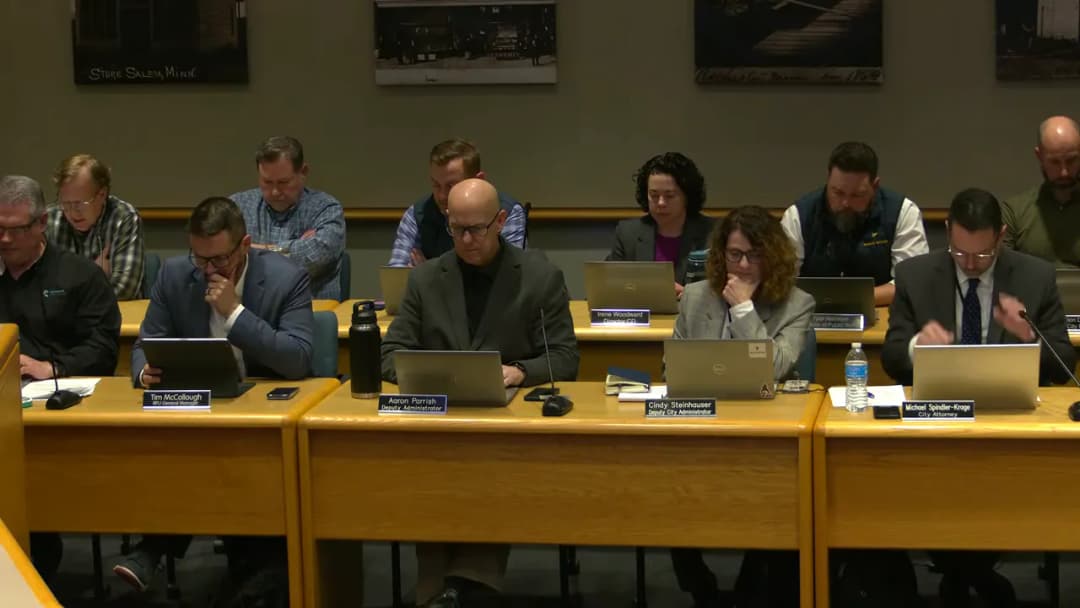
The Rochester Park Board met on March 3, 2026 at 4:30 PM in City Hall Conference Room 104 to discuss and act on several items including park projects, financial reports, and a naming rights agreement. All five present members voted unanimously on all actions taken. Consent Calendar - Bulk Playground Mulch Order: Authorized the purchase of playground mulch from Best Rubber Mulch. - Golf Course Concession Contracts: Approved concession contracts for Eastwood and Northern Hills Golf Courses. Public Comments & Testimony - Tammy Gross (President, Rochester Area Pickleball Association - RAPA): Expressed full support for rebuilding the pickleball courts at Cook Park, emphasizing how pickleball brings together diverse community members and strengthens connections. She acknowledged concerns about priority play for association members, stating that their goal is not to create exclusivity but to support a system that works for everyone—casual players, new players, families, and organized groups. Discussion Items - Project CIP Overview: Parks and Forestry Division Head Mike Nigbur presented a detailed overview of the Capital Improvement Plan (CIP) project financials, funding sources (tax levy, grants, partnerships, donations, activity-generated revenue), and planning. He reviewed numerous projects including disease tree removal, playground replacements, Quarry Hill improvements, Cascade Lake fiber/Wi-Fi, Plummer House renovations, park safety surfacing, Silver Lake dredging, Oxbow trail, central dog park, natural resource inventory, Game Haven mountain biking expansion, and Kutzky tennis courts. The board discussed the history and funding of the Flood Control Project. A request was made to authorize reserve funding for the relocation of wood waste processing from its current site (due to nearby development) to KR3 on 19th Street Northwest. Staff requested $70,000 total ($35,000 from each of two years) from department reserves. The board approved the funding. - Cook Park Pickleball Renovation: Staff presented five bids for the renovation of pickleball courts. The recommendation was for Alternate 2 (concrete courts) awarded to Rochester Sand and Gravel at $347,799.20, with an additional $25,000 contingency from General Park Reserves. Discussion included transparency around bid details, the relative costs of asphalt vs. concrete, and concerns about priority court time for RAPA versus public use. Commissioner Morgan expressed concern about verbiage in the agreement that could feel exclusive to taxpayers who also contributed public dollars. Staff explained that similar arrangements exist with other user groups (e.g., tennis, baseball). Commissioner Cormack inquired about the 10-year financing of RAPA's portion and default risks. Staff stated the 10-year timeframe is standard for larger-dollar agreements. President Neumann suggested signage at Cook Park directing users to other pickleball courts. The board approved the motion. - Hadley Creek Golf Course Clubhouse Repairs: The bid deadline was March 3, 2026 at 11:00 AM. Three quotes were received. The recommendation was to accept Kramer Contracting's bid of $86,199 (base bid $59,998 plus two alternates). Staff described water intrusion issues, subfloor damage, and planned work including drywall removal, insulation replacement, and window reinstallation. Unit pricing was included for potential additional work due to unforeseen conditions. Commissioner Cormack inquired about surprises; staff expressed confidence in the scope but acknowledged potential for undiscovered damage. The board approved the bid. - Rochester Recreation Center South Rink and Gymnasium Naming Rights Agreement and Partnership: Recreation Center Manager Caryn Rooney presented a 10-year naming rights agreement with Olmsted Medical Center (OMC). The south rink and gymnasium would be named "OMC Arena" and "OMC Performance Gym." OMC will invest $25,000 annually ($250,000 total) and provide $30,000 in gym equipment. Additional deliverables include community events like family fun nights and educational workshops. Commissioner Cormack noted the facility is much better maintained now than in the past. President Neumann thanked Rooney and OMC representatives (Brittany and Joel) for their efforts. The board approved the agreement. Key Outcomes - Minutes Approved: Minutes of February 10, 2026 meeting approved unanimously (5 ayes, 2 absent). - Monthly Reports Received and Filed: Parks and Recreation Department monthly reports for February 2026 received and filed. - Monthly Bills Approved: February 2026 bills approved unanimously. - Financial Performance Report Received and Filed: Year-to-date financials through February 2026 received and filed. - Consent Agenda Approved: Bulk Playground Mulch Order and Golf Course Concession Contracts approved unanimously. - CIP Overview – Wood Waste Processing: Authorized reserve funding of $70,000 ($35,000 from each of two years) for the relocation of wood waste processing. Motion carried unanimously. - Cook Park Pickleball Renovation: Authorized award of Concrete Alternate 2 to Rochester Sand and Gravel for $347,799.20, plus up to $25,000 from General Park Reserves as contingency. Motion carried unanimously. - Hadley Creek Golf Course Clubhouse Repairs: Authorized bid award to Kramer Contracting for $86,199 (base bid + alternates 1 and 2), with unit pricing for potential additional work. Motion carried unanimously. - Rec Center Naming Rights: Approved 10-year naming rights agreement between the City of Rochester and Olmsted Medical Center for the Recreation Center South Rink and Gymnasium. Motion carried unanimously. - Agenda Planner: Staff noted that Director Widman and Nigbur may be absent for the July meeting; Ben will attend. Commissioner Cormack noted a date error on the agenda planner: the October meeting should be October 6 (not October 10). - Adjournment: Meeting adjourned unanimously.
PARKS AND RECREATION 60% · PROCEDURAL 11% · PUBLIC ENGAGEMENT 11% · WASTE MANAGEMENT 9%
132
MAR 2, 2026 · ROCHESTER, MINNESOTA · BOARDS AND COMMISSIONS
Rochester City Council Committee Review of Outside Agency Financial Reports - March 2, 2026

The committee reviewed quarterly financial statements from multiple outside agencies receiving city funding, discussed performance and risks, and approved first-quarter disbursements for 2026. The meeting included reports on 125 Live, History Center, Human Rights Commission, RAEDI, SBDC, Our Neighbors, Art Center, Civic Theatre, Rochester Downtown Alliance, Southeastern Minnesota Initiative Fund, and Youth Council, along with a motion to invite select agencies to future meetings. Consent Calendar - Minutes Approval: The minutes from the November 24, 2025 meeting were approved unanimously without discussion. Discussion Items 125 Live - Report: Administrator zones noted that 125 Live provided robust financials with increased revenue and improved current ratio and operating reliance ratio. The agency's contract with the city includes membership components. - Committee Comments: A member shared personal positive observations about increased younger membership. No financial concerns raised. History Center - Report: The city budgeted $47,500 for the History Center in 2026. Financials showed planned adjustments due to a capital campaign for the sub barnstead expansion. Reporting is a quarter behind. - Committee Comments: Members noted the helpfulness of detailed financials and acknowledged seasonality in nonprofit reporting. Human Rights Commission - Report: The city provided $5,400 annually, but funding is shifting to the Youth Council for equal city-county support. This was the last report for this agency. - Committee Comments: No questions. Rochester Area Economic Development Inc. (RAEDI) - Report: Financials showed changes due to a CD cash-out and timing of investor revenue. Operating reliance ratio stable, current ratio down. SBDC (a program of RAEDI) faces federal funding uncertainties. - Committee Comments: Members noted the need for improved reporting from SBDC and shared a constituent's positive experience. Small Business Development Center (SBDC) - Report: Financials are based on federal reporting requirements, making interpretation difficult. Self-reported numbers may undercount impact. City dollars require federal match. - Committee Comments: Members acknowledged challenges in reporting and ongoing efforts to get better data. Our Neighbors - Report: Funding increased significantly for 2026 after prior cuts. Did not provide updated financials; requested an advance payment, which was not made. Fund balance is dangerously low. - Committee Comments: Strong concern expressed about financial viability. Motion passed to invite Our Neighbors to the next meeting to present on operations. Art Center - Report: City budgeted $185,000 for 2026. Small positive cash flow; total expenses exceed revenues without city support. Net assets include building lease value. - Committee Comments: Members noted stability compared to prior years but reliance on city funds. Civic Theatre - Report: City budgeted $115,000 for 2026, a $15,000 increase. Current ratio down; operating reliance up. Revenues down except for frozen. Third-party ticket markups hurt revenue; city assisting with direct purchase outreach. - Committee Comments: Discussion included changes in management, upcoming shows for 75th anniversary, and new sustainer donor model. Members expressed hope that creative direction improvements will boost attendance. Rochester Downtown Alliance (RDA) - Report: City funding $125,000 for operating support; additional contractual arrangements exist. Financials strong; shift from contracted services back to employees noted. - Committee Comments: Members praised RDA's role in downtown wayfinding and positive feedback from businesses. Requested clarity on staffing mix. Southeastern Minnesota Initiative Fund - Report: No report provided; no city funding for 2026. Agency has millions in reserves. - Committee Comments: Noted as not relevant for current review. Youth Council - Report: Funding of $15,400 for 2026. County considering moving to city youth commission; funding for travel debated (international travel raised concerns). - Committee Comments: Members valued youth presentations but acknowledged budget constraints at county level. Key Outcomes - Approval of First Quarter Disbursements: Motion to approve the 2026 first quarter disbursement of funds for outside agencies passed unanimously (all ayes, no opposition). - Future Agency Presentations: The committee directed staff to invite Our Neighbors and Civic Theatre to present at the next meeting, with a plan to cycle through agencies (two per meeting) to improve understanding of operations. - Reporting Improvements: Staff will continue working with agencies to standardize financial reporting and consider adding historical city support graphs to quarterly reports.

BUDGET EQUITY ANALYSIS 39% · PUBLIC ENGAGEMENT 21% · ECONOMIC DEVELOPMENT 15% · ARTS AND CULTURE 10%
133
MAR 2, 2026 · ROCHESTER, MINNESOTA · CITY COUNCIL
Rochester EDA Meeting Approves City Walk Apartments TIF Agreement - March 2, 2026

The Rochester Economic Development Authority (EDA) meeting on March 2, 2026, focused primarily on a single major agenda item: approval of a development assistance agreement (DAA) for the City Walk Apartments project, which would create Tax Increment Financing (TIF) District No. 85-1. The meeting began with a consent agenda and concluded with adjournment. Consent Calendar - Unanimously approved the minutes of the February 2, 2026 EDA meeting (motion by Councilmember Fredericks, second by Councilmember Miller; all in favor). Public Comments & Testimony - A speaker (not named in the transcript) stated that he had been through the buildings on the site and did not find blight, challenging the project's blight designation. This prompted clarifying questions from Councilmember Wall and Councilmember Palmer. Discussion Items - Development Assistance Agreement for City Walk Apartments (TIF District 85-1): Staff member Mr. Johnson presented the agreement. Key details: - The project is a 13-story residential building with 342 units, total investment of approximately $140 million (the largest multifamily development in Rochester history). - Current site market value: $3.1 million; minimum assessed value under agreement: $86 million (a 2,600% increase in property tax value). - The site was deemed blighted based on an independent blight study by Wood Seth Engineering, meeting statutory criteria for a redevelopment TIF district. - The developer will improve the intersection at Second Street and Sixth Avenue, including realigning the turn and creating a public realm space with a stormwater feature. - The developer (who also owns adjacent apartment complexes) will enter a 20-year agreement (via two 10-year 4D program cycles) to preserve 100% of the 67 existing units at or below 60% Area Median Income (AMI). Those units have received $300,000 in improvements. - The TIF term is 25 years or until the principal is paid off. Property tax base will be frozen at current value until TIF ends. - Heffron House (10 units) will be demolished, reducing on-site naturally occurring affordable housing from 77 to 57 units, but adding 342 market-rate units. - Councilmember Wall questioned the blight definition and the impact on affordable housing count. Mr. Johnson explained the blight test (cost to renovate vs. 15% of new construction cost). - Councilmember Palmer clarified the cycle track design (bike parking along Sixth Avenue). - Councilmember Keene raised a distinction between “naturally occurring affordable housing” and units preserved via the 4D program (which involves a tax abatement). City Attorney Yetzer clarified that the units currently are naturally occurring, and the 4D agreement preserves their affordability. - Councilmember Miller asked about annual tax revenue; Mr. Johnson estimated roughly 2% of the current assessed value (about $60,000) but noted that once the TIF expires, the full increased value will be taxed. Key Outcomes - Motion to approve the development assistance agreement for City Walk Apartments (TIF District 85-1) made by Councilmember Palmer, seconded by Councilmember Fredericks. Passed unanimously (all in favor, no nays). - Motion to adjourn the EDA meeting made by Councilmember Miller, seconded by Councilmember Keene, approved unanimously. - Next steps: The developer expects to close on the site in April 2026, start construction in June 2026, with a 25-month construction period and completion by December 31, 2028.

TAX INCREMENT FINANCING 53% · AFFORDABLE HOUSING 47%
134
MAR 2, 2026 · ROCHESTER, MINNESOTA · CITY COUNCIL
Rochester City Council Meeting - March 2, 2026

The Rochester City Council met on March 2, 2026, beginning with a public comment period followed by regular agenda items including transit service changes, a downtown corridor redevelopment plan, a downtown mobility network study, council rules updates, and a crisis response grant application. Key votes included approval of the Sixth Avenue corridor plan, adoption of an interim north-south bike route option (First Avenue Option B), and approval of council rules changes excluding certain sections. Consent Calendar - Items F1-F3, F5-F7, and F9-F15 were approved en bloc. Items F4 and F8 were pulled for separate discussion. Public Comments & Testimony - Barry Skolnick opposed assigning TIF funds to the City Walks apartment project, arguing the affordable housing percentage would decrease and that the properties do not meet the definition of urban blight. He also lamented the loss of the Hefferin House, a historic mayor’s residence. - Mike Schmidt (Chair, Pedestrian and Bicycle Commission) supported the Sixth Avenue through 4th Street bike route and either First or Second Avenue for north-south connectivity, citing economic benefits of biking and walking. - John Creasel urged the council not to accept the mayor’s resignation and cautioned about parking downtown, noting that the Mayo Clinic’s construction has reduced available spaces. - West Lund shared a state fraud report and argued that TIF funds should only be used for public purposes, not luxury developments. - Jason Bale Backen alleged assault by a sheriff’s deputy and obstruction of justice when attempting to file a fraud report, criticizing taxpayer-funded services not benefiting the community. - Tim Schmidt criticized community engagement for the downtown mobility network, claiming it only involved bike advisory groups and ignored stakeholders like neighborhoods, RDA, and the Preservation Commission. - Lucy Creesel supported data collection to evaluate how people move downtown, emphasizing predictability for new cyclists and pedestrians. - Michael Wojak (Executive Director, Bicycle Alliance of Minnesota) commended the Sixth Avenue design but noted intersections at Civic Center Drive and 2nd Street are not all-ages-and-abilities. He supported either First or Second Avenue for downtown connectivity. - Aaron Mead (WeBike Rochester) echoed support for Sixth Avenue but stressed the need for an all-ages-and-abilities route through downtown, supporting Second Avenue as a low-cost option. - Marty Cormac (regular cyclist) supported Sixth Avenue but noted the hill south of 2nd Street is not accessible. He encouraged a north-south connection on First or Second Avenue. Discussion Items - H1 - Rochester Public Transit Spring Service Changes: Rachel Fouch, interim transit director, presented proposed changes including route mergers, increased frequency to 20 minutes on key routes, bidirectional service, and a reduction of weekend hours. The changes are revenue-neutral and aim to increase boardings per hour. No vote was taken; the item was informational. - H2 - Reimagining Sixth Avenue West (Civic Center Drive to 2nd Street SW): The council adopted the corridor concept plan and authorized final design and bid documents. The project includes a two-way cycle track, signalized intersections, and sidewalks. Construction is expected from spring 2027 to end of 2027. The motion passed unanimously. - H3 - Reconnecting the Downtown Mobility Network: Several options were presented (First Avenue Options A, B, C; Second Avenue; Sixth Avenue extension; Broadway). After extensive debate, Councilmember Keene moved to adopt First Avenue Option B (interim solution with 16 parking spaces lost) as the preferred route. The motion passed 4-3 (Keene, Miller, Doring, Schubring in favor; Wall, Fredericks, Palmer opposed). The council also discussed the need for data collection and future consideration of Second Avenue or Broadway. - H4 - Updates to Council Rules and Code of Conduct: Council President Schubring proposed changes to clarify council-initiated action procedures. Following discussion and a motion by Councilmember Fredericks, the council approved the rules excluding changes to sections 2.03B and 2.03C, which dealt with anticipating action on CIAs and mayor-initiated actions. The vote was 5-2. - H5 - Minnesota Office of Justice Programs 2026-2028 Crisis Response Grant: Police Captain Hodgman presented the grant application to fund a homelessness navigator position. The council authorized the application. The motion passed unanimously. Key Outcomes - H2: Corridor concept plan for Sixth Avenue West adopted unanimously. - H3: First Avenue Option B selected as the preferred interim north-south connection (vote 4-3). - H4: Council rules approved without changes to 2.03B and 2.03C (vote 5-2). - H5: Authorization to apply for crisis response grant approved (unanimous). - The council also adopted findings of the Rochester Economic Development Authority (REDA) in the other business portion of the meeting.

TRANSPORTATION SAFETY 22% · PROCEDURAL 16% · PUBLIC ENGAGEMENT 12% · PUBLIC TRANSPORTATION 11%
135
FEB 26, 2026 · ROCHESTER, MINNESOTA · BOARDS AND COMMISSIONS
Heritage Preservation Commission Meeting - February 26, 2026

The Heritage Preservation Commission met on February 26, 2026, at 5:00 PM (the meeting started at 5:14 PM) to discuss the Downtown Historic District Vision Plan for the Public Realm and to consider forming an ad-hoc committee for an annual awards program. The commission took public comments, reviewed staff presentations, and made decisions on both agenda items. Consent Calendar - Minutes of January 27, 2026: Approved by unanimous consent as the official record. Public Comments & Testimony - Barry Skolnick: Expressed disappointment with the public participation process for the vision plan, stating that key meetings were not open to the public. He suggested researching the predecessor committee for awards program names and noted that the plan lacked details on funding, property owner support, and specific projects. He also referenced a city council discussion about parking and urged the commission to take a position on preserving older parking configurations. - John Kruesel: Emphasized the need for a symbiotic relationship between the historic district and the downtown business district. He discussed parking, noting that diagonal parking slows traffic and is safer than parallel parking, and stressed the importance of maintaining parking for businesses like dental and attorney offices. He referenced city council comments about the commission providing recommendations on parking for the historic district versus the broader downtown. - Barb Hudson: Continued points from Skolnick, asking for clearer definitions of “balance between preservation and modern needs” and “balance between historic preservation and other city priorities.” She questioned how much of the discussion truly focused on historic preservation versus revitalization, and urged that progress on the Indian Heights Park historic report not be lost. Discussion Items 5.A – Downtown Historic District Vision Plan for the Public Realm - Presentation: Staff coordinator Molly Patterson-Lundgren presented the draft vision plan, covering its basis in the 2024 historic designation study, the public engagement process (focus groups, workshops, pop-ups, website), and the six takeaways from community input (including trust, collaboration, and balance between preservation and modern needs). She outlined the plan’s sections: vision and guiding principles, case for action, public realm framework, and implementation strategy with estimated timelines and costs. - Commissioner Discussion: - Chair Zastrow raised the idea of a stakeholder liaison to address community distrust. Staff agreed to explore it. - Commissioner Poirier noted that only the first and sixth takeaways (balance, preservation) directly applied to the HPC’s purview, and asked what output was expected. Staff clarified that the commission could endorse, receive, or request more time. - Commissioner Kessler questioned historical parking configurations and stressed the need for accessibility for people with disabilities. She noted that back-in diagonal parking is safest and suggested testing interim configurations. - Commissioner Shabel emphasized the plan’s storytelling and interpretive signage components, which align with the HPC’s education mission. She voiced support for that aspect and asked that it be highlighted. - Commissioner Mutchler asked about the HPC’s role in reviewing future changes. Staff said it would provide a basis for future certificate of appropriateness decisions. - Commissioner Zastrow asked for clarification on how the plan relates to other city documents (comprehensive plan, complete streets, etc.). Staff explained it is a broad visioning plan that will inform future capital projects and can interact with other policies. - Motion: Commissioner Poirier moved to recommend that the City Council receive the Downtown Historic District Vision Plan for the Public Realm (not adopt). The motion was seconded by Commissioner Tator and passed unanimously (8 ayes, 1 absent – Boeddeker). 5.B – HPC Committee Formation – Annual Awards - Presentation: Staff presented a draft motion to form an ad-hoc committee to research and possibly re-establish an awards program, noting that it could serve public engagement and education goals. - Discussion: Commissioner Poirier moved to approve formation of an ad-hoc committee to establish an awards program (expediting the process for potential May 2026 Heritage Preservation Month). Chair Zastrow expressed concern about having only one volunteer (Commissioner Boeddeker) and requested at least two volunteers before proceeding. Commissioner Poirier then offered an amendment to the motion: the committee would only move forward if at least two commissioners volunteer to serve. - Votes: 1. Amendment (if at least two commissioners volunteer): Passed 7-1 (Zastrow opposed, Boeddeker absent). 2. Main motion as amended: Passed unanimously (8 ayes, 1 absent). - Outcome: An ad-hoc committee is approved to establish an awards program, contingent on at least two commissioners volunteering. Key Outcomes - Downtown Historic District Vision Plan: The commission voted unanimously to recommend that the City Council receive the plan (not adopt it). The plan will be forwarded to council for further consideration. - Awards Program: Formation of an ad-hoc committee to establish an awards program was approved, pending at least two commissioner volunteers. - Other Business: - Staff coordinator Patterson-Lundgren reported that two certificate of appropriateness applications have been received for review at the next meeting. She also noted a grant application for Indian Heights Park is due in April and will come to City Council for approval. - Chair Zastrow updated the commission on the Historic Context Committee’s progress: they are trialing a workflow for volunteer-submitted historical documents, using the 2024 Lowertown Neighborhood Association research project as a test case. About 100 documents from the 1800s and early 1900s have been added so far. - Next Meeting: Scheduled for March 24, 2026.

HISTORIC PRESERVATION 46% · URBAN DESIGN 15% · COMMUNITY ENGAGEMENT 13% · PROCEDURAL 12%
136
FEB 26, 2026 · ROCHESTER, MINNESOTA · BOARDS AND COMMISSIONS
Rochester Airport Commission Meeting - February 26, 2026

Note: The transcript of the meeting references March 3rd, 2026, but the official meeting date provided is February 26, 2026. This summary uses the latter as directed. The Rochester Airport Commission met to approve routine items, review operational and marketing data, approve a consulting services agreement, and authorize an airline operating agreement with United Airlines. The meeting featured updates on passenger statistics, capacity changes, and strategic marketing efforts. Consent Calendar - Minutes: Approved the minutes of the February 3rd meeting unanimously. Reports and Presentations - Airport Operations (Kyle McPowell): Presented December and January statistics. - December: Enplanements up 6% year-over-year (goal 8%), with 5,870 more passengers than the prior year. Seats available increased due to larger aircraft capacity, though departure frequency remained flat. Delta enplanements rose 8%, American 3%. Load factors for Delta were below 70%; American approached 70%. Cargo volume decreased by less than 1%. Parking and rental income increased. International passengers were stable (+34). - January: Early data showed higher enplanements year-over-year, but one fewer daily flight than the same period last year. The return of United Airlines at the end of April is expected to add flights. Discussion included potential FAA-mandated reductions at Chicago O'Hare due to oversaturation, which could affect Rochester's United service (currently planned at 3–4 flights daily). The Denver route, which performed well, has not been restored. - Load factor goals: Delta load factor for January exceeded 70%, American at 70%. - Marketing (Mary): January audience stable with 5% growth. Paid media targeted DFW (to build demand for a future hub connection) and Fort Myers (leisure destination). Social media engagement leveraged the "Stranger Things" finale. Top-performing ads included the "More Butts" campaign and retargeting ads showing high purchase intent. Most searched destinations: RST (inbound) and Fort Myers. New Business - 7A – Master Services Agreement with Mead & Hunt: Approved a five-year on-call professional consulting services contract for planning, engineering, architectural, and environmental work. Only one response was received. Staff reviewed and recommended approval. No funds are committed; task orders will be brought for approval. Discussion included Mead & Hunt's national reach (1,500 employees, 450 aviation-specific), their long tenure with RST (12 years), and a standard FAA clause on seismic activity deemed not applicable. Motion passed unanimously. - 7B – Airline Operating Agreement with United Airlines: Approved an agreement identical to the one United signed prior to its departure. A preamble was added to acknowledge ongoing development of a new comprehensive agreement (with Kaplan & Kirsch) expected later this year. Motion passed unanimously. Key Outcomes - The commission approved the consent agenda, the Mead & Hunt master services agreement, and the United Airlines operating agreement, all without opposition. - Staff will finalize details for United's inaugural flight on April 2026 (specific date TBD) and plan a celebration. - Mayor Norton announced her retirement, expressing regret at not being in office to see major projects (e.g., runway reconstruction) completed in 2027, but affirmed the decision to step down. - The next steps include continued monitoring of FAA decisions on Chicago O'Hare capacity, marketing efforts to regain Fort Myers passengers, and pursuit of a future Atlanta connection.

AIRPORT OPERATIONS 74% · ENGINEERING AND INFRASTRUCTURE 9% · PERSONNEL MATTERS 8% · PROCEDURAL 6%
137
FEB 23, 2026 · ROCHESTER, MINNESOTA · CITY COUNCIL
Rochester City Council Study Session on Historic District Vision Plan and 2025 Year-End Action Plan & KPI Update - February 23, 2026

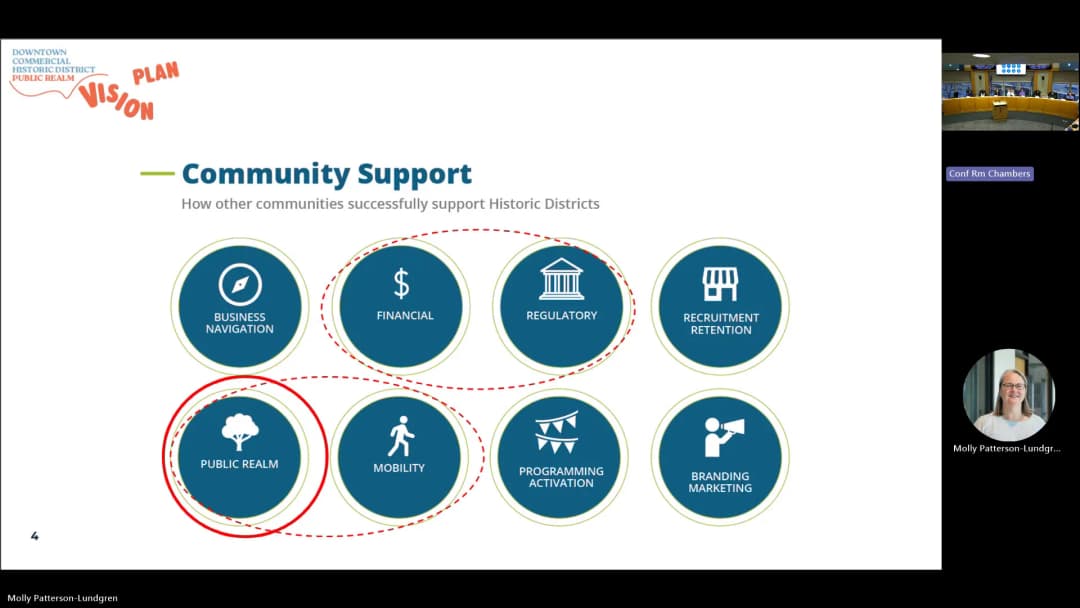
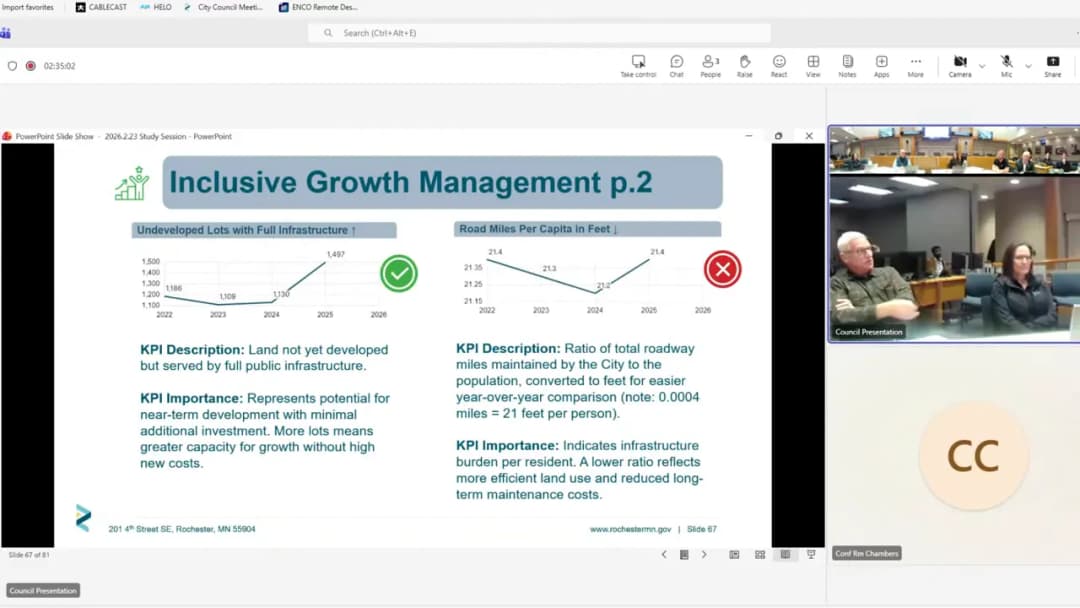
The City Council held a study session on February 23, 2026, to discuss two major agenda items: the Public Realm Vision Plan for the Downtown Commercial Historic District and the 2025 Year-End Action Plan & Key Performance Indicator (KPI) Update. The session featured presentations from city staff and consultants, followed by extensive council discussion on parking, land use, housing, and community engagement. Downtown Commercial Historic District Public Realm Vision Plan - Irene Wubert (City of Rochester) and Sandy (Mend Collaborative) presented the plan, developed with consultant New History. The plan aims to create a comprehensive vision for outdoor public spaces in the historic district, focusing on storytelling, streetscape improvements, and activation of alleyways. - Community engagement included focus groups, door knocking, workshops, and a pop-up at Thursday's Downtown. Six key takeaways were identified: strong historic identity needing visibility, desire for vibrant/inclusive walkable public realm, activation/small business support, accessibility/multimodal connectivity improvements, trust/collaboration/follow-through, and balance between preservation and modern needs. - The plan proposes four frameworks: infusing storytelling, reimagining streets (Broadway, First Avenue, Third Street), revisioning Third Street as a green corridor connecting to the river, and activating alleyways with art and lighting. - Council member discussion centered on parking. Council President noted the historic use of angled parking on Broadway and questioned its absence in the plan. Councilmember Fredericks expressed concern that removing on-street parking could harm businesses, citing that businesses on streets with parking are occupied. Councilmember Wall advocated for angled parking, noting it enhances the historic character. Councilmember Miller supported flexible design and managing parking demand through pricing and employee programs, rather than focusing solely on spot counts. Councilmember Palmer argued that convenient parking is critical for businesses and questioned the removal of half the parking on First and Third. Councilmember Dory emphasized accessible parking for people with disabilities, noting only three on-street accessible spots currently. Councilmember Keene highlighted the need for inclusive design, including auditory cues. - The plan also includes recommendations for small business support, public art, wayfinding, and coordination with other downtown planning efforts. Councilmember Fredericks asked about costs and funding; staff responded that estimates are ballpark and will be refined through CIP and grant identification. 2025 Year-End Action Plan and KPI Update - City staff presented the first annual integrated KPI update, covering economic resilience, housing access, inclusive growth, environmental stewardship, and transformational capital projects. - Key economic indicators: 13,000 new jobs since 2022, with 2,000 (15%) in non-healthcare/hospitality sectors. Weekend hotel occupancy and revenue grew year-over-year. Sales tax collections were on target. - Housing: 446 new housing units in 2025 (down from 878 in 2024), but staff noted several multi-family projects in plan review that could exceed 2024 numbers. Single-family homes as rentals increased from 9.2% to 10.5% over four years, a trend some council members found alarming. Councilmember Wall noted that rental homes serve temporary residents and that some fixer-uppers are only viable as rentals. Councilmember Miller cautioned against assuming causation. - Infill development: acres of vacant residential land increased, but infill units (in downtown and R2X zoning) dropped from 878 to 0 in 2025 due to timing of large projects. Undeveloped lots with full infrastructure grew significantly, indicating future lot supply. - Environmental: greenhouse gas emissions decreased, renewable energy capacity increased. The city is on track for 100% renewable energy by 2030. - Capital projects: 86% on budget, 80% on schedule. Highlights include Link Bus Rapid Transit (27% complete), 6th Street Bridge (90% design), downtown geothermal (48% energy reduction at City Hall), and North Broadway phase two completion expected June 2026. Grant funding was $26.7 million in 2025, lower than peak years but still substantial. - Councilmember Keene requested a deep dive on major capital projects like BRT and the bridge in a future session. Councilmember Palmer asked about the community survey costs and methodology; staff explained the scientific survey with 500 responses for about $25,000, plus Polco subscription. Councilmember Miller suggested using the survey to gather feedback on the Better Public Meetings process. Key Outcomes - No formal votes were taken. The Historic District Vision Plan will be reviewed by the Heritage Preservation Commission on February 24, 2026, and is expected to return to the City Council for adoption or receipt within the next one to two months. - The KPI update will be presented again in August 2026. Staff will refine data on job diversification, housing mix, and provide deeper analysis on specific topics (e.g., short-term rentals, employee parking) in future study sessions. - Next study session on March 9, 2026, will include a Supporting Transformation update, spongy moth treatment plan, and housing code update. The March 23 session will include leadership training and community engagement.

URBAN DESIGN 23% · HISTORIC PRESERVATION 20% · AFFORDABLE HOUSING 9% · ECONOMIC DEVELOPMENT 7%
138
FEB 18, 2026 · ROCHESTER, MINNESOTA · CITY COUNCIL
Rochester City Council Meeting - February 18, 2026

The Rochester City Council convened on February 18, 2026, for a regular meeting covering public comments, consent agenda, two public hearings, a contract amendment for the Sixth Street Bridge project, and other business. Key topics included floodplain development, a major subdivision, and ongoing labor disputes with Transdev. Consent Calendar - The council approved items F1 through F11 and F13 through F21 on the consent agenda, with Councilmember Wall polling F12 (not approved). The motion carried unanimously. Public Comments & Testimony - Linda Parker criticized local leaders for using official positions to promote personal or partisan beliefs, stating it violated public trust when officials remained silent about crimes. - Myron Rosted described a March 23, 2025 flood in his basement caused by a ruptured city water main. He incurred approximately $58,000 in damages, with a $19,000 cleaning bill and $12,000 bathroom replacement. The city denied his claim, deeming it an "act of God." He asked the council to justify that decision. - Adam Busby (representing Workers Strike Back) accused Transdev of union-busting tactics, citing harsh discipline and a growing labor dispute. - Ryan Timlin (former president of ATU Local 1005) stated that 14 operators had been suspended without completed investigations, including a 14-year employee with no prior record who received a three-day suspension. He called it a morale issue and a hostile work environment. - Emma Smith (Workers Strike Back) demanded the city not renew its contract with Transdev unless all worker demands were met, accusing the company of choosing profit over people. - Toby Holloway Holiday reported that union members voted unanimously to reject Transdev's "last best final offer" and authorized a strike. On February 17, 2026, 95% of members voted no on a second final offer. She noted 13 workers had been suspended, two after the strike authorization vote. - Rick Labor questioned why the city leases transit operations to Transdev while running other departments directly, asking for ridership comparisons. - Molly Dennis (former council member) echoed support for workers and criticized council accountability. She highlighted council salaries ($56,000/year for members, $65,000 for the president, $84,000 for the mayor) and expressed concern about lack of office hours and community presence. Discussion Items - City Administrator's Report: Alison Elms acknowledged park, forestry, and transit crews, noted Black History Month events, announced block-by-block closures on February 20-21 for equipment moves, and updated on the transit system: on February 11, 40% of fixed route drivers called in, causing 37 missed trips. A federal mediator had been requested, and Transdev contracted a driving company to improve reliability. The contract vote on February 17 did not pass, but negotiations continued. - Mayor's Report: A town hall on advanced policing technology (drones, cameras) is scheduled for March 3, 2026 at the Heinz Center, 6-7:30 p.m., hosted by Mayor Norton and Rochester Police Department. - G1 – Conditional Use Permit – ML Group LLC: The applicant sought a conditional use permit (CUP) to place excavated fill within the 100-year flood-prone subdistrict and provide compensatory storm storage for future multifamily development southeast of Country Club Road West and 45th Avenue Southwest. Staff recommended approval with three conditions. The applicant, Bill Twaiten (WSE Engineering), stated the design ensured no rise in flood levels, supported by hydraulic modeling. Public speakers: - Matt Puffer (Meadow Lakes HOA) argued the design had flaws: stormwater infiltration basins too deep, compensatory storage ponds too deep (bottom at 1,016 elevation while normal creek water levels are 1,021-1,023), and altered water flow that could increase erosion. He urged caution before moving dirt. - Jamie Newman cited concerns about flooding and traffic increases affecting the Cascade Lake parking structure and nearby developments. Council questions focused on modeling assumptions, groundwater levels, and coordination with other projects. Staff affirmed that the design does not count storage below groundwater and that no adverse impacts are expected. The motion passed 5-2-1 (Councilmember Miller voting no). - G2 – Major Land Subdivision – Westbury First: The applicant requested subdivision of 35.4 acres into 105 single-family lots (55 ft wide, 120 ft deep) east of 60th Avenue NW. The general development plan was approved in March 2025 for 220 lots. Conditions included a temporary fire access road or sprinklers for lots with single access. No public testimony was given. The motion passed unanimously. - H1 – Professional Services Contract Amendment – Sixth Street Bridge Project: Staff requested a $981,449 amendment to cover additional design work for the bridge, road safety, and riverfront improvements (total project cost $36.5 million). The amendment accounted for design iterations (e.g., clear span not feasible due to hydraulics), regulatory compliance, and enhanced public engagement. Councilmember Wall raised concerns about reducing construction funds, but staff assured value engineering had been applied (e.g., seeding instead of potted plants) and that bids may include alternates. The motion passed unanimously. - Ordinance Readings: - First reading of ordinance creating Chapter 5-24 on film permits. - First reading of rezoning 13 acres (west of Highway 63, north of 60th St SW) from AG to R1. - Second reading of rezoning 2.04 acres (southwest corner of East Center St and 6th Ave SE) from R2X to R4. All passed. - Other Business – Councilmember Palmer: - Reported on a county land use plan amendment meeting (continued for cooperation with township and developer). - Called for expedited review of the city's Tax Increment Financing (TIF) policy, citing the need for attainable housing and noting that each 20% cost increase translates to $200 more per month for rent. City Administrator Elms noted a contract had been approved to review the policy by June. Councilmember Keene and Miller argued against expediting, preferring to await comprehensive consultant analysis (urban three analysis and TIF component). No vote was taken, but the discussion indicated a June timeline. Key Outcomes - Consent agenda approved (items F1-F11, F13-F21) with F12 pulled by Councilmember Wall (no action on F12). - G1 – CUP for floodplain fill (CD 2025-007 CUP) : Approved 5-2-1 (Councilmember Miller nay, Councilmember Doring absent). - G2 – Westbury First subdivision (CD 2026-001 plat) : Approved unanimously. - H1 – Contract amendment for Sixth Street Bridge project : Approved unanimously. - Ordinance readings (J1, J2, K1) all passed. - TIF policy review remains on track for June; no expedited action taken. - Transit contract negotiations with Transdev continue; federal mediator involved; union authorized strike; no council action taken on the matter.

ENGINEERING AND INFRASTRUCTURE 45% · PROCEDURAL 19% · PUBLIC TRANSPORTATION 10% · TAX INCREMENT FINANCING 7%
139
FEB 18, 2026 · ROCHESTER, MINNESOTA · BOARDS AND COMMISSIONS
Citizens Advisory on Transit Meeting - February 18, 2026

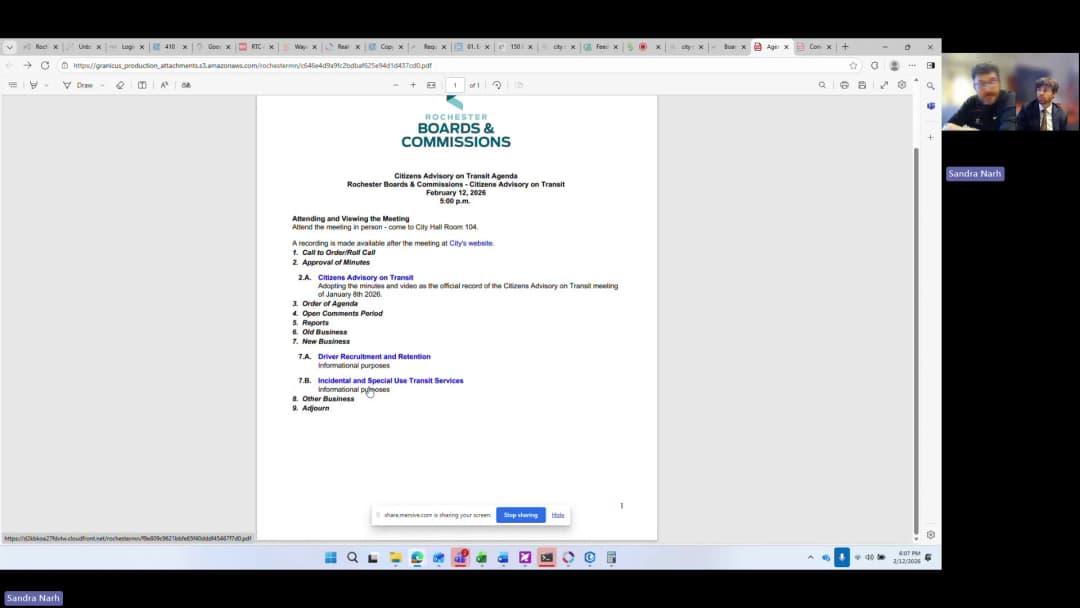
Note on date discrepancy: The provided agenda and minutes list the meeting date as February 12, 2026, but the user instruction specifies the meeting took place on February 18, 2026. This summary uses the date provided in the instruction. The Citizens Advisory on Transit (CAT) committee met to hear two informational presentations: one on driver recruitment and retention from Rochester Public Transit’s contractors, and one on incidental use of federally funded transit assets. The committee also received an update on upcoming spring service changes. Consent Calendar - Approval of Minutes: The minutes and video of the January 8, 2026 meeting were approved unanimously (motion by Parker Acree, second by Kenneth Baerg). - Order of Agenda: The agenda was approved unanimously (motion by Parker Acree, second by Kenneth Baerg). Public Comments & Testimony - No members of the public were present during the 15-minute open comment period; no comments were offered. Discussion Items Driver Recruitment and Retention (Item 7.A) Guest presenters Victoria Morales (General Manager, Transdev), Dereck Momany (Operations Manager, Transdev), and Sequoia Gaylord (General Manager, MyCity Transportation) provided a detailed overview of the recruitment, hiring, training, and retention process for Rochester Public Transit (RPT) drivers. Key points included: - Recruitment: Platforms like Indeed; use of “push premium” for postings; occasional job fairs (virtual and in-person). No current partnerships with colleges offering CDL programs, though this was suggested. - Hiring Process: Screening includes phone interview, official interview, offer letter, background check (takes 2–8 weeks), onboarding, orientation, classroom training, and 66 hours of behind-the-wheel CDL training. Smaller class sizes (2–4) are preferred for better one-on-one training. - Retention: Support includes 30/60/90-day check-ins, open-door policy, driver appreciation events (tacos, donuts, coffee), and recognition programs. The city partners by sharing rider compliments and participating in Driver Appreciation Week in March. - Challenges: Competition from other employers (e.g., Groom paying $30/hr), split shifts, winter snow removal at stops, construction delays, and discipline issues (red light/stop sign violations, hard braking, cell phone use). Progressive discipline is used; union contract governs pay and discipline. - Data/Tracking: No formal exit surveys or trend tracking on turnover, but presenters agreed to explore providing turnover trend data to CAT. The committee emphasized the need for hard numbers to identify improvement areas. - Discussion: Committee members asked about recruitment demographics (age, language barriers), coaching methods, and the balance between discipline and support. Concerns were raised about language barriers and the ability to communicate with passengers, but presenters noted CDL English proficiency requirements. The committee discussed the importance of communication skills without focusing on a specific language. Incidental and Special Use Transit Services (Item 7.B) Presenter Roxanne Theobald (Transit Administrative Manager) explained the concept of incidental use (joint/shared use) of federally funded transit assets. Under federal guidance, agencies are encouraged to use vehicles or property for secondary revenue as long as it does not interfere with transit service. Examples include subleasing vehicles on weekends or leasing shelter space for a food truck. RPT’s first incidental use agreement is with Mayo Clinic, which is renting a transit shelter at Station G (on 2nd Street) for valet parking for 6–8 months at fair market value. The committee discussed potential future opportunities (e.g., leasing park-and-ride space on weekends) and the need to avoid public perception of the city having excess property. The presentation was informational; no action taken. Other Business: Service Changes Update Staff provided an update on spring service changes following completion of the public engagement phase (open houses, feedback due February 13). Feedback has been collected and incorporated into planning. Staff recommended that the March meeting include a formal presentation on the finalized fall service changes and an overview of preliminary planning for spring adjustments. The committee voted unanimously to add this item to the March 2026 agenda. Key Outcomes - Approvals: The minutes of January 8, 2026, and the meeting agenda were approved unanimously. - Motion to add service changes to March agenda: The committee voted unanimously to include a presentation on the impacts of fall service changes and spring service plans at the next meeting. - Adjournment: The meeting was adjourned unanimously. - Data Request: The committee asked staff to explore obtaining trend data on driver turnover from Transdev, while respecting the contractor relationship and privacy boundaries. The committee also discussed the need for clearer guidance on what information can be requested from contractors. Note: The meeting ran longer than scheduled due to detailed discussion on driver recruitment and retention.

PUBLIC TRANSPORTATION 33% · WORKFORCE DEVELOPMENT 31% · ECONOMIC DEVELOPMENT 10% · PUBLIC ENGAGEMENT 6%
140
FEB 18, 2026 · ROCHESTER, MINNESOTA · BOARDS AND COMMISSIONS
Rochester Public Library Board Meeting – February 18, 2026

The Rochester Public Library Board met on February 18, 2026, at 4:30 p.m. in the Library’s First Floor Meeting Room. The board received updates, approved the consent agenda, adopted 2027 supplemental budget priorities, and discussed a draft strategic plan for the library. No public comments were made. The meeting moved to a closed executive session at 5:13 p.m. to evaluate the library director’s performance. Consent Calendar - Minutes: Accepted the January 21, 2026 meeting minutes as official. - Accounts Payable: Approved disbursements of $130,781.37 for February 12, 2026. - Financial Reports: Accepted the updated December 2025 expenditure report and January 2026 monthly reports. - Contracts: Accepted contracts signed by the Library Director. All consent items were approved unanimously. Updates & Reports - Rochester Public Library Foundation Report: Received and filed. - Friends of the Rochester Public Library Update: Friends Board President Val Kaliszewski reported: - 235 volunteers contributed 1,600 hours in 2025. - Over 6,600 donated items were added to the library’s collection, saving the library more than $1,400. - In 2025, the Friends pledged $68,000 to the library; for 2026 the pledge is $118,000. - A February book sale generated a net profit of $7,300 (over 720 sales across four days; the first night had more than 100 transactions totaling $1,900). - The Friends Bookstore achieved a record $80,000 in annual profit; a check for that amount was presented to the board. - Southeastern Libraries Cooperating (SELCO) Update: Board member Laura Wheatman reported: - SELCO’s advocacy committee is developing a document to help library boards advocate effectively. - Three community collaboration grants were approved, one of which will go to RPL. - SELCO is acquiring an automatic sorter machine for its Rochester office; a $500 stipend per library is offered for RFID-coding books. - RPL is donating its old self-checkout machines to regional libraries. - Executive Committee Update: Received and filed. Discussion moved to the closed executive session. Discussion Items Finance Committee Recommendations for 2027 Supplemental Budget Priorities The board reviewed the Finance Committee’s ranked priorities for the 2027 budget (second year of a two-year cycle). The library’s budget is 73% staffing, set by collective bargaining. The requested supplemental priorities were: 1. OCLC contractual obligations – mandatory increase. 2. Cell phone stipends for supervisors – needed for communication. 3. Background checks for UMR work-study students – the library is reimbursed 75% of their wages. 4. Increased vehicle parts and maintenance. 5. Temporary salaries cost-of-living adjustment – contingent on citywide wage grid adjustments. The board approved these priorities unanimously. Strategic Planning Discussion The board reviewed draft vision and mission statements and strategic priorities developed by library staff. Key points: - Proposed Vision: A community where everyone is welcome and opportunity grows. - Proposed Mission: Build connections, foster inclusion, and inspire lifelong learning. (Several board members felt the mission statement lacked the “warm” welcoming feel of the current version; staff will revise.) - Strategic Priorities (3-year plan) covering four master plan areas: - Facilities: Reimagine our physical footprint for connection and equity – goal to establish a plan for piloting a satellite location and modernizing the downtown library. - Leadership: Lead with united purpose and data-driven advocacy – goal to align partners (library, Friends, Foundation) with consistent messaging to advocate for sustainable funding. - Community & Identity: Amplify our presence as the heart of the community – goal to launch a marketing plan and leverage partnerships to reach every resident. - Operations: Cultivate an agile and responsive service model designed for authentic inclusion – goals: optimize workflows with technology and cross-training; expand multilingual services and co-create solutions with partners to dismantle barriers. - Board members discussed the need for clearer language in the facilities priority (e.g., what “equity” means in that context) and suggested adding “accessibility.” The draft will be refined before final approval at a future meeting. Key Outcomes - Approved consent agenda and accounts payable unanimously. - Approved the 2027 supplemental budget priorities as recommended by the Finance Committee (unanimous). - Discussed and provided feedback on draft vision, mission, and strategic priorities; staff will revise and bring back for formal approval. - Moved to closed executive session at 5:13 p.m. (unanimous) to discuss the 2025 performance evaluation of Library Director Karen Lemke, per Minnesota Statutes Section 13D.05, Subd. 3(a). A summary of the personnel committee’s conclusions will be presented at the March 2026 board meeting.

LIBRARIES FUNDING 79% · PUBLIC ENGAGEMENT 8% · BUDGET EQUITY ANALYSIS 7% · STRATEGIC PLANNING 4%
OPENPUBLICA · PUBLIC MEETING INDEXUPDATED DAILY · openpublica.com