The Airport Commission convened on February 3, 2026, at 2:00 p.m. to review financial and operational reports for November, discuss grant acceptances and change orders related to FAA infrastructure and runway reconstruction, and receive updates on the Joint Airport Zoning Board (JAZB). No members of the public attended the open comment period. Consent Calendar - Agenda Order of Business: Adopted unanimously after a technical amendment was proposed to remove the phrases "Every for the word between every and four" from Item 7D to clarify the title to "On Call Airport Service." - Minutes: Approved minutes from the December 2nd meeting. - Technical Amendments: The Commission agreed to a technical correction on the printed agenda title for Item 7D to remove descriptive text preceding the service name. Public Comments & Testimony - Absent: No members of the public were present to offer testimony during the open comment period. - Commissioner Comment: One Commissioner shared a personal anecdote regarding a recent Global Entry interview with Roxanne, noting a disparity in wait times (10 minutes vs. 2 hours) but praising her demeanor and noting she was "lonely." Another Commissioner expressed full support for the marketing efforts regarding Global Entry interviews. Discussion Items - Financial and Statistical Report (Kyle/John) - The Commission reviewed financial data through November, reporting a net profit of $1.8 million (projected to close near $1.9 million) with funds available for transfer back to the city airport fund. - Employment Statistics: The Commission discussed that while seats available will meet goals, departing flights in December fell slightly below the goal due to weather-related cancellations, particularly affecting American Airlines. - American Airlines Capacity: It was noted that American Airlines maintained a high seat count in November (12,375) compared to November 2024 (8,939), despite system-wide storm cancellations affecting Chicago, Dallas, and Charlotte. - Revenue Streams: Rental car revenue and international passenger numbers showed year-over-year increases, while parking lot transactions saw a slight decrease in volume but increased revenue. - Net Promoter Score (NPS) - Commissioner clarification was requested regarding how the launch of Mayo Clinic's private Wi-Fi intranet affects airport NPS metrics. It was explained that fewer passengers are forced to use the public RST Wi-Fi splash page surveys, which may skew data. The team indicated they will need to "massage" and re-gauge how this data is interpreted moving forward. - Marketing Report (Mary) - The Commission discussed a budget reduction in December which resulted in slight increases in web users and organic social traffic. - Content Performance: Repurposed Christmas content (PSAs) performed well without "content fatigue." - Paid Media: Despite a budget cut, search volume for destinations like Myrtle Beach and Las Vegas remained high, though actual bookings (purchases) decreased, suggesting aspirational searching. Retargeting ads showed strong engagement from high-end time consumers. - Item 7B: Grant Acceptance & Professional Services Agreement (Meet & Hunt) - Project Scope: Accepting a grant and agreement for the relocation of FAA-owned ASR 11 fiber optic cables encased in concrete duct banks near the air traffic control tower as part of the Runway 03-21 reconstruction. - Justification: The fiber line was found to be deeper and more difficult to relocate than initially estimated (encased in concrete requiring 20 feet of cut). A separate bid is expected to be considerably cheaper than a change order to the main contractor. - Funding: Funded 95% by the FAA and 5% by state bonding. - Position: The Commission supported the decision to separate the work to open the field to more electrical contractors and secure competitive pricing. - Item 7C: Change Order Number 2 (SM Henches and Sons) - Scope: A $139,642 net change order for Phase 4 of the Runway 03-21 reconstruction. - Components: - Excavation to remove an urban berm obstructing the runway visibility zone once fiber is relocated. - Installation of a 60-inch pipe crossing under the fiber optic line to protect FAA radar services (Minneapolis/Regional). - Costs associated with nine months of coordination with the FAA regarding the duct bank's protection. - Deductions: The order includes subtractions for two items no longer necessary (line lowering and an external cable). - Financial Context: This change order brings the total change orders to approximately 3.7% of the original contract, well under the anticipated 15% FAA allowance. Staff noted they negotiated approximately $220,000 off the contractor's initial quote. - Position: The Commission unanimously approved the change order, acknowledging the unforeseen nature of the concrete duct bank and the cost savings achieved through negotiation. - Joint Airport Zoning Board (JAZB) - Update: The JAZB unanimously agreed to proceed with the "model ordinance option" rather than a custom option, following staff recommendations presented by consultant Evan Barrett. - Stuartville Engagement: The Commission noted that concerns raised by Stuartville representatives regarding their lack of initial appointment were addressed; the city suspended rules to allow them to participate in the public comment and decision-making process regarding the model ordinance, which they accepted positively. - Next Steps: The draft ordinance is expected to be presented at a public hearing on April 1st at 5:00 p.m. Key Outcomes - Motion Approved: Technical amendment to the agenda consent items (Title correction for Item 7D). - Motion Approved: Acceptance of the grant and professional services agreement with Meet & Hunt for the fiber optic cable relocation (Item 7A). - Motion Approved: Change Order Number 2 ($139,642) for SM Henches and Sons for the Runway 03-21 reconstruction (Item 7B). - Motion Approved: Motion to close the meeting at 2:26 p.m. (Seconded by the Mayor/Commissioner). - Directives: Staff is to investigate the discrepancy in December departing flights and continue monitoring NPS metrics in light of private Wi-Fi usage. The JAZB is directed to proceed with the April 1st public hearing for the model ordinance.
Public Meetings - Rochester, Minnesota
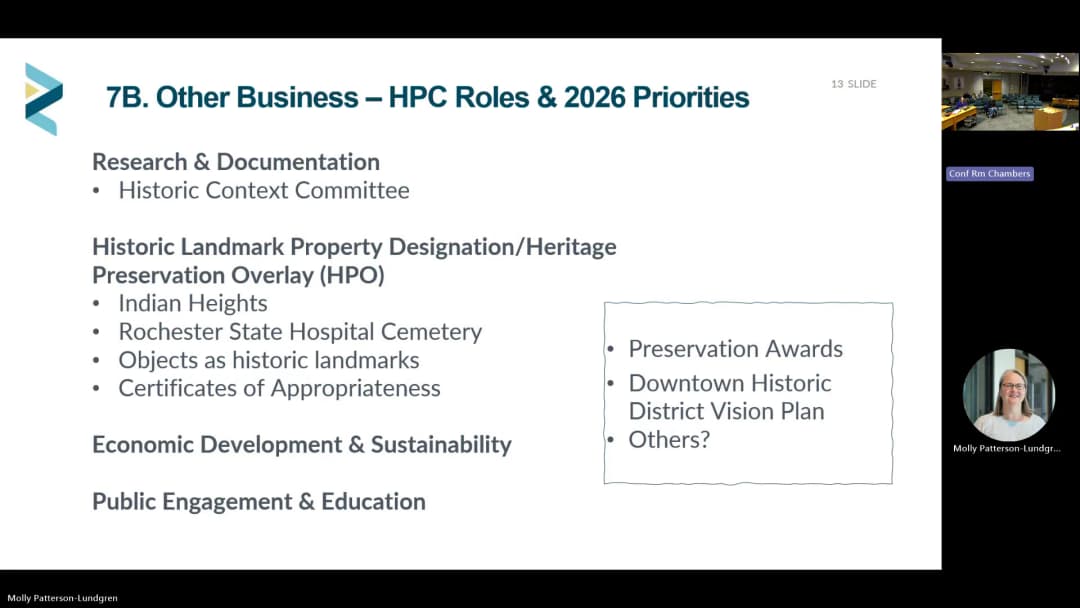
Public Meetings - Rochester, MinnesotaThe Rochester Heritage Preservation Commission held its 2026 kickoff meeting, welcoming new member Ryan Tater and appointing officer leadership. The meeting focused on public comments regarding the need for increased productivity and priority setting, the approval of a Certificate of Appropriateness for 822 4th Street NW, and a strategic discussion on 2026 priorities, including the potential landmarking of Assisi Heights and funding strategies for inventory evaluations. Public Comments & Testimony - Mr. Skolnick: Expressed hope that the upcoming City Council study session on the downtown historic district study will occur before the next HPC meeting and urged that the report be shared with the public and commission before City Council action. He stated a strong desire for the commission to prioritize reviewing the nine-year-old pending inventory list, citing specific properties like the Cavalry at Episcopal Church, Charles H. Mayo residence, Great Western Depot, Dairy Queen, Falwell School, IBM property, Mayo Ballfield, St. Francis of Assisi, Cali Grands, Sisi Heights, and Stone Silo. He emphasized the need to prioritize the heritage preservation awards, noting that waiting until May would delay the process by a year. - Barb Hudson: Representing public sentiment, she expressed a position that there is "no point in showing up" because "nothing happens," citing the loss of heritage properties and specifically noting that the purchase of Assisi Heights by Mayo Clinic makes landmarking that property "slim to none" at this point. She encouraged the commission to move beyond listing priorities and to create actionable plans, including committees for awards and prioritization. - John Creasel: Stated a firm position in support of establishing priorities, specifically focusing on properties "in harm's way." He voiced concerns regarding the potential development on the old criminal property affecting Assisi Heights and visual entities. He expressed a desire for action on Assisi Heights and urged the commission to consult with elected officials regarding trust issues with Mayo Clinic, specifically regarding artifacts promised by Mayo for the neighborhood at Leeward High School. Consent Calendar - Unanimously approved the December 16th meeting minutes, a Roberts Rules quick sheet, and the 2026 meeting calendar via block motion. - Unanimously elected officers for the 2026 term: Commissioner Astro as Chair, Commissioner Poyer as Vice Chair, and Commissioner Schable as Secretary. Discussion Items: Certificate of Appropriateness (822 4th Street NW) - Project Description: A request to replace the bottom portion of a character-defining non-movable window with two operable casement windows on an American Four Square contributing property. - Staff Position: Coordinator Patterson Lundgren recommended approval, stating the alteration meets Secretary of the Interior standards by preserving the distinctive leaded glass transom window, maintaining the existing opening, and being a minimal change to the secondary facade. The change allows for code-required egress for a rental bedroom. - Commission Deliberation: Commissioners questioned the applicant's intent (determined to be for egress compliance) and the potential for conflict between historic preservation and code requirements. No commissioner expressed opposition to the proposal. Discussion Items: Historic Landmarks and Inventory Lists - Commissioner Poyer: Expressed a position that Assisi Heights should be "high on" the priority list given Mayo Clinic's recent acquisition. - Commissioner Kessler: Expressed curiosity regarding the lack of triaging within the current inventory list of 68 properties and suggested creating a clear list of expectations or moving properties off the list if ineligible, rather than just waiting. - Commissioner Schable: Expressed a personal preference to focus on landmarking properties rather than simply removing items from the inventory to demonstrate the community's commitment to heritage. - Staff Response: Coordinator Lundren confirmed that while staff resources are limited (approx. $10,000 per evaluation, 2-3 evaluations per year), the commission can prioritize items. She noted that the historic context committee, led by Commissioners Astro, Mutchler, and Lundren, is testing a new collaborative process. She also addressed Commissioner Schable's question about Mayo Clinic, confirming she was unaware of the specific ownership transfer but noted that businesses typically view historic designation as a cost and potential slowdown, though she remained open to collaboration for adaptive reuse. Discussion Items: 2026 Roles and Priorities - Grant Strategy Discussion: Commissioners and staff discussed leveraging state preservation grants to fund eligibility studies. Commissioner Wasmer suggested a partnership grant with the History Center to co-write proposals, while Lundren noted the State Historic Preservation Office (SHPO) indicated strong potential for National Register eligibility for Indian Heights and Assisi Heights. - Commissioner Kessler: Expressed concern that at the current rate, the 68-property inventory would not be processed before her retirement; suggested requesting additional staff or funds from the City Council, though staff noted current budget constraints. - Commissioner Poyer: Expressed concurrence with the proposed priorities. - Proposed Priorities: The commission tentatively agreed to prioritize Indian Heights (potentially applying for a grant), the State Hospital, Assisi Heights (via a partner grant with the History Center), and to initiate discussions regarding historic objects. - Awards Committee: Commissioners agreed to form a committee to organize the Heritage Preservation Awards in time for May. Commissioner Mutchler shared examples of award processes from Red Wing and Eden Prairie. Staff agreed to compile materials for a formal motion in the February meeting. Key Outcomes - Officers Elected: Astro (Chair), Poyer (Vice Chair), Schable (Secretary). - Certificate of Appropriateness: Approved unanimously for 822 4th Street NW. - Priorities Set: Commission agreed to prioritize Indian Heights, State Hospital, and Assisi Heights, with a focus on securing grants to bypass current staff resource limitations. - Future Actions: A committee to plan Heritage Preservation Awards will be formed at the February 24, 2026 meeting. The Downtown Historic District Vision Plan will be presented for feedback at that same meeting following a City Council study session on February 23. - Adjournment: Meeting adjourned after a historical fact sharing regarding a survivor's account of the 1883 tornado. Housekeeping - Commissioners reminded to notify the Chair and staff of absences to avoid unexcused absence counts, with three unexcused absences potentially triggering contact with the Mayor's office.
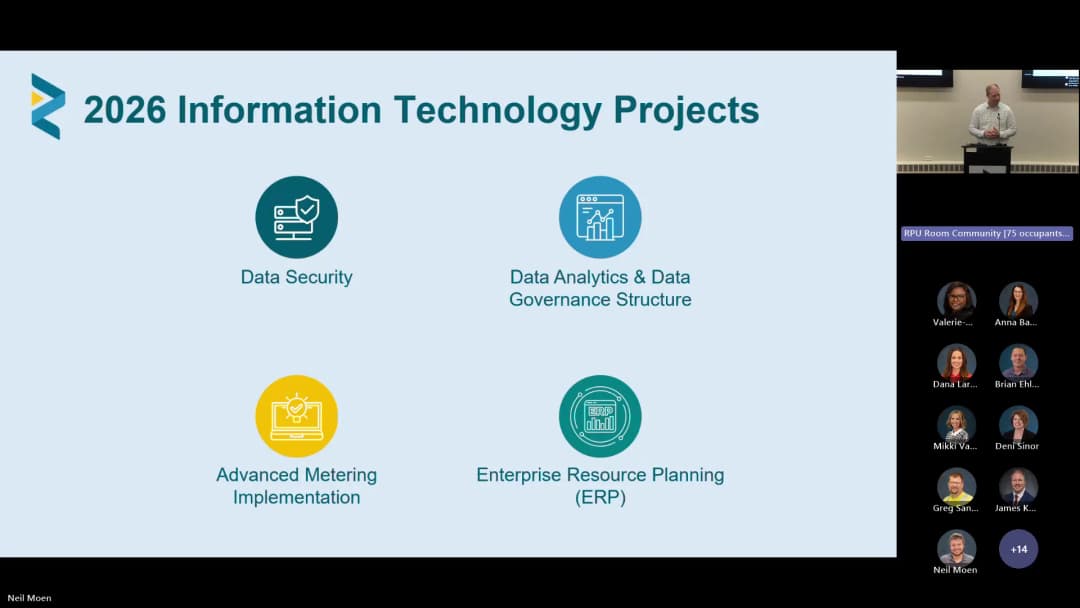
The Rochester Public Utilities Board convened to approve the agenda, review a historic fuel oil operation during a regional cold weather event, and receive strategic updates on 2026 initiatives across all utility divisions. The meeting highlighted the Board's response to an energy emergency resembling Winter Storm Uri, the progress on lead service line replacements, and major planning for future power capacity. Consent Calendar - Approved minutes from the December 16th, 2025 board meeting. - Approved review of accounts payable. - Approved the 2026 through 2029 ESRI citywide small government enterprise agreement renewal. - Approved generation fuel purchases, including a late addition authorizing up to the budgeted fuel amount for the remainder of the year due to a historic 49-hour GT2 engine run fueled by fuel oil (approx. 200,000 gallons) during a regional energy emergency. Public Comments & Testimony - No members of the public signed up to address the board during the designated 20-minute comment period. Discussion Items Regional Energy Emergency and Fuel Operations - Staff reported that the GT2 engine ran for 49 hours over the weekend, a duration not seen since Winter Storm Uri in February 2021. This was necessitated by low wind output, lack of solar in the evening, and curtailed natural gas thermal generation. The run was called in by MISO while the system was at the margin of generation across Missouri and the northern Midwest. - The board discussed load curtailment efforts, with staff noting that while loads decreased, quantifying the specific impact of curtailment is difficult due to concurrent weather and wind recovery factors. - Staff confirmed that running the unit allowed the utility to capture value despite high fuel costs (approx. $500,000), resulting in a net financial gain of over $1 million for the weekend. Water Division Initiatives - Lead Service Line Replacement: Staff confirmed that despite state funding changes in 2025, the pace for 2026 will match the previous year's volume, supported by $1.5 million in annual funding. A priority formula based on income and children under five must be followed for grant funds. - Water System Master Planning: The study is underway to address limitations on withdrawal from the Jordan Aquifer. Rochester Municipal Public Utilities (RPU) is funding 80% or more of the base study, with neighboring cities (Byron, Stewartville, Orinoco) providing data. The estimated max day demand in 40 years is around 50 million gallons per day, with annual requirements peaking at 8-9 billion gallons. - Board Member Questions: Members expressed concern regarding the equity of funding the regional study exclusively with RPU funds and queried the potential for customers to self-fund line replacements outside the prioritized grant sequence. Power and Transmission Initiatives - Mount Simon Station: Construction continues with design procurement and air permitting expected this year; the project targets an online date in early 2029. - Silver Lake Plant: Staff announced the plan to cease steam operations by the end of 2027 or 2028, subject to contract negotiations with Mayo Clinic. Workforce planning and infrastructure disposition are underway. - Capacity Expansion: A need for approximately 100 megawatts of additional power capacity was identified. The board discussed the urgency of securing this capacity by 2030 due to wind accreditation changes. Options include joint builds, partnerships, or partial requirements contracts. - Grid North Partners: The joint development agreement is scheduled for signing February 2nd, with routing determined by the Public Utilities Commission on February 5th. Asset Management and Infrastructure - Asset Lifecycle: Staff clarified that while the organization tracks "useful lives" for depreciation and audit purposes, asset replacement decisions are increasingly driven by condition, risk, and failure data rather than age alone. The board requested data on the replacement value of the asset base, which has risen due to inflation. - Specific Upgrades: Projects include replacing a Zumbro River substation transformer, upgrading circuit breakers and disconnect switches (including 40-year-old manhole switches), and converting overhead power lines to underground along 18th Avenue. - Water Main Breaks: Staff addressed two breaks on 9th Avenue, attributing them to age and soil conditions (cast iron corrosion) rather than the repair method of the initial break. Corporate Services, IT, and Customer Relations - ERP Implementation: A comprehensive migration from on-prem SAP to a cloud solution is scheduled to begin in February 2026, impacting finance, payroll, and asset management. - Data Analytics: The newly formed data division is focusing on building data governance structures to aggregate enterprise data (GIS, finance, asset management) into dashboards while ensuring customer data segregation. - Bond Rating Assessment: The utility is engaging Baker Tilly to assess the impact of new debt issuance on credit ratings, aiming to ensure a continued triple-A rating despite increased leverage. - Customer Relations: A transition to the Vertex One vConnect platform is expected by late 2026 or 2027. The website redesign is underway to meet WCAG 2.1 Double A accessibility standards by April 2026. - Deed Management: A request was made to consider the prepayment of energy contracts via conduit debt to secure 6-10% discounts over 20-year terms; further reporting is planned. Key Outcomes - The consent agenda, including the historic fuel oil authorization, was approved unanimously. - The board received informational updates on the 2026 strategic initiatives; no formal votes were taken on the proposals themselves as they are part of ongoing operational planning. - Staff committed to returning in March to discuss the Water System Master Plan progress and the specific details of the conduit debt/energy prepayment structure. - The meeting concluded with an adjournment after all division reports and the General Manager's update were heard.
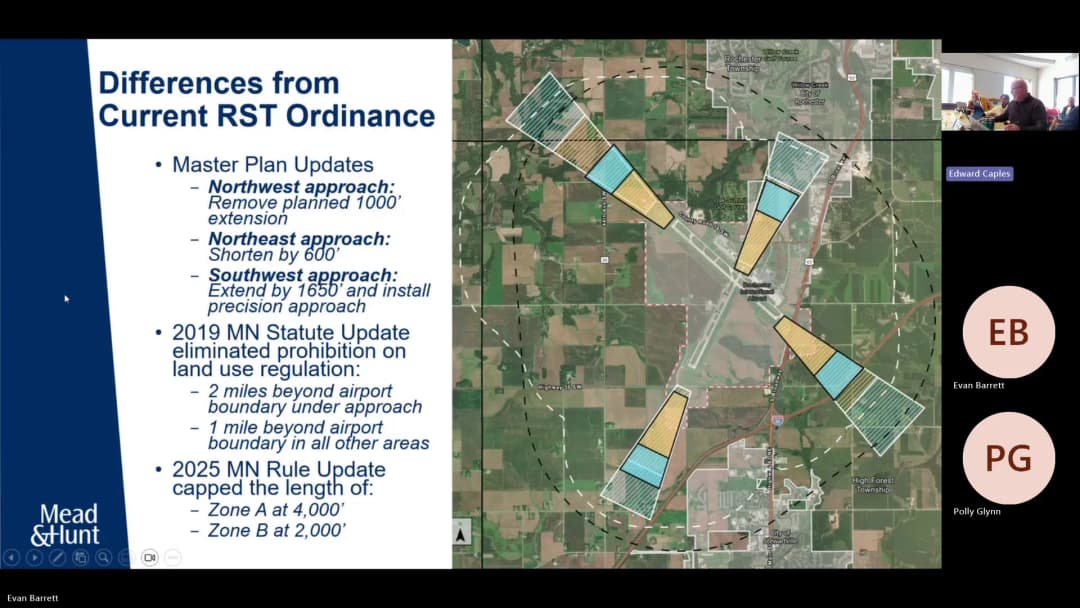
The Rochester Joint Airport Zoning Board convened for a meeting to review a proposed update to the airport zoning ordinance, driven by 2025 state statute revisions, updated FAA/MDIOT rules, and the airport's 2021 master plan. The board heard detailed presentations on the standard State Model Ordinance versus a custom option, engaging in discussions with stakeholders from the City of Stewartville regarding land use compatibility and airspace impacts. After analyzing the implications for safety, land use restrictions, and enforcement mechanisms, the board voted to proceed with the State Model Ordinance approach. Consent Calendar - Approved the minutes from the November 21, 2025 meeting without changes. Public Comments & Testimony - Bill Schemmel (City Administrator) and Mayor King (City of Stewartville): Expressed strong support for the airport and a desire to maintain a cooperative partnership. Mr. Schemmel noted that while Stewartville is supportive, their city zoning ordinance must align with FAA and state requirements to ensure orderly growth. Mayor King emphasized Stewartville's role as a listening partner and commitment to working within the zoning framework. - Stewartville Representative: Stated that Stewartville is currently finalizing its own zoning ordinance revisions for 2026. The representative sought assurance that the new airport zoning would not prohibit existing or planned residential, industrial, or commercial uses. They expressed confidence that the proposed changes would not conflict with underlying zoning, noting that most areas are already restricted or the new height limits (200-250 feet) allow for significant development like high-density residential. Discussion Items - Presentations on Ordinance Options: Deputy City Attorney Brent Carlson and consultant Evan Barrett presented two options: the State Model Ordinance and a Custom Ordinance. - State Model Ordinance: Recommended by the staff. It utilizes standard zones (A, B, C) and airspace surfaces based on the airport's "planned ultimate condition" from the master plan. It offers a streamlined approval process with MDOT, likely resulting in a "rubber stamp" approval compared to the custom route. - Custom Ordinance Option: Requires a detailed safety risk study (taking over a year) and significant coordination with MDOT to justify deviations from state models. Examples of Lake Elmo and Duluth were provided, noting they had to accommodate incompatible existing developments (e.g., residential in high-risk zones) that the standard model would prohibit. - Zone Changes and Impacts: - Land Use Zones: The presentation clarified that zones A and B would actually become less restrictive in most areas off-airport property. Zone A lengths are capped at 4,000 feet (down from the previous 2/3 of runway length), converting many existing Zone A areas to Zone B or Zone C. Zone C will expand slightly to the south in Stewartville and Rochester due to the removal of the 1-mile perimeter restriction in state law, though existing low-density land uses (agricultural, residential) remain largely unrestricted as they already fall below the 150-400 foot height limits. - Airspace Restrictions: The board discussed the removal of the 1.5-mile prohibition on airspace regulation. This allows the new ordinance to adopt FAA Part 77 imaginary surfaces extending further (up to 10 miles for precision approaches). However, the board was informed that these restrictions mostly affect tall structures like wind farms (400+ feet) and cell towers, rather than standard buildings. - Enforcement and Appeals: The board discussed the role of the joint board versus local jurisdictions. It was clarified that while local jurisdictions enforce the ordinance through their own permits, the Joint Airport Zoning Board will identify the City of Rochester's Board of Zoning Appeals to handle variances and appeals, rather than creating a new body. The state statute now explicitly mandates local enforcement integration. - Noise Mitigation Discussion: Members raised questions about whether noise abatement or sound insulation could be included in the zoning ordinance. Staff indicated that the State Model Ordinance does not include noise mitigation provisions and that such provisions would effectively require a custom ordinance or a separate resolution, noting that Rochester's current runway operations do not generate significant noise footprints extending beyond Zone A. Key Outcomes - Motion to Adopt Model Ordinance: The board voted to proceed with the State Model Ordinance route. - Motion made by Board Member Keene, seconded by Board Member Kenworthy. - Vote Result: Passed (All in favor). - Next Meeting Date: Set for Wednesday, April 1, 2026, at 5:00 PM. - This meeting will serve as a public hearing for the draft ordinance. - Location: Proposed to be in the Council Chambers or a room with live streaming capabilities (Teams link to be provided for remote attendees). - Agreed Strategy: Staff will draft the ordinance and detailed maps based on the State Model and the airport's planned ultimate condition, presenting them for public hearing and final consideration at the April meeting. The board agreed to meet annually thereafter to maintain the ordinance's relevance.
The Rochester City Council convened on January 21, 2026, to address an agenda dominated by intense public concern regarding Immigration and Customs Enforcement (ICE) activities in the city. Following extensive public testimony describing widespread fear among immigrant communities, the impact on school attendance and healthcare access, and allegations of aggressive enforcement tactics, city leadership and the Police Chief responded with reassurances that local police do not collaborate with ICE and do not share resident data. The council subsequently approved two major development projects: a wireless tower and a regional sports complex, and a site development agreement with Mayo Clinic for downtown facilities. Consent Calendar - Approved items F1 through F9 and F11 without discussion. Public Comments & Testimony Community Fear and Demands - Kyle Pike (disabled combat veteran and student) described local ICE presence as "Gestapo forces of an illegal tyrannical federal government" and expressed that the mayor and council must act to stop tyranny. He stated he did not serve in the armed forces to allow tyranny to destroy Rochester. - Jared Looker (resident) acknowledged the acute pain and fear felt by immigrant communities, including Somali and Mexican neighbors. He asked the council to reflect on their values and use their authority to set a moral example, opposing rhetoric meant to divide. - Toby Holliday (Workers Strike Back) alleged ICE agents are driving recklessly, running red lights, and working without warrants. The group demanded the city declare itself a sanctuary city, prosecute ICE for legal offenses, end drone and camera surveillance projects, and join a mass protest and strike on January 23. - Susan Robinson Denlow (retired educator) reported that half of ethnic students at a high school were no longer attending due to fear of ICE. She requested the council publicly call for ICE to leave, prohibit government property use for ICE, contact congressional officials to defund ICE by January 30, and address economic shutdowns. - Isaac Johnson (COO of a healthcare organization) stated that 86% of his clinic's diabetic patients are not showing up for appointments due to fear of ICE, forcing the clinic to mobilize manpower to reach the community. - Pete Vavang (Ward 5 resident) expressed that the immigrant community is being "overrun by ICE" and urged the council to act to preserve freedom and secure rights. - Casey Hill (resident physician) expressed terror that patients will face irreparable harm or die because they are not accessing critical medical care due to fear of ICE. - Saleem Mohammed (resident) described trauma in the refugee community, noting that parents are choosing between health care, food, and rent. He stated that silence is complicit and demanded concrete steps to protect residents and reject racial profiling. - Gloria Torres Herbeck (teacher and community leader) expressed fear for her students, noting they are not coming to school because they fear ICE will take their parents. She expressed concern for the financial burden on the community and the Latino Fest. - Samuel Korthaler (Ward 6 resident, veteran) stated his neighbor, a young mother and U.S. citizen, will not leave her house without passports due to ICE harassment. He demanded ICE be removed from schools and communities. - Jen Webber (resident) demanded ICE be removed from the city, citing incidents of unwarranted stops, arrests in schools and churches, and excessive force. She stated the city cannot condone ICE actions as they undermine public safety goals. - Karen McLaughlin (attorney) encouraged the council to use their voice to demand ICE leave and asked that the federal government be urged to defund ICE if constitutional rights are violated. - Asmir Hodžić (Ward 2 resident) stated that the response from business owners and regular people is overwhelmingly anti-ICE and demanded the council take a public stance against ICE and shut down operations on January 23. - Kirsten Lincoln (Ward 2 resident) reiterated the need to help schools feel safe and noted that people are not coming for food, health, or school. - Ruchi Gupta (naturalized citizen and Planning Commission Chair) recounted being surveilled by an unmarked SUV and tailing ICE agent, expressing fear and noting that restaurants are locking their doors. - Molly Dennis (former council member) urged the council to scrap executive branch priorities and focus on legislative action, demanding tangible city policies rather than platitudes, including allocating funds for training and passing sanctuary city legislation. Other Public Comments - James Smith requested the city extend the sewer line on 11th Avenue Southwest to support redevelopment of 10 acres near the airport. Discussion Items Mayo Clinic Site Development Agreement (Item F10) - Councilmember Wall and Councilmember Miller pulled the item for further discussion regarding the magnitude of the project and community engagement. - Ms. Steinhauser and Ms. Woodward (Community Development) clarified that Mayo Clinic remains committed to incorporating historic artifacts from the former Lourdes High School into the park design. - Councilmember Miller questioned the pedestrian access through the Osmond Waterman building; staff confirmed that public access through the building is a condition of a street vacation and is included in the agreement. - Councilmember Miller raised concerns about undergrounding overhead power lines for the linear park at Kutsky Park. Tim McCullough (RPU Director) estimated the cost of undergrounding the 7th Avenue corridor to be between $1 million and $2 million, noting this is not currently budgeted and typically requires developer or partner funding. - Councilmember Palmer questioned the use of DMC funds for park improvements outside the DMC boundary and the potential cost burden on ratepayers for undergrounding. - Councilmember Keene expressed support for holding the project moving but noted the need to trust the Unified Development Code and staff oversight. A study session in early March is planned to provide updates on the project and undergrounding costs. - Councilmember Fredericks noted that the neighborhood has not committed to paying for undergrounding and emphasized that underground construction costs are typically five times higher than overhead. - Motion: Authorized the site development agreement with Mayo Clinic for the West Logistics Center and Osman Waterman Clinical Building. Ordinance Rezoning (Item J1) - Read first re: rezoning 2.04 acres at East Center St and 6th Ave SE from R2X to R4. Other Business and ICE Response - Councilmember Doring reiterated his commitment to working within the law to ensure community safety, noting his involvement in food runs and standing vigil outside mosques. - Councilmember Wall expressed sadness that the situation creates "losers on all sides" and appreciated the unified stance of city leaders on community safety. - Councilmember Keene called for a shift in framing the issue from policy to methods, challenging Congressman Frinstead and Bishop Barron to act on human rights. He suggested supporting the state's lawsuit against the federal government and requested data on the impact of ICE on the community. - Mayor Norton acknowledged the fear in the community, stated she has called federal officials to request ICE's removal, and clarified that the Rochester Police Department is not notified by ICE and does not share license information. - Chief Franklin reassured the council that the Police Department does not enforce civil immigration law, does not collect immigrant data, and does not share CCTV or drone footage with ICE. He emphasized the department's commitment to public safety and the existing policy deferring immigration enforcement to federal agencies. - City Administrator Zelms and City Attorney Spindler Craig acknowledged the community's anxiety and reaffirmed the city's commitment to serving all residents with dignity and respect. Key Outcomes - Public Trust: Mayor Norton and Police Chief Franklin explicitly stated the Rochester Police Department does not collaborate with ICE, does not share resident data, and does not notify ICE of local police activities. - Zoning Approval: Approved Conditional Use Permit CD 2025-010 for a 105-foot wireless communications monopole tower by UCI Tower/Verizon at 1807 Marion Road SE. - Plat Approval: Approved Final Plat CD 2025-043 PLAT (Regional Sports Recreational Complex) for 158.21 acres, with Councilmember Doring voting nay. - Development Agreement: Authorized the Site Development Agreement with Mayo Clinic for the West Logistics Center and Osman Waterman Clinical Building, with conditions regarding historic artifacts, pedestrian access, and public realm improvements. - Next Steps: Council members requested a study session in early March regarding the Mayo Clinic project and undergrounding costs. Councilmember Miller suggested exploring resolutions for eviction moratoriums and utility bill relief. Proclamations & Announcements - Proclaimed January 18–24, 2026, as Certified Registered Nurse Anesthetists (CRNA) Week in the City of Rochester. - Reminded residents of International Holocaust Remembrance Day on January 27, 2026. - Noted an informational meeting for the sister city trip to Germany on January 24 at 125 Live.
The Rochester Public Library Board convened to introduce two new members, review strategic planning data from recent engagement sessions, update board committee assignments, and discuss the "Library at Home" program. The meeting focused on revising the library's mission and vision to better align with community needs regarding inclusivity, infrastructure, and accessibility. Consent Calendar - The agenda was approved by motion and second, resulting in an "all in favor" vote. - A motion to approve the concept agenda was also passed unanimously. Public Comments & Testimony - Community Context on Inclusivity: A staff member recounted an incident where a parent and child felt unwelcome because a library representative suggested the library accepted cash for purchases, highlighting a significant barrier to welcoming families. Another concern raised was that the physical space feels like a "white space" where certain community members do not see themselves represented. - Strategic Priorities on Affordability and Youth Retention: Board member Emily Saltis expressed "100%" support for affordable housing as a critical infrastructure need, noting it is nearly impossible for young people to live in the area without it. She stated she is "very concerned" that Rochester lacks reasons for youth to stay, citing a lack of nightlife and activities for young adults. She argued that to keep youth in the community, the area needs a "vibrant nightlife" and a "diverse infrastructure" beyond the medical industry. Several board members echoed these sentiments, describing a lack of options "at night" and the need for an "infrastructure for opportunity" to create spaces where people can make and do new things. Discussion Items Strategic Planning: Mission and Vision Revision - Data Analysis Presentation: The facilitator presented themes from engagement sessions. Staff and supervisors prioritized "facilities and operations" (accessibility and functionality). Community partners and the board prioritized "identity." Financial realization was identified as a critical area requiring focus. - Four Strategic Buckets Identified: - Infrastructure Upgrades: Focus on modernizing facilities, expanding satellite locations, and improving accessibility. The primary driver is making sure wherever the library operates, it is accessible to all. - Operational Efficiency: Focus on technology integration and cross-training staff to handle flexibility across satellite and main campus locations. - Identity & Visibility: Focus on refreshing marketing branding to tell a proactive story and strengthen community connections. - Inclusivity & Leadership: Focus on foundational inclusivity, multilingual programming, and alignment with community partners. - Specific Barriers Addressed: The discussion highlighted the need to address stigma and barriers through co-creative solutions. Priority was placed on addressing the "white space" feeling and expanding multilingual programming to ensure the library is seen as "really for everyone." - Facilities Strategy: The board discussed renovating the downtown branch to create a welcoming modern space and the need for a funding strategy. There was agreement on the need to expand satellite locations to improve access and equity by 2027, including testing pilots. - Operations Strategy: Cross-training staff was identified as a key action item to ensure adaptability in pilot and satellite locations. Technology solutions like ADA website compliance are underway but dependent on satellite site identification. - Identity Strategy: The focus is on raising the library's profile through partnerships with entities like the bioclinic, schools, and cultural organizations. There was a specific call to develop outreach strategies for non-users (e.g., board game enthusiasts) who are not currently utilizing the library's collections. - Leadership Strategy: The goal is to align the Friends, Foundation, Board, and Staff under a unified narrative to demonstrate a data-driven return on investment to the City and County. - Visioning Exercise: Board members participated in a workshop to define the vision for Holmes County/Rochester. Key concepts generated included: - The library as a "third space" that is "welcoming," "inclusive," "clean," and "safe." - A need for a "stronger educational infrastructure" from birth through retirement. - The importance of "affordable housing" as a prerequisite for community stability. - The need for a "vibrant night life" and diverse economic opportunities to retain youth. - Drafting Process: A draft mission statement was tentatively formulated: "The library will provide the necessary resources, connectivity, and services to support the intellectual health and development of the community of all community members." The board will review drafts of the new mission and vision before identifying specific strategic priorities for 2026, 2027, and 2028. Committee Assignments - The Finance Committee was clarified as a permanent committee, not ad hoc. - Nick (Nicholas) was assigned to a committee, with a note that his first name is spelled with an 'H' on the board's documents but the website may differ. - Standing meeting frequencies were discussed: - Advocacy: Should start with standing meetings aligned with the strategic plan. - Finance: Meets twice per year for the two-year budget cycle. - Planning: New committee added to the schedule. - Policy: Proposed to meet quarterly to rotate through policies over a two-year period. Library at Home Program Update - Program Status: The program is growing, with 45 items delivered in January requiring 5.5 hours of staff time from two employees. Six new patrons signed up for the following month. - Delivery Options: The board discussed options for delivery versus pickup. Currently, the program is delivery-only. Staff are investigating the logistics of allowing designated individuals (e.g., neighbors) to pick up materials, noting that Minnesota state law already allows anyone at the same address to pick up for patrons with authorization. - Funding and Partnerships: The program utilizes funding from the Foundation and staff capacity freed up by discontinuing a deposit program. Staff are exploring partnerships with community groups and DoorDash, though privacy implications are being reviewed by the privacy committee. Volunteers currently assist by pulling materials and organizing lists but do not perform deliveries due to policy. - Alternative Programs: Staff noted the existence of the "State Library for the Blind and Visually Impaired," which offers federally funded free matter mailing for audiobooks and large print materials to those who qualify. Staff aim to refer qualified patrons to this state program if it better suits their needs. Key Outcomes - Mission and Vision Revamp: The board agreed to prioritize inclusivity and address community barriers (stigma, lack of representation) in the upcoming strategic plan. - Strategic Focus Areas: - Prioritized addressing the "white space" feeling and expanding multilingual programming. - Actioned a plan to test satellite location pilots by 2027. - Committed to cross-training staff for operational flexibility. - Affordability Consensus: The board broadly acknowledged that "100%" affordable housing and a "vibrant night life" are critical community needs that the library's future vision must support. - Committee Structure: Clarified that the Finance Committee is permanent and established a framework for standing meetings for Policy, Advocacy, and Planning committees. - Library at Home Continuity: The board confirmed the program is continuing despite the challenges of staff time and logistics. Staff will report back on the feasibility of neighbor pickup options and potential partnerships with DoorDash or other community groups after privacy review.
The Fire Civil Service Commission convened to review monthly meeting dates, approve minutes from the previous session, and formally consider the new firefighter eligibility register. The commission also engaged in a detailed discussion regarding the current hiring model, specifically regarding candidates who are eligible to be listed without holding required certifications, and how new contract incentives impact recruitment. Consent Calendar - Unanimously approved the monthly meeting dates for the Fire Civil Service Commission. - Unanimously approved the minutes from the previous Fire Commission meeting. Public Comments & Testimony - The Chief of Department and the Chair emphasized that new contract provisions, including the 48-96 work schedule, removal of the residency perimeter, and the ability to offer lateral transfers two steps up the wage scale for experienced hires, are expected to significantly increase the pool of high-quality, experienced candidates in the future. - Commissioner Gilmore expressed concern that the current civil service process may not efficiently secure top talent, noting that the top candidates are often recruited away by other cities before a job offer can be presented in September, potentially resulting in wasted effort on the front end. Discussion Items - Approval of the Firefighter Eligibility Register: The Commission reviewed a list of approximately 65 candidates out of 126 interviewed. It was noted that 12 of the top 20 candidates hold both Firefighter Two and EMT certifications, though the list includes candidates who did not possess these certifications at the time of interview (December). - Hiring Model and Certification Requirements: Commissioners discussed the practice of listing candidates who do not yet hold required certifications. It was clarified that while candidates can apply and be listed based on interview scores and life experience, they must obtain the necessary certifications to proceed in the hiring process. - Hiring Process Timeline: Staff clarified that background checks and psychological evaluations are contingent upon a candidate receiving a contingent job offer from the Chief, rather than occurring at the application stage. The Chief will exercise discretion using the "rule of three" before moving candidates to the medical/psychological and background check stages. - Impact of New Contract Incentives: The Chair noted a new hiring leverage where the Chief can bump up an experienced hire two steps on the wage scale, a provision recently settled in the union contract. Currently, five of the top 20 candidates have prior career fire experience, allowing for immediate higher-step placement. - Strategic Concerns: Commissioner Gilmore and others raised concerns about the efficiency of current civil service lists lasting nine months, suggesting that top candidates may leave for other municipalities before an offer is made. They queried if the city could collect data on how many previously listed candidates without certifications were offered jobs but failed to obtain them, to evaluate the success of the current model. Key Outcomes - Motion Passed: The commission voted unanimously to accept the firefighter eligibility register as presented. - Recruitment Strategy Refinement: The Chief and Commission agreed to explore ways to streamline the process to make it more competitive, leveraging new contract terms to attract more experienced candidates. - Next Steps: Recruitment assistant Jill is scheduled to contact candidates on the list starting in April for the upcoming September academy, where certification status will be verified, and non-compliant candidates will be bypassed.
The City Sustainability Commission convened on January 14, 2026, to conduct a presentation on the Regional Indicators Initiative, welcome new members, approve the 2026 work plan, and hold officer elections. The meeting featured a comprehensive data review regarding Rochester's energy, travel, and waste emissions, followed by community engagement updates on the natural gas franchise fee project. The session concluded with the election of new officers and the approval of the upcoming work plan. Consent Calendar - Approved the minutes from the December 2025 meeting without objection. - Approved the 2026 Sustainability Division Work Plan by majority vote, which includes 18 priority items with updated greenhouse gas reduction impact rankings for each. Public Comments & Testimony - A public comment was solicited; no comments were submitted by any members of the public or online attendees (specifically Chris). - Commissioner Amy Cockett expressed full support for advancing the sustainability commission's work and urged alignment with the Mayor's priorities regarding multimodal transportation. - Commissioner Stuart Rath expressed a position focused on the 'people problem' in sustainability, viewing the role as one of change management and communication rather than a science problem, and offered his consulting expertise to support the commission. Discussion Items Regional Indicators Initiative Presentation - Consultants from LHB presented data on Rochester's greenhouse gas emissions. They noted that total emissions have decreased by 29% since 2007, with a 4% decrease between 2023 and 2024. - Commissioner Amy Cockett stated she was surprised that Rochester's electricity use appears low, questioning the data given the prevalence of electric vehicles and gadgets. - Consultant Becky Alexander clarified the data sources, noting that vehicle miles traveled data comes from the Minnesota Department of Transportation and fuel economy data is based on national averages. - Commissioner Amy questioned the methodology regarding travel emissions, asking if the data counts travel entirely within city limits versus commutes passing through, suspecting Rochester's lower travel emissions might be due to its self-contained nature compared to suburbs. - Commissioner Edward Cohen questioned why the baseline is set at 2007 rather than a year more aligned with current scientific methods (e.g., 2015). - Consultants explained the 2007 baseline was used because they began collecting Rochester's data back to 2008 and wanted to align with historical statewide goals, though they emphasized cities can choose their own baselines for local reporting. 2026 Work Plan Discussion - Staff updates highlighted that the commission has 18 priority items for 2026, an increase from the previous year. Commissioner Edward Cohen noted the document was "enormous" but essential. - Commissioner Stuart Rath expressed that the volume of items was "overwhelming" and asked for clarification on prioritization and risk/reward assessments. - Commissioner Terry Kinsey suggested aligning commission priorities with the Mayor's stated priorities, specifically regarding multimodal transportation challenges, to secure moral support and visibility. - Commissioner Sean Barons moved for approval of the work plan, noting the ambitious nature of the goals. Natural Gas Franchise Fee Project - Staff announced the launch of the project website and the start of the community engagement phase through early March. Sessions are scheduled for February 3rd (in-person) and February 12th (virtual). - Commissioner Stuart Rath requested talking points to advocate for the fee against potential public opposition regarding increased costs. Staff directed the commission to the project website for FAQs, bill estimators, and a list of over 62 other Minnesota cities with similar fees. Key Outcomes - Officer Elections: - Terry Kinsey was elected as the new Chair for the 2026 term (February 2026 – January 2027). - Casey McQuaid (Ace) was elected as the new Vice Chair for the 2026 term. - Seth Barons withdrew his nomination for Chair but continues to serve as a commissioner. - Strategic Directives: - The 2026 Sustainability Work Plan was officially adopted. - The commission agreed to act as advocates for the Natural Gas Franchise Fee, directing the public to the project website for detailed data and impact estimates. - Upcoming Meeting: - The February meeting is scheduled for the last week of the month, focusing on the Natural Gas Franchise Fee engagement feedback and the sustainability newsletter spotlight.
The Ethics Board convened on January 16, 2026, to review the minutes from December 18th, discuss board member training, debate amendments to City Code Chapter 216 regarding the definition of "city agency," and approve the 2025 annual report. The meeting featured discussions on conflict of interest perception, term length adequacy, and the communication status of board reports to the City Council. Consent Calendar - Minutes from the December 18th meeting were approved unanimously without changes. Public Comments & Testimony - No public comments were received during this session. Discussion Items - Board Member Training and Recusal: The City Attorney summarized recent training on the roles of boards, commissions, and ethics. A participant, citing a background in human resources, expressed strong support for the focus on "perception as reality" regarding conflicts of interest. The speaker noted that even if an individual feels they can act independently, public perception of a family or personal relationship could skew decision-making, and emphasized the importance of the recusal process to avoid embarrassment and maintain integrity. - City Code Chapter 216 Amendments: - Proposal to Define "City Agency": The board discussed adding a definition for "city agency." Nick presented two draft options: one streamlined version and one more detailed version listing specific bodies (boards, commissions, committees, etc.). - Debate on Definitions: Member Nedlin expressed a preference for a broader, more specific list to minimize interpretation, while other members suggested referencing the existing Minnesota state statute definition to leverage established case law and avoid redundancy. Another speaker noted that while some metro-area cities use granular definitions, many do not, and clarifying the term proactively is beneficial. - Typo Correction: The group agreed to correct a typo in the draft language changing "cooperate" to "collaborate" and fixing "human resources total department" to "human resources department." - Annual Report and Term Lengths: - During the review of the 2025 Annual Report, a member raised a concern regarding the three-year term structure. The speaker argued that with infrequent meetings, board members might complete their full term without encountering significant ethical issues, limiting their practical experience. - The City Attorney clarified that while boards report to the Council via the consent calendar, the Council typically does not discuss these reports unless an item of interest is pulled, a mechanism that exists for addressing specific updates. Key Outcomes - A motion was passed with two votes in favor of zero opposition to forward the recommended changes to the City Code Chapter 216. The changes include adopting the state statute definition of "city agency" ("any board commission, committee, trust, department, or office of city government, whether elected, appointed, or otherwise constituted, regardless of its source of funding") and correcting the "human resources department" typo. - The 2025 Annual Report was approved unanimously. The board agreed to pass the report to the City Council. - The next meeting was scheduled for February 19th at the same time and location.
The City Council convened on January 15, 2026, at 3:15 PM to address routine administrative updates, approve revisions to personnel rules, and review firefighter recruitment progress. The meeting proceeded without public comment or significant debate, culminating in unanimous votes on agenda items and a scheduled adjournment at 3:20 PM. Consent Calendar - The agenda and the minutes from the November 18th meeting were approved unanimously. Public Comments & Testimony - No members of the public addressed the council. Discussion Items - Personnel Rule Revisions (Section 5): Council Member Carrie Burns presented revisions to Section 5 of the personnel rules. The proposals included removing a residency requirement and clarifying language regarding the forfeiture of eligibility register status for employees who leave the department and seek reinstatement. Burns reported no negative feedback received during the prior month. - Firefighter Recruitment Update: An update was provided on interviews conducted in early December. Out of 160 initial applications, 126 candidates participated in interviews across nine stations. The Human Resources department is currently manually re-verifying over 1,000 individual scores. Officials noted that approximately 40 to 50 top-scoring candidates will be presented in January for approval to an eligibility register. Key Outcomes - The motion to accept Section 5A and 5B as written was carried unanimously. - The council noted that the firefighter eligibility register presentation is scheduled for January. - The next meeting is scheduled for January 20th at 3:15 PM.