Browse by city
Date range
Search help

Search titles, summaries, topics and stored transcripts together. Keywords may match separately; put the whole query in double quotes for a phrase. Matching follows word analysis, so punctuation is not exact. Both dates are included. Documents are not searched.

SHOWING 161–170 ENTRIES
161
JAN 15, 2026 · ROCHESTER, MINNESOTA · BOARDS AND COMMISSIONS
Planning and Zoning Commission Meeting Summary - January 15, 2026

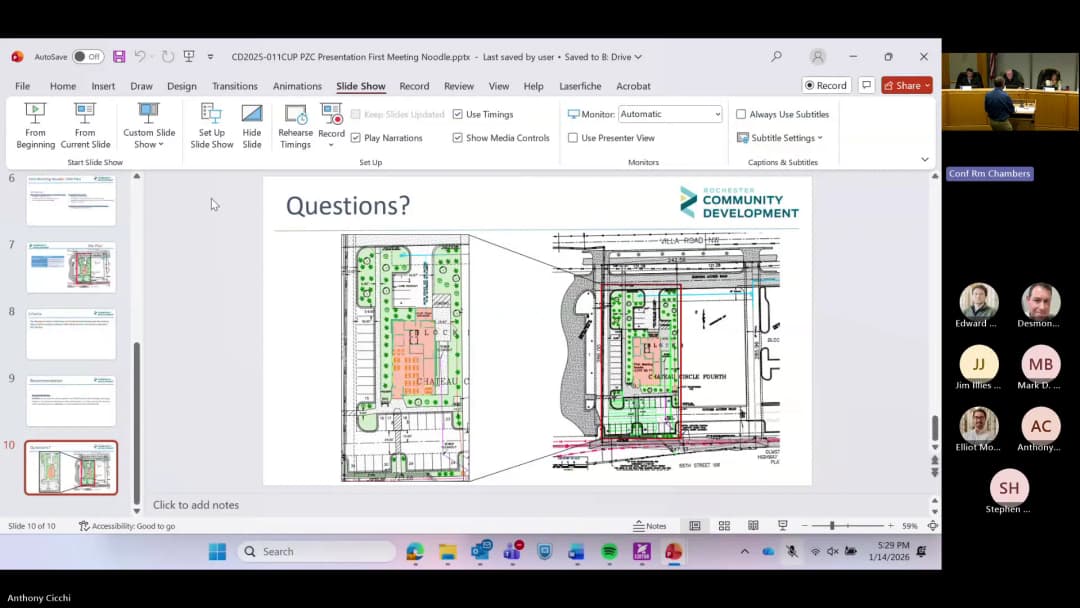
The Planning and Zoning Commission convened for its first meeting of 2026 with nine commissioners present (Commissioner Aishan absent). The meeting opened with the adoption of the agenda, unanimous approval of the December 2025 meeting minutes, and elections appointing Commissioner Gupta as Chair, Commissioner Krull as Vice Chair, and Commissioner Yost as the liaison to the Zoning Board of Appeals. Three substantive public hearings were held regarding travel demand management, low-density residential infill, and light industrial to mixed-use zoning changes. Consent Calendar - Minutes Approval: Approved the minutes from the December 10th, 2025, Commission meeting. Commissioner Boehm abstained; all others voted aye. - Commission Officers: - Re-elected Commissioner Gupta to the position of Commission Chair. - Re-elected Commissioner Krull to the position of Vice Chair. - Appointed Commissioner Yost as the Commission's liaison to the Rochester Zoning Board of Appeals. - Procedures: Adopted Robert's Rules of Parliamentary Procedure unanimously. Public Comments & Testimony - Bob Nordman (Northwest Neighborhoods Association): Expressed opposition to the applicant's request for 34 parking spaces without specific conditions regarding landscaping. Argued that two parking spots in the northwest corner of the rear lot currently conflict with mandatory tree planting locations due to water main and hydrant setbacks. Stated a position in favor of approving the project only if a condition is added requiring those two spots to be converted to green space for tree planting to soften commercial impact on adjacent neighborhoods. - Mark Walsh (GCUBE Engineering, representing SNC Invest LLC/Applicant): Expressed offense at the degree of neighborhood input, noting that the closest residence is 400 feet away. Stated a position that the neighborhood has had over a decade to plant their own trees and argued that requiring additional parking reductions based on landscaping concerns makes the project financially difficult to move forward. Stated that screening and buffer trees will be provided to the extent possible. - Lishang Shen (Owner, First Meeting Noodle): Explained that current high takeout rates (45%) are a result of parking scarcity, not patron preference. Stated a position that customers prefer dining in to experience the fresh food, but are forced to take out due to inability to find parking. Expressed a view that increasing parking will improve the dining experience and revenue without necessarily reducing total volume. - Anonymous Concerned Neighbor (West Circle Drive): Expressed strong opposition to the Sunshine Behavioral Health Group proposal. Argued that the change from light industrial to mixed-use is incompatible with the area. Stated a position that the site requires more light industrial uses and hotels, not a behavioral health facility. Cited past experiences with vandalism and property damage (checks stolen) as reasons for opposition. - Commissioner Andrist: Shared a personal anecdote supporting the need for behavioral health facilities, stating a position of support after living next to a similar rehabilitative group home that were "great neighbors." - Commissioner Ross: Asked the applicant for details on security, staffing, and insurance responsibilities regarding potential property damage to neighboring businesses, emphasizing the need to protect existing business owners. Discussion Items - Item 6A (Travel Demand Management): Discussed the request by SNC Invest LLC to increase parking for "First Meeting Noodle" from the staff-recommended 26 spaces to the applicant's requested 34 spaces. Staff noted the TDM plan is based on peak hour trip generation (28 customers + employees) and a ratio of 1 space per 150 square feet. The applicant argued that the current UDC calculations were insufficient due to the specific nature of the restaurant (fast turnover, high takeout reliance due to lack of space) and that existing ITE calculations for similar nearby projects (Chick-fil-A) allowed for higher ratios. Commissioner Klein questioned the relationship between table density and parking needs, while Commissioner Ross emphasized the need for businesses to survive financially. - Item 6B (Zone Change - INH Properties): Discussed the request to rezone 1.2 acres in the "Downtown Gateway"/"Traditional Core" area from R2X (Low Density Infill) to R3 (Medium Density Residential). Staff highlighted that the change supports infill development, aligns with the City's goal to support transit corridors (Link Bus Rapid Transit nearby), and maintains neighborhood protection standards (step-down height requirements, restricted parking locations). The applicant confirmed the change is the first step toward an apartment complex similar to adjacent developments. - Item 6C (Zone Change - Sunshine Behavioral Health): Discussed the request to rezone 2.71 acres from Light Industrial (L1) to Mixed Use General (MXG) to convert a 103-bed Country Inn Suites hotel into a 94-bed residential treatment center for substance use and mental health. Staff noted the site is already surrounded by commercial/business uses and that the MXG district permits institutional and medical facilities. The applicant detailed their 24/7 staffing, clinical programming, and insurance coverage. Commissioner Yost raised concerns about public safety, which the applicant addressed by confirming camera surveillance and full-time nursing/staff presence. Key Outcomes - Item 6A (Travel Demand Management CD 2025-011 C UP): Approved unanimously. The plan was modified to allow a maximum of 34 parking spaces. The motion reasoning cited the lack of viable shared parking options, the dangerous nature of the nearby bus stop location, and the developer's good faith efforts to address landscaping concerns through additional tree planting. - Item 6B (Zone Change CD 2025-007 ZC): Recommended approval of the rezoning from R2X to R3. The Planning Commission votes unanimously to forward a recommendation of approval to the City Council. - Item 6C (Zone Change CD 2025-008 ZC): Recommended approval of the rezoning from L1 to MXG. The Planning Commission votes unanimously to forward a recommendation of approval to the City Council following a public hearing on January 5th recap. - Adjournment: The meeting was adjourned following a motion by Commissioner Andrist.
PARKING 35% · ZONING REGULATIONS 23% · PROCEDURAL 12% · PUBLIC SAFETY 8%
162
JAN 13, 2026 · ROCHESTER, MINNESOTA · BOARDS AND COMMISSIONS
PVAC Meeting Summary - January 13, 2026

The Professional Advisory Committee for Active Transportation (PVAC) convened on January 13, 2026, to address an opening in board membership, review public comments on downtown mobility, and deliberate on two distinct but related bicycle infrastructure projects: "Reimagining Sixth Avenue West" and "Reconnecting the Downtown Mobility Network." Following agenda adjustments and leadership votes, the committee provided a formal letter of support for the Sixth Avenue project but deferred making a final recommendation on the broader downtown network due to unresolved concerns regarding parking turnover, street surface conditions, and timeline constraints. The committee requested a further meeting to address the second half of the mobility network project before the February City Council meeting. Consent Calendar - Reviewed and voted to approve the minutes from the December 8th meeting without objection. - Approved the City Council's request to move agenda items regarding the Chair/Vice Chair appointment and a grant support letter to the "New Business" section, as well as moving informational items 7A and 7B to New Business. - Adopted a motion to adjust the consent agenda structure to ensure clarity on recommendations versus informational items. Public Comments & Testimony - Barry (Resident of Sixth Avenue): Expressed strong opposition to the Sixth Avenue bike lane proposal, characterizing it as a "waste of money" due to the steep grade and lack of utility for the route. Stated there was no wide support among bikers for the corridor south of Second Street and argued that staff misrepresented community engagement. Advocated for alternatives on Broadway or Second Street instead. - Grace (First Presbyterian Church Representative): Expressed concern that the proposed move to First Avenue would negatively impact downtown business viability by displacing traffic to a corridor with insufficient infrastructure. Argued the city and Mayo Clinic have been disingenuous by sacrificing First Avenue businesses; stated the project should be moved west of First Avenue or postponed until Broadway is utilized. - Michael Lojak (Bicycle Alliance of Minnesota): Expressed significant concern that the public has not had adequate engagement on the preferred route. Stated that while Sixth Avenue West (Civic Center to 2nd) is good, the route south of 2nd Street is not "all ages and abilities" compliant due to steep grades. Argued that First Avenue lacks a complete safe route and has huge concerns regarding safety and accessibility. Expressed that the bicycle community is "not sold on First Avenue" and remains agnostic as long as a safe, complete route is provided, preferring Second Avenue as a viable alternative. - Advocacy Committee Representative: Stated that a few blocks of bike lanes do not create a usable network and stressed that First Avenue is not a complete route. Noted that Option B's proposed 8+2 foot lane width is below the NACTO minimum for a two-way cycle track and recommended making First Avenue one-way to allow for a wider, safer track. - Jennifer Personer: Expressed confusion regarding the comparison table in the project packets, stating that the information was weighted toward First Avenue despite the description acknowledging it is not a "complete route" due to gaps. Argued that the route is not ADA compliant and criticized the lack of clear explanation for why the flawed alternative was preferred. - Lizzie Krieg: Expressed that no solution is perfect and acknowledged that businesses are struggling with parking. Emphasized the need for continuity, predictability, and safety for all users, including those with mobility aids. Stated a preference for Second Avenue or a route that encourages new commuters, rather than a "blueprint" that feels disconnected. Discussion Items - Board Appointments (New Business): The committee voted to elect Mike Schmidt as Chair and Dave Cash as Vice Chair for the 2026 year. - Grant Support (New Business): Staff requested a letter of support for a Minnesota Department of Transportation (MDOT) Active Transportation Planning Assistance Grant. Staff clarified that the community does not receive money directly; funds go to a consultant to develop an implementation action plan. The committee voted to approve the letter of support. - Reimagining Sixth Avenue West: Staff presented a conceptual design for the corridor between Civic Center Drive and 2nd Street Southwest. The proposal includes 10-foot travel lanes, widened sidewalks, and a protected two-way bikeway. Staff noted the narrow lanes are a traffic-calming measure to target 25 mph speeds. A motion was made and passed to formally recommend proceeding with the conceptual design via a letter of support to City Council. - Reconnecting the Downtown Mobility Network: Staff presented options for connecting the network from 2nd Street to 4th Street Southwest, including routes via First Avenue, Second Avenue, and Sixth Avenue. Staff stated they are leaning toward First Avenue as a recommendation but do not yet have a formal recommendation due to complex factors: high parking occupancy (85-95%), low turnover rates (employees parking all day), and the need to coordinate with $38 million in Mayo Clinic infrastructure work starting in 2027. Staff proposed an "interim build" using paint and planters to test the concept before permanent construction. - Parking & Turnover: Staff acknowledged that current parking turnover does not support local retail and is being compromised by employees of the Mayo Clinic and construction contractors who stay for long durations. Explored strategies such as signage improvements, ramp access (which is free for the first hour), and business validation programs. It was noted that eliminating fees or offering free parking would require significant revenue offsets or council policy changes. - Route Surface Concerns: Committee members raised concerns about the paved surface at Peace Plaza being uneven and difficult for bicycles. Staff confirmed there are no current plans to modify the surface but acknowledged it would be evaluated during the 10-20% design phase, though it may exceed the current budget. - Timeline Constraints: Staff emphasized that a December 26th deadline prevents a delay in presenting a recommendation to City Council for the network project, as the design and bidding for the 2027 construction cycle are time-sensitive. Staff argued that the "Sixth Avenue" project and the "Network Connection" project cannot be entirely separated without jeopardizing the 2027 timeline. Key Outcomes - Agenda Motion: Approved moving the Chair/Vice Chair appointment and the MindOT grant letter request to New Business (now item 6A and 6B) and moving informational items 7A and 7B to New Business. - Leadership Elected: Mike Schmidt elected as PVAC Chair for 2026; Dave Cash elected as Vice Chair. - Grant Support Approved: PVAC voted unanimously to approve a letter of support for the MDOT Active Transportation Planning Assistance Grant application. - Sixth Avenue Recommendation: PVAC voted unanimously to formally recommend proceeding with the "Reimagining Sixth Avenue West" conceptual design and request a letter of support from the committee to the City Council. - Network Recommendation Deferred: PVAC voted to defer making a collective recommendation on the "Reconnecting the Downtown Mobility Network" (specifically the Sixth Avenue south segment and First/Second Avenue options) due to a lack of consensus on parking impacts, route continuity, and surface conditions. - Next Steps: The committee resolved to request a special meeting (potentially in late January) with staff to continue deliberations on the mobility network before the City Council meeting, though staff noted the February 2nd Council agenda is already finalized with limited flexibility for new recommendations. The committee will provide individual comments on the pros and cons of the options to the Council. - Adjournment: Motion to adjourn the meeting was approved. }

URBAN DESIGN 22% · TRANSPORTATION SAFETY 20% · ACTIVE TRANSPORTATION 15% · PUBLIC TRANSPORTATION 15%
163
JAN 12, 2026 · ROCHESTER, MINNESOTA · BOARDS AND COMMISSIONS
Citizens Advisory on Transit Meeting Summary - January 12, 2026

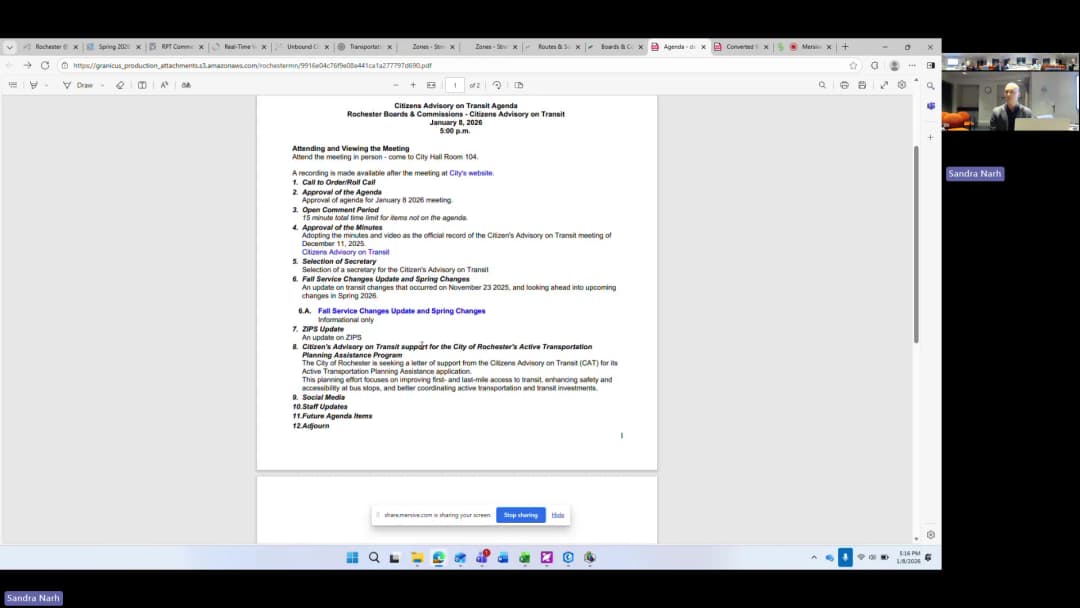
The Citizens Advisory on Transit (CAT) meeting convened on January 12, 2026, to address the upcoming Minnesota Department of Transportation (MnDOT) active transportation grant application, review recent service changes, and discuss upcoming operational challenges. The committee unanimously approved a letter supporting the City of Rochester's grant application, suspended the secretary position for the 2026 term, and received detailed updates on transit ridership trends, budget shifts, and service adjustments scheduled for spring 2026. Consent Calendar - No formal consent calendar items were presented; routine motions were handled under specific agenda items. - The motion to move Agenda Item 8 to immediately follow the approval of minutes passed unanimously. - The motion to approve the December 11, 2025, minutes passed unanimously. - The motion to approve the agenda as amended passed unanimously. Public Comments & Testimony - No members of the public provided comments during the open comment period as no guests were present. Discussion Items Active Transportation Planning Assistance Program Grant - Matt Lynch, MoShift Coordinator, requested a letter of support for the City of Rochester's application for the MnDOT Active Transportation Planning Assistance Program. He stated the grant funds an action plan to aggregate existing city plans and improve walking, cycling, and transit access. - Speaker Position: The committee expressed full support for the planning effort once clarifications were made regarding the grant's nature. - Discussion Points: - Barker Akry raised concerns regarding the specific dollar amount requested and the source of funding. - Matt Lynch clarified that the grant pool is statewide (estimated at $1 million total) and allocated based on need, not a fixed request amount. He confirmed the City Council previously approved the pursuit of the grant. - Speaker Position: Barker Akry noted that while the grant is for planning, the City of Rochester has already budgeted for the required cost share, alleviating immediate budget concerns. He expressed support for the initiative, noting the funds are pre-allocated by the state. - Speaker Position: The committee expressed trust in staff to review the draft letter and ensure the city does not accept funds they cannot manage, citing the ability to decline the grant if necessary. - Outcome: A unanimous vote was cast to support the application. Selection of Secretary - Rachel noted that while not required by statute, the secretary position had been vacant since December 2025 when Tracy's term expired. - Discussion Points: - Concerns were raised about the value of the role for public representation and skill development. - Staff clarified that city staff handle minute-taking and that the committee already approves minutes. - Speaker Position: The committee expressed support for suspending the secretary role for the year 2026 unless a member nominates a replacement. - Outcome: Unanimous motion to decline filling the secretary position for 2026. Fall Service Changes Update and Spring Changes - Sandra presented a review of the service changes implemented in November 2025 and outlined plans for spring 2026. - Key Metrics: - Ridership: Dropped from over 2 million in 2019 to approximately 650,000 in 2025, attributed to the pandemic, pandemic shuttles, and system inefficiencies. - Cost Structure: The local match required from the city increased from 5% to 15% of operating costs starting in 2026 due to state funding changes. - Operational Improvements: Mistrips decreased significantly from 96 (Sept) to 22 (Nov) following route consolidations and frequency adjustments (e.g., reducing frequency on routes 20, 21, and 102). - Spring 2026 Plans: - Speaker Position: Staff indicated intent to restructure routes based on efficiency, targeting routes with fewer than 8 boardings per hour. - Loop Routes: The committee discussed concerns regarding the complexity of loop routes; staff proposed converting loops to bi-directional routes to improve rider understanding and efficiency. - Holiday Service: Staff noted very low demand (150 boardings vs. 3,000 weekday) and are evaluating the reduction or removal of holiday service. - Fare Increases: Speaker Position: Staff expressed opposition to increasing fixed-route fares to maintain affordability, noting the fare would become the highest in the state. They are exploring alternative revenue through advertisements, park-and-ride leasing, and fare increases on paratransit (currently $3 vs. potential $4-$5). - Driver Recruitment: The committee discussed a driver shortage (current fleet requires 37 drivers; goal is 95 for future Link operations). Staff confirmed active recruitment and the availability of CDL training programs. - Social Media: Staff proposed closing the separate RPT Facebook page and consolidating content to the City of Rochester page to maintain engagement, with public input suggesting the city page may offer better reach. RFP for Transit Operations - Sandra updated the committee on the Request for Proposals (RFP) for the operation of fixed-route and paratransit systems. - Details: - The current contract with Transdev (formerly First Transit) is at the end of its 10-year term. The new RFP is for a 5-year term with a 5-year extension option. - 12 potential bidders attended the pre-bid meeting; 5 are companies. - Speaker Position: Committee members expressed interest in having the new operator discuss driver retention and pay structures. - Speaker Position: The committee recommended inviting an operator to discuss driver recruitment and retention at the next meeting. Link BRT Project Updates - Second Street remains open with partial lane closures for utilities. - Link Schedule: Project remains on track for summer 2027 operation. - Service Changes: Pre-canned detour routes were implemented for steep uphill routes (102, 104, 307) during winter; the committee expressed satisfaction with the app-based notifications and reduced wait times. Key Outcomes - Motion Passed: Unanimously approve a letter of support for the City of Rochester's Active Transportation Planning Assistance Program application (Deadline: Jan 13, 2026, 12:00 PM). - Motion Passed: Unanimously suspend the secretary position for the 2026 term. - Motion Passed: Unanimously adjourn the meeting. - Action Item: Matt Lynch will draft the letter of support for committee review and signature by the Acting Chair. - Action Item: Staff to bring a presentation on driver recruitment and retention to the February meeting. - Next Steps: Spring service changes will be presented after public engagement is finalized; an RFP update is scheduled for March.

PUBLIC TRANSPORTATION 58% · ACTIVE TRANSPORTATION 15% · PROCEDURAL 9% · PUBLIC ENGAGEMENT 7%
164
JAN 12, 2026 · ROCHESTER, MINNESOTA · CITY COUNCIL
Rochester City Council Study Session - January 12, 2026

The Rochester City Council convened a study session on January 12, 2026, for two primary agenda items: the future operating model of the Chateau Theater and the sustainability strategy for the Rochester Public Transit system. Prior to the agenda, Councilmember Doring made a statement regarding increased federal immigration enforcement activity in the city, clarifying that the Rochester Police Department does not assist in civil immigration enforcement and reaffirming the city's commitment to immigrant safety. Consent Calendar - No items listed for the Consent Calendar in the transcript. Public Comments & Testimony - Councilmember Doring: Expressed full support for immigrant residents, stating that residents should feel safe accessing services without fear. He explicitly positioned the Rochester Police Department as non-coordinating with civil immigration enforcement, noting they only respond to immediate public safety concerns or reports of criminal conduct. He encouraged community support for minority-owned businesses and immigrant neighbors. - Mayor Norton: Expressed concern that transit cuts would remove essential mobility for residents who have no other way to work. She emphasized that reliability is the primary factor driving riders to choose Uber over public transit and supported the goal of breaking down barriers between city staff and operators. - Councilmember Keene: Noted that cost-cutting measures feel "ugly" rather than radical or innovative. He expressed concern that reducing service effectively reduces the client base, making it harder to recover ridership numbers. - Councilmember Wall: Expressed skepticism about the current configuration's ability to attract corporate clients or upscale wedding events. He argued that the current facility does not meet the standards of either an elegant venue or an "outside the box" experience, leading families to choose other locations. - Councilmember Palmer: Expressed disappointment that the city is forced to cut routes, noting that 237,000 riders have been lost since 2022. He questioned why the city doesn't sell the building via RFP with deed restrictions to raise funds, while also acknowledging that 95% of 2023 funding was covered by DMC funds. - Councilmember Miller: Stated that while moving from a loop system to a two-way system is a positive step, the current metric of "93% of jobs within a half-mile" is insufficient. He argued that accessibility must be measured by time (e.g., 30-minute access to jobs) rather than distance. He also called for fare-free options and guaranteed ride-home programs to support transit use. - Councilmember Yetzer: Advocated for transparency, urging the community to understand that the team is pursuing significant structural changes (like the Operations RFP and Transit Development Plan) rather than minor tweaks. He urged staff to present tangible radical ideas rather than just vague concepts. - Councilmember Fredericks: Praised the transit team's efforts to build rider confidence and noted the improvement in on-time performance and missed trips following operational shifts. - General Community Sentiment (via Councilmembers): Councilmembers collectively expressed a position that the community values the Chateau's role as a free community space and fears the "One Roof" model (collaboration with Experience Rochester) might threaten local arts access. They also expressed a strong desire for real, vetted numbers before approving capital investments, citing past consultant failures. Discussion Items - Chateau Theater Operating Model - Staff Presentation (Josh Johnson): Presented three models for the Chateau's future: Model 1 (Stabilization), Model 2 (Enhanced Backstage/Capacity), and Model 3 (All-Inclusive/Daily Cafe). Staff recommended Model 2, while the consultant recommended Model 3. The city purchased the building for $6 million in 2016, with $11 million total invested to date. Current annual operating holding costs are approximately $80,000. Baseline facility improvements are estimated at $1.8 million (2024 data), with total renovation costs for the models ranging from $2.7 million to $5 million, though staff noted these are preliminary concepts requiring further vetting by contractors. - Funding and Cost Concerns: Councilmembers Miller and Keene explicitly opposed presenting these estimates as final financial obligations, noting a history of optimistic consultant projections that led to unrealistic expectations. Councilmember Paler emphasized that many of the $1.8 million baseline items have been vetted, but the additional costs for catering and capacity (up to 800 occupancy) require further engineering analysis. - Liquor and Food Infrastructure: The lack of a permanent liquor license and basic catering infrastructure (kitchen, permanent food service) was identified as a critical barrier to financial sustainability. Councilmember Doring and Mayor Norton stressed the need to secure a liquor license or a special carve-out to enable revenue generation. - Operating Partner Strategy: Staff proposed a "One Roof" concept involving Experience Rochester as a potential operating partner to leverage existing marketing, staffing, and catering resources. Councilmember Miller expressed hesitation, citing a lack of community input and a need for an RFP process to vet alternatives. Councilmember Doring voiced concerns from the arts community that this partnership might impact local arts access. Councilmember Palmer suggested selling the building with deed restrictions as an alternative. - Capacity and Infrastructure: Councilmember Wall questioned the feasibility of increasing capacity to 800 without massive renovation, citing the current "atmospheric" layout as a deterrent for weddings. Councilmember Miller noted the mezzanine and skyway access issues require detailed engineering regarding egress and agreements with adjacent buildings. - Rochester Public Transit Sustainability - Funding Shifts: Interim Director Rachel Fauch reported that the local match for operations funding has increased from 5% (2024-2025) to 15% effective January 2026. This shift increases the city's financial obligation from approximately $600,000 to $1.8 million for a $12 million budget. - Ridership Decline: Fixed route ridership has dropped from over 2 million in 2019 to roughly 669,000 in 2025, a loss of 237,000 riders since 2022. While a slight increase (20,000 riders) was seen from 2024 to 2025, councilmembers Palmer and Keene expressed frustration over the lack of a definitive explanation beyond COVID and work-from-home trends. - Reliability Issues: Missed trips and on-time performance were cited as the primary reasons for ridership decline. Director Fauch attributed improvements (reducing missed trips from 120 to 6 in December) to operational shifts and reduced driver shortages, though construction on Broadway remains a factor. - Proposed Changes: Staff outlined "radical and innovative thinking" including transitioning from loop routes to two-way service routes, reducing holiday service hours, and re-evaluating 13 underperforming routes (with a goal of 11 boardings per hour). The BRT (Link) system is scheduled to launch in approximately 18 months and will be 100% electric, funded by grants and a specific Mayo Clinic agreement covering the local share. - Fare Structure: Councilmember Miller proposed daily maximum fares and fare-free options, but Director Fauch and Councilmember Doring positioned fare increases or complex changes as secondary to fixing reliability. Mayo Clinic currently pays $1.80 per ride for its employees, covering a significant portion of the ridership. - Partnerships: Staff confirmed ongoing collaborations with Mayo Clinic, Rochester Public Schools (RPS), and ROCOG to improve access and equity. Councilmember Miller emphasized the need to view transit as a job access tool, not just a coverage metric. Key Outcomes - Chateau Theater: Council members directed staff to further vet capital cost estimates with contractors before finalizing numbers; no vote was taken on the operating model or partner. There was a consensus to engage with Experience Rochester to discuss the "One Roof" collaboration but no decision to proceed, pending community input and a more detailed financial plan. Council members requested a return with real, vetted numbers and a clear definition of programming priorities (community vs. commercial) before the current lease expires at the end of 2026. - Transit System: No immediate funding changes were approved, but the council was informed of the 15% local match increase starting 2026. Staff was directed to communicate the reliability improvements and the rationale for potential service changes (Spring 2026 adjustments) transparently to the public and riders. Council members requested a more detailed plan on how the fixed route system will integrate with the upcoming BRT launch to maximize new ridership. - General: The council adjourned with a directive for radical and innovative thinking but emphasized that the current data and projections are insufficient for final decision-making without further community engagement and contractor vetting. Note: There is a discrepancy regarding the local transit funding match. Councilmember Palmer stated he was not informed of the 5% to 15% shift until this meeting, while Director Fauch and Councilmember Yetzer confirmed the change was known for 2025 and the 2024-2025 period was a 5% match due to COVID relief. This discrepancy was noted in the discussion as a point of confusion for the council. Note: Regarding the Chateau Theater, there is a discrepancy between the consultant's recommendations (Model 3, All-Inclusive) and the city staff's recommendation (Model 2). The transcript reflects this conflict explicitly.

PUBLIC TRANSPORTATION 37% · ARTS AND CULTURE 24% · PUBLIC ENGAGEMENT 12% · FISCAL SUSTAINABILITY 8%
165
JAN 8, 2026 · ROCHESTER, MINNESOTA · BOARDS AND COMMISSIONS
Zoning Board of Appeals Meeting Summary (2026-01-08)

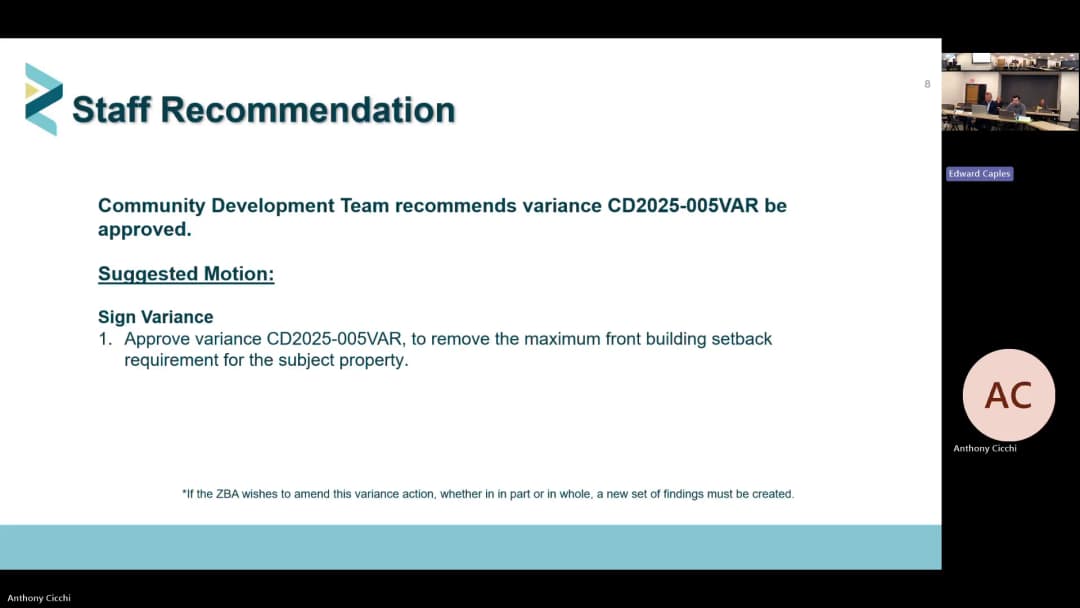
The Rochester Zoning Board of Appeals convened at 6:02 p.m. on January 8, 2026, to address the election of officers, procedural rules, and a variance application. The board established its leadership for the upcoming year, affirmed its adherence to parliamentary procedures, and reviewed a specific setback variance request. Public comments were solicited, revealing community support for the procedural necessity of the variance, though some neighbors expressed broader concerns regarding site details not under this specific vote. Consent Calendar - The agenda was adopted unanimously via motion by Commissioner Bucknell and second by Commissioner Stepp. - The minutes of the September 17, 2025, meeting were approved as the official record without changes, based on a motion by an unnamed commissioner and second by Commissioner Bucknell. Public Comments & Testimony - Bob Norman (Northwest Neighborhood Association): Expressed support for the variance. He clarified that the current request is strictly for the south side setback and noted that the variance is necessary to align businesses within the site, a requirement due to the historical transition from a special district to the Unified Development Code (UDC). He confirmed the neighborhood understands this is a procedural necessity. - Applicant (Mark Walls, G.): Stated that while neighbors have concerns regarding other criteria not under the current variance request (specifically infrastructure modifications and traffic command management), the neighborhood does not oppose the variance itself. Discussion Items - Elections for 2026: Commissioner Bucknell was elected Chair for 2026, and Commissioner Bucknell (who also served as Vice Chair nominee) was elected Vice Chair for 2026, both by unanimous vote of the present commissioners. - Parliamentary Procedure: The board unanimously affirmed its commitment to adopting and using Robert's Rules of Parliamentary Procedure for all 2026 meetings via a motion by Commissioner Abbott. - Variance CD 2025-005 (SC Invest LLC): Staff and the applicant presented a request to remove the maximum 15-foot front building setback requirement on the south side (55th Street frontage) for a proposed scanner restaurant. Staff recommended approval, citing the site's unique dual frontage and existing private roadway conditions that would otherwise result in an overly tight pedestrian setback if the standard were fully adhered to. Commissioners clarified that the vote is limited strictly to the south side setback variance and that any future development on the north side would require a separate variance if it deviates from code. Key Outcomes - Chair/Vice Chair Elected: Commissioner Bucknell (Chair) and Commissioner Bucknell (Vice Chair) were elected for 2026 unanimously (Commissioners Abbott, Pearl, Bucknell, Stepp voted aye). - Procedural Adoption: Robert's Rules of Parliamentary Procedure were adopted for the 2026 fiscal year (Unanimous). - Minutes Approval: Minutes from September 17, 2025, were approved (Unanimous). - Variance Approval: Variance CD 2025-005 VAR was approved to remove the maximum front building setback requirement for the south side of the property. The vote was unanimous (Commissioners Abbott, Pearl, Bucknell, Stepp/Burl all voted aye). The approval is based on findings outlined in the Community Development memo. - Future Consideration: Staff proposed adjusting meeting start times from 6:00 p.m. to 5:00 p.m. for the remainder of the year; the board agreed to gauge interest from other members before placing the change on the next agenda.

ZONING REGULATIONS 45% · PROCEDURAL 39% · PUBLIC ENGAGEMENT 16%
166
JAN 7, 2026 · ROCHESTER, MINNESOTA · BOARDS AND COMMISSIONS
Park Board Meeting Summary - January 7, 2026

The Rochester Park Board convened on January 7, 2026, to review minutes, receive public testimony regarding safety concerns at Judd Hill, and discuss infrastructure projects including the Sixteenth Street Bridge. The meeting featured a procedural reopening of the public comment period to accommodate a resident's detailed account of a childhood sledding accident. Staff presented updates on flood modeling, bridge design, and the 2026 art program, while deliberations on the balance between legal liability and moral responsibility regarding recreational safety took place during the public comment and old business sections. Consent Calendar - Cutsky Park Bridge Repairs: The board unanimously approved the authorization for construction work on the Cutsky Park Bridge. Staff explained that the $53,808 cost covers structural steel additions and the replacement of the entire bridge deck, a cost-effective measure compared to full bridge replacement estimated at two to three times the current cost. Public Comments & Testimony - Sheamus Palmer: Representing himself as a local resident and grandfather, Palmer expressed strong concern and opposition to current safety conditions at Judd Hill sledding area. He detailed a personal incident where his grandson suffered a broken leg after colliding with a telephone pole while sledding. Palmer argued that dumping snow to create bumps and placing boulders at the base of the hill are dangerous and increase liability. He opposed the current configuration and suggested installing snow fences along the sides and bottom to guide sleds safely, noting that the current setup causes children to veer into obstacles and the roadway. - Board Member Paul Marino: Expressed support for the caller's safety concerns but emphasized the legal reality, stating that the board cannot regulate where people slide as it would create a "free-for-all" and likely fail in court regarding liability. He acknowledged the moral weight of the situation but noted that state statutes generally place liability on users to manage themselves. Discussion Items - Sixth Street Bridge Project: - Jamie Wilson (Project Manager) and Steve Sampson Brown (Director of Construction): Presented an informational update on the bridge connecting Sixth Street to Soldiers Field Park. The design includes separation of pedestrians, bikers, and vehicles, with a pedestrian/bike path elevated above the road. The team is currently in the 60-100% design phase. - Flood Modeling: Staff explained that new modeling techniques from 2025 indicate that future FEMA 100-year flood maps would include additional areas in yellow compared to the 40-year-old maps. While the bridge design was optimized to minimize the rise in flood levels (approx. 1.25 inches) during the 100-year event, slight increases in flooding are expected in specific parking lots in Soldiers Field. - 200-Year Event Protection: To protect private properties in the northeast quadrant of Soldiers Field from the 200-year flood event (design basis for the city's flood control system), a proposal was made to construct a 1-2 foot earth berm (approx. $400,000 cost estimate). This would raise the 200-year flood protection level for specific private buildings. - Trail Design: Staff confirmed that the trail on top of the berm will be an elevation of an existing 2-year-old trail, kept level. A board member expressed concern about traffic safety on 6th Street near a school, but staff noted the project is past that design phase and the route is governed by state aid standards. - Canopy Design: Regarding the debate between two canopy options (smaller vs. larger), staff confirmed there is no final decision as the team works within budget constraints. The larger canopy was noted as the updated concept if funds permit. - Parks and Recreation Financial Report: - Staff presented a year-to-date performance report. A board member noted a $50,000 budget gap specifically for golf operations (covering Soldiers Field and other courses) and inquired if this was an administration-only issue; staff clarified it covers all golf operations. Another board member noted that steering goals to profitability would be discussed in detail in February. - Arts for Trails 2026: - Staff presented three selected art pieces for installation in June 2026: "Wool and Chime," "Three Amigos" (at Mail Landing), and an untitled piece described as "good sunshine and rays of sun" near Riverside Plaza. These pieces are temporary but made of durable metal. Staff noted that while some pieces last longer, the program's goal is annual rotation, though some permanent installations have existed. - Ice Rink Equity and Scheduling: - A board member questioned the lack of outdoor rinks in the southeast quadrant, citing high density of children in trailer courts and apartments. Staff responded that while there is a desire to expand rink access, challenges include the capacity to maintain ice, budget constraints for permanent rinks, and a lack of consistent high demand in certain proposed locations. Staff noted that the 2027 park system plan will address future location and capacity strategies. Key Outcomes - Judd Hill Safety: The board acknowledged the severity of the safety concerns raised regarding the telephone pole and the lack of current protection measures. While no immediate motion to change the physical landscape was made due to liability constraints, the board directed staff to research and report back on potential mitigation strategies, including anecdotal data or hospital visit statistics, by February. - Flood Response Plan: Staff committed to addressing the proposed earth berm in Soldiers Field to protect private property from the 200-year flood event as part of the bridge project coordination, with a target implementation window in the upcoming year pending park staff scheduling. - Arts Program: The three art pieces for the 2026 "Arts for Trails" program were presented to the board for awareness; no formal vote was required, and the permit will be issued annually as per tradition. - Golf Operations: The $50,000 golf budget gap and financial steering goals were noted as items to be detailed in the February board meeting.

PARKS AND RECREATION 34% · ENGINEERING AND INFRASTRUCTURE 20% · PUBLIC SAFETY 13% · PROCEDURAL 8%
167
JAN 5, 2026 · ROCHESTER, MINNESOTA · CITY COUNCIL
Rochester City Council Meeting Summary - January 5, 2026

The January 5, 2026 City Council meeting opened with the Pledge of Allegiance and a public comment period featuring three speakers. The meeting included a review of the 2025 City Administrator's report highlighting record permit valuations and community growth, followed by four public hearings and several council-initiated actions. Key discussions centered on street reconstruction assessments, two major land subdivision proposals (Prairie Oaks and Pulti Homes), and a resolution reaffirming support for the Somali community. The session concluded with routine ordinance readings and financial discussions regarding the Salvation Army's rental assistance program. Consent Calendar - Approved unanimously (6-0). No specific items were polled; the entire consent agenda was approved. Public Comments & Testimony - John Flaga: Spoke as a community member simply to listen and learn. - Lucy Crisel: Expressed cautious support for increased walkers and bikers but opposed the specific "First Avenue Southwest, the bike lane blip" proposal due to perceived risks for commuters and potential to not invite new traffic; recommended considering alternative solutions like Broadway. Represented the Cresel family business owners and cited her experience as a trained LCI instructor. - Jason Bucken: Expressed strong opposition to current government operations, alleging the Sheriffs Department and Rochester Police Department are "above the law" and committing financial fraud by failing to enforce laws; described the situation as tyranny. Public Hearings G1: Reconstruction of Center Street East - Staff Position: Presented a full reconstruction from the Zumbro River Bridge to 11th Avenue Northeast/Southeast with a cost of $7.4 million; 25% ($575,000) to be funded via special assessments. Staff noted an assessment hearing was previously held in error regarding notice and is conducting this hearing to ensure compliance. - Public Position: No public testimony was received. - Outcome: Motion to adopt resolutions levying assessments passed 6-1 (Councilmember Palmer voting against). G2: Zone Change and G3: Major Land Subdivision (Prairie Oaks/Oak Grove RST LLC) - Staff Position: Recommended approval for a zone change from AG (Agricultural) to R1 (Single Family Residential) and the subdivision of 15 acres into 37 lots. Staff noted the project aligns with the low-density residential land use classification and meets the General Development Plan review standards. - Applicant Position: The applicant stated the development provides needed single-family detached housing at a moderate density (2.5 lots per acre) and agreed to the nine conditions proposed by staff regarding stormwater management and final plat details. - Opposing Position: David Hinkware expressed strong opposition, arguing that the development is an "abomination" incompatible with the surrounding agricultural character, citing safety concerns regarding the 60th Street and Highway 52 intersection, and noting zoning commission irregularities and a potential conflict of interest. - Outcome: Motion to approve Zone Change CD 2025-006 ZC passed. Motion to approve Major Land Subdivision CD 2025-041 (Prairie Oaks) passed. G4: Major Land Subdivision (Pulti Homes of Minnesota LLC) - Staff Position: Recommended approval of a subdivision of 141 acres into 300 residential lots (Del Webb brand). Staff confirmed compliance with floodplain regulations, DNR requirements for stream bank restoration on Cascade Creek, and noted the project includes 100-year and 500-year flood events management. - Applicant Position: Dean Lauder (Pulti Homes) outlined a phased approach with primary access off 45th Avenue Southwest. The applicant expressed confidence in the traffic study, noted that many buyers are second-home owners reducing peak traffic, and confirmed the bridge in the design will be built in Phase 2 (approx. 2028). - Supporting Position: Alan Watts expressed full support for the Del Webb development, citing personal positive experiences with the brand in Arizona and a desire to downsize into such a community. - Opposing Position: Dr. Sunanda Kane and John Flaga raised concerns. Dr. Kane argued the traffic survey assumptions regarding Mayo Clinic retirees were faulty, potentially underestimating peak-hour travel by full-time workers and volunteers. She requested an independent traffic survey or an alternate site. John Flaga expressed caution regarding erosion and ecosystem impacts. - Discrepancy Note: Councilmember Miller initially moved to adopt the subdivision with a ninth condition directing staff to consider alternatives to the Neighborhood Traffic Management (NTM) program for intersection control. Councilmember Keene expressed discomfort with adding new conditions without study before voting. Miller subsequently offered an amendment to restrict construction traffic to specific routes (Country Club and 45th Ave) which passed. Miller then attempted to add a motion to direct staff to consider intersection control; he withdrew this motion after receiving assurance from staff that proactive safety evaluations are a standard city priority. - Outcome: Motion to approve Major Land Subdivision CD 2025-042 (Pulti Homes) with eight standard conditions and the construction traffic amendment passed 5-1 (Councilmember Keene voting against the original motion but the final amended motion passed; Keene's vote on the final motion is not explicitly detailed as "nay" in the final roll call, but the motion passed 5-1). Correction: The final roll call for the item with the amendment shows: Keene (Nay), Miller (Aye), Wall (Aye), Palmer (Aye), Doring (Aye), Schuberg (Aye) - 5-1. Council Initiated Actions & Other Business Resolution Reaffirming Support for Somali Community - Proposal: Councilmember Doring introduced a resolution supporting the Somali community and commitment to inclusion following disturbing language. - Opposing Position: Councilmember Keene opposed the resolution in its final form, specifically the fifth clause directing the clerk to distribute copies to community organizations and legislators, stating it appeared to politicize the city council and bring the city into national debates. Correction based on transcript: The motion to remove clause 5 (striking the distribution requirement) failed 3-3 Keene (Yes), Miller (No), Wall (Yes), Palmer (No), Doring (No), Schuberg (No). Consequently, the original resolution was voted on. - Outcome: The original resolution passed 5-1 (Councilmember Keene voting against). Salvation Army Funding Discussion - Proposal: Councilmember Doring requested a non-formal indication for staff to draft an agreement utilizing $20,000 from the contingency fund for the Salvation Army's rental assistance program, contingent on not receiving a grant from the Building Community Grant program (max $15,000). - Discussion: The City Administrator noted the Building Community Grant max is $15,000. Councilmember Palmer noted potential issues with CDBG funding if the building community grant is awarded. Councilmember Keene expressed discomfort with the language of "giving money" and preferred funding based on public mission alignment rather than direct charity. - Outcome: No formal vote taken; staff to proceed with drafting language contingent on the outcome of the grant application process. Key Outcomes - Center Street East: Assessment resolution adopted 6-1 ($575,000 special assessments levied). - Prairie Oaks (Oak Grove RST LLC): Zone change (AG to R1) and subdivision (37 lots) approved successfully. - Pulti Homes (Del Webb): Subdivision (300 lots) approved 5-1 with an amendment restricting construction traffic to Country Club Road and 45th Avenue Southwest. - Somali Community Resolution: Adopted 5-1 despite internal debate over the distribution clause. - Ordinances: Central Park historic landmark designation (J1) and Unified Development Code text amendment (K1) approved unanimously. - Agenda Approval: Agenda approved unanimously (7-0) with no changes proposed. - Attendance: Councilmembers Keene, Miller, Wall, Doring, Palmer, and President Schubberg present; Councilmember Fredericks absent. - Major Events: Mayor Norton announced the State of the City will be held this Thursday and a Germany trip for Council President Schuberg and Mayor Norton is scheduled for June 12-22.

TRANSPORTATION SAFETY 18% · PROCEDURAL 13% · COMMUNITY ENGAGEMENT 11% · ENGINEERING AND INFRASTRUCTURE 11%
168
DEC 22, 2025 · ROCHESTER, MINNESOTA · CITY COUNCIL
December 22, 2025 Special City Council Meeting Summary

The special City Council meeting was convened to reconsider three items previously vetoed by Mayor Norton: contract awards for the Rochester Sports and Recreation Complex (Item D1 and D2) and a funding allocation for the Salvation Army (Item D3). The Council faced significant public testimony and internal debate regarding the scope of the sports complex, specifically the exclusion of the indoor facility promised to voters, and the procedural propriety of emergency funding for the Salvation Army. After deliberation, the Council successfully overrode the Mayor's vetoes for the sports complex items by a 5-2 vote but failed to override the veto regarding the Salvation Army funding, falling short of the required supermajority. Consent Calendar - The Council President called for consent regarding routine approvals; no specific consent items were listed in the transcript aside from the agenda approval. - The agenda was amended with no changes and approved unanimously. Public Comments & Testimony - Mark Brandsford (317 15th Ave SW): Expressed opposition, stating plans presented were only drafts and the current outcome is a foreseeable result of delay. - Clark Jones (RCTC Baseball Coach): Expressed full support for the complex, highlighting that a quality tournament experience in March would save teams $20,000-$30,000 annually and boost local business. - Christine Erke (Parent/Hospitality): Expressed full support, emphasizing the facility's need for economic development and that the state would not fund purely local needs. - Emma Steeb (Rochester Area Chamber of Commerce): Expressed full support and urged an override of the veto, stating the complex is a voter-approved investment critical for economic competitiveness and community well-being. - Wyatt Ryan: Expressed opposition to the current iteration, noting his original "yes" vote was contingent on an indoor facility which is now absent. - Chris Lucanville (Rochester Area Lacrosse): Expressed full support, citing the need for reliable turf fields for youth accessibility and the ability to host regional events. - Tom Hexham: Expressed full support, arguing the city needs to think bigger in the $40 billion sports industry and that the facility complements the health mission. - Wade Fenski (Rochester Area Chamber of Commerce): Expressed full support, reiterating the economic benefits for hospitality and the necessity of the complex to attract large-scale events. - Wade Beavins: Expressed full support, citing economic success stories in Carmel, IN, and Blaine, MN, and challenging opponents to vote for the project's forward-thinking benefits. - Pat Sexton (Rochester Area Builders): Expressed full support, clarifying the 65 million budget was for the complex (similar to Ram Arena usage) and arguing that sports tourism brings new money. - Joseph LaForge: Expressed staunch opposition, requesting a pause to re-evaluate and re-engage the community for equitable access. - Mike Vance (Rochester Youth Baseball Association): Expressed full support, acknowledging the lack of indoor facilities but emphasizing this project lays the groundwork for future indoor phases and community connection. - Stephen Shaw: Expressed concern that the $65 million cost requires a larger community piece to ensure the whole community can be proud of the result. - AJ Copinto: Expressed opposition, arguing the outdoor facility serves the local community poorly in winter due to cold weather and fails the "local use" mandate. - Ed Ruska (Former Council/Sports Foundation Director): Expressed full support, stating the funds must be used for the approved regional project and warning against the vocal minority. - Marshall Barons (Rochester Sports Foundation): Expressed full support, emphasizing economic benefits, the 8-month outdoor usability, and the fiscal irresponsibility of delaying the project. - Laurel Schott (Empire Hotel Group): Expressed full support, noting the hospitality community needs this to remain competitive and anticipating an indoor facility in the future. - Brad Trahan (Ward 5): Expressed full support specifically for the Salvation Army funding, urging a 7-0 override of that specific veto. - Jane Shellum: Expressed opposition to overriding the veto, stating she voted for the project based on promises of both indoor and outdoor facilities and felt the drastic scope change requires a return to voters. Discussion Items - Mayor Norton (Veto Reasons for Sports Complex): Opposed overriding the veto, citing a lack of specificity during the original 2022 referendum, the fact that the $65 million does not fund an indoor facility as expected by voters, and the belief that the community desires a year-round indoor-outdoor facility. She highlighted ongoing negotiations with RCTC for a future indoor solution. - Mayor Norton (Veto Reasons for Salvation Army): Opposed overriding the veto on D3, arguing that security is already addressed by Salvation Army corporate and RPD, the process bypassed standard policy procedures (no staff language returned for debate), and that existing federal CDBG funds should be prioritized for rental assistance. - Councilmember Palmer: Supported overriding the sports complex veto, praising the leadership on RCTC negotiations as a strategic win-win. Regarding Salvation Army, he argued the need is great, the expense is legally defensible per the City Attorney, and the previous vote by seven members stands. - Councilmember Fredericks: Supported overriding both vetoes. Noted that the sales tax bill did not specify indoor facilities, but the community understood it based on renderings; argued that without property taxes, an indoor-only facility is unviable; and defended the Salvation Army funding as a legitimate one-time action similar to Channel One funding. - Councilmember Keene: Expressed support for overriding the sports complex veto but opposed the Salvation Army veto override, citing procedural concerns (motion bypassed standard staff review) and a desire to ensure proper guardrails before future spending. - Councilmember Wall: Expressed full support for the sports complex, arguing the $65 million is legally restricted to construction and that the community feedback favors operational self-sufficiency over increased taxes. - Councilmember Miller: Expressed support for the sports complex but opposed the Salvation Army funding. Raised concerns about "inclusive decision making" being tensioned with the project timeline and noted the operator's financial projections lacked sufficient risk allocation (only reputational risk). Regarding Salvation Army, argued the CIA process should have directed staff to research and return with recommendations rather than immediate allocation. - Councilmember Doring: Expressed support for the sports complex but opposed the Salvation Army funding. Criticized the operator for a lack of due diligence and financial accuracy regarding the scope change. Regarding Salvation Army, shared concerns with Councilmember Miller about the process and future implications. Key Outcomes - Item D1 (Contract Award): Motion to override Mayor Norton's veto on the contract with Knutson Construction for $27,978,635. Result: PASSED (5 Aye: Keene, Wall, Fredericks, Palmer, Schuebring; 2 Nay: Miller, Doring). - Item D2 (Operator Agreement): Motion to override Mayor Norton's veto on the operator agreement with Sports Academy. Result: PASSED (5 Aye: Keene, Wall, Fredericks, Palmer, Schuebring; 2 Nay: Miller, Doring). - Item D3 (Salvation Army Funding): Motion to uphold the council-initiated action for $20,000 funding. This required a 5-vote supermajority to override the veto. Result: FAILED (4 Aye: Wall, Fredericks, Palmer, Doring; 3 Nay: Keene, Miller, Schuebring). The veto was upheld. - Executive Session: Motion to adjourn to closed session for litigation (Molly Dennis v. City of Rochester) passed unanimously.

SPORTSPLEX DISCUSSION 48% · PROCEDURAL 14% · HOMELESSNESS 14% · COMMUNITY ENGAGEMENT 12%
169
DEC 18, 2025 · ROCHESTER, MINNESOTA · BOARDS AND COMMISSIONS
Rochester Public Library Board Meeting Summary - December 18, 2025

The Rochester Public Library Board convened on December 18, 2025, to review fundraising results, approve the replacement of self-checkout equipment, address a critical volunteer delivery policy change, and engage in the initial stages of strategic planning. The board approved several financial items unanimously, including a significant equipment purchase utilizing sole sourcing, and voted to suspend the current volunteer delivery model for the Library at Home initiative, opting to use emergency foundation funds to cover staff wages for January while exploring permanent solutions. Consent Calendar - Approval of Minutes: The board reviewed and acknowledged that no meeting occurred in the most recent prior month. - Board Recognition: A vote was held to present symbolic gifts, including bookplates, to board members for their service, including the outgoing president. Public Comments & Testimony - N/A: There was no formal public comment period conducted during this session as the transcript indicates the public comment inquiry yielded no participants. Discussion Items Financial Reports & Updates - Friends of the Library: The Friends group presented financial results, noting holiday shopping sales reached over $14,000 (exceeding the $12,000 goal) and reaching 25% of their $30,000 goal with 21 committed sponsors. Bookstore sales raised $1,300 despite snowstorms, and auditorium sales generated a net profit of $9,500, covering nearly all pledged programming costs. - Executive Committee: The committee confirmed that the strategic planning discussion with consultant Julie Brock would continue in January. Technology Procurement (Budget $64,623) - Item Description: Approval was sought for $64,623 to replace seven existing self-checkout stations with new Biblioteca machines, funded by IT revolving funds. - Sole Sourcing Justification: Library staff recommended sole sourcing from the current vendor, Biblioteca, citing compatibility with the city's rigorous IT tech approval process, integration with the specific credit card vendor used by the city, and the inability of other vendors to meet security standards without costly transitions. Staff noted that the current machines run Windows 10, which is no longer supported by Microsoft, creating a security liability. - Board Deliberation & Concerns: Board members expressed concern regarding the lack of competitive bidding, the depreciation timeline (equipment age of five years vs. usual seven-to-ten-year depreciation), and the specific pricing compared to a 2020 contract ($115,000). Concerns were raised about the 20% discount expiring on January 1st and the necessity of the credit card integration versus other payment methods. - Speaker Positions: - Support was expressed for the recommendation to ensure network security (Windows 11 compliance) and operational continuity, noting that the current pricing is comparable to 2020 rates. - Opposition concerns were voiced regarding the fiscal oversight and the necessity of bypassing the bid process, though no board member formally voted to table the item pending further investigation. - Outcome: The motion to approve $64,623 for the self-checkout replacement and sole sourcing was carried by a 3-0 vote (with one abstention noted as "favorite" or similar in transcript due to the roll call). Library at Home Program & Policy Change - Context: A new city-wide volunteer policy, effective the previous Friday, prohibits volunteers from using personal vehicles for official city business, threatening the current delivery model for the "Library at Home" program which serves homebound residents. - Proposed Options Discussed: 1. Sunsetting the program: Cited as having a huge negative impact on resident wellness. 2. Staff Delivery: Estimated to cost $8,000/year in staff time, impacting other library services. 3. Books by Mail: Involves ongoing postage costs and staff training, but eliminates liability for vehicle accidents. 4. Friends of the Library Transfer: Shifting delivery to Friends volunteers (who would need to sign a new MOU and assume liability). Staff noted Friends has not yet agreed to this. 5. Partnerships: Exploring collaboration with Meals on Wheels or other agencies (e.g., United Way, Family Service Rochester). - Speaker Positions: - The program presenter emphasized the critical social interaction provided to homebound residents, noting some receive this as their only monthly contact besides medical personnel. - A board member expressed concern that shifting to the Friends assumes liability they may not wish to carry without coverage. - Multiple board members expressed strong support for maintaining the program, citing the risk of leaving vulnerable residents without contact during the winter. - A board member noted that state services for the blind do not qualify all homebound individuals with low vision or physical disabilities who still require social interaction. - Resolution: The board voted to use a portion of unexpected foundation funds to cover staff wages for January to continue deliveries, preventing a service gap. They directed staff to continue exploring partnerships with the Friends of the Library and community agencies (e.g., Meals on Wheels, United Way) for a long-term solution. Strategic Planning Session - Facilitator: Julie Brock, consultant, led an engagement session to refine the library's 2026-2029 strategic plan based on the Master Plan recommendations. - Key Themes Identified: - Facilities/Operations: High excitement for satellite locations (free parking, satellite branches) and the bookmobile pilot. The consensus was that satellites would significantly increase access. - Identity: Strong focus on raising the library's profile and communicating the value of the library to different audiences (city leadership, schools, general public). - Leadership: Alignment with city and county goals and fostering a culture of innovation. - Speaker Positions: - Board members expressed enthusiasm for the satellite locations, viewing them as a way to capture non-users who find the downtown location inconvenient. - Concerns were raised about the need for targeted messaging and understanding specific audience needs (e.g., what city leaders value vs. what book lovers value) before finalizing stories. Key Outcomes - Adoption of Budget: Approved $64,623 for self-checkout replacement via sole sourcing to ensure Windows 11 compatibility and security, effective immediately due to vendor discounts. - Program Continuity: Voted to utilize foundation funds to pay staff for Library at Home deliveries in January only, pending the development of a permanent delivery solution involving potential partnerships or Friends of the Library adoption. - Bylaws Update: Approved bylaws changes moving the Advocacy Committee from ad-hoc to standing, and the Personnel Committee from standing to ad-hoc (with the Policy Committee remaining as a standing committee after an amendment). - Strategic Planning: Initiated the engagement phase for the 2026-2029 Strategic Plan, with staff tasked to synthesize the board's input on satellites, identity, and leadership alignment. The final plan is expected for approval in April. - Leadership Transition: Approving the election of Adam as President, Conn as Secretary, and the transition of the current President.

LIBRARIES FUNDING 33% · LIBRARY FUNDING 16% · STRATEGIC PLANNING 16% · PUBLIC ENGAGEMENT 13%
170
DEC 17, 2025 · ROCHESTER, MINNESOTA · BOARDS AND COMMISSIONS
Heritage Preservation Commission Meeting Summary - December 16, 2025

The Heritage Preservation Commission (HPC) convened on December 16, 2025, at 5:10 PM to review upcoming awards, provide funding updates for the Downtown Commercial Historic District, and discuss strategic priorities. The meeting included a public comment period, the introduction of new commissioner Elida Kessler, and deliberations on the potential reinstatement of historic preservation awards. Additionally, the commission reviewed the timeline for the Indian Heights national registration review and adopted the meeting schedule for 2026, with amendments proposed for May and November. Public Comments & Testimony - Barry Dunwick expressed full support for the commission to proceed with historic preservation awards, while cautioning that the current HBC membership may lack the specific architectural expertise of the former committee, potentially making technical award evaluations more difficult. He strongly advocated for including outreach and educational components in the heritage preservation district report to assist property owners with building maintenance and prevent demolition by neglect. He urged the commission to establish a clear timetable and specific priorities for the upcoming year regarding landmark inventory, noting that significant portions of the inventory remain unfinished after over a decade. - John Friesel expressed strong support for establishing clear award criteria to ensure awards reflect merit rather than "puffery and window dressing." He disagreed with the notion that the commission should lead educational efforts on building maintenance, arguing that property owners are generally aware of requirements through insurance mandates and that using commission time for such education is inefficient. Regarding the Indian Heights consultant timeline, he positioned the responsibility of assigning additional time to staff as lying with the City Council. He expressed advocacy for designating mobile landmarks, specifically citing the 1909 gasoline-powered truck and the Weber Jet clock. He clarified that the Aaron's Fox pumper truck is currently not a designated landmark. Discussion Items Reinstatement of Historic Preservation Awards - Coordinator Patterson Lundgren presented historical data indicating six award categories previously used by the committee, split between individual/organizational recognition and project-based awards. She recommended tying any future program to the HPC's statutory duties under the Unified Development Code (UDC), specifically linking the awards to the commission's duty to "provide educational opportunities" and act in an advisory capacity. - Commissioners debated the scope and resources required. Commissioner Poyer expressed concern regarding the staff time and procurement processes needed to manage awards, suggesting a volunteer committee if the program moves forward. Commissioner Hoyer and Commissioner Marshall expressed support for the awards as a means of fulfilling the commission's education and public engagement mandates. Commissioner Schable noted the program has been dormant since 2013. - A consensus emerged to pursue the matter further as a potential educational initiative. The commission opted not to vote immediately but directed staff to research other municipalities' award programs and prepare a report with recommendations for early 2026. A small committee (1-3 commissioners) may assist in this development. Downtown Commercial Historic District Funding Updates - Coordinator Patterson Lundgren reported that 11 applications representing 10 properties have been approved as of October, totaling nearly $1 million in committed city loan funds. She noted that while the pre-development grant fund remains active, the city revolving loan fund is nearing its $1 million cap. - The coordinator discussed a recent directive from the Downtown Management Corporation (DMC) to focus future DMC infrastructure funding on "shell and core" improvements (exterior building envelope and essential systems) rather than interior renovations or finishes. She clarified that this restriction applies specifically to DMC funds and has not yet been adopted for the city loan program. She expressed a position that before requesting additional funding in 2026, the commission must first ensure that currently funded projects are moving forward to completion and that property owners have sufficient support. Indian Heights Designation Status - Commissioner Dolmeyer requested a timeline update regarding the Indian Heights property. Coordinator Patterson Lundgren stated that she has submitted a questionnaire to the state historic preservation office to assess potential National Register status, which could unlock competitive grants for consultant fees. She indicated that a response from the state, which may take up to 90 days, is expected within the next month before a consultant can be engaged. 2026 Meeting Calendar - The commission reviewed the draft calendar. Commissioner Hart proposed moving the May and November meetings from the fourth Tuesday to the third Tuesday to improve attendance and avoid holiday conflicts. This change was accepted in principle for the January adoption vote. Key Outcomes - Motion Approved (Unanimous): The November 25 minutes were approved by unanimous consent. - Action Directed: Staff is directed to research other municipalities' award programs and prepare a report on reinstating the awards for early 2026; no immediate vote on the awards program was taken. - Calendar Update: The commission agreed to move the May and November meetings to the third Tuesday for formal adoption in January. - Information Provided: Coordinator Lundgren confirmed that the claim of $1 million in annual downtown loans in some public documents was an error; the pool is a total of $1 million. - Fact of the Month: Commissioner Gandhi shared the history of the Yeoman Cone Water Tower, noting its 2024 landmark designation and its significance to Rochester's agricultural and industrial past. - Next Steps: Staff will monitor the DMC-funded projects to address lagging permit pulls; the commission will wait for the state's response regarding Indian Heights before determining the timetable for hiring a consultant.

HISTORIC PRESERVATION 74% · PUBLIC ENGAGEMENT 12% · PROCEDURAL 11% · ECONOMIC DEVELOPMENT 2%
OPENPUBLICA · PUBLIC MEETING INDEXUPDATED DAILY · openpublica.com