Browse by city
Date range
Search help

Search titles, summaries, topics and stored transcripts together. Keywords may match separately; put the whole query in double quotes for a phrase. Matching follows word analysis, so punctuation is not exact. Both dates are included. Documents are not searched.

SHOWING 1351–1360 ENTRIES
1351
SEP 18, 2019 · SACRAMENTO, CALIFORNIA · PRESERVATION COMMISSION
Preservation Commission Meeting – September 18, 2019

The Sacramento Preservation Commission met on Wednesday, September 18, 2019, at 5:30 p.m. in City Hall Council Chamber. The meeting covered the approval of previous meeting minutes, presented public comments on two major discussion items, and heard public comments on matters not on the agenda. The meeting adjourned at 7:35 p.m. Consent Calendar - Item 1 – Approval of Meeting Minutes of June 19, 2019: Approved unanimously (7:0:0) on a motion by Vice Chair Valania, seconded by Commissioner Bowns. Public Comments & Testimony - Item 2 – Historic Districts Plans Public Comments and Responses: Public comments were received from John Marshack, Deborah Condon, Steven Cvitanov, William Burg, and Daphne Harris. (No transcript is available to detail specific positions.) - Item 3 – Draft Vision and Guiding Principles for the 2040 General Plan Update: Public comments were received from Daphne Harris, John Marshack, and Steven Cvitanov. (No transcript is available to detail specific positions.) - Public Comments – Matters Not on the Agenda: Steven Cvitanov addressed the Commission on topics not listed on the agenda. Discussion Items - Item 2 – Historic Districts Plans Public Comments and Responses (M19-003): Staff presented a review of public comments and responses related to historic district plans for the Central City, River District, and Oak Park (Council Districts 3, 4, and 5). The Commission reviewed the item and received comments from the public and commissioners. No formal action was taken beyond comment. - Item 3 – Draft Vision and Guiding Principles for the 2040 General Plan Update: Staff presented the draft vision and guiding principles for the citywide 2040 General Plan Update. The Commission reviewed the material, heard public comments, and provided commissioner comments. No formal action was taken. Key Outcomes - Consent Calendar: Minutes of June 19, 2019, approved (7:0:0). - Discussion Items: Both items (Historic Districts Plans and 2040 General Plan Update) were reviewed and comments received. No votes or further directives were recorded. - Director’s Report: Received and filed. - Adjournment: Meeting adjourned at 7:35 p.m.

1352
SEP 9, 2019 · SACRAMENTO, CALIFORNIA · COMMUNITY POLICE REVIEW COMMISSION
Sacramento Community Police Review Commission Meeting – September 9, 2019

The Sacramento Community Police Review Commission met on Monday, September 9, 2019, at 6:00 p.m. in the City Hall Council Chamber. The commission received an update on the Department of Justice review of the Sacramento Police Department, discussed ad hoc committee recommendations on body-worn cameras and use of force, and heard staff updates, including the resignation of the Office of Public Safety Accountability director. Attendance - Present: Kiran Savage-Sangwan (Chair), Mariana Sabeniano (Vice Chair), Graciella Castillo-Krings, Basim Elkarra, Jay King, Mario Guerrero, Richard Falcon, Renee Carter - Absent: Eddie Escobar, Erandi Zamora - Note: The draft minutes list Jay King as both present and absent; the roll call transcript indicates he was present. This discrepancy is noted. - Staff: Wendy Klock-Johnson (Assistant City Clerk), Francine Tournour (Director, Office of Public Safety and Accountability), Audreyell Anderson-White (Assistant City Attorney) - Meeting called to order at 6:08 p.m.; adjourned at 7:26 p.m. Discussion Items 1. Update on Department of Justice Use of Force Review of Sacramento Police Department - Captain Joy presented on behalf of the Sacramento Police Department (SPD). The review was requested on March 27, 2018, by SPD and Chief Daniel Hahn from the California Attorney General and DOJ. - Phase one reviewed use of force policies, training, and practices; it produced 66 recommendations across six categories. Phase two is underway, focusing on recruitment, hiring, and prevention of bias. - Status highlights: - Use of force policies: A pending revision will address 17 recommendations; foot pursuit policy (General Order 580.13) became effective July 2018 and is complete. - Use of force reporting/investigation: Pending revision will address recommendations 1, 2, 3, 4, and 7; recommendation 4.1 implemented (reportable uses of force require documentation and statements from involved and witnessing officers). - Use of force training: Research, development, and training division created in September 2018; recommendations 1–4 in this category implemented. - Officer-involved shootings: Recommendations 2, 3, 4, 5, and 6 implemented, including internal affairs oversight, homicide unit primary investigation, standardized case summaries, a two-step review process, and tracking software. - Personnel complaint procedures: Recommendations 1, 2, 3, 4, and 6 implemented via the Internal Affairs Manual; recommendation 5 (early intervention program) is underway. - Community outreach and transparency: Both recommendations in progress; area captains developing outreach plans. - Phase two challenges: DOJ review of non-electronic records (binders), privacy concerns under the Police Officer Bill of Rights, and access to body-worn camera footage. - Captain Joy stated the revised use of force policy will integrate AB 392 language, is under review by the police union and professional standards unit, and is expected to be finalized soon. - Regarding the “guardian mindset” training, Captain Joy noted the department has emphasized it but acknowledged a specific video criticized by DOJ has been removed. - Commissioners asked for written bullet-point updates, more community outreach details, explanation of why some recommendations are not adopted, and clarification on completed versus considered recommendations. Captain Joy committed to updating the department's transparency webpage and considering public explanations. 2. Discussion on Sacramento Community Police Review Commission Ad Hoc Committee Recommendations - Body-Worn Camera Ad Hoc (presented by Member Elkarra, with Member Sabeniano): Draft recommendations include: - Clarify that all officers shall be issued and use body-worn cameras. - Require documentation and reporting when an officer goes in-service without a camera due to equipment shortage or malfunction. - Change “private citizens” to “members of the public” throughout the general order. - Frame camera use as a cultural shift for transparency and trust. - Add that information sharing with immigration officers only occurs under a court order. - Clarify the public’s ability to view footage and the request procedure. - Publicize translator availability. - Further define when cameras must be on, including consent issues involving minors and domestic violence situations. - Use of Force Ad Hoc (presented by Member Guerrero and Member Zamora): Draft recommendations include: - Incorporate AB 392’s “necessary” standard. - Make duty to render aid a standalone policy with tighter “as soon as possible” language. - Strengthen the de-escalation definition with concrete examples (time, distance, communications, tactical repositioning). - Add “gravity of suspected activity” to foot pursuit factors; require body-worn camera activation during foot pursuits. - Make reporting policy standalone, cross-reference levels of force, clarify reporting discretion. - Mandatory drug testing of officers within 24 hours in uses of force resulting in death or serious bodily injury. - Change “police officer” to “peace officer” where appropriate. - Mental Health Ad Hoc: No formal presentation; Member Falcon will present in October and requested notes from the July 23 community meeting. - Discussion on process: Member Guerrero asked for clarity on when to share recommendations with SPD. Member Falcon noted a proposed monthly meeting between ad hoc chairs and SPD had not passed due to abstentions; the commission agreed to consider agendizing this for future discussion. Staff Updates - Office of Public Safety Accountability: Francine Tournour announced her resignation; her last day with the city will be September 27, 2019. - Sacramento Police Department: No update provided. - Chair’s Update: A mayoral appointment vacancy exists; five applications have been received. Commissioner Comments, Ideas, and Questions - Member Guerrero requested future presentations on: (1) SPD’s LGBTQ community agreements following Pride, including the community advisory committee and liaison position, and (2) policies related to media handling during protests, referencing the March 4th incident and concerns raised by journalist organizations. - Member Falcon shared positive remarks about attending an SPD promotion ceremony. Key Outcomes - Item 1: Received and filed (unanimous). - Item 2: Discussed and filed; ad hoc committees will continue refining recommendations and return in October for finalization and adoption. - Requests for written DOJ recommendation status updates and future presentations on LGBTQ relations and media/protest policies were made. - No public comments were received. - The commission acknowledged Francine Tournour’s service; the city will fill her position.

POLICE POLICY REVIEW 49% · BODY WORN CAMERAS 17% · PROCEDURAL 14% · COMMUNITY ENGAGEMENT 12%
1353
SEP 9, 2019 · SACRAMENTO, CALIFORNIA · ARTS, CULTURE, AND CREATIVE ECONOMY COMMISSION
Sacramento Metropolitan Arts Commission Meeting - September 9, 2019

The Sacramento Metropolitan Arts Commission met on Monday, September 9, 2019, at 2:00 p.m. to consider a new Artist Initiated Projects Program, receive updates on the Cultural Plan and Arts Consortium, and hear committee reports. Commissioners approved the new program and received several informational reports. Consent Calendar - Approve the Sacramento Metropolitan Arts Commission Meeting Minutes dated August 12, 2019. Public Comments & Testimony - No public comments were made under 'Matters Not on the Agenda.' Discussion Items Artist Initiated Projects Program - Staff (Lennee Eller and Donald Gensler) presented a new pilot program funded at $25,000 per city council district for temporary public art projects across eight districts. - Artists may apply for a specific district or at-large; projects may last up to two years. - The RFQ process will use a portfolio-based review, with up to 10 images and a 500-word project description; artists may include up to three files. - The budget is inclusive; up to 20% of the $25,000 may go to the artist's fee, with the remainder for materials, fabrication, permitting, etc. - Staff noted the program is meant to attract emerging artists and encourage diversity; at least two community engagement events are required per project. - Commissioners asked about selection criteria, outreach to new artists, and whether the program aligns with broader themes; staff responded that it is a public art grant and supports Creative Edge Plan Goal 5. - A motion to approve the program was made by Commissioner William Ishmael (on behalf of the Arts in Public Places Committee), seconded, and passed. Cultural Plan Update - Director Jody Ulich reported that new grants (Creative Economy, Artists in Residence, Cultural Equity) are open, with informational workshops scheduled for September 10, 17, and 18. - The film office transition to the city began September 1; the city is now handling permitting, and the film office manager position is open. - The Arts Commission is transitioning from a city-county entity to a city entity; council approved the new Arts and Creative Economy Commission, and the county will vote on dissolution in about two weeks. - Applications for the new commission are expected to open soon; appointments will include one per council member and three at-large from the mayor; the deadline for council member recommendations is November 8, with council confirmation scheduled December 10 and the new commission beginning in January. - Ulich clarified that ad hoc committees may include non-commissioners, and that the county will not create its own arts commission but will contract with SMAC as the local arts agency. Arts Consortium Update - Dr. Steven Winlock reported on arts education work tied to Creative Edge Plan Goal 1, including a funder collaborative, an arts education program directory, and district arts coordinators. - A $1 million arts education grant from Sacramento County will be fully expended by September 30; funds included $27,500 per school district (with $2,500 earmarked for an arts organization partner) and $22,000 for 14 local arts organizations. - A final grant meeting will be held on October 10 at the Sacramento County Office of Education (one speaker reference mentioned October 9); commissioners were invited. Outreach and Advocacy Committee Report - The committee discussed accountability for Measure U funding and the need to demonstrate grant impact quickly. - Concerns were raised that the grants are not prominently featured on the city's website; suggestions included a front-page banner and using the Engage SAC blog. Grants and Education Committee Report - The committee did not meet but focused on promoting the upcoming grant workshops and social media outreach. Arts in Public Places Committee Report - The committee reviewed the Artist Initiated Projects Program, public art tours (with 20 volunteers recruited from the Creative Arts League), and the next phase of convention center art, which will focus on smaller, portable works by local artists. Director's Report - Jody Ulich announced that a recruiter for the Cultural Services and Creative Economy Manager position will be chosen by next week; the film office manager search is being conducted locally with assistance from a consultant. Chairperson's Report - The Chairperson praised staff and commissioners for the synergy and collaboration around arts education and the Creative Edge Plan. Key Outcomes - Approved the Artist Initiated Projects Program. - Approved the August 12, 2019 meeting minutes. - Received and filed the Cultural Plan Update, Arts Consortium Update, and committee reports. - Next steps: RFQ for the Artist Initiated Projects Program deadline is November 2019; the Cultural and Creative Economy Manager recruiter will be selected by September 16; applications for the new Arts and Creative Economy Commission are expected to open the week of September 9.

ARTS AND CULTURE 42% · PUBLIC ART 33% · COMMUNITY ENGAGEMENT 6% · GRANT ADMINISTRATION 4%
1354
SEP 3, 2019 · SACRAMENTO, CALIFORNIA · BUDGET AND AUDIT COMMITTEE
Sacramento Budget and Audit Committee Meeting Summary – September 3, 2019

The Budget and Audit Committee (City Council sitting as the Budget and Audit Committee) met on Tuesday, September 3, 2019, at 3:00 p.m. in the Sacramento City Hall Council Chamber. The committee received presentations on the Sacramento Housing and Redevelopment Agency (SHRA) mid-year budget and comprehensive annual financial report, the City Auditor's recommendation follow-up report, the 2019 community survey, and the audit of the 911 Emergency Communications Center. During discussion of SHRA items, the committee directed SHRA to provide a written report on Capitol Park Hotel operations by the end of the week. The meeting adjourned at 4:38 p.m. to closed session. SHRA Mid-Year Budget Review - SHRA's 2019 budget totals almost $193 million, with 89% from federal sources and 11% from state and local sources. The largest funding sources include housing choice vouchers, public housing, and CDBG. - Largest expenditures are housing assistance payments, capital projects, salaries and benefits, and services and supplies. SHRA funding does not originate from or affect the city's general fund. - Mid-year adjustments show increased public services and capital project spending, largely due to the Capitol Park Hotel and HUD capital funds. Capital spending is estimated at about $39 million, approximately $4.2 million below budget. - Action: Received and filed. SHRA Comprehensive Annual Financial Report - The 2018 CAFR, audited by Clifton Larson Allen, LLP, received a clean opinion. GASB Statement No. 75 related to post-employment benefits other than pensions was implemented. - SHRA's overall financial position decreased by about 1.8% from 2017 to 2018. Revenues increased largely due to loan repayments from county CDBG and HOME funds; expenses increased due to planned project expenses. - Action: Received and filed. Capitol Park Hotel Discussion - Mayor Steinberg said SHRA has owned the Capitol Park Hotel for about six weeks and John Stewart Company has operated it for about three weeks. He explained the hotel is being used as a triage shelter while it transitions to roughly 180 units of permanent supportive housing, with about $13 million in tax-credit redevelopment funding expected. - Mayor Steinberg requested a full written report by Friday, September 6, covering elevator repairs, front desk staffing, relocation plan oversight and signatories, bed bug and roach treatment, triage bed availability, pace of relocation, and a payment structure ensuring the city pays only for the number of triage occupants actually served. - He stated that no current resident will be asked to leave unless and until another safe place meeting their needs is available. SHRA Executive Director La Shelle Dozier confirmed this and said a relocation consultant has met with each resident; 15 residents have moved out voluntarily. - Councilmember Hansen described a broken water pipe and asked about communication and expectations for the operator. Dozier acknowledged communication lapses and said pest management spraying is occurring weekly and will be followed by tenant education. - Councilmember Carr asked about admission criteria. Dozier said assessments are coordinated with Sacramento Steps Forward and police department referrals, with wraparound services, and screening regarding addiction and mental health to ensure appropriate placement. - Councilmember Warren asked about health assessments before people come indoors. Dozier said health assessments are part of the intake process. Councilmember Jennings requested weekly one-page updates on occupancy, relocation, and pest control for the first weeks or months. Councilmember Carr asked about resources; Dozier said the city entered into a services agreement with SHRA and staff worked through the weekend to open the shelter. - No separate vote was taken; discussion occurred under the SHRA receive-and-file items. City Auditor's Recommendation Follow-Up Report (January 1–June 30, 2019) - City Auditor Jorge Oseguera presented highlights: more than 554 recommendations were tracked during the period; 75 made progress, 18 were implemented, four were dropped, and 106 did not make progress. The report includes new infographics and an online dashboard. - Action: Motion to accept the report and forward it to City Council passed 6-0. Voting yes: Ashby, Carr, Guerra, Hansen, Jennings, and Mayor Steinberg. Absent: Harris, Schenirer, and Warren. City Auditor's 2019 Community Survey - This was the second National Community Survey. The city mailed 5,500 surveys to a random sample and received 895 responses, with a 95% confidence level and a margin of error generally no greater than plus or minus 3 percentage points citywide. An additional 4,039 residents completed the survey online; online results were reported separately. - Key results: 62% rated overall quality of life as excellent or good; 75% rated Sacramento positively as a place to live; 51% rated it positively as a place to visit; the neighborhood-as-place-to-live rating fell from 75% in 2018 to 63% in 2019; 45% rated economic health positively; 43% rated overall feeling of safety positively, down from 54% in 2018. - Homelessness-related items: 88% said providing homeless access to health care is essential or very important; 82% said creating affordable permanent housing and providing emergency shelter is essential or very important; 63% rated enforcing the no-camping ordinance as essential or very important. - Top priorities for the next two years: safety at 90% and overall economic health at 88%. High-rated services included fire, libraries, and garbage/recycling; lower-rated services included crime prevention, street cleaning, street repair, and code enforcement. - The auditor plans to update demographic questions (gender, sexual orientation, mixed race) and add a write-in section. Councilmembers noted the survey should inform budget priorities; Councilmember Jennings expressed concern that 54% of respondents identified as white and that response rates need to reflect the city's diversity. - Action: Received and filed. Audit of the 911 Emergency Communications Center - The audit found the 911 Center answered 98% of incoming 911 calls within 15 seconds in calendar year 2018, exceeding the state-mandated 95% standard. Call volume increased by over 80,000 calls between 2017 and 2018 after wireless calls began routing directly to the city in October 2017. - Recommendations include continuing to monitor call volume, improving the supervisor-to-dispatcher ratio, evaluating staffing for anticipated growth, implementing payroll controls, standardizing quality assurance, updating disaster preparedness and business continuity plans, and developing a succession plan. - Councilmember Carr asked about system integration with other agencies; staff described a warm handoff but said full electronic integration has not been completed. - Action: Motion to accept the audit and forward it to City Council passed 8-0. Voting yes: Ashby, Carr, Guerra, Hansen, Harris, Jennings, Schenirer, and Mayor Steinberg. Absent: Warren. Key Outcomes - SHRA mid-year budget and CAFR received and filed. - City Auditor's Recommendation Follow-Up Report accepted and forwarded to City Council (6-0). - 2019 Community Survey received and filed. - Audit of the 911 Emergency Communications Center accepted and forwarded to City Council (8-0); Mayor Steinberg also directed the City Auditor to pursue a follow-up audit on 911 triage models to reduce call volume and better align fire and police resources. - SHRA was directed to provide a full written report on Capitol Park Hotel by Friday, September 6, 2019, and to provide weekly updates for the first several weeks or months.

HOMELESSNESS 31% · BUDGET AND FINANCE 22% · EMERGENCY MANAGEMENT 13% · PUBLIC SAFETY 8%
1355
AUG 28, 2019 · SACRAMENTO, CALIFORNIA · UTILITIES RATE ADVISORY COMMISSION
Utilities Rate Advisory Commission Meeting – August 28, 2019

The Utilities Rate Advisory Commission (URAC) met on August 28, 2019, to conduct a public hearing on a proposed three-and-a-half-year rate adjustment for Recycling and Solid Waste (RSW) services. After hearing public testimony and deliberating, the commission voted 5-2 to approve the rate adjustment and recommend it to the City Council. Consent Calendar - Approval of Minutes for July 24, 2019 – Passed unanimously (7-0). Public Comments & Testimony - Muriel Strand – Objected to the rate structure, not the overall amount. She argued that the smallest landfill can users pay 75% of the rate for a can twice as large, which is disproportionate. She called for a rate structure that incentivizes waste reduction. - Brian Powers – Opposed the 37% increase over three years, questioning the need for such a large increase. He suggested delaying the CNG station and street sweeping improvements if the fund is at risk of insolvency, and argued that population growth should bring in more ratepayers, not increase costs. - Mark Wenzel – Expressed general support for the increase but urged the commission to delay the $3.7 million CNG station investment and instead assess zero-emission vehicle options to align with the city’s carbon neutrality goals. - Barbara Steinberg – Stated that services have diminished while costs have risen (e.g., weekly recycling reduced to bi-weekly, green waste changes). She said her combined city/county utilities have increased from $130 to $165 per month in four years, and many neighbors cannot afford the increases. - Kieran Kumar (Walk Sacramento) – Recommended investing some of the revenue in increasing street sweeping on high-capacity bike routes and purchasing a specialized sweeper for protected bike facilities, noting that bike lane obstructions are a safety issue. - Thomas Wallace – Proposed a barcode scanning system on trash cans to charge per actual pickup, as he rarely fills his cans. He also questioned the effectiveness of street sweeping. - Doug Bigart – Expressed concern about an additional food waste bin, as he already composts. He also doubted the value of increased street sweeping. - Rostam Blasne Masadisheni – Noted his utility rates have increased 75% over ten years while his government salary has not kept pace. He argued that expenses are rising while services decrease, and questioned the city’s financial management. - Ricardo Bellman – Echoed that fees are increasing faster than salaries, and services have declined (e.g., recycling from weekly to bi-weekly, leaf pickup delays). He called the increases unfair. - William Glenn – Protested the rate increase, stating that with all the new development, the city should be able to manage costs without raising rates. He also mentioned the homeless issue and trash theft. - Sang Sue – Opposed the increase, stating he has never seen a street sweeper in his area in ten years. He argued that rate increases will lead to higher rents and increased homelessness. - Stephanie Becker – Asked if a self-haul option exists for solid waste. - Juan Lopez – Opposed the increase, saying he is charged for recycling service he does not use. He supported a pay-per-use model and argued that recyclers should not be charged because the city makes money from recyclables. Discussion Items - Presentation by Jerome Council, Integrated Waste General Manager – Staff presented factors driving the rate increase: Senate Bill 1383 (unfunded mandate for food waste diversion by 2022), China’s National Sword policy (0.5% contamination limit, causing recycling costs to rise), need for a CNG fueling station ($3.7 million), population growth (4,000 new accounts since 2015, projected 18,000 more in 3–5 years), increased street sweeping frequency (from every six weeks to every four weeks), rising disposal costs (30% increase since 2013), and labor cost increases (14% since 2013). The five-year fund forecast without a rate increase would leave the solid waste fund insolvent by 2022. The proposed rate increases are 7.43% (Jan 2020), 7.49% (FY 2021), 7.49% (FY 2022), and 7.52% (FY 2023), totaling $12.33 per month for a 64-gallon container. A total of 124 valid protests were received out of 138,888 notices mailed (0.09% protest rate). The SURA program (rate assistance) has 8,000 participants, who will not be impacted by the increase. - Commissioner Questions and Deliberation – Commissioners discussed: - The proportionality of rates for different can sizes. Staff stated that garbage rates are tiered based on can size and are cost-based, but recycling and yard waste rates are flat. - The life of the CNG station (expected long-term). - The impact of SB 1383 on households without green waste service (11,000–12,000 accounts will need to be served). - The suggestion that small cans may be subsidizing larger cans due to the midday trip to the transfer station. Commissioner Megan Fidel argued that the small-can share of costs is too high, and that the rate structure may have Prop 218 issues. - Commissioner Andrew Day requested that the actual written protests be provided to the City Council before a final decision. - Commissioner Brian Beering suggested verifying the SURA program data with SMUD and increasing outreach to fixed-income residents. Key Outcomes - Motion to approve the proposed three-and-a-half-year rate adjustment for Recycling and Solid Waste services – Passed 5-2. Voting yes: Chair April Javis, Melissa Lee, Brian Beering, Rachel Ann Vanderwerf, Andrew Day. Voting no: Megan Fidel, Anthony Thomas. - Next Steps – Staff will present the rate ordinance to the City Council in September/October 2019 for implementation starting January 1, 2020.

SOLID WASTE MANAGEMENT 46% · PUBLIC COMMENTS 31% · WASTE MANAGEMENT 15% · PUBLIC WORKS 3%
1356
AUG 20, 2019 · SACRAMENTO, CALIFORNIA · BUDGET AND AUDIT COMMITTEE
Budget and Audit Committee Special Meeting - August 20, 2019

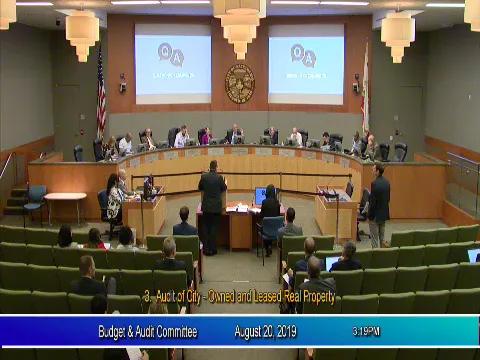
The Sacramento City Council, sitting as the Budget and Audit Committee, held a special meeting on Tuesday, August 20, 2019, at 2:00 p.m. in the City Hall Council Chamber. The committee reviewed and accepted multiple reports from the City Auditor, including the fourth quarter activity report, a fiscal impact analysis of the 2035 General Plan, an audit of city-owned and leased real property, an audit of the Department of Utilities vehicle fleet, and the results of the auditor's 2019 peer review. All items were approved with motions to forward to the full City Council. The meeting lasted from 2:02 p.m. to 3:40 p.m. Consent Calendar - Item 1: City Auditor’s Activity Report for the 4th Quarter of Fiscal Year 2018/19 – Accepted and forwarded to City Council. Motion passed unanimously (8-0, with Member Ashby absent at the time of the vote). Discussion Items - Item 2: City Auditor’s Fiscal Impact Analysis of 2035 General Plan Land Uses at Buildout – Amy Lapkin of Economic & Planning Systems presented the analysis, which estimated that buildout of the 2035 General Plan would generate a net fiscal surplus of approximately $30 million annually for the City’s general fund (based on FY2018-19 budget and Measure U rates). The model allows for scenario testing and identifies where revenues exceed expenditures geographically. Councilmembers Steve Hansen and Eric Guerra discussed the need to refine the tool to evaluate commercial corridor revitalization, multifamily housing sustainability, and shorter-term budget impacts. The item was approved (9-0) and forwarded to Council, with a commitment to develop a workplan for additional scope and cost. - Item 3: Audit of City-Owned and Leased Real Property – City Auditor Jorge Oseguera presented findings: the City owns nearly 2,000 parcels; a sample review of 550 parcels identified 69 potential surplus parcels totaling 90+ acres, conservatively valued at $18 million. The audit recommended centralizing/standardizing real property management, improving tracking and maintenance, and leveraging surplus property for goals like affordable housing. Councilmembers discussed specific parcels (e.g., 22 acres in District 3 under negotiation for sale, remnant parcels, integration with SHRA properties). The item was approved (9-0) and forwarded to Council, with direction to return with strategies for monetizing vacant land and improving the real estate division’s capacity. - Item 4: Audit of the Department of Utilities Vehicle Fleet – The audit found over 50 underutilized assets costing $854,000 annually, fuel control weaknesses (including potential fraud, unauthorized access), data quality issues in the fleet management system, and inconsistent employee licensure tracking. The Department of Utilities requested the audit and concurred with 26 recommendations; many are already being implemented (e.g., installing cameras, revoking manual fuel entries, developing underutilized vehicle criteria). The item was approved (9-0, with Mayor Steinberg absent for the vote) and forwarded to Council. - Item 5: City Auditor’s 2019 Peer Review Results – Presented without additional presentation; accepted and forwarded to Council. Motion passed unanimously (8-0, Mayor absent). Key Outcomes - All five agenda items were accepted and forwarded to the full City Council for final approval. - For Item 2, the Committee requested a follow-up scope and cost estimate to refine the fiscal impact model for shorter-term analysis and integration with economic development plans (Project Prosper, commercial corridor revitalization). - For Item 3, the Committee directed staff to return with options to strengthen the real estate division, explore monetization strategies (including models from other cities), and coordinate with Council districts and SHRA on surplus/underutilized properties. - For Item 4, staff confirmed corrective actions are underway with most recommendations to be completed by December 31, 2019. - Councilmember Steve Hansen requested that the Committee revert to a regular Budget and Audit Committee (rather than a committee of the whole) due to the normal workload; the clerk noted the request.

LAND USE PLANNING 30% · BUDGET AND FINANCE 25% · PROCEDURAL 14% · ECONOMIC DEVELOPMENT 14%
1357
AUG 15, 2019 · SACRAMENTO, CALIFORNIA · ACTIVE TRANSPORTATION COMMISSION
Active Transportation Commission Meeting - August 15, 2019

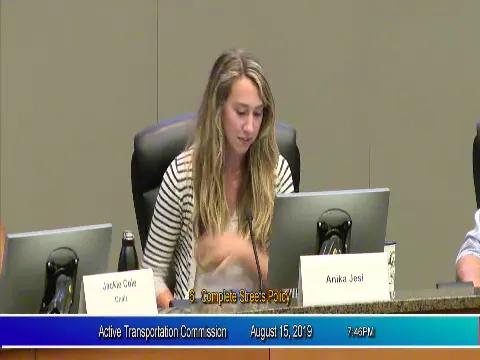
The Active Transportation Commission met on August 15, 2019, to discuss several items including a food delivery robot pilot project, the Sacramento Valley Station bikeway connection, a complete streets policy, bicyclist wayfinding, and the Morrison Creek Trail project. The commission voted to forward recommendations on the complete streets policy and Morrison Creek Trail, and received updates on shared rideables and the Del Rio Trail. Consent Calendar - Approval of Meeting Minutes of July 18, 2019: Passed unanimously. - Active Transportation Commission Log: Received and filed. - Commission Staff Report: Received and filed. Staff provided updates on shared rideables (Lime scooters deployed 250 devices, three more operators expected) and the Del Rio Trail (full funding awarded by SACOG for design and construction). Public Comments & Testimony - Food Delivery Robot Pilot Project: Dan Allison expressed support for the pilot but requested restrictions on sidewalks too narrow for a robot and wheelchair to pass, and on sidewalks shared with bicyclists. - Complete Streets Policy: Dan Allison commented that the city must take responsibility for sidewalk maintenance, require a grid network, address crossing complete streets, and implement a work zone detour policy that accommodates pedestrians and bicyclists. Kieran Kumar (Walk Sacramento) praised the policy but urged stronger language on prioritizing disadvantaged communities, mode shift goals, a modal hierarchy, first/last mile gap closure, interdepartmental coordination, curb management, and placemaking. - Morrison Creek Trail Project: Multiple speakers (Kieran Kumar, Naila Harden, Corey, Erica) urged support, emphasizing equity, community engagement, and the precedent set for community-driven projects. Discussion Items - Food Delivery Robot Pilot Project: KiwiBot representatives Diana Delamere and David presented a potential pilot using robots for food delivery, aiming to reduce congestion and emissions. Commissioners asked about safety, evaluation metrics, sidewalk width, lighting, and equity. No vote was taken; the item was for receive and comment. - Sacramento Valley Station Bikeway Connection: Greg Taylor presented the master plan update, focusing on bicycle access, bike parking, and connections. Commissioners discussed bike lockers, secure parking, and the need for signage. A public open house was announced for September 5, 2019. - Complete Streets Policy: Valerie Hermanson presented the draft policy. After public comment, Commissioner Haupt moved to forward the policy to the Law & Legislation Committee with a recommendation to consider public input and require stakeholder outreach for work zone detours. The motion was seconded and passed. - Wayfinding for Bicyclists in the City: Drew Hart presented an overview of existing and planned wayfinding signage. Commissioners discussed the need for directional signs to parallel bike facilities and parallel routes. No action taken. - Morrison Creek Trail Project: Jennifer Donlon Wyant presented the project, which is identified as a midterm project in the bike plan. The commission was asked to support moving it forward as a short-term project and to apply for an Urban Streams Restoration Program grant. After public comment, Commissioner Haupt moved to approve both recommendations; the motion passed unanimously. Key Outcomes - Approved: Meeting minutes, commission log, and staff report (consent calendar). - Vote on Complete Streets Policy: Motion passed (Commissioner Haupt, seconded by Commissioner Carpenter) to forward the policy to the Law & Legislation Committee with a recommendation to consider public input and include a provision for stakeholder outreach in work zone detour design. - Vote on Morrison Creek Trail Project: Motion passed unanimously to (a) support moving the project forward as a short-term project and (b) support an application for an Urban Streams Restoration Program grant for a Morrison Creek Trail Plan. - Next Steps: The Complete Streets Policy will go to the Law & Legislation Committee in September and City Council in December. The Morrison Creek Trail grant application will proceed. The next commission meeting is scheduled for September 19, 2019.

TECHNOLOGY AND INNOVATION 21% · PUBLIC TRANSPORTATION 20% · TRANSPORTATION SAFETY 15% · BICYCLE SAFETY 13%
1358
AUG 12, 2019 · SACRAMENTO, CALIFORNIA · ARTS, CULTURE, AND CREATIVE ECONOMY COMMISSION
Sacramento Metropolitan Arts Commission Meeting on August 12, 2019

The Sacramento Metropolitan Arts Commission met on Monday, August 12, 2019, at 6:00 p.m. in open session. The meeting focused on the Creative Economy Pilot Project report, approval of FY2020 grant guidelines for three programs, a new artist-in-residence pilot, the selection of an art concept for the Convention Center Plaza, and updates on the Cultural Plan and Arts Consortium. Public comment raised concerns about artist exploitation, grant accessibility, and local artist representation. Consent Calendar - Approval of July 8, 2019 Meeting Minutes: Motion passed unanimously to approve the minutes from the July 8, 2019 commission meeting. Public Comments & Testimony - Irma Barbose (local artist): Expressed concern about the stability and community-based measurement of the Cultural Equity Investment Grant program, requesting that it align with broader community needs and measurable outcomes. - Jade Nicole (United Artists Council): Called for accountability in the arts community, emphasizing that underserved communities must not be treated as a buzzword and that outreach has been insufficient in areas like Del Paso Heights, Meadow View, Oak Park, and South Sacramento. Also urged preference for local artists from those communities in the Artist in Residence program. - Carl Robinson (Black Zebra organization): Argued that the three-year operation requirement for cultural equity grants could exclude new and emerging organizations with sound plans, and stressed that organizational cultural diversity should reflect a blend of cultures, not just race. - David Lorette Mola (local artist): Expressed gratitude but raised concerns about tax implications of creative economy grants (i.e., full grant amount taxed even if not all used) and noted that reporting oversight was weak. - Mina Perez (CEO, Vida de Odo Foundation): Announced her foundation's move into the Wonderbread Building to create a cultural art center, and expressed intent to support underserved artists, citing safety and fairness issues among artists. Discussion Items - Creative Economy Pilot Project Report (Oral): Raymond Gargano presented findings from an evaluation by Third Plateau. The pilot, funded with $500,000, received over 500 applications, funded 57 projects (13 at $25,000; 44 at $5,000). It ran from January 2017 to November 2018. Key impacts: 35,000 event participants, $214,000 paid in salaries, 71% of projects continued, net surplus of $448,000. Recommendations included creating a theory of change, revising applications, improving communication, and possibly shifting from "creative economy" to "creative placemaking." - Creative Economy Grant Guidelines (FY2020): Approved $300,000 in project grants ($15,000 or $25,000 each) for projects with economic and social impact in underserved communities, open to individual artists, enterprises, businesses, nonprofits, and public institutions. Incorporated lessons from the pilot evaluation. - Cultural Equity Investment Grant Guidelines (FY2020): Approved $225,000 to fund three organizations per year for three years (first year $75,000, then $50,000, then $30,000) for capacity building. Eligible nonprofits: budgets under $500,000 and 3+ years of operation. Includes mentorship and cohort model. - Cultural Equity Grant Guidelines (FY2020): Approved $100,000 for project grants of $5,000 or $10,000 for small nonprofits (budgets under $500,000, 3+ years of operation). The commission noted a future discussion on the three-year requirement. - Artist in Residence Program Qualifications (Oral): Melissa Cirone presented a one-year pilot program with the Department of Youth, Parks, and Community Enrichment, placing artists in 8 community sites (one per council district). Artists receive a stipend (at least $12,000) and materials fee; RFQ will open in August 2019. The program emphasizes local artists with community knowledge. - Artist and Design Concept for Sacramento Convention Center Plaza: Lennee Eller presented artist Jiayi Young's concept, "Human Rock," a moon-rock-inspired interactive sculpture with lighting synced to moon phases and an audible "hum of the universe." Budget approximately $300,000. Commission approved moving forward to final concept and budget. - Update on Cultural Plan: Director Jody Ulich reported on ordinance changes to transition the commission to city-only (first hearing Sept 3, vote Sept 10), and the hiring of a consultant to develop a film office (meetings Aug 20-21). - Arts Consortium Update: Dr. Steven Winlock reported on an arts education grant ending September 19, 2019, with a celebration/event to share accomplishments. Committee Reports - Grants and Education Committee: Veronica Delgado reported that the committee met and enthusiastically discussed the new grant programs, emphasizing technical assistance for applicants and sustainability. - Other Committee Reports: Advocacy and Outreach and Art in Public Places reported no meetings or issues. Key Outcomes - Approved July 8, 2019 minutes (unanimous). - Approved Creative Economy Grant Guidelines (motion passed). - Approved Cultural Equity Investment Grant Guidelines (motion passed). - Approved Cultural Equity Grant Guidelines (motion passed). - Approved selection of Jiayi Young and design concept for Convention Center Plaza (motion passed). - Received and filed reports on Creative Economy Pilot, Artist in Residence program, Cultural Plan update, and Arts Consortium update. - Next Steps: Grant applications open August 19, 2019, due October 10, 2019; workshops scheduled for September 10, 17, and 18. RFQ for Artist in Residence closes September 30, 2019. Next commission meeting set for September 9, 2019 at 2 p.m. Note: The agenda listed the Creative Economy Pilot Project report as discussion item 2, but the transcript indicates it was presented. The agenda also included a duplicate item for Cultural Equity Grant Guidelines (item 5 and 5), though the commission addressed the one item once.

ARTS AND CULTURE 56% · PUBLIC COMMENTS 13% · PUBLIC WORKS 9% · GRANT MANAGEMENT 7%

1359
AUG 12, 2019 · SACRAMENTO, CALIFORNIA · COMMUNITY POLICE REVIEW COMMISSION
Sacramento Community Police Review Commission Meeting - August 12, 2019

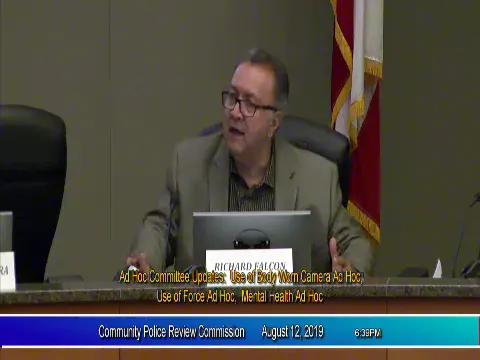
Meeting Overview The Sacramento Community Police Review Commission met on Monday, August 12, 2019, at 6:14 p.m. in City Hall Council Chamber. The meeting included a presentation on racial profiling data collection practices, ad hoc committee updates, and public comments. The consent calendar item was not approved due to an abstention. Consent Calendar - Item 1 – Approval of Meeting Minutes (July 16 and July 23, 2019): A motion to approve was made and seconded. Commissioner Falcon abstained, stating they had not had an opportunity to review the minutes. The motion did not pass, and the minutes were deferred to a future meeting. Discussion Items - Sacramento Police Department Presentation on Racial Profiling Data Collection Practices: Deputy Chief delivered an oral report. Key points included: the department has collected vehicle stop data since 2000 (23 data points); Assembly Bill 953 (Racial and Identity Profiling Act) mandated 37 data points from the California Department of Justice plus 7 department-specific points (total 44). Data collection began January 1, 2019, averaging over 5,000 detentions per month. Complaints alleging profiling were previously categorized under the broader “discrimination” category, but as of August 1, 2019, profiling is a standalone allegation based on DOJ definition. The department also eliminated the “inquiry” classification, now using “division investigations” with standard dispositions. Officers record their perception of demographics at first contact. Questions from commissioners addressed data trends, training on perception, and access to historical raw data. It was noted that raw data prior to 2016 is not publicly accessible. - Ad Hoc Committee Updates: - Body Worn Camera Ad Hoc: The committee held two community meetings and two additional meetings are planned. Draft recommendations are pending further community input and literature review. - Use of Force Ad Hoc: No update. - Mental Health Ad Hoc: Commissioner Guerrero reported on a community meeting at the Hagginwood Center, noting detailed discussions on mental health calls. The committee is seeking data on arrests and post-arrest transitions, particularly 5150 holds. A meeting with Captain Monk is planned to discuss data access and coordination with the Sheriff’s Department. Approximately 15% of all police calls for service are considered mental health-related. - Police Department Staff Update: Deputy Chief expressed condolences for Officer Sullivan, who was killed in the line of duty, and highlighted community support. He noted that Sacramento PD has been collecting racial profiling data since 2001, ahead of the state mandate. - Commissioner Comments: A commissioner raised concerns about public records request challenges, referencing an email from a community member. Another commissioner expressed interest in presenting commission recommendations at community forums. Public Comments - Mr. Savala spoke on behalf of a local business owner frustrated with the process for requesting public records from the police department. He described receiving automated responses via a portal without a designated point of contact, leading to delays (e.g., a request promised documents by July 21 but then extended to August 21). Deputy Chief acknowledged the issue and offered to serve as a contact. Key Outcomes - Consent calendar minutes not approved; will be brought back at a future meeting. - The Police Department presentation on racial profiling data collection was received and filed. - Body Worn Camera Ad Hoc will continue community meetings before issuing draft recommendations. - Mental Health Ad Hoc will meet with Captain Monk to explore data collection on mental health calls and arrests. - Deputy Chief offered to assist with public records inquiries going forward. - Meeting adjourned at 6:55 p.m.

PROCEDURAL 29% · POLICE POLICY REVIEW 25% · MENTAL HEALTH 16% · RACIAL EQUITY COMMITTEE 14%
1360
JUL 24, 2019 · SACRAMENTO, CALIFORNIA · UTILITIES RATE ADVISORY COMMISSION
Utilities Rate Advisory Commission Meeting - July 24, 2019

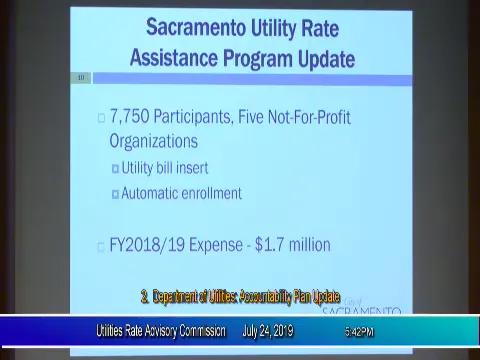
The Utilities Rate Advisory Commission (URAC) met on July 24, 2019, at 5:30 p.m. in the Council Chambers at 915 I Street, Sacramento. The meeting included approval of the June 26, 2019 minutes, quarterly updates from the Department of Utilities (DOU) on accountability and finances, and a zero-waste overview and landfill closure presentation from the Department of Public Works (DPW). Commissioners discussed fund balance surpluses, rate adjustment planning, and the city's zero-waste goals. Consent Calendar - Approval of Minutes for June 26, 2019: The motion passed with one abstention (Commissioner Travis abstained). Chair Jarvis also abstained from voting. Discussion Items - Department of Utilities: Accountability Plan Quarterly Update (Estimated Time 20 minutes): Pravani Vandia, Water Division Manager, presented the accountability plan update covering the community engagement program, FY17-20 CIP financing, and the director's report. Key details: the water capital finance plan includes a $173.1 million drinking water state revolving fund loan (as of March 31, 2019, $52.4 million spent, $54.8 million encumbered) and $62.6 million in Series 2017 water revenue bonds ($60.5 million expended, $2 million encumbered). Wastewater bonds ($32 million) were issued in April 2019 with a $6 million premium. All three funds (water, wastewater, storm drainage) project at least 120 days of working capital at June 30, 2019. The director's report noted 7,750 participants in the rate assistance program (with 5 not-for-profit organizations), with an anticipated increase to 8,500 by August. FY19 expenditures for the program were $1.7 million (budget $3.78 million); unspent funds will roll back to the general fund. Water conservation efforts include two-day-a-week watering, leak-free programs, and smart controller rebates. Current water usage is approximately 160–165 gallons per capita per day (down from 280+ historically). - Department of Utilities: Financial Update (Estimated Time 20 minutes): Jackie Price, Supervising Financial Analyst, presented FY19 year-end projections and FY20 budget. Key points: Water fund expenditures projected $7 million under budget, resulting in a net revenue of $31 million to fund balance. Wastewater fund revenues projected $1.9 million over budget due to increased sewer permits. Storm drainage fund expenditures projected $1.3 million under budget. Fund balances are growing; water fund has 456 days of working capital (significantly above the 120-day policy). Commissioners expressed concern about the large surplus (approximately $75 million above reserve) and questioned whether it undermines the need for future rate increases. Bill Busath, DOU Director, responded that the high balance is due to front-loading capital costs for the SRF loan, delayed debt service, and a cautious approach to spending, especially for the storm drainage fund which has not had a rate adjustment. He acknowledged the concern and agreed to bring forward projections showing the fund balance declining over time. Chair Jarvis also requested that presentations be provided in advance for better preparation. - Department of Public Works: Zero-waste Overview (Estimated Time 20 minutes): Jennifer Venema, Sustainability Manager, and John Febbo, Integrated Waste Planning Superintendent, presented on the city's zero-waste goals. The general plan (2015) sets a goal of achieving zero waste by 2040, with interim thresholds. Waste comprises about 6% of the city's greenhouse gas emissions (baseline 2005). The city has achieved a 24% reduction in municipal operations emissions (exceeding the 22% goal) and expects to meet the 2020 community reduction target of 15%. However, post-2020 targets (40% by 2030) will require significant progress in transportation and energy. The current waste diversion rate is 57.9% (state disposal-based accounting). Challenges include market disruptions (National Sword) and the high cost of increasing diversion due to diminishing returns. Senate Bill 1383 (2017) requires food waste collection beginning in 2022; the city plans to roll out a program in 2021. Commissioners asked about progress toward the 75% diversion goal and requested data showing current tonnage relative to 2005 levels. Discussion also covered upstream policies (e.g., product stewardship) and the role of recycling centers. Staff indicated that the Mayoral Climate Commission and upcoming Climate Action Plan update will address higher-level zero-waste strategies. - Department of Public Works: Landfill Maintenance and Closure Overview (Estimated Time 15 minutes): John Febbo presented on legacy landfill costs. The 28th Street Landfill (closed 1995) is in a 30-year post-closure maintenance period. Future closures include Cannon Scullen (1952-1957, estimated $3.75 million), Deller (1957-1963, already closed $4 million), and Bell Marine (1963-1968, estimated $3-5 million). These costs are borne by the solid waste rate base. The presentation noted that landfill costs are expected to decrease over time as closures are completed. The Cannon Scullen closure will use dirt from the McKinley Vault project. Key Outcomes - Minutes approved (one abstention). - All presentations were received and filed (no vote required). - Commissioners requested that DOU provide projections showing how fund balances will decline over time, and that presentations be sent in advance. - Staff committed to reporting back on the diversion rate relative to the 2005 baseline at a future meeting. - Meeting adjourned after the landfill presentation (time not recorded, but meeting was noted as long).

WASTE MANAGEMENT 23% · BUDGET AND FINANCE 22% · UTILITIES 20% · CLIMATE ACTION 12%
OPENPUBLICA · PUBLIC MEETING INDEXUPDATED DAILY · openpublica.com