Browse by city
Date range
Search help

Search titles, summaries, topics and stored transcripts together. Keywords may match separately; put the whole query in double quotes for a phrase. Matching follows word analysis, so punctuation is not exact. Both dates are included. Documents are not searched.

SHOWING 1341–1350 ENTRIES
1341
NOV 14, 2019 · SACRAMENTO, CALIFORNIA · ARTS, CULTURE, AND CREATIVE ECONOMY COMMISSION
Sacramento Metropolitan Arts Commission Meeting - November 14, 2019

The Sacramento Metropolitan Arts Commission met on November 14, 2019, at 6:00 p.m. to approve the artist and design concept for the East Plaza of the Safe Credit Union Convention Center (C3 project), receive updates on the Cultural Plan, Arts Consortium, and committee reports, and discuss the transition to a new city-based commission. The meeting included a consent calendar and several oral reports. Consent Calendar - Approval of Commission Meeting Minutes: The commission unanimously approved the minutes from the October 14, 2019 meeting. Public Comments & Testimony - No public comments were made. Discussion Items - Approval of Artist and Design Concept for East Plaza of C3 Project (Item 2): Staff presented a proposal by artist Kimberly Garza to create one to three sculptures using reclaimed wood from trees lost to California's changing climate (147 million trees lost). The total budget is $300,000, with $10,000 already allocated for concept development. The artwork will be interactive and wheelchair-accessible, located at the east plaza off 15th Street. The commission voted unanimously to approve the concept and recommend proceeding to city council for contract on December 10, 2019. - Update on the Cultural Plan (Item 3): Director Jody Ulich reported that 29 applications were received for the Cultural Equity Grant Program (7 for $5,000 and 22 for $10,000), spread across all eight council districts. For the Cultural Equity Investment Grant Program ($75,000 for three organizations), 11 applications were received. Staff continues to review. - Arts Consortium Update (Item 4): Dr. Steven Winlock reported that the Arts Consortium's leadership advisory includes representatives from the city, SMAC, Friends of Sacramento Arts, and the Sacramento County Office of Education. The group meets monthly to support arts education in school districts. - Advocacy and Outreach Committee Report (Item 5): Commissioner Jason Silva reported no meeting was held. - Grants and Education Committee Report (Item 6): Commissioner Veronica Delgado was absent. Dr. Winlock provided an update on the $1 million arts education grant from the California Department of Education, which facilitated partnership development and credentialed 47 teachers in visual arts and music. - Arts in Public Places Committee Report (Item 7): Commissioner William Ishmael reported no meeting was held. - Director’s Report (Item 8): Jody Ulich announced a national search for a new Cultural Services and Creative Economy Manager, conducted by the Arts Consulting Group. She also reported that 47 submissions were received for the pilot artist-in-residence program, with a panel meeting on November 22. Grant panels for cultural equity and creative economy grants met in October and November. - Chairperson’s Report (Item 9): Dr. Steven Winlock served on the creative economy grant panel, reviewing 109 applications. He provided a breakdown: 23 art installations, 24 education, 2 food innovation, 9 marketing, 8 multi-use space, 26 performing arts, 3 technology, and 14 temporary activation. He also noted the final meeting will be December 9, 2019, with a reception at his home. He encouraged committee chairs to present highlights of the commission's 40-year history at the next meeting. Key Outcomes - The commission approved the artist and design concept for the East Plaza of the C3 project (motion carried unanimously). - The commission received and filed all oral reports. - The commission will prepare a final presentation of highlights to the city council, led by the chair. - The final commission meeting is scheduled for December 9, 2019, followed by a thank-you reception.
ARTS AND CULTURE 56% · PUBLIC ART 18% · PROCEDURAL 8% · EDUCATION POLICY 8%
1342
OCT 30, 2019 · SACRAMENTO, CALIFORNIA · PRESERVATION COMMISSION
Preservation Director Special Meeting on Historic District Plans - October 30, 2019

On October 30, 2019, the Sacramento Preservation Director held a special public hearing to review the Statement of Nomination for updating the Sacramento Register of Historic and Cultural Resources as part of the Historic District Plans project. The meeting covered 27 historic districts, proposing boundary revisions, designation of contributing and non-contributing resources, and deletion of two districts (12th Street Commercial and Memorial Auditorium). Staff presented an overview of the process, incentives (Mills Act, grants), and the three-step review approach. Public comments were received on multiple districts. The director will forward a recommendation to the Preservation Commission on November 20, 2019, with further review by the Planning and Design Commission and final action by City Council in December 2019. Public Comments & Testimony - Michael Malinowski (architect, representing Michael Fond) objected to listing 1219 17th Street as a contributing resource, citing poor integrity and infeasibility for mixed-use development. He also raised concerns about 2612 J Street and 520 S Street. - James Fitzpatrick confirmed that 1706 P Street and 1611 17th Street are contributing resources. - Lily Mohanna (representing Mohanna Development) requested that 904 J Street be designated non-contributing due to heavy alterations and difficulty of future development. - Matthew Piner (architect) noted confusion over parcel vs. address designation at 904 J Street/1009 9th Street and the building's deteriorated condition. - Jenny Hilderbrand asked about the grant program and confirmed that 900 J Street is a city landmark. - Joe Maloney objected to 1412 F Street being listed as contributing, arguing it lacks integrity and does not match district characteristics. He also questioned the benefits of the Mills Act. - Clea Bertakis (owner of 1115 T Street) petitioned for non-contributing status, describing the property as a "stucco box" with no significant features. - John Lucas (representing Greg McRae, 422 U Street) objected to listing due to a pending dispute over heat pump condensers and insufficient notice. - Margot Parks (South Side Park owner) questioned restrictions on new construction and their impact on housing supply, and opposed the designations as a policy. - Steven Cvitanov (owner of 2318 H Street) expressed concern about late notice, the rushed timeline to meet SB 330 implications, and the impact on development potential. - Rhonda Pope-Flores (owner of 1412 20th Street) recommended incorporating an economic analysis and tribal cultural resources into the process. - Evelyn Fallon requested that the consultant (Page & Turnbull) be present at public meetings to hear feedback. Discussion Items - Staff Presentation: Sean deCourcy and Director Anderson outlined the project background, public outreach, CEQA determination (no additional significant effects), and the permitting process. They explained that many districts from the 1980s lacked contributing/non-contributing lists, and the update aims to streamline review. - District-by-District Review: Each of the 27 districts was presented with proposed changes. Most had no speakers; some received objections or questions. Key districts with public comments included: - Alkali Flat North: A speaker questioned 1111 D Street (1995 building) as contributing; staff will re-examine. - Boulevard Park: A non-contributing property owner (2220 C Street) asked about benefits; staff clarified that non-contributing status may simplify review. - Cathedral Square: John Fairbanks questioned the inclusion of "masks and animal figure heads" as character-defining features; staff will review. - East End (Capitol Avenue): Michael Malinowski objected to 1219 17th Street; James Fitzpatrick confirmed 1611 17th Street as contributing. - Merchant Street: A speaker (88-year-old) requested that 923 7th Street be changed to non-contributing due to extensive alterations. - Memorial Auditorium: Deletion recommended; no objections. - Plaza Park (Cesar Chavez): Lily Mohanna and Matthew Piner raised concerns about 904 J Street; Jenny Hilderbrand asked about landmark status. - Poverty Ridge: Leon Corcos objected to 1921 21st Street (1940s stucco duplex) being listed as contributing, citing cost and incompatibility. - South Side: Clea Bertakis, John Lucas, Margot Parks, and others objected to contributing status for their properties, citing lack of integrity, housing supply concerns, and insufficient notice. - General Public Comments: Several speakers highlighted the rushed timeline, lack of consultant presence, economic impacts, and the need for alignment with state housing laws. Key Outcomes - The Preservation Director will forward a Statement of Nomination to the Preservation Commission for each district, incorporating the recommendations presented and noting public comments that require further research. - Staff will review objections to specific property designations (e.g., 1111 D Street, 1219 17th Street, 904 J Street, 923 7th Street, 1412 F Street, 1115 T Street, 422 U Street, 1921 21st Street, 2318 H Street) and update the record before the Preservation Commission hearing. - The Preservation Commission public hearing is scheduled for November 20, 2019. The Planning and Design Commission will also consider code revisions for non-contributing resources. Final action by City Council is expected in December 2019. - CEQA determination: The project is within the scope of the Master EIR for the 2035 General Plan, with no additional significant effects.

HISTORIC PRESERVATION 70% · PUBLIC COMMENTS 21% · AFFORDABLE HOUSING 3% · PERMITTING 1%
1343
OCT 23, 2019 · SACRAMENTO, CALIFORNIA · PRESERVATION COMMISSION
Sacramento Preservation Commission Special Meeting on Historic Districts Plans - October 23, 2019

The Preservation Commission held a special meeting on October 23, 2019, from 5:36 p.m. to 6:46 p.m. in the Historic City Hall Council Chamber. The sole agenda item was to review and comment on the Final Draft Historic Districts Plans, an update to the Sacramento Register of Historic and Cultural Resources, and a proposed ordinance amending Section 17.808.140 of the City Code relating to director-level site plan and design review. The commission took no formal action but provided feedback to staff for final revisions ahead of a public hearing in November. Public Comments & Testimony - William Burg, speaking on behalf of Preservation Sacramento, expressed general support for the final draft, highlighting specific positive changes such as the inclusion of three houses on 21st Street in the Wind Park Historic District, the Morgan Jones Mortuary building as an individual landmark, and Herb Kane's childhood home in the Bungalow Row Historic District. He noted that the document provides a template for future historic district guidelines and mentioned potential future districts (Richmond Grove, New Era Park, Eastern R Streets, Oak Park, mid-century Chinatown). He concluded by wishing the commission good luck moving forward. - Steven Cvitanov, a property owner, criticized the document for lacking clarity and credibility. He stated that he, his broker, and other real estate professionals could not determine what is buildable on his lot based on the diagrams. He argued that the alley infill setback graphics do not match historical Sanborn maps and that the language across districts is not unique (e.g., similar wording for Boulevard Park and South Side Park regarding alley uses). He said the plan will diminish his property value and that city staff cannot provide definitive answers. Discussion Items - Staff Presentation: Carson Anderson (Preservation Director) and Sean de Courcy (Associate Preservation Planner) presented the final draft. Key points included: - The plan is required by Planning and Development Code Section 17.604.300 and was developed in response to the 2017 Interim Principles for Infill and the 2035 General Plan. - A $250,000 contract with Page & Turnbull was used to prepare the document. Public outreach began in spring 2018 and included engagement with neighborhood associations, business organizations, professional groups, and a technical advisory group. - The plan contains historic contexts, periods of significance, significance justifications, character-defining features, and design standards/criteria for each district. - The design standards are based on Secretary of the Interior Standards and include mandatory principles, rationale, photographs, and graphics. - A proposed code amendment would allow staff-level review for new development on vacant parcels or involving non-contributing resources (currently all new development requires a director hearing). Landmark and contributing resource projects would still require director or commission hearing. - The draft includes an update to the Sacramento Register, focusing on the oldest and most out-of-date districts (shown in blue on a map). Boundaries would be modified in four districts, and two districts (Memorial Auditorium and 12th Street Commercial) recommended for deletion. Property owner notifications were already sent (about 2,400 notices, each 7 pages, totaling 16,000 pages). - A schedule was outlined: Preservation Director hearing on Oct. 30 (focused on Register update), Nov. 1 final screen check comments to consultant, Nov. 14 Planning and Design Commission review, Nov. 20 Preservation Commission public hearing for recommendation to City Council, and Dec. 3 City Council approval via emergency ordinance to meet SB 330 deadlines (which restricts new discretionary design review standards after Jan. 1, 2020). - Commissioner Questions & Feedback: - Commissioner Alice Valania suggested adding cross-references (e.g., referencing map page numbers within district descriptions) and clarifying what is not included in character-defining features (e.g., fences in Boulevard Park). She also asked about adding a note for the state tax credit resource. - Commissioner Christine Miller-Cruiess offered to submit minor administrative edits via email. - Commissioner Ryan Miller inquired about the reasoning for different setback treatments in alley infill graphics. Sean de Courcy explained that the decision was based on historic development patterns observed in Sanborn maps: some districts show clear separation patterns (e.g., Capitol Mansions), others are more organic (e.g., Alkali Flat), and industrial/commercial districts have none. Different districts either require a minimum distance from adjacent parcels or not, to preserve the historic spatial relationship. Miller also noted errors in the draft ordinances: one referenced an April 17, 2019 meeting that did not occur (staff confirmed an error), and another used the slang term "peppered." - Commissioner Caru Browns praised the document's clarity and noted that the historic district context could be disseminated to neighborhoods as a separate tool to promote Mills Act awareness. - Commissioner William Carter stated that the plan was well done and provides needed parameters. - Chair Jacqueline Whitelam raised questions about the alley infill graphic: whether the term "existing building" should be revised to "contributing building" to avoid ambiguity (staff agreed and planned to revise). She also questioned the definition of "total floor height" in the height restriction graphic (150% of surrounding contributing buildings). Bruce Monighan (Urban Design Manager) clarified the intent: to allow two-story infill next to one-and-a-half story buildings while maintaining scale. Chair Whitelam also asked about measuring from floor height vs. plate height and whether roof pitch is considered. Staff acknowledged the graphic needs refinement. Whitelam also suggested implementing a regular reporting system to track approvals and staff decisions under the new guidelines, to keep the commission informed. Staff and Preservation Director Anderson agreed that providing data on project types, processing times, and outcomes would be valuable. Key Outcomes - No formal motion was made or vote taken. The purpose was review and comment only. - Staff will collect all commissioner comments by November 1, 2019, to submit to consultant Page & Turnbull for final revisions. - A public hearing on the final plan will occur at the Preservation Commission's November 20, 2019 meeting, leading to a recommendation to City Council. - Staff will refine the alley infill and height graphics to clarify definitions and reference "contributing" structures. - The commission and staff agreed to develop a regular report on staff-level project approvals to monitor implementation of the new guidelines.

HISTORIC PRESERVATION 65% · URBAN DESIGN 17% · PROCEDURAL 5% · PUBLIC COMMENTS 5%
1344
OCT 22, 2019 · SACRAMENTO, CALIFORNIA · PERSONNEL AND PUBLIC EMPLOYEES COMMITTEE
Personnel and Public Employees Committee Meeting – October 22, 2019

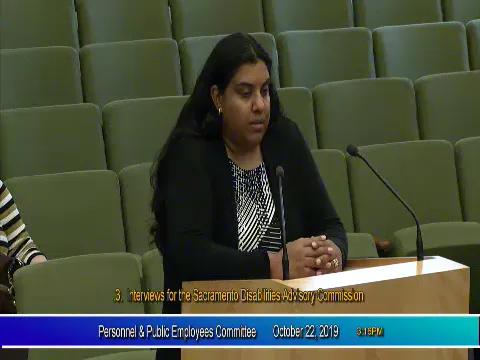
The Personnel and Public Employees Committee met on Tuesday, October 22, 2019, at 3:03 p.m. in the City Hall Council Chamber. The committee approved consent calendar items and conducted interviews for three advisory bodies: the Measure U Community Advisory Committee, the Sacramento Disabilities Advisory Commission, and the Utilities Rate Advisory Commission. All interview items were continued to the next meeting on November 19, 2019 for discussion and nominations. Consent Calendar - Approved the minutes from the July 23, 2019 meeting (Motion by Carr, second by Hansen; passed unanimously). Discussion Items Interviews for Measure U Community Advisory Committee (Seat L – Youth) - Candidates interviewed: Taylor Buck, Liam Elliott-Beckett, Sarah England, Khalil Ferguson, Raina Jenkins, Estella Shy. - Applicants expressed interest in representing youth and underserved communities, with backgrounds in youth services, civic engagement, and community relations. The committee noted an "embarrassment of riches" and continued the item to the next meeting for selection. Interviews for Sacramento Disabilities Advisory Commission (Seat I) - Candidates interviewed: Lisa Rudman (interested in helping disabled seniors), Mousumi Crowley (incumbent, sought to provide continuity and ADA expertise), Sumner Blanchard (speech-language pathologist with 30 years of experience). - Continued to next meeting. Interviews for Utilities Rate Advisory Commission (Seats D and E) - Candidates interviewed: Brian Freedman (in-house counsel with solar/construction background), Connie Gutowski (environmental engineer, former City of Sacramento engineer), Anthony Thomas (incumbent commissioner, emphasized dedication). Emmanuel Amanfor was listed but not present. - Continued to next meeting. Key Outcomes - Consent Calendar: Approved unanimously. - All three interview items were continued to the November 19, 2019 meeting for discussion and nominations. - No committee comments or public comments on non-agendized matters. The meeting adjourned at 3:31 p.m.

BOARDS AND COMMISSIONS 48% · PROCEDURAL 24% · YOUTH SERVICES 7% · ECONOMIC DEVELOPMENT 7%
1345
OCT 17, 2019 · SACRAMENTO, CALIFORNIA · ACTIVE TRANSPORTATION COMMISSION
Active Transportation Commission Meeting - October 17, 2019: Highway Safety, Pedestrian Projects, and Envision Broadway Plan

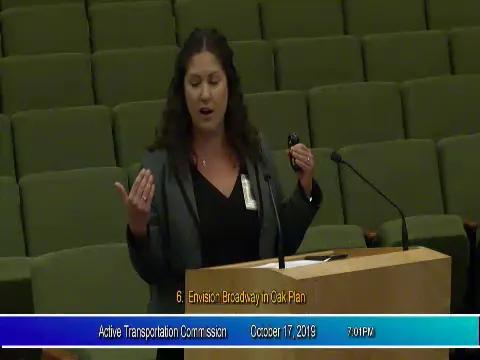
The Active Transportation Commission met on Thursday, October 17, 2019, at 6:00 PM in the City Council Chambers at 915 I Street, Sacramento. Commissioners present: Chair Cole, Garrow, Pollins, Haupt, Brassel, Heim, and Smith. Absent: Vice Chair Ward Waller, Berdugo, and Carpenter. The meeting included updates on highway safety improvement projects, pedestrian beacon and signal projects, and a recommendation to City Council to approve the Envision Broadway in Oak Park Plan. Consent Calendar - Approved the meeting minutes of August 15, 2019, and received and filed the Active Transportation Commission Log and the Commission Staff Report. Public Comments & Testimony - Dan Allison (District 4) requested a citywide program to daylight crosswalks (remove parking spaces near crosswalks for visibility), added parking on crosswalks as a separate category in the 311 app, urged the commission to request law enforcement address failure to yield to pedestrians, and raised safety concerns about the C3 construction project’s bicycle routing (shared sidewalk insufficient, missing southbound signage, pedestrians walking in a narrow lane next to traffic). Discussion Items - Highway Safety Improvement Projects (Item 4): Senior Engineer Adam Randolph presented on the Federal Highway Safety Improvement Program. Over 200 locations citywide are receiving improvements including 11 rapid‑flashing beacons with pedestrian islands, pedestrian countdown heads at downtown intersections, and ADA‑compliant curb ramps. Projects are data‑driven with a state‑calculated benefit‑cost ratio. Commissioners discussed the challenge of underreported collisions in underserved areas and the importance of Vision Zero corridors. - Pedestrian Beacon and Signal Projects (Item 5): Randolph presented six locally funded or Community Development Block Grant (CDBG)‑funded projects: the Mayphong trail extension (completed), a flashing beacon at Tahoe Park, a hybrid beacon at Sacramento Children’s Home, crossing improvements at the Sim Center (flashing beacon and traffic signal), and a flashing beacon at Broadway and 58th Street. These projects target underserved areas and are expected to begin construction in early 2020. - Envision Broadway in Oak Park Plan (Item 6): Leslie Mancebo and Adrian Angle presented the plan for Broadway from Franklin Boulevard to Martin Luther King Jr. Boulevard. Based on extensive community engagement (over 150 participants, including a demonstration project closing 2nd Avenue to vehicles), the preferred alternative includes a road diet (one lane each direction), buffered bike lanes, widened medians, dedicated left‑turn lanes, two new traffic signals, and closure of 2nd Avenue to through traffic. Collision data showed a hot spot at 2nd Avenue/34th Street/Broadway. No funding has been secured yet; the plan will be forwarded to City Council for adoption. Key Outcomes - The commission unanimously approved the consent calendar. - The commission unanimously voted to forward a recommendation to City Council to approve the Envision Broadway in Oak Park Plan (moved by Commissioner Haupt, seconded by Commissioner Pollins). - Staff reported submission of two Caltrans grant applications for Vision Zero corridors 6–10 and commercial corridor mobility plans, and the award of a Bird scooter permit (250 devices initially). - Commissioner Garrow reported on the Old Sacramento waterfront plan, which includes a class I bike trail along the railroad right‑of‑way; Commissioner Haupt requested a future presentation on the project. - The commission agreed to add a report on daylighting crosswalks to the Active Transportation Commission log, with a presentation from traffic engineering.

TRANSPORTATION SAFETY 21% · PEDESTRIAN AND BICYCLE SAFETY 19% · PUBLIC TRANSPORTATION 18% · URBAN DESIGN 17%
1346
OCT 16, 2019 · SACRAMENTO, CALIFORNIA · PRESERVATION COMMISSION
Sacramento Preservation Commission Meeting - October 16, 2019: Cemetery Operations, Housing Streamlining, and Valley Station Master Plan

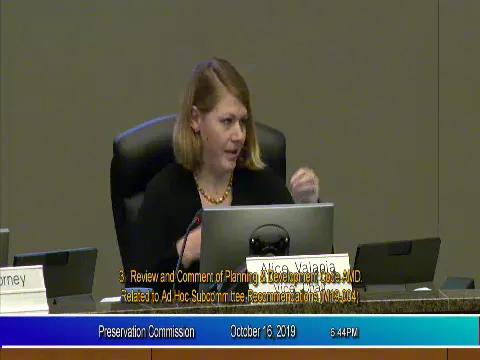
The Preservation Commission met on Wednesday, October 16, 2019, at 5:30 PM in City Hall Council Chamber, 915 I Street, 1st Floor. The meeting included a consent calendar, four discussion items, public comments, and a director's report. The meeting was adjourned at 8:20 PM. Consent Calendar - Item 1: Approval of Meeting Minutes of September 18, 2019 – Approved unanimously (6-0-1, Commissioner Miller-Cruiess absent). Public Comments & Testimony - Historic City Cemetery Operations and Assessment Study: - Judy Eitzen (President, Old City Cemetery Committee, Inc.) – Expressed support for the cemetery operations study, emphasized the committee's primary focus on education and fundraising (not just gardening), and encouraged a formal Memorandum of Understanding with the city. - Anita Clevenger (Former volunteer rose garden curator) – Raised concerns about the termination of her volunteer service, the loss of volunteer rose garden staff, and the impact of city guidelines on rose arbors. Requested implementation of the 2019 horticultural guidelines and exploration of alternatives for trellises. - Jennifer Holden (Community member) – Expressed disappointment with the city's perceived shift from volunteer stewardship to revenue generation (e.g., movie nights), arguing the cemetery should remain a community resource, not a tourist attraction. She presented photos showing poor conditions under previous city management. - Planning and Development Code Amendments: - William Burg (Preservation Sacramento) – Opposed the proposed streamlining, arguing it reduces public participation, especially for large projects. Criticized the elimination of automatic commission review thresholds, the daytime director-level meetings, and the private Architectural Review Committee. Recommended making ARC meetings public and requiring early developer outreach. - Steven Cvitanov – Supported streamlining, citing difficulty in selling his property due to unclear historic district rules. Favored ministerial approval processes and argued that historic district plans counter the city's housing goals. - Catherine Turnill-Lupo (Boulevard Park Neighborhood Association) – Expressed concern that the code amendments conflict with the ongoing Historic District Plans project and may undermine preservation principles. - Streamlined Ministerial Approval of Housing Projects: - Steven Cvitanov – Disagreed with excluding historic districts from the city's ministerial process, stating it limits housing variety and contradicts the General Plan. He supported SB 35 and ministerial approval but opposed the exclusion. - Public Comments – Matters Not on Agenda: - Steven Cvitanov – Raised concerns about ambiguity in alley infill setback diagrams in the Historic District Plans, questioning whether his property is buildable and requesting clarity. Discussion Items - Item 2: Historic City Cemetery Operations and Assessment Study – Staff (Gary Haydn, YPCE; Andrew McVicar, Cemetery Manager) presented the study, highlighting key findings: limited staff time, lack of formal volunteer agreements, insufficient capital funding. Recommendations included hiring a full-time cemetery manager (completed), establishing formal volunteer MOUs, digitizing records, and creating an endowment fund. Commissioners discussed the endowment concept, the need for a standardized work order system, and the importance of preserving historic character. The commission reviewed and commented without taking action. - Item 3: Planning and Development Code Amendments (M19-004) – Garrett Norman presented amendments to streamline site plan and design review, conditional use permits, and tentative subdivision maps. Key changes: eliminate automatic commission-level review thresholds for large projects, delegate more decisions to the director level, and establish an informal Architectural Review Committee (ARC) for early design input. Public participation improvements include early posting of development signs and mailing notices to occupants. The commission asked clarifying questions about impacts on historic districts and requested regular reports on director-level decisions. The item will proceed to the Planning and Design Commission and City Council. - Item 4: Streamlined Ministerial Approval of Housing Development Projects – Ryan Dodge presented a framework for a city ministerial permit (beyond SB 35) for housing projects up to 500 units, excluding historic districts and historic structures. The city's process would not include prevailing wage or affordability requirements for projects under 11 units. Commissioners noted the importance of objective design standards and welcomed the exclusion of historic districts from the city's ministerial process. The item will return to Law and Legislation Committee and then to public hearings. - Item 5: Sacramento Valley Station Master Plan Progress Update – Greg Taylor presented an update on the master plan, focusing on the proposed bus and mobility center to be built by 2023. The plan now aligns the new concourse on-axis with the historic station, creates a direct pedestrian plaza, and integrates a light rail connection. The mobility center will include 18 bus bays, a bike hub, EV charging, and restrooms. The design emphasizes transparency, carbon-sequestering materials, and biophilic elements. Commissioners praised the improved alignment and transparency. The commission will receive a fuller presentation in December 2019. Key Outcomes - No formal votes were taken on discussion items (all were review and comment). - The commission provided feedback on the cemetery study, code amendments, and housing streamlining framework. - Staff will incorporate comments into the evolving ordinances and plans. - A special meeting on the Historic District Plans was scheduled for October 23, 2019, with a public hearing on November 20, 2019. - The director noted the passage of Senate Bill 451 (state historic rehabilitation tax credit) and the hiring of new staff for long-range planning and housing. - The commission requested regular updates on director-level development approvals and a future in-depth presentation on the Valley Station Master Plan.

HISTORIC PRESERVATION 30% · LAND USE PLANNING 9% · URBAN DESIGN 9% · PARKS AND RECREATION 8%
1347
OCT 14, 2019 · SACRAMENTO, CALIFORNIA · COMMUNITY POLICE REVIEW COMMISSION
Sacramento Community Police Review Commission Meeting - October 14, 2019

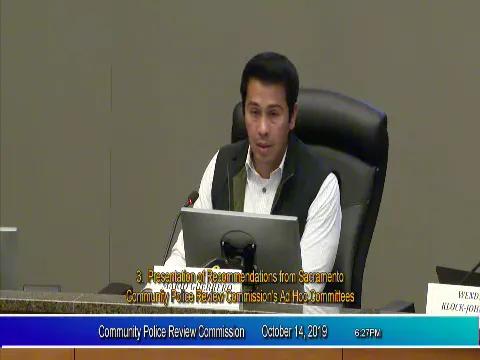
The Sacramento Community Police Review Commission met on Monday, October 14, 2019 at 6:01 PM in the City Hall Council Chamber, adjourning at 7:25 PM. The commission voted unanimously to forward recommendations from three ad hoc committees (Use of Force, Body Worn Cameras, and Mental Health) to the City Council, and received updates on committee status and a follow-up log. Consent Calendar - Item 1 – Meeting Minutes: Approved minutes from December 18, 2018, January 14, 2019, February 11, 2019, and March 11, 2019 as amended, and minutes from April 8, May 13, July 16, July 23, August 12, and September 9, 2019. (Motion by Commissioner Guerrero, second by Commissioner Elkarra; vote 9-0, with Commissioner Zamora absent.) - Item 2 – Police Complaint Activity Report (July-September 2019): Received and filed. Discussion Items Item 3: Recommendations from Ad Hoc Committees Three sets of recommendations were presented and approved for forwarding to the City Council. Use of Force Committee (Commissioners Guerrero, Carter, Zamora, Elkarra): - Recommended incorporating California's AB 392 (effective January 1, 2020) which changes the use-of-force standard from "reasonable" to "necessary." - Proposed a standalone duty-to-render-aid policy, stronger de-escalation language, adding "gravity of suspected activity" to foot pursuit policy, requiring body-worn cameras to be turned on as soon as physically possible during pursuits, consolidating reporting procedures, treating CEWs (conducted energy weapons) as use of force, and mandatory drug testing of officers within 24 hours after a death or serious bodily injury. - Discussion: Commissioner Guerrero expressed concern that the existing police department policy did not reflect AB 392, while Captain Bernard asserted it was vetted by the city attorney and complies. The commission agreed to schedule a detailed review for a future meeting. Body Worn Camera Committee (Commissioners Sabeniano, Elkarra, others): - Five recommendations: (1) Ensure all uniformed officers have body-worn cameras; (2) Document instances where officers go into service without a camera; (3) Replace "private citizens" with "members of the public" in policies; (4) Allow community members to view footage before filing a complaint; (5) Require cameras to be turned on before approaching a location when responding to a dispatch call. - Additional recommendation: Create a General Order for releasing recordings, addressing standardized processes, engagement with non-English speakers, and sensitivity toward minors and victims of domestic abuse. - Noted that 24/7 recording is not currently feasible but agreed to revisit in one year as technology improves. Mental Health Committee (Commissioners Falcon, Guerrero, King): - Provided legislative background (Props 63, 36, 47) and noted that all Sacramento Police Department officers have completed the required 40-hour CIT (Crisis Intervention Team) training. - Observations: Funding for county mental health services not fully utilized; data sharing siloed; rising suicide ideation among youth; need for co-occurring disorder recognition. - Recommendations: Update General Order 52201 (handling mentally ill persons) to include co-occurring disorders and CIT language; review all general orders for opportunities to incorporate CIT; additional dispatcher training; consider a separate non-emergency number for mental health calls; recertification for CIT team members; use person-first language ("people with mental illness"); increase number of CIT teams as funding allows. - Clarified that a recommendation to continue the ad hoc committee would not be forwarded, as committee structure is internal to the commission. Item 4: Status Update on Ad Hoc Committees - Assistant City Clerk Wendy Klock-Johnson reported that the Mental Health Ad Hoc, formed September 2018, exceeded its temporary duration. Future work must be handled through the full commission or a new focused ad hoc. A request for quarterly meetings with the police department would require a standing committee, which is not supported. Informal meetings are permissible if disclosed. Item 5: Follow-Up Log - The log tracks outstanding items: Commissioner Falcon’s requests for Spanish translation of commission documents and partnership with the Parks Commission; a use-of-force policy update scheduled for December; a PRA issue raised by a community member. The clerk will maintain the log for future agendas. Key Outcomes - Votes: Three motions to forward recommendations to City Council passed unanimously (9-0). - Use of Force: Motion by Commissioner Elkarra, second by Commissioner King. - Body Worn Camera: Motion by Commissioner Sabeniano, second by Commissioner Elkarra. - Mental Health: Motion by Commissioner Falcon, second by Commissioner Guerrero. - Schedule: Final language for recommendations due to Assistant City Clerk by November 20, 2019, for inclusion at the December City Council meeting (consent item). - Future Meetings: Detailed briefing on police department’s use-of-force policy (including AB 392 compliance) scheduled for December 2019; overview of PRA process likely February 2020. - Other: Revisit body-worn camera technology in one year; mental health ad hoc sunset; Spanish translation advocacy referred to individual council members.

POLICE POLICY REVIEW 25% · MENTAL HEALTH 18% · PUBLIC SAFETY 14% · BODY WORN CAMERAS 14%
1348
OCT 14, 2019 · SACRAMENTO, CALIFORNIA · ARTS, CULTURE, AND CREATIVE ECONOMY COMMISSION
Sacramento Metropolitan Arts Commission Meeting – October 14, 2019

The Sacramento Metropolitan Arts Commission (SMAC) met on Monday, October 14, 2019, at 2:01 p.m. at Historic City Hall. All commissioners were present and a quorum was established. The meeting included approval of minutes, a public art artist selection, an oral report on a river dock naming project, approval of a public art plan for the Powerhouse Science Center, and updates on the Cultural Plan, Arts Consortium, and committee reports. There were no public comments on matters not on the agenda. Consent Calendar - Approval of Commission Meeting Minutes: The commission unanimously approved the meeting minutes. The agenda text references minutes dated August 12, 2019, while the attached file label indicates September 9, 2019; no discrepancy was noted during the meeting. Discussion Items - Artist Selection for the North Natomas Library Tech Art Project: Staff reported on the selection of artist Vincent Damyanovich for a technology-focused artwork at the North Natomas Library. The project involves interior wall hanging or freestanding pieces designed to last 10 years, with a two-year warranty. The artist is a previous recipient of a Creative Economy Grant. Commissioner Wallace highlighted that the artist's history with the creative economy grant was an important factor. A motion to approve the selection passed unanimously. - River Crossing Naming of Public Dock: Staff presented an oral report on the NEA Our Town-funded project led by artist Joshua Sofer. A public nomination process resulted in 672 qualifying nominations from May 25 to July 10. Two names were selected: Isabel S. Naranjo (Sacramento) and Etanesh Zelecki (West Sacramento). Both were grandmothers, immigrants, and had connections to the river. Commissioners expressed strong support; Commissioner Wallace noted she fully stood behind the panel's decision but raised concerns about how the selection process was communicated to the public, citing a finalist who was a fugitive slave. Commissioner Silva suggested enhanced media outreach to increase visibility and economic potential. The report was received and filed. - Powerhouse Science Center Permanent Public Art Plan: Staff presented the plan for a permanent interior artwork in the entrance area of the new Powerhouse Science Center, with a budget of $300,000–$400,000, and a timeline leading to installation by February 2021. Commissioner Silva disclosed that his firm, Dreyfus Blackwell, is the architecture firm for the center. A motion to approve the plan passed unanimously. - Update on Cultural Plan: Director Jody Ulich reported that 47 Artist-in-Residence grants, 109 Creative Economy grants, 29 Cultural Equity grants, and 11 large Cultural Investment grants were submitted. The City received 68 applications for the Film Office Manager position. The transition to the new Arts and Creative Economy Commission was also discussed. - Arts Consortium Update: Dr. Steven Winlock reported the completion of a $1 million grant from the Sacramento County Office of Education, which provided status reports on arts education across 13 school districts and capacity-building for 13 local arts organizations. County Superintendent Dave Gordon contributed $10,000 to Friends of Sacramento Arts in Dr. Winlock's name. - Outreach and Advocacy Committee Report: Commissioner Silva reported on transition planning, including a reception at the final SMAC meeting to honor past chairs and commissioners, and identifying work for the new commission to carry forward. - Grants and Education Committee Report: Dr. Winlock, in place of Commissioner Delgado, reported that the Any Given Child program added River Delta school district, bringing participation to six districts for the 2019–20 school year, with 65 residencies and 138 school assemblies. SMAC also received a Certificate of Recognition from Twin Rivers School District. - Art in Public Places Committee Report: Received and filed without detailed discussion. - Director’s Report: Director Ulich announced selection of Arts Consulting Group to recruit for the Cultural Services and Creative Economy Manager position, and offered copies of the arts consortium report. - Chairperson’s Report: No separate report was given; transition-related items were covered under committee reports. Key Outcomes - Approved the meeting minutes. - Approved the selection of Vincent Damyanovich for the North Natomas Library Tech Art Project. - Approved the permanent public art plan for the Powerhouse Science Center. - Received and filed the River Crossing naming update, Cultural Plan update, Arts Consortium update, and all committee reports. - No public comments were made.

PUBLIC ART 57% · ARTS AND CULTURE 31% · EDUCATION POLICY 5% · PUBLIC PRIVATE PARTNERSHIPS 2%
1349
SEP 25, 2019 · SACRAMENTO, CALIFORNIA · UTILITIES RATE ADVISORY COMMISSION
Utilities Rate Advisory Commission Meeting – September 25, 2019

The Utilities Rate Advisory Commission (URAC) held a regular meeting on Wednesday, September 25, 2019, at 5:30 p.m. in the Council Chambers at 915 I Street, Sacramento. The meeting began with roll call and included a consent calendar and two discussion items. No minutes or transcript were provided; the following summary is based solely on the published agenda. Consent Calendar - Approval of Minutes for August 28, 2019: The Commission considered a motion to approve the draft minutes from the previous meeting. (Routine approval; no further details available.) Discussion Items - 2020 URAC Meeting Calendar (Estimated Time: 5 minutes): Staff recommended that the Commission pass a motion to approve the proposed 2020 meeting calendar. Contact: Erin Treadwell, Community Outreach & Media Manager. - Department of Utilities Accountability Plan Update (Estimated Time: 30 minutes): Staff recommended that the Commission receive and file the Department of Utilities Accountability Plan quarterly update, which included a Water CIP Dashboard and a Wastewater Dashboard. Contact: William O. Busath, Director of Utilities. Public Comments – Matters Not on the Agenda - No public comments were listed on the agenda. Member Comments – Ideas, Questions and Meeting/Conference Reports - Scheduled but no specifics available from the agenda. Adjournment - The meeting was adjourned. Note: Actual discussion, votes, and public testimony are not recorded in the available agenda. The recommendations listed above are as stated in the agenda for each item.

1350
SEP 24, 2019 · SACRAMENTO, CALIFORNIA · WATER COMMITTEE
Water Committee Meeting - September 24, 2019

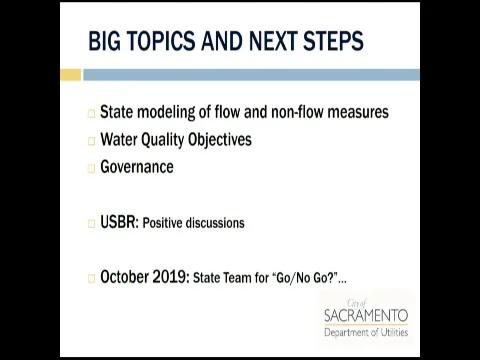
The Sacramento Water Committee met on Tuesday, September 24, 2019, from 1:00 p.m. to 1:50 p.m. in the City Hall Council Chamber. Members present were Chair Jeff Harris (District 3), Vice-Chair Eric Guerra (District 6), and Member Angelique Ashby (District 1). The committee received and filed three oral reports and forwarded one resolution to the City Council. Discussion Items Item 2: Resolution Supporting Pam Tobin for ACWA Vice President - The committee began with this item, taking it out of order. Chair Harris noted that Pam Tobin had been unanimously recommended by the Regional Water Authority. - Member Guerra moved and Chair Harris seconded a motion to review the resolution and forward it to the City Council for approval. The motion passed unanimously (3-0). Item 1: Sacramento Regional Groundwater Bank - Ralph Schwartz presented an overview of the proposed Sacramento Regional Groundwater Bank. He explained that the North American and South American subbasins historically declined about 2 feet per year due to overdraft, but in-lieu conjunctive use since the mid-1990s has stabilized and slightly raised groundwater levels. - Climate change is reducing Folsom Reservoir reliability; average monthly storage from 2001-2016 was 65,000 acre-feet less than historical averages. The groundwater basin offers approximately 1.8 million acre-feet of available storage. - A regional water reliability plan found that reoperating today's system could deliver an additional 63,000 acre-feet of surface water in wet years and extract an additional 57,000 acre-feet of groundwater in dry years. With planned facilities, these amounts could increase by almost 50% to about 90,000 acre-feet each. - Schwartz identified cost barriers: about $300 per acre-foot cost differential for switching supplies and an estimated $288 million in capital costs for new facilities. - The city participated in a successful 2018 groundwater transfer with other agencies, using 60 production wells. The group pumped nearly 18,000 acre-feet over a three-month period versus a typical 7,000, and received credit for 10,000 acre-feet of transferred water. - The city netted approximately $1.8 million, dedicated to well improvements (including pump-to-waste systems) and water efficiency for disadvantaged customers. A Proposition 1 grant of about $1 million is being pursued. - In response to questions, Schwartz said monitoring wells and modeling are used to track contamination plumes, and that fully refilling the basin is not necessary; operations would use small annual increments. Item 3: Water Rights and Water Supply Regulatory Processes - Outside counsel Wes Miliband presented on the city's water rights portfolio and regulatory risks. The city holds a pre-1914 right, four permitted rights on the American River and one on the Sacramento River, a 1957 Bureau of Reclamation operating agreement, and groundwater rights. - Miliband detailed the American River Voluntary Agreement, including flow measures (10,000 acre-feet from upstream partners up to six times over 15 years in wetter years; 10,000 acre-feet of groundwater substitution in critical/dry years; additional 10,000 acre-feet reservoir reoperation; up to 20,000 acre-feet more if a groundwater bank is established), non-flow measures (50 acres of spawning and 150 acres of rearing habitat), and funding mechanisms. - He noted that state modeling (CalSim vs. SACWAM) is a live issue, and the October 15 "go/no-go" date may slip. Bureau of Reclamation planning minimums in Folsom are being discussed in the 250,000-300,000 acre-feet range. - Members expressed support for the city's participation in the voluntary agreement process, with Harris saying it directly affects the city's water future. Item 4: American River Habitat Restoration Site - Tom Goring, executive director of the Sacramento Water Forum, presented a video and photos of an ongoing habitat project at Sailor Bar, across from the hatchery. It is the eighth such project on the Lower American River and a commitment under the Water Forum Agreement. - The project is a $1 million effort, with about $900,000 in federal funds (from surcharges on agricultural water deliveries and power contracts). It involves moving 14,000 cubic yards of gravel to create spawning and rearing habitat. - Goring explained that natural-spawned salmon are more genetically resilient, and these projects align with endangered species goals. The voluntary agreement proposes expanding spawning projects from 50 to 200 acres over 15 years. - The equipment operators are city of Sacramento Department of Utilities staff, paid through federal grant dollars. Committee members praised the project's multiple benefits. Key Outcomes - Received and filed the Sacramento Regional Groundwater Bank presentation (Item 1). - Reviewed the resolution supporting Pam Tobin and passed a motion forwarding it to City Council; the vote was 3-0 (Item 2). - Received and filed the Water Rights and Water Supply Regulatory Processes presentation (Item 3). - Received and filed the American River Habitat Restoration Site presentation (Item 4). - No public comment was offered on matters not on the agenda. - The meeting adjourned at 1:50 p.m.

WATER MANAGEMENT 72% · ENVIRONMENTAL HEALTH 11% · VOLUNTARY AGREEMENT PROCESS 7% · PROCEDURAL 4%
OPENPUBLICA · PUBLIC MEETING INDEXUPDATED DAILY · openpublica.com