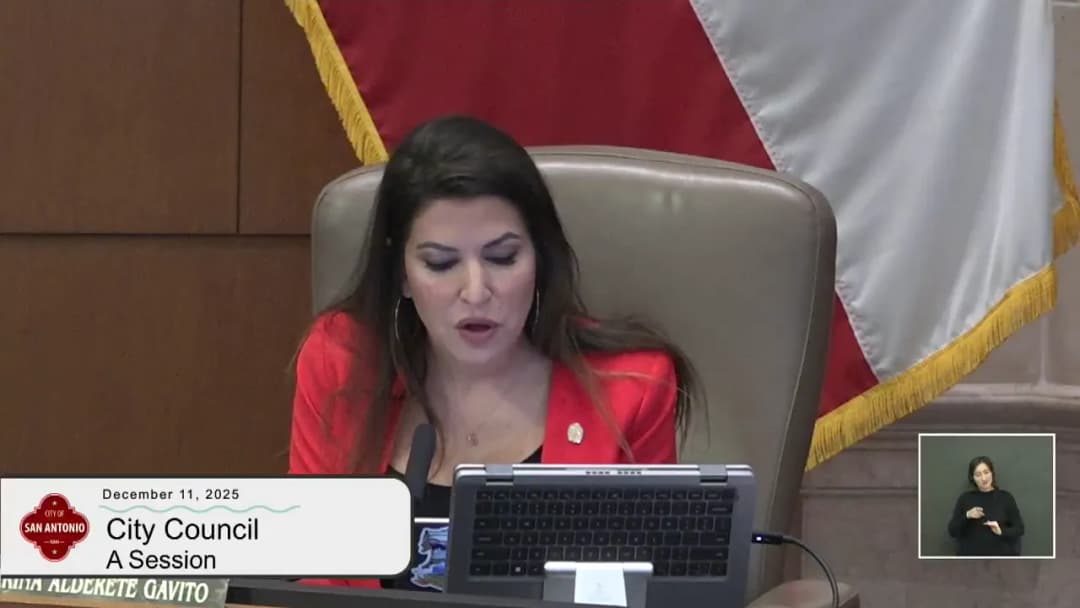
The San Antonio City Council convened on December 11, 2025, to honor local community contributors, celebrate the upcoming Texas Space Summit, and formally approve the extension and strategic refinement of the city's "Ready to Work" workforce development program following a vote of approval with significant public and council engagement. Consent Calendar - Approved items 4 through 24 as a group without pull request, including the construction contract for the new veterinary hospital (Item 8), funding for Magic Theater renovations (Item 5), and the adoption of the Bandera Road Corridor Plan Phase 2 (Item 23). Public Comments & Testimony - Kristen Beno (Magic Theater): Expressed concern regarding specific consent agenda items, stating the organization needed to be present to address questions, specifically regarding potential restrictions on their operations. - Jack Finger: Expressed strong opposition ("large resounding flop") to the program's outcomes, arguing that promised numbers and good-paying jobs never materialized, and suggested the council place a measure on the ballot to eradicate the program. - Ray David Cardona (ST Engineering San Antonio): Expressed full support for the Ready to Work program, stating it benefits the aerospace industry by providing funding and training for up-and-coming talent and mechanics. - Montana Williams (Frost Bank): Expressed full support, highlighting the program's role in launching an apprenticeship program and streamlining hiring efforts for the contact center. - Shmika Ellison (Program Participant): Expressed deep gratitude and advocacy for the program's extension, describing it as a "promise" and a "movement" that provided stability and a full-time job, moving her family from a shelter to homeownership. - Renee Odin (COPS Metro): Expressed strong endorsement of the program and the advisory board, citing Project Quest's historical success and urging approval of the board appointments. - Christopher Mammon (D. Howard Foundation): Expressed support, noting nearly 3,500 individuals placed at wages starting at $21.50/hour and emphasizing the need to serve underserved individuals with barriers. - Priscilla Camacho (Alamo Colleges): Expressed pride and commitment as a partner, stating the city is unique in investing in human talent and affirming a focus on family-sustaining wages. - Ali Bukhari (GuideHouse): Expressed excitement and support, citing the program as the primary factor in their decision to locate in San Antonio without incentives, and highlighted successful hires from the program. - Katie Farrier (Greater San Antonio Chamber): Expressed conditional support, stating the initiative should continue but must shift toward demand-driven training, faster on-ramps, and clearer transparency regarding outcomes. - Jennifer Cantu (Bank of America): Expressed support as an advisory board member, highlighting the ecosystem of workforce development and the program's impact on women of color. - Ruby Duarte (Project Quest/Participant): Expressed strong advocacy, describing the program as a life-changing mechanism that removed barriers to education and provided generational impact. - Daniel Herrera (Results for America): Expressed support for the program's 70% placement rate as aligned with national evidence for high-barrier populations. - Jerry Graber (Workforce Solutions Alamo/Board Member): Expressed full support, calling the program a significant long-term economic mobility strategy and urging council members to attend board meetings. - Shemika Ellison & Ruby Duarte: Positioned themselves as living proof of the program's success, contrasting their personal narratives of upward mobility against statistical critiques. Discussion Items - Extension of Ready to Work Advisory Board (Item 3): Council debated extending the board's term to December 31, 2030, and amending its composition. - Mayor: Expressed concern that the return on investment (ROI) needed to be better to justify the investment, noting that 25% of participants were still not in approved jobs after a full year. Expressed gratitude that the board listened to feedback and eliminated the "Incumbent Worker Training" program (IWT) which resulted in minimal pay increases, but emphasized the need for improved data reporting and meeting placement numbers. - Councilwoman Via Gran: Expressed support, framing the 20% poverty rate (specifically 50% of whom are women) as the driving data point, and defending the program as a strategic movement necessary for economic equity. - Councilman Castillo: Expressed support and gratitude for the new seat dedicated to "high employment barrier" organizations, emphasizing the need to reduce barriers for individuals with criminal records. - Councilwoman Correa: Expressed concern regarding data transparency (program completion rates), the need for better pre-placement coaching on career paths (like IT vs. CDL), and the lack of visibility on support services like child care. - Councilman Galvan: Expressed belief in the program's potential to address poverty but inquired about the timeline and process for phasing out underperforming occupations. Expressed concern regarding the phasing out of the education workforce sector. - Councilman McKee Rodriguez: Expressed gratitude for hearing feedback and eliminating the IWT program, looking forward to continued improvements. - Councilwoman Speers: Expressed excitement for the revitalization of the board to align with stakeholders and help participants build self-confidence, noting the program benefits future generations. - Councilwoman Mesa Gonzalez: Expressed support, commending the partners and the focus on the "Ready" aspect (completion rates) of the program. - Councilwoman Eldridge Gavito: Expressed acknowledgment of the difficulty of the task (changing generational poverty) and thanked the board for their efforts and willingness to pivot. Key Outcomes - Vote Passed: Approved Item 3 to extend the San Antonio Ready to Work Advisory Board term to December 31, 2030, and amend the board composition to include new seats for a training provider, a higher education institution, and a reserve seat for an organization serving individuals with high barriers to employment. - Program Adjustment Confirmed: Staff confirmed the elimination of the "Incumbent Worker Training" (IWT) program (saving approximately $3 million) and the phasing out of low-performing occupations, with a commitment to market high-performing pathways. - Public Health Accreditation: Noted that Metro Health successfully achieved reaccreditation status from the Public Health Accreditation Board (PHAB). - City Communications: Announced that the City Communications and Engagement (TBSA) team received 10 state awards, a record high. - New Appointments: Several new individuals were announced for various boards and commissions, including Ashley Don Perez to the San Antonio Arts Commission, Pastor Jonathan Pyle to the Commission on Strengthening Family Wellbeing, and others to the Ethics Review Board. - Executive Session: Held an executive session to discuss economic development negotiations, real property transactions, and legal issues related to litigation and collective bargaining, with no official action taken.
Public Meetings - San Antonio, Texas
Public Meetings - San Antonio, TexasThe San Antonio City Council convened on December 11, 2025, to approve routine matters, honor community leaders, and discuss significant economic and workforce development initiatives. The meeting featured a prayer by Father Jorge Jarro, personal privilege presentations recognizing Edward Arguello and the upcoming Space Summit, and extensive deliberation on the "Ready to Work" workforce program. Following a public hearing and board member discussions, the council voted to approve the revised "Ready to Work" plan, which included the removal of a specific incumbent worker component. The session concluded with a brief executive session on economic development and property acquisition. Consent Calendar - Approved agenda items 4 and 24 without objection. - Unanimous approval of the revised "Ready to Work" program (Point 3) following a council motion. Public Comments & Testimony - Ray David Cardona (Engineering San Antonio Air Space/Ready to Work Program): Expressed gratitude for the board's willingness to listen to feedback and adjust the program. However, stated disappointment regarding the removal of a portion of the program that yielded an increase of less than 50 cents per trainee hour. Argued that the feedback was not fully utilized to maintain the intended poverty reduction goals. - Concejal Villagrán (Committee Chair on Workforce): While not a public commenter, expressed strong support for the program's strategic direction. Emphasized that a 20% poverty rate in the city, with 50% of those being women, necessitates continued investment regardless of the program's current metrics. - Concejal Castillo: Voices concerns regarding barriers to hiring for participants with criminal records (1 in 7 adults). Position: Supports the program but urges the city to collaborate with employers to reduce these barriers to improve second-chance hiring outcomes. - Concejal Spears: Expressed full support for developing good-paying jobs and workforce infrastructure. Position: Proud to serve on the committee and thanked the administrators for their assistance. - Concejal Mesa González: Expressed strong support for the diverse construction, healthcare, and education jobs generated by Ready to Work. Position: Emphasized the importance of completing programs to serve the target population effectively. - Concejal Galván: Stated concern regarding the efficiency and employment data reporting of the program. Position: Supports the program's intent to include residents in city growth but requested a formal review of the data by January 20th to ensure responsible resource use. - Concejal Miquez Rodríguez: Expressed gratitude for the program's impact on changing lives and specific support for eliminating the "WT" (Work Task) component that was underperforming. Discussion Items - Personal Privilege - Edward Arguello (District 7): Concejal Cor recognized Edward Arguello for his 190s-era contributions to music (Triple A Records, "96 Tears"), his role in the film "Barrio Dogs," and his leadership as a CPS Energy director. Position: Celebrated his 89th birthday and his family's contributions to the city. - Space Summit Announcement: Concejal White announced the Texas Space Summit scheduled for September 21-23 of the upcoming year. Position: Expressed excitement, stating San Antonio is well-positioned to lead in the space economy due to its military, education, and manufacturing assets. Jeff Sweb (President, San Antonio Chamber of Commerce) joined to thank the council; the summit aims to attract 2,000 attendees and is hosted internationally. - Ready to Work Program Review: - Concejal Cor (District CEO): Expressed support for the program but noted frustration with how success metrics are displayed. Pointed out that incomplete data from programs lasting two years obscures success rates. Position: Advocated for better monitoring of how many individuals enter versus complete the training. - Concejal Miquez Rodríguez: Stated a preference for data quality research, recalling a previous proposal to investigate why 3 million dollars was potentially unspent due to non-completion. - Concejal Spears: Emphasized the goal of securing living wages for children in the city. - Concejal Galván: Reiterated the need for clear data on employment outcomes. - Resolution: The council agreed to remove the "Incumbent Worker" program component because it was not showing expected promotion rates (only 35% success cited). The "Ready to Work" program will continue with a focus on increasing completion rates and job placement. Key Outcomes - Vote Passed: Unanimous approval of the revised "Ready to Work" agenda item (Point 3), excluding the underperforming incumbent worker segment. - San Antonio Space Summit: Officially announced for September 21-23, 2026. Website (texasspacesummit.com) is active for sponsorship and registration. - Metro Health Accreditation: The Department of Health successfully underwent re-accreditation by the Accreditation Joint Committee; originally accredited in 2019, the review reaffirmed the department's rigorous policies and procedures. - Executive Session: The council moved into an executive session (551.07) at 11:15 AM to discuss economic development release of negotiations, property purchase evaluation, and legal matters. No public decisions were recorded from this session. - Discrepancy Note: The transcript concludes with conflicting time markers ("11:04" and "11:15") regarding the start of the executive session and the final adjournment time, though the session is confirmed to have occurred.
The San Antonio Governance Committee convened on December 11, 2025, to review seven Council Consideration Requests (CCRs) and provide public testimony opportunities. The committee addressed critical issues including the Wahalote Ranch development's impact on the Edwards Aquifer, the need for a second-chance hiring initiative, the formalization of Community Benefits Agreements (CBAs), and the regulation of growing data center infrastructure. Public comments highlighted significant community concerns regarding water protection, environmental justice, and criminal justice reform. The committee generally referred the proposed items to their respective functional committees for further study and policy development. Consent Calendar - Approved the minutes from the November 7, 2025, meeting without corrections by unanimous vote. Public Comments & Testimony - Alan Montemayor (Chair, Alamo Group of the Sierra Club, representing 3,000 people): Expressed strong opposition to high-density development at Wahalote Ranch, citing risks of aquifer pollution via treated sewage in Hilotus Creek and anticipated traffic congestion. He urged the city to discourage the MUD formation request and prioritize water protection. - Peter Bella: Expressed interest in the data center CCR and concern regarding energy demands and citizen safety; requested clarity on local and state rules governing data center developments. - Alison Greer (CHCS): Expressed support for the creation of an ad hoc committee to establish a jail diversion center, noting the increasing behavioral health safety net population and the need to bypass the jail for low-level offenders. - Deborah Ponce (District 4 Community Member, Public Citizen): Expressed full support for Councilman Galvan's CCR regarding data centers; raised concerns about a policy gap leaving the city without zoning or development standards, specifically regarding water usage (up to 300,000 gallons/day) and lack of transparency due to developer anonymity. - Judith Temple: Expressed support for the data center CCR; argued ratepayers should not subsidize data center energy costs, citing projections that data centers could comprise 50% of new load by 2035; requested independent studies on water/energy impacts. - Steven Huerta (Executive Director, All of Us; Coordinator, Environmental Collaborative of San Antonio): Expressed support for the CCR regarding Wahalote Ranch; warned that untreated toxic waste and wastewater from the development could inevitably impact the Edwards Aquifer during extreme rain events; urged slowing the process to explore conservation easements. - Barbara Acosta (Director, Participatory Defense and Pathway to Freedom): Expressed strong support for the
The Construction Code Enforcement Board convened on December 11, 2025, to address four properties identified as public nuisances and hazardous structures. The meeting featured testimony from code enforcement officers, property owners, engineers, and community members regarding structural damage, illegal occupancy, and the feasibility of repairs versus demolition. Consent Calendar - Unanimously approved the minutes from the November 13, 2025, meeting as written. Public Comments & Testimony Property: 655 Humboldt Street (Appellant: Abel Cantú) - Position Expressed: The owner expressed strong opposition to the demolition recommendation, asserting he is actively repairing the property and that the city's actions and documentation are false or misleading. He stated he is a "merchant" and "electrician" (though lacking active state licenses) whose progress has been hindered by code enforcement officers seizing materials and equipment. He argued that the city caused the current damage (specifically mentioning a hole in the wall and water lines severed by a tractor) and that the property is not in the condition depicted in the official photos. He requested that his property be returned to him or that he be allowed to continue repairs without interference, claiming he has funds and intends to finish the work. - Counter-Testimony: Neighbors (Diana Garza) and code enforcement officers (Brian Gilman, Vincent Gonzalez) expressed that the owner has been uncooperative, hostile, and difficult to communicate with. They stated that while the owner claims to have funds, he has not engaged in a verified timeline for completion. They confirmed that the property has been without city water/electricity (utilizing a generator) since 2022 and that previous attempts to offer assistance (social workers, legal aid) were rejected or unfulfilled by the owner due to non-compliance with deadlines. The owner's legal aid contact (Kelly Hope) was noted as having been contacted, but the owner claimed he did not want the help. Property: 214 Prosperity Drive (Appellant: Sharon Peters) - Position Expressed: The owner expressed full support for the recommendation to repair rather than demolish. She presented evidence of her financial capability to fund the reconstruction and cited a previous successful property repair completed in under four months. She argued that 60% of the structure is viable and that the damaged portion was already partially demolished by an engineer following an earlier fire. She requested an extension to allow her contractor to submit updated plans and complete the reconstruction, stating she has sufficient funds and a contractor ready to build. - Rebuttal/Clarification: The owner's engineer (Mónica Lance) confirmed the structure can be saved with reconstruction, estimating the project will take 180 days (six months) to complete, including foundation work. The owner stated the property is currently insured and she has the means to pay for the repair. Discussion Items - 655 Humboldt Street: Staff presented findings that the main structure and two accessory buildings (one mobile home, two structures without roofs/foundations) were violating codes regarding dangerous conditions, lack of permits, and public safety hazards. The owner denied negligence, claiming the city interfered with his repairs. Code enforcement emphasized that the property has been uninhabitable for years, utilities have been disconnected, and the owner has failed to meet agreed-upon timelines despite receiving assistance offers. - 1906 San Fernando Street: Staff reported the property is a single-story structure in ruins, leaning significantly, with a collapsed porch and severe water damage. No owner appeared. Code enforcement noted the property is uninhabitable, has no owner contact, and cannot be feasibly repaired. The owner's absence and lack of financial or repair documentation were highlighted. - 513 Duval Street: Staff stated the accessory structure is sitting directly on the ground without cimientos, has rotted wood, and is unstable. The owner (JJL Property Group) was contacted but absent. The structure was previously occupied by homeless individuals but has continued to deteriorate. The recommendation was for immediate demolition due to safety hazards. - 214 Prosperity Drive Re-evaluation: Discussion focused on whether the structure could be saved. The owner and engineer provided financial proof and a timeline (180 days). The Board discussed the feasibility of the repair versus the public nuisance status. The owner agreed to a strict reporting schedule to prove progress. Key Outcomes - 655 Humboldt Street: Motion Passed Unanimously (7-0). The property is declared a public nuisance and unrepairable. Directive: Demolition required within 30 days. The property must be cleared of trash/debris, and all services (water/electricity) must be cut. An order of evacuation is issued. - 214 Prosperity Drive: Motion Passed Unanimously. The property is declared a public nuisance but repairable. Directive: The structure must be reconstructed within 180 days. Amendment: The city is required to receive a work status update every 30 days. The property must be secured. - 1906 San Fernando Street: Motion Passed Unanimously. The property is declared a public nuisance and unrepairable. Directive: Demolition required within 30 days. The property must be secured and cleared of debris. - 513 Duval Street: Motion Passed Unanimously. The accessory structure is declared a public nuisance and unrepairable. Directive: Demolition required within 30 days. The property must be secured and cleared of debris. Board Personnel Updates - Welcome was extended to incoming board members Juan, Bolvan, and Keila Moranda. - Announcements were made regarding panel assignments for 2026 (Panels A and B) and the upcoming February board meeting. - No quorum issues were noted for future meetings as replacements were being sought for absent members.
The San Antonio Belief Standards Board convened on December 11, 2025, to hear dangerous premises cases and approve the November 13, 2025, minutes. The meeting featured deliberations on four properties, including a heated exchange regarding the owner's claim of property damage by code enforcement and a successful rehabilitation proposal for a fire-damaged home. Consent Calendar - Approved the minutes of November 13, 2025, as drafted. - Received staff updates regarding emergency demolitions completed on records: a structure at 5431 Godek Drive (demolished Nov 14, 2025) and 3132 Vera Cruz (demolished Nov 26, 2025). No action required by the board for these closed cases. Public Comments & Testimony - Abel Kantu (Owner, 655 Humboldt Street): Expressed strong opposition to the staff's characterization of the property as dilapidated, stating the condition was caused by code enforcement entering with a bobcat, breaking water lines, and destroying walls. He argued that the city is targeting him, taking his new materials and tools, and preventing repairs. He stated he has no active electricity from the city (using generators) and claimed to purchase water, though staff disputed this. He also questioned the legality of the city's actions regarding his property and expressed distrust in city officials. - Diana Garza (Supporter for 655 Humboldt): Verified that the owner, Mr. Cantu, owns the property and maintains water payments. She expressed opposition to demolition, noting the owner is a skilled carpenter but is restricted from working due to fear of city seizure of materials. She described a history of confrontation and asserted the property is habitable but stalled by city enforcement. - Erica Ragsdale (Neighborhood and Housing Services): Stated that their "Operation Rebuild" program attempted to work with Mr. Cantu for a year to facilitate rehabilitation but terminated efforts because milestones regarding property cleanup and communication were not met. She expressed that they are directing resources to owners ready to participate. - Sharon Peters (Owner, 214 Prosperity Drive): Expressed full support for the board to find the property repairable, offering proof of funds and successful rehabilitation history on a similar fire-damaged property (262 Wingate) cleared in four months. She argued the structure was salvageable (40% valuable structure) and opposed demolition, proposing a rebuild if the board allows. - Monica Leos (Contractor, 214 Prosperity Drive): Confirmed that the owner has secured a contractor and engineer to execute a rebuild. She stated opposition to demolition and expressed confidence in completing the work within six months, utilizing existing materials. Discussion Items - 655 Humboldt Street (Able Cantu): The Board heard conflicting positions regarding the property's condition and the owner's history. Code Enforcement presented evidence of severe disrepair, including exposed wires, sagging roofs, and interior debris posing egress hazards. They noted only one active repair permit for cosmetic items (doors, windows) existed and no electrical service was active. Officer Brandon Ginn and Officer Vincent Gonzalez described confrontational interactions with the owner during security sweeps. Mr. Cantu argued the city caused the damage and that he has been unable to repair due to material confiscation. The Board questioned the feasibility of repairs given the lack of utilities and structural integrity. - 214 Prosperity Drive (Sharon Peters): Discussion focused on the feasibility of repair versus demolition due to prior fire damage. Staff recommended demolition, but the owner provided updated engineering plans and a fire assessment showing 40% of the structure was valuable. The Board discussed the timeline for a rebuild versus a repair, with the owner and contractor proposing a six-month timeline to restore the home to its original footprint, citing a successful precedent with a previous property. - 1906 San Fernando Street: Staff presented evidence of a single-story structure with a sagging roof, bowing walls, holes in floors and ceilings, and severe accumulation of trash. No owner or representative was present to offer a defense or repair plan. Utilities were confirmed to be cut. - 513 Duvall Street: Discussion centered on a post-demolition accessory structure left behind. Staff described the structure as lacking a foundation, constructed without permits, and deteriorating due to weather and use by vagrants. The owner stated an intent to demolish but failed to do so. Key Outcomes - 655 Humboldt Street: The Board voted 7-0 (unanimous) that the property is a public nuisance and infeasible to repair. Directive: Demolition required within 30 days; property must be vacated, secured, and freed of debris; water service to be disconnected. - 214 Prosperity Drive: The Board voted unanimously (voice vote) that the property requires repair rather than demolition. Directive: Rebuild required within 180 days. Motion Amendment: The City Code Officer must be updated on progress every 30 days. - 1906 San Fernando Street: The Board voted unanimously (voice vote) that the property is a public nuisance and infeasible to repair. Directive: Demolition required within 30 days; property to be secured and cleared of debris. - 513 Duvall Street: The Board voted unanimously (voice vote) that the accessory structure is a public nuisance and infeasible to repair. Directive: Structural demolition required within 30 days; property to be secured and cleared of debris. - Board Business: Noted the appointment of new member Ryan Baldwin (District 1), upcoming chair rotations for Dwayne Nelson and Kayla Miranda in January, and the need to contact council members regarding pending reappointments for members Doris Ole and George Grimes Jr.
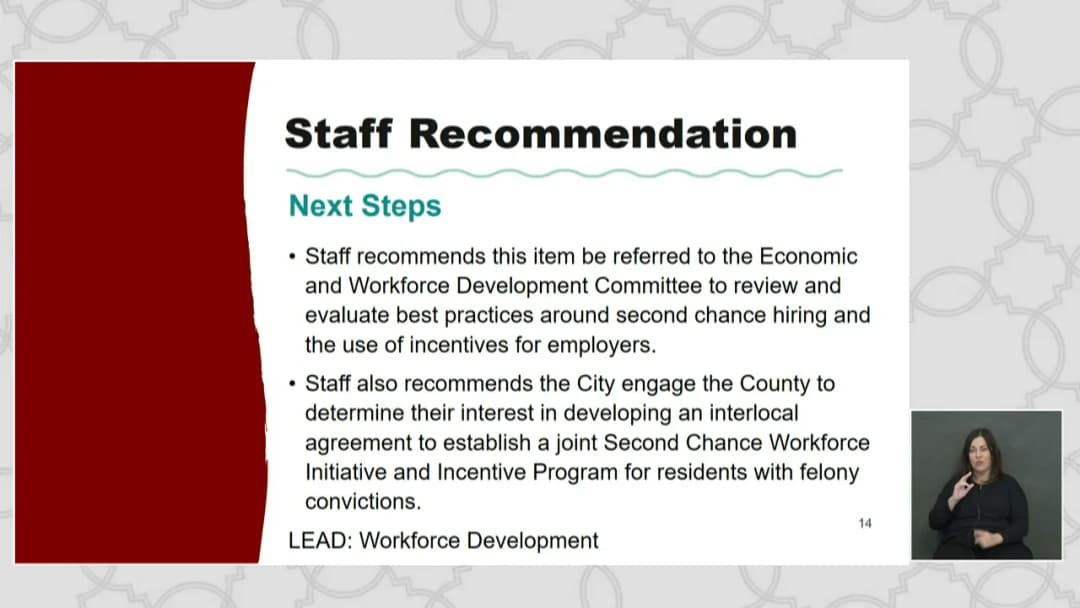
The Governance Committee convened on December 11, 2025, to review multiple Citizens' Consideration Requests (CCRs) regarding high-density development threats to the Edwards Aquifer, the regulation of data center growth, second-chance employment initiatives, Community Benefit Agreements, vacant property enforcement, and the establishment of a medical diversion center. The committee heard extensive public testimony expressing strong opposition to development without water impact studies and strong support for housing and employment equity, followed by deliberations on referring items to full council or specific standing committees for further action. Consent Calendar - Approvals: The committee unanimously approved the minutes from the previous meeting via a motion and second. Public Comments & Testimony - Alan Montemayor (Sierra Club): Expressed categorical opposition to the "Guajolote Ranch" high-density development (3,000 units), citing guaranteed aquifer contamination, drainage issues, and traffic congestion. Stated residents have been ignored and advocated for denying utility district formation. - Peter Vela: Expressed concern regarding the environmental and infrastructure impacts of rapid data center development, specifically regarding energy demand and potential electricity rate increases for citizens. - Deborah Ponce (Catholic Health Services): Expressed full support for a diversion center project to treat low-level offenders with mental health or substance abuse issues in a residential setting to prevent incarceration. - Lidi Montares (District 4 Community Organizer): Expressed strong support for CCRs regulating data centers, emphasizing that current codes lack standards for water usage (200,000–300,000 gallons daily), electricity, and noise. Stated that developers negotiate in secret and that LLC structures obscure ownership. - Judith Tempo (Private Citizen): Expressed full support for the CCR by Councilmember Galván regarding data centers, citing resource conservation and the need for transparency and independent impact studies. - Judith Temple (San Antonio Environmental Collaborative): Expressed opposition to the Guajolote Ranch development, urging the council to delay the process to allow for conservation designation of parts of the property and to prevent sewage overflows from contaminating the Edwards Aquifer. - Steve Huerta (Employment with Justice): Expressed strong support for the Second Chance Initiative CCR, stating it is a moral and economic imperative to hire individuals with criminal records to combat poverty and improve public safety. - Barbara Costa (Participatory Defense): Expressed strong support for the Second Chance Initiative, describing her personal experience of being denied housing and employment due to criminal records, framing the initiative as a restoration of dignity. - Destiny de la Rosa: Expressed strong support for the Second Chance Initiative, stating that criminal records currently close doors to employment and housing, preventing individuals from rebuilding their lives. - Dr. Alexander Testa (University of Texas): Expressed strong support for the medical diversion center committee, citing research showing that individuals with mental health issues remain in jail longer than necessary without appropriate treatment. Discussion Items - Guajolote Ranch & Edwards Aquifer Threats: - Staff presented a request from Councilmembers Mesa González and Gavito to consider the acquisition of the Guajolote Ranch land and evaluate threats to the Edwards Aquifer. Staff noted a 90-day statutory timeline to refer this to the full council. - SOS (San Antonio Water System) Representative Donovan Bursen: Stated that while geology includes a fault line, they do not currently see a significant threat to the aquifer based on existing contract clauses and monitoring, though conceded uncertainty regarding specific water flow paths. - Councilmember Munguía: Expressed support for the motion to refer the issue to the full council but requested clarification on funding sources for land acquisition and specific threat metrics. - Councilmember Villagrán: Expressed support for referring the item to the full council for broader discussion involving ETJ (Extraterritorial Jurisdiction) impacts and the need for investor inclusion. - Councilmember Mickey Rodríguez: Noted that SOS had not previously notified the city of a threat, questioning why this situation now warrants elevation to a council-level threat. Requested public sharing of SOS metrics defining "threats." - Action: The committee voted to refer both the land acquisition inquiry and the SOS threat assessment to the full council (specifically referencing a future Session B) while requesting a committee update on threat definitions and specific metrics before the council meeting in February. - Second Chance Initiative for Employment (CCR by Castillo): - Staff recommended referral to the Workforce Development and Economic Development Committee (WDEDC) to explore best practices, grant opportunities, and contract incentives for hiring individuals with criminal records. - Councilmember Castillo: Expressed that the initiative complements existing "Ready to Work" programs and aims to fill gaps in employment for the justice-impacted population. - Councilmembers: Discussed the need for individualized assessments in contracts and confirmed that the policy does not exceed current legal limits for employment practices. Council unanimously supported referral to the appropriate committee. - Community Benefit Agreements (CBA) Policy (CCR by Castillo & Munguía): - Staff presented the CCR requesting development of a formal CBA policy for discretionary city projects to ensure community benefits such as jobs and housing. - Councilmember Munguía: Expressed that a formal policy might be too rigid for districts with different needs (e.g., District 3 vs. District 10). Stated a preference for a "strategic framework" or "template" that allows negotiation on a case-by-case basis rather than a blanket mandate. - Councilmember Galván: Expressed support for a formal policy but emphasized the need to distinguish between CBA obligations and the separate issue of naming rights (e.g., Spurs arena). - Councilmember Villagrán: Suggested a broader conversation about economic incentives and the need for transparency regarding how CBAs worked for the Spurs and the baseball arena. - Action: The committee voted to refer the CCR to the Workforce Development and Economic Development Committee, with the intention of incorporating it into a broader dialogue on development incentives and a potential strategic framework to be discussed at a future full council meeting. - Vacant and Nuisance Property Program (CCR by Castillo): - Staff recommended referral to the full council to expand the existing program to include vacant lots, implement escalating fines based on duration of vacancy, and explore demolition as a last resort. - Councilmember Munguía: Expresssed support, citing numerous vacant lots in District 4 causing neighborhood blight. - Action: The committee voted unanimously to refer the CCR to the full council for further evaluation and potential action. - Medical Diversion Center (CCR by Castillo): - Staff recommended referral to the Public Safety Committee to study the feasibility of a diversion center for individuals with developmental disabilities, mental health, or substance use issues, in partnership with the County and UH (University Hospital System). - Councilmember Villagrán: Expressed support but called for a broader community conversation regarding mental health normalization. - Action: The committee voted unanimously to refer the CCR to the Public Safety Committee for further review and to schedule a full council session B to discuss the broader system of care and funding. - Data Center Planning Policy (CCR by Galván): - Staff recommended referral to the Planning and Community Development Committee (PCDC) to review the city's authority to regulate data centers, relevant state laws, water/energy consumption codes, and economic impacts. - Councilmember Galván: Expressed that the CCR is needed to understand the economic and environmental footprint of data centers, including noise, water usage, and electricity rates. - Councilmember Vela: Expressed that the issue is complex and requires detailed analysis before code changes, noting that data centers might not be located in high-density areas but could impact infrastructure. - Action: The committee voted unanimously to refer the CCR to the Planning and Community Development Committee. Key Outcomes - Referrals: All five CCRs (Guajolote Ranch, Second Chance Employment, Community Benefit Agreements, Vacant Properties, Medical Diversion, and Data Centers) were referred to the Workforce Development and Economic Development Committee, the Public Safety Committee, or the Planning and Community Development Committee (or the full council) for further deliberation. - Next Steps: - The committee will coordinate with the full council to hold a Session B discussion in early January regarding the Guajolote Ranch aquifer threats and Community Benefit Agreements prior to the February deadline. - The Public Safety Committee is tasked with reviewing the Medical Diversion Center proposal and presenting a timeline to the full council. - The PCDC is to review data center regulations and present recommendations by early next year. - SOS representatives agreed to provide updated threat metrics and analysis for the committee's review before the next council action. - Vote Summary: All motions to proceed with referrals were passed unanimously with no opposition recorded.
The San Antonio City Council held a sensitive, time-critical session on December 10, 2025, to discuss the potential legislative and charter changes required to move municipal elections from May to November. The conversation was triggered by recent state legislation allowing cities to alter election dates, with a strict deadline approaching. The council heard testimony from city staff, school district representatives, and community advocates regarding voter turnout, administrative costs, and logistical impacts on schools and other municipalities. While many speakers expressed strong support for the change to increase participation and align with other major Texas cities, several council members voiced concerns about the lack of community outreach time, uncertain cost savings, and the complex interplay with school district election cycles. Consent Calendar - No consent calendar items were listed in the provided transcript. Public Comments & Testimony - Valerie Rieford (Executive Director, Voter Education Organization): Expressed 100% support for moving elections to November, arguing it is necessary to increase voter registration and engagement, particularly for the BQT (Black, Latinx, and Tribal) communities and youth. She stated it is "good for the fiscal year" and strengthens democracy. - Manuel Garza (Field Director, Project voteLA): Urged the council to support the change to November, citing San Antonio's history of low turnout in May. He emphasized that consolidation would save money and expand the electorate base beyond just Democrats or Republicans. - Graciela Sánchez (Executive Director, Center for Peace and Justice): Firmly supported the move, framing it as a critical opportunity to expand the base of voters and strengthen democracy. She argued against personal political biases, stating the focus must be on maximizing voter turnout (potentially tripling from 10% to 30%) and reducing voter confusion by consolidating elections. - Professor Melissa Marshall (Rice University): Presented data indicating that May elections have lower turnout than November elections, particularly in off-cycle years. She supported the move, noting that November aligns with high-profile federal elections, creates less fatigue for students (who are not graduating in May), and that Dallas recently made this change unanimously. - Concordance with Council Members: The council heard extensive questioning and varied sentiments from their colleagues regarding the merits of the proposal (see Discussion Items below). Discussion Items - Legislative Context & Urgency: Staff explained that a recent state law change, influenced by the Texas delegation (Johnson, West), allows cities to move elections. A deadline extension was granted following Dallas's successful vote-in-referendum. The current date cannot be moved back to May. The council has a tight deadline (potentially acting by December 18) to proceed with a vote to trigger a charter change, or face a missed opportunity for this legislative window. - School District Impacts: Representatives from the school district (Dr. Toran, Dr. Crust) highlighted significant concerns regarding budgets and fiscal cycles. Moving to November could increase costs if districts do not also move to November, as they would be responsible for a higher share of fixed costs (polling places, staff). They noted that school board elections in off-cycle (non-even) years often have higher administrative costs per voter and complex budget timing issues, as the new school board (elected in November) would be forced to operate under a budget adopted by the previous board. - Cost Estimates and Uncertainty: The Finance Director (Eric Walsh) clarified that while the original estimate for savings was $800,000 to $1,000,000, this is highly variable depending on ballot contents and which other districts/municipalities join San Antonio in November. It was noted that if San Antonio moves alone, costs could increase due to sharing arrangements with other entities. The actual cost to voters in 2025 was $470,000, with runoff elections at $1.1 million. - Voter Turnout & Competitiveness: Professor Marshall presented data showing that November elections typically see 20% higher turnout than May elections in off-cycle years. She noted that May elections often have higher margins of victory (61.3%) due to fewer candidates, whereas November elections often have more competitive races (46% avg margin). - Council Positions & Deliberation: - Supportive: Several council members (including those aligned with the Mayor's office) argued that Houston, Austin, and Dallas have already made this move or do so. They emphasized that May is a difficult time for students (graduations) and that November is the established voting season. They stressed the urgency of the deadline. - Skeptical/Concerned: Council members (Cor, Mungía, White, Aldeerte-Gabito) expressed that the process is rushed, lacking sufficient time for community input. They raised concerns that moving to November without a public referendum could erode trust. They questioned whether the proposal truly increases turnout or just consolidates existing voters, and highlighted the risk of increased costs for school districts if they do not coordinate. - Specific Concerns: Council members noted that May elections are not necessarily "non-partisan" in practice and that the budget cycles for schools make a November municipal election logistically difficult for local governments if they don't align their fiscal years. Key Outcomes - No Final Vote Taken: The session concluded as a discussion; the council did not vote on the resolution during this meeting. The Mayor adjourned the session to a closed executive session (economic development/legal matters) and returned, but no action was recorded on the election date change. - Next Steps Identified: The council agreed to continue deliberations with a focus on gathering more data and community feedback before the potential December 18 agenda. Several members indicated they need to consult with school districts to finalize cost impact analyses. - Legislative Strategy: The council acknowledged that if they do not act immediately, they must advocate with the state legislature in the 2027 session to potentially align with even-numbered years, though this is not guaranteed. - Consensus on Principle: While there was no consensus on the specific timing or method, there was a general agreement on the goal of maximizing voter participation and the importance of consolidating elections to reduce confusion and cost, provided the logistics and costs are managed equitably. - Public Sentiment: The transcript indicates the Mayor and several members are pressured by the urgency of the legislative window, while a significant portion of the council feels the lack of community engagement poses a risk to the proposal's legitimacy if approved without a public vote. Additional Agenda Items - Executive Session: The meeting included a brief executive session regarding economic development, negotiation of property exchanges, and legal cases, from which no action was taken due to time constraints or lack of public business. The session was reconvened and adjourned at 5:26 PM.
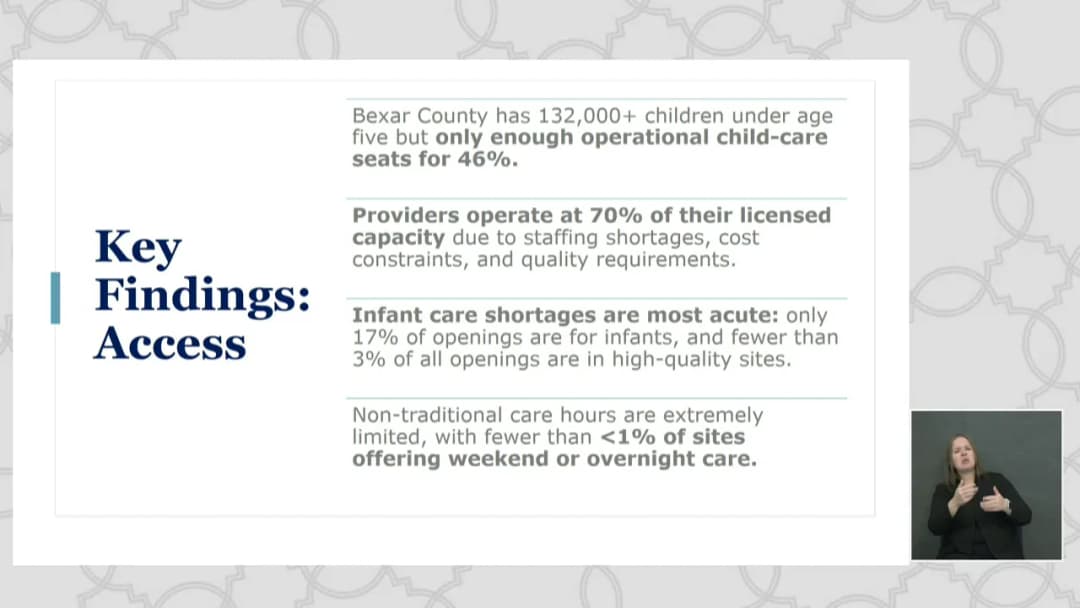
The Education Opportunities Committee convened to review early childhood initiatives from the Departments of Human Services, Pre-K for SA, and the Public Library, followed by a strategic discussion on adopting a community resource mapping tool similar to Dallas ISD's model. The meeting featured detailed presentations on program metrics, enrollment demographics, and workforce development, alongside a contentious public comment regarding municipal election timing and its potential impact on school district funding. Consent Calendar - Approved the minutes of the previous meeting without corrections by unanimous motion. Public Comments & Testimony - Melina Espiritu Asocard (President, North Side AFT): Expressed strong concerns regarding the potential shift of municipal elections from May to November odd-numbered cycles. Argued that such a move could cause school district election costs to rise 20 to 40 percent, potentially diverting resources from classrooms. Stated that families are the primary decision-makers for school board elections and that isolation in city-ISD decision-making creates unintended challenges for public schools. Expressed full support for maintaining a steady, intentional collaboration between the city and public school districts to ensure student success. Discussion Items Early Childhood Program Briefings - Human Services (Melody Woosley): Reported that 50 million in grant and general fund resources are focused on early childhood for Fiscal Year 2026. Noted that Head Start serves 3,300 children, making it the third largest program in the country. Highlighted that almost 40 percent of families in the service area receive SNAP benefits compared to 16 percent citywide. Expressed that 20 percent of currently enrolled children have identified disabilities, exceeding the 10 percent federal minimum. Stated that attendance improved from 92 percent in 2024 to 93 percent in 2025. Discussed the "Ready to Work" child care initiative, noting a 15 percent increase in co-enrollments but identifying barriers such as the requirement for parents to be on waitlists for long-term subsidies and a preference for home care. - Pre-K for SA (Dr. Sarah Bray): Provided data showing the program serves 1,823 four-year-olds and 60 infants/toddlers, with 15 percent of children receiving therapy services. Stated that 18 percent of current enrollment is composed of military families. Presented findings from an early learning landscape study indicating that while 132,000 children under five exist in Bexar County, only 46 percent have child care seats available. Highlighted a critical shortage in infant care, where only 3 percent of openings are in quality-rated centers. Discussed partnerships with Educare at Texas A&M University to serve infants to age five, and plans for summer programming in 2027. - Public Library (Dale McNeill): Outlined services provided by the 30 locations (including the Little Red Wagon mobile unit). Stated that the library provides free virtual homework help and weekly programs for infants, toddlers, and preschoolers focused on pre-literate activities. Emphasized that Little Red Wagon staff work entirely on early literacy, visiting neighborhoods and schools to provide books and parent education. Discussed the social isolation faced by parents and the library's role in connecting families. Noted the lack of a formal data triangulation system between library usage and pre-K/Head Start enrollment but pledged to include self-reporting questions in surveys. Community Resource Explorer Tool (Dallas Model) - Rebecca Flores (HDS): Presented the Dallas Community Resource Explorer, a tool developed by the Child Poverty Action Lab (CPAL) that maps positive and negative community assets within a two-mile radius of schools. Noted limitations including the cost of keeping data current, margin of error when pivot data to different geographies, and the inability to customize indices. Stated that the committee should consider aligning with Texas Education Agency (TEA) block group reporting requirements. - Julia (Bexar County Education Coalition): Expressed support for adapting the model to include all school districts and county-level data. Suggested creating an interactive overlay for ArcGIS dashboards to visualize school locations alongside poverty and infrastructure data. Proposed using the tool for community engagement regarding bond measures. - Councilmember Mungia: Expressed caution regarding external data management, stating a preference for in-house development to prevent data loss if external partners change or funding stops. Advocated for using existing city resources while seeking support from partners like the Urban Education Institute at UTSA. - Councilmember Castillo: Expressed support for the data analysis but emphasized that the ultimate outcome must be equitable resource distribution. Stated that data alone is insufficient without a willingness to have tough budget conversations to direct more funding to underserved areas. Urged the inclusion of data on closed schools to highlight historical under-investment. - Councilmember Corrao: Expressed concerns about housing the tool outside the city due to potential loss of data continuity. Expressed interest in seeing an internal refinement of existing city tools before committing to a new external model. Key Outcomes - Requests for Data: Council requested offline data delivery regarding trends in children born to teen mothers in Head Start (5-year data), homeless referrals sources, and third-grade meeting scores specifically for Edgewood ISD Head Start students compared to non-Head Start controls. - Data Sharing: Council requested that the Library Department provide breakdowns of usage metrics by council district and library branch to identify geographic disparities. Councilmember Mungia requested a current map of child care deserts from Pre-K for SA. - Program Expansion: Pre-K for SA confirmed plans to launch a center at Texas A&M University (Educare) in summer 2026, pilot summer programming for preschoolers in 2027, and pursue a ballot authorization for re-extension in 2028. - Next Steps: The committee agreed to review internal city data tools in February 2026 to determine whether to refine existing resources or pursue an external partnership for a community resource mapping initiative. Staff will investigate opportunities to formalize partnerships with non-city Head Start providers to increase awareness of city services like the Green and Healthy Homes initiative. - Timeline Adjustment: The meeting concluded at 11:50 a.m., with several items noted for follow-up discussion in future meetings.
On December 10, 2025, the San Antonio City Council convened a special B-session to discuss a time-sensitive legislative opportunity to move municipal elections from May to November of odd-numbered years. Staff presented that the 89th Legislative Session passed permissive legislation allowing cities to transition their election dates if a resolution is passed by December 31, 2025. The discussion centered on potential voter turnout increases, cost savings, and the logistical and financial impacts on the seventeen Independent School Districts (ISDs) currently holding elections in May. Consent Calendar - No routine items discussed during this special B-session. Public Comments & Testimony - Julia Grizzard (Texas Association of School Districts): Stated that ISDs are not automatically aligned with the city's election schedule and face potential cost increases if the city moves to November while school districts remain in May. She noted that ISDs must share the cost of polling locations based on the number of participating entities. - Valerie Reffert (Radical Registrars): Expressed full support for moving the election to November, arguing it would increase voter turnout, diversify the electorate, and save the city money. She stated that staying in May benefits the status quo. - Manuel Garza (Southwest Voter Registration and Education Project): Urged the council to support the resolution to move to November, citing potential savings of $800,000 to $1 million and increased voter participation. He emphasized that the vote is about democracy and expanding the electorate. - Graciela Sanchez (Esperanza Peace and Justice Center): Expressed strong support for the change, describing current May turnout as "dismal." She argued that consolidating elections reduces voter confusion and that the opportunity should not be lost. She encouraged supporting the vote even if it feels rushed. - Professor Melissa Marshall (Rice University): Presented data indicating that while odd-year May elections have slightly higher turnout than November odds in San Antonio due to high local contestation, November generally offers higher turnout in broader samples and more contested races. She noted that off-cycle elections often skew toward wealthier, older, and white voters, and that voter mobilization groups typically focus on November. - Dr. Kraft (Northside ISD Superintendent): Raised concerns that moving the city election could increase costs for school districts if they remain in May, as they would have to cover more polling locations per remaining voter. He highlighted logistical challenges regarding board onboarding and fiscal year budgeting, noting that a November election would disrupt the standard onboarding timeline before the August 31 fiscal year end. - Councilmember Mesa Gonzalez: Noted that while a move to November is popular, the rushed timeline is concerning. She emphasized that Dallas took the measure to a public vote before legislative action. Discussion Items - Turnout and Representation: Councilmembers engaged in a debate over whether moving to November would significantly increase turnout. Councilmember Galvan and Councilmember White expressed skepticism that November odd-year elections would yield the drastic increases seen in even years (presidential cycles), citing Houston's 17% turnout as a comparable baseline to San Antonio's runoff rates. Councilmember Rodriguez and Councilmember Via Gran argued that November aligns with voter habit and reduces barriers like high school graduation and Fiesta conflicts. - Financial Impacts and ISDs: Councilmember Corr and Councilmember Castillo sought clarity on the claimed $800,000 to $1 million savings. Assistant City Manager John Bateric clarified that savings are contingent on how many entities move and that costs are allocated by registered voters, not just entities. Several council members expressed concern that the city might shift election costs to school districts, potentially straining their already deficit-ridden budgets. Councilmember Galvan noted that Northside ISD faces a $220,000 to $250,000 potential increase if they remain in May while the city moves. - Timing and Community Input: Councilmember White and Councilmember Castillo argued for delaying the decision to allow for a charter review or public vote, citing the short timeline and the need for deeper community engagement similar to Dallas. Councilmember Rodriguez countered that the council was elected to make tough decisions under time constraints and that current survey data shows overwhelming community support for the change. - Fiesta and Calendar Conflicts: Councilmembers discussed the conflict with the annual Fiesta celebration and the school calendar. While Councilmember Mesa Gonzalez suggested moving Fiesta, Councilmember Rodriguez dismissed this as an insufficient solution, arguing that the psychological association of November with voting remains stronger regardless of Fiesta. - Legislative Constraints: Councilmember White and Councilmember Galvan noted that state law currently only permits movement to November odd-year elections, not even years, making the immediate decision urgent if a move to even years (which would yield higher turnout) is desired in the future. Key Outcomes - No final vote was taken during this B-session. The council agreed to move the item to the A-session agenda for December 18th for further deliberation and a potential vote. - Councilmember Torres (Corr) proposed a meeting with ISD superintendents to discuss cost mitigation and alignment. - The Mayor reiterated that the deadline to pass a resolution is December 31, 2025. - The council adjourned to Executive Session at 4:34 PM to discuss economic development, real property, and legal issues, and reconvened in open session at 5:26 PM to conclude the meeting.
The San Antonio City Council convened on December 10, 2025, to discuss early childhood education initiatives, reviewing progress and partnerships across Human Services, public schools, and the public library system. The meeting addressed challenges regarding service capacity, funding for childcare, and the need for data transparency to better serve families in underserved areas. Council members emphasized collaboration between city agencies, school districts, and nonprofit providers to stabilize communities and expand access to quality care, particularly for military families and those with special needs. Consent Calendar - Approval of meeting minutes unanimously passed on a voice vote. Public Comments & Testimony - Molina Espíritu (North IofT Union Representative): Expressed full support for the committee's existence to improve educational quality. Stated that district stability is crucial as it directly impacts daily lives, noting that 30% to 40% of funding should be focused on classrooms. Emphasized the need for the city to consider the interconnectivity of systems (housing, transport, education) and requested that school districts remain a top priority in decision-making to ensure lasting economic success. - Melody Rousley (Director of Human Services): Provided a detailed report on the Head Start and Early Head Start programs, noting that nearly $43.5 million supports the enrollment of approximately 33,300 children. Highlighted that in 2024, almost 40% of families in the service area receive SNAP assistance. Noted that nearly 2,600 children aged 0-2 with low incomes currently lack access, and that 92% to 93% of attendance rates improved in 2025. Expressed strong support for expanding services to vulnerable populations and families with disabilities. - Sarah (San Antonio Independent School District): Stated that the district serves 1,620 children in early education and prioritizes low-income, unsheltered, and military families (18% of enrolled children). Advocated for the "Ready to Work" program, noting a 15% enrollment increase last year. Expressed a strong position that San Antonio must rise from the bottom of federal rankings regarding childcare capacity, especially for military families. Supported the 2028 ballot initiative for a 20-year authorization period. - Gemini (Assistant Director, San Antonio Public Library): Expressed full support for the "Little Red Wagon" literacy program, describing it as a unique, multi-generational initiative. Positioned the library as a vital, free resource that strengthens neural pathways through play and reading. Advocated for the program's expansion to isolated parents and emphasized the emotional benefit of social connections for families. Discussion Items - Childcare Capacity and Workforce: Council Member Castillo raised concerns about the lack of data on teenage mothers and homeless populations within the service area. She inquired about the specific tools used for emotional development assessment (ELC vs. EDECC) and requested a map visualizing "first childcare deserts" in the city. - Service Integration and Data: The Council discussed the need to triangulate data between library usage, Head Start enrollment, and socioeconomic indicators. Council Member Core suggested integrating digital library access data with family surveys to better understand community usage patterns. Council Member Mungía stressed the importance of overlaying different data sets (housing, income, school locations) to create a unified view of resource distribution across the county. - Funding and Eligibility Barriers: Discussion highlighted that "Ready to Work" childcare funds were lower than anticipated ($195k spent vs. $1M budget), with barriers identified as complex application processes and a lack of awareness among parents. It was noted that many parents rely on informal family care, which is not eligible for subsidy. - Infrastructure and Partnerships: Council Member Mungía supported the development of a new childcare center in West San Antonio, specifically linking it to the ACLAN military base to serve local families. The Council discussed potential partnerships with affordable housing developers to co-locate childcare services, though the City clarified it does not dictate housing site selection. Key Outcomes - The Council unanimously acknowledged the critical role of Human Services, SAISD, and the Library in early childhood development. - A directive was implicitly issued to departments to collaborate on creating a unified data dashboard that overlays school districts, libraries, and housing resources to identify service gaps. - The Council expressed commitment to reviewing the "Little Red Wagon" program for potential expansion to address social isolation among parents. - Further discussion and a formal report on the proposed "Data Collaborative" (similar to the Dallas model) were scheduled to identify specific data gaps and funding alignment strategies with the county and non-profits. - No formal votes were taken on new appropriations during this session; the meeting focused on information sharing and strategic alignment.