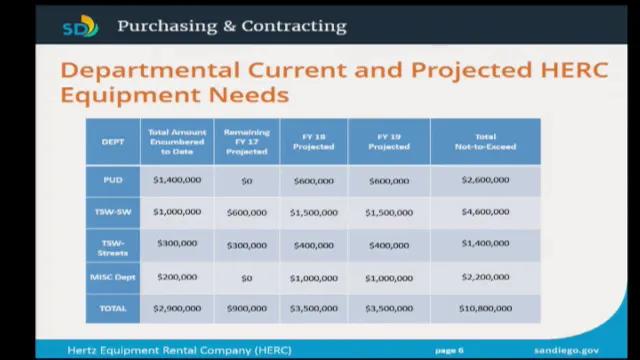
The Budget and Government Efficiency Committee met on May 24, 2017, to consider four action items: an amendment to the banking services contract, additional funding for water main break remediation services, an amendment to the Hertz equipment rental agreement, and a new marketing partnership with Service Line Warranties of America. All items were approved unanimously. Consent Calendar - The committee approved the record of actions from the March 22, 2017 meeting by unanimous consent. Public Comments & Testimony - An unidentified public speaker expressed concern about the city's pension obligations, stating that pension funds are "hidden" in city funds and that fixing the pension would be easy if unspent funds were used. The speaker noted that a pension-related vote ends in 2018 and said the committee has the power to address the issue. - Mr. Chipman, speaking on behalf of San Diegans for Safe Neighborhoods, urged a moratorium on all additional marijuana commercialization permits until state regulations are in place. He cited reports from Denver District Attorney Mitch Morrissey showing that every crime type increased in every Denver neighborhood after legalization, and argued that commercialization encourages lawlessness. Item 1: Banking Services Contract Amendment (Bank of America) - Kent Morris, Chief Investment Officer, requested approval to authorize the Chief Financial Officer to expend up to $9,050,000 for the Bank of America banking services contract, increasing the not-to-exceed amount from $5.75 million by $3.3 million. The increase is needed because 5,700 smart parking meters installed in fiscal year 2015 accept credit/debit cards. - Morris reported that in FY17 the city averages about 200,000 credit card transactions per month, generating about $65,000 in merchant fees. Credit card usage rose from 54% to just over 60%, and parking meter revenue increased by an average of 19% over the last two fiscal years; Councilmember Gomez noted revenue increased by $1.7 million per fiscal year. - Councilmember Gomez expressed discomfort with continuing to do business with Bank of America given its impact on the housing crisis, and asked about community criteria in contracting. Staff disclosed that a Responsible Banking Ordinance from 2012 created a committee that has never met; Gomez requested a copy of the ordinance. - The item was approved with a motion by Councilmember Sherman, seconded by Councilmember Kate. Item 2: Additional Funding for Remediation and Cleanup Services (Luth and Turley) - Risk Management Director Julio Canistal and Claudia Castillo requested an additional $1.5 million to complete the current contract year, bringing the total to $4 million, plus a month-to-month extension through June 2018 with a not-to-exceed amount of $1 million. - The request stems from a January 5, 2017 water main break in North Park, where a 50-year-old, 30-inch cast iron pipe ruptured under home plate at the baseball field at North Park Recreation Center. Approximately 82 claimants incurred property damage, with remediation costs estimated at about $3 million. - The RFP for a new contract is expected to be issued within the next month; from responses to award typically takes about 65 days. - Councilmember Kate asked how the contractor assists residents; Councilmember Gomez asked about RFP timing and general fund impact; staff confirmed funding comes from water and sewer funds, not the general fund. Councilmember Sherman asked about remaining cast iron pipe mileage; Tom Howard, Deputy Director of Water Construction, said he would provide that information. - The item was approved with a motion by Councilmember Kate, seconded by Councilmember Sherman. Item 3: Hertz Equipment Rental Agreement Second Amendment - Purchasing Director Christina Peralta and Deputy Director Matthew Helm requested approval to exercise the second amendment to the Hertz Equipment Rental Company (HERC) contract, extending it through March 2018 and increasing expenditure authority to $11 million not-to-exceed through the contract life in 2019. - The contract provides about 40% off retail prices and platinum-level pricing, and covers a wide range of equipment for day-to-day operations, including stormwater channel clearing and drought response. The original $3 million authority has been nearly exhausted due to wet weather and increased department needs. - Councilmember Sherman asked about pricing guarantees and whether rentals are supplementing fleet deficiencies; Alia Corey, Director of Fleet Operations, confirmed the mill and pave machines are now in service. Councilmember Gomez asked about the large increase and general fund impact; staff stated most funding comes from non-general fund accounts. - The item was approved with a motion by Councilmember Sherman, seconded by Councilmember Gomez. Item 4: Marketing Partnership Agreement with Service Line Warranties of America (SLWA) - Natasha Kalara, Executive Director of Corporate Partnerships, presented the second amendment to the SLWA agreement. The five-year partnership includes three mailings per year, is fully funded by SLWA, and provides the city an annual payment of $56,250 (minimum $281,250 over five years), estimated licensing fees of almost $500,000, and a one-time $150,000 donation to the H2O fund for low-income water rate assistance—totaling approximately $914,250. - Over 8,000 San Diegans purchased home warranties under the previous contract; about 20% used the service, and the program has a 92% satisfaction rating. - Councilmember Gomez asked about the H2O fund; Mike Vogel, Deputy Director for Public Utilities, said details will be presented to the Environment Committee next month. Councilmember Sherman noted the improved transparency with the city's phone number included. - The item was approved with a motion by Councilmember Gomez, seconded by Councilmember Sherman. Key Outcomes - All four action items were approved unanimously by the committee. - The committee approved the record of actions from March 22, 2017. - The committee will reconvene on Wednesday, June 21 at 9 a.m.
Public Meetings - San Diego, California
Public Meetings - San Diego, CaliforniaThis regular meeting of the San Diego Infrastructure Committee was held on May 24, 2017, chaired by Chris Kersey, with Vice Chair Scott Ward, Councilmembers Lorie Zapf and David Gomez present. The committee reviewed several items, including a report on project controls improvements, approval of three golf course construction contracts, an annual CIP budget monitoring report with over $40 million in adjustments, and an updated public facilities financing plan for Black Mountain Ranch. Chair Kersey recused himself from item 7 due to a conflict of interest. Consent Calendar - Items 1, 2, and 3 were adopted unanimously via a single motion. These items were routine administrative approvals. Public Comments & Testimony - Non-agenda public comment: Martha Welch spoke about poor road conditions in the city, citing specific locations (Broadway, Sports Arena area, market between 23rd and 26th). She criticized the city's repair priorities and noted problems with bus stops and bike lanes. No other public testimony was offered on agenda items. Discussion Items - Item 4: Amendment to Atkins North America Agreement (Project Controls Gap Analysis) - Staff from Public Works (Richard Leija, Mosin Maui, James Nagelberg) presented a request to increase the contract with Atkins by $680,000 (from $120,000 to $800,000) and extend it through July 2019. The original contract funded a gap analysis of the city's Capital Improvement Program (CIP) project controls, which produced over 30 recommendations. The additional funds would support implementation, including software upgrades, new classifications, and training. The CIP budget grew from $180 million in 2014 to $445 million in 2018, projected to reach $605 million. - Councilmember Gomez questioned why the work wasn't being done in-house and expressed a preference for investing in city staff. Vice Chair Ward raised concerns about the significant scope change and potential lack of competition, noting the contract was originally awarded competitively. He urged bringing the work in-house. - The motion to approve staff recommendation passed 3-1 (Vice Chair Ward opposed) and was forwarded to the full City Council without a recommendation. - Item 5: Multiple Work Construction Contracts (MACs) for Golf Course Improvements - Staff requested approval to enter into three design-build MACs with a total capacity of $14 million over three years. The first task is anticipated for Torrey Pines South golf course improvements (estimated $6-7 million) ahead of the 2021 U.S. Open. No other tasks have been identified. The committee approved unanimously. - Item 6: FY17 CIP Year-End Budget Monitoring Report & Revisions - Matt Besby and Michael Clark (Financial Management) presented a consolidated request for $40.6 million in budget adjustments: $23.1 million in new appropriations, $14.3 million in reallocations, and $3.2 million in deappropriations. The report consolidated about 100 separate actions, saving 485 staff hours. Updates included cash management progress, Transnet fund balance projected at $26.4 million (less than one year's revenue), and commercial paper program developments. - Councilmember Zapf moved to amend the report to allocate $200,000 ($120,000 from Ocean Beach DIF fund and $80,000 from Fire Rescue and Lifeguard Facilities fund) to begin preliminary engineering for a new Ocean Beach Lifeguard Station, replacing a legacy project from 2002. The motion passed unanimously. - Councilmember Gomez noted the closure of the College Area fire station CIP ($270,000) with funds redirected to the Tubman Charter Joint Use Improvements Project. - IBA representative Gillian Cassidy highlighted changes to ADA reporting, uncommitted fund balances, and the absence of a traditional waterfall list for underfunded projects; staff indicated a new process will be presented in June. - Item 7: Black Mountain Ranch Public Facilities Financing Plan (PFFP) FY17 Update - Staff (Marco Camacho, Bill Crane, Angela Beta) presented the updated PFFP, which would replace the 2014 plan. The community is 86% developed, with 515,000 sq. ft. of employment space and a 300-room hotel still planned. A $34 million starting fund balance allowed for an 11% reduction in fee rates. Notable projects include the Delcer Neighborhood Park (opening fall 2017) and Fire Station 48 (negotiations underway). The Rancho Peñasquitos Planning Board voted 14-1-1 to recommend approval. The committee unanimously approved the item (Chair Kersey recused). Key Outcomes - Item 4: Approved and forwarded to full Council without recommendation (3-1 vote). Staff committed to providing a clearer scope summary. - Item 5: Approved unanimously. - Item 6: Approved unanimously with an amendment to fund $200,000 for preliminary engineering on a new Ocean Beach Lifeguard Station. The report will be forwarded to the full Council. - Item 7: Approved unanimously (Chair Kersey recused). The plan and associated fee schedule will go to the full Council. - The next regularly scheduled Infrastructure Committee meeting is June 21, 2017 at 2 p.m.
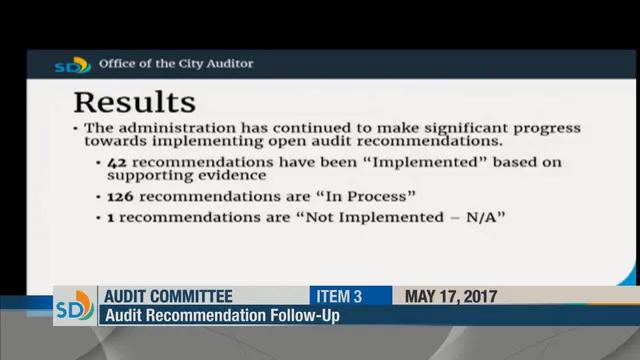
This meeting of the City Council's Audit Committee was held on May 22, 2017 (note: the transcript references May 17, 2017, but the official date provided is May 22, 2017). The committee reviewed audit activity, a performance audit, and the status of audit recommendations. Members present included Chair (unidentified), Councilmembers Ricardo Valdivia, Alan Spencer, Tom Hebrank, and others. Staff from multiple city departments attended to answer questions. Consent Calendar - The committee approved the records of action from the April 12, 2017 meeting by unanimous consent without discussion. Public Comments & Testimony - Martha Walsh, a member of the public, expressed dissatisfaction with the lack of performance audits since 2015. She specifically mentioned the Mission Bay Fund and stated she had been investing in it for about two years and wanted to understand why money was not being allocated appropriately. She urged the committee to examine that fund. Discussion Items - Monthly Activity Report (presented by City Auditor Eduardo Luna): Provided updates on issued audits (special event permit process, recommendation follow-up), audits in progress (Excel implementation IT audit, economic development incentives, lifeguard tower construction, etc.), and new staff hires. No action required. - Performance Audit of Special Event Permit Application Process (presented by Shawnee Pickney and Luis Briseño): The audit found the department invoiced fees correctly (less than 1% exceptions), collected fees per AR 6330, issued permits as required, and conducted environmental reviews per a 2014 lawsuit settlement. The main observation was that invoicing took an average of 63 days after application review began; one recommendation was made to develop a standard billing timeframe. Department Director Carolyn Wormser confirmed staff have addressed the issue with an analyst. Committee members praised the audit and the department. - Audit Recommendations Follow-Up Report (presented by Danielle Knighton): As of December 31, 2016, there were 169 open recommendations across 44 audit reports. During the period, 43 recommendations were implemented or no longer applicable, leaving 126 to carry forward; 55 of those were past due. Of the 126, 36 were over two years old. One recommendation regarding the Qualcomm stadium was deemed no longer applicable. The committee then reviewed statuses department-by-department, with many departments citing pending technology implementations (e.g., Accela, Ariba) and legal processes as reasons for delays. Key Outcomes - The committee accepted the performance audit report and forwarded it to City Council unanimously. - The committee accepted the recommendation follow-up report and agreed to drop the Qualcomm stadium recommendation (unanimous). - Various departments provided progress updates; some target dates were revised (e.g., Development Services tied to Accela go-live on June 19, 2017; Purchasing Contracting tied to Ariba go-live on June 12, 2017). - The committee requested departments to provide more accurate target dates and explanations for delays in future reports. (Note: The date discrepancy between the transcript and the provided date is noted.)
The Budget Review Committee of the San Diego City Council met on May 18, 2017, at approximately 10:00 AM to review the Fiscal Year 2017 Year-End Budget Monitoring Report and the Mayor's May Revision to the Fiscal Year 2018 Proposed Budget. The committee heard public testimony, deliberated on revenue and expenditure projections, and voted on the year-end report. Non-Agenda Public Comments - Catherine Rhodes recommended that the council pursue a 3% increase to the Transient Occupancy Tax (TOT) directed to the general fund, and reclassify online travel agencies as hotel operators to capture additional revenue, citing Santee's Proposition U as a model. She argued this would not be a tax increase but a tax diversion from out-of-state agencies. - Martha Welch complained about poor road conditions on Market Street and other streets, criticizing the city's reliance on low-bid contractors. She also opposed spending $5 million on a special election, stating the money could be used for parks, senior centers, and other projects. Item 1: FY2017 Year-End Budget Monitoring Report - Presentation: Financial Management Director Tracy McCraner, Budget Coordinator Vanessa Montenegro, and Deputy Director Matt Vespee reported a projected general fund surplus of $11.2 million, driven by $15.4 million in excess revenue (including a one-time $13.6 million payment from the county for annexation of property near Mount Hope Cemetery) offset by $4.2 million in over-budget expenditures (primarily fire rescue full staffing and police/fire overtime). Major revenues exceeded budget by $12.4 million, while expenditures were over budget by 4.2 million. Risk management reserves were projected to meet policy targets. The report included recommended appropriation adjustments and year-end budget authorities. - Public Testimony: Martha Welch questioned why sales tax did not decrease after Proposition 30 ended, and criticized franchise fees and insurance company practices. - Council Discussion: Councilmember Gomez requested details on how the Mount Hope annexation funds would be used for maintenance in surrounding communities. Councilmember Ward asked about franchise fee negotiations with SDG&E (still years away) and noted a housing commission letter recommending a reduction in inclusionary housing fees. Councilmember Kate clarified that the sales tax increase from a one-time correction was not ongoing, and inquired about the Qualcomm Stadium fund transfer. Councilmember Alvarez asked about the unused park and recreation savings that were transferred to Qualcomm. - Vote: The committee unanimously adopted the FY2017 year-end budget monitoring report. Item 2: FY2018 May Revision to the Proposed Budget - Presentation: Deputy Director Matt Besby, Budget Coordinator Adrian Del Rio, and Director Tracy McCraner presented a $14.6 million increase in expenditures and 5.5 new positions, funded by updated ongoing revenues ($500,000), $14.1 million in excess equity, and minor reductions. Key additions included: $2.4 million one-time for arts and culture, $150,000 for a police officer recruitment/retention study and marketing plan, $100,000 for police chief recruitment, three positions in the city attorney's office for domestic violence and neighborhood prosecution, $800,000 for a littering and graffiti abatement pilot program, funding for tree planting under the Climate Action Plan, $10.3 million to pre-fund the general fund reserve, and $215,000 for IT projects in the city treasurer's office. The May revise also incorporated Senate Bill 1 (gas tax) funding, freeing up $10.2 million in the Infrastructure Fund for drainage, facility improvements, and road repairs. - Public Testimony: Over 30 speakers, mostly in opposition to arts funding cuts. Key speakers: - Lissa Corona (San Diego Art Institute) requested flat funding of $15.1 million for arts, emphasizing the economic and educational value of the arts. - Karen Andrus (Coral Club of San Diego) opposed cuts, noting that small arts organizations are disproportionately impacted. - Alan Zider (San Diego Regional Arts and Culture Coalition) asked for $15.1 million flat funding, noting that every city arts dollar leverages three-to-one private matching funds, and that a cut would result in loss of $9.2 million in total resources. - Jean Samuels (Spreckles Organ Society) described the importance of city funding for the free public concerts. - Ann Feige (Community Forest Advisory Board) requested restoration of $880,000 for shade tree pruning, warning of increased tree failure risks and city liability. - Freedom Bradley Ballantine (Old Globe Theatre) urged restoration of arts funding, citing programs that serve homeless and correctional facilities. - Jorge Rivas (Old Globe) shared personal testimony that arts programs saved his life. - Sophie Wolfram (Climate Action Campaign) requested funding for Community Choice Energy, bike lanes, and tree pruning restoration. - Andy Hanshaw (Bicycle Coalition) emphasized the need to fund climate action plan goals and bike infrastructure. - Larry Baza (Arts Commissioner) thanked council members and requested $15.1 million for arts. - Robert McNamara (District 3) supported the mayor's budget as balanced and opposed Proposition H waiving, suggesting an extra $80,000 for beach trash pickup. - Amanda Lee (ACLU) urged a community-inclusive process for the police chief search, with a diverse stakeholder committee. - Council Discussion: - Councilmember Ward expressed concern about the arts still being shortchanged despite the $2.3 million restoration, and questioned the $10.3 million reserve pre-funding (exceeding FY19 target) and the $800,000 for graffiti abatement (which was not publicly requested). He also noted the lack of funding for police recruitment/retention beyond the study. - Councilmember Alvarez also supported arts funding at FY2017 levels, questioned the graffiti program's origin, and expressed concern about police staffing levels and the need for a public process for the police chief search. He asked about SB1 funds being used for slurry seal and questioned Fire Station 22 funding vs. other priority stations. - Council President Cole thanked the public and staff, supported the police chief search with community input, and noted that arts and libraries remain priorities. - Councilmember Sherman noted the difficulty of future budgets and the need to replenish the pension stabilization reserve. - Councilmember Zaf (likely Councilmember Zapf) highlighted the importance of arts and culture funding, including festivals and parades, and advocated for looking internally for the next police chief to avoid morale issues and unnecessary spending. - Councilmember Kate asked about franchise fee projections, channel clearings, and minor expenditures for parking citation hearings and CAFR software. She supported pre-funding reserves to ease next year's deficit. - Councilmember Kercy (Council President Pro Tem) asked about the one-time nature of the arts funding and praised infrastructure projects funded by SB1. - Chair Bree outlined her priorities: police recruitment/retention (including funding for AB 953 compliance), lifeguard training, and lifeguard staffing at Children's Pool. Key Outcomes - The FY2017 Year-End Budget Monitoring Report was unanimously adopted. - The FY2018 May Revision was discussed in detail; no final vote was taken. Councilmembers will submit budget memos by May 22, 2017, with further prioritization. The Independent Budget Analyst (IBA) will issue a report on the May revise on June 1, 2017. - The committee will continue to deliberate on the FY2018 budget before adoption.
The Smart Growth and Land Use Committee met on May 17, 2017, with Chair Sherman and Councilmembers Alvarez, Gomez, and Kate present. Staff from the City Attorney's Office and the City's Real Estate Assets division assisted. The committee unanimously approved the April 12, 2017 meeting minutes, approved the consent calendar, and took action on appeal fee and process updates and the fiscal year 2018 Affordable Housing Fund Annual Plan. Consent Calendar - The four-item consent calendar was approved unanimously. - Bay Shore Bikeway maintenance agreement: Councilmember Alvarez raised concerns about overgrown vegetation impeding the bikeway. Nathan Patterson of the Street Division said that location is not related to the brush issue and his office would work with council staff to address abatement. - Sangu Square property: Martha Welch spoke in opposition, saying she has known the property since it was built under Mayor O'Connor, that it was originally HUD-assisted, and that it looks better outside than inside; she opposed selling it again. - Wireless telecommunications facility leases: Councilmember Alvarez asked whether surveillance equipment such as ShotSpotter could be installed on these leased facilities. Sabelle Thompson, Director of Real Estate Assets, explained that the item further defines wireless telecommunications facilities and that the city has historically included non-personal uses such as government and broadcast equipment, typically on mountaintops. Alvarez said he wanted more information before the item goes to council. Public Comments & Testimony - A non-agenda speaker asked the city to hold off issuing more licenses for marijuana product manufacturing until safety, extraction, sanitary manufacturing, packaging, and labeling standards are established. - John Stoll, a vacation rental operator in a CC-PDR zone, said his two units are near an SRO hotel with 70 beds and a tattoo parlor open until 3 a.m. He stated he has paid $50,000 in taxes, has had no police complaints, and intentionally bought in a commercial zone where vacation rentals should be permitted; he asked the committee to distinguish between residential-emphasis RE zones and residential-estate RE zones. - Martha Welch, in non-agenda comment, criticized current downtown building, saying many new projects are empty while affordable housing is scarce, and called for more affordable housing. - On the appeal fee item, David Modi, representing the Community Planners Committee and San Diego's 42 community planning groups, asked the committee to maintain the current exemption from appeal fees for community planning groups, saying they have used appeals judiciously. - On the Affordable Housing Fund plan, Martha Welch opposed the item and questioned whether listed projects were truly multifamily and whether the addresses were correct. David Modi, speaking as a Talmadge resident, supported the item and proposed developing an objective standard for measuring neighborhood affordable housing saturation. Discussion Items Item 6 - Updates and Expedites to Appeal Fees and Processes - Staff presented a proposal to update appeal fees and processing for process 4 appeals and environmental determination appeals. Current fees are $100 for individual appellants and $0 for community planning groups, set by a 2000 ordinance. - For fiscal years 2015 and 2016, there were 32 appeals. The average appeal delay was 104 days, the average cost to the applicant was $9,802, an average of 11 city staff members handled each appeal, and total city staff time exceeded 2,200 hours. Applicants paid over $300,000. - An analysis of selected California cities found appeal fees ranging from $100 up to $5,479, with San Diego on the low end. A Prop 26 analysis found the average council appeal hearing cost the general fund $1,243, while only $242 was reimbursed, leaving more than $1,000 unrecovered per hearing. - The committee approved recommendations to: (1) raise the appeal fee to $1,000 for individual appellants; (2) require appeal hearings within 60 days, with tentative-map appeals heard within 30 days under the Subdivision Map Act; and (3) provide that if all appellants withdraw, the last decision becomes final and does not go to the full city council. - During discussion, Councilmember Alvarez asked about waivers in other jurisdictions and legal support for the fee; staff confirmed most agencies allow waivers for community planning groups and the City Attorney's Office supported the fee. Councilmember Kate supported retaining the community planning group waiver. The motion carried unanimously. Item 5 - Fiscal Year 2018 Affordable Housing Fund Annual Plan - The San Diego Housing Commission requested approval of the proposed FY2018 Affordable Housing Fund Annual Plan, allocating $74,244,502 in anticipated funds and authorizing the agency's president/CEO to reallocate funds among model programs in response to market opportunities. - The plan covers the Inclusionary Housing Fund and Housing Trust Fund. Of the projected $62.6 million fund balance, $27.5 million was already committed, and three pending projects would commit another $23 million, leaving roughly $4 million available. - Proposed model program changes include updating rental housing production scope and terms, adding an affordable housing transit-oriented development revolving loan fund seed investment, adding a Clean and Green homeowner sustainability loan program under housing rehabilitation, and adding landlord engagement, prevention and diversion assistance, outreach and navigation, and moving on rental assistance under homeless housing initiatives. - Anticipated outcomes include approximately 480 new rental units, assistance for 10 homebuyers, 625 transitional housing beds, rapid rehousing for 180 households, landlord engagement for 850 households, and diversion of 300 households from homelessness. - Councilmember Alvarez requested a clearer breakdown of new fee collections versus loan repayments for each fund. Councilmember Kate asked about developer referrals to Civic San Diego and about Promise Zone opportunities; Housing Commission staff said Promise Zone work was underway and reviewed how resources could be targeted there. Councilmember Gomez noted the inclusionary fee is dropping from $9.36 to $7.03; staff said the change may reduce fee revenue but increase the number of affordable units through the density bonus program. - The motion to approve the annual plan and requested authorization passed unanimously. Key Outcomes - Approved the four-item consent calendar unanimously, including the Bay Shore Bikeway maintenance agreement, Sangu Square property action, and wireless facility lease definitions. - Approved the appeal fee and process updates unanimously, increasing the individual appeal fee to $1,000, setting 60-day hearing deadlines (30 days for tentative-map appeals), and eliminating full council hearings when all appellants withdraw. - Approved the FY2018 Affordable Housing Fund Annual Plan unanimously, with a request to provide a clearer breakdown of fee collections versus loan repayments. - The next Smart Growth and Land Use Committee meeting was scheduled for June 14, 2017 at 2 p.m.
The Budget Review Committee (BRC) of the San Diego City Council met on May 10, 2017, at 5:30 PM to review the proposed FY18 budget for the Communications Department. The meeting was chaired by Barbara Bree, with Council President Cole, Councilmember Kate Sherman, and Councilmember Gomez present. No public testimony was offered. The committee heard a presentation from Communications Director Katie Keach and discussed the department's performance, budget adjustments, and upcoming initiatives. Discussion Items - FY18 Communications Department Budget Presentation: Director Katie Keach presented the proposed budget, highlighting a slight overall increase of just under $70,000 and a reduction of 2.5 positions (a vacant senior public information officer, an executive secretary who transferred within the city, and an unused hourly intern position). She reported that the department is on track to meet its key performance indicators, including 52 features posted online. Social media engagement has grown significantly: Facebook likes increased from 4,400 to over 6,200, and Twitter followers rose from under 3,000 to nearly 5,300 since July 2016. The department also centralized communications functions and is developing a citywide photo library, a social media policy (including personal use for employees), and a citywide communications plan that serves as a living document. - Revenue Projections: The Independent Budget Analyst (IBA) representative, Trisha Tackey, noted that the department's revenue projections were discussed in the IBA report, but no additional comments were needed. Director Keach clarified that the current year's expenditures are under budget by approximately $24,000, mitigating the revenue shortfall and ensuring no undue impact on the general fund. - Vision Zero Education Campaign: Councilmember Gomez and Council President Cole expressed support for the campaign. Director Keach confirmed that the campaign will target all roadway users, with a "heads up" message against distracted walking, driving, and biking. The department plans to use Cox Communications PSA packages (earned media) for the campaign, and it will be part of a broader Vision Zero plan presented to the council. - Community Outreach and Engagement: Councilmember Gomez emphasized the need for better communication during community plan updates (e.g., Claremont and Kearney Mesa). Director Keach noted that the department is exploring tools like Facebook Live for meetings and suggested door hangers as an effective outreach method, as recommended by the chair. The department works with client departments to develop tailored communication strategies. - Social Media Policy: The social media policy is under development, with a draft focused on departmental accounts. The department is collaborating with HR to add a personal use policy for employees. Key Outcomes - No formal votes were taken; the committee received the presentation and discussed the budget. - The BRC will hold an evening hearing on Monday, May 15, 2017, at 6 PM to take additional public feedback on the budget. - The committee will reconvene on May 18, 2017, to review the May revise and the 2017 year-end budget monitoring report. - Final budget modification priority memos are due to the IBA by May 22, 2017.
The Budget Review Committee of the San Diego City Council met on May 9, 2017, to review the FY2018 proposed budgets for Development Services, Planning, Economic Development, Civic San Diego/Successor Agency, and Real Estate Assets. The meeting included public testimony, departmental presentations, and comments from the Independent Budget Analyst (IBA). Key concerns were raised about proposed cuts to code enforcement positions, the need for affordable housing, and community plan updates. Public Comments & Testimony - Non-agenda public comment: Martha Welch raised concerns about the SMART program, fire station conditions, and transparency. - Development Services: Ann Fage (Community Forest Advisory Board) opposed cuts to code enforcement for trees. Jean Hogar, Andre Beauparlant, and Armin Kuhlman (College Area Code Enforcement Volunteers) opposed cuts to code enforcement, arguing it undermines voluntary compliance and neighborhood quality. They noted that 1,200 letters were sent to nearly 700 properties, with 76% voluntary compliance, but 140 properties remain out of compliance due to lack of enforcement. - Planning: Muriel King (Forestry Board) emphasized trees for walkability and urged more trees along sidewalks. Mark Steele (Barrio Logan Planning Group) requested certainty and a timeline for the community plan update. Isabel Kaye (Community Forestry Advisory Board) supported the parks master plan and tree planning for climate resiliency. - Civic San Diego: Daniel Reeves (Downtown San Diego Partnership) supported the Fred program and called it a worthwhile public investment. - Real Estate Assets: Martha Welch spoke against using TOT funds for the stadium special election. Discussion Items - Development Services (DSD): Director Bob Vacky presented performance metrics: 54% more solar permits issued in 2016 (top in U.S.), 150,000 inspections/year, 106,000 reviews/year. Proposed budget includes $250,000 for nuisance abatement fund, reduction of two code compliance officer positions (leaving two), and an alternative compliance program for low-priority violations (e.g., barking dogs, parking on lawns). IBA noted the reduction would impact non-health/safety violations. A $1.5 million penalty from the Regional Water Quality Control Board was included. Council members (Ward, Gomez, Cole, Alvarez, Sherman) expressed strong concern, with several noting the cuts contradicted their budget priority memos. The department aims to implement new ASELA tracking system in June 2017. - Planning Department: Director Jeff Murphy presented budget with two new staff for regulatory reform and housing initiatives. Key initiatives: seven simultaneous community plan updates, transit priority area parking standards (18-month timeline), workforce housing density bonus, accessory dwelling unit ordinance (summer 2017), and Barrio Logan plan update. IBA noted transfer of urban forestry to Transportation/Stormwater. Council members questioned timelines for legacy plans (Midway, Old Town) and Barrio Logan (2 months for stakeholder meetings). Councilmember Gomez urged faster completion of community plans and criticized starting new ones before finishing old ones. - Economic Development: Director Eric Caldwell presented budget with reductions: $250,000 cut to Civic San Diego support, $179,000 in program support reductions (including $25,000 to workforce partnership, offset by CDBG). Six new FTEs for reinvestment initiative (CDBG repayments of $215 million over 10-15 years). IBA noted discrepancy in successor agency transfer ($3.3M vs $2.7M) to be corrected in May revise. Council members asked about homeless services funding ($2.3M maintained), small business enhancement program (SBEP) funding below policy goal, and the relationship with Civic San Diego. - Civic San Diego and Successor Agency: President Reese Jarrett presented Civic San Diego's budget of $8 million, with 2 FTE reductions. Highlighted projects: New Markets Tax Credits ($83M allocated), affordable housing (OC Courtyard, Atmosphere), Fred program (86,000 rides since August 2016). Successor agency budget of $3.7 million, funded by ROPS, with $2.4 million administrative and $541,000 project management costs approved by DOF. IBA noted significant decrease in successor agency funding. Council members asked about wind-down of 22 redevelopment sites (5 under contract), central library RFP (withdrawn, awaiting city direction), and parking district revenue. - Real Estate Assets: Director Sibelle Thompson presented budget with $1.5 million increase in non-general fund expenditures. Key items: $3.5 million transfer to general fund for a proposed special election on TOT increase (from Chargers lease termination fee), $600,000 for DeAnza Mobile Home Park management (vacant), $5 million reduction in Qualcomm Stadium expenses after Chargers departure. Sold 11 surplus properties for $24 million (3.3M above appraisal). Council members discussed stadium future, suite/signage sales, and Petco Park police services cap. Councilmember Ward suggested not using the $3.5 million for the special election. Key Outcomes - Code Enforcement: Council members unanimously opposed the reduction of two code compliance officers. The committee will monitor the alternative compliance program and may seek to restore positions in the final budget. - Planning Timelines: The committee requested faster timelines for community plan updates, especially Barrio Logan. The department will provide updates on the central library RFP and Barrio Logan plan within two months. - Successor Agency: The $3.3 million transfer to Civic San Diego corrected to $2.7 million in May revise. Council requested a full list of remaining redevelopment sites. - Qualcomm Stadium: The committee acknowledged the $3.5 million transfer for a potential special election. Councilmember Ward suggested not using the funds for the election. The department will continue discussions on naming rights and contingency planning. - General: Council members emphasized the need for performance metrics, especially for customer experience in development services and code enforcement response times.
This afternoon session of the Budget Review Committee featured presentations from the San Diego Housing Commission, the San Diego Employees Retirement System (SD SERS), the San Diego Convention Center Corporation, and the Ethics Commission. The committee heard public testimony and discussed budgets, homelessness programs, investment returns, facility maintenance, and regulatory oversight. The meeting was chaired by Councilmember Barbara Breed with a quorum present. Consent Calendar - No consent calendar items were identified. Public Comments & Testimony - Martha Welch (speaker in opposition) criticized the Housing Commission budget, alleging "50 million for salaries" and stating that the Section 8 program is not functioning properly because landlords are not paid by the county and that the AMI calculation is preventing affordable housing. - Ann Murphy (Cortez Hill Residents Group) opposed using the old Central Library as a homeless facility, urging alternative locations outside downtown, such as Golden Hill. - Todd Hutchins (speaker in opposition) argued the Housing Commission's plan has not worked, stating homelessness is skyrocketing and affordable housing declining. He claimed rehabbing units displaces low-income people and that proposed 500 new permanent supportive units are insufficient compared to 8,000 homeless. - Bob Link (East Village resident) spoke in favor, congratulating the Housing Commission on an aggressive budget to address homelessness, but requested accountability for placement numbers and suggested using the Midway Post Office site for immediate impact. - Sarah Watkins (East Village resident) noted an oversized concentration of homelessness in downtown, reducing the tax base and hindering redevelopment. - Joan Wolchik (President, East Village Residence Group) supported the budget but opposed using the old library, recommending Golden Hall for 18 months while developing long-term solutions like Sunbreak Ranch and the Campo juvenile facility. - Daniel Reeves (Downtown San Diego Partnership) supported the Housing Commission budget but urged using funds for long-term solutions rather than a temporary shelter at the old library. - Claudine Scott (East Village resident) encouraged not using the old library, suggested selling it for $12 million to fund permanent housing, and favored Golden Hall. - Jason Wood (East Village resident, business owner) expressed concern over concentration of homeless facilities downtown and urged moving more resources outside downtown. - David Gapp (retired Lieutenant Colonel) supported the budget but asked the council to mitigate the impact of homelessness in East Village and not put more services in the old library. - Michael Trimble (Gaslamp Quarter Association) favored approving the budget but requested resources be directed away from the old library, suggesting 20th and B or Golden Hall. - John Clut (business owner, Cafe Chloe) described physical attacks on himself and guests, stating the coexistence of homeless services and businesses in East Village is untenable for both. Discussion Items San Diego Housing Commission (FY 2018 Proposed Budget) - Presenter: Jeff Davis (Chief of Staff) and Tracy McDermott (CFO). The budget request is $433 million, up from $368 million in FY 2017 (an increase of $65 million, 17.7%). The increase is attributed to $21.3 million in federal funds for affordable housing acquisition/rehabilitation, $32.7 million in fund balance from prior years, and new programming. - Key Elements: Hiring 26 additional staff; $28 million for the third phase of "Housing for San Diego" (three-year proposal) including prevention/diversion for 1,000 families, rapid rehousing for 600 families, expansion of landlord engagement, and acquisition/construction of up to 500 new permanent supportive units. - Financial Management Technical Review: Presented by Adrian Del Rio. Noted the budget includes 5% reduction in actual disbursements from HUD for housing assistance programs. Reserves of $84.3 million (increase of $5.4 million). - IBA Comments: Presented by Trisha Tackey. Highlighted $70 million for homeless program expenditures (increase of $55% over FY17). Noted relocation of Neil Good Day Center no longer likely; renovation plan being developed by city and Housing Commission. Noted federal funding reliance (81% from federal sources) and potential impact of proposed elimination of CDBG and HOME programs. - Council Questions: - Councilmember Ward inquired about the impact of the new funding for housing first and additional $29 million from linkage fees; noted the old library site is not funded in this budget. - Councilmember Gomez asked about the new prevention/diversion program, best practices, and eligibility for Section 8 waitlist (75,000 families). She also asked about raising payment standards and the status of the 2016 performance audit response (due June 30, 2017). - Councilmember Zaff noted the tripling of homeless expenditures from $21M to $70M and asked about staff roles; housing navigators were described as "real estate agents for the homeless." - Council President Cole commended increased homeless efforts. - Councilmember Sherman asked about using reserve funds before losing them; noted in-lieu fee balance may decline as more projects choose on-site affordable housing. Asked about construction cost comparison report (to be followed up offline). - Chair Breed asked about inclusionary housing opinions; Gentry noted agnostic position, but on-site gives better economic integration. San Diego Employees Retirement System (SD SERS) – FY 2018 Budget - Presenter: Mark Hovey (CEO) and Ted Lesalvia (CFO). Total budget is $48 million ($13.3 million administrative, $34.7 million investment management). Administrative budget decreased 2.1% ($289,000) due to reduced headcount (54 to 50) and lower legal fees. Investment management expenses increased 4% ($1.3 million) due to higher asset levels and new private equity/real estate investments. Asset assumption: 7% growth, average $7.3 billion. - Highlights: 20-year investment return 7.9% net (top 5% of public pensions); 8.3% return for year ending Dec 31, 2016 (top 15%); preliminary nine-month return 8.6%. Board priorities: member service, data accuracy, investment excellence, governance. - Financial Management Technical Review: Presented by Matt Vespy. Administrative expenses: $13.3M (down $300K). Investment expenses: $34.7M (up $1.3M). 93 cents of every administrative dollar funded by City. - IBA Comments: Referenced report; no additional comments. Noted budget approved by Board of Administration, does not require council approval. - Council Questions: - Councilmember Kate asked about actuarial cost overages (experience study); Hovey confirmed non-retainer work drove higher costs. Asked about investment performance by category; Hovey agreed to provide memo. - Councilmember Gomez asked about storage area network expense (necessary, deferred from FY17). - Councilmember Sherman asked about the actual return for year ended June 30, 2016 (1.1%) and congratulated improvement. - Councilmember Kersey asked if higher fee investments (real estate, private equity) justify returns; Hovey said they do (real estate earned over 9% net). - Councilmember Alvarez asked about projections for ADC payment; no projections provided. San Diego Convention Center Corporation – FY 2018 Budget - Presenter: Gil Cabrera (Vice Chair) and Mark Emsch (CFO). Budget: $38.5 million in expenses (increase of $2.8 million). Revenue increase of $600,000. New revenue category: co-promoted events/sponsorships ($500,000). Personnel increase of 6.15 FTE (2 full-time, rest part-time). Non-personnel increase due to chair replacement and depreciation. - Reserves: Targeted minimum 8%, goal 14%; projected to drop to 5% due to capital investments. 10-year capital and OM needs: $81 million total, including $61.5 million in capital (with $13.9 million from IBank loan). The city provides $3.4 million annual support payment (same as last year). Total annual city payments in support: $16.8 million (including debt service and dewatering). - Performance: FY17 projection: record 707,354 attendees, 845,582 room nights, $681 million direct spending, $25.6 million in hotel/sales tax. 75% occupancy. 150 events, 66 conventions. $1.15 billion regional economic impact. - IBA Comments: Presented by Jeff Kawar. Noted the IBank loan of $25.5 million at 3.6% for 25 years. Capital projects must be completed by January 2019. Annual debt service of $1.7M begins FY2020. Also noted a proposed TOT increase could cover expansion and capital costs of existing facility if approved by voters. - Council Questions: - Councilmember Sherman commended the level of detail; asked about the 2012 audit recommendations (not yet fully implemented). Noted dewatering costs decreased after requesting detailed backup. Capital infrastructure spending for FY18: $5.3 million (excluding IBank). - Councilmember Ward asked about revenue above projections (TwitchCon was a data-intensive event); they are trying to bring them back in 2019. Occupancy at 75% is record, leaving little room for additional events. - Councilmember Gomez asked about expansion bond payoff (2028), IBank project timeline (escalators until Jan 2019), and parking revenue (goes to port entirely). Naming rights: only interior sponsorships ($150,000), not whole building naming (requires port approval). - Councilmember Kersey congratulated on IBank loan and noted the process was cumbersome but successful. - Council President Cole expressed support for naming rights from port. Ethics Commission – FY 2018 Budget - Presenter: Stacy Fulhorst. Budget is bare bones, no significant adjustments. Focus on education/training: 15 live sessions, 450 advice requests, proposed updates to campaign laws. 100% response rate within 24 hours. Audit of 50-75% of committees from 2016 election cycle planned. Key performance indicators: 90% of investigations completed within 180 days; educational materials updated within 30 days of law changes. - Financial Management: No report. - IBA: No additional comments. - Council Comments: Councilmember Alvarez thanked for prompt responses; Councilmember Kersey suggested renaming the commission; Chair Breed praised responsiveness as a former candidate. Key Outcomes - No votes were taken at this meeting; it was a review and discussion session. - The committee heard presentations and public testimony; further deliberation will occur in subsequent sessions. - The Housing Commission's budget will need formal council approval; SD SERS budget is approved by its board; Convention Center budget was approved by its board on March 22, 2017; Ethics Commission budget is part of city budget. - Councilmembers expressed support for increased homelessness efforts, requested additional reports on Housing Commission performance audit (due June 30, 2017), and noted concerns about federal funding cuts and reserve levels for the Convention Center. - The committee is scheduled to reconvene at 9:30 AM the next day (May 10, 2017) for a short meeting on communications.
This meeting of the San Diego Budget Review Committee, chaired by Councilmember Barbara Bree, took place on May 8, 2017, from approximately 9:00 AM to noon. The committee reviewed the proposed Fiscal Year 2018 budgets for Neighborhood Services, the Commission for Arts and Culture, Special Promotional Programs, the Library Department, and the Park and Recreation Department. Public testimony was heavily weighted toward opposition to a proposed 31% cut to arts and culture funding, with over 100 speaker slips submitted. Council members expressed strong support for restoring arts funding, maintaining library services, and addressing park maintenance needs. Public Comments & Testimony - Non-Agenda Public Comment: Martha Welsh spoke about inadequate facilities at fire stations, including lack of showers, bathrooms, and kitchens for firefighters. - Arts and Culture (in opposition to proposed cuts): Over 36 speakers, including organized presentations from the Commission for Arts and Culture, the San Diego Arts and Culture Coalition, and representatives from La Jolla Playhouse, the Old Globe, the San Diego Museum of Art, and other organizations. They argued that the proposed 31% cut ($4.7 million reduction from FY17) would devastate arts programming, reduce jobs, and harm educational outreach. Key points: The arts contribute $210.9 million in expenditures and support 6,962 jobs annually. Speakers urged the council to restore funding and adhere to the Penny for the Arts goal of 9.5% of TOT. - Library (in favor of increased funding): Representatives from the Library Foundation, Friends of the Library, and Library Commission requested the council increase the library budget to 4% of general fund spending (an additional $2.2 million) to restore programming, add youth services librarians, and increase materials. They noted the library serves over 7 million visitors annually. - Parks and Recreation (in opposition to cuts): Speakers expressed concerns about reductions in tree trimming, pool maintenance, and staffing. Martha Welsh questioned the use of Mission Bay funds. Virginia Wilson urged preserving tree canopy. Kathy Bosley and others highlighted the need for repairs at the Carmel Valley pool, which serves seniors and children. Discussion Items - Neighborhood Services Overview: Deputy COO David Graham presented the branch's mission and accomplishments, including annual work plans for boards. The budget includes a $44,000 increase for the Community Review Board and independent legal counsel. - Commission for Arts and Culture (Dana Springs, Executive Director): The proposed total budget is $10.3 million (down from $15 million in FY17). The commission recommends allocating $831,000 to Creative Community San Diego, $6.8 million to Organizational Support Program (OSP), and $460,000 to the Public Art Fund. The IBA noted that the 4.5% of TOT funding level is the lowest since 2013 and below the Penny for the Arts goal of 9.52%. - Special Promotional Programs (Matt Vesby, Deputy Director): The TOT fund budget includes a $4.7 million decrease for arts and culture, and a $1.4 million increase for the one-cent discretionary transfer to the general fund. The IBA stated that the bulk of the increase in TOT transfer supports lifeguard and park and recreation expenses. - Council Comments on Arts: Councilmembers Ward, Zaf, Cole, Gomez, Alvarez, Sherman, and Bree all voiced strong support for the arts. They committed to finding additional funding, noting that the proposed cuts were disproportionate and that the Penny for the Arts policy remains in effect. Councilmember Zaf shared personal stories about the impact of arts on youth. Councilmember Sherman warned that next year's budget would be even more difficult due to expiring one-time funds. - Library Department (Misty Jones, Director): The proposed budget is $54.1 million, a $2.4 million increase, but includes reductions of 20.26 FTEs (all currently vacant) and $500,000 in programming funds. The IBA noted that the library's share of general fund spending is 3.84%, well below the 6% goal set by ordinance. Councilmembers questioned how programming could be maintained without cuts; Jones stated that the department had developed sustainable programs that would continue for 2-3 years. - Park and Recreation Department (Herman Parker, Director): The general fund budget is $109.3 million, a $1 million increase, with reductions of 6 FTEs (vacant), $447,000 in water conservation savings, and reduced contractual services for tree trimming and pool maintenance. The IBA noted that the six FTE reduction reverses the FY17 addition of seven maintenance positions. Councilmembers expressed concerns about tree trimming, park maintenance, and the condition of the Carmel Valley pool. Key Outcomes - No formal votes were taken; the committee heard presentations and public testimony for informational purposes. - Council members unanimously indicated they would work to restore arts and culture funding in the final budget, with several noting the need to find at least $5 million to avoid the 31% cut. - The committee requested additional information on the Carmel Valley pool repairs, the status of park condition assessments, and the impact of reduced tree trimming. - The Library and Park departments were asked to provide more details on how reduced staffing and programming cuts would affect services. - The meeting adjourned at approximately 12:00 PM, with further budget hearings scheduled.
The Budget Review Committee, chaired by Councilmember Barbara Bree, met on May 8, 2017, to review proposed budgets for the City Attorney's Office, Fleet Operations, Purchasing and Contracting, Information Technology, Human Resources, Personnel, City Clerk, and City Auditor. Discussions centered on staffing requests, budget reductions, and service impacts. Public testimony was heard on wage theft enforcement, fleet staffing, and living wage compliance. Public Comments & Testimony - Martha Welch (opposition to city attorney budget) expressed frustration about missing agenda pages, but stated she liked the city attorney's plans for parks and other initiatives. - Marco Brionis (for Raise Up San Diego Coalition) read a letter supporting funding for earned sick leave and minimum wage enforcement positions in the city attorney's office, emphasizing the need for effective investigations and recovery of back wages. - Anna Aldama (for Raise Up San Diego Coalition) described systemic wage violations at major employers, noted that only $30 million of $70 million in back wages had been recovered, and urged the city to fund enforcement positions. - Peter Zicy (for Raise Up San Diego Coalition) argued that wage theft is a property crime affecting all districts, called for the city attorney's office to act as a deterrent (like a CHP officer on the highway), and stressed that enforcement would benefit honest employers and workers. - Vincent Blanco (AFSCME Local 127) spoke in favor of fleet operations, requesting 15 additional FTE positions (5 assistant fleet technicians, 10 fleet technicians) to reduce the red tag list (average 40 vehicles per day non-operational) and improve preventative maintenance. - Emily Howe (Center on Policy Initiatives) supported the purchasing and contracting budget, noting that fully staffed living wage enforcement had recovered $400,000 in FY 2015, but with vacancies only $5,700 was recovered in the past year. She opposed moving a position out of the living wage program. - Martha Welch (second appearance) criticized the city clerk's office for not providing full agenda backup materials, questioning transparency. Discussion Items - City Attorney's Office (Mara Elliott) : Presented a request to restore five positions that were cut from the budget (to be kept vacant) and add six deputy city attorneys and one investigator. Highlighted a 22% increase in domestic violence/sex crime cases over two years, a 60% increase in child abuse trials, and the need for prosecutors in the neighborhood justice unit (one per police division). Noted that the office's aggressive defense strategy saved $20-30 million in seven trials. Requested an advisory attorney for climate action plan implementation. Councilmembers expressed support for domestic violence, neighborhood justice, and SMART program funding. Councilmember Cole stated she would include funding for two DCAs for neighborhood justice and two for domestic violence/sex crimes in her budget priorities. Councilmember Alvarez inquired about wage theft enforcement; the city attorney indicated it could be done with resources. - Fleet Operations (Elizabeth Corey) : Reported 4,300 vehicles, conversion to renewable diesel (80% less GHG), new CNG fueling station, and a new fire repair facility. Operating budget $57M (up 2%), replacement fund $42M (up 40% due to one-time facility costs). Proposed reductions of 1.6M from efficiencies and 14 vehicles removed. IBA noted SB1 impact on fuel costs. Councilmember Kate asked about SB1; FM director said revised budget would include updated fuel costs. Councilmember Gomez asked about CAP goals; fleet plans to expand low/zero-emission vehicles to 30-40% of fleet over two years. - Purchasing and Contracting (Christina Peralta) : Budget of $6.6M, reduction of 3 FTEs (including one senior management analyst moved from living wage to minimum wage program). 13 vacancies; IBA recommended monitoring resources for potential equal pay ordinance. Councilmember Ward expressed concern about vacancies and living wage enforcement. Councilmember Cole asked about declining contracts to African American firms (from 5% in 2013 to <1% in 2016); department cited increased outreach efforts. - Information Technology (Jonathan Banke) : Budget highlights include $1M savings in network circuits, 611 computer replacements, 2 new FTEs for cybersecurity, and 99.999% radio availability (only 168 seconds downtime). IBA noted network services RFP issued and cybersecurity study request ($50k) not funded. - Human Resources (Judy Von Kalinowski) : Consolidation of 11 positions from other departments, no employee displacement. Budget reduction of $74k and one public information specialist position. Councilmember Alvarez clarified that the labor relations manager position will be eliminated and replaced by a deputy director from Fire. - Personnel (Hadi Degani) : Presented FY18 budget, requesting restoration of one associate personnel analyst position added in FY17. Highlighted 255 recruitments, 40,000 applications processed, 82 police recruit exams (19 out of town). IBA recommended discussion on impact of eliminating the analyst position. Councilmember Alvarez asked about impacts; personnel director noted delays in classification studies and special salary adjustments. - City Clerk (Liz??) : Budget increase of $11k, one position added from citizens assistance program consolidation. Reduced printing costs by $20k. Public speaker Martha Welch complained about missing agenda materials. - City Auditor (Eduardo Luna) : Proposed budget of $3.989M for 22 FTEs, slight increase of $106k. Issued 13 performance audits and 3 hotline investigations, seventh consecutive Knighton Award. IBA had no additional comments. Key Outcomes - No formal votes were taken; the committee received presentations and discussed budget priorities. - Councilmember Cole committed to including funding for two deputy city attorneys for the neighborhood justice unit and two for domestic violence/sex crimes in her budget priority memo. - Councilmember Ward, Alvarez, and others expressed support for restoring the five city attorney positions and adding requested positions, as well as funding wage theft enforcement. - Councilmember Alvarez noted that keeping positions vacant provides the same savings as elimination, but the administration argued for ongoing reductions due to future pension obligations. - The IBA recommended that the council discuss the impact of eliminating the personnel analyst position and that purchasing and contracting provide an update on vacancies if the equal pay ordinance is considered. - The meeting was adjourned with plans to reconvene the following day at 9:00 a.m.