Browse by city
Date range
Search help

Search titles, summaries, topics and stored transcripts together. Keywords may match separately; put the whole query in double quotes for a phrase. Matching follows word analysis, so punctuation is not exact. Both dates are included. Documents are not searched.

SHOWING 991–1000 ENTRIES
991
JUL 12, 2017 · SAN DIEGO, CALIFORNIA · ACTIVE TRANSPORTATION & INFRASTRUCTURE COMMITTEE
San Diego Infrastructure Committee Meeting - July 12, 2017

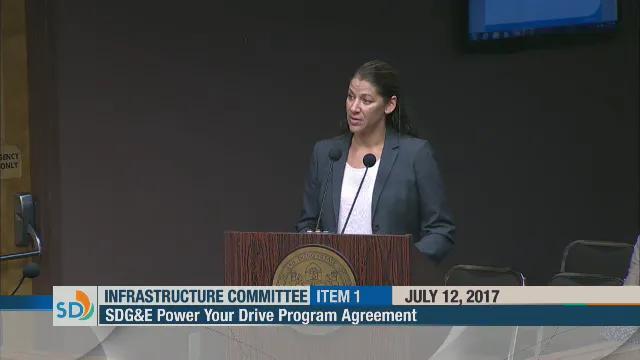
The Infrastructure Committee of the San Diego City Council met on July 12, 2017, at 10:00 AM. The committee, chaired by Councilmember Chris Cate, included Vice Chair Lorie Zapf, and Councilmembers Georgette Gomez and David Alvarez. Staff from the Economic Development Department, Transportation and Stormwater Department, and representatives from SDG&E, the IBA, and the City Attorney's office were present. The meeting covered two main agenda items: a proposal to participate in SDG&E's Power Your Drive electric vehicle (EV) charging program, and an amendment to the Transnet Regional Transportation Improvement Program (RTIP) for fiscal year 2018. Consent Calendar - The meeting minutes from June 29, 2017, were approved as distributed without objection. - No items were on the consent calendar. Public Comments & Testimony - Non-Agenda Public Comment: Martha Welch spoke about the widespread and worsening pothole conditions on city streets, particularly on Broadway, 10th, 9th, and Eastman/Fuller Street. She criticized the city's maintenance contracts and expressed frustration that potholes are damaging tires and vehicles, stating it shows the city does not care about people. - Item 1 – EV Charging Stations: - Molly Ament (SDG&E Clean Transportation Manager): Expressed strong support for the program, noting that over half of city emissions come from transportation. She highlighted SDG&E's grid is 43% renewable, and the program incentivizes daytime charging when renewable energy is abundant. She also mentioned the upcoming SB 350 transportation electrification program. - Martha Welch: Spoke in favor of the EV program, noting that Ford and Tesla are moving toward electric vehicles and that the city should prepare for increased adoption. Discussion Items - Item 1: Report from Economic Development Department – SDG&E Power Your Drive Program - Lydia Moreno (Deputy Director) presented the proposed 10-year agreement allowing installation of up to 194 EV charging stations at 14 city sites (95 for fleet vehicles, 99 for employee parking). The program is part of a $45 million CPUC pilot approved in 2016 targeting 3,500 stations regionwide, with at least 10% in disadvantaged communities. - A city employee survey in 2016 received 75 responses. Site selection was based on survey results, on-site visits, and engineering review. - Fiscal impact: minimal. A one-time fee of $640 per station for sites outside disadvantaged communities (total $40,000, with $27,720 from fleet operations and $11,970 from Environmental Services Department). SDG&E will install, own, operate, and maintain the stations. - The program aligns with the city's Climate Action Plan goals: 50% of municipal fleet zero-emission by 2020 and 90% by 2035, and the state's goal of 1.5 million zero-emission vehicles by 2025. - Committee discussion: - Councilmember Gomez asked about the definition of disadvantaged communities (tracks with CalEnviroScreen, expanded by 25% of census tracts). He also questioned the gap between current fleet (45 hybrids, no full EVs) and the 50% target by 2020. Fleet Operations Director Alia Corey replied that a report from the Center for Sustainable Energy is expected by November/December 2017 and will come to committee. - Vice Chair Ward asked about charging rates (variable hourly rates, typically 13-15 cents/kWh, with a cap of 25 cents via app). He also inquired about public access after hours; staff noted stations are for employees only, but Vice Chair Ward suggested exploring public use. SDG&E's April Bold Duke explained the program is for workplaces and multifamily communities only. - Councilmember Zapf raised concerns about limited parking spaces and the need for a reservation system. She also noted that she drives a Chevy Volt and finds public charging stations often Tesla-only or require complicated sign-ups. - Item 2: Report from Transportation and Stormwater Department – Transnet RTIP Amendment - Hassan Yousuf (Deputy Director) and Ben Bitalia presented the amendment to the 2016 RTIP to conform to the FY 2018 adopted Transnet budget of $32.5 million. Breakdown: 30% ($9.6M) for street maintenance, 70% ($22.5M) for congestion relief (including $19.2M for CIP projects and $3.3M for implementation), and $300,000 for administration. - The five-year forecast (FY18-22) shows revenues growing from $32.5M to $38.1M (4% annual growth). A list of specific CIP projects is in Attachment A. - Committee discussion: - Vice Chair Ward asked about past revenue reliability (staff noted actual revenues are typically 1-2% less than projections, a manageable variance). He also noted a significant increase in resurfacing funding in FY20-22, which staff said is because no large standalone projects are currently planned for those years; amendments can be made later. - Councilmember Gomez expressed concern that 64% of funding goes to road/highway widening and lane extensions, with little for bicycle/pedestrian projects or traffic calming that supports the Climate Action Plan's goal of reducing vehicle miles traveled. She asked how projects are tied to the CAP. Staff responded that all projects include pedestrian and bicycle components and that the RTIP list is built from council and public input. Councilmember Gomez also noted that she had requested projects but never received a response; staff committed to providing formal responses in the future. She stated she could not support the motion due to the need to shift priorities toward sustainable transportation. - Councilmember Zapf clarified that truck route widening (e.g., La Media Road in Otay Mesa) is on city streets, not freeways, and the 163/Friars interchange is a cooperative project with Caltrans that improves city street circulation. She supported the motion. Key Outcomes - Item 1 – EV Charging Program: The committee voted unanimously to approve the staff recommendation to enter into the 10-year agreement with SDG&E for the Power Your Drive program. The approval includes the concept plan and allows each city department to enter separate agreements for specific sites. Next steps include department approvals, application submission, and construction expected by end of 2017 or early 2018. - Item 2 – Transnet RTIP Amendment: The committee approved the required SANDAG resolutions to amend the 2016 RTIP to conform to the FY 2018 Transnet budget. The vote was 3-1, with Councilmember Gomez opposing. The amendment will allow the city to draw Transnet funds against expenses for approved projects.
ELECTRIC VEHICLE CHARGING 39% · TRANSPORTATION 28% · CLIMATE ACTION PLAN 20% · PROCEDURAL 4%
992
JUN 29, 2017 · SAN DIEGO, CALIFORNIA · ACTIVE TRANSPORTATION & INFRASTRUCTURE COMMITTEE
Infrastructure Committee Meeting – June 29, 2017

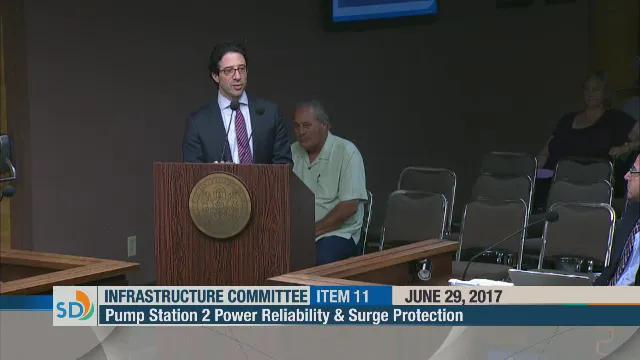
The Infrastructure Committee of the San Diego City Council met on June 29, 2017, with a full quorum including Chair, Vice Chair Ward, and Councilmembers Zapf and Gomez. The committee approved the consent agenda, heard public comment on potholes, and discussed three major infrastructure projects. All three discussion items were unanimously approved for forwarding to the full City Council. Consent Calendar - Items 1 through 8 were approved unanimously on a motion by Vice Chair Ward, seconded by Councilmember Gomez. Public Comments & Testimony - Martha Welch (member of the public) spoke about potholes across the city, citing specific locations including Qualcomm Way, Westfall Mall, Genesis Avenue, Loha Drive, 15th to 32nd Street, Beach and Second, and Vermont and University. She criticized the city's repair quality, stating that improper patching creates new hazards, and expressed frustration with the lack of visible road maintenance. Discussion Items - Item 9: Montezuma Mid‑City Pipeline Phase 2 – Amendment to Design Contract - Staff Presentation: Elif Chetin (Assistant Deputy Director, Public Works) and Brian Wutell (Senior Civil Engineer) presented. The project adds a parallel water pipeline to the existing 54‑inch Trojan pipeline (built in the 1940s) to improve reliability for mid‑city communities. Phase 2 runs from Alvarado Treatment Plant to Alvarado Boulevard; Phase 2A will connect the 69th & Mohawk pump station to Phase 1. The consultant contract with SOMAS is being amended by $277,000 (from $1,653,000 to $1,931,000) due to extensive engineering needed to split the project into two components. Total project cost is $33.04 million. Phase 2 construction ($22 million) starts summer 2018, ends spring 2020. Phase 2A ($3 million) starts winter 2017/18, ends fall 2018. The amendment extends the contract duration to October 2021. - Councilmember Gomez expressed full support for the project but raised concerns about traffic impacts near Freeway 8 and requested a traffic control plan that avoids peak hours, with community notification. Staff confirmed a 24/7 traffic control plan will be prepared and shared with his office. - Vote: Motion to approve the staff recommendation and forward to full council by Councilmember Gomez, seconded by Vice Chair Ward. Passed unanimously. - Item 10: Multiple Award Design‑Build (MAC) Contracts for Intelligent City Outdoor Lighting - Staff Presentation: Darren Greenhalgh (Environmental Services), Lori Cosio‑Hazel (Project Manager), and Jack Clark (Deputy Director) presented. The MAC contracts (up to $100 million over five years) will streamline procurement for outdoor lighting retrofits. The first project is a $30 million retrofit of 14,000 city‑owned street lights and 3,200 sensors to LED with adaptive controls. Benefits include: remote monitoring, energy savings of 2.8 million kWh annually ($2.8 million/year), reduced greenhouse gas emissions, and data collection for parking, traffic, and environmental analytics. Funding for the $30 million comes from a GE Capital loan (13‑year term) approved in February 2017; savings exceed loan payments. Five contractors were shortlisted: Barn Hart Reese, HMS, Select Electric, Siemens, and Southern Contracting. - Councilmember Zapf asked about funding (clarified that $30 million is already identified) and expressed enthusiasm for the technology, noting that remote fault detection will reduce citizen complaints about broken lights. Councilmember Gomez requested the expected GHG reduction (staff promised to provide it) and urged aggressive pursuit of grants. Vice Chair Ward asked about coordination with Streets Division (confirmed) and whether the work plan will be shared with council districts (yes). - Vote: Motion to approve by Councilmember Zapf, seconded by Councilmember Gomez. Passed unanimously. - Item 11: Pump Station 2 Power Reliability and Surge Protection – Construction and CM Contracts - Staff Presentation: Mark Nassar (Deputy Director), Debbie Van Martin, and Alex Garcia presented. Pump Station 2 is the city’s largest sewer pump station (at the airport, 300 feet from San Diego Bay), handling all regional wastewater flows to Point Loma treatment plant. The project adds redundant emergency backup power: two new diesel generators, two new natural‑gas generators, surge protection, heat exchange upgrades, control system upgrades, variable‑frequency drives on two pumps, replacement of 30‑year‑old staff trailers, and ADA upgrades. Construction contract awarded to Steve P. Rados, Inc. (lowest bidder) for $56,228,000. Construction management contract awarded to Black & Veatch (highest qualified) for $3,749,869. Total project cost is $72.2 million (hard costs $56.2M, soft costs $16.0M including design, permitting, etc.). The project spans four years; backup generators will be operational in year three. The pump station must remain fully operational throughout construction. - Councilmember Zapf asked about the state revolving fund loan (applied for, reasonable assurance of approval; contingency from wastewater fund). She moved approval. Councilmember Gomez asked about energy usage and suggested exploring solar on the large roof area; staff agreed to look into it. He also made broader comments urging the city to update its purchasing/contracting policies to better reflect the city’s minority‑majority population (current 2% goal for minority‑owned businesses). Vice Chair Ward asked about vulnerability during the 2011 countywide power outage (staff explained that the facility relied on pipeline storage and temporary backup generators brought in for El Niño; the project provides permanent redundancy). He also inquired about coordination with the Pure Water project (confirmed) and expressed concern about cost growth from $51M to $72M, asking that scope be appropriately sized. Staff stated that condition assessments for other pump stations do not require similar magnitude upgrades. - Vote: Motion by Councilmember Zapf, seconded by Councilmember Gomez. Passed unanimously. Key Outcomes - Consent agenda (items 1–8) approved unanimously. - Item 9: Amendment to SOMAS contract for Montezuma Mid‑City Pipeline Phase 2 design approved; forwarded to full council. - Item 10: Five MAC contractors and $30 million CIP for Intelligent City Outdoor Lighting approved; forwarded to full council. - Item 11: Construction contract award ($56,228,000) to Steve P. Rados, Inc. and construction management contract ($3,749,869) to Black & Veatch for Pump Station 2 approved; forwarded to full council. - The next Infrastructure Committee meeting is scheduled for July 12, 2017.

PUBLIC WORKS 34% · WATER AND WASTEWATER MANAGEMENT 29% · PIPELINE CONSTRUCTION 13% · ENERGY AND SUSTAINABILITY 8%
993
JUN 28, 2017 · SAN DIEGO, CALIFORNIA · PUBLIC SAFETY & LIVABLE NEIGHBORHOODS COMMITTEE
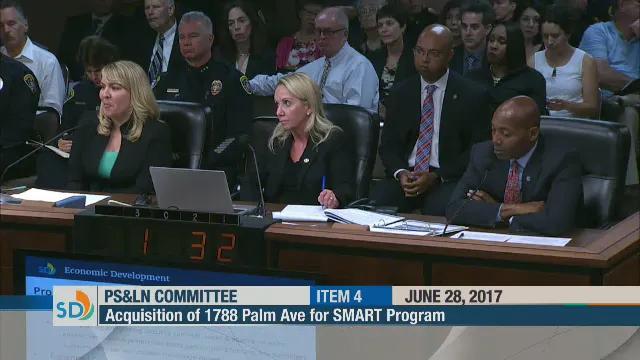
Public Safety Committee Meeting - June 28, 2017: SMART Program Expansion, Card Room Appeal, Grand Jury Update

The Public Safety and Local Neighborhoods Committee met on June 28, 2017, with a quorum of Chair Kate, Vice Chair Bree, Councilmember Zapf, and Councilmember Ward. The meeting addressed non-agenda public comments, a major proposal to acquire a motel for the SMART program (a diversion program for low-level drug offenders), annual maintenance assessment district reports, an appeal regarding denial of a card room permit, and an update on responses to a grand jury report on police oversight. Consent Calendar - The record of action items from June 7, 2017, was approved unanimously. - Two items on the consent agenda were adopted by unanimous consent. Public Comments & Testimony - Non-Agenda Public Comments: - Carol Green expressed concern about the proliferation of marijuana signage throughout San Diego, stating that assurances given years ago about regulated, discreet facilities had not been kept. - Kathleen Lippitz noted that operators and landlords of illegal dispensaries are now allowed to apply for permits, and the city has not addressed a deficiency in the ordinance acknowledged two years prior. - Judy Strang (resident of District One) stated that the Torrey Pines Planning Group is dealing with a flurry of marijuana storefront applications in Sorrento Valley, and one proposed location is within 1,000 feet of a San Diego Youth Orchestra facility; she argued the definition of "facility" should not require a standalone building. - Public Comments on SMART Program (Item 4): - Opposition speakers (majority): - Alice De La Torre (retired school administrator, Sunny Cedar community) stated that 30% of children in the Sunny Cedar School District are homeless and that bringing homeless from outside is not in the community's best interest. - Grace Kojima and others expressed concern that the community is already inundated with homeless and at-risk families, and that the location is inappropriate. - Bobby Hicks (Nestor Committee member) cited high police calls at the site, concern that only 1 out of 20-25 participants stayed in the program, and that the facility would not be locked. - Leon Benham (citizen and businessman) argued the placement is disproportionate for the small South Bay population, as participants could come from downtown. - Shirley Nakawatase (Imperial Beach business owner) cited transitional housing utilization rates (81.7% nationally, lowest since 2007) and opposed the project. - Cindy Gomper Graves (South County Economic Development Council) said the location is a gateway to South County beaches, will discourage investment, and is inconsistent with the Palm Avenue revitalization plan; she also noted loss of tourist tax revenue. - Johnny Swanson (40-year Nestor resident) argued you cannot help people who do not want to get clean and called for placing such programs in Point Loma or Rancho Bernardo. - Several speakers (including Walt Zumstain, Lorraine Delore, Raleigh Sanders, Barbara Elliott Sanders, Sam Mendoza, Maria Mendoza, Estela Corona, Alberto Velasquez, Dan Malcolm, Alicia Jimenez, Gary Brown, Omar Sanchez, Christian Ramirez) raised concerns about safety, proximity to schools and mobile home parks with 527 units, lack of community notification, inadequate staffing (1 caseworker per 25 participants), and the potential for participants to relapse in an area with drug activity. - Alberto Velasquez (Chair, Otay Mesa Nestor Planning Group) stated that at a June 14 meeting, near universal opposition was expressed; the facility would not be locked; there were concerns about participants from other areas and whether other city properties were considered. - Dan Malcolm quoted the California Coastal Commission letter stating the conversion is not consistent with the community plan and would require a coastal development permit. - Support speakers: - Jonathan Castillo (PATH) endorsed the expansion, noting successful integration of similar facilities with neighborhood advisory committees. - Michael Ruiz (Supervising Attorney, County Public Defender's Office) argued that current hotels are already drug houses, SMART saves taxpayer money, and it is the smart thing to do. - Tim Fraser (Family Health Centers of San Diego) reported that the pilot program currently serves 10 clients, one graduated in June, and three more are scheduled to graduate. - Andre Simpson (Veterans Village of San Diego) supported the program based on expertise and proven track record. - Thomas Barb (Talmadge Community Council) expressed support, citing the need for temporary housing and support services. - Vicky Granowitz (Consolidated Plan Advisory Board) acknowledged community fears but said these are not realized because of stringent moderation; she recommended forming an ad hoc committee like the one for the Rescue Mission. - Steve Dush (City of Imperial Beach) raised land use and economic health concerns, but acknowledged support for addressing homelessness. - Robert Coleman (Second Challenge) noted he provides housing for SMART and said a well-run program can mitigate issues; he drives past the facility without knowing it is there. - Public Comments on Card Room Appeal (Item 7): - (See discussion section for detailed positions; all public speakers urged the committee to hear the appeal, citing impact on employees, business, and community.) Discussion Items - Item 4: SMART Program Acquisition of 1788 Palm Avenue - Presenters: Laura Easton (Chief Deputy City Attorney), Chief Zimmerman (Police), Stephen Medula Williams (Economic Development). - The SMART (Serial Inebriate, Mentally Altered, Drug-Addicted) program began as a pilot in December 2016 with 10 beds, funded by Prop 47. Due to Prop 47, misdemeanor drug/theft cases nearly tripled. The program offers bridge housing, substance abuse treatment, job training, and housing navigation. - The city received a $3 million Prop 47 grant (ranked 1 out of 58 statewide) to expand from 10 to 70 beds. - The proposed site is 1788 Palm Avenue, currently a Super 8 motel with 61 rooms. Purchase price: $6.65 million (appraisal at $5.9M). Total development cost: $11.15 million (including $4.5M in upgrades: security, ADA, curb appeal). - After rehab, it will have 42 double-occupancy rooms (84 beds). Only 20% of current motel use is tourist; the rest is associated with crime and drug activity (73 police calls from Jan 2015 to June 2017). - The use is permitted with a Conditional Use Permit; staff believes a Coastal Development Permit is not required because parking intensity does not increase. - Timeline: Council approval July 17-18, close escrow by October, start construction January 2018, open June 2018. - Committee discussion: Councilmember Ward praised the pilot's success (26 offers made, currently full, 4 participants graduating) and asked about per-unit cost ($265,000 vs. $335,000 for new affordable housing). He noted that similar fears were raised about the Aspire VA facility, which became a good neighbor. He moved approval with a recommendation for a community advisory board. Vice Chair Bree seconded. Councilmember Zapf expressed support but asked about grant sustainability (3-year renewable) and noted the pilot's success. - The committee voted unanimously to recommend Council approval. - Items 5 & 6: Maintenance Assessment Districts Annual Reports - Paul Saroyce (Park and Recreation) and Luisa Ojeda (Economic Development) presented the annual reports for 64 MADs. The reports note that assessments may adjust based on inflation, and only special benefits may be assessed. No public comments. The committee voted unanimously to approve both items. - Item 7: Appeal Request – Lucky Lady Card Room Permit Denial - Background: Stanley Penn (dba Lucky Lady Card Room) applied for renewal of his police permit. The San Diego Police Department denied renewal based on: (1) failure to disclose a federal indictment on the application, (2) failure to disclose a services agreement with JB Gaming Solutions, and (3) transfer of control. A hearing officer upheld the denial on March 24, 2017, solely on the failure to disclose the services agreement. The permittee requested the committee hear an appeal. Under Municipal Code, the committee may hear an appeal if five grounds are met; appellant asserted four. - The city attorney explained the committee's role is limited to deciding whether to hear the appeal, not the merits. Public comment is allowed, but no questions to parties. - Public speakers in favor of hearing the appeal: - William R. Winship (attorney) called the denial the "death penalty" for a 43-year-old business with 115 employees. - James Perinello (attorney) argued the hearing officer based his decision on an issue never raised (failure to obtain a work permit), that it is a citywide issue affecting at-risk workers (minorities, women, over 50), and that the penalty is disproportionate (the city code provides graduated discipline). - 14 individual speakers (employees, patrons, business owner) spoke tearfully about the impact on their lives, including Stanley Penn (79-year-old owner with stage 4 cancer), who said he missed a sentence on a newly revised form by accident. - Gretchen von Helms (attorney) argued the police used a "gotcha" technicality; the federal indictment involves betting on sports, not drugs or violence; the state gaming commission renewed the license; and closing the business would cause blight and homelessness. - Committee discussion: Councilmember Ward noted that the grounds for hearing an appeal are specific; he did not see evidence that appellant was denied a full presentation, that the decision was arbitrary, or that it conflicted with policy. Vice Chair Bree agreed. Councilmember Zapf expressed regret but said she could not support the appeal because the questions of why the indictment was not listed and why a legal advisor was not used. The committee voted unanimously to deny the request for an appeal hearing. - Item 3: Update on Response to Grand Jury Report – Citizen Oversight Boards of Police Behavior - Marshall Anderson (Mayor's Office) and Charmaine Mosley (Executive Director, Citizens Review Board on Police Practices) presented. - Two recommendations initially left for further analysis: - Recommendation 16-27 (provide CRB with independent legal counsel): The city is seeking qualified outside counsel via RFP; selection expected July 2017. - Recommendation 16-28 (provide modest compensation for board members): After analysis, the city decided not to implement this, as no other city board members receive compensation; it would depart from practice and carry significant budget impacts. The CRB discussed it and supports volunteer service. - Public comment: Robert McNamara agreed with no compensation but said the grand jury intended independent counsel full-time, which may require a charter amendment. - The item was informational; no vote taken. Key Outcomes - Item 4 (SMART Program): Committee voted unanimously to recommend City Council approval of the acquisition and related actions. Motion by Councilmember Ward, second by Vice Chair Bree. - Items 5 & 6 (Maintenance Assessment Districts): Each passed unanimously. Motion by Vice Chair Bree, second by Councilmember Zapf for item 5; motion by Councilmember Zapf, second by Vice Chair Bree for item 6. - Item 7 (Lucky Lady Appeal): Committee voted unanimously (3-0) to deny the request for an appeal hearing, meaning the denial of the card room permit stands. Motion by Councilmember Ward, second by Vice Chair Bree. Speakers included over 20 people in support of hearing the appeal. - Item 3 (Grand Jury Update): Informational; no action taken. The committee acknowledged the update. Note: The meeting was adjourned; the next meeting is scheduled for Wednesday, July 19, 2017, at 2 p.m.

HOMELESSNESS 29% · PUBLIC SAFETY 14% · PUBLIC COMMENT 12% · PROCEDURAL 9%
994
JUN 21, 2017 · SAN DIEGO, CALIFORNIA · BUDGET & GOVERNMENT EFFICIENCY COMMITTEE
Budget and Government Efficiency Committee Meeting - June 21, 2017

The meeting was called to order at 17:00 UTC on June 21, 2017, with a quorum present consisting of Chair Bream, Councilmember Sherman, and Councilmember Gomez. The committee approved the record of actions from the May 24, 2017 meeting by unanimous consent. No non-agenda public comment was offered. The primary agenda item was a review of the Fiscal Year 2018 Appropriations Ordinance. Discussion Items Financial Management Deputy Director Matt Vespe, along with Michael Clark and Adrian Del Rio, presented the FY2018 Appropriations Ordinance. The ordinance is the final step in the budget process, appropriating funds based on the previously approved salary ordinance and budget resolution. Staff recommended forwarding the ordinance to City Council for approval. The presentation detailed 14 proposed changes, grouped into two categories: CIP cash management (7 changes) and technical adjustments (6 changes). Key CIP cash management changes included: - Replacing the "waterfall list" with authority to transfer project savings from completed projects to an annual allocation of the same asset type. - Authority to administratively remove unexpended balances from annual allocations at year-end. - Ability to add restricted funds to projects without increasing overall budget, freeing up less restricted funds for council reprogramming. - Clarifying language to close projects when funding is removed for future programming. - Expanding authority to close funds with no revenue (increasing from $15,000 to $25,000 and including any fund type). - Authority to change project accounting from preliminary engineering to other project types, and to transfer subprojects from annual allocations into standalone projects for transparency. Technical adjustments included clarifications on CFO authority to transfer CPPS budget, removal of Connect Careers language from TOT fund (since program is now general fund supported), removal of authority related to consolidated maintenance assessment district funds, adding the new road maintenance fund (from SB passage) to existing gas tax authority, updating the San Diego Regional Parks project list, adding two fleet service replacement funds to internal service fund list, and minor grammatical corrections. Jillian Cassie from the Independent Budget Analyst (IBA) offered three recommendations: 1. Specify a cap of $100,000 on the level of funding that can be transferred to an annual allocation under the new waterfall list replacement. 2. Require reporting to council on transfers made under the authority to return unexpended balances from prior year annual allocations to fund balance. 3. Clarify language to ensure the authority to transfer appropriations from an annual allocation to a new CIP project is limited to converting an existing subproject into a standalone project. Councilmember Sherman expressed support for the changes, particularly the effort to close small funds, and made a motion to approve and forward to council with the IBA recommendations. Councilmember Gomez seconded the motion. Gomez raised concerns about the mayor's veto authority and checks and balances in the strong mayor system, and asked the IBA about potential future discussions. Councilmember Kate (likely Mr. Kate) asked questions about the waterfall list, the police range project, and the IBA's clarifying language, and provided historical perspective on council authority during the budget process. Chair Bream thanked staff and the IBA for their assistance during her first budget cycle, and expressed optimism about working together. Key Outcomes - The committee voted unanimously to approve the motion to recommend City Council approval of the FY2018 Appropriations Ordinance, including the IBA recommendations. The motion was made by Councilmember Sherman and seconded by Councilmember Gomez. All members present voted in favor. - The meeting was adjourned, with the next meeting scheduled for July 12, 2017 at 9:00 a.m.

BUDGET 60% · CAPITAL IMPROVEMENT PLANNING 14% · GOVERNANCE 12% · PROCEDURAL 9%
995
JUN 15, 2017 · SAN DIEGO, CALIFORNIA · ECONOMIC DEVELOPMENT & INTERGOVERNMENTAL RELATIONS COMMITTEE
San Diego City Council Economic Development & International Affairs Committee Meeting - June 15, 2017

The Economic Development and International Affairs Committee of the San Diego City Council met on June 15, 2017, at 10:00 AM. The meeting was chaired by Councilmember Barbara Bree, with Councilmembers Mark Kersey and David Alvarez present. Deputy City Attorney Daphne Scogan, Jack Straw from the Mayor's office, Jeff Kawar from the Independent Budget Analyst Office, and committee consultant Ryan Purdy were also in attendance. The committee approved the record of action from the April 20, 2017 meeting by unanimous consent. The agenda consisted of one non-agenda public speaker and three informational presentations: the International Affairs Board's two-year work plan, an economic outlook from Dr. Reeser, and a report from Startup San Diego. Public Comments & Testimony - Martha Roach spoke about the Orange Line trolley service change to American Plaza. She argued that the change was premature because the courthouse construction is not finished and the tracks are not even half completed. She also complained that committee meeting materials lack background information, making it difficult for people without computers to follow, and noted poor collaboration between the city and county. Discussion Items - International Affairs Board Work Plan: Joel Day, Executive Director of the International Affairs Board, presented the 2016 annual report and the first-ever two-year work plan (2017-2019). He highlighted the board's role in promoting San Diego's global identity, including a new friendship city program, an annual consular reception, and attendance at over 100 community events. Board Vice Chair Dr. Kathleen Charla and board member Bob Morris also spoke. Councilmember Alvarez requested the board consider addressing the Tijuana sewage spill issue as a local international affairs matter, and Councilmember Bree emphasized the importance of leveraging the board as a hub for international organizations and local economic engines. Councilmember Kersey noted the need to include the year of global rankings on materials and encouraged leveraging council members' expertise for delegations. - Economic Outlook: Dr. Reeser, with associate Tom Hill, provided an update on global, national, state, and local economic conditions. Key points included: global growth is improving; U.S. GDP growth remains around 2%; the Federal Reserve is gradually raising interest rates (three hikes expected in 2017); San Diego is adding about 25,000 jobs this year; housing remains a seller's market with prices up 6%, but out-migration is 14,000 people annually due to affordability; and the local minimum wage increase to $11.50 in January 2017 has been associated with three consecutive months of year-over-year job losses in the restaurant industry, unlike the state where restaurant jobs continue growing. Councilmembers discussed the housing bubble risk, unfilled positions (especially engineers and trades), and the impact of minimum wage hikes on low-skilled workers. - Startup San Diego Report: Kelly Gardner, PR Director for San Diego Startup Week, reported on the fifth annual Startup Week (June 19-23, 2017). The event has grown from 300 attendees to an expected 5,000, with 250 events across 15 tracks, including binational, cannabis (Grow SD), impact, and cybersecurity. It is organized by 300 volunteers and is a nonprofit. Councilmembers expressed support, with Councilmember Alvarez noting he had not previously heard of the event, and Councilmember Kersey highlighted connections with the city's economic development department and speakers like David Graham and Eric Caldwell. The committee encouraged future outreach to students and military. Key Outcomes - The committee received and discussed all three informational reports. No formal votes or actions were taken. Councilmembers offered suggestions and requested follow-up information, such as connecting the International Affairs Board with the Tijuana sewage issue and providing detailed track information for Startup San Diego's impact track.

ECONOMIC DEVELOPMENT 31% · INTERNATIONAL RELATIONS 15% · STARTUP SAN DIEGO 14% · PUBLIC POLICY 11%
996
JUN 14, 2017 · SAN DIEGO, CALIFORNIA · AUDIT COMMITTEE
San Diego City Council Audit Committee Meeting – June 14, 2017

The Audit Committee of the San Diego City Council met on June 14, 2017, at 5:00 PM UTC (approximate start in the morning local time). The meeting covered approval of prior minutes, public comments, a monthly activity report from the City Auditor, a presentation on the Fiscal Year 2016 Single Audit Report, and a performance audit of the city's management of its advisory boards. Key outcomes included unanimous adoption of the single audit report and the advisory board audit, both to be forwarded to the City Council. Consent Calendar - The record of action for the May 2017 meeting minutes was approved without objection. Public Comments & Testimony - Martha Welch (public comment): Expressed concern about deferred maintenance (citing $3–5 million) and alleged that funds (e.g., Mission Bay fund, J and PROP C) are being hidden or not used for their intended purposes. Called for an audit of the Mission Bay fund and other funds without employees. - Robert McNamara (District 3): Complained about the lack of printed backup materials for agenda items, which were previously available. Requested restoration of at least a handful of copies for public use. Chair Gomez acknowledged the comment, noting the city's effort to reduce paper. - J. Powell (member of the Sustainable Energy Advisory Board): Strongly supported the advisory board audit recommendations. Highlighted specific issues: high number of vacancies and expired seats on boards, the need for better training on the Brown Act and conflict of interest, the need for clear guidance on statutory duties, and the value of public participation. Discussion Items 1. Monthly Activity Report (Item 1) – Presented by Kyle Elser (Assistant City Auditor) and Danielle Knighton. Reported that since the last meeting, one audit product was issued (advisory boards audit). Three audits are in the report-writing phase (Capital Improvement Program Quality Assurance, Capital Improvement Lifeguard Tower Project, and Economic Development Business and Industry Incentive Program). Six audits in progress, including IT audits and the annual Mission Bay Fund audit. No committee questions or action required (information only). 2. Fiscal Year 2016 Single Audit Report (Item 2) – Presented by Kevin Starkey (MGO). Key points: - The city expended about $52 million in federal awards and is subject to single audit requirements. - The city qualified as a low-risk auditee for the first time in at least six years, allowing only 20% coverage of total federal awards ($11.5 million, or 20.5% of $56.2 million) through four programs: Lead-Based Paint Hazard Control, Airport Improvement Program, Capitalization Grants for Drinking Water, and National Urban Search and Rescue. - No material weaknesses or major compliance findings were identified. Two internal control deficiencies were reported: one carry-forward for the National Urban Search and Rescue program (lack of documented controls) and one new for the Lead-Based Paint program (timing of reports). Both are being remediated; the city expects no impact on low-risk status. - Committee members (Sherman, Hebrank, Valdivia) asked clarifying questions about the findings. The city attorney’s office confirmed that expenditures were proper and that corrective actions (process narratives) have been implemented or are underway. 3. Performance Audit of City's Management of Advisory Boards (Item 3) – Presented by Andy Hannah (Office of the City Auditor) and Danielle Novokolski. Findings: - Finding 1: Over half of the 334 member positions on active boards were either vacant or filled by members with expired terms (by March 2017). Many positions have been expired/vacant for over two years. Contributing factors: the City Council rarely uses its charter authority to appoint after 45 days, the vetting process lacks formal timelines, and there is no recourse if council members do not submit nominees. Recommendations: improve notifications to council, formalize vetting, and develop a strategy for publicizing vacancies. - Finding 2: Advisory boards must comply with the Brown Act, but the city does not require all members to receive training, and not all boards have websites to post agendas and minutes. Recommendations: require Brown Act training (e.g., via video) and provide websites for all boards. - Finding 3: There may be unnecessary overlap, outlived boards, and lack of periodic review. The mayor’s office is conducting a one-time review. Recommendations: standard analysis for new boards, annual reports from all boards, and a biennial review process by the mayor and council. - The audit made 14 recommendations, all accepted by the mayor’s office, city attorney’s office, city clerk’s office, and city administration. - Public comment from J. Powell (Sustainable Energy Advisory Board) supported the recommendations and raised additional concerns about conflict-of-interest guidance and outdated municipal code defining board duties. - Committee members (Sherman, Valdivia, Hebrank) discussed challenges in filling positions, the need for ongoing Brown Act training, and the importance of transparency. The city attorney’s office noted that a training video already exists and they are available for live sessions if needed. The mayor’s office (Francis Barraza) reported progress on consolidating about 12 boards, to be presented at the rules committee in July. The city clerk’s office (Deanna Fuentes) noted the need for policy clarification on calculating the 45-day appointment rule. The communications department (Katie Keats) is developing a broader outreach strategy using social media. Staff liaisons will develop standard operating procedures for boards. Key Outcomes - Motion and vote: The committee unanimously (by voice vote) adopted the single audit report (Item 2) and directed it to be forwarded to the City Council. - Motion and vote: The committee unanimously adopted the performance audit of advisory boards (Item 3) and directed it to be forwarded to the City Council. - Next meeting: Scheduled for July 26, 2017.

BOARDS AND COMMISSIONS 45% · AUDIT FOLLOW-UP 42% · PUBLIC ENGAGEMENT 7% · PROCEDURAL 4%
997
JUN 14, 2017 · SAN DIEGO, CALIFORNIA · LAND USE & HOUSING COMMITTEE
Smart Growth and Land Use Committee Meeting - June 14, 2017

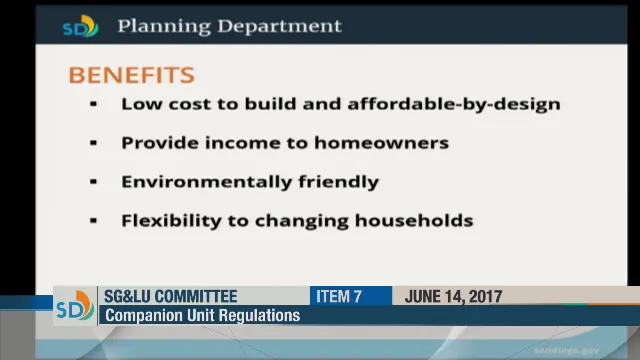
The Smart Growth and Land Use Committee met on June 14, 2017, from approximately 9:00 AM to 12:00 PM, to consider a consent calendar, action items, and informational reports. Key topics included environmental consulting agreements, a transportation modeling contract, placemaking code amendments, companion unit financing and regulations, and the airports business plan. The committee heard public testimony on several items and took unanimous votes on action items. Consent Calendar - The consent agenda (items 1, 2, 3) was approved unanimously. Councilmember Chris Kate thanked staff for keeping the North Claremont Senior Center open (item 2). Councilmember David Alvarez asked about restroom operations at item 1; staff confirmed the tenant opens and closes those public restrooms. Public Comments & Testimony - Placemaking (Item 6): Joe Cosgrove (Circulate San Diego) supported the effort but recommended: an easy-to-read bulletin, allowing community nonprofits (not just city-recognized groups) to apply, accepting leaseholder permission instead of property owner permission, removing community planning group sign-off, and avoiding extra Commission for Arts and Culture approval steps. David Modi (Community Planners Committee) supported requiring planning group letters of support for placemaking projects. - Companion Unit Regulations (Item 7): - Molly Kirkland (San Diego County Apartment Association) supported the ordinance but expressed concern about the owner-occupancy requirement. - Marta Stasik (Talus Properties) and Michelle Robb (Ritz Design Build) supported, citing benefits for seniors, property values, and affordable housing. - Matt Adams (Building Industry Association) supported the companion unit concept as a tool to address the housing crisis. - Mary Leiden (Housing You Matters) supported the staff recommendation and urged making the process easy. - David Modi (Community Planners Committee) supported a 30-day minimum rental, no front yard parking, and owner occupancy; he opposed parking exemptions in transit areas that lack transit. - Rhea Kuhlman (College Area Community Planning Board) supported but requested a fix to apply bedroom limits cumulatively to properties with companion units in the college area, citing the mini-dorm ordinance. - Andre Beauparlant (homeowner) supported requiring record owner occupancy to prevent rental companies from outbidding homebuyers. - Ann Cottrell (college area resident) expressed concern that investors would use companion units to circumvent existing bedroom limits. - Artemis Spiridonidis (development consultant) supported the amendments as a feasible way to increase housing supply and reduce displacement. - Ryan Maxon (Greater San Diego Association of Realtors) supported the staff recommendations and opposed owner occupancy requirements. Discussion Items - Environmental Consulting Agreements (Item 4): Planning Department staff presented four on-call contracts (total $6.5 million, five-year terms) for CEQA/NEPA, greenhouse gas, and climate resiliency studies. Councilmember Gomez asked about the work program; Councilmember Alvarez noted that workforce statistics forms were blank. Staff explained the forms would be completed before council. The item passed unanimously. - SANDAG Transportation Modeling Contract (Item 5): Staff requested a $500,000 amendment to extend the agreement for five years. Councilmember Gomez asked about the shift from in-house modeling; staff cited cost savings ($130,000/year vs. $800,000 previously) and increased complexity. The item passed unanimously. - Placemaking Code Amendments (Item 6): Economic Development Department staff proposed a definition for placemaking and streamlined permits (process one) for temporary activation of public and private spaces. Councilmember Gomez inquired about fees; staff noted a process one permit would cost $400–$1,200, plus $200,000 in activation grants and a $400,000 revolving loan fund. Councilmember Kate asked about zones and adjacent property permissions. Councilmember Alvarez raised concerns about excluding industrial zones and limiting assembly uses in residential zones. The committee voted to forward the item to the Planning Commission and requested that the committee consultant receive a draft before the August 24 Planning Commission hearing. - Companion Unit Financing (Item 9): Informational presentation by Sarah Jarman (committee consultant) and Ricardo Flores (LISC) on developing a San Diego-specific toolkit and a loan program model (like Santa Cruz, targeting 80% AMI tenants). LISC may provide HUD Section 4 funds through an intermediary. Councilmember Alvarez asked about the AMI level and the role of the Housing Commission. No action was taken. - Companion Unit Regulations (Item 7): Planning staff presented amendments to comply with state law (SB 1069, AB 2406) and add incentives: no owner-occupancy requirement for companion units, reduced parking, and a new junior unit category. Councilmember Alvarez asked about junior unit definitions, multifamily zone provisions, floor area ratio, parking, and setbacks. Councilmember Gomez expressed support but proposed amendments: a two-year pilot with a flat fee of $2,000 (including all fees) and compliance with the high occupancy ordinance to the extent legally possible. Councilmember Alvarez added amendments: allow detached companion units up to 1,200 square feet and able to exceed the floor area ratio, and eliminate the above-garage setback requirement. The motion passed unanimously. - Airports Business Plan (Item 8): Informational report by Rod Props (Deputy Director for Airports) covering Montgomery Field and Brown Field. Goals included safe operation, regulatory compliance, self-sufficiency, and development. Financial highlights: $47 million in assets, $15 million in working capital, but operational inefficiencies due to holdover leases. Councilmember Kate asked about timelines for the minimum standards document and the National Air College RFP; staff estimated next month for both. Councilmember Gomez asked about holdover leases and financial liabilities; staff explained increases due to FAA grant accounting. No action taken. Key Outcomes - Consent calendar approved unanimously. - Environmental consulting agreements approved (4 contracts, $6.5 million total). - SANDAG modeling contract amendment approved ($500,000). - Placemaking code amendments forwarded to Planning Commission with a request for the committee to review the draft beforehand. - Companion unit regulations approved with amendments: two-year pilot with a flat $2,000 fee (including all fees), compliance with the high occupancy ordinance, detached units up to 1,200 square feet allowed to exceed FAR, and elimination of the above-garage setback requirement. - Airports business plan received as informational.

HOUSING 16% · AFFORDABLE HOUSING 15% · PLACEMAKING 10% · AIRPORT MANAGEMENT 10%
998
JUN 7, 2017 · SAN DIEGO, CALIFORNIA · RULES COMMITTEE
San Diego Rules Committee Meeting Summary – June 7, 2017

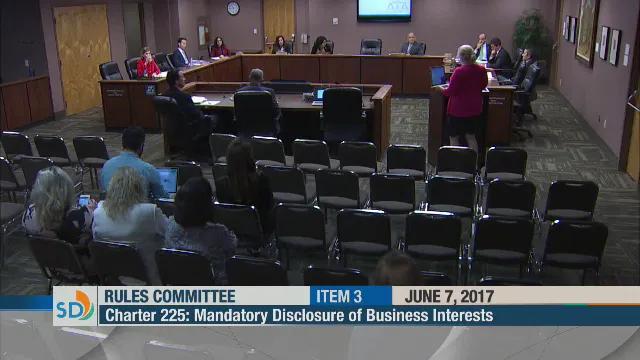
The San Diego City Council Rules Committee met on June 7, 2017, at 10:00 a.m. (presumed, per transcript) under the chairmanship of Council President Cole. The committee considered several significant items, including a performance audit of advisory board management, proposed changes to the Ethics Commission governance, implementation of Charter Section 225 requiring disclosure of persons doing business with the city, and a response to a grand jury report on refuse bin replacement. Votes were taken on all action items. Consent Calendar - Approved the committee record of actions from April 5, 2017, by unanimous consent. Public Comments & Testimony - Martha Welch (non‑agenda public comment) criticized the committee for moving public comment to the bottom of the agenda, stating it was disrespectful to the public and suggesting it was done to silence dissent. She expressed a belief that the committee does not care about the public. - Catherine Rhodes (Point Loma resident) commented on Item 50 (passed on consent earlier in the week) which exempted two program manager positions from classified service. She argued that this action violated the five-year pensionable pay freeze and mirrored a pattern of granting raises through exemptions without required actuarial reports, as previously reported by the Union-Tribune. Discussion Items Performance Audit of Advisory Board Management (Informational) - Presented by Andy Hannah (Supervising Senior Performance Auditor) and Danielle Novikolski (Performance Auditor II) from the Office of the City Auditor. - Key findings: As of March 2017, over half of the 334 member positions on 30 active advisory boards were vacant or held by members serving on expired terms. Many vacancies had persisted for over two years, impeding quorum and board effectiveness. The city’s appointment and vetting process lacks formal timelines and does not uniformly notify the council of its authority under Charter Section 43C to fill vacancies if the mayor does not act within 45 days. Additionally, many boards lack Brown Act training and dedicated websites for posting agendas and minutes. - Recommendations: (1) Improve notification to the council of its 45‑day appointment authority; (2) establish formal vetting procedures with deadlines; (3) develop a strategy for publicizing vacancies; (4) require all advisory board members to receive Brown Act training; (5) provide all boards with a website or designated city web page for posting agendas/minutes; (6) perform cost–benefit analyses before creating new boards, require annual reports, and conduct biennial reviews of existing boards. All 14 recommendations were accepted by the mayor’s office, city clerk’s office, city attorney’s office, and administration. - Public comment: Kate Yavendetti (Women Occupy San Diego, National Lawyers Guild, District 3 resident) noted that the Community Review Board (CRB) has six vacancies despite many applicants waiting at the mayor’s office. She urged the council to move forward with appointments once the implementing ordinance (Measure G) is adopted. She also highlighted potential overlap between the CRB and the Citizens’ Advisory Board (CAB) and raised concerns about overly restrictive membership requirements (e.g., bankruptcy bars). Ethics Commission Governance (Action Item) - Presented by Barrett Tetlow (Chief of Staff to Councilmember Sherman). The proposed ordinance would amend municipal code to increase the required number of attorneys on the Ethics Commission from two to four (making it a majority), require all commissioners to have demonstrated familiarity with campaign finance, lobbying, and conflict‑of‑interest laws, and establish a five‑year waiting period for candidates or staff who have run against a current city elected official. The proposal came in response to a prior rules committee discussion and a grand jury report. - Committee discussion: Councilmember Kersey opposed the five‑year waiting period, arguing that the commission must be impartial and that former candidates could not be objective. He proposed reducing the required attorneys from four to three and changing the “required” familiarity with ethics laws to “recommended.” Councilmember Kate supported these amendments, noting difficulty in measuring “familiarity” and preferring to keep the pool broad. Councilmember Bree also supported three attorneys rather than four, and Councilmember Ward echoed that preference. - Vote: Motion by Vice Chair Kersey to approve the ordinance with the following amendments: (1) reduce required attorneys to three; (2) change “required familiarity” to “recommended familiarity”; (3) strike the five‑year waiting period for candidates/staff. Seconded by Councilmember Kate. Passed unanimously, subject to full legal review by the city attorney. Implementation of Charter Section 225 (Discussion and Direction) - Presented by Steve Hadley (Committee Consultant) with input from the City Attorney’s Office (Mr. Zelini), the Independent Budget Analyst (IBA), and Mayor’s Office staff. Charter Section 225, approved by voters in 1992, requires all persons doing business with the city to disclose their identities and interests. However, the provision is broadly worded and has been inconsistently enforced. The working group proposed an interim ordinance requiring disclosure from entities doing $500,000 or more in aggregate business annually, including corporate officers, board members, shareholders with 10% or greater interest, and investors with felony convictions or crimes related to truthfulness. Publicly traded companies would be excluded from certain requirements due to existing federal disclosures. - Discussion: Councilmember Kersey questioned the feasibility of enforcing the 10% shareholder/felony disclosure for publicly traded companies; Councilmember Bree noted the working group had already discussed excluding public companies. The IBA noted that the city already collects such information for real estate leases but not consistently for other contracts. The city attorney clarified that an interim ordinance could prioritize enforcement on larger transactions but could not narrow the charter’s scope; a charter amendment would be needed for permanent clarity. - Direction: Councilmember Bree moved to: (1) direct the city attorney, with the working group, to draft a charter amendment for the November 2018 ballot; and (2) immediately draft an interim ordinance to implement enforcement priorities. Seconded by Vice Chair Kersey. Passed unanimously. Grand Jury Report Response (Action Item) - Presented by Lisa Byrne (Fiscal & Policy Analyst, Office of the IBA). The grand jury report “Broken Garbage Cans, City Apathy, Free Cans for a few” (filed March 22, 2017) contained seven findings and seven recommendations. Three recommendations were directed to the City Council: (1) amend the municipal code to establish procedures for free replacement of damaged refuse bins (recommendation not implemented due to limited city resources and equity concerns); (2) amend Council Policy 100-06 to more clearly define allowable uses of CPPS funds (recommendation not implemented, as policy is adequate but implementation was flawed); (3) establish oversight of CPPS spending (recommendation implemented via current procedures and training). The proposed response was to partially disagree with the findings and not implement recommendations 1 and 2, while confirming implementation of recommendation 3. - Vote: Motion by Council President Cole to approve the proposed response. Seconded by Vice Chair Kersey. Passed unanimously. Key Outcomes - Approved committee minutes and consent calendar items. - Received the advisory board audit as informational; all recommendations accepted for implementation. - Passed amended ordinance modifying Ethics Commission qualifications, subject to legal review. - Directed the city attorney to draft a charter amendment on Charter Section 225 for the November 2018 ballot and an interim enforcement ordinance. - Approved the proposed response to the grand jury report on garbage cans, forwarding it to the full council. - The next rules committee meeting was scheduled for Thursday, July 27, 2017, at 2 p.m.

ETHICS COMMISSION 25% · BOARDS AND COMMISSIONS 19% · PUBLIC COMMENT 13% · PUBLIC CONTRACT CODE 11%
999
JUN 7, 2017 · SAN DIEGO, CALIFORNIA · PUBLIC SAFETY & LIVABLE NEIGHBORHOODS COMMITTEE
San Diego Public Safety Committee Meeting - June 7, 2017

The Public Safety and Livable Neighborhoods Committee met on June 7, 2017, to discuss two major public safety issues: tobacco retailer enforcement and the enforcement of illegal marijuana dispensaries. The committee received reports from the San Diego Police Department, Code Enforcement, and the City Attorney's Office, heard from numerous public speakers, and approved a motion to request a report on illegal marijuana delivery services. The meeting concluded with a unanimous vote on the motion. Consent Calendar - Adopted the record of action items for April 26, 2017 by unanimous consent. Public Comments & Testimony - Tobacco Items: Residents and representatives expressed concerns about hookah lounges, citing noise, crime, and regulatory violations. Specific speakers: Mauricio Rios (College Area Community Council) called for an ordinance to close hookah lounges between midnight and 8 a.m.; Michael Rossman (restaurant owner) reported crime near his business; Scott Shipman (San Diegans for Safe Neighborhoods) highlighted the transfer of alcohol licenses to hookah lounges; William Purno (Central Region Prevention Coalition) raised concerns about youth access and advertising. - Marijuana Enforcement: Public speakers expressed support for enforcement against illegal dispensaries but raised concerns about illegal delivery services and advertising. Rocky Goyle (Apothecare, United Medical Marijuana Coalition) and Phil Rath (United Medical Marijuana Coalition) emphasized the problem of illegal deliveries and offered partnership; Peggy Walker and Scott Shipman urged action against illegal delivery and advertising. Discussion Items - Tobacco Retailer Ordinance Update (Information Item): Lt. Kevin Meyer and Officer Joel Sandoval presented the annual tobacco report for calendar year 2016. They reported 1,056 tobacco permits issued, 96 violation notices, 127 covert inspections resulting in 14 citations for illegal sales to minors (an 11% rate, up from 8% in 2015). They also reported collecting $200,226 in fees. Committee members asked about enforcement gaps and the fee structure; Chief Zimmerman noted staffing constraints and legal limits on fees (Prop 26). - Marijuana Dispensary Enforcement Update (Discussion Item): Mike Richmond (Code Enforcement), John Hemerling (City Attorney), Diane Silva Martinez (Chief Deputy City Attorney), and Mark Skiels (Chief of Special Prosecutions) reported that only 3 illegal storefront dispensaries remain operating, after shutting down over 240 since 2011. Courts have ordered over $8 million in civil penalties and $240,000 in investigative costs. Since May 2016, SDPD executed 27 search warrants, producing 21 criminal complaints and 35 convictions. The discussion focused on the shift to illegal delivery services and the need for new enforcement tools. Committee members expressed support for a motion to request a report on delivery services enforcement and potential new tools. Key Outcomes - Motion passed unanimously: Requested the City Attorney's Office, SDPD, Code Enforcement, and other relevant departments to work together to develop recommendations for additional enforcement tools against illegal marijuana operations and to analyze the scope of illegal delivery services, reporting back within 120 days (or up to 6 months). - No further action on tobacco; the report was accepted as informational.

CANNABIS REGULATION 35% · MISCELLANEOUS 27% · PUBLIC SAFETY 14% · TOBACCO REGULATION 8%
1000
MAY 25, 2017 · SAN DIEGO, CALIFORNIA · ENVIRONMENT COMMITTEE
Environment Committee Meeting - May 25, 2017: Lead Testing, Rate Consultant, EPS Recycling

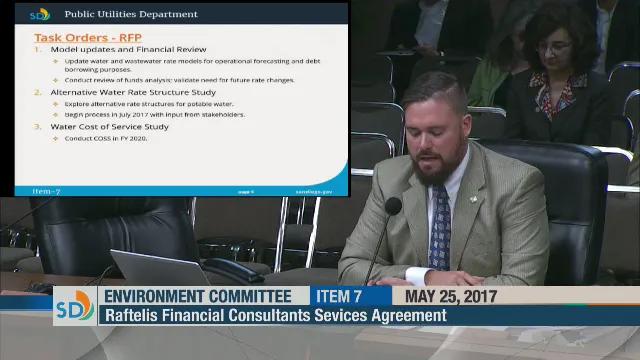
The Environment Committee of the San Diego City Council met on May 25, 2017, to discuss several items including a lead testing update in schools, a contract amendment for a rate consultant, and the expansion of curbside recycling to include expanded polystyrene (EPS) food containers. Councilmembers Ward, Kate, and Sherman were present. Consent Calendar - The committee approved the record of action items from April 13, 2017, by unanimous consent (Sherman absent). - Four consent agenda items were moved and approved unanimously. Public Comments & Testimony - Healthy Soils Coalition: Mickey Nabb, director of operations for Mesa Family Restaurant Group, spoke on behalf of the coalition requesting an organics policy innovation process. He described two local innovators (Closing the Loop and Food to Soil) and his own experience diverting 60% of waste from landfill while saving money. The coalition requested a one-year exemption for existing organics operators and a fast-track process to avoid being outlawed as of July 1, 2017. The chair directed the mayor's office and Environmental Services Department to review the proposal. - Jim Ambroso (Resource Management Group) echoed the request for an exemption for small food waste collectors up to 1,000 tons per year and asked for more time. - Carolina Rodriguez (Climate Action Campaign) supported the Healthy Soils proposal as a win-win for the city, restaurants, and small businesses. - Anne Feige (Community Forest Advisory Board) thanked the committee for confirming new members and expressed concern about lack of staffing for the urban forestry program, noting only three staff (two vacant) for a city of San Diego's size. Discussion Items Lead Testing in Schools (Informational Update) - Peter Vroom (Deputy Public Utilities Director) provided an update on lead testing in K-12 schools. Of 202 schools tested, results for 164 were returned: 161 below the action level (15 ppb), three above. Two schools (Emerson Elementary and San Diego Co-op 2) were co-located and remediated; Bernie Elementary was pending retest. San Diego Public Utilities has received 250 requests, representing over 25% of all statewide requests. Testing costs: $230,000 startup, $2,200 per school. The state permit requires testing through November 2019. Councilmembers Kate and Ward asked about cost reimbursement, school district remediation deadlines, and the potential for legislative changes. No action taken. Rate Consultant Contract Amendment - Staff presented an amendment to a contract with a financial consulting firm to provide rate consultant services, including model updates, alternative rate structure review, and cost-of-service studies for water and wastewater. Councilmember Kate requested adding specific language ensuring the consultant would present multiple viable rate structure options with comparative analysis to the council. After discussion, a motion to approve with that clarification was made and seconded, and passed unanimously. Fifth Amendment to Curbside Recyclable Materials Processing and Marketing Contract - Angela Colton (Waste Reduction Deputy Director) presented the amendment to include expanded polystyrene (EPS) food containers in the city's curbside recycling program. Implementation target: July 1, 2017. Estimated cost: $90,000 per year. Public speakers supported the amendment: Clarissa Falcon (Dart Container Corporation), Chris Duggan (California Restaurant Association), and Sophie Barnhorst (San Diego Regional Chamber of Commerce) all urged approval. Councilmember Sherman noted the importance of outreach to educate residents. A motion to approve and send to full council passed unanimously. Key Outcomes - The committee referred the Healthy Soils Coalition's organics proposal to the mayor's office and Environmental Services Department for analysis. - The lead testing update was received; no action taken. - The rate consultant contract amendment was approved with a request for explicit language on rate structure options. - The Fifth Amendment to the curbside recycling contract was approved and sent to the full City Council. The meeting adjourned. The next regularly scheduled Environment Committee meeting is June 29, 2017, at 9:00 a.m.

PUBLIC HEALTH 17% · WATER AND WASTEWATER MANAGEMENT 17% · ORGANIC WASTE MANAGEMENT 14% · RECYCLING 11%
OPENPUBLICA · PUBLIC MEETING INDEXUPDATED DAILY · openpublica.com